INTERNATIONAL STANDARDS
AND lU3COMMENDFB PRACTICES
AERODROMES
ANNEX 14 TO THE CONVENTTON
ON INTERNATIONAL CIVIL AVIATION
I [
'I
1st Erlibion EIPecQ1ve1 Novemhr ls&l
-t PN'IXRNAI"KNYrU, CIVIL AVIATION ORGANICZAmON
INTERNATIONAL STANDARDS
AND RECOMMENDED PRACTICES
AERODROMES
ANNEX 14 TO THE CONVENTION
ON INTERNATIONAL CIVIL AVIATION
This Annex is published by a,uthority of the Council.
For implementation please refer to the introduction
of the Foreword on page 5.
1st Edition ElTective 1 November 1951
INTERNATIONAL CIVIL AVIATION ORGANIZATION
Printed in English, French and Spanish, separately
issued under the titles of :
AERODROMES
Pub'lished in Montreal, Canada, by the Interna-
tional Civil Aviation Organization. Correspond-
ence concerning publications should be ad-
dressed to the Secretary General of ICAO,
International Aviation Building, 1080 Uni-
versity Street, Montreal, Canada.
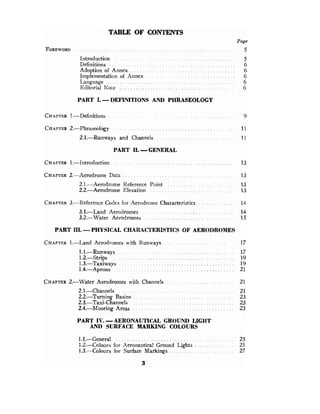
TABLE OF CONTENTS
Page
Introduction . . . . . . . . . . . . . . . . . . . . . . . . . . . . . . . . . . . 5
. . . . . . . . . . . . . . . . . . . . . . . . . . . . . . . . . . . . . . . . . . .
Definitions 6
. . . . . . . . . . . . . . . . . . . . . . . . . . . . . . . . . . .
Adoption of Annex 6
Implementation of Annex . . . . . . . . . . . . . . . . . . . . . . . . . 6
. . . . . . . . . . . . . . . . . . . . . . . . . . . . . . . . . . . . . . . . . . . . .
Language 6
. . . . . . . . . . . . . . . . . . . . . . . . . . . . . . . . . . . . . . . . . .
Editorla1 Note 6
PART I..
DEFINITIONS AND PIIRASEOLOGY
. . . . . . . . . . . . . . . . . . . . . . . . . . . . . . . . . . . . . . . . .
CHAPTER
2.-.Phraseology 11
. . . . . . . . . . . . . . . . . . . . . . . . . . . . .
2.1.-Runways and Channels 11
PART I1..
GENERAL
. . . . . . . . . . . . . . . . . . . . . . . . . . . . . . . . . . . . . .
CHAPTER
2.-Aerodrome Data 13
. . . . . . . . . . . . . . . . .
2.1.-Aerodrome Reference Point 13
. . . . . . . . . . . . . . . . . . . . . . . . . . . . . .
2.2.-Aerodrome Elevation 13
. . . . . . . . . . . . .
CHAPTER
3....Reference Codes for Aerodrome Characteristics 14
3.1.-Land Aerodromes
3.2.-Water Aerodromes
PART 1
1
1
..
PHYSICAL CHARACTERISTICS OF AERODROMES
. . . . . . . . . . . . . . . . . . . . .
CHAPTER
1.-Land Aerodromes with Runways 17
. . . . . . . . . . . . . . . . . . . . . . . .
CHAPTER
2.-Water Aerodromes with Channels 21
. . . . . . . . . . . . . . . . . . . . . . .
2.1.Ahannels . . . . . . . . . . . . . . . . 21
2.2.-Turning Basins . . . . . . . . . . . . . . . . . . . . . . . . . . . . . . . . . . . 23
. . . . . . . . . . . . . . . . . . . . . . . . . . . . . . . . . . . .
2.3.Taxi.Channels 23
. . . . . . . . . . . . . . . . . . . . . . . . . . . . . . . . . . . .
2.4.-Mooring Areas 23
PART IV..
AERONAUTICAL GROUND LIGHT
AND SURFACE MARKING COLOURS
. . . . . . . . . . . . . . . . . . . . . . . . . . . . . . . . . . . . . . . . . .
1.1.-General 25
. . . . . . . . . . . . . .
1.2.-Colours for Aeronautical Ground Lights 25
. . . . . . . . . . . . . . . . . . . . . .
1.3.-Colours for Surface Markings 27
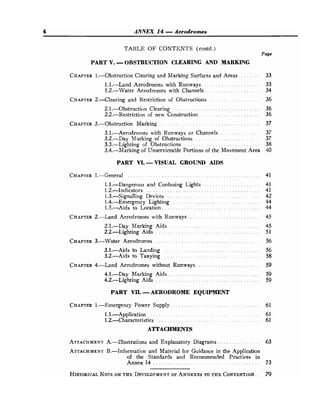
4 ANNEX 14 .
Aerodromes
TABLE OF CONTENTS (contd.)
Page
PART V..
OBSTRUCTION CLEARING AND MARKING
CHAPTER
l.--Obstruction Clearing and Marking Surfaces and Areas . . . . . . . . 33
1.1.-Land Aerodromes with Runways . . . . . . . . . . . . . . . . . . . . . 33
1.2.-Water Aerodromes with Channels. . . . . . . . . . . . . . . . . . . . 34
CHAPTER
2..-Clearing and Restriction of Obstructions. . . . . . . . . . . . . . . . . . . 36
2.1.-Obstruction Clearing . . . . . . . . . . . . . . . . . . . . . . . . . . . . . . . 36
2.2.-Restriction of new Construction . . . . . . . . . . . . . . . . . . . . . . 36
CHAPTER
3.-Obstruction Marking . . . . . . . . . . . . . . . . . . . . . . . . . . . . . . . . . . . . 37
3.1.-Aerodromes with Runways or Channels. . . . . . . . . . . . . . . 37
3.2.-Day Marking of Obstructions . . . . . . . . . . . . . . . . . . . . . . . 37
. . . . . . . . . . . . . . . . . . . . . . . . . . . .
3.3.-Lighting of Obstructions 38
3.4.-Marking of Unserviceable Portions of the Movement Area 40
PART VI..
VISUAL GROUND AIDS
. . . . . . . . . . . . . . . . . . . . .
1.1.-Dangerous and Confusing Lights 41
1.2.-Indicators . . . . . . . . . . . . . . . . . . . . . . . . . . . . . . . . . . . . . . . . 41
. . . . . . . . . . . . . . . . . . . . . . . . . . . . . . . . .
1.3.-Signalling Devices 42
1.4.-Emergency Lighting . . . . . . . . . . . . . . . . . . . . . . . . . . . . . . . 44
1.5.-Aids to Location. . . . . . . . . . . . . . . . . . . . . . . . . . . . . . . . . . . 44
CHAPTER
2.-Land Aerodromes with Runways . . . . . . . . . . . . . . . . . . . . . . . . . . 45
. . . . . . . . . . . . . . . . . . . . . . . . . . . . . . . . .
2.1.-Day Marking Aids 45
2.2.-Lighting Aids . . . . . . . . . . . . . . . . . . . .
.
.
.
. . . . . . . . . . . . 51
CHAPTER
3.-Water Aerodromes . . . . . . . . . . . . . . . . . . . . . . . . . . . . . . . . . . . . . 56
3.1.-Aids to Landing . . . . . . . . . . . . . . . . . . . . . . . . . . . . . . . . . . 56
. . . . . . . . . . . . . . . . . . . . . . . . . . . . . . . . . .
3.2.-Aids to Taxying 58
. . . . . . . . . . . . . . . . . . . . . . .
CHAPTER
4.-Land Aerodromes without Runways 59
. . . . . . . . . . . . . . . . . . . . . . . . . . . . . . . . .
4.1.-Day Marking Aids 59
.
4.2.-Lighting Aids . . . . . . . . . . . . . . . . . . . .
.
. . . . . . . . . . . . . .. 59
PART VII..
AERODROME EQUIPMENT
CHAPTER
1.-Emergency Power Supply . . . . . . . . . . . . . . . . . . . . . . . . . . . . . . . . 61
1.1.-Application . . . . . . . . . . . . . . . . . . . . . . . . . . . . . . . . . . . . . . . 61
1.2.-Characteristics . . . . . . . . . . . . . . . . . . . . . . . . . . . . . . . . . . . . 61
ATTACHMENTS
ATTACHMENT
A.-Illustrations and Explanatory Diagrams . . . . . . . . . . . . . . . 63
ATTACHMENT
B.-Information and Material for Guidance in the Application
of the Standards and Recommended Practices in
. . . . . . . . . . . . . . . . . . . . . . . . . . . . . . . . . . . . . .
Annex14 73
FOREWORD
Introduction
This document contains International Stand-
ards and Recommended Practices pursuant to
Article 37 of the Convention on International
Civil Aviation (Chicago 1944). These Standards
and Recommended Practices became effective on
1 November 1951.
They will come into force as follows:
a ) in the case of aerodromes used as
regular or alternate aerodromes by interna-
tional air services: on l June 1952;
b ) in the case of all other aerodromes used
or intended to be used for the operation of
aircraft engaged in international air naviga-
tion: on 1January 1954.
The Standards and Recommended Practices
as now presented have undergone the following
stages of development:
At the Chicago (1944) Conferences, Annex A
to the Convention was developed. This was sub-
sequently reviewed and amended at the First
Session of the PICA^ Subcommittee on Air-
ways Systems, Landing Areas and Ground Aids
(LAG)in 1945, and at the Second Session of the
Aerodromes, Air Routes and Ground Aids Divi-
sion (AGA)in 1946. In September 1947 the
Division, at its Third Session, developed and
submitted the material in the form of recom-
mendations for Standards and Recommended
Practices which were forwarded to States for
comment in the first quarter of 1948.
The Air Navigation Commission during 1949
further developed the pmposed Standards and
Recommended Practices and then resubmitted
them. to States, together with additional recom-
mendations made in November 1949 by the AGA
Division at its Fourth Session, for comment by
October 1950. Still further development was
made by the Air Navigation Commission on the
basis of States' comments and the resulting pro-
posals were adopted by the Council as Annex 14.
Attention is drawn to the title adopted for the
Annex, viz. "Aerodromes". Use of this title is
not intended to imply that the Annex contains all
the Standards and Recommended Practices
relating to aerodromes. The terms Air Routes
and Ground Aids have been omitted from the
title, the former because no such specifications
have been adopted, and the latter because, when
coupled with aerodromes, it does not adequately
describe the contents and purpose of the Annex.
The contents of this Annex apply to
a ) all aerodromes in territories under the
jurisdiction of a Contracting State that are
used as regular or alternate aerodromes by
-international air services ; and
b) all other aerodromes in territories under
the jurisdiction of a Contracting State that
are used or intended to be used for the oper-
ation of aircraft engaged in international air
navigation.
It is important that the provisions of this
Annex be applied, at the earliest practicable date,
to all these aerodromes. Nevertheless, it is recog-
nized that a considerable time may elapse before
a Contracting State can apply all the specifica-
tions o
f the Annex in respect of all the aerodromes
referred to above. For this reason, and in view of
their greater imprtance to international avia-
tion, Council has given priority to implementing
the Annex in respect of the aerodromes u n d e ~
Q ) above and has allowed one year in which to
apply the specifications. In the case of aero-
6 ANNEX 14 -Aerodromes
dromes included under b) above, a longer period
has been allowed.
The interpretation of some of the specifications
in the Annex expressly requires the exercising
of discretion, the taking of a decision or the per-
formance of a function by the Competent Author-
ity. In other specifications, the expression
Colgtpetent Authority does not actually appear
although its inclusion is implied. In both cases,
the responsibility for whatever determination or
action is necessary rests with the State having
jurisdiction over the aerodrome or the person or
hgency through which the State exercises its
Dower in the matter concerned.
In order to ensure uniform interpretation of
the terms "Standard" and "Recommended Prac-
tice", which are not specifically defined in the
Convention,, the Council has promulgated the
following definitions which apply to this Annex:
Standard: Any specification for physical
characteristics, configuration, matkriel, per-
formance, personnel or procedure, the uniform
application o
f which is recognized as necessary
for the safety or regularity of international air
navigation and to which Contracting States
will conform in accordance with the Gonven-
tion; in the event of impossibility of com-
pliance, notification to the Council is com-
pulsory under Article 38.
Recommended Practice.: Any specification
for physical characteristics, configuration, ma-
tCriel, performance, personnel or procedure,
the uniform application of which is recognized
as desirable in the interest of safety, regularity
or efficiency of international air navigation,
and to which Contracting States will endeavour
to conform in accordance with the Convention.
Notes which do not alter the meaning of
the Standards and Recommended Practices have
been included in certain cases where it was neces-
sary to clarify an intention, to stress a particular
point or to indicate that a particular question is
under- study,
Adoption of Annex
Standards and Recommended Practices for
A.erodromes were adopted by the Council on
29 May 1951 and designated as Annex 14 to the
Convention. The Annex was submitted forthwith
to each Contracting State together with a copy
of the Resolution of Adoption by the Council.
On I. November 1951, which was the date sel
by the Council for the notification by States of
disapproval of the Annex in whole or in part
under Article 90, only five States had registered
disapproval of any part of the Annex. The Annex
accordingly became effective on that date.
Implementation of Annex
It is expected that by 1 June 1952 States will
have ii~troducedthe provisions of the Annex at
aerodromes tised as regular or alternate aero-
dromes by international services, and that by
1 Januarv 1954 States will have introduced the
of the Annex at all other aerodromes
used or intended to be used for the operation of
aircraft engaged in international air navigation.
Attention is invited to the Irttroduction
(Part 11, Chapter 1) regarding the review
by rcAo Regional Air Navigation Meetings of
the need for specific installations on the basis of
which the Council formulates policy and forwards
recommendations to the Contracting States
concerned.
Language
The Standards and Recommended Practices
for Aerodromes, being an Annex to the Con-
vention, exist and are officially circulated in three
lang~ages
- English, French and Spanish.
Pursuant to Council action on 6 December
1948, each Contracting State has been requested
to select one of those texts for the purpose o
f
national implementation and for other effects pro-
vided for in the Convention, either through direct
use or through translation into its own national
language, and to notify the Organization accord-
ingly.
Editorial Note
The following practice has been adhered to in
order to indicate at a glance the status of each
statement: Standards have been printed in bold
face type; Recommended Practices have been
printed in light face type, the status being indi-
Foreword 7
cated by the prefix RECOMMENDATION;
Notes theses by corresponding measurements in the
have been printed in small type italics, the status foot-pound system.
being indicated by the prefix Note.
Any reference to a portion of this document,
Throughout this document measurements are which is identified by a number, includes all sub-
given in the metric system followed in paren- divisions of such portion.
THIS PAGE INTENTIONALLY LEFT BLANK
International Standards and Recommended Practices
AERODROMES
PART I.- DEFINITIONS AND PHRASEOLOGY
CaAPTER 1
.-DEFINITIONS
When the following terme are used in the
Standarde and Recommended Practices for
Aerodromes, they have the following mean-
inge:
Aerodrome. A defined area on land or
water (including any buildings, inetdatione
and equipment) intended to be ueed either
wholly or in part for the arrival, departure
and movement of aircraft.
Aerodrome beacon, Aeronautical beacon
used to indicate the location of an aero-
drome.
Aerodrome elevation, The elevation of the
highest point of the landing area.
a particular point on the enrface of the
earth.
Aeronautical ground light. Any light spe-
cially provided as an aid to air navigation,
other than a light displayed on an aircraft.
Angle-of-approach Zighk. Aeronautical
ground lighte arranged so as to indicate the
deeired angle of descent during an approach
to an aerodrome.
Approach lighting system, A configuration
of aeronautical ground Iighte in the approach
area to a runway or channel intended to
aeeist a pilot in making an approach to that
runway or channel.
Aerodrome identif;cation sign. A sign
placed on or adjacent to an aerodrome to aid Apron. A defined area, on a land aero-
in identifying the aerodrome from the air. drome, intended to accommodate aircraft for
purpoees of loading or unloading paseen-
Aerodrome reference pain+ The desig. ger8 Or cargo, refuellin%, pmking or main-
mated geographical location of an aerodrome. tenance*
Aeronautical beacon. An aeronautical Boundary lights. Aeronautical ground
ground light visible at all azimuths, either lights delimiting the boundary of a landing
continuouely or intermittently, to designate area
10 ANNEX 14-Aerodromes
Boundary markers. Markers used to indi-
cate the boundary of a landing area.
Channel. A defined rectangular area on a
water aerodrome, intended for the 1an.ding
and take-off run of aircraft along its length.
Channel lights. Aeronautical ground lights
arranged along the sides of a channel.
Density altitude. An atmospheric density
expressed in terms of the altitude which
corresponds to that density in the standard
atmosphere.
Fixed light. A light having constant
luminous intensity when observed from a
fixed point.
Hasard beacon. An aeronautical beacon
used to designate a danger to air navigation.
identification beacon. An aeronautical
beacon emitting a coded signal by means of
which a particular point of reference can be
identified.
lnstrument channel. A channel intended
for the operation of aircraft using non-visual
aids.
lnstrument runway. A runway intended
for the operation of aircraft using non-visual
aids.
Landing area. The part of the movement
area intended for the landing or take-off run
of aircraft.
Landing direction indicator. A device to
indicate visually the direction currently
designated for landing and for take-off.
Low water level. The average low level
during that month of the year when levels
are lowest or, in the case of tidal waters, the
average level of low water springs or lower
low waters, depending on the type of tide.
Main channel. The channel determined as
such by the Competent Authority.
Main channel selected basic length. The
length selected by the Competent Authority
as the basis for the design of a given water
aerodrome.
Main runway. The runway determined as
such by the Competent Authority.
Main runway selected basic length. The
length selected by the Competent Authority
as the basis for the design of a given land
aerodrome.
Markers. Objects, other than landing
direction indicators, wind direction indica-
tors and flags, used to indicate obstructions
or to convey aeronautical information by
day.
Markings. Signs displayed on surfaces in
order to convey aeronautical information.
Movement area. That part of an aero-
drome intended for the surface movement
of aircraft.
Obstruction lights. Aeronautical ground
lights provided to indicate obstructions.
Runway. A defined rectangular area, on
a land aerodrome selected or prepared for
the landing and take-off run of aircraft along
its length.
Runway lights. Aeronautical ground lights
arranged along a runway indicating its
direction or boundaries.
Runway threshold markings. Markings so
placed as to indicate the longitudinal limits
of that portion of the runway usable for
landing.
Signal area. An area on an aerodrome
used for the display of ground signals.
Signalling lamp. A device used for
directing light signals at individual targets.
Taxi-channel. A defined path, on a water
aerodrome, intended for the use of taxying
aircraft.
Taxi-channel lights. Aeronautical ground
lights arranged along a taxi-channel to
indicate the route to be followed by taxying
aircraft.
Taxi-holding position. A designated posi-
tion at which taxying aircraft may be re-
quired to stop.
Part I -Definitions 1
1
Taxiway. A defined path, on a land aero- route to be followed by taxying aircraft.
drome, selected or prepared for the use of
taxying aircraft. Threshold lights. Aeronautical ground
lights so placed as to indicate the longitu-
Taxiway lights. Aeronautical ground lights dinal limits of that portion of a runway,
arranged along a taxiway to indicate the channel or landing path usable for landing.
CHAPTER 2. -PHRASEOLOGY
2.1.RUNWAYS AND CHANNELS tions" (see Part IIl, 1.1.1and 2.1.1), unless
otherwise indicated in a particular context.
2.1.1 Wherever a Standard or
Recommended Practice in this Annex is 2.1.2 Wherever a specification
marked with an asterisk, it applies at least regarding runways or channels is not marked
with an asterisk, it applies to all the runways
to lhose Or that are needed 0
, all the channela provided at every amo-
at a particular aerodrome to satisfy the drorne to which the Annex relates, unless
specification entitled "Number and orienta- otherwise indicated in a particular dontext.
THIS PAGE INTENTIONALLY LEFT BLANK
PART 1
1
.
- GENERAL
CHAPTER 1. -INTRODUCTION
Note.-This Annex contains Standards and Recom-
mended Practices that prescribe the physical and arso-
ciated characteristics to be fiossessed by and the equipment
to be provided at aerodromes used or intended to be
used for the operation of aircraft engaged in international
air navigation.
Its contrni;~are not yet complete but awmgements
have been made for the inclwion in a)+ropriate Chapters
of additional material dealiwg with aerodromes of types
other than those now covered c.Q., land aerodromes
withoztt runways, water aerodromes without channels,
helicopter ruerodromes, etc.
It does not include Standards relating to the location,
siting, size or capacity of particular aerodromes or
separation betzueen adjacent aerodrows to avoid con-
flicting trafic patterns, since Contracting States will
determine these factors, taking into consideration the
air trafic such aerodromes are intended to serve. Council
periodically reviews the requirements of infernatiod
air navigation for aerodromes and for?n~lates ICAO
opinion and recommendations to Contracting States con-
cerning them, ordinarily on the basis of the recommenda-
tions of Regional Air Navigation Meetings.
The A n n a contains specifications that wescribe the
a p p r o m t e relatiomhip between a number of diflerent
physical characteristics, according to the partkular type
or size of aerodrome under conderatiott. These inter-
related specifications, when grouped in the prescribed
manner, provide a series of design criteria for eficiently
proportioned aerodromes. The groups of specifications
are suficiently wide in their scope to cover the needs of
international air trafic both now and in the foreseeable
future. A s will be seen from Chalpter 3 in this Part, a
code system is used in various parts of the Annex to
facilitate reference.
It also contains specifications concerning the clearing
and marking of obstructions on and in the vicinity of
aerodromes and concerning the visuat ground aids and
other faciIities necessary on aerodromes for the safe
and eficient operation of aircraft engaged itz intema-
tional air navigation.
CHAPTER 2. -AERODROME DATA
Note.-This Chapter contains specifications requiring 2.1.3 The position of the aero-
the determination by the C~mpetetttAuthon'ty of data drome reference point shall be as near to the
about aerodrow~. The munnev in which the reprived
data is to be pzcblished is not prescribed in this Annex. geometric centre the landing area as is
~racticableand consistent with 2.1.2. taking
-
2.1. --ROI)ROME ~ F E R E N C Eporn possible future development of the aero-
drome into account.
2.1.1 The Competent Authority
shall determine the position of the aero- 2.2.AERODROME ELEVATION
drome referenee point selected for each
aerodrome. 2.2.1 The Competent Authority
shall determine the aerodrome elevation.
2.1.2 The position of the aero-
drome reference point shall be permanently 2.2.2 The aerodrome elevation
established and shall be given in terms of the shall be given in terms of the nearest metre
nearest eecond of latitude and longitude. or foot.
14 ANNEX 14 -Aerodromes
CHAPTER 3. -REFERENCE CODES FOR AERODROME CHARACTERISTICS
Note.-This Chapter corztains definitive material
establishing the meaning of various reference code
letters and numbers; the code letters arrd nu~nbersare
yiuen in tables that are followed by explanatory notes.
rhr use of code letters and, to a lesser extent, code
nu~nbers,with the meanings assigned to them in this
chapter sinrplifies the drafting of certain specifications
contained in Parts III, l/ and V I of fhc L4nn~,.r.Thr
sk+ecificationsin irethirh rode letters or code numbers ore
used are those that we interrelated with what are
ktwww as an aerodrome's principal physi: a1 c.haracfer-
istirs, namely main runway length and st/-cngtll and
nmln channel length artd depth. Values haze to be selected
by the Competent Authority for certain specified prin-
cifial physical clzaracteristics in the munner prescribed
in Part IIZ of the Annex before the interrelated speci-
fications can be interpreted in the case of a particula*
crerodrome.
The code letters and code numbers itz the tables in
this Chapter ere not suitable for w e es an aprodrome 07
runway classification system, such as might he useful in
air navigation.
3.1.1 Code letters when used in 3.1.2 Code numbers when used
this Annex in connection with land aero- in this Annex in connection with land aero-
dromes, have the meanings assigned to them dromes, have the meanings assigned to them
in Table 1. in Table 2.
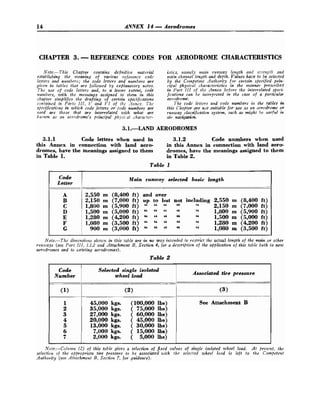
Table 1
Note.-TILE dilizensiotrs shozcvz in this fable are in no way intended to restrict the actual length of the main or other
rzrnnpays (see Part 111, 1.1.2 and Attachment B, Section 4, for a description of the application of this table both to new
aerodromes and to existing aerodronzes).
Table 2
Code
Letter
A
B
C
D
E
F
G
Main runway selected basic length
- -
-
2,550 m (8,400 ft) and over
2,150 m (7,000 ft) up to but not including 2,550 m (8,400 ft)
1,800 m (5,900 ft) '' CC "
66 2,150 m (7,000 ft)
1,500 m (5,000 ft) " " " "
LC 1,800 m (5,900 ft)
1,280 m (4,200 ft) " " " 'C
66 1,500 m (5,000 ft)
1,080 m (3,500 ft) " " " "
cc 1,280 m (4,200 ft)
900 m (3,000 ft) " " ‘' "
GC 1,080 m (3,500 ft)
Note.--Colzif~zn (2) of this table gives a selection of fixed valzres of single isolated wheel load. At present, t h ~
selection of the appropriate tire pvessuve to be associated with fbe selected wheel load is left to the Competent
Authority (see Attachment B, Section 7, for guidance).
Associated tire pressure
(3
See Attachment B
Code
Number
-
(1)
1
2
3
4
5
6
7
Selected single isolated
wheel load
-
(2)
45,000 kgs. (100,000 lbs)
35,000 kgs. ( 75,000 lbs)
27,000 kgs. ( 60,000 lbs)
20,000 kgs. ( 45,000 lbs)
13,000 kgs. ( 30,000 lbs)
7,000 kgs. ( 15,000 be)
2,000 kgs. ( 5,000 lbs)
Part ZZ -General 15
3.2.WATER AERODROMES
3.2.1 Code letters when used in 3.2.2 Code numbers when used
this Annex in connection with water aero- in this Annex in connection with water aero-
dromes, have the meanings assigned to them dromes, have the meanings assigned to them
in Table 3. in Table 4.
Table 3
Note.-The diwwnsions shown in this table are in no way infekzded to rcstrict the actual length o
f the main or other
chalznels (see Part 111, 2.1.2 and also Attachment B, Section 4, for a descrifition of the apfilicatiojt of this table both
to near aerodromes and to existing aerodrojnes).
Code
Letter
-
A
B
C
Table 4
Main channel selected basic length
-
- - -
-
4,500 m (15,000 ft) and over
3,000 m (10,000 ft) up to but not including 4,500 m (15,000 ft)
2,000 m ( 6,500 ft) up to but not including 3,000 m (10,000 ft)
Note 1.-The deptlz of a channel is the miniwum Note 2.-The dimsnsions shown in the table are in
de~th
of water at low watev level that is to be expected ?to way inrcrzded to vestl-ict thr actual d~ptlz of t!z:
anyzuhere in the channel. n d n or other channels.
Code
Number
1
2
3
Main channel selected depth
4.5 m (15 ft) and over
3.7 m (12 ft) up to but not including 4.5 m (15 ft)
2.4 m ( 8 ft) up to but not including 3.7 m (12 ft)
THIS PAGE INTENTIONALLY LEFT BLANK
PART 111. -PHYSICAL CHARACTERISTICS
OF AERODROMES
CHAPTER 1. -LAND AERODROMES WITH RTJNWAYS
Note.-This Chapter deals with land aerodromes with 1.1.2 RECOMMENDATION.
- Main
a main runway selected basic length of not less than runway lengfi, ~h~ length of the main runway
900 metres (3,000 feet).
at an aerodrome should be not less than the main
Inter-relationship of certain of the specifications con- runway selected basic Iength together with :
tairted in this Chabter -use being made of the code sys-
tem for this PU.~)O;E
-and il.rclu$on of specifications con-
taining suitable quantitatiz*erequirem~nts,
aim at ensz~ring I) an additional length to be determined in
the maxinzunz all-round l~sefulnessof an aerodrome accordance with 1.1.2.2 where the temperature
withcut incurring dispvoportionute construction and and pressure at the site differ from sea level
maintcmce expenditure. standard atmospheric conditions;
The requisite inter-relationship is achieved by assunzing
two chararteristics, namely nrain rwnway selected basic
length arzd strength, as principal characteristics and by
linking specifications for other characteristics to them,
in the marzltrr indicated in this Chapter.
Appropriate values for the two principal charac-
/cristics are to be selected by the Competmt Authority,
It(~Gngregard to tlte needs of air trafic that the aero-
tlrome i
s irtterlded to serve. Quantitative spccificatwns for
flle rharocter-istics that are related to the two princzpal
!,hnl-artcristirszrrill be found in tlze r e l ~ v n tparagraphs
that f{.llow,
1.1.1 RECOMMENDATION.
- Num-
ber and orientation. The number of runways at
an aerodrome and their orientation should be
such that for as large a percentage of time as
practicable but for not less than 95 per cent there
is at least one runway for which the surface wind
velocity component at right angles to its lungitu-
dinal axis will not preclude the landing or taking-
off of aircraft that the aerodrome is intended to
serve.
Note.-In Atfach~rrentB, Section 2, gllidance is gi7lert
on the acceptable values of cross-wind components.
2) a further additional length in respect of
longitudinal slopes (if any), to be determined
in accordance with 1.1.2.3.
Note.-See Attachment Li, Secticitts 3, 4 alrd 5.
1.1.2.1 RECOMMENDATION.
- Main
runway selected basic length. The main runway
selected basic length should be the length that
would actually be required at a level site at sea
level in standard atmospheric conditions to meet
the present and estimated future needs of the air
traffic that the aerodrome is intended to serve.
Ar~7te.-The rode letter apjropriate to the main rutzway
selected basic length is to be found in Part I I , Chapter 3,
Table 1.
1.1.2.2 RECOMMENDATION.
- Addi-
tional length for differencesfrom sea level stand-
ard atmospheric conditions. Additional length
for differences from sea level standard atmospher-
ic conditions should be calculated at the rate of
5 per cent of the main runway selected basic
length for every 300 metres (1,000 feet) of
density altitude, except that in cases where
18 ANNEX 14 -Aerodromes
particularly high temperature or humidity condi-
tions occur, a method of calculation, taking
temperature, pressure and humidity into account
independentIy, should be used. The value selected
as the density altitude of a site should be the mean
of the highest density altitudes occurring on each
day in the hottest month of the year (i.e. the
month which has the highest mean of daily
maximum temperature) averaged over a period
of years.
Note.-Attachmplzt B, 5.1 gives the methods used
by certain States in determining the additional length
required, taking into account altitude and temperature
independently.
1.1.2.3 RECOMMENDATION.
- Addi-
tional length for longitudinal slopes. The addi-
tional length to be provided when longitudinal
slopes occur either along the whole runway or
along portions of it should be determined with
due consideration to specific slopes and their
positions along the runway.
Note.-In view o
f the many variables involved, it is
not possible to recommend, for gencrd appriratiotz, a
method of deterwining the additional length required.
Attachment B, 5.2, gl?~esthe methods used by certain
States in detrrmining the additional length required, in
the case of uniform longitudinal slopes along the whole
runway.
1.1.3 * RECOMMENDATION.
- Le~zgth
of rzlnwajrs ofher than the main runway. The
length of runways other than the main runway
should be not less than 85 per cent of the main
runway selected basic length, together with an
additional length for differences froin sea level
standard atmospheric conditions determined as
1.1.5 RECOMMENDATION.
- Set-
aration o
f parallel runways. Where parallel run-
ways are provided for simultaneous use under
visuaI conditions only, the minimum distance be-
tween their centre lines should be:
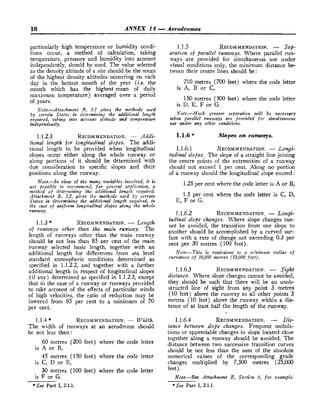
210 metres (700 feet) where the code letter
is A, B or C,
150 metres (500 feet) where the code letter
is D, E, F or G.
Note.-Much greater separation zorill be necessary
when parallel runways are prozbided for simltltaneozls
use under any other conditions.
1.1.6* Slopes on runways.
1.1.6.1 RECOMMENDATION.
- Longi-
tudinal slopes. The slope of a straight Iine joining
the centre points of the extremities of a runway
should not exceed 1 per cent. Along no portion
of a runway should the longitudinal slope exceed:
1.25per cent where the code letter is A or B,
1.5 per cent where the code letter is C, D,
E, F or G.
t%dinalslope changes. Where slope changes can-
not be avoided, the transition from one slope to
another should be accompIished by a curved sur-
face with a rate of change not exceeding 0.3 per
cent per 30 metres (100 feet).
Note.-This is equivalent to a nz!ni~mzimq-adi~sof
cwrvatzire of 10,000 metres (33,000 fcet).
specified in 1.1.2.2, and together with a further
additional length in respect of longitudinal slopes 1.1.6.3 RECOMMENDATION.
- Sight
(if any) determined as specified in 1.1.2.3, except distance. IVhere slope changes cannot be avoided,
that in the case of a runway or runways provided they should be such that there will be an unob-
to take account of the effects of particular winds structed line of sight from any point 3 metres
of high velocities, the ratio of reduction may be (10 feet) above the runway to all other points 3
lowered from 85 per cent to a minimum of 70 metres (10 feet) above the runway within a dis-
per cent. tance of at Ieast half the length o
f the runway.
1.1.4 * RECOMMENDATION.
- Widtlz.
The width of runways at an aerodrome should
be not less than:
60 metres (200 feet) where the code letter
is A or B,
45 metres (150 feet) where the code letter
is C, D or E,
30 metres (100 feet) where the code letter
is F or G.
*See Part 1
, 2.1.1.
1.1.6.4 RECOMMENDATION.
- Dis-
tance between slope changes. Frequent undula-
tions or appreciable changes in slope located close
together along a runway should be avoided. The
distance between two successive transition curves
should be not less than the sum of the absolute
numerical values of the corresponding grade
changes mukiplied by 7,500 metres (25,000
feet).
Note.-See Attachnzertt B, Section 6, for example.
*See Part I, 2.1.1.
Part 111 -Physical Characteristics 19
1.1.6.5 RECOMMENDATION.
- Trans-
verse slopes. The transverse slopes of a runway
should be such as to prevent the accumulation of
water on the surface of the runway, but should
not exceed 1.5 per cent.
1.1.7 * RECOMMENDATION.-
Strength
of runways. Runways should be capable of
withstanding the traffic of aircraft imposing
a value of single isolated wheel load selected by
the Competent Authority from Table 2, Part 11,
3.1.2 at a tire pressure chosen by the Competent
Authority that together would produce stresses
at least equivalent to those resulting from such
aircraft as the aerodrome is intended to serve.
The frequency of operations assumed should be
the maximum expected at the aerodrome of air-
craft o
f the kind producing such stresses, but
should be not less than 10 operations per day.
Note 1.-Attachment B, Section 7, gives guidartce
regarding the tire pressure to be associated with the
selected value of single isolated wheel load.
Note 2.-One operation is either a landing or a
take-08.
1.2.1 * Each runway shall be in-
cluded in a strip. The surface of that portion
of the strip that abuts the runway shall be
flush with the surface of the runway.
1.2.2* RECOMMENDATION.
-Le~agth.
The strip should extend at least 60 metres (200
feet) beyond both ends of the runway it includes.
1.2.3 Width.
1.2.3.1 RECOMMENDATION.
- Ins-
trument runways. The strip including an instru-
ment runway should extend to a distance of at
least 150 metres (500 feet) on each side of the
centre line of the runway throughout the length
of the strip.
1.2.3.2* RECOMMENDATION.
- Run-
ways other thafr instrument runways. The strip
including a runway other than an instrument run-
way should extend to at least the distance given
herein, on each side of the centre line of the run-
way throughout the length of the strip:
*See Part I, 2.1.1.
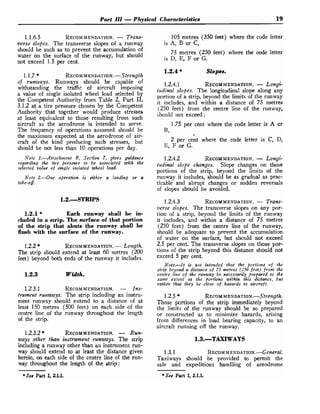
105 metres (350 feet) where the code letter
is A, B or C,
75 metres (250 feet) where the code letter
is D, E, F o r G.
1.2.4 * Slopes.
1.2.4.1 RECOMMENDATION.
- Longi-
tudinal slopes. The longitudinal slope along any
portion of a strip, beyond the limits of the runway
it includes, and within a distance of 75 metres
(250 feet) from the centre line of the runway,
should not exceed :
1.75 per cent where the code letter is A or
B,
2 per cent where the code letter is C, D,
E, F or G.
1.2.4.2 RECOMMENDATION.
- Longi-
tudinal slope changes. Slope changes on those
portions of the strip, beyond the limits o
f the
runway it includes, should be as gradual as prac-
ticable and abrupt changes or sudden reversals
of slopes shmould be avoided.
1.2.4.3 RECOMMENDATION.
- Trans-
verse slopes. The transverse slopes on any por-
tion of a strip, beyond the limits of the runway
it includes, and within a distance of 75 metres
(250 feet) from the centre line of the runway,
should be adequate to prevent the accumulation
of water on the surface, but should not exceed
2.5 per cent. The transverse slopes on those por-
tions of the strip beyond this distance should not
exceed 5 per cent.
Note.-It is not intended that the portions o f the
strip beyond a distance of 75 metres (250 feet) from the
cetttre line of the runway be necessarily prebared to the
sarrg exterzt au the bortions within this distance, but
rather that ilrey be clear of hazards to aircraft.
1.2.5 * RECOM
MEND AT ION.-^^^^?^^^^.
Those portions of the strip immediately beyond
the limits of the runway should be so prepared
or constructed as to minimize hazards, arising
from differences in load bearing capacity, to an
aircraft running off the runway.
1.3.1 RECOM
MENDATION.-G~?~~Y~~.
Taxiways should be provided to permit the
safe and expeditious handling of aerodrome
*See Part I, 2.1.1.
20 ANNEX 14 -Aerodromes
traffic. When so provided the following provisions
of this section apply.
1.3.2 RECOMMENDATION.
-Changes
in direction. Taxiways should be straight for
as great a proportion of their length as is prac-
ticable. '
&
'
h
e
r
e changes in direction are neces-
sary, the radius of curvature of the taxiway centre
line should be not less than 1.5 times the width
of the taxiway.
1.3.3 RECOMMENDATION.
- Width.
Taxiways should have a width of not less than:
30 metres (100 feet) where the code letter
is A,
23 metres (75 feet) where the code letter
is B or C,
18 metres (60 fed) where the code letter
is D,
15 metres (50 feet) where the code letter
is E,
12.5 metres (40 feet) where the code letter
is F or G.
1.3.4 RECOMMENDATION.
- Fillets.
Fillets should be provided at the junction 0.r inter-
section of taxiways with runways, aprons and
other taxiways, as necessary to facilitate the move-
ment of aircraft. The radius of the fillet should
be not less than the taxiway width. Where two
taxiways having unequal widths join or cross, the
width of the wider taxiway should govern the
minimum radius of curvature of the fillet.
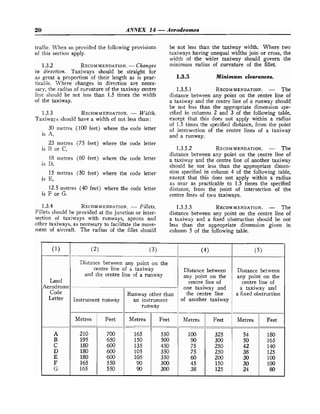
1.3.5 Minimum clearances.
1.3.5.1 RECOMMENDATION.
- The
distance between any point on the centre.line of
a taxiway and the centre line of a runway should
be not less than the appropriate dimension spe-
cified in columns 2 and 3 o
f the following table,
except that this does not apply within a radius
of 1.5 times the specified distance, from the point
of intersection of the centre lines of a taxiway
and a runway.
1.3.5.2 RECOMMENDATION.
- The
distance between any point on the centre line of
a taxiway and the centre line of another taxiway
should be not less than the appropriate dimen-
sion specified in column 4 of the following table,
except that this does not apply within a radius
as near as practicable to 1.5 times the specified
distance, from the point of intersection of the
centre lines of two taxiways.
1.3.5.3 RECOMMENDATION.
- The
distance between any point on the centre line of
a taxiway and a fixed obstruction should be not
less than the appropriate dimension given in
column 5 of the following table.
(1)
Land
Aerodrome
Code
Letter
A
B
C
D
E
F
G
-
(2) (3)
Distance between any point on the
centre line of a taxiway
and the centre line of a rurlway
( 5 )
Distance between
any point on the
centre line of
a taxiway and
a fixed obstruction
(4)
Distance between
any point on the
centre line of
one taxiway and
the centre line
of another taxiway
Metres
54
50
42
38
30
30
24
Instrument runway
Metres
100
90
75
75
60
45
38
Feet
180
165
140
125
100
100
80
Runway other than
an instrument
runway
Metres
-
-
-
210
195
180
1
80
180
165
165
Feet
325
300
250
250
200
150
125
Metres
165
150
135
105
105
90
90
.
Feet
700
650
600
600
600
550
550 .
Feet
--
550
500
450
350
350
300
300
Part ZZZ -Physical Characteristics 21
1.3.5.4 RECOMMENDATION.
- In the
case of a taxiway serving the end of a runway,
the taxiway should, where practicable, be at right
angles to the runway, for the first 30 metres (100
feet) from the edge of the runway.
1.3.6 Slopes.
1.3.6.1 RECOMMENDATION.
- Longi-
tudinal slopes. The longitudinal slope of taxiways
should be as small as practicable and should not
exceed 3 per cent.
1.3.6.2 RECOMMENDATION.
- Longi-
tudinal slope changes. Where slope changes on
taxiways cannot be avoided, the transition from
one slope to another slope should be accomplished
by a curved surface with a rate of change not
exceeding 1 per cent per 30 metres (100 feet).
Note.-This is equivale~zt to a minimtlm radius of
curvature of 3,000 metres (10,000 feet).
1.3.6.3 RECOMMENDATION.
- Sight
distance. Where slope changes on taxiways can-
not be avoided, they should be such that from any
point 3 metres (10 feet) above the taxiway it
will be possible to see the whole surface of the
taxiway for a distance of 300 metres (1,000 feet)
from that point.
1.3.6.4 RECOMMENDATION.
- Trans-
verse slope. The transverse slope of taxiways
should be such as to prevent the accumulation of
water on the surface of the taxiway but should
not exceed 1.5 per cent.
1.3.7 R E C ~ M M E N D A T I ~ N . - S ~ ~ ~ ~ ~ ~
The strength of taxiways should be at least
that of the runways they serve, due considera-
tion being given to the fact that taxiways, as
compared with runways, will be subjected to a
greater density of traffic and to higher stresses
that result from slow moving or stationary air-
craft.
Note.-In Attachment B, Section 8, guidance is gi-en
on the relation of the strengih of t ~ i w a . y sto the
strength of rzinways.
1.4.1 RECOMMENDATION.
-General.
Aprons should be provided as and when necessary
to permit the on- and off-loading of passengers,
cargo or mail without interfering with the aero-
drome traffic.
1.4.2 RECOMMENDATION. - Size.
The total apron area should be adequate to per-
mit expeditious handling of the air traffic at its
maximum anticipated density.
1.4.3 R E C ~ M M E N D A T I O N . - S ~ ~ ~ ~ ~ ~ ~
Each part of an apron should be capable
of withstanding the traffic of the aircraft it
is intended to serve, due consideration being given
to the fact that aprons, as compared with run-
ways, will be subjected to a greater density of
trafficand to higher stresses that result from slow
moving or stationary aircraft.
Note.-In Attalchment B, Section 8, guidance is gizrert
on fhe relation of the strength of ahons to the strength
of runways.
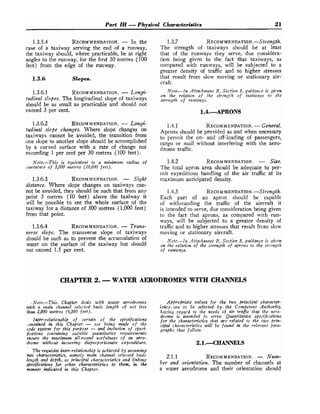
CHAPTER 2. -WATER AERODROMES WITH CHANNELS
.Note,-This. Chaptm deals with water aerodromes
w-th a main channel selected basic length of not less
than 2,000 metres (6,500 feet).
Inter-relationship of certain of the specifications
*.ontaincd in this Chabpter - zrse being made of the
code system for this purpose - and inclusion of speci-
fications containing suitable qtrantitatize requirements
enswe the m m i m ~ mall-round usefulness of an aero-
drome w'thozct incurring disproportionate expenditure.
. .
The reqzcidte inter-relationshii, tachieved b y assuming
wo'characteristics, namely main channel selected basic
length and depth, as pinciflal characteristics and 1:'nking
specifications for other characteristics to them, in the
manner indicated i this Chapter.
Appropriate values for :the two principd character-
isbkcs. are .to be selected by. the Competent .Authority,
having .regard to the needs of a
C
r trafic that the acro-
drome is intended to serve. Quu~ztitativespecifications
for' the charcocteristics that m e related to the two @-in-
cipd chal-acteristics wall be fozrnd in the relevant fiara-
graphs that follozv.
2.1.1 RECOMMENDATION.
- Num-
ber and orientation. The number of channels at
a water aerodrome and their orientation should
22 ANNEX 14 -Aerodromes
be such that, for as large a percentage of time as
practicable but for not less than 95 per cent there
is at least one channel for which the surface wind
velocity component at right angles to its longitu-
dinal axis will not preclude the landing or taking-
off of aircraft that the aerodrome is intended to
serve.
Note.-In Attachment B, Section 2, .quida+?rr
is give12
on the acceptable zdues of cross-wild components.
2.1.2 RECOMMENDATION.
- Main
channel length. The length of the main channel
at a water aerodrome should be not less than the
main channel selected basic length, together with
an additional length to be determined in accord-
ance with 3.1.2.2 where the temperature and
pressure at the site differ from sea level standard
atmospheric conditions.
Note.-See Attachment B, Sections 3, 4 and 5.
2.1.2.1 RECOMMENDATION.
- Main
channel selected basic length. The main channel
selected basic length should be the length that
would actually be required at sea level in stand-
ard atmospheric conditions to meet the present
and future needs o
f the air traffic that the aero-
drome is intended to serve.
Note.-The code letter a)proprMte to the itrain chanrrel
selected basic length is to be found in Part II, Chapter 3,
Table 3.
2.1.2.2 RECOMMENDATION.
- Addi-
tional length for diferences from sea level stand-
ard atmospheric conditions. Additional length
to be provided for differences from sea level stand-
ard atmospheric conditions should be calculated
at the rate of 5 per cent of the main channel
selected basic length for every 300 metres (1,000
feet) of density altitude, except that in cases
where particularly high temperature or humidity
conditions occur, a method of calculation taking
temperature, pressure and humidity into account
independently, should be used. The value selected
as the density altitude of a site should be the mean
of the highest density altitude occurring on each
day in the hottest month of the year (i.e. the
month which has the highest mean o
f daily maxi-
mum temperature) developed over a period of
years.
Note.-Attachment B, 5.1, ghtes the ntethods used by
certain States in determining thc cadditional length re-
qired, taking into m c o u ~ taltitude on,d temperatirr-1.
inwendently.
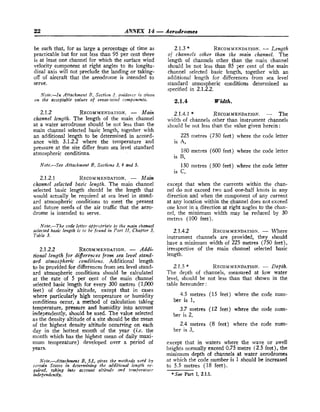
2.1.3 * RECOMMENDATION.
-Length
of channels other than the main channel. The
length of channels other than the main channel
should be not less than 85 per cent of the main
channel selected basic length, together with an
additional length for differences from sea level
standard atmospheric conditions determined as
specified in 2.1.2.2.
2.1.4 Width.
2.1.4.1 * RECOMMENDATION.
- The
width o
f channels other than instrument channels
should be not less than the value given herein:
225 metres (750 feet) where the code letter
is A,
180 metres (600 feet) where the code letter
is B,
150 metres (500 feet) where the code letter
is C,
except that when the currents within the chan-
nel do not exceed two and one-half knots in any
direction and when the component of any current
at any location within the channel does not exceed
one knot in a direction at right angles to the chan-
nel, the minimum width may be reduced by 30
metres (100 feet).
2.1.4.2 RECOMMENDATION.
- Where
instrument channels are provided, they should
have a minimum width of 225 metres (750 feet),
irrespective of the main channel selected basic
length.
2.1.5 * RECOMMENDATION.
- Depth.
The depth of channels, measured at low water
level, should be not less than that shown in the
table hereunder :
4.5 metres (15 feet) where the code num-
ber is 1,
3.7 metres (12 feet) where the code num-
ber is 2,
2.4 metres (8 feet) where the code num-
ber is 3,
except that in waters where the wave or swell
heights normally exceed 0.75 metre ('2.5 feet), the
minimum depth of channels at water aerodromes
at which the code number is 1 should be increased
to 5.5 metres (18 feet).
*See Part 1, 2.1.1.
Part 111 -Physical Characteristics 23
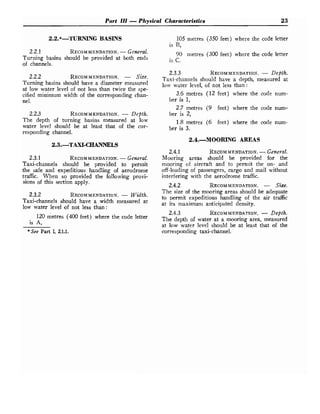
2.2.*-TURNING BASINS
2.2.1 RECOMMENDATION.
-General.
Turning basins should be provided at both ends
of channels.
2.2.2 RECOMMENDATION.
- Size.
Turning basins should have a diameter measured
at low water level of not less than twice the spe-
cified minimum width of the corresponding chan-
nel.
2.2.3 RECOMMENDATION.
- Depth.
The depth of turning basins measured at low
water level should be at least that of the cor-
responding channel.
105 metres (350 feet) where the code letter
is B,
90 metres (300 feet) where the code letter
is C.
2.3.3 RECOMMENDATION.
- Depth.
Taxi-channels should have a depth, measured at
low water level, of not less than :
3.6 metres (12 feet) where the code num-
ber is 1,
2.7 metres (9 feet) where the code num-
ber is 2,
1.8 metres (6 feet) where the code num-
ber is 3.
2.4.MOORING AREAS
2.3.1 RECOMMENDATION.
-General.
Taxi-channels should be provided to permit
the safe and expeditious handling of aerodrome
traffic. When so provided the following provi-
sions of this section apply.
2.3.2 RECOMMENDATION.
- Width.
Taxi-channels should have a width measured at
low water level of not less than :
120 metres (400 feet) where the code letter
is A,
*See Part I, 2.1.1.
2.4.1 RECOMMENDATION.
-General.
Mooring areas should be provided for the
mooring of aircraft and to permit the on- and
off-loading of passengers, cargo and mail without
interfering with the aerodrome traffic.
2.4.2 RECOMMENDATION.
- Size.
The size of the mooring areas should be adequate
to permit expeditious handling of the air traffic
at its maximum anticipated density.
2.4.3 RECOMMENDATION.
- Depth.
The depth of water at a mooring area, measured
at low water level should be at least that o
f the
corresponding taxi-channel.
THIS PAGE INTENTIONALLY LEFT BLANK
PART IV. - AERONAUTICAL GROUND LIGHT
AND SURFACE MARKING COLOURS
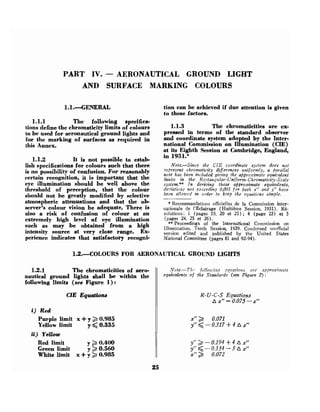
1.1.--GENERAL tion can be achieved if due attention is given
to these factors.
1.1.1 The following specifica-
tions define the chromaticity limits of colours 1.1.3 The chromaticities are ex-
to be used for aeronautical ground lights and ~"ssed in terms of the standard observer
for the marking of surfaces as required in and coordinate system adopted by the Inter-
this Annex. national Commission on Illumination (CIE)
at its Eighth Session at Cambridge, England,
1.1.2 It is not ~ossibleto estab-
in 1931.*
lish specifications for colou~s
such that there
is no possibility of confusion. For reasonably
certain recognition, it is important that the
eye illumination should be well above the
threshold of perception, that the colour
should not be greatly modified by selective
atmospheric attenuations and that the ob-
server's colour vision be adequate, There is
also a risk of confusion of colour at an
extremely high level of eye illumination
such as may be obtained from a high
intensity source at very close range. Ex-
perience indicates that satisfactory recogni-
Note.-Since the CIE coordinate system does r:ot
rejresent chromaticity diflerences uniformly, a Barallel
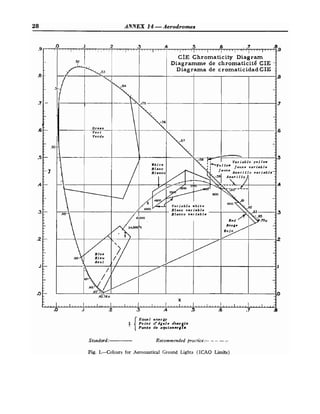
?tote has been iftcluded giving the afiproximcrte equi7)alent
limits in the Rectangular-Unifornt-Chromaticity-Scale
system.** In deriving these approximate equivalents,
de:liations not exceeding 0,003 for both x" and y" have
been allozc~rdin order to keep the equations simple.
* Recommandations officielles de la Commission inter-
nationale de I'Eclairage (Kuitihe Session, 1931). 326-
solutions: 1 (pages 19, 20 et 21) ; 4 (page 23) et 5
(pages 24, 25 et 26).
**Proceedings of the International Commission on
IIlumination, Tenth Session, 1939. Condensed unofficial
version edited and published by the United States
National Committee (pages 81 and 92-94).
1.2.POLOURS FOR AERONAUTICAL GROUND LIGHTS
1.2.1 The chromaticities of aero-
nautical ground lights shall be within the
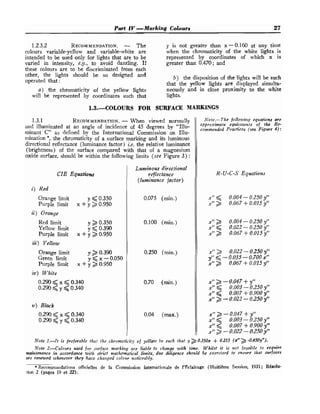
following Umits (see Figure 1) :
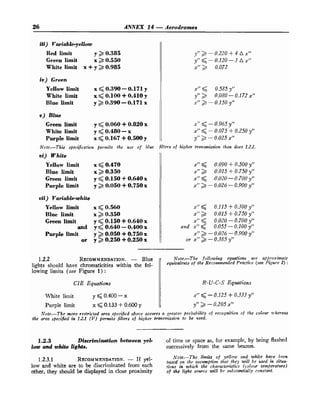
CIE Equations
i ) Red
Purple limit x +y 2 0.985
Yellow limit y <0.335
ii) Yellow
Red limit y 2 0.400
Green limit y 2 0.560
White limit x +y 2 0.985
Note.-Tllr fo[[ozcd:ip cqiiatio~t.c crc npp~os;rnnte
equivalents of the Standards (see Figure 2) :
R-U-C-S Equations
A x" = 0.075-x"
26 ANh'EX 14 -Aerodromes
iii) Variableyellow II
Red limit y 2 0.385
Green limit x 3 0.550
White limit x +y 2 0.985
iv) Green
Yellow limit x <0.390-0.171 y
White limit x <0.100 +0.410 y
Blue limit y 2 0.390 -0.171x
v ) Blue
I1
Green limit y <0.060 +0.820 x
White limit y <0.480-x
Purple limit x <0.167 +0.500 y
Note.-This permits the use of blue filters of higher transmission than does 1.2.2.
oi) White
II
Yellow limit x <0.470
Blue limit x 2 0.350
Green limit y <0.150 +0.640 x
Purple limit y 20.050 +0.750 x
vii) Variable-white
Yellow limit x <0.560
Blue limit x 2 0.350
Green limit y <0.150 +0.640 x
and y <0.640 -0.400 x
Purple limit y 2 0.050 +0.750 x
or y 2 0,250 +0.250 x
CIE Equations
II R-U-C-S Equations
1.2.2 RECOMMENDATION.
- Blue Note.-The follow'ng equotiom are approximate
White limit <0.400 -x .r" <-0.125 +0.333 y"
Purple limit x <0.133 +0.600 y y" 2 -0.205 x"
lights should have chromaticities within the fol-
lowing limits (see Figure 1):
Note.-The more restricted area specified above asstire3 a greater probability of recognitio~tof the coloztr zcrhereas
the area sjecified in 1.2.1 ( V ) permits filters of higher transmission to be used.
equivalents of the Recommended Practice (see Figure 2) :
1.2.3 Discrimination between yel- of time or space as, for example, by being flashed
low and white lights. successively from the same beacon.
1.2.3.1 Note.-The limits of yellow and white hawe been
- If bascd on the assumpion that they d l be used in sifua-
low and white are to be discriminated from each tiom .h which the characteri~tics
(colow temperature)
other, they should be displayed in close proximity of the light source duill b~ stcbstmtidly coltstant.
Part ZV -Marking Colours 27
1.2.3.2 RECOMMENDATION.
- The y is not greater than x- 0.160 at any time
colours variable-yellow and variable-white are when the chromaticity of the white lights is
intended to be used only for lights that are to be represented by coordinates of which x is
varied in intensity, e.g., to avoid dazzling. If greater than 0.470; and
these colours are to be discriminated from each
other, the lights should be so designed and
operated that : b) the disposition of the lights will be such
that the yellow lights are displayed simulta-
a ) the chromaticity of the yellow lights neously and in close proximity to the white
will be represented by coordinates such that lights.
1.3.COLOURS FOR SURFACE MARKINGS
1.3.1 RECOMMENDATION.
- When viewed normally
and illuminated at an angle of incidence of 45 degrees by "Illu-
minant C" as defined by the International Commission on Illu-
mination *, the chromaticity of a surface marking and its luminous
directional reflectance (luminance factor) i.e. the relative luminance
(brightness) of the surface compared with that of a magnesium
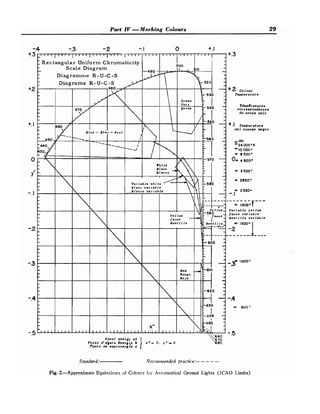
oxide surface, should be within the following limits (see Figure 3) :
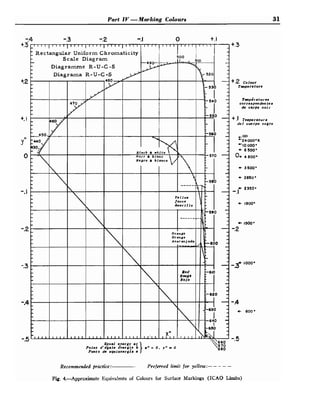
Note..--The follozving equations are
~ ~ ~ ~ ~ ~ ~ ~ p
7;;
R-U-C-S Equations
x" < 0.004-0.250y
"
X" >, 0.067 +0.015y
"
x" 2 0.004 -0.250 y"
x" < 0.022 -0.250 y
"
x" 2 0.067 +0.015 y"
x" 0.022-0.250 y"
y" <-0.035-0.700 Z"
dJ
2 0.067 +0.015 y"
z7'2 -0.047 +y"
x" < 0.003-0.250 y"
z" < 0.007 +0.900 y"
xJJ
2 -0.022 -0.250 y"
rJJ
2 -0.047 +y"
z" < 0.003-0.250 y"
x" < 0.007 +0.900 y"
x" 2 -0.022-0.250y"
CZE Equations
i) Red
Orange limit y <0.350
Purple limit x +y )
,0.950
ii) Orange
Red limit y 2 0.350
Yellow limit y <0.390
Purple limit x +y 2 0.950
iii) Yellow
Orange limit y> 0.390
Green limit <x -0.050
Purple limit x +y 2 0.950
iv) White
0.290 ,<x <0.340
0.290 <y <0.340
v ) Black
0.290 <x <0.340
0.290 <y <0.340
Note 1.-It is preferable that the chromaticity of yellow be such that y 20.3502 + 0.215 ( H a -0.450~").
Note 2.-Colours zwed for surface marking are liable to change with time. Whilst it is not feasible to reqzLire
mahtewnce h accordance with strict mathematical limits, due diligence should be exercised to enswe that swfaces
ore renewed whenever they havc charaged colour noticeably.
+ Recommandations officielles de la Commission internationale de 1'Eclairage (Huitihe Session, 1931; Rbolu-
lion 2 (pages 19 et 22).
Luminous directional
reflectance
(luminance factor)
0.075 (min.)
0.100 (min.)
0.250 (min.)
0.70 (min.)
0.04 (max.)
28 ANNEX I 4 -Aerodromes
Equal energy
Point d'dgale e'ner ie
Punto de eguienerpfa
Standard: Recommended practice:- -- --
Fig. I.-Colours for Aeronautical Ground Lights (ICAO Limits)
Part ZV M a r k i n g Colours 29
:4 -.3 -.2 -.I 0 +.I
I
Temperature
TCmp$ratures
correapondantea
du corps noir
Jeune variable
Amarillo variable
Equal energy at
Standard: Recovnnzended practice:- ----
F
i
g
.
2.-Approximate Equivalents of Colours for Arronautical Ground Lights (ICAO Limits)
30 ANNEX 14 -Aerodromes
Equal energy
Point d'dgale iner i e
Punto de eguienergfa
Recommended practice: Preferred limit for yellow:- --- -
Fig. 3.-Colours for Surface Markings (ICAO L
i
m
i
t
s
)
Part IV -Marking Colours 31
74 -.3 -
.
2 -.I 0 +.I
+.3
Scale Diagram
t.2
+. I
Y"
0
-.I
-
.
2
-.3
-.4
-.5
I
"
= 0 , y" = Q
+.2 colour
Temperature
Tsmp;ra t urea
correapondan tea
du c w p a n o i r
+.I Temperbture
del cuerpo n e l i o
Recommended practice: Preferred limit for yellow:- - - - -
Fig. 4.-Approximate Equiva!ents of Colours for Surface Markings (ICAO Limits)
THIS PAGE INTENTIONALLY LEFT BLANK
PART V. - OBSTRUCTION CLEARING AND MARKING
CHAPTER 1.-OBSTRUCTION CLEARING
AND MARKING SURFACES AND AREAS
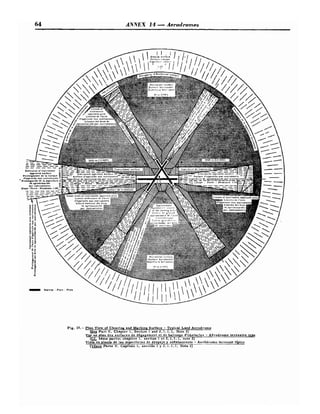
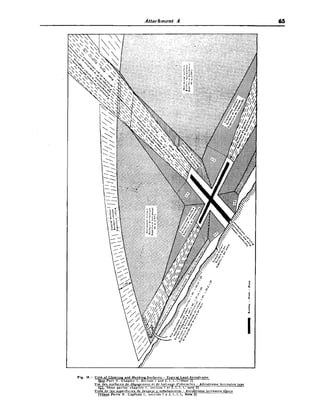
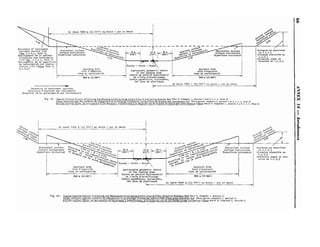
(See Figures 17, 18, 19, 20 and 21
in Attachment A)
When the following terms are used in this
Annex they have the following meanings.
1.1.LAND AERODROMES
WITH RUNWAYS
1.1.1* Approach areas.
1
.
1
.
1
.
1 An a ~ ~ r o a c h
area ie a
portion of the surfaci bf the ground (or
water) at the end of a runway. There are
two approach areas to a runway, one at each
end of it. Each approach area is quadrilat-
eral in shape and ite projection onto a
horizontal plane is symmetrical about the
vertical plane containing the extended centre
line of the runway. Two sides are contained
in vertical planes perpendicular to the
*See Part I, 2.1.1.
vertical plane containing the centre line of
the runway and the other two sides converge
toward the runway.
1.1.1.2 The inner edge of each
approach area is at a distance of 60 metres
(200 feet) measured horizontally from the
end of the runway.
1.1.1.3 The dimensions of each
approach area, when projected onto a hor-
izontal plane, are as indicated herein.
/ a0 a (
a
mf
t
.
)
- A- - -
&I
Runway Ipproach Area
AE = 3,000 wtrea (10,000 feet)
lnstrument runways
ab 300 m (1,000 ft)
cd 1,200 m (4,000 ft)
Runways other than instrument
runways at aerodromes at which
the main runway code letter is:
A, B or C D, E, F or G
210 m ( 700 ft) 150 m ( 500 ft)
750 m (2,500 ft) 750 m (2,500 ft)
34 ANNEX 14 -Aerodromes
1.1.2 * Approach surfaces.
1.1.2.1 An approach surface is a
portion of an inclined plane with limits ver-
tically above the limits of the corresponding
approach area. The lower limit of each ap-
proach surface is a horizontal line at right
angles to the vertical plane containing the
centre line of the runway.
1.1.2.2 Each approach surface
passes through a point on the ground or
water located at the intersection of the inner
edge of the corresponding approach area
with the vertical plane containing the centre
tine of the runway. The slope, measured in
the vertical plane containing the centre line
of the runway, is:
1 ) 1:50 for instrument runways;
2) 1:PO for runways other than instru-
ment runways where the code letter is A,
B, C or D;
3) 1:30 for runways other than instru-
ment runways where the code letter is E
or F;
4) 1:25 for runways other than instru-
ment runways where the code letter is G.
1.1.3 Horizontal surface. The
horizontal surface is contained in a horizon-
tal plane located 45 metres (150 feet) above
the mean level of the landing,area and its
outer limits are at a horizontal radius of at
least 4,000 metres (13,000 feet) from the
approximate geometric centre of the landing
area.
Not?.-The czitrr limits of the horizontal surface
diSie?mlned by ilze minmzmz raditbs prescribed in 1.1.3
nzay reqrli-e e.rtensiolz in the care of large aerodromes
euitlz ~lnzrszio!layoztts.
1.1.4 * Transitional surfaces.
1.1.4.1 The transitional surfaces
slope upwards and outwards from the edgee
of the approach surfaces and from the edges
of the prescribed minimum strip, till they
intersect the horizontal surface.
hTote.-Mittinturn strip width is prescribed in Part Ill,
1.2.3.
1.1.4.2 The slope of these transi-
tional surfaces, measured in a vertical plane
perpendicular to the vertical plane contain-
ing the axie of each runway, ie I:?.
-
1.1.5 Conical surface.
1.1.5.1 The conical surface slopes
upwards and outwards from the periphery
of the horizontal surface.
1.1.5.2 The slope of the conical
surface, measured in any vertical plane
passing through the approximate geometric
centre of the landing area, is 1:20.
1.1.5.3 The outer limits of the
conical surface are contained in a horizontal
plane located t
1) 100 metres (350 feet) above the
horizontal surface where the code letter
is A or B,
2) 50 metres (150 feet) above the
horizontal surface where the code letter ie
C, D or E.
Note.-There is no provision made for a conical
szirface at aerodromes where the code letter is F or G.
1.2.WATER AERODROMES
WITH CHANNELS
1.2.1 * Approach areas.
1.2.1.1 An approach area is a por-
tion of the ground (or water) at the end of
a channel. There are two approach areas to
a channel, one at each end of it. Each ap-
proach area is quadrilateral in shape and its
projection onto a horizontal plane is symme-
trical about the extended centre line of the
channel. Two sides are contained in vertical
planes perpendicular to the vertical plane
containing the centre line of the channel
and the other two sides converge toward the
channel.
1.2.1.2 The inner edge of each
approach area is coincident with the end of
the channel.
1.2.1.3 The dimensions of each
approach area, when projected onto a hor-
izontal plane are as indicated herein.
.
.. - . -
*See Part I, 2.1.1.
*See Part I, 2.1.1.
Part V -Clearing and Marking 35
1
.
2
.
2 * Approach surfaces.
lnstrument channels
ab Channel width
cd Channel width plus
900 metres (3,000 feet)
1
.
2
.
2
.
1 An approach surface is a
portion of an inclined plane with limits ver-
tically above the limits of the corresponding
approach area. The lower limit of each ap-
proach surface is the end of the channel at
low water level.
Channels other than
instrument channels
Channel width
Channel width plue
600 metree (2,000 feet)
1
.
2
.
2
.
2 The slope measured in the
vertical plane containing the centre line of
the channel is:
1) 1:50 for instrument channels,
2 ) 1:4O for channels other than instru-
ment channele where the code letter is A
or B,
3
) 1:30 for channels other than instru-
ment channele where the code letter is C.
1
.
2
.
3 HorisontaZ surface. The
horizontal eurface is contained in a horizon-
tal plane located 45 metres (150feet) above
the low water level of the landing area
and its outer limits are at a horizontal radius
of at least 4,000 metres (13,000feet) from
the approximate geometric centre of the
landing area.
Note.-The ozrter limits of the horizoi~tal surfacr
determined by the minimzim radius prescribed irz 1.2.3
1 ~ 3 1require extension in the care of la~rgraerodromes
with llnusuul layouts.
1
.
2
.
4 * Transitional surfaces.
1
.
2
.
4
.
1 The transitional eurfaces
slope upwards and outward8 from the edges
of the approach surface till they intersect the
horizontal surface and from the edges of the
channels at low water level, till they intersect
the horizontal surface.
1
.
2
.
4
.
2 The slope of these transi-
tional surfaces, measured in a vertical plane
perpendicular to the vertical plane contain-
ing the axis of each channel is 1:?.
1
.
2
.
5 Conical surface.
1
.
2
.
5
.
1 The conical surface slopes
upwards and outwards from the periphery
of the horizontal eurface,
1
.
2
.
5
.
2 The elope of the conical
surface, measured in any vertical plane
passing through the approximate geometric
centre of the landing area, ie 1:20.
1
.
2
.
5
.
3 The outer limits of the
conical surface are contained in a horizontal
plane located:
1) 100 metres (350 feet) above the
horizontal eurface where the code letter
is A,
2 ) 50 metres (150 feet) above the
horizontal eurface where the code letter
is B.
*See Part I, 2.1.1.
iVote.-There is no provision made for a conical
~trrfarc
at aerodromes where the code leffer is C.
Rh ANNEX 14 -Aerodromes
CHAPTER 2. -CLEARING AND RESTRICTION
OF OBSTRUCTIONS
Xote.-The term "objectsJJ as used in this Chapter
includes bofh temporary and permanent objects.
2.1.1 Land aerodromes with run-
ways.
2.1.1.1 RECOMMENDATION.
-At least
those objects or portions thereof that extend
above the approach or transitional surfaces should
be regarded as obstructions and should be
removed.
Note I.--In certain cases when the strip has a
transverse slope, portioils of the lower (horiz2ntaI) edge
of the approach surface will be below the s t 4 , and
objects, or fhe surface of the strip itself, will be above
the approacfz surface. It is not intended that the s t 4
be graded dowit to confornz with approach surface nor
is it intended that objects beyond the end of the strip
tltnt are lower tltatl the lever of the strip be cleared
utzless it is considered that they may endanger aircraft.
Note 2.-It may be necessary to remove objects or
portiorts thereof, pa,rticularly in the case of instruntent
runways, that:
a) extend above a plane rising at a slope of
1:40 from the osrter limit of the approach surface;
b) are located within the apfiroach area extended
to 8 nautical nziles from the end of the runway, and
c) might endanger aircraft.
Note 3.-The removal of objects zwithin a distance
of 360 metres (1,200 feet) of the end of a runway
d i c l t , although they do not amozlltt to obstr?l,ctions,
may rzcverthelcss constitarfe a danger to aircraft over-
shooting or undershooting the runway or interfere with
the satisfactory oQerafion of 7.isual or non-vist~daids
to abproach and landing, may also be necessary.
2.1.1.2 RECOMMENDATION.
- Any-
thing which may endanger aircraft on the move-
ment area or in the air within the limits of the
horizontal and 'conical surfaces should be regarded
as an obstruction and should be removed insofar
as practicable.
Note.-In certain circzimstanccs, objects that do not
firoject above any of the surfaces enumerated in 1.1.
cotastitute a hazard to aircraft as, for example, where
tlzere are owe or more isola.ted objects in the 7ricinity
of an acrodromc.
2.1.2 Water aerodromes with
channels.
2.1.2.1 RECOMMENDATION.
-At least
those objects or portions thereof that extend
above the approach or transitional surfaces should
be regarded as obstructions and should be re-
moved.
Note 1.-It may be rrecessnry to remoue objects or
porliorts fl~ereof,
partictllarly in tire care of itrstrumewt
cha~rnels,that:
a) extend above a plane rising at a slope of
1:40 from the outer limit of the approach surface;
b) are located within the approach area extended
to 8 nautical miles from the end of the channel, and
c
) mighf endarrger aircraft.
Note 2.-The removal of objects within a distance
of 3170 metres (1,000 feet) of the end o f a channel
which, although they do not amoufzt to obstructions,
tnmq nevertheless constitzrtc a danger to aircraft over-
shooting or z~izdershooting a chaiattel or interfere with
the satisfactory operation of visual or non-visual aids
to approach aa~dlarzdi~rg,may also be neressary.
2.1
thing
ment
.2.2 RECOMMENDATION.
- Any-
which may endanger aircraft on the move-
area or in the air within the limits of the
horizontal and conical surfaces should be regarded
as an obstruction and should be removed insofar
as practicable.
Note.-In certain circunzstanccs, objects that do not
project above any of the ssirfaces enumerated in 1.2.
may constitute a hazard to aircraft as, for example,
wherc there are one 01, more isolatcd objects in the
zrici,nnlty of an acrodromc.
2.2.-RESTRICTION OF NEW
CONSTRUCTION
2.2.1 New construction which
would project above the approach surfaces
or transitional surfaces, shall be pro-
hibited.
2.2.2 RECOMMENDATION.
- New
construction which would project above the hori-
zontal surface should be prohibited.
Part V -Clearing and Marking 37
2.2.3 RECQM
~ E ~ ~ ~ ~ ~ Q ~ . - P a r t i c u l a r l yb) be located within an approach area ex-
in the case of instrument runways or channels, tended to 8 nautical miles from the end of the
new construction which would : runway or channel, and
a ) project above a plane rising at a slope
of 1:40 measured from the outer end of an
c ) be likely to endanger aircraft,
approach surface, should be prohibited.
CHAPTER 3. -OBSTRUCTION MARKING
3.1,-AERODROMES WITH RUNWAYS 1,500 metres ( 5,000 feet)
OR CHANNELS where the code letter is G.
Note.-The term "objects" as used in this section Table 2 -Water aerodronzes
inclzrdes both temfiorary and permanent objects.
3.1.1 Obstructions which should
be removed in accordance with the Recom-
4,000 metres (13,000 feet)
where the code letter is A,
mended Practices in 2.1.1.1, 2.1.1.2, 2.1.2.1, 3,000 metres (10,000 feet)
and 2.1.2.2 shall, if not removed, be marked. where the code letter is B,
3.1.2 Objects or portions thereof
within the limits of approach areas that ex-
1,800 metres ( 6,000 feet)
where the code letter is C.
tend above the horizoital surface shall be
regarded as obstructions and shall be 3.1.4 Vehicles on the movement
marked. area of a land aerodrome shall be regarded
as obstructions and shall be marked.
3.1.3 RECOMMENDATION.
-Objects
or portions thereof that extend above the
horizontal surface outside the limits of approach
areas but within the radius, measured from the
approximate geometric centre of the landing area,
specified in the tables hereunder should be re-
garded as obstructions and should be marked.
Table 1-Land aerodromes
4,000 metres (13,000 feet)
where the code letter is A,
3,500 metres (11,500 feet)
where the code letter is B,
3,000 metres (10,000 feet)
where the code letter is C,
3.2.-DAY MARKING
OF OBSTRUCTIONS
3.2.1 General.
3.2.1.1 All obstructions the mark-
ing of which is prescribed in section 3.1
except 3.1.4 shall be marked by colour
whenever practicable, but if this is not
practicable, markers or flags shall be di*
played on or above them, except that:
a) obstructions that are sdciently
conspicuous by their shape, size or colour
need not be otherwise marked;
b) such parts of obstructions as are
shielded by surrounding objects need not
be marked but the surrounding objecta
2,500 metres ( 8.500 feet) shall be marked.
where the .code letter is D,
The marking of vehicles
2,000 metres ( 7,000 feet) prescribed in 3.1.4 ehall be achieved either
where the code letter is E, by colours, by markers or by flags.
1,800 metres ( 6,000 feet) 3.2.1.3 When an elevated type of
where the code letter is F, light is used within the boundary of the
38 ANNEX 14 -Aerodromes
movement area, it shall be made conspicuous
by day by a suitable form of marking and
shall be of such construction that its presence
does not endanger aircraft.
3.2.2 Use of colours.
3.2.2.1 RECOMMENDATION.-O~S~~UC-
tions with essentially unbroken surfaces, the
projection of which on any vertical plane exceeds
4.5 metres (15 feet) in both dimensions, should be
coloured to show a chequered pattern of orange
and white rectangles of not less than 1.5 metres
(5 feet) and not more than 3 metres (10 feet)
on a side, the corners being orange. (See Fig-
ures 23 and 26 in Attachment A.)
3.2.2.2 REC~MMENDATION.-O~S~~UC-
tions with essentially unbroken surfaces, the
projection of which on any vertical plane exceeds
1.5 metres (4% feet) in one dimension, and is
less than 4.5 metres (15 feet) in the other dirnen-
sion, and any skeleton type of obstruction having
both dimensions greater than 1.5 metres (4%
feet) should be cdoured to show bands of orange
and white. The bands should be not less than 0.5
nietre (1% feet) and not more than 6 metres
(20 feet) wide and should be perpendicular to
the major axis. Bands at the extremities of this
type of obstruction should be orange. (See Fig-
ures 22, 23, 24, 25, 26 and 27 in Attachment A.)
3.2.2.3 RECOMMENDATION.-Obstm-
tions the projection of which on any vertical
plane has both dimensions less than 1.5 metres
(4% feet) should be coloured to show a single
conspicuous colour, preferably orange.
3.2.2.4 RECOMMENDATION.
- When
vehicles are marked by colour, a single conspic-
uous colour, preferably yellow for service vehi-
cles and red for emergency vehicles should be
used.
3.2.3 Use of markers,
3.2.3.1 Markere displayed on or
adjacent to obstructions shall be located in
conspicuous positione eo as to retain the
general definition of the obstruction and
shall be recognizable in clear air from a dis-
tance of at least 300 metres (1,000 'feet) in
all directions in which an aircraft is likely
to approach the obstruction. The shape of
markers shall be distinctive to the extent
necessary to ensure that they are not mis-
taken for markers employed to convey other
information, and they shall be such that the
hazard presented by the obstruction they
mark is not increased.
3.2.3.2 R E C ~ M M E N D A T I O N . - M ~ ~ ~ ~ ~
displayed on overhead wires should be placed
not more than 40 metres (120 feet) apart, with
the top of each marker not below the level of the
highest wire at the point marked.
3.2.3.3 RECOMMENDATION.-M~~~~~S
displayed on vehicles should consist of two
discs intersecting at right angles. The diameter
of the discs should be not less than 0.6 metre
(2 feet).
3.2.3.4 RECOMMENDATION.-Markers
should be coloured in accordance with the
specifications given in 3.2.2. -"Use of co1oursy'.
3.2.4 Use of flags.
3.2.4.1 Flags used to mark ob-
structions shall be displayed around, on top
of, or around the highest edge of the ob-
struction. When flags are used to mark ex-
tensive obstructions or groups of closely
spaced obstructions, they shall be displayed
at least every 15 metres (50 feet). Flags
shall not increase the hazard presented by
the obstruction they mark.
3.2.4.2 Flags used to mark ob-
structions shall in no case be less than
0.6 metre (2 feet) square.
3.2.4.3 RECOMMENDATION.
- Flags
used to mark obstructions should be wholly orange
in colour or a combination of two triangular
sections, one orange and the other white, except
that where such colours merge with the back-
ground, other conspicuous colours should be used.
3.2.4.4 Flags ueed to mark vehicles
shall not be less than 0.9 metre (3 feet)
square and shall consist of a chequered pat-
tern of orange and white squares; each
square having sides of not less than
0.3 metre ( 1 foot).
3.3.-LIGHTING OF OBSTRUCTIONS
3.3.1 General. In the case of
aerodromes intended for use at night, all
Part V -Clearing and Marking 39
obstructions the marking of which is pre-
scribed in section 3.1 shall be marked by
obstruction lights, except that hazard beacons
may in special cases be employed instead of
or in addition to obstruction lights, in the
manner indicated hereafter.
3.3.2 Application of obstruction
lights and hazard beacons.
3.3.2.1 Obstruction lights shall be
used to indicate the existence of obstructions
in approach areas or on movement areas,
except that, in cases where an early or special
warning is required, one or more hazard
beacons shall be provided in the positions in
which obstruction lights would normally be
displayed.
not^ 1.-Care must be taken to eitsure that hazard
bcra'con.r do not create disconccrtittg da-le.
Note 2.-The obstrl~ction1Ght required at a cwtain
position m y be o?ilittcd when an hazard beacon is
provided at that position.
3.3.2.2 Obstruction lights shall be
used to indicate the existence of obstructions
located outside approach areas and off the
movement area, except that hazard beacons
may be used as an alternative to obstruction
lights when such obstructions are extensive,
e.g. a line of hills, and where the use of ob-
struction lights would be impracticable or
inadequate.
3.3.3 Obstruction lights.
3.3.3.1 General. When obstruction
lights are used, one or more lights shall be
located at the top of the obstruction except
in the case of a chimney or other structure
of like function (see 3.3.3.2.1). Where the
top of an obstruction is more than 45 metres
(150 feet) above the level of the surround-
ing ground, additional lights shall be pro-
vided at intermediate levels. The number and
arrangement of lights at each level to be
marked shall be such that the obstruction is
indicated from every angle in azimuth.
Where a light is shielded in any direction by
an adjacent object, additional lights shall be
provided on that object in such a way as to
retain the general definition of the obstruc-
tion, the shielded light being omitted if it
does not contribute to the definition of the
obstruction.
Note.-Reference to the Standards given in 3.3.3.2
will indlcate t1ra.t thr poilzt or. edge highest i:z rclaiion
to the obstrz~ctiofin;ark!ng surface i~
to be rcnnrded
as the "top of the obstruction". In certain cases, such
as w h m tlzc su.rface cortcei-rscd is on a?pi.oa:lt or
trantsitioital srrrface (i.e. sloping), this poiizt or edge
may not be the highest abozje a Itorixoicfal plarte passing
througlt the base of the object. In srrch cases it wzay, in
the interests 9f safety, be advi.~a:blcto filace addifinnal
obstruction light(s) on the highest part of the object
as well as on the point or edge highest in elation to the
obstruction marking sni,f ace.
3.3.3.2 Location.
3.3.3.2.1 The top light or lights shall
be so arranged as to mark the point or edge
of the obstruction highest in relation to the
obstruction marking surface. In the case of
a chimney or other structure of like func-
tion, the lights shall be placed between
1.5 metres (5 feet) and 3 metres (10 feet)
below the top. (See Figures 22, 23, 24, 25
and 26 in Attachment A.)
3.3.3.2.2 In the case of an extensive
obstruction or of a group of closely spaced
obstructions, top lights shall be displayed on
the points or edges of the obstruction
highest in relation to the obstruction mark-
ing surface, at intervals of not more than
45 metres (150 feet), so as to indicate the
general definition and extent of the ob-
struction. If two or more edges are of the
same height, the edge nearest the landing
area shall be marked.
Note.-0bstr~r.ctions consisting of built-lip aird tree-
covered areas are regarded as extensive obstructions.
3.3.3.2.3 When the top of the ob-
struction is more than 45 metres (150 feet)
above the level of the surrounding ground,
an intermediate light or lights shall be pro-
vided for each additional 45 metres (150
feet) or fraction thereof. These intermediate
lights shall be spaced as equally as practi-
cable between the top light and ground level.
Note.--In clo~elybuilt-up areas the mcan elevation
of the top of bztildings may be used as the eqzkvalent
of the ground level.
3.3.3.3 Characteristics.
3.3.3.3.1 Obstruction lights shall be
red in colour.
3.3.3.3.2 RECOMMENDATION.-Obstruc-
tion lights should be fixed lights of an intensity
of not less than ten candles of red light.
40 ANNEX 14-Aerodromes
3.3.4 Hasard beacons.
3.3.4.1 General. When hazard
beacons are used, one beacon shall be located
on the highest and most prominent feature
(in relation to the nearest obstruction mark-
ing surface) of the obstruction to be marked.
In the case of an extensive obstruction or a
group of closely spaced obstructions, addi-
tional hazard beacons shall be located at
intervals of not more than 900 metres
(3,000 feet) on prominent features.
Note.-Obstructions consisting of built-up and tree-
covered area6 are regarded as extensive obstructiow.
m
3.3.4.2 Characteristics.
3.3.4.2.1 Hazard beacons shall show
a succession of red flashes. The frequency
of flash shall be between 20 and 60 per
minute. The peak intensity of the flash shall
be not less than 2,000 candles of red light.
3.3.4.2.2 RECOMMENDATION.
- The
duration of the flash should exceed that of the
dark period.
3.3.4.2.3 RECOMMENDATION.
- In a
specific application, a higher intensity than that
specified in 3.3.4.2.1, should be adopted if consid-
ered desirable for ensuring an adequate degree
of protection against the hazard concerned.
3.4.MARKING OF UNSERVICEABLE
PORTIONS OF THE MOVEMENT AREA
3.4.1 Land Aerodromes.
3.4.1.1 Day marking. For day
marking purposes, unserviceability markings
shall be displayed to indicate any part of the
movement area unfit for the movement of
aircvaft, except that when the unserviceable
portion of the movement area is sufficiently
small for it to be by-passed by aircraft with-
out affecting the safety of their operation,
flags may be used to outline its limits.
3.4.1.1.1 Location.
3.4.1.1.1.1 Inthecaseofrunwaysand
taxiways, an unserviceability marking shall
be displayed at each end of any unserviceable
part.
3.4.1.1.1.2 RECOMMENDATION.
- Un-
serviceable parts of the movement area other than
runways and taxiways should be delineated by
markings or flags and where appropriate an un-
serviceability marking should be placed near the
centre of the unserviceable area.
3.4.1.1.2 Characteristics. An unserv-
iceability marking shall consist of a cross of
the form and minimum dimensions shown
in Figure 5 and shall be of a single con-
spicuous colour, preferably white.
Figure 5. - Unserviceability Marking
3.4.1.2 Night marking. When lights
are used for delimiting unserviceable por-
tions of the movement area, they shall be
fixcd red lights.
PART VI. - VISUAL GROUND AIDS
CHAPTER 1. -GENERAL
1.1.DANGEROUS AND CONFUSING
LIGHTS
1.1.1 Lights which endanger the
safety of aircraft. Any light near an aero-
drome which is deemed a danger to the
safety of aircraft shall be extinguished or so
modified as to eliminate the source of
danger.
1.1.2 RECOMMENDATION.
- L
i
g
h
t
which may cause confusion. All non-aeronautical
lights which, by reason of their intensity, config-
uration or colour, might prevent or cause confu-
sion in the clear interpretation of aeronautical
lights should be so screened or otherwise mo-
dified as to eliminate such a possibility. In
particular, attention should be directed to any
lights visible from the air within the areas
described herein.
a ) At land aerodromes where the code let-
ter is A or B:
within an area extending 750 metres
(2,500 feet) on each side of the extended
centre line of an instrument runway and for
a distance of at least 4,500 metres (15,000
feet) from each end of the runway and with-
in the approach areas of all the other run-
ways.
b) At land aerodromes where the code let-
ter is C, D or E :
as in a), except that the distance from
the ends o
f an instrument runway should be
at least 3,000 metres (10,000 feet).
c) At all other land and water aerodromes:
within the approach areas of all runways
or channels.
1.2.1 Wind direction indicators.
1.2.1.1 All aerodromes shall be
equipped with at least one wind direction
indicator.
1.2.1.2 RECOMMENDATION.
- Provi-
sion should be made for illuminating at least one
wind direction indicator at each aerodrome in-
tended for use at night.
1.2.1.3 Location. Wind direction
indicators shall be mounted so as to be
visible from aircraft in flight or on the
movement area and in such -a way as to be
free from the effects of air disturbances
caused by nearby objects.
1.2.1.4 Characteristics.
1.2.1.4.1 RECOMMENDATION.
- The
wind direction indicator should be in the form of
a truncated cone made of fabric.
1.2.1.4.2 RECOMMENDATION.
- When
in the form of a truncated cone made of fabric:
1 ) the wind direction indicator should
have a length of not less than 3.6 metres (12
feet) and a diameter, at the larger end, of not
less than 0.9 metre (3 feet). It should be con-
structed so that it gives a clear indication of
42 ANNEX 14 -Aerodromes
the direction of the surface wind and a general
indication of the wind speed;
2) the colour or colours should be so
selected as to make it clearly seen and under-
stood from a height of at least 300 metres
(1,000 feet), having regard to background.
Where practicable, a single colour, preferably
white or orange, should be used. Where a com-
bination of two colours is required to give ade-
quate conspicuity against changing back-
grounds, they should preferably be orange and
white, or black and white, and should be ar-
ranged in five alternate bands, the first and
last bands being the darker colour.
1.2.1.4.3 RECOMMENDATION.
- The
location of at least one wind direction indicator
provided at a land aerodrome should be marked
by a circular band 15 metres (50 feet) in dia-
meter and 1.2 metres (4 feet) wide. The band
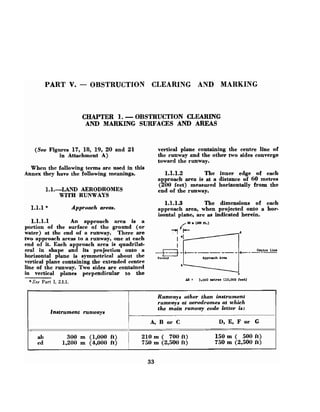
should be centered about the wind direction indi-
cator support and should be in a colour chosen to
give adequate conspicuity, preferably white.
1.2.2 Landing direction indicators.
1.2.2.1 When a landing direction
indicator is provided, the following specifica-
tions of this section apply.
1.2.2.2 Provisio~? shall be made
for lighting or illuminating landing direction
indicators when such devices are provided
for use at night.
1.2.2.3 Location. The landing direc-
tion indicator shall be located in a con-
spicuous place on the aerodrome.
1.2.2.4 RECOMMENDATION.
- Char-
acteristics. The landing direction indicator should
be a T, a tetrahedron or a launch. If a launch is
used, its shape, position and heading should be
such that the direction of landing is positively
indicated.
1.2.2.5 Characteristics of a Imcd-
tng T. The shape and minimum dimensions
of a landing T shall be as shown in Figure 6.
The colour of the landing T shall be either
white or orange arranged againat a con-
spicuous background.
Wte or orange
Planc ou orange
Blanco o anaranjado
0
.
4 m 4 m
-
(16"
1
cl
(12'1
Figure 6. - Landing "T"
1.2.2.6 Characteristics of the land-
ing tetrahedron. A landing tetrahedron,
when installed, shall have its long axis
approximately horizontal.
1.2.2.6.1 RECOMMENDATION.
- The
tetrahedron should have a long axis of not less
than 8 metres (25 feet) and an equilateral trian-
gular base with not less than 4-metre (12-foot)
sides.
1.2.2.6.2 When viewing the tetra-
hedron from the base toward the apex, the
left side shall be coloured orange or black
and the right side white or aluminum. The
landing tetrahedron shall be outlined by
lights where required for use at night. When
viewing the tetrahedron from the base
toward the apex, the ridge, the right edge
and the right edge of the base shall be out-
lined with green lights. Similarly the left
edge and the left edge of the base shall be
outlined with red lights.
1.3.-SIGNALLING DEVICES
1.3.1 Signalling lamp.
1.3.i.l A signalling lamp shall be
provided at all controlled aerodromes.
1.3.1.2.1 RECOMMENDATION.
- The
lamp should be capable of producing red, green
and white signals, and of:
Part VI -Visual Ground Aids 43
1) being aimed manually at any target
as required ;
2) giving a signal in any one colour fol-
lowed by a signal in either of the two other
colours ;
3) transmitting a message in any one of
the three colours by Morse Code up to a
speed of at least four words per minute.
1.3.1.2.2 RECOMMENDATION.
- The
beam spread should be not less than 1" or greater
than 3". The intensity of the coloured light when
used in the daytime should be not less than 6,000
candles. The lamp should be so designed that the
A. - Dumb-bell signal
Signal en forme d'haltere
Sefial en f o r m a de pesas
light intensity at angles greater than 3" from the
axis of the beam is negligible.
1.3.2 Ground signal panels and
signal area.
1.3.2.1 When ground signal panels
and a signal area are provided for the pur-
pose of controlling aerodrome traffic, the
following specifications apply.
1.3.2.2 Characteristics of ground
signal panels.
1.3.2.2.1 Ground signal panels shall
be of the types, colours and minimum sizes
shown in Figure 7.
C. - Red square with yellow c r o s s
CarrC rouge a croix jaune
Cuadrado rojo con c r u z en amarillo
B .- Landing "TI'
I'T19 dfatterrissage
'IT" de aterrizajc
Note.-See Annex 2 to the Convention on International
Civil Aviation regarding the use of these signals. D. - Red square witla yellow diagonal
CarrC rouge h diagonale jaune
Cuadrado rojo con diagonal en amarillo
Figure 7. - Signal Area Panels
4A ANNEX 14 -Aerodromes
1.3.2.3 Characteristics of signal
area.
1.3.2.3.1 The signal area shall be an
even horizontal surface at least 9 metres
(30 feet) square, surrounded by a white
border not less than 0.30 metre (1 foot)
wide.
1.3.2.3.2 RECOMMENDATION.
- The
signal area should be selected or prepared to con-
trast with red, yellow and white ground signal
panels. The area selected should be located so as
to be visible in all azimuths above an angle of
10" above the horizontal.
1.4.-EMERGENCY LIGHTING
1.4.1 Land aerodromes.
1.4.1.1 RECOMMENDATION.
- Emer-
gency lighting equipment should be available at
all land aerodromes intended for use at night,
for the purpose of indicating a preferred landing
path.
1.5.1.1 RECOMMENDATION.
- An
aerodrome identification sign should be provided
at each aerodrome where there is insufficient alter-
native means of visual identification.
1.5.1.2 RECOMMENDATION.-^^^^^^^^.
The aerodrome identification sign or signs
should be placed on the aerodrome so as to be
legible, insofar as practicable, at all angles above
the horizontal.
1.5.1.3 Characteristics.
1.5.1.3.1 Form. Where provided,
aerodrome identification signs shall consist
of the name of the aerodrome.
1.5.1.3.2 RECOMMENDATION.
-Colour.
The colour selected for aerodrome identification
signs should give adequate conspicuity.
1.5.1.3.3 RECOMMENDATION.
-Dinzen-
sions. The characters should be not less than
3 metres (10 feet) high.
1.5.2 Aerodrome beacons.
1.4.1.2 Location.
1.4.1.2.1 When used to indicate a
preferred landing ~ a t h , the emergency
lighting shall be arranged in the form of an
inverted "L". The long side shall indicate
the edge of the preferred landing path on
the left side of the landing aircraft. The
short side shall indicate the remote end of
the preferred landing path.
1.4.1.2.2 RECOMMENDATION.
- Lights
along the side of the preferred landing path should
be spaced not more than 100 metres (330 feet)
apart. The position of the first and last lights in
the line should be so arranged that a normal ap-
proach or take-off will clear all unlit obstructions.
There should be at least two lights placed not
more than 60 metres (200 feet) apart to indicate
the end of the preferred landing path.
1.4.1.2.3 RECOMMENDATION.
- Char-
acteristics. Emergency lights should, as near as
practicable, show variable-white.
1.5.AIDS TO LOCATION
1.5.1 Aerodrome identification
signs.
1.5.2.1 An aerodrome beacon shall
be provided at each aerodrome intended for
use at night.
1.5.2.2 RECOMMENDATION.
- Loca-
tion. Aerodrome beacons should be located on or
adjacent to the aerodrome.
1.5.3 Identification beacons.
1.5.3.1 Application.
1.5.3.1.1 RECOMMENDATION.-An
iden-
tification beacon should be provided at each
aerodrome intended for use at night if such aero-
drome cannot be easily identified from the air by
existing lights or other visual means.
1.5.3.1.2 RECOMMENDATION.
- In the
case of a combined water and land aerodrome
where the aerodrome beacon indicates that the
principal facility is a land aerodrome, the water
aerodrome section, if used at night, should be
provided with an identification beacon, and vice
versa.
1.5.3.2 Location. Where provided,
identification beacons shall be located on
aerodromea.
Part Vl- Visual Ground Aids 45
1.5.3.3 Characteristics.
1.5.3.3.1 Identification beacons shall
show green at land aerodromes and yellow
at water aerodromes.The peak intensity shall
not be less than 2,000 candles of coIoured
light.
1.5.3.3.2 RECOMMENDATION.
- Light
should be emitted at all angles in azimuth and up
to at least 45" above the horizontal.
1.5.3.3.3 The identification charac-
ters shall be transmitted in the International
Morse Code.
1.5.3.3.4 RECOMMENDATION.
- The
speed of transn~issionshould be between six and
eight words per minute, the corresponding range
of duration of the Morse dots being from 0.2 to
0.15 second.
CHAPTER 2. -LAM) AERODROMES WITH RUNWAYS
2.1.DAY MARKING AIDS
2.1.1 Approach day marking
system.
Note.-An approach day marking system consists of
a configuration of day markers confornzing to the speci-
fications given in 2.1.1.2. Since structures supporting
the lights of approach lighting systenzs have to be
conspicuously marked (See 2.2.1.1.2.13), such structures
may be utilized as part or d l of an app~,oachday marking
system. Where the length of the row of approach light
structures is insuficient to satisfy 2.1.1.2.2, paragraph
2.1.1.2.1 provides for additional markers in prolongation
of the row of approach lights.
The decision as to whether da.y marking aids to
approach are necessary at a particular aerodrome and,
if so, whether they are needed at each end of ewry
rzrnzvay, or only in certain approach areas, is dependent
upon local conditions. Consequently, it is for the
Competent Authority to deternzine requirements for
the provision of such aids. Recommendations made by
ICAO Regional Air Nawigafion Meetings ntny aford
guidance in determining requirements.
2.1.1.1 RECOMMENDATION.
- Appli-
cation. An approach day marking system should
be provided when, in the opinion of the Compe-
tent Authority, it is difficult for pilots, under cer-
tain conditions, to make a satisfactory approach
to the desired runway.
Note.-The conditions envisaged include lack of
contrast beteoeen the runway and the surrounding terrain,
featureless approach terrain or prevalence of poor wisi-
bility conditions due to snoke, haze, dust, etc., which
niuy be associated z&th high background brightness.
2.1.1.2 Characteristics.
2.1.1.2.1 RECOMMENDATION.
- The
system should consist of a single row of markers
spaced at uniform intervals, preferably of 60 me-
tres (200 feet) but of not more than 90 metres
(300 feet) located in the approach area at the
approach end of the runway served.
2.1.1.2.2 RECOMMENDATION.
- The
row of markers should extend from the runway
threshold outwards for a distance of at least 900
metres (3,000 feet), except that where terrain
conditions make this impracticable, the row
should extend as far as conditions permit.
2.1.1.2.3 RECOMMENDATION.
- The
row of markers should be positioned either:
a) along the runway centre line extended,
or
b) to the left of the approach and parallel
to the extended centre line of the runway, pro-
vided that the row of markers is not placed
more than 8 metres (25 feet) outwards from
the edge of the runway.
2.1.1.2.4 RECOMMENDATION.
- The
positioning of approach day marking systems, in
relation to the axes of the runways they serve,
should be consistent at any one aerodrome.
2.1.1.2.5 RECOMMENDATION.
- The
system should be immediately identifiable as an
approach system. The markers should be conspic-
uous and should contrast with their background.
Their form should be such that they cannot be
confused with runway markers.
Note 1.-Three dimensional objects provide greater
contrast than do fiat markers on the groufzd.
Note 2.-A specification covering the need for clearly
identifiable runway threshold markings to be associated
i ~ i t happroach day marking system is inclzided in
2.1.2.1.3.1.
46 ANNEX 14 -Aerodromes
2.1.1.2.6 RECOMMENDATION.
- Each 2.1.2.1.2.1 Runway caution zone mark-
marker should be of sufficient size to provide an ings shall be displayed on instrument run-
adequate signal. ways.
Note.-If fiat markers are used, minimum dimensions
equivalent to 3 metres (10 feet) square will meet this Note.-Runway caution zone markings may be dis-
requb-ement. played on other runways.
2.1.1.2.7 RECOMMENDATION.
- The
markers should not constitute obstructions.
2.1.1.2.8 RECOMMENDATION.
- Where
distance indication is considered desirable, suit-
able distance markers should be arranged at inter-
vals of 300 metres (1,000 feet) starting from the
runway threshold.
2.1.2 Runway day markings (see
Figure 28 in Attachment A).
2.1.2.1 Paved runways.
2.1.2.1.1 RECOM
MENDATION.-G~~~~U~.
All runway markings should be of a conspicuous
colour, preferably white.
2.1.2.1.2.2 Where provided, runway
caution zone markings shall be of the form
and dimensions .shown in Figure 8. They
shall be placed 1/3 of the runway length
from each end of the runway.
2.1.2.1.3 Runway threshold mark.
ings.
2.1.2.1.3.1 RECOMMENDATION.
- The
threshold of an instrument runway or any run-
way with which an approach day marking system
is associated should be so marked as to make it
clearly identifiable and conspicuous under condi-
tions of poor daylight visibility.
2.1.2.1.2 Runway caution aone mark- Note.-See Attachment B, section 9, for an appro-
ings. priate method of marking.
W = Width of runway
g W z Largeur de l o pisto
u,:'a E W -Ancho de l a pista
r v
f ?
N o t e - -
Each merking area to be f i l l e d
v l t h a t least t h e e eynb3?.5
having dimensiors as siom
Chaque aire de balisage d o i t
comprendre au mins t r o i e
symboles a p - t l e s dinensions
ci-contre
Cada zona de ee-des di:;eri
llenarse con tres a h l c l o a ,
- .
!
! 0,15 m min. P O r l o menoe, que teiigan 13s
2 1- L dimensionee i"mbs
.
4 (6" m i r ? )
Figure 8.-Runway Caution Zone Markings
-
1
A
S~ecing
between a p b l e t o be
not lesa than 0,3 m i12'j)
O a7d not more than 2 m ( 6 ' ) .
3 E~artementdwa ajlabclea cumpris
entre 0,3 a. (11.") e t 2 m (6').
El eepaciado entre loo s ~ b c l o s
no ha ds eer rneror de 013 e:
(12") ni mayor de 2 m ( 6 ' ) .
blnrking oymbol
Symbcle de balisage
Sfmhlo indicador
Part VI -Visual Ground Aids 47
Stroke width to be not l e s s than
La largeur du trait doit Qtre &
r>
sup6rieure ou Bgale h 21
El ancho de las lfneas que f o m ~
10ssignos no serd menor de -3.
t-
Past of the runway not available for landing.
I'nrtie de la piste ne devant pas a t r e u t i l i s d e
_
pour l'atkerrissage.
Pecte de l a p i s h no disponible para aterrizaje.
>
h = Height to be not l e s s thsn 10 m (30') h
h = Mteur qui doit Btre sup6rieure ou
Q&e & 10 m (308) I 1
h = Altura que no s e r i W e r i o r a 10 m (MI)
Runway - Piste - Pista
Runway threshold
hi1 de piate
/ Entrade de l a pista
Stripe to be not leas than 1,2 m (1')wide.
La largaur du t r a i t d o i t Q t r e superieure ou
6gtd.e B 1,2 rn (4').
La banda no ha de ser inferior a 1,2 m (4')
de alcho.
Figure 9.- Runway Threshold Markings
2
.
1
.
2
.
1
.
3
.
2 Where a threshold has been parallel runways at an aerodrome. The
removed from its normal position at the end letter or letters assigned shall be as follows,
of the runway, markings of the form and in the order shown from left to right when
minimum dimensions shown in Figure 9 viewed from the direction of approach.
shall be used to indicate its altered osition.
Not less than four symbols shall k ueed For two parallel runways
equally spaced across the runway. b
b
L
9
9 b
b
R
9
9
2
.
1
.
2
.
1
.
4 Runway designation mark- For three parallel runways
ings. 6
b
L
9
9 b 6 C W b
6
R
9
9
2
.
1
.
2
.
1
.
4
.
1 Assignment of numbers.
All runways shall be numbered with a two-
digit number at each end. The number
assigned shall be that whole number nearest
to one-tenth of the magnetic azimuth of the
centre line of the runway, measured clock-
wise from magnetic North when viewed from
the direction of approach.
2
.
1
.
2
.
1
.
4
.
2 Assignment of letters. A
Merentiating letter or letters shall be in-
cluded in the runway desipation of d
l
For four parallel runways
b
b
L
7
7 bbLC7.) 6
S
R
C
9
9 6
6
R
9
9
For five parallel runways
6
b
L
W b
6
L
C
9
9 6 b C 9 9 C
6
R
C
9
9 6
b
R
9
9
2
.
1
.
2
.
1
.
4
.
3 Locdion. The markings
shall be placed at the most appropriate posi-
tion near the end of the runway, in such a
manner that the runway is effectively identi-
fied and shall conform to the arrangement
shown in Figure 10.
48 ANNEX 14 -Aerodromes
h = Height of numbers and letters (see Fig, n)
h = Hauteur des chiffres et des lettres (m~ig.11)
h = Altura de 10s nheros y letras (& ~i~,ll)
Fractions of "hn are approximative
Les fractions de Irhn sont approximatives
Las fracciones de nhlf eon aproximadas
Figure 10.-Runway Designation Markings
2
.
1
.
2
.
1
.
4
.
4 Characteristics. The num- 2.1.2.1.5.3 RECOMMENDATION.
- Run-
bers and letters shall be of the form and way longitudinal markings should be as shown
proportions shown in Figure 11. The dimen- either in Figure 12 or in Figure 13.
sions shall be not less than those shown in
Figure 11. 2
.
1
.
2
.
2 Unpaved runways.
2
.
1
.
2
.
1
.
5 Runway longitudinal mark- 2.1.2.2.1 RECOM
MENDATION.-G~~~?T~~.
ings. Unpaved runways should be provided, so far
as practicable, with the markings prescribed for
2.1.2.1.5.1 RECOMMEN~A~ION,
- Run- paved runways in 2.1.2.1.
way longitudinal markings should be displayed
on all runways. 2
.
1
.
2
.
2
.
2 Runway edge markings.
2
.
1
.
2
.
1
.
5
.
2 Where provided, runway 2.1.2.2.2.1 RECOMMENDATION.
-Where
longitudinal markings shall extend along the the extent ,of a runway is not clearly indicated by
whole length of runways between the two the appearance of its surface compared with that
runway designation markings except that of the surrounding ground, simple day markers
longitudinal markings on runways other should be provided for this purpose. Where run-
than instrument runways may be interrupted way and threshold lights are provided, the mark-
at runway intersections. ers should be incorporated in the light fixtures.
Part VI -Visual Ground Aids 49
Where there are no lights, day markers of flat markers should have a height not exceeding 0.5
rectangular or conical shape should be placed so metre (20 inches).
as to delimit clearly the runway.
2.1.2.3 Marking oj snow-covered
2.1.2.2.2.2 RECOM
MENDATION.-The flat runways.
rectangular markers should have a minimum
size of 1 metre (3 feet) by 3 metres (10 feet) 2.1.2.3.1 RECOMMENDATION.-G~~~T~.
and should be placed with their long dimension Markers should be used to indicate the usable
parallel to the runway centre line. The conical limits of snow-covered runways.
P
P
. - -
' .
Feet Reds. Pier 5 10 25 50
Two figures are given for each dimension; the upper (slanting) figure represents metres, the lower (vertical)
figure represents feet.
Figure 11. -Form and Proportions of Numbers and Letters for Runway Designation Markings
50 ANNEX 14 -Aerodromes
Figure 12. - Longitudinal Runway Markings
B
Figure 13. - Longitudinal Runway Markings
2.1.2.3.2 RECOMMENDATION.
- Loca-
tion. Markers should be placed along the sides
of the snow-covered runways, spaced at inter-
vals of not more than 100 metres (330 feet) and
should be located symmetrically about the axis
of the runway. Sufficient markers should be
placed across the end of the runway to indicate
the threshold.
2.1.2.3.3 RECOMMENDATION.
- Char-
acteristics. Markers on snow-covered runways
should consist of conspicuous objects such as
spruce trees about 1.5 metres (5 feet) high, set
upright, or light wooden tripods. (See Figure 29
in Attachment A.)
2.1.3 Taxiway day markings.
(See Figure 28 in Attachment A).
2.1.3.1 Paved taxiways.
2.1.3.1.1 RECOMMENDATION.
- Appli-
cation. Longitudinal markings should be dis-
played on all paved taxiways and taxi holding
position markings should be displayed at all inter-
sections of paved taxiways with runways.
2.1.3.1.2 Location. Where provided,
the location shall be as shown in Figures 14
or 15.
Part Vl- Visual Ground Aids 51
Not leas than 30 m (100')
Distance sup&ieure ou Bgale B 30 m (100')
No menor de 30 m (100r)
Figure 14.-Taxi Longitudinal and Holding Position Markings
2.1.3.1.3 Characteristics. 2.1.3.2.1 RECOMMENDATION.
- Where
the extent of a taxiway is not clearly indicated
2.1.3.1.3.1 RECOMMENDATION.
-Colour. by the appearance of its surface as compared with
The markings should be of a conspicuous colour, that of the surrounding ground, simple day mark-
preferably white or yellow. ers should be provided for this purpose. Where
taxiway lights are provided, the markers should
2.1.3.1.3.2 Longitudinal be incorporated in the light fixtures. Where there
Where provided, the longitudinal markings are no lights, day markers of conical shape should
shall be as shown in Figure 14. be placed so as to delimit clearly the taxiway.
2.1.3.1.3.3 Taxi holding position 2.1.3.2.2 RECOMMENDATION.
- The
markings, Where provided, the taxi holding conical markers should have a height not exceed-
position markings shall be as shown either ing 0.5 metre (20 inches) and should be of such
in Figure 14 or in Figure 15. colour as to contrast with the background and be
readily distinguishable from runway markers.
Note.-Particularly on taxiways serving instrument
runways the markings shown in Figure 15 may be found
preferable. 2.2.LIGHTING AIDS
2.1.3.2 RECOMMENDATION.
- Un- 2.2.1 Approach lighting systems.
paved taxiways. Unpaved taxiways should be pro-
vided, so far as practicable, with the markings When the following term is used in this
prescribed for paved taxiways in 2.1.3.1. Annex, it has the fobwing meaning:
52 ANNEX 14-Aerodromes
Not leas than 30 m (100')
I Distance sup6rieure ou 6gale h 30 m (100') 1
4 lines and 3 spaces a t 0,15 m (6") each
4 traits e t 3 espaces de 0,15 m (6") chacun
4 Liheas y 3 espacios a 0,15 m (6") cada una
single stripe 0,15 m (bn) wide
trait simple de 0,15 m (69 de large
bands aenoilla de 0,15 m (6")de aDoho
Figure 15.-Taxi Longitudinal and Holding Position Markings
Approach portal. An area, lying in the
vertical plane perpendicular to the run-
way axis and 1,050 metres (3,500 feet)
from the threshold, through which an air-
craft making an instrument approach
may be expected to pass.
Note.-$or the purposes of this Annex, approach
lighting systems have been divided into two types:
type A and type B.
Type A has been known popularly as a simple
s.vstcm, a low intensity system or a lead-in system.
Type B has been known as an etaborate system, a
complete system, a high intensity system or a let-down
system. All of these terms are descriptmle to some extent
but are not srcficiently precise to be adopted for use in the
Aganex. It is for this yeason that the terms "approach
lighting system type A" and "approach lighting system
type B" have been used.
that make the provision of an approach lighting system
type B zinwarranted.
Approach lighting system type B is a system designed
to permit approaches in weather conditions inferior to
those for which approach lighting system tybe A is
designed, irrespective of whether or not the ground
plane is visible.
While the A G A Division made recommendations for
three different configirrations for approach lighting
system type B, Council was not able to accept these
recommendations for inclusion in the Annex. Descrifi-
tions of the three configurations and their design features
are conta.ined in the final report of the Fourth Session
of the AGA Division, Doc 6932-AGA/590.
2.2.1.1 Approach lighting system
type A.
2.2.1.1.1 Application.
Approach lighting system type A is a simple system
of lights designed with the intention of affordingguidance 2.2.1.1.1.1 An approach lighting SYS-
to pilots approaching to land whcn the ground plane is tem type A shall be installed for use in con-
visible and the atmospheric transmission is equal to or nection with each instrument runway, h e -
grcater than that represrnted by a davlight object 7t.yisi-
bility of 800 metres (2,650 feet or mile). It is intended spective Of the type Of non-visual aid pro-
for use at aerodromes where topographical, meteoro- vided, except where an approach lighting
logical, operational or trafic conditions introduce factors system type B is installed.
Part V l -Visual Ground Aids 53
2.2.1.1.1.2 RECOMMENDATION.-T~~
sys-
tem should be installed for use in connection with
runways other than instrument runways ' as may
be deemed necessary.
2
.
2
.
1
.
1
.
2 Characteristics.
2
.
2
.
1
.
1
.
2
.
1 The system shall consist of
a single row of fixed lights spaced at inter-
vals of not more than 90 metres (300feet)
located in the approach area at the approach
end of the runway served.
Note.-Flashing lights may be addcd to improve iden-
tification.
2.2.1.1.2.2 RECOMMENDATION.
- The
spacing of the lights should, as far as practicable,
be uniform.
2
.
2
.
1
.
1
.
2
.
3 The row of lights shall ex-
tend from the runway threshold outwards
for a distance of not less than 450 metres
(1,500feet).
2.2.1.1.2.4 RECOMMENDATION.
- Nor-
mally the row of lights should extend from the
runway threshold outwards for a distance of 900
metres (3,000 feet).
2
.
2
.
1
.
1
.
2
.
5 The row of lights shall be
positioned either :
a) along the runway centre line ex-
tended, or
b) to the left of the approach and
parallel to the extended centre line of the
runway, provided that the row of lights is
not placed more than 8 metres (25 feet)
outwards from the left-hand edge of the
runway.
2.2.1.1.2.6 RECOMMENDATION.
- The
positioning of approach lighting systems, in rela-
tion of the axes of the runways they serve, should
be consistent at any one aerodrome.
2
.
2
.
1
.
1
.
2
.
7 The intensity of the lights
shall be such that:
i) by night -all the lights, and
ii) by day -at least three lights
are visible from any point in the approach
portal when the ground plane is visible and
the atmospheric transmission is equal to or
greater than that represented by a daylight
object visibility of 800 metres (2,650feet or
1/3 mile).
2
.
2
.
1
.
1
.
2
.
8 The maximum intensity of
each light shall be directed towards the a p
proach portal.
Note 1.-Uniform intensity distribution of each light
throughout the solid angle subtended a,t the Iight by
the a.fiproach portal will help to ensure that the lights
are visible from approaching aircraft.
Note 2.-The prozrisinn of lights visible through
360 dcgrees itz asimrcth will enable the system to be
uscd for circling approaches in visibi!ity conditions
superior to those for which the system i
s mainly designed.
2
.
2
.
1
.
1
.
2
.
9 The lights that form the
row shall produce no dazzle disconcerting to
a pilot approaching to land.
2
.
2
.
1
.
1
.
2
.
1
0 The characteristics of the
system of lights shall be such as to ensure
that it is readily distinguishable from:
i ) other aeronautical ground lights;
and
ii) extraneous lighting, if present.
Note.-Action to be taken to avoid the exictence of
"confusing lights" in the vicinity of aeronautical lighting
aids is recommended in 1.1.2.
2.2.1.1.2.11 RECOMMENDATION.
- ASfar
as practicable, neither the lights nor the struc-
tures supporting them should project above the
approach surface.
Note.-In fiarticular cases where it is impracticable
to keep the lights or supporting structures below the
qpprooch surface, it is a matter for the Competent
Authority to weigh the advantages likely to be gained
from the informatwn provided by an approach lighting
system against the h m w d created.
2
.
2
.
1
.
1
.
2
.
1
2 There shall be an un-
obstructed line of sight between any light in
the row and all points in the approach portal.
2
.
2
.
1
.
1
.
2
.
1
3 Structures supporting the
lights shall be conspicuously marked to pro-
vide guidance to aircraft approaching to land
by day.
Note.-The fact that proflerly m r k e d aj$v-oach
light sllpporting structures may form pad of an aHroach
day marking system .is referred to in the Note to 2.1.1.
2
.
2
.
1
.
2
, Angle-of-approach lights.
Note.-It may be useful to insta1l.w angle-of-approach
light to indicate an ajpropriate gltde path.
54 ANNEX 14 -Aerodromes
2
.
2
.
1
.
2
.
1 Location.
2
.
2
.
1
.
2
.
1
.
1 When used, angleof-ap-
proach lights shall be placed outside but
close to the edge of the runway. If one angle-
of-approach light only is provided, it shall
be installed on the left-hand side of the run-
way as viewed from an aircraft approaching
to land.
2.2.1.2.1.2 RECOMMENDATION.
- The
longitudinal location of the angle-of-approach
lights should be:
i) at a point between 60 metres (200 feet)
and 90 metres (300 feet) measured inwards
from the runway threshold, if not intended
for simultaneous use with an electronic ap-
proach aid, or
ii) at a point whi& will ensure that the
lower edge of the green beam will coincide
with the glide path as defined by the electronic
aid, if intended for simultaneous use with an
electronic approach aid.
2
.
2
.
1
.
2
.
2 Characteristics,
2
.
2
.
1
.
2
.
2
.
1 The angle-of-approachlight
shall produce three contiguous beams of
coloured light with a sharp change of colour
at the boundaries between beams. The
lowest beam shall be red with a spread in the
vertical plane of not less than 3 degrees. The
middle beam shall be green with a spread in
the vertical plane of 2 degrees. The upper
beam shall be yellow with a spread in the
vertical plane of not less than 6 degrees. The
spread of any beam in the horizontal plane
shall be not less than 12 degrees and the
centre of the beam shall be so orientated in
azimuth as to provide the best possible
guidance for a pilot approaching to land.
The intensity of the light within the angles
specified above shall not be less than 200
candles for any colour. The light shall emit
flashes of equal duration, at a frequency of
30 to 60 per minuta, the duration of the
flashes being longer than the intervening
dark periods.
2.2.1.2.2.2 RECOMMENDATION.
- In the
case of angle-of-approach lights intended for use
with an electronic approach aid, the lower edge
of the green beam should coincide with the glide
path of the electronic approach aid. In the case
of angle-of-approach lights not intended for use
with an electronic approach aid, the angle of ele-
vation of the centre of the green beam should be
between the limits of 3% degrees and 4%
degrees above the horizontal. I
f two angle-of-ap
proach lights are used, the elevation of the green
beams should be the same. At all times, however,
the low limit of the green beam should provide
guidance giving adequate clearance above all
obstructions on the approach path.
2
.
2
.
2 Runway lighting.
2
.
2
.
2
.
1 Runway lights.
2
.
2
.
2
.
1
.
1 Application. Runway lights
shall be provided on all runways intended for
use at night.
2
.
2
.
2
.
1
.
2 Location.
2
.
2
.
2
.
1
.
2
.
1 Runway lights shall be
placed along the full length of the runway,
between the threshold lights, and shall be in
two straight lines parallel to and equidistant
from the centre line.
a) Where the width of the rectangular area
intended for use as a runway is 45 metres
(150 feet) or less, the lines should either be
placed along the edges of the area or outside
the edges a distance of not more than 4.5 metres
(15 feet].
b ) Where the width of the rectangular area
exceeds 45 metres (150 feet) the distance be-
tween the rows of lights should not be less than
45 metres (150 feet) and should not be greater
than the width o
f the rectangular area plus
4.5 metres (15 feet) on either side.
Note.-In the case of instrument runways it is
preferable not to exceed o spacang of 70 metres (230
feet) between the rows of lights.
c j The lights should be uniformly spaced
in rows at intervals of not more than 60 metres
(200 feet) for instrument runways and at in-
tervals of not more than 100 metres (330 feet)
for all other runways. The lights on opposite
sides of the runway axis should be on lines at
right angles to that axis. At intersections of
runways, lights may be spaced irregularly or
omitted.
Part VI -Visual Ground Aids 55
2
.
2
.
2
.
1
.
3 Characteristics.
2
.
2
.
2
.
1
.
3
.
1 Runway lights shall be
fixed lights showing variable-white, except
that on an instrument runway the lights, as
seen from either end, shall show variable-
yellow for a section at the remote end of the
runway. This section shall extend from the
end of the runway to and including the run-
way light nearest to a point one-third of the
length of the runway from that end.
a) The lights should show at all angles in
azimuth and up to at least 30 degrees above
the horizontal. The intensity of the white light
should be not less than 50 candles in all direc-
tions from which a final approach is likely to
be made.
b) In addition to the above, the lights on
instrument runways should have an intensity
and a light distribution such that, when in-
stalled at the spacing for which they are
designed, an adequate indication is given
under all visibility conditions in which it is
intended that landings will be made by the aid
of the lights.
2
.
2
.
2
.
2 Runway threshold lights.
2
.
2
.
2
.
2
.
1 Application. Runway thresh-
old lights ehall be provided on all runways
equipped with runway lights.
2
.
2
.
2
.
2
.
2 Location.
2
.
2
.
2
.
2
.
2
.
1 Runway threshold lights
shall be placed in a line on each runway
threshold, the line being at right angles to
the runway axis and the lights indicating the
limits of the surface usable for landing. The
lights shall be equally spaced between the
lines of runway lights or arranged in groups
near the lines of runway lights. The number
of lights on any runway threshold shall be at
least four with one light in line with each line
of runway lights. The lights shall be ar-
ranged to show simultaneously at both ends
of the runway.
2
.
2
.
2
.
2
.
2
.
2 When the threshold has
been altered as in cases where a section at
the end of the runway is either completely
unusable or only partially usable because of
obstructions in the approach, the altered
threshold shall be indicated by threshold
lights located as required in 2
.
2
.
2
.
2
.
2
.
1
. In
such cases the original runway lights and
threshold lights outlining the end section
shall be obscured if the section is completely
unusable or replaced by blue lights if the
section is usable for movement of aircraft.
2
.
2
.
2
.
2
.
3 Characteristics.
2
.
2
.
2
.
2
.
3
.
1 Runway threshold lights
shall be fixed lights showing green at all
angles in azimuth and up to at least 30 degrees
above the horizontal.
2.2.2.2.3.2 RECOMMENDATION.
- The
intensity of the coloured lights should be at least
15 per cent of the intensity of the white runway
lights when measured in corresponding direc-
tions.
Note.--An intensity comfiarable with the runway
ligl~tsi s considered desirable provided dazzle is not
introduced.
2.2.2.2.3.3 RECOMMENDATION.
-Thresh-
old lights at the end of an instrument runway
where a system of approach lights is installed
should, in addition to providing the omni-direc-
tional characteristics prescribed in 2.2.2.2.3.1,
have beam characteristics and an intensity com-
parable with the approach lights with which they
are associated.
2
.
2
.
3 Taxiway lighting.
2.2.3.1 RECOMMENDATION.-A~~~~CU-
tion. Taxiway lights should be provided on all
taxiways required for use at night, except where
the traffic is so infrequent that it can be satisfac-
torily guided by other means.
2
.
2
.
3
.
2 Location.
2
.
2
.
3
.
2
.
1 Where provided, the lights
shall be so arranged as to provide a clear and
continuous indication of any taxying route
to be followed. The lights shall be placed
either along both sides of the taxiway or
along the centre line, or both along the sides
and the centre line.
Note.-At aerodromes with covnplicated taxiway
intersections where centre line taxiway lighting is firo-
zn'ded, it may he necessary to add edge lighting.
56 ANNEX 14 -Aerodromes
2.2.3.2.2 RECOMMENDATION.
- When
placed along the sides, the lights should be as near
the edges of the taxiways as practicable and not
more than 3 metres (10 feet) outside.
2.2.3.2.3 RECOMMENDATION.
- The
spacing between lights in any straight line should
not exceed 60 metres (200 feet). The spacing
between lights on curves should be less so that
a clear indication of the curve is provided.
2.2.3.3 Characteristics. Where taxi-
way lights are provided, the following speci-
fications apply:
2.2.3.3.1 Taxiway lights shall be
fixed lights. Light shall be emitted through
all necessary angles in azimuth and up to at
least 30 degrees above the horizontal.
2.2.3.3.2 When lights are placed
along the sides of the taxiway, they shall be
either blue on both sides or blue on one side
and yellow on the other.
2.2.3.3.3 RECOMMENDATION.
- Yellow
light distribution, however, should be such that
the yellow light is visible only to aircraft on or
in the immediate vicinity of the taxiway.
2.2.3.3.4 When lights are placed on
the centre line of the taxiway, they shall be
green.
2.2.3.3.5 RECOMMENDATION.
- The
green light distribution should be such that the
green light is visible only to aircraft on or in the
immediate vicinity of the taxiway.
Note.-Care is necessary to limit the light distribution
of green taxiway lights new rtrnways so as to a71oid
possible confusion &th threshold lights.
CHAPTER 3. -WATER AERODROMES
Note.--This Chapter deals with visual ground aids
for water aerodromes including those with and wt'thout
channels.
It is considered importwt that water m~odrome
lighting, apart from obstruction and taxi-chamel light-
ing, should bc clearly and easily distkgishable from
land aerodrome lighting in order to avoid the possi-
bility of a landplane being inadvertently landed on a
water aerodrome or vice versa. The colour cItara~ter-
istics of lights for water a.erodroms have been selected
on this principle rather than with a vim to providing
for maximum lighf intensities. This is deemed reasonable
since the density of trafic at water aerodromes, both
at the present fimc and i n the foreseeable future is
not likely to warrant tlte proviJion of &ual aids in
excess of those that will enable seaplanes to be operated
safely in fair weather conditions. There is, however,
nothing to prevent the Competent Authority from in-
stalling, at a barticular site, &tiom1 visual aids, i.e.
an approach lighting system, angle-of-approach lights,
etc., providing such aids do not cowflict with the aids
set down in this Ckcopter.
If it is found necessary in the future to provide for
operations under low visibility conditions or for any
comiderdlt increme in the dmsity of trafic at wakr
aerodromes, it may be necessary to reconsider the visual
ground m
i
d requirements for water aerodromes, in
particular the colour chactektics for light aids to
lmdittg.
Although every endeavour has been made to avoid
the possibility of confict math marine signals, in the
care of water aerodromes situated at or in the vicinity
of navigable waters on which marine navigation is
practised, it will rest with the Competent Aicthority
to decide, in conjunction with the maritime authorities,
to what extent these Standards and Recommended
Practices can be applied without danger of conflict or
confwwn.
In the case of landing aids, three fypcs of lighting
are set forth. The selection of the type to be adopted for
a particular aerodrome is left to the Competent Authority
to make, taking into consideration the recommendations
of ICAO Regional Air Navigation Meetings as accepted
by Council and all other relevant factors, such crs fhe
needs of marine nuvigation, etc.
3.1.AIDS TO LANDING
3.1.1 Day marking.
3.1.1.1 Application.
3.1.1.1.1 Where water aerodrome
lighting is provided, each light support shall
be conspicuously marked.
Note.-Where the size of the support provides sufi-
cient area for the marking, no additiod structure is
necessary.
3.1.1.1.2 RECOMMENDATION.
- Chan-
nels used only by day and so not provided with
lighting should be clearly defined by day marking.
Part Vl- Visual Ground Aids 57
Note.-Day marking may also be required at wafer
aerodromes such as lakes, bays, etc., wed only by day,
if the limits of the landing area are not clearly indicated
by natural features.
3
.
1
.
1
.
2 Characteristics.
3.1.1.2.1 RECOMMENDATION.
- Where
provided, the markers should present an area of
approximately 0.4 square metre (4 square feet)
when viewed from any angle in azimuth and up
to at least 30 degrees above the horizontal.
3.1.1.2.2 RECOMMENDATION.
- The
markers should be tonspicuously coloured, with
alternate vertical stripes o
f yellow and black, not
less than 0.15 metre (6 inches) in width.
3
.
1
.
2 Lighting.
3
.
1
.
2
.
1 General.
3
.
1
.
2
.
1
.
1 Double row lighting is a
type of water aerodrome lighting consisting
of two lines of channel lights and associated
threshold lights.
3
.
1
.
2
.
1
.
2 Single row lighting is a
type of water aerodrome lighting consisting
of one line of lights and associated threshold
lights.
3
.
1
.
2
.
1
.
3 Boundary lighting is a
type of water aerodrome lighting consisting
of boundary lights and range lights.
3.1.2.2 Application.
3
.
1
.
2
.
2
.
1 Water aerodromes intended
for use during hours of darkness shall be
equipped with one or more of the three types
of lighting as defined in 3
.
1
.
2
.
1
.
3.1.2.2.2 RECOMMENDATION.
- Water
aerodromes with channels physically limited to
300 metres (1,000feet) width or less and intended
for use during hours of darkness should be
equipped with double row lighting.
3
.
1
.
2
.
3 Double row lighting. When
double row lighting is provided, the follow-
ing specifications apply:
3
.
1
.
2
.
3
.
1 Channel lights.
3
.
1
.
2
.
3
.
1
.
1 Location. The channel
lights shall be placed in straight lines along
the sides of the channels.
3.12.3.1.2 RECOMMENDATION.
- The
lines of lights should be not more than 300 metres
(1,000 feet) apart.
3.1.2.3.1.3 RECOMMENDATION.
- The
lights in each row should be uniformly spaced at
intervals of not more than 150 metres (500 feet),
the first and last lights being not more than 150
metres (500 feet) from the ends of the channel.
As far as possible, the lights on opposite sides of
the channel axis should be on lines at right angles
to that axis.
3
.
1
.
2
.
3
.
1
.
4 Characteristics. Channel
lights shall be fixed lights showing green at
all angles in azimuth and up to at least
30 degrees above the horizontal. The inten-
sity of the lights shall be not less than
10 candles of green light.
3
.
1
.
2
.
3
.
2 Threshold lights.
3
.
1
.
2
.
3
.
2
.
1 Location. Threshold lights
shall be placed on each channel threshold in
a straight line at right angles to the channel
axis.
3.1.2.3.2.2 RECOMMENDATION.
-Where
the width of the channel does not exceed 150
metres (500 feet), four lights should be provided
at each end of the channel. The lights should be
arranged in groups of two with one group at each
end of each row of channel lights.
3.1.2.3.2.3 RECOMMENDATION.
- Where
the width of the channel is more than 150 metres
(500 feet), additional lights should be provided
between the two groups of two lights at each end
of the channel at spacings of not less than 60 me-
tres (200 feet) and not more than 100 metres
(330 feet).
3
.
1
.
2
.
3
.
2
.
4 Characteristics. Threshold
lights shall be fixed lights showing yellow at
all angles in azimuth and up to at least
30 degrees above the horizontal. The inten-
sity of the lights shall be not less than
10 candles of yellow light.
3
.
1
.
2
.
4 Single row lighting. Where
single row lighting is provided, the following
specifications apply:
58 ANNEX 14 -Aerodromes
3
.
1
.
2
.
4
.
1 Line of Eights.
3
.
1
.
2
.
4
.
1
.
1 Location. The lights shall
be placed in a straight line along the left
side of the landing path as viewed from the
approach.
3.1.2.4.1.2 RECOMMENDATION.
- The
lights should be uniformly spaced at intervals of
not more than 300 metres (1,000 feet). The lights
should be at least eight in number, not including
the threshold lights placed at each end of the
line.
3
.
1
.
2
.
4
.
1
.
3 Characteristics, The lights
shall be fixed lights showing green at all
angles in azimuth and up to at least
30 degrees above the horizontal. The inten-
sity of the lights shall be not less than
10 candles of green light.
3
.
1
.
2
.
4
.
2 Threshold lights.
3
.
1
.
2
.
4
.
2
.
1 Location. One threshold
light shall be placed at each end of the line
of lights in line with it and at a distance from
the nearest green light equal to the interval
between successive green lights.
3.1.2.4.2.2 RECOMMENDATION.
- An ad-
ditional threshold light should be placed at not
less than 150 metres (500 feet) and not more
than 300 metres (1,000 feet) to the right, as
viewed from the approach, of each of the
threshold lights mentioned in 3.1.2.4.2.1. The four
lights should thus form the corners of a rectan-
gle.
3.1.2.1.2.3 RECOMMENDATION.
- Where
other additional lights are provided, they should
be placed at each end of the landing area. These
lights should be spaced at intervals of 100 metres
(330 feet) or less to the right of the lights men-
tioned in 3.1.2.4.2.2 and to the left of the lights
mentioned in 3.1.2.4.2.1 provided that the addi-
tional lights installed on the right side, as viewed
from the approach, should only be used if the
rectangular area defined thereby is a usable area.
3
.
1
.
2
.
4
.
2
.
4 Characteristics. Threshold
lights shall be fixed lights showing yellow at
all angles in azimuth and up to at least
30 degrees above the horizontal. The inten-
sity of the lights shall be not less than
10candles of yellow light.
3
.
1
.
2
.
5 Boundary lighting. Where
boundary lighting is provided, the following
specifications apply:
3
.
1
.
2
.
5
.
1 Boundary lights.
3.1.2.5.1.1 RECOMMENDATION.
- Loca-
tion. Boundary lights should be placed along the
boundary of the landing area at intervals of ap-
proximately 150 metres (500 feet).
3
.
1
.
2
.
5
.
1
.
2 Characteristics. Boundary
lights shall be fixed lights showing green at
all angles in azimuth and up to at least
30 degrees above the horizontal. The inten-
sity of the lights shall be not less than
10 candles of green light.
3
.
1
.
2
.
5
.
2 Range lights.
3
.
1
.
2
.
5
.
2
.
1 Location. Range lights shall
form part of the boundary lighting system
and be placed in straight lines at right
angles to preferred landing paths.
3
.
1
.
2
.
5
.
2
.
2 Range lights placed at each
end of a preferred landing path shall consist
of groups of equal numbers of lights arm
ranged symmetrically about the axis of the
preferred landing path. The groups used on
each path shall contain a number of lights
different from that used to indicate any other
path. The landing path prescribed for use
under conditions of light winds (less than
5 knots) or, in the absence of such prescrip-
tion, the longest landing path shall have the
greatest number of lights. The lights in a
group shall be arranged at equal intervals of
not more than 30 metres (100feet).
3
.
1
.
2
.
5
.
2
.
3 Characteristics. Range
lights shall be fixed lights showing yellow
at all angles in azimuth and up to at least
30 degrees above the horizontal. The inten-
sity of the lights shall be not less than
10 candles of yellow light.
3
.
2
.
1 Day marking. Where taxi
channel lighting is provided, each light sup-
port shall be conspicuously marked.
3
.
2
.
2 Lighting.
Note.--Tmi-channel lighting may be provided otr
chafinels that are outside the landing area and that are
not provided &th marine lighting.
Part VI -Visual Ground Aids 59
3.2.2.1 Characteristics. Where pro- through all necessary angles in azimuth and
vided, taxi-channel lights shall be fixed lights up to at least 30 degrees above the hori-
showing blue. The light shall be emitted zontal.
CHAPTER 4. -LAND AERODROMES WITHOUT RUNWAYS
4.1. D A Y MARKING AIDS
4.1.1 Boundary marking.
4.1.1.1 RECOMMENDATION.-~!~~~~C~-
tion. Boundary markers should be provided at
land aerodromes without runways.
4.1.1.2 Location.
4.1.1.2.1 Boundary markers shall be
placed along the boundary of the landing
area and at such corners as may be necessary
for marking clearly the limits of the landing
area.
4.1.1.2.2 RECOMMENDATION.
- The
markers should be spaced at intervals of not more
than 200 metres (600 feet) if the type shown in
Figure 16 is used, or approximately 90 metres
(300 feet) if the conical type is used.
4.1.1.3 RECOMMENDATION.
- Char-
acteristics. Boundary markers should be of a
form similar to that shown in Figure 16 or in the
form of a cone not less than 0.50 metre (20 inches)
high and not less than 0.75 metre (30 inches) in
diameter. The markers should be a single cons-
picuous colour, preferably orange, or two con-
trasting colours, preferably orange and white.
4.2.-LIGHTING AIDS
4.2.1 Boundary lights.
4.2.1.1 R E C ~ M M E N D A T I O N . - ~ ! ~ ~ ~ ~ C ~ -
tion. Boundary lights should be provided at
each land aerodrome without runways intended
for use at night.
building areas where the outline of the land-
ing area is adequately indicated by apron
floodlighting or similar illumination.
Nofe.-A somewhat reduced spalcing is generally
cornridered desirable.
4.2.1.3 Characteristics. Where pro-
vided, boundary lights shall be fixed lights
showing white at all angles up to at least
30 degrees above the horizontal. The inten-
sity of the lights shall be not less than
10 candles.
4.2.2 Range lights.
Note.-Range lights may be provided at land aero-
dromes without runways that w e equififiedwith boundary
4.2.1.2 Location. Where provided,
boundary Lights shall be arranged at intervals
Din~nsionaare approximative
Les d h n a i o n e sont appro*-tins
of not more than 100 metres (330 feet) Las dimensionee son aproximadm
along the boundary of the landing area ex-
cept that boundary lights may be omitted in Figure 1
6
. - Boundary Markers
60 ANNEX 14 -Aerodromes
lights, when it is desired to iltdicate a preferred landing
path.
4.2.2.1 Location. Where ueed,
range lighte shall be arranged in groupe at
both ende of each preferred landing path.
Theee groups of lights ehall form part of the
boundary lighting eystem and shall be ar-
ranged to show eimultaneouely with the
boundary lights. The groupe used to indicate
any landing path ehall contain a number of
lighte different from those used to indicate
any other landing path. The lights in a
group ehall be arranged at equal intervals in
a straight line at right angles to the landing
path. The landing path for uee
under conditione of light winde (less than
5 knots), or in the absence of such preecrip-
tion, the longest landing path, ehall be indi-
cated by light groupe containing the greateet
number of range lights.
4.2.2.2 Characteristics.
4.2.2.2.1 Where used, range lights
ehall be fixed lights ehowing green at all
angles up to at least 30 degreee above the
horizontal.
4.2.2.2.2 RECOMMENDATION.
- The
intensity of the green light should be not less than
one-half of the intensity of the white boundary
lights and the light distribution should be similar.
PART VII. -AERODROME EQUIPMENT
CHAPTER 1. -EMERGENCY POWER SUPPLY
RECOMMENDATION.
- An emergency electric
power supply should be provided, capable of sup-
plying the power requirements of at least the
aerodrome facilities listed below for land aero-
dromes and at least those facilities listed in a),
b ) and c ) for water aerodromes:
a) radio and land-line communication
equipment for aeronautical mobile and fixed
services as required for the operation of air
traffic services, the signalling lamp and the mi-
nimum lighting necessary to enable air traffic
services personnel to carry out their duties;
Note.-The requirement for mini~num lighting
may be met by other than electrical means.
b ) radio navigational aids ;
c) all obstruction lights which, in the
opinion of the Competent Authority, are
essential to ensure the safe operation of air-
craft;
d ) runway or boundary lights and their
associated threshold or range lights.
1.2.1 RECOMMENDATION.
- Elec-
tric power supply connections, to those elec-
trically-operated facilities for which an emergency
source of power is required, should be so arranged
that the facilities are automatically connected, on
failure of the normal source of power, to an inde-
pendent emergency source o
f supply.
1.2.2 RECOMMENDATION.
- The
time interval between failure of the normal source
of supply and the complete restoration of the
services required by 1.1 should be as short as
practicable and should not exceed two minutes.
Note.-In certain cases, less than thirty seconds has
been found to be attainable.
THIS PAGE INTENTIONALLY LEFT BLANK
ATTACHMENT A
ILLUSTRATIONS AM) EKPLGNATORY DUGRAMS
This attachment does not constitntc a part o
f Anntx 14. The m r t d
contained herein is intended to assist in the applifarion of tbt Amex.
64 ANNEX 14 -Aerorl rornes
Fig. 17. - Plan View of clear in^ a d Markinn Surface - T pica1 Land Aerodrome
(S+SPart V. Chapter 1, Section I and 2. I. 1.'I, Note 2)
Vue en plan des surfaces de d4xaxement et de balisaxe d'obstacles - A4rodrome terrestre type
(
C
f
. 5Sme partie; chapitre 1, section 1 et 2.1.1.1, note 2
Vista en planta dc las superficies de despeje y senalamiento )- Aer6dromo terreste tipico
(
v
- Parte V. Capitulo 1, secci6n 1 y 2.1. I. I , Nota 2)
Fig. 18.- View of Clearing and Marking Surfacer - Typic4 Land Aerodrome
(Sle Part V. Chapter 1. Section 1 and 2. I. I. I .Wote 2)
Vue des surfaces de d6gagernent e t dc balisage d'obstacles - Abrodrorne terrertre type
(GSame partie: chapitrc I, sectLon 1 e t 2. 1. 1. 1, note Z
Vista de tar svperiicies de despeje y senalamlento - A e r a r b m o tcrrestre tipico
(
u
Part. V. Capitulo 1 . secct6n 1 y 2.1.1.1. Nota 2)
Direction of instrument approach
Direction d'approche aux instruments
Direcci6n de l a aproximaci6n por instrunentos
I
At l e a s t 4000 m (13 WO'I a u moins - por l o aenos -
F:g 19. - f=l<dI V v r t ~ c a !5 , C : ~ o nof < 111- 8nd P.!arllng S i r f n c e s ai-Ccntrr 1.hr.r of 1~s:rumer.LRunway (%r Pol: V, Chapltr I. Serxior. I and 2 . 1. 1. 1. Sore 2 )
C O L : . ~ v r r s . e des u t f ~ . c c r
d i 2 J i ~ G X ~ t
~ C T . ~ ' ; . : Q ~ G I ~ ; - ~ T ~ ~ ~ I ; ~ Y ~ ~ ~ I ~
a& ~ n , t r u m e n t , Q. 5eme partie: 'napnre I. acctlon I er 2.1.1. I. n,cc 2)
Sec<:6n v c r . 8 ~ ~ 1
t:o:cr,
-
-
-
-
-
-
cr i s r ..>i.rrf.c:rs dr d e 5 p ~ r
-
r r r # t a l ~ n ~ . - ! ~ . ~ n , - ~ ~ l r ~ ~ j ; ; ; i i ~ ~ t ; ~
3s v ~ r l o s
p o r T i r c m e n c o s (
V
- Parte V. Capitula I. .csc:6n I y 2. I . I .!, xota2 )
Extension of instrument
Surface horizontals
*
Runway - P i s t e - P i s t a
2.1.1.1) ApproncQ area
Ure d'apprache A ? p r o ~ l ~ ? a t a
eeometric centre
krea d e aproxizaci6n of t h e landing area
- Centre de gravit6 approximatif
M M ) m (10000') de l ' a i r e d ' a t t e r r i s s a g e
Centro geom6trico aproximado,
de: Breo de a k e r r l z a j e
- L A t Ie-st COO .
T (13 CC?'l au ~ c i n s
- '33r 10 Fer.35
-
1.1.5.3
D i s t a n c i a seglin s e dss-
c r i b e en 1.1.5.3
Approach a r e a
h p p r o x i m t e g e o n e t r i c c e n t r e
of t h e l a n d i n g a r e a
Centre de g r a v i t e approximatif
de l'nirs d ' s t t e r r i s s n g e
Centro geom6tric0, aproximado,
del de BtFrizB'e ~t l e a s t 4000 m (13 OW') a u u s i n s - por lo mews
Distance a s described
i n 1.1.5.3
Distance p r e s e r i t e a u
1.1.5.3
Distancin s e g h s e
describe en 1.1.5.3
Flg. 20. - T !cal Vcrt1caI SccttDn of c l e a ~ i n ~
and M a r k ~ n s u r l a c e s
alo? Centre Llnc of Other Rr ulrcd Runwavs (See Part V. Chapter I . Sec!:on 1)
cLePr vertica1e.t e dss surtaces d e d
&
a .men1 e i a < d v ? b r : a c l e r rJt>antL'axr:,une Lare o r d ~ n z e
(GI. Slnrc Tzrur: cha?~trcI. srcuon I)
S-cclon vcrttcal de<a-i;ctcsJde drrpeje y aeRal!mlenio. a lo I n r ~ o
I c . c:e de :
a
. d?ernhs p Z G e c & . r ~ a # (
V
%
r p a r t e V. Capitulo 1, rrcc.6n I)
L 4 t 1sl.t 40~10m (13 OW') au nolnr - por lo menos
-
-
-
Sransltionel mrface Dltt.lrca ns deirribed
in 1.1.5,3
C15tance presc7l:e ilu
1.1,5.3
Liner as aeflneb in 1.1.4.1 Licar as cler1el.d ?n 1.1.4.1 ulsrnncln recin 3s les-
L!etsa d C l l n l o i ~u 1.1.4.1 *rib+ an 1.1.5.3
~ i n a n aser<n se d o r c r l t m er. 1.1.4.1
'- or ;he <indin& Brea
Centre de rravlt6 arrliror1rat:I
de Ibn:?e d'lttrrriisap
Crntro qeondtrico, s~;rorlmdu.
d e l 6rea ao nterrirsje
Fig. 21 - Typical Vertical Section of Clearin and Marking Surfaces across Runway
(See Part V; Chapter 1, Section ?)
Coupe type des surfaces de dbgagement rt de balisage d'obstacleh par un plan vertical perpendicula~reP I'axc dc la piste
(Cf. 52me parile: chapitre I , section 1
SecciSn vertical tipira. d e las superficics) de drspeje y srnalamiento, n trav6s de la pista
(VGase Parte V. Capitulo I, seccion I)
leas than 4,5 m (15')
illfbrieur B 4,5 m (15')
......................... menoa de 1,5 m (15')
.........................
.........................
.........................
Use of colours, 3. 2.2:
Lighting, 3 . 3 . 3 . 2 . 1 .
Balisage 2 l'aide de couleurs, 3. 2 . 2 ;
Balisage lumineux, 3. 3. 3. 2 . 1.
V d Empleo de colores, 3 . 2 . 2 ;
Lluminaci6~1,3. 3 . 3 . 2 . 1.
Fig. 22 - Day and Night Marking Obstruction (See Part V, Chapter 3)
Balisape de jour et de nuit des obstacles (Cf, 5Lme partie, chapitre 3)
SeAalamiento diurno y nocturno de obst~culos( V J Parte V, Capitulo 3)
68 ANNEX 14 -Aerodromes
less than 4,5 m (15')
inf6rieur 8. 4,5 m (15')
menos de 4
,5 m (15')
4,s rn (15') or more
B I 4,5 m (15') on plus
4,5 m (15') o &
s
less than 40,5 m (135')
inf6rieur ir &0,5 m (135')
menos de GO, 5 m (135')
I
between 45 rn (150') and 90 rn (300')
A, E
, H compris entre 45 m (150') e t 90 m (3CO')
entre 45 m (150') y 90 rn (3001)
less than 45 m (150' )
'
inferieur ?
I 65 rn (1501)
menos de 45 m (150')
See Use of colours, 3, 2. 1. 1, 3. 2. 2, I and 3 . 2. 2.2;
- Lighting 3. 3. 3. 1 and 3. 3. 3. 2.
Cf. Balisage 2 l'aide de couleurs, 3.2. 1. 1, 3. 2. 2. I e t 3. 2. 2. 2;
Balisage lumineux, 3. 3. 3. 1 et 3.3. 3. 2
V
& Empleo de colores, 3. 2. 1. 1 , 3 . 2. 2. 1 y 3 . 2. 2. 2;
Iluminaci6n, 3. 3.3. 1 y 3.3. 3.2.
Fig. 23 - Day and Night Marking
(See P a r t V. Chapter 3)
E i k x a a s ede jour et'de nuit
--
(Cf. 56me partie, chapitre 3)
SeRalamiento diurno y nocturno
(w
P a r t e V, Cap<tulo 3)
Fig. 24 - Day and Night Marking
(SeeP a r t V, Chapter 3)
Balisage de jour et de nult
--
(CL. 55me partie, chapitre 3)
Seiialam~ento
d ~ u r n o
y nocturno
(V(ase P a r t e V, Capl'tulo 3)
Atttrchment A 69
half overall height
moiti6 de l a hauteur t o t d e
mitad de la altura t o t a l
45 m (150') or more
45 m (150') ou plus
15 m (150') o d s
I betmen L5 m (150')and 90 m (300')
See Use of colours, 3 . 2 . 1 . 1 and 3. 2. 2. l ;
- Lighting, 3 . 3 . 3. 1. 3. 3 . 3 . 2 and 3 . 3 . 3. 3
a Balisage A l'aide de couleurs, 3 . 2 . 1.1 et 3 . 2 . 2 . 1;
Balisage lumineux, 3. 3 . 3 . 1, 3 . 3 . 3 . 2 et 3 . 3 . 3. 3.
V
& Empleo de co1ores. 3. 2. I . 1 y 3 . 2 . 2 . L ;
lluminaci6n. 3 . 3 . 3 . 1, 3 . 3 . 3 . 2 y 3 . 3 . 3 . 3 .
Fig. 25 - Dav and Night Marking (SeeP a r t V, Chapter 3)
Balisage de jour et de nuit ( C f . 5Bme partie, chapitre 3)
SeRalamiento diurno y nocturno (
V
- P a r t e V, Capitulo 3)
70 ANNEX I 4 -- Aeroilromes
Il e s s than 45 m (150')
H~ + H~ + H~ infgrieur b 45 m (150')
menor de 45 m (150')
roof top pattern
t o i t en damier
~ a t r 6 n
de l a parbe superior
plain roof pattern
A' It o i t uni
patrdn de techo simple
curved surface
surface courbe
superffcie cunra
skeleton structure
charpe,nte
8XlWZOll
See Use of colours, 3 . 2 . 2 . ;
- Lighting, 3 . 3 . 3 . 2. 1.
Cf. Balisage 1 Itaide de couleurs. 3 . 2 . 2 . ;
-
Bafisage lurnineux 3. 3. 3. 2. 1.
V6ase Empleo de colores, 3 . 2.2;
Iluminacibn, 3 . 3 . 3 . 2 . I.
Fig. 25 - Day and Night Marking (See P a r t V, Chapter 3)
Balisage de jour et de nuit (
C
f
. 5i:rne partie, chapitre 3)
Senalamiento diurno y nocturno ( V eP a r t e V, ~ a p i t u l o
3 )
Attachment A 71
height 4,5 m (15') or less
hauteur Qgale ou inferleure B 4,s m (15')
&tufa 4,5 I
I
I (15') o =nos
height greater then 4,5 m (15')
I hauteur superieure & L,5 rn (15')
atura superlor a 4,5 m (15')
4 5 m (15') or more
L,5 m (15l) ou plus
less than 4,5 m (15')
inf'hrieur & 4,5 m (15')
menos de 4,5 m (15')
See Use of colours. 3 . 2 . 2 . 1 and 3 . 2 . 2 . 2 .
Cf. Balisage ?
i
l'aide de couleurs, 3 . 2 . 2 . 1 et 3 . 2 . 2 . 2 .
Vease Empleo de colores, 3 . 2 . 2 . 1 y 3 . 2 . 2 . 2 .
Fig. 27 - Da Marking of Obstructions (See Part V, Chapter 3)
BaEaage de jour des o b r t a c l e s ~ ~
5Lme partie, chapitre 3)
--
Seflalamiento diurno de obsticulos ( V J Parte V. tapitulo 3)
(Fig. 8)
- (Fig. 14 or Fig. 15)
'
-
I
-
-
-
C
Fig. 28 - Runwa and Taxiwa Markin
(~ee'l'artV1. 2 . laV2and 2 . 7 . 3)
Balisaae de iour d e s pistes e t d e s voies de circulation
(cT. 6hme partie, 2. 1. 2 e t 2 . I . 3)
Senales indicadoras de pistas y calles de rodaje
(VCase Parte VI, 2. 1 . 2 y 2 . 1 . 3)
72 ANNEX 14 -
.
IAerodromes
ons - Dimensiones Colours - Couleurs -
Spacing
Ecartement
Espaeiado
0,15 m (6")
Orange
Naranja
2
,
5 m (81) long
Lonmeu.: 2.5 m (8')
Material
Three supporting members to
be 0,05 m x 0,10 m (
2
" An)
scantlings 2
,
5 m (8') long
or equivalent. The aidas to
be boarda or alabs 0,25 m
(10")in wldth and spaced
0,15 m (6")apart.
I
Black
Les t r o i s montants seront
constitu6s par des chevrons
de 0,05 m x 0,10 m (2" x 4")
dlune longueur de 2
,
s m (81 ) .
Les c6Gs seront des planches
de 0,25 m (109 de large, es-
pacies de 0,15 m (6").
Colores
Tres elementos resiatentes
que serkn maderos de 0,05 m
x 0,10 m x 2,s m (2" x LN
x 8 ' ) o su e q u i d e n t e . Lns
tablas o planchas de lo8
ladoa aer& de 0,25 m (10":
de ancho y espaciadas a
0
,
1
5 m (6").
Tripod Marker
Trepied de balisage
Trfpode indicador
Fig. 29 - Tripod Marker for Snow-Covered Runways (See P a r t VI, 2.1.2.3.3)
TrCpied de balisage des pistes enneigh (Cf. 6Lme partie. 2.1.2. 3-31
7
T r ~ p o d eindicador =$stas cubiertas de nieve (
V
* Parte VI. 2.1.2.3.3)
-
Attnchrnent B 75
INFORMATION AND MATERIAL FOR GUIDANCE
IN THE APPLICATION OF THE STANDARDS
AND RECOMMENDED PRACTlCES IN ANNEX 14
I.-INTRODUCTIOS Si~ou!d hc- suhsequcntly decide to use or to providc
one or Innre additional runways or channels to serve
The material contained in this Attaci~mentis intended slnallcr types of aircraft that arc nlore sensitive to
t
:
, assist in the application of Annex 14. The Attach- effccts of high cross-wind components, he niay use his
lnent does not constitute a part the Annex and the
discretiotl ill regard to tile "interrelated
matcrial is subject to amendment fir extension with- acteristics,, and desigll them on the assun,p-
nut prior circu!ation to Contracting States.
tion that t!le rnain runivay or channel length code letter
2.-AERODROME USABILITY
The Recon~n~e~ldations
cuncernirlg the ~iumber and
orientation of runways or channels, Part 111, 1.1.1 and
2.1.1, do not prescribe any specific valuc(s) of cross-
wind component to be assumed. Present-day values of
the niaximum acceptable component cover a wide
range, from approximately 5 knots for sn~allprivate
sporting aircraft with fixed undercarriages and tail
whcel, to 25 knots or more for medium-sized airliners
fittcd with swivelling-type undercarriage and large
transport-type aircraft wit11 tricycle undercarriages. The
selection of an appropriate value for a particular site
is left to the Competerlt Authority who will doubtless
take into consideration :
a) the kind of aircraft the aerodrome is intended
to serve and the "critical cross-wind" conlponent for
each as published in the relevant Aeroplalle Flight
Manual (or siniilar publication) under "Operating
Limitation Information" ;
b) the relative importance of regularity in opera-
tion so far as one or marc particular classes of air-
craft are conccriled.
The Competetit Autllority may, for instalrce, after
taking into consideratiori the fact that aircraft clesigns
are becoming less critical with respect to wind conditior?~,
dccitle that the aerodrolne is irltended to serve those
classcs of aircraft that are capable of being operated
under moderately 11igIi cross-wind conditions. It !night
be found that in such case an aerodrome having one
or perhaps two runways or c11annc.l~will provide tlle
rcrj~tiredwind coverage and thus mcet the requirements
of Part 111, 1.1.1 and 2.1.1.
Tlie Competent Authority will then apply the spe-
cifications interrelatillg the physical characteristics and
marked with an asterisk (sce Part I, 2.1.1) to the
above-mentioned one or two runways.
-
is onc which identifies a lower range of lengths.
3.-STrlNDARD ATMOSPHZRE
.4n11ex 8 (Airwortl~iness
of Aircraft) gives the fullow-
ing definition for standard atmosphere:
An atmosphere in ~vhich
a) the air is a perfect dry gas;
b) the ten~peratureat sea level is 15°C (59°F) ;
c) the pressrrre at sea level is 760 millimetres
(29.92 inches) of mercury (1013.3 millibars) ;
d) t l ~ etemperattire gradient from sea level to the
altitude at xvi~ich the temperature becomes -56.S°C
(-69.7"F) is -0.0065"C per metre (-0.003566"F per
foot), and zero thereabove.
Nofe.-The derisity Po at sea le?!el 211311~-1. flit ~l)r).i.c'
corzditio~isis 0.12497 kg sec~/rrcb(0.002318 IB. . s e c ~ / f t ~ ) .
Proposnls for the detailed specifications of the ICAO
standard atmosphere and extreme atmosplieres contain
the following suggested modifications to the definition :
The pressure at sea level sllould read:
760 mrn (29.92126 inclies) of mercury (1013.25
millibars) ;
instead of
760 rnm (29.92 inches) of mercury (1013.3 ~rlilli-
bars).
The value of the density P o at sea level given in tlle
note to the general definition sliould be:
0.12492 kg sect/m" (0.0023769 lb. sec2/ft") ;
instead of
0.12497 kg sec"jm.i (0.002378 Ib. secZ/ft-s).
74 ANNEX 14 -Aerodromes
4.-MAIN RUNWAY O R CHANNEL BASIC
AND ACTUAL LENGTH
It will be ]toted that the princil~le underlying the
Recommendations (Part 111, Chapters 1 and 2) con-
cerning the acttlal lengths of runways or channels is the
same both for new and for existing aerodromes. The
Competent Authority first selects a main runway or
c l ~ a ~ ~ n e l
basic length to suit the requirements of the
trafic that the aerodrome is intended to serve. Then, by
adding any additional length necessary to take into
account density altitude and slope, if ally, he arrives at
the minimum actual length needed for the main run-
way or the main channel. In the case of an existing
For this reason it is always preferable to add correc-
tions to a wisely selected main runway or channel basic
length than to subtract "corrections" from the actual
letigth of a main runway or channel the origin of which
is in no way connected with current or future civil air
traffic requirements.
5.-RUNWAY OR C H A N N E L LENGTH
CORRECTIONS
5.1.-Additiolaal runzeaay or channel length
to be allozued for diflererrces from sea level
standurd atlnospheric conditions
~erodrome,the Competent Authority has onIy to compare
this required length with the existing length of the main
As stated in Part 111, Chapters 1 and 2, the accepted
~ncthod of calculating density altitude allowance may
runway or channel in order to determine whether ex-
tension is r~ecessaryor not. Ttie reverse process of sub-
not prove adequate in the case of aerodrome sites subject
tracting "corrections" for density altitude and longitu- to pr?rticularly higll temperature and high relative
dinal slope (if any) from the actual length of the main
humidity, particularly if the aerodrome is intended to
runway or channel at an existing aerodrome, in order serve turbo-jet engined aircraft.
to obtain the basic length. is nit prescribed for the
following reasons : To take care of such special cases, certain States
correct the runway or channel basic length selected for
a) there is no internationally accepted method of temperature and in the manner in&-
ca~culating the corrections to be made for specific =ated in the following extracts from official documents:
lcngitudinal slopes ;
United States practice.-Altitude correction - Basic slopes on runways, it has not yet proved possible to
length to be increased by 7 per cent per 300 metres ~~roduce
an internationally accepted method of deter-
(1,000 feet) of elevation above sea level. mining appropriate allowances.
b) the actual length of the inain runway or channel Fvc~zclt pn~ctice.
-Additional lel~gth for altitude :
at 11 existing aerodrome may be greater or less than 5 per cent of the basic length per 300 metres (1,000
ihat required for the traffic that it is intended to serve feet) above sea level.
both now and in the future. An attempt to use a basic
length arrived at by subtracting "corrections" for Further additional length for temperature: variable
density altitude and slope from the actual length is percentages according to the difference between the
likely to lead to the developn~entof either an uneco- mean of the highest daily temperatures in the hottest
nomically large aerodrome or an aerodrome that is month of the year and the standard temperature of
too small for the traffic it is intended to serve. 15°C (59"F), as shown in the following table:
Temperature correction -Altitude corrected length
to be further increased by 0.5 per cent for each degree The following extracts from official documents will
Fahrenheit w,hich the ten~peratureof the hottest month afford useful guidance :
exceeds the standard temperature of the site.
5.2.-Addition01 run~uayletlgth to be allowed
for longitudinal slope
0
~
0
10
I
i 20
I
I 18 1 - 36
Difference
1) Fre~tch practice. -The additional length of a
runway should be calculated at the rate of 3.5 per cent
of the uncorrected length where the code letter is A,
30
54
Cent.
Fah.
Because of the wide variety of possible !olrgitudinal B, C, D, E,F or G if the average slope of the runway
20%
- - I -1 .- - -
I
.
-
-
-
-
I Percentage ! 0 1 5%
i ! I
10%
Attachment B 75
reaches 1 per cent. Where the code letter is E, F or G,
tlte additional length ~l~orrltl
be 6 per cent of the
uncorrected length if the average slope reaches 1.5
per cent.
2) United Kirrgdorrr Bractice. -For average aircraft
under average operating conditions the unstick distance
is increased by apl~roximately 10 per cent for every
1" s runway is inclined above the horizontal.
3j Unifed Sfotes practicz. - The runway length
should be increased to correct for runway gradient at
tlte rate of 20 per cent of the length corrected for
(tensity altitude for each 1 per cent of effective runway
gradient. The effective runway gradient is determined
by dividing tlte maxilnuln difference in runway centre
line elevation by the total length of the runway.
4.-DISTANCE BETWEEN SLOPE CHANGES
As an example of how the Recommendations contained
in Part 111, 1.1.6.4, is itltended to be applied, consider
the case illustrated in the following profile:
I I
Profile on centre line of runw:l)'
D should be at least
25,000 (Ix-y] + IY-z~) feet
being the absolute numeral value of x-y
1 being the absolute numeral value of y-z
Assuming x = + 0.01
y = - 0.005
z = + 0.005
Then Ix-yl = 0.015
ly-z 1 z 0.01
To comply with the specification, D sl~ouldbe not less
than 7,500 (0.015 -{- 0.01) metres, that is, 7,500x0.025 =
187.50 metres
or
25,000 (0.015 + 0.01) feet,
that is, 25,000 x 0.025 = 625 feet.
7.-RUNWAY STRENGTH
The AGA Division at its Third Session recommended
the associatioil of tire pressures with single isolated
wheel load as follows:
76 ANNEX 14 -Aerodromes
Associated tire pressure
(3)
8.5 kgs./scl.cm. (120 lbs./sq.ir~.)
7.0 Irgs./sq.cm. (100 lbs./sq.in.)
7.0 kgs./sq.cn~. (100 Ibs./sq.in.)
7.0 kgs./sq.cm. (100 1bs.jsq.in.)
6.0 kgs./scl.cm. ( 85 lbs./sq.in.)
5.0 kgs./sq.cm. ( 70 Ibs./sq.in.)
2.5 kgs./sq.cm. ( 35 Ibs./sq.in.)
Code
Number
(1)
1
2
3
4
5
6
7
The Division noted, however, that "it is possible that higher tire pressures may be used in future
aircraftJJ.
Selected single isolated
whect load
(2)
-
- -
.
-
-
-
-
-
45,000 kgs. (100,000 lbs.)
35,000 kgs. ( 75,000 lbs.)
27,000 kgs. ( 60,000 lbs.)
20,000 kgs. ( 45.000 lbs.)
13,000 kgs. ( 30,000 Ibs.)
7,000 kgs. ( 15,000 lbs.)
2,000 kgs. ( 5,000 11)s.)
The following table gives values of the equivalent single isolated wheel load of a certain
number of modern types of aircraft, together wit11 the tire pressure in each main gear wheel.
For the computation of the equivalent single isolated wheel load, the following assumption has
been made: in the case of single main wheels, the single isolated wheel load has been taken as being
0.45 of the gross weight; in the case of dual wheels, as being 0.35 of the gross weight; in the case
of dual tandem wheels, as being 0.22 of the gross weight; and for 8-wheel bogey main under-
carriage, 0.18 of the gross weight.
Aircraft type
-
Bristol Brabazon 167-Mk 2
SNCASE - SE-2010
Boeing Stratocruiser B-377
Number of
wheels on each
main under-
carriage leg
G~~~~weight
kgs.
Equivalent single
isolated wheel load
8.7
8.4
8.4
7.7
5.4
6.3
6.3
Bristol 175
-
De Havilland Comet
Lockheed 749-A
Douglas DC-6
Hermes 5
Ibs.
-
-
148,500
75,000
kgs.
125
120
120
110
77
-
90 -
90
Tire pressure in main
gear wheel(s)
59,000
50,000
48,000
41,000
38,000
-
-
330,000
-
-
168,000
lbs.
75
77
85
-
58
95
60
kgs./cms
130,000
-
-
-
-
-
110,000
p
p
107,000
-
-
91,000
-
-
84,000
lbs./sq./in.
8
2
12,800
10,900
16,800
14.300
13,200
4
4
2 -
-
2
2
Canadair DC-4M
Douglas DC-4
A.V.Roe C-102
Ambassador Airspeed
66,000
-
-
7.8
9.3
28,600
24,200
37,500
31,800
29,400
12,600
10,700 1 1 5.2
-
-
112
132
7.3
8.4
28,000
27,000
26,600
36,000
33,000
30,500
23,500 8,300
7,900
6,600
6.300
-
-
6,300
.
-
6,300
Beech Twin Quad
105 (inboard)
120 (outboard)
11,500
-
-
60,000
59,000
Vickers Viscount
Martin 404
Convair 240
Martin 202
Super DC-3
8,800
146,000
-
80,000
-
-
73,000
-
-
68,000
-
-
-
-
52,500
L
22,500 50,000 2
19,000 42,000 2
-
-
18,000 / 40,000 2
-
-
18,000 40,000 2
--- -
-
14,000 31,000 1
4.2
18,400 5.4
17.500 / 5.9
1
23,000
2
2
2
2
2
14,700
14,000
14,000
14,000
4,000
51,000
4.1
6.6
4.2
Attachment B 77
8.-TAXIWAY AND APRON STRENGTH
When applying Part 111, 1.3.7 and 1.4.3, account is
usually taken of the established fact that slow-moving
or stationary aircraft impose higher stresses than fast-
moving ones, in the following manner: the strength of
the taxiways and of those portions of the aprons that
accommodate the heaviest aircraft that the aerodrome
is intended to serve, is computed on the basis of a single
isolated wheel load equal to 125 per cent of that on
which the main runway strength is computed.
9.-RUNWAY THRESHOLD MARKING
The following method of marking rutlway thresholds
to increase their conspicuity under conditions of poor
visibility (see Part VI, 2.1.2.1.3.1) is considered appro-
priate :
I
22 markings 2.1 m (
7
'
) wide 1.8 m (61) apart vith 2.4 m (8') Bpace at centre. t
22 marquee de 2,l m (
7
'
) de largeur, edpardee de 1,8 m ( 6 ' ) B llexoeption de
l'espacernent axial qui est de 2,4 m ( 8 ' ) .
22 marcaa de 2,l m (7f) de anoho a 1,8 m (6') de diatanoia, y a 2,4 n (8')
en e l centro,
Figure 30
THIS PAGE INTENTIONALLY LEFT BLANK
HISTORICAL NOTE ON THE DEVELOPRIIENT
OF ANNEXES TO THE CONVENTION
At Chicago in November 1944, the Interna-
tional Civil Aviation Conference, at which fifty-
two States were represented, drew up an Interim
Agreement on International Civil Aviation and
a Convention on International Civil Aviation that
was to supersede it. The Conference further pre-
pared draft technical annexes to the convention
and resolved that they should be accepted as
models of scope and arrangement to be studied by
participating States who undertoolc to submit
conlments on them by 1 May 1945. The corn-
ments were to be considered by technical com-
mittees established by the Provisional Interna-
tional Civil Aviation Organization and the an-
nexes, in their final form, accepted for attach-
ment to the Convention. Meanwhile, States of
the world were urged to accept the recommended
practices contained in the draft technical annexes
as those towards which the national practices of
the several States should be directed as rapidly
and as far as might prove practicable.
The Provisional International Civil Aviation
Organization was formed on 6 June 1945 and
the Interim Council convened on 15 August
1945. It immediately began to improve the tech-
nical anneses by preparing PIC-to'sRecommen-
dations for Standards, Practices and Procedures
drafted in meetings by technical experts from
Member States and international organizations.
The meetings were those of subcolnmittees of the
Air Navigation Committee, the nomenclature of
which was subsequently changed to Divisions *.
The Divisions were aided in improving their
recommendations by the comments of technical
experts representing Member States oi the Organ-
ization, non-member States and other interna-
tional organizations at Regional Air Navigation
Xeetings and at special meetings. SIoreover, the
technical experts and administrative authorities
of all States were accorded three months in which
to scrutinize and comment upon the Recommen-
dations of each Division. Meanwhile, under the
Interim Agreement, Member States undertook to
apply as rapidly as possible in their national civil
aviation practices the PICAO Recommendations
for Standards, Practices and Procedures.
~ c n ocame into being on 4 April 1947. On
20 June 1947, the ICAO Council recommended
that Contracting States should continue to apply
in their national civil aviation practices the
Recomn~endations for Standards and Recom-
mended Practices of PICAO and that they shou!d
similarly apply, insofar as they individually
considered it advisable and appropriate, the
divisionaI recomnlendations on which the Council
had not yet acted. Many Contracting States
made progress in this direction.
The First Session of the ICAO Assembly ex-
pressed general satisfaction with the Recommen-
dations for Standards, Practices and Procedures
proposed by the Divisions, but decided to rename
them henceforth International Standards and
Recommended Practices. It resolved (Resolution
*The following ten Divisions wcre established under
PICAO and have colltinued under ~ c a o :
Rules of the AIR and Air Traffic Control (RAC)
Search and Rescue (SAR)
Accident Investigation (AIG) On 25 November 1950 the Council approved the
Aerodromes, Air Routes and Ground Aids (AGA) estabtishme~~t
of an Aeronautical Information Scrvices
(AIS) Division, as the result of a recommendation of a
Aeronautical Maps and Charts (MAP) S1)ecial PI'OT.LI Meeting held in April 1949.
Airwortl~iz~ess(including Aircraft Nationality
and Registration Marlcs) (AIR) Note 1-A spccinl Radio Technical Division (COT)
Communications (COM) held o ~ i c?~zcefirzg
in N o ~ e ~ ~ ~ h c r
1946. Its fuprctions arc
Meteorology (MET)
~zozuillclzlded ilt tllosc of the COM Division.
Operations (OPS)
Personnel Licensing (PEL)
Note 2-The PEL Division now includes Training
ilz its f zlttctiorts.
79
80 ANNEX 14 -Aerodromes
A1-33) that the Council should examine them in
the light of the definitions already pronlulgated
and or^ the comments of Contracting States and
should adopt, as soon as practicable, those on
which substantial agreement had been reached.
Recomlnendations that failed to meet these re-
quirements should be referred to the Technical
Divisions.
The Second Session of the Assembly recog-
nized that there existed some uncertainty on the
part of Contracting States as to when Interna-
tional Standards adopted by the Council would
come into effect and when Contracting States
would be expected to comply with them, or give
notice of non-compliance in accordance with
-Article 35 of the Convention. It was considered
that Contracting States should be allowed a
reasonable period for implementing the Standards
after receiving notification that a majority of the
total nulnber of Contracting States had not dis-
approved them and that they had, therefore, be-
come effective under Article 90 of the Conven-
tion. Accordingly, the Council adopted a resolu-
tion on 1 July 1947 providing for the establish-
ment of a date following submission of the Stand-
ards by the Council to Contracting States (nor-
mally not less than ninety days) after which
States could no longer notify disapproval under
Article 90, a further date by which the Standards
and Recommended Practices should be applied
by Contracting States and a date prior to rvhich
States linable to comply were expected to give
notification to that effect.
The recommendations of the Technical Divi-
sions for Standards and Recommended Practices
in their respective fields are submitted in the
Final R e p r t s oi the Divisions to the Air Xavi-
gation Commission (which superseded the Air
Navigation Conlmittee in February 1949, pur-
suant to Article 56 of the Convention). The As-
sembly at its First Session resolved (Resolution
Al-32) that recomn~endations of the Divisions
for Standards and Recommended Practices, or
amendments thereto, should be submitted to Con-
tracting States for a period of three months be-
fore the Council adopted them in order to give
States reasonable time for study. The Air Navi-
gation Commission, with the approval of Coun-
cil, has adopted a procedure to facilitate this study
by Contracting States, whereby the Standards and
Recommended Practices proposed by a Division
are reviewed by the Con~mission
as soon as prac-
ticable after the termination of the Division ses-
sion. From the recommendations of the Division,
the Air Kavigation Conlmission develops a draft
Annex, taking into account also matters arising
from regional ancl special meetings, suggestions
by the Secretariat and also material emerging
from the Conlmission's deliberations. The object
of this procedure is to assess the areas of agree-
ment reached during the Division session and to
develop Standards and Recommended Practices
that not only meet essential requirements of
safety of air navigation but are likely to be accep-
table to a majority of the Contracting States. The
clraft Annex so prepared is then submitted to
States for comment, over a period of three months,
in accordance with Resolution A1-32 of the First
Session of the Assembly. The comments received
from Contracting States are collated and those
involving modifications in the draft Annex are
studied 1n conjunction with the Division's original
recommendations. The Annex is then finalized by
the Air Navigation Commission and presented
to Council for adoption under Article 37 of the
Convention.
LVhen adopting an Annex the Council requests
each Contracting State to notify the Organiza-
tion, in accordance with Article 38, of any differ-
ences that will exist, after the Annex comes into
force, between its own regulations and practices
and those established by the International Stand-
ards contained in the Annex. The differences so
notified are promulgated by the Organization to
all Contracting States.
'4s aviation develops, the Divisions will im-
prove and add to the International Standards and
Rccommended Practices which to-day constitute
considerable international agreement pains-
takingly reached through co-ordination between
Contracting States by means of technical discus-
sion extending over a considerable period. Im-
movements can best be made after Contracting
States have had practical experience of applying
the principles inherent in the Standards and
Recoinmendcd Practices. The texts of the Inter-
national Standards and Recommended Practices
provide such principles in the form of minimum
recjuirements in the various fields of air naviga-
tion for incorpration into the regulations and
administrative practices of each Contracting
State.
- END -
PRICE: $0.75 (Canadian) (Montreal)
Equivalents at date of publication:
L.E. 0.250 ................(Cairo)
................
Soles 10.75 (Lima)
f 0/5/2 .............(London)
Aust. S 0/6/3 ..........(Melbourne)
Francs 250 ..................
(Paris)

unit 4 reference.pdf

  • 1.
    INTERNATIONAL STANDARDS AND lU3COMMENDFBPRACTICES AERODROMES ANNEX 14 TO THE CONVENTTON ON INTERNATIONAL CIVIL AVIATION I [ 'I 1st Erlibion EIPecQ1ve1 Novemhr ls&l -t PN'IXRNAI"KNYrU, CIVIL AVIATION ORGANICZAmON
  • 2.
    INTERNATIONAL STANDARDS AND RECOMMENDEDPRACTICES AERODROMES ANNEX 14 TO THE CONVENTION ON INTERNATIONAL CIVIL AVIATION This Annex is published by a,uthority of the Council. For implementation please refer to the introduction of the Foreword on page 5. 1st Edition ElTective 1 November 1951 INTERNATIONAL CIVIL AVIATION ORGANIZATION
  • 3.
    Printed in English,French and Spanish, separately issued under the titles of : AERODROMES Pub'lished in Montreal, Canada, by the Interna- tional Civil Aviation Organization. Correspond- ence concerning publications should be ad- dressed to the Secretary General of ICAO, International Aviation Building, 1080 Uni- versity Street, Montreal, Canada.
  • 4.
    TABLE OF CONTENTS Page Introduction. . . . . . . . . . . . . . . . . . . . . . . . . . . . . . . . . . . 5 . . . . . . . . . . . . . . . . . . . . . . . . . . . . . . . . . . . . . . . . . . . Definitions 6 . . . . . . . . . . . . . . . . . . . . . . . . . . . . . . . . . . . Adoption of Annex 6 Implementation of Annex . . . . . . . . . . . . . . . . . . . . . . . . . 6 . . . . . . . . . . . . . . . . . . . . . . . . . . . . . . . . . . . . . . . . . . . . . Language 6 . . . . . . . . . . . . . . . . . . . . . . . . . . . . . . . . . . . . . . . . . . Editorla1 Note 6 PART I.. DEFINITIONS AND PIIRASEOLOGY . . . . . . . . . . . . . . . . . . . . . . . . . . . . . . . . . . . . . . . . . CHAPTER 2.-.Phraseology 11 . . . . . . . . . . . . . . . . . . . . . . . . . . . . . 2.1.-Runways and Channels 11 PART I1.. GENERAL . . . . . . . . . . . . . . . . . . . . . . . . . . . . . . . . . . . . . . CHAPTER 2.-Aerodrome Data 13 . . . . . . . . . . . . . . . . . 2.1.-Aerodrome Reference Point 13 . . . . . . . . . . . . . . . . . . . . . . . . . . . . . . 2.2.-Aerodrome Elevation 13 . . . . . . . . . . . . . CHAPTER 3....Reference Codes for Aerodrome Characteristics 14 3.1.-Land Aerodromes 3.2.-Water Aerodromes PART 1 1 1 .. PHYSICAL CHARACTERISTICS OF AERODROMES . . . . . . . . . . . . . . . . . . . . . CHAPTER 1.-Land Aerodromes with Runways 17 . . . . . . . . . . . . . . . . . . . . . . . . CHAPTER 2.-Water Aerodromes with Channels 21 . . . . . . . . . . . . . . . . . . . . . . . 2.1.Ahannels . . . . . . . . . . . . . . . . 21 2.2.-Turning Basins . . . . . . . . . . . . . . . . . . . . . . . . . . . . . . . . . . . 23 . . . . . . . . . . . . . . . . . . . . . . . . . . . . . . . . . . . . 2.3.Taxi.Channels 23 . . . . . . . . . . . . . . . . . . . . . . . . . . . . . . . . . . . . 2.4.-Mooring Areas 23 PART IV.. AERONAUTICAL GROUND LIGHT AND SURFACE MARKING COLOURS . . . . . . . . . . . . . . . . . . . . . . . . . . . . . . . . . . . . . . . . . . 1.1.-General 25 . . . . . . . . . . . . . . 1.2.-Colours for Aeronautical Ground Lights 25 . . . . . . . . . . . . . . . . . . . . . . 1.3.-Colours for Surface Markings 27
  • 5.
    4 ANNEX 14. Aerodromes TABLE OF CONTENTS (contd.) Page PART V.. OBSTRUCTION CLEARING AND MARKING CHAPTER l.--Obstruction Clearing and Marking Surfaces and Areas . . . . . . . . 33 1.1.-Land Aerodromes with Runways . . . . . . . . . . . . . . . . . . . . . 33 1.2.-Water Aerodromes with Channels. . . . . . . . . . . . . . . . . . . . 34 CHAPTER 2..-Clearing and Restriction of Obstructions. . . . . . . . . . . . . . . . . . . 36 2.1.-Obstruction Clearing . . . . . . . . . . . . . . . . . . . . . . . . . . . . . . . 36 2.2.-Restriction of new Construction . . . . . . . . . . . . . . . . . . . . . . 36 CHAPTER 3.-Obstruction Marking . . . . . . . . . . . . . . . . . . . . . . . . . . . . . . . . . . . . 37 3.1.-Aerodromes with Runways or Channels. . . . . . . . . . . . . . . 37 3.2.-Day Marking of Obstructions . . . . . . . . . . . . . . . . . . . . . . . 37 . . . . . . . . . . . . . . . . . . . . . . . . . . . . 3.3.-Lighting of Obstructions 38 3.4.-Marking of Unserviceable Portions of the Movement Area 40 PART VI.. VISUAL GROUND AIDS . . . . . . . . . . . . . . . . . . . . . 1.1.-Dangerous and Confusing Lights 41 1.2.-Indicators . . . . . . . . . . . . . . . . . . . . . . . . . . . . . . . . . . . . . . . . 41 . . . . . . . . . . . . . . . . . . . . . . . . . . . . . . . . . 1.3.-Signalling Devices 42 1.4.-Emergency Lighting . . . . . . . . . . . . . . . . . . . . . . . . . . . . . . . 44 1.5.-Aids to Location. . . . . . . . . . . . . . . . . . . . . . . . . . . . . . . . . . . 44 CHAPTER 2.-Land Aerodromes with Runways . . . . . . . . . . . . . . . . . . . . . . . . . . 45 . . . . . . . . . . . . . . . . . . . . . . . . . . . . . . . . . 2.1.-Day Marking Aids 45 2.2.-Lighting Aids . . . . . . . . . . . . . . . . . . . . . . . . . . . . . . . . . . . 51 CHAPTER 3.-Water Aerodromes . . . . . . . . . . . . . . . . . . . . . . . . . . . . . . . . . . . . . 56 3.1.-Aids to Landing . . . . . . . . . . . . . . . . . . . . . . . . . . . . . . . . . . 56 . . . . . . . . . . . . . . . . . . . . . . . . . . . . . . . . . . 3.2.-Aids to Taxying 58 . . . . . . . . . . . . . . . . . . . . . . . CHAPTER 4.-Land Aerodromes without Runways 59 . . . . . . . . . . . . . . . . . . . . . . . . . . . . . . . . . 4.1.-Day Marking Aids 59 . 4.2.-Lighting Aids . . . . . . . . . . . . . . . . . . . . . . . . . . . . . . . . . . .. 59 PART VII.. AERODROME EQUIPMENT CHAPTER 1.-Emergency Power Supply . . . . . . . . . . . . . . . . . . . . . . . . . . . . . . . . 61 1.1.-Application . . . . . . . . . . . . . . . . . . . . . . . . . . . . . . . . . . . . . . . 61 1.2.-Characteristics . . . . . . . . . . . . . . . . . . . . . . . . . . . . . . . . . . . . 61 ATTACHMENTS ATTACHMENT A.-Illustrations and Explanatory Diagrams . . . . . . . . . . . . . . . 63 ATTACHMENT B.-Information and Material for Guidance in the Application of the Standards and Recommended Practices in . . . . . . . . . . . . . . . . . . . . . . . . . . . . . . . . . . . . . . Annex14 73
  • 6.
    FOREWORD Introduction This document containsInternational Stand- ards and Recommended Practices pursuant to Article 37 of the Convention on International Civil Aviation (Chicago 1944). These Standards and Recommended Practices became effective on 1 November 1951. They will come into force as follows: a ) in the case of aerodromes used as regular or alternate aerodromes by interna- tional air services: on l June 1952; b ) in the case of all other aerodromes used or intended to be used for the operation of aircraft engaged in international air naviga- tion: on 1January 1954. The Standards and Recommended Practices as now presented have undergone the following stages of development: At the Chicago (1944) Conferences, Annex A to the Convention was developed. This was sub- sequently reviewed and amended at the First Session of the PICA^ Subcommittee on Air- ways Systems, Landing Areas and Ground Aids (LAG)in 1945, and at the Second Session of the Aerodromes, Air Routes and Ground Aids Divi- sion (AGA)in 1946. In September 1947 the Division, at its Third Session, developed and submitted the material in the form of recom- mendations for Standards and Recommended Practices which were forwarded to States for comment in the first quarter of 1948. The Air Navigation Commission during 1949 further developed the pmposed Standards and Recommended Practices and then resubmitted them. to States, together with additional recom- mendations made in November 1949 by the AGA Division at its Fourth Session, for comment by October 1950. Still further development was made by the Air Navigation Commission on the basis of States' comments and the resulting pro- posals were adopted by the Council as Annex 14. Attention is drawn to the title adopted for the Annex, viz. "Aerodromes". Use of this title is not intended to imply that the Annex contains all the Standards and Recommended Practices relating to aerodromes. The terms Air Routes and Ground Aids have been omitted from the title, the former because no such specifications have been adopted, and the latter because, when coupled with aerodromes, it does not adequately describe the contents and purpose of the Annex. The contents of this Annex apply to a ) all aerodromes in territories under the jurisdiction of a Contracting State that are used as regular or alternate aerodromes by -international air services ; and b) all other aerodromes in territories under the jurisdiction of a Contracting State that are used or intended to be used for the oper- ation of aircraft engaged in international air navigation. It is important that the provisions of this Annex be applied, at the earliest practicable date, to all these aerodromes. Nevertheless, it is recog- nized that a considerable time may elapse before a Contracting State can apply all the specifica- tions o f the Annex in respect of all the aerodromes referred to above. For this reason, and in view of their greater imprtance to international avia- tion, Council has given priority to implementing the Annex in respect of the aerodromes u n d e ~ Q ) above and has allowed one year in which to apply the specifications. In the case of aero-
  • 7.
    6 ANNEX 14-Aerodromes dromes included under b) above, a longer period has been allowed. The interpretation of some of the specifications in the Annex expressly requires the exercising of discretion, the taking of a decision or the per- formance of a function by the Competent Author- ity. In other specifications, the expression Colgtpetent Authority does not actually appear although its inclusion is implied. In both cases, the responsibility for whatever determination or action is necessary rests with the State having jurisdiction over the aerodrome or the person or hgency through which the State exercises its Dower in the matter concerned. In order to ensure uniform interpretation of the terms "Standard" and "Recommended Prac- tice", which are not specifically defined in the Convention,, the Council has promulgated the following definitions which apply to this Annex: Standard: Any specification for physical characteristics, configuration, matkriel, per- formance, personnel or procedure, the uniform application o f which is recognized as necessary for the safety or regularity of international air navigation and to which Contracting States will conform in accordance with the Gonven- tion; in the event of impossibility of com- pliance, notification to the Council is com- pulsory under Article 38. Recommended Practice.: Any specification for physical characteristics, configuration, ma- tCriel, performance, personnel or procedure, the uniform application of which is recognized as desirable in the interest of safety, regularity or efficiency of international air navigation, and to which Contracting States will endeavour to conform in accordance with the Convention. Notes which do not alter the meaning of the Standards and Recommended Practices have been included in certain cases where it was neces- sary to clarify an intention, to stress a particular point or to indicate that a particular question is under- study, Adoption of Annex Standards and Recommended Practices for A.erodromes were adopted by the Council on 29 May 1951 and designated as Annex 14 to the Convention. The Annex was submitted forthwith to each Contracting State together with a copy of the Resolution of Adoption by the Council. On I. November 1951, which was the date sel by the Council for the notification by States of disapproval of the Annex in whole or in part under Article 90, only five States had registered disapproval of any part of the Annex. The Annex accordingly became effective on that date. Implementation of Annex It is expected that by 1 June 1952 States will have ii~troducedthe provisions of the Annex at aerodromes tised as regular or alternate aero- dromes by international services, and that by 1 Januarv 1954 States will have introduced the of the Annex at all other aerodromes used or intended to be used for the operation of aircraft engaged in international air navigation. Attention is invited to the Irttroduction (Part 11, Chapter 1) regarding the review by rcAo Regional Air Navigation Meetings of the need for specific installations on the basis of which the Council formulates policy and forwards recommendations to the Contracting States concerned. Language The Standards and Recommended Practices for Aerodromes, being an Annex to the Con- vention, exist and are officially circulated in three lang~ages - English, French and Spanish. Pursuant to Council action on 6 December 1948, each Contracting State has been requested to select one of those texts for the purpose o f national implementation and for other effects pro- vided for in the Convention, either through direct use or through translation into its own national language, and to notify the Organization accord- ingly. Editorial Note The following practice has been adhered to in order to indicate at a glance the status of each statement: Standards have been printed in bold face type; Recommended Practices have been printed in light face type, the status being indi-
  • 8.
    Foreword 7 cated bythe prefix RECOMMENDATION; Notes theses by corresponding measurements in the have been printed in small type italics, the status foot-pound system. being indicated by the prefix Note. Any reference to a portion of this document, Throughout this document measurements are which is identified by a number, includes all sub- given in the metric system followed in paren- divisions of such portion.
  • 9.
  • 10.
    International Standards andRecommended Practices AERODROMES PART I.- DEFINITIONS AND PHRASEOLOGY CaAPTER 1 .-DEFINITIONS When the following terme are used in the Standarde and Recommended Practices for Aerodromes, they have the following mean- inge: Aerodrome. A defined area on land or water (including any buildings, inetdatione and equipment) intended to be ueed either wholly or in part for the arrival, departure and movement of aircraft. Aerodrome beacon, Aeronautical beacon used to indicate the location of an aero- drome. Aerodrome elevation, The elevation of the highest point of the landing area. a particular point on the enrface of the earth. Aeronautical ground light. Any light spe- cially provided as an aid to air navigation, other than a light displayed on an aircraft. Angle-of-approach Zighk. Aeronautical ground lighte arranged so as to indicate the deeired angle of descent during an approach to an aerodrome. Approach lighting system, A configuration of aeronautical ground Iighte in the approach area to a runway or channel intended to aeeist a pilot in making an approach to that runway or channel. Aerodrome identif;cation sign. A sign placed on or adjacent to an aerodrome to aid Apron. A defined area, on a land aero- in identifying the aerodrome from the air. drome, intended to accommodate aircraft for purpoees of loading or unloading paseen- Aerodrome reference pain+ The desig. ger8 Or cargo, refuellin%, pmking or main- mated geographical location of an aerodrome. tenance* Aeronautical beacon. An aeronautical Boundary lights. Aeronautical ground ground light visible at all azimuths, either lights delimiting the boundary of a landing continuouely or intermittently, to designate area
  • 11.
    10 ANNEX 14-Aerodromes Boundarymarkers. Markers used to indi- cate the boundary of a landing area. Channel. A defined rectangular area on a water aerodrome, intended for the 1an.ding and take-off run of aircraft along its length. Channel lights. Aeronautical ground lights arranged along the sides of a channel. Density altitude. An atmospheric density expressed in terms of the altitude which corresponds to that density in the standard atmosphere. Fixed light. A light having constant luminous intensity when observed from a fixed point. Hasard beacon. An aeronautical beacon used to designate a danger to air navigation. identification beacon. An aeronautical beacon emitting a coded signal by means of which a particular point of reference can be identified. lnstrument channel. A channel intended for the operation of aircraft using non-visual aids. lnstrument runway. A runway intended for the operation of aircraft using non-visual aids. Landing area. The part of the movement area intended for the landing or take-off run of aircraft. Landing direction indicator. A device to indicate visually the direction currently designated for landing and for take-off. Low water level. The average low level during that month of the year when levels are lowest or, in the case of tidal waters, the average level of low water springs or lower low waters, depending on the type of tide. Main channel. The channel determined as such by the Competent Authority. Main channel selected basic length. The length selected by the Competent Authority as the basis for the design of a given water aerodrome. Main runway. The runway determined as such by the Competent Authority. Main runway selected basic length. The length selected by the Competent Authority as the basis for the design of a given land aerodrome. Markers. Objects, other than landing direction indicators, wind direction indica- tors and flags, used to indicate obstructions or to convey aeronautical information by day. Markings. Signs displayed on surfaces in order to convey aeronautical information. Movement area. That part of an aero- drome intended for the surface movement of aircraft. Obstruction lights. Aeronautical ground lights provided to indicate obstructions. Runway. A defined rectangular area, on a land aerodrome selected or prepared for the landing and take-off run of aircraft along its length. Runway lights. Aeronautical ground lights arranged along a runway indicating its direction or boundaries. Runway threshold markings. Markings so placed as to indicate the longitudinal limits of that portion of the runway usable for landing. Signal area. An area on an aerodrome used for the display of ground signals. Signalling lamp. A device used for directing light signals at individual targets. Taxi-channel. A defined path, on a water aerodrome, intended for the use of taxying aircraft. Taxi-channel lights. Aeronautical ground lights arranged along a taxi-channel to indicate the route to be followed by taxying aircraft. Taxi-holding position. A designated posi- tion at which taxying aircraft may be re- quired to stop.
  • 12.
    Part I -Definitions1 1 Taxiway. A defined path, on a land aero- route to be followed by taxying aircraft. drome, selected or prepared for the use of taxying aircraft. Threshold lights. Aeronautical ground lights so placed as to indicate the longitu- Taxiway lights. Aeronautical ground lights dinal limits of that portion of a runway, arranged along a taxiway to indicate the channel or landing path usable for landing. CHAPTER 2. -PHRASEOLOGY 2.1.RUNWAYS AND CHANNELS tions" (see Part IIl, 1.1.1and 2.1.1), unless otherwise indicated in a particular context. 2.1.1 Wherever a Standard or Recommended Practice in this Annex is 2.1.2 Wherever a specification marked with an asterisk, it applies at least regarding runways or channels is not marked with an asterisk, it applies to all the runways to lhose Or that are needed 0 , all the channela provided at every amo- at a particular aerodrome to satisfy the drorne to which the Annex relates, unless specification entitled "Number and orienta- otherwise indicated in a particular dontext.
  • 13.
  • 14.
    PART 1 1 . - GENERAL CHAPTER1. -INTRODUCTION Note.-This Annex contains Standards and Recom- mended Practices that prescribe the physical and arso- ciated characteristics to be fiossessed by and the equipment to be provided at aerodromes used or intended to be used for the operation of aircraft engaged in international air navigation. Its contrni;~are not yet complete but awmgements have been made for the inclwion in a)+ropriate Chapters of additional material dealiwg with aerodromes of types other than those now covered c.Q., land aerodromes withoztt runways, water aerodromes without channels, helicopter ruerodromes, etc. It does not include Standards relating to the location, siting, size or capacity of particular aerodromes or separation betzueen adjacent aerodrows to avoid con- flicting trafic patterns, since Contracting States will determine these factors, taking into consideration the air trafic such aerodromes are intended to serve. Council periodically reviews the requirements of infernatiod air navigation for aerodromes and for?n~lates ICAO opinion and recommendations to Contracting States con- cerning them, ordinarily on the basis of the recommenda- tions of Regional Air Navigation Meetings. The A n n a contains specifications that wescribe the a p p r o m t e relatiomhip between a number of diflerent physical characteristics, according to the partkular type or size of aerodrome under conderatiott. These inter- related specifications, when grouped in the prescribed manner, provide a series of design criteria for eficiently proportioned aerodromes. The groups of specifications are suficiently wide in their scope to cover the needs of international air trafic both now and in the foreseeable future. A s will be seen from Chalpter 3 in this Part, a code system is used in various parts of the Annex to facilitate reference. It also contains specifications concerning the clearing and marking of obstructions on and in the vicinity of aerodromes and concerning the visuat ground aids and other faciIities necessary on aerodromes for the safe and eficient operation of aircraft engaged itz intema- tional air navigation. CHAPTER 2. -AERODROME DATA Note.-This Chapter contains specifications requiring 2.1.3 The position of the aero- the determination by the C~mpetetttAuthon'ty of data drome reference point shall be as near to the about aerodrow~. The munnev in which the reprived data is to be pzcblished is not prescribed in this Annex. geometric centre the landing area as is ~racticableand consistent with 2.1.2. taking - 2.1. --ROI)ROME ~ F E R E N C Eporn possible future development of the aero- drome into account. 2.1.1 The Competent Authority shall determine the position of the aero- 2.2.AERODROME ELEVATION drome referenee point selected for each aerodrome. 2.2.1 The Competent Authority shall determine the aerodrome elevation. 2.1.2 The position of the aero- drome reference point shall be permanently 2.2.2 The aerodrome elevation established and shall be given in terms of the shall be given in terms of the nearest metre nearest eecond of latitude and longitude. or foot.
  • 15.
    14 ANNEX 14-Aerodromes CHAPTER 3. -REFERENCE CODES FOR AERODROME CHARACTERISTICS Note.-This Chapter corztains definitive material establishing the meaning of various reference code letters and numbers; the code letters arrd nu~nbersare yiuen in tables that are followed by explanatory notes. rhr use of code letters and, to a lesser extent, code nu~nbers,with the meanings assigned to them in this chapter sinrplifies the drafting of certain specifications contained in Parts III, l/ and V I of fhc L4nn~,.r.Thr sk+ecificationsin irethirh rode letters or code numbers ore used are those that we interrelated with what are ktwww as an aerodrome's principal physi: a1 c.haracfer- istirs, namely main runway length and st/-cngtll and nmln channel length artd depth. Values haze to be selected by the Competent Authority for certain specified prin- cifial physical clzaracteristics in the munner prescribed in Part IIZ of the Annex before the interrelated speci- fications can be interpreted in the case of a particula* crerodrome. The code letters and code numbers itz the tables in this Chapter ere not suitable for w e es an aprodrome 07 runway classification system, such as might he useful in air navigation. 3.1.1 Code letters when used in 3.1.2 Code numbers when used this Annex in connection with land aero- in this Annex in connection with land aero- dromes, have the meanings assigned to them dromes, have the meanings assigned to them in Table 1. in Table 2. Table 1 Note.-TILE dilizensiotrs shozcvz in this fable are in no way intended to restrict the actual length of the main or other rzrnnpays (see Part 111, 1.1.2 and Attachment B, Section 4, for a description of the application of this table both to new aerodromes and to existing aerodronzes). Table 2 Code Letter A B C D E F G Main runway selected basic length - - - 2,550 m (8,400 ft) and over 2,150 m (7,000 ft) up to but not including 2,550 m (8,400 ft) 1,800 m (5,900 ft) '' CC " 66 2,150 m (7,000 ft) 1,500 m (5,000 ft) " " " " LC 1,800 m (5,900 ft) 1,280 m (4,200 ft) " " " 'C 66 1,500 m (5,000 ft) 1,080 m (3,500 ft) " " " " cc 1,280 m (4,200 ft) 900 m (3,000 ft) " " ‘' " GC 1,080 m (3,500 ft) Note.--Colzif~zn (2) of this table gives a selection of fixed valzres of single isolated wheel load. At present, t h ~ selection of the appropriate tire pvessuve to be associated with fbe selected wheel load is left to the Competent Authority (see Attachment B, Section 7, for guidance). Associated tire pressure (3 See Attachment B Code Number - (1) 1 2 3 4 5 6 7 Selected single isolated wheel load - (2) 45,000 kgs. (100,000 lbs) 35,000 kgs. ( 75,000 lbs) 27,000 kgs. ( 60,000 lbs) 20,000 kgs. ( 45,000 lbs) 13,000 kgs. ( 30,000 lbs) 7,000 kgs. ( 15,000 be) 2,000 kgs. ( 5,000 lbs)
  • 16.
    Part ZZ -General15 3.2.WATER AERODROMES 3.2.1 Code letters when used in 3.2.2 Code numbers when used this Annex in connection with water aero- in this Annex in connection with water aero- dromes, have the meanings assigned to them dromes, have the meanings assigned to them in Table 3. in Table 4. Table 3 Note.-The diwwnsions shown in this table are in no way infekzded to rcstrict the actual length o f the main or other chalznels (see Part 111, 2.1.2 and also Attachment B, Section 4, for a descrifition of the apfilicatiojt of this table both to near aerodromes and to existing aerodrojnes). Code Letter - A B C Table 4 Main channel selected basic length - - - - - 4,500 m (15,000 ft) and over 3,000 m (10,000 ft) up to but not including 4,500 m (15,000 ft) 2,000 m ( 6,500 ft) up to but not including 3,000 m (10,000 ft) Note 1.-The deptlz of a channel is the miniwum Note 2.-The dimsnsions shown in the table are in de~th of water at low watev level that is to be expected ?to way inrcrzded to vestl-ict thr actual d~ptlz of t!z: anyzuhere in the channel. n d n or other channels. Code Number 1 2 3 Main channel selected depth 4.5 m (15 ft) and over 3.7 m (12 ft) up to but not including 4.5 m (15 ft) 2.4 m ( 8 ft) up to but not including 3.7 m (12 ft)
  • 17.
  • 18.
    PART 111. -PHYSICALCHARACTERISTICS OF AERODROMES CHAPTER 1. -LAND AERODROMES WITH RTJNWAYS Note.-This Chapter deals with land aerodromes with 1.1.2 RECOMMENDATION. - Main a main runway selected basic length of not less than runway lengfi, ~h~ length of the main runway 900 metres (3,000 feet). at an aerodrome should be not less than the main Inter-relationship of certain of the specifications con- runway selected basic Iength together with : tairted in this Chabter -use being made of the code sys- tem for this PU.~)O;E -and il.rclu$on of specifications con- taining suitable quantitatiz*erequirem~nts, aim at ensz~ring I) an additional length to be determined in the maxinzunz all-round l~sefulnessof an aerodrome accordance with 1.1.2.2 where the temperature withcut incurring dispvoportionute construction and and pressure at the site differ from sea level maintcmce expenditure. standard atmospheric conditions; The requisite inter-relationship is achieved by assunzing two chararteristics, namely nrain rwnway selected basic length arzd strength, as principal characteristics and by linking specifications for other characteristics to them, in the marzltrr indicated in this Chapter. Appropriate values for the two principal charac- /cristics are to be selected by the Competmt Authority, It(~Gngregard to tlte needs of air trafic that the aero- tlrome i s irtterlded to serve. Quantitative spccificatwns for flle rharocter-istics that are related to the two princzpal !,hnl-artcristirszrrill be found in tlze r e l ~ v n tparagraphs that f{.llow, 1.1.1 RECOMMENDATION. - Num- ber and orientation. The number of runways at an aerodrome and their orientation should be such that for as large a percentage of time as practicable but for not less than 95 per cent there is at least one runway for which the surface wind velocity component at right angles to its lungitu- dinal axis will not preclude the landing or taking- off of aircraft that the aerodrome is intended to serve. Note.-In Atfach~rrentB, Section 2, gllidance is gi7lert on the acceptable values of cross-wind components. 2) a further additional length in respect of longitudinal slopes (if any), to be determined in accordance with 1.1.2.3. Note.-See Attachment Li, Secticitts 3, 4 alrd 5. 1.1.2.1 RECOMMENDATION. - Main runway selected basic length. The main runway selected basic length should be the length that would actually be required at a level site at sea level in standard atmospheric conditions to meet the present and estimated future needs of the air traffic that the aerodrome is intended to serve. Ar~7te.-The rode letter apjropriate to the main rutzway selected basic length is to be found in Part I I , Chapter 3, Table 1. 1.1.2.2 RECOMMENDATION. - Addi- tional length for differencesfrom sea level stand- ard atmospheric conditions. Additional length for differences from sea level standard atmospher- ic conditions should be calculated at the rate of 5 per cent of the main runway selected basic length for every 300 metres (1,000 feet) of density altitude, except that in cases where
  • 19.
    18 ANNEX 14-Aerodromes particularly high temperature or humidity condi- tions occur, a method of calculation, taking temperature, pressure and humidity into account independentIy, should be used. The value selected as the density altitude of a site should be the mean of the highest density altitudes occurring on each day in the hottest month of the year (i.e. the month which has the highest mean of daily maximum temperature) averaged over a period of years. Note.-Attachmplzt B, 5.1 gives the methods used by certain States in determining the additional length required, taking into account altitude and temperature independently. 1.1.2.3 RECOMMENDATION. - Addi- tional length for longitudinal slopes. The addi- tional length to be provided when longitudinal slopes occur either along the whole runway or along portions of it should be determined with due consideration to specific slopes and their positions along the runway. Note.-In view o f the many variables involved, it is not possible to recommend, for gencrd appriratiotz, a method of deterwining the additional length required. Attachment B, 5.2, gl?~esthe methods used by certain States in detrrmining the additional length required, in the case of uniform longitudinal slopes along the whole runway. 1.1.3 * RECOMMENDATION. - Le~zgth of rzlnwajrs ofher than the main runway. The length of runways other than the main runway should be not less than 85 per cent of the main runway selected basic length, together with an additional length for differences froin sea level standard atmospheric conditions determined as 1.1.5 RECOMMENDATION. - Set- aration o f parallel runways. Where parallel run- ways are provided for simultaneous use under visuaI conditions only, the minimum distance be- tween their centre lines should be: 210 metres (700 feet) where the code letter is A, B or C, 150 metres (500 feet) where the code letter is D, E, F or G. Note.-Much greater separation zorill be necessary when parallel runways are prozbided for simltltaneozls use under any other conditions. 1.1.6* Slopes on runways. 1.1.6.1 RECOMMENDATION. - Longi- tudinal slopes. The slope of a straight Iine joining the centre points of the extremities of a runway should not exceed 1 per cent. Along no portion of a runway should the longitudinal slope exceed: 1.25per cent where the code letter is A or B, 1.5 per cent where the code letter is C, D, E, F or G. t%dinalslope changes. Where slope changes can- not be avoided, the transition from one slope to another should be accompIished by a curved sur- face with a rate of change not exceeding 0.3 per cent per 30 metres (100 feet). Note.-This is equivalent to a nz!ni~mzimq-adi~sof cwrvatzire of 10,000 metres (33,000 fcet). specified in 1.1.2.2, and together with a further additional length in respect of longitudinal slopes 1.1.6.3 RECOMMENDATION. - Sight (if any) determined as specified in 1.1.2.3, except distance. IVhere slope changes cannot be avoided, that in the case of a runway or runways provided they should be such that there will be an unob- to take account of the effects of particular winds structed line of sight from any point 3 metres of high velocities, the ratio of reduction may be (10 feet) above the runway to all other points 3 lowered from 85 per cent to a minimum of 70 metres (10 feet) above the runway within a dis- per cent. tance of at Ieast half the length o f the runway. 1.1.4 * RECOMMENDATION. - Widtlz. The width of runways at an aerodrome should be not less than: 60 metres (200 feet) where the code letter is A or B, 45 metres (150 feet) where the code letter is C, D or E, 30 metres (100 feet) where the code letter is F or G. *See Part 1 , 2.1.1. 1.1.6.4 RECOMMENDATION. - Dis- tance between slope changes. Frequent undula- tions or appreciable changes in slope located close together along a runway should be avoided. The distance between two successive transition curves should be not less than the sum of the absolute numerical values of the corresponding grade changes mukiplied by 7,500 metres (25,000 feet). Note.-See Attachnzertt B, Section 6, for example. *See Part I, 2.1.1.
  • 20.
    Part 111 -PhysicalCharacteristics 19 1.1.6.5 RECOMMENDATION. - Trans- verse slopes. The transverse slopes of a runway should be such as to prevent the accumulation of water on the surface of the runway, but should not exceed 1.5 per cent. 1.1.7 * RECOMMENDATION.- Strength of runways. Runways should be capable of withstanding the traffic of aircraft imposing a value of single isolated wheel load selected by the Competent Authority from Table 2, Part 11, 3.1.2 at a tire pressure chosen by the Competent Authority that together would produce stresses at least equivalent to those resulting from such aircraft as the aerodrome is intended to serve. The frequency of operations assumed should be the maximum expected at the aerodrome of air- craft o f the kind producing such stresses, but should be not less than 10 operations per day. Note 1.-Attachment B, Section 7, gives guidartce regarding the tire pressure to be associated with the selected value of single isolated wheel load. Note 2.-One operation is either a landing or a take-08. 1.2.1 * Each runway shall be in- cluded in a strip. The surface of that portion of the strip that abuts the runway shall be flush with the surface of the runway. 1.2.2* RECOMMENDATION. -Le~agth. The strip should extend at least 60 metres (200 feet) beyond both ends of the runway it includes. 1.2.3 Width. 1.2.3.1 RECOMMENDATION. - Ins- trument runways. The strip including an instru- ment runway should extend to a distance of at least 150 metres (500 feet) on each side of the centre line of the runway throughout the length of the strip. 1.2.3.2* RECOMMENDATION. - Run- ways other thafr instrument runways. The strip including a runway other than an instrument run- way should extend to at least the distance given herein, on each side of the centre line of the run- way throughout the length of the strip: *See Part I, 2.1.1. 105 metres (350 feet) where the code letter is A, B or C, 75 metres (250 feet) where the code letter is D, E, F o r G. 1.2.4 * Slopes. 1.2.4.1 RECOMMENDATION. - Longi- tudinal slopes. The longitudinal slope along any portion of a strip, beyond the limits of the runway it includes, and within a distance of 75 metres (250 feet) from the centre line of the runway, should not exceed : 1.75 per cent where the code letter is A or B, 2 per cent where the code letter is C, D, E, F or G. 1.2.4.2 RECOMMENDATION. - Longi- tudinal slope changes. Slope changes on those portions of the strip, beyond the limits o f the runway it includes, should be as gradual as prac- ticable and abrupt changes or sudden reversals of slopes shmould be avoided. 1.2.4.3 RECOMMENDATION. - Trans- verse slopes. The transverse slopes on any por- tion of a strip, beyond the limits of the runway it includes, and within a distance of 75 metres (250 feet) from the centre line of the runway, should be adequate to prevent the accumulation of water on the surface, but should not exceed 2.5 per cent. The transverse slopes on those por- tions of the strip beyond this distance should not exceed 5 per cent. Note.-It is not intended that the portions o f the strip beyond a distance of 75 metres (250 feet) from the cetttre line of the runway be necessarily prebared to the sarrg exterzt au the bortions within this distance, but rather that ilrey be clear of hazards to aircraft. 1.2.5 * RECOM MEND AT ION.-^^^^?^^^^. Those portions of the strip immediately beyond the limits of the runway should be so prepared or constructed as to minimize hazards, arising from differences in load bearing capacity, to an aircraft running off the runway. 1.3.1 RECOM MENDATION.-G~?~~Y~~. Taxiways should be provided to permit the safe and expeditious handling of aerodrome *See Part I, 2.1.1.
  • 21.
    20 ANNEX 14-Aerodromes traffic. When so provided the following provisions of this section apply. 1.3.2 RECOMMENDATION. -Changes in direction. Taxiways should be straight for as great a proportion of their length as is prac- ticable. ' & ' h e r e changes in direction are neces- sary, the radius of curvature of the taxiway centre line should be not less than 1.5 times the width of the taxiway. 1.3.3 RECOMMENDATION. - Width. Taxiways should have a width of not less than: 30 metres (100 feet) where the code letter is A, 23 metres (75 feet) where the code letter is B or C, 18 metres (60 fed) where the code letter is D, 15 metres (50 feet) where the code letter is E, 12.5 metres (40 feet) where the code letter is F or G. 1.3.4 RECOMMENDATION. - Fillets. Fillets should be provided at the junction 0.r inter- section of taxiways with runways, aprons and other taxiways, as necessary to facilitate the move- ment of aircraft. The radius of the fillet should be not less than the taxiway width. Where two taxiways having unequal widths join or cross, the width of the wider taxiway should govern the minimum radius of curvature of the fillet. 1.3.5 Minimum clearances. 1.3.5.1 RECOMMENDATION. - The distance between any point on the centre.line of a taxiway and the centre line of a runway should be not less than the appropriate dimension spe- cified in columns 2 and 3 o f the following table, except that this does not apply within a radius of 1.5 times the specified distance, from the point of intersection of the centre lines of a taxiway and a runway. 1.3.5.2 RECOMMENDATION. - The distance between any point on the centre line of a taxiway and the centre line of another taxiway should be not less than the appropriate dimen- sion specified in column 4 of the following table, except that this does not apply within a radius as near as practicable to 1.5 times the specified distance, from the point of intersection of the centre lines of two taxiways. 1.3.5.3 RECOMMENDATION. - The distance between any point on the centre line of a taxiway and a fixed obstruction should be not less than the appropriate dimension given in column 5 of the following table. (1) Land Aerodrome Code Letter A B C D E F G - (2) (3) Distance between any point on the centre line of a taxiway and the centre line of a rurlway ( 5 ) Distance between any point on the centre line of a taxiway and a fixed obstruction (4) Distance between any point on the centre line of one taxiway and the centre line of another taxiway Metres 54 50 42 38 30 30 24 Instrument runway Metres 100 90 75 75 60 45 38 Feet 180 165 140 125 100 100 80 Runway other than an instrument runway Metres - - - 210 195 180 1 80 180 165 165 Feet 325 300 250 250 200 150 125 Metres 165 150 135 105 105 90 90 . Feet 700 650 600 600 600 550 550 . Feet -- 550 500 450 350 350 300 300
  • 22.
    Part ZZZ -PhysicalCharacteristics 21 1.3.5.4 RECOMMENDATION. - In the case of a taxiway serving the end of a runway, the taxiway should, where practicable, be at right angles to the runway, for the first 30 metres (100 feet) from the edge of the runway. 1.3.6 Slopes. 1.3.6.1 RECOMMENDATION. - Longi- tudinal slopes. The longitudinal slope of taxiways should be as small as practicable and should not exceed 3 per cent. 1.3.6.2 RECOMMENDATION. - Longi- tudinal slope changes. Where slope changes on taxiways cannot be avoided, the transition from one slope to another slope should be accomplished by a curved surface with a rate of change not exceeding 1 per cent per 30 metres (100 feet). Note.-This is equivale~zt to a minimtlm radius of curvature of 3,000 metres (10,000 feet). 1.3.6.3 RECOMMENDATION. - Sight distance. Where slope changes on taxiways can- not be avoided, they should be such that from any point 3 metres (10 feet) above the taxiway it will be possible to see the whole surface of the taxiway for a distance of 300 metres (1,000 feet) from that point. 1.3.6.4 RECOMMENDATION. - Trans- verse slope. The transverse slope of taxiways should be such as to prevent the accumulation of water on the surface of the taxiway but should not exceed 1.5 per cent. 1.3.7 R E C ~ M M E N D A T I ~ N . - S ~ ~ ~ ~ ~ ~ The strength of taxiways should be at least that of the runways they serve, due considera- tion being given to the fact that taxiways, as compared with runways, will be subjected to a greater density of traffic and to higher stresses that result from slow moving or stationary air- craft. Note.-In Attachment B, Section 8, guidance is gi-en on the relation of the strengih of t ~ i w a . y sto the strength of rzinways. 1.4.1 RECOMMENDATION. -General. Aprons should be provided as and when necessary to permit the on- and off-loading of passengers, cargo or mail without interfering with the aero- drome traffic. 1.4.2 RECOMMENDATION. - Size. The total apron area should be adequate to per- mit expeditious handling of the air traffic at its maximum anticipated density. 1.4.3 R E C ~ M M E N D A T I O N . - S ~ ~ ~ ~ ~ ~ ~ Each part of an apron should be capable of withstanding the traffic of the aircraft it is intended to serve, due consideration being given to the fact that aprons, as compared with run- ways, will be subjected to a greater density of trafficand to higher stresses that result from slow moving or stationary aircraft. Note.-In Attalchment B, Section 8, guidance is gizrert on fhe relation of the strength of ahons to the strength of runways. CHAPTER 2. -WATER AERODROMES WITH CHANNELS .Note,-This. Chaptm deals with water aerodromes w-th a main channel selected basic length of not less than 2,000 metres (6,500 feet). Inter-relationship of certain of the specifications *.ontaincd in this Chabpter - zrse being made of the code system for this purpose - and inclusion of speci- fications containing suitable qtrantitatize requirements enswe the m m i m ~ mall-round usefulness of an aero- drome w'thozct incurring disproportionate expenditure. . . The reqzcidte inter-relationshii, tachieved b y assuming wo'characteristics, namely main channel selected basic length and depth, as pinciflal characteristics and 1:'nking specifications for other characteristics to them, in the manner indicated i this Chapter. Appropriate values for :the two principd character- isbkcs. are .to be selected by. the Competent .Authority, having .regard to the needs of a C r trafic that the acro- drome is intended to serve. Quu~ztitativespecifications for' the charcocteristics that m e related to the two @-in- cipd chal-acteristics wall be fozrnd in the relevant fiara- graphs that follozv. 2.1.1 RECOMMENDATION. - Num- ber and orientation. The number of channels at a water aerodrome and their orientation should
  • 23.
    22 ANNEX 14-Aerodromes be such that, for as large a percentage of time as practicable but for not less than 95 per cent there is at least one channel for which the surface wind velocity component at right angles to its longitu- dinal axis will not preclude the landing or taking- off of aircraft that the aerodrome is intended to serve. Note.-In Attachment B, Section 2, .quida+?rr is give12 on the acceptable zdues of cross-wild components. 2.1.2 RECOMMENDATION. - Main channel length. The length of the main channel at a water aerodrome should be not less than the main channel selected basic length, together with an additional length to be determined in accord- ance with 3.1.2.2 where the temperature and pressure at the site differ from sea level standard atmospheric conditions. Note.-See Attachment B, Sections 3, 4 and 5. 2.1.2.1 RECOMMENDATION. - Main channel selected basic length. The main channel selected basic length should be the length that would actually be required at sea level in stand- ard atmospheric conditions to meet the present and future needs o f the air traffic that the aero- drome is intended to serve. Note.-The code letter a)proprMte to the itrain chanrrel selected basic length is to be found in Part II, Chapter 3, Table 3. 2.1.2.2 RECOMMENDATION. - Addi- tional length for diferences from sea level stand- ard atmospheric conditions. Additional length to be provided for differences from sea level stand- ard atmospheric conditions should be calculated at the rate of 5 per cent of the main channel selected basic length for every 300 metres (1,000 feet) of density altitude, except that in cases where particularly high temperature or humidity conditions occur, a method of calculation taking temperature, pressure and humidity into account independently, should be used. The value selected as the density altitude of a site should be the mean of the highest density altitude occurring on each day in the hottest month of the year (i.e. the month which has the highest mean o f daily maxi- mum temperature) developed over a period of years. Note.-Attachment B, 5.1, ghtes the ntethods used by certain States in determining thc cadditional length re- qired, taking into m c o u ~ taltitude on,d temperatirr-1. inwendently. 2.1.3 * RECOMMENDATION. -Length of channels other than the main channel. The length of channels other than the main channel should be not less than 85 per cent of the main channel selected basic length, together with an additional length for differences from sea level standard atmospheric conditions determined as specified in 2.1.2.2. 2.1.4 Width. 2.1.4.1 * RECOMMENDATION. - The width o f channels other than instrument channels should be not less than the value given herein: 225 metres (750 feet) where the code letter is A, 180 metres (600 feet) where the code letter is B, 150 metres (500 feet) where the code letter is C, except that when the currents within the chan- nel do not exceed two and one-half knots in any direction and when the component of any current at any location within the channel does not exceed one knot in a direction at right angles to the chan- nel, the minimum width may be reduced by 30 metres (100 feet). 2.1.4.2 RECOMMENDATION. - Where instrument channels are provided, they should have a minimum width of 225 metres (750 feet), irrespective of the main channel selected basic length. 2.1.5 * RECOMMENDATION. - Depth. The depth of channels, measured at low water level, should be not less than that shown in the table hereunder : 4.5 metres (15 feet) where the code num- ber is 1, 3.7 metres (12 feet) where the code num- ber is 2, 2.4 metres (8 feet) where the code num- ber is 3, except that in waters where the wave or swell heights normally exceed 0.75 metre ('2.5 feet), the minimum depth of channels at water aerodromes at which the code number is 1 should be increased to 5.5 metres (18 feet). *See Part 1, 2.1.1.
  • 24.
    Part 111 -PhysicalCharacteristics 23 2.2.*-TURNING BASINS 2.2.1 RECOMMENDATION. -General. Turning basins should be provided at both ends of channels. 2.2.2 RECOMMENDATION. - Size. Turning basins should have a diameter measured at low water level of not less than twice the spe- cified minimum width of the corresponding chan- nel. 2.2.3 RECOMMENDATION. - Depth. The depth of turning basins measured at low water level should be at least that of the cor- responding channel. 105 metres (350 feet) where the code letter is B, 90 metres (300 feet) where the code letter is C. 2.3.3 RECOMMENDATION. - Depth. Taxi-channels should have a depth, measured at low water level, of not less than : 3.6 metres (12 feet) where the code num- ber is 1, 2.7 metres (9 feet) where the code num- ber is 2, 1.8 metres (6 feet) where the code num- ber is 3. 2.4.MOORING AREAS 2.3.1 RECOMMENDATION. -General. Taxi-channels should be provided to permit the safe and expeditious handling of aerodrome traffic. When so provided the following provi- sions of this section apply. 2.3.2 RECOMMENDATION. - Width. Taxi-channels should have a width measured at low water level of not less than : 120 metres (400 feet) where the code letter is A, *See Part I, 2.1.1. 2.4.1 RECOMMENDATION. -General. Mooring areas should be provided for the mooring of aircraft and to permit the on- and off-loading of passengers, cargo and mail without interfering with the aerodrome traffic. 2.4.2 RECOMMENDATION. - Size. The size of the mooring areas should be adequate to permit expeditious handling of the air traffic at its maximum anticipated density. 2.4.3 RECOMMENDATION. - Depth. The depth of water at a mooring area, measured at low water level should be at least that o f the corresponding taxi-channel.
  • 25.
  • 26.
    PART IV. -AERONAUTICAL GROUND LIGHT AND SURFACE MARKING COLOURS 1.1.--GENERAL tion can be achieved if due attention is given to these factors. 1.1.1 The following specifica- tions define the chromaticity limits of colours 1.1.3 The chromaticities are ex- to be used for aeronautical ground lights and ~"ssed in terms of the standard observer for the marking of surfaces as required in and coordinate system adopted by the Inter- this Annex. national Commission on Illumination (CIE) at its Eighth Session at Cambridge, England, 1.1.2 It is not ~ossibleto estab- in 1931.* lish specifications for colou~s such that there is no possibility of confusion. For reasonably certain recognition, it is important that the eye illumination should be well above the threshold of perception, that the colour should not be greatly modified by selective atmospheric attenuations and that the ob- server's colour vision be adequate, There is also a risk of confusion of colour at an extremely high level of eye illumination such as may be obtained from a high intensity source at very close range. Ex- perience indicates that satisfactory recogni- Note.-Since the CIE coordinate system does r:ot rejresent chromaticity diflerences uniformly, a Barallel ?tote has been iftcluded giving the afiproximcrte equi7)alent limits in the Rectangular-Unifornt-Chromaticity-Scale system.** In deriving these approximate equivalents, de:liations not exceeding 0,003 for both x" and y" have been allozc~rdin order to keep the equations simple. * Recommandations officielles de la Commission inter- nationale de I'Eclairage (Kuitihe Session, 1931). 326- solutions: 1 (pages 19, 20 et 21) ; 4 (page 23) et 5 (pages 24, 25 et 26). **Proceedings of the International Commission on IIlumination, Tenth Session, 1939. Condensed unofficial version edited and published by the United States National Committee (pages 81 and 92-94). 1.2.POLOURS FOR AERONAUTICAL GROUND LIGHTS 1.2.1 The chromaticities of aero- nautical ground lights shall be within the following Umits (see Figure 1) : CIE Equations i ) Red Purple limit x +y 2 0.985 Yellow limit y <0.335 ii) Yellow Red limit y 2 0.400 Green limit y 2 0.560 White limit x +y 2 0.985 Note.-Tllr fo[[ozcd:ip cqiiatio~t.c crc npp~os;rnnte equivalents of the Standards (see Figure 2) : R-U-C-S Equations A x" = 0.075-x"
  • 27.
    26 ANh'EX 14-Aerodromes iii) Variableyellow II Red limit y 2 0.385 Green limit x 3 0.550 White limit x +y 2 0.985 iv) Green Yellow limit x <0.390-0.171 y White limit x <0.100 +0.410 y Blue limit y 2 0.390 -0.171x v ) Blue I1 Green limit y <0.060 +0.820 x White limit y <0.480-x Purple limit x <0.167 +0.500 y Note.-This permits the use of blue filters of higher transmission than does 1.2.2. oi) White II Yellow limit x <0.470 Blue limit x 2 0.350 Green limit y <0.150 +0.640 x Purple limit y 20.050 +0.750 x vii) Variable-white Yellow limit x <0.560 Blue limit x 2 0.350 Green limit y <0.150 +0.640 x and y <0.640 -0.400 x Purple limit y 2 0.050 +0.750 x or y 2 0,250 +0.250 x CIE Equations II R-U-C-S Equations 1.2.2 RECOMMENDATION. - Blue Note.-The follow'ng equotiom are approximate White limit <0.400 -x .r" <-0.125 +0.333 y" Purple limit x <0.133 +0.600 y y" 2 -0.205 x" lights should have chromaticities within the fol- lowing limits (see Figure 1): Note.-The more restricted area specified above asstire3 a greater probability of recognitio~tof the coloztr zcrhereas the area sjecified in 1.2.1 ( V ) permits filters of higher transmission to be used. equivalents of the Recommended Practice (see Figure 2) : 1.2.3 Discrimination between yel- of time or space as, for example, by being flashed low and white lights. successively from the same beacon. 1.2.3.1 Note.-The limits of yellow and white hawe been - If bascd on the assumpion that they d l be used in sifua- low and white are to be discriminated from each tiom .h which the characteri~tics (colow temperature) other, they should be displayed in close proximity of the light source duill b~ stcbstmtidly coltstant.
  • 28.
    Part ZV -MarkingColours 27 1.2.3.2 RECOMMENDATION. - The y is not greater than x- 0.160 at any time colours variable-yellow and variable-white are when the chromaticity of the white lights is intended to be used only for lights that are to be represented by coordinates of which x is varied in intensity, e.g., to avoid dazzling. If greater than 0.470; and these colours are to be discriminated from each other, the lights should be so designed and operated that : b) the disposition of the lights will be such that the yellow lights are displayed simulta- a ) the chromaticity of the yellow lights neously and in close proximity to the white will be represented by coordinates such that lights. 1.3.COLOURS FOR SURFACE MARKINGS 1.3.1 RECOMMENDATION. - When viewed normally and illuminated at an angle of incidence of 45 degrees by "Illu- minant C" as defined by the International Commission on Illu- mination *, the chromaticity of a surface marking and its luminous directional reflectance (luminance factor) i.e. the relative luminance (brightness) of the surface compared with that of a magnesium oxide surface, should be within the following limits (see Figure 3) : Note..--The follozving equations are ~ ~ ~ ~ ~ ~ ~ ~ p 7;; R-U-C-S Equations x" < 0.004-0.250y " X" >, 0.067 +0.015y " x" 2 0.004 -0.250 y" x" < 0.022 -0.250 y " x" 2 0.067 +0.015 y" x" 0.022-0.250 y" y" <-0.035-0.700 Z" dJ 2 0.067 +0.015 y" z7'2 -0.047 +y" x" < 0.003-0.250 y" z" < 0.007 +0.900 y" xJJ 2 -0.022 -0.250 y" rJJ 2 -0.047 +y" z" < 0.003-0.250 y" x" < 0.007 +0.900 y" x" 2 -0.022-0.250y" CZE Equations i) Red Orange limit y <0.350 Purple limit x +y ) ,0.950 ii) Orange Red limit y 2 0.350 Yellow limit y <0.390 Purple limit x +y 2 0.950 iii) Yellow Orange limit y> 0.390 Green limit <x -0.050 Purple limit x +y 2 0.950 iv) White 0.290 ,<x <0.340 0.290 <y <0.340 v ) Black 0.290 <x <0.340 0.290 <y <0.340 Note 1.-It is preferable that the chromaticity of yellow be such that y 20.3502 + 0.215 ( H a -0.450~"). Note 2.-Colours zwed for surface marking are liable to change with time. Whilst it is not feasible to reqzLire mahtewnce h accordance with strict mathematical limits, due diligence should be exercised to enswe that swfaces ore renewed whenever they havc charaged colour noticeably. + Recommandations officielles de la Commission internationale de 1'Eclairage (Huitihe Session, 1931; Rbolu- lion 2 (pages 19 et 22). Luminous directional reflectance (luminance factor) 0.075 (min.) 0.100 (min.) 0.250 (min.) 0.70 (min.) 0.04 (max.)
  • 29.
    28 ANNEX I4 -Aerodromes Equal energy Point d'dgale e'ner ie Punto de eguienerpfa Standard: Recommended practice:- -- -- Fig. I.-Colours for Aeronautical Ground Lights (ICAO Limits)
  • 30.
    Part ZV Ma r k i n g Colours 29 :4 -.3 -.2 -.I 0 +.I I Temperature TCmp$ratures correapondantea du corps noir Jeune variable Amarillo variable Equal energy at Standard: Recovnnzended practice:- ---- F i g . 2.-Approximate Equivalents of Colours for Arronautical Ground Lights (ICAO Limits)
  • 31.
    30 ANNEX 14-Aerodromes Equal energy Point d'dgale iner i e Punto de eguienergfa Recommended practice: Preferred limit for yellow:- --- - Fig. 3.-Colours for Surface Markings (ICAO L i m i t s )
  • 32.
    Part IV -MarkingColours 31 74 -.3 - . 2 -.I 0 +.I +.3 Scale Diagram t.2 +. I Y" 0 -.I - . 2 -.3 -.4 -.5 I " = 0 , y" = Q +.2 colour Temperature Tsmp;ra t urea correapondan tea du c w p a n o i r +.I Temperbture del cuerpo n e l i o Recommended practice: Preferred limit for yellow:- - - - - Fig. 4.-Approximate Equiva!ents of Colours for Surface Markings (ICAO Limits)
  • 33.
  • 34.
    PART V. -OBSTRUCTION CLEARING AND MARKING CHAPTER 1.-OBSTRUCTION CLEARING AND MARKING SURFACES AND AREAS (See Figures 17, 18, 19, 20 and 21 in Attachment A) When the following terms are used in this Annex they have the following meanings. 1.1.LAND AERODROMES WITH RUNWAYS 1.1.1* Approach areas. 1 . 1 . 1 . 1 An a ~ ~ r o a c h area ie a portion of the surfaci bf the ground (or water) at the end of a runway. There are two approach areas to a runway, one at each end of it. Each approach area is quadrilat- eral in shape and ite projection onto a horizontal plane is symmetrical about the vertical plane containing the extended centre line of the runway. Two sides are contained in vertical planes perpendicular to the *See Part I, 2.1.1. vertical plane containing the centre line of the runway and the other two sides converge toward the runway. 1.1.1.2 The inner edge of each approach area is at a distance of 60 metres (200 feet) measured horizontally from the end of the runway. 1.1.1.3 The dimensions of each approach area, when projected onto a hor- izontal plane, are as indicated herein. / a0 a ( a mf t . ) - A- - - &I Runway Ipproach Area AE = 3,000 wtrea (10,000 feet) lnstrument runways ab 300 m (1,000 ft) cd 1,200 m (4,000 ft) Runways other than instrument runways at aerodromes at which the main runway code letter is: A, B or C D, E, F or G 210 m ( 700 ft) 150 m ( 500 ft) 750 m (2,500 ft) 750 m (2,500 ft)
  • 35.
    34 ANNEX 14-Aerodromes 1.1.2 * Approach surfaces. 1.1.2.1 An approach surface is a portion of an inclined plane with limits ver- tically above the limits of the corresponding approach area. The lower limit of each ap- proach surface is a horizontal line at right angles to the vertical plane containing the centre line of the runway. 1.1.2.2 Each approach surface passes through a point on the ground or water located at the intersection of the inner edge of the corresponding approach area with the vertical plane containing the centre tine of the runway. The slope, measured in the vertical plane containing the centre line of the runway, is: 1 ) 1:50 for instrument runways; 2) 1:PO for runways other than instru- ment runways where the code letter is A, B, C or D; 3) 1:30 for runways other than instru- ment runways where the code letter is E or F; 4) 1:25 for runways other than instru- ment runways where the code letter is G. 1.1.3 Horizontal surface. The horizontal surface is contained in a horizon- tal plane located 45 metres (150 feet) above the mean level of the landing,area and its outer limits are at a horizontal radius of at least 4,000 metres (13,000 feet) from the approximate geometric centre of the landing area. Not?.-The czitrr limits of the horizontal surface diSie?mlned by ilze minmzmz raditbs prescribed in 1.1.3 nzay reqrli-e e.rtensiolz in the care of large aerodromes euitlz ~lnzrszio!layoztts. 1.1.4 * Transitional surfaces. 1.1.4.1 The transitional surfaces slope upwards and outwards from the edgee of the approach surfaces and from the edges of the prescribed minimum strip, till they intersect the horizontal surface. hTote.-Mittinturn strip width is prescribed in Part Ill, 1.2.3. 1.1.4.2 The slope of these transi- tional surfaces, measured in a vertical plane perpendicular to the vertical plane contain- ing the axie of each runway, ie I:?. - 1.1.5 Conical surface. 1.1.5.1 The conical surface slopes upwards and outwards from the periphery of the horizontal surface. 1.1.5.2 The slope of the conical surface, measured in any vertical plane passing through the approximate geometric centre of the landing area, is 1:20. 1.1.5.3 The outer limits of the conical surface are contained in a horizontal plane located t 1) 100 metres (350 feet) above the horizontal surface where the code letter is A or B, 2) 50 metres (150 feet) above the horizontal surface where the code letter ie C, D or E. Note.-There is no provision made for a conical szirface at aerodromes where the code letter is F or G. 1.2.WATER AERODROMES WITH CHANNELS 1.2.1 * Approach areas. 1.2.1.1 An approach area is a por- tion of the ground (or water) at the end of a channel. There are two approach areas to a channel, one at each end of it. Each ap- proach area is quadrilateral in shape and its projection onto a horizontal plane is symme- trical about the extended centre line of the channel. Two sides are contained in vertical planes perpendicular to the vertical plane containing the centre line of the channel and the other two sides converge toward the channel. 1.2.1.2 The inner edge of each approach area is coincident with the end of the channel. 1.2.1.3 The dimensions of each approach area, when projected onto a hor- izontal plane are as indicated herein. . .. - . - *See Part I, 2.1.1. *See Part I, 2.1.1.
  • 36.
    Part V -Clearingand Marking 35 1 . 2 . 2 * Approach surfaces. lnstrument channels ab Channel width cd Channel width plus 900 metres (3,000 feet) 1 . 2 . 2 . 1 An approach surface is a portion of an inclined plane with limits ver- tically above the limits of the corresponding approach area. The lower limit of each ap- proach surface is the end of the channel at low water level. Channels other than instrument channels Channel width Channel width plue 600 metree (2,000 feet) 1 . 2 . 2 . 2 The slope measured in the vertical plane containing the centre line of the channel is: 1) 1:50 for instrument channels, 2 ) 1:4O for channels other than instru- ment channele where the code letter is A or B, 3 ) 1:30 for channels other than instru- ment channele where the code letter is C. 1 . 2 . 3 HorisontaZ surface. The horizontal eurface is contained in a horizon- tal plane located 45 metres (150feet) above the low water level of the landing area and its outer limits are at a horizontal radius of at least 4,000 metres (13,000feet) from the approximate geometric centre of the landing area. Note.-The ozrter limits of the horizoi~tal surfacr determined by the minimzim radius prescribed irz 1.2.3 1 ~ 3 1require extension in the care of la~rgraerodromes with llnusuul layouts. 1 . 2 . 4 * Transitional surfaces. 1 . 2 . 4 . 1 The transitional eurfaces slope upwards and outward8 from the edges of the approach surface till they intersect the horizontal surface and from the edges of the channels at low water level, till they intersect the horizontal surface. 1 . 2 . 4 . 2 The slope of these transi- tional surfaces, measured in a vertical plane perpendicular to the vertical plane contain- ing the axis of each channel is 1:?. 1 . 2 . 5 Conical surface. 1 . 2 . 5 . 1 The conical surface slopes upwards and outwards from the periphery of the horizontal eurface, 1 . 2 . 5 . 2 The elope of the conical surface, measured in any vertical plane passing through the approximate geometric centre of the landing area, ie 1:20. 1 . 2 . 5 . 3 The outer limits of the conical surface are contained in a horizontal plane located: 1) 100 metres (350 feet) above the horizontal eurface where the code letter is A, 2 ) 50 metres (150 feet) above the horizontal eurface where the code letter is B. *See Part I, 2.1.1. iVote.-There is no provision made for a conical ~trrfarc at aerodromes where the code leffer is C.
  • 37.
    Rh ANNEX 14-Aerodromes CHAPTER 2. -CLEARING AND RESTRICTION OF OBSTRUCTIONS Xote.-The term "objectsJJ as used in this Chapter includes bofh temporary and permanent objects. 2.1.1 Land aerodromes with run- ways. 2.1.1.1 RECOMMENDATION. -At least those objects or portions thereof that extend above the approach or transitional surfaces should be regarded as obstructions and should be removed. Note I.--In certain cases when the strip has a transverse slope, portioils of the lower (horiz2ntaI) edge of the approach surface will be below the s t 4 , and objects, or fhe surface of the strip itself, will be above the approacfz surface. It is not intended that the s t 4 be graded dowit to confornz with approach surface nor is it intended that objects beyond the end of the strip tltnt are lower tltatl the lever of the strip be cleared utzless it is considered that they may endanger aircraft. Note 2.-It may be necessary to remove objects or portiorts thereof, pa,rticularly in the case of instruntent runways, that: a) extend above a plane rising at a slope of 1:40 from the osrter limit of the approach surface; b) are located within the apfiroach area extended to 8 nautical nziles from the end of the runway, and c) might endanger aircraft. Note 3.-The removal of objects zwithin a distance of 360 metres (1,200 feet) of the end of a runway d i c l t , although they do not amozlltt to obstr?l,ctions, may rzcverthelcss constitarfe a danger to aircraft over- shooting or undershooting the runway or interfere with the satisfactory oQerafion of 7.isual or non-vist~daids to abproach and landing, may also be necessary. 2.1.1.2 RECOMMENDATION. - Any- thing which may endanger aircraft on the move- ment area or in the air within the limits of the horizontal and 'conical surfaces should be regarded as an obstruction and should be removed insofar as practicable. Note.-In certain circzimstanccs, objects that do not firoject above any of the surfaces enumerated in 1.1. cotastitute a hazard to aircraft as, for example, where tlzere are owe or more isola.ted objects in the 7ricinity of an acrodromc. 2.1.2 Water aerodromes with channels. 2.1.2.1 RECOMMENDATION. -At least those objects or portions thereof that extend above the approach or transitional surfaces should be regarded as obstructions and should be re- moved. Note 1.-It may be rrecessnry to remoue objects or porliorts fl~ereof, partictllarly in tire care of itrstrumewt cha~rnels,that: a) extend above a plane rising at a slope of 1:40 from the outer limit of the approach surface; b) are located within the approach area extended to 8 nautical miles from the end of the channel, and c ) mighf endarrger aircraft. Note 2.-The removal of objects within a distance of 3170 metres (1,000 feet) of the end o f a channel which, although they do not amoufzt to obstructions, tnmq nevertheless constitzrtc a danger to aircraft over- shooting or z~izdershooting a chaiattel or interfere with the satisfactory operation of visual or non-visual aids to approach aa~dlarzdi~rg,may also be neressary. 2.1 thing ment .2.2 RECOMMENDATION. - Any- which may endanger aircraft on the move- area or in the air within the limits of the horizontal and conical surfaces should be regarded as an obstruction and should be removed insofar as practicable. Note.-In certain circunzstanccs, objects that do not project above any of the ssirfaces enumerated in 1.2. may constitute a hazard to aircraft as, for example, wherc there are one 01, more isolatcd objects in the zrici,nnlty of an acrodromc. 2.2.-RESTRICTION OF NEW CONSTRUCTION 2.2.1 New construction which would project above the approach surfaces or transitional surfaces, shall be pro- hibited. 2.2.2 RECOMMENDATION. - New construction which would project above the hori- zontal surface should be prohibited.
  • 38.
    Part V -Clearingand Marking 37 2.2.3 RECQM ~ E ~ ~ ~ ~ ~ Q ~ . - P a r t i c u l a r l yb) be located within an approach area ex- in the case of instrument runways or channels, tended to 8 nautical miles from the end of the new construction which would : runway or channel, and a ) project above a plane rising at a slope of 1:40 measured from the outer end of an c ) be likely to endanger aircraft, approach surface, should be prohibited. CHAPTER 3. -OBSTRUCTION MARKING 3.1,-AERODROMES WITH RUNWAYS 1,500 metres ( 5,000 feet) OR CHANNELS where the code letter is G. Note.-The term "objects" as used in this section Table 2 -Water aerodronzes inclzrdes both temfiorary and permanent objects. 3.1.1 Obstructions which should be removed in accordance with the Recom- 4,000 metres (13,000 feet) where the code letter is A, mended Practices in 2.1.1.1, 2.1.1.2, 2.1.2.1, 3,000 metres (10,000 feet) and 2.1.2.2 shall, if not removed, be marked. where the code letter is B, 3.1.2 Objects or portions thereof within the limits of approach areas that ex- 1,800 metres ( 6,000 feet) where the code letter is C. tend above the horizoital surface shall be regarded as obstructions and shall be 3.1.4 Vehicles on the movement marked. area of a land aerodrome shall be regarded as obstructions and shall be marked. 3.1.3 RECOMMENDATION. -Objects or portions thereof that extend above the horizontal surface outside the limits of approach areas but within the radius, measured from the approximate geometric centre of the landing area, specified in the tables hereunder should be re- garded as obstructions and should be marked. Table 1-Land aerodromes 4,000 metres (13,000 feet) where the code letter is A, 3,500 metres (11,500 feet) where the code letter is B, 3,000 metres (10,000 feet) where the code letter is C, 3.2.-DAY MARKING OF OBSTRUCTIONS 3.2.1 General. 3.2.1.1 All obstructions the mark- ing of which is prescribed in section 3.1 except 3.1.4 shall be marked by colour whenever practicable, but if this is not practicable, markers or flags shall be di* played on or above them, except that: a) obstructions that are sdciently conspicuous by their shape, size or colour need not be otherwise marked; b) such parts of obstructions as are shielded by surrounding objects need not be marked but the surrounding objecta 2,500 metres ( 8.500 feet) shall be marked. where the .code letter is D, The marking of vehicles 2,000 metres ( 7,000 feet) prescribed in 3.1.4 ehall be achieved either where the code letter is E, by colours, by markers or by flags. 1,800 metres ( 6,000 feet) 3.2.1.3 When an elevated type of where the code letter is F, light is used within the boundary of the
  • 39.
    38 ANNEX 14-Aerodromes movement area, it shall be made conspicuous by day by a suitable form of marking and shall be of such construction that its presence does not endanger aircraft. 3.2.2 Use of colours. 3.2.2.1 RECOMMENDATION.-O~S~~UC- tions with essentially unbroken surfaces, the projection of which on any vertical plane exceeds 4.5 metres (15 feet) in both dimensions, should be coloured to show a chequered pattern of orange and white rectangles of not less than 1.5 metres (5 feet) and not more than 3 metres (10 feet) on a side, the corners being orange. (See Fig- ures 23 and 26 in Attachment A.) 3.2.2.2 REC~MMENDATION.-O~S~~UC- tions with essentially unbroken surfaces, the projection of which on any vertical plane exceeds 1.5 metres (4% feet) in one dimension, and is less than 4.5 metres (15 feet) in the other dirnen- sion, and any skeleton type of obstruction having both dimensions greater than 1.5 metres (4% feet) should be cdoured to show bands of orange and white. The bands should be not less than 0.5 nietre (1% feet) and not more than 6 metres (20 feet) wide and should be perpendicular to the major axis. Bands at the extremities of this type of obstruction should be orange. (See Fig- ures 22, 23, 24, 25, 26 and 27 in Attachment A.) 3.2.2.3 RECOMMENDATION.-Obstm- tions the projection of which on any vertical plane has both dimensions less than 1.5 metres (4% feet) should be coloured to show a single conspicuous colour, preferably orange. 3.2.2.4 RECOMMENDATION. - When vehicles are marked by colour, a single conspic- uous colour, preferably yellow for service vehi- cles and red for emergency vehicles should be used. 3.2.3 Use of markers, 3.2.3.1 Markere displayed on or adjacent to obstructions shall be located in conspicuous positione eo as to retain the general definition of the obstruction and shall be recognizable in clear air from a dis- tance of at least 300 metres (1,000 'feet) in all directions in which an aircraft is likely to approach the obstruction. The shape of markers shall be distinctive to the extent necessary to ensure that they are not mis- taken for markers employed to convey other information, and they shall be such that the hazard presented by the obstruction they mark is not increased. 3.2.3.2 R E C ~ M M E N D A T I O N . - M ~ ~ ~ ~ ~ displayed on overhead wires should be placed not more than 40 metres (120 feet) apart, with the top of each marker not below the level of the highest wire at the point marked. 3.2.3.3 RECOMMENDATION.-M~~~~~S displayed on vehicles should consist of two discs intersecting at right angles. The diameter of the discs should be not less than 0.6 metre (2 feet). 3.2.3.4 RECOMMENDATION.-Markers should be coloured in accordance with the specifications given in 3.2.2. -"Use of co1oursy'. 3.2.4 Use of flags. 3.2.4.1 Flags used to mark ob- structions shall be displayed around, on top of, or around the highest edge of the ob- struction. When flags are used to mark ex- tensive obstructions or groups of closely spaced obstructions, they shall be displayed at least every 15 metres (50 feet). Flags shall not increase the hazard presented by the obstruction they mark. 3.2.4.2 Flags used to mark ob- structions shall in no case be less than 0.6 metre (2 feet) square. 3.2.4.3 RECOMMENDATION. - Flags used to mark obstructions should be wholly orange in colour or a combination of two triangular sections, one orange and the other white, except that where such colours merge with the back- ground, other conspicuous colours should be used. 3.2.4.4 Flags ueed to mark vehicles shall not be less than 0.9 metre (3 feet) square and shall consist of a chequered pat- tern of orange and white squares; each square having sides of not less than 0.3 metre ( 1 foot). 3.3.-LIGHTING OF OBSTRUCTIONS 3.3.1 General. In the case of aerodromes intended for use at night, all
  • 40.
    Part V -Clearingand Marking 39 obstructions the marking of which is pre- scribed in section 3.1 shall be marked by obstruction lights, except that hazard beacons may in special cases be employed instead of or in addition to obstruction lights, in the manner indicated hereafter. 3.3.2 Application of obstruction lights and hazard beacons. 3.3.2.1 Obstruction lights shall be used to indicate the existence of obstructions in approach areas or on movement areas, except that, in cases where an early or special warning is required, one or more hazard beacons shall be provided in the positions in which obstruction lights would normally be displayed. not^ 1.-Care must be taken to eitsure that hazard bcra'con.r do not create disconccrtittg da-le. Note 2.-The obstrl~ction1Ght required at a cwtain position m y be o?ilittcd when an hazard beacon is provided at that position. 3.3.2.2 Obstruction lights shall be used to indicate the existence of obstructions located outside approach areas and off the movement area, except that hazard beacons may be used as an alternative to obstruction lights when such obstructions are extensive, e.g. a line of hills, and where the use of ob- struction lights would be impracticable or inadequate. 3.3.3 Obstruction lights. 3.3.3.1 General. When obstruction lights are used, one or more lights shall be located at the top of the obstruction except in the case of a chimney or other structure of like function (see 3.3.3.2.1). Where the top of an obstruction is more than 45 metres (150 feet) above the level of the surround- ing ground, additional lights shall be pro- vided at intermediate levels. The number and arrangement of lights at each level to be marked shall be such that the obstruction is indicated from every angle in azimuth. Where a light is shielded in any direction by an adjacent object, additional lights shall be provided on that object in such a way as to retain the general definition of the obstruc- tion, the shielded light being omitted if it does not contribute to the definition of the obstruction. Note.-Reference to the Standards given in 3.3.3.2 will indlcate t1ra.t thr poilzt or. edge highest i:z rclaiion to the obstrz~ctiofin;ark!ng surface i~ to be rcnnrded as the "top of the obstruction". In certain cases, such as w h m tlzc su.rface cortcei-rscd is on a?pi.oa:lt or trantsitioital srrrface (i.e. sloping), this poiizt or edge may not be the highest abozje a Itorixoicfal plarte passing througlt the base of the object. In srrch cases it wzay, in the interests 9f safety, be advi.~a:blcto filace addifinnal obstruction light(s) on the highest part of the object as well as on the point or edge highest in elation to the obstruction marking sni,f ace. 3.3.3.2 Location. 3.3.3.2.1 The top light or lights shall be so arranged as to mark the point or edge of the obstruction highest in relation to the obstruction marking surface. In the case of a chimney or other structure of like func- tion, the lights shall be placed between 1.5 metres (5 feet) and 3 metres (10 feet) below the top. (See Figures 22, 23, 24, 25 and 26 in Attachment A.) 3.3.3.2.2 In the case of an extensive obstruction or of a group of closely spaced obstructions, top lights shall be displayed on the points or edges of the obstruction highest in relation to the obstruction mark- ing surface, at intervals of not more than 45 metres (150 feet), so as to indicate the general definition and extent of the ob- struction. If two or more edges are of the same height, the edge nearest the landing area shall be marked. Note.-0bstr~r.ctions consisting of built-lip aird tree- covered areas are regarded as extensive obstructions. 3.3.3.2.3 When the top of the ob- struction is more than 45 metres (150 feet) above the level of the surrounding ground, an intermediate light or lights shall be pro- vided for each additional 45 metres (150 feet) or fraction thereof. These intermediate lights shall be spaced as equally as practi- cable between the top light and ground level. Note.--In clo~elybuilt-up areas the mcan elevation of the top of bztildings may be used as the eqzkvalent of the ground level. 3.3.3.3 Characteristics. 3.3.3.3.1 Obstruction lights shall be red in colour. 3.3.3.3.2 RECOMMENDATION.-Obstruc- tion lights should be fixed lights of an intensity of not less than ten candles of red light.
  • 41.
    40 ANNEX 14-Aerodromes 3.3.4Hasard beacons. 3.3.4.1 General. When hazard beacons are used, one beacon shall be located on the highest and most prominent feature (in relation to the nearest obstruction mark- ing surface) of the obstruction to be marked. In the case of an extensive obstruction or a group of closely spaced obstructions, addi- tional hazard beacons shall be located at intervals of not more than 900 metres (3,000 feet) on prominent features. Note.-Obstructions consisting of built-up and tree- covered area6 are regarded as extensive obstructiow. m 3.3.4.2 Characteristics. 3.3.4.2.1 Hazard beacons shall show a succession of red flashes. The frequency of flash shall be between 20 and 60 per minute. The peak intensity of the flash shall be not less than 2,000 candles of red light. 3.3.4.2.2 RECOMMENDATION. - The duration of the flash should exceed that of the dark period. 3.3.4.2.3 RECOMMENDATION. - In a specific application, a higher intensity than that specified in 3.3.4.2.1, should be adopted if consid- ered desirable for ensuring an adequate degree of protection against the hazard concerned. 3.4.MARKING OF UNSERVICEABLE PORTIONS OF THE MOVEMENT AREA 3.4.1 Land Aerodromes. 3.4.1.1 Day marking. For day marking purposes, unserviceability markings shall be displayed to indicate any part of the movement area unfit for the movement of aircvaft, except that when the unserviceable portion of the movement area is sufficiently small for it to be by-passed by aircraft with- out affecting the safety of their operation, flags may be used to outline its limits. 3.4.1.1.1 Location. 3.4.1.1.1.1 Inthecaseofrunwaysand taxiways, an unserviceability marking shall be displayed at each end of any unserviceable part. 3.4.1.1.1.2 RECOMMENDATION. - Un- serviceable parts of the movement area other than runways and taxiways should be delineated by markings or flags and where appropriate an un- serviceability marking should be placed near the centre of the unserviceable area. 3.4.1.1.2 Characteristics. An unserv- iceability marking shall consist of a cross of the form and minimum dimensions shown in Figure 5 and shall be of a single con- spicuous colour, preferably white. Figure 5. - Unserviceability Marking 3.4.1.2 Night marking. When lights are used for delimiting unserviceable por- tions of the movement area, they shall be fixcd red lights.
  • 42.
    PART VI. -VISUAL GROUND AIDS CHAPTER 1. -GENERAL 1.1.DANGEROUS AND CONFUSING LIGHTS 1.1.1 Lights which endanger the safety of aircraft. Any light near an aero- drome which is deemed a danger to the safety of aircraft shall be extinguished or so modified as to eliminate the source of danger. 1.1.2 RECOMMENDATION. - L i g h t which may cause confusion. All non-aeronautical lights which, by reason of their intensity, config- uration or colour, might prevent or cause confu- sion in the clear interpretation of aeronautical lights should be so screened or otherwise mo- dified as to eliminate such a possibility. In particular, attention should be directed to any lights visible from the air within the areas described herein. a ) At land aerodromes where the code let- ter is A or B: within an area extending 750 metres (2,500 feet) on each side of the extended centre line of an instrument runway and for a distance of at least 4,500 metres (15,000 feet) from each end of the runway and with- in the approach areas of all the other run- ways. b) At land aerodromes where the code let- ter is C, D or E : as in a), except that the distance from the ends o f an instrument runway should be at least 3,000 metres (10,000 feet). c) At all other land and water aerodromes: within the approach areas of all runways or channels. 1.2.1 Wind direction indicators. 1.2.1.1 All aerodromes shall be equipped with at least one wind direction indicator. 1.2.1.2 RECOMMENDATION. - Provi- sion should be made for illuminating at least one wind direction indicator at each aerodrome in- tended for use at night. 1.2.1.3 Location. Wind direction indicators shall be mounted so as to be visible from aircraft in flight or on the movement area and in such -a way as to be free from the effects of air disturbances caused by nearby objects. 1.2.1.4 Characteristics. 1.2.1.4.1 RECOMMENDATION. - The wind direction indicator should be in the form of a truncated cone made of fabric. 1.2.1.4.2 RECOMMENDATION. - When in the form of a truncated cone made of fabric: 1 ) the wind direction indicator should have a length of not less than 3.6 metres (12 feet) and a diameter, at the larger end, of not less than 0.9 metre (3 feet). It should be con- structed so that it gives a clear indication of
  • 43.
    42 ANNEX 14-Aerodromes the direction of the surface wind and a general indication of the wind speed; 2) the colour or colours should be so selected as to make it clearly seen and under- stood from a height of at least 300 metres (1,000 feet), having regard to background. Where practicable, a single colour, preferably white or orange, should be used. Where a com- bination of two colours is required to give ade- quate conspicuity against changing back- grounds, they should preferably be orange and white, or black and white, and should be ar- ranged in five alternate bands, the first and last bands being the darker colour. 1.2.1.4.3 RECOMMENDATION. - The location of at least one wind direction indicator provided at a land aerodrome should be marked by a circular band 15 metres (50 feet) in dia- meter and 1.2 metres (4 feet) wide. The band should be centered about the wind direction indi- cator support and should be in a colour chosen to give adequate conspicuity, preferably white. 1.2.2 Landing direction indicators. 1.2.2.1 When a landing direction indicator is provided, the following specifica- tions of this section apply. 1.2.2.2 Provisio~? shall be made for lighting or illuminating landing direction indicators when such devices are provided for use at night. 1.2.2.3 Location. The landing direc- tion indicator shall be located in a con- spicuous place on the aerodrome. 1.2.2.4 RECOMMENDATION. - Char- acteristics. The landing direction indicator should be a T, a tetrahedron or a launch. If a launch is used, its shape, position and heading should be such that the direction of landing is positively indicated. 1.2.2.5 Characteristics of a Imcd- tng T. The shape and minimum dimensions of a landing T shall be as shown in Figure 6. The colour of the landing T shall be either white or orange arranged againat a con- spicuous background. Wte or orange Planc ou orange Blanco o anaranjado 0 . 4 m 4 m - (16" 1 cl (12'1 Figure 6. - Landing "T" 1.2.2.6 Characteristics of the land- ing tetrahedron. A landing tetrahedron, when installed, shall have its long axis approximately horizontal. 1.2.2.6.1 RECOMMENDATION. - The tetrahedron should have a long axis of not less than 8 metres (25 feet) and an equilateral trian- gular base with not less than 4-metre (12-foot) sides. 1.2.2.6.2 When viewing the tetra- hedron from the base toward the apex, the left side shall be coloured orange or black and the right side white or aluminum. The landing tetrahedron shall be outlined by lights where required for use at night. When viewing the tetrahedron from the base toward the apex, the ridge, the right edge and the right edge of the base shall be out- lined with green lights. Similarly the left edge and the left edge of the base shall be outlined with red lights. 1.3.-SIGNALLING DEVICES 1.3.1 Signalling lamp. 1.3.i.l A signalling lamp shall be provided at all controlled aerodromes. 1.3.1.2.1 RECOMMENDATION. - The lamp should be capable of producing red, green and white signals, and of:
  • 44.
    Part VI -VisualGround Aids 43 1) being aimed manually at any target as required ; 2) giving a signal in any one colour fol- lowed by a signal in either of the two other colours ; 3) transmitting a message in any one of the three colours by Morse Code up to a speed of at least four words per minute. 1.3.1.2.2 RECOMMENDATION. - The beam spread should be not less than 1" or greater than 3". The intensity of the coloured light when used in the daytime should be not less than 6,000 candles. The lamp should be so designed that the A. - Dumb-bell signal Signal en forme d'haltere Sefial en f o r m a de pesas light intensity at angles greater than 3" from the axis of the beam is negligible. 1.3.2 Ground signal panels and signal area. 1.3.2.1 When ground signal panels and a signal area are provided for the pur- pose of controlling aerodrome traffic, the following specifications apply. 1.3.2.2 Characteristics of ground signal panels. 1.3.2.2.1 Ground signal panels shall be of the types, colours and minimum sizes shown in Figure 7. C. - Red square with yellow c r o s s CarrC rouge a croix jaune Cuadrado rojo con c r u z en amarillo B .- Landing "TI' I'T19 dfatterrissage 'IT" de aterrizajc Note.-See Annex 2 to the Convention on International Civil Aviation regarding the use of these signals. D. - Red square witla yellow diagonal CarrC rouge h diagonale jaune Cuadrado rojo con diagonal en amarillo Figure 7. - Signal Area Panels
  • 45.
    4A ANNEX 14-Aerodromes 1.3.2.3 Characteristics of signal area. 1.3.2.3.1 The signal area shall be an even horizontal surface at least 9 metres (30 feet) square, surrounded by a white border not less than 0.30 metre (1 foot) wide. 1.3.2.3.2 RECOMMENDATION. - The signal area should be selected or prepared to con- trast with red, yellow and white ground signal panels. The area selected should be located so as to be visible in all azimuths above an angle of 10" above the horizontal. 1.4.-EMERGENCY LIGHTING 1.4.1 Land aerodromes. 1.4.1.1 RECOMMENDATION. - Emer- gency lighting equipment should be available at all land aerodromes intended for use at night, for the purpose of indicating a preferred landing path. 1.5.1.1 RECOMMENDATION. - An aerodrome identification sign should be provided at each aerodrome where there is insufficient alter- native means of visual identification. 1.5.1.2 RECOMMENDATION.-^^^^^^^^. The aerodrome identification sign or signs should be placed on the aerodrome so as to be legible, insofar as practicable, at all angles above the horizontal. 1.5.1.3 Characteristics. 1.5.1.3.1 Form. Where provided, aerodrome identification signs shall consist of the name of the aerodrome. 1.5.1.3.2 RECOMMENDATION. -Colour. The colour selected for aerodrome identification signs should give adequate conspicuity. 1.5.1.3.3 RECOMMENDATION. -Dinzen- sions. The characters should be not less than 3 metres (10 feet) high. 1.5.2 Aerodrome beacons. 1.4.1.2 Location. 1.4.1.2.1 When used to indicate a preferred landing ~ a t h , the emergency lighting shall be arranged in the form of an inverted "L". The long side shall indicate the edge of the preferred landing path on the left side of the landing aircraft. The short side shall indicate the remote end of the preferred landing path. 1.4.1.2.2 RECOMMENDATION. - Lights along the side of the preferred landing path should be spaced not more than 100 metres (330 feet) apart. The position of the first and last lights in the line should be so arranged that a normal ap- proach or take-off will clear all unlit obstructions. There should be at least two lights placed not more than 60 metres (200 feet) apart to indicate the end of the preferred landing path. 1.4.1.2.3 RECOMMENDATION. - Char- acteristics. Emergency lights should, as near as practicable, show variable-white. 1.5.AIDS TO LOCATION 1.5.1 Aerodrome identification signs. 1.5.2.1 An aerodrome beacon shall be provided at each aerodrome intended for use at night. 1.5.2.2 RECOMMENDATION. - Loca- tion. Aerodrome beacons should be located on or adjacent to the aerodrome. 1.5.3 Identification beacons. 1.5.3.1 Application. 1.5.3.1.1 RECOMMENDATION.-An iden- tification beacon should be provided at each aerodrome intended for use at night if such aero- drome cannot be easily identified from the air by existing lights or other visual means. 1.5.3.1.2 RECOMMENDATION. - In the case of a combined water and land aerodrome where the aerodrome beacon indicates that the principal facility is a land aerodrome, the water aerodrome section, if used at night, should be provided with an identification beacon, and vice versa. 1.5.3.2 Location. Where provided, identification beacons shall be located on aerodromea.
  • 46.
    Part Vl- VisualGround Aids 45 1.5.3.3 Characteristics. 1.5.3.3.1 Identification beacons shall show green at land aerodromes and yellow at water aerodromes.The peak intensity shall not be less than 2,000 candles of coIoured light. 1.5.3.3.2 RECOMMENDATION. - Light should be emitted at all angles in azimuth and up to at least 45" above the horizontal. 1.5.3.3.3 The identification charac- ters shall be transmitted in the International Morse Code. 1.5.3.3.4 RECOMMENDATION. - The speed of transn~issionshould be between six and eight words per minute, the corresponding range of duration of the Morse dots being from 0.2 to 0.15 second. CHAPTER 2. -LAM) AERODROMES WITH RUNWAYS 2.1.DAY MARKING AIDS 2.1.1 Approach day marking system. Note.-An approach day marking system consists of a configuration of day markers confornzing to the speci- fications given in 2.1.1.2. Since structures supporting the lights of approach lighting systenzs have to be conspicuously marked (See 2.2.1.1.2.13), such structures may be utilized as part or d l of an app~,oachday marking system. Where the length of the row of approach light structures is insuficient to satisfy 2.1.1.2.2, paragraph 2.1.1.2.1 provides for additional markers in prolongation of the row of approach lights. The decision as to whether da.y marking aids to approach are necessary at a particular aerodrome and, if so, whether they are needed at each end of ewry rzrnzvay, or only in certain approach areas, is dependent upon local conditions. Consequently, it is for the Competent Authority to deternzine requirements for the provision of such aids. Recommendations made by ICAO Regional Air Nawigafion Meetings ntny aford guidance in determining requirements. 2.1.1.1 RECOMMENDATION. - Appli- cation. An approach day marking system should be provided when, in the opinion of the Compe- tent Authority, it is difficult for pilots, under cer- tain conditions, to make a satisfactory approach to the desired runway. Note.-The conditions envisaged include lack of contrast beteoeen the runway and the surrounding terrain, featureless approach terrain or prevalence of poor wisi- bility conditions due to snoke, haze, dust, etc., which niuy be associated z&th high background brightness. 2.1.1.2 Characteristics. 2.1.1.2.1 RECOMMENDATION. - The system should consist of a single row of markers spaced at uniform intervals, preferably of 60 me- tres (200 feet) but of not more than 90 metres (300 feet) located in the approach area at the approach end of the runway served. 2.1.1.2.2 RECOMMENDATION. - The row of markers should extend from the runway threshold outwards for a distance of at least 900 metres (3,000 feet), except that where terrain conditions make this impracticable, the row should extend as far as conditions permit. 2.1.1.2.3 RECOMMENDATION. - The row of markers should be positioned either: a) along the runway centre line extended, or b) to the left of the approach and parallel to the extended centre line of the runway, pro- vided that the row of markers is not placed more than 8 metres (25 feet) outwards from the edge of the runway. 2.1.1.2.4 RECOMMENDATION. - The positioning of approach day marking systems, in relation to the axes of the runways they serve, should be consistent at any one aerodrome. 2.1.1.2.5 RECOMMENDATION. - The system should be immediately identifiable as an approach system. The markers should be conspic- uous and should contrast with their background. Their form should be such that they cannot be confused with runway markers. Note 1.-Three dimensional objects provide greater contrast than do fiat markers on the groufzd. Note 2.-A specification covering the need for clearly identifiable runway threshold markings to be associated i ~ i t happroach day marking system is inclzided in 2.1.2.1.3.1.
  • 47.
    46 ANNEX 14-Aerodromes 2.1.1.2.6 RECOMMENDATION. - Each 2.1.2.1.2.1 Runway caution zone mark- marker should be of sufficient size to provide an ings shall be displayed on instrument run- adequate signal. ways. Note.-If fiat markers are used, minimum dimensions equivalent to 3 metres (10 feet) square will meet this Note.-Runway caution zone markings may be dis- requb-ement. played on other runways. 2.1.1.2.7 RECOMMENDATION. - The markers should not constitute obstructions. 2.1.1.2.8 RECOMMENDATION. - Where distance indication is considered desirable, suit- able distance markers should be arranged at inter- vals of 300 metres (1,000 feet) starting from the runway threshold. 2.1.2 Runway day markings (see Figure 28 in Attachment A). 2.1.2.1 Paved runways. 2.1.2.1.1 RECOM MENDATION.-G~~~~U~. All runway markings should be of a conspicuous colour, preferably white. 2.1.2.1.2.2 Where provided, runway caution zone markings shall be of the form and dimensions .shown in Figure 8. They shall be placed 1/3 of the runway length from each end of the runway. 2.1.2.1.3 Runway threshold mark. ings. 2.1.2.1.3.1 RECOMMENDATION. - The threshold of an instrument runway or any run- way with which an approach day marking system is associated should be so marked as to make it clearly identifiable and conspicuous under condi- tions of poor daylight visibility. 2.1.2.1.2 Runway caution aone mark- Note.-See Attachment B, section 9, for an appro- ings. priate method of marking. W = Width of runway g W z Largeur de l o pisto u,:'a E W -Ancho de l a pista r v f ? N o t e - - Each merking area to be f i l l e d v l t h a t least t h e e eynb3?.5 having dimensiors as siom Chaque aire de balisage d o i t comprendre au mins t r o i e symboles a p - t l e s dinensions ci-contre Cada zona de ee-des di:;eri llenarse con tres a h l c l o a , - . ! ! 0,15 m min. P O r l o menoe, que teiigan 13s 2 1- L dimensionee i"mbs . 4 (6" m i r ? ) Figure 8.-Runway Caution Zone Markings - 1 A S~ecing between a p b l e t o be not lesa than 0,3 m i12'j) O a7d not more than 2 m ( 6 ' ) . 3 E~artementdwa ajlabclea cumpris entre 0,3 a. (11.") e t 2 m (6'). El eepaciado entre loo s ~ b c l o s no ha ds eer rneror de 013 e: (12") ni mayor de 2 m ( 6 ' ) . blnrking oymbol Symbcle de balisage Sfmhlo indicador
  • 48.
    Part VI -VisualGround Aids 47 Stroke width to be not l e s s than La largeur du trait doit Qtre & r> sup6rieure ou Bgale h 21 El ancho de las lfneas que f o m ~ 10ssignos no serd menor de -3. t- Past of the runway not available for landing. I'nrtie de la piste ne devant pas a t r e u t i l i s d e _ pour l'atkerrissage. Pecte de l a p i s h no disponible para aterrizaje. > h = Height to be not l e s s thsn 10 m (30') h h = Mteur qui doit Btre sup6rieure ou Q&e & 10 m (308) I 1 h = Altura que no s e r i W e r i o r a 10 m (MI) Runway - Piste - Pista Runway threshold hi1 de piate / Entrade de l a pista Stripe to be not leas than 1,2 m (1')wide. La largaur du t r a i t d o i t Q t r e superieure ou 6gtd.e B 1,2 rn (4'). La banda no ha de ser inferior a 1,2 m (4') de alcho. Figure 9.- Runway Threshold Markings 2 . 1 . 2 . 1 . 3 . 2 Where a threshold has been parallel runways at an aerodrome. The removed from its normal position at the end letter or letters assigned shall be as follows, of the runway, markings of the form and in the order shown from left to right when minimum dimensions shown in Figure 9 viewed from the direction of approach. shall be used to indicate its altered osition. Not less than four symbols shall k ueed For two parallel runways equally spaced across the runway. b b L 9 9 b b R 9 9 2 . 1 . 2 . 1 . 4 Runway designation mark- For three parallel runways ings. 6 b L 9 9 b 6 C W b 6 R 9 9 2 . 1 . 2 . 1 . 4 . 1 Assignment of numbers. All runways shall be numbered with a two- digit number at each end. The number assigned shall be that whole number nearest to one-tenth of the magnetic azimuth of the centre line of the runway, measured clock- wise from magnetic North when viewed from the direction of approach. 2 . 1 . 2 . 1 . 4 . 2 Assignment of letters. A Merentiating letter or letters shall be in- cluded in the runway desipation of d l For four parallel runways b b L 7 7 bbLC7.) 6 S R C 9 9 6 6 R 9 9 For five parallel runways 6 b L W b 6 L C 9 9 6 b C 9 9 C 6 R C 9 9 6 b R 9 9 2 . 1 . 2 . 1 . 4 . 3 Locdion. The markings shall be placed at the most appropriate posi- tion near the end of the runway, in such a manner that the runway is effectively identi- fied and shall conform to the arrangement shown in Figure 10.
  • 49.
    48 ANNEX 14-Aerodromes h = Height of numbers and letters (see Fig, n) h = Hauteur des chiffres et des lettres (m~ig.11) h = Altura de 10s nheros y letras (& ~i~,ll) Fractions of "hn are approximative Les fractions de Irhn sont approximatives Las fracciones de nhlf eon aproximadas Figure 10.-Runway Designation Markings 2 . 1 . 2 . 1 . 4 . 4 Characteristics. The num- 2.1.2.1.5.3 RECOMMENDATION. - Run- bers and letters shall be of the form and way longitudinal markings should be as shown proportions shown in Figure 11. The dimen- either in Figure 12 or in Figure 13. sions shall be not less than those shown in Figure 11. 2 . 1 . 2 . 2 Unpaved runways. 2 . 1 . 2 . 1 . 5 Runway longitudinal mark- 2.1.2.2.1 RECOM MENDATION.-G~~~?T~~. ings. Unpaved runways should be provided, so far as practicable, with the markings prescribed for 2.1.2.1.5.1 RECOMMEN~A~ION, - Run- paved runways in 2.1.2.1. way longitudinal markings should be displayed on all runways. 2 . 1 . 2 . 2 . 2 Runway edge markings. 2 . 1 . 2 . 1 . 5 . 2 Where provided, runway 2.1.2.2.2.1 RECOMMENDATION. -Where longitudinal markings shall extend along the the extent ,of a runway is not clearly indicated by whole length of runways between the two the appearance of its surface compared with that runway designation markings except that of the surrounding ground, simple day markers longitudinal markings on runways other should be provided for this purpose. Where run- than instrument runways may be interrupted way and threshold lights are provided, the mark- at runway intersections. ers should be incorporated in the light fixtures.
  • 50.
    Part VI -VisualGround Aids 49 Where there are no lights, day markers of flat markers should have a height not exceeding 0.5 rectangular or conical shape should be placed so metre (20 inches). as to delimit clearly the runway. 2.1.2.3 Marking oj snow-covered 2.1.2.2.2.2 RECOM MENDATION.-The flat runways. rectangular markers should have a minimum size of 1 metre (3 feet) by 3 metres (10 feet) 2.1.2.3.1 RECOMMENDATION.-G~~~T~. and should be placed with their long dimension Markers should be used to indicate the usable parallel to the runway centre line. The conical limits of snow-covered runways. P P . - - ' . Feet Reds. Pier 5 10 25 50 Two figures are given for each dimension; the upper (slanting) figure represents metres, the lower (vertical) figure represents feet. Figure 11. -Form and Proportions of Numbers and Letters for Runway Designation Markings
  • 51.
    50 ANNEX 14-Aerodromes Figure 12. - Longitudinal Runway Markings B Figure 13. - Longitudinal Runway Markings 2.1.2.3.2 RECOMMENDATION. - Loca- tion. Markers should be placed along the sides of the snow-covered runways, spaced at inter- vals of not more than 100 metres (330 feet) and should be located symmetrically about the axis of the runway. Sufficient markers should be placed across the end of the runway to indicate the threshold. 2.1.2.3.3 RECOMMENDATION. - Char- acteristics. Markers on snow-covered runways should consist of conspicuous objects such as spruce trees about 1.5 metres (5 feet) high, set upright, or light wooden tripods. (See Figure 29 in Attachment A.) 2.1.3 Taxiway day markings. (See Figure 28 in Attachment A). 2.1.3.1 Paved taxiways. 2.1.3.1.1 RECOMMENDATION. - Appli- cation. Longitudinal markings should be dis- played on all paved taxiways and taxi holding position markings should be displayed at all inter- sections of paved taxiways with runways. 2.1.3.1.2 Location. Where provided, the location shall be as shown in Figures 14 or 15.
  • 52.
    Part Vl- VisualGround Aids 51 Not leas than 30 m (100') Distance sup&ieure ou Bgale B 30 m (100') No menor de 30 m (100r) Figure 14.-Taxi Longitudinal and Holding Position Markings 2.1.3.1.3 Characteristics. 2.1.3.2.1 RECOMMENDATION. - Where the extent of a taxiway is not clearly indicated 2.1.3.1.3.1 RECOMMENDATION. -Colour. by the appearance of its surface as compared with The markings should be of a conspicuous colour, that of the surrounding ground, simple day mark- preferably white or yellow. ers should be provided for this purpose. Where taxiway lights are provided, the markers should 2.1.3.1.3.2 Longitudinal be incorporated in the light fixtures. Where there Where provided, the longitudinal markings are no lights, day markers of conical shape should shall be as shown in Figure 14. be placed so as to delimit clearly the taxiway. 2.1.3.1.3.3 Taxi holding position 2.1.3.2.2 RECOMMENDATION. - The markings, Where provided, the taxi holding conical markers should have a height not exceed- position markings shall be as shown either ing 0.5 metre (20 inches) and should be of such in Figure 14 or in Figure 15. colour as to contrast with the background and be readily distinguishable from runway markers. Note.-Particularly on taxiways serving instrument runways the markings shown in Figure 15 may be found preferable. 2.2.LIGHTING AIDS 2.1.3.2 RECOMMENDATION. - Un- 2.2.1 Approach lighting systems. paved taxiways. Unpaved taxiways should be pro- vided, so far as practicable, with the markings When the following term is used in this prescribed for paved taxiways in 2.1.3.1. Annex, it has the fobwing meaning:
  • 53.
    52 ANNEX 14-Aerodromes Notleas than 30 m (100') I Distance sup6rieure ou 6gale h 30 m (100') 1 4 lines and 3 spaces a t 0,15 m (6") each 4 traits e t 3 espaces de 0,15 m (6") chacun 4 Liheas y 3 espacios a 0,15 m (6") cada una single stripe 0,15 m (bn) wide trait simple de 0,15 m (69 de large bands aenoilla de 0,15 m (6")de aDoho Figure 15.-Taxi Longitudinal and Holding Position Markings Approach portal. An area, lying in the vertical plane perpendicular to the run- way axis and 1,050 metres (3,500 feet) from the threshold, through which an air- craft making an instrument approach may be expected to pass. Note.-$or the purposes of this Annex, approach lighting systems have been divided into two types: type A and type B. Type A has been known popularly as a simple s.vstcm, a low intensity system or a lead-in system. Type B has been known as an etaborate system, a complete system, a high intensity system or a let-down system. All of these terms are descriptmle to some extent but are not srcficiently precise to be adopted for use in the Aganex. It is for this yeason that the terms "approach lighting system type A" and "approach lighting system type B" have been used. that make the provision of an approach lighting system type B zinwarranted. Approach lighting system type B is a system designed to permit approaches in weather conditions inferior to those for which approach lighting system tybe A is designed, irrespective of whether or not the ground plane is visible. While the A G A Division made recommendations for three different configirrations for approach lighting system type B, Council was not able to accept these recommendations for inclusion in the Annex. Descrifi- tions of the three configurations and their design features are conta.ined in the final report of the Fourth Session of the AGA Division, Doc 6932-AGA/590. 2.2.1.1 Approach lighting system type A. 2.2.1.1.1 Application. Approach lighting system type A is a simple system of lights designed with the intention of affordingguidance 2.2.1.1.1.1 An approach lighting SYS- to pilots approaching to land whcn the ground plane is tem type A shall be installed for use in con- visible and the atmospheric transmission is equal to or nection with each instrument runway, h e - grcater than that represrnted by a davlight object 7t.yisi- bility of 800 metres (2,650 feet or mile). It is intended spective Of the type Of non-visual aid pro- for use at aerodromes where topographical, meteoro- vided, except where an approach lighting logical, operational or trafic conditions introduce factors system type B is installed.
  • 54.
    Part V l-Visual Ground Aids 53 2.2.1.1.1.2 RECOMMENDATION.-T~~ sys- tem should be installed for use in connection with runways other than instrument runways ' as may be deemed necessary. 2 . 2 . 1 . 1 . 2 Characteristics. 2 . 2 . 1 . 1 . 2 . 1 The system shall consist of a single row of fixed lights spaced at inter- vals of not more than 90 metres (300feet) located in the approach area at the approach end of the runway served. Note.-Flashing lights may be addcd to improve iden- tification. 2.2.1.1.2.2 RECOMMENDATION. - The spacing of the lights should, as far as practicable, be uniform. 2 . 2 . 1 . 1 . 2 . 3 The row of lights shall ex- tend from the runway threshold outwards for a distance of not less than 450 metres (1,500feet). 2.2.1.1.2.4 RECOMMENDATION. - Nor- mally the row of lights should extend from the runway threshold outwards for a distance of 900 metres (3,000 feet). 2 . 2 . 1 . 1 . 2 . 5 The row of lights shall be positioned either : a) along the runway centre line ex- tended, or b) to the left of the approach and parallel to the extended centre line of the runway, provided that the row of lights is not placed more than 8 metres (25 feet) outwards from the left-hand edge of the runway. 2.2.1.1.2.6 RECOMMENDATION. - The positioning of approach lighting systems, in rela- tion of the axes of the runways they serve, should be consistent at any one aerodrome. 2 . 2 . 1 . 1 . 2 . 7 The intensity of the lights shall be such that: i) by night -all the lights, and ii) by day -at least three lights are visible from any point in the approach portal when the ground plane is visible and the atmospheric transmission is equal to or greater than that represented by a daylight object visibility of 800 metres (2,650feet or 1/3 mile). 2 . 2 . 1 . 1 . 2 . 8 The maximum intensity of each light shall be directed towards the a p proach portal. Note 1.-Uniform intensity distribution of each light throughout the solid angle subtended a,t the Iight by the a.fiproach portal will help to ensure that the lights are visible from approaching aircraft. Note 2.-The prozrisinn of lights visible through 360 dcgrees itz asimrcth will enable the system to be uscd for circling approaches in visibi!ity conditions superior to those for which the system i s mainly designed. 2 . 2 . 1 . 1 . 2 . 9 The lights that form the row shall produce no dazzle disconcerting to a pilot approaching to land. 2 . 2 . 1 . 1 . 2 . 1 0 The characteristics of the system of lights shall be such as to ensure that it is readily distinguishable from: i ) other aeronautical ground lights; and ii) extraneous lighting, if present. Note.-Action to be taken to avoid the exictence of "confusing lights" in the vicinity of aeronautical lighting aids is recommended in 1.1.2. 2.2.1.1.2.11 RECOMMENDATION. - ASfar as practicable, neither the lights nor the struc- tures supporting them should project above the approach surface. Note.-In fiarticular cases where it is impracticable to keep the lights or supporting structures below the qpprooch surface, it is a matter for the Competent Authority to weigh the advantages likely to be gained from the informatwn provided by an approach lighting system against the h m w d created. 2 . 2 . 1 . 1 . 2 . 1 2 There shall be an un- obstructed line of sight between any light in the row and all points in the approach portal. 2 . 2 . 1 . 1 . 2 . 1 3 Structures supporting the lights shall be conspicuously marked to pro- vide guidance to aircraft approaching to land by day. Note.-The fact that proflerly m r k e d aj$v-oach light sllpporting structures may form pad of an aHroach day marking system .is referred to in the Note to 2.1.1. 2 . 2 . 1 . 2 , Angle-of-approach lights. Note.-It may be useful to insta1l.w angle-of-approach light to indicate an ajpropriate gltde path.
  • 55.
    54 ANNEX 14-Aerodromes 2 . 2 . 1 . 2 . 1 Location. 2 . 2 . 1 . 2 . 1 . 1 When used, angleof-ap- proach lights shall be placed outside but close to the edge of the runway. If one angle- of-approach light only is provided, it shall be installed on the left-hand side of the run- way as viewed from an aircraft approaching to land. 2.2.1.2.1.2 RECOMMENDATION. - The longitudinal location of the angle-of-approach lights should be: i) at a point between 60 metres (200 feet) and 90 metres (300 feet) measured inwards from the runway threshold, if not intended for simultaneous use with an electronic ap- proach aid, or ii) at a point whi& will ensure that the lower edge of the green beam will coincide with the glide path as defined by the electronic aid, if intended for simultaneous use with an electronic approach aid. 2 . 2 . 1 . 2 . 2 Characteristics, 2 . 2 . 1 . 2 . 2 . 1 The angle-of-approachlight shall produce three contiguous beams of coloured light with a sharp change of colour at the boundaries between beams. The lowest beam shall be red with a spread in the vertical plane of not less than 3 degrees. The middle beam shall be green with a spread in the vertical plane of 2 degrees. The upper beam shall be yellow with a spread in the vertical plane of not less than 6 degrees. The spread of any beam in the horizontal plane shall be not less than 12 degrees and the centre of the beam shall be so orientated in azimuth as to provide the best possible guidance for a pilot approaching to land. The intensity of the light within the angles specified above shall not be less than 200 candles for any colour. The light shall emit flashes of equal duration, at a frequency of 30 to 60 per minuta, the duration of the flashes being longer than the intervening dark periods. 2.2.1.2.2.2 RECOMMENDATION. - In the case of angle-of-approach lights intended for use with an electronic approach aid, the lower edge of the green beam should coincide with the glide path of the electronic approach aid. In the case of angle-of-approach lights not intended for use with an electronic approach aid, the angle of ele- vation of the centre of the green beam should be between the limits of 3% degrees and 4% degrees above the horizontal. I f two angle-of-ap proach lights are used, the elevation of the green beams should be the same. At all times, however, the low limit of the green beam should provide guidance giving adequate clearance above all obstructions on the approach path. 2 . 2 . 2 Runway lighting. 2 . 2 . 2 . 1 Runway lights. 2 . 2 . 2 . 1 . 1 Application. Runway lights shall be provided on all runways intended for use at night. 2 . 2 . 2 . 1 . 2 Location. 2 . 2 . 2 . 1 . 2 . 1 Runway lights shall be placed along the full length of the runway, between the threshold lights, and shall be in two straight lines parallel to and equidistant from the centre line. a) Where the width of the rectangular area intended for use as a runway is 45 metres (150 feet) or less, the lines should either be placed along the edges of the area or outside the edges a distance of not more than 4.5 metres (15 feet]. b ) Where the width of the rectangular area exceeds 45 metres (150 feet) the distance be- tween the rows of lights should not be less than 45 metres (150 feet) and should not be greater than the width o f the rectangular area plus 4.5 metres (15 feet) on either side. Note.-In the case of instrument runways it is preferable not to exceed o spacang of 70 metres (230 feet) between the rows of lights. c j The lights should be uniformly spaced in rows at intervals of not more than 60 metres (200 feet) for instrument runways and at in- tervals of not more than 100 metres (330 feet) for all other runways. The lights on opposite sides of the runway axis should be on lines at right angles to that axis. At intersections of runways, lights may be spaced irregularly or omitted.
  • 56.
    Part VI -VisualGround Aids 55 2 . 2 . 2 . 1 . 3 Characteristics. 2 . 2 . 2 . 1 . 3 . 1 Runway lights shall be fixed lights showing variable-white, except that on an instrument runway the lights, as seen from either end, shall show variable- yellow for a section at the remote end of the runway. This section shall extend from the end of the runway to and including the run- way light nearest to a point one-third of the length of the runway from that end. a) The lights should show at all angles in azimuth and up to at least 30 degrees above the horizontal. The intensity of the white light should be not less than 50 candles in all direc- tions from which a final approach is likely to be made. b) In addition to the above, the lights on instrument runways should have an intensity and a light distribution such that, when in- stalled at the spacing for which they are designed, an adequate indication is given under all visibility conditions in which it is intended that landings will be made by the aid of the lights. 2 . 2 . 2 . 2 Runway threshold lights. 2 . 2 . 2 . 2 . 1 Application. Runway thresh- old lights ehall be provided on all runways equipped with runway lights. 2 . 2 . 2 . 2 . 2 Location. 2 . 2 . 2 . 2 . 2 . 1 Runway threshold lights shall be placed in a line on each runway threshold, the line being at right angles to the runway axis and the lights indicating the limits of the surface usable for landing. The lights shall be equally spaced between the lines of runway lights or arranged in groups near the lines of runway lights. The number of lights on any runway threshold shall be at least four with one light in line with each line of runway lights. The lights shall be ar- ranged to show simultaneously at both ends of the runway. 2 . 2 . 2 . 2 . 2 . 2 When the threshold has been altered as in cases where a section at the end of the runway is either completely unusable or only partially usable because of obstructions in the approach, the altered threshold shall be indicated by threshold lights located as required in 2 . 2 . 2 . 2 . 2 . 1 . In such cases the original runway lights and threshold lights outlining the end section shall be obscured if the section is completely unusable or replaced by blue lights if the section is usable for movement of aircraft. 2 . 2 . 2 . 2 . 3 Characteristics. 2 . 2 . 2 . 2 . 3 . 1 Runway threshold lights shall be fixed lights showing green at all angles in azimuth and up to at least 30 degrees above the horizontal. 2.2.2.2.3.2 RECOMMENDATION. - The intensity of the coloured lights should be at least 15 per cent of the intensity of the white runway lights when measured in corresponding direc- tions. Note.--An intensity comfiarable with the runway ligl~tsi s considered desirable provided dazzle is not introduced. 2.2.2.2.3.3 RECOMMENDATION. -Thresh- old lights at the end of an instrument runway where a system of approach lights is installed should, in addition to providing the omni-direc- tional characteristics prescribed in 2.2.2.2.3.1, have beam characteristics and an intensity com- parable with the approach lights with which they are associated. 2 . 2 . 3 Taxiway lighting. 2.2.3.1 RECOMMENDATION.-A~~~~CU- tion. Taxiway lights should be provided on all taxiways required for use at night, except where the traffic is so infrequent that it can be satisfac- torily guided by other means. 2 . 2 . 3 . 2 Location. 2 . 2 . 3 . 2 . 1 Where provided, the lights shall be so arranged as to provide a clear and continuous indication of any taxying route to be followed. The lights shall be placed either along both sides of the taxiway or along the centre line, or both along the sides and the centre line. Note.-At aerodromes with covnplicated taxiway intersections where centre line taxiway lighting is firo- zn'ded, it may he necessary to add edge lighting.
  • 57.
    56 ANNEX 14-Aerodromes 2.2.3.2.2 RECOMMENDATION. - When placed along the sides, the lights should be as near the edges of the taxiways as practicable and not more than 3 metres (10 feet) outside. 2.2.3.2.3 RECOMMENDATION. - The spacing between lights in any straight line should not exceed 60 metres (200 feet). The spacing between lights on curves should be less so that a clear indication of the curve is provided. 2.2.3.3 Characteristics. Where taxi- way lights are provided, the following speci- fications apply: 2.2.3.3.1 Taxiway lights shall be fixed lights. Light shall be emitted through all necessary angles in azimuth and up to at least 30 degrees above the horizontal. 2.2.3.3.2 When lights are placed along the sides of the taxiway, they shall be either blue on both sides or blue on one side and yellow on the other. 2.2.3.3.3 RECOMMENDATION. - Yellow light distribution, however, should be such that the yellow light is visible only to aircraft on or in the immediate vicinity of the taxiway. 2.2.3.3.4 When lights are placed on the centre line of the taxiway, they shall be green. 2.2.3.3.5 RECOMMENDATION. - The green light distribution should be such that the green light is visible only to aircraft on or in the immediate vicinity of the taxiway. Note.-Care is necessary to limit the light distribution of green taxiway lights new rtrnways so as to a71oid possible confusion &th threshold lights. CHAPTER 3. -WATER AERODROMES Note.--This Chapter deals with visual ground aids for water aerodromes including those with and wt'thout channels. It is considered importwt that water m~odrome lighting, apart from obstruction and taxi-chamel light- ing, should bc clearly and easily distkgishable from land aerodrome lighting in order to avoid the possi- bility of a landplane being inadvertently landed on a water aerodrome or vice versa. The colour cItara~ter- istics of lights for water a.erodroms have been selected on this principle rather than with a vim to providing for maximum lighf intensities. This is deemed reasonable since the density of trafic at water aerodromes, both at the present fimc and i n the foreseeable future is not likely to warrant tlte proviJion of &ual aids in excess of those that will enable seaplanes to be operated safely in fair weather conditions. There is, however, nothing to prevent the Competent Authority from in- stalling, at a barticular site, &tiom1 visual aids, i.e. an approach lighting system, angle-of-approach lights, etc., providing such aids do not cowflict with the aids set down in this Ckcopter. If it is found necessary in the future to provide for operations under low visibility conditions or for any comiderdlt increme in the dmsity of trafic at wakr aerodromes, it may be necessary to reconsider the visual ground m i d requirements for water aerodromes, in particular the colour chactektics for light aids to lmdittg. Although every endeavour has been made to avoid the possibility of confict math marine signals, in the care of water aerodromes situated at or in the vicinity of navigable waters on which marine navigation is practised, it will rest with the Competent Aicthority to decide, in conjunction with the maritime authorities, to what extent these Standards and Recommended Practices can be applied without danger of conflict or confwwn. In the case of landing aids, three fypcs of lighting are set forth. The selection of the type to be adopted for a particular aerodrome is left to the Competent Authority to make, taking into consideration the recommendations of ICAO Regional Air Navigation Meetings as accepted by Council and all other relevant factors, such crs fhe needs of marine nuvigation, etc. 3.1.AIDS TO LANDING 3.1.1 Day marking. 3.1.1.1 Application. 3.1.1.1.1 Where water aerodrome lighting is provided, each light support shall be conspicuously marked. Note.-Where the size of the support provides sufi- cient area for the marking, no additiod structure is necessary. 3.1.1.1.2 RECOMMENDATION. - Chan- nels used only by day and so not provided with lighting should be clearly defined by day marking.
  • 58.
    Part Vl- VisualGround Aids 57 Note.-Day marking may also be required at wafer aerodromes such as lakes, bays, etc., wed only by day, if the limits of the landing area are not clearly indicated by natural features. 3 . 1 . 1 . 2 Characteristics. 3.1.1.2.1 RECOMMENDATION. - Where provided, the markers should present an area of approximately 0.4 square metre (4 square feet) when viewed from any angle in azimuth and up to at least 30 degrees above the horizontal. 3.1.1.2.2 RECOMMENDATION. - The markers should be tonspicuously coloured, with alternate vertical stripes o f yellow and black, not less than 0.15 metre (6 inches) in width. 3 . 1 . 2 Lighting. 3 . 1 . 2 . 1 General. 3 . 1 . 2 . 1 . 1 Double row lighting is a type of water aerodrome lighting consisting of two lines of channel lights and associated threshold lights. 3 . 1 . 2 . 1 . 2 Single row lighting is a type of water aerodrome lighting consisting of one line of lights and associated threshold lights. 3 . 1 . 2 . 1 . 3 Boundary lighting is a type of water aerodrome lighting consisting of boundary lights and range lights. 3.1.2.2 Application. 3 . 1 . 2 . 2 . 1 Water aerodromes intended for use during hours of darkness shall be equipped with one or more of the three types of lighting as defined in 3 . 1 . 2 . 1 . 3.1.2.2.2 RECOMMENDATION. - Water aerodromes with channels physically limited to 300 metres (1,000feet) width or less and intended for use during hours of darkness should be equipped with double row lighting. 3 . 1 . 2 . 3 Double row lighting. When double row lighting is provided, the follow- ing specifications apply: 3 . 1 . 2 . 3 . 1 Channel lights. 3 . 1 . 2 . 3 . 1 . 1 Location. The channel lights shall be placed in straight lines along the sides of the channels. 3.12.3.1.2 RECOMMENDATION. - The lines of lights should be not more than 300 metres (1,000 feet) apart. 3.1.2.3.1.3 RECOMMENDATION. - The lights in each row should be uniformly spaced at intervals of not more than 150 metres (500 feet), the first and last lights being not more than 150 metres (500 feet) from the ends of the channel. As far as possible, the lights on opposite sides of the channel axis should be on lines at right angles to that axis. 3 . 1 . 2 . 3 . 1 . 4 Characteristics. Channel lights shall be fixed lights showing green at all angles in azimuth and up to at least 30 degrees above the horizontal. The inten- sity of the lights shall be not less than 10 candles of green light. 3 . 1 . 2 . 3 . 2 Threshold lights. 3 . 1 . 2 . 3 . 2 . 1 Location. Threshold lights shall be placed on each channel threshold in a straight line at right angles to the channel axis. 3.1.2.3.2.2 RECOMMENDATION. -Where the width of the channel does not exceed 150 metres (500 feet), four lights should be provided at each end of the channel. The lights should be arranged in groups of two with one group at each end of each row of channel lights. 3.1.2.3.2.3 RECOMMENDATION. - Where the width of the channel is more than 150 metres (500 feet), additional lights should be provided between the two groups of two lights at each end of the channel at spacings of not less than 60 me- tres (200 feet) and not more than 100 metres (330 feet). 3 . 1 . 2 . 3 . 2 . 4 Characteristics. Threshold lights shall be fixed lights showing yellow at all angles in azimuth and up to at least 30 degrees above the horizontal. The inten- sity of the lights shall be not less than 10 candles of yellow light. 3 . 1 . 2 . 4 Single row lighting. Where single row lighting is provided, the following specifications apply:
  • 59.
    58 ANNEX 14-Aerodromes 3 . 1 . 2 . 4 . 1 Line of Eights. 3 . 1 . 2 . 4 . 1 . 1 Location. The lights shall be placed in a straight line along the left side of the landing path as viewed from the approach. 3.1.2.4.1.2 RECOMMENDATION. - The lights should be uniformly spaced at intervals of not more than 300 metres (1,000 feet). The lights should be at least eight in number, not including the threshold lights placed at each end of the line. 3 . 1 . 2 . 4 . 1 . 3 Characteristics, The lights shall be fixed lights showing green at all angles in azimuth and up to at least 30 degrees above the horizontal. The inten- sity of the lights shall be not less than 10 candles of green light. 3 . 1 . 2 . 4 . 2 Threshold lights. 3 . 1 . 2 . 4 . 2 . 1 Location. One threshold light shall be placed at each end of the line of lights in line with it and at a distance from the nearest green light equal to the interval between successive green lights. 3.1.2.4.2.2 RECOMMENDATION. - An ad- ditional threshold light should be placed at not less than 150 metres (500 feet) and not more than 300 metres (1,000 feet) to the right, as viewed from the approach, of each of the threshold lights mentioned in 3.1.2.4.2.1. The four lights should thus form the corners of a rectan- gle. 3.1.2.1.2.3 RECOMMENDATION. - Where other additional lights are provided, they should be placed at each end of the landing area. These lights should be spaced at intervals of 100 metres (330 feet) or less to the right of the lights men- tioned in 3.1.2.4.2.2 and to the left of the lights mentioned in 3.1.2.4.2.1 provided that the addi- tional lights installed on the right side, as viewed from the approach, should only be used if the rectangular area defined thereby is a usable area. 3 . 1 . 2 . 4 . 2 . 4 Characteristics. Threshold lights shall be fixed lights showing yellow at all angles in azimuth and up to at least 30 degrees above the horizontal. The inten- sity of the lights shall be not less than 10candles of yellow light. 3 . 1 . 2 . 5 Boundary lighting. Where boundary lighting is provided, the following specifications apply: 3 . 1 . 2 . 5 . 1 Boundary lights. 3.1.2.5.1.1 RECOMMENDATION. - Loca- tion. Boundary lights should be placed along the boundary of the landing area at intervals of ap- proximately 150 metres (500 feet). 3 . 1 . 2 . 5 . 1 . 2 Characteristics. Boundary lights shall be fixed lights showing green at all angles in azimuth and up to at least 30 degrees above the horizontal. The inten- sity of the lights shall be not less than 10 candles of green light. 3 . 1 . 2 . 5 . 2 Range lights. 3 . 1 . 2 . 5 . 2 . 1 Location. Range lights shall form part of the boundary lighting system and be placed in straight lines at right angles to preferred landing paths. 3 . 1 . 2 . 5 . 2 . 2 Range lights placed at each end of a preferred landing path shall consist of groups of equal numbers of lights arm ranged symmetrically about the axis of the preferred landing path. The groups used on each path shall contain a number of lights different from that used to indicate any other path. The landing path prescribed for use under conditions of light winds (less than 5 knots) or, in the absence of such prescrip- tion, the longest landing path shall have the greatest number of lights. The lights in a group shall be arranged at equal intervals of not more than 30 metres (100feet). 3 . 1 . 2 . 5 . 2 . 3 Characteristics. Range lights shall be fixed lights showing yellow at all angles in azimuth and up to at least 30 degrees above the horizontal. The inten- sity of the lights shall be not less than 10 candles of yellow light. 3 . 2 . 1 Day marking. Where taxi channel lighting is provided, each light sup- port shall be conspicuously marked. 3 . 2 . 2 Lighting. Note.--Tmi-channel lighting may be provided otr chafinels that are outside the landing area and that are not provided &th marine lighting.
  • 60.
    Part VI -VisualGround Aids 59 3.2.2.1 Characteristics. Where pro- through all necessary angles in azimuth and vided, taxi-channel lights shall be fixed lights up to at least 30 degrees above the hori- showing blue. The light shall be emitted zontal. CHAPTER 4. -LAND AERODROMES WITHOUT RUNWAYS 4.1. D A Y MARKING AIDS 4.1.1 Boundary marking. 4.1.1.1 RECOMMENDATION.-~!~~~~C~- tion. Boundary markers should be provided at land aerodromes without runways. 4.1.1.2 Location. 4.1.1.2.1 Boundary markers shall be placed along the boundary of the landing area and at such corners as may be necessary for marking clearly the limits of the landing area. 4.1.1.2.2 RECOMMENDATION. - The markers should be spaced at intervals of not more than 200 metres (600 feet) if the type shown in Figure 16 is used, or approximately 90 metres (300 feet) if the conical type is used. 4.1.1.3 RECOMMENDATION. - Char- acteristics. Boundary markers should be of a form similar to that shown in Figure 16 or in the form of a cone not less than 0.50 metre (20 inches) high and not less than 0.75 metre (30 inches) in diameter. The markers should be a single cons- picuous colour, preferably orange, or two con- trasting colours, preferably orange and white. 4.2.-LIGHTING AIDS 4.2.1 Boundary lights. 4.2.1.1 R E C ~ M M E N D A T I O N . - ~ ! ~ ~ ~ ~ C ~ - tion. Boundary lights should be provided at each land aerodrome without runways intended for use at night. building areas where the outline of the land- ing area is adequately indicated by apron floodlighting or similar illumination. Nofe.-A somewhat reduced spalcing is generally cornridered desirable. 4.2.1.3 Characteristics. Where pro- vided, boundary lights shall be fixed lights showing white at all angles up to at least 30 degrees above the horizontal. The inten- sity of the lights shall be not less than 10 candles. 4.2.2 Range lights. Note.-Range lights may be provided at land aero- dromes without runways that w e equififiedwith boundary 4.2.1.2 Location. Where provided, boundary Lights shall be arranged at intervals Din~nsionaare approximative Les d h n a i o n e sont appro*-tins of not more than 100 metres (330 feet) Las dimensionee son aproximadm along the boundary of the landing area ex- cept that boundary lights may be omitted in Figure 1 6 . - Boundary Markers
  • 61.
    60 ANNEX 14-Aerodromes lights, when it is desired to iltdicate a preferred landing path. 4.2.2.1 Location. Where ueed, range lighte shall be arranged in groupe at both ende of each preferred landing path. Theee groups of lights ehall form part of the boundary lighting eystem and shall be ar- ranged to show eimultaneouely with the boundary lights. The groupe used to indicate any landing path ehall contain a number of lighte different from those used to indicate any other landing path. The lights in a group ehall be arranged at equal intervals in a straight line at right angles to the landing path. The landing path for uee under conditione of light winde (less than 5 knots), or in the absence of such preecrip- tion, the longest landing path, ehall be indi- cated by light groupe containing the greateet number of range lights. 4.2.2.2 Characteristics. 4.2.2.2.1 Where used, range lights ehall be fixed lights ehowing green at all angles up to at least 30 degreee above the horizontal. 4.2.2.2.2 RECOMMENDATION. - The intensity of the green light should be not less than one-half of the intensity of the white boundary lights and the light distribution should be similar.
  • 62.
    PART VII. -AERODROMEEQUIPMENT CHAPTER 1. -EMERGENCY POWER SUPPLY RECOMMENDATION. - An emergency electric power supply should be provided, capable of sup- plying the power requirements of at least the aerodrome facilities listed below for land aero- dromes and at least those facilities listed in a), b ) and c ) for water aerodromes: a) radio and land-line communication equipment for aeronautical mobile and fixed services as required for the operation of air traffic services, the signalling lamp and the mi- nimum lighting necessary to enable air traffic services personnel to carry out their duties; Note.-The requirement for mini~num lighting may be met by other than electrical means. b ) radio navigational aids ; c) all obstruction lights which, in the opinion of the Competent Authority, are essential to ensure the safe operation of air- craft; d ) runway or boundary lights and their associated threshold or range lights. 1.2.1 RECOMMENDATION. - Elec- tric power supply connections, to those elec- trically-operated facilities for which an emergency source of power is required, should be so arranged that the facilities are automatically connected, on failure of the normal source of power, to an inde- pendent emergency source o f supply. 1.2.2 RECOMMENDATION. - The time interval between failure of the normal source of supply and the complete restoration of the services required by 1.1 should be as short as practicable and should not exceed two minutes. Note.-In certain cases, less than thirty seconds has been found to be attainable.
  • 63.
  • 64.
    ATTACHMENT A ILLUSTRATIONS AM)EKPLGNATORY DUGRAMS This attachment does not constitntc a part o f Anntx 14. The m r t d contained herein is intended to assist in the applifarion of tbt Amex.
  • 65.
    64 ANNEX 14-Aerorl rornes Fig. 17. - Plan View of clear in^ a d Markinn Surface - T pica1 Land Aerodrome (S+SPart V. Chapter 1, Section I and 2. I. 1.'I, Note 2) Vue en plan des surfaces de d4xaxement et de balisaxe d'obstacles - A4rodrome terrestre type ( C f . 5Sme partie; chapitre 1, section 1 et 2.1.1.1, note 2 Vista en planta dc las superficies de despeje y senalamiento )- Aer6dromo terreste tipico ( v - Parte V. Capitulo 1, secci6n 1 y 2.1. I. I , Nota 2)
  • 66.
    Fig. 18.- Viewof Clearing and Marking Surfacer - Typic4 Land Aerodrome (Sle Part V. Chapter 1. Section 1 and 2. I. I. I .Wote 2) Vue des surfaces de d6gagernent e t dc balisage d'obstacles - Abrodrorne terrertre type (GSame partie: chapitrc I, sectLon 1 e t 2. 1. 1. 1, note Z Vista de tar svperiicies de despeje y senalamlento - A e r a r b m o tcrrestre tipico ( u Part. V. Capitulo 1 . secct6n 1 y 2.1.1.1. Nota 2)
  • 67.
    Direction of instrumentapproach Direction d'approche aux instruments Direcci6n de l a aproximaci6n por instrunentos I At l e a s t 4000 m (13 WO'I a u moins - por l o aenos - F:g 19. - f=l<dI V v r t ~ c a !5 , C : ~ o nof < 111- 8nd P.!arllng S i r f n c e s ai-Ccntrr 1.hr.r of 1~s:rumer.LRunway (%r Pol: V, Chapltr I. Serxior. I and 2 . 1. 1. 1. Sore 2 ) C O L : . ~ v r r s . e des u t f ~ . c c r d i 2 J i ~ G X ~ t ~ C T . ~ ' ; . : Q ~ G I ~ ; - ~ T ~ ~ ~ I ; ~ Y ~ ~ ~ I ~ a& ~ n , t r u m e n t , Q. 5eme partie: 'napnre I. acctlon I er 2.1.1. I. n,cc 2) Sec<:6n v c r . 8 ~ ~ 1 t:o:cr, - - - - - - cr i s r ..>i.rrf.c:rs dr d e 5 p ~ r - r r r # t a l ~ n ~ . - ! ~ . ~ n , - ~ ~ l r ~ ~ j ; ; ; i i ~ ~ t ; ~ 3s v ~ r l o s p o r T i r c m e n c o s ( V - Parte V. Capitula I. .csc:6n I y 2. I . I .!, xota2 ) Extension of instrument Surface horizontals * Runway - P i s t e - P i s t a 2.1.1.1) ApproncQ area Ure d'apprache A ? p r o ~ l ~ ? a t a eeometric centre krea d e aproxizaci6n of t h e landing area - Centre de gravit6 approximatif M M ) m (10000') de l ' a i r e d ' a t t e r r i s s a g e Centro geom6trico aproximado, de: Breo de a k e r r l z a j e - L A t Ie-st COO . T (13 CC?'l au ~ c i n s - '33r 10 Fer.35 - 1.1.5.3 D i s t a n c i a seglin s e dss- c r i b e en 1.1.5.3 Approach a r e a h p p r o x i m t e g e o n e t r i c c e n t r e of t h e l a n d i n g a r e a Centre de g r a v i t e approximatif de l'nirs d ' s t t e r r i s s n g e Centro geom6tric0, aproximado, del de BtFrizB'e ~t l e a s t 4000 m (13 OW') a u u s i n s - por lo mews Distance a s described i n 1.1.5.3 Distance p r e s e r i t e a u 1.1.5.3 Distancin s e g h s e describe en 1.1.5.3 Flg. 20. - T !cal Vcrt1caI SccttDn of c l e a ~ i n ~ and M a r k ~ n s u r l a c e s alo? Centre Llnc of Other Rr ulrcd Runwavs (See Part V. Chapter I . Sec!:on 1) cLePr vertica1e.t e dss surtaces d e d & a .men1 e i a < d v ? b r : a c l e r rJt>antL'axr:,une Lare o r d ~ n z e (GI. Slnrc Tzrur: cha?~trcI. srcuon I) S-cclon vcrttcal de<a-i;ctcsJde drrpeje y aeRal!mlenio. a lo I n r ~ o I c . c:e de : a . d?ernhs p Z G e c & . r ~ a # ( V % r p a r t e V. Capitulo 1, rrcc.6n I)
  • 68.
    L 4 t1sl.t 40~10m (13 OW') au nolnr - por lo menos - - - Sransltionel mrface Dltt.lrca ns deirribed in 1.1.5,3 C15tance presc7l:e ilu 1.1,5.3 Liner as aeflneb in 1.1.4.1 Licar as cler1el.d ?n 1.1.4.1 ulsrnncln recin 3s les- L!etsa d C l l n l o i ~u 1.1.4.1 *rib+ an 1.1.5.3 ~ i n a n aser<n se d o r c r l t m er. 1.1.4.1 '- or ;he <indin& Brea Centre de rravlt6 arrliror1rat:I de Ibn:?e d'lttrrriisap Crntro qeondtrico, s~;rorlmdu. d e l 6rea ao nterrirsje Fig. 21 - Typical Vertical Section of Clearin and Marking Surfaces across Runway (See Part V; Chapter 1, Section ?) Coupe type des surfaces de dbgagement rt de balisage d'obstacleh par un plan vertical perpendicula~reP I'axc dc la piste (Cf. 52me parile: chapitre I , section 1 SecciSn vertical tipira. d e las superficics) de drspeje y srnalamiento, n trav6s de la pista (VGase Parte V. Capitulo I, seccion I) leas than 4,5 m (15') illfbrieur B 4,5 m (15') ......................... menoa de 1,5 m (15') ......................... ......................... ......................... Use of colours, 3. 2.2: Lighting, 3 . 3 . 3 . 2 . 1 . Balisage 2 l'aide de couleurs, 3. 2 . 2 ; Balisage lumineux, 3. 3. 3. 2 . 1. V d Empleo de colores, 3 . 2 . 2 ; Lluminaci6~1,3. 3 . 3 . 2 . 1. Fig. 22 - Day and Night Marking Obstruction (See Part V, Chapter 3) Balisape de jour et de nuit des obstacles (Cf, 5Lme partie, chapitre 3) SeAalamiento diurno y nocturno de obst~culos( V J Parte V, Capitulo 3)
  • 69.
    68 ANNEX 14-Aerodromes less than 4,5 m (15') inf6rieur 8. 4,5 m (15') menos de 4 ,5 m (15') 4,s rn (15') or more B I 4,5 m (15') on plus 4,5 m (15') o & s less than 40,5 m (135') inf6rieur ir &0,5 m (135') menos de GO, 5 m (135') I between 45 rn (150') and 90 rn (300') A, E , H compris entre 45 m (150') e t 90 m (3CO') entre 45 m (150') y 90 rn (3001) less than 45 m (150' ) ' inferieur ? I 65 rn (1501) menos de 45 m (150') See Use of colours, 3, 2. 1. 1, 3. 2. 2, I and 3 . 2. 2.2; - Lighting 3. 3. 3. 1 and 3. 3. 3. 2. Cf. Balisage 2 l'aide de couleurs, 3.2. 1. 1, 3. 2. 2. I e t 3. 2. 2. 2; Balisage lumineux, 3. 3. 3. 1 et 3.3. 3. 2 V & Empleo de colores, 3. 2. 1. 1 , 3 . 2. 2. 1 y 3 . 2. 2. 2; Iluminaci6n, 3. 3.3. 1 y 3.3. 3.2. Fig. 23 - Day and Night Marking (See P a r t V. Chapter 3) E i k x a a s ede jour et'de nuit -- (Cf. 56me partie, chapitre 3) SeRalamiento diurno y nocturno (w P a r t e V, Cap<tulo 3) Fig. 24 - Day and Night Marking (SeeP a r t V, Chapter 3) Balisage de jour et de nult -- (CL. 55me partie, chapitre 3) Seiialam~ento d ~ u r n o y nocturno (V(ase P a r t e V, Capl'tulo 3)
  • 70.
    Atttrchment A 69 halfoverall height moiti6 de l a hauteur t o t d e mitad de la altura t o t a l 45 m (150') or more 45 m (150') ou plus 15 m (150') o d s I betmen L5 m (150')and 90 m (300') See Use of colours, 3 . 2 . 1 . 1 and 3. 2. 2. l ; - Lighting, 3 . 3 . 3. 1. 3. 3 . 3 . 2 and 3 . 3 . 3. 3 a Balisage A l'aide de couleurs, 3 . 2 . 1.1 et 3 . 2 . 2 . 1; Balisage lumineux, 3. 3 . 3 . 1, 3 . 3 . 3 . 2 et 3 . 3 . 3. 3. V & Empleo de co1ores. 3. 2. I . 1 y 3 . 2 . 2 . L ; lluminaci6n. 3 . 3 . 3 . 1, 3 . 3 . 3 . 2 y 3 . 3 . 3 . 3 . Fig. 25 - Dav and Night Marking (SeeP a r t V, Chapter 3) Balisage de jour et de nuit ( C f . 5Bme partie, chapitre 3) SeRalamiento diurno y nocturno ( V - P a r t e V, Capitulo 3)
  • 71.
    70 ANNEX I4 -- Aeroilromes Il e s s than 45 m (150') H~ + H~ + H~ infgrieur b 45 m (150') menor de 45 m (150') roof top pattern t o i t en damier ~ a t r 6 n de l a parbe superior plain roof pattern A' It o i t uni patrdn de techo simple curved surface surface courbe superffcie cunra skeleton structure charpe,nte 8XlWZOll See Use of colours, 3 . 2 . 2 . ; - Lighting, 3 . 3 . 3 . 2. 1. Cf. Balisage 1 Itaide de couleurs. 3 . 2 . 2 . ; - Bafisage lurnineux 3. 3. 3. 2. 1. V6ase Empleo de colores, 3 . 2.2; Iluminacibn, 3 . 3 . 3 . 2 . I. Fig. 25 - Day and Night Marking (See P a r t V, Chapter 3) Balisage de jour et de nuit ( C f . 5i:rne partie, chapitre 3) Senalamiento diurno y nocturno ( V eP a r t e V, ~ a p i t u l o 3 )
  • 72.
    Attachment A 71 height4,5 m (15') or less hauteur Qgale ou inferleure B 4,s m (15') &tufa 4,5 I I I (15') o =nos height greater then 4,5 m (15') I hauteur superieure & L,5 rn (15') atura superlor a 4,5 m (15') 4 5 m (15') or more L,5 m (15l) ou plus less than 4,5 m (15') inf'hrieur & 4,5 m (15') menos de 4,5 m (15') See Use of colours. 3 . 2 . 2 . 1 and 3 . 2 . 2 . 2 . Cf. Balisage ? i l'aide de couleurs, 3 . 2 . 2 . 1 et 3 . 2 . 2 . 2 . Vease Empleo de colores, 3 . 2 . 2 . 1 y 3 . 2 . 2 . 2 . Fig. 27 - Da Marking of Obstructions (See Part V, Chapter 3) BaEaage de jour des o b r t a c l e s ~ ~ 5Lme partie, chapitre 3) -- Seflalamiento diurno de obsticulos ( V J Parte V. tapitulo 3) (Fig. 8) - (Fig. 14 or Fig. 15) ' - I - - - C Fig. 28 - Runwa and Taxiwa Markin (~ee'l'artV1. 2 . laV2and 2 . 7 . 3) Balisaae de iour d e s pistes e t d e s voies de circulation (cT. 6hme partie, 2. 1. 2 e t 2 . I . 3) Senales indicadoras de pistas y calles de rodaje (VCase Parte VI, 2. 1 . 2 y 2 . 1 . 3)
  • 73.
    72 ANNEX 14- . IAerodromes ons - Dimensiones Colours - Couleurs - Spacing Ecartement Espaeiado 0,15 m (6") Orange Naranja 2 , 5 m (81) long Lonmeu.: 2.5 m (8') Material Three supporting members to be 0,05 m x 0,10 m ( 2 " An) scantlings 2 , 5 m (8') long or equivalent. The aidas to be boarda or alabs 0,25 m (10")in wldth and spaced 0,15 m (6")apart. I Black Les t r o i s montants seront constitu6s par des chevrons de 0,05 m x 0,10 m (2" x 4") dlune longueur de 2 , s m (81 ) . Les c6Gs seront des planches de 0,25 m (109 de large, es- pacies de 0,15 m (6"). Colores Tres elementos resiatentes que serkn maderos de 0,05 m x 0,10 m x 2,s m (2" x LN x 8 ' ) o su e q u i d e n t e . Lns tablas o planchas de lo8 ladoa aer& de 0,25 m (10": de ancho y espaciadas a 0 , 1 5 m (6"). Tripod Marker Trepied de balisage Trfpode indicador Fig. 29 - Tripod Marker for Snow-Covered Runways (See P a r t VI, 2.1.2.3.3) TrCpied de balisage des pistes enneigh (Cf. 6Lme partie. 2.1.2. 3-31 7 T r ~ p o d eindicador =$stas cubiertas de nieve ( V * Parte VI. 2.1.2.3.3) -
  • 74.
    Attnchrnent B 75 INFORMATIONAND MATERIAL FOR GUIDANCE IN THE APPLICATION OF THE STANDARDS AND RECOMMENDED PRACTlCES IN ANNEX 14 I.-INTRODUCTIOS Si~ou!d hc- suhsequcntly decide to use or to providc one or Innre additional runways or channels to serve The material contained in this Attaci~mentis intended slnallcr types of aircraft that arc nlore sensitive to t : , assist in the application of Annex 14. The Attach- effccts of high cross-wind components, he niay use his lnent does not constitute a part the Annex and the discretiotl ill regard to tile "interrelated matcrial is subject to amendment fir extension with- acteristics,, and desigll them on the assun,p- nut prior circu!ation to Contracting States. tion that t!le rnain runivay or channel length code letter 2.-AERODROME USABILITY The Recon~n~e~ldations cuncernirlg the ~iumber and orientation of runways or channels, Part 111, 1.1.1 and 2.1.1, do not prescribe any specific valuc(s) of cross- wind component to be assumed. Present-day values of the niaximum acceptable component cover a wide range, from approximately 5 knots for sn~allprivate sporting aircraft with fixed undercarriages and tail whcel, to 25 knots or more for medium-sized airliners fittcd with swivelling-type undercarriage and large transport-type aircraft wit11 tricycle undercarriages. The selection of an appropriate value for a particular site is left to the Competerlt Authority who will doubtless take into consideration : a) the kind of aircraft the aerodrome is intended to serve and the "critical cross-wind" conlponent for each as published in the relevant Aeroplalle Flight Manual (or siniilar publication) under "Operating Limitation Information" ; b) the relative importance of regularity in opera- tion so far as one or marc particular classes of air- craft are conccriled. The Competetit Autllority may, for instalrce, after taking into consideratiori the fact that aircraft clesigns are becoming less critical with respect to wind conditior?~, dccitle that the aerodrolne is irltended to serve those classcs of aircraft that are capable of being operated under moderately 11igIi cross-wind conditions. It !night be found that in such case an aerodrome having one or perhaps two runways or c11annc.l~will provide tlle rcrj~tiredwind coverage and thus mcet the requirements of Part 111, 1.1.1 and 2.1.1. Tlie Competent Authority will then apply the spe- cifications interrelatillg the physical characteristics and marked with an asterisk (sce Part I, 2.1.1) to the above-mentioned one or two runways. - is onc which identifies a lower range of lengths. 3.-STrlNDARD ATMOSPHZRE .4n11ex 8 (Airwortl~iness of Aircraft) gives the fullow- ing definition for standard atmosphere: An atmosphere in ~vhich a) the air is a perfect dry gas; b) the ten~peratureat sea level is 15°C (59°F) ; c) the pressrrre at sea level is 760 millimetres (29.92 inches) of mercury (1013.3 millibars) ; d) t l ~ etemperattire gradient from sea level to the altitude at xvi~ich the temperature becomes -56.S°C (-69.7"F) is -0.0065"C per metre (-0.003566"F per foot), and zero thereabove. Nofe.-The derisity Po at sea le?!el 211311~-1. flit ~l)r).i.c' corzditio~isis 0.12497 kg sec~/rrcb(0.002318 IB. . s e c ~ / f t ~ ) . Proposnls for the detailed specifications of the ICAO standard atmosphere and extreme atmosplieres contain the following suggested modifications to the definition : The pressure at sea level sllould read: 760 mrn (29.92126 inclies) of mercury (1013.25 millibars) ; instead of 760 rnm (29.92 inches) of mercury (1013.3 ~rlilli- bars). The value of the density P o at sea level given in tlle note to the general definition sliould be: 0.12492 kg sect/m" (0.0023769 lb. sec2/ft") ; instead of 0.12497 kg sec"jm.i (0.002378 Ib. secZ/ft-s).
  • 75.
    74 ANNEX 14-Aerodromes 4.-MAIN RUNWAY O R CHANNEL BASIC AND ACTUAL LENGTH It will be ]toted that the princil~le underlying the Recommendations (Part 111, Chapters 1 and 2) con- cerning the acttlal lengths of runways or channels is the same both for new and for existing aerodromes. The Competent Authority first selects a main runway or c l ~ a ~ ~ n e l basic length to suit the requirements of the trafic that the aerodrome is intended to serve. Then, by adding any additional length necessary to take into account density altitude and slope, if ally, he arrives at the minimum actual length needed for the main run- way or the main channel. In the case of an existing For this reason it is always preferable to add correc- tions to a wisely selected main runway or channel basic length than to subtract "corrections" from the actual letigth of a main runway or channel the origin of which is in no way connected with current or future civil air traffic requirements. 5.-RUNWAY OR C H A N N E L LENGTH CORRECTIONS 5.1.-Additiolaal runzeaay or channel length to be allozued for diflererrces from sea level standurd atlnospheric conditions ~erodrome,the Competent Authority has onIy to compare this required length with the existing length of the main As stated in Part 111, Chapters 1 and 2, the accepted ~ncthod of calculating density altitude allowance may runway or channel in order to determine whether ex- tension is r~ecessaryor not. Ttie reverse process of sub- not prove adequate in the case of aerodrome sites subject tracting "corrections" for density altitude and longitu- to pr?rticularly higll temperature and high relative dinal slope (if any) from the actual length of the main humidity, particularly if the aerodrome is intended to runway or channel at an existing aerodrome, in order serve turbo-jet engined aircraft. to obtain the basic length. is nit prescribed for the following reasons : To take care of such special cases, certain States correct the runway or channel basic length selected for a) there is no internationally accepted method of temperature and in the manner in&- ca~culating the corrections to be made for specific =ated in the following extracts from official documents: lcngitudinal slopes ; United States practice.-Altitude correction - Basic slopes on runways, it has not yet proved possible to length to be increased by 7 per cent per 300 metres ~~roduce an internationally accepted method of deter- (1,000 feet) of elevation above sea level. mining appropriate allowances. b) the actual length of the inain runway or channel Fvc~zclt pn~ctice. -Additional lel~gth for altitude : at 11 existing aerodrome may be greater or less than 5 per cent of the basic length per 300 metres (1,000 ihat required for the traffic that it is intended to serve feet) above sea level. both now and in the future. An attempt to use a basic length arrived at by subtracting "corrections" for Further additional length for temperature: variable density altitude and slope from the actual length is percentages according to the difference between the likely to lead to the developn~entof either an uneco- mean of the highest daily temperatures in the hottest nomically large aerodrome or an aerodrome that is month of the year and the standard temperature of too small for the traffic it is intended to serve. 15°C (59"F), as shown in the following table: Temperature correction -Altitude corrected length to be further increased by 0.5 per cent for each degree The following extracts from official documents will Fahrenheit w,hich the ten~peratureof the hottest month afford useful guidance : exceeds the standard temperature of the site. 5.2.-Addition01 run~uayletlgth to be allowed for longitudinal slope 0 ~ 0 10 I i 20 I I 18 1 - 36 Difference 1) Fre~tch practice. -The additional length of a runway should be calculated at the rate of 3.5 per cent of the uncorrected length where the code letter is A, 30 54 Cent. Fah. Because of the wide variety of possible !olrgitudinal B, C, D, E,F or G if the average slope of the runway 20% - - I -1 .- - - I . - - - - I Percentage ! 0 1 5% i ! I 10%
  • 76.
    Attachment B 75 reaches1 per cent. Where the code letter is E, F or G, tlte additional length ~l~orrltl be 6 per cent of the uncorrected length if the average slope reaches 1.5 per cent. 2) United Kirrgdorrr Bractice. -For average aircraft under average operating conditions the unstick distance is increased by apl~roximately 10 per cent for every 1" s runway is inclined above the horizontal. 3j Unifed Sfotes practicz. - The runway length should be increased to correct for runway gradient at tlte rate of 20 per cent of the length corrected for (tensity altitude for each 1 per cent of effective runway gradient. The effective runway gradient is determined by dividing tlte maxilnuln difference in runway centre line elevation by the total length of the runway. 4.-DISTANCE BETWEEN SLOPE CHANGES As an example of how the Recommendations contained in Part 111, 1.1.6.4, is itltended to be applied, consider the case illustrated in the following profile: I I Profile on centre line of runw:l)' D should be at least 25,000 (Ix-y] + IY-z~) feet being the absolute numeral value of x-y 1 being the absolute numeral value of y-z Assuming x = + 0.01 y = - 0.005 z = + 0.005 Then Ix-yl = 0.015 ly-z 1 z 0.01 To comply with the specification, D sl~ouldbe not less than 7,500 (0.015 -{- 0.01) metres, that is, 7,500x0.025 = 187.50 metres or 25,000 (0.015 + 0.01) feet, that is, 25,000 x 0.025 = 625 feet. 7.-RUNWAY STRENGTH The AGA Division at its Third Session recommended the associatioil of tire pressures with single isolated wheel load as follows:
  • 77.
    76 ANNEX 14-Aerodromes Associated tire pressure (3) 8.5 kgs./scl.cm. (120 lbs./sq.ir~.) 7.0 Irgs./sq.cm. (100 lbs./sq.in.) 7.0 kgs./sq.cn~. (100 Ibs./sq.in.) 7.0 kgs./sq.cm. (100 1bs.jsq.in.) 6.0 kgs./scl.cm. ( 85 lbs./sq.in.) 5.0 kgs./sq.cm. ( 70 Ibs./sq.in.) 2.5 kgs./sq.cm. ( 35 Ibs./sq.in.) Code Number (1) 1 2 3 4 5 6 7 The Division noted, however, that "it is possible that higher tire pressures may be used in future aircraftJJ. Selected single isolated whect load (2) - - - . - - - - - 45,000 kgs. (100,000 lbs.) 35,000 kgs. ( 75,000 lbs.) 27,000 kgs. ( 60,000 lbs.) 20,000 kgs. ( 45.000 lbs.) 13,000 kgs. ( 30,000 Ibs.) 7,000 kgs. ( 15,000 lbs.) 2,000 kgs. ( 5,000 11)s.) The following table gives values of the equivalent single isolated wheel load of a certain number of modern types of aircraft, together wit11 the tire pressure in each main gear wheel. For the computation of the equivalent single isolated wheel load, the following assumption has been made: in the case of single main wheels, the single isolated wheel load has been taken as being 0.45 of the gross weight; in the case of dual wheels, as being 0.35 of the gross weight; in the case of dual tandem wheels, as being 0.22 of the gross weight; and for 8-wheel bogey main under- carriage, 0.18 of the gross weight. Aircraft type - Bristol Brabazon 167-Mk 2 SNCASE - SE-2010 Boeing Stratocruiser B-377 Number of wheels on each main under- carriage leg G~~~~weight kgs. Equivalent single isolated wheel load 8.7 8.4 8.4 7.7 5.4 6.3 6.3 Bristol 175 - De Havilland Comet Lockheed 749-A Douglas DC-6 Hermes 5 Ibs. - - 148,500 75,000 kgs. 125 120 120 110 77 - 90 - 90 Tire pressure in main gear wheel(s) 59,000 50,000 48,000 41,000 38,000 - - 330,000 - - 168,000 lbs. 75 77 85 - 58 95 60 kgs./cms 130,000 - - - - - 110,000 p p 107,000 - - 91,000 - - 84,000 lbs./sq./in. 8 2 12,800 10,900 16,800 14.300 13,200 4 4 2 - - 2 2 Canadair DC-4M Douglas DC-4 A.V.Roe C-102 Ambassador Airspeed 66,000 - - 7.8 9.3 28,600 24,200 37,500 31,800 29,400 12,600 10,700 1 1 5.2 - - 112 132 7.3 8.4 28,000 27,000 26,600 36,000 33,000 30,500 23,500 8,300 7,900 6,600 6.300 - - 6,300 . - 6,300 Beech Twin Quad 105 (inboard) 120 (outboard) 11,500 - - 60,000 59,000 Vickers Viscount Martin 404 Convair 240 Martin 202 Super DC-3 8,800 146,000 - 80,000 - - 73,000 - - 68,000 - - - - 52,500 L 22,500 50,000 2 19,000 42,000 2 - - 18,000 / 40,000 2 - - 18,000 40,000 2 --- - - 14,000 31,000 1 4.2 18,400 5.4 17.500 / 5.9 1 23,000 2 2 2 2 2 14,700 14,000 14,000 14,000 4,000 51,000 4.1 6.6 4.2
  • 78.
    Attachment B 77 8.-TAXIWAYAND APRON STRENGTH When applying Part 111, 1.3.7 and 1.4.3, account is usually taken of the established fact that slow-moving or stationary aircraft impose higher stresses than fast- moving ones, in the following manner: the strength of the taxiways and of those portions of the aprons that accommodate the heaviest aircraft that the aerodrome is intended to serve, is computed on the basis of a single isolated wheel load equal to 125 per cent of that on which the main runway strength is computed. 9.-RUNWAY THRESHOLD MARKING The following method of marking rutlway thresholds to increase their conspicuity under conditions of poor visibility (see Part VI, 2.1.2.1.3.1) is considered appro- priate : I 22 markings 2.1 m ( 7 ' ) wide 1.8 m (61) apart vith 2.4 m (8') Bpace at centre. t 22 marquee de 2,l m ( 7 ' ) de largeur, edpardee de 1,8 m ( 6 ' ) B llexoeption de l'espacernent axial qui est de 2,4 m ( 8 ' ) . 22 marcaa de 2,l m (7f) de anoho a 1,8 m (6') de diatanoia, y a 2,4 n (8') en e l centro, Figure 30
  • 79.
  • 80.
    HISTORICAL NOTE ONTHE DEVELOPRIIENT OF ANNEXES TO THE CONVENTION At Chicago in November 1944, the Interna- tional Civil Aviation Conference, at which fifty- two States were represented, drew up an Interim Agreement on International Civil Aviation and a Convention on International Civil Aviation that was to supersede it. The Conference further pre- pared draft technical annexes to the convention and resolved that they should be accepted as models of scope and arrangement to be studied by participating States who undertoolc to submit conlments on them by 1 May 1945. The corn- ments were to be considered by technical com- mittees established by the Provisional Interna- tional Civil Aviation Organization and the an- nexes, in their final form, accepted for attach- ment to the Convention. Meanwhile, States of the world were urged to accept the recommended practices contained in the draft technical annexes as those towards which the national practices of the several States should be directed as rapidly and as far as might prove practicable. The Provisional International Civil Aviation Organization was formed on 6 June 1945 and the Interim Council convened on 15 August 1945. It immediately began to improve the tech- nical anneses by preparing PIC-to'sRecommen- dations for Standards, Practices and Procedures drafted in meetings by technical experts from Member States and international organizations. The meetings were those of subcolnmittees of the Air Navigation Committee, the nomenclature of which was subsequently changed to Divisions *. The Divisions were aided in improving their recommendations by the comments of technical experts representing Member States oi the Organ- ization, non-member States and other interna- tional organizations at Regional Air Navigation Xeetings and at special meetings. SIoreover, the technical experts and administrative authorities of all States were accorded three months in which to scrutinize and comment upon the Recommen- dations of each Division. Meanwhile, under the Interim Agreement, Member States undertook to apply as rapidly as possible in their national civil aviation practices the PICAO Recommendations for Standards, Practices and Procedures. ~ c n ocame into being on 4 April 1947. On 20 June 1947, the ICAO Council recommended that Contracting States should continue to apply in their national civil aviation practices the Recomn~endations for Standards and Recom- mended Practices of PICAO and that they shou!d similarly apply, insofar as they individually considered it advisable and appropriate, the divisionaI recomnlendations on which the Council had not yet acted. Many Contracting States made progress in this direction. The First Session of the ICAO Assembly ex- pressed general satisfaction with the Recommen- dations for Standards, Practices and Procedures proposed by the Divisions, but decided to rename them henceforth International Standards and Recommended Practices. It resolved (Resolution *The following ten Divisions wcre established under PICAO and have colltinued under ~ c a o : Rules of the AIR and Air Traffic Control (RAC) Search and Rescue (SAR) Accident Investigation (AIG) On 25 November 1950 the Council approved the Aerodromes, Air Routes and Ground Aids (AGA) estabtishme~~t of an Aeronautical Information Scrvices (AIS) Division, as the result of a recommendation of a Aeronautical Maps and Charts (MAP) S1)ecial PI'OT.LI Meeting held in April 1949. Airwortl~iz~ess(including Aircraft Nationality and Registration Marlcs) (AIR) Note 1-A spccinl Radio Technical Division (COT) Communications (COM) held o ~ i c?~zcefirzg in N o ~ e ~ ~ ~ h c r 1946. Its fuprctions arc Meteorology (MET) ~zozuillclzlded ilt tllosc of the COM Division. Operations (OPS) Personnel Licensing (PEL) Note 2-The PEL Division now includes Training ilz its f zlttctiorts. 79
  • 81.
    80 ANNEX 14-Aerodromes A1-33) that the Council should examine them in the light of the definitions already pronlulgated and or^ the comments of Contracting States and should adopt, as soon as practicable, those on which substantial agreement had been reached. Recomlnendations that failed to meet these re- quirements should be referred to the Technical Divisions. The Second Session of the Assembly recog- nized that there existed some uncertainty on the part of Contracting States as to when Interna- tional Standards adopted by the Council would come into effect and when Contracting States would be expected to comply with them, or give notice of non-compliance in accordance with -Article 35 of the Convention. It was considered that Contracting States should be allowed a reasonable period for implementing the Standards after receiving notification that a majority of the total nulnber of Contracting States had not dis- approved them and that they had, therefore, be- come effective under Article 90 of the Conven- tion. Accordingly, the Council adopted a resolu- tion on 1 July 1947 providing for the establish- ment of a date following submission of the Stand- ards by the Council to Contracting States (nor- mally not less than ninety days) after which States could no longer notify disapproval under Article 90, a further date by which the Standards and Recommended Practices should be applied by Contracting States and a date prior to rvhich States linable to comply were expected to give notification to that effect. The recommendations of the Technical Divi- sions for Standards and Recommended Practices in their respective fields are submitted in the Final R e p r t s oi the Divisions to the Air Xavi- gation Commission (which superseded the Air Navigation Conlmittee in February 1949, pur- suant to Article 56 of the Convention). The As- sembly at its First Session resolved (Resolution Al-32) that recomn~endations of the Divisions for Standards and Recommended Practices, or amendments thereto, should be submitted to Con- tracting States for a period of three months be- fore the Council adopted them in order to give States reasonable time for study. The Air Navi- gation Commission, with the approval of Coun- cil, has adopted a procedure to facilitate this study by Contracting States, whereby the Standards and Recommended Practices proposed by a Division are reviewed by the Con~mission as soon as prac- ticable after the termination of the Division ses- sion. From the recommendations of the Division, the Air Kavigation Conlmission develops a draft Annex, taking into account also matters arising from regional ancl special meetings, suggestions by the Secretariat and also material emerging from the Conlmission's deliberations. The object of this procedure is to assess the areas of agree- ment reached during the Division session and to develop Standards and Recommended Practices that not only meet essential requirements of safety of air navigation but are likely to be accep- table to a majority of the Contracting States. The clraft Annex so prepared is then submitted to States for comment, over a period of three months, in accordance with Resolution A1-32 of the First Session of the Assembly. The comments received from Contracting States are collated and those involving modifications in the draft Annex are studied 1n conjunction with the Division's original recommendations. The Annex is then finalized by the Air Navigation Commission and presented to Council for adoption under Article 37 of the Convention. LVhen adopting an Annex the Council requests each Contracting State to notify the Organiza- tion, in accordance with Article 38, of any differ- ences that will exist, after the Annex comes into force, between its own regulations and practices and those established by the International Stand- ards contained in the Annex. The differences so notified are promulgated by the Organization to all Contracting States. '4s aviation develops, the Divisions will im- prove and add to the International Standards and Rccommended Practices which to-day constitute considerable international agreement pains- takingly reached through co-ordination between Contracting States by means of technical discus- sion extending over a considerable period. Im- movements can best be made after Contracting States have had practical experience of applying the principles inherent in the Standards and Recoinmendcd Practices. The texts of the Inter- national Standards and Recommended Practices provide such principles in the form of minimum recjuirements in the various fields of air naviga- tion for incorpration into the regulations and administrative practices of each Contracting State. - END -
  • 82.
    PRICE: $0.75 (Canadian)(Montreal) Equivalents at date of publication: L.E. 0.250 ................(Cairo) ................ Soles 10.75 (Lima) f 0/5/2 .............(London) Aust. S 0/6/3 ..........(Melbourne) Francs 250 .................. (Paris)