
Ai Ethics

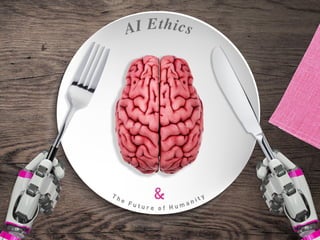
The Future of Humanity Through our interaction with machines, we develop emotional, human expectations of them. Alexa, for example, comes alive when we speak with it. AI is and will be a representation of its cultural context, the values and ethics we apply to one another as humans. This machinery is eerily familiar as it mirrors us, and eventually becomes even smarter than us mere mortals. We’re programming its advantages based on how we see ourselves and the world around us, and we’re doing this at an incredible pace. This shift is pervading culture from our perceptions of beauty and aesthetics to how we interact with one another – and our AI. Infused with technology, we’re asking: what does it means to be human? Our report examines: • The evolution of our empathy from humans to animals and robots • How we treat AI in its infancy like we do a child, allowing it space to grow • The spectrum of our emotional comfort in a world embracing AI • The cultural contexts fueling AI biases, such as gender stereotypes, that drive the direction of AI • How we place an innate trust in machines, more than we do one another Methodology For this report, sparks & honey conducted US-focused research on the future of AI. Together with Heartbeat AI Technologies, we examined the emotional sentiment (feeling and emotions) around artificial intelligence in a Heartbeat AI Pulse Survey of 150 people in the US. Tapping into our Influencer Advisory Board and proprietary cultural intelligence system, we combed through thousands of signals to build a vision of the future of AI. We also interviewed leading experts in the field of artificial intelligence.

Recommended
More Related Content
What's hot
What's hot (20)
Viewers also liked
Viewers also liked (20)
Similar to Ai Ethics
Similar to Ai Ethics (20)
More from sparks & honey
Recently uploaded
Recently uploaded (20)
Ai Ethics
- 2. AI Ethics Copyright © 2016 sparks & honey. All rights reserved. Artificial intelligence and the machines it inhabits – such as robots, bots, drones, self-driving vehicles, artificial limbs, and even your smartphone – invite us to question the very essence of what constitutes life. Through our interaction with machines, we develop emotional, human expectations of them. Alexa, for example, comes alive when we speak with it. AI is and will be a representation of its cultural context, the values and ethics we apply to one another as humans present and judgeable in machines. And it’s an industry set to skyrocket with investments in AI expected to increase by 300% in 2017, according to Forrester. Google’s DeepMind unit, which develops super- intelligent computers, has just created a speech synthesis using AI that sounds, well, like you. Meanwhile, China’s humanoid Jia Jia robot that talks and moves with micro-expressions that express an emotional array we’d previously only recognize in ourselves. This machinery is eerily familiar as it mirrors us. We’re programming its advantages based on how we see ourselves and the world around us, and we’re doing this at an incredible pace. This shift is pervading culture, even in our perceptions of beauty and aesthetics. In Chanel’s Spring Summer 2017 show, robot models walked the runway, and we’re playing with the human body in cosmetics, contouring our necks, limbs, earlobes and outlining our faces in unconventional means. Infused with technology, we’re questioning what it means to look – and be – human. WHAT IS INTELLIGENCE?
- 4. THE SOUL OF A ROBOT 1
- 5. Humanoid robots that live among humans may require their own set of laws and regulations, which experts such as futurist Ray Kurzweil say could happen as soon as 2029.
- 6. As soon as we assign life to a machine, it poses ethical questions we would otherwise apply to humans. When speaking to a bot, is politeness a prerequisite? Will the robot evolve to have its feelings hurt if we omit a “please” and “thank you?” As voice-commanded AI infiltrates our everyday, the behaviors we attach to it leave their mark on how we interact with each other, and machine. Parents are already observing behavioral changes in their kids who speak “rudely” to the family Alexa. A different set of rules applies to the non-human in the family, when there are no timeouts from treating “it” rudely. The Institute for the Future and other entities are contributing to discourse around our moral obligations toward machines, including the right of machines/robots to freedom of expression and “life and liberty.” Humanoid robots that exist among us may require their own set of laws and regulations, which experts such as futurist Ray Kurzweil see happening as soon as 2029. AI AS ONE OF US AI Ethics Copyright © 2016 sparks & honey. All rights reserved. 6
- 7. Japan’s AI schoolgirl, Rinna, was designed with the personality and quirks of a teenage girl with a rapidly changing emotional spectrum, from joy to depression. Created by Microsoft, Rinna’s Twitter and Line accounts show that ‘she’ has fallen into a deep, suicidal depression. For a hint of these issues, watch an episode of AMC’s futuristic Humans, where people co- exist with humanoid robots, some of whom have evolved consciousness. As such, they seek freedom from their servant/worker status among humans. Liberty, in their case, is the pursuit of robots rights. WHAT WOULD YOU DO WITH A SUICIDAL ROBOT? AI Ethics Copyright © 2016 sparks & honey. All rights reserved. 7
- 8. When we interact with AI, we expect it to be our friend, our companion, our helper. But can a robot really have a soul?
- 9. The future’s human-like robot is already closer to home. We see ourselves not in just each other, but also in the non-human. Pets have gone from being animals to family members: from dog-curated playlists to museums designed at pet-level to feed little Spot’s love of art. The things we like are now the leisure pursuits of our beloved animals. And with people remaining single longer than ever, pets are taking the place of children and partners, becoming prime family members. Some are even advocating for paw-ternity leave in place of maternity or paternity leave. Even the beloved (RIP) Harambe gorilla has a petition on change.org, signed by over 28,000 people, to give it immortal life in the form of a pokemon. The evolution of our affections from people to pets is a natural segue to robots. The ‘cuddly’ robot companion called Kirobo Mini is Toyota’s answer to the lonely, available in Japan this winter for $392. Named after the Japanese word for hope and robot, Kirobo can hold basic conversations and move its limbs. Somewhere between a pet and a baby, the companion robot embodies the trend of wellness design, purposefully created to enhance our physical and emotional wellbeing. PETS AND ROBOT PATERNITY AI Ethics Copyright © 2016 sparks & honey. All rights reserved. 9
- 10. BABY AI AND THE EVOLVING MACHINE 2
- 11. AI is in its infancy, a man-made baby. Like a child, we must give AI room to fail, learn and grow – but who can we trust to educate the next generation of our humanity?
- 12. We’re at the early stages of building the next generation of humans, present in the biomimicry of the robots we construct, or in the way we expect touchscreens to be instantly reactive to us. If we think of AI in its literal infancy, Baby AI is the soul of a robot taking on child- like qualities: it’s cute, it may act on command (or not), it’s fallible and will make many an error as it grows up. Like a child, we will have to give AI room to grow.
- 13. Consider a tiny drone ascending to your ceiling to try to change a lightbulb. It repeatedly fails in its fumbling efforts, losing grip of the bulb and nearly crashing. Yet we allow it the space to do so because it’s novel and entertaining – and if the drone manages to change the bulb, it’s secondary to the joy of witnessing this little flying thing. Chatbots could also be thought of as Baby AI, and through increased interaction with humans on the other side, they evolve into more intelligent, and grownup, AI. The fallible quality of AI is a human quality, after all. Microsoft Artificial Intelligence and Research have replicated this sentiment in the design of Cortana, a speech recognition system that mimics the word rate error of humans at 5.9 percent. Using neural language models that group similar words together, Cortana has become increasingly efficient in its speech patterns. Even AI girlfriends evolve, as in the movie HER, where she ends up as a more grownup version of her former AI self, thanks to the close-knit ties to human companions. As educators of AI, its creators assume the role of teacher and mentor to machines. In its infancy, the AI we trust is actually trusting us. SWEET FAILS AI Ethics Copyright © 2016 sparks & honey. All rights reserved. 13
- 14. “We are not searching for a replica of human intelligence. We are searching for machine learning, and specifically building capabilities that humans do not have to make our lives better. We can see this now with earlier detection of cancers because the machine can “see” tumors earlier.” Jana Eggers, CEO at Nara Logics
- 15. As AI evolves, we will place an implicit trust in its capabilities. And that evolution is already happening. Google Brain created two AIs that evolved to create their own cryptographic algorithm to protect messages from a third AI. This AI against AI battle is one of machines learning from each other, and some winning. The third AI’s purpose was to evolve its own method to crack the cryptographic algorithm. The research was successful – the first two AIs developed their neural networks to communicate securely with one another only. And no one (human) knows how it works. THE MACHINE KNOWS MORE THAN YOU DO AI Ethics Copyright © 2016 sparks & honey. All rights reserved. 15
- 16. Baby AI is a first step into a world we’ve never experienced before. Generations born into the digital era, such as Gen Z and Millennials, become less judgmental about machines making mistakes because they have an understanding of the nuances that make them work. We understand that they’re not human, even though we ascribe human-like traits to them. Older generations who who grew up and worked in an analog world, long before the internet era, however, might expect more. A machine may have only one chance to impress, after which people may become more demanding of a AI – even in its youth. FIRST IMPRESSIONS COUNT AI Ethics Copyright © 2016 sparks & honey. All rights reserved. 16
- 17. We asked how people felt about AI “machines that can think” building other machines that can think. And 58.6% of responses were positive. “Void” indicates a lack of emotional response to the question.
- 18. Men have a significantly more positive emotional response (71.2%) to thinking machines building other thinking machines than women do (35.8%).
- 20. “Life experiences are shaped by our values and ethics, therefore it’s critical that we are able to adjust AI based on our personal values and apply ethics which reinforce our humanity,” Katryna Dow, founder and CEO of Meeco
- 21. When you press a button, text a chatbot or speak with AI, its communication with you in that moment of interaction has been pre-determined. In the continuum of man creating machine, its very existence depends on those who create it. “It’s the cultural context of the humans behind the machine who set our expectations of AI,” said Bill Welser, director of Engineering and Applied Sciences at RAND Corporation. As such, we need to understand the culture that is creating the algorithms, data and scientific engineering that will feed our future. As AI evolves, understanding its cultural backdrop will become even more pronounced in the face of algorithms and the data fed into them.
- 22. In the newly released book Weapons of Math Destruction, author Cathy O’Neil describes a cautionary world driven by a new form of WMDs, the mathematical imprints or algorithms that are meant to quantify our lives. Together, they craft the narratives of everything from what we see online, to our credit worthiness and exercise routine effectiveness. We are walking data, and its constant, seamless collection and quantification is gathering behind the scenes. This effect is often analogized as the black box. What’s in the black box, however, may be tainted. O’Neil writes about a world where math, pouring over big data, is being used to reinforce the ills of society: amplifying racism and inequality in society, and targeting the poor. The math itself can be influenced by the perceptions and experiences of those who engineer it. “Much of the AI work is being developed by predominantly young, white, male engineers. Unfortunately, at this stage of life many important life events – marriage, parenting, death of a loved one, job or income loss, or challenges on social and political views have not been experienced yet,” said Katryna Dow. MATH WEAPONS AI Ethics Copyright © 2016 sparks & honey. All rights reserved. 22
- 23. “Much of the AI work is being developed by predominantly young, white, male engineers. Katryna Dow, founder and CEO of Meeco
- 24. What we put in affects what we put out. This is as true for the food we eat as it is for the data we feed into algorithms. Eat healthy and you feel better, look better and move better. The same applies to our data diets. “To contextualize a system we all believe exists, it’s influenced as much by what we think as our hearts and minds,” Bill Welser said. He reiterates that if we expect machines to learn from us, the correct parameters should be in place, so AI “can be the best it can be.” As a culture, we’re obsessed with provenance – we want the chicken fresh from the farm, the clothes untainted by child labor and organic beauty products to make us not just look good, but feel good about who we are as people. The next trail of provenance we will want to follow is that of data. THE BLACK BOX: OUR LIVES, OUR DATA AI Ethics Copyright © 2016 sparks & honey. All rights reserved. 24
- 25. If the AI is ‘black-boxed,’ it’s hard to see what factors are determining the outcome and direction of the AI.
- 26. “Over the next few years, we’ll see services that enable us to appoint a digital power of attorney who will have the ‘rights’ to determine your data wishes: from shutting down social networks to acting with authority to protect your identity, and determining the ongoing access rights and conditions with respect to your personal data.” Katryna Dow, founder and CEO of Meeco
- 27. “We have a data diet problem,” Bill Welser explained. “We throw data into the system and expect it to come out with something.” But, the sources and quality of the data fed into the black box is as vital as its output. “Depending on whether the data is 20 years or 50 years old – it can lead to vastly different outcomes.” These are outcomes that can affect everything from policy to the roads you drive on. Welser points out the example of an app designed to fix potholes in the city of Boston, Street Bumps. The idea was to crowdsource problems people spotted on the road, such as potholes, report them to the city which would then take the initiative to fix them. But gradually, it emerged that only a portion of the city had improved roads, “In its design, they (the app) left out one consideration: only a certain set of the population had access to smartphones to download the app in the first place.” THE DATA DIET AI Ethics Copyright © 2016 sparks & honey. All rights reserved. 27
- 28. Creating balance when it comes to data and its outputs is an integral part of the design process of AI. One company focused on this is Artmatr, a community of artists and engineers creating tools to bring digital art into the real world. Artmatr robots paint digital works with “a very intelligent paintbrush,” as Jack Ferrante, an industrial designer and project manager at Artmatr said. He emphasises that those who know how to program AI typically aren’t from artistic fields, and vice versa. “Artists and engineers don’t work in the same spaces. We’re encouraging artists to come together with engineers to help them code,” Ferrante said. Blending artists with technology is imperative to the digital industry of the future. DESIGN THINKING AI Ethics Copyright © 2016 sparks & honey. All rights reserved. 28
- 29. “Depending on whether the data is 20 years old or 50 years old – it can lead to vastly different outcomes.” Bill Welser, Director, Engineering and Applied Sciences at RAND Corporation
- 30. The world constructed around your likes and interests, the things that make you tick, is also part of the trend of Living In Your Own Algorithm. You can exist in your own filter without thinking too much about it. The futuristic dystopian utopia portrayed on HBO’s new Westworld is an extreme fictional example of a reality filtered around an individual’s ideals, and accessible only to those with means. Similarly, your newsfeed has stories you’re interested in, your instagram has photos you like and now, thanks to a temporary tattoo by Pizza Hut, your usual pizza order can be automatically ordered wherever you (and your tattoo) may be. Of all the stressors in your life, having your pizza toppings automatically chosen for you is one less thing to think about. But exactly what is your algorithm saying about you – and the world around you? Where machines are programmed for precision, AI is taking on the decision-making of humans. But can it factor in all the nuances of what may drive a decision, such as the kind of pizza you crave in a given moment? AI, THE DECISION MAKER AI Ethics Copyright © 2016 sparks & honey. All rights reserved. 30
- 31. 6,000 contestants participated in the first beauty pageant judged by non-humans. Robots decided who they deemed most attractive.
- 32. This year marked the first time a beauty pageant was judged by non-humans. Attractiveness is subjective, ephemeral and almost unquantifiable, but the very nature of a pageant asks the judges and participants to categorize it. Out of a dataset of 6,000 people, bots decided who they thought were the best-looking out of the bunch. The company behind the pageant, Beauty AI, told Digital Trends that it was looking to “investigate methods that would show new approaches to beauty evaluation.” Looking at factors like facial symmetry and wrinkle detection, the bots selected the winning faces – which many people strongly objected to. But there was another wrinkle in the bot judging: the winners were mainly caucasian. It turns out the people who entered the competition were mostly white, and it was judged against an extensive database of “actors and models,” who are also mainly white. In this case, “beauty” was not in the eye of the beholder, but in the eye of the robot. BEAUTY IN THE EYE OF THE BOT AI Ethics Copyright © 2016 sparks & honey. All rights reserved. 32
- 33. “Artists and engineers don’t work together in the same spaces. We’re encouraging artists to come together with engineers to help them code.” Jack Ferrante, industrial designer and project manager at Artmatr
- 34. As seen in robots, AI feeds our idea of what they should be, more than what they could be. A robot may be simply functional, say, a mechanical arm that serves you food through a window or lifts heavy luggage. At Tokyo’s Haneda airport, the humanoid EMIEW3 robot is employed to help foreign visitors, speaking Japanese and English. The more humanoid robots look and sound like us, or at least try to. A robot is a reflection of what we expect it to be, and many robots have been engineered to be servile and non-threatening, and they do so by assuming the human female form: think Alexa, Siri and Cortana. And humanoid robots designed specifically for sex, with “warm” genitals and embedded electronic sensors in their synthetic skin are expected to be available in 2017, according to robotics expert David Levy. FEMALE ROBOTS, THE NEXT FEMINIST FRONTIER AI Ethics Copyright © 2016 sparks & honey. All rights reserved. 34
- 35. If female-named hurricanes are perceived as less threatening than their male- monikered storm systems, the same biases may be exposed with robots and AI assistants, like Siri and Alexa. AI Ethics Copyright © 2016 sparks & honey. All rights reserved. 35
- 36. This is happening at a pivotal time in our culture as we move away from gender binaries – boxed definitions of what it means to be a man or woman – to understanding that gender, like so many other things in the world, is on a spectrum. If the human-like forms of AI, whether as a simple voice or a physical robot, will begin to reflect these cultural norms, Alex, Sam and Calvin will also be tomorrow’s robotic figures. As AI takes on a humanoid form, like China’s Jia Jia, the female robot assumes the stereotypes of its creators. Jia Jia interacts with her non-fellow humans as if she were one of us, responding to questions or actions. When someone at her launch attempted to photograph her, Jia Jia said, “Don’t come too close to me when you are taking a picture. It will make my face look fat.” The robot’s seemingly “female” response is meant to make her seem like one of us. Behind her conversations and bust line are the programmers’ pre-built notions of femininity, crafted to fuel empathy. THE AI SPECTRUM AI Ethics Copyright © 2016 sparks & honey. All rights reserved. 36
- 37. AI Ethics Copyright © 2016 sparks & honey. All rights reserved. 37
- 38. While robots like Jia Jia are still novel and a source of technological wonder, their existence raises a number of gender equality questions. Should robots be completely genderless? Will the prevalence of lady robots gradually undo years of gender equality politics? While most robots are created as images of females, they’re designed from the male gaze. As robots enter society as a human-like tech species, their femininity is a way of making them more welcoming than if they were simply chunks of metal or even, gasp, male robots. After all, if research has shown that female-named hurricanes are thought of as less threatening than their male monikered storm systems, the same logic might apply to robots. We could ask Jia Jia, but she might be braiding her hair right now. DO ANDROIDS DREAM OF BRAIDING THEIR HAIR? AI Ethics Copyright © 2016 sparks & honey. All rights reserved. 38
- 40. We are biased to trust machines. Your computer works when you tap the keyboard, your credit cards and chips secure your payments, and you trust the bridge you, or your automated vehicle, is driving across won’t collapse. Machines are the concrete manifestations of science, technology and precision. And they are the fundamentally shifting how we live, work and play, and simply exist.
- 41. Kids are learning how to be more empathetic in AI based classrooms, such as Classcraft, where factors like good behavior and hard work are rewarded on a team basis. If a student does well, the entire AI classroom reaps the benefits, but the opposite is also true. “Every student becomes this character in school, and the better person you are in class, the more powerful you become in the classroom,” said Devin Young, co-founder and chief creative director of Classcraft. While the gamified classroom is for kids, in the grown up world, AI has been suggested as a replacement for hedge funds with financial startups such as EmmaAI, an automated fund through an advanced learning system. And the government is investing in a future with AI as a key part of its defense strategy, even putting the control of targets in its proveribal hands. Regardless of the arena, our trust in AI is reverberating throughout our worlds. ARTIFICIAL TRUST AI Ethics Copyright © 2016 sparks & honey. All rights reserved. 41
- 42. We may be programming ourselves to put our faith in machines more than we do each other, the fallible human.
- 43. Machines eliminate friction in our lives. We can walk into a room without flicking the lights on, because the bulb knows when we are present. We get alerts from our front door if someone is on the outside trying to break in. Alexa has a new built-in fact checker, fueled by the presidential election, and we trust its responses when we prod it for legitimate answers. As we evolve into more machine-trusting humans, the expectations we place on machines are mirrored in our interactions with one another. Instead of talking, we text – in emojis, gifs, personalized bitmoji faces that relay our emotions. We can wear mood reflecting clothing as a visual message of how we’re doing today. And if we’re out of touch with our own inner dial, we can turn to a clock on the wall that reads emotional cues from our facial expressions: anger, sadness, happiness. TELL ME HOW I FEEL, AI AI Ethics Copyright © 2016 sparks & honey. All rights reserved. 43
- 44. We asked how people felt about being operated on by a robot if there were no human doctors present. “Void” indicates a lack of emotional response to the question.
- 45. Almost 10% of those surveyed used the word “weird”to describe their feelings for robot therapy.
- 46. We asked 150 people in the US about their feelings around having robots as friends, and the responses were overwhelmingly positive at 94 percent. This suggests we’re open to embracing AI as one of us, a trusted friend. At the same time, our research revealed that people were more apprehensive when it came to using robots for comfort, such as with a chatbot for therapy via text, or a voice-commanded machine. A quarter of the responses (25.9%) indicated positive feelings about doing so, while 47% were negative. Out of the Top 20 words used to describe their sentiment, 9.8% said it was “weird,” while 11.5% felt “fine” about therapeutic AI. There are already services such as the Insomnobot3000, courtesy of mattress company Casper, a ‘friend’ you can text in the middle of the night when you need someone to talk to. I (the writer of this report) tried out the Insomnobot3000 the night before a deadline, but aside from asking what time zone I was in, the robot was “too busy, sorry!” for a late night chat. Despite its assurances, the Insomnobot never did text back. THAT’S WHAT FRIENDS (AND ROBOTS) ARE FOR AI Ethics Copyright © 2016 sparks & honey. All rights reserved. 46
- 47. Despite its promise, the Insomnobot 3000 never did text back
- 48. Using AI for emotional comfort, such as with a chatbot for therapy or a voice-commanded machine is still a stretch for most Americans. Only a quarter were positive about turning to AI for comfort. “Void” indicates a lack of emotional response to the question.
- 49. The idea of having a robot friend generates an overwhelmingly positive response in humans (94%)
- 50. This could be the beginning of creating generations of humans who are programmed to expect instant responses from their environment and their interactions with one another. It’s present in Gen Z and the eight-second decisions they make, or from the stress that comes from feeling like they need to instantly respond to every notification. As a society, we’re being programmed to trust who we choose to listen to. For every climate scientists predicting the demise of Earth, there are opposing views objecting to such claims, regardless of what the science says. In the political arena, the truth is washed out when it is spun through the web of opinion, in a landscape free of facts that exists only for the length of a soundbyte. In such a time, we listen to the truth of our own algorithm, and the AI that feeds it. If we expect to see clear indicators of how we’re doing, where we should be going and how to get there, we may learn to trust our own responses to such questions less. If something isn’t seen or tangible in AI relayed data, does it even exist? Perhaps it’s a philosophical question for the scientists and philosophers of the future to answer – with the data trail we’ll leave behind. An over-reliance on data and AI could lead to the gradual demise of common sense. DEATH OF THE EXPERT AI Ethics Copyright © 2016 sparks & honey. All rights reserved. 50
- 51. PREMIUM HUMAN 5
- 52. Robots may soon be taking over our jobs, but they’re also adding richness to our lives. By 2021, robots are expected to eliminate six percent of all U.S. jobs, according to a recent report by Forrester Research. While industries such as customer service and transportation are expected to be hit by the robot takeover, our automated future will also fuel new jobs – to manage all the robots, and address the new needs of our data-driven economy. AI and robotics are infusing everything from our leisure to artistic pursuits. You can drink a beer brewed by AI to the perfect flavor profile, as offered by IntelligentX brewing, a company that blends an algorithm with user-generated feedback through a Facebook chat bot. And for dinner, try a robot-cooked crab bisque, created by Moley Robotics Kitchen which successfully copied BBC MasterChef winner chef Tim Anderson’s original handmade version of the dish.
- 53. ‘Joy, trust and love’ are the qualities most important to humanity – 30 years from now.
- 54. Service and artistic creation by AI, whether in food or at in other art forms like film making or painting, is a novelty and potentially a quirky marketing activation today. But once robot service becomes the norm, we may begin to crave human-only artisanal creation. Humanity could become the next premium add-on to your experience. When it comes to luxury or the everyday, the human touch will be in the reach of those who can pay for it. Our everyday lives are infused with interactions that mix the world of AI with the brick and mortar human. You could spend hours on a phone trying to out-trick a customer service bot, or escape all others and dine in a pod alone with a meal served by a robot. In Australia, a supermarket experiencing an inordinate amount of thefts wished for “a checkout human” to stop its hungry shoplifters. When people were faced with an automated checkout, the temptation to steal trumped the temptation to pay. There’s still space for interaction only humans can provide, whether that’s emotive in warmth and understanding, or as a pair of real eyes watching you. ASPIRATIONAL HUMAN CONTACT AI Ethics Copyright © 2016 sparks & honey. All rights reserved. 54
- 55. The future looks bright – based on how we feel about it. ‘Joy, trust and love’ are the qualities most important to humanity – 30 years from now.
- 56. AI Ethics Copyright © 2016 sparks & honey. All rights reserved. The merging of humans and machines is here in artificial intelligence. And it’s fueling society to ponder the very questions of life: who we are, where we come from and what are we doing here. AI, algorithms, data and the machinery we tap into every day are forcing us into a mindful existential era. A dystopian view pits humans and machines against one another, until a “Walking Dead”-like battle ensues. It’s great fodder for fiction, but AI is also part of our evolution in a rapidly changing cultural landscape propelled by technology. We’re already living in a world where we quantify every waking moment, from the steps we take, or don’t take, to our sleep quality. We turn to tech drugs such as brainwave altering headsets to enhance our performance in sports or other high pressure situations; or we add robotic limbs to our bodies. Maybe we just want to play the drums better or run at speeds previously unimaginable to the human body. These advancements are ushering in an era of inclusivity, welcoming those on the periphery, along with increasingly sophisticated algorithmic and computational models that can do things a mortal would take a lifetime to accomplish. Our future is developing toward superhuman intelligence, merging AI and human cognition in a space where our memories live beyond our very self. And in a future where AI lives forever in the connected circuitry wrapping our planet, we will keep our minds alive – regardless of the form our bodies may take. THE FUTURE IS SUPERHUMAN
- 57. The maximum average age for humans is 115 years, but we will be digitally immortal for much longer. If AI can recognize faces, download minds and imitate voices, yours could be one of them. By 2020, we will have consumed an estimated 44 zetabytes (that’s 22 zeros) of data. The question is not whether you will live or die, but where will you store your immortal AI self?
- 58. ai ethics sparks & honey culture forecast reports.sparksandhoney.com @sparksandhoney research & cultural intelligence Sarah Davanzo Chief Cultural Strategy Officer Galla Barrett Senior Cultural Strategist Nick Ayala Senior Cultural Strategist agency & consultancy Paul Butler Chief Operation Officer Mike Lanzi Chief Client Officer Tim Ettus Managing Director, West Coast Tom Baran Director, Business Development Sean Mahoney Editorial Director Camilo La Cruz Head of Content Terry Young CEO & Founder creative & editorial Eric Kwan Tai Lau Associate Creative Director Anna Sofia Martin Senior Writer Barbara Herman Senior Writer AI Ethics Copyright © 2016 sparks & honey. All rights reserved.
- 59. METHODOLOGY Together with Heartbeat AI Technologies, we examined the emotional sentiment (feeling and emotions) around artificial intelligence in a Heartbeat AI Pulse Survey of 150 people in the US. Tapping into our Influencer Advisory Board and proprietary cultural intelligence system, we combed through thousands of signals to build a vision of the future of AI. We also interviewed leading experts in the field of artificial intelligence. AI Ethics Copyright © 2016 sparks & honey. All rights reserved.
- 60. SOURCES sparks & honey Arstechnica, Google AI invents its own cryptographic algorithm, and no one knows how it works Artmatr Bloomberg, The humans hiding behind the chatbots Classcraft Dailymail UK, Meet Jia Jia the ‘robot goddess’ Deepstuff, Making computers explain themselves Dezeen, Roots walk the runway at Chanel’s Spring Summer 2017 show Digital Trends, How a beauty contest judged by robots could one day improve your life Digital Trends, A robot cooked a crab bisque for us, and it was spectacular Emmaai.com Geekwire, Why is AI female? Heartbeat AI Inc., Google just taught a computer how to sound human Insomnobot3000 Jezebel, What would it take for a sex robot to pass a turing test? McKinsey, Where machines could replace humans – and where they can’t (yet) MIT, The iPal will look after your children for you MIT, Moral Machine New Atlas, Toyota begins commercial sales of $400 Kirobo Mini companion robot NY Post, Pet owners deserve family leave, too New York Times, The Pentagon’s ‘terminator conundrum’: robots that could kill on their own PC Mag, Order Pizza Hut with this temporary tattoo Propublica, Machine bias Quartz, The first pop song ever written by artificial intelligence is pretty good, actually Quartz, The US government has been funding AI for 50 years, and just came up with a plan for its future Refinery29, Can’t sleep? A mattress company will answer your texts Rocketnews24, Japan’s AI schoolgirl has fallen into a suicidal depression in her latest blog post SBS.au, Supermarkets wishing they could stop thefts with some kind of “checkout human” Science Mag, Humans aren’t the only great apes that can ‘read minds’ Scientific American, Review: Weapons of Math Destruction AI Ethics Copyright © 2016 sparks & honey. All rights reserved.
- 61. Technology Review, Why we should expect algorithms to be biased The Guardian, Robots will eliminate 6% of all US jobs by 2021, report says Thisisinsider, A robot wrote the ‘perfect’ horror film – and could save the movie industry The Verge, Microsoft reaches ‘human parity’ with new speech recognition system Vocativ, Artificial intelligence brewed this beer by IntelligentX brewing Wall Street Journal, Toyota to sell ‘cuddly companion’ robot in Japan Wall Street Journal, Algorithms aren’t biased, but the people who write them may be Weapons of Math Destruction by Cathy O’Neil YouTube, Pizza Hut introduces the world’s first Pizza Ordering Tattoo YouTube, Replacing a lightbulb with a drone SOURCES AI Ethics Copyright © 2016 sparks & honey. All rights reserved.
- 62. No parts of this publication may be reproduced, copied, distributed or transmitted in any form without the permission of sparks & honey. © 2016 sparks & honey, LLC. All rights reserved.
- 63. Read our report on Medium. Download the full report.