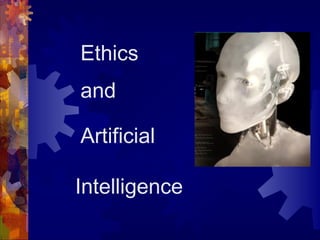
Ethics
and
Artificial
Intelligence
From our
earliest
beginnings,
mankind has
contemplated a
future in which
our creations
can replace
human labour.
“If every tool, when ordered, or
even of its own accord, could do
the work that befits it, just as
the creations of Daedalus moved
of themselves . . . If the weavers'
shuttles were to weave of
themselves, then there would be
no need either of apprentices for
the master workers or of slaves
for the lords.”
Aristotle
(from Atheniensium Republica)
However, caution has also been urged
by those who see the potential for
harm in AI:
“…since we do not now have
any ways of making
computers wise, we ought not
now to give computers tasks
that demand wisdom.”
(Joseph Weizenbaum,
Computer Power 227)
In this presentation, I will focus on
the ethical dilemmas associated with
AI as they αναφερθείτε to human
beings…

…not our creations.
What are our fears?
Patricia Warrick identifies four themes in Mary Shelley’ s
Frankenstein that re-emerge in science fiction over the ages:
1) Promethean Theme – man stealing
knowledge from the gods unintended for our
use.
2) Ambiguity of Technology – will what we
create ultimately benefit or hinder
humanity?
3) Irresponsibility of Science – a lack of
foresight and ethical concern associated
with science.
4) Reversal of Master-Servant Role –
technology created to serve humanity
becomes its master.
In this presentation, the main focus will
be on two of Warrick’s pervasive
themes as they relate to AI:

1)Ambiguity of Technology
2)Reversal of MasterServant Role
In her article addressing the ambiguity we feel
towards the role of technology in our lives,
Margaret Boden raises some interesting points.
On the positive side…


AI could expand our capacity for knowledge,
creativity, and problem solving



In the classroom, computer-assisted AI wouldn’t
undermine student progress and self-esteem



AI may “rehumanize” society as we have more
time to devote to humanistic endeavours
On the negative side…


Without political or social controls, AI may
endanger humanity (ie. military defense) or
impede our autonomy and privacy (ie. government
databases)



What would be the social costs of an automated
work force where the work of a few supported the
many?



How would such changes affect who we are and
our attitudes towards what we value?
Nick Bostrom suggests other
frightening insights related to AI:
“Artificial minds can be easily
copied.”
“Human-level artificial intelligence leads quickly to
greater-than-human-level artificial intelligence.”
“Technological progress in other
fields will be accelerated by the
arrival of artificial intelligence.”
“Unlike other technologies, artificial
intelligences are not merely tools.
They are potentially independent
agents.”
Yikes!!
Might this lead to a reversal of
Master-Servant roles?
Raymond Kurzweil writes about the arrival
of a Second Industrial Revolution in the
prologue to his book The Age of Intelligent
Machines (1990).

This AI Revolution will impact our lives in
several ways:
Economic Impact







Scarcity of jobs (especially mentally unstimulating
ones)
Fewer blue collar and white collar jobs
Challenge to our Protestant work ethic
Countries that discourage independent thought in
their citizens will be at a disadvantage when AI
revolutionizes menial work
Countries with access to technology and resources
will be key players in the future
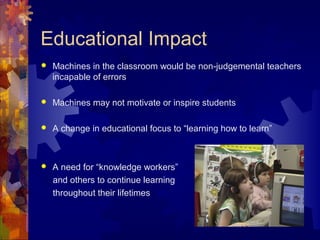
Educational Impact


Machines in the classroom would be non-judgemental teachers
incapable of errors



Machines may not motivate or inspire students



A change in educational focus to “learning how to learn”



A need for “knowledge workers”
and others to continue learning
throughout their lifetimes
Medical Impact


Devices designed to give advanced warning before our bodily
systems are endangered



Doctors and nurses relegated to marginalized roles



People take more responsibility for their own health using
machines to diagnose their problems and propose treatment



Silicon chips to replace damaged nerve cells



Robotic surgeons to increase precision
Military Impact
 Laser

and particle beam weapons
 Smart weapons
 Planes without pilots
Social / Re-humanizing Impact


Less need for an urbanized workforce as people
move away from cities



More devices available to assist handicapped people



Increase in the value of interpersonal relations as
machines are impersonal



Direct relationship between
increased leisure time and
increased social contact



Impact of less competition
in the workforce
I believe that in the short term, AI will
continue to bring us many useful devices
that will enhance our quality of life:
Medical advances
Leisure opportunities
Communication devices
Entertainment options
Labour-saving devices
Human nature being what it is, however, at
some point in the near future we will be
faced with the question:

Just because we CAN do something,
does that mean we SHOULD?
Who will make these decisions?
On whose authority?

Once we’ve reached this point,
will it be too late to choose a
different path?
The decisions we make today are all steps
towards a future we may not be prepared for…

…will we recognize ourselves by the end
of this century?
References
Boden, M. “The Age of Intelligent Machines.” (1990)
http://www.kurzweilai.net/meme/frame.html?main=/articles/art0162.html
Bostrom, N. “When Machines Outsmart Humans.” Futures. Vol. 35:7, pp.759-764,
2000.
http://www.nickbostrom.com/2050/outsmart.html
Davies, O., ed. The Omni Book of Computers and Robots. New York:
Kensington Publishing Corp., 1982.
Kurzweil, R. “The Age of Intelligent Machines” 1990.
http://www.kurzweilai.net/meme/frame.html?main=/meme/
Warrick, P. The Cybernetic Imagination in Science Fiction. Cambridge,
Mass.: MIT Press, 1980.
Weizenbaum, J. “Computer Power and Human Reason.” San Francisco, CA:
W.H. Freeman, 1976.
http://www.gslis.utexas.edu/~palmquis/courses/reviews/amy.htm

Ethics and AI

  • 1.
  • 2.
    From our earliest beginnings, mankind has contemplateda future in which our creations can replace human labour.
  • 3.
    “If every tool,when ordered, or even of its own accord, could do the work that befits it, just as the creations of Daedalus moved of themselves . . . If the weavers' shuttles were to weave of themselves, then there would be no need either of apprentices for the master workers or of slaves for the lords.” Aristotle (from Atheniensium Republica)
  • 4.
    However, caution hasalso been urged by those who see the potential for harm in AI: “…since we do not now have any ways of making computers wise, we ought not now to give computers tasks that demand wisdom.” (Joseph Weizenbaum, Computer Power 227)
  • 5.
    In this presentation,I will focus on the ethical dilemmas associated with AI as they αναφερθείτε to human beings… …not our creations.
  • 6.
  • 7.
    Patricia Warrick identifiesfour themes in Mary Shelley’ s Frankenstein that re-emerge in science fiction over the ages: 1) Promethean Theme – man stealing knowledge from the gods unintended for our use. 2) Ambiguity of Technology – will what we create ultimately benefit or hinder humanity? 3) Irresponsibility of Science – a lack of foresight and ethical concern associated with science. 4) Reversal of Master-Servant Role – technology created to serve humanity becomes its master.
  • 8.
    In this presentation,the main focus will be on two of Warrick’s pervasive themes as they relate to AI: 1)Ambiguity of Technology 2)Reversal of MasterServant Role
  • 9.
    In her articleaddressing the ambiguity we feel towards the role of technology in our lives, Margaret Boden raises some interesting points.
  • 10.
    On the positiveside…  AI could expand our capacity for knowledge, creativity, and problem solving  In the classroom, computer-assisted AI wouldn’t undermine student progress and self-esteem  AI may “rehumanize” society as we have more time to devote to humanistic endeavours
  • 11.
    On the negativeside…  Without political or social controls, AI may endanger humanity (ie. military defense) or impede our autonomy and privacy (ie. government databases)  What would be the social costs of an automated work force where the work of a few supported the many?  How would such changes affect who we are and our attitudes towards what we value?
  • 12.
    Nick Bostrom suggestsother frightening insights related to AI: “Artificial minds can be easily copied.” “Human-level artificial intelligence leads quickly to greater-than-human-level artificial intelligence.” “Technological progress in other fields will be accelerated by the arrival of artificial intelligence.” “Unlike other technologies, artificial intelligences are not merely tools. They are potentially independent agents.”
  • 13.
    Yikes!! Might this leadto a reversal of Master-Servant roles?
  • 14.
    Raymond Kurzweil writesabout the arrival of a Second Industrial Revolution in the prologue to his book The Age of Intelligent Machines (1990). This AI Revolution will impact our lives in several ways:
  • 15.
    Economic Impact      Scarcity ofjobs (especially mentally unstimulating ones) Fewer blue collar and white collar jobs Challenge to our Protestant work ethic Countries that discourage independent thought in their citizens will be at a disadvantage when AI revolutionizes menial work Countries with access to technology and resources will be key players in the future
  • 16.
    Educational Impact  Machines inthe classroom would be non-judgemental teachers incapable of errors  Machines may not motivate or inspire students  A change in educational focus to “learning how to learn”  A need for “knowledge workers” and others to continue learning throughout their lifetimes
  • 17.
    Medical Impact  Devices designedto give advanced warning before our bodily systems are endangered  Doctors and nurses relegated to marginalized roles  People take more responsibility for their own health using machines to diagnose their problems and propose treatment  Silicon chips to replace damaged nerve cells  Robotic surgeons to increase precision
  • 18.
    Military Impact  Laser andparticle beam weapons  Smart weapons  Planes without pilots
  • 19.
    Social / Re-humanizingImpact  Less need for an urbanized workforce as people move away from cities  More devices available to assist handicapped people  Increase in the value of interpersonal relations as machines are impersonal  Direct relationship between increased leisure time and increased social contact  Impact of less competition in the workforce
  • 20.
    I believe thatin the short term, AI will continue to bring us many useful devices that will enhance our quality of life: Medical advances Leisure opportunities Communication devices Entertainment options Labour-saving devices
  • 21.
    Human nature beingwhat it is, however, at some point in the near future we will be faced with the question: Just because we CAN do something, does that mean we SHOULD?
  • 22.
    Who will makethese decisions? On whose authority? Once we’ve reached this point, will it be too late to choose a different path?
  • 23.
    The decisions wemake today are all steps towards a future we may not be prepared for… …will we recognize ourselves by the end of this century?
  • 24.
    References Boden, M. “TheAge of Intelligent Machines.” (1990) http://www.kurzweilai.net/meme/frame.html?main=/articles/art0162.html Bostrom, N. “When Machines Outsmart Humans.” Futures. Vol. 35:7, pp.759-764, 2000. http://www.nickbostrom.com/2050/outsmart.html Davies, O., ed. The Omni Book of Computers and Robots. New York: Kensington Publishing Corp., 1982. Kurzweil, R. “The Age of Intelligent Machines” 1990. http://www.kurzweilai.net/meme/frame.html?main=/meme/ Warrick, P. The Cybernetic Imagination in Science Fiction. Cambridge, Mass.: MIT Press, 1980. Weizenbaum, J. “Computer Power and Human Reason.” San Francisco, CA: W.H. Freeman, 1976. http://www.gslis.utexas.edu/~palmquis/courses/reviews/amy.htm