Artificial intelligence
NameRahulMehta
UID19BCA1033
Contents
• Definition
• Early History
• Current status of AI
• Challenges for AI
• Future of AI
• Pros & Cons
• Conclusion
What is AI?
• The studyofcomputersystemsthatattempttomodel andapplytheintelligence ofthe humanmind.
• A branchofcomputerscience dealing with thesimulationofintelligent behaviorin computers.
• The capabilityofamachine toimitateintelligent humanbehavior.
Examples of AI
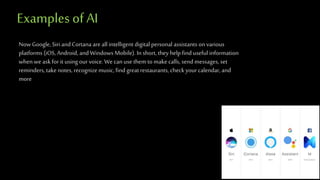
NowGoogle, Siri and Cortana are all intelligent digital personal assistants on various
platforms (iOS,Android, and Windows Mobile). In short, they helpfind useful information
when we ask for it using our voice. We can use them to make calls, send messages, set
reminders, take notes, recognizemusic, find greatrestaurants, check your calendar, and
more
Early History
In 1950 English mathematician Alan Turing wrote a landmark papertitled “Computing
Machinery and Intelligence” that asked the question: “Can machines think?”
Further work cameout of a 1956 workshop at Dartmouth sponsored by John McCarthy. In the
proposal for that workshop, he coinedthe phrase a “study of Artificial Intelligence”
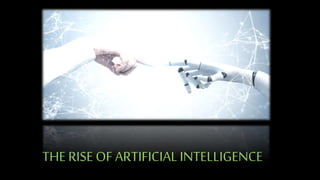
THE RISE OF ARTIFICIALINTELLIGENCE
CurrentAI Status
AIhave takenmany shapes and forms over recent years
oMobilePhones( Siri/Cortana)
oVideoGamesCharacters
oGPS/ VoiceRecognition
oRobotics.
Google hasbeen a major play on AI transcendence and Deep Learning. o Deep learning is a
machine learning based on algorithms.
CHALLENGES
• ComputingPower
• Tolerance Power
• IntuitiveThinking
• JudgingPowe
FUTUREOF AI
• Beyond negotiation,Moore says CMU is bettingseveral other AI areas are going to be
hugelyimportantin thenear future.
• Self Driving Cars.
• Improved Medical Care & Treatment.
• Open up doors to futureexplorations.
PROS & CONS
Pros
• Precision andAccuracy
• Spaceexploration
• Used formining process
• Candolaborioustasks
• Frauddetection,managerecords
CONS
• Notableto actanydifferent
• Lackthe humantouch
• Lacka creativemind
• Lackcommon sense
• Unemployment
CONCLUSION
Finally wecan say that the Artificial Intelligence (AI) is the
intelligence ofmachines and the branch ofComputer Sciencethat
aims to createit.AI textbooks define the field as “ TheStudy and
Design of Intelligent Agents” where an intelligent agent is a system
that perceives it’s environment and takes actions that maximize the
chances of it’s success. John McCarthy ,who coinedthe termin
1955, defines it as “The Science and Engineering of making
intelligent Machines”
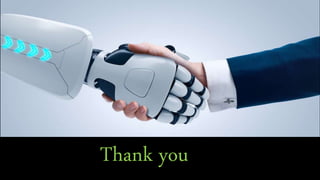
Thank you

Artificial intelligence PPT (AI PPT)

  • 1.
  • 2.
    Contents • Definition • EarlyHistory • Current status of AI • Challenges for AI • Future of AI • Pros & Cons • Conclusion
  • 3.
    What is AI? •The studyofcomputersystemsthatattempttomodel andapplytheintelligence ofthe humanmind. • A branchofcomputerscience dealing with thesimulationofintelligent behaviorin computers. • The capabilityofamachine toimitateintelligent humanbehavior.
  • 4.
    Examples of AI NowGoogle,Siri and Cortana are all intelligent digital personal assistants on various platforms (iOS,Android, and Windows Mobile). In short, they helpfind useful information when we ask for it using our voice. We can use them to make calls, send messages, set reminders, take notes, recognizemusic, find greatrestaurants, check your calendar, and more
  • 5.
    Early History In 1950English mathematician Alan Turing wrote a landmark papertitled “Computing Machinery and Intelligence” that asked the question: “Can machines think?” Further work cameout of a 1956 workshop at Dartmouth sponsored by John McCarthy. In the proposal for that workshop, he coinedthe phrase a “study of Artificial Intelligence”
  • 6.
    THE RISE OFARTIFICIALINTELLIGENCE
  • 7.
    CurrentAI Status AIhave takenmanyshapes and forms over recent years oMobilePhones( Siri/Cortana) oVideoGamesCharacters oGPS/ VoiceRecognition oRobotics. Google hasbeen a major play on AI transcendence and Deep Learning. o Deep learning is a machine learning based on algorithms.
  • 8.
    CHALLENGES • ComputingPower • TolerancePower • IntuitiveThinking • JudgingPowe
  • 9.
    FUTUREOF AI • Beyondnegotiation,Moore says CMU is bettingseveral other AI areas are going to be hugelyimportantin thenear future. • Self Driving Cars. • Improved Medical Care & Treatment. • Open up doors to futureexplorations.
  • 10.
    PROS & CONS Pros •Precision andAccuracy • Spaceexploration • Used formining process • Candolaborioustasks • Frauddetection,managerecords CONS • Notableto actanydifferent • Lackthe humantouch • Lacka creativemind • Lackcommon sense • Unemployment
  • 11.
    CONCLUSION Finally wecan saythat the Artificial Intelligence (AI) is the intelligence ofmachines and the branch ofComputer Sciencethat aims to createit.AI textbooks define the field as “ TheStudy and Design of Intelligent Agents” where an intelligent agent is a system that perceives it’s environment and takes actions that maximize the chances of it’s success. John McCarthy ,who coinedthe termin 1955, defines it as “The Science and Engineering of making intelligent Machines”
  • 12.