Baby to Bot: Future of the Ability Spectrum
economics of
Copyright © 2017 sparks & honey. All rights reserved.
2
METHODOLOGY
Economics of Ability / Ability Spectrum /
For this report, sparks & honey conducted primary
research and interviewed experts in the field of
ability, including thought leaders from our
Influencer Advisory Board (IAB). We surveyed 1,009
people in the US, aged 18 to 65, to engage their
perceptions on evolving technologies. Leveraging
social listening, patent analysis, and our
proprietary Cultural Intelligence system, we combed
through thousands of signals to build a vision of
the future cultural landscape of ability.
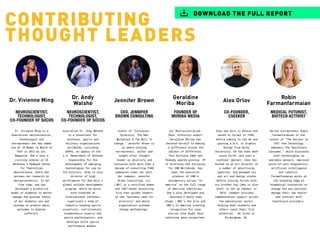
CONTRIBUTING 

THOUGHT LEADERS
Dr. Vivienne Ming Jennifer Brown
Dr. Andy
Walshe
Geraldine
Moriba
NEUROSCIENTIST,
TECHNOLOGIST,
CO-FOUNDER OF SOCOS
Dr. Vivienne Ming is a
theoretical neuroscientist,
technologist and
entrepreneur who was named
one of 10 Women to Watch in
Tech in 2013 by Inc.
Magazine. She’s also a
visiting scholar at UC
Berkeley's Redwood Center
for Theoretical
Neuroscience, where she
pursues her research in
neuroprosthetics. In her
free time, she has
developed a predictive
model of diabetes to better
manage the glucose levels
of her diabetic son and
systems to predict manic
episodes in bipolar
sufferers.
NEUROSCIENTIST,
TECHNOLOGIST,
CO-FOUNDER OF SOCOS
CEO, JENNIFER
BROWN CONSULTING
FOUNDER OF 

MORIBA MEDIA
Alex Orlov


CO-FOUNDER, 

CSEEKER
Australian Dr. Andy Walshe
is a consultant for
business, sports and
military organizations
worldwide, including
DARPA, an agency of the
U.S. Department of Defense
responsible for the
development of emerging
technologies for use by
the military. Andy is also
director of high
performance for Red Bull's
global athlete development
program, where he works
with hundreds of
international athletes;
supervises a team of
industry-leading sports
scientists, nutritionists,
biomechanics experts and
sports psychologists; and
develops elite sports
performance models.
Author of “Inclusion:
Diversity, The New
Workplace & The Will To
Change,” Jennifer Brown is
an award-winning
entrepreneur, author and
sought-after thought
leader on diversity and
inclusion with more than a
decade of consulting F500
companies under her belt.
Her company, Jennifer
Brown Consulting, LLC
(JBC) is a certified woman
and LGBT-owned consulting
firm that guides leaders
on the “business case for
diversity” and whole
organization systems
change methodology.
Our Multiculturalism,
Race, Ethnicity expert
Geraldine Moriba has
devoted herself to making
a difference around the
subject of difference.
This multiple Emmy and
Peabody awards-winning VP
of Diversity and Inclusion
for CNN Worldwide, has
been the executive
producer of CNN's
documentary series “In
America” on the full range
of American identities.
She’s also developed and
launched 2 daily news
blogs – NBC’s The Grio and
CNN’s In America creating
recognition for news
stories that might have
otherwise gone unreported.
Alex was born in Russia and
moved to Israel in 1990,
before coming to the UK and
gaining a B.A. in Graphic
Design from Derby
University. He has been Deaf
since birth, and uses a
cochlear implant. Alex has
worked as an art director at
a number of advertising
agencies, and managed his
own art and design studio
before joining forces with
his brother Guy (who is also
Deaf) to set up cSeeker in
2014. cSeeker provides
communication support across
the educational sector,
helping Deaf students and
others reach their full
potential.  He lives in
Birmingham, UK.
Robin
Farmanfarmaian


MEDICAL FUTURIST,
BIOTECH ACTIVIST
Serial entrepreneur Robin
Farmanfarmaian is the
author of “The Patient as
CEO: How Technology
Empowers the Healthcare
Consumer,” which discusses
such technologies as
wearable sensors, improved
point-of-care diagnostics,
artificial intelligence
and robotics.
Farmanfarmaian works at
the bleeding edge of
biomedical innovation to
change the way patients
manage their own health
and interact with
healthcare providers.
Economics of Ability / Ability Spectrum
Copyright © 2017 sparks & honey. All rights reserved.
“ ”It’s a hard time to be a human.
Conversely, it’s never been more thrilling
to be a human, or part robot, than now.
Copyright © 2017 sparks & honey. All rights reserved.
5
THE CULTURAL TIDE
TOWARD ABILITY
Economics of Ability / Ability Spectrum /
The world is no longer a simplistic divide of us
versus them, or any other binary. Across the cultural
tide, we’re seeing how humanity is taking the place of
the other – whether it’s with gender, age, race, or
even machines. At the same time, the rising populist
nationalism, from the White House to Europe, poses an
ever-tightening tension to these cultural shifts.
With these blurring lines, cohorts of people who have
traditionally been in the periphery are being embraced
in the mainstream. This cultural tide is evident in
everything from freckles as the coveted look-du-jour
in beauty to inclusive design permeating our urban
spaces and products, or in broader social terms,
parental leave aspirations for any composition of the
modern family: whether same sex, single or married.
Policy is often slow to reflect these shifts in a non-
binary culture, but eventually some pierce the
bureaucratic bubble. In New York City, schools have
just been mandated by the local government to address
transgender students by their pronoun of choice—they,
them, their, for example.
Economics of Ability / Ability Spectrum
Copyright © 2017 sparks & honey. All rights reserved.
“ ”The binary also limits us. Traditionally, we’ve thought
of binaries with diversity, and inclusion: when we say
“diverse talent” in organizations, for example, it is
meant to refer to “minority” identities or those less-
represented, whether it be race, ethnicity, gender,
sexual orientation, or ability. This sets up an “us” vs.
“them” dynamic, whereas the reality is more fluid,
and becoming even more so, as identity blurs.
Jennifer Brown 

author of “Inclusion: Diversity, The New Workplace & The Will To Change,” 

sparks & honey Influencer Advisory Board (IAB) member
Copyright © 2017 sparks & honey. All rights reserved.
7Economics of Ability / Ability Spectrum /
The taboos are being lifted on old ways of living,
by challenging our perceptions of the world we’re
living in, and will live in.
The same holds true when it comes to our physical
or cognitive ability. Leaning on technology and
design, we are in an era of augmenting, tinkering,
and enhancing our abilities, whether cognitive or
physical. We may be more alert or productive
thanks to using a mediation app, immersing
ourselves in environments constructed around
nature, or boosting our physical endurance by
altering our brain waves.
From the mundane to the futuristic, our abilities
as humans (and machines) evolve throughout our
days and lifetimes. This spectrum of ability is a
constant reverberating tide that affects all of
us, and moves culture.
When we’re not talking to, or about, each other, we’re
communicating through our intensely connected labyrinth
of devices, wearables, and voice-assisted techy guides.
And those devices are fueling human potential. In Adam
Piore’s new book, “The Body Builders: Inside the Science
of the Engineered Human,” he posits a world where
bioengineers are harnessing technology to tap into
unlocked ability in the human body and mind. Think
computers translating neural brain patterns of your
thoughts into words.
We’re in an era of dissolving lines between human and
machine. After all, you can brand yourself with a tech
tattoo that automatically orders your favorite pizza (if
you really, really like Pizza Hut), or swallow a
wireless thermometer like the e-Celsius by BodyCap,
designed to monitor your core temperature—from the
inside out.
But these intimate connections blur the very boundaries,
or binaries, of humans and technology. Where does one
start and the other begin? Amazon has boldly suggested
that its Echo be given First Amendment rights, when one
was subpoenaed as a potential murder witness. If the
Echo did record the final moments of a person’s life,
the digital imprint of their final moments takes on a
life of its own. It may seem extreme, but we’ll continue
to see such lines blur between humans and machines.
Copyright © 2017 sparks & honey. All rights reserved.
8Economics of Ability / Ability Spectrum /
And here’s why. The perception of who is able and
who may not be able is connected to power and to
the assumptions or stereotypes attached to such
hierarchies and societal assumptions. One example
is the differences in between the Olympics and
Paralympics, which run in tandem. NBC’s coverage
focused on airing the Olympics, leaving
Paralympian media exposure in the dust.
Conversely, the UK’s Channel 4 spot, a Rio
Paralympics 2016 trailer called, “We’re the
Superhumans,” was lauded for its impact and grit,
showing more than 140 people with disabilities
alongside athletes. Its “unbridled celebration of
ability,” as Channel 4’s CMO Dan Brook told
Adweek, brought the breadth of human potential to
audiences. At the same time, Paralympic athletes
such as Gold medalist Abdellatif Baka, finished
1.7 seconds faster than Olympic champion Matthew
Centrowitz. “A lack of inclusion restricts us all
in understanding the full spectrum of human
potential,” said Andy Walshe, who is also a sparks
& honey IAB member.
The current political climate is increasingly
highlighting the needs of anyone who is not an old,
white male. There’s a complex undercurrent of bias
in current policy and government affairs, explains
Dr. Andy Walshe, a human potential hacker who serves
on the Science & Technology Board at Defense
Advanced Research Projects Agency (DARPA). But
against the growing tide of extremist politics,
whether it’s the rights to medical insurance, gender
equality or immigrant policies at play, there is an
ever-vocal groundswell of resistance against
policies and stereotypes that pit one against the
other. On January 21, 2017, over four million people
marched on behalf of the Women’s March—including the
largest-ever gathering of disability activists (in
the US), estimated at 45,000. As the socio-political
climate continues to section the world into
binaries, we can only expect for the voices of
dissent to grow louder.
ABILITY =
HUMAN
POTENTIAL
Economics of Ability / Ability Spectrum
Copyright © 2017 sparks & honey. All rights reserved.
BillionPeople globally who live with some form of
disability — or 15% of the world’s population.
- The World Bank
Copyright © 2017 sparks & honey. All rights reserved.
10Economics of Ability / Ability Spectrum /
In this light, the idea of human potential, or
simply, ability, is limited by fear. “For those in
a position of power, this is fear of the unknown,
of discomfort (real or perceived), of loss of
status, or loss of control. For those without
power, discomfort, lack of status, and lack of
control are daily realities,” said Jennifer Brown,
author of “Inclusion: Diversity, The New Workplace
& The Will To Change,” and sparks & honey IAB
member.
In a world beyond binaries, we are part of a vast,
influential range of abilities, both cognitive and
physical, that are constantly in flux and
influencing one another. Whether we see it or not,
we’re all connected, and all deserving of the
spaces we occupy: from home to school to work. As
we infuse our lives with technology and look to
robots for companionship, entertainment and
assistance, Ability, in this context, is about
human and civil rights. And maybe even, robot
rights.
It begs the question, what does tomorrow look like
– for all of us?
TABLE OF CONTENTS
ABILITY SPECTRUM12-17
FASHIONABLE18-30
DESIGNED FOR GOOD31-54
EMPATHY TECH55-69
SUPER-ABLED70-81
ABILITY
SPECTRUM
Economics of Ability / Ability Spectrum /
Copyright © 2017 sparks & honey. All rights reserved.
13
THE
ABILITY
SPECTRUM
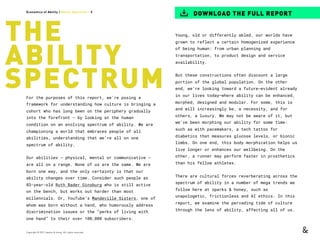
Young, old or differently abled, our worlds have
grown to reflect a certain homogenized experience
of being human: from urban planning and
transportation, to product design and service
availability.
But these constructions often discount a large
portion of the global population. On the other
end, we’re looking toward a future–evident already
in our lives today–where ability can be enhanced,
morphed, designed and modular. For some, this is
and will increasingly be, a necessity, and for
others, a luxury. We may not be aware of it, but
we’ve been morphing our ability for some time:
such as with pacemakers, a tech tattoo for
diabetics that measures glucose levels, or bionic
limbs. On one end, this body morphication helps us
live longer or enhances our wellbeing. On the
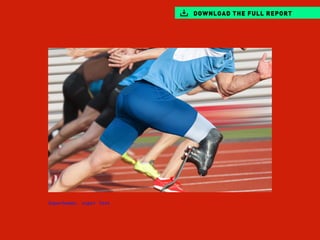
other, a runner may perform faster in prosthetics
than his fellow athletes.
There are cultural forces reverberating across the
spectrum of ability in a number of mega trends we
follow here at sparks & honey, such as
unapologetic, frictionless and AI ethics. In this
report, we examine the pervading tide of culture
through the lens of ability, affecting all of us.
For the purposes of this report, we’re posing a
framework for understanding how culture is bringing a
cohort who has long been on the periphery gradually
into the forefront – by looking at the human
condition on an evolving spectrum of ability. We are
championing a world that embraces people of all
abilities, understanding that we’re all on one
spectrum of ability.
Our abilities — physical, mental or communicative —
are all on a range. None of us are the same. We are
born one way, and the only certainty is that our
ability changes over time. Consider such people as
83-year-old Ruth Bader Ginsburg who is still active
on the bench, but works out harder than most
millennials. Or, YouTube’s Mandeville Sisters, one of
whom was born without a hand, who humorously address
discrimination issues or the “perks of living with
one hand” to their over 100,000 subscribers.
Superhuman, super fast
Economics of Ability / Ability Spectrum /
Copyright © 2017 sparks & honey. All rights reserved.
15
CULTURE
EMBRACES
THE
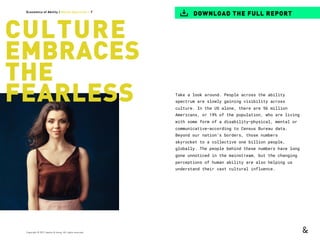
FEARLESS Take a look around. People across the ability
spectrum are slowly gaining visibility across
culture. In the US alone, there are 56 million
Americans, or 19% of the population, who are living
with some form of a disability—physical, mental or
communicative—according to Census Bureau data.
Beyond our nation’s borders, those numbers
skyrocket to a collective one billion people,
globally. The people behind these numbers have long
gone unnoticed in the mainstream, but the changing
perceptions of human ability are also helping us
understand their vast cultural influence.
Economics of Ability / Ability Spectrum
Copyright © 2017 sparks & honey. All rights reserved.
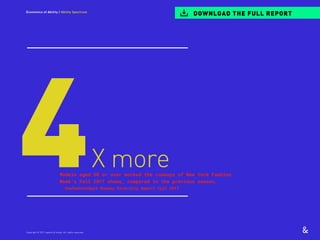
4Models aged 50 or over worked the runways of New York Fashion
Week's Fall 2017 shows, compared to the previous season.
- theFashionSpot Runway Diversity Report Fall 2017
X more
Economics of Ability / Ability Spectrum /
Copyright © 2017 sparks & honey. All rights reserved.
17
Whether in policy, art, fashion or media, the ability
spectrum is evident in trends we track at sparks & honey:
unapologetic is about boldly owning and presenting who you
are, an attitude we’ve seen shift among generations. It’s
evident from beauty campaigns to New York Fashion Week’s
Fall 2017 shows, where models of all ages walked the
catwalk. This season, four times as many models over the age
of 50 were employed in the Fall 2017 shows, compared to the
previous season, according to theFashionSpot’s diversity
report. Gracing Simone Rocha’s runways, 72-year-old Jan de
Villeneuve was one of them.
Or, it’s the paraplegic man and his wife who announced their
pregnancy to friends with a photo and the words, “it still
works” scrawled on the wall behind them. And those who build
our worlds are creating innovative user experiences that
remove needless complexity from simple tasks, such as
opening a cabinet. Embracing the unapologetic—whether in
art, fashion, design or technology—is a natural connection
to people across the ability spectrum.
The mindset of our youngest generation, Gen Z, exemplify
this cultural shift. They actively see the world through a
collective lens: it’s the kids and teens of today who are
the unapologetic champions of humanity. Take the 13-year-old
best friends, one Muslim, one Jewish, who dressed us as
“Juslim” superheroes for Halloween. They’re part of a
growing multiracial youth population, which has increased
50% since 2000. As Gen Z grows up, they absorb the norms of
acceptance in their culturally rich world and home. Instead
of the “other,” it’s about all of us, Gen Z says.
FASHION-
ABLE
Models of all ages graced Fashion Week runways
Economics of Ability / Fashionable /
Copyright © 2017 sparks & honey. All rights reserved.
20
THE
AESTHETICS 

OF ABILITY
For every $100 spent on its 100% Human line, the
company donates $5 to Equality Now.
In the Ukraine, model Alexandra Kutas, 23,
headlined in a Kiev fashion show in couture
dresses which she wore in her wheelchair. “People
are not all the same – we are all different in
this world,” Ukrainian designer Fedir Vozianov
told FashionUnited.
The vibe is distinctly unapologetic and
inclusive, and it’s percolating in the fashion
arena. Fashion and art are materializing to
represent people of all abilities, from young to
senior, and across life circumstances. In that
process, they’re influencing what everyone wears
– or wants to wear.
We process our surroundings by absorbing their look
and feel. In art and fashion alike, the intangible –
our emotional responses – are translated into
objects of desire we wear or experience, that can
help us understand one another on a more profound
level. What was once high brow and very exclusive is
now reflecting a changed world.
At New York Fashion Week, models of all ages and
abilities graced the runway, from 18-year-old
Australian model Madeline Stuart, who has Down
Syndrome, to Jeremy Meeks, whose brooding mug shot
launched a modeling career. Inclusivity is
permeating everything from the faces of fashion to
the clothes we wear. Online retailer Everlane
launched its 100% Human collection, a ‘brand as
activist’ message that flattens any divide between
genders, races or geographies.
Economics of Ability / Fashionable
Copyright © 2017 sparks & honey. All rights reserved.
Fashion designers employed in the US
- IBIS, Fashion Designers Market Research Report, 2016
26,98126,981
Economics of Ability / Fashionable /
Copyright © 2017 sparks & honey. All rights reserved.
22
In fashion and beauty, there’s a continuous
tension between two ends of the aesthetic
spectrum: the minimal, bare-bones neutral chic—no
makeup, monotone palettes, minimalist designs—
juxtaposed to the brightly colored, fur-lined,
loud looks popularized by brands such as Versace,
or the ‘70s to ‘80s.
Whatever your appeal, you’re communicating a
sensibility through an aesthetic. In the
mainstream, au naturel Alicia Keys has famously
been bare-faced for over a year, while maximalists
such as YouTube’s PolishMountain, where applying
over 100 coats of nail polish has attracted over
15 million views, portray the maximalist look.
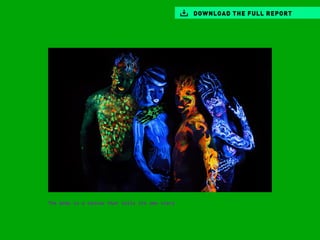
Whether maximalist, minimalist or somewhere in
between, we’re finding new ways of self-expression
using our bodies as a canvas, reflected in the
trend of perceptual diversity. Honing in on a
specific area of the body aesthetically, such as
earlobe makeup or fingernail art, could be seen as
a subtle cue of self-empowerment, or singular
cosplay blended into the everyday. Your body
becomes a canvas that tells its own story, one
that’s adorned, painted, tattooed.
ADORNING
THE HIDDEN:
THE BODY
AS A
CANVAS
The body is a canvas that tells its own story
Economics of Ability / Fashionable /
Copyright © 2017 sparks & honey. All rights reserved.
24
Influencing this trend are the people who have
chosen to highlight their unapologetic physiques,
with stunning visual effect.
Michael Olajide, Jr. is a renowned trainer in the
fashion world, whose clientele includes models
such as Adriana Lima. A former champion boxer,
Olajide is blind in his right eye and wears
dramatic eye patches of horus design or steampunk
metal, creating a maximalist vision of his lack of
vision. “Bionic pop star” Viktoria Modesta is a
multimedia performance artist and singer, whose
customized uber-modern prosthetics inspire as much
as her performances do. Instead of veiling these
specific parts, Olajide and Modesta transform them
into powerful, visually stunning fashion
statements.
Economics of Ability / Fashionable /
Copyright © 2017 sparks & honey. All rights reserved.
25
COMMUNICATE
THROUGH CLOTHING: 

TELL ME HOW 

YOU FEEL Kids and adults alike can wear compression t-
shirts to help them stay calm and focused
throughout the day. Designs such as the Sens-
ational Hip Hugging Tee provide deep pressure to
parts of the body that are meant to calm its
wearer. Innovations in fabric design are helping
to bridge the emotional connection between a
garment and wearer. German fashion design student
Babette Sperling created a clothing collection
that incorporates braille notes–the written
language for people with blindness—using 3D
printing technology. Each item contains a hidden
message embedded in the piece, adding a layer of
extrasensory intrigue and emotion.
From sweats to evening attire, we use clothing to
either cover or accentuate the parts of ourselves we
want to expose to the world. However you may feel or
want to move, your outfit can speak for itself.
The strong connection between fashion and mood state
suggests people should wear clothes they associate
with happiness, according to a study by the School
of Psychology at the University of Hertforshire in
the UK. But now, fashion has caught up to our
internal dials and can express or help us regulate
or enhance our cognitive and physical abilities.
Economics of Ability / Fashionable
Copyright © 2017 sparks & honey. All rights reserved.
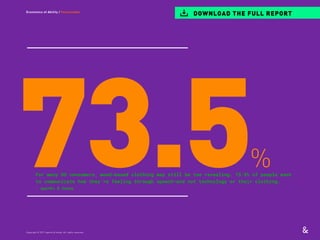
73.5For many US consumers, mood-based clothing may still be too revealing. 73.5% of people want
to communicate how they’re feeling through speech–and not technology or their clothing.
- sparks & honey
%
Economics of Ability / Fashionable /
Copyright © 2017 sparks & honey. All rights reserved.
27
Beyond emotions, what we wear can build on our
physical abilities, too. Smart shirts such as the
Polar Team Pro Shirt (introduced at CES this year)
are set to compete against performance-enhancing
wearables that you might attach to your wrist or
track on your phone. This smart running shirt is
embedded with fabric sensors that can monitor your
heart rate, track your motion, speed, distance run
and just how fast you did it all.
What may be a fashion statement for some is a
therapeutic companion or performance builder for
others. These ability-enhancing items could be
hanging in your closet.
Economics of Ability / Fashionable
Copyright © 2017 sparks & honey. All rights reserved.
Of US consumers are interested in using clothing with
sensors that can detect diseases, conditions or ailments.
- Mintel, For the Blind to See, 2017
%
Economics of Ability / Fashionable /
Copyright © 2017 sparks & honey. All rights reserved.
29
TAKING
FRICTION
OUT OF
FASHION
Think of what you put on this morning: how many
zippers, buttons or strings did you have to pull
just to get dressed? What may be tedious for some
is prohibitive for others, in the routine of
getting dressed. Consider people who may not have
strength in their hands or even a cast on a limb.
For this cohort, fastening a simple button is an
example of a trend called premium friction, where
a task is purposely made more cumbersome. But many
designers are simplifying the act of getting
dressed, with appeal that extends across the
ability spectrum.
In 2016, Tommy Hilfiger launched his adaptive
clothing line for kids, Runway of Dreams. The
line’s clothes are similarly priced and styled to
his other children’s clothing. The line
substitutes zippers and buttons with magnetic
clasps, and includes wider top and leg openings.
One of the first major brands targeting friction-
free kids’ fashion, the line has attracted a broad
audience of kids and shopping parents. Last year,
Runway of Dreams accounted for over 20 percent of
all children’s clothing sales, according to the
Wall Street Journal.
Economics of Ability / Fashionable
Copyright © 2017 sparks & honey. All rights reserved.
“ ”People with disabilities are a $220
billion-dollar industry and they are
still virtually ignored.
Dr. Danielle Sheypuk, 

psychologist, model, disability-rights advocate, sparks & honey IAB member
DESIGNED
FOR GOODSpaces and places for all-ability
Economics of Ability / Designed for Good /
Copyright © 2017 sparks & honey. All rights reserved.
32
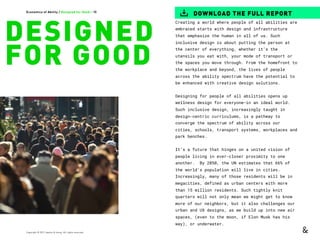
DESIGNED
FOR GOOD
Creating a world where people of all abilities are
embraced starts with design and infrastructure
that emphasize the human in all of us. Such
inclusive design is about putting the person at
the center of everything, whether it’s the
utensils you eat with, your mode of transport or
the spaces you move through. From the homefront to
the workplace and beyond, the lives of people
across the ability spectrum have the potential to
be enhanced with creative design solutions.
Designing for people of all abilities opens up
wellness design for everyone—in an ideal world.
Such inclusive design, increasingly taught in
design-centric curriculums, is a pathway to
converge the spectrum of ability across our
cities, schools, transport systems, workplaces and
park benches.
It’s a future that hinges on a united vision of
people living in ever-closer proximity to one
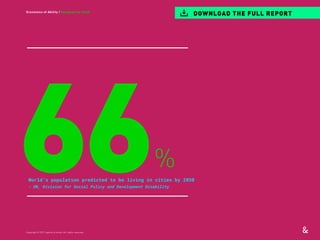
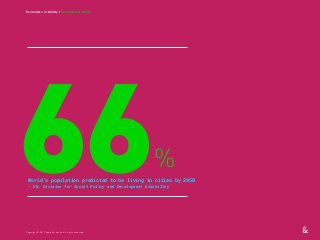
another. By 2050, the UN estimates that 66% of
the world’s population will live in cities.
Increasingly, many of those residents will be in
megacities, defined as urban centers with more
than 15 million residents. Such tightly knit
quarters will not only mean we might get to know
more of our neighbors, but it also challenges our
urban and UX designs, as we build up into new air
spaces, (even to the moon, if Elon Musk has his
way), or underwater.
Economics of Ability / Designed for Good
Copyright © 2017 sparks & honey. All rights reserved.
“ ”If you design cities that are friendly
for the aged, it works for all people.
Dr. Ruth Finkelstein, 

Associate Director of Robert N. Butler Columbia Aging Center, 

sparks & honey IAB member
Economics of Ability / Designed for Good /
Copyright © 2017 sparks & honey. All rights reserved.
34
INCLUSIVITY
IN THE CITYInclusive design gives a voice to that which you
might not see otherwise. In the UK, a wellness
design effort by Transport for London, (TfL),
emerged in the form of blue badges you can wear on
your lapel. In September 2016, TfL introduced its
“please offer me a seat” badges for passengers who
have conditions or illnesses that are not
immediately visible. And thanks to a campaign by
Maltesers, the city has also seen its other public
surfaces evolve to embrace those on the periphery.
In January 2017, the sweets brand launched Braille
billboards in a bid to champion inclusivity in open
spaces and the media.
Wellness design welcomes people of all
abilities
Economics of Ability / Designed for Good
Copyright © 2017 sparks & honey. All rights reserved.
“ ”The first step to inclusivity and
genuine political correctness is to stop
avoiding certain words and just take it
easy. “Inclusivity” for “disabled”
makes life easier for the abled, too.
Alex Orlov, 

Co-Founder of cSeeker, who is deaf
Economics of Ability / Designed for Good /
Copyright © 2017 sparks & honey. All rights reserved.
37
CHANGING
BEHAVIORS,
CHANGING
CITIES Changes in the way we move through spaces are
being reflected in our environments. In London,
there’s now a Direct Lane for pedestrians who have
places to get to—quickly. The Direct Lane supports
walkers who move at speeds of at least three miles
per hour, although the speed of your stride may be
hard to regulate. In the other lanes? The texters,
the YouTube viewers, or other casual strollers. In
Germany, the streets are evolving to adapt to our
lower-gaze eye levels. The cities of Augsburg and
Cologne were concerned with the growing number of
citizens glued to their devices while walking and
ignoring red lights. They installed traffic lights
—on the sidewalk. If we untether ourselves from
the grasp of technology, will we start to look
forward again? Or, perhaps up–at the drone passing
by in our air space.
Urban design is responding to our behaviors and
abilities, which are rapidly changing thanks to our
keen attachments to tech. Every minute spent hunched
over a screen adds up, and eventually our bodies
either adapt or develop what we call technomaladies,
ailments as a result of our tech-infused existences.
Teens are developing pains previously seen only in
the older population, such as a stiff neck, known as
text neck. And we’re less likely to pay attention
than we were just ten years ago: the human attention
span has shortened from 12 seconds to eight seconds,
according to a study by Microsoft.
Economics of Ability / Designed for Good
Copyright © 2017 sparks & honey. All rights reserved.
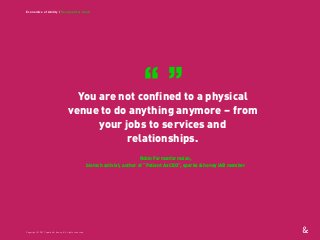
“ ”You are not confined to a physical
venue to do anything anymore – from
your jobs to services and
relationships.
Robin Farmanfarmaian, 

biotech activist, author of “Patient As CEO”, sparks & honey IAB member
Economics of Ability / Designed for Good /
Copyright © 2017 sparks & honey. All rights reserved.
39
COMMUNITIES
DESIGNED
FOR SPECIFIC
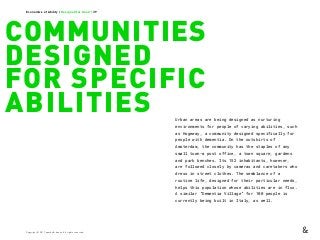
ABILITIES Urban areas are being designed as nurturing
environments for people of varying abilities, such
as Hogeway, a community designed specifically for
people with dementia. On the outskirts of
Amsterdam, the community has the staples of any
small town—a post office, a town square, gardens
and park benches. Its 152 inhabitants, however,
are followed closely by cameras and caretakers who
dress in street clothes. The semblance of a
routine life, designed for their particular needs,
helps this population whose abilities are in flux.
A similar “Dementia Village” for 100 people is
currently being built in Italy, as well.
Economics of Ability / Designed for Good
Copyright © 2017 sparks & honey. All rights reserved.
66World’s population predicted to be living in cities by 2050
- UN, Division for Social Policy and Development Disability
%
Economics of Ability / Designed for Good /
Copyright © 2017 sparks & honey. All rights reserved.
41
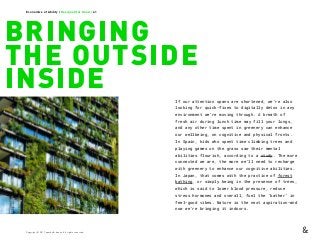
BRINGING
THE OUTSIDE
INSIDE
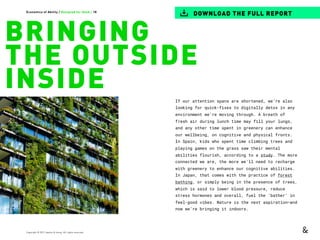
If our attention spans are shortened, we’re also
looking for quick-fixes to digitally detox in any
environment we’re moving through. A breath of
fresh air during lunch time may fill your lungs,
and any other time spent in greenery can enhance
our wellbeing, on cognitive and physical fronts.
In Spain, kids who spent time climbing trees and
playing games on the grass saw their mental
abilities flourish, according to a study. The more
connected we are, the more we’ll need to recharge
with greenery to enhance our cognitive abilities.
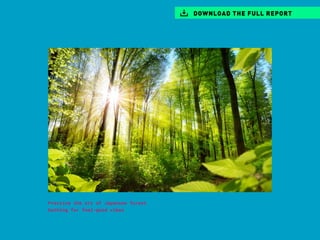
In Japan, that comes with the practice of forest
bathing, or simply being in the presence of trees,
which is said to lower blood pressure, reduce
stress hormones and overall, fuel the ‘bather’ in
feel-good vibes. Nature is the next aspiration—and
now we’re bringing it indoors.
Economics of Ability / Designed for Good
Copyright © 2017 sparks & honey. All rights reserved.
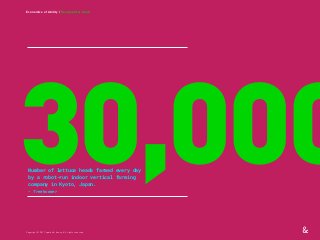
30,000Number of lettuce heads farmed every day
by a robot-run indoor vertical farming
company in Kyoto, Japan.
- Treehugger
Economics of Ability / Designed for Good /
Copyright © 2017 sparks & honey. All rights reserved.
43
GREEN
GIVES YOUR
BRAIN A
BREAK
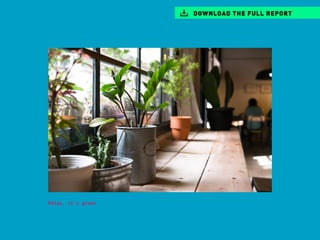
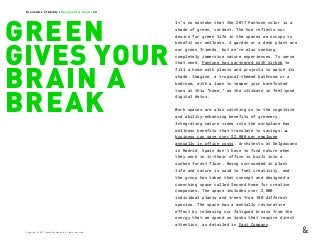
It’s no mistake that the 2017 Pantone color is a
shade of green, verdant. The hue reflects our
desire for green life in the spaces we occupy to
benefit our wellness. A garden or a desk plant are
our green friends, but we’re also seeking
completely immersive nature experiences. To serve
that need, Pantone has partnered with Airbnb to
fill a home with plants and projects to match its
shade. Imagine, a tropical-themed bathroom or a
bedroom, with a lawn to temper your barefooted
toes at this “home,” as the ultimate in feel-good
digital detox.
Work spaces are also catching on to the cognitive
and ability-enhancing benefits of greenery.
Integrating nature views into the workplace has
wellness benefits that translate to savings: a
business can save over $2,000 per employee
annually in office costs. Architects at Selgascano
in Madrid, Spain don’t have to find nature when
they work in it—their office is built into a
sunken forest floor. Being surrounded in plant
life and nature is said to fuel creativity, and
the group has taken that concept and designed a
coworking space called Second Home for creative
companies. The space includes over 2,000
individual plants and trees from 100 different
species. The space has a mentally restorative
effect by releasing our fatigued brains from the
energy that we spend on tasks that require direct
attention, as detailed in Fast Company.
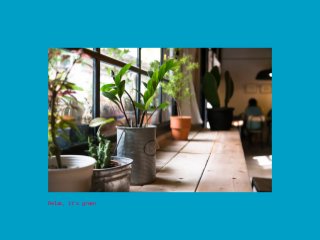
Relax, it’s green
Economics of Ability / Designed for Good
Copyright © 2017 sparks & honey. All rights reserved.
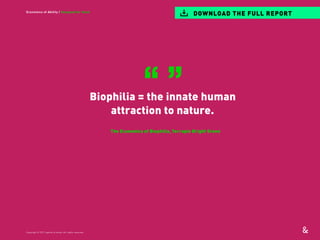
“ ”Biophilia = the innate human
attraction to nature.
The Economics of Biophilia, Terrapin Bright Green
Economics of Ability / Designed for Good /
Copyright © 2017 sparks & honey. All rights reserved.
46
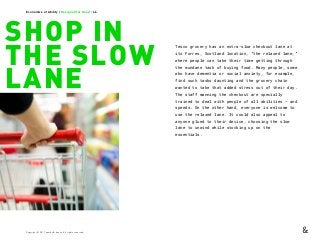
SHOP IN
THE SLOW
LANE
Tesco grocery has an extra-slow checkout lane at
its Forres, Scotland location, “the relaxed lane,”
where people can take their time getting through
the mundane task of buying food. Many people, some
who have dementia or social anxiety, for example,
find such tasks daunting and the grocery chain
wanted to take that added stress out of their day.
The staff manning the checkout are specially
trained to deal with people of all abilities – and
speeds. On the other hand, everyone is welcome to
use the relaxed lane. It could also appeal to
anyone glued to their device, choosing the slow
lane to unwind while stocking up on the
essentials.
Economics of Ability / Designed for Good
Copyright © 2017 sparks & honey. All rights reserved.
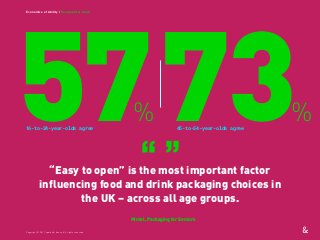
“ ”“Easy to open” is the most important factor
influencing food and drink packaging choices in
the UK – across all age groups.
Mintel, Packaging for Seniors
5716-to-24-year-olds agree
% 7345-to-54-year-olds agree
%
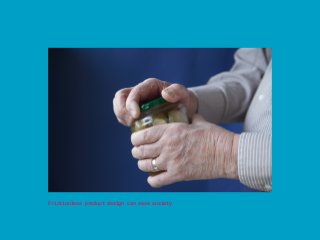
Frictionless product design can ease anxiety
Economics of Ability / Designed for Good /
Copyright © 2017 sparks & honey. All rights reserved.
49
DESIGNED
FOR
EMOTIONAL
COMFORT
Design concepts that focus on the user’s
wellness can also ease anxiety. This is true in
everyday situations, like a busy grocery store,
as it is in more confined spaces. In Norway, a
group of students at the University of Bergen
tackled the anxiety many prisoners feel in their
confined spaces with furniture designs made to
lessen their anxiety. Their furniture design
prototypes, displayed at the Stockholm Furniture
Fair, included prototypes such as an S-curved
mattress that promotes relaxation, or a chair
made for the “post-release environment” that
makes the sitter feel safe and protected, yet
fully in control of the piece. While designed
for inmates, these emotionally nurturing
daybeds, lamps and chairs would be attractive
pieces for anyone’s home, or cell.
Economics of Ability / Designed for Good /
Copyright © 2017 sparks & honey. All rights reserved.
50
WHERE A NEED
BECOMES A
LUXURY Similar designs have been created for aspirational
lifestyles of millennials who may not live in one
place too long, but desire all the comforts of
home with modularity. These homes contain features
such as hidden cabinets, moveable walls and pull-
out tables, all of which can be easily changed for
varying needs of space. Hong Kong architecture
firm LAAB created such a modular smart apartment
for its clients, where entertainment space turns
into a sleeping zone, or a gym, in a few swift
moves—in a 309 square foot apartment.
The appeal of user-centric design can become an
aspiration, or a luxury, taking away from the people
who may need it more. The team behind a concept
apartment for older people, on view at the London
Design Museum, redesigned basic household appliances
and items to cater to an aging population. Designed
by Future Facility, they pared down the basics, such
as washing machines and cabinets, for a futuristic
user-centric home designed to improve the lifestyles
of its inhabitants. And its minimalist, sleek, out-
of-eyeshot design is appealing across the board.
Economics of Ability / Designed for Good
Copyright © 2017 sparks & honey. All rights reserved.
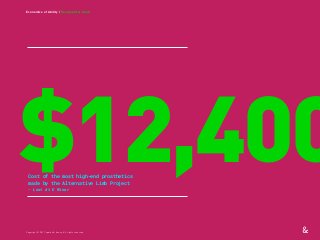
$12,400Cost of the most high-end prosthetics
made by the Alternative Limb Project
- Lost At E Minor
Economics of Ability / Designed for Good /
Copyright © 2017 sparks & honey. All rights reserved.
52
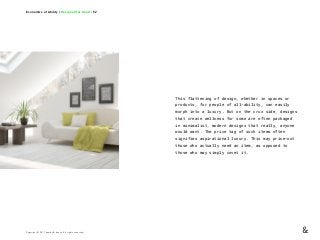
This flattening of design, whether in spaces or
products, for people of all-ability, can easily
morph into a luxury. But on the crux side, designs
that create wellness for some are often packaged
in minimalist, modern designs that really, anyone
would want. The price tag of such items often
signifies aspirational luxury. This may price-out
those who actually need an item, as opposed to
those who may simply covet it.
Economics of Ability / Designed for Good
Copyright © 2017 sparks & honey. All rights reserved.
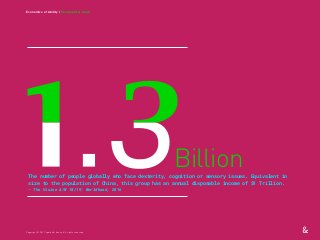
The number of people globally who face dexterity, cognition or sensory issues. Equivalent in
size to the population of China, this group has an annual disposable income of $1 Trillion.
- The Vision A/W 18/19: Worldhood, 2016
Billion
Practice the art of Japanese forest
bathing for feel-good vibes
EMPATHY
TECHUnderstanding the intangible through tech
Economics of Ability / Empathy Tech
Copyright © 2017 sparks & honey. All rights reserved.
“ ”Technology is hope.
Robin Farmanfarmaian 

biotech activist, author of “Patient As CEO,” sparks & honey IAB member
Economics of Ability / Empathy Tech /
Copyright © 2017 sparks & honey. All rights reserved.
57
EMPATHY TECH
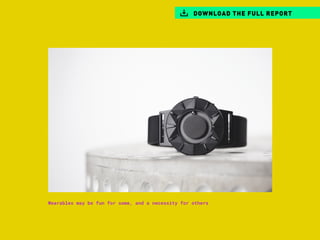
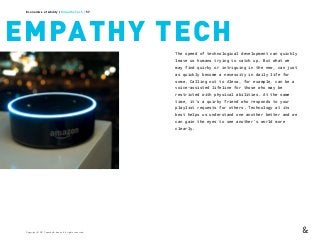
The speed of technological development can quickly
leave us humans trying to catch up. But what we
may find quirky or intriguing in the new, can just
as quickly become a necessity in daily life for
some. Calling out to Alexa, for example, can be a
voice-assisted lifeline for those who may be
restricted with physical abilities. At the same
time, it’s a quirky friend who responds to your
playlist requests for others. Technology at its
best helps us understand one another better and we
can gain the eyes to see another’s world more
clearly.
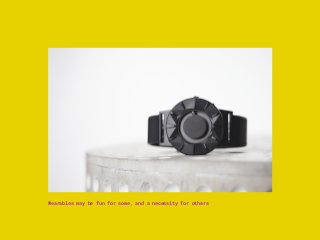
Wearables may be fun for some, and a necessity for others
Economics of Ability / Empathy Tech /
Copyright © 2017 sparks & honey. All rights reserved.
59
DISCONNECTING
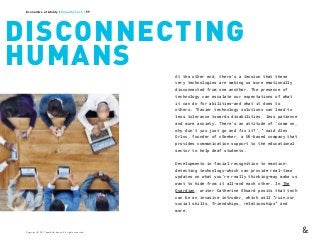
HUMANS At the other end, there’s a tension that these
very technologies are making us more emotionally
disconnected from one another. The presence of
technology can escalate our expectations of what
it can do for abilities—and what it does to
others. “Easier technology solutions can lead to
less tolerance towards disabilities, less patience
and more anxiety. There’s an attitude of ‘come on,
why don’t you just go and fix it?’,” said Alex
Orlov, founder of cSeeker, a UK-based company that
provides communication support to the educational
sector to help deaf students.
Developments in facial recognition to emotion-
detecting technology—which can provide real-time
updates on what you’re really thinking–may make us
want to hide from it all—and each other. In The
Guardian, writer Catherine Shoard posits that tech
can be an invasive intruder, which will “ruin our
social skills, friendships, relationships” and
more.
Economics of Ability / Empathy Tech
Copyright © 2017 sparks & honey. All rights reserved.
“ ”Sometimes employers or onlookers doubt an
invisible condition exists are suspicious that it’s
an attempt to gain special treatment. How can
people with invisible disabilities better
communicate the nature of their circumstances?
Geraldine Moriba 

founder of Moriba Media, former VP of Diversity and Inclusion for CNN Worldwide
Economics of Ability / Empathy Tech /
Copyright © 2017 sparks & honey. All rights reserved.
61
AUGMENTED
UNDERSTANDINGAt the same time, benefits abound for many users of
augmentative technology. Dr. Vivienne Ming’s
expression recognition system, FaceMaze, improves
empathy in autistic children. “Without the training
in learning to read expressions, they simply lacked
a means of understanding the motives of each other,”
Dr. Ming said. The key, she maintained, is designing
such technology with the right intention.
“Augmentative tech should only provide what we need
to grow—it should only complement and not replace.”
Economics of Ability / Empathy Tech
Copyright © 2017 sparks & honey. All rights reserved.
“ ”We now understand that identity lives on a
continuum, and it is as much about our invisible
characteristics as it is about our visible
characteristics. That we have power over what
we “show”, to a degree, and it’s about trust.
Jennifer Brown

author of “Inclusion: Diversity, The New Workplace & The Will To Change,” sparks & honey IAB member
Economics of Ability / Empathy Tech /
Copyright © 2017 sparks & honey. All rights reserved.
63
EMPATHY
TECH TO
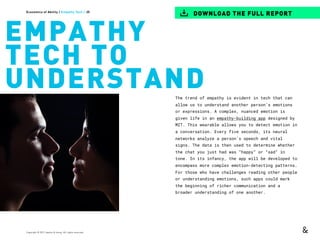
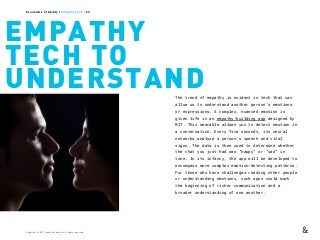
UNDERSTANDThe trend of empathy is evident in tech that can
allow us to understand another person’s emotions
or expressions. A complex, nuanced emotion is
given life in an empathy-building app designed by
MIT. This wearable allows you to detect emotion in
a conversation. Every five seconds, its neural
networks analyze a person’s speech and vital
signs. The data is then used to determine whether
the chat you just had was “happy” or “sad” in
tone. In its infancy, the app will be developed to
encompass more complex emotion-detecting patterns.
For those who have challenges reading other people
or understanding emotions, such apps could mark
the beginning of richer communication and a
broader understanding of one another.
Economics of Ability / Empathy Tech
Copyright © 2017 sparks & honey. All rights reserved.
“ ”What if you could give a child 

with autism a superpower?
Dr. Vivienne Ming

theoretical neuroscientist, technologist, entrepreneur, and sparks & honey IAB member
Economics of Ability / Empathy Tech /
Copyright © 2017 sparks & honey. All rights reserved.
65
SHAPESHIFTING
EMOTIONS A visual cue to our internal dials is also present
in projects such as architect Federico Babino’s
ARCHIATRIC series, in which he illustrates 16
mental illnesses, interpreted through various
architectural forms. His image for Bipolar, for
instance, is a house clearly sliced in half, with
a monotone black on one side, and a chaotic,
joyful series of uneven circular shapes habiting
the other. Babino says his work is “a reflection
on the prejudices and negative stigmas with which
the pathologies of the mind are often observed,”
as told to Designboom. A picture may tell a
thousand words, but increasingly, a distilled
version of our complex emotional states, too.
Beyond what you express to the world—or choose not
to—your emotions, feelings or personality traits can
take on physical forms that can help others quickly
‘get’ you. And more importantly, help you ‘get’ how
the people in your circle are shaping up. In this
sense, mood itself could be seen as an ability.
Interdisciplinary artists Kayla Mattes and Justin
Seibert created a website, The Shape of Things,
which prompts users to answer 24 questions that are
used to design a unique “shape” applicable to your
personality. Mine turned into a scorpion-like shape
in a pattern of black and blue squares veering into
rectangles. When someone asks, “how are you,” your
response can be handed over in this personality-tech
sculpture.
Economics of Ability / Empathy Tech
Copyright © 2017 sparks & honey. All rights reserved.
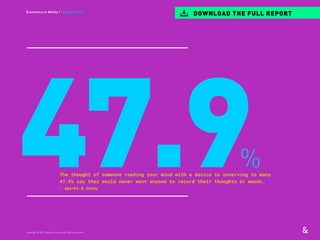
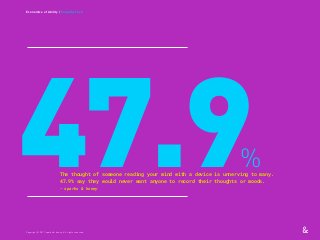
47.9The thought of someone reading your mind with a device is unnerving to many.
47.9% say they would never want anyone to record their thoughts or moods.
- sparks & honey
%
Economics of Ability / Empathy Tech /
Copyright © 2017 sparks & honey. All rights reserved.
67
THE
EMOTION
MARKET
The perhaps unnerving ability of other people to
read or interpret our moods or thoughts might be an
anxiety-fueling prospect, but less so if we feel in
control and understood by our environment and the
people in it. When we enter a home, the lights may
respond to your presence by turning on, but they
could do much more. “An Internet of Things mesh
network that makes up a home or office could offer
much more to a user if it understood their
feelings,” said Dr. Vivienne Ming.
“Commoditizing (our emotions) isn’t all bad, if I’m
an informed participant in that ‘emotion market,’”
said Dr. Vivienne Ming. Instead of a tech-focused
environment where our machines communicate with us,
we communicate with them. Dr. Ming calls this the
“Marketplace of Things,” and not the Internet of
Things, as it’s commonly known. But advancing
toward such a model means we’ll have to think
differently of our place in a machine-built world.
“It will require some significant changes in the
model of how we interact with the technology
providers,” Dr. Ming added.
Economics of Ability / Empathy Tech /
Copyright © 2017 sparks & honey. All rights reserved.
68
MAKING
MACHINE
FRIENDS
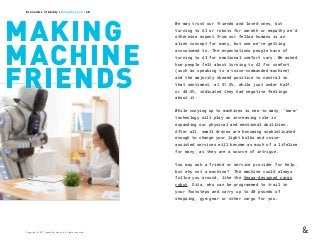
We may trust our friends and loved ones, but
turning to AI or robots for warmth or empathy we’d
otherwise expect from our fellow humans is an
alien concept for many, but one we’re getting
accustomed to. The expectations people have of
turning to AI for emotional comfort vary. We asked
how people felt about turning to AI for comfort
(such as speaking to a voice-commanded machine)
and the majority skewed positive to neutral in
that sentiment, at 51.5%, while just under half,
or 48.5%, indicated they had negative feelings
about it.
While cozying up to machines is new to many, ‘warm’
technology will play an increasing role in
expanding our physical and emotional abilities.
After all, small drones are becoming sophisticated
enough to change your light bulbs and voice-
assisted services will become as much of a lifeline
for many, as they are a source of intrigue.
You may ask a friend or service provider for help,
but why not a machine? The machine could always
follow you around, like the Vespa-designed cargo
robot, Gita, who can be programmed to trail in
your footsteps and carry up to 40 pounds of
shopping, gym gear or other cargo for you.
Economics of Ability / Empathy Tech
Copyright © 2017 sparks & honey. All rights reserved.
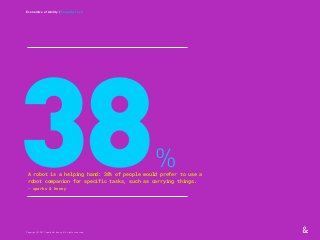
38A robot is a helping hand: 38% of people would prefer to use a
robot companion for specific tasks, such as carrying things.
- sparks & honey
%
SUPER-
ABLEDBorn to be bionic
Economics of Ability / Super-abled /
Copyright © 2017 sparks & honey. All rights reserved.
71
SUPER-ABLED
On the spectrum of ability, morphing, tweaking or
adding to your body can give you abilities
previously unimaginable, or super-ability. We’re
already super-abled in ways you probably take for
granted. Contact lenses or pacemakers allow you to
see and maintain your heart rate. By this
definition, many people are already ‘bionic,’ by
morphing their bodies with technology. This assumes
that the ‘super’ is seen against that which is our
natural, unaltered selves. But does that mean
someone with a cochlear implant, a pacemaker or even
a digital tattoo is super-human? Medical futurist
Robin Farmanfarmaian says, “We are already bionic.”
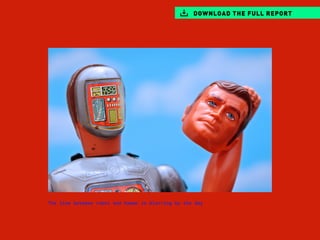
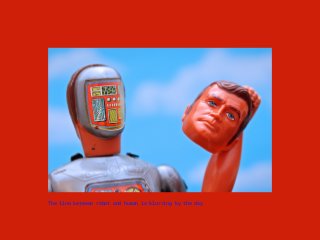
Like humanity, the line between robot and human is
blurring by the day. A biomimetic artificial skin
layer, for instance, is a material that can sense
change in temperature with more sensitivity than
actual human skin. Developed by researchers at the
California Institute of Technology and the Swiss
Federal Institute of Technology, the material could
be seen as a kind of super sense, more sophisticated
than its human-only inspiration.
Economics of Ability / Super-abled /
Copyright © 2017 sparks & honey. All rights reserved.
72
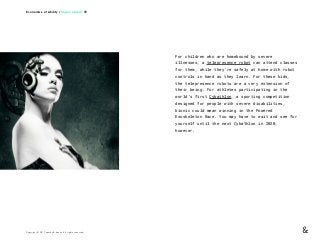
For children who are homebound by severe
illnesses, a telepresence robot can attend classes
for them, while they’re safely at home with robot
controls in hand as they learn. For these kids,
the telepresence robots are a very extension of
their being. For athletes participating in the
world’s first Cybathlon, a sporting competition
designed for people with severe disabilities,
bionic could mean winning in the Powered
Exoskeleton Race. You may have to wait and see for
yourself until the next Cybathlon in 2020,
however.
The line between robot and human is blurring by the day
Economics of Ability / Super-abled /
Copyright © 2017 sparks & honey. All rights reserved.
74
TALK ABOUT
‘SUPERHUMAN’
While technology develops faster than we mortals
can keep up, we are still finding the words to
describe a world where man and machine meet, blend
and work together to create alternate abilities
previously unseen.
Economics of Ability / Super-abled
Copyright © 2017 sparks & honey. All rights reserved.
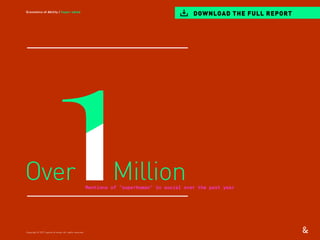
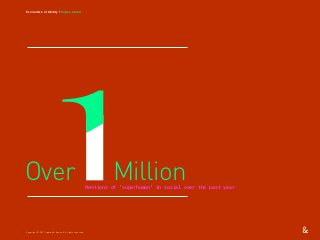
Mentions of “superhuman” in social over the past year
MillionOver
Economics of Ability / Super-abled /
Copyright © 2017 sparks & honey. All rights reserved.
76
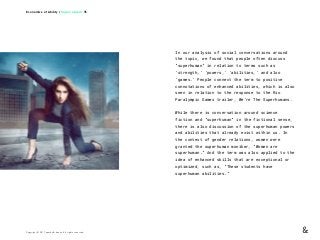
In our analysis of social conversations around
the topic, we found that people often discuss
“superhuman” in relation to terms such as
‘strength,’ ‘powers,’ ‘abilities,’ and also
‘games.’ People connect the term to positive
connotations of enhanced abilities, which is also
seen in relation to the response to the Rio
Paralympic Games trailer, We’re The Superhumans.
While there is conversation around science
fiction and “superhuman” in the fictional sense,
there is also discussion of the superhuman powers
and abilities that already exist within us. In
the context of gender relations, women were
granted the superhuman moniker, “Women are
superhuman.” And the term was also applied to the
idea of enhanced skills that are exceptional or
optimized, such as, “These students have
superhuman abilities.”
Economics of Ability / Super-abled
Copyright © 2017 sparks & honey. All rights reserved.
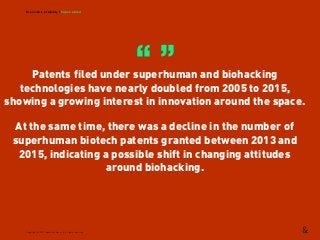
“ ”Patents filed under superhuman and biohacking
technologies have nearly doubled from 2005 to 2015,
showing a growing interest in innovation around the space.
At the same time, there was a decline in the number of
superhuman biotech patents granted between 2013 and
2015, indicating a possible shift in changing attitudes
around biohacking.
Economics of Ability / Super-abled /
Copyright © 2017 sparks & honey. All rights reserved.
78
NEW
COHORTS
OF HUMAN
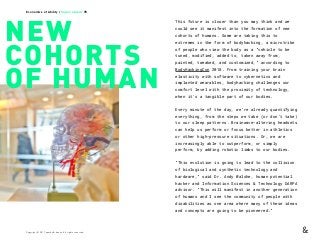
This future is closer than you may think and we
could see it manifest into the formation of new
cohorts of humans. Some are taking this to
extremes in the form of bodyhacking, a microtribe
of people who view the body as a “vehicle to be
tuned, modified, added to, taken away from,
painted, tweaked, and customized,” according to
BodyHackingCon 2018. From training your brain
elasticity with software to cybernetics and
implanted wearables, bodyhacking challenges our
comfort level with the proximity of technology,
when it’s a tangible part of our bodies.
Every minute of the day, we’re already quantifying
everything, from the steps we take (or don’t take)
to our sleep patterns. Brainwave-altering headsets
can help us perform or focus better in athletics
or other high-pressure situations. Or, we are
increasingly able to outperform, or simply
perform, by adding robotic limbs to our bodies.
“This evolution is going to lead to the collision
of biological and synthetic technology and
hardware,” said Dr. Andy Walshe, human potential
hacker and Information Sciences & Technology DARPA
advisor. “This will manifest in another generation
of humans and I see the community of people with
disabilities as one area where many of these ideas
and concepts are going to be pioneered.”
Economics of Ability / Super-abled
Copyright © 2017 sparks & honey. All rights reserved.
“ ”Technology evolves so quickly that our ability
to adapt to it as humans leaves us behind.
How can we continue to help make people
more powerful – and not just the technology?
Dr. Vivienne Ming 

theoretical neuroscientist, technologist, entrepreneur, sparks & honey IAB member
Economics of Ability / Super-abled /
Copyright © 2017 sparks & honey. All rights reserved.
80
THE FUTURE IS
SUPERHUMANWith ever-sophisticated algorithmic and
computational models that can do things mere mortals
would take a lifetime to accomplish, we’re becoming
more abled as a result. From the clothes we put on
in the morning to the mattress we sleep on at night,
technology is blending in with our everyday lives to
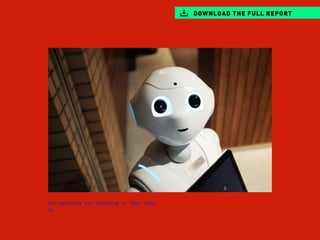
enhance our abilities. Similarly, our machines are
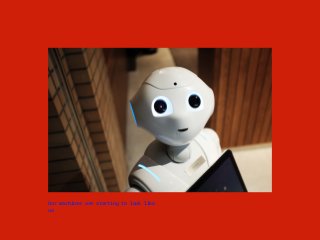
taking on human-like qualities, whether it’s robots
who have expressions that look like your friends, a
Hugging Face chatbot that turns into a confidant, or
AI that allows robots to ask us questions when
they’re confused. Technology is fueling a future
where we may become more powerful, or physically and
cognitively abled humans—or machines.
Our machines are starting to look like
us
Copyright © 2017 sparks & honey. All rights reserved.
82
THE TEAM
Economics of Ability / Appendix /
TITLE: ECONOMICS OF ABILITY

SPARKS & HONEY REPORT
reports.sparksandhoney.com

@sparksandhoney
Anna Sofia Martin

Editorial Director
Camilo La Cruz

Head of Content
Terry Young

CEO & Founder
CREATIVE & EDITORIAL
Eric Kwan Tai Lau

Associate Creative Director
Purva Michaels

Senior Visual Designer
Barbara Herman 

Senior Writer
RESEARCH & CULTURAL INTELLIGENCE
Anna Rosenblatt

VP, Cultural Strategy
Olivia McLean

Cultural Strategist
Annalie Killian

Director Human Networks
Merlin U Ward

Director of Cultural Systems
AGENCY & CONSULTANCY
Paul Butler

Chief Operation Officer
Sharon Foo 

Client Partner
Tim Ettus 

Managing Director, West Coast
Tom Baran 

Director, Business Development
Copyright © 2017 sparks & honey. All rights reserved.
83
METHODOLOGY
Economics of Ability / Appendix /
For this report, sparks & honey conducted primary
research and interviewed experts in the field of
ability, including thought leaders from our
Influencer Advisory Board (IAB). We surveyed 1,009
people in the US, aged 18 to 65, to engage their
perceptions on evolving technologies. Leveraging
social listening, patent analysis, and our
proprietary Cultural Intelligence system, we combed
through thousands of signals to build a vision of
the future cultural landscape of ability.
Copyright © 2017 sparks & honey. All rights reserved.
84
SOURCES
Economics of Ability / Appendix /
3DPrint, Fashion Designer Babette Sperling Uses WillowFlex Filament to 3D Print Secret Messages
Adweek, Ad of the Day: Stunning New ‘Superhumans’ Paralympics Spot Goes Well Beyond Sport
Atlantic, The Dutch Village Where Everyone Has Dementia
BBC, Cybathlon: Battle of the bionic athletes
BodyhackingCon
Brown, Jennifer, Inclusion: Diversity, The New Workplace & The Will To Change, 2016
Brown, Jennifer, CEO Jennifer Brown Consulting, interview
Census Bureau, Americans with Disabilities Report
Circumplex.us
Designboom, Federico Babina architecturally interprets mental illnesses
Dezeen, Concept apartment by Future Facility gives older residents “revolutionary domestic independence”
Dezeen, Pantone creates Greenery-themed home that can be booked on Airbnb
Dezeen, University of Bergen students design furniture for prison inmates
Engadget, Polar’s next fitness wearable is a smart shirt
Engadget, Vespa’s creators just unveiled a personal cargo robot
Everlane, 100% Human
Farmanfarmaian, Robin, biotech activist, author of “The Patient As CEO,” interview
FashionSpot, Runway Diversity Report Fall 2017
FashionUnited, Ukraine celebrates first disabled model Alexandra Kutas
Dr. Finkelstein, Ruth, associate director of the Robert N. Butler Columbia Aging Center
Fast Company, There Are More Than 2,000 Plants In This Lush Coworking Space
Fun and Function, Sens-ational Hip Hugging Tee
GoodTherapy.org, The Link Between Clothing Choices and Emotional States
The Guardian, Friendships, romance, humanity: mind-reading tech will kill it all
Heartbeat.AI
IBIS, Fashion Designers Market Research Report, 2016
LAAB.pro, Small Home Smart Home
Lost At E Minor, Artist makes prosthetics so badass, people actually want to wear them
Medical Daily, Human Attention Span Shortens To 8 Seconds Due To Digital Technology
MedGadget, Biomimetic Artificial Skin Layer with Significant Temperature Sensitivity
MedGadget, BodyCap e-Celsius Electronic Pill for Core Body Temperature Monitoring
Dr. Ming, Vivienne, neuroscientist, technologist, co-founder of Socos, interview
Mintel, For the Blind to See, 2017
Mintel, Packaging for Seniors
Moriba, Geraldine, founder of Moriba Media, interview
Copyright © 2017 sparks & honey. All rights reserved.
85
SOURCES
Economics of Ability / Appendix /
Orlov, Alex, co-founder of cSeeker, interview
Piore, Adam, The Body Builders: Inside the Science of the Engineered Human, 2017
Politico, I Did Ruth Bader Ginsburg’s Workout. It Nearly Broke Me.
Refinery29, Would You Support Phone-Free Walking Lanes In Your City?
Runnersworld, Can Electric Brain Stimulation Boost Your Endurance?
Dr. Walshe, Andy. Human potential hacker, board advisor, interview
Dr. Sheypuk, Danielle, psychologist, model, disability-rights advocate
Scientific American, Mind-Reading Computers That Can Translate Thoughts into Words
TechnologyReview, Three Weeks with a Chatbot and I’ve Made a New Friend
Terrapin Bright Green, The Economics of Biophilia
Tommy Hilfiger, Runway of Dreams
Transport for London, Please offer me a seat
Treehugger, Automated indoor vertical farm will produce 30,000 heads of lettuce per day
UK Daily Mail, From perp to catwalk
United Nations, Disability, Accessibility and Sustainable Urban Development
Upworthy, She’s Jewish. Her BFF is Muslim. And their costumes just won Halloween.
Wall Street Journal, A New Range of Clothing for People With Disabilities
Washington Post, Peyton’s Awesome Virtual Self, a robot that allows a girl with cancer to attend school
World Bank, World Report on Disability, 2016
The Verge, MIT built a wearable app to detect emotion in conversation
Victoriamodesta.com
The Vision A/W, Worldhood, 2016
Vox, Women’s March expected to be largest gathering of people with disabilities in US history
YouTube, Mandeville Sisters
YouTube, Polish Mountain
IMAGE RESOURCES
Page 57, Photo courtesy Eone Timepieces, Inc.
Page 72, photo courtesy JD Hancock
Page 77, photo courtesy Jesse Orrico
Page 80, photo courtesy Alex Knight
No parts of this publication may be
reproduced, copied, distributed or
transmitted in any form without the
permission of sparks & honey.
© 2017 sparks & honey, LLC. 

All rights reserved.