Sanjivani Rural Education Society’s
Sanjivani College of Engineering, Kopargaon-423 603
(An Autonomous Institute, Affiliated to Savitribai Phule Pune University, Pune)
NAAC ‘A’ Grade Accredited, ISO 9001:2015 Certified
Department of Mechanical Engineering
Subject:- Heating, Ventilation and Air
Conditioning (ME 411)
B.Tech.Mechanical
Purushottam W. Ingle
Assistant Professor
• Air handling unit
• Air handling unit, Fan Coil Units & Fresh air handling units, types of
fans used air conditioning applications, fan laws, filters, supply and
return grills, sensors (humidity, temperature, smoke). Types of Air
Terminal Device, Selection And Sizing of Air Terminal Device
12/27/2023 P.W. Ingle Department Of Mechanical Engineering, Sanjivani COE, Kopargaon
Air Handling Unit (AHU)
• An air handling unit, commonly called an AHU, is the composition of
elements mounted in large, accessible box-shaped units called
modules, which house the appropriate ventilation requirements for
purifying, air-conditioning or renewing the indoor air in a building or
premises.
• They are usually installed on the roof of buildings and, through ducts,
the air is circulated to reach each of the rooms in the building.
•
12/27/2023 P.W. Ingle Department Of Mechanical Engineering, Sanjivani COE, Kopargaon
Main functions of an AHU
• In addition to managing the proper ventilation of the interior with
outside air, the AHU performs other functions:
• Filtration and control of the quality of the air that will reach the
interior, by using air purification filters, and depending on the
retention of these filters, the air will be clean.
• Control of the air temperature that regulates the air conditioning
system in cold or hot, so that the thermal sensation in the interior is
the desired one.
• Relative humidity monitoring for greater indoor comfort.
12/27/2023 P.W. Ingle Department Of Mechanical Engineering, Sanjivani COE, Kopargaon
• For its part, the places for which the AHU is intended are those in
which the flow of people is very large and accumulates many people
at the same time and whose natural ventilation is limited: hotel
dining rooms, function rooms, restaurants, convention halls... It is
also a suitable option for those spaces with very high hygiene
requirements: laboratories, clean rooms or operating theatres, among
others.
• An AHU can also be used to ventilate places where air conditioning is
provided by radiators or underfloor heating, for example.
12/27/2023 P.W. Ingle Department Of Mechanical Engineering, Sanjivani COE, Kopargaon
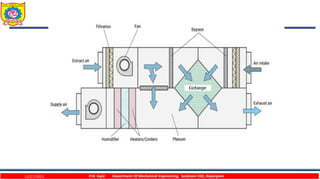
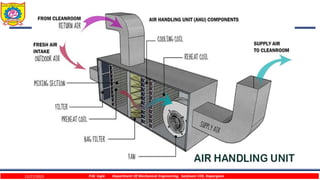
AHU Components
• Air intake: air handling units collect air from outside, which is treated
and distributed throughout the rooms; and/or indoor air that is
"recycled".
• Filter: depending on the air purity requirements, the filter applied will
have a higher or lower particle, viruses, bacteria, odours, and other
air pollutants retention.
• Fan: this is an electromechanical system that powers the air to expel
it from the AHU to the ducts that distribute the air throughout the
rooms.
12/27/2023 P.W. Ingle Department Of Mechanical Engineering, Sanjivani COE, Kopargaon
• Heat exchangers: devices that transfer temperature between two
fluids, in this case, coolant and air, separated by a solid barrier.
• Cooling coil: the air passing through this module is cooled. In this
process, water droplets can be generated, which are collected in a
condensate tray thanks to the built-in droplet separator.
• Silencer: coatings that considerably reduce the sound level of the
installation.
• Plenums: empty spaces in which the air flow is homogenised.
12/27/2023 P.W. Ingle Department Of Mechanical Engineering, Sanjivani COE, Kopargaon
Fan Coil Unit
• A fan coil unit (FCU), or vertical fan coil unit (VFC), is a device that
uses a coil and a fan to heat or cool a room without ductwork.
• A fan coil unit (FCU) is a device used to heat or cool a room without
the need for ductwork.
• It consists of an indoor coil, a fan and an outdoor condensing unit.
The fan forces air through the indoor coil, which is filled with
refrigerant, either cooling or heating it depending on the desired
temperature in the room.
• This cooled or heated air is then sent into the room to maintain a
comfortable environment.
12/27/2023 P.W. Ingle Department Of Mechanical Engineering, Sanjivani COE, Kopargaon
• FCUs are often found in offices and other commercial buildings as
well as some homes.
• There are two main types: vertical fan coils (VFCs) and horizontal fan
coils (HFCs). VFCs are typically used for smaller spaces since they can
be mounted vertically on walls or ceilings, while HFCs are more
suitable for larger areas as they can be installed horizontally on the
floor or ceiling.
• Fan coil units are standalone systems that circulate the existing air in
a space. They can also be part of a large HVAC system while air
handling units (AHU) are a part of an HVAC system that cools and
redistributes air into your home via ducts.
12/27/2023 P.W. Ingle Department Of Mechanical Engineering, Sanjivani COE, Kopargaon
• Yes, fan coil units use refrigerant to cool or heat the air in a room.
Refrigerant is placed inside the indoor coil of an FCU and when the
fan is turned on, it forces air through this coil which either heats or
cools it depending on the desired temperature. The cooled or heated
air is then sent into the room to maintain a comfortable environment
12/27/2023 P.W. Ingle Department Of Mechanical Engineering, Sanjivani COE, Kopargaon
• Fan Coil Components
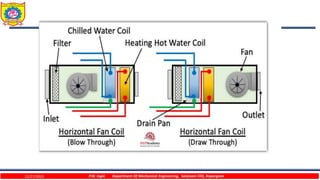
• Fan coils are very simple compared to other pieces of equipment. The
fan coil contains a filter, fan, coil, and a drain pan to
catch condensate from the cooling coil. The source of the heating and
cooling is usually provided by a Chiller and Boiler located in a
mechanical room, or outside on the roof.
12/27/2023 P.W. Ingle Department Of Mechanical Engineering, Sanjivani COE, Kopargaon
• These Fan Coils use Chilled water or Heating Hot Water to provide the
room with cooling or heating. A central ventilation unit will provide
tempered air through a main duct to all the fan coils.
• This is the primary air supplied to the inlet of the fan coil to provide
the required ventilation air (outside air) in accordance with ASHRAE
62.1.
• The fan coils reduce the amount of ductwork needed by the central
system, because most of the heat transfer is done using water instead
of air, by using Chilled Water or Heating Hot Water.
12/27/2023 P.W. Ingle Department Of Mechanical Engineering, Sanjivani COE, Kopargaon
• Air enters the back of the fan coil and passes over filters before
passing over the heating and cooling coils. The fan can be arranged in
either a blow-through or draw-through configuration. With a blow
through, the fan is before the coils, in a draw-through, the fan is after
the coils.
• The filters provide a means of keeping the air free of dust and
particles, while preventing the coils from becoming clogged. The filter
can be in a filter track attached at the back of the fan coil or a
separate return air filter grill could be provided in the ceiling such as
is common in some hotel room style installations using horizontal fan
coils.
12/27/2023 P.W. Ingle Department Of Mechanical Engineering, Sanjivani COE, Kopargaon
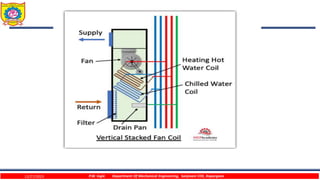
Vertical Fan Coils
• Just like the vertical stacked Heat Pumps used in hotels, there are also
Vertical Stacked Fan Coils. These vertically stacked fan coils can be
either a two-pipe or four-pipe system. Using a 4-pipe system, there
will be a chilled water and heating hot water supply and return
piping, and of course a fifth pipe for condensate.
• These vertical fan coils come with riser piping attached for easily
stacking them one on top the other from floor to floor. These are best
used in high-rise building such as hotels, condominiums, apartments,
dormitories or similar high-rises.
12/27/2023 P.W. Ingle Department Of Mechanical Engineering, Sanjivani COE, Kopargaon
• Fresh Air Handling Unit (FAHU) is an excellent solution for regulating
and circulating fresh air as part of an HVAC system and it ensures a
constant flow of fresh clean air and a very well-conditioned
environment.
• While an AHU can handle both fresh outside air and recirculated air
from within the building, a FAHU is specifically designed to handle
only fresh outside air.
• A fresh air AHU provides one of the most economical ways of
addressing the need for clean fresh air in enclosed areas like kitchens,
restaurants and catering facilities.
12/27/2023 P.W. Ingle Department Of Mechanical Engineering, Sanjivani COE, Kopargaon
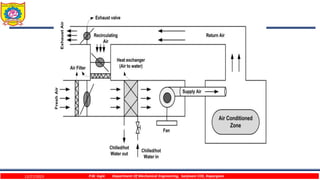
• A FAHU system consists of a fan, a filter, a heat exchanger, and a
damper. The fan draws in the outdoor air and passes it through the
filter to remove dust and pollutants. The heat exchanger transfers
heat or cold between the outdoor air and the indoor air, depending
on the season and the desired temperature.
• A fresh air handing unit basically regulates and circulates the fresh air
into different chambers. This HVAC unit collects the fresh air from
outside and conditions it in the mixing chamber. After conditioning
the air, it circulates the air to various chambers through duct works.
12/27/2023 P.W. Ingle Department Of Mechanical Engineering, Sanjivani COE, Kopargaon
FAN
• Fans are necessary to distribute air through ducts to spaces that are
to be conditioned.
• Types of Fans
• Fans are mainly classified into two groups, namely centrifugal and
axial fans.
12/27/2023 P.W. Ingle Department Of Mechanical Engineering, Sanjivani COE, Kopargaon
Centrifugal Fan
• In a centrifugal fan, air is pulled along the fan shaft and then blown
radially outwards from the shaft.
• The air is usually collected by a scroll casing and concentrated in one
direction.
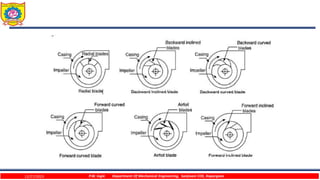
• Centrifugal fans may be sub classified into forward curved, radial,
backward curved and backward inclined types. These differ in the
shape of their impeller blades as shown in Figure
• In addition, backward curved blades with a double-thickness blade
are called airfoil blades.
12/27/2023 P.W. Ingle Department Of Mechanical Engineering, Sanjivani COE, Kopargaon
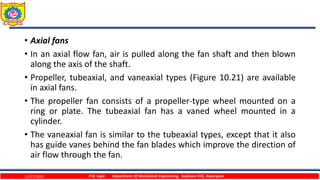
• Axial fans
• In an axial flow fan, air is pulled along the fan shaft and then blown
along the axis of the shaft.
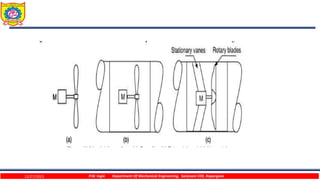
• Propeller, tubeaxial, and vaneaxial types (Figure 10.21) are available
in axial fans.
• The propeller fan consists of a propeller-type wheel mounted on a
ring or plate. The tubeaxial fan has a vaned wheel mounted in a
cylinder.
• The vaneaxial fan is similar to the tubeaxial types, except that it also
has guide vanes behind the fan blades which improve the direction of
air flow through the fan.
12/27/2023 P.W. Ingle Department Of Mechanical Engineering, Sanjivani COE, Kopargaon
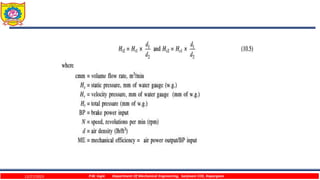
Fan Laws
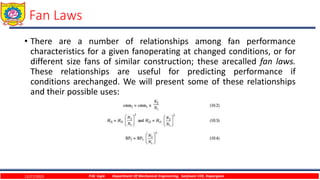
• There are a number of relationships among fan performance
characteristics for a given fanoperating at changed conditions, or for
different size fans of similar construction; these arecalled fan laws.
These relationships are useful for predicting performance if
conditions arechanged. We will present some of these relationships
and their possible uses:
12/27/2023 P.W. Ingle Department Of Mechanical Engineering, Sanjivani COE, Kopargaon
filters
• Air cleaners can be classified in a number of ways such as (1) types of media,
(2) permanent or disposable, (3) stationary or removable, and (4) electronic
air cleaners.
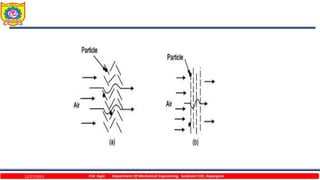
• Viscous impingement filters
• The dust particles in the air stream strike the filter media and are therefore
stopped. The viscous impingement air filter has a media of coarse fibres (glass
fibres and metal screens) that are coated with a viscous adhesive. Air
velocities range from 90-180 mpm. This type of filter will remove larger dust
particles satisfactorily but not the smaller particles. It is low in cost. Refer to
Figure (a).
• In straining type air filters [Figure 10.15(b)], the dust particles are larger than
the space between adjacent fibres and therefore are trapped there.
12/27/2023 P.W. Ingle Department Of Mechanical Engineering, Sanjivani COE, Kopargaon
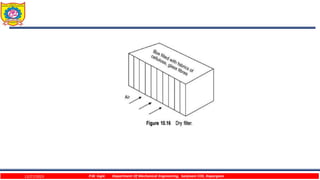
Dry-type filters
• These use uncoated fibre mats (glass fibres and paper) as shown in
Figure. The media can be constructed of either loosely packed coarse
fibres or densely packed fine fibres .
• By varying density, dry-type air filters are manufactured that have
good efficiency only on larger particles, as with the viscous
impingement type, or are also available with medium or high
efficiency forremoving very small particles.
12/27/2023 P.W. Ingle Department Of Mechanical Engineering, Sanjivani COE, Kopargaon
• HEPA (High Efficiency Particulate Air) filter It is a very high efficiency
dry-type filter for removing extremely small particles.
• For example, it is the only type of filter that will effectively remove
viruses as small as 0.05 micron.
• Air face velocities through HEPA filters are very low (about 15 mpm).
• The media in air filters can be arranged in the form of random fibre
mats, screens or corrugated sinuous strips.
12/27/2023 P.W. Ingle Department Of Mechanical Engineering, Sanjivani COE, Kopargaon
• Permanent and disposable air filters
• One can develop disposable type air filters so that they can be
discarded.
• One can have permanent type too, which when saturated with dust,
can be cleaned and reused.
• Permanent types have metal media that will withstand repeated
washings, but cost more than disposable types.
12/27/2023 P.W. Ingle Department Of Mechanical Engineering, Sanjivani COE, Kopargaon
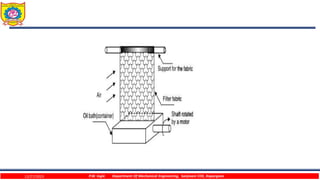
• Stationary air filters are manufactured in rectangular panels. The
panels can be removed and either replaced or cleaned when dirty.
Renewable type air filters consist of a roll mounted on a spool that
moves across the airstream as shown in Figure.
• The fabric is wound on a take-up spool, driven by a motor. The clean
fabric is continuously brought in front of the air stream by rotating
the shaft. Renewable air filters are considerably more expensive than
the stationary types, but maintenance costs are greatly decreased.
Either fibrous materials or metal screens are used as media.
12/27/2023 P.W. Ingle Department Of Mechanical Engineering, Sanjivani COE, Kopargaon
Stationary and renewable air filters
12/27/2023 P.W. Ingle Department Of Mechanical Engineering, Sanjivani COE, Kopargaon
Electronic Air Cleaners
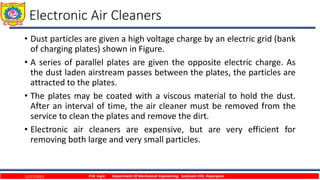
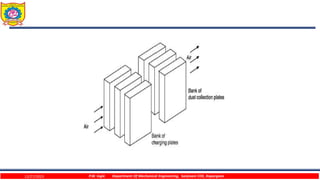
• Dust particles are given a high voltage charge by an electric grid (bank
of charging plates) shown in Figure.
• A series of parallel plates are given the opposite electric charge. As
the dust laden airstream passes between the plates, the particles are
attracted to the plates.
• The plates may be coated with a viscous material to hold the dust.
After an interval of time, the air cleaner must be removed from the
service to clean the plates and remove the dirt.
• Electronic air cleaners are expensive, but are very efficient for
removing both large and very small particles.
12/27/2023 P.W. Ingle Department Of Mechanical Engineering, Sanjivani COE, Kopargaon
supply and return grills
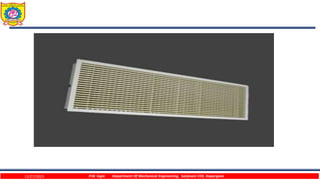
• A return air grill connects to ductwork that allows air to return to any
cooling or heating system. The openings that connect to ducts and
other spaces for the returning air are normally covered with grillwork.
• Every cooling or heating system will have air being pushed though
into rooms and spaces through a system of ducts.
• This increases the air pressure in the conditioned area and at some
time will act to even prevent any further air from entering unless a
circulating system is set up to relieve the pressure.
• This is done normally through return ducts which allow the air to be
recirculated or completely vented to the outside in certain cases. A
return air grill will cover such ducts, and can also act to regulate the
flow of air.
12/27/2023 P.W. Ingle Department Of Mechanical Engineering, Sanjivani COE, Kopargaon
• They also act to close off the ducts from view. A return air grill also
has a filter mounted on it to trap particulate matter and thus ensure
that the recirculated air is more pure. This can also in the long run
reduce the amount of cleaning required for ducts.
12/27/2023 P.W. Ingle Department Of Mechanical Engineering, Sanjivani COE, Kopargaon
• Supply Grille
• Supply grilles will typically be deflected so that you are able to direct
the airflow needed to a specific area. For instance, you would want to
put supply grilles for air conditioning somewhere higher, as cold air
falls, and vice versa for for heating – those supply grilles should be
placed lower on the wall, as heat rises.
• Return Grilles
• For return grilles, the degree of deflection is not necessarily
important unless you are trying to conceal what is in the vent behind
the grille. Most commercial applications utilize light shields that affix
behind the grille, or a double deflected grille, so that the view is
relatively obscured.
12/27/2023 P.W. Ingle Department Of Mechanical Engineering, Sanjivani COE, Kopargaon
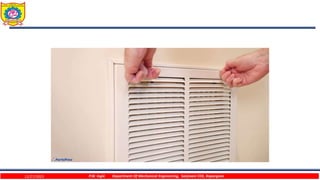
• It is essential that your return air vents are not blocked. Most HVAC
systems require constant airflow to work properly, and a blocked vent
could cause your system to either lose efficiency or fail earlier than it
should. Some of the most common blockages include placing a couch
or other furniture in front of the vent, as well as curtains, which can
get sucked in and inhibit airflow.
12/27/2023 P.W. Ingle Department Of Mechanical Engineering, Sanjivani COE, Kopargaon
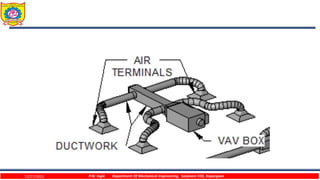
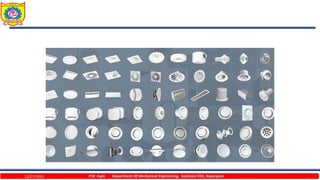
• Air terminal units (ATU) are zone-level air distribution devices that
regulate airflow for maximum occupant comfort. The ATU controls
the zone space temperature to maintain a desired occupied space
temperature. In variable air volume (VAV) systems, the flow of air is
supplied by a single air handling unit.
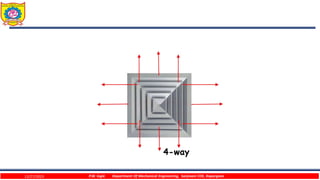
• Air volume and velocity are the key selection factors alongside the
aesthetic appearance of air terminal devices such as grilles, diffusers
and louvres.
12/27/2023 P.W. Ingle Department Of Mechanical Engineering, Sanjivani COE, Kopargaon
• These terminal devices are often miss selected and then don’t
perform correctly when installed in an HVAC system. Differences
often occur in the design criteria for a supply or extract device as the
pattern and behaviour of the air entering or exiting needs to be
different.
• Other points to consider include the throw, diffusion and equalisation
of air flow, system balance and noise.
12/27/2023 P.W. Ingle Department Of Mechanical Engineering, Sanjivani COE, Kopargaon

AHU HVAC.ppt Air Distribution Systems, HVAC

  • 1.
    Sanjivani Rural EducationSociety’s Sanjivani College of Engineering, Kopargaon-423 603 (An Autonomous Institute, Affiliated to Savitribai Phule Pune University, Pune) NAAC ‘A’ Grade Accredited, ISO 9001:2015 Certified Department of Mechanical Engineering Subject:- Heating, Ventilation and Air Conditioning (ME 411) B.Tech.Mechanical Purushottam W. Ingle Assistant Professor
  • 2.
    • Air handlingunit • Air handling unit, Fan Coil Units & Fresh air handling units, types of fans used air conditioning applications, fan laws, filters, supply and return grills, sensors (humidity, temperature, smoke). Types of Air Terminal Device, Selection And Sizing of Air Terminal Device 12/27/2023 P.W. Ingle Department Of Mechanical Engineering, Sanjivani COE, Kopargaon
  • 3.
    Air Handling Unit(AHU) • An air handling unit, commonly called an AHU, is the composition of elements mounted in large, accessible box-shaped units called modules, which house the appropriate ventilation requirements for purifying, air-conditioning or renewing the indoor air in a building or premises. • They are usually installed on the roof of buildings and, through ducts, the air is circulated to reach each of the rooms in the building. • 12/27/2023 P.W. Ingle Department Of Mechanical Engineering, Sanjivani COE, Kopargaon
  • 4.
    Main functions ofan AHU • In addition to managing the proper ventilation of the interior with outside air, the AHU performs other functions: • Filtration and control of the quality of the air that will reach the interior, by using air purification filters, and depending on the retention of these filters, the air will be clean. • Control of the air temperature that regulates the air conditioning system in cold or hot, so that the thermal sensation in the interior is the desired one. • Relative humidity monitoring for greater indoor comfort. 12/27/2023 P.W. Ingle Department Of Mechanical Engineering, Sanjivani COE, Kopargaon
  • 5.
    • For itspart, the places for which the AHU is intended are those in which the flow of people is very large and accumulates many people at the same time and whose natural ventilation is limited: hotel dining rooms, function rooms, restaurants, convention halls... It is also a suitable option for those spaces with very high hygiene requirements: laboratories, clean rooms or operating theatres, among others. • An AHU can also be used to ventilate places where air conditioning is provided by radiators or underfloor heating, for example. 12/27/2023 P.W. Ingle Department Of Mechanical Engineering, Sanjivani COE, Kopargaon
  • 6.
    12/27/2023 P.W. IngleDepartment Of Mechanical Engineering, Sanjivani COE, Kopargaon
  • 7.
    12/27/2023 P.W. IngleDepartment Of Mechanical Engineering, Sanjivani COE, Kopargaon
  • 8.
    AHU Components • Airintake: air handling units collect air from outside, which is treated and distributed throughout the rooms; and/or indoor air that is "recycled". • Filter: depending on the air purity requirements, the filter applied will have a higher or lower particle, viruses, bacteria, odours, and other air pollutants retention. • Fan: this is an electromechanical system that powers the air to expel it from the AHU to the ducts that distribute the air throughout the rooms. 12/27/2023 P.W. Ingle Department Of Mechanical Engineering, Sanjivani COE, Kopargaon
  • 9.
    • Heat exchangers:devices that transfer temperature between two fluids, in this case, coolant and air, separated by a solid barrier. • Cooling coil: the air passing through this module is cooled. In this process, water droplets can be generated, which are collected in a condensate tray thanks to the built-in droplet separator. • Silencer: coatings that considerably reduce the sound level of the installation. • Plenums: empty spaces in which the air flow is homogenised. 12/27/2023 P.W. Ingle Department Of Mechanical Engineering, Sanjivani COE, Kopargaon
  • 10.
    Fan Coil Unit •A fan coil unit (FCU), or vertical fan coil unit (VFC), is a device that uses a coil and a fan to heat or cool a room without ductwork. • A fan coil unit (FCU) is a device used to heat or cool a room without the need for ductwork. • It consists of an indoor coil, a fan and an outdoor condensing unit. The fan forces air through the indoor coil, which is filled with refrigerant, either cooling or heating it depending on the desired temperature in the room. • This cooled or heated air is then sent into the room to maintain a comfortable environment. 12/27/2023 P.W. Ingle Department Of Mechanical Engineering, Sanjivani COE, Kopargaon
  • 11.
    • FCUs areoften found in offices and other commercial buildings as well as some homes. • There are two main types: vertical fan coils (VFCs) and horizontal fan coils (HFCs). VFCs are typically used for smaller spaces since they can be mounted vertically on walls or ceilings, while HFCs are more suitable for larger areas as they can be installed horizontally on the floor or ceiling. • Fan coil units are standalone systems that circulate the existing air in a space. They can also be part of a large HVAC system while air handling units (AHU) are a part of an HVAC system that cools and redistributes air into your home via ducts. 12/27/2023 P.W. Ingle Department Of Mechanical Engineering, Sanjivani COE, Kopargaon
  • 12.
    • Yes, fancoil units use refrigerant to cool or heat the air in a room. Refrigerant is placed inside the indoor coil of an FCU and when the fan is turned on, it forces air through this coil which either heats or cools it depending on the desired temperature. The cooled or heated air is then sent into the room to maintain a comfortable environment 12/27/2023 P.W. Ingle Department Of Mechanical Engineering, Sanjivani COE, Kopargaon
  • 13.
    • Fan CoilComponents • Fan coils are very simple compared to other pieces of equipment. The fan coil contains a filter, fan, coil, and a drain pan to catch condensate from the cooling coil. The source of the heating and cooling is usually provided by a Chiller and Boiler located in a mechanical room, or outside on the roof. 12/27/2023 P.W. Ingle Department Of Mechanical Engineering, Sanjivani COE, Kopargaon
  • 14.
    • These FanCoils use Chilled water or Heating Hot Water to provide the room with cooling or heating. A central ventilation unit will provide tempered air through a main duct to all the fan coils. • This is the primary air supplied to the inlet of the fan coil to provide the required ventilation air (outside air) in accordance with ASHRAE 62.1. • The fan coils reduce the amount of ductwork needed by the central system, because most of the heat transfer is done using water instead of air, by using Chilled Water or Heating Hot Water. 12/27/2023 P.W. Ingle Department Of Mechanical Engineering, Sanjivani COE, Kopargaon
  • 15.
    • Air entersthe back of the fan coil and passes over filters before passing over the heating and cooling coils. The fan can be arranged in either a blow-through or draw-through configuration. With a blow through, the fan is before the coils, in a draw-through, the fan is after the coils. • The filters provide a means of keeping the air free of dust and particles, while preventing the coils from becoming clogged. The filter can be in a filter track attached at the back of the fan coil or a separate return air filter grill could be provided in the ceiling such as is common in some hotel room style installations using horizontal fan coils. 12/27/2023 P.W. Ingle Department Of Mechanical Engineering, Sanjivani COE, Kopargaon
  • 16.
    12/27/2023 P.W. IngleDepartment Of Mechanical Engineering, Sanjivani COE, Kopargaon
  • 17.
    Vertical Fan Coils •Just like the vertical stacked Heat Pumps used in hotels, there are also Vertical Stacked Fan Coils. These vertically stacked fan coils can be either a two-pipe or four-pipe system. Using a 4-pipe system, there will be a chilled water and heating hot water supply and return piping, and of course a fifth pipe for condensate. • These vertical fan coils come with riser piping attached for easily stacking them one on top the other from floor to floor. These are best used in high-rise building such as hotels, condominiums, apartments, dormitories or similar high-rises. 12/27/2023 P.W. Ingle Department Of Mechanical Engineering, Sanjivani COE, Kopargaon
  • 18.
    12/27/2023 P.W. IngleDepartment Of Mechanical Engineering, Sanjivani COE, Kopargaon
  • 19.
    • Fresh AirHandling Unit (FAHU) is an excellent solution for regulating and circulating fresh air as part of an HVAC system and it ensures a constant flow of fresh clean air and a very well-conditioned environment. • While an AHU can handle both fresh outside air and recirculated air from within the building, a FAHU is specifically designed to handle only fresh outside air. • A fresh air AHU provides one of the most economical ways of addressing the need for clean fresh air in enclosed areas like kitchens, restaurants and catering facilities. 12/27/2023 P.W. Ingle Department Of Mechanical Engineering, Sanjivani COE, Kopargaon
  • 20.
    • A FAHUsystem consists of a fan, a filter, a heat exchanger, and a damper. The fan draws in the outdoor air and passes it through the filter to remove dust and pollutants. The heat exchanger transfers heat or cold between the outdoor air and the indoor air, depending on the season and the desired temperature. • A fresh air handing unit basically regulates and circulates the fresh air into different chambers. This HVAC unit collects the fresh air from outside and conditions it in the mixing chamber. After conditioning the air, it circulates the air to various chambers through duct works. 12/27/2023 P.W. Ingle Department Of Mechanical Engineering, Sanjivani COE, Kopargaon
  • 21.
    12/27/2023 P.W. IngleDepartment Of Mechanical Engineering, Sanjivani COE, Kopargaon
  • 22.
    FAN • Fans arenecessary to distribute air through ducts to spaces that are to be conditioned. • Types of Fans • Fans are mainly classified into two groups, namely centrifugal and axial fans. 12/27/2023 P.W. Ingle Department Of Mechanical Engineering, Sanjivani COE, Kopargaon
  • 23.
    Centrifugal Fan • Ina centrifugal fan, air is pulled along the fan shaft and then blown radially outwards from the shaft. • The air is usually collected by a scroll casing and concentrated in one direction. • Centrifugal fans may be sub classified into forward curved, radial, backward curved and backward inclined types. These differ in the shape of their impeller blades as shown in Figure • In addition, backward curved blades with a double-thickness blade are called airfoil blades. 12/27/2023 P.W. Ingle Department Of Mechanical Engineering, Sanjivani COE, Kopargaon
  • 24.
    12/27/2023 P.W. IngleDepartment Of Mechanical Engineering, Sanjivani COE, Kopargaon
  • 25.
    • Axial fans •In an axial flow fan, air is pulled along the fan shaft and then blown along the axis of the shaft. • Propeller, tubeaxial, and vaneaxial types (Figure 10.21) are available in axial fans. • The propeller fan consists of a propeller-type wheel mounted on a ring or plate. The tubeaxial fan has a vaned wheel mounted in a cylinder. • The vaneaxial fan is similar to the tubeaxial types, except that it also has guide vanes behind the fan blades which improve the direction of air flow through the fan. 12/27/2023 P.W. Ingle Department Of Mechanical Engineering, Sanjivani COE, Kopargaon
  • 26.
    12/27/2023 P.W. IngleDepartment Of Mechanical Engineering, Sanjivani COE, Kopargaon
  • 27.
    Fan Laws • Thereare a number of relationships among fan performance characteristics for a given fanoperating at changed conditions, or for different size fans of similar construction; these arecalled fan laws. These relationships are useful for predicting performance if conditions arechanged. We will present some of these relationships and their possible uses: 12/27/2023 P.W. Ingle Department Of Mechanical Engineering, Sanjivani COE, Kopargaon
  • 28.
    12/27/2023 P.W. IngleDepartment Of Mechanical Engineering, Sanjivani COE, Kopargaon
  • 29.
    filters • Air cleanerscan be classified in a number of ways such as (1) types of media, (2) permanent or disposable, (3) stationary or removable, and (4) electronic air cleaners. • Viscous impingement filters • The dust particles in the air stream strike the filter media and are therefore stopped. The viscous impingement air filter has a media of coarse fibres (glass fibres and metal screens) that are coated with a viscous adhesive. Air velocities range from 90-180 mpm. This type of filter will remove larger dust particles satisfactorily but not the smaller particles. It is low in cost. Refer to Figure (a). • In straining type air filters [Figure 10.15(b)], the dust particles are larger than the space between adjacent fibres and therefore are trapped there. 12/27/2023 P.W. Ingle Department Of Mechanical Engineering, Sanjivani COE, Kopargaon
  • 30.
    12/27/2023 P.W. IngleDepartment Of Mechanical Engineering, Sanjivani COE, Kopargaon
  • 31.
    Dry-type filters • Theseuse uncoated fibre mats (glass fibres and paper) as shown in Figure. The media can be constructed of either loosely packed coarse fibres or densely packed fine fibres . • By varying density, dry-type air filters are manufactured that have good efficiency only on larger particles, as with the viscous impingement type, or are also available with medium or high efficiency forremoving very small particles. 12/27/2023 P.W. Ingle Department Of Mechanical Engineering, Sanjivani COE, Kopargaon
  • 32.
    12/27/2023 P.W. IngleDepartment Of Mechanical Engineering, Sanjivani COE, Kopargaon
  • 33.
    • HEPA (HighEfficiency Particulate Air) filter It is a very high efficiency dry-type filter for removing extremely small particles. • For example, it is the only type of filter that will effectively remove viruses as small as 0.05 micron. • Air face velocities through HEPA filters are very low (about 15 mpm). • The media in air filters can be arranged in the form of random fibre mats, screens or corrugated sinuous strips. 12/27/2023 P.W. Ingle Department Of Mechanical Engineering, Sanjivani COE, Kopargaon
  • 34.
    • Permanent anddisposable air filters • One can develop disposable type air filters so that they can be discarded. • One can have permanent type too, which when saturated with dust, can be cleaned and reused. • Permanent types have metal media that will withstand repeated washings, but cost more than disposable types. 12/27/2023 P.W. Ingle Department Of Mechanical Engineering, Sanjivani COE, Kopargaon
  • 35.
    • Stationary airfilters are manufactured in rectangular panels. The panels can be removed and either replaced or cleaned when dirty. Renewable type air filters consist of a roll mounted on a spool that moves across the airstream as shown in Figure. • The fabric is wound on a take-up spool, driven by a motor. The clean fabric is continuously brought in front of the air stream by rotating the shaft. Renewable air filters are considerably more expensive than the stationary types, but maintenance costs are greatly decreased. Either fibrous materials or metal screens are used as media. 12/27/2023 P.W. Ingle Department Of Mechanical Engineering, Sanjivani COE, Kopargaon Stationary and renewable air filters
  • 36.
    12/27/2023 P.W. IngleDepartment Of Mechanical Engineering, Sanjivani COE, Kopargaon
  • 37.
    Electronic Air Cleaners •Dust particles are given a high voltage charge by an electric grid (bank of charging plates) shown in Figure. • A series of parallel plates are given the opposite electric charge. As the dust laden airstream passes between the plates, the particles are attracted to the plates. • The plates may be coated with a viscous material to hold the dust. After an interval of time, the air cleaner must be removed from the service to clean the plates and remove the dirt. • Electronic air cleaners are expensive, but are very efficient for removing both large and very small particles. 12/27/2023 P.W. Ingle Department Of Mechanical Engineering, Sanjivani COE, Kopargaon
  • 38.
    12/27/2023 P.W. IngleDepartment Of Mechanical Engineering, Sanjivani COE, Kopargaon
  • 39.
    supply and returngrills • A return air grill connects to ductwork that allows air to return to any cooling or heating system. The openings that connect to ducts and other spaces for the returning air are normally covered with grillwork. • Every cooling or heating system will have air being pushed though into rooms and spaces through a system of ducts. • This increases the air pressure in the conditioned area and at some time will act to even prevent any further air from entering unless a circulating system is set up to relieve the pressure. • This is done normally through return ducts which allow the air to be recirculated or completely vented to the outside in certain cases. A return air grill will cover such ducts, and can also act to regulate the flow of air. 12/27/2023 P.W. Ingle Department Of Mechanical Engineering, Sanjivani COE, Kopargaon
  • 40.
    • They alsoact to close off the ducts from view. A return air grill also has a filter mounted on it to trap particulate matter and thus ensure that the recirculated air is more pure. This can also in the long run reduce the amount of cleaning required for ducts. 12/27/2023 P.W. Ingle Department Of Mechanical Engineering, Sanjivani COE, Kopargaon
  • 41.
    • Supply Grille •Supply grilles will typically be deflected so that you are able to direct the airflow needed to a specific area. For instance, you would want to put supply grilles for air conditioning somewhere higher, as cold air falls, and vice versa for for heating – those supply grilles should be placed lower on the wall, as heat rises. • Return Grilles • For return grilles, the degree of deflection is not necessarily important unless you are trying to conceal what is in the vent behind the grille. Most commercial applications utilize light shields that affix behind the grille, or a double deflected grille, so that the view is relatively obscured. 12/27/2023 P.W. Ingle Department Of Mechanical Engineering, Sanjivani COE, Kopargaon
  • 42.
    • It isessential that your return air vents are not blocked. Most HVAC systems require constant airflow to work properly, and a blocked vent could cause your system to either lose efficiency or fail earlier than it should. Some of the most common blockages include placing a couch or other furniture in front of the vent, as well as curtains, which can get sucked in and inhibit airflow. 12/27/2023 P.W. Ingle Department Of Mechanical Engineering, Sanjivani COE, Kopargaon
  • 43.
    12/27/2023 P.W. IngleDepartment Of Mechanical Engineering, Sanjivani COE, Kopargaon
  • 44.
    12/27/2023 P.W. IngleDepartment Of Mechanical Engineering, Sanjivani COE, Kopargaon
  • 45.
    • Air terminalunits (ATU) are zone-level air distribution devices that regulate airflow for maximum occupant comfort. The ATU controls the zone space temperature to maintain a desired occupied space temperature. In variable air volume (VAV) systems, the flow of air is supplied by a single air handling unit. • Air volume and velocity are the key selection factors alongside the aesthetic appearance of air terminal devices such as grilles, diffusers and louvres. 12/27/2023 P.W. Ingle Department Of Mechanical Engineering, Sanjivani COE, Kopargaon
  • 46.
    • These terminaldevices are often miss selected and then don’t perform correctly when installed in an HVAC system. Differences often occur in the design criteria for a supply or extract device as the pattern and behaviour of the air entering or exiting needs to be different. • Other points to consider include the throw, diffusion and equalisation of air flow, system balance and noise. 12/27/2023 P.W. Ingle Department Of Mechanical Engineering, Sanjivani COE, Kopargaon
  • 47.
    12/27/2023 P.W. IngleDepartment Of Mechanical Engineering, Sanjivani COE, Kopargaon
  • 48.
    12/27/2023 P.W. IngleDepartment Of Mechanical Engineering, Sanjivani COE, Kopargaon
  • 49.
    12/27/2023 P.W. IngleDepartment Of Mechanical Engineering, Sanjivani COE, Kopargaon