1
terminologies relevant to HVAC
2
 Thermodynamics is a branch of natural science concerned with heat and its
relation to energy and work. It defines macroscopic variables (such as
temperature, internal energy, entropy, and pressure) that characterize
materials and radiation, and explains how they are related and by what
laws they change with time.
 Fluid Mechanics : Fluid mechanics is the branch of physics that
 studies fluids (liquids, gases, and plasmas) and the forces on them. Fluid
mechanics can be divided into fluid statics, the study of fluids at rest; fluid
kinematics, the study of fluids in motion; and fluid dynamics, the study of
the effect of forces on fluid
 motion.
 Heat transfer is a discipline of thermal engineering that concerns the
generation, use, conversion, and exchange of thermal energy and heat
between physical systems. As such, heat transfer is involved in almost
every sector of the economy. Heat transfer is classified into various
mechanisms, such as thermal
 conduction, thermal convection, thermal radiation, and transfer of energy
by phase
 changes
02
TERMINOLOGIES
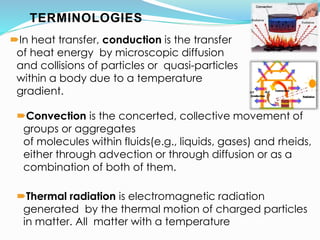
In heat transfer, conduction is the transfer
of heat energy by microscopic diffusion
and collisions of particles or quasi-particles
within a body due to a temperature
gradient.hermal radiation.
Convection is the concerted, collective movement of
groups or aggregates
of molecules within fluids(e.g., liquids, gases) and rheids,
either through advection or through diffusion or as a
combination of both of them.
Thermal radiation is electromagnetic radiation
generated by the thermal motion of charged particles
in matter. All matter with a temperature greater
4
DEFINITIONS
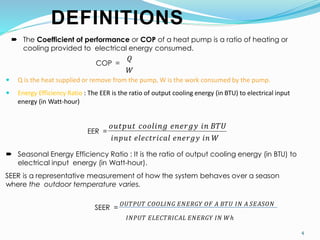
 The Coefficient of performance or COP of a heat pump is a ratio of heating or
cooling provided to electrical energy consumed.
COP =
𝑄
𝑊
 Q is the heat supplied or remove from the pump, W is the work consumed by the pump.
 Energy Efficiency Ratio : The EER is the ratio of output cooling energy (in BTU) to electrical input
energy (in Watt-hour)
EER =
𝑖𝑛𝑝𝑢𝑡 𝑒𝑙𝑒𝑐𝑡𝑟𝑖𝑐𝑎𝑙 𝑒𝑛𝑒𝑟𝑔𝑦 𝑖𝑛 𝑊
𝑜𝑢𝑡𝑝𝑢𝑡 𝑐𝑜𝑜𝑙𝑖𝑛𝑔 𝑒𝑛𝑒𝑟𝑔𝑦 𝑖𝑛 𝐵𝑇𝑈
 Seasonal Energy Efficiency Ratio : It is the ratio of output cooling energy (in BTU) to
electrical input energy (in Watt-hour).
SEER is a representative measurement of how the system behaves over a season
where the outdoor temperature varies.
SEER =
𝑂𝑈𝑇𝑃𝑈𝑇 𝐶𝑂𝑂𝐿𝐼𝑁𝐺 𝐸𝑁𝐸𝑅𝐺𝑌 𝑂𝐹 𝐴 𝐵𝑇𝑈 𝐼𝑁 𝐴 𝑆𝐸𝐴𝑆𝑂𝑁
𝐼𝑁𝑃𝑈𝑇 𝐸𝐿𝐸𝐶𝑇𝑅𝐼𝐶𝐴𝐿 𝐸𝑁𝐸𝑅𝐺𝑌 𝐼𝑁 𝑊ℎ
DEFINITIONS
5
 Kilo-Watt per Ton (kW/ton)
The efficiencies of large industrial air conditioner systems,
especially chillers, are given in kW/ton to specify the amount of
electrical power that is required for a certain power of cooling. In this
case, a smaller value represents a more efficient system.
 Horse Power
Another unit in use in the US is the horse power (HP). This is a unit of
power and typically is used to specify the size of motors. It may also be
used to specify the input power of an air conditioning system. One HP
is approxima ely 746 W.
 Energy Star :
In the US, Energy Star is the Environmental Protection Agency’s
(EPA’s) indication for products that have high energy efficiency. it
makes it easy for consumers to identify and purchase products that
have higher energy efficiency than those products without such
designation.
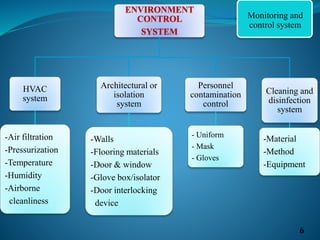
ENVIRONMENT
CONTROL
SYSTEM
HVAC
system
-Air filtration
-Pressurization
-Temperature
-Humidity
-Airborne
cleanliness
Architectural or
isolation
system
-Walls
-Flooring materials
-Door & window
-Glove box/isolator
-Door interlocking
device
Personnel
contamination
control
- Uniform
- Mask
- Gloves
Cleaning and
disinfection
system
-Material
-Method
-Equipment
Monitoring and
control system
6
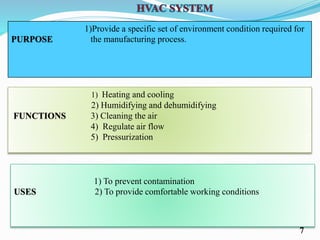
1)Provide a specific set of environment condition required for
PURPOSE the manufacturing process.
1) Heating and cooling
2) Humidifying and dehumidifying
FUNCTIONS 3) Cleaning the air
4) Regulate air flow
5) Pressurization
1) To prevent contamination
USES 2) To provide comfortable working conditions
7
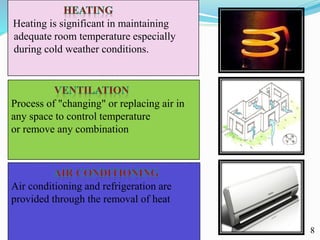
Heating is significant in maintaining
adequate room temperature especially
during cold weather conditions.
Process of "changing" or replacing air in
any space to control temperature
or remove any combination
Air conditioning and refrigeration are
provided through the removal of heat
8
Objective
 Goal: To develop an automotive air-conditioning system that is
smaller and lighter than with conventional technology.
 The Challenge: The system must be capable of keeping a
temperature of 22˚C inside a room, with an outside
temperature of 40˚C. Also, the system must be an efficient
heating system, keeping an internal temperature of 15˚C with
an outside temperature of 0˚C.
9
H.V.A.C
 H.V.A.C – Heating, Ventilation and Air Conditioning system
 The HVAC regulates
 Room Temperature
 Humidity
 Air Quality
 Air Flow
10
H.V.A.C
COMPONENTS:-
 Air conditioners
 AHUs
 Dehumidifiers/ Heater
 Filters (Pre & HEPA)
 Dust extractore
 Ducting (for delivery of controlled air)
 Supply fans
 Smoke detectores
 Damper
 Humidity/Temp./ Pressure sensor
 Heating & Cooling coils
11
DESIGN PARAMETERS
 Energy efficiency
 Cleanliness
 Cost
 Temperature uniformity
 Humidity control
 Chemical exhuast efficiency
 Noise control
12
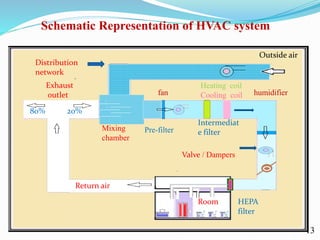
Distribution
network
Exhaust
outlet
Outside air
Heating coil
Cooling coil
HEPA
filter
Valve / Dampers
Intermediat
e filter
Mixing
chamber
Return air
Pre-filter
fan
Room
humidifier
80% 20%
Schematic Representation of HVAC system
13
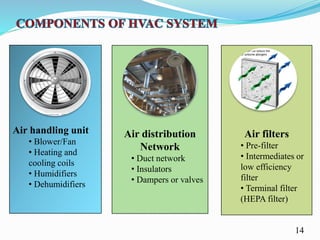
Air handling unit
• Blower/Fan
• Heating and
cooling coils
• Humidifiers
• Dehumidifiers
Air distribution
Network
• Duct network
• Insulators
• Dampers or valves
Air filters
• Pre-filter
• Intermediates or
low efficiency
filter
• Terminal filter
(HEPA filter)
14
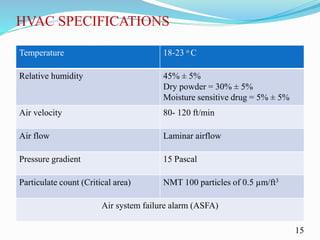
HVAC SPECIFICATIONS
Temperature 18-23 o C
Relative humidity 45% ± 5%
Dry powder = 30% ± 5%
Moisture sensitive drug = 5% ± 5%
Air velocity 80- 120 ft/min
Air flow Laminar airflow
Pressure gradient 15 Pascal
Particulate count (Critical area) NMT 100 particles of 0.5 µm/ft3
Air system failure alarm (ASFA)
15
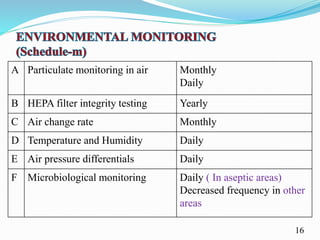
A Particulate monitoring in air Monthly
Daily
B HEPA filter integrity testing Yearly
C Air change rate Monthly
D Temperature and Humidity Daily
E Air pressure differentials Daily
F Microbiological monitoring Daily ( In aseptic areas)
Decreased frequency in other
areas
16
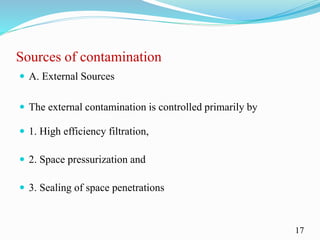
Sources of contamination
 A. External Sources
 The external contamination is controlled primarily by
 1. High efficiency filtration,
 2. Space pressurization and
 3. Sealing of space penetrations
17
B. Internal Sources-
 Control is primarily through airflow design.
 Construction finishes; personnel and garments; materials and equipments.
Important control precautions include:
 1. Walls, floors, ceiling tiles, doors, and windows.
 2. People must wear garments.
 3. Materials and equipment must be cleaned before entering the clean room.
 4. Room entrances such as air locks .
 5. Air showers are used to remove contaminants from personnel before entering .
18
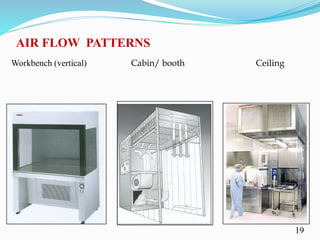
AIR FLOW PATTERNS
Workbench (vertical) Cabin/ booth Ceiling
19
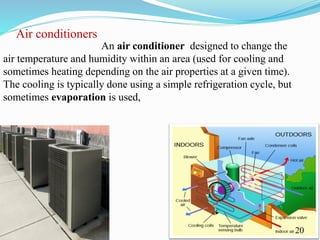
Air conditioners
An air conditioner designed to change the
air temperature and humidity within an area (used for cooling and
sometimes heating depending on the air properties at a given time).
The cooling is typically done using a simple refrigeration cycle, but
sometimes evaporation is used,
20
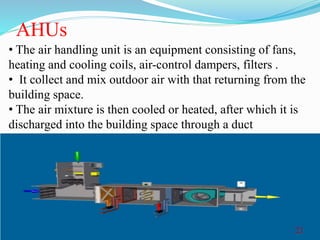
AHUs
• The air handling unit is an equipment consisting of fans,
heating and cooling coils, air-control dampers, filters .
• It collect and mix outdoor air with that returning from the
building space.
• The air mixture is then cooled or heated, after which it is
discharged into the building space through a duct
21
To do work
 1. What do heating, ventilation, and air conditioning
(HVAC) systems control?
 2- Mention the components of AHU’s?
22
THANK YOU !

components of HVAC system.pdf

  • 1.
  • 2.
    terminologies relevant toHVAC 2  Thermodynamics is a branch of natural science concerned with heat and its relation to energy and work. It defines macroscopic variables (such as temperature, internal energy, entropy, and pressure) that characterize materials and radiation, and explains how they are related and by what laws they change with time.  Fluid Mechanics : Fluid mechanics is the branch of physics that  studies fluids (liquids, gases, and plasmas) and the forces on them. Fluid mechanics can be divided into fluid statics, the study of fluids at rest; fluid kinematics, the study of fluids in motion; and fluid dynamics, the study of the effect of forces on fluid  motion.  Heat transfer is a discipline of thermal engineering that concerns the generation, use, conversion, and exchange of thermal energy and heat between physical systems. As such, heat transfer is involved in almost every sector of the economy. Heat transfer is classified into various mechanisms, such as thermal  conduction, thermal convection, thermal radiation, and transfer of energy by phase  changes
  • 3.
    02 TERMINOLOGIES In heat transfer,conduction is the transfer of heat energy by microscopic diffusion and collisions of particles or quasi-particles within a body due to a temperature gradient.hermal radiation. Convection is the concerted, collective movement of groups or aggregates of molecules within fluids(e.g., liquids, gases) and rheids, either through advection or through diffusion or as a combination of both of them. Thermal radiation is electromagnetic radiation generated by the thermal motion of charged particles in matter. All matter with a temperature greater
  • 4.
    4 DEFINITIONS  The Coefficientof performance or COP of a heat pump is a ratio of heating or cooling provided to electrical energy consumed. COP = 𝑄 𝑊  Q is the heat supplied or remove from the pump, W is the work consumed by the pump.  Energy Efficiency Ratio : The EER is the ratio of output cooling energy (in BTU) to electrical input energy (in Watt-hour) EER = 𝑖𝑛𝑝𝑢𝑡 𝑒𝑙𝑒𝑐𝑡𝑟𝑖𝑐𝑎𝑙 𝑒𝑛𝑒𝑟𝑔𝑦 𝑖𝑛 𝑊 𝑜𝑢𝑡𝑝𝑢𝑡 𝑐𝑜𝑜𝑙𝑖𝑛𝑔 𝑒𝑛𝑒𝑟𝑔𝑦 𝑖𝑛 𝐵𝑇𝑈  Seasonal Energy Efficiency Ratio : It is the ratio of output cooling energy (in BTU) to electrical input energy (in Watt-hour). SEER is a representative measurement of how the system behaves over a season where the outdoor temperature varies. SEER = 𝑂𝑈𝑇𝑃𝑈𝑇 𝐶𝑂𝑂𝐿𝐼𝑁𝐺 𝐸𝑁𝐸𝑅𝐺𝑌 𝑂𝐹 𝐴 𝐵𝑇𝑈 𝐼𝑁 𝐴 𝑆𝐸𝐴𝑆𝑂𝑁 𝐼𝑁𝑃𝑈𝑇 𝐸𝐿𝐸𝐶𝑇𝑅𝐼𝐶𝐴𝐿 𝐸𝑁𝐸𝑅𝐺𝑌 𝐼𝑁 𝑊ℎ
  • 5.
    DEFINITIONS 5  Kilo-Watt perTon (kW/ton) The efficiencies of large industrial air conditioner systems, especially chillers, are given in kW/ton to specify the amount of electrical power that is required for a certain power of cooling. In this case, a smaller value represents a more efficient system.  Horse Power Another unit in use in the US is the horse power (HP). This is a unit of power and typically is used to specify the size of motors. It may also be used to specify the input power of an air conditioning system. One HP is approxima ely 746 W.  Energy Star : In the US, Energy Star is the Environmental Protection Agency’s (EPA’s) indication for products that have high energy efficiency. it makes it easy for consumers to identify and purchase products that have higher energy efficiency than those products without such designation.
  • 6.
    ENVIRONMENT CONTROL SYSTEM HVAC system -Air filtration -Pressurization -Temperature -Humidity -Airborne cleanliness Architectural or isolation system -Walls -Flooringmaterials -Door & window -Glove box/isolator -Door interlocking device Personnel contamination control - Uniform - Mask - Gloves Cleaning and disinfection system -Material -Method -Equipment Monitoring and control system 6
  • 7.
    1)Provide a specificset of environment condition required for PURPOSE the manufacturing process. 1) Heating and cooling 2) Humidifying and dehumidifying FUNCTIONS 3) Cleaning the air 4) Regulate air flow 5) Pressurization 1) To prevent contamination USES 2) To provide comfortable working conditions 7
  • 8.
    Heating is significantin maintaining adequate room temperature especially during cold weather conditions. Process of "changing" or replacing air in any space to control temperature or remove any combination Air conditioning and refrigeration are provided through the removal of heat 8
  • 9.
    Objective  Goal: Todevelop an automotive air-conditioning system that is smaller and lighter than with conventional technology.  The Challenge: The system must be capable of keeping a temperature of 22˚C inside a room, with an outside temperature of 40˚C. Also, the system must be an efficient heating system, keeping an internal temperature of 15˚C with an outside temperature of 0˚C. 9
  • 10.
    H.V.A.C  H.V.A.C –Heating, Ventilation and Air Conditioning system  The HVAC regulates  Room Temperature  Humidity  Air Quality  Air Flow 10
  • 11.
    H.V.A.C COMPONENTS:-  Air conditioners AHUs  Dehumidifiers/ Heater  Filters (Pre & HEPA)  Dust extractore  Ducting (for delivery of controlled air)  Supply fans  Smoke detectores  Damper  Humidity/Temp./ Pressure sensor  Heating & Cooling coils 11
  • 12.
    DESIGN PARAMETERS  Energyefficiency  Cleanliness  Cost  Temperature uniformity  Humidity control  Chemical exhuast efficiency  Noise control 12
  • 13.
    Distribution network Exhaust outlet Outside air Heating coil Coolingcoil HEPA filter Valve / Dampers Intermediat e filter Mixing chamber Return air Pre-filter fan Room humidifier 80% 20% Schematic Representation of HVAC system 13
  • 14.
    Air handling unit •Blower/Fan • Heating and cooling coils • Humidifiers • Dehumidifiers Air distribution Network • Duct network • Insulators • Dampers or valves Air filters • Pre-filter • Intermediates or low efficiency filter • Terminal filter (HEPA filter) 14
  • 15.
    HVAC SPECIFICATIONS Temperature 18-23o C Relative humidity 45% ± 5% Dry powder = 30% ± 5% Moisture sensitive drug = 5% ± 5% Air velocity 80- 120 ft/min Air flow Laminar airflow Pressure gradient 15 Pascal Particulate count (Critical area) NMT 100 particles of 0.5 µm/ft3 Air system failure alarm (ASFA) 15
  • 16.
    A Particulate monitoringin air Monthly Daily B HEPA filter integrity testing Yearly C Air change rate Monthly D Temperature and Humidity Daily E Air pressure differentials Daily F Microbiological monitoring Daily ( In aseptic areas) Decreased frequency in other areas 16
  • 17.
    Sources of contamination A. External Sources  The external contamination is controlled primarily by  1. High efficiency filtration,  2. Space pressurization and  3. Sealing of space penetrations 17
  • 18.
    B. Internal Sources- Control is primarily through airflow design.  Construction finishes; personnel and garments; materials and equipments. Important control precautions include:  1. Walls, floors, ceiling tiles, doors, and windows.  2. People must wear garments.  3. Materials and equipment must be cleaned before entering the clean room.  4. Room entrances such as air locks .  5. Air showers are used to remove contaminants from personnel before entering . 18
  • 19.
    AIR FLOW PATTERNS Workbench(vertical) Cabin/ booth Ceiling 19
  • 20.
    Air conditioners An airconditioner designed to change the air temperature and humidity within an area (used for cooling and sometimes heating depending on the air properties at a given time). The cooling is typically done using a simple refrigeration cycle, but sometimes evaporation is used, 20
  • 21.
    AHUs • The airhandling unit is an equipment consisting of fans, heating and cooling coils, air-control dampers, filters . • It collect and mix outdoor air with that returning from the building space. • The air mixture is then cooled or heated, after which it is discharged into the building space through a duct 21
  • 22.
    To do work 1. What do heating, ventilation, and air conditioning (HVAC) systems control?  2- Mention the components of AHU’s? 22
  • 23.