Ashutosh Kumar Dubey
HVAC
 As name suggest its main purpose is to generate heat which
can be achieved by various equipment like heater ,boiler ,
furnace or heat pump to heat water ,steam or air in central
location such as a furnace room in a home or a mechanical
room in large building .
 A heating system may be a central heating system or
distributed.
 This is mostly used in cold countries.
CONVECTION-It is heat transfer by mass motion of a fluid such as air or water
when the heated fluid is caused to move away from the source of heat, carrying
energy with it. It occurs above hot because hot air expands, becomes less dense,
and rises
CONDUCTION -the process by which heat or electricity is directly transmitted
through the material of a substance when there is a difference of temperature or of
electrical potential between adjoining regions, without movement of the material.
RADIATION- the emission of energy as electromagnetic waves or as moving
subatomic particles, especially high-energy particles which cause ionization.
 It is a process in which air is replaced or exchanged for a particular area
to control moisture , odours ,smoke ,heat ,dust airborne bacteria ,carbon
di-oxide and maintaining oxygen level .
 It have two type first one is natural ventilation in which air is exchanged
naturally and second one is forced Ventilation in which air is exchanged
forcefully by means of fans.
 Ex. Kitchens exhaust , Basement (car park) exhaust.
1) Wall Mounted Propeller fan-
In this type of fan air flows in parallel to the shaft. A wall mounted
fan is a machine used to create flow within a system, typically a gas as
air. It consist of rotating arrangement of vanes or blade which act on
fluid. Usually it is contained within some form of housing or case.
This may direct the airflow or increase safety by preventing object
from contacting the fan blades. Mostly these type of fan use in toilet
,pantry for exhaust and fresh air purpose.
2) Inline Centrifugal fan
A centrifugal fan is a fan in which air flows in a radial or
perpendicular direction relative to the fan shaft. These fan is specially
designed to be connected to duct work in direct line with discharge
from housing. These fan contain scroll shaped fan housing. it is
available in circular and cabinet. It is mostly used for because it offer
speed controllable ,maintenance free ,can be installed outside.
3) Axial Fan
It is mostly used for commercial application. It uses axial forces to achieve
movement of air or gas ,spinning a central hub with blade extending radially
from its outer diameter. The fluid moves parallel to fan wheels shaft or it axis
of rotation. An axial fan consists of much fewer blades i.e., two to six, as
compared to ducted fan. Axial fans operate at high specific speed i.e., high
flow rate and low head and hence adding more blades will restrict the high
flow rate required for its operation. The axial fan wheel is often contained
within a short section of cylindrical duct work , to which inlet and outlet
ducting can be connected.
4) Roof Mounted fan
Roof exhaust fan generally exhaust the air out of building. It mostly
called Roof Extractor. It have simple design and suitable for fixing on
inclined roof. The equipment contains of one M.S. cowl for rain
protection, Axial Flow Fan having cast aluminum alloy impeller of
aero foil design fitted on motor's shaft. It is better suited for relatively
clean air systems, Roof exhaust fan suitable for commercial
application like warehouses, hospitals, retails stores.
5) Jet fan
This type of fan develop for ventilation in tunnels and now it is
widely used in basement car parking areas also. It work by
propelling. A small jet of air at extremely high velocity which causes
surrounding air to be entrained and in a confined space like tunnel or
car park. It is used to reduce duct work and to drive the smoke
toward extract fan to keep pollution within acceptable limit.
FRESH AIR EXHAUST AIR
Formula(Q) - N x V
N-Air change rate
V-Volume of room ( m³)
Q-Fresh air quantity(CMH)
Air change Rate(N)
1.General space - 4ACPH
2.Auditorium - 8 to15 ACPH
3.Bakeries/Bars- 20 to 30 ACPH
4. Class Room-6 to 20 ACPH
5. Pump rooms-5 ACPH
6.Residential toilet-8 ACPH
7.Commercial kitchen & toilet-12 to 15 ACPH
8.Office-3 to 4 ACPH
9.Computer Room-15 to 20 ACPH
10. Warehouses-6 to 30 ACPH
11. Theaters- 8 to 15 ACPH
12.Substation,electric-5 to 10 ACPH
13. Museums-12 to 15 ACPH
14. Cafeterias-12 to 15 ACPH
Formula(Q) - (N x A x H)/60
N-Air change rate
A-Area of room ( m³)
Q-Exhaust air quantity(CMF)
H-Height of room
Air change Rate(N)
1.Basement parking-15 to 30 ACPH
2.Commercial Kitchen & toilet-15
to 30 ACPH
3.Lab-6 to 12 ACHP
4.Warehouse-1 to 2 ACPH
5.Smoking room-10 to 15 ACPH
6.Residential toilet-10 to 15 ACPH
7.Classroom-3 to 4 ACPH
8.Smoke exhaust
Basement -30 ACPH &
Above Gr. Floor ACPH
 It is the process of maintaining thermal condition ,indoor air
quality ,humidity and remove anti micro organism ,dust ,soot and
foreign particle from particular area for human comfort.
 Compressor
 Condenser
 Evaporator
 Expansion valve
1.It is heart of air conditioning system.
2.The compressor pumps vapor refrigerant at
high pressure and temperature into a condenser,
and receive super heat vapor at low temperature and
pressure from evaporator.
3.Types of Compressor
a) Reciprocating.
b) Scroll.
c) Screw.
d) Rotary.
e) Centrifugal.
1.It is part of refrigeration system and
responsible for heat transfer.
2.It receive vapor refrigerant from compressor at
high temperature and pressure and removes its
heat and pass it to expansion valve.
3.Types of Compressor
a)air cooled condensers
b)water cooled condensers
c) evaporative condensers.
1.It is part of refrigeration cycle and responsible
for heat transfer.
2.It receive refrigerant from TXV valve or
capillary tube and this refrigerant is in liquid and
vapor form at low pressure.
3.It changes the phase of refrigerant in to complete
vapor form and supplies to compressor.
4.Types of
a) Bare Tube Evaporators
b)Plate Type of Evaporators
c) Finned Evaporators
d)Shell and Tube types of Evaporators
1.It control the refrigerant in to refrigeration cycle. It
receive the refrigerant from condenser(high pressure
liquid) and it reduce the pressure and pass it to
evaporator.
2.The liquid refrigerant is controlled according to
superheat at outlet of evaporator.
3.It allow the refrigerant in such a way that the
refrigerant coming out from evaporator will be in
vapor form.
4.Types of Expansion Valve
 Automatic Exp. Valves
 Thermostatic Exp. Valves
 Capillary Tubes
 Float Valves
Other Parts Used in Refrigeration Cycle
1. Oil Separator-As name suggest it is used to separate oil from refrigerant. It is
installed in the discharge line after compressor and oil is returned to
compressor by mechanical system.
2. Liquid Receiver- It is mounted after condenser. Its main function to separate
vapor from refrigerant and allow liquid refrigerant to expansion valve. It
store the refrigerant during maintenance.
3. Filter Drier-It is used in liquid line to remove moisture and acid from
refrigerant. Inside filter drier it contain molecular sieves ,activated carbon,
alumina due to its high absorption capacity.
4. Solenoid Valve –It is used in liquid line before expansion valve. It prevent
refrigerant flow when system is switched off. During pump down process it
play major role.
5. Sight Glass –It is used to check dryness of refrigerant.
6. Accumulator –It is used to prevent liquid refrigerant into compressor
because liquid refrigerant can damage compressor.. It is not used in small AC
system ,it is mostly used in VRF and bigger system.
1) Window air-conditioning system
2) Split air-conditioning system
3) Centralized air-conditioning system
4) Package air-conditioning system
5) Portable air-conditioning
1) Windows Air-conditioning System
 Window AC are one of the most commonly used unit for a single room
and cheapest type of air conditioners.
 To install one of these units, you need to make a slot in the wall, and
there should also be some open space behind the wall so that hot air
can be thrown out.
 It is one box unit and very simple to install.
2) Split Air-Conditioning System
 It consist of 2 unit one is Indoor unit and second one is outdoor unit.
 The Outdoor Unit, fitted outside the room, houses components like the compressor,
condenser and expansion valve.
 The Indoor Unit comprises the evaporator or cooling coil and the cooling fan.
 Copper pipe are used to connect the IDU and ODU.
 Depending upon the aesthetic view and use split unit have following type
a) HI wall Unit
b) Duct able Unit
c) Cassette Unit.
 Depending Upon flow cassette unit available in One way Cassette ,two way cassette
four way cassette and compact cassette.
 For large area ,duct able units are used. Air is distributed through duct and grills.
 The window and split Ac are used for single rooms or small spaces
because these units cannot satisfactorily cool the large areas,
auditoriums, receptions areas etc. If it is used then it’s maintenance
will be costlier and it take large space for outdoor unit.
 Central air conditioning systems are used in large buildings, hotels,
movie theatres, factories, and other bigger spaces and it saves a lot of
space also.
 This type of system makes use of a large compressor. Two separate
packaged units are also used. The condensing unit is placed outside
and contains the condensing fan, compressor, and condenser coil. The
internal evaporative unit, consisting of the evaporator coil and
expansion valve, is placed in side the rooms.
 Types of Central air conditioning is
 VRV/VRV
 Chilled water system
 This is a variation of the unitary air conditioning
system. This type has a mobile air conditioning system
placed on the floor inside a room. It discharges exhaust
heat through the exterior wall by means of a hose vent.
While this type is noisier than other systems, it can cool
even the most stubborn hot rooms.
• Package air conditioner is a next version of the window air
conditioner. However, unlike window air conditioner it has a higher
cooling or heating capacity and is usually able to cool an entire house or
a commercial building. The nominal capacities ranges from 5 TR to 22
TR.
• These units are used commonly in places like restaurants, big offices ,
supermarkets & small halls, etc.
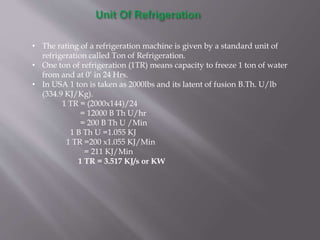
• The rating of a refrigeration machine is given by a standard unit of
refrigeration called Ton of Refrigeration.
• One ton of refrigeration (1TR) means capacity to freeze 1 ton of water
from and at 0’ in 24 Hrs.
• In USA 1 ton is taken as 2000lbs and its latent of fusion B.Th. U/lb
(334.9 KJ/Kg).
1 TR = (2000x144)/24
= 12000 B Th U/hr
= 200 B Th U /Min
1 B Th U =1.055 KJ
1 TR =200 x1.055 KJ/Min
= 211 KJ/Min
1 TR = 3.517 KJ/s or KW
Hvac & Refrigeration

Hvac & Refrigeration

  • 1.
  • 3.
     As namesuggest its main purpose is to generate heat which can be achieved by various equipment like heater ,boiler , furnace or heat pump to heat water ,steam or air in central location such as a furnace room in a home or a mechanical room in large building .  A heating system may be a central heating system or distributed.  This is mostly used in cold countries.
  • 4.
    CONVECTION-It is heattransfer by mass motion of a fluid such as air or water when the heated fluid is caused to move away from the source of heat, carrying energy with it. It occurs above hot because hot air expands, becomes less dense, and rises CONDUCTION -the process by which heat or electricity is directly transmitted through the material of a substance when there is a difference of temperature or of electrical potential between adjoining regions, without movement of the material. RADIATION- the emission of energy as electromagnetic waves or as moving subatomic particles, especially high-energy particles which cause ionization.
  • 5.
     It isa process in which air is replaced or exchanged for a particular area to control moisture , odours ,smoke ,heat ,dust airborne bacteria ,carbon di-oxide and maintaining oxygen level .  It have two type first one is natural ventilation in which air is exchanged naturally and second one is forced Ventilation in which air is exchanged forcefully by means of fans.  Ex. Kitchens exhaust , Basement (car park) exhaust.
  • 6.
    1) Wall MountedPropeller fan- In this type of fan air flows in parallel to the shaft. A wall mounted fan is a machine used to create flow within a system, typically a gas as air. It consist of rotating arrangement of vanes or blade which act on fluid. Usually it is contained within some form of housing or case. This may direct the airflow or increase safety by preventing object from contacting the fan blades. Mostly these type of fan use in toilet ,pantry for exhaust and fresh air purpose.
  • 7.
    2) Inline Centrifugalfan A centrifugal fan is a fan in which air flows in a radial or perpendicular direction relative to the fan shaft. These fan is specially designed to be connected to duct work in direct line with discharge from housing. These fan contain scroll shaped fan housing. it is available in circular and cabinet. It is mostly used for because it offer speed controllable ,maintenance free ,can be installed outside.
  • 8.
    3) Axial Fan Itis mostly used for commercial application. It uses axial forces to achieve movement of air or gas ,spinning a central hub with blade extending radially from its outer diameter. The fluid moves parallel to fan wheels shaft or it axis of rotation. An axial fan consists of much fewer blades i.e., two to six, as compared to ducted fan. Axial fans operate at high specific speed i.e., high flow rate and low head and hence adding more blades will restrict the high flow rate required for its operation. The axial fan wheel is often contained within a short section of cylindrical duct work , to which inlet and outlet ducting can be connected.
  • 9.
    4) Roof Mountedfan Roof exhaust fan generally exhaust the air out of building. It mostly called Roof Extractor. It have simple design and suitable for fixing on inclined roof. The equipment contains of one M.S. cowl for rain protection, Axial Flow Fan having cast aluminum alloy impeller of aero foil design fitted on motor's shaft. It is better suited for relatively clean air systems, Roof exhaust fan suitable for commercial application like warehouses, hospitals, retails stores.
  • 10.
    5) Jet fan Thistype of fan develop for ventilation in tunnels and now it is widely used in basement car parking areas also. It work by propelling. A small jet of air at extremely high velocity which causes surrounding air to be entrained and in a confined space like tunnel or car park. It is used to reduce duct work and to drive the smoke toward extract fan to keep pollution within acceptable limit.
  • 11.
    FRESH AIR EXHAUSTAIR Formula(Q) - N x V N-Air change rate V-Volume of room ( m³) Q-Fresh air quantity(CMH) Air change Rate(N) 1.General space - 4ACPH 2.Auditorium - 8 to15 ACPH 3.Bakeries/Bars- 20 to 30 ACPH 4. Class Room-6 to 20 ACPH 5. Pump rooms-5 ACPH 6.Residential toilet-8 ACPH 7.Commercial kitchen & toilet-12 to 15 ACPH 8.Office-3 to 4 ACPH 9.Computer Room-15 to 20 ACPH 10. Warehouses-6 to 30 ACPH 11. Theaters- 8 to 15 ACPH 12.Substation,electric-5 to 10 ACPH 13. Museums-12 to 15 ACPH 14. Cafeterias-12 to 15 ACPH Formula(Q) - (N x A x H)/60 N-Air change rate A-Area of room ( m³) Q-Exhaust air quantity(CMF) H-Height of room Air change Rate(N) 1.Basement parking-15 to 30 ACPH 2.Commercial Kitchen & toilet-15 to 30 ACPH 3.Lab-6 to 12 ACHP 4.Warehouse-1 to 2 ACPH 5.Smoking room-10 to 15 ACPH 6.Residential toilet-10 to 15 ACPH 7.Classroom-3 to 4 ACPH 8.Smoke exhaust Basement -30 ACPH & Above Gr. Floor ACPH
  • 12.
     It isthe process of maintaining thermal condition ,indoor air quality ,humidity and remove anti micro organism ,dust ,soot and foreign particle from particular area for human comfort.
  • 15.
     Compressor  Condenser Evaporator  Expansion valve
  • 16.
    1.It is heartof air conditioning system. 2.The compressor pumps vapor refrigerant at high pressure and temperature into a condenser, and receive super heat vapor at low temperature and pressure from evaporator. 3.Types of Compressor a) Reciprocating. b) Scroll. c) Screw. d) Rotary. e) Centrifugal.
  • 17.
    1.It is partof refrigeration system and responsible for heat transfer. 2.It receive vapor refrigerant from compressor at high temperature and pressure and removes its heat and pass it to expansion valve. 3.Types of Compressor a)air cooled condensers b)water cooled condensers c) evaporative condensers.
  • 18.
    1.It is partof refrigeration cycle and responsible for heat transfer. 2.It receive refrigerant from TXV valve or capillary tube and this refrigerant is in liquid and vapor form at low pressure. 3.It changes the phase of refrigerant in to complete vapor form and supplies to compressor. 4.Types of a) Bare Tube Evaporators b)Plate Type of Evaporators c) Finned Evaporators d)Shell and Tube types of Evaporators
  • 19.
    1.It control therefrigerant in to refrigeration cycle. It receive the refrigerant from condenser(high pressure liquid) and it reduce the pressure and pass it to evaporator. 2.The liquid refrigerant is controlled according to superheat at outlet of evaporator. 3.It allow the refrigerant in such a way that the refrigerant coming out from evaporator will be in vapor form. 4.Types of Expansion Valve  Automatic Exp. Valves  Thermostatic Exp. Valves  Capillary Tubes  Float Valves
  • 20.
    Other Parts Usedin Refrigeration Cycle 1. Oil Separator-As name suggest it is used to separate oil from refrigerant. It is installed in the discharge line after compressor and oil is returned to compressor by mechanical system. 2. Liquid Receiver- It is mounted after condenser. Its main function to separate vapor from refrigerant and allow liquid refrigerant to expansion valve. It store the refrigerant during maintenance. 3. Filter Drier-It is used in liquid line to remove moisture and acid from refrigerant. Inside filter drier it contain molecular sieves ,activated carbon, alumina due to its high absorption capacity. 4. Solenoid Valve –It is used in liquid line before expansion valve. It prevent refrigerant flow when system is switched off. During pump down process it play major role. 5. Sight Glass –It is used to check dryness of refrigerant. 6. Accumulator –It is used to prevent liquid refrigerant into compressor because liquid refrigerant can damage compressor.. It is not used in small AC system ,it is mostly used in VRF and bigger system.
  • 21.
    1) Window air-conditioningsystem 2) Split air-conditioning system 3) Centralized air-conditioning system 4) Package air-conditioning system 5) Portable air-conditioning
  • 22.
    1) Windows Air-conditioningSystem  Window AC are one of the most commonly used unit for a single room and cheapest type of air conditioners.  To install one of these units, you need to make a slot in the wall, and there should also be some open space behind the wall so that hot air can be thrown out.  It is one box unit and very simple to install.
  • 23.
    2) Split Air-ConditioningSystem  It consist of 2 unit one is Indoor unit and second one is outdoor unit.  The Outdoor Unit, fitted outside the room, houses components like the compressor, condenser and expansion valve.  The Indoor Unit comprises the evaporator or cooling coil and the cooling fan.  Copper pipe are used to connect the IDU and ODU.  Depending upon the aesthetic view and use split unit have following type a) HI wall Unit b) Duct able Unit c) Cassette Unit.  Depending Upon flow cassette unit available in One way Cassette ,two way cassette four way cassette and compact cassette.  For large area ,duct able units are used. Air is distributed through duct and grills.
  • 25.
     The windowand split Ac are used for single rooms or small spaces because these units cannot satisfactorily cool the large areas, auditoriums, receptions areas etc. If it is used then it’s maintenance will be costlier and it take large space for outdoor unit.  Central air conditioning systems are used in large buildings, hotels, movie theatres, factories, and other bigger spaces and it saves a lot of space also.  This type of system makes use of a large compressor. Two separate packaged units are also used. The condensing unit is placed outside and contains the condensing fan, compressor, and condenser coil. The internal evaporative unit, consisting of the evaporator coil and expansion valve, is placed in side the rooms.  Types of Central air conditioning is  VRV/VRV  Chilled water system
  • 27.
     This isa variation of the unitary air conditioning system. This type has a mobile air conditioning system placed on the floor inside a room. It discharges exhaust heat through the exterior wall by means of a hose vent. While this type is noisier than other systems, it can cool even the most stubborn hot rooms.
  • 28.
    • Package airconditioner is a next version of the window air conditioner. However, unlike window air conditioner it has a higher cooling or heating capacity and is usually able to cool an entire house or a commercial building. The nominal capacities ranges from 5 TR to 22 TR. • These units are used commonly in places like restaurants, big offices , supermarkets & small halls, etc.
  • 29.
    • The ratingof a refrigeration machine is given by a standard unit of refrigeration called Ton of Refrigeration. • One ton of refrigeration (1TR) means capacity to freeze 1 ton of water from and at 0’ in 24 Hrs. • In USA 1 ton is taken as 2000lbs and its latent of fusion B.Th. U/lb (334.9 KJ/Kg). 1 TR = (2000x144)/24 = 12000 B Th U/hr = 200 B Th U /Min 1 B Th U =1.055 KJ 1 TR =200 x1.055 KJ/Min = 211 KJ/Min 1 TR = 3.517 KJ/s or KW