Sanjivani Rural Education Society’s
Sanjivani College of Engineering, Kopargaon-423 603
(An Autonomous Institute, Affiliated to Savitribai Phule Pune University, Pune)
NAAC ‘A’ Grade Accredited, ISO 9001:2015 Certified
Department of Mechanical Engineering
Subject:- Heating, Ventilation and Air
Conditioning (ME 411)
B.Tech.Mechanical
Purushottam W. Ingle
Assistant Professor
1
Evaporative-Cooling Air Conditioning Systems
• This system is based on the principle that when moist but
unsaturated air comes in contact with a wetted surface whose
temperature is higher than the dew point temperature of air, some
water from the wetted surface evaporates into air.
• The latent heat of evaporation is taken from water, air or both of
them. In this process, the air loses sensible heat but gains latent heat
due to transfer of water vapor. Thus the air gets cooled and
humidified. The cooled and humidified air can be used for providing
thermal comfort.
P.W. Ingle Department Of Mechanical Engineering, Sanjivani COE, Kopargaon
9/4/2023
9/4/2023 P.W. Ingle Department Of Mechanical Engineering, Sanjivani COE, Kopargaon
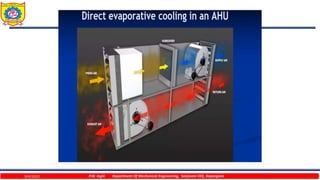
Direct evaporative cooling system
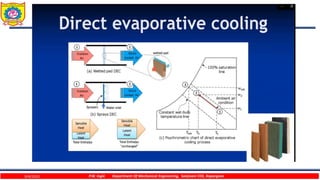
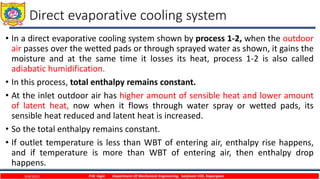
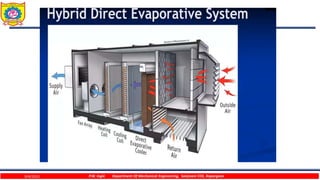
• In a direct evaporative cooling system shown by process 1-2, when the outdoor
air passes over the wetted pads or through sprayed water as shown, it gains the
moisture and at the same time it losses its heat, process 1-2 is also called
adiabatic humidification.
• In this process, total enthalpy remains constant.
• At the inlet outdoor air has higher amount of sensible heat and lower amount
of latent heat, now when it flows through water spray or wetted pads, its
sensible heat reduced and latent heat is increased.
• So the total enthalpy remains constant.
• If outlet temperature is less than WBT of entering air, enthalpy rise happens,
and if temperature is more than WBT of entering air, then enthalpy drop
happens.
9/4/2023 P.W. Ingle Department Of Mechanical Engineering, Sanjivani COE, Kopargaon
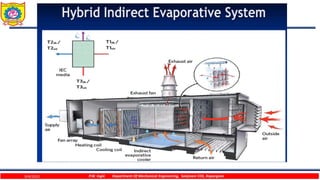
Indirect evaporative cooling system
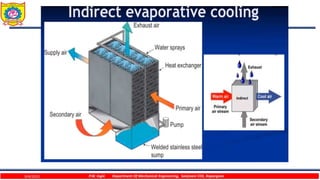
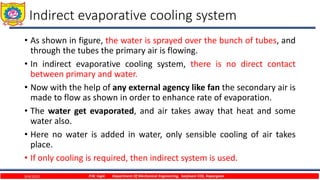
• As shown in figure, the water is sprayed over the bunch of tubes, and
through the tubes the primary air is flowing.
• In indirect evaporative cooling system, there is no direct contact
between primary and water.
• Now with the help of any external agency like fan the secondary air is
made to flow as shown in order to enhance rate of evaporation.
• The water get evaporated, and air takes away that heat and some
water also.
• Here no water is added in water, only sensible cooling of air takes
place.
• If only cooling is required, then indirect system is used.
9/4/2023 P.W. Ingle Department Of Mechanical Engineering, Sanjivani COE, Kopargaon
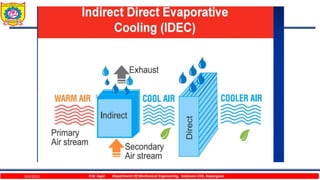
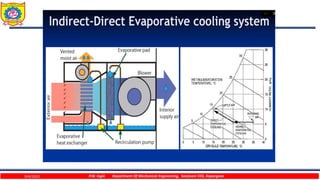
• In indirect direct evaporative cooling system, both systems are used
in combination connect in series, so in indirect cooling system only
sensible cooling is occurred, whereas in direct cooling system cooling
and humidification occurs.
• As shown on slide next, the primary air flows through the channel
through evaporative heat exchanger, liquid is spray by recirculation
pump, so sensible cooling happens here.
• Now when same air is made to flow over evaporative pad, both
cooling and humidification occurs.
• Two psychometric processes are shown on chart, sensible cooling
and Cooling and humidification.
9/4/2023 P.W. Ingle Department Of Mechanical Engineering, Sanjivani COE, Kopargaon
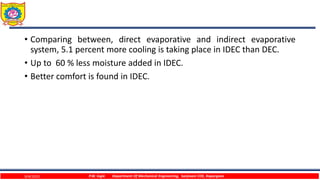
• Comparing between, direct evaporative and indirect evaporative
system, 5.1 percent more cooling is taking place in IDEC than DEC.
• Up to 60 % less moisture added in IDEC.
• Better comfort is found in IDEC.
9/4/2023 P.W. Ingle Department Of Mechanical Engineering, Sanjivani COE, Kopargaon
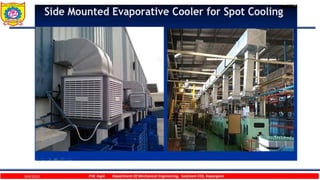
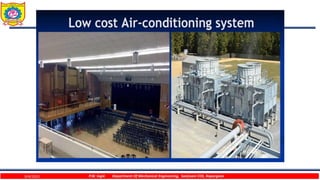
• Advantages and disadvantages of evaporative cooling systems :
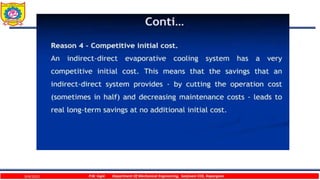
• Lower equipment and installation costs.
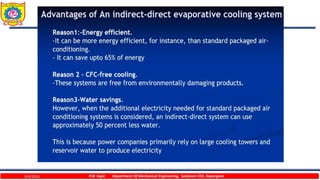
• Substantially lower operating and power costs. Energy savings can be
as high as 75 %.
• Ease of fabrication and installation.
• Lower maintenance costs.
• Ensures a very good ventilation due to the large air flow rates
involved, hence, are very good especially in 100 % outdoor air
applications.
• Better air distribution in the conditioned space due to higher flow
rates.
9/4/2023 P.W. Ingle Department Of Mechanical Engineering, Sanjivani COE, Kopargaon
• The fans/blowers create positive pressures in the conditioned space, so that
infiltration of outside air is prevented.
• Very environment friendly as no harmful chemicals are used.
• Disadvantages:
• The moisture level in the conditioned space could be higher, hence, direct
evaporative coolers are not good when low humidity levels in the conditioned
space is required. However, the indirect evaporative cooler can be used
without increasing humidity.
• Since the required air flow rates are much larger this may create draft and/or
high noise levels in the conditioned space.
• Precise control of temperature and humidity in the conditioned space is not
possible.
9/4/2023 P.W. Ingle Department Of Mechanical Engineering, Sanjivani COE, Kopargaon
• May lead to health problems due to micro-organisms if the water
used is not clean or the wetted surfaces are not maintained properly
9/4/2023 P.W. Ingle Department Of Mechanical Engineering, Sanjivani COE, Kopargaon

Evaporative cooling Air conditioning system.ppt

  • 1.
    Sanjivani Rural EducationSociety’s Sanjivani College of Engineering, Kopargaon-423 603 (An Autonomous Institute, Affiliated to Savitribai Phule Pune University, Pune) NAAC ‘A’ Grade Accredited, ISO 9001:2015 Certified Department of Mechanical Engineering Subject:- Heating, Ventilation and Air Conditioning (ME 411) B.Tech.Mechanical Purushottam W. Ingle Assistant Professor
  • 2.
    1 Evaporative-Cooling Air ConditioningSystems • This system is based on the principle that when moist but unsaturated air comes in contact with a wetted surface whose temperature is higher than the dew point temperature of air, some water from the wetted surface evaporates into air. • The latent heat of evaporation is taken from water, air or both of them. In this process, the air loses sensible heat but gains latent heat due to transfer of water vapor. Thus the air gets cooled and humidified. The cooled and humidified air can be used for providing thermal comfort. P.W. Ingle Department Of Mechanical Engineering, Sanjivani COE, Kopargaon 9/4/2023
  • 3.
    9/4/2023 P.W. IngleDepartment Of Mechanical Engineering, Sanjivani COE, Kopargaon
  • 4.
    Direct evaporative coolingsystem • In a direct evaporative cooling system shown by process 1-2, when the outdoor air passes over the wetted pads or through sprayed water as shown, it gains the moisture and at the same time it losses its heat, process 1-2 is also called adiabatic humidification. • In this process, total enthalpy remains constant. • At the inlet outdoor air has higher amount of sensible heat and lower amount of latent heat, now when it flows through water spray or wetted pads, its sensible heat reduced and latent heat is increased. • So the total enthalpy remains constant. • If outlet temperature is less than WBT of entering air, enthalpy rise happens, and if temperature is more than WBT of entering air, then enthalpy drop happens. 9/4/2023 P.W. Ingle Department Of Mechanical Engineering, Sanjivani COE, Kopargaon
  • 5.
    9/4/2023 P.W. IngleDepartment Of Mechanical Engineering, Sanjivani COE, Kopargaon
  • 6.
    Indirect evaporative coolingsystem • As shown in figure, the water is sprayed over the bunch of tubes, and through the tubes the primary air is flowing. • In indirect evaporative cooling system, there is no direct contact between primary and water. • Now with the help of any external agency like fan the secondary air is made to flow as shown in order to enhance rate of evaporation. • The water get evaporated, and air takes away that heat and some water also. • Here no water is added in water, only sensible cooling of air takes place. • If only cooling is required, then indirect system is used. 9/4/2023 P.W. Ingle Department Of Mechanical Engineering, Sanjivani COE, Kopargaon
  • 7.
    9/4/2023 P.W. IngleDepartment Of Mechanical Engineering, Sanjivani COE, Kopargaon
  • 8.
    • In indirectdirect evaporative cooling system, both systems are used in combination connect in series, so in indirect cooling system only sensible cooling is occurred, whereas in direct cooling system cooling and humidification occurs. • As shown on slide next, the primary air flows through the channel through evaporative heat exchanger, liquid is spray by recirculation pump, so sensible cooling happens here. • Now when same air is made to flow over evaporative pad, both cooling and humidification occurs. • Two psychometric processes are shown on chart, sensible cooling and Cooling and humidification. 9/4/2023 P.W. Ingle Department Of Mechanical Engineering, Sanjivani COE, Kopargaon
  • 9.
    9/4/2023 P.W. IngleDepartment Of Mechanical Engineering, Sanjivani COE, Kopargaon
  • 10.
    • Comparing between,direct evaporative and indirect evaporative system, 5.1 percent more cooling is taking place in IDEC than DEC. • Up to 60 % less moisture added in IDEC. • Better comfort is found in IDEC. 9/4/2023 P.W. Ingle Department Of Mechanical Engineering, Sanjivani COE, Kopargaon
  • 11.
    9/4/2023 P.W. IngleDepartment Of Mechanical Engineering, Sanjivani COE, Kopargaon
  • 12.
    9/4/2023 P.W. IngleDepartment Of Mechanical Engineering, Sanjivani COE, Kopargaon
  • 13.
    9/4/2023 P.W. IngleDepartment Of Mechanical Engineering, Sanjivani COE, Kopargaon
  • 14.
    9/4/2023 P.W. IngleDepartment Of Mechanical Engineering, Sanjivani COE, Kopargaon
  • 15.
    9/4/2023 P.W. IngleDepartment Of Mechanical Engineering, Sanjivani COE, Kopargaon
  • 16.
    9/4/2023 P.W. IngleDepartment Of Mechanical Engineering, Sanjivani COE, Kopargaon
  • 17.
    9/4/2023 P.W. IngleDepartment Of Mechanical Engineering, Sanjivani COE, Kopargaon
  • 18.
    9/4/2023 P.W. IngleDepartment Of Mechanical Engineering, Sanjivani COE, Kopargaon
  • 19.
    9/4/2023 P.W. IngleDepartment Of Mechanical Engineering, Sanjivani COE, Kopargaon
  • 20.
    9/4/2023 P.W. IngleDepartment Of Mechanical Engineering, Sanjivani COE, Kopargaon
  • 21.
    9/4/2023 P.W. IngleDepartment Of Mechanical Engineering, Sanjivani COE, Kopargaon
  • 22.
    9/4/2023 P.W. IngleDepartment Of Mechanical Engineering, Sanjivani COE, Kopargaon
  • 23.
    • Advantages anddisadvantages of evaporative cooling systems : • Lower equipment and installation costs. • Substantially lower operating and power costs. Energy savings can be as high as 75 %. • Ease of fabrication and installation. • Lower maintenance costs. • Ensures a very good ventilation due to the large air flow rates involved, hence, are very good especially in 100 % outdoor air applications. • Better air distribution in the conditioned space due to higher flow rates. 9/4/2023 P.W. Ingle Department Of Mechanical Engineering, Sanjivani COE, Kopargaon
  • 24.
    • The fans/blowerscreate positive pressures in the conditioned space, so that infiltration of outside air is prevented. • Very environment friendly as no harmful chemicals are used. • Disadvantages: • The moisture level in the conditioned space could be higher, hence, direct evaporative coolers are not good when low humidity levels in the conditioned space is required. However, the indirect evaporative cooler can be used without increasing humidity. • Since the required air flow rates are much larger this may create draft and/or high noise levels in the conditioned space. • Precise control of temperature and humidity in the conditioned space is not possible. 9/4/2023 P.W. Ingle Department Of Mechanical Engineering, Sanjivani COE, Kopargaon
  • 25.
    • May leadto health problems due to micro-organisms if the water used is not clean or the wetted surfaces are not maintained properly 9/4/2023 P.W. Ingle Department Of Mechanical Engineering, Sanjivani COE, Kopargaon