Sanjivani Rural Education Society’s
Sanjivani College of Engineering, Kopargaon-423 603
(An Autonomous Institute, Affiliated to Savitribai Phule Pune University, Pune)
NAAC ‘A’ Grade Accredited, ISO 9001:2015 Certified
Department of Mechanical Engineering
Subject:- Heating, Ventilation and Air
Conditioning (ME 411)
B.Tech.Mechanical
Purushottam W. Ingle
Assistant Professor
E-mail:- inglepurushottammech@sanjivani.org.in
Cell No. 9923567075
Types & Application of Chillers
• LIQUID COOLERS (CHILLERS)
• The liquid coolers are essentially the recuperative type of heat exchangers in
which the liquid refrigerant and the liquid to be cooled exist on either side of
the tube.
• The liquids being cooled are water, brine solutions, milk, beer and other
products with low viscosity. The liquid refrigerant is evaporated producing
cold and is transferred to these fluids. The types of liquid coolers are:
• Direct expansion type
• Flooded shell-and-tube coolers
• Shell-and-coil types.
12/27/2023 P.W. Ingle Department Of Mechanical Engineering, Sanjivani COE, Kopargaon
Direct Expansion Type
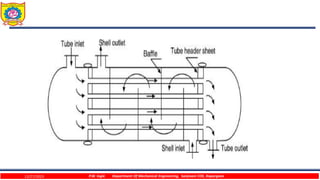
• Figure shows a typical shell-and-tube cooler. The refrigerant evaporates
inside the tubes while the liquid being cooled occupies the space of the
shell.
• The liquid on the shell side flows at right angles to the tubes. The baffles will
help to increase the velocity thereby increasing the heat transfer coefficient
and subsequently the rate of heat transfer. These are used with positive
displacement compressors like reciprocating, rotary and screw compressors.
• The uniform distribution of refrigerant in all the tubes is difficult to achieve,
therefore a spray distributor is a must for this purpose. The number
refrigerant passes is another important item in the performance of a direct
expansion cooler.
12/27/2023 P.W. Ingle Department Of Mechanical Engineering, Sanjivani COE, Kopargaon
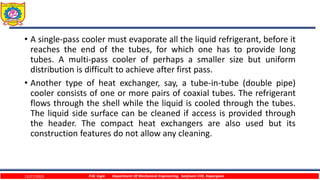
• A single-pass cooler must evaporate all the liquid refrigerant, before it
reaches the end of the tubes, for which one has to provide long
tubes. A multi-pass cooler of perhaps a smaller size but uniform
distribution is difficult to achieve after first pass.
• Another type of heat exchanger, say, a tube-in-tube (double pipe)
cooler consists of one or more pairs of coaxial tubes. The refrigerant
flows through the shell while the liquid is cooled through the tubes.
The liquid side surface can be cleaned if access is provided through
the header. The compact heat exchangers are also used but its
construction features do not allow any cleaning.
12/27/2023 P.W. Ingle Department Of Mechanical Engineering, Sanjivani COE, Kopargaon
Flooded Shell-and-Tube Coolers
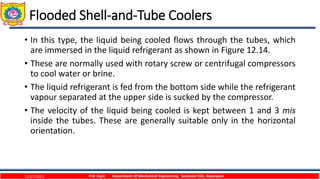
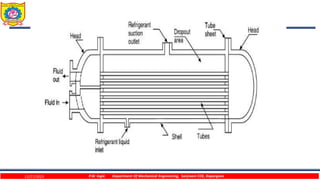
• In this type, the liquid being cooled flows through the tubes, which
are immersed in the liquid refrigerant as shown in Figure 12.14.
• These are normally used with rotary screw or centrifugal compressors
to cool water or brine.
• The liquid refrigerant is fed from the bottom side while the refrigerant
vapour separated at the upper side is sucked by the compressor.
• The velocity of the liquid being cooled is kept between 1 and 3 mis
inside the tubes. These are generally suitable only in the horizontal
orientation.
12/27/2023 P.W. Ingle Department Of Mechanical Engineering, Sanjivani COE, Kopargaon
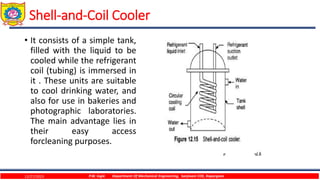
Shell-and-Coil Cooler
• It consists of a simple tank,
filled with the liquid to be
cooled while the refrigerant
coil (tubing) is immersed in
it . These units are suitable
to cool drinking water, and
also for use in bakeries and
photographic laboratories.
The main advantage lies in
their easy access
forcleaning purposes.
12/27/2023 P.W. Ingle Department Of Mechanical Engineering, Sanjivani COE, Kopargaon

CHILLERS OR COOLERS. Refrigeration system component.

  • 1.
    Sanjivani Rural EducationSociety’s Sanjivani College of Engineering, Kopargaon-423 603 (An Autonomous Institute, Affiliated to Savitribai Phule Pune University, Pune) NAAC ‘A’ Grade Accredited, ISO 9001:2015 Certified Department of Mechanical Engineering Subject:- Heating, Ventilation and Air Conditioning (ME 411) B.Tech.Mechanical Purushottam W. Ingle Assistant Professor E-mail:- inglepurushottammech@sanjivani.org.in Cell No. 9923567075
  • 2.
    Types & Applicationof Chillers • LIQUID COOLERS (CHILLERS) • The liquid coolers are essentially the recuperative type of heat exchangers in which the liquid refrigerant and the liquid to be cooled exist on either side of the tube. • The liquids being cooled are water, brine solutions, milk, beer and other products with low viscosity. The liquid refrigerant is evaporated producing cold and is transferred to these fluids. The types of liquid coolers are: • Direct expansion type • Flooded shell-and-tube coolers • Shell-and-coil types. 12/27/2023 P.W. Ingle Department Of Mechanical Engineering, Sanjivani COE, Kopargaon
  • 3.
    Direct Expansion Type •Figure shows a typical shell-and-tube cooler. The refrigerant evaporates inside the tubes while the liquid being cooled occupies the space of the shell. • The liquid on the shell side flows at right angles to the tubes. The baffles will help to increase the velocity thereby increasing the heat transfer coefficient and subsequently the rate of heat transfer. These are used with positive displacement compressors like reciprocating, rotary and screw compressors. • The uniform distribution of refrigerant in all the tubes is difficult to achieve, therefore a spray distributor is a must for this purpose. The number refrigerant passes is another important item in the performance of a direct expansion cooler. 12/27/2023 P.W. Ingle Department Of Mechanical Engineering, Sanjivani COE, Kopargaon
  • 4.
    • A single-passcooler must evaporate all the liquid refrigerant, before it reaches the end of the tubes, for which one has to provide long tubes. A multi-pass cooler of perhaps a smaller size but uniform distribution is difficult to achieve after first pass. • Another type of heat exchanger, say, a tube-in-tube (double pipe) cooler consists of one or more pairs of coaxial tubes. The refrigerant flows through the shell while the liquid is cooled through the tubes. The liquid side surface can be cleaned if access is provided through the header. The compact heat exchangers are also used but its construction features do not allow any cleaning. 12/27/2023 P.W. Ingle Department Of Mechanical Engineering, Sanjivani COE, Kopargaon
  • 5.
    12/27/2023 P.W. IngleDepartment Of Mechanical Engineering, Sanjivani COE, Kopargaon
  • 6.
    Flooded Shell-and-Tube Coolers •In this type, the liquid being cooled flows through the tubes, which are immersed in the liquid refrigerant as shown in Figure 12.14. • These are normally used with rotary screw or centrifugal compressors to cool water or brine. • The liquid refrigerant is fed from the bottom side while the refrigerant vapour separated at the upper side is sucked by the compressor. • The velocity of the liquid being cooled is kept between 1 and 3 mis inside the tubes. These are generally suitable only in the horizontal orientation. 12/27/2023 P.W. Ingle Department Of Mechanical Engineering, Sanjivani COE, Kopargaon
  • 7.
    12/27/2023 P.W. IngleDepartment Of Mechanical Engineering, Sanjivani COE, Kopargaon
  • 8.
    Shell-and-Coil Cooler • Itconsists of a simple tank, filled with the liquid to be cooled while the refrigerant coil (tubing) is immersed in it . These units are suitable to cool drinking water, and also for use in bakeries and photographic laboratories. The main advantage lies in their easy access forcleaning purposes. 12/27/2023 P.W. Ingle Department Of Mechanical Engineering, Sanjivani COE, Kopargaon