Evaluation of services using a
fuzzy analytic hierarchy process
使用模糊階層分析法來評估服務
Dean Yeh (葉承宇)
德明資管系研究所101碩專班
Computer Sciences
Abstract
• The pre-negotiation problem in negotiations over services is regarded
as decision-making under uncertainty, based on multiple criteria of
quantitative and qualitative nature, where the imprecise decisionmaker’s judgements are represented as fuzzy numbers.

• The proposed fuzzy prioritisation method uses fuzzy pairwise

comparison judgements rather than exact numerical values of the
comparison ratios and transforms the initial fuzzy prioritisation
problem into a non-linear program.

• Unlike the known fuzzy prioritisation techniques, the proposed

method derives crisp weights from consistent and inconsistent fuzzy
comparison matrices, which eliminates the need of additional
aggregation and ranking procedures.
Introduction
Service-oriented negotiations
Fuzzy analytic hierarchy process & prioritisation approach
Numerical example
Conclusions
Introduction
• The design and implementation of decision support systems that can

introduce automation and intelligence to on-line negotiations, is currently
the focus of intensive research efforts.

• Various negotiating models and automated trading systems have been
produced, answering different market requirements and needs.

• Among those, the services negotiation model seems the most complex,

since it requires evaluation and decision-making under uncertainty, based
on multiple attributes (criteria) of quantitative and qualitative nature,
involving temporal and resource constraints, risk and commitment
problems, varying tactics and strategies, domain specific knowledge and
information asymmetries, etc.
Service-Oriented Negotiations
Pre-negotiation process

Related research
• Multi-Attribute Utility Theory (MAUT)
• Constraint Satisfaction Problem(CSP)
Fuzzy analytic hierarchy process &
prioritisation approach
Main stages of the AHP
Fuzzy comparison judgements
Deriving priorities from fuzzy comparison matrices
Statement of the problem
Assumptions of the fuzzy prioritisation method
Solving the fuzzy prioritisation problem
Decision Hierarchy
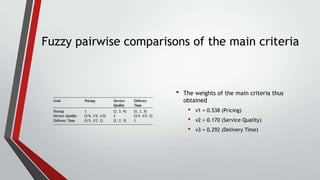
Fuzzy pairwise comparisons of the main criteria

•

The weights of the main criteria thus
obtained

•
•
•

v1 = 0.538 (Pricing)
v2 = 0.170 (Service Quality)
v3 = 0.292 (Delivery Time)
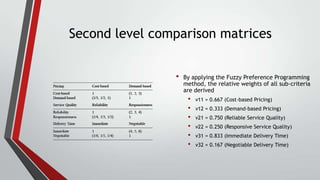
Second level comparison matrices
•

By applying the Fuzzy Preference Programming
method, the relative weights of all sub-criteria
are derived

•
•
•
•
•
•

v11 = 0.667 (Cost-based Pricing)

v12 = 0.333 (Demand-based Pricing)
v21 = 0.750 (Reliable Service Quality)
v22 = 0.250 (Responsive Service Quality)
v31 = 0.833 (Immediate Delivery Time)
v32 = 0.167 (Negotiable Delivery Time)
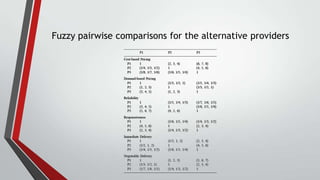
Fuzzy pairwise comparisons for the alternative providers
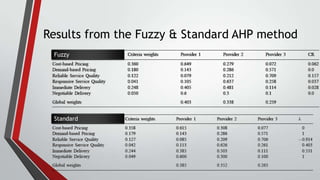
Results from the Fuzzy & Standard AHP method
Fuzzy

Standard
Conclusions
• It is asserted that the service evaluation is a critical factor in the prenegotiation process and there is a need of formalised decision-making
support.

• The service evaluation process is formulated as a multiple criteria
decision-making problem under uncertainty, where the imprecise
decision-maker’s judgements are represented as fuzzy numbers.

• A new fuzzy programming method is proposed for assessment of the

weights of evaluation criteria and scores of alternative service providers.

• The fuzzy modification of the AHP, thus, obtained is implemented for
finding global scores of all possible alternatives.

Evaluation of services using a fuzzy analytic hierarchy process

  • 1.
    Evaluation of servicesusing a fuzzy analytic hierarchy process 使用模糊階層分析法來評估服務 Dean Yeh (葉承宇) 德明資管系研究所101碩專班
  • 2.
  • 3.
    Abstract • The pre-negotiationproblem in negotiations over services is regarded as decision-making under uncertainty, based on multiple criteria of quantitative and qualitative nature, where the imprecise decisionmaker’s judgements are represented as fuzzy numbers. • The proposed fuzzy prioritisation method uses fuzzy pairwise comparison judgements rather than exact numerical values of the comparison ratios and transforms the initial fuzzy prioritisation problem into a non-linear program. • Unlike the known fuzzy prioritisation techniques, the proposed method derives crisp weights from consistent and inconsistent fuzzy comparison matrices, which eliminates the need of additional aggregation and ranking procedures.
  • 4.
    Introduction Service-oriented negotiations Fuzzy analytichierarchy process & prioritisation approach Numerical example Conclusions
  • 5.
    Introduction • The designand implementation of decision support systems that can introduce automation and intelligence to on-line negotiations, is currently the focus of intensive research efforts. • Various negotiating models and automated trading systems have been produced, answering different market requirements and needs. • Among those, the services negotiation model seems the most complex, since it requires evaluation and decision-making under uncertainty, based on multiple attributes (criteria) of quantitative and qualitative nature, involving temporal and resource constraints, risk and commitment problems, varying tactics and strategies, domain specific knowledge and information asymmetries, etc.
  • 6.
    Service-Oriented Negotiations Pre-negotiation process Relatedresearch • Multi-Attribute Utility Theory (MAUT) • Constraint Satisfaction Problem(CSP)
  • 7.
    Fuzzy analytic hierarchyprocess & prioritisation approach Main stages of the AHP Fuzzy comparison judgements Deriving priorities from fuzzy comparison matrices Statement of the problem Assumptions of the fuzzy prioritisation method Solving the fuzzy prioritisation problem
  • 8.
  • 9.
    Fuzzy pairwise comparisonsof the main criteria • The weights of the main criteria thus obtained • • • v1 = 0.538 (Pricing) v2 = 0.170 (Service Quality) v3 = 0.292 (Delivery Time)
  • 10.
    Second level comparisonmatrices • By applying the Fuzzy Preference Programming method, the relative weights of all sub-criteria are derived • • • • • • v11 = 0.667 (Cost-based Pricing) v12 = 0.333 (Demand-based Pricing) v21 = 0.750 (Reliable Service Quality) v22 = 0.250 (Responsive Service Quality) v31 = 0.833 (Immediate Delivery Time) v32 = 0.167 (Negotiable Delivery Time)
  • 11.
    Fuzzy pairwise comparisonsfor the alternative providers
  • 12.
    Results from theFuzzy & Standard AHP method Fuzzy Standard
  • 13.
    Conclusions • It isasserted that the service evaluation is a critical factor in the prenegotiation process and there is a need of formalised decision-making support. • The service evaluation process is formulated as a multiple criteria decision-making problem under uncertainty, where the imprecise decision-maker’s judgements are represented as fuzzy numbers. • A new fuzzy programming method is proposed for assessment of the weights of evaluation criteria and scores of alternative service providers. • The fuzzy modification of the AHP, thus, obtained is implemented for finding global scores of all possible alternatives.