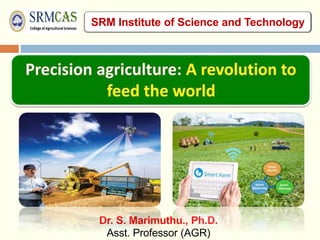
Dr. S. Marimuthu., Ph.D.
Asst. Professor (AGR)
SRM Institute of Science and Technology
Introduction
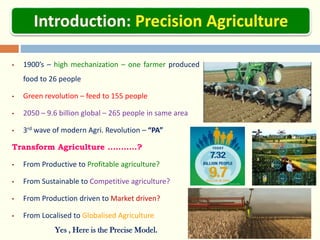
• 1900’s – high mechanization – one farmer produced
food to 26 people
• Green revolution – feed to 155 people
• 2050 – 9.6 billion global – 265 people in same area
• 3rd wave of modern Agri. Revolution – “PA”
Transform Agriculture ………..?
• From Productive to Profitable agriculture?
• From Sustainable to Competitive agriculture?
• From Production driven to Market driven?
• From Localised to Globalised Agriculture
Yes , Here is the Precise Model.
• USA (1980’s) – 1st input as fertilizer & pH change
• Pioneer: USA, Canada & Australia
• Precise application of agricultural input with respect
to soil, weather & crop need in order to improve
productivity, quality & profitability in agriculture
• Art & science of utilizing advanced technologies
for enhancing crop production while minimizing
potential environmental pollution
• “Satellite farming or Site Specific Crop
Management (SSCM) or Digital Agriculture or As
needed farming or Smart farming”
Definition
Precision Agriculture is Technology
Precision farming Conservation farming
Optimizing crop yield, &
economic and environmental
benefits
Mgnt strategy (Considering variability) to
increase productivity & economic returns
with a reduce impact on the environment
Long term ecological &
economical sustainable farming
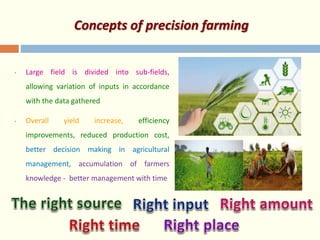
• Right input
• Right source
• Right amount
• Right place
• Right time
• Minimum soil
disturbance
• Permanent soil cover
• Crop diversification
NOT
Objectives of precision farming
• Increase production efficiency,
• Improve product quality,
• Reduce environmental degradation,
• Conserve energy & protection of soil &
ground water
• Understand basic concepts and
principles
Concepts of precision farming
• Large field is divided into sub-fields,
allowing variation of inputs in accordance
with the data gathered
• Overall yield increase, efficiency
improvements, reduced production cost,
better decision making in agricultural
management, accumulation of farmers
knowledge - better management with time
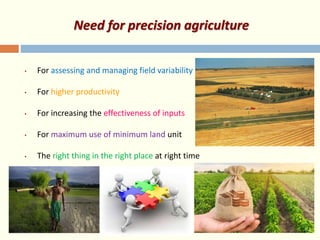
Need for precision agriculture
• For assessing and managing field variability
• For higher productivity
• For increasing the effectiveness of inputs
• For maximum use of minimum land unit
• The right thing in the right place at right time
What precision farming can do?
• Improve crop yield
• Give information to better management decisions
• Reduce chemical and fertilizer costs through more
efficient application
• Provide more accurate farm records
• Increase profit margin
• Reduce pollution
• Efficient use of water resources
• Dissemination of modern farm practices to
improve quality, quantity & reduced cost of
production in agricultural crops
The scope of precision farming
• Soil property sampling - GPS can be used
to locate soils
• Tillage - varying depth and plant residue
• Planting - varying seeding rate
• Fertilizing - varying fertilizer and app.
Rate
• Spraying - varying rate of application
• Crop scouting - remotely sensing areas
that affect crop yield
• Harvesting - yield monitoring
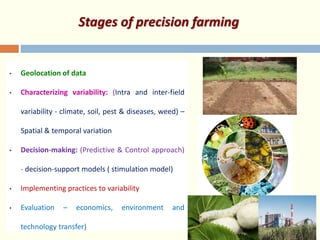
Stages of precision farming
• Geolocation of data
• Characterizing variability: (Intra and inter-field
variability - climate, soil, pest & diseases, weed) –
Spatial & temporal variation
• Decision-making: (Predictive & Control approach)
- decision-support models ( stimulation model)
• Implementing practices to variability
• Evaluation – economics, environment and
technology transfer)
Tools in Precision Farming
Yield monitors Sensors - PA Remote sensing system
Stationary & other sensors
On the go sensors
Soil sensors Plant sensors
Targeted properties
• Texture, OM, SM, pH,
• Nutrients, Compaction
Plant sensors
Measurement Principle
• Electric & Electromagnetic
• Optical & Radiometric
• Mechanical
• Acoustic & pneumatic
• Electro-chemical
Targeted properties
• DMP, Level of nutrient deficit
• Weed population
• Water stress
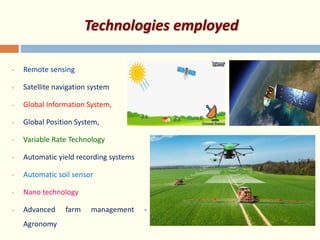
Technologies employed
• Remote sensing
• Satellite navigation system
• Global Information System,
• Global Position System,
• Variable Rate Technology
• Automatic yield recording systems
• Automatic soil sensor
• Nano technology
• Advanced farm management -
Agronomy
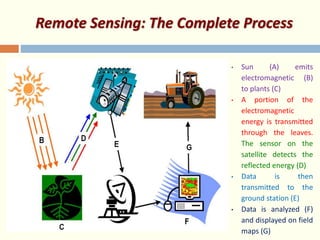
Remote Sensing: The Complete Process
• Sun (A) emits
electromagnetic (B)
to plants (C)
• A portion of the
electromagnetic
energy is transmitted
through the leaves.
The sensor on the
satellite detects the
reflected energy (D)
• Data is then
transmitted to the
ground station (E)
• Data is analyzed (F)
and displayed on field
maps (G)
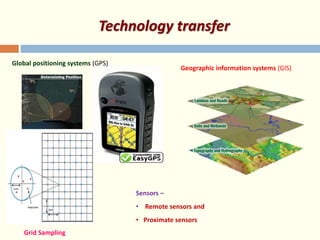
Technology transfer
Global positioning systems (GPS)
Geographic information systems (GIS)
Grid Sampling
Sensors –
• Remote sensors and
• Proximate sensors
Variable rate technology (VRT)
• Map based - electronic map
• Sensor-based VRA
• Real-time sensors measure the desired
properties - “On-the-go” sensor
Yield monitoring and mapping
• Process of collecting georeferenced data on crop yield & characteristics,
such as moisture content, while the crop is being harvested.
Components of yield monitor
• Grain flow sensor
• Grain moisture sensor
• Clean grain elevator speed sensor
• GPS antenna
• Yield monitor display with a GPS receiver
• Header position sensor and Travel speed
sensor
Higher yields
Lower yields
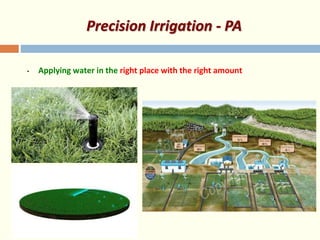
Precision Irrigation - PA
• Applying water in the right place with the right amount
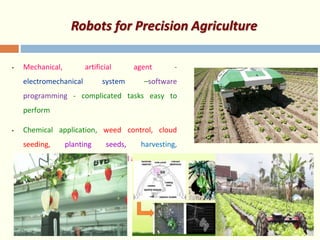
Robots for Precision Agriculture
• Mechanical, artificial agent -
electromechanical system –software
programming - complicated tasks easy to
perform
• Chemical application, weed control, cloud
seeding, planting seeds, harvesting,
environmental monitoring & soil analysis
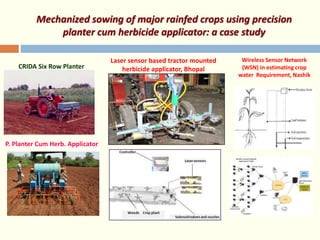
Mechanized sowing of major rainfed crops using precision
planter cum herbicide applicator: a case study
CRIDA Six Row Planter
P. Planter Cum Herb. Applicator
Laser sensor based tractor mounted
herbicide applicator, Bhopal
Wireless Sensor Network
(WSN) in estimating crop
water Requirement, Nashik
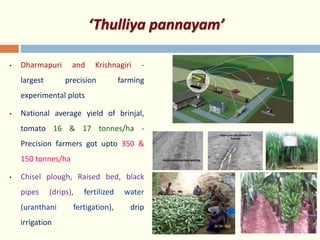
‘Thulliya pannayam’
• Dharmapuri and Krishnagiri -
largest precision farming
experimental plots
• National average yield of brinjal,
tomato 16 & 17 tonnes/ha -
Precision farmers got upto 350 &
150 tonnes/ha
• Chisel plough, Raised bed, black
pipes (drips), fertilized water
(uranthani fertigation), drip
irrigation
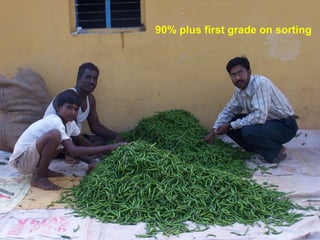
90% plus first grade on sorting
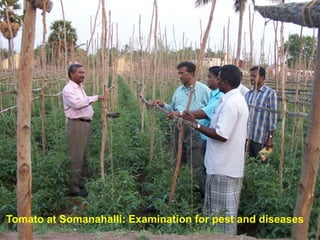
Tomato at Somanahalli: Examination for pest and diseases
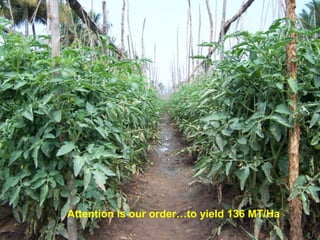
Attention is our order…to yield 136 MT/Ha
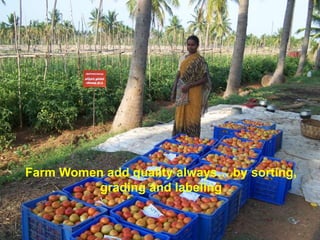
Farm Women add quality always….by sorting,
grading and labeling
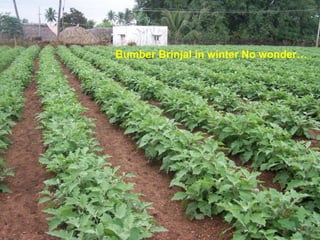
Bumber Brinjal in winter No wonder…
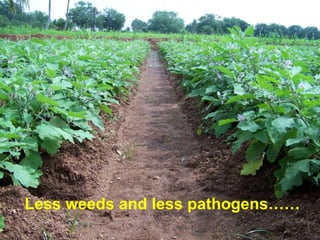
Less weeds and less pathogens……
Brinjal Hybrid Fertigation
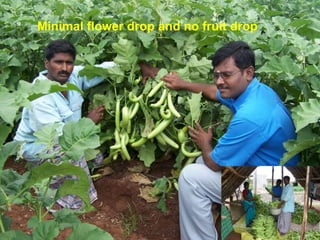
Minimal flower drop and no fruit drop
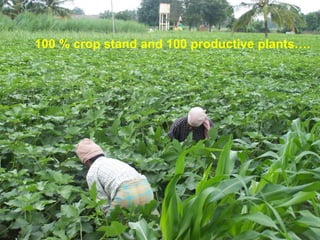
100 % crop stand and 100 productive plants….
Onion under Fertigation
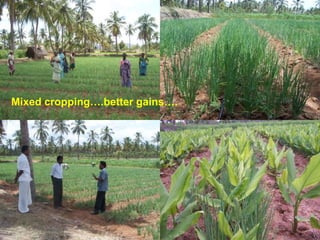
Mixed cropping….better gains….
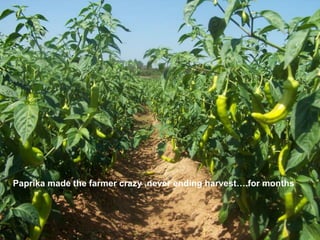
Paprika made the farmer crazy .never ending harvest….for months
Striking uniformity of marketable produces
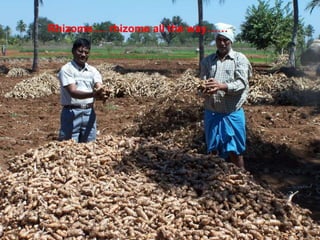
Rhizome…. rhizome all the way……
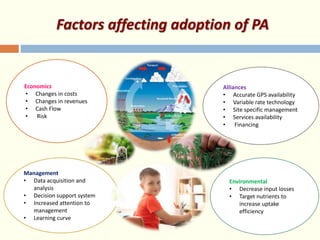
Factors affecting adoption of PA
Economics
• Changes in costs
• Changes in revenues
• Cash Flow
• Risk
Alliances
• Accurate GPS availability
• Variable rate technology
• Site specific management
• Services availability
• Financing
Management
• Data acquisition and
analysis
• Decision support system
• Increased attention to
management
• Learning curve
Environmental
• Decrease input losses
• Target nutrients to
increase uptake
efficiency
Advantages of precision farming
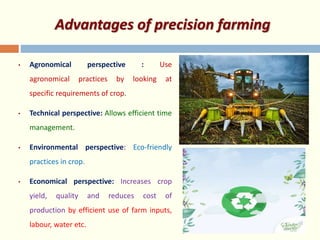
• Agronomical perspective : Use
agronomical practices by looking at
specific requirements of crop.
• Technical perspective: Allows efficient time
management.
• Environmental perspective: Eco-friendly
practices in crop.
• Economical perspective: Increases crop
yield, quality and reduces cost of
production by efficient use of farm inputs,
labour, water etc.
Obstacles of precision farming
 High cost
 Lack of technical expertise knowledge and
technology
 Not applicable or difficult/costly small holdings
 Heterogeneity of cropping systems and
 Market imperfections
 Culture and perceptions of the users
 Lack of success stories
 Land ownership, infrastructure & institutional
constraints
 Data availability, quality and costs.
Opportunities of Precision Agriculture
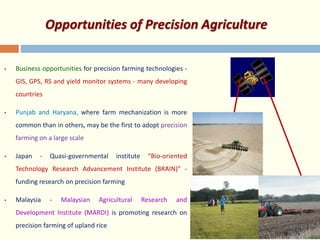
• Business opportunities for precision farming technologies -
GIS, GPS, RS and yield monitor systems - many developing
countries
• Punjab and Haryana, where farm mechanization is more
common than in others, may be the first to adopt precision
farming on a large scale
• Japan - Quasi-governmental institute “Bio-oriented
Technology Research Advancement Institute (BRAIN)” -
funding research on precision farming
• Malaysia - Malaysian Agricultural Research and
Development Institute (MARDI) is promoting research on
precision farming of upland rice
Agro-informatics and precision agriculture
• Precision crop production
• Precision crop protection
• Precision horticulture
• Precision livestock management
• Precision forestry
• Geospatial technologies in precision
agriculture
• Sensor technologies and wireless sensor
networks in precision agriculture
Future thrust
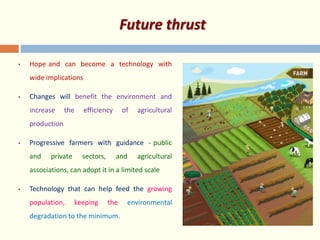
• Hope and can become a technology with
wide implications
• Changes will benefit the environment and
increase the efficiency of agricultural
production
• Progressive farmers with guidance - public
and private sectors, and agricultural
associations, can adopt it in a limited scale
• Technology that can help feed the growing
population, keeping the environmental
degradation to the minimum.
Conclusion
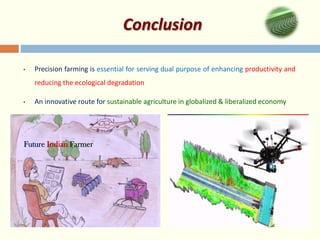
• Precision farming is essential for serving dual purpose of enhancing productivity and
reducing the ecological degradation
• An innovative route for sustainable agriculture in globalized & liberalized economy
Future Indian Farmer
Thanks a lot
Email: marimuts@srmist.edu.in
Mobile: 86681 70431