Breeding and biotechnology of
medicinal plants
1
Seminar presentation
By
AMINU MALLAM BELLO
5 May, 2019(15/2/1398)
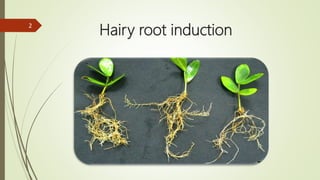
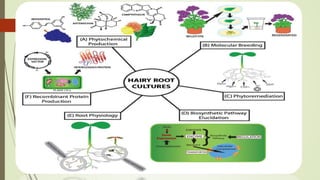
Hairy root induction
2
Introduction
 Plants are requisite source for the
production of phytochemicals.
 Transgenic plant produced by genetic
engineering made it possible to commence
the genes of interest to plants.
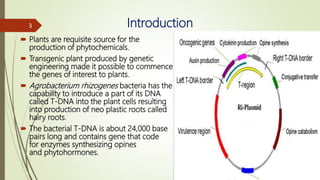
 Agrobacterium rhizogenes bacteria has the
capability to introduce a part of its DNA
called T-DNA into the plant cells resulting
into production of neo plastic roots called
hairy roots.
 The bacterial T-DNA is about 24,000 base
pairs long and contains gene that code
for enzymes synthesizing opines
and phytohormones.
3
Opines
 Based on the types of opines produced, the strains of A.rhizogenes can be
separated into five lines
 Nopaline
 Mannopine
 Cucumopine: found in carrot hairy root cultures
 Octopine
 Agropine (strains are the most often used strains owing to their strongest
induction ability)
 Such opines are used by the bacterium as a carbon, nitrogen and energy source and to
grow abnormally.
4
Special features of hairy roots
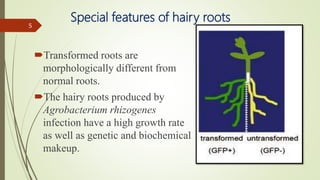
Transformed roots are
morphologically different from
normal roots.
The hairy roots produced by
Agrobacterium rhizogenes
infection have a high growth rate
as well as genetic and biochemical
makeup.
5
An introduction to Hairy root induction
The regenerated plants are genetically stable and often have
morphological and physiological changes like wrinkled leaves,
extremely abundant and plagiotropic root system and also reduced
apical dominance, internode length and leaf size.
The induced hairy roots exhibit several superior features such as
1. Rapid growth.
2. Genetic and biochemical stability.
3. Ability to growth in hormone-free media.
4. Ease of maintenance.
5. The ability to synthesize a variety of chemical compounds.
6
An introduction to Hairy root induction7
 It was previously confirmed that optimizing the composition of
organic/inorganic nutrients of the media for hairy root cultures is
essential to gain high production of secondary metabolites.
 Hairy root culture is also called as transformed root culture from
naturally occurring Gram negative soil bacterium Agrobacterium
rhizogenes that contains root inducing plasmids (Ri plasmids).
 It infect roots of dicot and some monocot plants cause them to
produce the opines which is a type of unusual amino acids.
Special features of hairy roots
1. More genotype and phenotype stability.
2. High levels of secondary metabolite production.
3. Metabolic studies using phytoremediation.
4. Production of artificial seed.
5. Bioaccumulation of heavy metals.
6. Regeneration of whole plants
7. Production of compounds not found in
untransformed roots
8
9
Secondary metabolites produced in hairy root.
1. L-DOPA: a precursor of catecholamines, an important neurotransmitter used in the
treatment of Parkinson’s disease.
2. Shikonin: used as an anti-bacterial and anti ulcer agent
3. Anthraquinone: used for dyes and medicinal purpose
4. Opiate alkaloids: particularly codeine and morphine for medical purposes
5. Barberine: an alkaloid with medicinal uses for cholera and bacterial dysentery
6. Valepotriates: used as a sedative
7. Ginsenosides: for medicinal purposes
8. Rosmarinic acid: for antiviral, suppression of endotoxin shock and other medicinal purposes
9. Quinine: for malaria
10. Cardenolides or cardioactive glycosides: for treatment of heart disease.
10
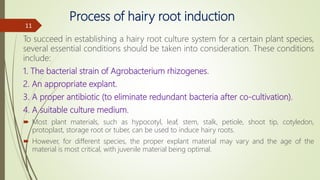
Process of hairy root induction
To succeed in establishing a hairy root culture system for a certain plant species,
several essential conditions should be taken into consideration. These conditions
include:
1. The bacterial strain of Agrobacterium rhizogenes.
2. An appropriate explant.
3. A proper antibiotic (to eliminate redundant bacteria after co-cultivation).
4. A suitable culture medium.
 Most plant materials, such as hypocotyl, leaf, stem, stalk, petiole, shoot tip, cotyledon,
protoplast, storage root or tuber, can be used to induce hairy roots.
 However, for different species, the proper explant material may vary and the age of the
material is most critical, with juvenile material being optimal.
11
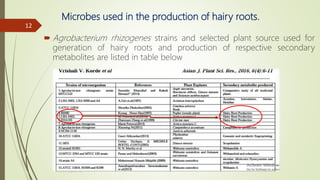
Microbes used in the production of hairy roots.
 Agrobacterium rhizogenes strains and selected plant source used for
generation of hairy roots and production of respective secondary
metabolites are listed in table below
12
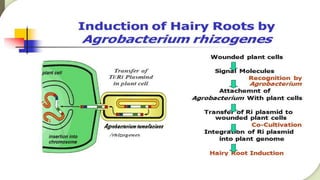
Process of hairy root induction
To induce hairy root, explants are separately wounded and
cocultivated or inoculated with A. rhizogenes.
 Usually two or three days later, the explant can be transferred
into solid media with antibiotics, to kill or eliminate redundant
bacteria.
13
14
Process of hairy root induction
• The hairy roots will be induced within a short period of time, which varies from one week
to over a month depending on different plant species.
• Optimizing the composition of nutrients for hairy root cultures is critical to gain a high
production of secondary metabolites.
• Factors such as the carbon source and its concentration, the ionic concentration of the
medium, the pH of the medium, light, phytohormones, temperature, and inoculum are
known to influence growth and secondary metabolism.
• The addition of auxin and elicitors often increases the levels of secondary metabolites.
• Because of these factors and the fact that individual hairy roots may have different
requirements for nutrient conditions, the culture conditions should be optimized separately
for each species and for individual clones.
15
Reporter gene
The β-glucuronidase (GUS) gene is usually transferred
into hairy roots as a reporter gene and it can be
analyzed easily by histological assay.
16
Advantages of hairy root culture
 Harvesting roots for extracting secondary metabolites can cause destruction to whole
plants. Therefore, interest in producing secondary metabolites by developing hairy root
culture has been raised.
 Hairy root culture potentially grows faster without needing an external supply of auxins.
In certain cases, they do not need incubation under light.
 Due to their high genetic stability all hairy root cultures are stable in metabolite
production.
 Yield in hairy root cultures can be altered by optimizing various factors such as carbon
source and its concentration, ionic concentration of the medium, pH of the medium, light,
temperature, and inoculum.
 In addition utilization of techniques like precursor feeding, cell immobilization,
elicitation, and bio-tranformation of hairy root culture can improve secondary metabolite
production.
17
Potential Problems of hairy root induction
 As a new method in the study of plant genetic engineering, hairy root
culture shows many useful functions. However, at the same time, it also
has some potential problems that remain to be solved:
 Over expression of key enzymes does not always improve secondary
metabolism.
 Morphological alterations of regenerated plants: These abnormal
phenotypes possibly originate from genomic disturbances due to either
the insertion of foreign DNA or soma clonal variation, rather than from
the expression of T-DNA genes in the transformants Transgenic plants
often show higher mortality than normal, non-transformed plants.
 Possible reduction of chromosome numbers during subculture.
18
19

HAIRY ROOT INDUCTION

  • 1.
    Breeding and biotechnologyof medicinal plants 1 Seminar presentation By AMINU MALLAM BELLO 5 May, 2019(15/2/1398)
  • 2.
  • 3.
    Introduction  Plants arerequisite source for the production of phytochemicals.  Transgenic plant produced by genetic engineering made it possible to commence the genes of interest to plants.  Agrobacterium rhizogenes bacteria has the capability to introduce a part of its DNA called T-DNA into the plant cells resulting into production of neo plastic roots called hairy roots.  The bacterial T-DNA is about 24,000 base pairs long and contains gene that code for enzymes synthesizing opines and phytohormones. 3
  • 4.
    Opines  Based onthe types of opines produced, the strains of A.rhizogenes can be separated into five lines  Nopaline  Mannopine  Cucumopine: found in carrot hairy root cultures  Octopine  Agropine (strains are the most often used strains owing to their strongest induction ability)  Such opines are used by the bacterium as a carbon, nitrogen and energy source and to grow abnormally. 4
  • 5.
    Special features ofhairy roots Transformed roots are morphologically different from normal roots. The hairy roots produced by Agrobacterium rhizogenes infection have a high growth rate as well as genetic and biochemical makeup. 5
  • 6.
    An introduction toHairy root induction The regenerated plants are genetically stable and often have morphological and physiological changes like wrinkled leaves, extremely abundant and plagiotropic root system and also reduced apical dominance, internode length and leaf size. The induced hairy roots exhibit several superior features such as 1. Rapid growth. 2. Genetic and biochemical stability. 3. Ability to growth in hormone-free media. 4. Ease of maintenance. 5. The ability to synthesize a variety of chemical compounds. 6
  • 7.
    An introduction toHairy root induction7  It was previously confirmed that optimizing the composition of organic/inorganic nutrients of the media for hairy root cultures is essential to gain high production of secondary metabolites.  Hairy root culture is also called as transformed root culture from naturally occurring Gram negative soil bacterium Agrobacterium rhizogenes that contains root inducing plasmids (Ri plasmids).  It infect roots of dicot and some monocot plants cause them to produce the opines which is a type of unusual amino acids.
  • 8.
    Special features ofhairy roots 1. More genotype and phenotype stability. 2. High levels of secondary metabolite production. 3. Metabolic studies using phytoremediation. 4. Production of artificial seed. 5. Bioaccumulation of heavy metals. 6. Regeneration of whole plants 7. Production of compounds not found in untransformed roots 8
  • 9.
  • 10.
    Secondary metabolites producedin hairy root. 1. L-DOPA: a precursor of catecholamines, an important neurotransmitter used in the treatment of Parkinson’s disease. 2. Shikonin: used as an anti-bacterial and anti ulcer agent 3. Anthraquinone: used for dyes and medicinal purpose 4. Opiate alkaloids: particularly codeine and morphine for medical purposes 5. Barberine: an alkaloid with medicinal uses for cholera and bacterial dysentery 6. Valepotriates: used as a sedative 7. Ginsenosides: for medicinal purposes 8. Rosmarinic acid: for antiviral, suppression of endotoxin shock and other medicinal purposes 9. Quinine: for malaria 10. Cardenolides or cardioactive glycosides: for treatment of heart disease. 10
  • 11.
    Process of hairyroot induction To succeed in establishing a hairy root culture system for a certain plant species, several essential conditions should be taken into consideration. These conditions include: 1. The bacterial strain of Agrobacterium rhizogenes. 2. An appropriate explant. 3. A proper antibiotic (to eliminate redundant bacteria after co-cultivation). 4. A suitable culture medium.  Most plant materials, such as hypocotyl, leaf, stem, stalk, petiole, shoot tip, cotyledon, protoplast, storage root or tuber, can be used to induce hairy roots.  However, for different species, the proper explant material may vary and the age of the material is most critical, with juvenile material being optimal. 11
  • 12.
    Microbes used inthe production of hairy roots.  Agrobacterium rhizogenes strains and selected plant source used for generation of hairy roots and production of respective secondary metabolites are listed in table below 12
  • 13.
    Process of hairyroot induction To induce hairy root, explants are separately wounded and cocultivated or inoculated with A. rhizogenes.  Usually two or three days later, the explant can be transferred into solid media with antibiotics, to kill or eliminate redundant bacteria. 13
  • 14.
  • 15.
    Process of hairyroot induction • The hairy roots will be induced within a short period of time, which varies from one week to over a month depending on different plant species. • Optimizing the composition of nutrients for hairy root cultures is critical to gain a high production of secondary metabolites. • Factors such as the carbon source and its concentration, the ionic concentration of the medium, the pH of the medium, light, phytohormones, temperature, and inoculum are known to influence growth and secondary metabolism. • The addition of auxin and elicitors often increases the levels of secondary metabolites. • Because of these factors and the fact that individual hairy roots may have different requirements for nutrient conditions, the culture conditions should be optimized separately for each species and for individual clones. 15
  • 16.
    Reporter gene The β-glucuronidase(GUS) gene is usually transferred into hairy roots as a reporter gene and it can be analyzed easily by histological assay. 16
  • 17.
    Advantages of hairyroot culture  Harvesting roots for extracting secondary metabolites can cause destruction to whole plants. Therefore, interest in producing secondary metabolites by developing hairy root culture has been raised.  Hairy root culture potentially grows faster without needing an external supply of auxins. In certain cases, they do not need incubation under light.  Due to their high genetic stability all hairy root cultures are stable in metabolite production.  Yield in hairy root cultures can be altered by optimizing various factors such as carbon source and its concentration, ionic concentration of the medium, pH of the medium, light, temperature, and inoculum.  In addition utilization of techniques like precursor feeding, cell immobilization, elicitation, and bio-tranformation of hairy root culture can improve secondary metabolite production. 17
  • 18.
    Potential Problems ofhairy root induction  As a new method in the study of plant genetic engineering, hairy root culture shows many useful functions. However, at the same time, it also has some potential problems that remain to be solved:  Over expression of key enzymes does not always improve secondary metabolism.  Morphological alterations of regenerated plants: These abnormal phenotypes possibly originate from genomic disturbances due to either the insertion of foreign DNA or soma clonal variation, rather than from the expression of T-DNA genes in the transformants Transgenic plants often show higher mortality than normal, non-transformed plants.  Possible reduction of chromosome numbers during subculture. 18
  • 19.