Hairy Root Cell Culture 
Presented by Abu Raihan 
M.Tech, 1st year,Biotechnology
Culture Types 
Callus Culture 
Cell Suspension Culture 
Protoplast Culture 
Hairy Root Culture
Hairy Root Culture 
Definition: 
It is the culture produced after the infection of explants and 
cultures by the gram negetive Soil bacterium 
Agrobacterium rhizogenes. 
This processes take advantage of the naturally occuring hairy 
root disease in Dicotyledons.
Properties of hairy roots 
Genotype and phenotype stability 
Autotrophy in plant hormones 
Fast growth 
High levels of secondary metabolite 
production
Production of hairy root in plant cell 
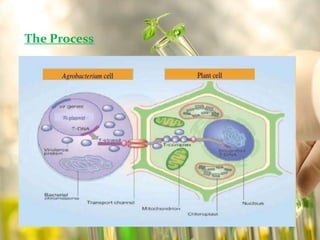
Agrobacterium recognizes some signal 
molecules exuded by wonded plant cells and 
becomes attached to it. 
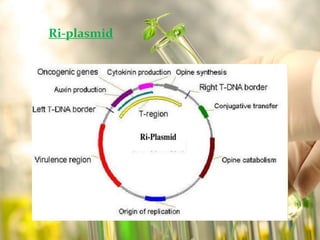
The bacteria contain the Root inducing 
plasmid ( Ri-plasmid). 
The bacteria Genetically trasfer part of 
the Ri-plasmid called the trasfer DNA 
(T-DNA) to the plant genome.
Production of hairy root in plant cell 
The plant cell to proliferate by increasing 
the rate of cell division ( cytokine expression ) 
and cell elongation (auxin expression) to 
produce the hairy roots. 
Produce the opines which is a type of unusual 
amino acids ( octopine, agropine, nopaline, 
mannopine amd cucumopine) which is used 
by the bacterium as a carbon , nitrogen and 
energy source.
The Process
Ri-plasmid
Induction of hairy root cultures In Vitro 
Explants are wounded and then inoculated with 
Agrobacterium rhizogenes. 
Usually two or three days later, the explant can 
be transferred into solid media with antibiotics, 
such as cefotaxime , vancomycine or ampicillin to 
kill or eliminate redundant bacteria. 
The hairy roots will be induced within a short 
period of time, which varies from one week to 
over a month depending on different plant 
species. 
The decontaminated hairy roots can be 
subcultured on phytohormone –free medium.
Bioreactors for hairy root cultures 
Stirred tank bioreactor 
Air lift bioreactor 
Bubble column bioreactor 
Turbine blade bioreactor 
Trickle bed bioreactor 
Rotating drum bioreactor 
Spin filter bioreactor
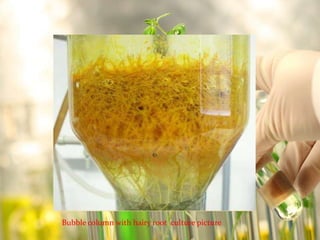
Bubble column with hairy root culture picture
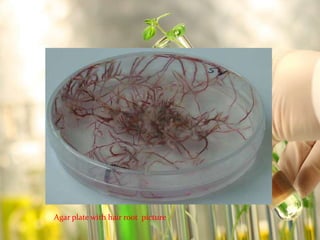
Agar plate with hair root picture
Hairy root cell culture picture
Advantages of hairy root cultures 
The hairy root system is genetically 
and biosynthetically stable. 
High production of secondary 
metabolites 
The culture can grow under phyto-hormone- 
free conditions. 
The culture shows fast growth which 
reduces the culture time and easy 
the handling.
Application of Hairy Root Cultures 
Functional analysis of genes. 
Expression foreign proteins. 
Production of secondary metabolites. 
The culture may produce compounds 
which is not found untransformed roots. 
The culture may change the composition 
of metabolites. 
The culture can be used to regenerate a 
whole plant.
Thanks

Hairy root culture

  • 1.
    Hairy Root CellCulture Presented by Abu Raihan M.Tech, 1st year,Biotechnology
  • 2.
    Culture Types CallusCulture Cell Suspension Culture Protoplast Culture Hairy Root Culture
  • 3.
    Hairy Root Culture Definition: It is the culture produced after the infection of explants and cultures by the gram negetive Soil bacterium Agrobacterium rhizogenes. This processes take advantage of the naturally occuring hairy root disease in Dicotyledons.
  • 4.
    Properties of hairyroots Genotype and phenotype stability Autotrophy in plant hormones Fast growth High levels of secondary metabolite production
  • 5.
    Production of hairyroot in plant cell Agrobacterium recognizes some signal molecules exuded by wonded plant cells and becomes attached to it. The bacteria contain the Root inducing plasmid ( Ri-plasmid). The bacteria Genetically trasfer part of the Ri-plasmid called the trasfer DNA (T-DNA) to the plant genome.
  • 6.
    Production of hairyroot in plant cell The plant cell to proliferate by increasing the rate of cell division ( cytokine expression ) and cell elongation (auxin expression) to produce the hairy roots. Produce the opines which is a type of unusual amino acids ( octopine, agropine, nopaline, mannopine amd cucumopine) which is used by the bacterium as a carbon , nitrogen and energy source.
  • 7.
  • 8.
  • 9.
    Induction of hairyroot cultures In Vitro Explants are wounded and then inoculated with Agrobacterium rhizogenes. Usually two or three days later, the explant can be transferred into solid media with antibiotics, such as cefotaxime , vancomycine or ampicillin to kill or eliminate redundant bacteria. The hairy roots will be induced within a short period of time, which varies from one week to over a month depending on different plant species. The decontaminated hairy roots can be subcultured on phytohormone –free medium.
  • 10.
    Bioreactors for hairyroot cultures Stirred tank bioreactor Air lift bioreactor Bubble column bioreactor Turbine blade bioreactor Trickle bed bioreactor Rotating drum bioreactor Spin filter bioreactor
  • 11.
    Bubble column withhairy root culture picture
  • 12.
    Agar plate withhair root picture
  • 13.
    Hairy root cellculture picture
  • 14.
    Advantages of hairyroot cultures The hairy root system is genetically and biosynthetically stable. High production of secondary metabolites The culture can grow under phyto-hormone- free conditions. The culture shows fast growth which reduces the culture time and easy the handling.
  • 15.
    Application of HairyRoot Cultures Functional analysis of genes. Expression foreign proteins. Production of secondary metabolites. The culture may produce compounds which is not found untransformed roots. The culture may change the composition of metabolites. The culture can be used to regenerate a whole plant.
  • 16.