FIELD CROPS and
CEREALS
Jennifer P. Celades
Agriculture Department
College of Agriculture & Natural Resources
BISU-Bilar
FIELD CROPS AND
CEREALS
 Philippine Agricultural Situation
 Examples
 Economic Importance
 Production Constraints
 Definition
Field Crops defined
 any of the herbaceous plants grown on a
large scale in cultivated fields: primarily a
grain, forage, sugar, oil, or fiber crop.
the usable products are usually in high
dry matter form.
Economic Importance of Field
Crops and Cereals
 half the world's population subsists
wholly or partially on rice.
 Ninety percent of the world crop is grown
and consumed in Asia.
 American consumption, although
increasing, is still only about 25 lb (11
kg) per person annually, as compared
with 200 to 400 lb (90–181 kg) per
person in parts of Asia.
Importance of Rice as Food
 Rice is the only major cereal crop that is
primarily consumed by humans directly
as harvested, and only wheat and corn
are produced in comparable quantity.
Importance of Rice
 International Rice Research Institute,
attempting to keep pace with demand
from a burgeoning world population,
have repeatedly developed improved
varieties of "miracle rice" that allow
farmers to increase crop yields
substantially.
 rice yields are adversely affected by
warmer nighttime temperatures, leading
to concerns about the effects that global
warming may have on rice crops.
Importance of Rice
 Brown rice has a greater food value than
white, since the outer brown coatings
contain the proteins and minerals; the
white endosperm is chiefly carbohydrate.
 . As a food rice is low in fat and
(compared with other cereal grains) in
protein.
 The miracle rice have grains richer in
protein than the old varieties. In the East,
rice is eaten with foods and sauces
made from the soybean
Philippine Agricultural
Situation
Philippines as an Agricultural Country
 composed of small farms
 humid tropical climate and variable
weather
 varying topographies and soil types
 diverse flora and fauna; and
 a combination of cultures in numerous
communities
Philippine Agricultural
Situation
Characteristics of Phil. Agriculture
 generally small-scale
 dependent on manual labor
 farmers are heterogeneous; commercial,
semi-commercial, subsistence and landless
farm workers
Philippine Agricultural
Situation
Contributions of Agricultural Sector to
the Economy
 main driver of economic growth in the
country --- agricultural sector contributes
about 22 % to the country's GNP
 about 50% of total labor force is involved
in agricultural activities
 about 1/3 income derived comes from
agriculture --- traders, processors,
retailers, and other groups
Philippine Agricultural
Situation
Country’s Small-scale Commodity
Production
 dominated by subsistence and semi-
commercial farmers cultivating an average
area of 1.5 ha  comprising 2/3 two-
thirds of the landowning population 
landholdings of these small farmers
account for 1/5 of the total farm area
Philippine Agricultural
Situation
Country’s Small-scale Commodity
Production
 poor rice farmers join the landless peasant
population in toiling on large landholdings
comprising at least 75% of the total farm
area controlled by 1/5 of the landholding
population
Philippine Agricultural
Situation
Poverty Incidence: Rural (68%) >
Urban Areas (34%)
 corn farmers --- 41%
 rice and corn workers --- 36%
 sugarcane farm workers, coconut farm
workers, forestry workers --- 33%
 fishers in the coastal waters --- 31%
Philippine Agricultural
Situation
Why Filipinos are Poor?
 severe inequality of income and assets -
worsened by the inequality of access to
education, health care and other social
services such as safe drinking water,
electricity and farm to market roads
 the wealthiest fifth of our people are 10x
richer than the poorest fifth
 rural people are the poorest because the
urban poor have better access to social
services
Philippine Agricultural
Situation
Constraints to Increasing Yield
Biophysical/Technical
 Pests and diseases
 Yield potential of varieties/cultivars --- limiting
 Technological efficiency at farm level --- low
 Declining soil fertility and degraded soils
(uplands)
 Water shortage --- lack of / deteriorating
irrigation facilities, El Niño
Philippine Agricultural
Situation
Constraints to Increasing Yield
Socioeconomic
 Limited / unavailable capital
 Low production incentives
Institutional
 Deteriorating extension support services
 Weak institutional capabilities
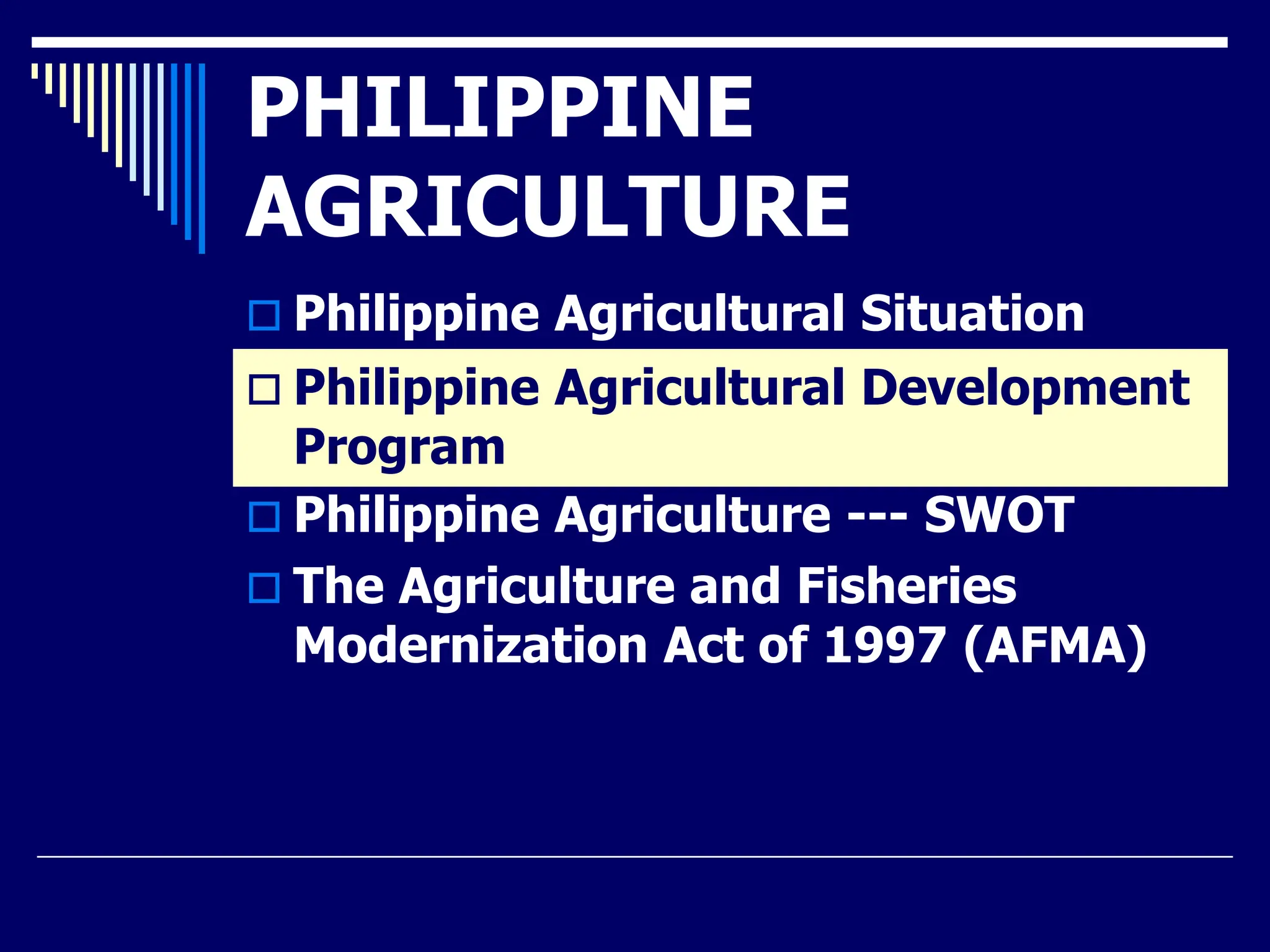
PHILIPPINE
AGRICULTURE
 Philippine Agricultural Situation
 Philippine Agricultural Development
Program
 Philippine Agriculture --- SWOT
 The Agriculture and Fisheries
Modernization Act of 1997 (AFMA)
 Philippine Agricultural Development
Program
Philippine Agricultural
Development Program
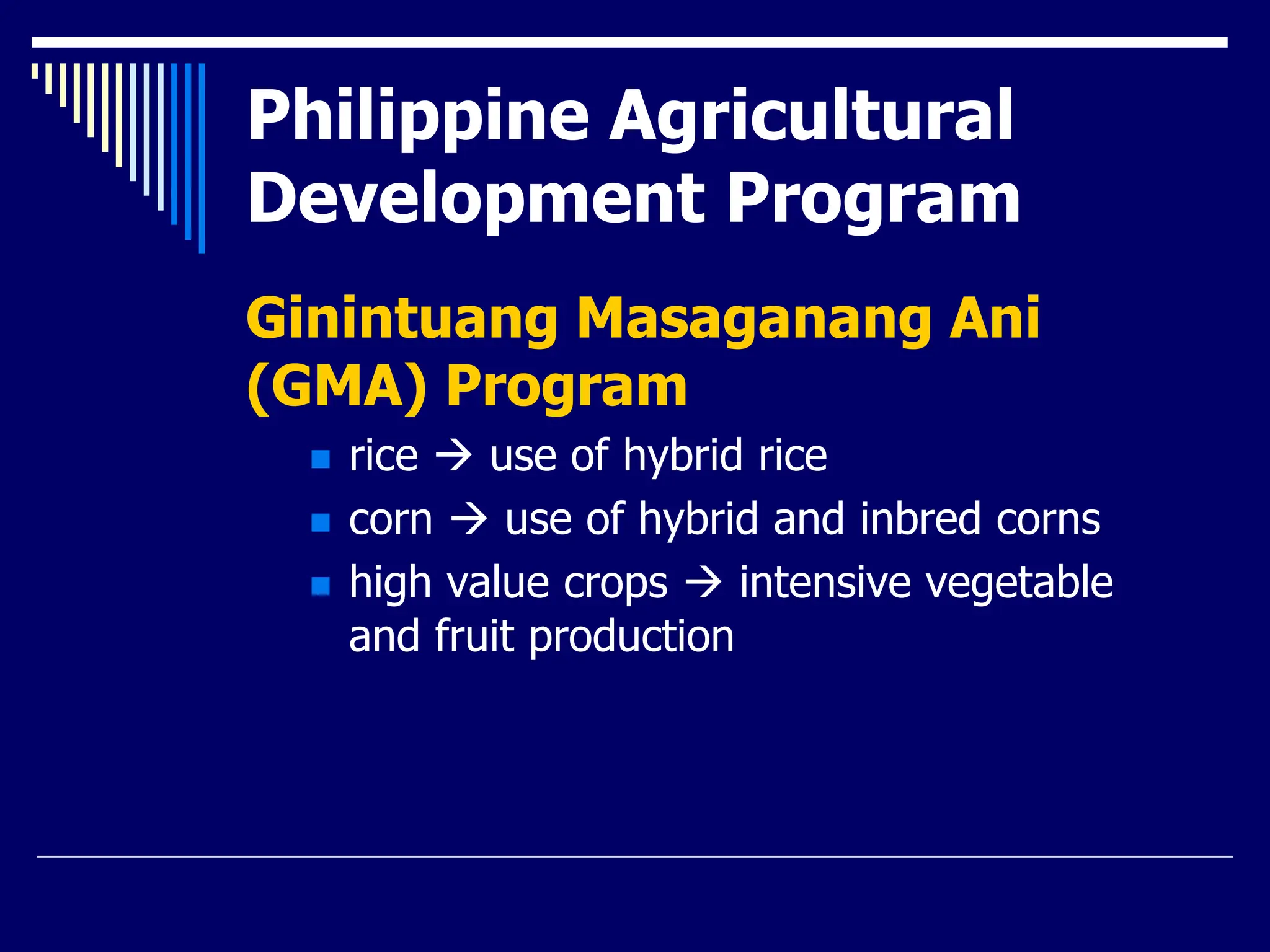
Ginintuang Masaganang Ani
(GMA) Program
 rice  use of hybrid rice
 corn  use of hybrid and inbred corns
 high value crops  intensive vegetable
and fruit production
Philippine Agricultural
Development Program
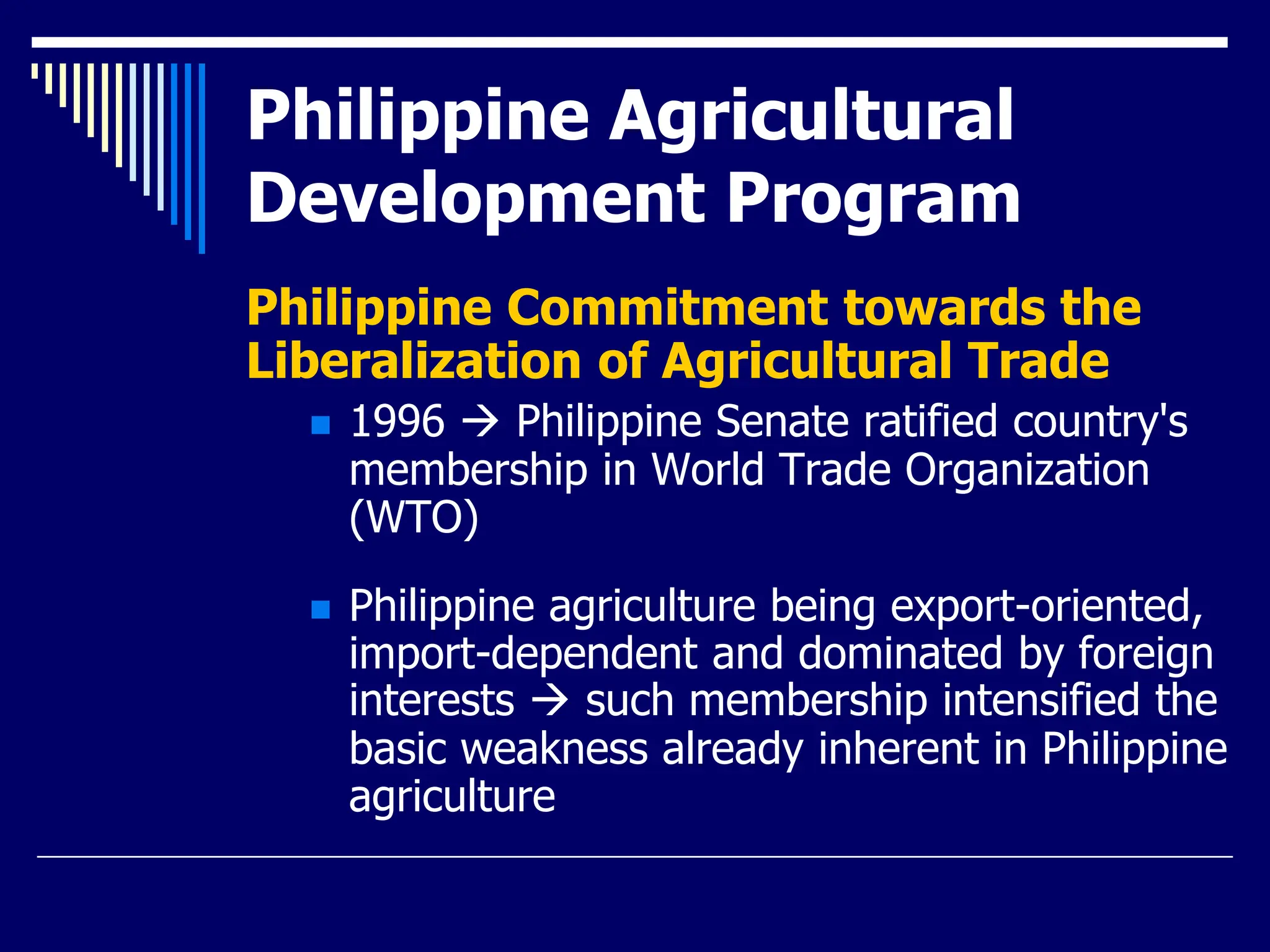
Philippine Commitment towards the
Liberalization of Agricultural Trade
 1996  Philippine Senate ratified country's
membership in World Trade Organization
(WTO)
 Philippine agriculture being export-oriented,
import-dependent and dominated by foreign
interests  such membership intensified the
basic weakness already inherent in Philippine
agriculture
Philippine Agricultural
Development Program
Philippines as Member of WTO is
Committed to:
1. Increased market access through the conversion of
all quantitative restrictions (QR) into tariffs which
will be eventually phased down. AoA/WTO
stipulates that tariff reduction will be by 24% over
the next 10 years for developing countries and by
36% over the next 6 years for developed countries
Philippine Agricultural
Development Program
Philippines as Member of WTO is
Committed to:
3. Reduction of budgetary … developing countries
 Philippine government did not have to reduce
export subsidies  there is never any export
subsidy provided to the farmers
 Bound future government not to implement any
agricultural subsidies that could boost the
country’s agricultural sector
Philippine Agricultural
Development Program
Philippines as Member of WTO is
Committed to:
4. Harmonization of sanitary and phytosanitary
measures based on internationally accepted
and scientifically justifiable standards
Philippine Agricultural
Development Program
Philippines as Member of WTO is
Committed to:
4. Harmonization of sanitary and phytosanitary
measures based on internationally accepted and
scientifically justifiable standards
 Restriction of entry of certain agricultural
products in some countries  e.g., aflatoxin test
requirement for Philippine coconut products to
the US and vapor heat treatment of Philippine
mangoes against fruit fly for mangoes entering
Japan
PHILIPPINE
AGRICULTURE
 Philippine Agricultural Situation
 Philippine Agriculture --- SWOT
Philippine Agriculture
SWOT
Strength of Philippine Agriculture
 Agriculture provides a total output (GDP) of about
22%  positive
 Provides direct and indirect employment to about
12.5 M families  5.1 M are into farming
 Food security remains to be lifeline of the country 
priority attention of the government
 Agriculture  mother of many industries
(raw material  processing  local/export markets)
 Land asset still valuable possession for future’s
security
 Farming remains to be noble human undertaking and
profession
Philippine Agriculture
SWOT
Weaknesses of Philippine Agriculture
 Low adoption rates of component technologies/whole
systems  technological deficiencies/weak
extension/etc.
 Heavy dependence on imported inputs
Philippine Agriculture
SWOT
Weaknesses of Philippine Agriculture
 Multiple problems
 Physical
 climate (rainfall, To, sunshine duration)
 soil fertility (top soil erosion, etc.)
 Biological
 pests, diseases, weeds
 physiological disorders (intensively cropped areas 
nutrient deficiency
 Socioecon
 low farm income
 inadequate support services (farm)
 inadequate incentives for agricultural production
(input prices/prices of product)
Philippine Agriculture
SWOT
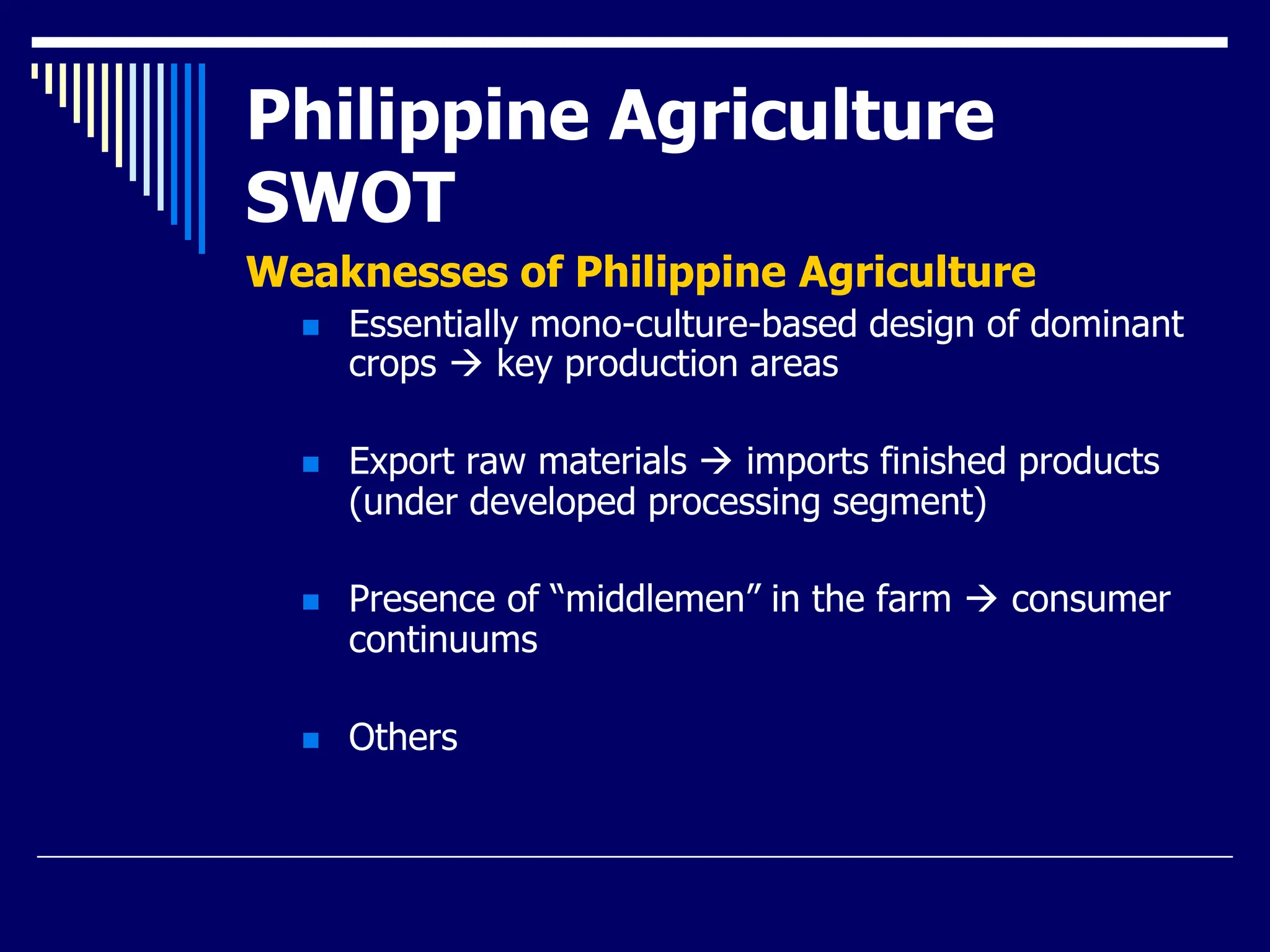
Weaknesses of Philippine Agriculture
 Essentially mono-culture-based design of dominant
crops  key production areas
 Export raw materials  imports finished products
(under developed processing segment)
 Presence of “middlemen” in the farm  consumer
continuums
 Others
Philippine Agriculture
SWOT
Opportunities for Philippine Agriculture
 Diverse agroenvironment  diverse
cropping/farming system
 Wide variety of climate and soil that allows
production of a wide variety of crops
 Food staple crops
 Fruit orchard
 Aesthetics/ornamental
 Agri-aquaculture system
Philippine Agriculture
SWOT
Opportunities for Philippine Agriculture
 Whole year round growing period for essentially
crop-based agriculture
 Sunshine duration (11 -13 hrs)
 To (24 – 32 oC)
 Rainfall (2,400 – 4,000 mm/year)
 Soils which are fertile/suitable for agricultural
production
 Alluvial soils rich in K and MEs
 Young fertile soils in flood plains
Philippine Agriculture
SWOT
Opportunities for Philippine Agriculture
 Farming families (about 5.1 M) engaged in various
agricultural-related activities
 Family-based small farm  labor intensive provided
Philippine Agriculture
SWOT
Threats to Philippine Agriculture
 Globalization/Import liberalization
 Influx of cheap imports  displaces local market of
locally produced materials
 Uncompetitive small farms  selling/mortgaging
their lands
 Erratic rainfall pattern  El Niño, La Niña
 Only 1.3 M ha irrigated
 Deforestation  watershed dysfunctional in
holding water
 5.4 M ha remaining (about 18%) vary below 40%
critical level
Philippine Agriculture
SWOT
Threats to Philippine Agriculture
 Introduction of saline water
  when water table pumped for domestic /
irrigation purposes
Thank You

Agriculture in the Philippine Setting ppt

  • 1.
    FIELD CROPS and CEREALS JenniferP. Celades Agriculture Department College of Agriculture & Natural Resources BISU-Bilar
  • 2.
    FIELD CROPS AND CEREALS Philippine Agricultural Situation  Examples  Economic Importance  Production Constraints  Definition
  • 3.
    Field Crops defined any of the herbaceous plants grown on a large scale in cultivated fields: primarily a grain, forage, sugar, oil, or fiber crop. the usable products are usually in high dry matter form.
  • 4.
    Economic Importance ofField Crops and Cereals  half the world's population subsists wholly or partially on rice.  Ninety percent of the world crop is grown and consumed in Asia.  American consumption, although increasing, is still only about 25 lb (11 kg) per person annually, as compared with 200 to 400 lb (90–181 kg) per person in parts of Asia.
  • 5.
    Importance of Riceas Food  Rice is the only major cereal crop that is primarily consumed by humans directly as harvested, and only wheat and corn are produced in comparable quantity.
  • 6.
    Importance of Rice International Rice Research Institute, attempting to keep pace with demand from a burgeoning world population, have repeatedly developed improved varieties of "miracle rice" that allow farmers to increase crop yields substantially.  rice yields are adversely affected by warmer nighttime temperatures, leading to concerns about the effects that global warming may have on rice crops.
  • 7.
    Importance of Rice Brown rice has a greater food value than white, since the outer brown coatings contain the proteins and minerals; the white endosperm is chiefly carbohydrate.  . As a food rice is low in fat and (compared with other cereal grains) in protein.  The miracle rice have grains richer in protein than the old varieties. In the East, rice is eaten with foods and sauces made from the soybean
  • 8.
    Philippine Agricultural Situation Philippines asan Agricultural Country  composed of small farms  humid tropical climate and variable weather  varying topographies and soil types  diverse flora and fauna; and  a combination of cultures in numerous communities
  • 9.
    Philippine Agricultural Situation Characteristics ofPhil. Agriculture  generally small-scale  dependent on manual labor  farmers are heterogeneous; commercial, semi-commercial, subsistence and landless farm workers
  • 10.
    Philippine Agricultural Situation Contributions ofAgricultural Sector to the Economy  main driver of economic growth in the country --- agricultural sector contributes about 22 % to the country's GNP  about 50% of total labor force is involved in agricultural activities  about 1/3 income derived comes from agriculture --- traders, processors, retailers, and other groups
  • 11.
    Philippine Agricultural Situation Country’s Small-scaleCommodity Production  dominated by subsistence and semi- commercial farmers cultivating an average area of 1.5 ha  comprising 2/3 two- thirds of the landowning population  landholdings of these small farmers account for 1/5 of the total farm area
  • 12.
    Philippine Agricultural Situation Country’s Small-scaleCommodity Production  poor rice farmers join the landless peasant population in toiling on large landholdings comprising at least 75% of the total farm area controlled by 1/5 of the landholding population
  • 13.
    Philippine Agricultural Situation Poverty Incidence:Rural (68%) > Urban Areas (34%)  corn farmers --- 41%  rice and corn workers --- 36%  sugarcane farm workers, coconut farm workers, forestry workers --- 33%  fishers in the coastal waters --- 31%
  • 14.
    Philippine Agricultural Situation Why Filipinosare Poor?  severe inequality of income and assets - worsened by the inequality of access to education, health care and other social services such as safe drinking water, electricity and farm to market roads  the wealthiest fifth of our people are 10x richer than the poorest fifth  rural people are the poorest because the urban poor have better access to social services
  • 15.
    Philippine Agricultural Situation Constraints toIncreasing Yield Biophysical/Technical  Pests and diseases  Yield potential of varieties/cultivars --- limiting  Technological efficiency at farm level --- low  Declining soil fertility and degraded soils (uplands)  Water shortage --- lack of / deteriorating irrigation facilities, El Niño
  • 16.
    Philippine Agricultural Situation Constraints toIncreasing Yield Socioeconomic  Limited / unavailable capital  Low production incentives Institutional  Deteriorating extension support services  Weak institutional capabilities
  • 17.
    PHILIPPINE AGRICULTURE  Philippine AgriculturalSituation  Philippine Agricultural Development Program  Philippine Agriculture --- SWOT  The Agriculture and Fisheries Modernization Act of 1997 (AFMA)  Philippine Agricultural Development Program
  • 18.
    Philippine Agricultural Development Program GinintuangMasaganang Ani (GMA) Program  rice  use of hybrid rice  corn  use of hybrid and inbred corns  high value crops  intensive vegetable and fruit production
  • 19.
    Philippine Agricultural Development Program PhilippineCommitment towards the Liberalization of Agricultural Trade  1996  Philippine Senate ratified country's membership in World Trade Organization (WTO)  Philippine agriculture being export-oriented, import-dependent and dominated by foreign interests  such membership intensified the basic weakness already inherent in Philippine agriculture
  • 20.
    Philippine Agricultural Development Program Philippinesas Member of WTO is Committed to: 1. Increased market access through the conversion of all quantitative restrictions (QR) into tariffs which will be eventually phased down. AoA/WTO stipulates that tariff reduction will be by 24% over the next 10 years for developing countries and by 36% over the next 6 years for developed countries
  • 21.
    Philippine Agricultural Development Program Philippinesas Member of WTO is Committed to: 3. Reduction of budgetary … developing countries  Philippine government did not have to reduce export subsidies  there is never any export subsidy provided to the farmers  Bound future government not to implement any agricultural subsidies that could boost the country’s agricultural sector
  • 22.
    Philippine Agricultural Development Program Philippinesas Member of WTO is Committed to: 4. Harmonization of sanitary and phytosanitary measures based on internationally accepted and scientifically justifiable standards
  • 23.
    Philippine Agricultural Development Program Philippinesas Member of WTO is Committed to: 4. Harmonization of sanitary and phytosanitary measures based on internationally accepted and scientifically justifiable standards  Restriction of entry of certain agricultural products in some countries  e.g., aflatoxin test requirement for Philippine coconut products to the US and vapor heat treatment of Philippine mangoes against fruit fly for mangoes entering Japan
  • 24.
    PHILIPPINE AGRICULTURE  Philippine AgriculturalSituation  Philippine Agriculture --- SWOT
  • 25.
    Philippine Agriculture SWOT Strength ofPhilippine Agriculture  Agriculture provides a total output (GDP) of about 22%  positive  Provides direct and indirect employment to about 12.5 M families  5.1 M are into farming  Food security remains to be lifeline of the country  priority attention of the government  Agriculture  mother of many industries (raw material  processing  local/export markets)  Land asset still valuable possession for future’s security  Farming remains to be noble human undertaking and profession
  • 26.
    Philippine Agriculture SWOT Weaknesses ofPhilippine Agriculture  Low adoption rates of component technologies/whole systems  technological deficiencies/weak extension/etc.  Heavy dependence on imported inputs
  • 27.
    Philippine Agriculture SWOT Weaknesses ofPhilippine Agriculture  Multiple problems  Physical  climate (rainfall, To, sunshine duration)  soil fertility (top soil erosion, etc.)  Biological  pests, diseases, weeds  physiological disorders (intensively cropped areas  nutrient deficiency  Socioecon  low farm income  inadequate support services (farm)  inadequate incentives for agricultural production (input prices/prices of product)
  • 28.
    Philippine Agriculture SWOT Weaknesses ofPhilippine Agriculture  Essentially mono-culture-based design of dominant crops  key production areas  Export raw materials  imports finished products (under developed processing segment)  Presence of “middlemen” in the farm  consumer continuums  Others
  • 29.
    Philippine Agriculture SWOT Opportunities forPhilippine Agriculture  Diverse agroenvironment  diverse cropping/farming system  Wide variety of climate and soil that allows production of a wide variety of crops  Food staple crops  Fruit orchard  Aesthetics/ornamental  Agri-aquaculture system
  • 30.
    Philippine Agriculture SWOT Opportunities forPhilippine Agriculture  Whole year round growing period for essentially crop-based agriculture  Sunshine duration (11 -13 hrs)  To (24 – 32 oC)  Rainfall (2,400 – 4,000 mm/year)  Soils which are fertile/suitable for agricultural production  Alluvial soils rich in K and MEs  Young fertile soils in flood plains
  • 31.
    Philippine Agriculture SWOT Opportunities forPhilippine Agriculture  Farming families (about 5.1 M) engaged in various agricultural-related activities  Family-based small farm  labor intensive provided
  • 32.
    Philippine Agriculture SWOT Threats toPhilippine Agriculture  Globalization/Import liberalization  Influx of cheap imports  displaces local market of locally produced materials  Uncompetitive small farms  selling/mortgaging their lands  Erratic rainfall pattern  El Niño, La Niña  Only 1.3 M ha irrigated  Deforestation  watershed dysfunctional in holding water  5.4 M ha remaining (about 18%) vary below 40% critical level
  • 33.
    Philippine Agriculture SWOT Threats toPhilippine Agriculture  Introduction of saline water   when water table pumped for domestic / irrigation purposes
  • 34.