Agri. 105
PRACTICES OF
CROP PRODUCTION
Units: 3
2 Hrs. Lecture
3 Hrs. Lab./ week
Grading System Percentage
Self-checks/ Quizzes 20%
Hands-on exercises and outputs 30%
Midterm/Final Examination 50%
TOTAL: 100%
Final Grade Midterm 30%
Final 70%
TOTAL: 100%
Get one half crosswise sheet of pad paper
Diagnostic Examination
 What is Agriculture?
 What are the Branches of agriculture?
 What are the six major subject areas of
our course?
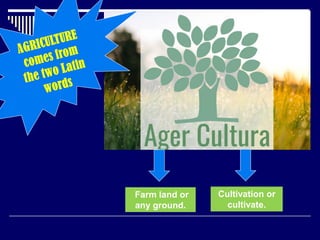
What are the two Latin words for the
word AGRICULTURE?
INTRODUCTION TO
CROP PRODUCTION
(Human Development
and Agriculture)
MARTIN BOFILL TON-OGAN M.Sc.
Course Facilitator
Let’s get to define first
what is
Cultivation or
cultivate.
Farm land or
any ground.
 Is a science, art, business and
technology of growing plants and
raising animals for man’s welfare and
economic development.
ART
BUSINESS
TECHNOLOGY
Why is Agriculture a
Utilizes all technologies
developed on scientific
principles such as crop
breeding, production
techniques, crop protection,
economics etc. to maximize
the yield and profit.
 it embraces knowledge of the way
to perform the operations of the
farm in a skillful manner.
 it allows at every juncture for the
farmer to create form from his or
her vision. A farmer sees, in his
mind’s eye, that the fields might
look, feel and produce a certain
way. Eg. Growing crops in rows or
with certain designs or lay out
(Cropping system)
Why is Agriculture an
ART
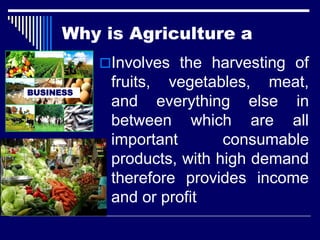
Involves the harvesting of
fruits, vegetables, meat,
and everything else in
between which are all
important consumable
products, with high demand
therefore provides income
and or profit
BUSINESS
Why is Agriculture a
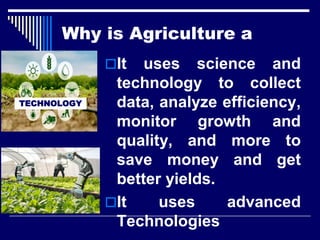
It uses science and
technology to collect
data, analyze efficiency,
monitor growth and
quality, and more to
save money and get
better yields.
It uses advanced
Technologies
TECHNOLOGY
Why is Agriculture a
 Agriculture plays a significant
role in the Philippine economy.
Involving about 33 to 40 percent
of Filipino workers, it contributes
an average of 20 percent to the
Gross Domestic Product. This
output comes mainly from
agribusiness, which in turn
accounts for about 70 percent of
the total agricultural output
(CIDA-LGSP, 2003).
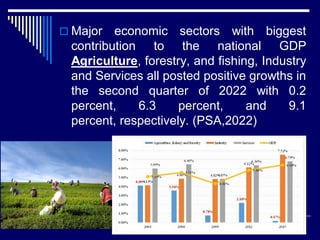
 Major economic sectors with biggest
contribution to the national GDP
Agriculture, forestry, and fishing, Industry
and Services all posted positive growths in
the second quarter of 2022 with 0.2
percent, 6.3 percent, and 9.1
percent, respectively. (PSA,2022)
BRANCHES OF
AGRICULTURE
BRANCHES OF
AGRICULTURE
Agriculture is broadly divided into:
1. Animal Husbandry (Livestock farming)
2. Agronomy: Two latin words, Agros: Field,
Nomos: Management or Field crop
Management
3. Horticulture: Two Latin words, hortus:
garden, and cultura culture.
BRANCHES OF
AGRICULTURE cont.
4.aquaculture(fish farming)
5.forestry
6.agricultural economics
7.agricultural engineering.
8.apiculture(bee keeping)
Branches of Horticulture
1.Pomology-fruit cultivation is known as pomology.
2.Olericulture- vegetable cultivation such as beans,
tomatoes, etc.
3.Floriculture- flower cropping such as roses, carnations,
etc, and gardening.
4.Arboriculture-assortment, planting, maintenance, and
removal of trees, shrubs, and other woody plants.
5. Landscaping-production, presentation, and care of
landscapes, flowers, and other plants.
6.Viticulture- Cultivation and retailing grapes are known as
viticulture.
7.Oenology- Study of all the characteristics of wine plant
and wine-making.
Human Development and
Agriculture
Agriculture, although considered as
one of the most ancient human
activities, is of fairly late occurrence.
Developments of Agriculture led to the
growth of civilizations in the past,
continue to shape the present and will
determine mankind’s future in the
planet.
 Homo sapiens (from Africa) and
their forebears have existed on
earth for more than 4 million years.
200,000 years B.C. (or earlier),
homo sapiens began exploring
other lands and reached as far as
the middle east.
 For much of the period of their
existence, early humans subsisted as
food gatherers and hunters
 10,000 to 15,000 years after the ice
age during Neolithic periods when
agriculture was known to have first
started.
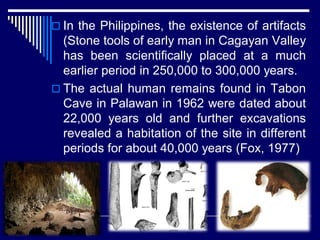
 In the Philippines, the existence of artifacts
(Stone tools of early man in Cagayan Valley
has been scientifically placed at a much
earlier period in 250,000 to 300,000 years.
 The actual human remains found in Tabon
Cave in Palawan in 1962 were dated about
22,000 years old and further excavations
revealed a habitation of the site in different
periods for about 40,000 years (Fox, 1977)
 During the Neolithic periods
beginning 6,000 B.C. In the
Philippines, domestication of plants
and animals intensified.
 Root crops like Taro (Gabi), Yam
(Ube) and upland rice became
important staples.
 Further improvements in agriculture
took place when human power (In
1760’s when power-driven
machinery began replacing manual
labor industry and later in farming),
It Increased agricultural prod. a
hundred fold.
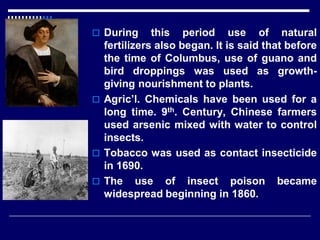
 During this period use of natural
fertilizers also began. It is said that before
the time of Columbus, use of guano and
bird droppings was used as growth-
giving nourishment to plants.
 Agric’l. Chemicals have been used for a
long time. 9th. Century, Chinese farmers
used arsenic mixed with water to control
insects.
 Tobacco was used as contact insecticide
in 1690.
 The use of insect poison became
widespread beginning in 1860.
 In plant breeding, development of
commercial varieties begin in
eaurope in the 1700’s and 1800’s
even before the time of Gregor
Mendel. (Eg. Hybrid corn developed
in 1920’s)
 Green revolution followed that
existed between the 1930s and the
late 1960s by Norman Borlaug an
American agronomist.
 From there, development and
advancement continues until this
days.
 This is where science will play a vital role in making
things differently using the lessons of the past.
 Crop Science is the embodiment of knowledge
gained from contributions of many basic and
applied disciplines. Such body of knowledge should
now be translated into crop production principles
and practices that will maximize monetary returns
to the individual growers on per-crop basis, and
simultaneously contribute to the long term welfare
of the environment and society
Definition of Crop Production
and Subject Matter Coverage
Crop Production is defined as the art and science
of producing crops, aimed at increasing productivity
and quality of the products in order to maximize
monetary returns but at the same time minimize, if not
completely eliminate, the negative effects on the
environment.
The subject matter coverage includes discussion
on the principles underlying crop growth and
development in relation to the factors of the
environment and appropriate crop production
practices and management to follow for both
agronomic and horticultural crops.
 Crop Production covers the whole range of
operations from planting to harvesting, including
primary aspects of crop processing.
Definition of Crop Production
and Subject Matter Coverage
cont.
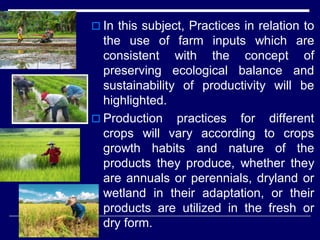
 In this subject, Practices in relation to
the use of farm inputs which are
consistent with the concept of
preserving ecological balance and
sustainability of productivity will be
highlighted.
 Production practices for different
crops will vary according to crops
growth habits and nature of the
products they produce, whether they
are annuals or perennials, dryland or
wetland in their adaptation, or their
products are utilized in the fresh or
dry form.
Crop Groups and Terminologies
 Agronomic or Field Crops
are annual herbaceous plants that are grown on the
farm under a system of ‘’extensive’’ or large scale
culture.
Crop Groups and Terminologies
The Agronomic crops can be
further grouped based on
the manner by which they
are utilized
Cereal or Grain crops belonging
to the grass family, Graminaceae
or Poaceae. These are utilized as
staples. The word ‘’cereal’’ is
derived from the name of the most
important deity, the Roman
Goddess Ceres.
Grain Legumes or Pulses of the
family Leguminoseae, which are
consumed in the dry seed form. The
legumes are rich sources of protein.
The plants possess the ability to fix
nitrogen from the air in symbiotic
association with the Rhizobium
bacteria. The major legume crops in
the Philippines are mungbean, peanut
and soybeans
 Fiber Crops
 Are sources of fiber. The commercial
fiber crops in the Philippines are Kenaf,
(Hibiscus sabdariffa) jute (Corchorus
olitorius); ramie (Boehmeria nivea);
cotton (Gossypium hirsutum)
Kenaf jute ramie
 Are plants yielding starchy roots. They
are used mainly for human food (as such
or in processed form). The major species
are: Cassava (Sci. name) and
Sweetpotato (Sci. name)
 Root Crops
Dioscorea esculenta (Lour.) Burkill
LESSER YAM
 Forage Legumes and
grasses for animal
fodder.
 Plants that are grown to provide feed
for livestock. The crops can be
harvested and fed to the animals in a
barn, or the animals can be allowed to
graze directly on the field.
 Eg. Napier or elephant grass
(Pennisetum purpureum); Guinea
grass (Panicum maximum), Paragrass
(Bracharia mutica) etc.
The important legume forages
are:
 Centro (Centrosema pubescens), Ipil-
ipil (Leucaena leucocephala) and
siratro (Macroptilium atrpurpureum)
 Crops which are normally not
sold directly for consumption
because they need to be
industrially processed prior to
final use.
 Eg. Coconut, Tobacco, Abacca,
Cacao, Coffee, Rubber tree.
 Industrial crops for
processing
 Horticultural Crops
are annual and perennial species of plants that are
grown under a system of ‘’intensive’’ culture which
means they usually require special care. They can
be further grouped in relation to the manner they are
utilized. Eg. HVC crops.
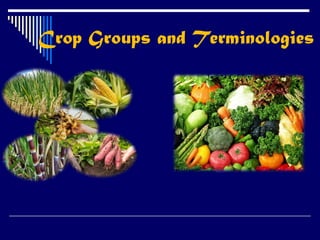
Crop Groups
Branches of Horticulture
1. Pomology- Fruit cultivation or growing of fruit/fruit trees.
Eg. Strawberry, Mango, jackfruit, pineapple, papaya, dragon fruit
etc.
2. Olericulture- vegetable cultivation such as beans, tomatoes,
cabbage, bitter gourd etc.
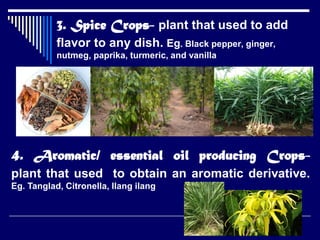
3. Spice Crops- plant that used to add
flavor to any dish. Eg. Black pepper, ginger,
nutmeg, paprika, turmeric, and vanilla
4. Aromatic/ essential oil producing Crops-
plant that used to obtain an aromatic derivative.
Eg. Tanglad, Citronella, Ilang ilang
5. Medicinal and biocidal Plants-
Which are sources of pharmaceutical
and insecticidal compounds. Eg. Lagundi,
Yerba Buena, Oregano, Sambong etc.
6.Floriculture- Planting of flowering
and ornamental plants like roses,
carnations etc, and gardening.
7.Arboriculture- assortment, planting, maintenance,
and removal of trees, shrubs, and other woody plants.
 The Method of grouping of crops into
agronomic and horticultural is based not on
botanical differences but on the purpose and
extent by which the crops are cultivated,
which can be arbitrary, depending on the
prevailing situations in the country
 Usage of the commodity has also been used
as basis of grouping crops. A good example is
maize; when it is grown and utilized as a grain
crop, it is classified as agronomic; when it is
used as vegetable as in the case of young
corn and sweet corn, it is classified as a
horticultural crop.
GET ONE HALF (1/5) CROSSWISE
SHEET OF PAD PAPER
Basic Physiological
Processes that
influence Crop Yields
Basic Physiological Processes that
influence Crop Yields
 Growth and development in plants, from
seed germination to plant maturation, are
controlled by a chain of physiological
processes.
 Photosynthesis, Respiration, Source-Sink
Relationship, Transpiration
 This knowledge is significant to know under
what conditions such systems operate
normally or how they can be constrained by
some factors so that proper measures can
be taken.
Photosynthesis
The process by which green
plants and some other organisms
use sunlight to synthesize foods
from carbon dioxide and water.
Photosynthesis in plants generally
involves the green pigment
chlorophyll and generates oxygen
as a byproduct.
Photosynthesis
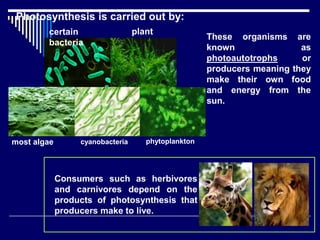
Photosynthesis is carried out by:
plant
s
cyanobacteria
certain
bacteria
most algae phytoplankton
These organisms are
known as
photoautotrophs or
producers meaning they
make their own food
and energy from the
sun.
Consumers such as herbivores
and carnivores depend on the
products of photosynthesis that
producers make to live.
Site for Photosynthesis
Chloroplasts are full of round flattened
discs called thylakoids.
A stack of thylakoids is called a
granum.
Chloroplasts are where photosynthesis
occurs.
Both pictures are of
chloroplasts in plant cells
at different magnifications.
Chloroplast
Stroma is the
space inside
chloroplasts
Light reaction takes place
in the thylakoids and dark
reaction takes place in the
stroma
In short Photosynthesis
requires
 Raw materials H20 and CO2
 Sunlight
 Pigments (3 types of pigments) --
*Chlorophyll (Chlorophyll a and Chlorophyll b)
but Chlorophyll a is most important
because it has the reaction center
*Carotenoids- Accessory pigments (made up
of Lipid Molecules)
* Phycobillins- Accessory pigments (found in
Blue green algae)
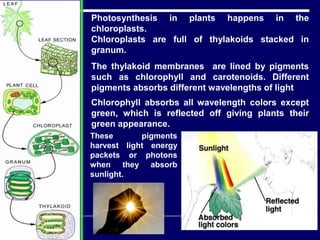
Photosynthesis in plants happens in the
chloroplasts.
Chloroplasts are full of thylakoids stacked in
granum.
The thylakoid membranes are lined by pigments
such as chlorophyll and carotenoids. Different
pigments absorbs different wavelengths of light
These pigments
harvest light energy
packets or photons
when they absorb
sunlight.
Chlorophyll absorbs all wavelength colors except
green, which is reflected off giving plants their
green appearance.
Again the product of
Photosynthesis is
 12 H2O+ C02 + Light Energy in
the presence of
chlorophyll
C6 H12 O6+ 6O2 + 6 H2O
Uses of Photosynthesis
1. Conversion of light energy into chemical energy, for use in
metabolic processes by plants
2. Inorganic compounds are converted into essential
foodstuffs and other products useful to man
3. The release of oxygen into the atmosphere which is used in
respiration by both plants and animals. The air contains
about 21% oxygen supplied by green plants. The oxygen
that is released comes mainly from water molecules utilized
in the process.
 Provide plants energy for their cells to be active
or alive.
 The process of respiration in plants involves using
the sugars produced during photosynthesis plus
oxygen to produce energy for plant growth. In many
ways, respiration is the opposite of
photosynthesis. In the natural environment, plants
produce their own food to survive.
 Respiration process undergo 3 various processes
(Glycolysis, Kreb’s Cycle, and Electron Transport
Chain (ETC) )
Respiration
 Overall, photosynthesis involves the energizing of electrons
by light energy to reduce (add electrons to) CO2 to build a
larger compound (glucose), producing oxygen as a
byproduct. Cellular respiration, on the other hand, involves
taking electrons away from a substrate (glucose, for
instance), which is to say oxidation, and in the process the
substrate is degraded so that its carbon atoms are released
as CO2, while oxygen is consumed. Thus, photosynthesis
and cellular respiration are nearly opposite biochemical
processes.
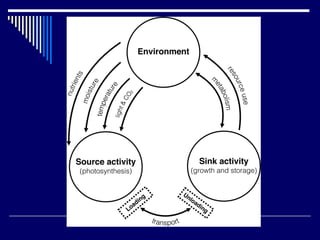
 Determine the yield and nutritional
quality of the crops produced
Source-Sink Relation
 Yield is enhanced if photoassimilates
and nutrients over the course of
seed development.
 “Transpiration is the biological process by
which water is lost in the form of water vapour
from the aerial parts of the plants.”
 Like all living organism, plants also require an excretory
system to discharge excess water from their body. This
process of elimination of excess water from the plant
body is known as transpiration. It is generally the
evaporation of water from the surface of the leaves.
 During the process of transpiration, water molecules in
the plant tissues are removed from the aerial parts of
the plants. Only a small amount of water absorbed by
the plants is utilized in growth and development. The
rest is eliminated in the form of transpiration.
Transpiration
3 Types of Transpiration
Stomatal Transpiration
Lenticular Transpiration
Cuticular Transpiration
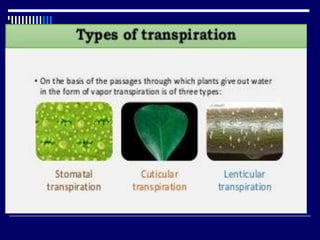
 Stomatal Transpiration-evaporation of water from the
stomata of the plants. Most of the water from the plants is
transpired this way. The water near the surface of the
leaves changes into vapour and evaporates when the
stomata are open.
 Lenticular Transpiration -are minute openings in the bark
of branches and twigs. Evaporation of water from the
lenticels of the plants is known as lenticular transpiration.
 Cuticular Transpiration- It is the evaporation of water from
the cuticle of the plants. The cuticle is a waxy covering on
the surface of the leaves of the plants. About 5-10% of the
water from the leaves is lost through cuticular
transpiration. During dry conditions when the stomata are
closed, more water is transpired through the cuticles.
 Understanding plant physiology gives a
scientific basis for planting crops
according to soil-appropriate climatic
conditions. A thorough knowledge of the
various aspects of plant physiology
helps in agriculture and its development.
In-depth knowledge of plant physiology
is essential and helps in crop
development by implementing
appropriate breeding strategies.
THANK YOU!!!

AGRI.-105-PRACTICES-OF-CROP-PRODUCTION.pdf

  • 1.
    Agri. 105 PRACTICES OF CROPPRODUCTION Units: 3 2 Hrs. Lecture 3 Hrs. Lab./ week
  • 2.
    Grading System Percentage Self-checks/Quizzes 20% Hands-on exercises and outputs 30% Midterm/Final Examination 50% TOTAL: 100% Final Grade Midterm 30% Final 70% TOTAL: 100%
  • 5.
    Get one halfcrosswise sheet of pad paper
  • 6.
    Diagnostic Examination  Whatis Agriculture?  What are the Branches of agriculture?  What are the six major subject areas of our course? What are the two Latin words for the word AGRICULTURE?
  • 10.
    INTRODUCTION TO CROP PRODUCTION (HumanDevelopment and Agriculture) MARTIN BOFILL TON-OGAN M.Sc. Course Facilitator
  • 11.
    Let’s get todefine first what is
  • 12.
  • 13.
     Is ascience, art, business and technology of growing plants and raising animals for man’s welfare and economic development. ART BUSINESS TECHNOLOGY
  • 14.
    Why is Agriculturea Utilizes all technologies developed on scientific principles such as crop breeding, production techniques, crop protection, economics etc. to maximize the yield and profit.
  • 15.
     it embracesknowledge of the way to perform the operations of the farm in a skillful manner.  it allows at every juncture for the farmer to create form from his or her vision. A farmer sees, in his mind’s eye, that the fields might look, feel and produce a certain way. Eg. Growing crops in rows or with certain designs or lay out (Cropping system) Why is Agriculture an ART
  • 16.
    Involves the harvestingof fruits, vegetables, meat, and everything else in between which are all important consumable products, with high demand therefore provides income and or profit BUSINESS Why is Agriculture a
  • 17.
    It uses scienceand technology to collect data, analyze efficiency, monitor growth and quality, and more to save money and get better yields. It uses advanced Technologies TECHNOLOGY Why is Agriculture a
  • 18.
     Agriculture playsa significant role in the Philippine economy. Involving about 33 to 40 percent of Filipino workers, it contributes an average of 20 percent to the Gross Domestic Product. This output comes mainly from agribusiness, which in turn accounts for about 70 percent of the total agricultural output (CIDA-LGSP, 2003).
  • 19.
     Major economicsectors with biggest contribution to the national GDP Agriculture, forestry, and fishing, Industry and Services all posted positive growths in the second quarter of 2022 with 0.2 percent, 6.3 percent, and 9.1 percent, respectively. (PSA,2022)
  • 20.
  • 21.
    BRANCHES OF AGRICULTURE Agriculture isbroadly divided into: 1. Animal Husbandry (Livestock farming) 2. Agronomy: Two latin words, Agros: Field, Nomos: Management or Field crop Management 3. Horticulture: Two Latin words, hortus: garden, and cultura culture.
  • 22.
    BRANCHES OF AGRICULTURE cont. 4.aquaculture(fishfarming) 5.forestry 6.agricultural economics 7.agricultural engineering. 8.apiculture(bee keeping)
  • 23.
    Branches of Horticulture 1.Pomology-fruitcultivation is known as pomology. 2.Olericulture- vegetable cultivation such as beans, tomatoes, etc. 3.Floriculture- flower cropping such as roses, carnations, etc, and gardening. 4.Arboriculture-assortment, planting, maintenance, and removal of trees, shrubs, and other woody plants. 5. Landscaping-production, presentation, and care of landscapes, flowers, and other plants. 6.Viticulture- Cultivation and retailing grapes are known as viticulture. 7.Oenology- Study of all the characteristics of wine plant and wine-making.
  • 24.
    Human Development and Agriculture Agriculture,although considered as one of the most ancient human activities, is of fairly late occurrence. Developments of Agriculture led to the growth of civilizations in the past, continue to shape the present and will determine mankind’s future in the planet.
  • 25.
     Homo sapiens(from Africa) and their forebears have existed on earth for more than 4 million years. 200,000 years B.C. (or earlier), homo sapiens began exploring other lands and reached as far as the middle east.
  • 26.
     For muchof the period of their existence, early humans subsisted as food gatherers and hunters  10,000 to 15,000 years after the ice age during Neolithic periods when agriculture was known to have first started.
  • 27.
     In thePhilippines, the existence of artifacts (Stone tools of early man in Cagayan Valley has been scientifically placed at a much earlier period in 250,000 to 300,000 years.  The actual human remains found in Tabon Cave in Palawan in 1962 were dated about 22,000 years old and further excavations revealed a habitation of the site in different periods for about 40,000 years (Fox, 1977)
  • 28.
     During theNeolithic periods beginning 6,000 B.C. In the Philippines, domestication of plants and animals intensified.  Root crops like Taro (Gabi), Yam (Ube) and upland rice became important staples.  Further improvements in agriculture took place when human power (In 1760’s when power-driven machinery began replacing manual labor industry and later in farming), It Increased agricultural prod. a hundred fold.
  • 29.
     During thisperiod use of natural fertilizers also began. It is said that before the time of Columbus, use of guano and bird droppings was used as growth- giving nourishment to plants.  Agric’l. Chemicals have been used for a long time. 9th. Century, Chinese farmers used arsenic mixed with water to control insects.  Tobacco was used as contact insecticide in 1690.  The use of insect poison became widespread beginning in 1860.
  • 30.
     In plantbreeding, development of commercial varieties begin in eaurope in the 1700’s and 1800’s even before the time of Gregor Mendel. (Eg. Hybrid corn developed in 1920’s)  Green revolution followed that existed between the 1930s and the late 1960s by Norman Borlaug an American agronomist.  From there, development and advancement continues until this days.
  • 31.
     This iswhere science will play a vital role in making things differently using the lessons of the past.  Crop Science is the embodiment of knowledge gained from contributions of many basic and applied disciplines. Such body of knowledge should now be translated into crop production principles and practices that will maximize monetary returns to the individual growers on per-crop basis, and simultaneously contribute to the long term welfare of the environment and society
  • 32.
    Definition of CropProduction and Subject Matter Coverage Crop Production is defined as the art and science of producing crops, aimed at increasing productivity and quality of the products in order to maximize monetary returns but at the same time minimize, if not completely eliminate, the negative effects on the environment.
  • 33.
    The subject mattercoverage includes discussion on the principles underlying crop growth and development in relation to the factors of the environment and appropriate crop production practices and management to follow for both agronomic and horticultural crops.  Crop Production covers the whole range of operations from planting to harvesting, including primary aspects of crop processing. Definition of Crop Production and Subject Matter Coverage cont.
  • 34.
     In thissubject, Practices in relation to the use of farm inputs which are consistent with the concept of preserving ecological balance and sustainability of productivity will be highlighted.  Production practices for different crops will vary according to crops growth habits and nature of the products they produce, whether they are annuals or perennials, dryland or wetland in their adaptation, or their products are utilized in the fresh or dry form.
  • 35.
    Crop Groups andTerminologies
  • 36.
     Agronomic orField Crops are annual herbaceous plants that are grown on the farm under a system of ‘’extensive’’ or large scale culture. Crop Groups and Terminologies
  • 37.
    The Agronomic cropscan be further grouped based on the manner by which they are utilized Cereal or Grain crops belonging to the grass family, Graminaceae or Poaceae. These are utilized as staples. The word ‘’cereal’’ is derived from the name of the most important deity, the Roman Goddess Ceres.
  • 38.
    Grain Legumes orPulses of the family Leguminoseae, which are consumed in the dry seed form. The legumes are rich sources of protein. The plants possess the ability to fix nitrogen from the air in symbiotic association with the Rhizobium bacteria. The major legume crops in the Philippines are mungbean, peanut and soybeans
  • 39.
     Fiber Crops Are sources of fiber. The commercial fiber crops in the Philippines are Kenaf, (Hibiscus sabdariffa) jute (Corchorus olitorius); ramie (Boehmeria nivea); cotton (Gossypium hirsutum) Kenaf jute ramie
  • 40.
     Are plantsyielding starchy roots. They are used mainly for human food (as such or in processed form). The major species are: Cassava (Sci. name) and Sweetpotato (Sci. name)  Root Crops Dioscorea esculenta (Lour.) Burkill LESSER YAM
  • 41.
     Forage Legumesand grasses for animal fodder.  Plants that are grown to provide feed for livestock. The crops can be harvested and fed to the animals in a barn, or the animals can be allowed to graze directly on the field.  Eg. Napier or elephant grass (Pennisetum purpureum); Guinea grass (Panicum maximum), Paragrass (Bracharia mutica) etc.
  • 42.
    The important legumeforages are:  Centro (Centrosema pubescens), Ipil- ipil (Leucaena leucocephala) and siratro (Macroptilium atrpurpureum)
  • 43.
     Crops whichare normally not sold directly for consumption because they need to be industrially processed prior to final use.  Eg. Coconut, Tobacco, Abacca, Cacao, Coffee, Rubber tree.  Industrial crops for processing
  • 44.
     Horticultural Crops areannual and perennial species of plants that are grown under a system of ‘’intensive’’ culture which means they usually require special care. They can be further grouped in relation to the manner they are utilized. Eg. HVC crops. Crop Groups
  • 45.
    Branches of Horticulture 1.Pomology- Fruit cultivation or growing of fruit/fruit trees. Eg. Strawberry, Mango, jackfruit, pineapple, papaya, dragon fruit etc. 2. Olericulture- vegetable cultivation such as beans, tomatoes, cabbage, bitter gourd etc.
  • 46.
    3. Spice Crops-plant that used to add flavor to any dish. Eg. Black pepper, ginger, nutmeg, paprika, turmeric, and vanilla 4. Aromatic/ essential oil producing Crops- plant that used to obtain an aromatic derivative. Eg. Tanglad, Citronella, Ilang ilang
  • 47.
    5. Medicinal andbiocidal Plants- Which are sources of pharmaceutical and insecticidal compounds. Eg. Lagundi, Yerba Buena, Oregano, Sambong etc.
  • 48.
    6.Floriculture- Planting offlowering and ornamental plants like roses, carnations etc, and gardening. 7.Arboriculture- assortment, planting, maintenance, and removal of trees, shrubs, and other woody plants.
  • 49.
     The Methodof grouping of crops into agronomic and horticultural is based not on botanical differences but on the purpose and extent by which the crops are cultivated, which can be arbitrary, depending on the prevailing situations in the country  Usage of the commodity has also been used as basis of grouping crops. A good example is maize; when it is grown and utilized as a grain crop, it is classified as agronomic; when it is used as vegetable as in the case of young corn and sweet corn, it is classified as a horticultural crop.
  • 51.
    GET ONE HALF(1/5) CROSSWISE SHEET OF PAD PAPER
  • 52.
  • 53.
    Basic Physiological Processesthat influence Crop Yields  Growth and development in plants, from seed germination to plant maturation, are controlled by a chain of physiological processes.  Photosynthesis, Respiration, Source-Sink Relationship, Transpiration  This knowledge is significant to know under what conditions such systems operate normally or how they can be constrained by some factors so that proper measures can be taken.
  • 54.
    Photosynthesis The process bywhich green plants and some other organisms use sunlight to synthesize foods from carbon dioxide and water. Photosynthesis in plants generally involves the green pigment chlorophyll and generates oxygen as a byproduct. Photosynthesis
  • 55.
    Photosynthesis is carriedout by: plant s cyanobacteria certain bacteria most algae phytoplankton These organisms are known as photoautotrophs or producers meaning they make their own food and energy from the sun. Consumers such as herbivores and carnivores depend on the products of photosynthesis that producers make to live.
  • 56.
  • 57.
    Chloroplasts are fullof round flattened discs called thylakoids. A stack of thylakoids is called a granum. Chloroplasts are where photosynthesis occurs. Both pictures are of chloroplasts in plant cells at different magnifications. Chloroplast Stroma is the space inside chloroplasts Light reaction takes place in the thylakoids and dark reaction takes place in the stroma
  • 58.
    In short Photosynthesis requires Raw materials H20 and CO2  Sunlight  Pigments (3 types of pigments) -- *Chlorophyll (Chlorophyll a and Chlorophyll b) but Chlorophyll a is most important because it has the reaction center *Carotenoids- Accessory pigments (made up of Lipid Molecules) * Phycobillins- Accessory pigments (found in Blue green algae)
  • 59.
    Photosynthesis in plantshappens in the chloroplasts. Chloroplasts are full of thylakoids stacked in granum. The thylakoid membranes are lined by pigments such as chlorophyll and carotenoids. Different pigments absorbs different wavelengths of light These pigments harvest light energy packets or photons when they absorb sunlight. Chlorophyll absorbs all wavelength colors except green, which is reflected off giving plants their green appearance.
  • 60.
    Again the productof Photosynthesis is  12 H2O+ C02 + Light Energy in the presence of chlorophyll C6 H12 O6+ 6O2 + 6 H2O Uses of Photosynthesis 1. Conversion of light energy into chemical energy, for use in metabolic processes by plants 2. Inorganic compounds are converted into essential foodstuffs and other products useful to man 3. The release of oxygen into the atmosphere which is used in respiration by both plants and animals. The air contains about 21% oxygen supplied by green plants. The oxygen that is released comes mainly from water molecules utilized in the process.
  • 61.
     Provide plantsenergy for their cells to be active or alive.  The process of respiration in plants involves using the sugars produced during photosynthesis plus oxygen to produce energy for plant growth. In many ways, respiration is the opposite of photosynthesis. In the natural environment, plants produce their own food to survive.  Respiration process undergo 3 various processes (Glycolysis, Kreb’s Cycle, and Electron Transport Chain (ETC) ) Respiration
  • 62.
     Overall, photosynthesisinvolves the energizing of electrons by light energy to reduce (add electrons to) CO2 to build a larger compound (glucose), producing oxygen as a byproduct. Cellular respiration, on the other hand, involves taking electrons away from a substrate (glucose, for instance), which is to say oxidation, and in the process the substrate is degraded so that its carbon atoms are released as CO2, while oxygen is consumed. Thus, photosynthesis and cellular respiration are nearly opposite biochemical processes.
  • 63.
     Determine theyield and nutritional quality of the crops produced Source-Sink Relation  Yield is enhanced if photoassimilates and nutrients over the course of seed development.
  • 66.
     “Transpiration isthe biological process by which water is lost in the form of water vapour from the aerial parts of the plants.”  Like all living organism, plants also require an excretory system to discharge excess water from their body. This process of elimination of excess water from the plant body is known as transpiration. It is generally the evaporation of water from the surface of the leaves.  During the process of transpiration, water molecules in the plant tissues are removed from the aerial parts of the plants. Only a small amount of water absorbed by the plants is utilized in growth and development. The rest is eliminated in the form of transpiration. Transpiration
  • 68.
    3 Types ofTranspiration Stomatal Transpiration Lenticular Transpiration Cuticular Transpiration
  • 70.
     Stomatal Transpiration-evaporationof water from the stomata of the plants. Most of the water from the plants is transpired this way. The water near the surface of the leaves changes into vapour and evaporates when the stomata are open.  Lenticular Transpiration -are minute openings in the bark of branches and twigs. Evaporation of water from the lenticels of the plants is known as lenticular transpiration.  Cuticular Transpiration- It is the evaporation of water from the cuticle of the plants. The cuticle is a waxy covering on the surface of the leaves of the plants. About 5-10% of the water from the leaves is lost through cuticular transpiration. During dry conditions when the stomata are closed, more water is transpired through the cuticles.
  • 71.
     Understanding plantphysiology gives a scientific basis for planting crops according to soil-appropriate climatic conditions. A thorough knowledge of the various aspects of plant physiology helps in agriculture and its development. In-depth knowledge of plant physiology is essential and helps in crop development by implementing appropriate breeding strategies.
  • 72.