Agile/Lean PMO 
Andrew Rusling 
Agile Coach 
@andrewrusling
Competencies to be gained 
By the end of this session, I am hopeful that you will be able to: 
1. Summarise the responsibilities of a typical PMO that are impacted by 
supporting Agile projects. 
2. Summarise the Portfolio Management responsibilities that are 
impacted by supporting Agile projects. 
3. Summarise the incremental funding approach 
4. Summarise how Lean Portfolio Management achieves flow of value. 
5. List the pros and cons of Stable teams vs Dynamic teams. 
6. List some strategies that support Stable teams. 
2
What is a PMO?
Definitions 4 
“An organizational body or entity assigned various responsibilities 
related to the centralized and coordinated management of those 
projects under its domain. The responsibilities of the PMO can range 
from providing project management support functions to actually being 
responsible for the direct management of a project.” 
PMBOK 2003 
“A project management office is a formal, centralized layer of control 
between senior management and project management” 
IS Project Management: Size, practices and the project management 
office. 2007
5 
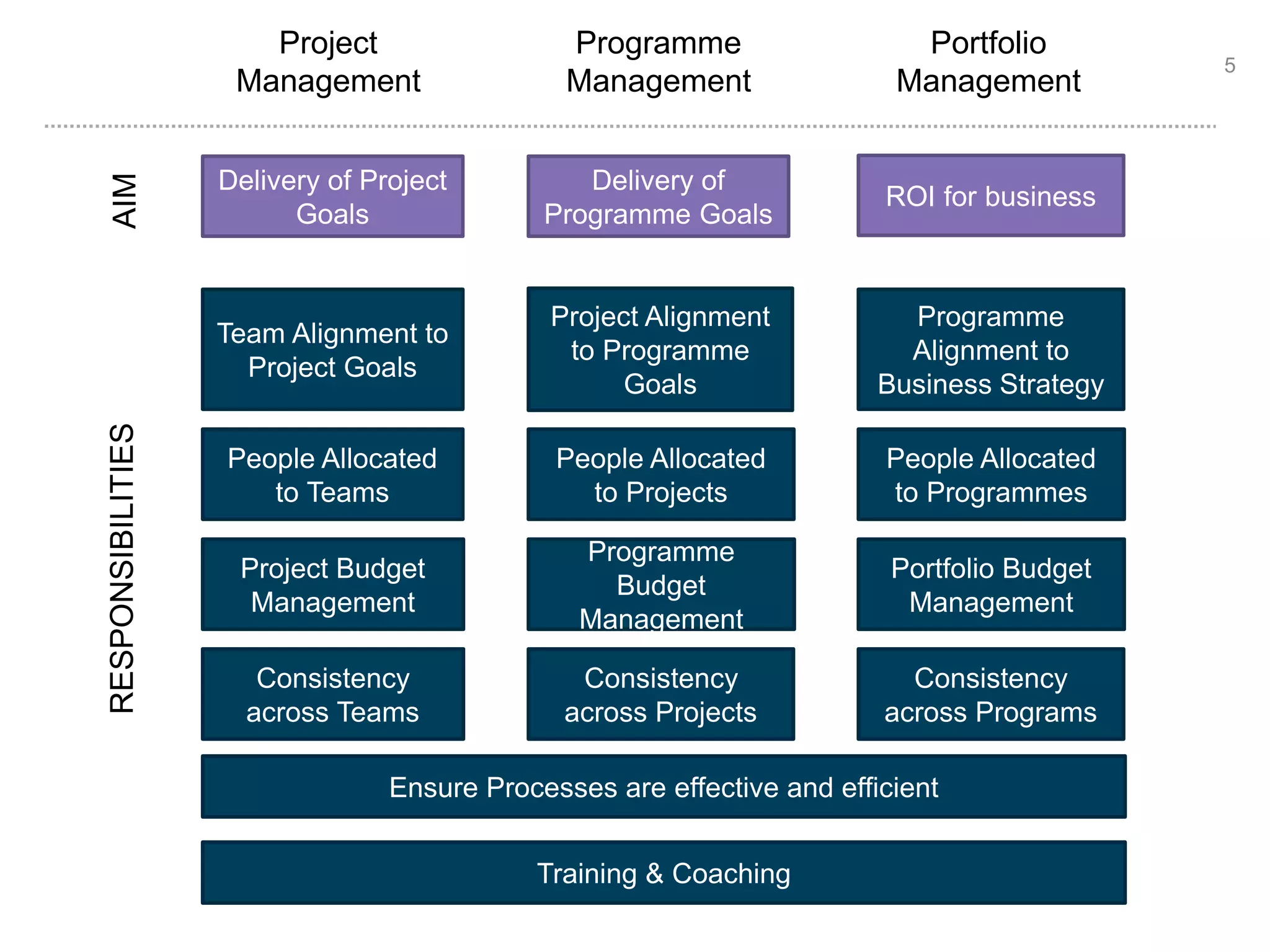
RESPONSIBILITIES AIM 
Project 
Management 
Programme 
Management 
Portfolio 
Management 
Delivery of Project 
Goals 
Delivery of 
Programme Goals 
ROI for business 
Team Alignment to 
Project Goals 
Project Alignment 
to Programme 
Goals 
Programme 
Alignment to 
Business Strategy 
People Allocated 
to Programmes 
Portfolio Budget 
Management 
Consistency 
across Programs 
People Allocated 
to Projects 
People Allocated 
to Teams 
Programme 
Budget 
Management 
Consistency 
across Projects 
Project Budget 
Management 
Consistency 
across Teams 
Ensure Processes are effective and efficient 
Training & Coaching
Project Management
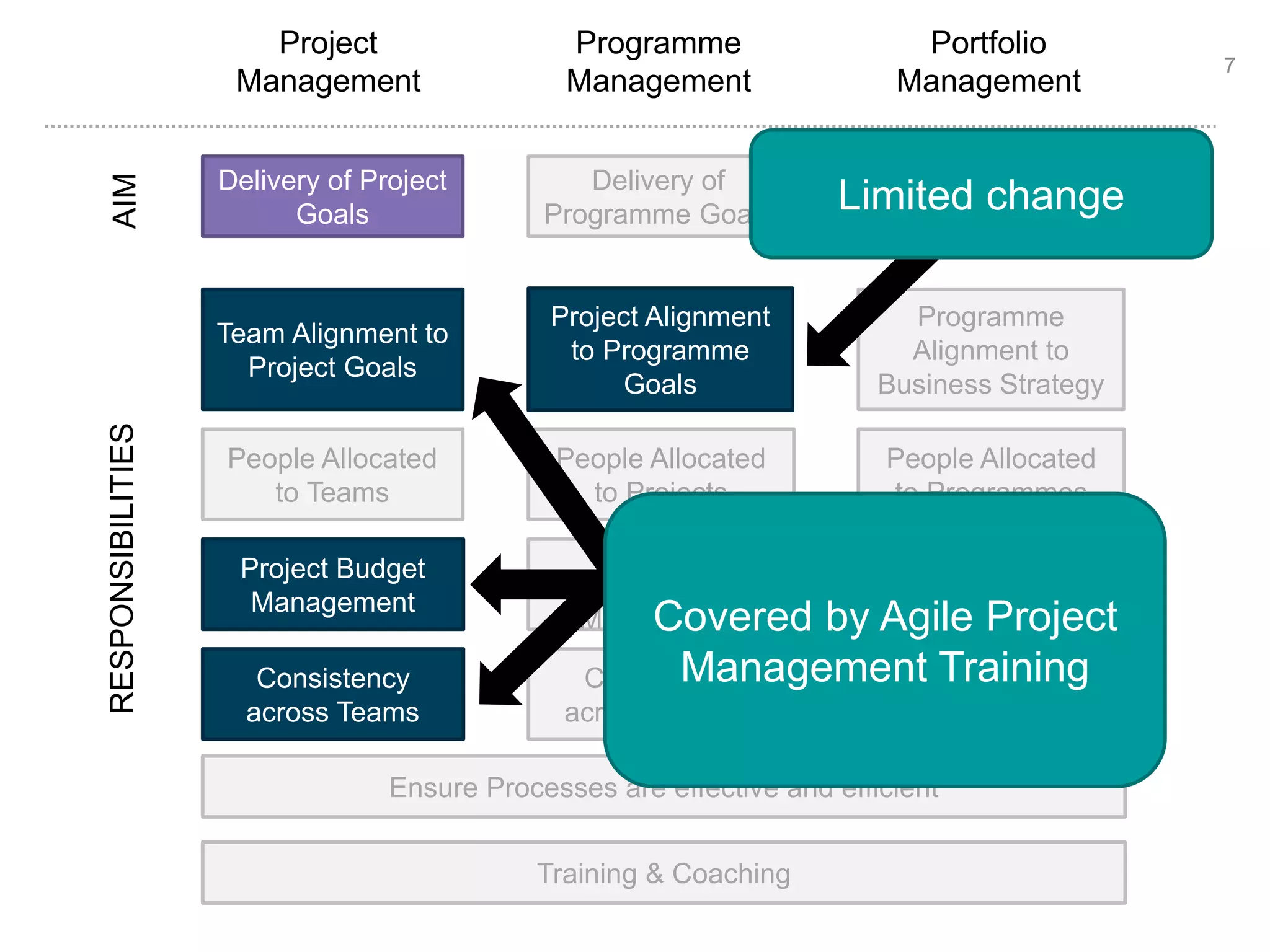
7 
RESPONSIBILITIES AIM 
Project 
Management 
Programme 
Management 
Portfolio 
Management 
Delivery of Project 
Goals 
Delivery of 
Programme Goals 
ROI for business 
Team Alignment to 
Project Goals 
Project Alignment 
to Programme 
Goals 
Programme 
Alignment to 
Business Strategy 
People Allocated 
to Programmes 
Portfolio Budget 
Management 
Covered by Agile Project 
Management Training 
Consistency 
across Programs 
People Allocated 
to Projects 
People Allocated 
to Teams 
Consistency 
across Projects 
Consistency 
across Teams 
Programme 
Budget 
Management 
Project Budget 
Management 
Ensure Processes are effective and efficient 
Training & Coaching 
Limited change
People Management
9 
RESPONSIBILITIES AIM 
Project 
Management 
Programme 
Management 
Portfolio 
Management 
Delivery of Project 
Goals 
Delivery of 
Programme Goals 
ROI for business 
Team Alignment to 
Project Goals 
Project Alignment 
to Programme 
Goals 
Programme 
Alignment to 
Business Strategy 
People Allocated 
to Programmes 
Portfolio Budget 
Management 
Consistency 
across Programs 
People Allocated 
to Projects 
People Allocated 
to Teams 
Consistency 
across Projects 
Consistency 
across Teams 
Programme 
Budget 
Management 
Project Budget 
Management 
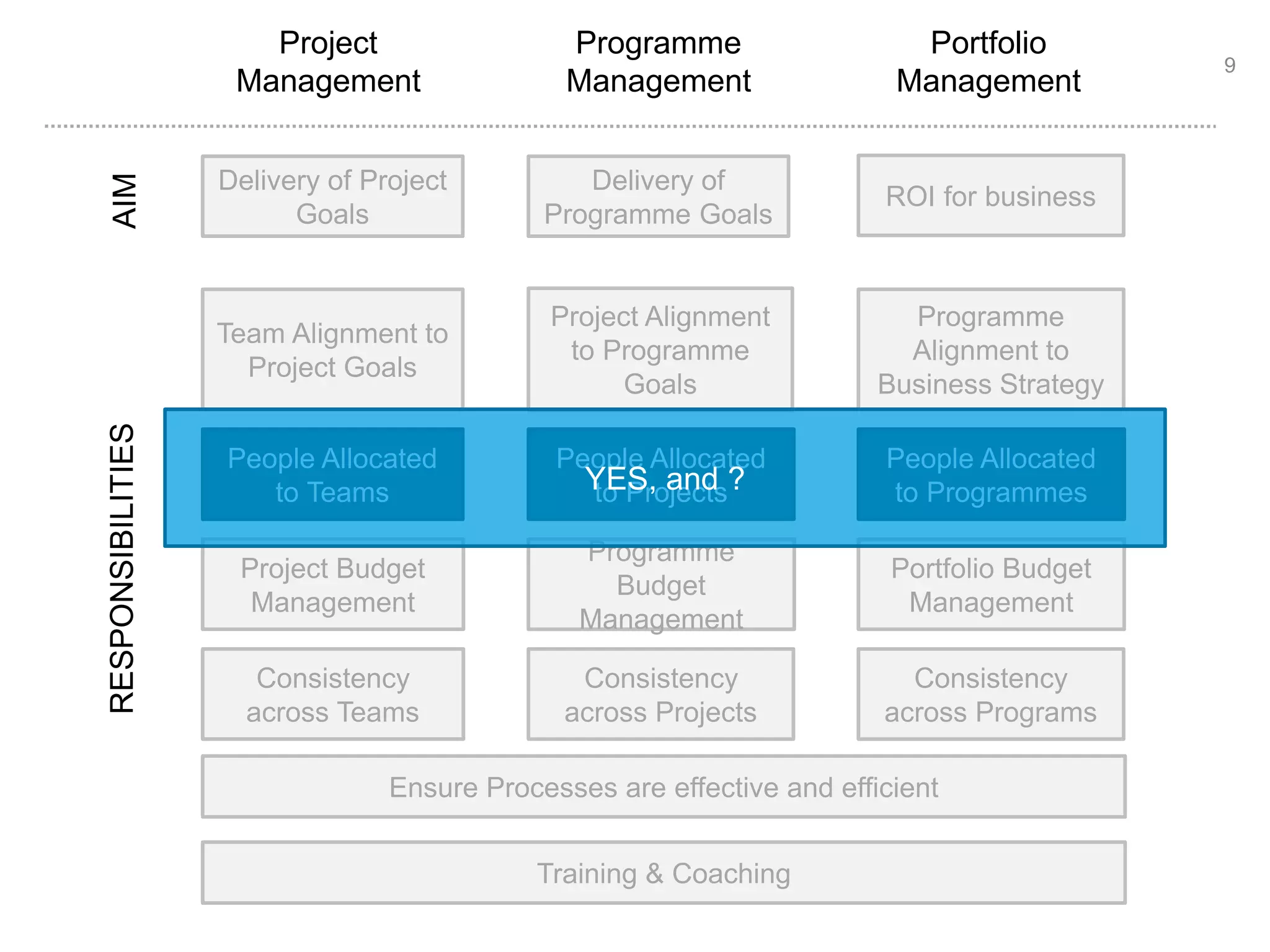
YES, and ? 
Ensure Processes are effective and efficient 
Training & Coaching
10 
RESPONSIBILITIES AIM 
Project 
Management 
Programme 
Management 
Portfolio 
Management 
Delivery of Project 
Goals 
Delivery of 
Programme Goals 
ROI for business 
Team Alignment to 
Project Goals 
Project Alignment 
to Programme 
Goals 
Programme 
Alignment to 
Business Strategy 
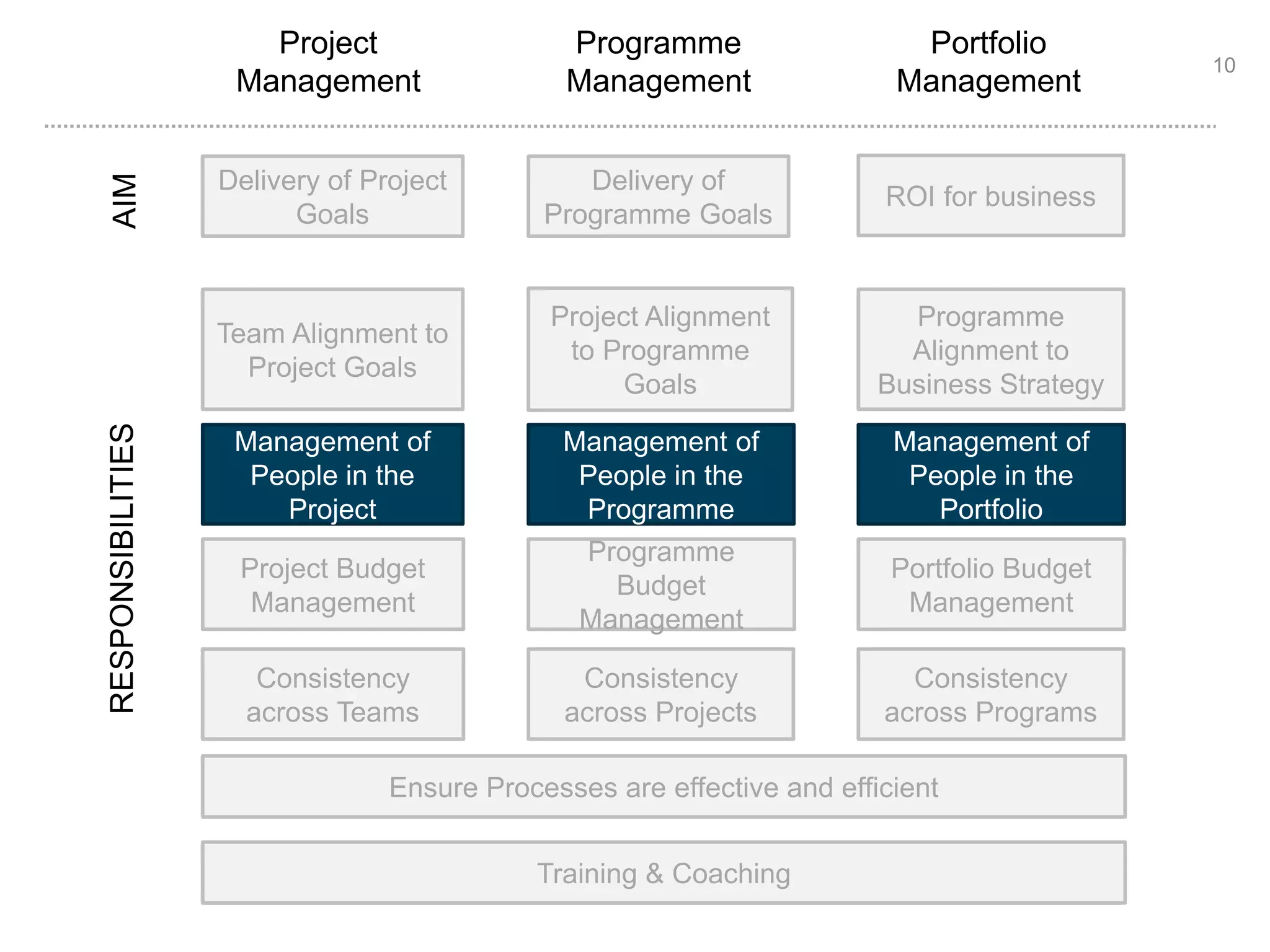
Management of 
People in the 
Portfolio 
Portfolio Budget 
Management 
Consistency 
across Programs 
Management of 
People in the 
Programme 
Management of 
People in the 
Project 
Consistency 
across Projects 
Consistency 
across Teams 
Programme 
Budget 
Management 
Project Budget 
Management 
Ensure Processes are effective and efficient 
Training & Coaching
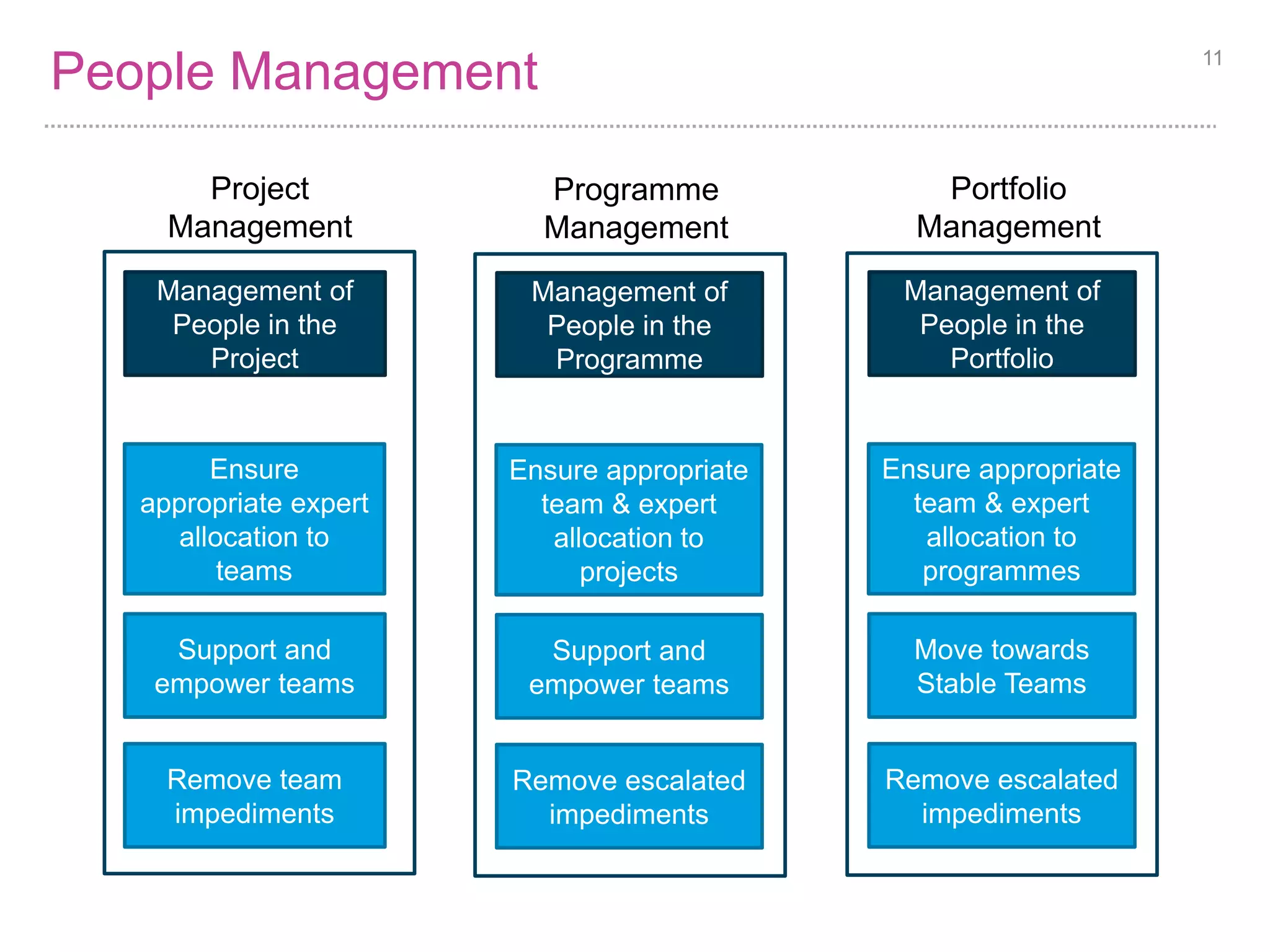
People Management 11 
Project 
Management 
Programme 
Management 
Portfolio 
Management 
Management of 
People in the 
Portfolio 
Management of 
People in the 
Programme 
Management of 
People in the 
Project 
Move towards 
Stable Teams 
Support and 
empower teams 
Support and 
empower teams 
Remove escalated 
impediments 
Remove escalated 
impediments 
Remove team 
impediments 
Ensure appropriate 
team & expert 
allocation to 
programmes 
Ensure appropriate 
team & expert 
allocation to 
projects 
Ensure 
appropriate expert 
allocation to 
teams
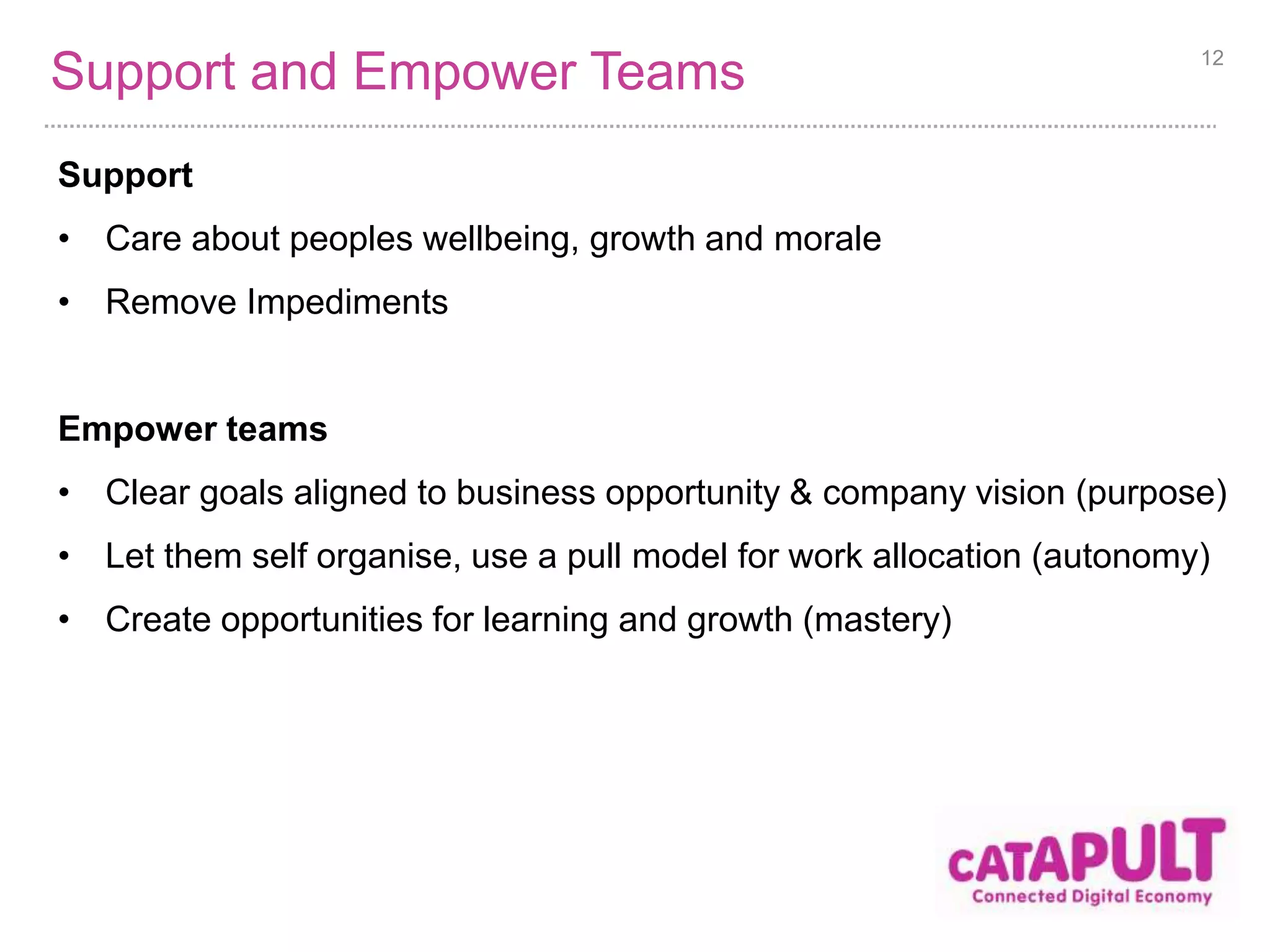
Support and Empower Teams 
Support 
• Care about peoples wellbeing, growth and morale 
• Remove Impediments 
12 
Empower teams 
• Clear goals aligned to business opportunity & company vision (purpose) 
• Let them self organise, use a pull model for work allocation (autonomy) 
• Create opportunities for learning and growth (mastery)
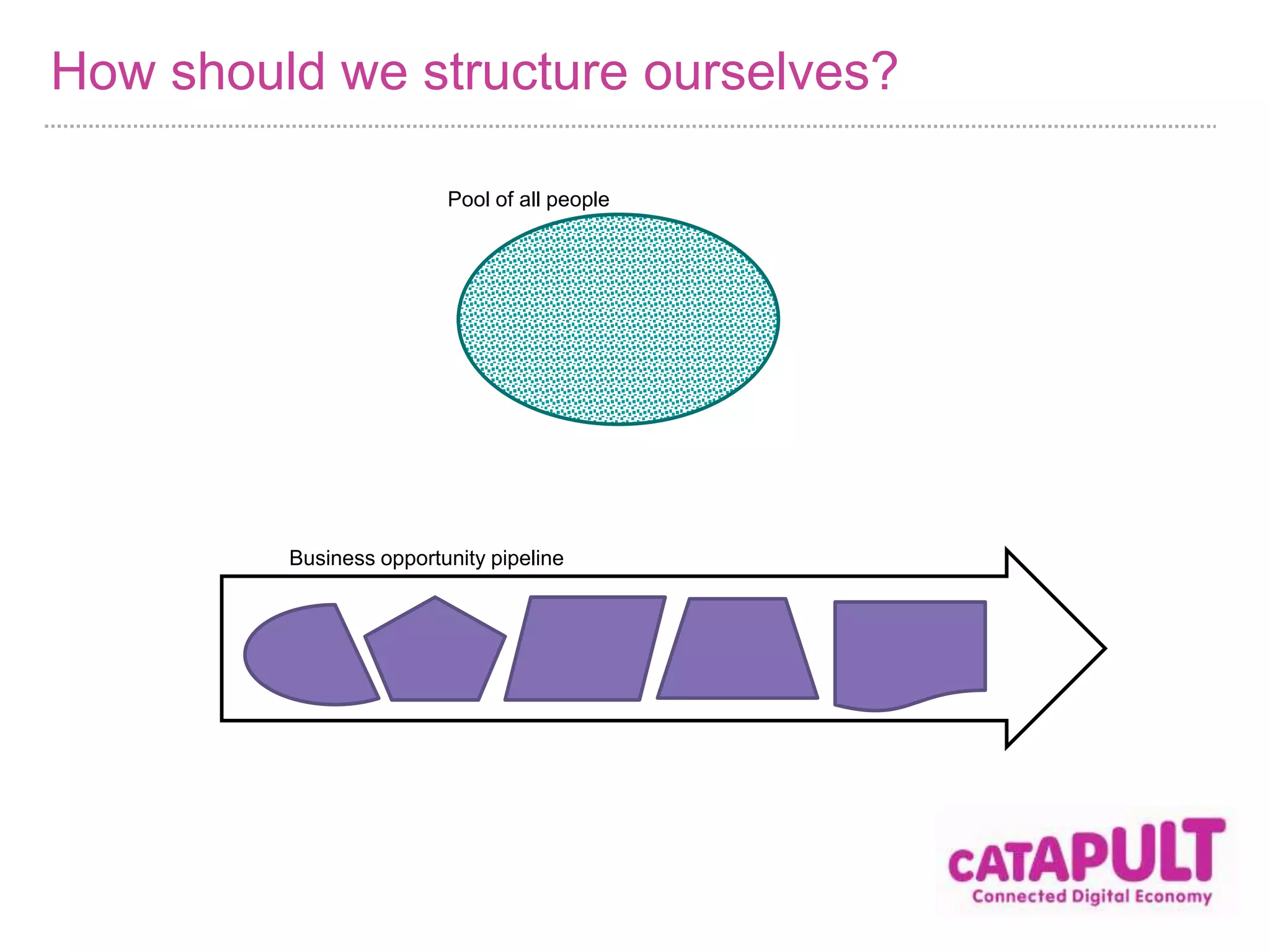
How should we structure ourselves? 
Pool of all people 
Business opportunity pipeline
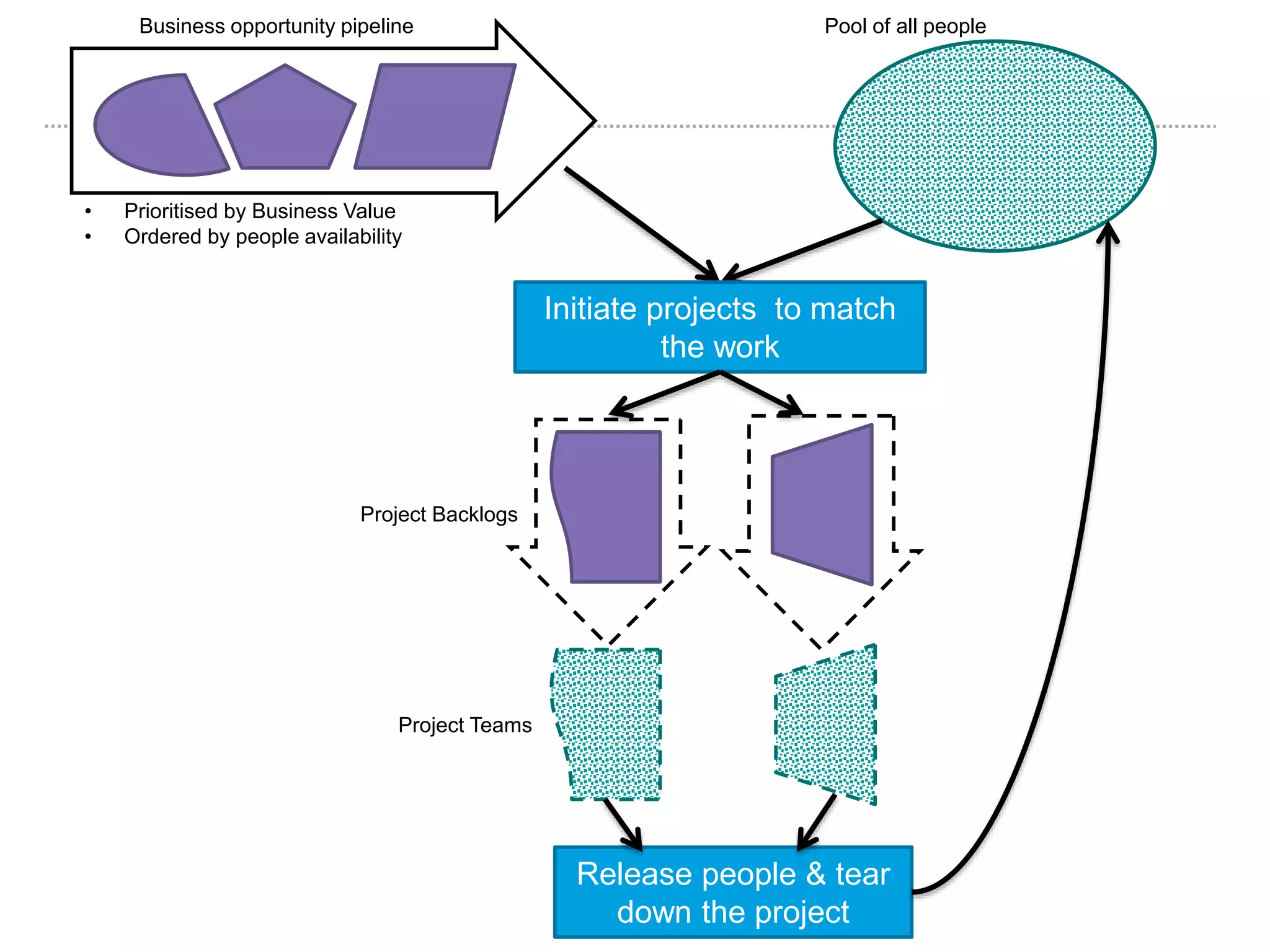
Business opportunity pipeline Pool of all people 
Initiate projects to match 
the work 
Release people & tear 
down the project 
• Prioritised by Business Value 
• Ordered by people availability 
Project Backlogs 
Project Teams
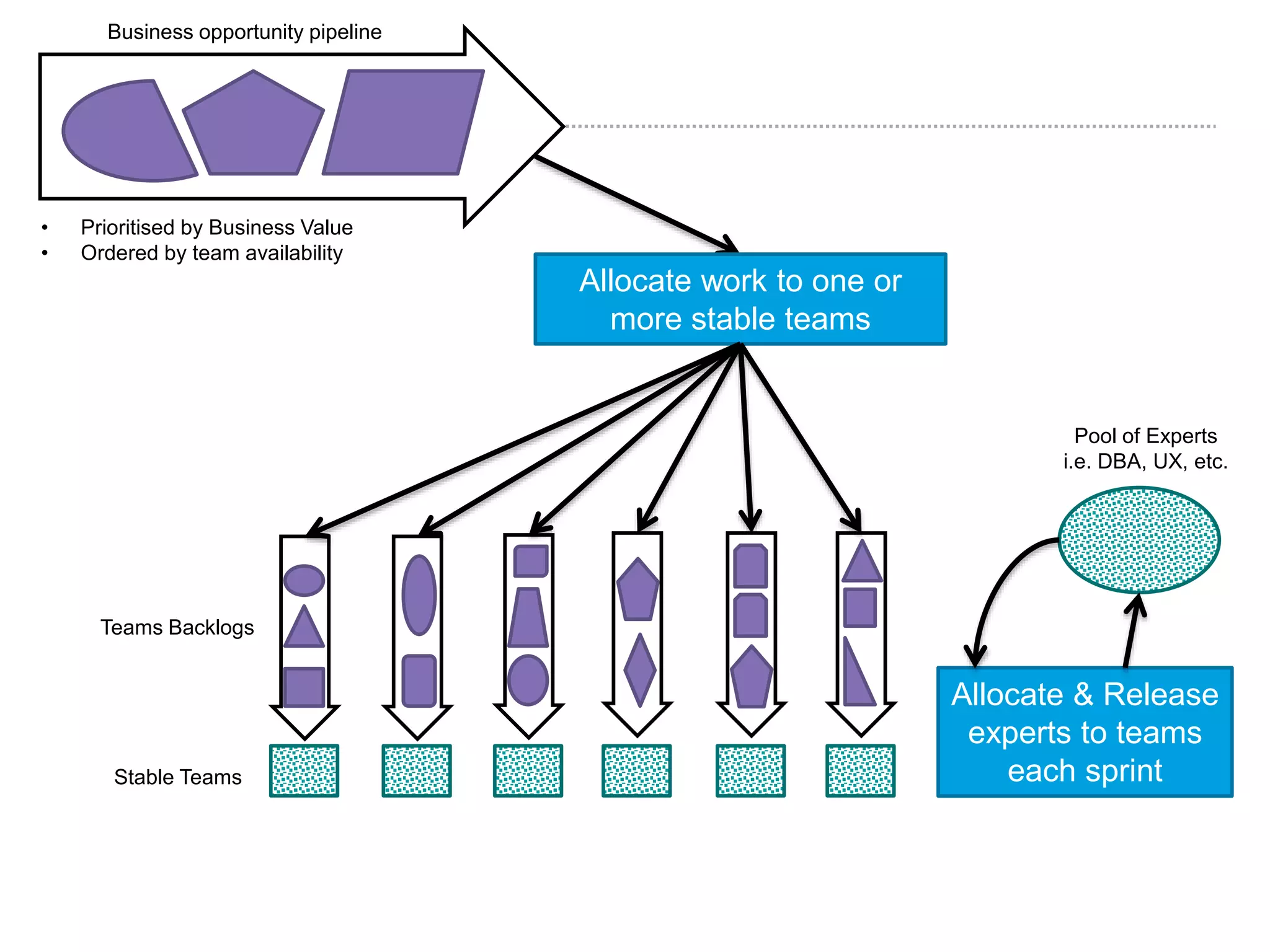
Allocate work to one or 
more stable teams 
• Prioritised by Business Value 
• Ordered by team availability 
Pool of Experts 
i.e. DBA, UX, etc. 
Business opportunity pipeline 
Stable Teams 
Allocate & Release 
experts to teams 
each sprint 
Teams Backlogs
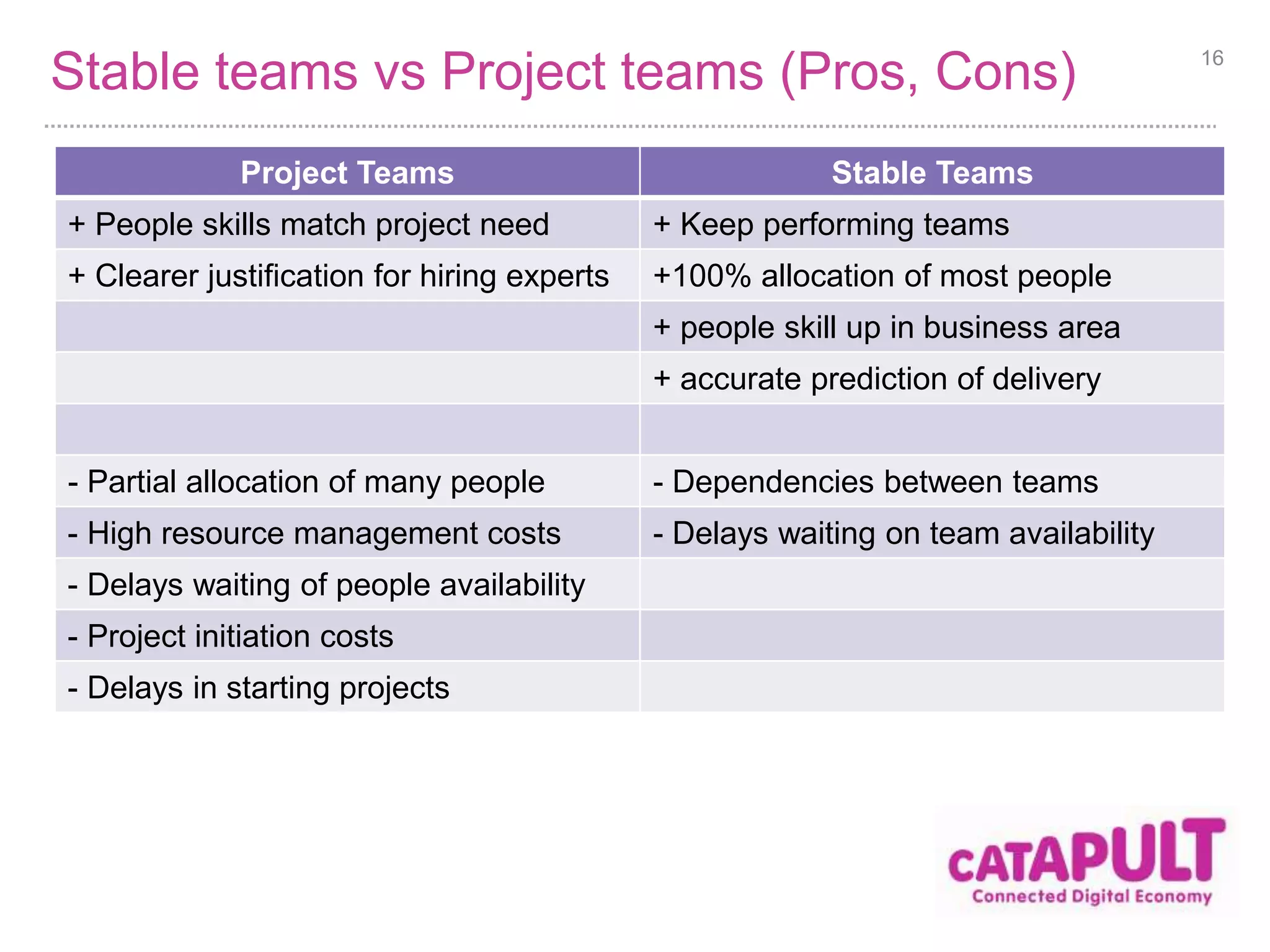
Stable teams vs Project teams (Pros, Cons) 16 
Project Teams Stable Teams 
+ People skills match project need + Keep performing teams 
+ Clearer justification for hiring experts +100% allocation of most people 
+ people skill up in business area 
+ accurate prediction of delivery 
- Partial allocation of many people - Dependencies between teams 
- High resource management costs - Delays waiting on team availability 
- Delays waiting of people availability 
- Project initiation costs 
- Delays in starting projects
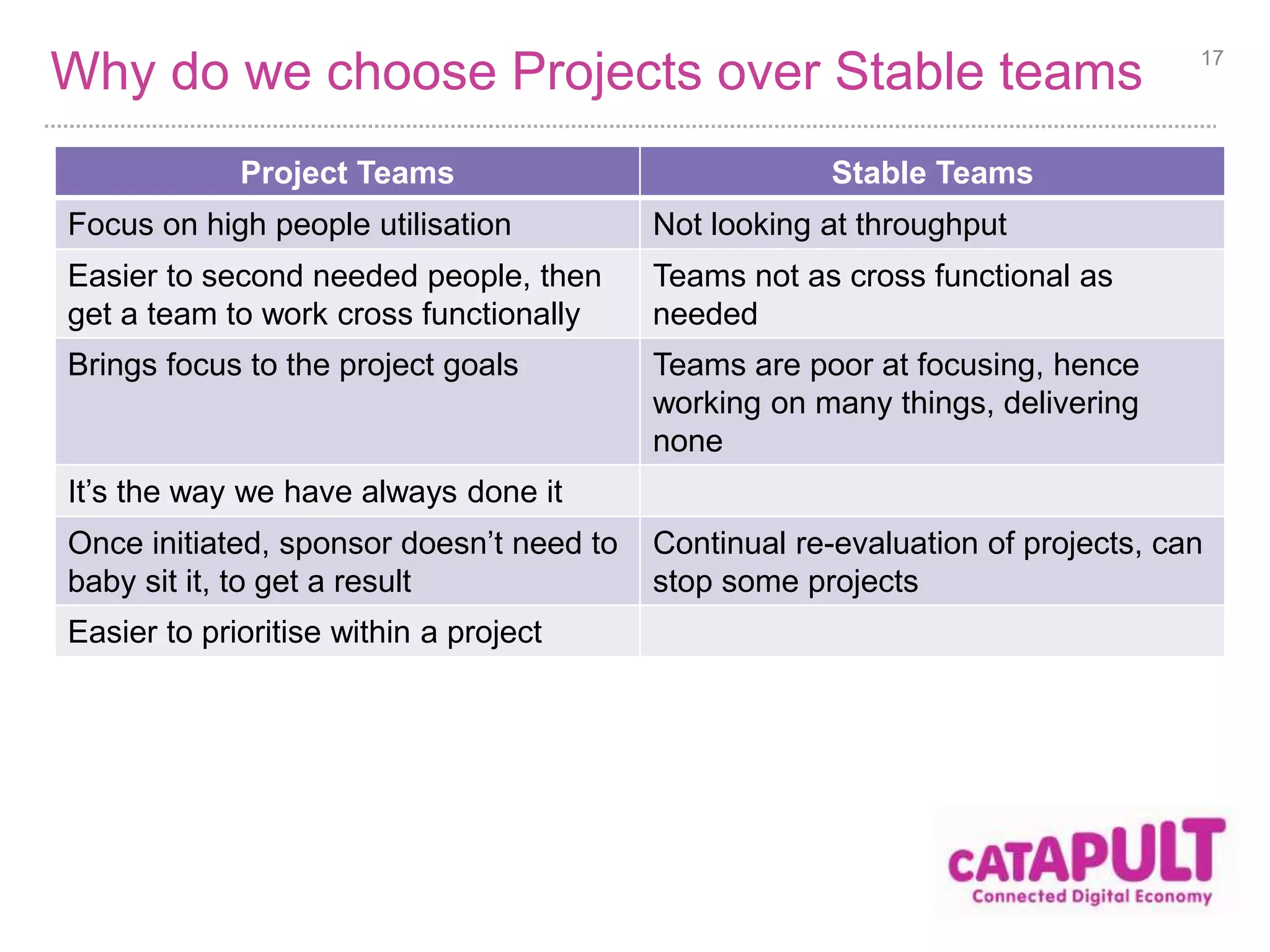
Why do we choose Projects over Stable teams 17 
Project Teams Stable Teams 
Focus on high people utilisation Not looking at throughput 
Easier to second needed people, then 
get a team to work cross functionally 
Teams not as cross functional as 
needed 
Brings focus to the project goals Teams are poor at focusing, hence 
working on many things, delivering 
none 
It’s the way we have always done it 
Once initiated, sponsor doesn’t need to 
baby sit it, to get a result 
Continual re-evaluation of projects, can 
stop some projects 
Easier to prioritise within a project
Portfolio Management
19 
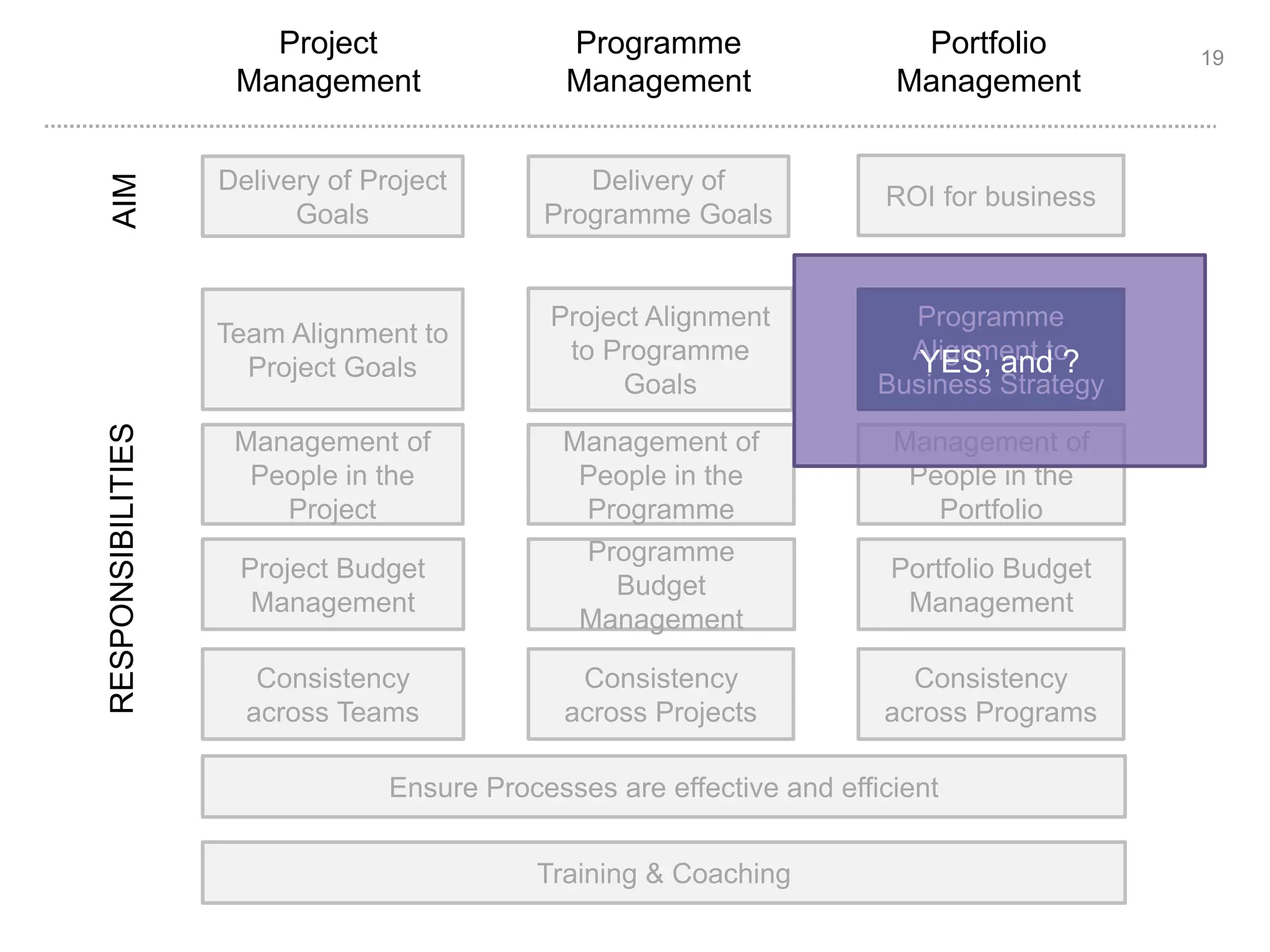
RESPONSIBILITIES AIM 
Project 
Management 
Programme 
Management 
Portfolio 
Management 
Delivery of Project 
Goals 
Delivery of 
Programme Goals 
ROI for business 
Team Alignment to 
Project Goals 
Project Alignment 
to Programme 
Goals 
Programme 
Alignment to 
Business Strategy 
Management of 
People in the 
Portfolio 
Portfolio Budget 
Management 
Consistency 
across Programs 
Management of 
People in the 
Programme 
Management of 
People in the 
Project 
Consistency 
across Projects 
Consistency 
across Teams 
Programme 
Budget 
Management 
Project Budget 
Management 
YES, and ? 
Ensure Processes are effective and efficient 
Training & Coaching
20 
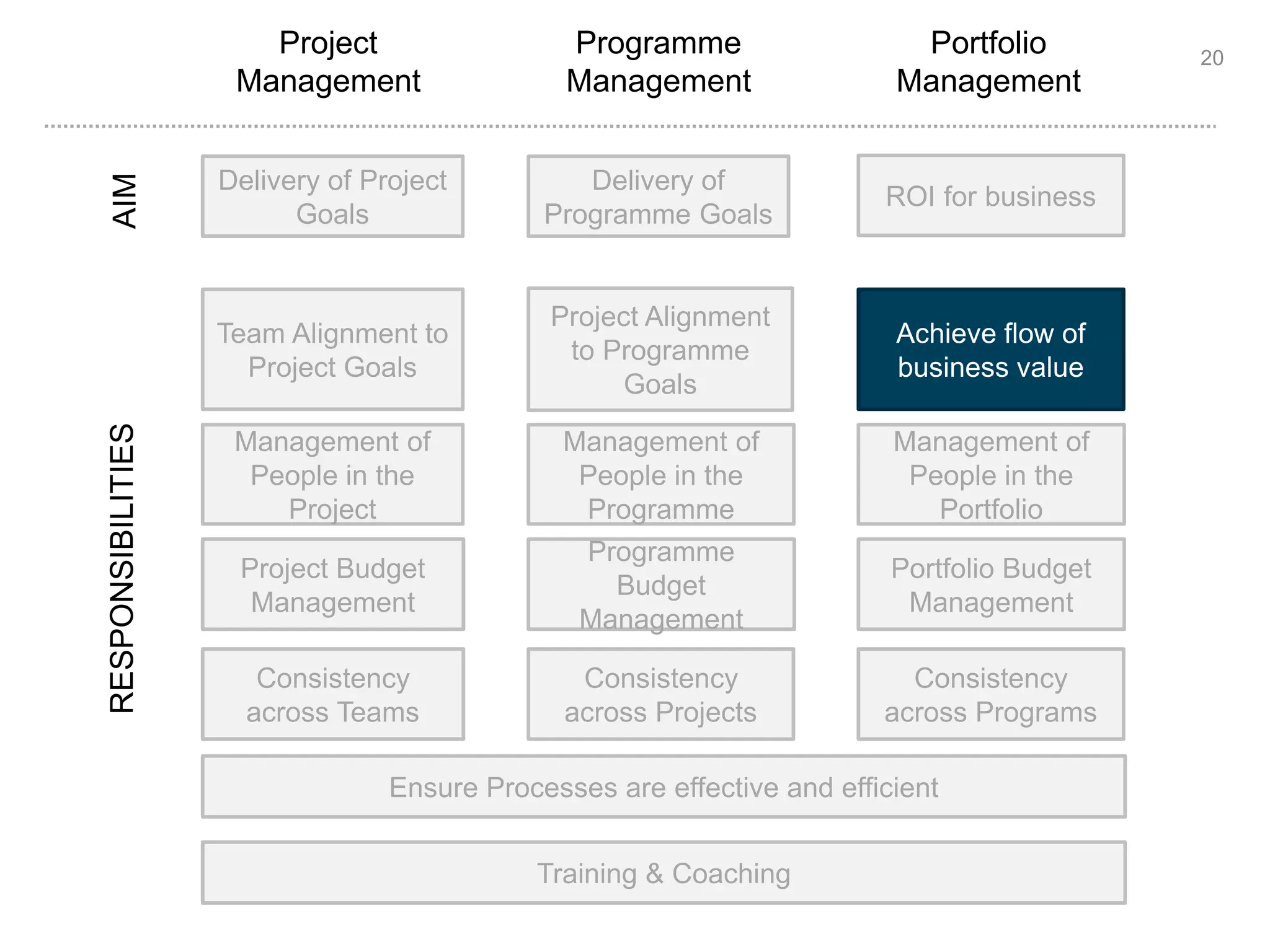
RESPONSIBILITIES AIM 
Project 
Management 
Programme 
Management 
Portfolio 
Management 
Delivery of Project 
Goals 
Delivery of 
Programme Goals 
ROI for business 
Team Alignment to 
Project Goals 
Project Alignment 
to Programme 
Goals 
Achieve flow of 
business value 
Management of 
People in the 
Portfolio 
Portfolio Budget 
Management 
Consistency 
across Programs 
Management of 
People in the 
Programme 
Management of 
People in the 
Project 
Consistency 
across Projects 
Consistency 
across Teams 
Programme 
Budget 
Management 
Project Budget 
Management 
Ensure Processes are effective and efficient 
Training & Coaching
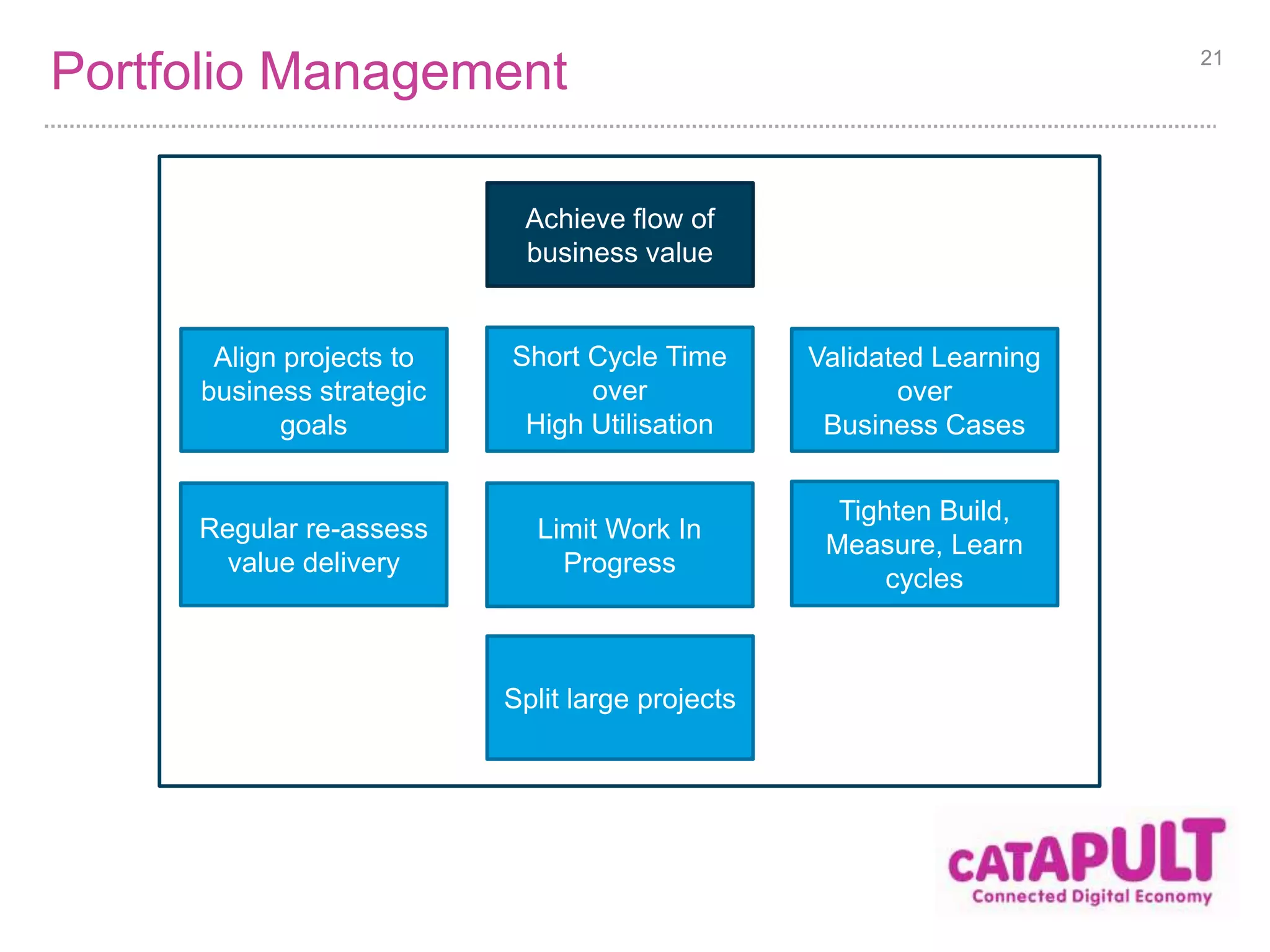
Portfolio Management 21 
Achieve flow of 
business value 
Align projects to 
business strategic 
goals 
Short Cycle Time 
over 
High Utilisation 
Split large projects 
Validated Learning 
over 
Business Cases 
Tighten Build, 
Measure, Learn 
cycles 
Limit Work In 
Progress 
Regular re-assess 
value delivery
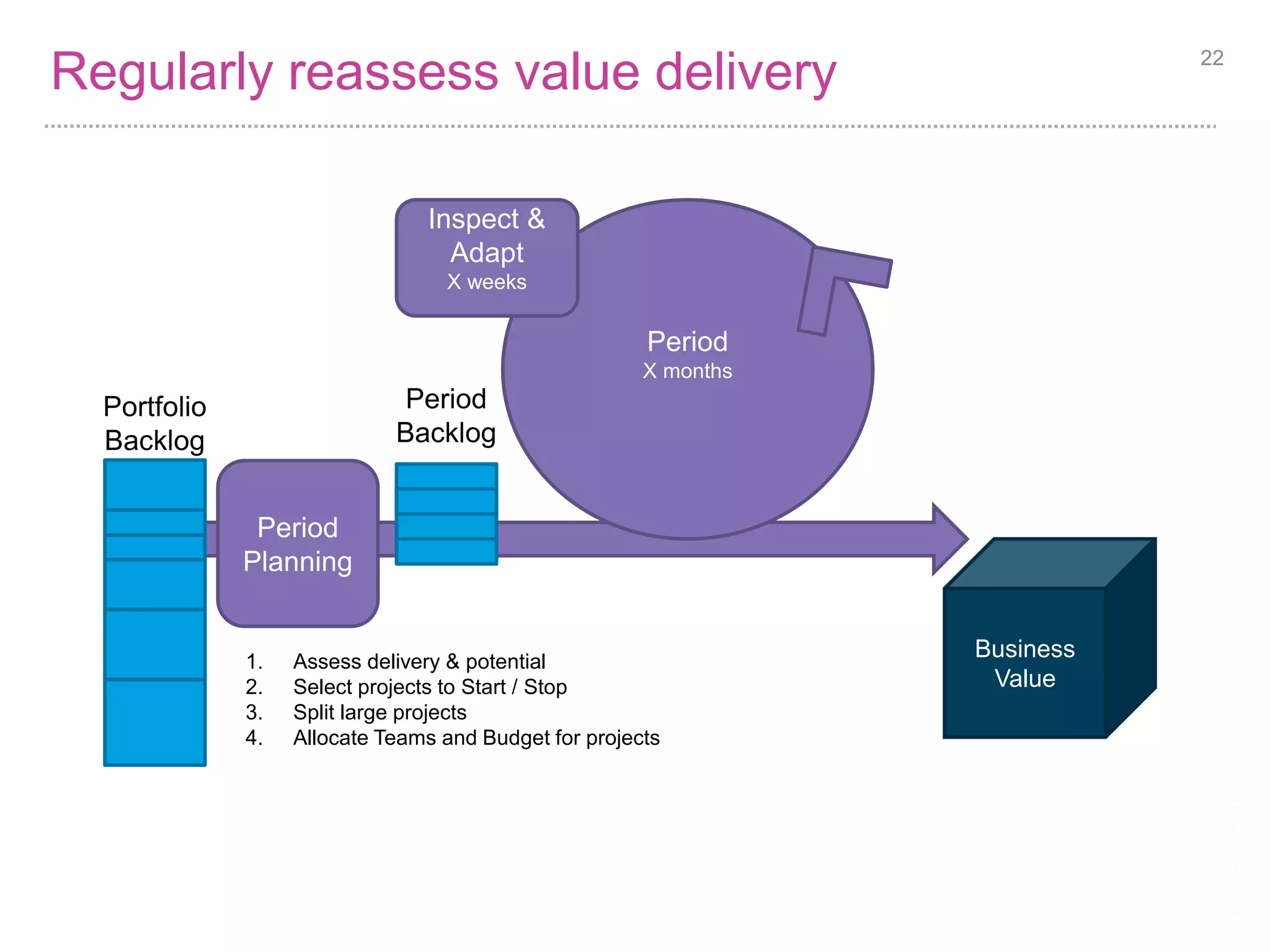
Regularly reassess value delivery 22 
Period 
X months 
Period 
Planning 
Inspect & 
Adapt 
X weeks 
Business 
Value 
Portfolio 
Backlog 
Period 
Backlog 
1. Assess delivery & potential 
2. Select projects to Start / Stop 
3. Split large projects 
4. Allocate Teams and Budget for projects
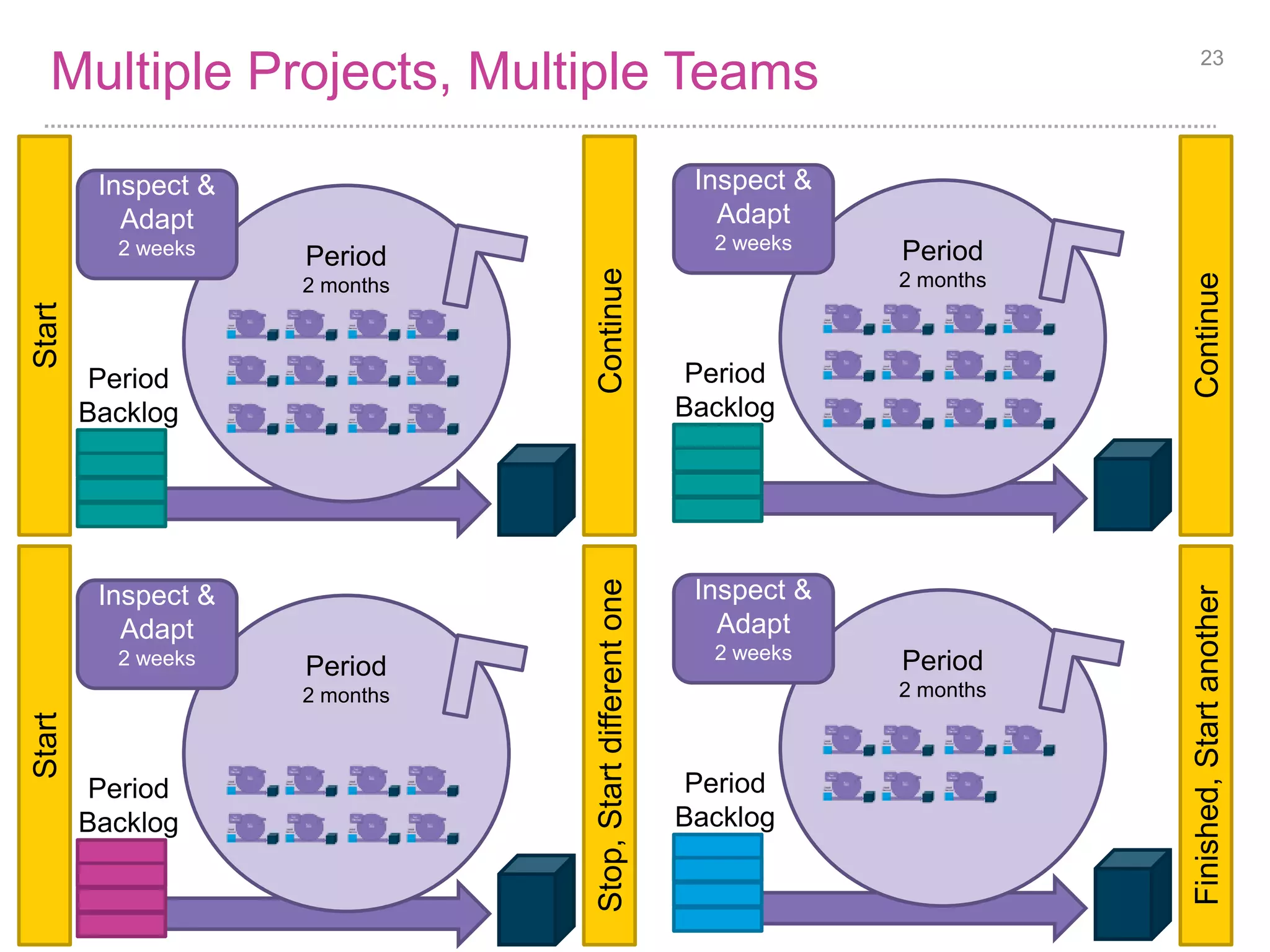
Multiple Projects, Multiple Teams 23 
Period 
2 months 
Inspect & 
Adapt 
2 weeks 
Period 
Backlog 
Start 
Continue 
Period 
2 months 
Inspect & 
Adapt 
2 weeks 
Period 
Backlog 
Continue 
Period 
2 months 
Inspect & 
Adapt 
2 weeks 
Period 
Backlog 
Start 
Stop, Start different one 
Period 
2 months 
Inspect & 
Adapt 
2 weeks 
Period 
Backlog 
Finished, Start another
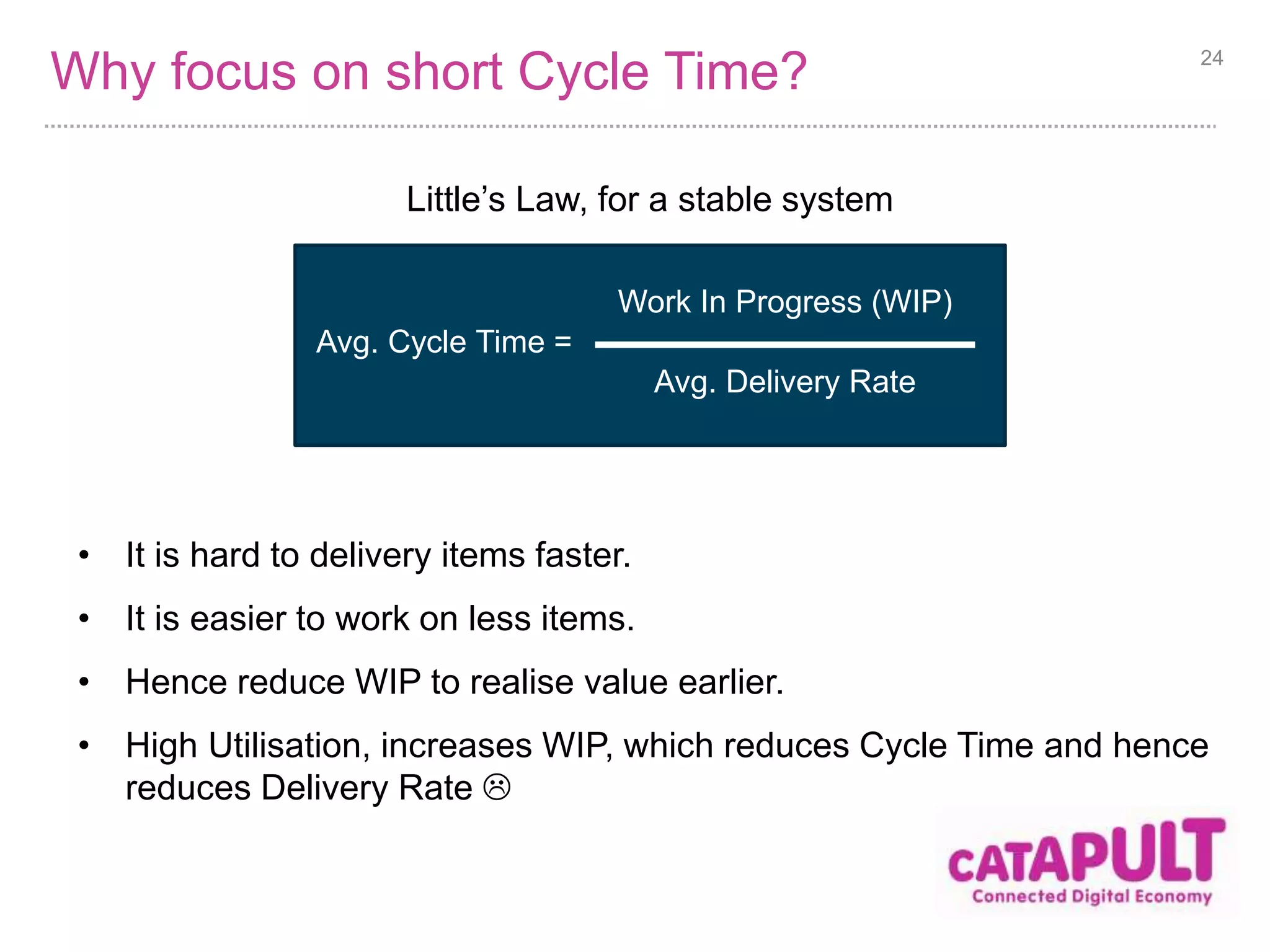
Why focus on short Cycle Time? 
Little’s Law, for a stable system 
• It is hard to delivery items faster. 
• It is easier to work on less items. 
• Hence reduce WIP to realise value earlier. 
• High Utilisation, increases WIP, which reduces Cycle Time and hence 
reduces Delivery Rate  
24 
Avg. Cycle Time = 
Work In Progress (WIP) 
Avg. Delivery Rate
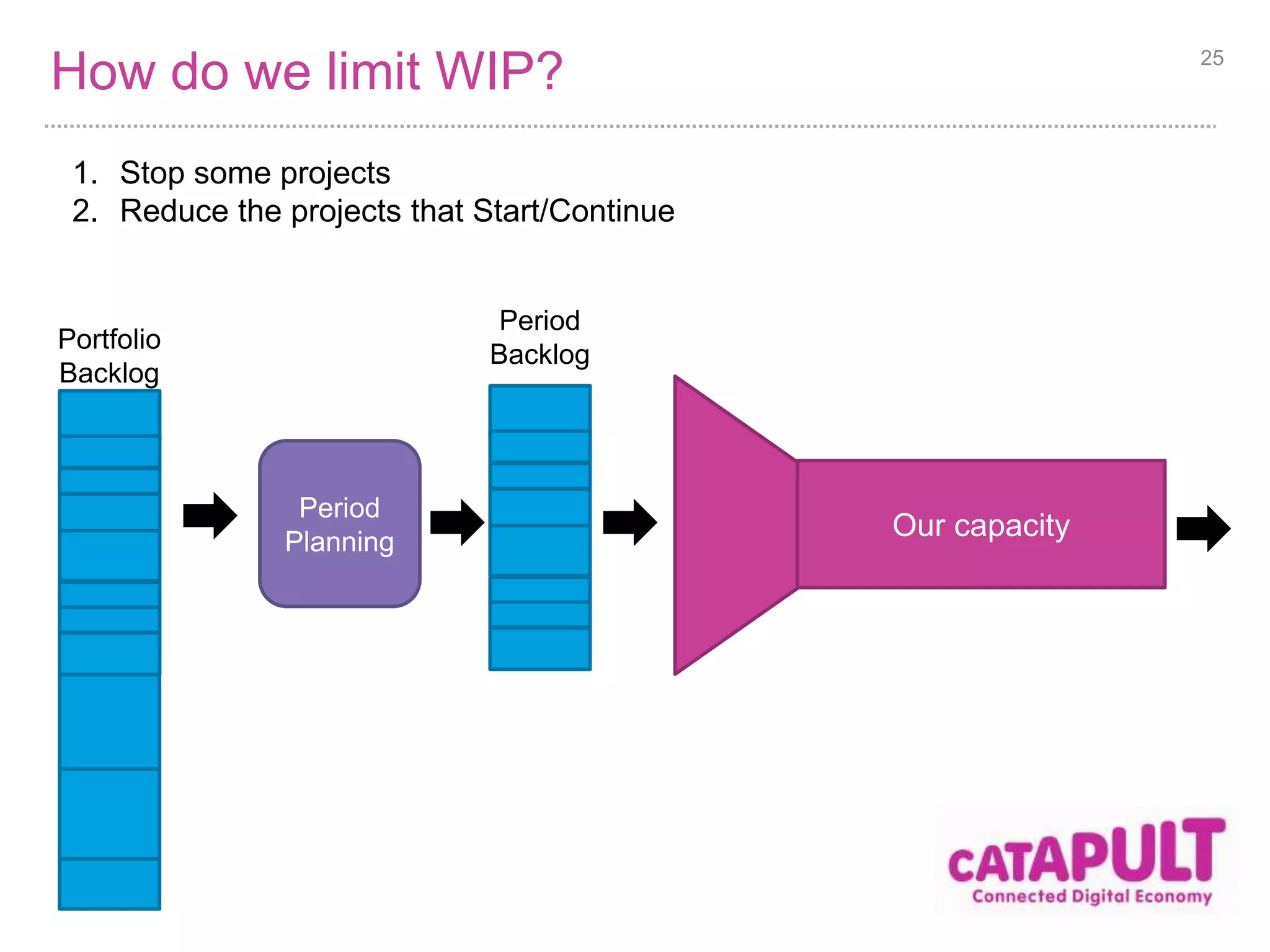
How do we limit WIP? 25 
1. Stop some projects 
2. Reduce the projects that Start/Continue 
Portfolio 
Backlog 
Period 
Backlog 
Our capacity 
Period 
Planning
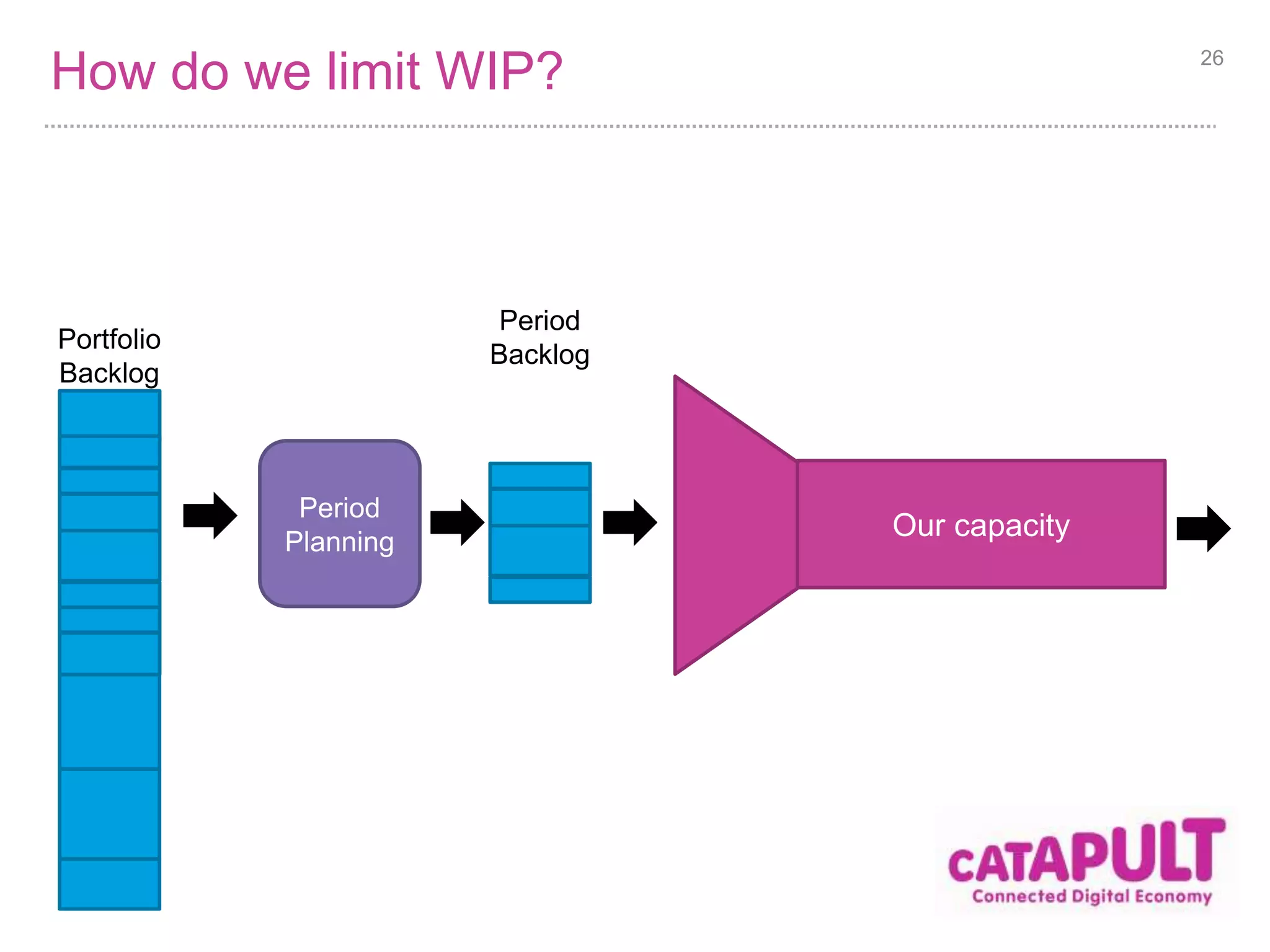
How do we limit WIP? 26 
Portfolio 
Backlog 
Period 
Backlog 
Our capacity 
Period 
Planning
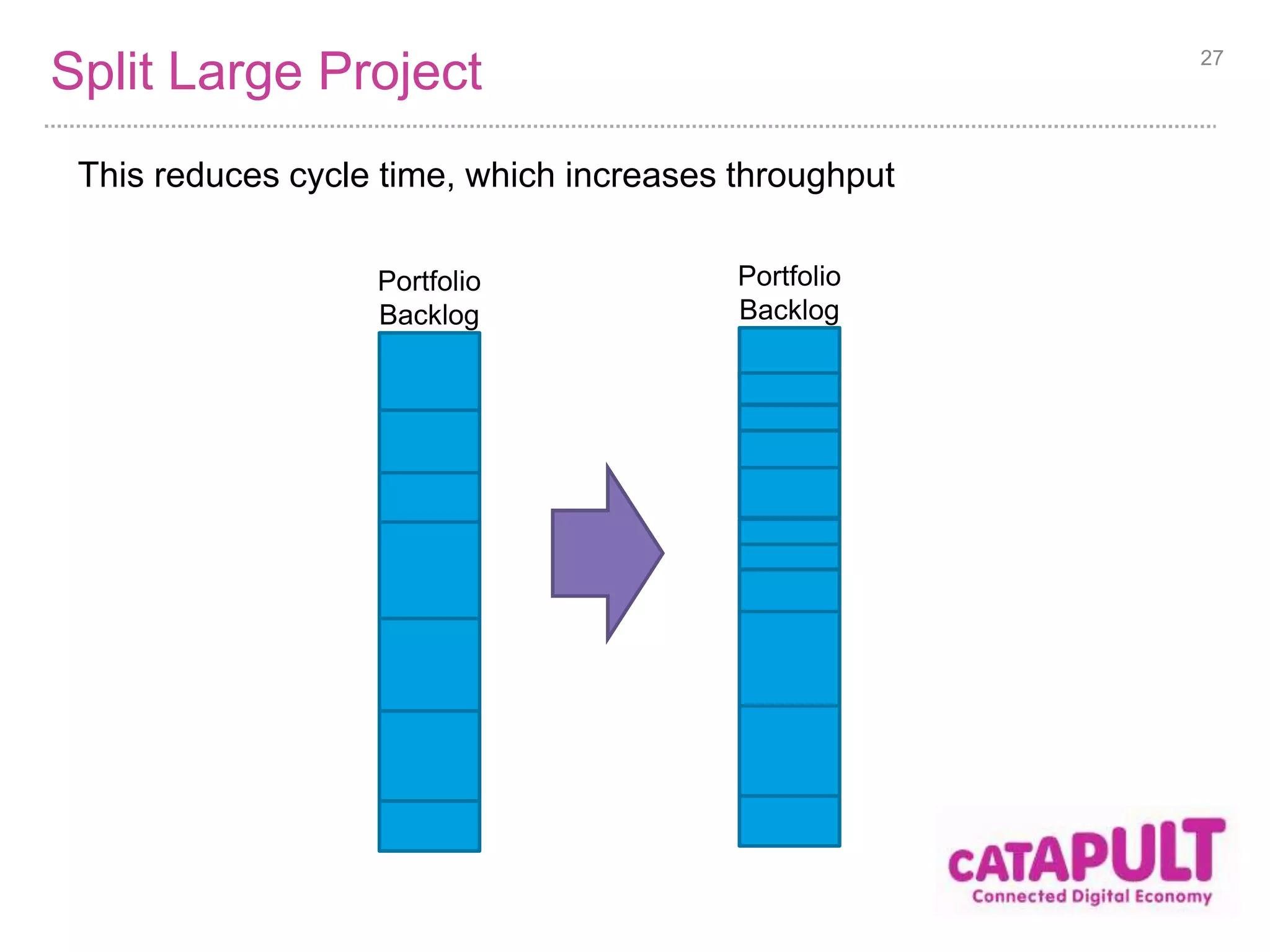
Split Large Project 
This reduces cycle time, which increases throughput 
27 
Portfolio 
Backlog 
Portfolio 
Backlog
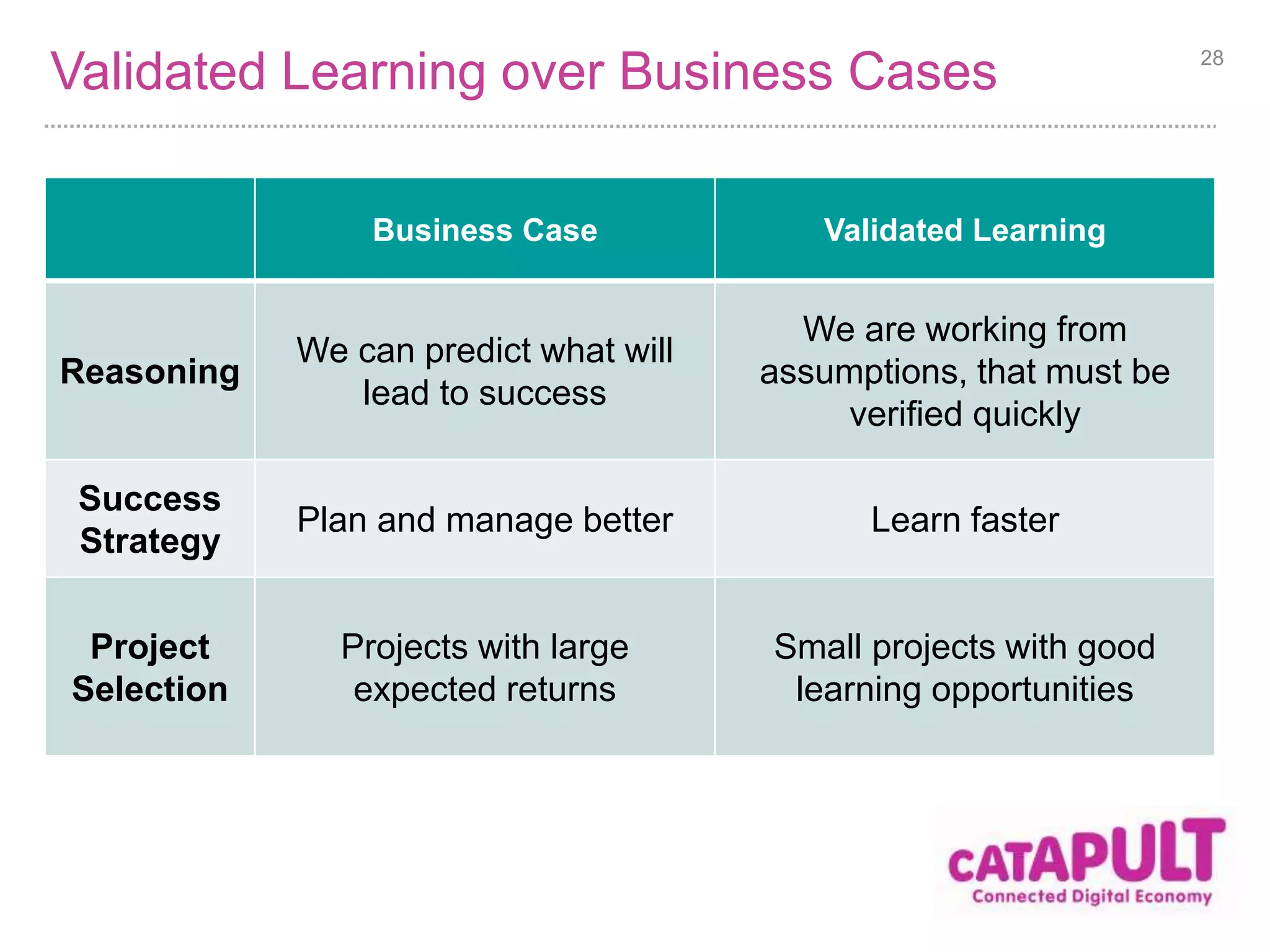
Validated Learning over Business Cases 
Business Case Validated Learning 
Reasoning 
We can predict what will 
lead to success 
We are working from 
assumptions, that must be 
verified quickly 
Success 
Strategy 
Plan and manage better Learn faster 
Project 
Selection 
Projects with large 
expected returns 
Small projects with good 
learning opportunities 
28
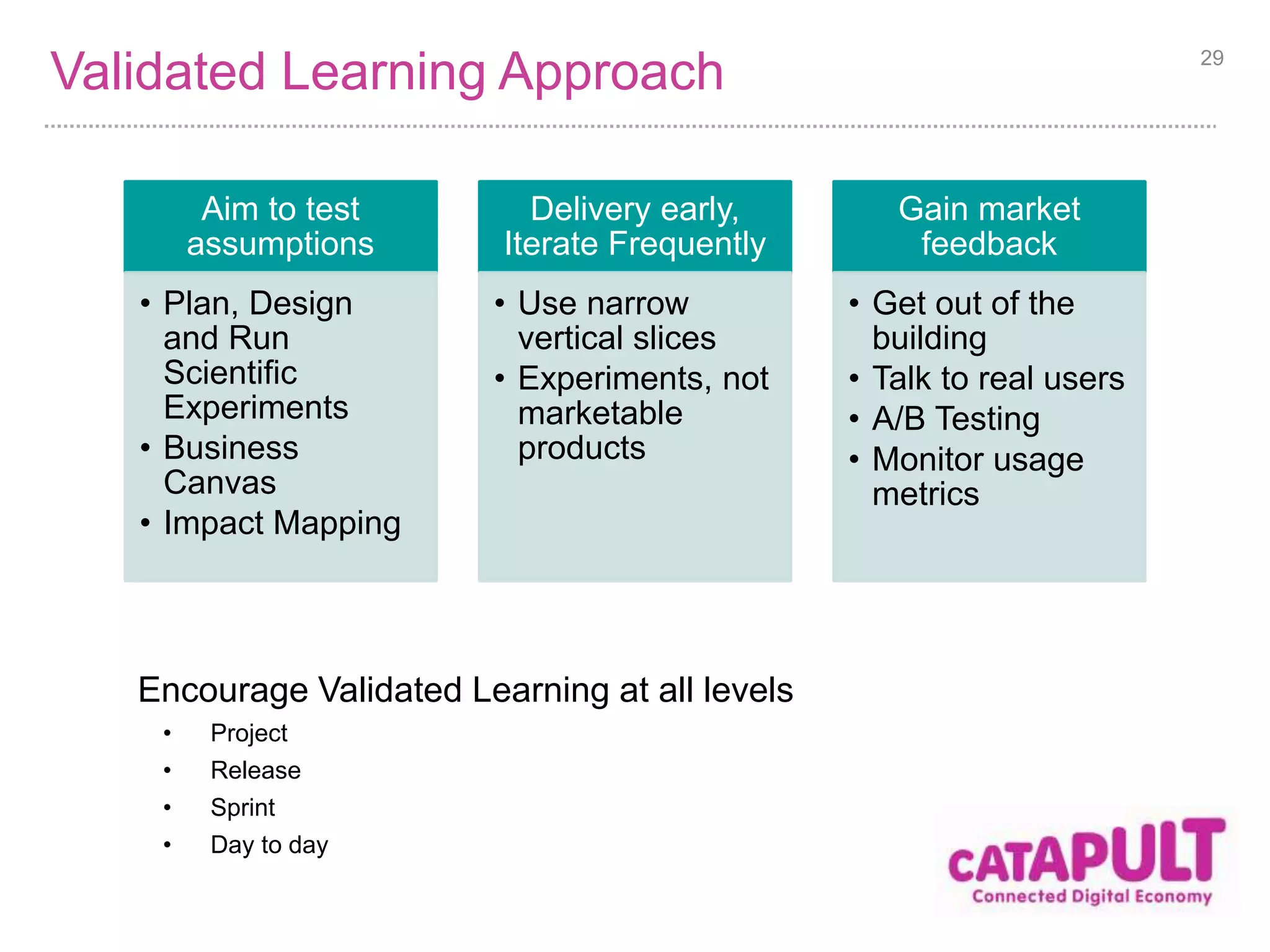
Validated Learning Approach 
Encourage Validated Learning at all levels 
• Project 
• Release 
• Sprint 
• Day to day 
29 
Aim to test 
assumptions 
• Plan, Design 
and Run 
Scientific 
Experiments 
• Business 
Canvas 
• Impact Mapping 
Delivery early, 
Iterate Frequently 
• Use narrow 
vertical slices 
• Experiments, not 
marketable 
products 
Gain market 
feedback 
• Get out of the 
building 
• Talk to real users 
• A/B Testing 
• Monitor usage 
metrics
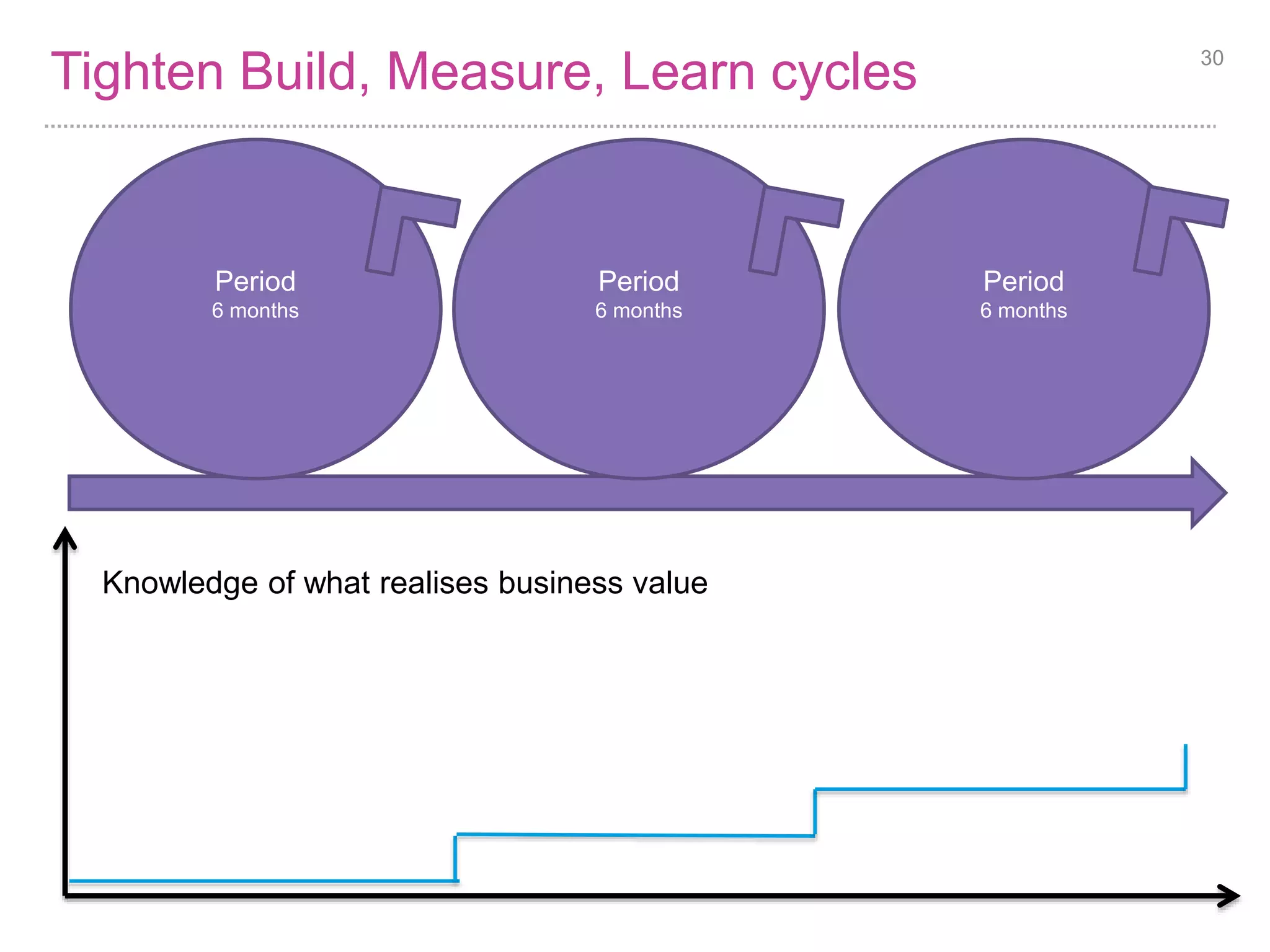
Tighten Build, Measure, Learn cycles 30 
Period 
6 months 
Period 
6 months 
Knowledge of what realises business value 
Period 
6 months
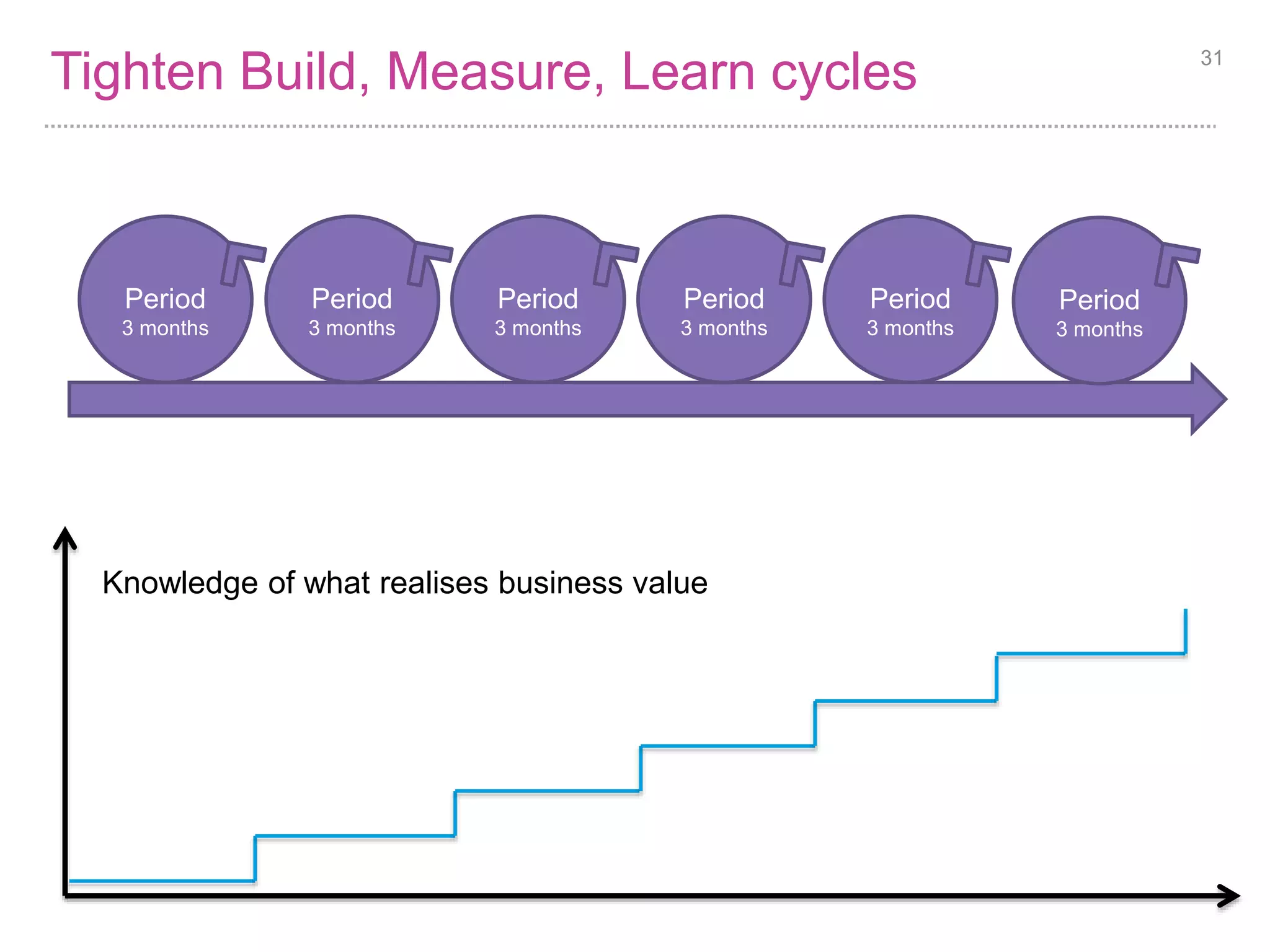
Tighten Build, Measure, Learn cycles 31 
Period 
3 months 
Period 
3 months 
Period 
3 months 
Period 
3 months 
Period 
3 months 
Period 
3 months 
Knowledge of what realises business value
Budget Management
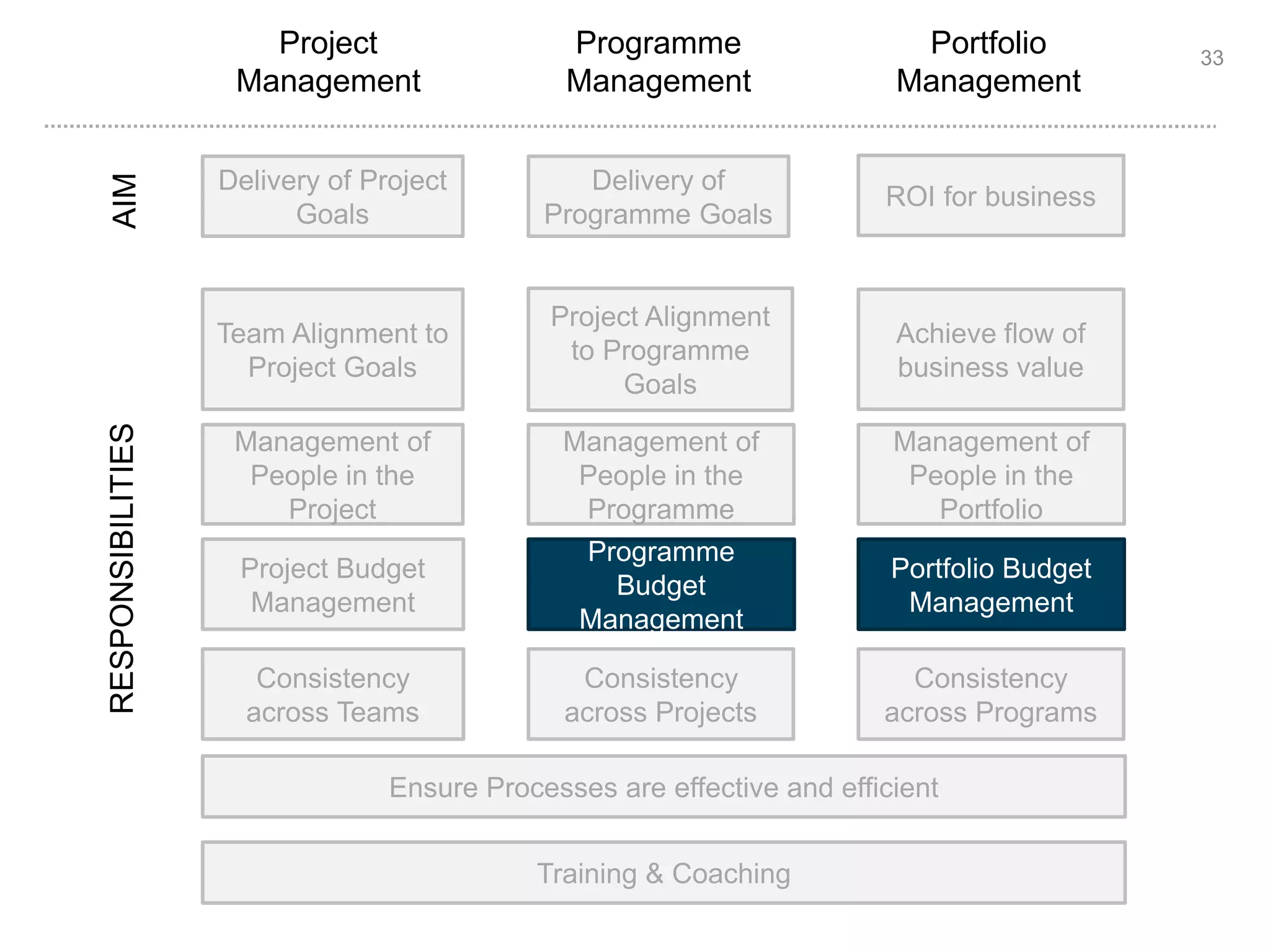
33 
RESPONSIBILITIES AIM 
Project 
Management 
Programme 
Management 
Portfolio 
Management 
Delivery of Project 
Goals 
Delivery of 
Programme Goals 
ROI for business 
Team Alignment to 
Project Goals 
Project Alignment 
to Programme 
Goals 
Achieve flow of 
business value 
Management of 
People in the 
Portfolio 
Portfolio Budget 
Management 
Consistency 
across Programs 
Management of 
People in the 
Programme 
Management of 
People in the 
Project 
Consistency 
across Projects 
Consistency 
across Teams 
Programme 
Budget 
Management 
Project Budget 
Management 
Ensure Processes are effective and efficient 
Training & Coaching
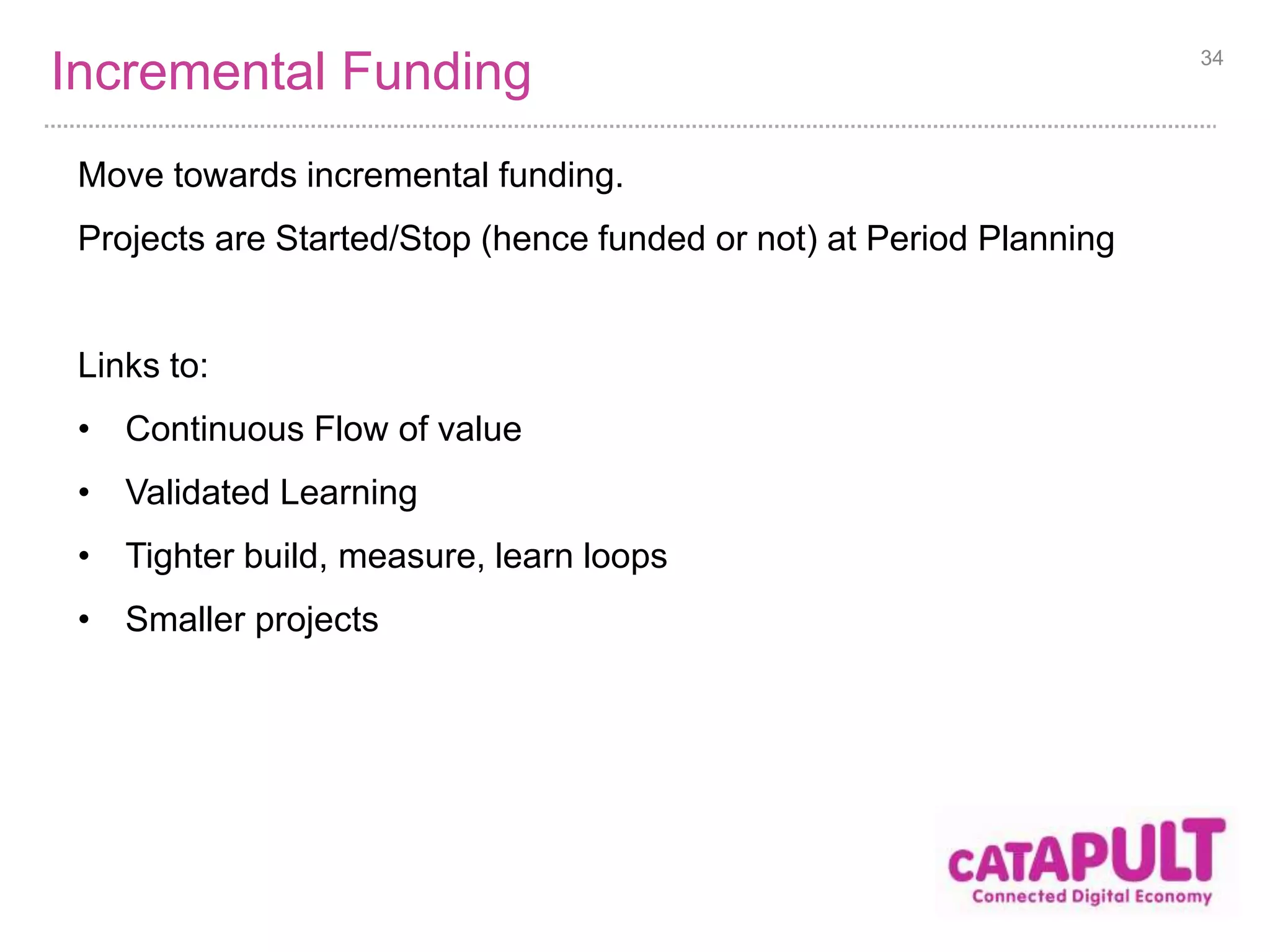
Incremental Funding 34 
Move towards incremental funding. 
Projects are Started/Stop (hence funded or not) at Period Planning 
Links to: 
• Continuous Flow of value 
• Validated Learning 
• Tighter build, measure, learn loops 
• Smaller projects
The remainder
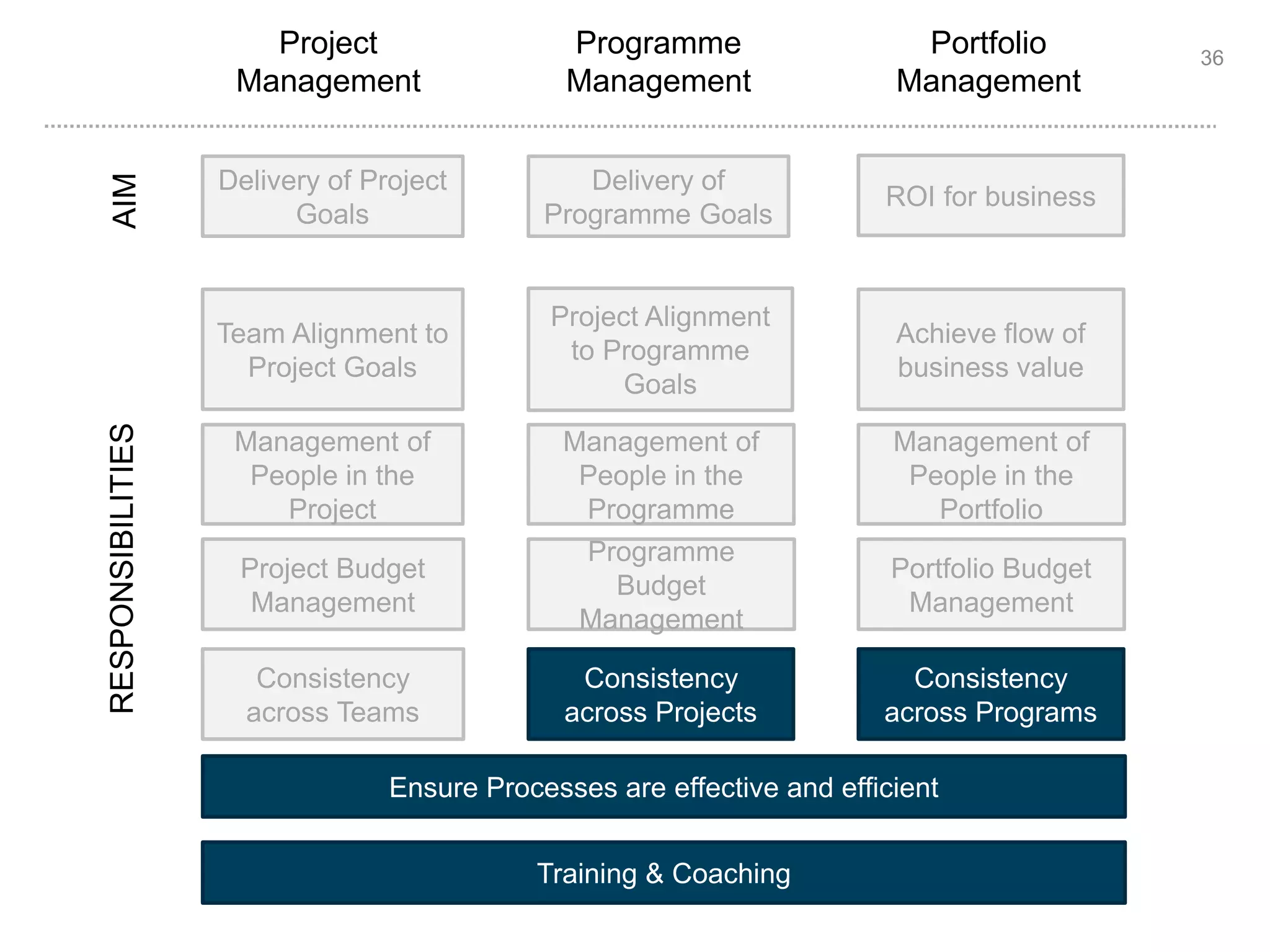
36 
RESPONSIBILITIES AIM 
Project 
Management 
Programme 
Management 
Portfolio 
Management 
Delivery of Project 
Goals 
Delivery of 
Programme Goals 
ROI for business 
Team Alignment to 
Project Goals 
Project Alignment 
to Programme 
Goals 
Achieve flow of 
business value 
Management of 
People in the 
Portfolio 
Portfolio Budget 
Management 
Consistency 
across Programs 
Management of 
People in the 
Programme 
Management of 
People in the 
Project 
Consistency 
across Projects 
Consistency 
across Teams 
Programme 
Budget 
Management 
Project Budget 
Management 
Ensure Processes are effective and efficient 
Training & Coaching
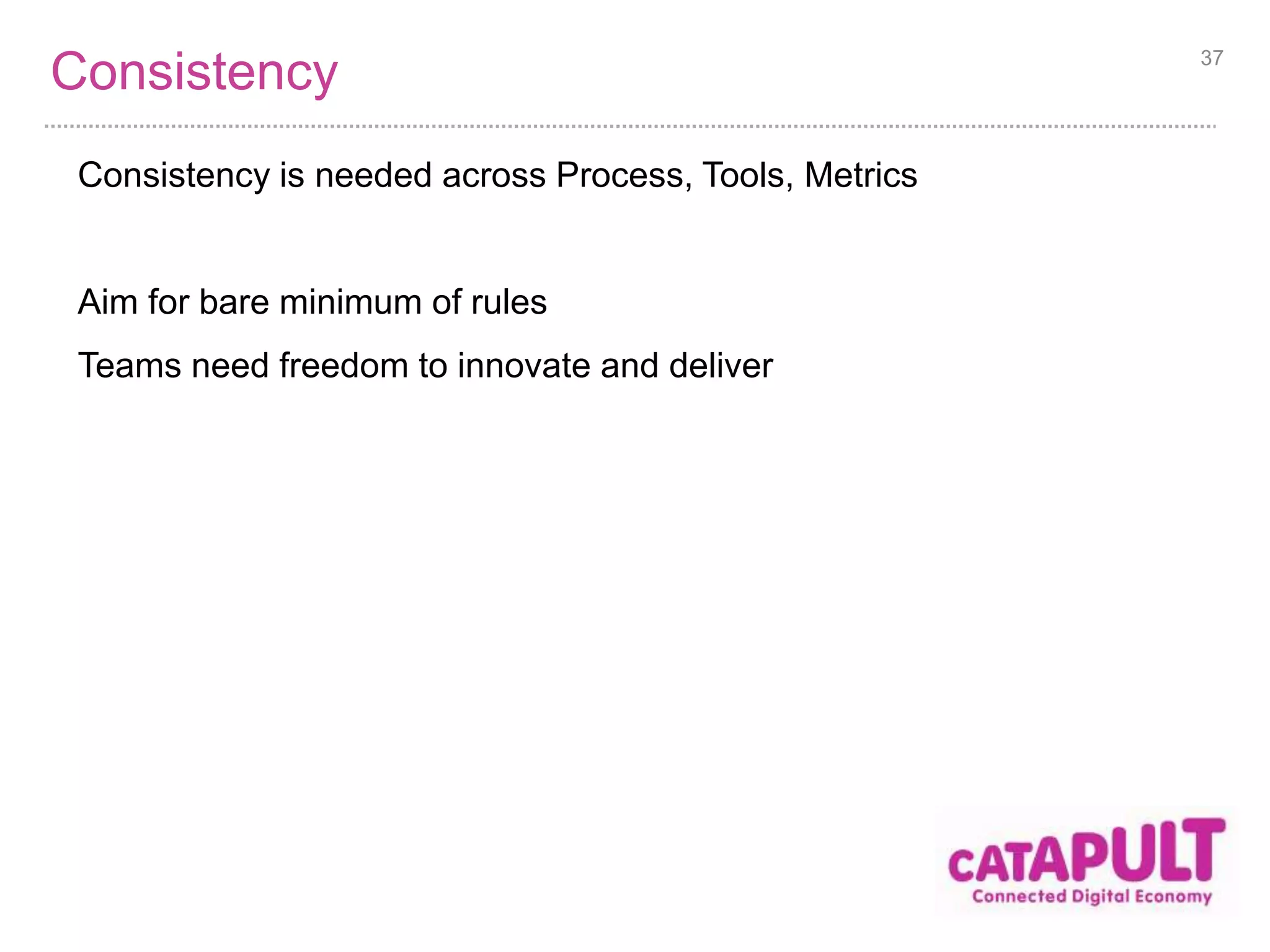
Consistency 37 
Consistency is needed across Process, Tools, Metrics 
Aim for bare minimum of rules 
Teams need freedom to innovate and deliver
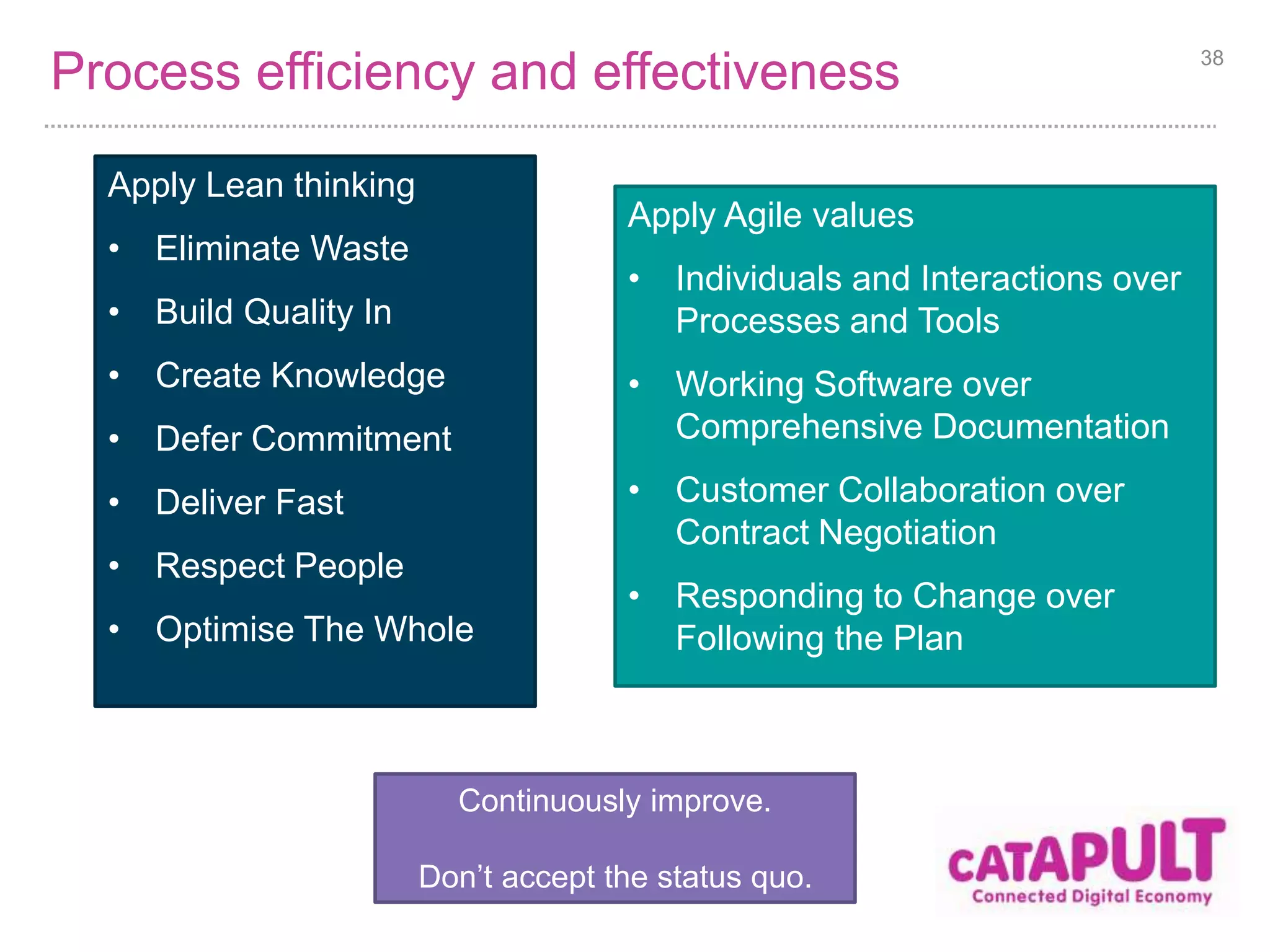
Process efficiency and effectiveness 38 
Apply Lean thinking 
• Eliminate Waste 
• Build Quality In 
• Create Knowledge 
• Defer Commitment 
• Deliver Fast 
• Respect People 
• Optimise The Whole 
Apply Agile values 
• Individuals and Interactions over 
Processes and Tools 
• Working Software over 
Comprehensive Documentation 
• Customer Collaboration over 
Contract Negotiation 
• Responding to Change over 
Following the Plan 
Continuously improve. 
Don’t accept the status quo.
Training and Coaching 39 
Training on 
• Processes, Tools, Reporting, etc. 
• Agile, Lean, etc. 
Coaching on 
• Agile, Lean 
• Agile Project Management 
• Validate Learning, Lean Start Up, Business Model Canvas 
• etc.
Declaration of 
Interdependence
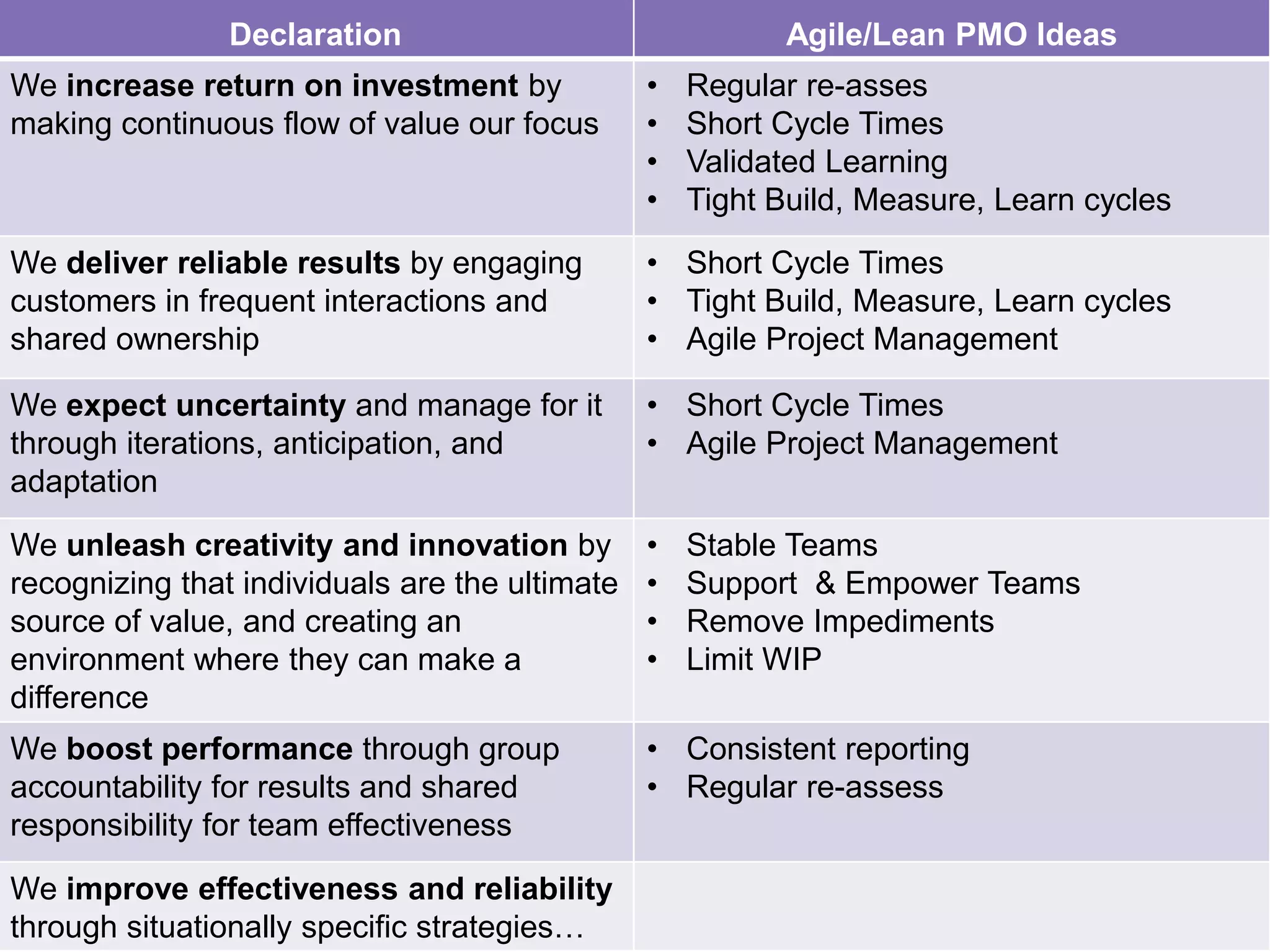
Declaration Agile/Lean PMO Ideas 
We increase return on investment by 
making continuous flow of value our focus 
• Regular re-asses 
• Short Cycle Times 
• Validated Learning 
• Tight Build, Measure, Learn cycles 
We deliver reliable results by engaging 
customers in frequent interactions and 
shared ownership 
• Short Cycle Times 
• Tight Build, Measure, Learn cycles 
• Agile Project Management 
We expect uncertainty and manage for it 
through iterations, anticipation, and 
adaptation 
• Short Cycle Times 
• Agile Project Management 
We unleash creativity and innovation by 
recognizing that individuals are the ultimate 
source of value, and creating an 
environment where they can make a 
difference 
• Stable Teams 
• Support & Empower Teams 
• Remove Impediments 
• Limit WIP 
We boost performance through group 
accountability for results and shared 
responsibility for team effectiveness 
• Consistent reporting 
• Regular re-assess 
We improve effectiveness and reliability 
through situationally specific strategies…
Wrap up
Reference Information 
• The agile PMO by cPrime 
• Elements of a Lean PMO 
• Scaling Agile through Adaptive Governance by Sanjiv Augustine 
• The Roles of the Project Management Office in Scrum by Mike Cohn 
• 21st Century Portfolio Management by David Joyce 
• The Agile PMO by Alex Adamopoulos (Emergn) 
43
44 
Thank you

Agile & Lean PMO

  • 1.
    Agile/Lean PMO AndrewRusling Agile Coach @andrewrusling
  • 2.
    Competencies to begained By the end of this session, I am hopeful that you will be able to: 1. Summarise the responsibilities of a typical PMO that are impacted by supporting Agile projects. 2. Summarise the Portfolio Management responsibilities that are impacted by supporting Agile projects. 3. Summarise the incremental funding approach 4. Summarise how Lean Portfolio Management achieves flow of value. 5. List the pros and cons of Stable teams vs Dynamic teams. 6. List some strategies that support Stable teams. 2
  • 3.
  • 4.
    Definitions 4 “Anorganizational body or entity assigned various responsibilities related to the centralized and coordinated management of those projects under its domain. The responsibilities of the PMO can range from providing project management support functions to actually being responsible for the direct management of a project.” PMBOK 2003 “A project management office is a formal, centralized layer of control between senior management and project management” IS Project Management: Size, practices and the project management office. 2007
  • 5.
    5 RESPONSIBILITIES AIM Project Management Programme Management Portfolio Management Delivery of Project Goals Delivery of Programme Goals ROI for business Team Alignment to Project Goals Project Alignment to Programme Goals Programme Alignment to Business Strategy People Allocated to Programmes Portfolio Budget Management Consistency across Programs People Allocated to Projects People Allocated to Teams Programme Budget Management Consistency across Projects Project Budget Management Consistency across Teams Ensure Processes are effective and efficient Training & Coaching
  • 6.
  • 7.
    7 RESPONSIBILITIES AIM Project Management Programme Management Portfolio Management Delivery of Project Goals Delivery of Programme Goals ROI for business Team Alignment to Project Goals Project Alignment to Programme Goals Programme Alignment to Business Strategy People Allocated to Programmes Portfolio Budget Management Covered by Agile Project Management Training Consistency across Programs People Allocated to Projects People Allocated to Teams Consistency across Projects Consistency across Teams Programme Budget Management Project Budget Management Ensure Processes are effective and efficient Training & Coaching Limited change
  • 8.
  • 9.
    9 RESPONSIBILITIES AIM Project Management Programme Management Portfolio Management Delivery of Project Goals Delivery of Programme Goals ROI for business Team Alignment to Project Goals Project Alignment to Programme Goals Programme Alignment to Business Strategy People Allocated to Programmes Portfolio Budget Management Consistency across Programs People Allocated to Projects People Allocated to Teams Consistency across Projects Consistency across Teams Programme Budget Management Project Budget Management YES, and ? Ensure Processes are effective and efficient Training & Coaching
  • 10.
    10 RESPONSIBILITIES AIM Project Management Programme Management Portfolio Management Delivery of Project Goals Delivery of Programme Goals ROI for business Team Alignment to Project Goals Project Alignment to Programme Goals Programme Alignment to Business Strategy Management of People in the Portfolio Portfolio Budget Management Consistency across Programs Management of People in the Programme Management of People in the Project Consistency across Projects Consistency across Teams Programme Budget Management Project Budget Management Ensure Processes are effective and efficient Training & Coaching
  • 11.
    People Management 11 Project Management Programme Management Portfolio Management Management of People in the Portfolio Management of People in the Programme Management of People in the Project Move towards Stable Teams Support and empower teams Support and empower teams Remove escalated impediments Remove escalated impediments Remove team impediments Ensure appropriate team & expert allocation to programmes Ensure appropriate team & expert allocation to projects Ensure appropriate expert allocation to teams
  • 12.
    Support and EmpowerTeams Support • Care about peoples wellbeing, growth and morale • Remove Impediments 12 Empower teams • Clear goals aligned to business opportunity & company vision (purpose) • Let them self organise, use a pull model for work allocation (autonomy) • Create opportunities for learning and growth (mastery)
  • 13.
    How should westructure ourselves? Pool of all people Business opportunity pipeline
  • 14.
    Business opportunity pipelinePool of all people Initiate projects to match the work Release people & tear down the project • Prioritised by Business Value • Ordered by people availability Project Backlogs Project Teams
  • 15.
    Allocate work toone or more stable teams • Prioritised by Business Value • Ordered by team availability Pool of Experts i.e. DBA, UX, etc. Business opportunity pipeline Stable Teams Allocate & Release experts to teams each sprint Teams Backlogs
  • 16.
    Stable teams vsProject teams (Pros, Cons) 16 Project Teams Stable Teams + People skills match project need + Keep performing teams + Clearer justification for hiring experts +100% allocation of most people + people skill up in business area + accurate prediction of delivery - Partial allocation of many people - Dependencies between teams - High resource management costs - Delays waiting on team availability - Delays waiting of people availability - Project initiation costs - Delays in starting projects
  • 17.
    Why do wechoose Projects over Stable teams 17 Project Teams Stable Teams Focus on high people utilisation Not looking at throughput Easier to second needed people, then get a team to work cross functionally Teams not as cross functional as needed Brings focus to the project goals Teams are poor at focusing, hence working on many things, delivering none It’s the way we have always done it Once initiated, sponsor doesn’t need to baby sit it, to get a result Continual re-evaluation of projects, can stop some projects Easier to prioritise within a project
  • 18.
  • 19.
    19 RESPONSIBILITIES AIM Project Management Programme Management Portfolio Management Delivery of Project Goals Delivery of Programme Goals ROI for business Team Alignment to Project Goals Project Alignment to Programme Goals Programme Alignment to Business Strategy Management of People in the Portfolio Portfolio Budget Management Consistency across Programs Management of People in the Programme Management of People in the Project Consistency across Projects Consistency across Teams Programme Budget Management Project Budget Management YES, and ? Ensure Processes are effective and efficient Training & Coaching
  • 20.
    20 RESPONSIBILITIES AIM Project Management Programme Management Portfolio Management Delivery of Project Goals Delivery of Programme Goals ROI for business Team Alignment to Project Goals Project Alignment to Programme Goals Achieve flow of business value Management of People in the Portfolio Portfolio Budget Management Consistency across Programs Management of People in the Programme Management of People in the Project Consistency across Projects Consistency across Teams Programme Budget Management Project Budget Management Ensure Processes are effective and efficient Training & Coaching
  • 21.
    Portfolio Management 21 Achieve flow of business value Align projects to business strategic goals Short Cycle Time over High Utilisation Split large projects Validated Learning over Business Cases Tighten Build, Measure, Learn cycles Limit Work In Progress Regular re-assess value delivery
  • 22.
    Regularly reassess valuedelivery 22 Period X months Period Planning Inspect & Adapt X weeks Business Value Portfolio Backlog Period Backlog 1. Assess delivery & potential 2. Select projects to Start / Stop 3. Split large projects 4. Allocate Teams and Budget for projects
  • 23.
    Multiple Projects, MultipleTeams 23 Period 2 months Inspect & Adapt 2 weeks Period Backlog Start Continue Period 2 months Inspect & Adapt 2 weeks Period Backlog Continue Period 2 months Inspect & Adapt 2 weeks Period Backlog Start Stop, Start different one Period 2 months Inspect & Adapt 2 weeks Period Backlog Finished, Start another
  • 24.
    Why focus onshort Cycle Time? Little’s Law, for a stable system • It is hard to delivery items faster. • It is easier to work on less items. • Hence reduce WIP to realise value earlier. • High Utilisation, increases WIP, which reduces Cycle Time and hence reduces Delivery Rate  24 Avg. Cycle Time = Work In Progress (WIP) Avg. Delivery Rate
  • 25.
    How do welimit WIP? 25 1. Stop some projects 2. Reduce the projects that Start/Continue Portfolio Backlog Period Backlog Our capacity Period Planning
  • 26.
    How do welimit WIP? 26 Portfolio Backlog Period Backlog Our capacity Period Planning
  • 27.
    Split Large Project This reduces cycle time, which increases throughput 27 Portfolio Backlog Portfolio Backlog
  • 28.
    Validated Learning overBusiness Cases Business Case Validated Learning Reasoning We can predict what will lead to success We are working from assumptions, that must be verified quickly Success Strategy Plan and manage better Learn faster Project Selection Projects with large expected returns Small projects with good learning opportunities 28
  • 29.
    Validated Learning Approach Encourage Validated Learning at all levels • Project • Release • Sprint • Day to day 29 Aim to test assumptions • Plan, Design and Run Scientific Experiments • Business Canvas • Impact Mapping Delivery early, Iterate Frequently • Use narrow vertical slices • Experiments, not marketable products Gain market feedback • Get out of the building • Talk to real users • A/B Testing • Monitor usage metrics
  • 30.
    Tighten Build, Measure,Learn cycles 30 Period 6 months Period 6 months Knowledge of what realises business value Period 6 months
  • 31.
    Tighten Build, Measure,Learn cycles 31 Period 3 months Period 3 months Period 3 months Period 3 months Period 3 months Period 3 months Knowledge of what realises business value
  • 32.
  • 33.
    33 RESPONSIBILITIES AIM Project Management Programme Management Portfolio Management Delivery of Project Goals Delivery of Programme Goals ROI for business Team Alignment to Project Goals Project Alignment to Programme Goals Achieve flow of business value Management of People in the Portfolio Portfolio Budget Management Consistency across Programs Management of People in the Programme Management of People in the Project Consistency across Projects Consistency across Teams Programme Budget Management Project Budget Management Ensure Processes are effective and efficient Training & Coaching
  • 34.
    Incremental Funding 34 Move towards incremental funding. Projects are Started/Stop (hence funded or not) at Period Planning Links to: • Continuous Flow of value • Validated Learning • Tighter build, measure, learn loops • Smaller projects
  • 35.
  • 36.
    36 RESPONSIBILITIES AIM Project Management Programme Management Portfolio Management Delivery of Project Goals Delivery of Programme Goals ROI for business Team Alignment to Project Goals Project Alignment to Programme Goals Achieve flow of business value Management of People in the Portfolio Portfolio Budget Management Consistency across Programs Management of People in the Programme Management of People in the Project Consistency across Projects Consistency across Teams Programme Budget Management Project Budget Management Ensure Processes are effective and efficient Training & Coaching
  • 37.
    Consistency 37 Consistencyis needed across Process, Tools, Metrics Aim for bare minimum of rules Teams need freedom to innovate and deliver
  • 38.
    Process efficiency andeffectiveness 38 Apply Lean thinking • Eliminate Waste • Build Quality In • Create Knowledge • Defer Commitment • Deliver Fast • Respect People • Optimise The Whole Apply Agile values • Individuals and Interactions over Processes and Tools • Working Software over Comprehensive Documentation • Customer Collaboration over Contract Negotiation • Responding to Change over Following the Plan Continuously improve. Don’t accept the status quo.
  • 39.
    Training and Coaching39 Training on • Processes, Tools, Reporting, etc. • Agile, Lean, etc. Coaching on • Agile, Lean • Agile Project Management • Validate Learning, Lean Start Up, Business Model Canvas • etc.
  • 40.
  • 41.
    Declaration Agile/Lean PMOIdeas We increase return on investment by making continuous flow of value our focus • Regular re-asses • Short Cycle Times • Validated Learning • Tight Build, Measure, Learn cycles We deliver reliable results by engaging customers in frequent interactions and shared ownership • Short Cycle Times • Tight Build, Measure, Learn cycles • Agile Project Management We expect uncertainty and manage for it through iterations, anticipation, and adaptation • Short Cycle Times • Agile Project Management We unleash creativity and innovation by recognizing that individuals are the ultimate source of value, and creating an environment where they can make a difference • Stable Teams • Support & Empower Teams • Remove Impediments • Limit WIP We boost performance through group accountability for results and shared responsibility for team effectiveness • Consistent reporting • Regular re-assess We improve effectiveness and reliability through situationally specific strategies…
  • 42.
  • 43.
    Reference Information •The agile PMO by cPrime • Elements of a Lean PMO • Scaling Agile through Adaptive Governance by Sanjiv Augustine • The Roles of the Project Management Office in Scrum by Mike Cohn • 21st Century Portfolio Management by David Joyce • The Agile PMO by Alex Adamopoulos (Emergn) 43
  • 44.

Editor's Notes

  • #12 Support care about peoples wellbeing, growth and morale Empower teams clear goals aligned to business opportunity & company vision (purpose) Let them self organise, use a pull model for work allocation (autonomy) Create opportunities for learning and growth (mastery)
  • #39 Optimise the Whole - (they are in a unique position to do this)