Agile Portfolio Management
© Copyright 2014 Conteneo, Inc. 1
Four Key Concepts
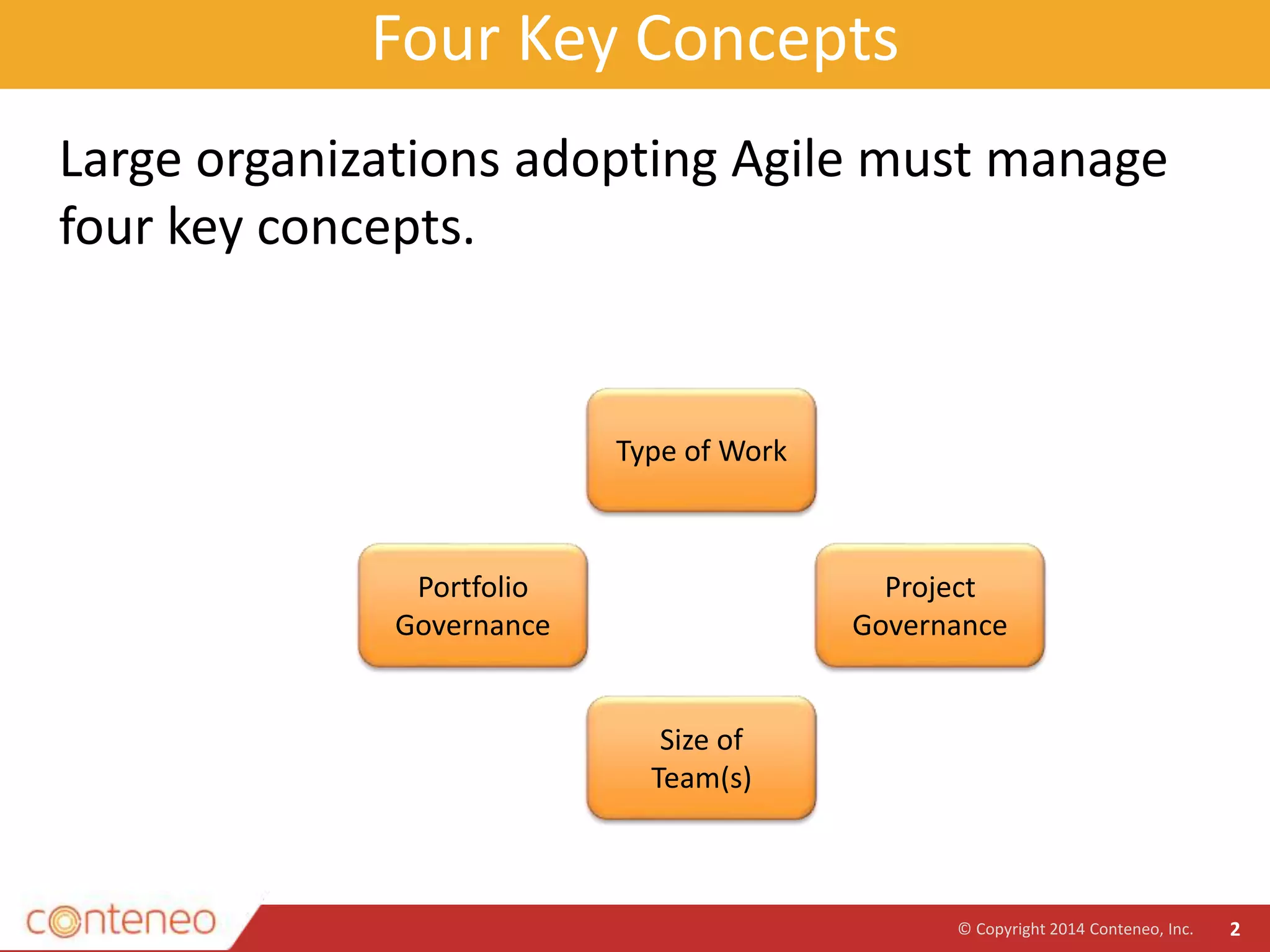
Large organizations adopting Agile must manage
four key concepts.
© Copyright 2014 Conteneo, Inc. 2
Type of Work
Size of
Team(s)
Project
Governance
Portfolio
Governance
Four Key Questions
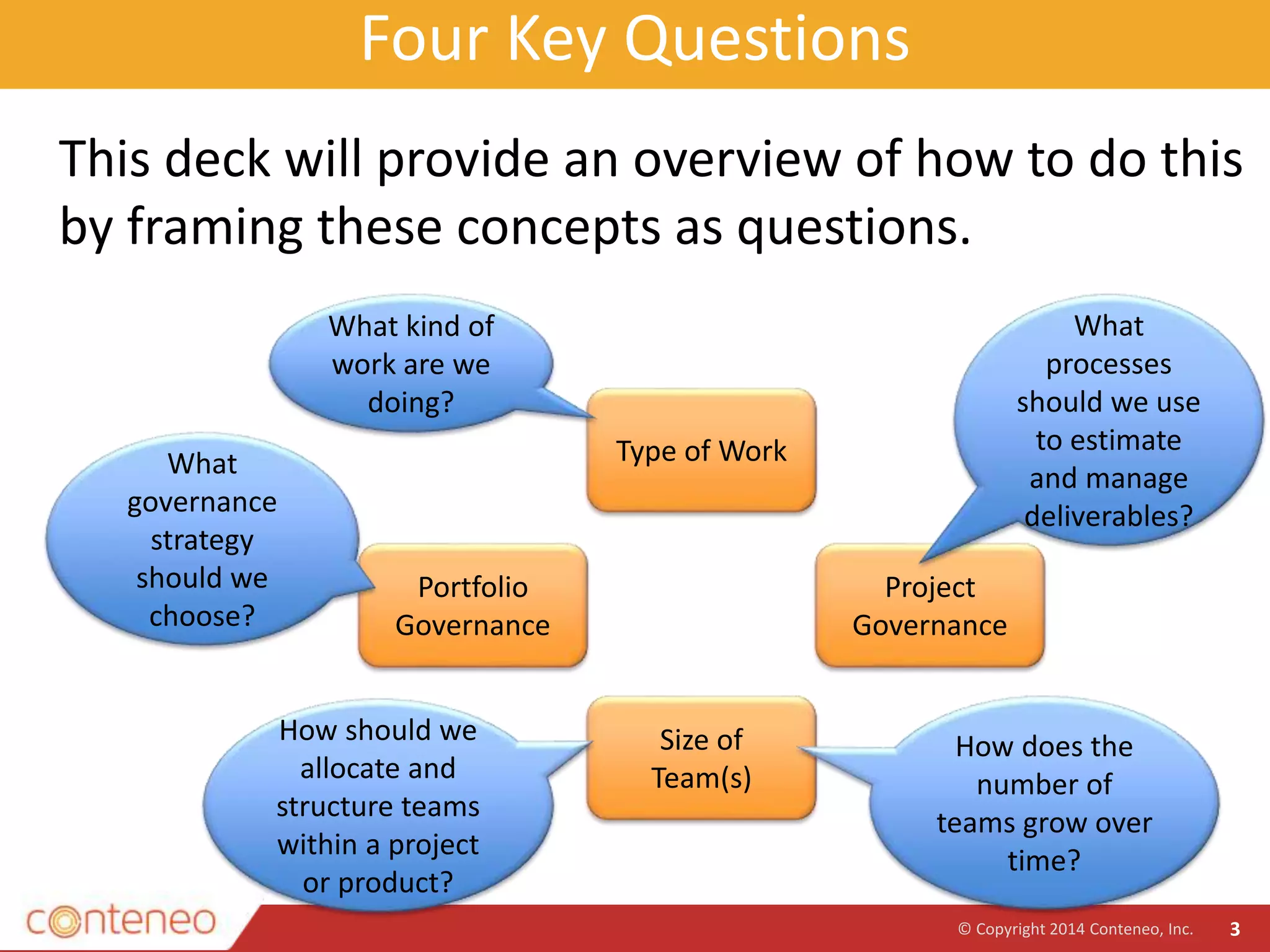
This deck will provide an overview of how to do this
by framing these concepts as questions.
© Copyright 2014 Conteneo, Inc. 3
Type of Work
Size of
Team(s)
Project
Governance
Portfolio
Governance
What kind of
work are we
doing?
What
processes
should we use
to estimate
and manage
deliverables?
What
governance
strategy
should we
choose?
How should we
allocate and
structure teams
within a project
or product?
How does the
number of
teams grow over
time?
PMO &Product Development Processes
4
PM
TPM
Team
SM
Portfolio board
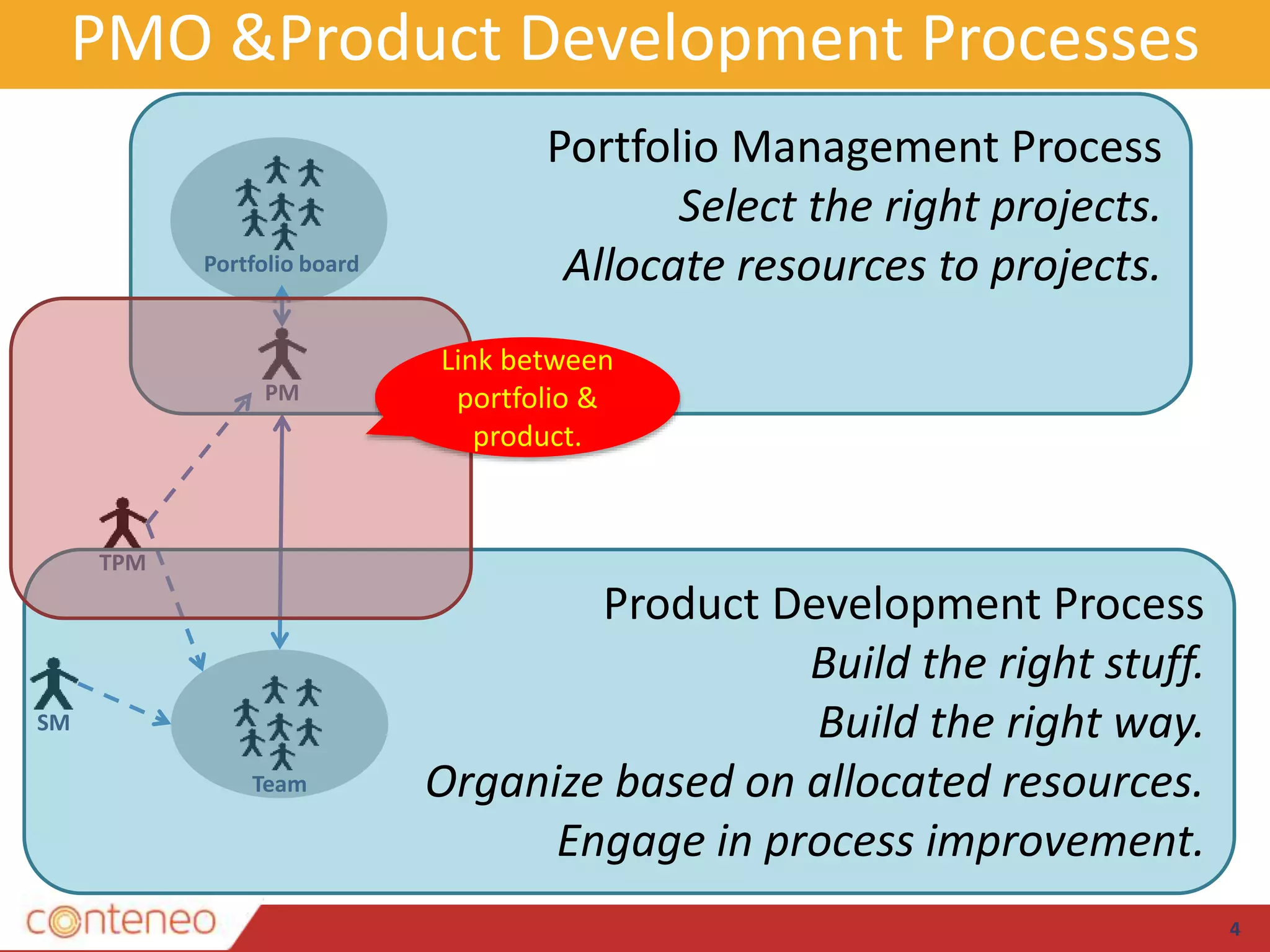
Portfolio Management Process
Select the right projects.
Allocate resources to projects.
Product Development Process
Build the right stuff.
Build the right way.
Organize based on allocated resources.
Engage in process improvement.
Link between
portfolio &
product.
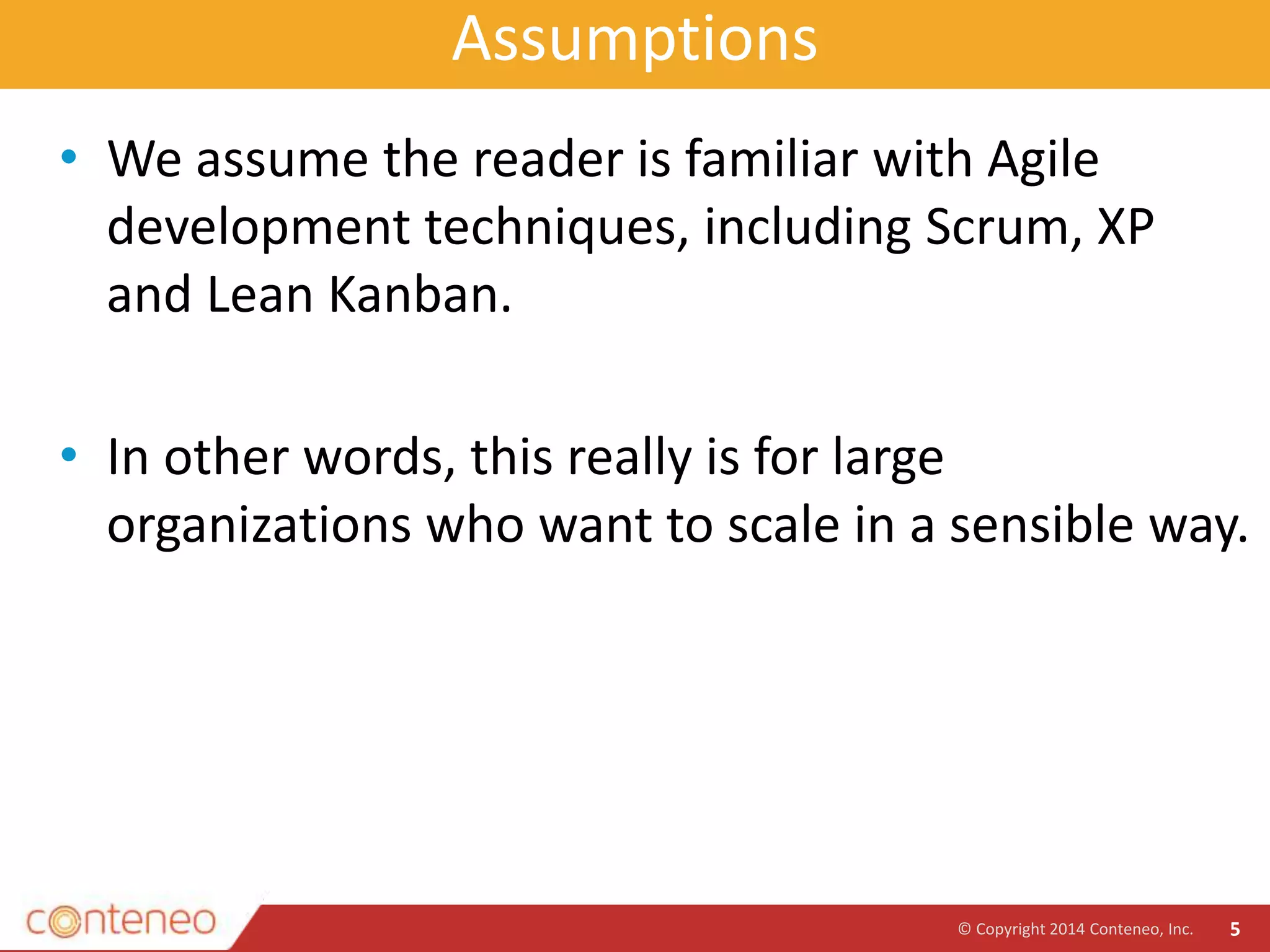
Assumptions
• We assume the reader is familiar with Agile
development techniques, including Scrum, XP
and Lean Kanban.
• In other words, this really is for large
organizations who want to scale in a sensible way.
© Copyright 2014 Conteneo, Inc. 5
Let’s start with Types of Work
And we’ll keep going from there
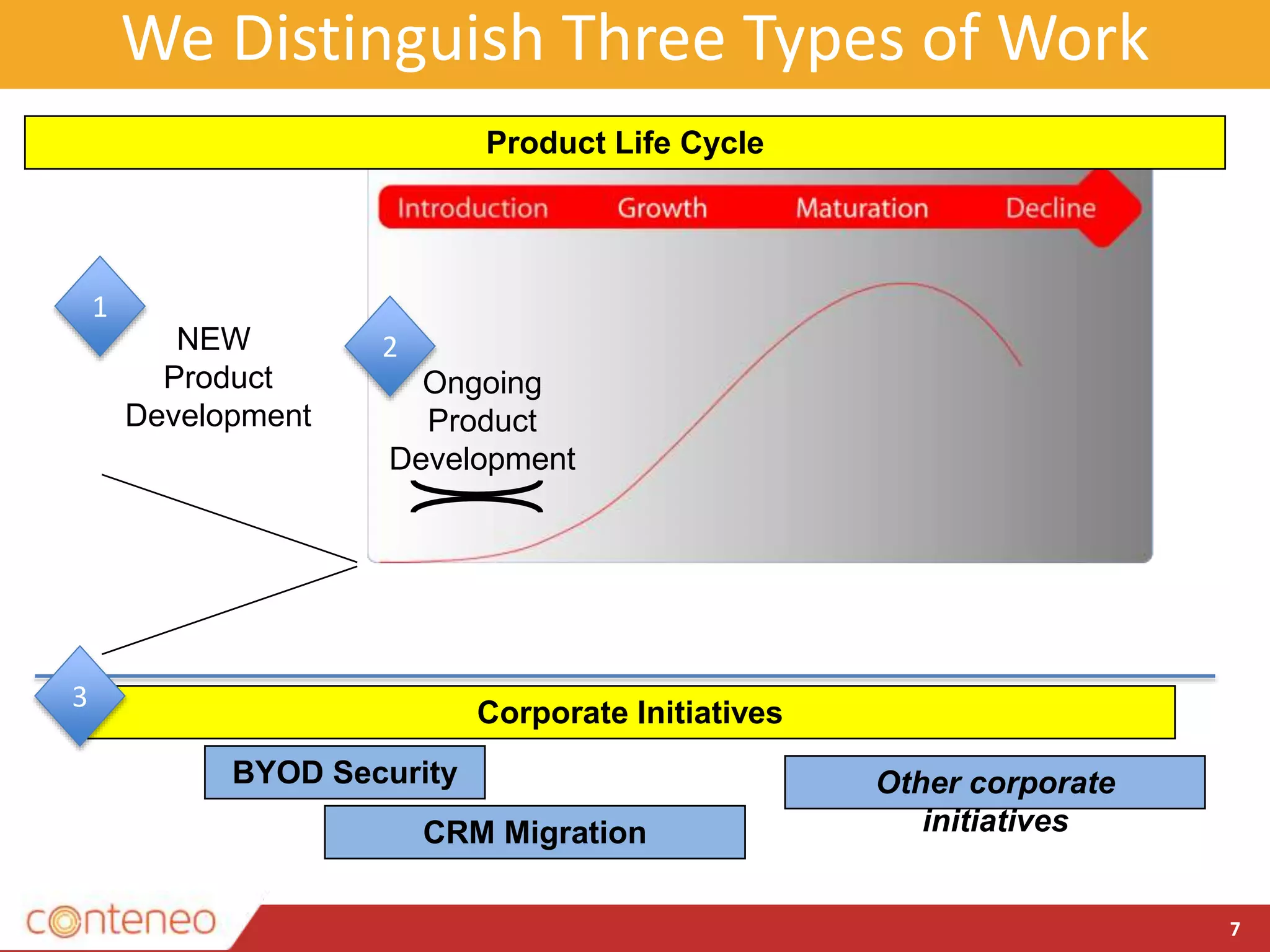
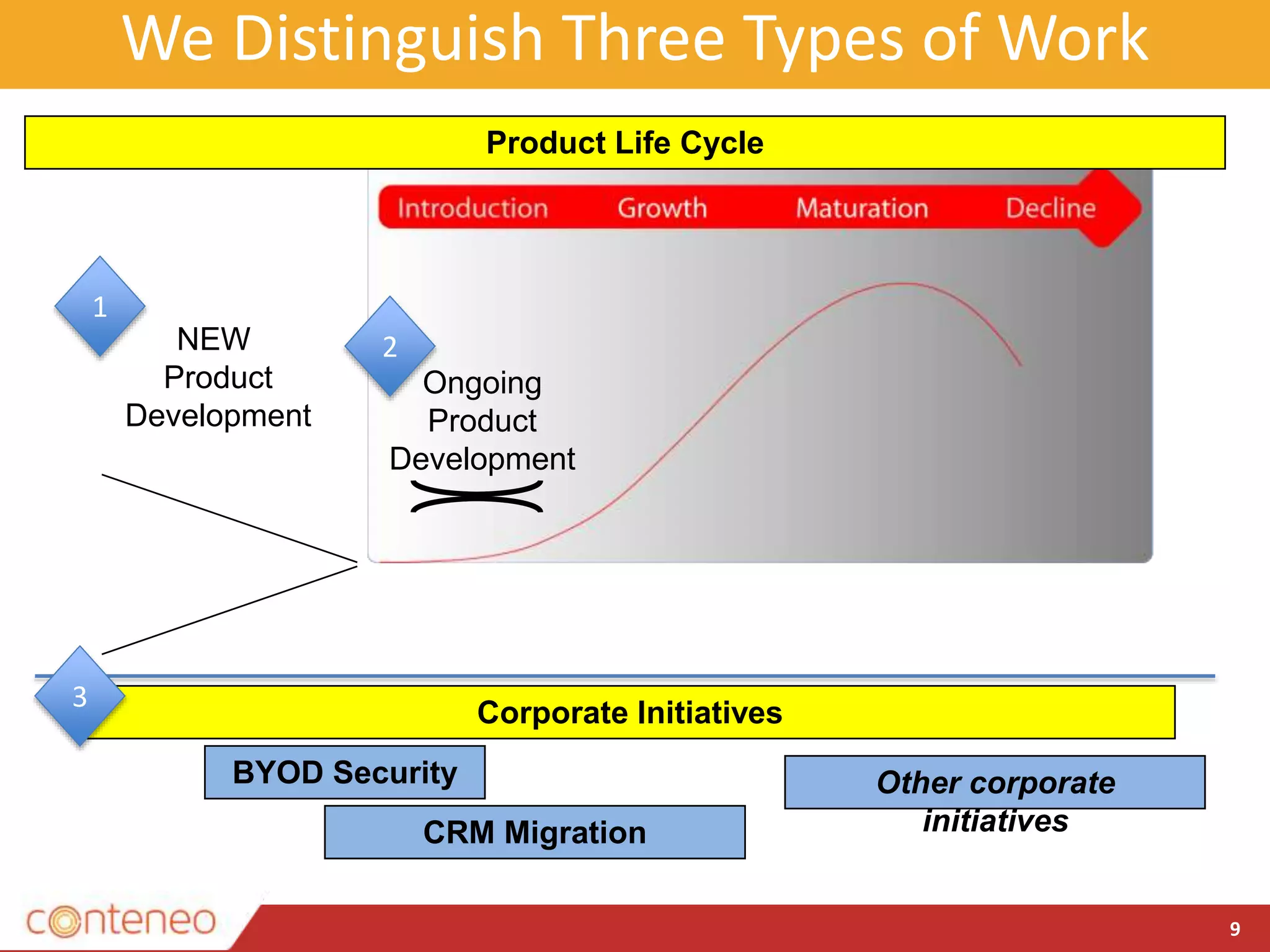
Corporate Initiatives
We Distinguish Three Types of Work
7
Ongoing
Product
Development
NEW
Product
Development
1
2
3
BYOD Security
CRM Migration
Other corporate
initiatives
Product Life Cycle
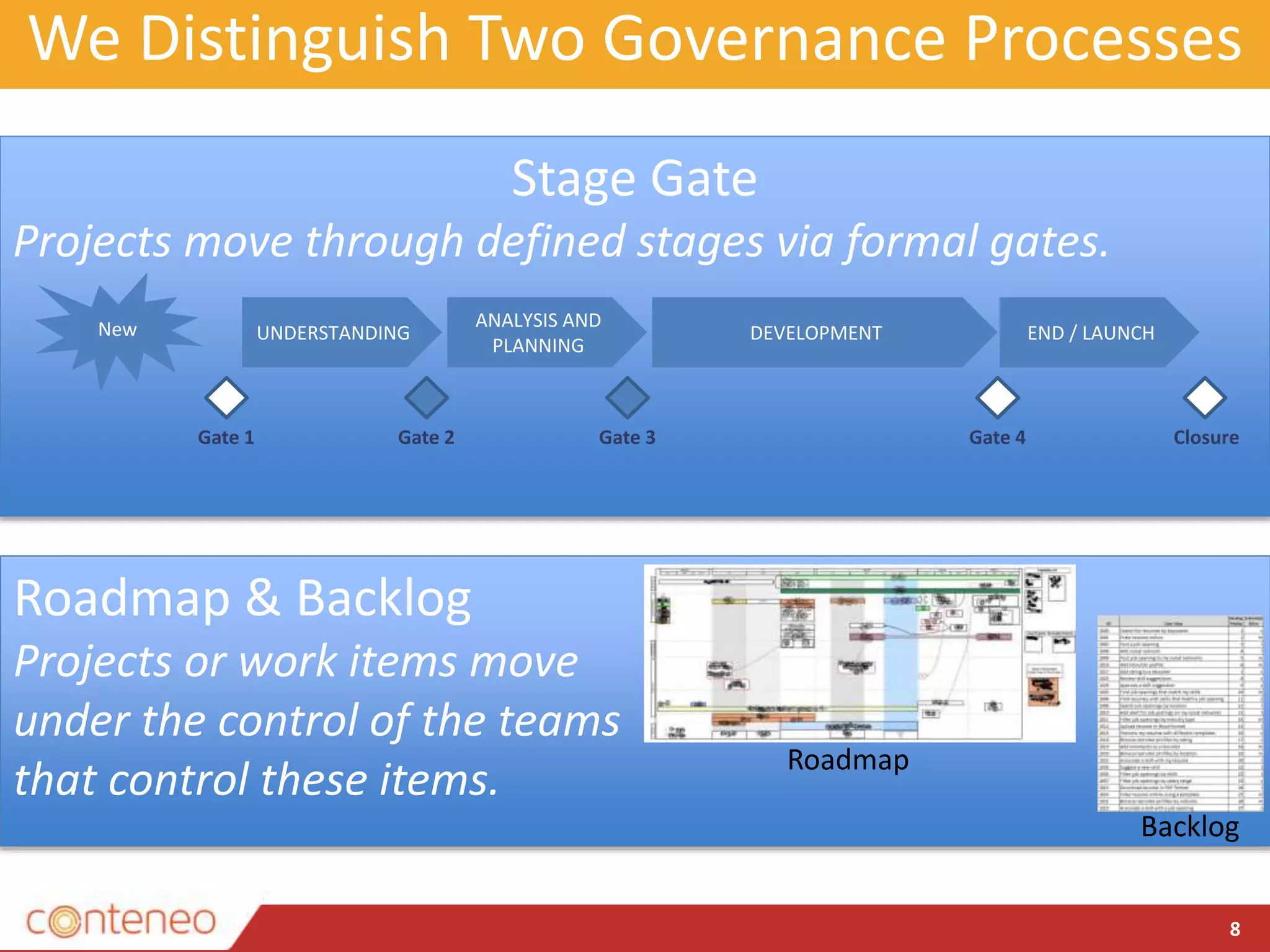
Stage Gate
Projects move through defined stages via formal gates.
We Distinguish Two Governance Processes
8
UNDERSTANDING DEVELOPMENT
ANALYSIS AND
PLANNING
END / LAUNCH
Gate 1 Gate 2 Gate 3 Gate 4 Closure
New
Roadmap & Backlog
Projects or work items move
under the control of the teams
that control these items.
Roadmap
Backlog
Corporate Initiatives
We Distinguish Three Types of Work
9
Ongoing
Product
Development
NEW
Product
Development
1
2
3
BYOD Security
CRM Migration
Other corporate
initiatives
Product Life Cycle
Corporate Initiatives
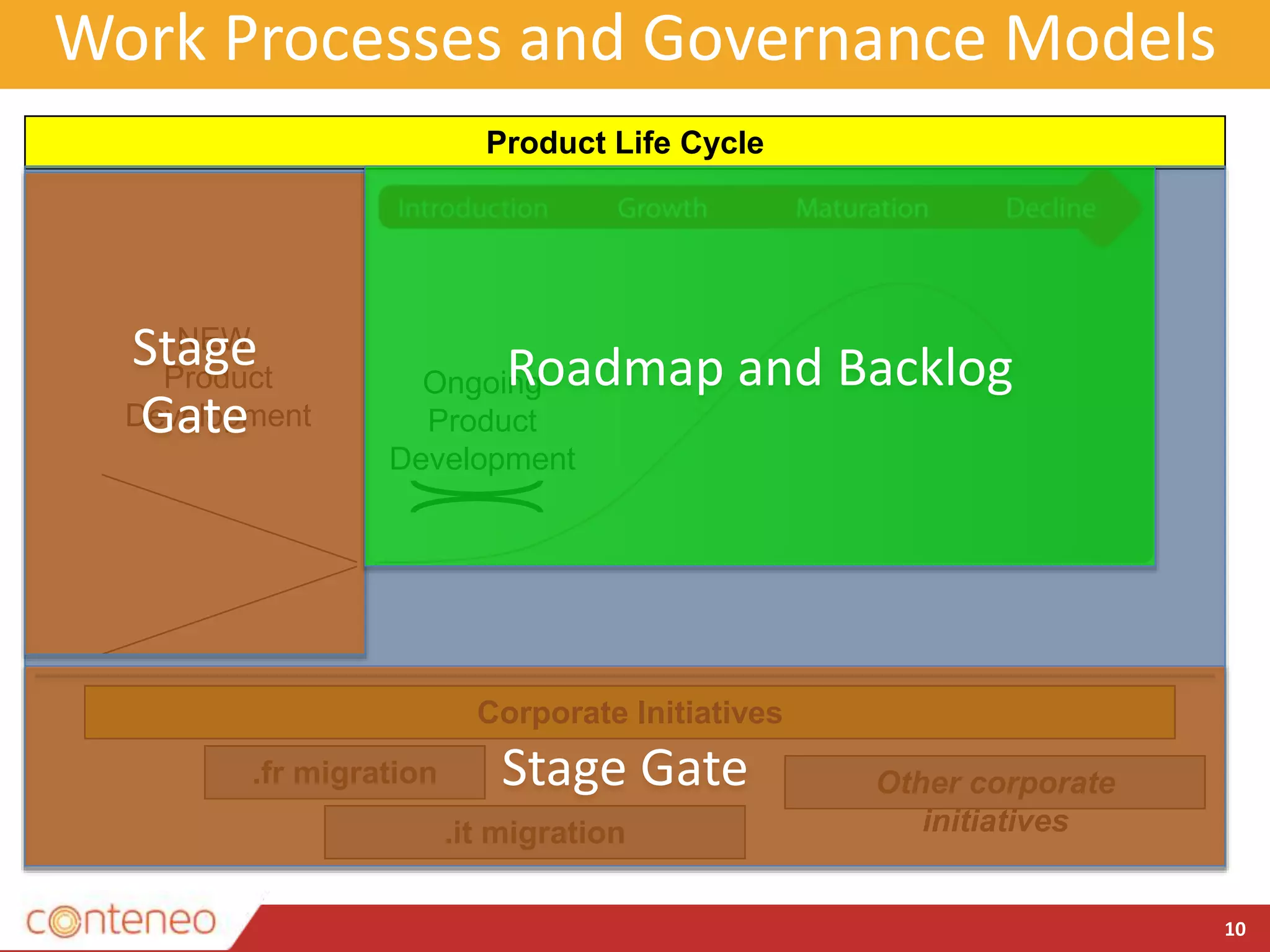
Work Processes and Governance Models
10
Ongoing
Product
Development
Product Life Cycle
NEW
Product
Development
.fr migration
.it migration
Other corporate
initiatives
Stage
Gate
Stage Gate
Roadmap and Backlog
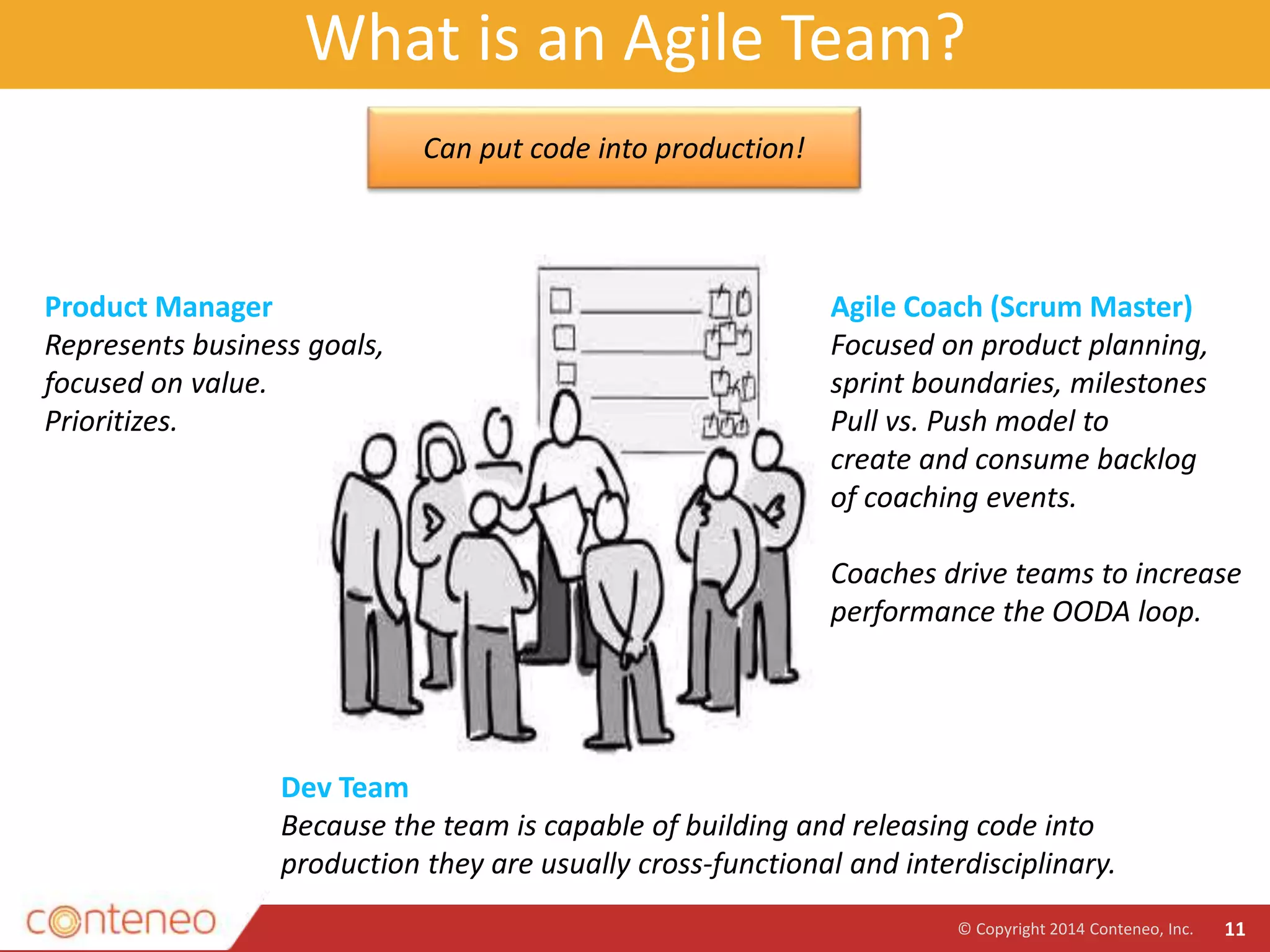
What is an Agile Team?
© Copyright 2014 Conteneo, Inc. 11
Product Manager
Represents business goals,
focused on value.
Prioritizes.
Agile Coach (Scrum Master)
Focused on product planning,
sprint boundaries, milestones
Pull vs. Push model to
create and consume backlog
of coaching events.
Coaches drive teams to increase
performance the OODA loop.
Dev Team
Because the team is capable of building and releasing code into
production they are usually cross-functional and interdisciplinary.
Can put code into production!
Corporate Initiatives
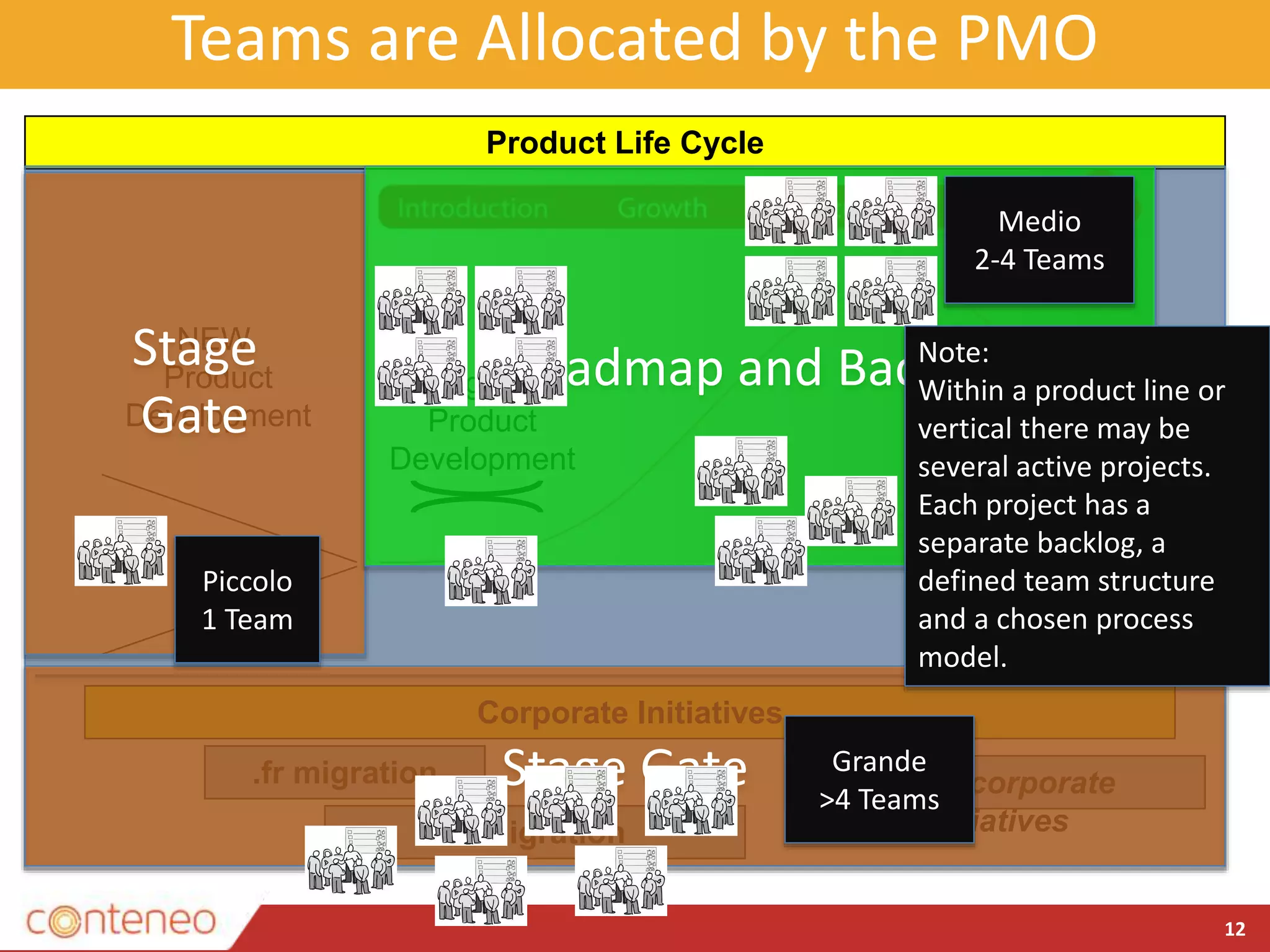
Teams are Allocated by the PMO
12
Ongoing
Product
Development
Product Life Cycle
NEW
Product
Development
.fr migration
.it migration
Other corporate
initiatives
Stage
Gate
Stage Gate
Roadmap and Backlog
Piccolo
1 Team
Grande
>4 Teams
Medio
2-4 Teams
Note:
Within a product line or
vertical there may be
several active projects.
Each project has a
separate backlog, a
defined team structure
and a chosen process
model.
Corporate Initiatives
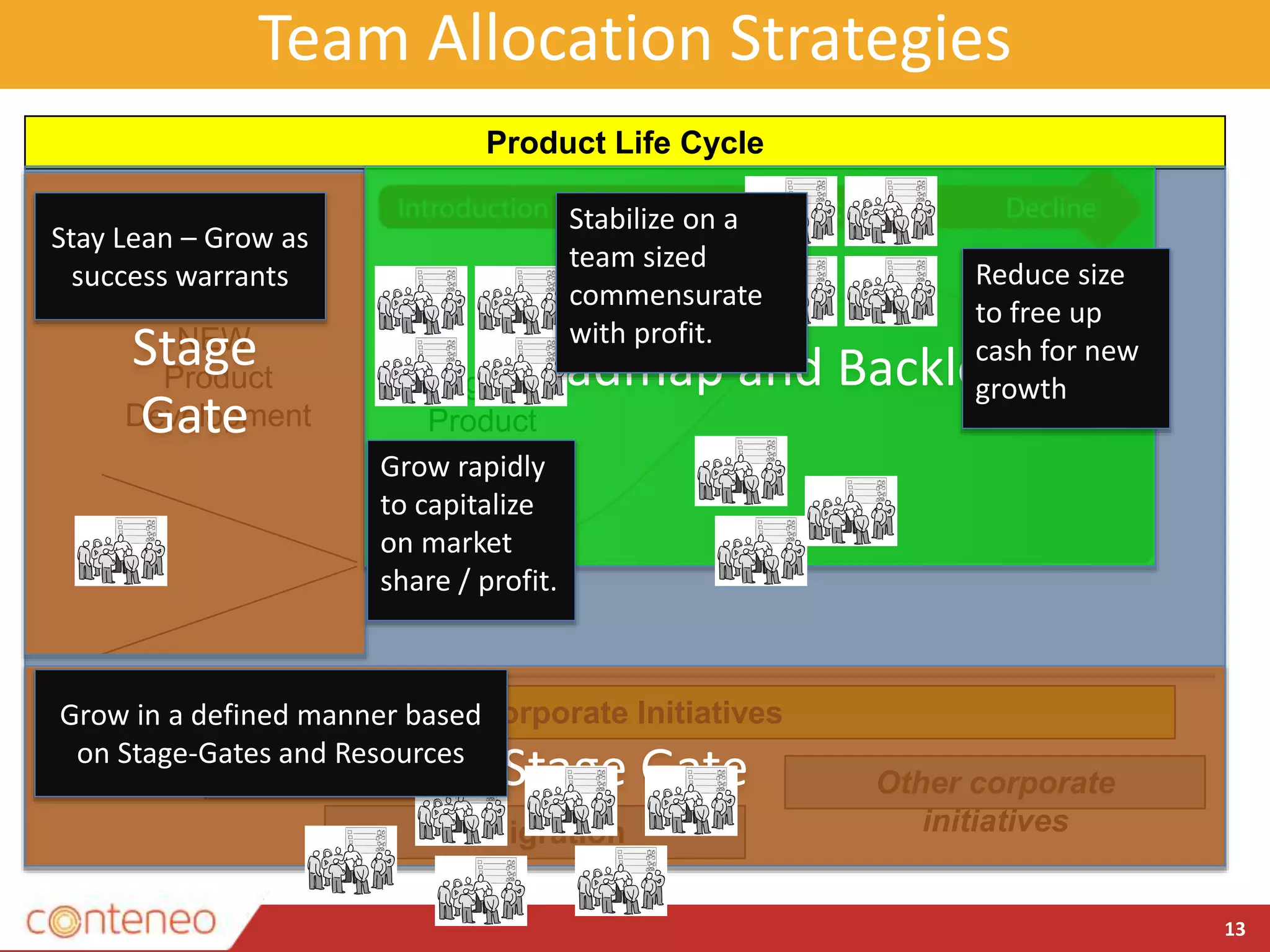
Team Allocation Strategies
13
Ongoing
Product
Development
Product Life Cycle
NEW
Product
Development
.fr migration
.it migration
Other corporate
initiatives
Stage
Gate
Stage Gate
Roadmap and Backlog
Stay Lean – Grow as
success warrants
Grow in a defined manner based
on Stage-Gates and Resources
Grow rapidly
to capitalize
on market
share / profit.
Reduce size
to free up
cash for new
growth
Stabilize on a
team sized
commensurate
with profit.
Teams Allocated By Forward Planning
14
UNDERSTANDING DEVELOPMENT
ANALYSIS AND
PLANNING
END / LAUNCH
Gate 1 Gate 2 Gate 3 Gate 4 Closure
Number
ofTeams
Time
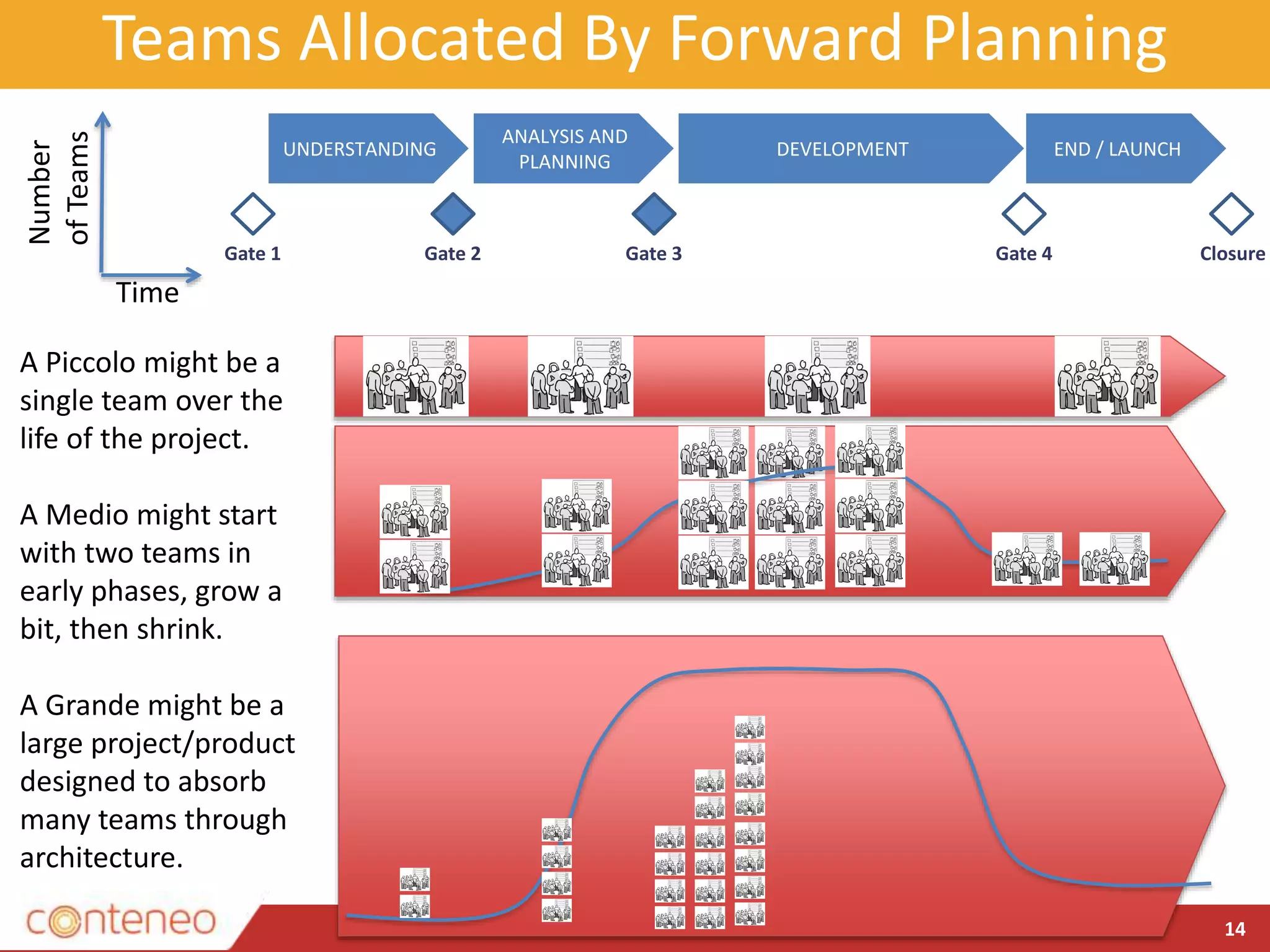
A Piccolo might be a
single team over the
life of the project.
A Medio might start
with two teams in
early phases, grow a
bit, then shrink.
A Grande might be a
large project/product
designed to absorb
many teams through
architecture.
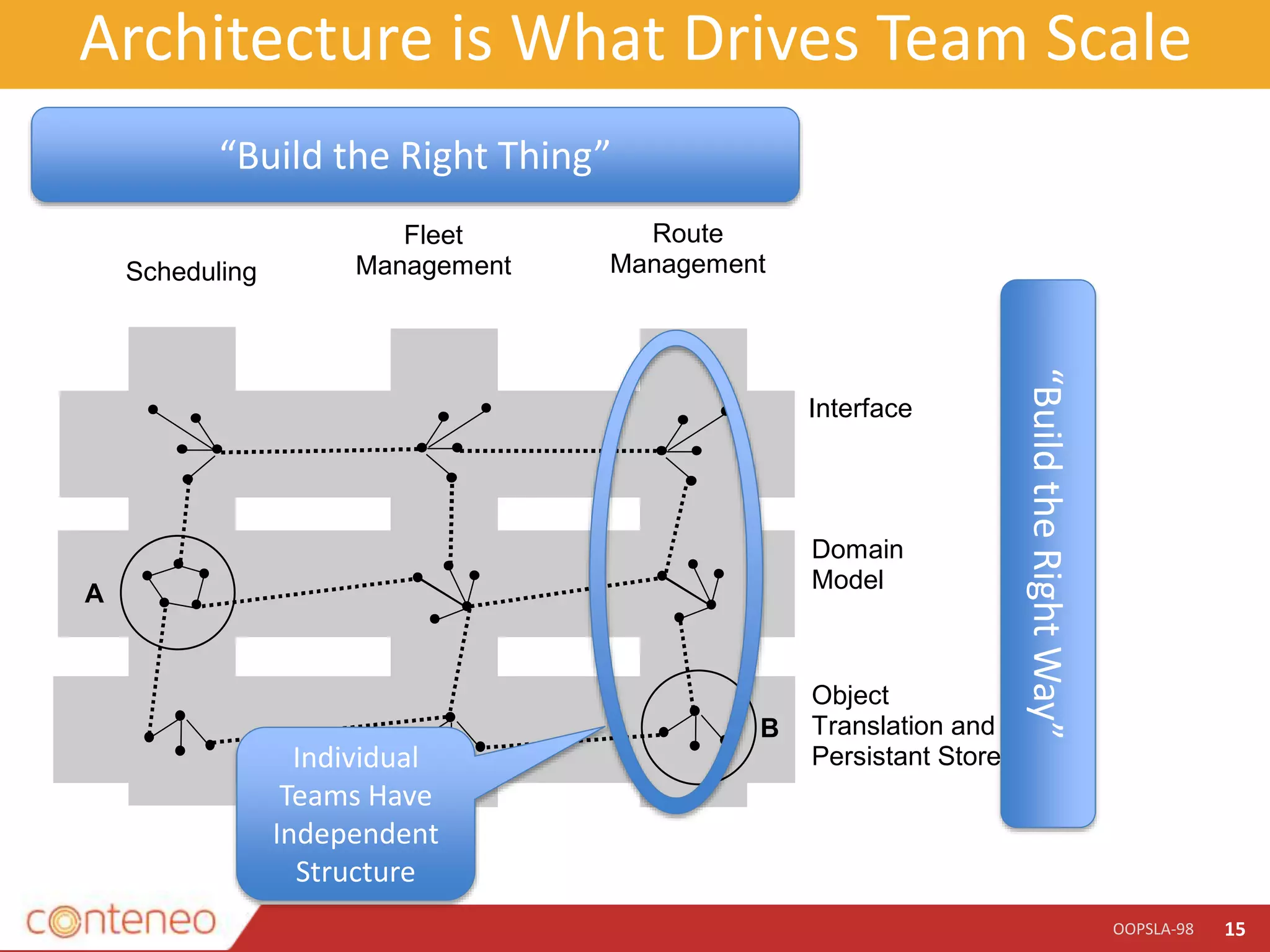
Architecture is What Drives Team Scale
OOPSLA-98 15
Interface
Domain
Model
Object
Translation and
Persistant Store
Route
Management
Fleet
ManagementScheduling
A
B
Individual
Teams Have
Independent
Structure
“Build the Right Thing”
“BuildtheRightWay”
Shapes Of Projects
© Copyright 2014 Conteneo, Inc. 16
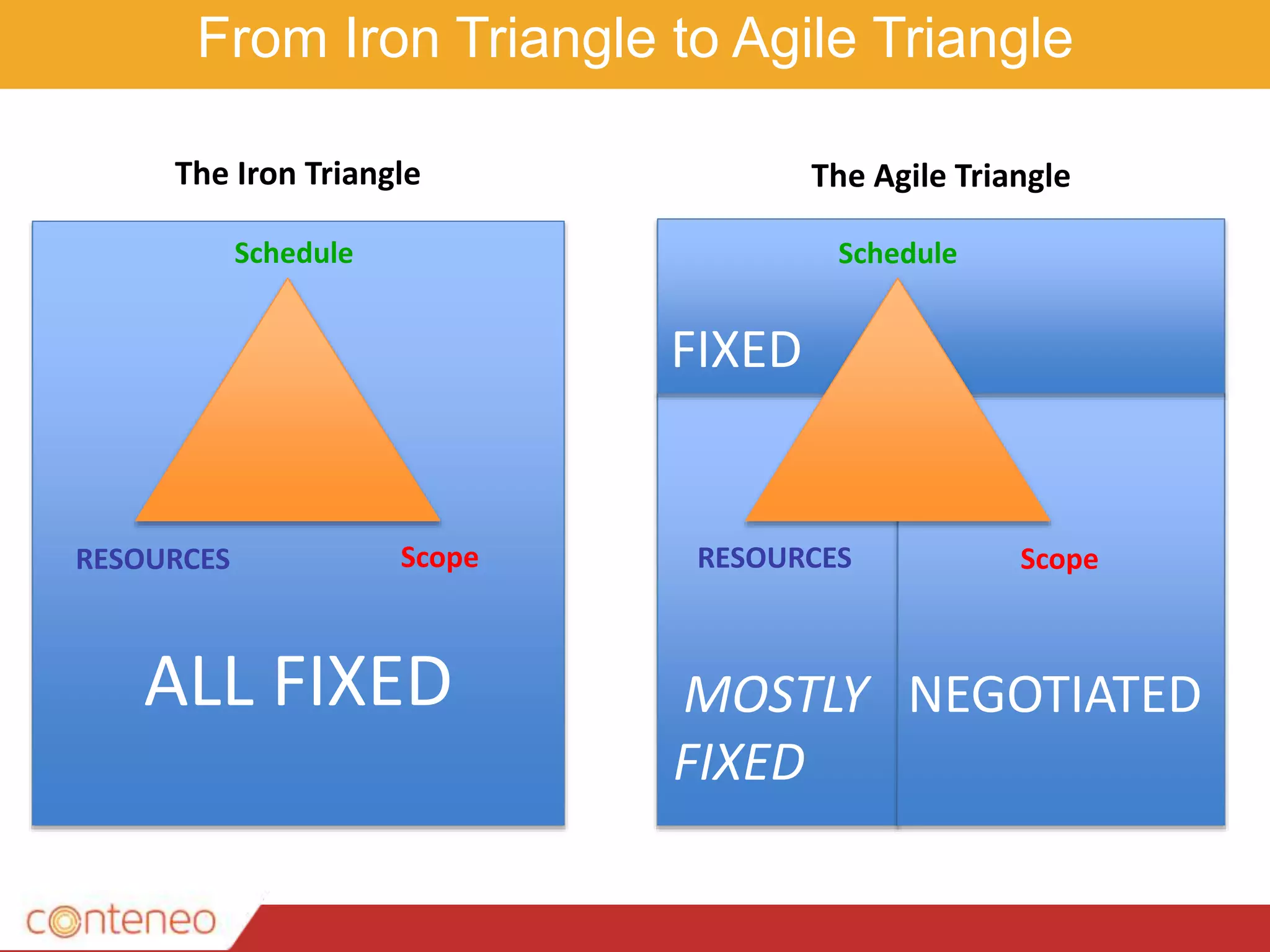
ALL FIXED
From Iron Triangle to Agile Triangle
ScopeRESOURCES
Schedule
The Iron Triangle
ScopeRESOURCES
Schedule
The Agile Triangle
FIXED
NEGOTIATEDMOSTLY
FIXED
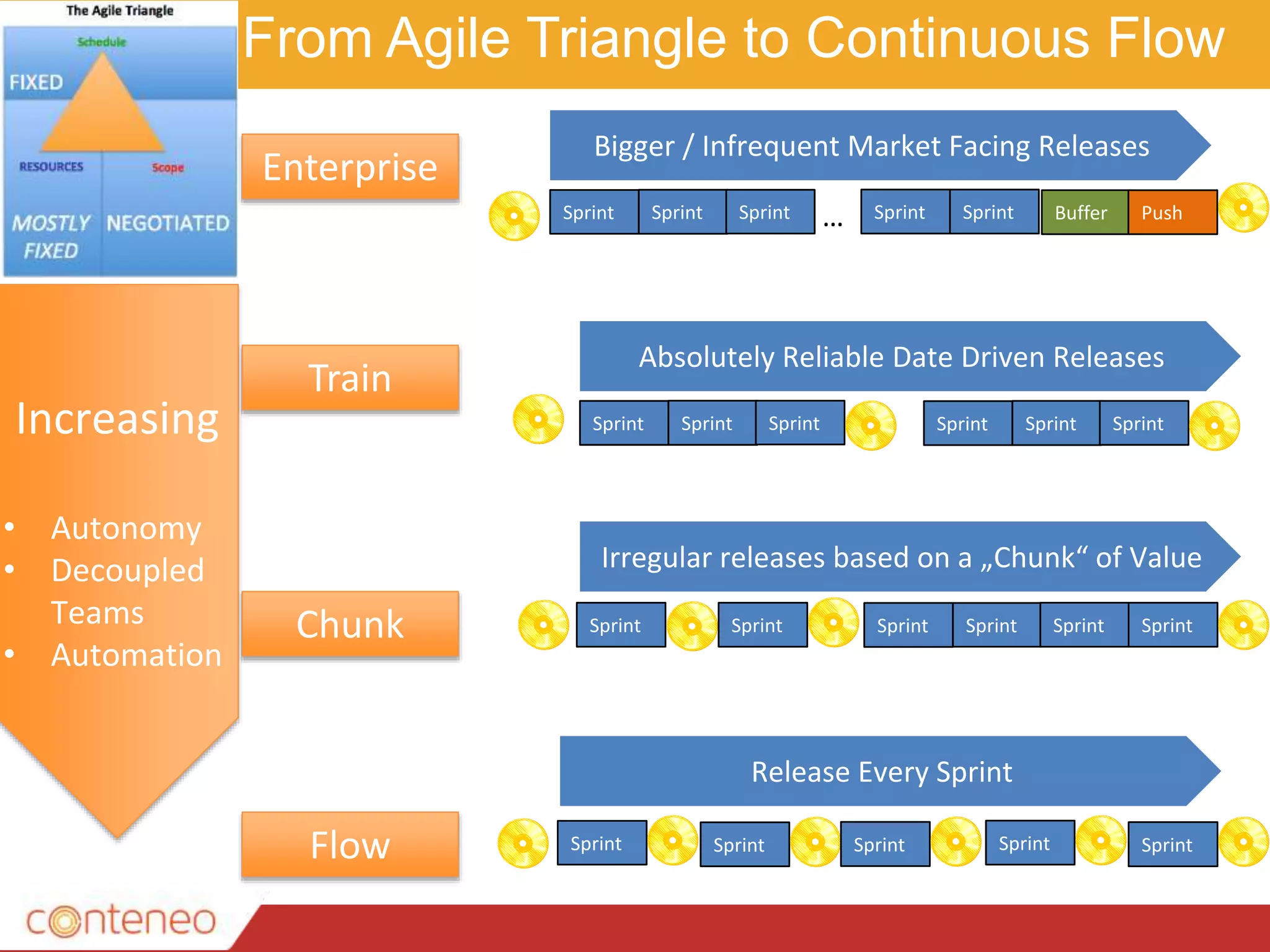
From Agile Triangle to Continuous Flow
Sprint Sprint Sprint Sprint Sprint…
Sprint Sprint Sprint SprintSprint Sprint
SprintSprint Sprint SprintSprint
Bigger / Infrequent Market Facing Releases
Buffer Push
Enterprise
Chunk
Flow
Increasing
• Autonomy
• Decoupled
Teams
• Automation
Sprint Sprint Sprint
Absolutely Reliable Date Driven Releases
Train
Sprint Sprint Sprint
Irregular releases based on a „Chunk“ of Value
Release Every Sprint
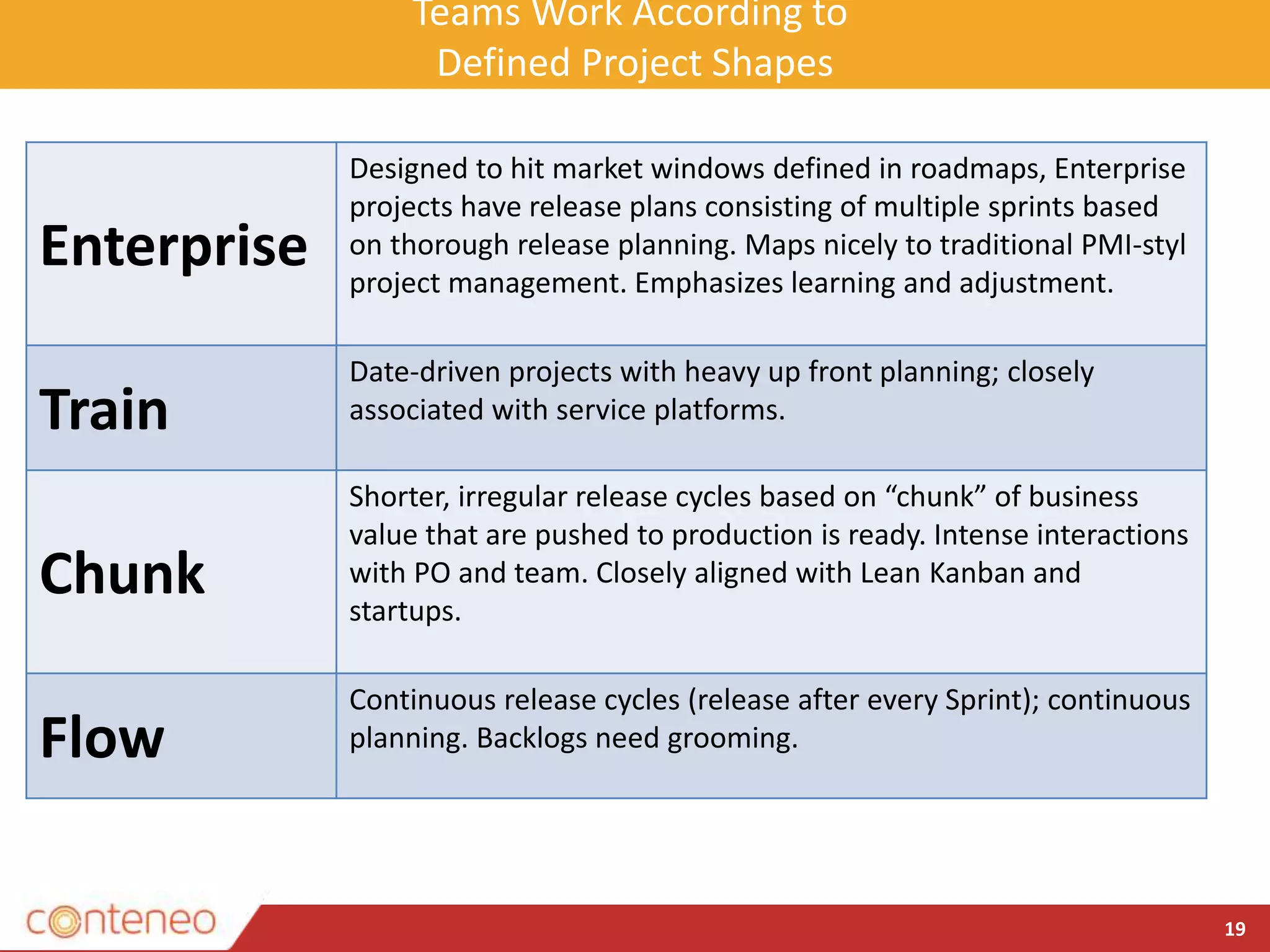
Teams Work According to
Defined Project Shapes
19
Enterprise
Designed to hit market windows defined in roadmaps, Enterprise
projects have release plans consisting of multiple sprints based
on thorough release planning. Maps nicely to traditional PMI-styl
project management. Emphasizes learning and adjustment.
Train
Date-driven projects with heavy up front planning; closely
associated with service platforms.
Chunk
Shorter, irregular release cycles based on “chunk” of business
value that are pushed to production is ready. Intense interactions
with PO and team. Closely aligned with Lean Kanban and
startups.
Flow
Continuous release cycles (release after every Sprint); continuous
planning. Backlogs need grooming.
Putting These Concepts Together
© Copyright 2014 Conteneo, Inc. 20
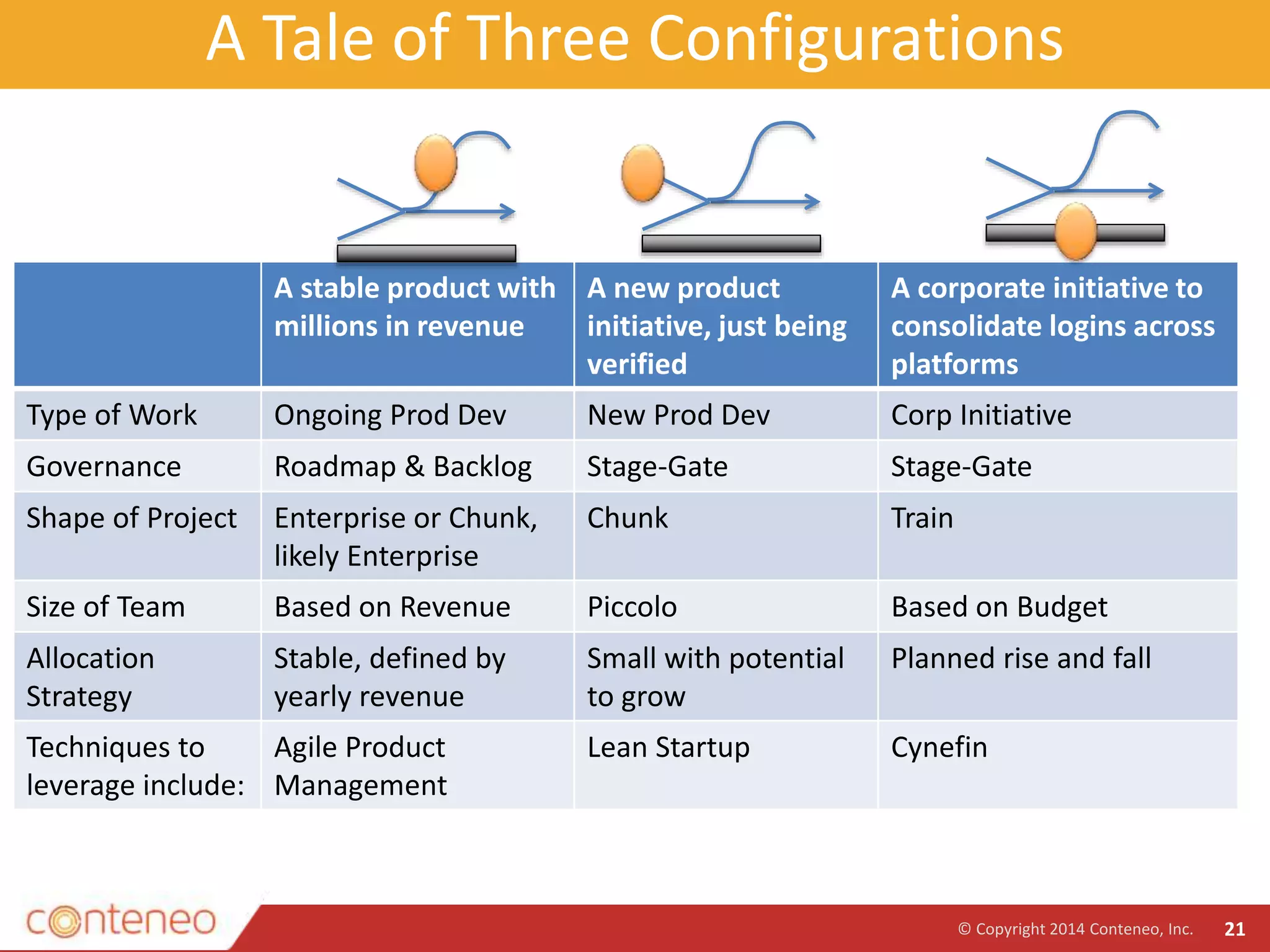
A Tale of Three Configurations
© Copyright 2014 Conteneo, Inc. 21
A stable product with
millions in revenue
A new product
initiative, just being
verified
A corporate initiative to
consolidate logins across
platforms
Type of Work Ongoing Prod Dev New Prod Dev Corp Initiative
Governance Roadmap & Backlog Stage-Gate Stage-Gate
Shape of Project Enterprise or Chunk,
likely Enterprise
Chunk Train
Size of Team Based on Revenue Piccolo Based on Budget
Allocation
Strategy
Stable, defined by
yearly revenue
Small with potential
to grow
Planned rise and fall
Techniques to
leverage include:
Agile Product
Management
Lean Startup Cynefin
Strategy-Glue-Tactics
Agile Product Development
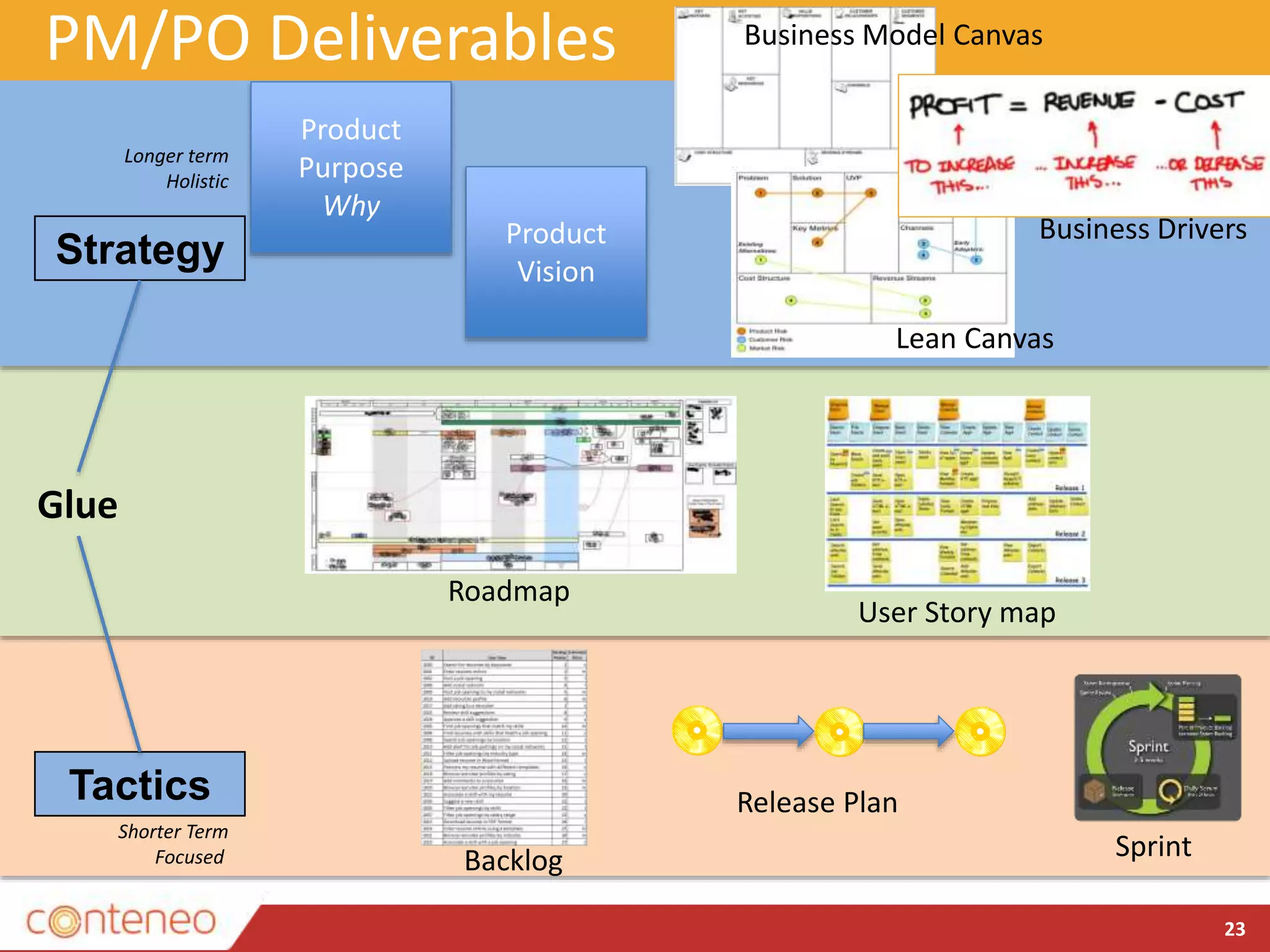
PM/PO Deliverables
23
Strategy
Tactics
Glue
Longer term
Holistic
Shorter Term
Focused
Product
Vision
Product
Purpose
Why
Roadmap
User Story map
Backlog
Release Plan
Lean Canvas
Business Model Canvas
Business Drivers
Sprint
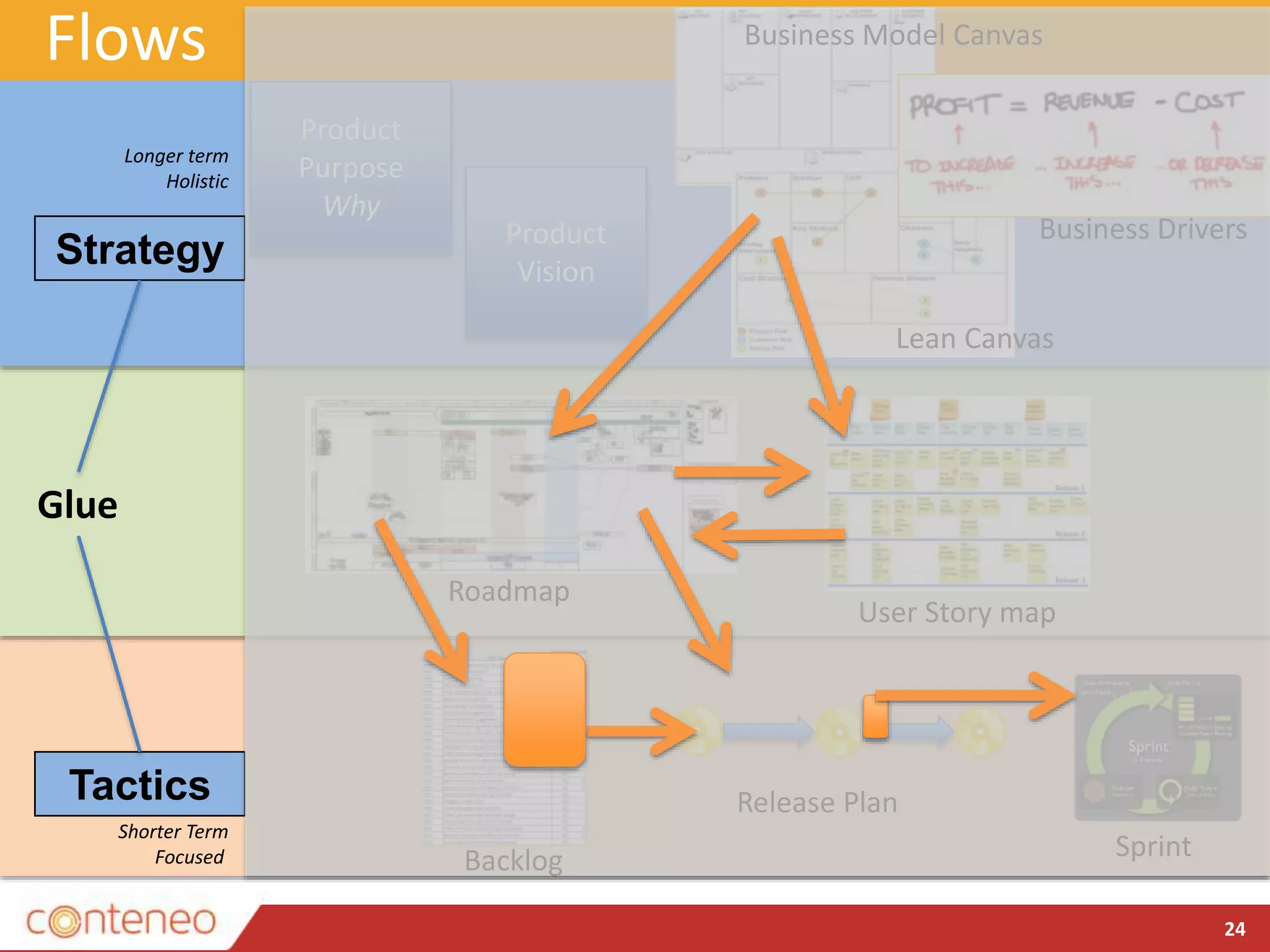
Flows
24
Strategy
Tactics
Glue
Longer term
Holistic
Shorter Term
Focused
Product
Vision
Product
Purpose
Why
Roadmap
User Story map
Backlog
Release Plan
Lean Canvas
Business Model Canvas
Business Drivers
Sprint
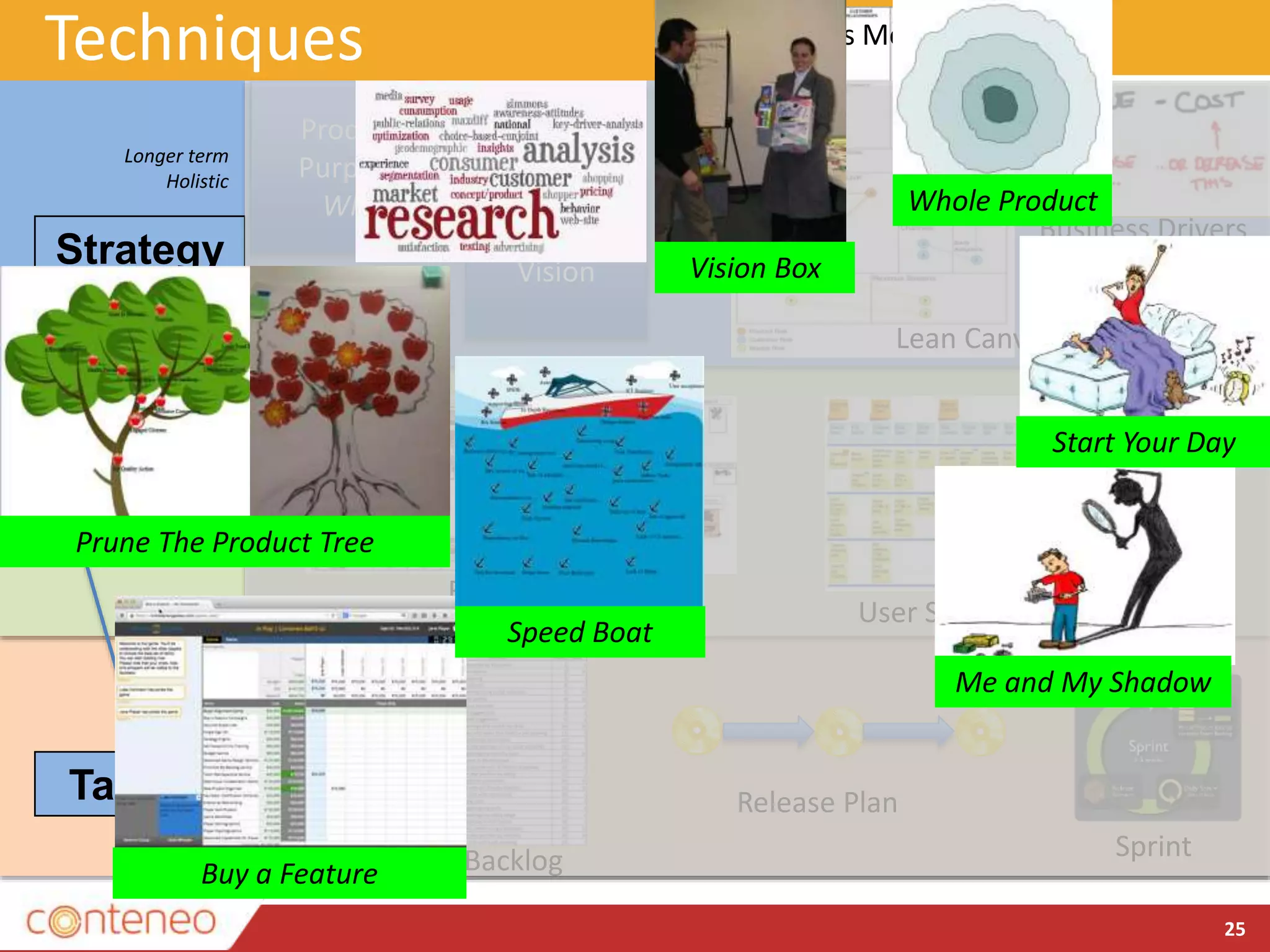
Techniques
25
Strategy
Tactics
Glue
Longer term
Holistic
Shorter Term
Focused
Product
Vision
Product
Purpose
Why
Roadmap
User Story map
Backlog
Release Plan
Lean Canvas
Business Model Canvas
Business Drivers
Sprint
Prune The Product Tree
Speed Boat
Vision Box
Me and My Shadow
Start Your Day
Buy a Feature
Whole Product
© Copyright 2014 Conteneo, Inc. 26
480 San Antonio Road, Suite 202
Mountain View, CA 94040
mobile: (408) 529-0319
luke.hohmann@conteneo.co

Agile PMO - PM

  • 1.
    Agile Portfolio Management ©Copyright 2014 Conteneo, Inc. 1
  • 2.
    Four Key Concepts Largeorganizations adopting Agile must manage four key concepts. © Copyright 2014 Conteneo, Inc. 2 Type of Work Size of Team(s) Project Governance Portfolio Governance
  • 3.
    Four Key Questions Thisdeck will provide an overview of how to do this by framing these concepts as questions. © Copyright 2014 Conteneo, Inc. 3 Type of Work Size of Team(s) Project Governance Portfolio Governance What kind of work are we doing? What processes should we use to estimate and manage deliverables? What governance strategy should we choose? How should we allocate and structure teams within a project or product? How does the number of teams grow over time?
  • 4.
    PMO &Product DevelopmentProcesses 4 PM TPM Team SM Portfolio board Portfolio Management Process Select the right projects. Allocate resources to projects. Product Development Process Build the right stuff. Build the right way. Organize based on allocated resources. Engage in process improvement. Link between portfolio & product.
  • 5.
    Assumptions • We assumethe reader is familiar with Agile development techniques, including Scrum, XP and Lean Kanban. • In other words, this really is for large organizations who want to scale in a sensible way. © Copyright 2014 Conteneo, Inc. 5
  • 6.
    Let’s start withTypes of Work And we’ll keep going from there
  • 7.
    Corporate Initiatives We DistinguishThree Types of Work 7 Ongoing Product Development NEW Product Development 1 2 3 BYOD Security CRM Migration Other corporate initiatives Product Life Cycle
  • 8.
    Stage Gate Projects movethrough defined stages via formal gates. We Distinguish Two Governance Processes 8 UNDERSTANDING DEVELOPMENT ANALYSIS AND PLANNING END / LAUNCH Gate 1 Gate 2 Gate 3 Gate 4 Closure New Roadmap & Backlog Projects or work items move under the control of the teams that control these items. Roadmap Backlog
  • 9.
    Corporate Initiatives We DistinguishThree Types of Work 9 Ongoing Product Development NEW Product Development 1 2 3 BYOD Security CRM Migration Other corporate initiatives Product Life Cycle
  • 10.
    Corporate Initiatives Work Processesand Governance Models 10 Ongoing Product Development Product Life Cycle NEW Product Development .fr migration .it migration Other corporate initiatives Stage Gate Stage Gate Roadmap and Backlog
  • 11.
    What is anAgile Team? © Copyright 2014 Conteneo, Inc. 11 Product Manager Represents business goals, focused on value. Prioritizes. Agile Coach (Scrum Master) Focused on product planning, sprint boundaries, milestones Pull vs. Push model to create and consume backlog of coaching events. Coaches drive teams to increase performance the OODA loop. Dev Team Because the team is capable of building and releasing code into production they are usually cross-functional and interdisciplinary. Can put code into production!
  • 12.
    Corporate Initiatives Teams areAllocated by the PMO 12 Ongoing Product Development Product Life Cycle NEW Product Development .fr migration .it migration Other corporate initiatives Stage Gate Stage Gate Roadmap and Backlog Piccolo 1 Team Grande >4 Teams Medio 2-4 Teams Note: Within a product line or vertical there may be several active projects. Each project has a separate backlog, a defined team structure and a chosen process model.
  • 13.
    Corporate Initiatives Team AllocationStrategies 13 Ongoing Product Development Product Life Cycle NEW Product Development .fr migration .it migration Other corporate initiatives Stage Gate Stage Gate Roadmap and Backlog Stay Lean – Grow as success warrants Grow in a defined manner based on Stage-Gates and Resources Grow rapidly to capitalize on market share / profit. Reduce size to free up cash for new growth Stabilize on a team sized commensurate with profit.
  • 14.
    Teams Allocated ByForward Planning 14 UNDERSTANDING DEVELOPMENT ANALYSIS AND PLANNING END / LAUNCH Gate 1 Gate 2 Gate 3 Gate 4 Closure Number ofTeams Time A Piccolo might be a single team over the life of the project. A Medio might start with two teams in early phases, grow a bit, then shrink. A Grande might be a large project/product designed to absorb many teams through architecture.
  • 15.
    Architecture is WhatDrives Team Scale OOPSLA-98 15 Interface Domain Model Object Translation and Persistant Store Route Management Fleet ManagementScheduling A B Individual Teams Have Independent Structure “Build the Right Thing” “BuildtheRightWay”
  • 16.
    Shapes Of Projects ©Copyright 2014 Conteneo, Inc. 16
  • 17.
    ALL FIXED From IronTriangle to Agile Triangle ScopeRESOURCES Schedule The Iron Triangle ScopeRESOURCES Schedule The Agile Triangle FIXED NEGOTIATEDMOSTLY FIXED
  • 18.
    From Agile Triangleto Continuous Flow Sprint Sprint Sprint Sprint Sprint… Sprint Sprint Sprint SprintSprint Sprint SprintSprint Sprint SprintSprint Bigger / Infrequent Market Facing Releases Buffer Push Enterprise Chunk Flow Increasing • Autonomy • Decoupled Teams • Automation Sprint Sprint Sprint Absolutely Reliable Date Driven Releases Train Sprint Sprint Sprint Irregular releases based on a „Chunk“ of Value Release Every Sprint
  • 19.
    Teams Work Accordingto Defined Project Shapes 19 Enterprise Designed to hit market windows defined in roadmaps, Enterprise projects have release plans consisting of multiple sprints based on thorough release planning. Maps nicely to traditional PMI-styl project management. Emphasizes learning and adjustment. Train Date-driven projects with heavy up front planning; closely associated with service platforms. Chunk Shorter, irregular release cycles based on “chunk” of business value that are pushed to production is ready. Intense interactions with PO and team. Closely aligned with Lean Kanban and startups. Flow Continuous release cycles (release after every Sprint); continuous planning. Backlogs need grooming.
  • 20.
    Putting These ConceptsTogether © Copyright 2014 Conteneo, Inc. 20
  • 21.
    A Tale ofThree Configurations © Copyright 2014 Conteneo, Inc. 21 A stable product with millions in revenue A new product initiative, just being verified A corporate initiative to consolidate logins across platforms Type of Work Ongoing Prod Dev New Prod Dev Corp Initiative Governance Roadmap & Backlog Stage-Gate Stage-Gate Shape of Project Enterprise or Chunk, likely Enterprise Chunk Train Size of Team Based on Revenue Piccolo Based on Budget Allocation Strategy Stable, defined by yearly revenue Small with potential to grow Planned rise and fall Techniques to leverage include: Agile Product Management Lean Startup Cynefin
  • 22.
  • 23.
    PM/PO Deliverables 23 Strategy Tactics Glue Longer term Holistic ShorterTerm Focused Product Vision Product Purpose Why Roadmap User Story map Backlog Release Plan Lean Canvas Business Model Canvas Business Drivers Sprint
  • 24.
    Flows 24 Strategy Tactics Glue Longer term Holistic Shorter Term Focused Product Vision Product Purpose Why Roadmap UserStory map Backlog Release Plan Lean Canvas Business Model Canvas Business Drivers Sprint
  • 25.
    Techniques 25 Strategy Tactics Glue Longer term Holistic Shorter Term Focused Product Vision Product Purpose Why Roadmap UserStory map Backlog Release Plan Lean Canvas Business Model Canvas Business Drivers Sprint Prune The Product Tree Speed Boat Vision Box Me and My Shadow Start Your Day Buy a Feature Whole Product
  • 26.
    © Copyright 2014Conteneo, Inc. 26 480 San Antonio Road, Suite 202 Mountain View, CA 94040 mobile: (408) 529-0319 luke.hohmann@conteneo.co