Presented by ZweigWhite Project Management Part III
ZweigWhite is a Registered Provider with The American Institute of Architects Continuing Education Systems. Credit earned on completion of this program will be reported to CES Records for AIA members. Certificates of Completion for non-AIA members are available on request. This program is registered with the AIA/CES for continuing professional education. As such, it does not include content that may be deemed or construed to be an approval or endorsement by the AIA of any material of construction or any method or manner of handling, using distributing, or dealing in any material or product. Questions related to specific materials, methods, and services will be addressed at the conclusion of this presentation.
Copyright Materials This presentation is protected by US and International copyright laws. Reproduction, distribution, display and use of the presentation without written permission of the speaker is prohibited. © ZweigWhite, 2010
Seminar Overview Introduction and Logistics Headaches and Learning Objectives Facts, Figures, and Things to Consider Skills and Abilities of Today’s Project Manager What we need to do, when, why and how Project Phases Key Concepts Excellence in Project Leadership Objectives in Motion
What We Need to Do, When, Why, and How
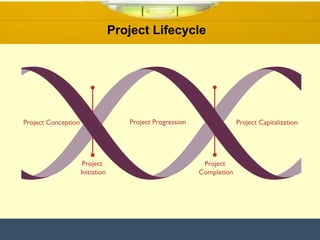
Project Lifecycle
Project Completion
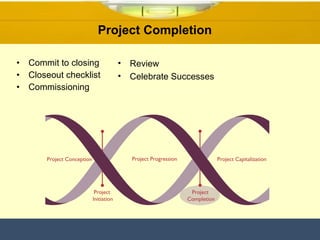
Project Completion  Commit to closing Closeout checklist Commissioning Review Celebrate Successes
Closeout and Substantial Completion  Almost there: When and what Finishing all the little details so we can get our final payment and the client can move in  Committing to closing Why The longer we are active on a project, the more it costs us $$ The client has waited for this day  We owe it to the client to stay committed
Closeout and Substantial Completion  Almost there: How Stay focused  Design and use a closeout checklist Delegate if necessary – good training Leveraging that we are organized; using technology  Start assembling paperwork early  Lock in dates for training as soon as possible Realistic punchlists Negotiate remaining change orders or close them out Verify paperwork – warranties, liens, other required docs Process final pay request swiftly  Closeout project numbers in accounting
Project Review  Taking a Look Back: When and what Let’s consider if we should work for this client again  Why Working for a not so ideal client prevents us from working for an ideal one!   Ideal Clients Add  value to our firm Reward with fees that value our expertise Meet obligations of the contract  Are responsive Give a great reference
Project Review  Taking a Look Back: Not So Ideal Clients Do   not  add value to our firm Take issue with budget/scope and do not acknowledge our expertise or what we can do for them Do not meet their obligations of the contract Are unreliable
Sub-Consultant Reviews Should we work with this consultant again? Considerations: Was it worth the lower cost? Was it worth the delay in delivery? What were the actual costs and benefits? Do we all make a great team? Do I have the authority to hire a different consultant? Why not a competitive assessment?  Who wants to work with us and why?
At Milestones and Completions: Document what went right Document what didn’t go right Thank the entire team for hard work Share lessons learned among the project team Publicize project achievements:  internally and externally Never stop improving Celebrate Successes!
Deliver Feedback to Individuals: First:  highlight effective performance Second:  highlight areas for improvement Everyone receives feedback after every project – PMs should also get feedback from project team Key Concept:  Feedback
Give directly—with real feeling– based on trust In a timely manner—use recent examples to support it Ensure the individual / group receiving the feedback is prepared to discuss it Make it valid and limited to areas the individual can control or change Small, well thought-out doses of feedback are better than large dumps of information Key Concept:  Feedback
Project Capitalization
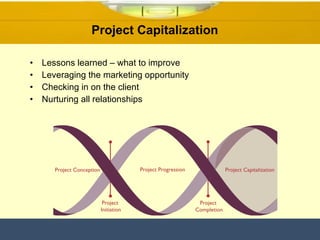
Project Capitalization  Lessons learned – what to improve Leveraging the marketing opportunity Checking in on the client  Nurturing all relationships
Leveraging our Expertise  We’ve got this down….now what? When and what Expertise in  project type / client type / sector  Why These are important skills– we need to take advantage of it We did an excellent job– we need to showcase it How Do it really well Repeat Make sure it appears in our marketing material
Knowledge Transfer  How Develop standards for retaining and maintaining project information and work product Collect and archive project records Make files and records easy to access Establish responsibility for maintaining institutional knowledge Hold periodic firm-wide lessons learned sessions or lunches
Marketing Activities  How Continue to build and strengthen relationships with clients even when they don’t have projects for us  Work with clients to publicize projects Follow up with clients every six months Be innovative and different
Benchmarks  Project Management Benchmarks: Number of new and repeat clients  Total gross and net revenues  Repeat, additional, and special service revenues Billing and collection periods Amount of rework and write-offs
Project Leadership
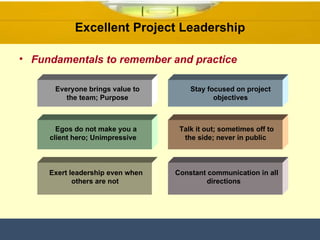
Excellent Project Leadership Fundamentals to remember and practice Everyone brings value to the team; Purpose Stay focused on project objectives Egos do not make you a client hero; Unimpressive  Talk it out; sometimes off to the side; never in public  Exert leadership even when others are not  Constant communication in all directions
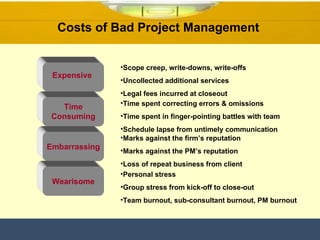
Costs of Bad Project Management  Expensive Time Consuming Wearisome Embarrassing Scope creep, write-downs, write-offs Uncollected additional services Legal fees incurred at closeout Time spent correcting errors & omissions Time spent in finger-pointing battles with team Schedule lapse from untimely communication Marks against the firm’s reputation Marks against the PM’s reputation  Loss of repeat business from client  Personal stress Group stress from kick-off to close-out Team burnout, sub-consultant burnout, PM burnout
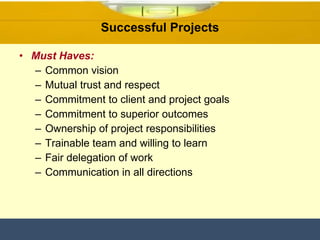
Must Haves: Common vision Mutual trust and respect Commitment to client and project goals Commitment to superior outcomes Ownership of project responsibilities Trainable team and willing to learn Fair delegation of work Communication in all directions Successful Projects
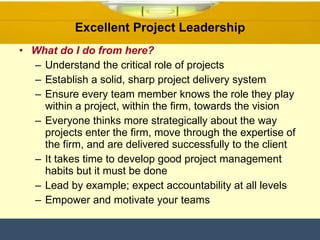
What do I do from here? Understand the critical role of projects Establish a solid, sharp project delivery system  Ensure every team member knows the role they play within a project, within the firm, towards the vision Everyone thinks more strategically about the way projects enter the firm, move through the expertise of the firm, and are delivered successfully to the client It takes time to develop good project management habits but it must be done Lead by example; expect accountability at all levels Empower and motivate your teams Excellent Project Leadership
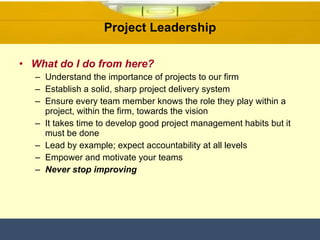
Project Leadership What do I do from here? Understand the importance of projects to our firm Establish a solid, sharp project delivery system  Ensure every team member knows the role they play within a project, within the firm, towards the vision It takes time to develop good project management habits but it must be done Lead by example; expect accountability at all levels Empower and motivate your teams Never stop improving
Identify three things you will implement on your next project based on what you have learned in this course: _____________________________________  _____________________________________   _____________________________________ Work with your manager to build these competencies   Objectives in Motion
 
Thank You! Christine Brack, PMP Principal 239-280-2300 x2902 [email_address] Click here to purchase the entire series: http://www.zweigwhite.com/p-792-ae-project-management-optimization-series.aspx

A/E Project Management Optimization-Part Three

  • 1.
    Presented by ZweigWhiteProject Management Part III
  • 2.
    ZweigWhite is aRegistered Provider with The American Institute of Architects Continuing Education Systems. Credit earned on completion of this program will be reported to CES Records for AIA members. Certificates of Completion for non-AIA members are available on request. This program is registered with the AIA/CES for continuing professional education. As such, it does not include content that may be deemed or construed to be an approval or endorsement by the AIA of any material of construction or any method or manner of handling, using distributing, or dealing in any material or product. Questions related to specific materials, methods, and services will be addressed at the conclusion of this presentation.
  • 3.
    Copyright Materials Thispresentation is protected by US and International copyright laws. Reproduction, distribution, display and use of the presentation without written permission of the speaker is prohibited. © ZweigWhite, 2010
  • 4.
    Seminar Overview Introductionand Logistics Headaches and Learning Objectives Facts, Figures, and Things to Consider Skills and Abilities of Today’s Project Manager What we need to do, when, why and how Project Phases Key Concepts Excellence in Project Leadership Objectives in Motion
  • 5.
    What We Needto Do, When, Why, and How
  • 6.
  • 7.
  • 8.
    Project Completion Commit to closing Closeout checklist Commissioning Review Celebrate Successes
  • 9.
    Closeout and SubstantialCompletion Almost there: When and what Finishing all the little details so we can get our final payment and the client can move in Committing to closing Why The longer we are active on a project, the more it costs us $$ The client has waited for this day We owe it to the client to stay committed
  • 10.
    Closeout and SubstantialCompletion Almost there: How Stay focused Design and use a closeout checklist Delegate if necessary – good training Leveraging that we are organized; using technology Start assembling paperwork early Lock in dates for training as soon as possible Realistic punchlists Negotiate remaining change orders or close them out Verify paperwork – warranties, liens, other required docs Process final pay request swiftly Closeout project numbers in accounting
  • 11.
    Project Review Taking a Look Back: When and what Let’s consider if we should work for this client again Why Working for a not so ideal client prevents us from working for an ideal one! Ideal Clients Add value to our firm Reward with fees that value our expertise Meet obligations of the contract Are responsive Give a great reference
  • 12.
    Project Review Taking a Look Back: Not So Ideal Clients Do not add value to our firm Take issue with budget/scope and do not acknowledge our expertise or what we can do for them Do not meet their obligations of the contract Are unreliable
  • 13.
    Sub-Consultant Reviews Shouldwe work with this consultant again? Considerations: Was it worth the lower cost? Was it worth the delay in delivery? What were the actual costs and benefits? Do we all make a great team? Do I have the authority to hire a different consultant? Why not a competitive assessment? Who wants to work with us and why?
  • 14.
    At Milestones andCompletions: Document what went right Document what didn’t go right Thank the entire team for hard work Share lessons learned among the project team Publicize project achievements: internally and externally Never stop improving Celebrate Successes!
  • 15.
    Deliver Feedback toIndividuals: First: highlight effective performance Second: highlight areas for improvement Everyone receives feedback after every project – PMs should also get feedback from project team Key Concept: Feedback
  • 16.
    Give directly—with realfeeling– based on trust In a timely manner—use recent examples to support it Ensure the individual / group receiving the feedback is prepared to discuss it Make it valid and limited to areas the individual can control or change Small, well thought-out doses of feedback are better than large dumps of information Key Concept: Feedback
  • 17.
  • 18.
    Project Capitalization Lessons learned – what to improve Leveraging the marketing opportunity Checking in on the client Nurturing all relationships
  • 19.
    Leveraging our Expertise We’ve got this down….now what? When and what Expertise in project type / client type / sector Why These are important skills– we need to take advantage of it We did an excellent job– we need to showcase it How Do it really well Repeat Make sure it appears in our marketing material
  • 20.
    Knowledge Transfer How Develop standards for retaining and maintaining project information and work product Collect and archive project records Make files and records easy to access Establish responsibility for maintaining institutional knowledge Hold periodic firm-wide lessons learned sessions or lunches
  • 21.
    Marketing Activities How Continue to build and strengthen relationships with clients even when they don’t have projects for us Work with clients to publicize projects Follow up with clients every six months Be innovative and different
  • 22.
    Benchmarks ProjectManagement Benchmarks: Number of new and repeat clients Total gross and net revenues Repeat, additional, and special service revenues Billing and collection periods Amount of rework and write-offs
  • 23.
  • 24.
    Excellent Project LeadershipFundamentals to remember and practice Everyone brings value to the team; Purpose Stay focused on project objectives Egos do not make you a client hero; Unimpressive Talk it out; sometimes off to the side; never in public Exert leadership even when others are not Constant communication in all directions
  • 25.
    Costs of BadProject Management Expensive Time Consuming Wearisome Embarrassing Scope creep, write-downs, write-offs Uncollected additional services Legal fees incurred at closeout Time spent correcting errors & omissions Time spent in finger-pointing battles with team Schedule lapse from untimely communication Marks against the firm’s reputation Marks against the PM’s reputation Loss of repeat business from client Personal stress Group stress from kick-off to close-out Team burnout, sub-consultant burnout, PM burnout
  • 26.
    Must Haves: Commonvision Mutual trust and respect Commitment to client and project goals Commitment to superior outcomes Ownership of project responsibilities Trainable team and willing to learn Fair delegation of work Communication in all directions Successful Projects
  • 27.
    What do Ido from here? Understand the critical role of projects Establish a solid, sharp project delivery system Ensure every team member knows the role they play within a project, within the firm, towards the vision Everyone thinks more strategically about the way projects enter the firm, move through the expertise of the firm, and are delivered successfully to the client It takes time to develop good project management habits but it must be done Lead by example; expect accountability at all levels Empower and motivate your teams Excellent Project Leadership
  • 28.
    Project Leadership Whatdo I do from here? Understand the importance of projects to our firm Establish a solid, sharp project delivery system Ensure every team member knows the role they play within a project, within the firm, towards the vision It takes time to develop good project management habits but it must be done Lead by example; expect accountability at all levels Empower and motivate your teams Never stop improving
  • 29.
    Identify three thingsyou will implement on your next project based on what you have learned in this course: _____________________________________ _____________________________________ _____________________________________ Work with your manager to build these competencies Objectives in Motion
  • 30.
  • 31.
    Thank You! ChristineBrack, PMP Principal 239-280-2300 x2902 [email_address] Click here to purchase the entire series: http://www.zweigwhite.com/p-792-ae-project-management-optimization-series.aspx