CONFERENCE VIEW AND
KNOWLEDGE MANAGEMENT 2020 AND BEYOND
March 4, 2020
ZACH WAHL
FOUNDER AND PRESIDENT, EK
@ZACHARYWAHL, @EKCONSULTING
WELCOME!
Thank you for being here!
#KMShow
@KMInstitute
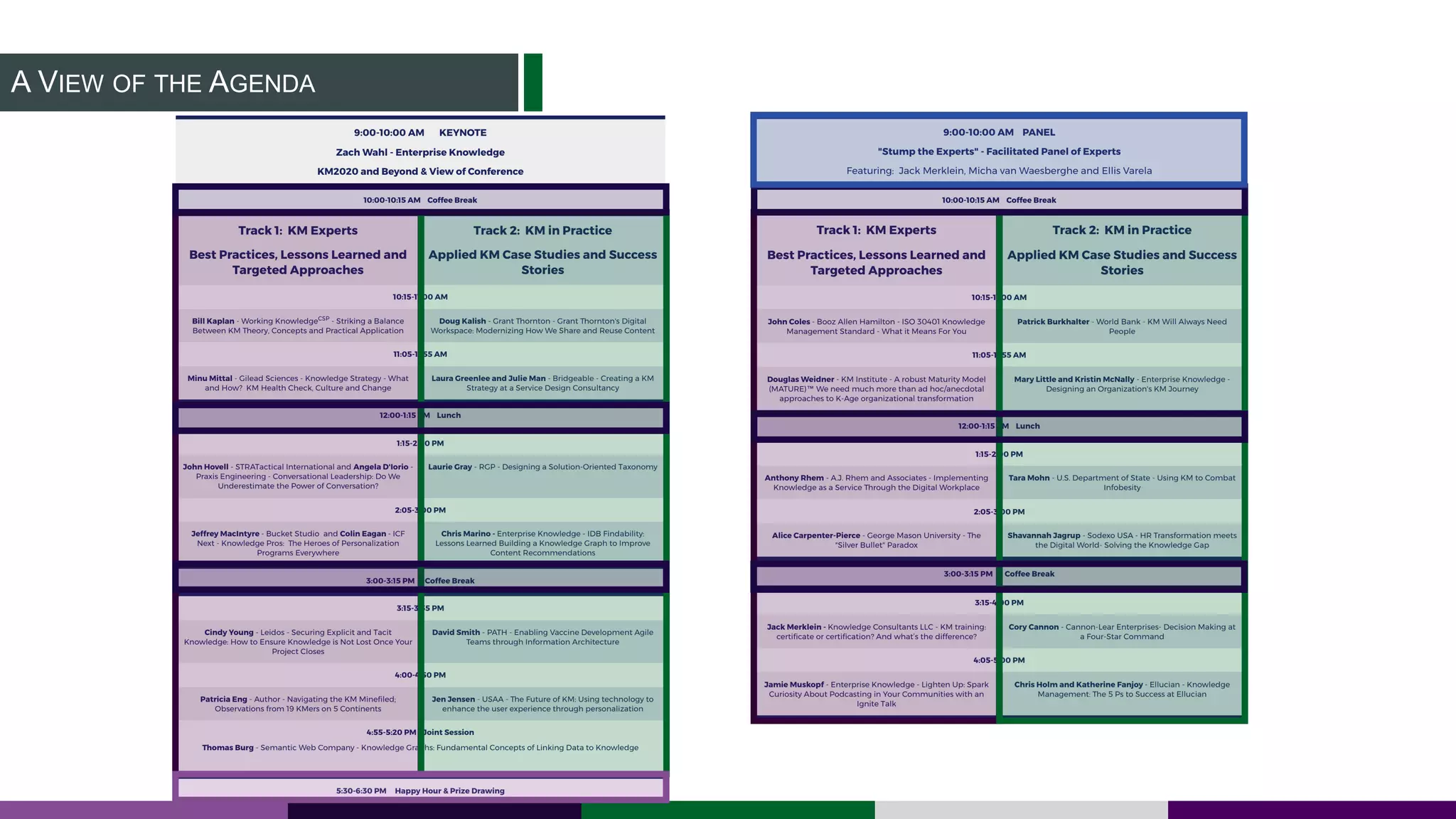
A VIEW OF THE AGENDA
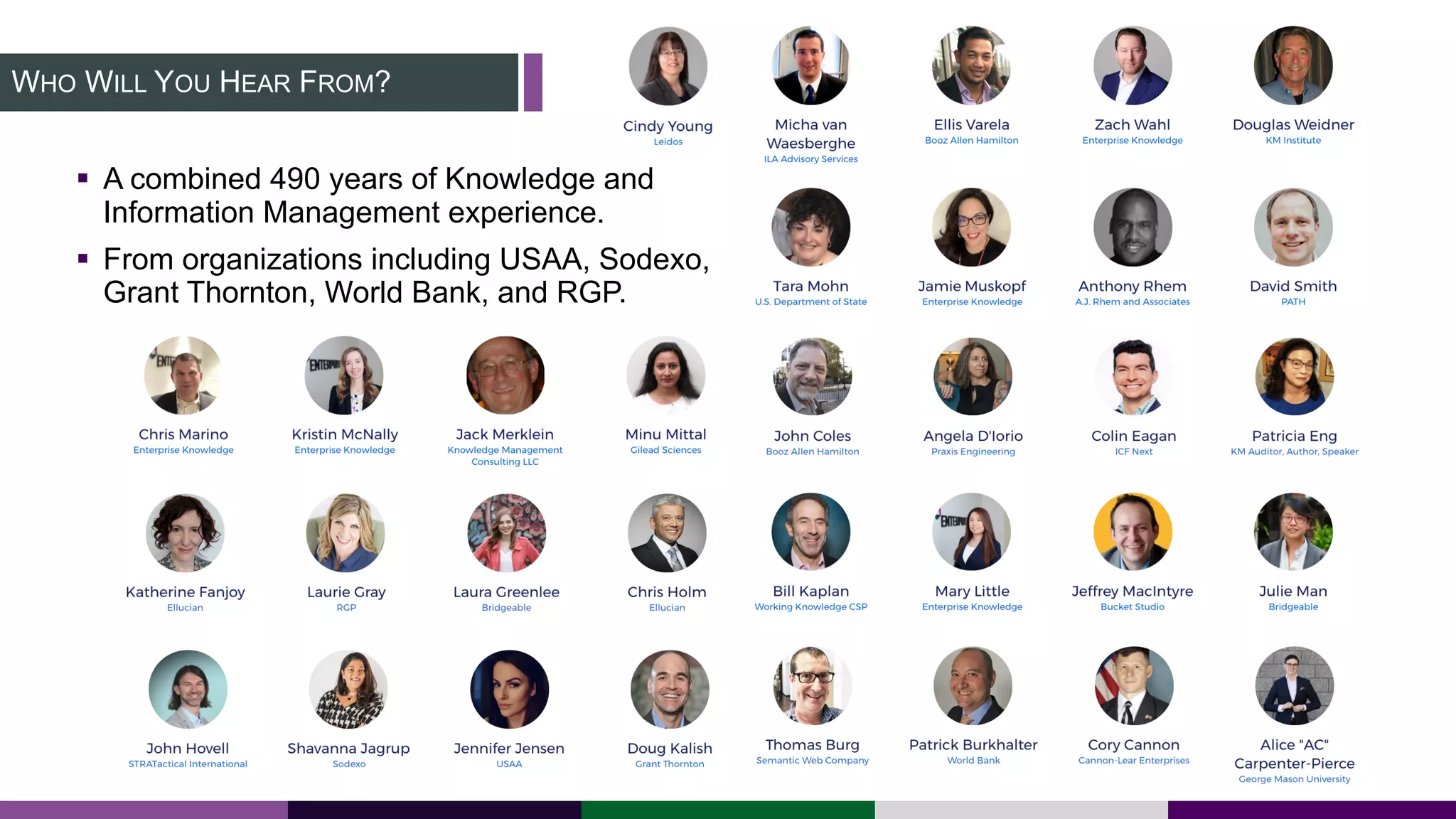
WHO WILL YOU HEAR FROM?
§ A combined 490 years of Knowledge and
Information Management experience.
§ From organizations including USAA, Sodexo,
Grant Thornton, World Bank, and RGP.
KM FOUNDATIONS
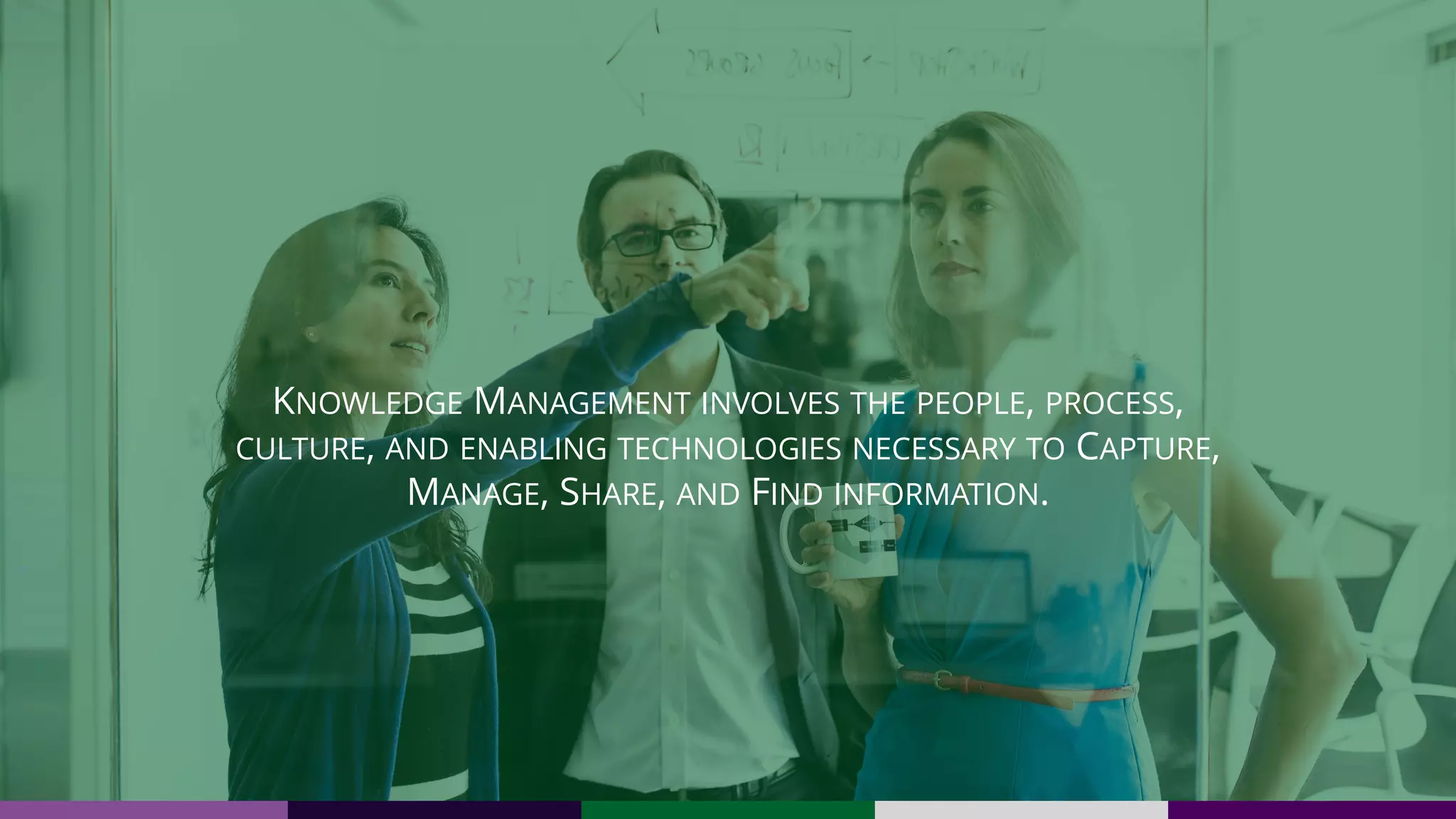
KNOWLEDGE MANAGEMENT INVOLVES THE PEOPLE, PROCESS,
CULTURE, AND ENABLING TECHNOLOGIES NECESSARY TO CAPTURE,
MANAGE, SHARE, AND FIND INFORMATION.
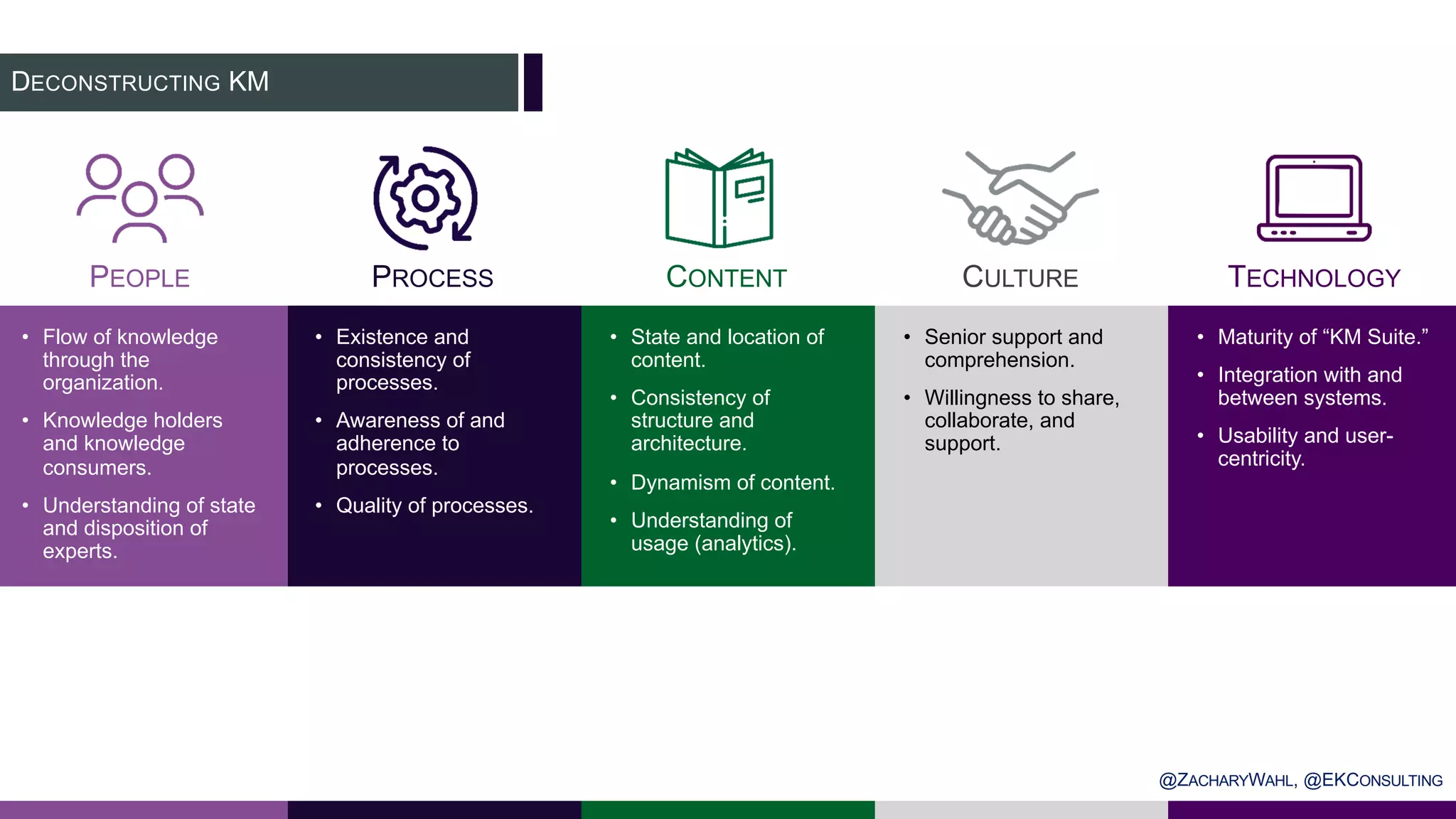
DECONSTRUCTING KM
PEOPLE PROCESS CONTENT CULTURE TECHNOLOGY
• Flow of knowledge
through the
organization.
• Knowledge holders
and knowledge
consumers.
• Understanding of state
and disposition of
experts.
• Existence and
consistency of
processes.
• Awareness of and
adherence to
processes.
• Quality of processes.
• State and location of
content.
• Consistency of
structure and
architecture.
• Dynamism of content.
• Understanding of
usage (analytics).
• Senior support and
comprehension.
• Willingness to share,
collaborate, and
support.
• Maturity of “KM Suite.”
• Integration with and
between systems.
• Usability and user-
centricity.
@ZACHARYWAHL, @EKCONSULTING
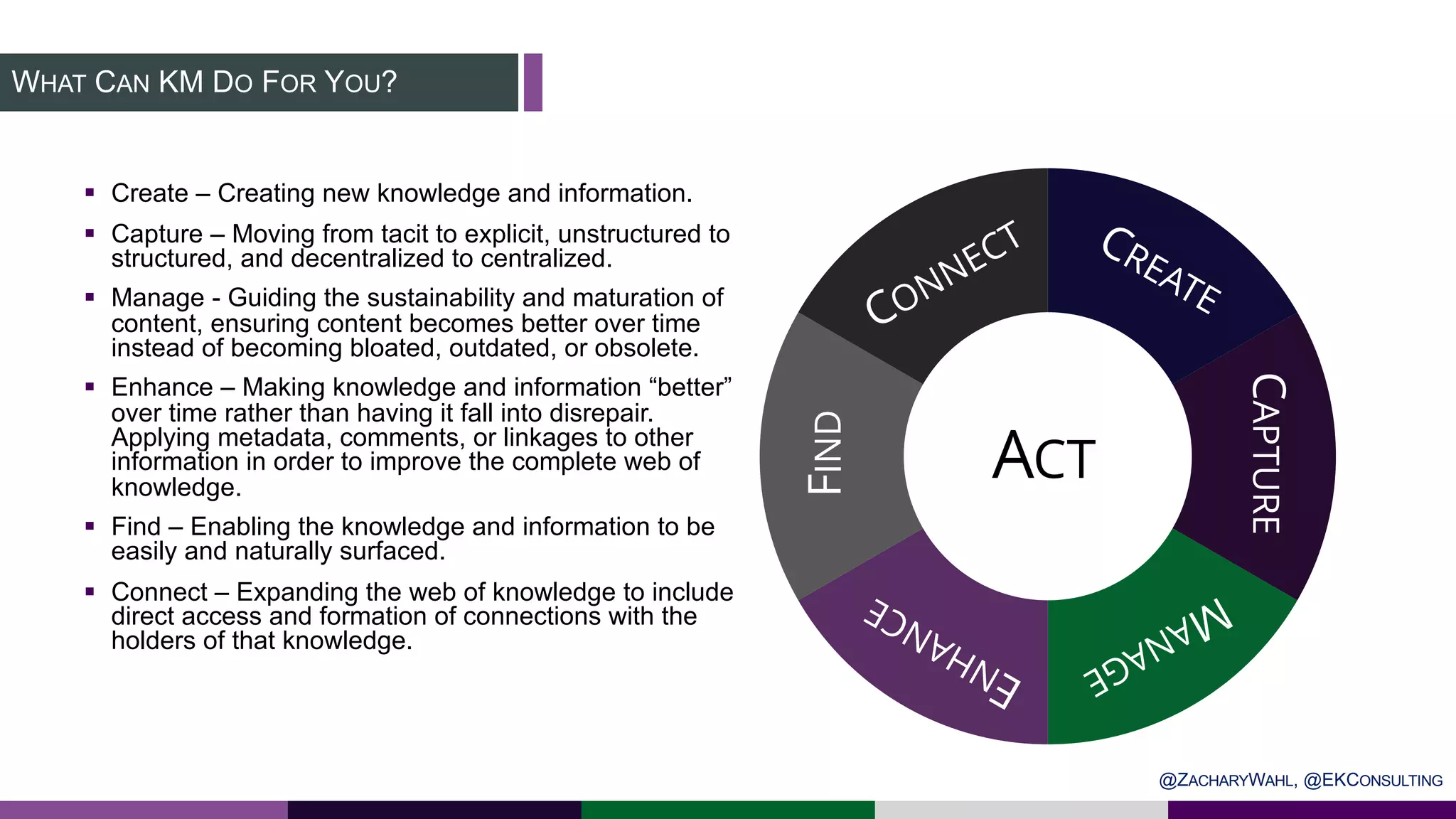
FIND
CAPTURE
CREATE
CONNECT
MANAGEENHANCE
ACT
WHAT CAN KM DO FOR YOU?
§ Create – Creating new knowledge and information.
§ Capture – Moving from tacit to explicit, unstructured to
structured, and decentralized to centralized.
§ Manage - Guiding the sustainability and maturation of
content, ensuring content becomes better over time
instead of becoming bloated, outdated, or obsolete.
§ Enhance – Making knowledge and information “better”
over time rather than having it fall into disrepair.
Applying metadata, comments, or linkages to other
information in order to improve the complete web of
knowledge.
§ Find – Enabling the knowledge and information to be
easily and naturally surfaced.
§ Connect – Expanding the web of knowledge to include
direct access and formation of connections with the
holders of that knowledge.
@ZACHARYWAHL, @EKCONSULTING
KM 2020 AND BEYOND
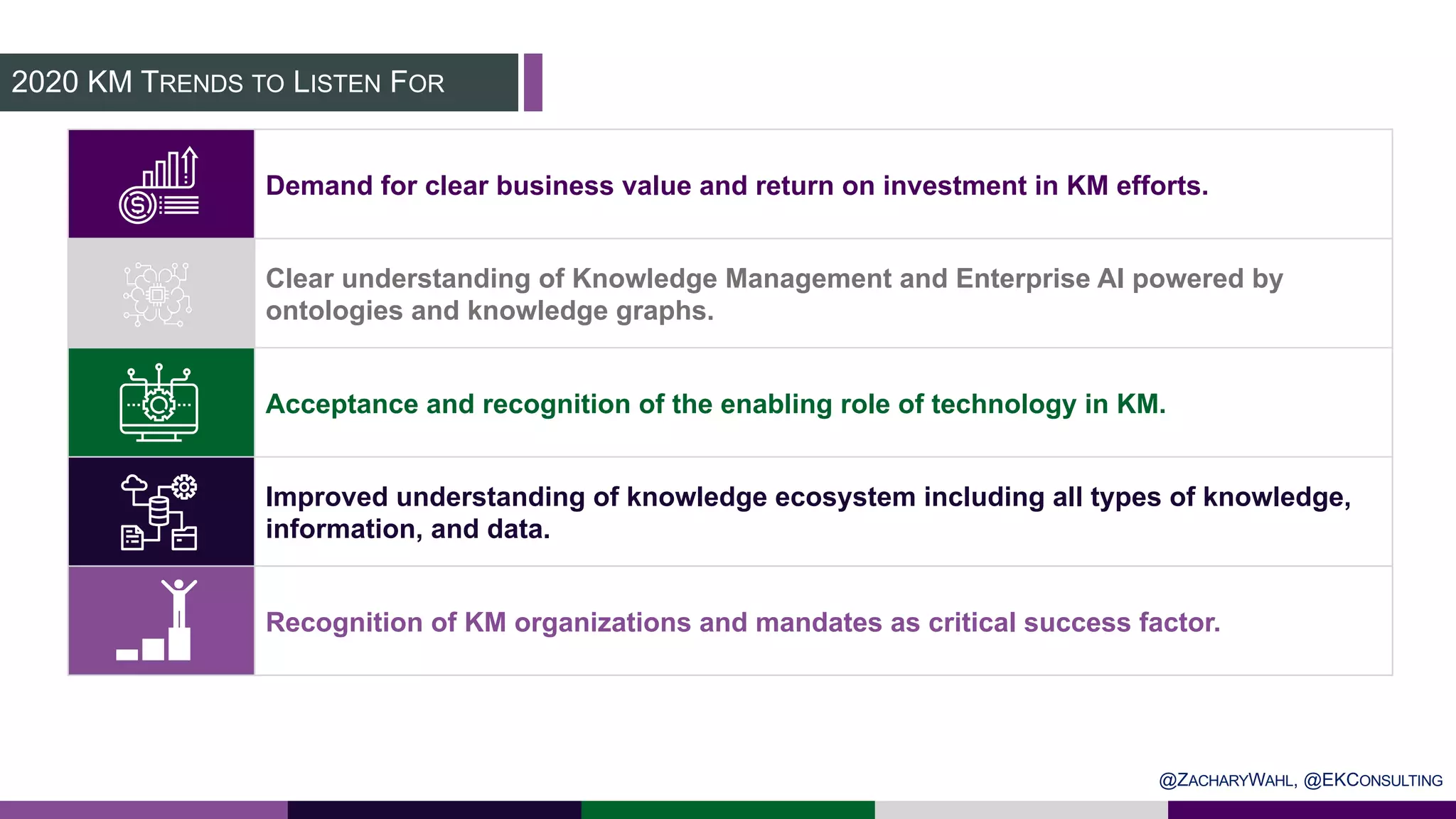
Demand for clear business value and return on investment in KM efforts.
Clear understanding of Knowledge Management and Enterprise AI powered by
ontologies and knowledge graphs.
Acceptance and recognition of the enabling role of technology in KM.
Improved understanding of knowledge ecosystem including all types of knowledge,
information, and data.
Recognition of KM organizations and mandates as critical success factor.
2020 KM TRENDS TO LISTEN FOR
@ZACHARYWAHL, @EKCONSULTING
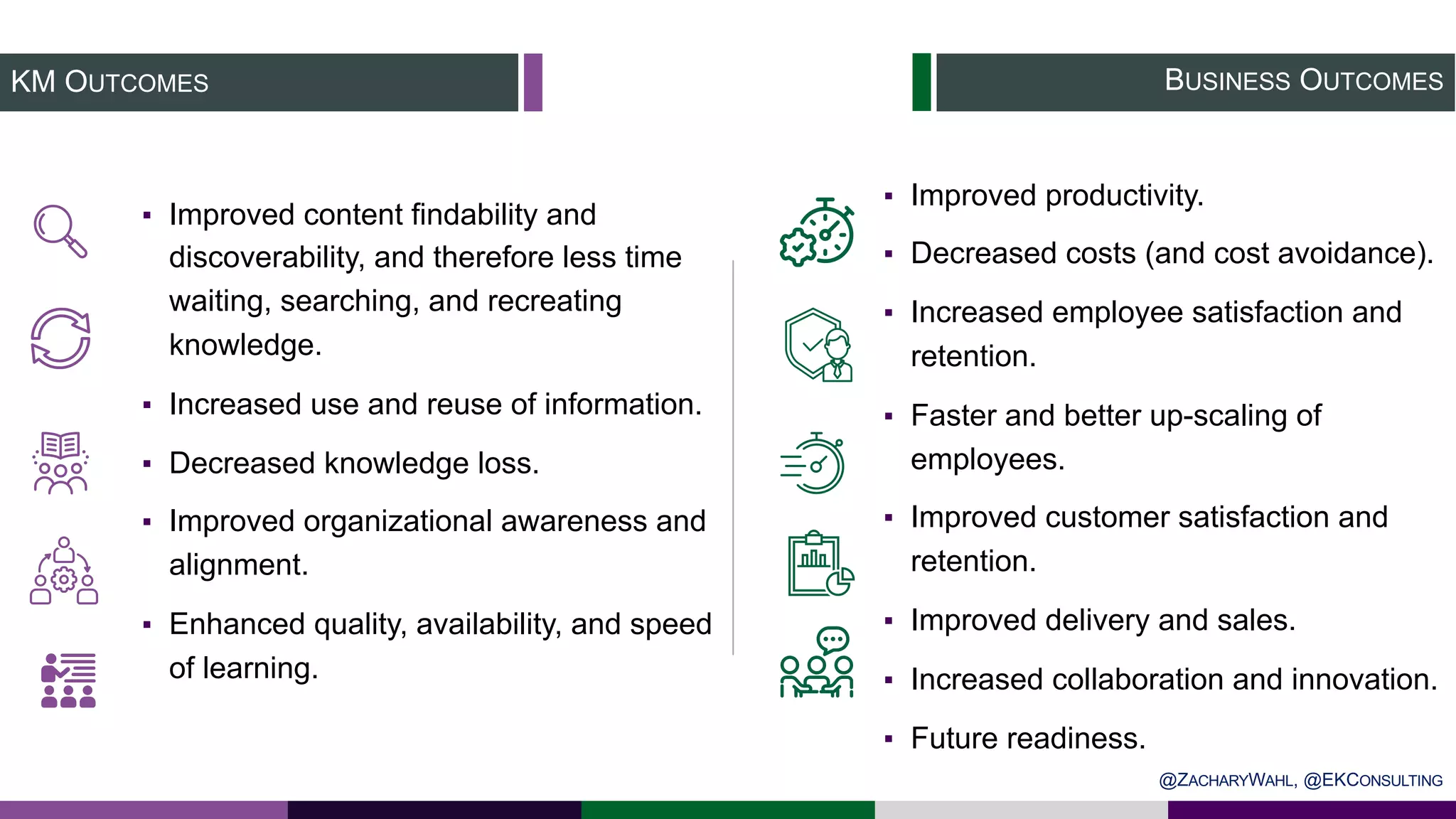
BUSINESS OUTCOMESKM OUTCOMES
▪ Improved content findability and
discoverability, and therefore less time
waiting, searching, and recreating
knowledge.
▪ Increased use and reuse of information.
▪ Decreased knowledge loss.
▪ Improved organizational awareness and
alignment.
▪ Enhanced quality, availability, and speed
of learning.
▪ Improved productivity.
▪ Decreased costs (and cost avoidance).
▪ Increased employee satisfaction and
retention.
▪ Faster and better up-scaling of
employees.
▪ Improved customer satisfaction and
retention.
▪ Improved delivery and sales.
▪ Increased collaboration and innovation.
▪ Future readiness.
@ZACHARYWAHL, @EKCONSULTING
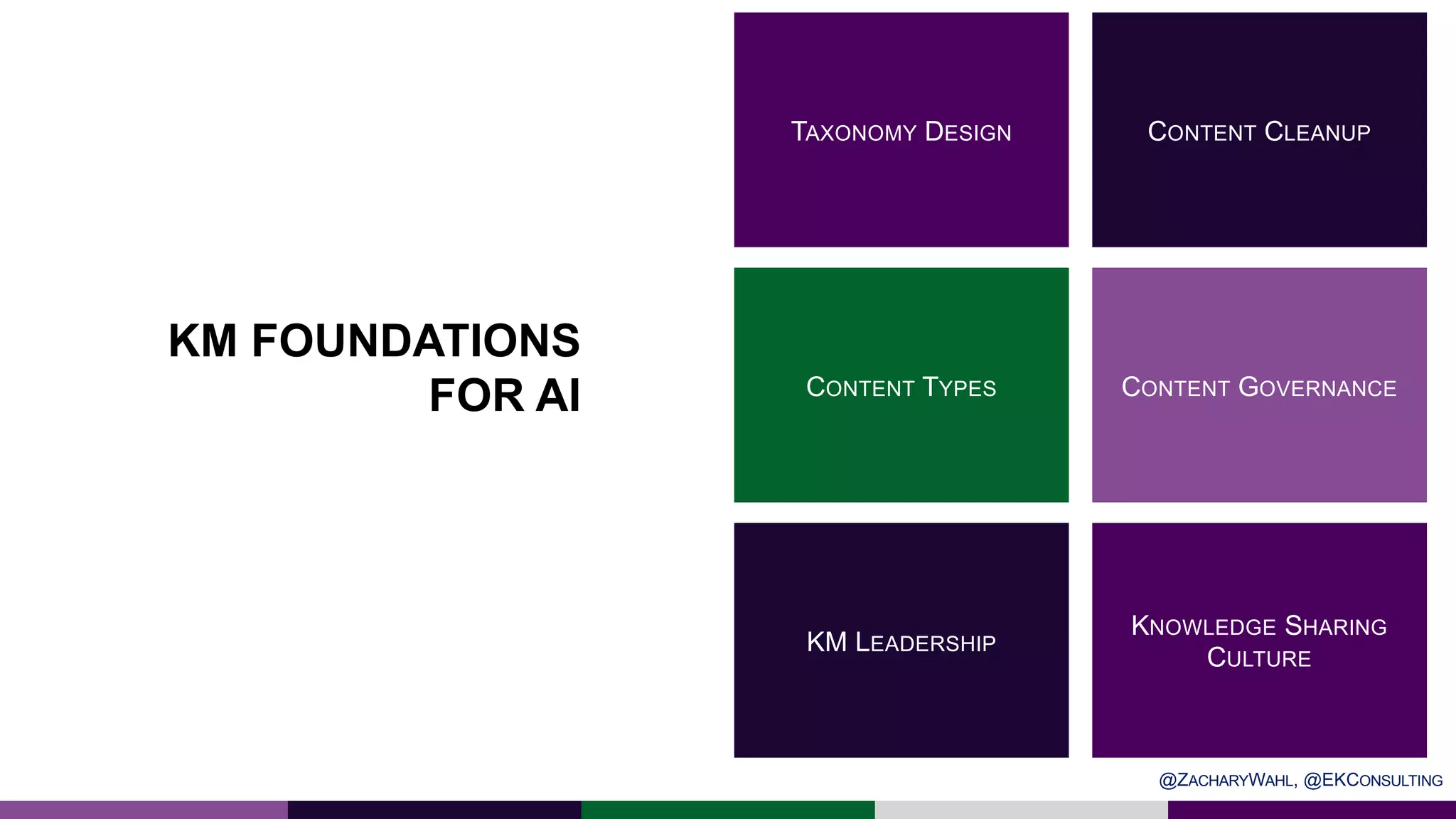
KM FOUNDATIONS
FOR AI
CONTENT CLEANUP
CONTENT GOVERNANCE
TAXONOMY DESIGN
CONTENT TYPES
KNOWLEDGE SHARING
CULTURE
KM LEADERSHIP
@ZACHARYWAHL, @EKCONSULTING
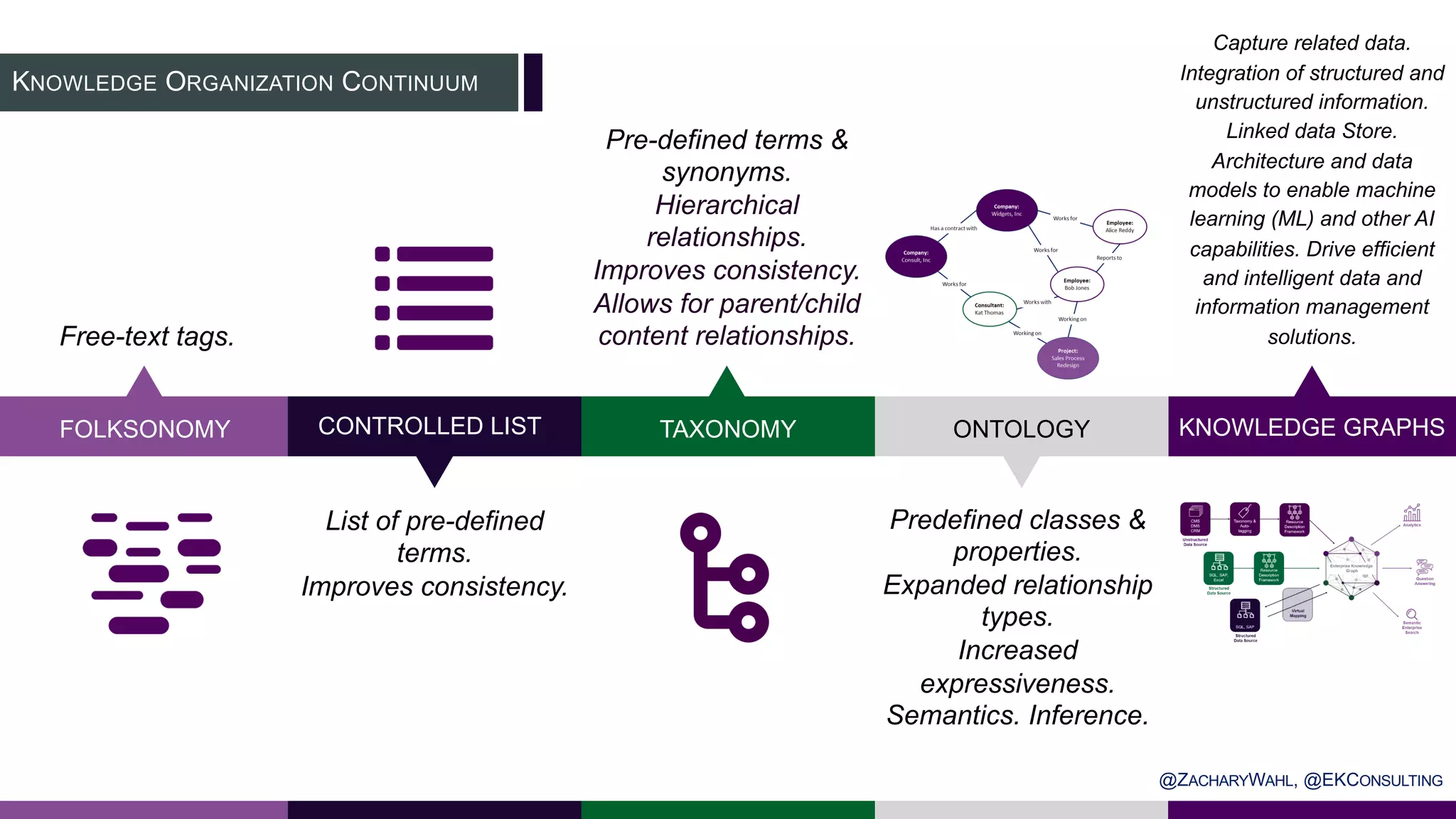
FOLKSONOMY
Free-text tags.
CONTROLLED LIST
List of pre-defined
terms.
Improves consistency.
TAXONOMY
Pre-defined terms &
synonyms.
Hierarchical
relationships.
Improves consistency.
Allows for parent/child
content relationships.
Capture related data.
Integration of structured and
unstructured information.
Linked data Store.
Architecture and data
models to enable machine
learning (ML) and other AI
capabilities. Drive efficient
and intelligent data and
information management
solutions.
ONTOLOGY
Predefined classes &
properties.
Expanded relationship
types.
Increased
expressiveness.
Semantics. Inference.
KNOWLEDGE GRAPHS
KNOWLEDGE ORGANIZATION CONTINUUM
@ZACHARYWAHL, @EKCONSULTING
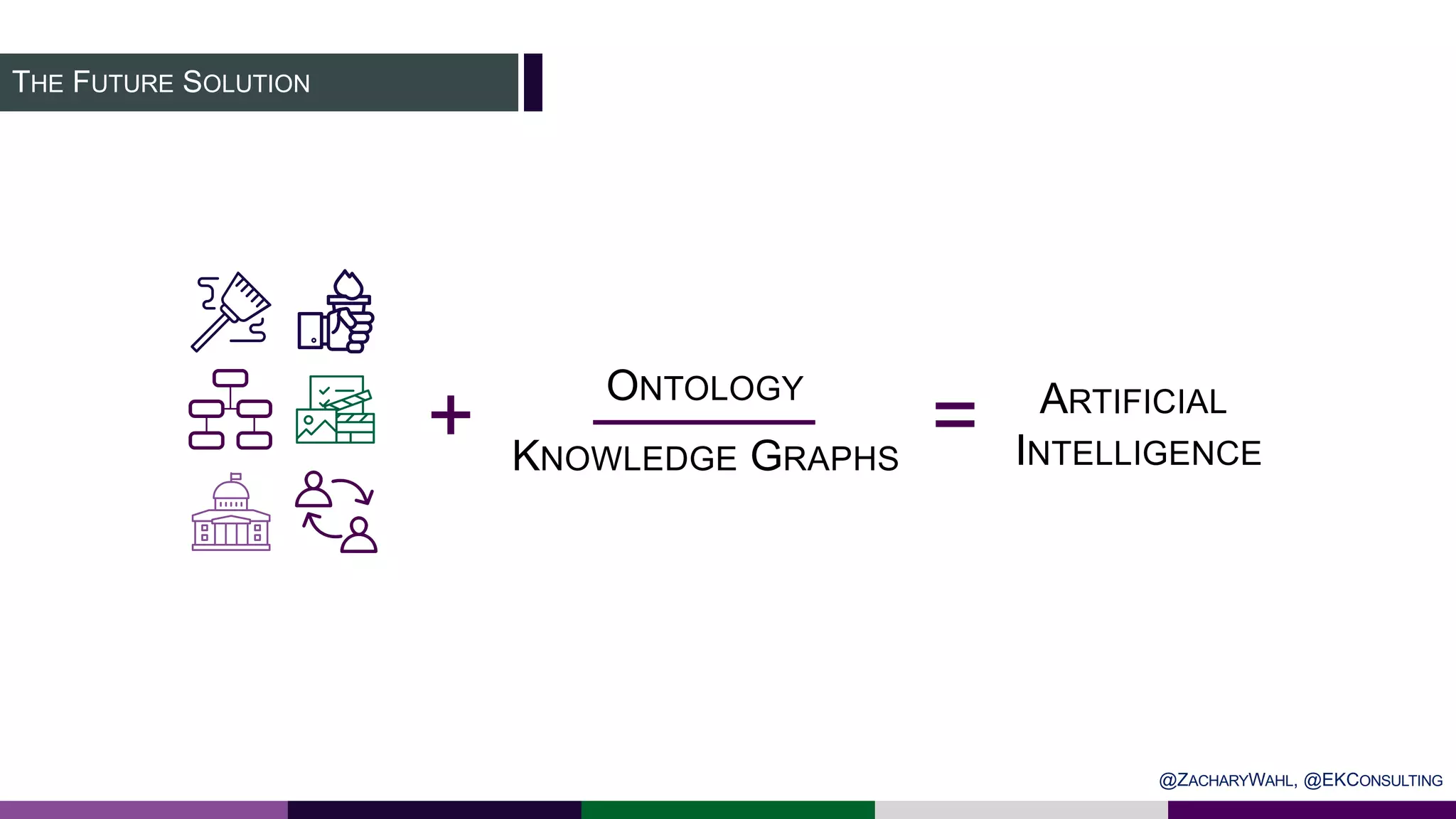
THE FUTURE SOLUTION
+
ONTOLOGY
KNOWLEDGE GRAPHS
= ARTIFICIAL
INTELLIGENCE
@ZACHARYWAHL, @EKCONSULTING
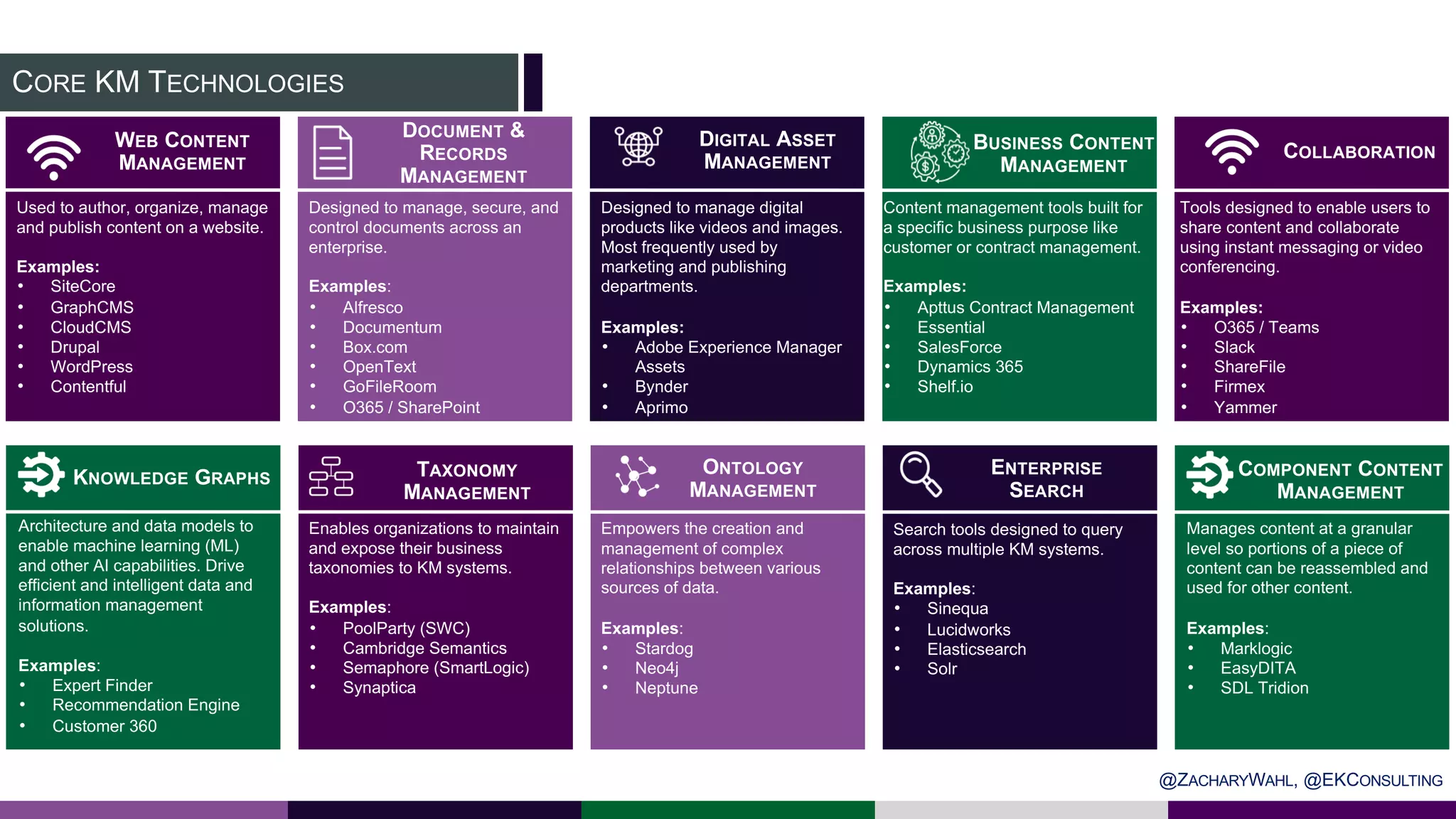
CORE KM TECHNOLOGIES
KNOWLEDGE GRAPHS TAXONOMY
MANAGEMENT
ONTOLOGY
MANAGEMENT
ENTERPRISE
SEARCH
Architecture and data models to
enable machine learning (ML)
and other AI capabilities. Drive
efficient and intelligent data and
information management
solutions.
Examples:
• Expert Finder
• Recommendation Engine
• Customer 360
WEB CONTENT
MANAGEMENT
DOCUMENT &
RECORDS
MANAGEMENT
DIGITAL ASSET
MANAGEMENT
BUSINESS CONTENT
MANAGEMENT
Used to author, organize, manage
and publish content on a website.
Examples:
• SiteCore
• GraphCMS
• CloudCMS
• Drupal
• WordPress
• Contentful
Designed to manage, secure, and
control documents across an
enterprise.
Examples:
• Alfresco
• Documentum
• Box.com
• OpenText
• GoFileRoom
• O365 / SharePoint
Designed to manage digital
products like videos and images.
Most frequently used by
marketing and publishing
departments.
Examples:
• Adobe Experience Manager
Assets
• Bynder
• Aprimo
Content management tools built for
a specific business purpose like
customer or contract management.
Examples:
• Apttus Contract Management
• Essential
• SalesForce
• Dynamics 365
• Shelf.io
Search tools designed to query
across multiple KM systems.
Examples:
• Sinequa
• Lucidworks
• Elasticsearch
• Solr
Empowers the creation and
management of complex
relationships between various
sources of data.
Examples:
• Stardog
• Neo4j
• Neptune
Enables organizations to maintain
and expose their business
taxonomies to KM systems.
Examples:
• PoolParty (SWC)
• Cambridge Semantics
• Semaphore (SmartLogic)
• Synaptica
COMPONENT CONTENT
MANAGEMENT
Manages content at a granular
level so portions of a piece of
content can be reassembled and
used for other content.
Examples:
• Marklogic
• EasyDITA
• SDL Tridion
COLLABORATION
Tools designed to enable users to
share content and collaborate
using instant messaging or video
conferencing.
Examples:
• O365 / Teams
• Slack
• ShareFile
• Firmex
• Yammer
@ZACHARYWAHL, @EKCONSULTING
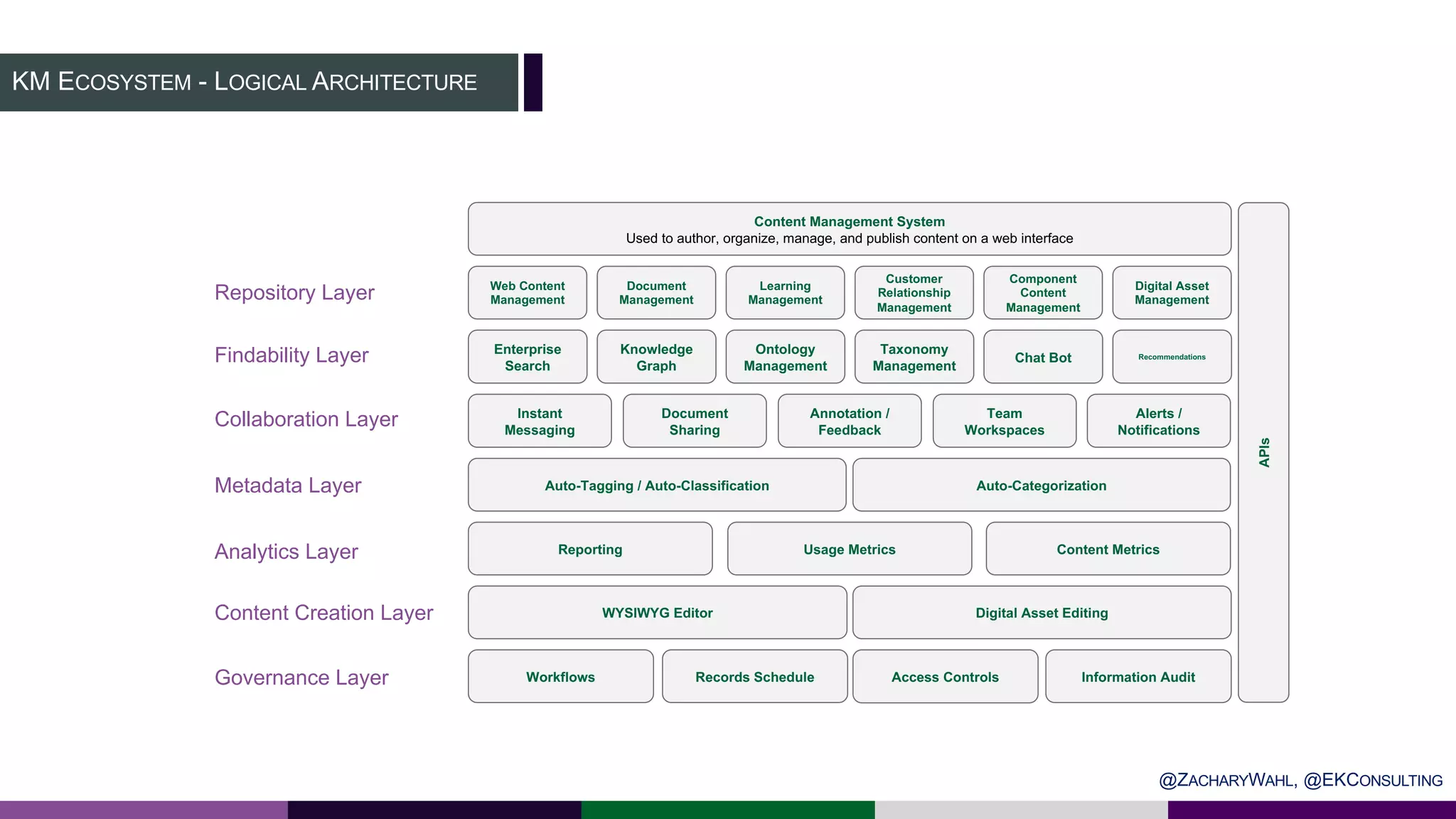
KM ECOSYSTEM - LOGICAL ARCHITECTURE
Content Management System
Used to author, organize, manage, and publish content on a web interface
Repository Layer Web Content
Management
Enterprise
Search
Learning
Management
Analytics Layer
Taxonomy
Management
Document
Management
Instant
Messaging
Findability Layer Ontology
Management
Collaboration Layer
Content Creation Layer
Document
Sharing
Annotation /
Feedback
Chat Bot
Team
Workspaces
Reporting Usage Metrics Content Metrics
Governance Layer Workflows Records Schedule Access Controls Information Audit
WYSIWYG Editor Digital Asset Editing
Alerts /
Notifications
Recommendations
APIs
Knowledge
Graph
Customer
Relationship
Management
Digital Asset
Management
Component
Content
Management
Metadata Layer Auto-Tagging / Auto-Classification Auto-Categorization
@ZACHARYWAHL, @EKCONSULTING
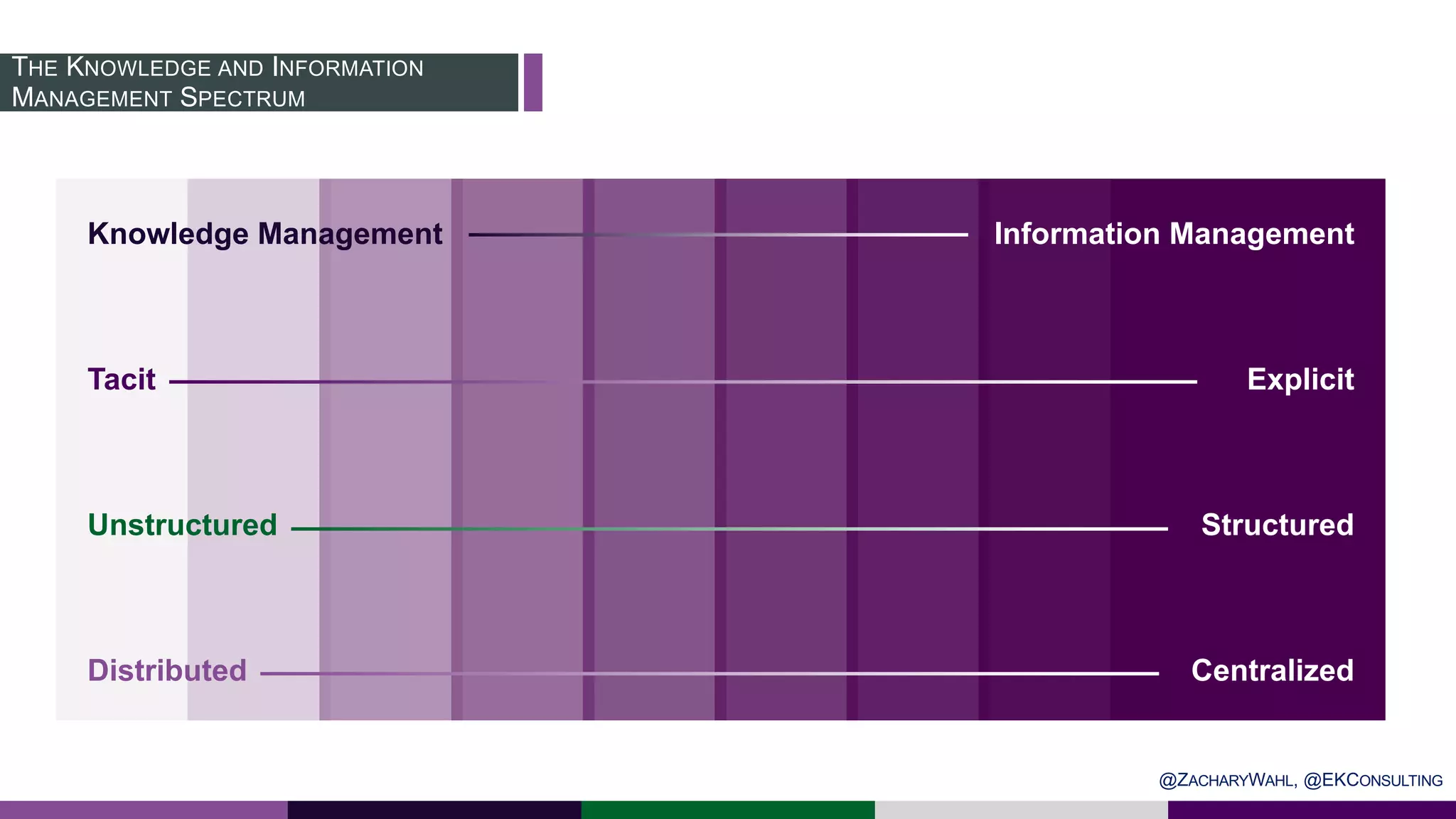
THE KNOWLEDGE AND INFORMATION
MANAGEMENT SPECTRUM
Knowledge Management
Tacit
Unstructured
Distributed
Information Management
Explicit
Structured
Centralized
@ZACHARYWAHL, @EKCONSULTING
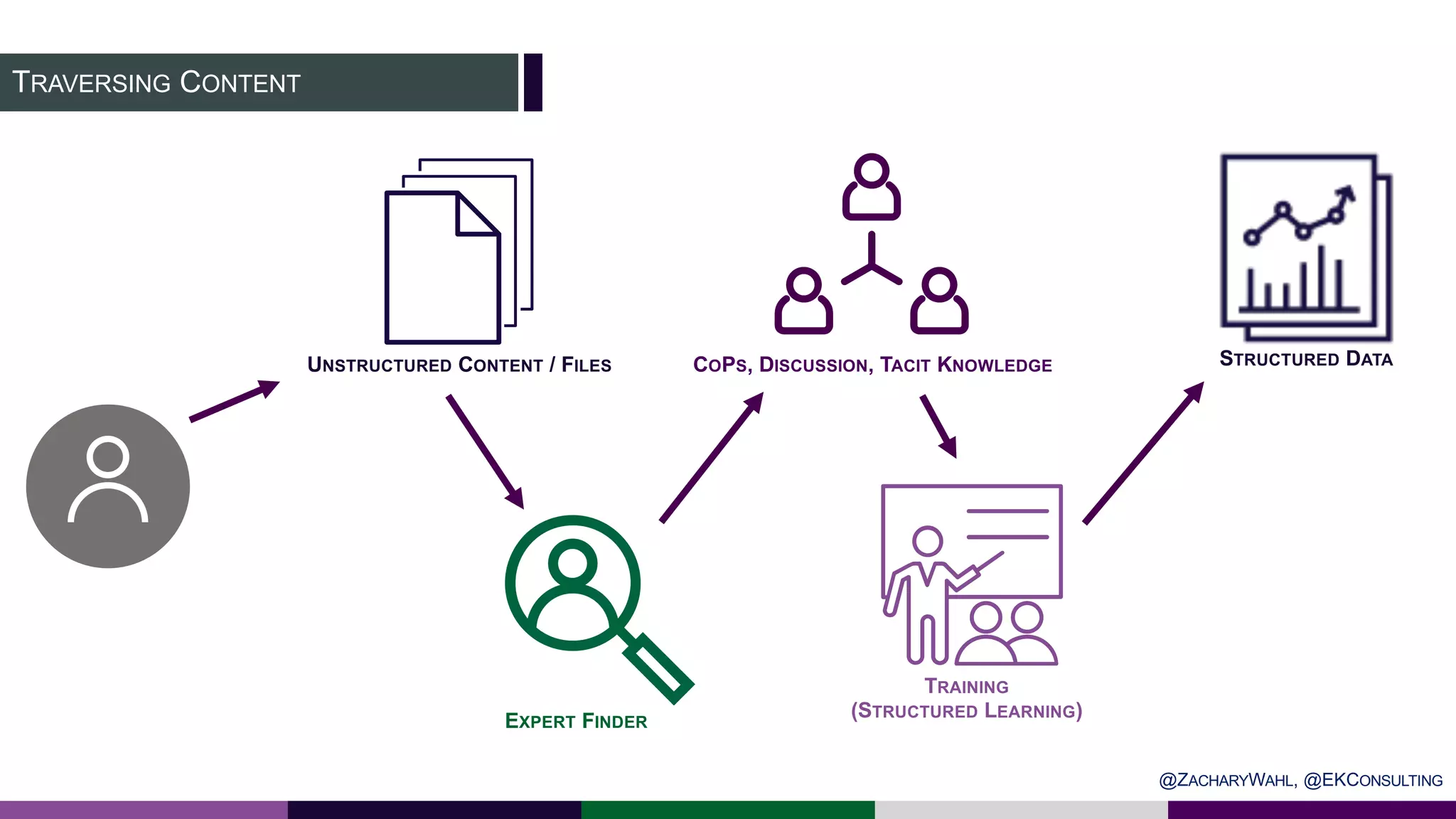
TRAVERSING CONTENT
UNSTRUCTURED CONTENT / FILES
EXPERT FINDER
COPS, DISCUSSION, TACIT KNOWLEDGE
TRAINING
(STRUCTURED LEARNING)
STRUCTURED DATA
@ZACHARYWAHL, @EKCONSULTING
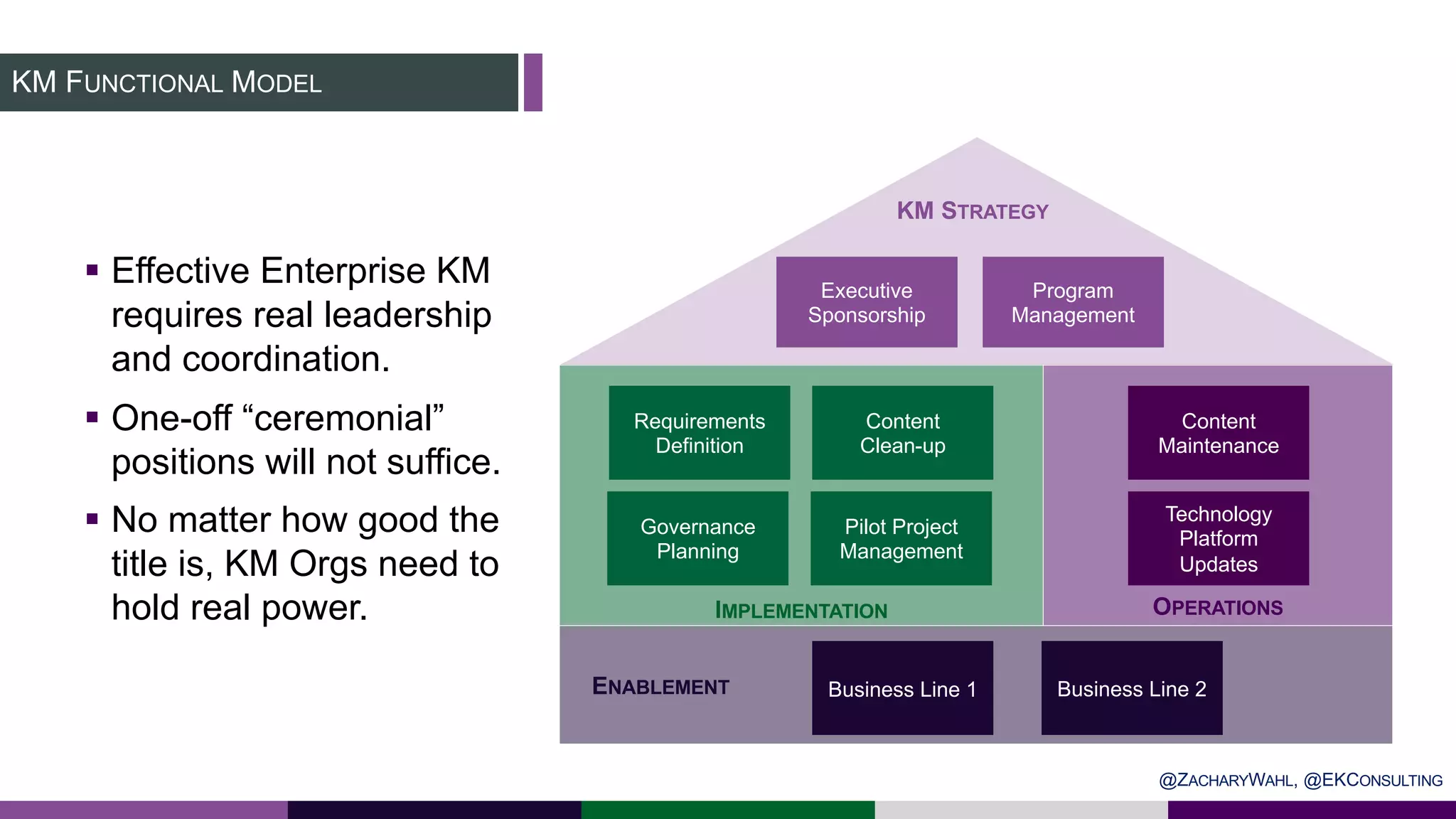
KM FUNCTIONAL MODEL
Executive
Sponsorship
Requirements
Definition
Pilot Project
Management
Governance
Planning
Content
Clean-up
Content
Maintenance
Technology
Platform
Updates
Program
Management
KM STRATEGY
IMPLEMENTATION
ENABLEMENT
OPERATIONS
Business Line 1 Business Line 2
§ Effective Enterprise KM
requires real leadership
and coordination.
§ One-off “ceremonial”
positions will not suffice.
§ No matter how good the
title is, KM Orgs need to
hold real power.
@ZACHARYWAHL, @EKCONSULTING
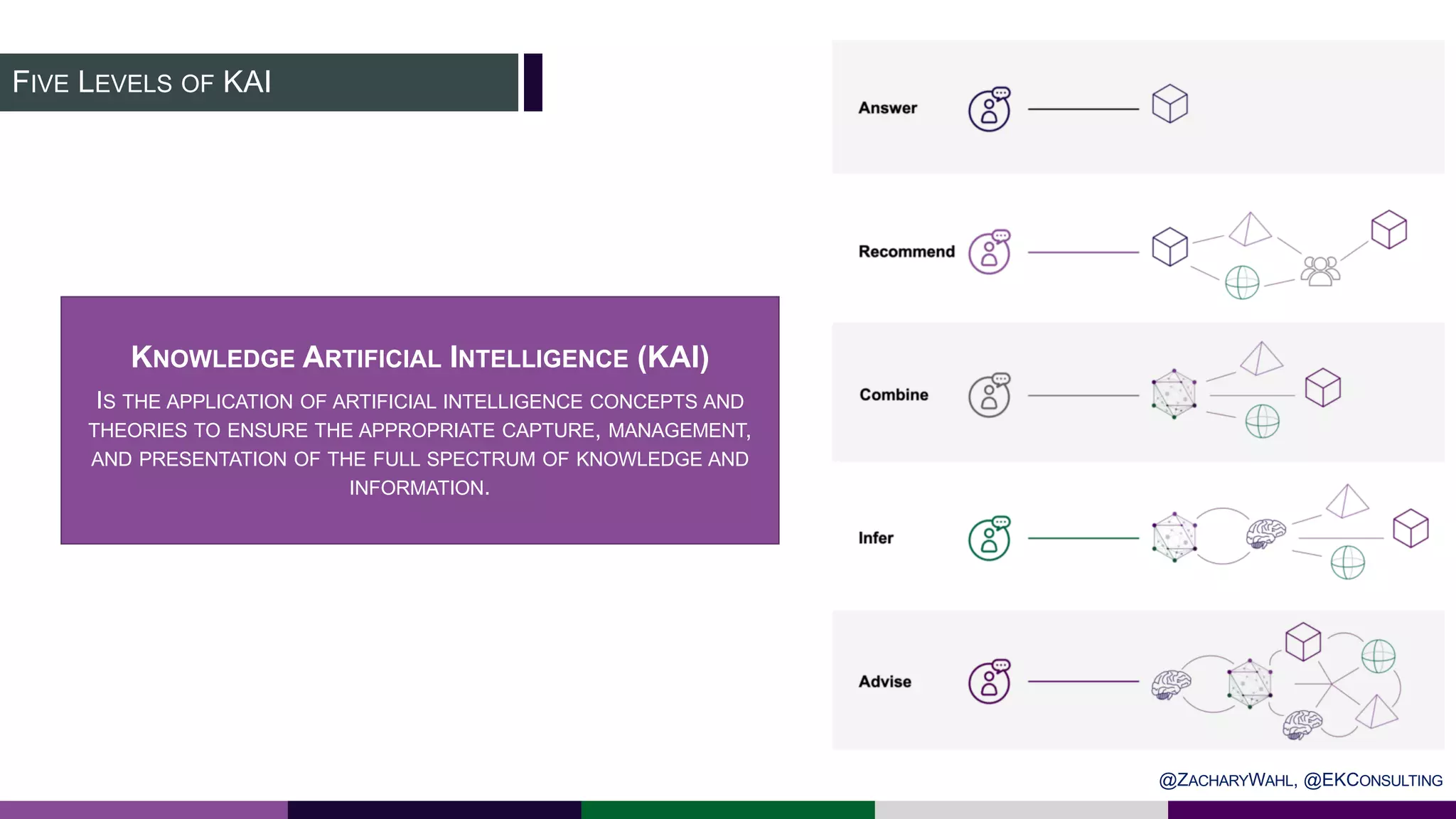
FIVE LEVELS OF KAI
KNOWLEDGE ARTIFICIAL INTELLIGENCE (KAI)
IS THE APPLICATION OF ARTIFICIAL INTELLIGENCE CONCEPTS AND
THEORIES TO ENSURE THE APPROPRIATE CAPTURE, MANAGEMENT,
AND PRESENTATION OF THE FULL SPECTRUM OF KNOWLEDGE AND
INFORMATION.
@ZACHARYWAHL, @EKCONSULTING
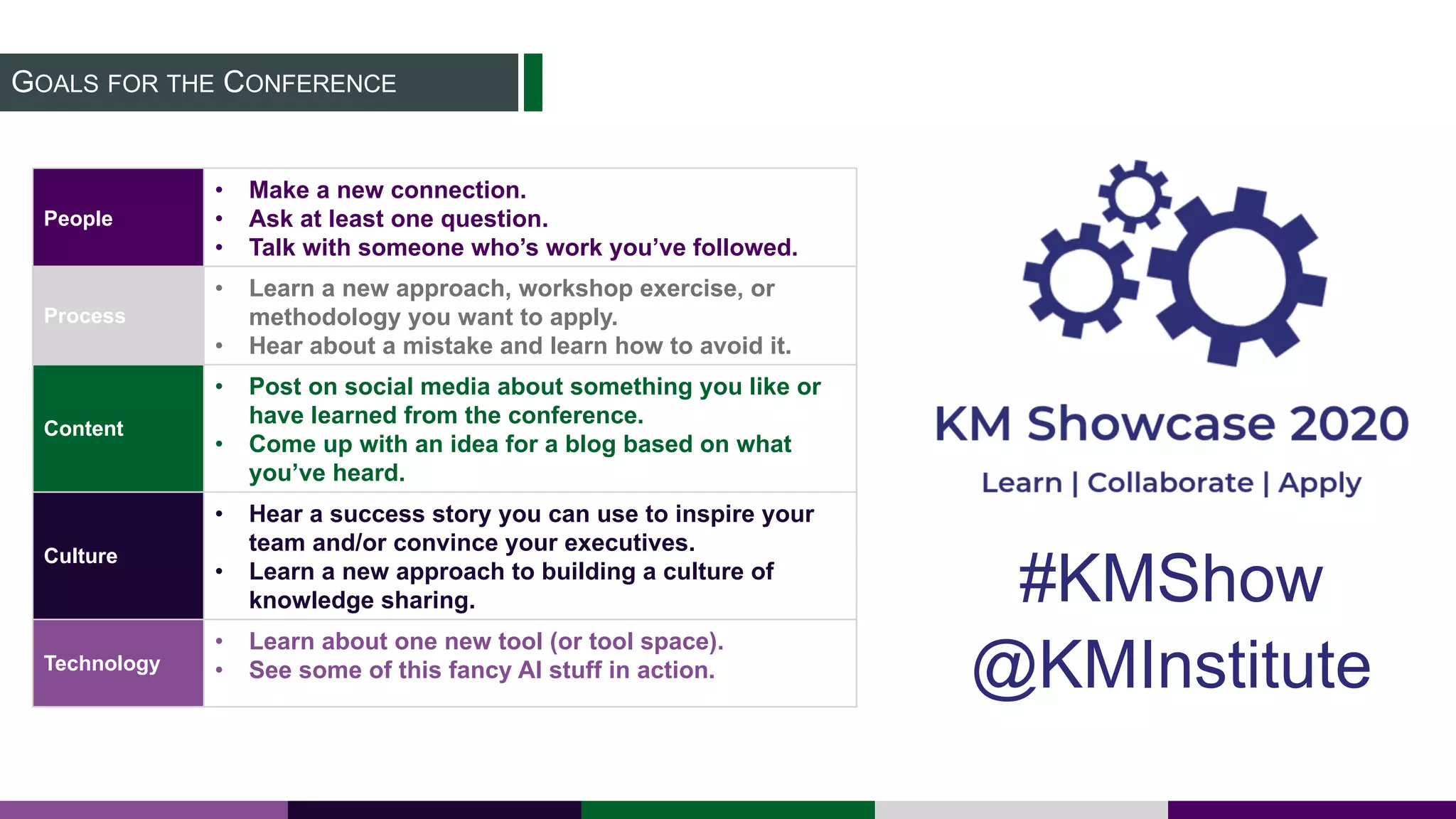
MY GOALS FOR THE CONFERENCE
GOALS FOR THE CONFERENCE
#KMShow
@KMInstitute
People
• Make a new connection.
• Ask at least one question.
• Talk with someone who’s work you’ve followed.
Process
• Learn a new approach, workshop exercise, or
methodology you want to apply.
• Hear about a mistake and learn how to avoid it.
Content
• Post on social media about something you like or
have learned from the conference.
• Come up with an idea for a blog based on what
you’ve heard.
Culture
• Hear a success story you can use to inspire your
team and/or convince your executives.
• Learn a new approach to building a culture of
knowledge sharing.
Technology
• Learn about one new tool (or tool space).
• See some of this fancy AI stuff in action.

KM Showcase: Conference View and Knowledge Management 2020 and Beyond

  • 1.
    CONFERENCE VIEW AND KNOWLEDGEMANAGEMENT 2020 AND BEYOND March 4, 2020
  • 2.
    ZACH WAHL FOUNDER ANDPRESIDENT, EK @ZACHARYWAHL, @EKCONSULTING
  • 3.
    WELCOME! Thank you forbeing here! #KMShow @KMInstitute
  • 4.
    A VIEW OFTHE AGENDA
  • 5.
    WHO WILL YOUHEAR FROM? § A combined 490 years of Knowledge and Information Management experience. § From organizations including USAA, Sodexo, Grant Thornton, World Bank, and RGP.
  • 6.
  • 7.
    KNOWLEDGE MANAGEMENT INVOLVESTHE PEOPLE, PROCESS, CULTURE, AND ENABLING TECHNOLOGIES NECESSARY TO CAPTURE, MANAGE, SHARE, AND FIND INFORMATION.
  • 8.
    DECONSTRUCTING KM PEOPLE PROCESSCONTENT CULTURE TECHNOLOGY • Flow of knowledge through the organization. • Knowledge holders and knowledge consumers. • Understanding of state and disposition of experts. • Existence and consistency of processes. • Awareness of and adherence to processes. • Quality of processes. • State and location of content. • Consistency of structure and architecture. • Dynamism of content. • Understanding of usage (analytics). • Senior support and comprehension. • Willingness to share, collaborate, and support. • Maturity of “KM Suite.” • Integration with and between systems. • Usability and user- centricity. @ZACHARYWAHL, @EKCONSULTING
  • 9.
    FIND CAPTURE CREATE CONNECT MANAGEENHANCE ACT WHAT CAN KMDO FOR YOU? § Create – Creating new knowledge and information. § Capture – Moving from tacit to explicit, unstructured to structured, and decentralized to centralized. § Manage - Guiding the sustainability and maturation of content, ensuring content becomes better over time instead of becoming bloated, outdated, or obsolete. § Enhance – Making knowledge and information “better” over time rather than having it fall into disrepair. Applying metadata, comments, or linkages to other information in order to improve the complete web of knowledge. § Find – Enabling the knowledge and information to be easily and naturally surfaced. § Connect – Expanding the web of knowledge to include direct access and formation of connections with the holders of that knowledge. @ZACHARYWAHL, @EKCONSULTING
  • 10.
  • 11.
    Demand for clearbusiness value and return on investment in KM efforts. Clear understanding of Knowledge Management and Enterprise AI powered by ontologies and knowledge graphs. Acceptance and recognition of the enabling role of technology in KM. Improved understanding of knowledge ecosystem including all types of knowledge, information, and data. Recognition of KM organizations and mandates as critical success factor. 2020 KM TRENDS TO LISTEN FOR @ZACHARYWAHL, @EKCONSULTING
  • 13.
    BUSINESS OUTCOMESKM OUTCOMES ▪Improved content findability and discoverability, and therefore less time waiting, searching, and recreating knowledge. ▪ Increased use and reuse of information. ▪ Decreased knowledge loss. ▪ Improved organizational awareness and alignment. ▪ Enhanced quality, availability, and speed of learning. ▪ Improved productivity. ▪ Decreased costs (and cost avoidance). ▪ Increased employee satisfaction and retention. ▪ Faster and better up-scaling of employees. ▪ Improved customer satisfaction and retention. ▪ Improved delivery and sales. ▪ Increased collaboration and innovation. ▪ Future readiness. @ZACHARYWAHL, @EKCONSULTING
  • 15.
    KM FOUNDATIONS FOR AI CONTENTCLEANUP CONTENT GOVERNANCE TAXONOMY DESIGN CONTENT TYPES KNOWLEDGE SHARING CULTURE KM LEADERSHIP @ZACHARYWAHL, @EKCONSULTING
  • 16.
    FOLKSONOMY Free-text tags. CONTROLLED LIST Listof pre-defined terms. Improves consistency. TAXONOMY Pre-defined terms & synonyms. Hierarchical relationships. Improves consistency. Allows for parent/child content relationships. Capture related data. Integration of structured and unstructured information. Linked data Store. Architecture and data models to enable machine learning (ML) and other AI capabilities. Drive efficient and intelligent data and information management solutions. ONTOLOGY Predefined classes & properties. Expanded relationship types. Increased expressiveness. Semantics. Inference. KNOWLEDGE GRAPHS KNOWLEDGE ORGANIZATION CONTINUUM @ZACHARYWAHL, @EKCONSULTING
  • 17.
    THE FUTURE SOLUTION + ONTOLOGY KNOWLEDGEGRAPHS = ARTIFICIAL INTELLIGENCE @ZACHARYWAHL, @EKCONSULTING
  • 19.
    CORE KM TECHNOLOGIES KNOWLEDGEGRAPHS TAXONOMY MANAGEMENT ONTOLOGY MANAGEMENT ENTERPRISE SEARCH Architecture and data models to enable machine learning (ML) and other AI capabilities. Drive efficient and intelligent data and information management solutions. Examples: • Expert Finder • Recommendation Engine • Customer 360 WEB CONTENT MANAGEMENT DOCUMENT & RECORDS MANAGEMENT DIGITAL ASSET MANAGEMENT BUSINESS CONTENT MANAGEMENT Used to author, organize, manage and publish content on a website. Examples: • SiteCore • GraphCMS • CloudCMS • Drupal • WordPress • Contentful Designed to manage, secure, and control documents across an enterprise. Examples: • Alfresco • Documentum • Box.com • OpenText • GoFileRoom • O365 / SharePoint Designed to manage digital products like videos and images. Most frequently used by marketing and publishing departments. Examples: • Adobe Experience Manager Assets • Bynder • Aprimo Content management tools built for a specific business purpose like customer or contract management. Examples: • Apttus Contract Management • Essential • SalesForce • Dynamics 365 • Shelf.io Search tools designed to query across multiple KM systems. Examples: • Sinequa • Lucidworks • Elasticsearch • Solr Empowers the creation and management of complex relationships between various sources of data. Examples: • Stardog • Neo4j • Neptune Enables organizations to maintain and expose their business taxonomies to KM systems. Examples: • PoolParty (SWC) • Cambridge Semantics • Semaphore (SmartLogic) • Synaptica COMPONENT CONTENT MANAGEMENT Manages content at a granular level so portions of a piece of content can be reassembled and used for other content. Examples: • Marklogic • EasyDITA • SDL Tridion COLLABORATION Tools designed to enable users to share content and collaborate using instant messaging or video conferencing. Examples: • O365 / Teams • Slack • ShareFile • Firmex • Yammer @ZACHARYWAHL, @EKCONSULTING
  • 20.
    KM ECOSYSTEM -LOGICAL ARCHITECTURE Content Management System Used to author, organize, manage, and publish content on a web interface Repository Layer Web Content Management Enterprise Search Learning Management Analytics Layer Taxonomy Management Document Management Instant Messaging Findability Layer Ontology Management Collaboration Layer Content Creation Layer Document Sharing Annotation / Feedback Chat Bot Team Workspaces Reporting Usage Metrics Content Metrics Governance Layer Workflows Records Schedule Access Controls Information Audit WYSIWYG Editor Digital Asset Editing Alerts / Notifications Recommendations APIs Knowledge Graph Customer Relationship Management Digital Asset Management Component Content Management Metadata Layer Auto-Tagging / Auto-Classification Auto-Categorization @ZACHARYWAHL, @EKCONSULTING
  • 22.
    THE KNOWLEDGE ANDINFORMATION MANAGEMENT SPECTRUM Knowledge Management Tacit Unstructured Distributed Information Management Explicit Structured Centralized @ZACHARYWAHL, @EKCONSULTING
  • 23.
    TRAVERSING CONTENT UNSTRUCTURED CONTENT/ FILES EXPERT FINDER COPS, DISCUSSION, TACIT KNOWLEDGE TRAINING (STRUCTURED LEARNING) STRUCTURED DATA @ZACHARYWAHL, @EKCONSULTING
  • 25.
    KM FUNCTIONAL MODEL Executive Sponsorship Requirements Definition PilotProject Management Governance Planning Content Clean-up Content Maintenance Technology Platform Updates Program Management KM STRATEGY IMPLEMENTATION ENABLEMENT OPERATIONS Business Line 1 Business Line 2 § Effective Enterprise KM requires real leadership and coordination. § One-off “ceremonial” positions will not suffice. § No matter how good the title is, KM Orgs need to hold real power. @ZACHARYWAHL, @EKCONSULTING
  • 26.
    FIVE LEVELS OFKAI KNOWLEDGE ARTIFICIAL INTELLIGENCE (KAI) IS THE APPLICATION OF ARTIFICIAL INTELLIGENCE CONCEPTS AND THEORIES TO ENSURE THE APPROPRIATE CAPTURE, MANAGEMENT, AND PRESENTATION OF THE FULL SPECTRUM OF KNOWLEDGE AND INFORMATION. @ZACHARYWAHL, @EKCONSULTING
  • 27.
    MY GOALS FORTHE CONFERENCE
  • 28.
    GOALS FOR THECONFERENCE #KMShow @KMInstitute People • Make a new connection. • Ask at least one question. • Talk with someone who’s work you’ve followed. Process • Learn a new approach, workshop exercise, or methodology you want to apply. • Hear about a mistake and learn how to avoid it. Content • Post on social media about something you like or have learned from the conference. • Come up with an idea for a blog based on what you’ve heard. Culture • Hear a success story you can use to inspire your team and/or convince your executives. • Learn a new approach to building a culture of knowledge sharing. Technology • Learn about one new tool (or tool space). • See some of this fancy AI stuff in action.