Artificial Intelligence
Module 2: Automated Problem Solving
PART 2.1: Intelligent Agent & Environment
(Slides adapted from StuartJ. Russell, B Ravindran, Mausam, Prof. Pallab Dasgupta, Prof. Partha Pratim Chakrabarti, Saikishor Jangiti
Module 2: Automated Problem Solving
• PART 2.1: Intelligent Agent & Environment
– Agent : Intelligent agent
– Rational Agents
– Task environments: PEAS
– Environment
– Structure of Agents
• PART 2.2: Complex Problems and AI
• PART 2.3: Problem Solving Methods
2
Identify
3
Intelligent Agents
• What is an agent ?
– An agent is anything that can be viewed
• as perceiving its environment through sensors and
• acting upon that environment through actuators
– Example:
• Human Agent:
– eyes, ears, and other organs for sensors;,
– Hands, legs, mouth, and other body parts for actuators
• Robotic Agent:
– cameras and infrared range finders for sensors;
– various motors for actuators
– A thermostat detecting room temperature.
4
Intelligent Agents
5
• Percept
• Agent’s perceptual inputs
at any given instant
• Percept sequence
• Complete history of
everything that the agent
has ever perceived.
Agent’s behavior is mathematically described by
Agent function maps from percept histories to actions:
[f: P* à A]
Agent program runs on the physical architecture to produce f
Diagram of an agent
6
What AI should fill
Agents that Plan Ahead
7
An agent should strive to "do the right thing", based on what it can perceive and the
actions it can perform.
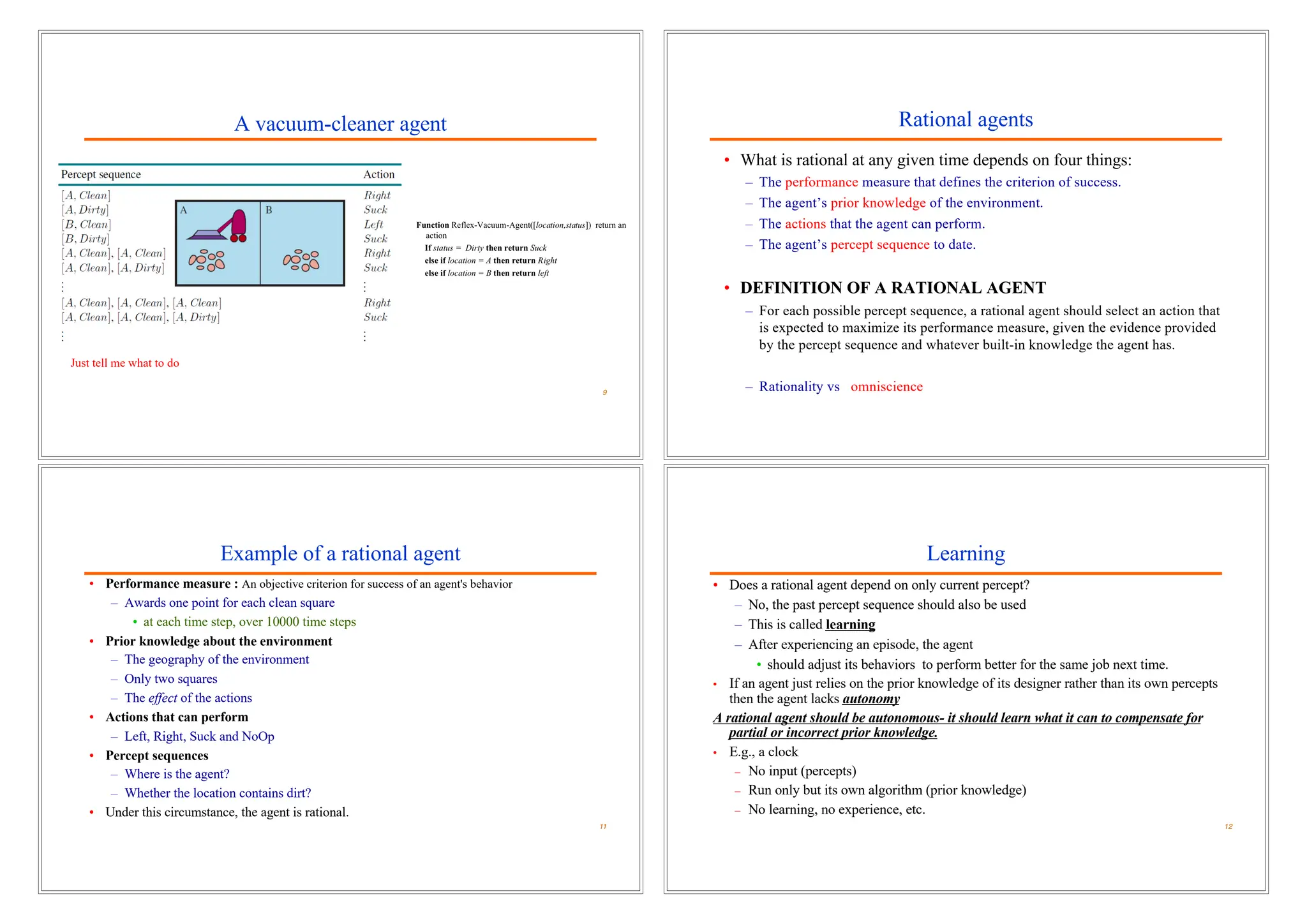
Example : Vacuum-cleaner world Agent
• Percepts:
– location and contents(Clean or Dirty?),
– e.g., [A , Dirty]
• Actions:
– Left: Move left,
– Right: Move right
– Suck: suck up the dirt,
– NoOp: do nothing
8
A vacuum-cleaner agent
9
Just tell me what to do
Rational agents
• What is rational at any given time depends on four things:
– The performance measure that defines the criterion of success.
– The agent’s prior knowledge of the environment.
– The actions that the agent can perform.
– The agent’s percept sequence to date.
• DEFINITION OF A RATIONAL AGENT
– For each possible percept sequence, a rational agent should select an action that
is expected to maximize its performance measure, given the evidence provided
by the percept sequence and whatever built-in knowledge the agent has.
– Rationality vs omniscience
Example of a rational agent
• Performance measure : An objective criterion for success of an agent's behavior
– Awards one point for each clean square
• at each time step, over 10000 time steps
• Prior knowledge about the environment
– The geography of the environment
– Only two squares
– The effect of the actions
• Actions that can perform
– Left, Right, Suck and NoOp
• Percept sequences
– Where is the agent?
– Whether the location contains dirt?
• Under this circumstance, the agent is rational.
11
Learning
• Does a rational agent depend on only current percept?
– No, the past percept sequence should also be used
– This is called learning
– After experiencing an episode, the agent
• should adjust its behaviors to perform better for the same job next time.
• If an agent just relies on the prior knowledge of its designer rather than its own percepts
then the agent lacks autonomy
A rational agent should be autonomous- it should learn what it can to compensate for
partial or incorrect prior knowledge.
• E.g., a clock
– No input (percepts)
– Run only but its own algorithm (prior knowledge)
– No learning, no experience, etc.
12
Software Agents
• Sometimes, the environment may not be the real world
– E.g., flight simulator, video games, Internet
– They are all artificial but very complex environments
– Those agents working in these environments are called
• Software agent (softbots)
• Because all parts of the agent are software
13
Task environments
• Task environments are the problems
– While the rational agents are the solutions
– Must specify the task environment as fully as possible
• Specifying the task environment
– PEAS description as fully as possible
• Performance measure
• Environment
• Actuators
• Sensors
• In designing an agent, the first step must always be to specify the
task environment as fully as possible.
14
Task environments : Performance measure
• Performance measure
– How can we judge the automated driver?
– Which factors are considered?
• getting to the correct destination
• minimizing fuel consumption
• minimizing the trip time and/or cost
• minimizing the violations of traffic laws
• maximizing the safety and comfort, etc.
PEAS - Automated taxi driver
• Performance measure:
– Safe, fast, legal, comfortable trip, maximize
profits, impact on other road users
• Environment:
– Roads, other traffic, pedestrians, customers,
weather
• Actuators:
– Steering wheel, accelerator, brake, signal,
horn, display, speech
• Sensors:
– Cameras, radar, sonar, speedometer, GPS,
odometer, engine sensors, microphones,
touchscreen 16
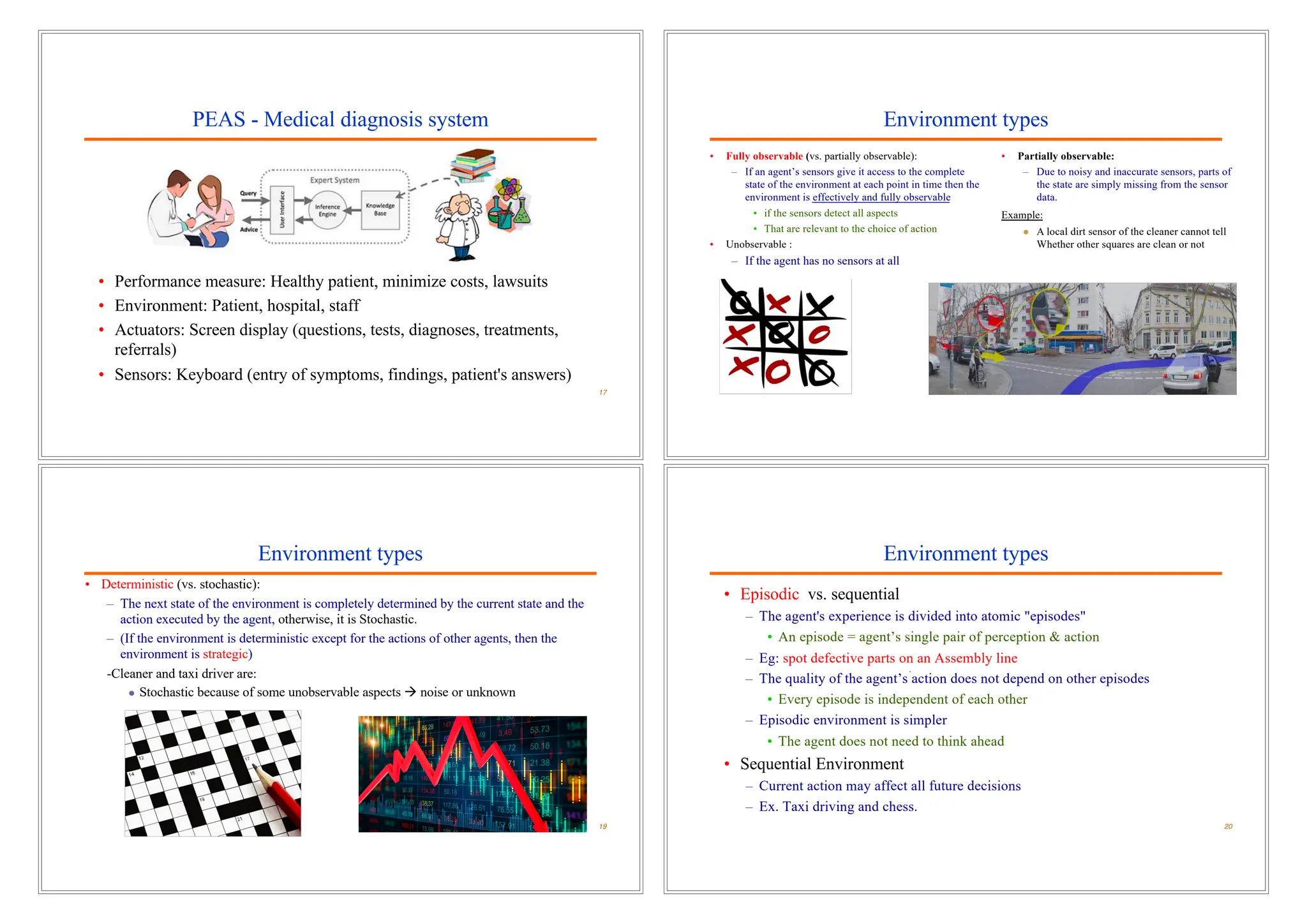
PEAS - Medical diagnosis system
• Performance measure: Healthy patient, minimize costs, lawsuits
• Environment: Patient, hospital, staff
• Actuators: Screen display (questions, tests, diagnoses, treatments,
referrals)
• Sensors: Keyboard (entry of symptoms, findings, patient's answers)
17
Environment types
• Fully observable (vs. partially observable):
– If an agent’s sensors give it access to the complete
state of the environment at each point in time then the
environment is effectively and fully observable
• if the sensors detect all aspects
• That are relevant to the choice of action
• Unobservable :
– If the agent has no sensors at all
18
E
• Partially observable:
– Due to noisy and inaccurate sensors, parts of
the state are simply missing from the sensor
data.
Example:
l A local dirt sensor of the cleaner cannot tell
Whether other squares are clean or not
Environment types
• Deterministic (vs. stochastic):
– The next state of the environment is completely determined by the current state and the
action executed by the agent, otherwise, it is Stochastic.
– (If the environment is deterministic except for the actions of other agents, then the
environment is strategic)
-Cleaner and taxi driver are:
l Stochastic because of some unobservable aspects à noise or unknown
19
Environment types
• Episodic vs. sequential
– The agent's experience is divided into atomic "episodes"
• An episode = agent’s single pair of perception & action
– Eg: spot defective parts on an Assembly line
– The quality of the agent’s action does not depend on other episodes
• Every episode is independent of each other
– Episodic environment is simpler
• The agent does not need to think ahead
• Sequential Environment
– Current action may affect all future decisions
– Ex. Taxi driving and chess.
20
Environment types
• Static vs. dynamic
– The environment is unchanged while an agent is
deliberating.
– Agent need not keep looking at the world while deciding
an action nor need it worry about the passage of time.
– A dynamic environment is always changing over time
• E.g., Taxi driving : the number of people in the street
21
• Semidynamic
– environment is not changed over time
– but the agent’s performance score does
– Eg: Chess when played with a clock is
semi-dynamic
Environment types
• Discrete (vs. continuous):
• If there are a limited number of distinct states, clearly defined
percepts and actions, the environment is discrete
– E.g., Chess game
• Continuous: Taxi driving
22
Environment types
• Single agent (vs. multiagent):
• An agent operating by itself in an
environment.
– Playing a crossword puzzle – single
agent
– Chess playing – two agents
– Competitive multiagent environment
• Chess playing
– Cooperative multiagent environment
• Automated taxi driver
• Avoiding collision
23
Environment types
• Known vs. unknown
• This distinction refers not to the environment itslef but to the agent’s
(or designer’s) state of knowledge about the environment.
– In known environment, the outcomes for all actions are given.
– example: solitaire card games
• If the environment is unknown, the agent will have to learn how it
works in order to make good decisions.
– example: new video game.
24
Examples of task environments
• The real world is : partially observable, stochastic, sequential, dynamic,
nondeterministic, continuous, multi-agent . How do we handle it then?
25
The environment type largely
determines the agent design
Properties of the Task Environment
26
Structure of agents
• Agent = architecture + program
– Architecture = some sort of computing device (sensors + actuators)
– (Agent) Program = some function that implements the agent
mapping = “?”
– Agent Program = Job of AI
27
Pac-Man as an Agent
28
Pac-Man is a registered trademark of Namco-Bandai Games, used here for educational purposes
Agent functions and programs
• An agent is completely specified by the agent function mapping
percept sequences to actions
• Input for Agent Program
– Only the current percept
• Input for Agent Function
– The entire percept sequence
– The agent must remember all of them
• Implement the agent program as
– A look up table (agent function)
29
Agent types /Agent architectures
• Five basic types in order of increasing
generality
– Table Driven agents
– Simple reflex agents
– Model-based reflex agents
– Goal-based agents
– Utility-based agents
30
Agent functions: Table-lookup agent
• Lookup Table – An action for every possible percept sequence.
• P = the set of possible percepts
• T= lifetime of the agent
– The total number of percepts it receives
• Size of the look up table
• Consider playing chess
– P =10, T=150
– Will require a table of at least 10150 entries
å=
T
t
t
P
1
31
Table-lookup agent
• Skeleton design of an agent program
• input{algorithms/table-agent-algorithm}
• Drawbacks: – Huge table
– Take a long time to build the table
– No autonomy
– Even with learning, need a long time to learn the table entries 32
Agent programs
• Despite of huge size, look up table does what we want.
• The key challenge of AI
– Find out how to write programs that, to the extent possible, produce rational
behavior
• From a small amount of code
• Rather than a large amount of table entries
– E.g., a five-line program of Newton’s Method running on electronic
calculators.
– V.s. huge tables of square roots, sine, cosine, …
33
Types of agent programs
• Four type
– Simple reflex agents
– Model-based reflex agents
– Goal-based agents
– Utility-based agents
34
Simple reflex agents
• Reflex agents:
– Choose action based on current percept (and maybe memory)
– May have memory or a model of the world’s current state
– Do not consider the future consequences of their actions
– Consider how the world IS
• Can a reflex agent be rational?
• It uses just condition-action rules
– The rules are like the form “if … then …”
– efficient but have narrow range of applicability
– Because knowledge sometimes cannot be stated explicitly
– Work only
• if the environment is fully observable
35
Simple reflex agents
36
Pac-Man : Video of Demo Reflex Optimal
37
Not Good for other Cases
Planning Agents
• Ask “what if”
• Decisions based on (hypothesized) consequences of actions
• Must have a model of how the world evolves in response to actions
• Must formulate a goal (test)
• Consider how the world WOULD BE
• Optimal vs. Complete planning
• Planning vs. replanning
• Simulate many games, execute one. Doesn’t do it in the world, does
it in the model.
– Complete – a solution; optimal – best
38
Demo Plan slow (Mastermind Pac-Man)
39
Video of Demo Plan fast ('replanning')
40
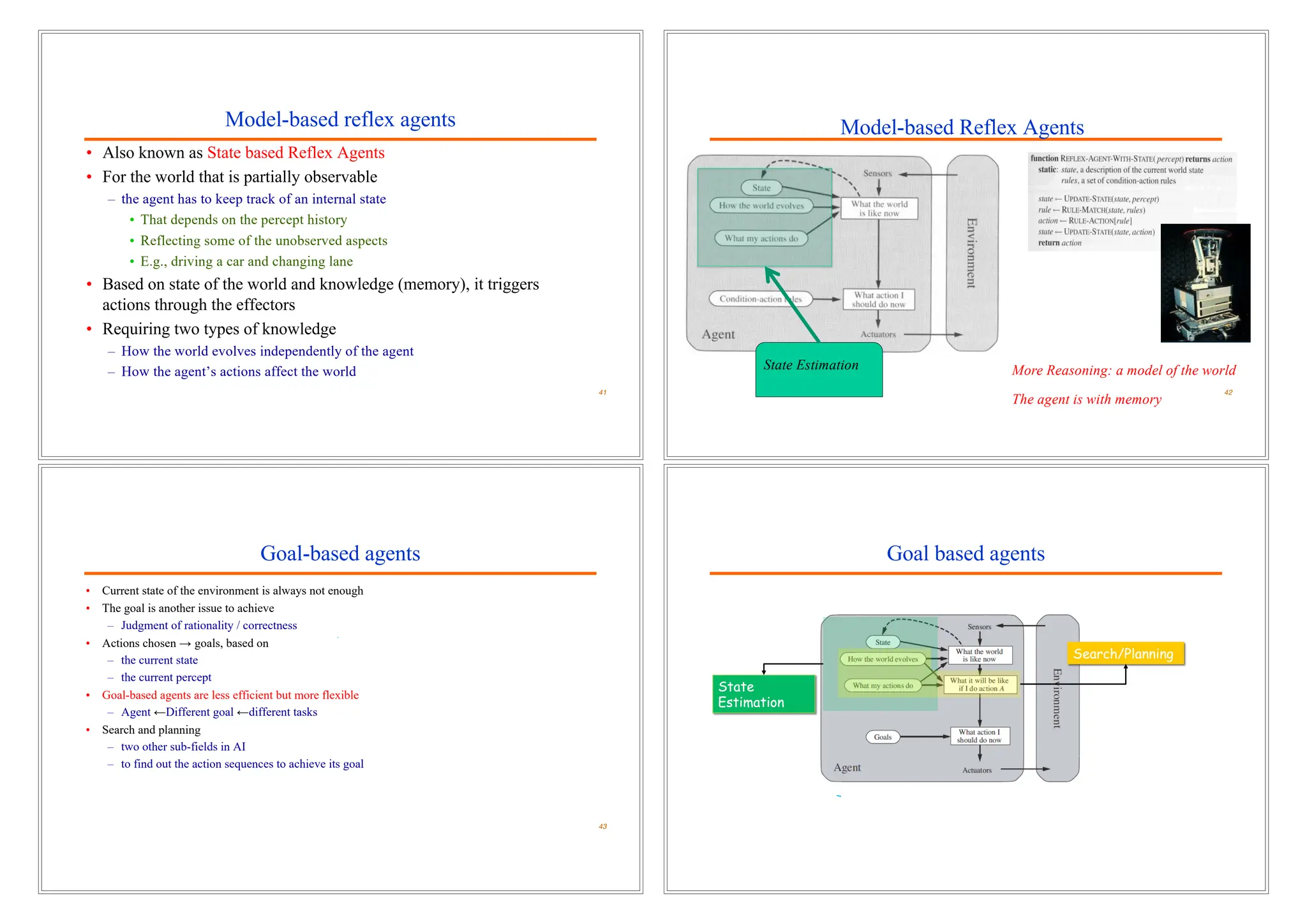
Model-based reflex agents
• Also known as State based Reflex Agents
• For the world that is partially observable
– the agent has to keep track of an internal state
• That depends on the percept history
• Reflecting some of the unobserved aspects
• E.g., driving a car and changing lane
• Based on state of the world and knowledge (memory), it triggers
actions through the effectors
• Requiring two types of knowledge
– How the world evolves independently of the agent
– How the agent’s actions affect the world
41
Model-based Reflex Agents
42
More Reasoning: a model of the world
The agent is with memory
State Estimation
Goal-based agents
• Current state of the environment is always not enough
• The goal is another issue to achieve
– Judgment of rationality / correctness
• Actions chosen → goals, based on
– the current state
– the current percept
• Goal-based agents are less efficient but more flexible
– Agent ←Different goal ←different tasks
• Search and planning
– two other sub-fields in AI
– to find out the action sequences to achieve its goal
43
Goal based agents
Utility-based agents
• Goals alone are not enough
– to generate high-quality behavior
– E.g. meals in Canteen, good or not ?
• Many action sequences à the goals
– some are better and some worse
– If goal means success,
– then utility means the degree of success (how successful it is)
• It is said state A has higher utility
– If state A is more preferred than others
• Utility is therefore a function
– that maps a state onto a real number
– the degree of success 45
Utility-based agents
46
Utility-based agents
• Utility has several advantages:
– When there are conflicting goals,
• Only some of the goals but not all can be achieved
• utility describes the appropriate trade-off
– When there are several goals
• None of them are achieved certainly
• utility provides a way for the decision-making
47
Learning Agents
• After an agent is programmed, can it work immediately?
– No, it still need teaching
• In AI,
– Once an agent is done
– We teach it by giving it a set of examples
– Test it by using another set of examples
• We then say the agent learns
– A learning agent
48
Learning Agents
• Four conceptual components
– Learning element
• Making improvement
– Performance element
• Selecting external actions
– Critic
• Tells the Learning element how well the agent is doing with respect to fixed
performance standard.
• (Feedback from user or examples, good or not?)
– Problem generator
• Suggest actions that will lead to new and informative experiences.
49
Learning Agents
50
Three broad categories of ML
51
Google Data Centre Cooling
• DeepMind AI Reduces Google
Data Centre Cooling Bill by 40%
• Optimal operation of pumps,
chillers and cooling towers
• Compared to five years ago,
Google get around 3.5 times the
computing power out of the same
amount of energy
52
Reference: Emilie Kaufmann et al. Adaptive Reward-Free
Exploration
https://arxiv.org/pdf/2006.06294.pdf
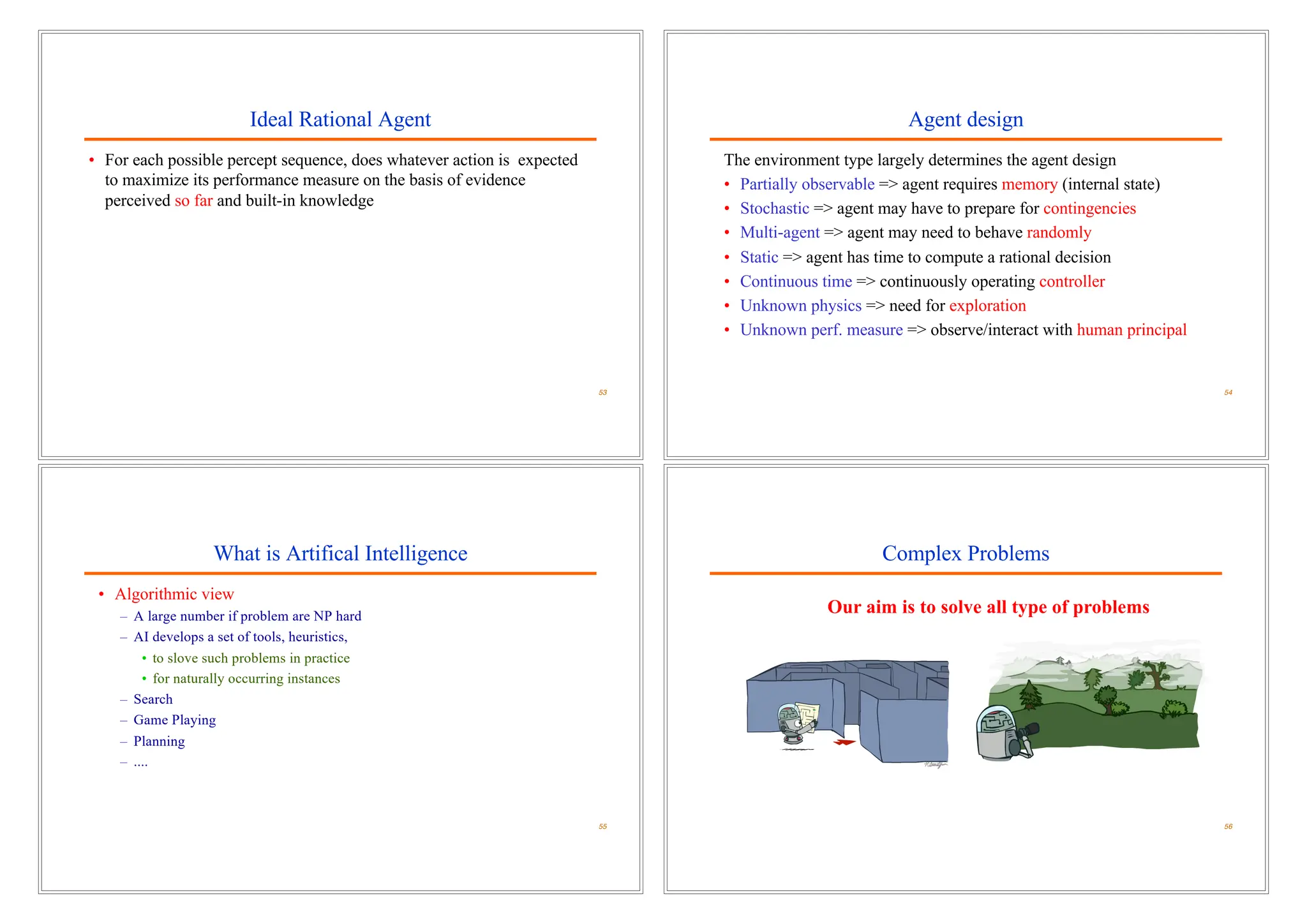
Ideal Rational Agent
• For each possible percept sequence, does whatever action is expected
to maximize its performance measure on the basis of evidence
perceived so far and built-in knowledge
53
Agent design
The environment type largely determines the agent design
• Partially observable => agent requires memory (internal state)
• Stochastic => agent may have to prepare for contingencies
• Multi-agent => agent may need to behave randomly
• Static => agent has time to compute a rational decision
• Continuous time => continuously operating controller
• Unknown physics => need for exploration
• Unknown perf. measure => observe/interact with human principal
54
What is Artifical Intelligence
• Algorithmic view
– A large number if problem are NP hard
– AI develops a set of tools, heuristics,
• to slove such problems in practice
• for naturally occurring instances
– Search
– Game Playing
– Planning
– ....
55
Complex Problems
56
Our aim is to solve all type of problems
Search Problems Are Models Conclusion
58
Next
• Module 2: Automated Problem Solving
– PART 2.1: Intelligent Agent & Environment
– PART 2.2: Complex Problems and AI
– PART 2.3: Problem Solving Methods
•
59
References
• Slides adapted from CS188 Instructor: Anca Dragan, University of California, Berkeley
• Slides adapted from CS60045 ARTIFICIAL INTELLIGENCE
60
(some slides adapted from
http://aima.cs.berkeley.edu/)

2_1_Intelligent Agent , Type of Intelligent Agent and Environment .pdf

  • 1.
    Artificial Intelligence Module 2:Automated Problem Solving PART 2.1: Intelligent Agent & Environment (Slides adapted from StuartJ. Russell, B Ravindran, Mausam, Prof. Pallab Dasgupta, Prof. Partha Pratim Chakrabarti, Saikishor Jangiti Module 2: Automated Problem Solving • PART 2.1: Intelligent Agent & Environment – Agent : Intelligent agent – Rational Agents – Task environments: PEAS – Environment – Structure of Agents • PART 2.2: Complex Problems and AI • PART 2.3: Problem Solving Methods 2 Identify 3 Intelligent Agents • What is an agent ? – An agent is anything that can be viewed • as perceiving its environment through sensors and • acting upon that environment through actuators – Example: • Human Agent: – eyes, ears, and other organs for sensors;, – Hands, legs, mouth, and other body parts for actuators • Robotic Agent: – cameras and infrared range finders for sensors; – various motors for actuators – A thermostat detecting room temperature. 4
  • 2.
    Intelligent Agents 5 • Percept •Agent’s perceptual inputs at any given instant • Percept sequence • Complete history of everything that the agent has ever perceived. Agent’s behavior is mathematically described by Agent function maps from percept histories to actions: [f: P* à A] Agent program runs on the physical architecture to produce f Diagram of an agent 6 What AI should fill Agents that Plan Ahead 7 An agent should strive to "do the right thing", based on what it can perceive and the actions it can perform. Example : Vacuum-cleaner world Agent • Percepts: – location and contents(Clean or Dirty?), – e.g., [A , Dirty] • Actions: – Left: Move left, – Right: Move right – Suck: suck up the dirt, – NoOp: do nothing 8
  • 3.
    A vacuum-cleaner agent 9 Justtell me what to do Rational agents • What is rational at any given time depends on four things: – The performance measure that defines the criterion of success. – The agent’s prior knowledge of the environment. – The actions that the agent can perform. – The agent’s percept sequence to date. • DEFINITION OF A RATIONAL AGENT – For each possible percept sequence, a rational agent should select an action that is expected to maximize its performance measure, given the evidence provided by the percept sequence and whatever built-in knowledge the agent has. – Rationality vs omniscience Example of a rational agent • Performance measure : An objective criterion for success of an agent's behavior – Awards one point for each clean square • at each time step, over 10000 time steps • Prior knowledge about the environment – The geography of the environment – Only two squares – The effect of the actions • Actions that can perform – Left, Right, Suck and NoOp • Percept sequences – Where is the agent? – Whether the location contains dirt? • Under this circumstance, the agent is rational. 11 Learning • Does a rational agent depend on only current percept? – No, the past percept sequence should also be used – This is called learning – After experiencing an episode, the agent • should adjust its behaviors to perform better for the same job next time. • If an agent just relies on the prior knowledge of its designer rather than its own percepts then the agent lacks autonomy A rational agent should be autonomous- it should learn what it can to compensate for partial or incorrect prior knowledge. • E.g., a clock – No input (percepts) – Run only but its own algorithm (prior knowledge) – No learning, no experience, etc. 12
  • 4.
    Software Agents • Sometimes,the environment may not be the real world – E.g., flight simulator, video games, Internet – They are all artificial but very complex environments – Those agents working in these environments are called • Software agent (softbots) • Because all parts of the agent are software 13 Task environments • Task environments are the problems – While the rational agents are the solutions – Must specify the task environment as fully as possible • Specifying the task environment – PEAS description as fully as possible • Performance measure • Environment • Actuators • Sensors • In designing an agent, the first step must always be to specify the task environment as fully as possible. 14 Task environments : Performance measure • Performance measure – How can we judge the automated driver? – Which factors are considered? • getting to the correct destination • minimizing fuel consumption • minimizing the trip time and/or cost • minimizing the violations of traffic laws • maximizing the safety and comfort, etc. PEAS - Automated taxi driver • Performance measure: – Safe, fast, legal, comfortable trip, maximize profits, impact on other road users • Environment: – Roads, other traffic, pedestrians, customers, weather • Actuators: – Steering wheel, accelerator, brake, signal, horn, display, speech • Sensors: – Cameras, radar, sonar, speedometer, GPS, odometer, engine sensors, microphones, touchscreen 16
  • 5.
    PEAS - Medicaldiagnosis system • Performance measure: Healthy patient, minimize costs, lawsuits • Environment: Patient, hospital, staff • Actuators: Screen display (questions, tests, diagnoses, treatments, referrals) • Sensors: Keyboard (entry of symptoms, findings, patient's answers) 17 Environment types • Fully observable (vs. partially observable): – If an agent’s sensors give it access to the complete state of the environment at each point in time then the environment is effectively and fully observable • if the sensors detect all aspects • That are relevant to the choice of action • Unobservable : – If the agent has no sensors at all 18 E • Partially observable: – Due to noisy and inaccurate sensors, parts of the state are simply missing from the sensor data. Example: l A local dirt sensor of the cleaner cannot tell Whether other squares are clean or not Environment types • Deterministic (vs. stochastic): – The next state of the environment is completely determined by the current state and the action executed by the agent, otherwise, it is Stochastic. – (If the environment is deterministic except for the actions of other agents, then the environment is strategic) -Cleaner and taxi driver are: l Stochastic because of some unobservable aspects à noise or unknown 19 Environment types • Episodic vs. sequential – The agent's experience is divided into atomic "episodes" • An episode = agent’s single pair of perception & action – Eg: spot defective parts on an Assembly line – The quality of the agent’s action does not depend on other episodes • Every episode is independent of each other – Episodic environment is simpler • The agent does not need to think ahead • Sequential Environment – Current action may affect all future decisions – Ex. Taxi driving and chess. 20
  • 6.
    Environment types • Staticvs. dynamic – The environment is unchanged while an agent is deliberating. – Agent need not keep looking at the world while deciding an action nor need it worry about the passage of time. – A dynamic environment is always changing over time • E.g., Taxi driving : the number of people in the street 21 • Semidynamic – environment is not changed over time – but the agent’s performance score does – Eg: Chess when played with a clock is semi-dynamic Environment types • Discrete (vs. continuous): • If there are a limited number of distinct states, clearly defined percepts and actions, the environment is discrete – E.g., Chess game • Continuous: Taxi driving 22 Environment types • Single agent (vs. multiagent): • An agent operating by itself in an environment. – Playing a crossword puzzle – single agent – Chess playing – two agents – Competitive multiagent environment • Chess playing – Cooperative multiagent environment • Automated taxi driver • Avoiding collision 23 Environment types • Known vs. unknown • This distinction refers not to the environment itslef but to the agent’s (or designer’s) state of knowledge about the environment. – In known environment, the outcomes for all actions are given. – example: solitaire card games • If the environment is unknown, the agent will have to learn how it works in order to make good decisions. – example: new video game. 24
  • 7.
    Examples of taskenvironments • The real world is : partially observable, stochastic, sequential, dynamic, nondeterministic, continuous, multi-agent . How do we handle it then? 25 The environment type largely determines the agent design Properties of the Task Environment 26 Structure of agents • Agent = architecture + program – Architecture = some sort of computing device (sensors + actuators) – (Agent) Program = some function that implements the agent mapping = “?” – Agent Program = Job of AI 27 Pac-Man as an Agent 28 Pac-Man is a registered trademark of Namco-Bandai Games, used here for educational purposes
  • 8.
    Agent functions andprograms • An agent is completely specified by the agent function mapping percept sequences to actions • Input for Agent Program – Only the current percept • Input for Agent Function – The entire percept sequence – The agent must remember all of them • Implement the agent program as – A look up table (agent function) 29 Agent types /Agent architectures • Five basic types in order of increasing generality – Table Driven agents – Simple reflex agents – Model-based reflex agents – Goal-based agents – Utility-based agents 30 Agent functions: Table-lookup agent • Lookup Table – An action for every possible percept sequence. • P = the set of possible percepts • T= lifetime of the agent – The total number of percepts it receives • Size of the look up table • Consider playing chess – P =10, T=150 – Will require a table of at least 10150 entries å= T t t P 1 31 Table-lookup agent • Skeleton design of an agent program • input{algorithms/table-agent-algorithm} • Drawbacks: – Huge table – Take a long time to build the table – No autonomy – Even with learning, need a long time to learn the table entries 32
  • 9.
    Agent programs • Despiteof huge size, look up table does what we want. • The key challenge of AI – Find out how to write programs that, to the extent possible, produce rational behavior • From a small amount of code • Rather than a large amount of table entries – E.g., a five-line program of Newton’s Method running on electronic calculators. – V.s. huge tables of square roots, sine, cosine, … 33 Types of agent programs • Four type – Simple reflex agents – Model-based reflex agents – Goal-based agents – Utility-based agents 34 Simple reflex agents • Reflex agents: – Choose action based on current percept (and maybe memory) – May have memory or a model of the world’s current state – Do not consider the future consequences of their actions – Consider how the world IS • Can a reflex agent be rational? • It uses just condition-action rules – The rules are like the form “if … then …” – efficient but have narrow range of applicability – Because knowledge sometimes cannot be stated explicitly – Work only • if the environment is fully observable 35 Simple reflex agents 36
  • 10.
    Pac-Man : Videoof Demo Reflex Optimal 37 Not Good for other Cases Planning Agents • Ask “what if” • Decisions based on (hypothesized) consequences of actions • Must have a model of how the world evolves in response to actions • Must formulate a goal (test) • Consider how the world WOULD BE • Optimal vs. Complete planning • Planning vs. replanning • Simulate many games, execute one. Doesn’t do it in the world, does it in the model. – Complete – a solution; optimal – best 38 Demo Plan slow (Mastermind Pac-Man) 39 Video of Demo Plan fast ('replanning') 40
  • 11.
    Model-based reflex agents •Also known as State based Reflex Agents • For the world that is partially observable – the agent has to keep track of an internal state • That depends on the percept history • Reflecting some of the unobserved aspects • E.g., driving a car and changing lane • Based on state of the world and knowledge (memory), it triggers actions through the effectors • Requiring two types of knowledge – How the world evolves independently of the agent – How the agent’s actions affect the world 41 Model-based Reflex Agents 42 More Reasoning: a model of the world The agent is with memory State Estimation Goal-based agents • Current state of the environment is always not enough • The goal is another issue to achieve – Judgment of rationality / correctness • Actions chosen → goals, based on – the current state – the current percept • Goal-based agents are less efficient but more flexible – Agent ←Different goal ←different tasks • Search and planning – two other sub-fields in AI – to find out the action sequences to achieve its goal 43 Goal based agents
  • 12.
    Utility-based agents • Goalsalone are not enough – to generate high-quality behavior – E.g. meals in Canteen, good or not ? • Many action sequences à the goals – some are better and some worse – If goal means success, – then utility means the degree of success (how successful it is) • It is said state A has higher utility – If state A is more preferred than others • Utility is therefore a function – that maps a state onto a real number – the degree of success 45 Utility-based agents 46 Utility-based agents • Utility has several advantages: – When there are conflicting goals, • Only some of the goals but not all can be achieved • utility describes the appropriate trade-off – When there are several goals • None of them are achieved certainly • utility provides a way for the decision-making 47 Learning Agents • After an agent is programmed, can it work immediately? – No, it still need teaching • In AI, – Once an agent is done – We teach it by giving it a set of examples – Test it by using another set of examples • We then say the agent learns – A learning agent 48
  • 13.
    Learning Agents • Fourconceptual components – Learning element • Making improvement – Performance element • Selecting external actions – Critic • Tells the Learning element how well the agent is doing with respect to fixed performance standard. • (Feedback from user or examples, good or not?) – Problem generator • Suggest actions that will lead to new and informative experiences. 49 Learning Agents 50 Three broad categories of ML 51 Google Data Centre Cooling • DeepMind AI Reduces Google Data Centre Cooling Bill by 40% • Optimal operation of pumps, chillers and cooling towers • Compared to five years ago, Google get around 3.5 times the computing power out of the same amount of energy 52 Reference: Emilie Kaufmann et al. Adaptive Reward-Free Exploration https://arxiv.org/pdf/2006.06294.pdf
  • 14.
    Ideal Rational Agent •For each possible percept sequence, does whatever action is expected to maximize its performance measure on the basis of evidence perceived so far and built-in knowledge 53 Agent design The environment type largely determines the agent design • Partially observable => agent requires memory (internal state) • Stochastic => agent may have to prepare for contingencies • Multi-agent => agent may need to behave randomly • Static => agent has time to compute a rational decision • Continuous time => continuously operating controller • Unknown physics => need for exploration • Unknown perf. measure => observe/interact with human principal 54 What is Artifical Intelligence • Algorithmic view – A large number if problem are NP hard – AI develops a set of tools, heuristics, • to slove such problems in practice • for naturally occurring instances – Search – Game Playing – Planning – .... 55 Complex Problems 56 Our aim is to solve all type of problems
  • 15.
    Search Problems AreModels Conclusion 58 Next • Module 2: Automated Problem Solving – PART 2.1: Intelligent Agent & Environment – PART 2.2: Complex Problems and AI – PART 2.3: Problem Solving Methods • 59 References • Slides adapted from CS188 Instructor: Anca Dragan, University of California, Berkeley • Slides adapted from CS60045 ARTIFICIAL INTELLIGENCE 60 (some slides adapted from http://aima.cs.berkeley.edu/)