M O B I L E AG E N T
MOBILE DEVICES: SERVER
AND MANAGEMENT
MEANING OF AGENT
 ‘An agent is a computer system that is situated in some
environment, and that is capable of autonomous action
in this environment in order to meet its design objectives’.
 Two basic properties of Software Agents :
 Autonomicity – ability to act without direct human
intervention.
 Situatedness – Agents tend to be used where the
environment is challenging (dynamic, unpredictable
and unreliable).
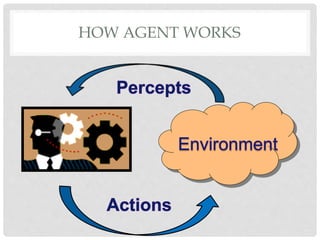
HOW AGENT WORKS
OTHER PROPERTIES OF AGENT
• Reactive – senses changes in the environment and acts
accordingly to those changes.
• Proactive – persistently pursues goals.
• Flexible – has multiple ways of achieving goals.
• Robust – recovers from failure.
OTHER PROPERTIES OF AGENT
• Communicative – able to communicate with other
agents.
• Mobile – can travel from one host to another.
• Learning – adapts in accordance with previous
experience.
• Believable – appears believable to the end-user.
WHAT IS A MOBILE AGENT?
• Program that can migrate from system to system within a
network environment.
• Performs some processing at each host.
• Agent decides when and where to move next.
• How does it move ?
Save state
Transport saved state to next system
Resume execution of saved state
MOBILE AGENT
• Consists of software with data, which can move from one
computing system to another autonomously.
• Functions for a device or system on the present host.
• Described as an autonomous software which runs on a
host with some data.
• Dynamically moving software to another host (which has
other required data) as and when required.
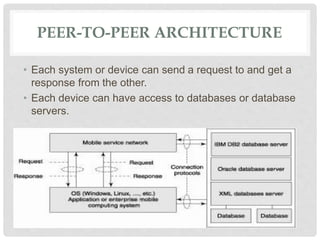
PEER-TO-PEER ARCHITECTURE
• Each system or device can send a request to and get a
response from the other.
• Each device can have access to databases or database
servers.
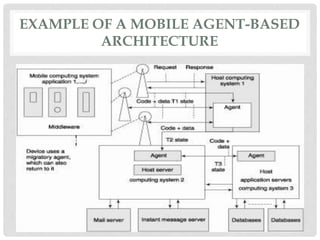
EXAMPLE OF A MOBILE AGENT-BASED
ARCHITECTURE
A MOBILE AGENT-BASED
ARCHITECTURE
• Agent moves at instants T1, T2, and T3 to process a
request, get email, and get records from a database,
respectively.
• When a mobile agent moves at instant T1, T2, or T3, it
saves its own state at the host and transmits this saved
state to the next host in order to resume
execution of the codes starting from the saved
state.
CHARACTERISTICS OF A MOBILE
AGENT
1. Mobility of code and data from one computing system
(host) to another.
2. Ability to learn in order to adapt code and data to the
host computing system.
3. Ability to clone, extend, or dispose itself after its role
finishes.
4. Compatibility to the hosts.
5. Ability to continuously and autonomously process
requests and send responses and alerts.
“AGENT OS”, AN OPERATING SYSTEM
• Developed in 2006.
• Provides application virtualization environment.
• Allows automatic thread migration (ATM).
• The threads running on the host being.
• Independent of the OS.
AGENT OS APPLICATION
VIRTUALIZATION ENVIRONMENT
• An application instead of running in its own environment
provided by the OS and the system hardware actually
runs at a host OS and host system hardware of the
mobile agent of that system.
• To a user, the application appears to be running at the
system environment while. it is actually running at the
host environment, which is host to the agent.
ADVANTAGES OF A MOBILE AGENT
1. Asynchronous running of codes on diversified
heterogeneous hosts.
2. Reduced computational and data requirements on the
devices with limited resources.
3. Tolerance to connection failures.
4. Only the agent source (for example, device middleware,
which sends the agent) needs to be modified in order to
redefine the functions expected from the agent.
• There is no need of a centralized or an application-
specific server
ADVANTAGES OF A MOBILE AGENT
5. An agent can send the requests to a computing system
as well as generate responses for requests from the
system.
• An agent thus has certain similarities to peer-to-peer
architecture.
6. The connection protocol and the connecting network
between host and source are immaterial
LATENCY ISSUES IN USE OF THE
AGENT
• Migration latency means waiting period in migrating from
one host to another.
• Collaboration latency means waiting period in start of
collaboration between the application server and the
service requesting system.
• An agent possess migration and collaboration latencies.
ENVIRONMENT- AND PLATFORM-SPECIFIC
AND
SECURITY ISSUES IN USE OF THE AGENT
• There can be environment- and platform specific difficulties
in implementing adaptability and compatibility at diversified
hosts.
• In addition, security-specific issues related to an agent
moving from one host to another.
MOBILITY ISSUES IN USE OF THE
AGENT
• Agent may have strong or weak mobility.
• Strong ability:
When moving a mobile agent carries
(code +data state+ execution state)
• Weak ability:
When moving a mobile agent carries
(code +data state)
SUMMARY
• Mobile Agent─ an autonomous software which runs on a
host with some data for the device or system.
• Dynamically moving (migrating) software to another host
(which has other required data) as and when required.
• No need of a centralized or an application-specific server
when using agent.

Mobile Agent

  • 1.
    M O BI L E AG E N T MOBILE DEVICES: SERVER AND MANAGEMENT
  • 2.
    MEANING OF AGENT ‘An agent is a computer system that is situated in some environment, and that is capable of autonomous action in this environment in order to meet its design objectives’.  Two basic properties of Software Agents :  Autonomicity – ability to act without direct human intervention.  Situatedness – Agents tend to be used where the environment is challenging (dynamic, unpredictable and unreliable).
  • 3.
  • 4.
    OTHER PROPERTIES OFAGENT • Reactive – senses changes in the environment and acts accordingly to those changes. • Proactive – persistently pursues goals. • Flexible – has multiple ways of achieving goals. • Robust – recovers from failure.
  • 5.
    OTHER PROPERTIES OFAGENT • Communicative – able to communicate with other agents. • Mobile – can travel from one host to another. • Learning – adapts in accordance with previous experience. • Believable – appears believable to the end-user.
  • 6.
    WHAT IS AMOBILE AGENT? • Program that can migrate from system to system within a network environment. • Performs some processing at each host. • Agent decides when and where to move next. • How does it move ? Save state Transport saved state to next system Resume execution of saved state
  • 7.
    MOBILE AGENT • Consistsof software with data, which can move from one computing system to another autonomously. • Functions for a device or system on the present host. • Described as an autonomous software which runs on a host with some data. • Dynamically moving software to another host (which has other required data) as and when required.
  • 8.
    PEER-TO-PEER ARCHITECTURE • Eachsystem or device can send a request to and get a response from the other. • Each device can have access to databases or database servers.
  • 9.
    EXAMPLE OF AMOBILE AGENT-BASED ARCHITECTURE
  • 10.
    A MOBILE AGENT-BASED ARCHITECTURE •Agent moves at instants T1, T2, and T3 to process a request, get email, and get records from a database, respectively. • When a mobile agent moves at instant T1, T2, or T3, it saves its own state at the host and transmits this saved state to the next host in order to resume execution of the codes starting from the saved state.
  • 11.
    CHARACTERISTICS OF AMOBILE AGENT 1. Mobility of code and data from one computing system (host) to another. 2. Ability to learn in order to adapt code and data to the host computing system. 3. Ability to clone, extend, or dispose itself after its role finishes. 4. Compatibility to the hosts. 5. Ability to continuously and autonomously process requests and send responses and alerts.
  • 12.
    “AGENT OS”, ANOPERATING SYSTEM • Developed in 2006. • Provides application virtualization environment. • Allows automatic thread migration (ATM). • The threads running on the host being. • Independent of the OS.
  • 13.
    AGENT OS APPLICATION VIRTUALIZATIONENVIRONMENT • An application instead of running in its own environment provided by the OS and the system hardware actually runs at a host OS and host system hardware of the mobile agent of that system. • To a user, the application appears to be running at the system environment while. it is actually running at the host environment, which is host to the agent.
  • 14.
    ADVANTAGES OF AMOBILE AGENT 1. Asynchronous running of codes on diversified heterogeneous hosts. 2. Reduced computational and data requirements on the devices with limited resources. 3. Tolerance to connection failures. 4. Only the agent source (for example, device middleware, which sends the agent) needs to be modified in order to redefine the functions expected from the agent. • There is no need of a centralized or an application- specific server
  • 15.
    ADVANTAGES OF AMOBILE AGENT 5. An agent can send the requests to a computing system as well as generate responses for requests from the system. • An agent thus has certain similarities to peer-to-peer architecture. 6. The connection protocol and the connecting network between host and source are immaterial
  • 16.
    LATENCY ISSUES INUSE OF THE AGENT • Migration latency means waiting period in migrating from one host to another. • Collaboration latency means waiting period in start of collaboration between the application server and the service requesting system. • An agent possess migration and collaboration latencies.
  • 17.
    ENVIRONMENT- AND PLATFORM-SPECIFIC AND SECURITYISSUES IN USE OF THE AGENT • There can be environment- and platform specific difficulties in implementing adaptability and compatibility at diversified hosts. • In addition, security-specific issues related to an agent moving from one host to another.
  • 18.
    MOBILITY ISSUES INUSE OF THE AGENT • Agent may have strong or weak mobility. • Strong ability: When moving a mobile agent carries (code +data state+ execution state) • Weak ability: When moving a mobile agent carries (code +data state)
  • 19.
    SUMMARY • Mobile Agent─an autonomous software which runs on a host with some data for the device or system. • Dynamically moving (migrating) software to another host (which has other required data) as and when required. • No need of a centralized or an application-specific server when using agent.