Introduction to the
agents
By: Aryan Rathore
Head Of Aryan Dell Corporation Jaipur
Aryan Computer Organization Jaipur
Mob:- 8560089002
Since the beginning of recorded history, people
have been fascinated with the idea of non-
human agencies. Against which software agents
are perceived.
Significantly, for the moment, the momentum seems to
have shifted from hardware to software, from the atoms
that comprise a mechanical robot to the bits that make up
a digital agent
According to Alan Kay, a longtime proponent of
agent technology:
A system that, when given a goal, could carry
out the details of the appropriate computer
operations and could ask for and receive advice,
offered in human terms, when it was stuck. An
agent would be a ‘soft robot’ living and doing
its business within the computer’s world.” (Kay
1984)
What is a software agent?
• agent as an ascription,
• and agent as a description.
Agent as an ascription
There is very little similarity between the
agents, yet there is something that we can
recognize as a family resemblance. This
resemblance has nothing to do with the details
of implementation, architecture or theory.
It must be to a great degree a function of the
eye of the beholder.
“Agent is that agent does”
Agency cannot ultimately be characterized by listing a
collection of attributes but rather consists fundamentally
as an attribution on the part of some person.
• one person’s “intelligent agent”
• is another person’s “smart object”;
• and today’s “smart object” is tomorrow’s
“dumb program.”
The key distinction is in our expectations and
our point of view.
The American Heritage Dictionary defines an
agent as
“one that acts or has the power or authority to
act… or represent another”
or
“means by which something is done or caused;
instrument.”
We expect a software agent to act on behalf of
someone to carry out a particular task which has
been delegated to it.
But since it is tedious to have to spell out every
detail, we would like our agents to be able to infer
what we mean from what we tell it.
Agents can only do this if they “know” something
about the context of the request.
The best agents, then, would not only need to
exercise a particular form of expertise, but also
take into account the peculiarities of the user and
situation.
In this sense an agent fills the role of what Negroponte calls a
“digital sister-in-law:”
Agent as a description
A more acceptable description of agents is:
A software entity which functions continuously
and autonomously in a particular environment,
often inhabited by other agents and processes.
• Why continuity and autonomy?
We desire:
• An agent be able to carry out activities in a flexible and
intelligent manner
• Is responsive to changes in the environment without requiring
constant human guidance or intervention.
• Be able to learn from its experience.
• To be able to communicate and cooperate with other processes
and agents.
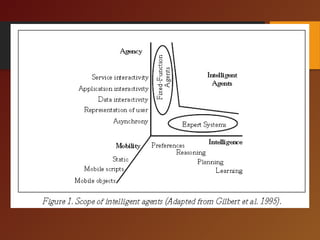
• Attributes
• Reactivity
• Autonomy
• Collaborative behavior
• “Knowledge-level” (Newell 1982) communication ability
• Inferential capability
• Temporal continuity
• Personality
• Adaptability
• Mobility
Why software agents??
• To address two main concerns
• Overcoming User Interface Problems
• Simplifying Distributed Computing
Overcoming User Interface Problems
• Limitations of direct manipulation
• Large search space
• Actions in response to immediate user interaction
only
• No composition
• Rigidity
• Function orientation
• No improvement of behavior
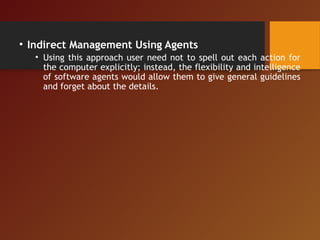
• Indirect Management Using Agents
• Using this approach user need not to spell out each action for
the computer explicitly; instead, the flexibility and intelligence
of software agents would allow them to give general guidelines
and forget about the details.
Example
On what date in February did I record a phone
conversation with Sam?
Make me an appointment at a tire shop that is on my
way home and is open after 6 PM.
Distribute this draft to the rest of the group and let me
know when they’ve read it.
Whenever a paper is published on fullerene molecules,
order a copy for my library.
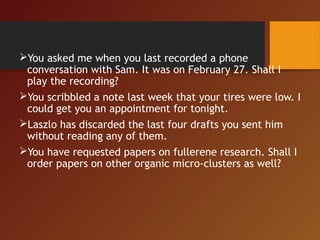
You asked me when you last recorded a phone
conversation with Sam. It was on February 27. Shall I
play the recording?
You scribbled a note last week that your tires were low. I
could get you an appointment for tonight.
Laszlo has discarded the last four drafts you sent him
without reading any of them.
You have requested papers on fullerene research. Shall I
order papers on other organic micro-clusters as well?
Attributes
• Scalability
• Scheduled or event-driven actions
• Abstraction and delegation
• Flexibility and opportunism
• Task orientation
• Adaptivity
Simplifying Distributed Computing
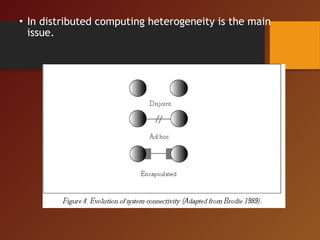
• In distributed computing heterogeneity is the main
issue.
• Incorporating Agents as Resource Managers
• A higher level of interoperability would require knowledge of
the capabilities of each system, so that secure task planning,
resource allocation, execution, monitoring, and, possibly,
intervention between the systems could take place.
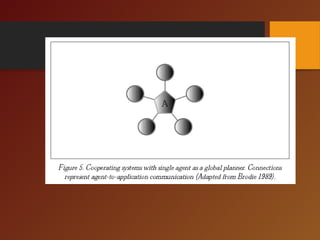
• To accomplish this, an intelligent agent could function as a
global resource manager.
Agents: From Direct Manipulation to
Delegation.
“The best metaphor I can conceive of for a human-
computer interface is that of a well-trained English
butler. The “agent” answers the phone, recognizes the
callers, disturbs you when appropriate, and may even
tell a white lie on your behalf. The same agent is well
trained in timing… and respectful of idiosyncrasies.
People who know the butler enjoy considerable
advantage over a total stranger. That is just fine.”
(Negroponte 1997)
What will such digital butlers
do?
• They will filter, extract, and present the
relevant information from bodies of
information larger than we could ordinarily
digest on their own.
• They will act as “digital sisters-in-law,”
combining their knowledge of information
and computing services with intimate
knowledge about the person on whose
behalf they are acting.
• To create such agents
• We will need to re-open profound and basic
questions of intelligence.
• An understanding of decentralized approaches to
intelligence is key
• User interface design will also be
decentralized
• Instead of being an effort by professionals to
produce the best interface for the masses, it will
become an individual affair, driven more by the
personalized intelligence of one’s local agents than
the blanket application of general human-factors
knowledge.
The agent’s long-time familiarity with a person, gained
by numerous shared experiences, will be critical to the
new beyond-the-desktop metaphor.

Introduction to the agents

  • 1.
    Introduction to the agents By:Aryan Rathore Head Of Aryan Dell Corporation Jaipur Aryan Computer Organization Jaipur Mob:- 8560089002
  • 2.
    Since the beginningof recorded history, people have been fascinated with the idea of non- human agencies. Against which software agents are perceived.
  • 3.
    Significantly, for themoment, the momentum seems to have shifted from hardware to software, from the atoms that comprise a mechanical robot to the bits that make up a digital agent
  • 4.
    According to AlanKay, a longtime proponent of agent technology: A system that, when given a goal, could carry out the details of the appropriate computer operations and could ask for and receive advice, offered in human terms, when it was stuck. An agent would be a ‘soft robot’ living and doing its business within the computer’s world.” (Kay 1984)
  • 5.
    What is asoftware agent? • agent as an ascription, • and agent as a description.
  • 6.
    Agent as anascription
  • 7.
    There is verylittle similarity between the agents, yet there is something that we can recognize as a family resemblance. This resemblance has nothing to do with the details of implementation, architecture or theory. It must be to a great degree a function of the eye of the beholder.
  • 8.
    “Agent is thatagent does”
  • 9.
    Agency cannot ultimatelybe characterized by listing a collection of attributes but rather consists fundamentally as an attribution on the part of some person.
  • 10.
    • one person’s“intelligent agent” • is another person’s “smart object”; • and today’s “smart object” is tomorrow’s “dumb program.” The key distinction is in our expectations and our point of view.
  • 11.
    The American HeritageDictionary defines an agent as “one that acts or has the power or authority to act… or represent another” or “means by which something is done or caused; instrument.”
  • 12.
    We expect asoftware agent to act on behalf of someone to carry out a particular task which has been delegated to it. But since it is tedious to have to spell out every detail, we would like our agents to be able to infer what we mean from what we tell it. Agents can only do this if they “know” something about the context of the request. The best agents, then, would not only need to exercise a particular form of expertise, but also take into account the peculiarities of the user and situation. In this sense an agent fills the role of what Negroponte calls a “digital sister-in-law:”
  • 13.
    Agent as adescription
  • 14.
    A more acceptabledescription of agents is: A software entity which functions continuously and autonomously in a particular environment, often inhabited by other agents and processes.
  • 15.
    • Why continuityand autonomy? We desire: • An agent be able to carry out activities in a flexible and intelligent manner • Is responsive to changes in the environment without requiring constant human guidance or intervention. • Be able to learn from its experience. • To be able to communicate and cooperate with other processes and agents.
  • 16.
    • Attributes • Reactivity •Autonomy • Collaborative behavior • “Knowledge-level” (Newell 1982) communication ability • Inferential capability • Temporal continuity • Personality • Adaptability • Mobility
  • 20.
    Why software agents?? •To address two main concerns • Overcoming User Interface Problems • Simplifying Distributed Computing
  • 21.
  • 22.
    • Limitations ofdirect manipulation • Large search space • Actions in response to immediate user interaction only • No composition • Rigidity • Function orientation • No improvement of behavior
  • 23.
    • Indirect ManagementUsing Agents • Using this approach user need not to spell out each action for the computer explicitly; instead, the flexibility and intelligence of software agents would allow them to give general guidelines and forget about the details.
  • 24.
    Example On what datein February did I record a phone conversation with Sam? Make me an appointment at a tire shop that is on my way home and is open after 6 PM. Distribute this draft to the rest of the group and let me know when they’ve read it. Whenever a paper is published on fullerene molecules, order a copy for my library.
  • 25.
    You asked mewhen you last recorded a phone conversation with Sam. It was on February 27. Shall I play the recording? You scribbled a note last week that your tires were low. I could get you an appointment for tonight. Laszlo has discarded the last four drafts you sent him without reading any of them. You have requested papers on fullerene research. Shall I order papers on other organic micro-clusters as well?
  • 26.
    Attributes • Scalability • Scheduledor event-driven actions • Abstraction and delegation • Flexibility and opportunism • Task orientation • Adaptivity
  • 27.
  • 28.
    • In distributedcomputing heterogeneity is the main issue.
  • 29.
    • Incorporating Agentsas Resource Managers • A higher level of interoperability would require knowledge of the capabilities of each system, so that secure task planning, resource allocation, execution, monitoring, and, possibly, intervention between the systems could take place. • To accomplish this, an intelligent agent could function as a global resource manager.
  • 31.
    Agents: From DirectManipulation to Delegation.
  • 32.
    “The best metaphorI can conceive of for a human- computer interface is that of a well-trained English butler. The “agent” answers the phone, recognizes the callers, disturbs you when appropriate, and may even tell a white lie on your behalf. The same agent is well trained in timing… and respectful of idiosyncrasies. People who know the butler enjoy considerable advantage over a total stranger. That is just fine.” (Negroponte 1997)
  • 33.
    What will suchdigital butlers do? • They will filter, extract, and present the relevant information from bodies of information larger than we could ordinarily digest on their own. • They will act as “digital sisters-in-law,” combining their knowledge of information and computing services with intimate knowledge about the person on whose behalf they are acting.
  • 34.
    • To createsuch agents • We will need to re-open profound and basic questions of intelligence. • An understanding of decentralized approaches to intelligence is key
  • 35.
    • User interfacedesign will also be decentralized • Instead of being an effort by professionals to produce the best interface for the masses, it will become an individual affair, driven more by the personalized intelligence of one’s local agents than the blanket application of general human-factors knowledge.
  • 36.
    The agent’s long-timefamiliarity with a person, gained by numerous shared experiences, will be critical to the new beyond-the-desktop metaphor.