Creating Definitions
 Best practices for creating and
documenting definitions in technical
writing and editing
Creating Definitions
 Effective Definitions
 Explain an unfamiliar term using vocabulary and
concepts within readers’ grasp
 Tailored for different audiences by adjusting
details, vocabulary & types of egs & explanations.
Analytical Reports include prim/secon. readers
 Anticipate questions readers/users may have;
avoid multiple meanings, complexity of meaning,
technical jargon & symbols
Purpose of Definitions
 Multiple Meanings – depends on field: focus can
mean:
 Localized area of disease (biology)
 One of the points that defines a conic section
(calculus)
 Location of an earthquake’s origin (earth science)
 Adjustment of a camera lens to specific image
(photography)
 Small area of a surface that light or sound waves
converge upon (physics)
 Rotation & elevation of a gun to hit a target (naval
gunnery)
Purpose of Definitions
 Complexity of Meaning – depends on
reader’s technical level. Volt can be defined
as:

Standard unit of electromotive force
(general diction for school & home)

Derived SI unit of electric potential
defined as difference of potential
between two points on a conducting wire
carrying a constant current of one
ampere…(technical dictionary)
Purpose of Definitions
 Technical Jargon – needed when technical, not
everyday, terms are used, i.e. a trade publication for
plastics industry (professionals who know plastics):
 “ratios are indexed via a digital thumbwheel…
polyol is then added…”

If new, unfamiliar terms are used to describe a
process outside the plastics industry but within
the same article, definitions will still be needed
even though the readers are considered
“technical.”
Purpose of Definitions
 Symbols – nonverbal language of math, chemistry,
physics need explanation if audience is non-technical
—highly educated but not trained in the discipline:
 E=mc2 means that energy is equivalent to mass
times the square of the constant velocity of light.
 E=mc2 means mass-energy is conserved. The
energy produced directly from the loss of mass
during a nuclear fission or fusion reaction is equal
to that mass loss times the square of the constant
velocity of light.
Kinds of Definitions
 Formal Definitions
 Found in dictionary
 Tech writer may have to create a formal def for a
new product or process when one does not exist
or existing one is inadequate
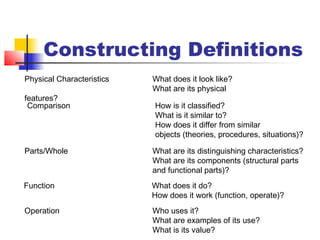
Constructing Definitions
Physical Characteristics What does it look like?
What are its physical
features?
Comparison How is it classified?
What is it similar to?
How does it differ from similar
objects (theories, procedures, situations)?
Parts/Whole What are its distinguishing characteristics?
What are its components (structural parts
and functional parts)?
Function What does it do?
How does it work (function, operate)?
Operation Who uses it?
What are examples of its use?
What is its value?
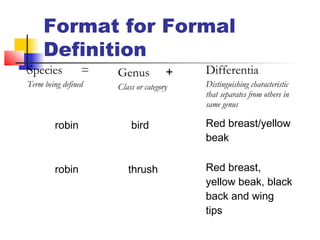
Format for Formal
Definition
Species =
Term being defined
Genus +
Class or category
Differentia
Distinguishing characteristic
that separates from others in
same genus
robin bird Red breast/yellow
beak
robin thrush Red breast,
yellow beak, black
back and wing
tips
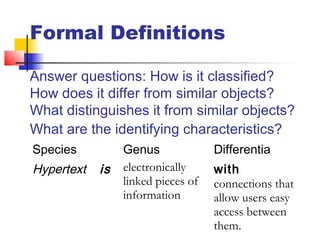
Formal Definitions
Answer questions: How is it classified?
How does it differ from similar objects?
What distinguishes it from similar objects?
What are the identifying characteristics?
Species
Hypertext is
Genus
electronically
linked pieces of
information
Differentia
with
connections that
allow users easy
access between
them.
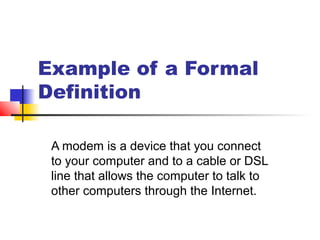
Example of a Formal
Definition
A modem is a device that you connect
to your computer and to a cable or DSL
line that allows the computer to talk to
other computers through the Internet.
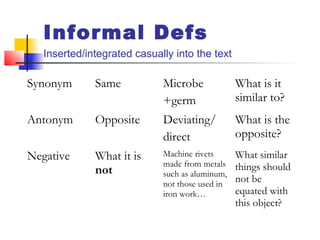
Informal Defs
Inserted/integrated casually into the text
Synonym Same Microbe
+germ
What is it
similar to?
Antonym Opposite Deviating/
direct
What is the
opposite?
Negative What it is
not
Machine rivets
made from metals
such as aluminum,
not those used in
iron work…
What similar
things should
not be
equated with
this object?
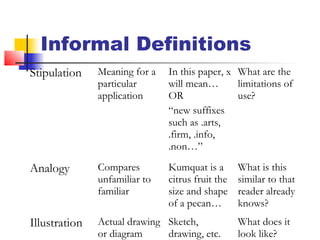
Informal Definitions
Stipulation Meaning for a
particular
application
In this paper, x
will mean…
OR
“new suffixes
such as .arts,
.firm, .info,
.non…”
What are the
limitations of
use?
Analogy Compares
unfamiliar to
familiar
Kumquat is a
citrus fruit the
size and shape
of a pecan…
What is this
similar to that
reader already
knows?
Illustration Actual drawing
or diagram
Sketch,
drawing, etc.
What does it
look like?
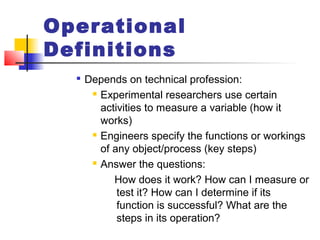
Operational
Definitions

Depends on technical profession:
 Experimental researchers use certain
activities to measure a variable (how it
works)
 Engineers specify the functions or workings
of any object/process (key steps)
 Answer the questions:
How does it work? How can I measure or
test it? How can I determine if its
function is successful? What are the
steps in its operation?
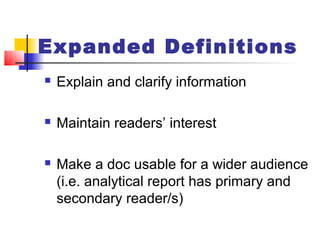
Expanded Definitions
 Explain and clarify information
 Maintain readers’ interest
 Make a doc usable for a wider audience
(i.e. analytical report has primary and
secondary reader/s)
Expanded Definitions
 Etymology – linguistic origin of a term for general
readers who find it interesting or will
understand/relate to roots (see OED)
 How did it get its name? How old is it? Where did
it come from?
 History – background re development/use of subject
gives perspective on current meaning
 What are its origins? How long have such
objects/subjects existed? How has history affected
modern development? How was original different?
Expanded Definitions
 Example – illustrate the application of a
term; include examples that specified
audience will relate to
 Informal definitions – all work together
to clarify meaning for specific audience
(synonym, antonym, negative,
stipulation, analogy, illustration)
Placement of Definitions
Glossary – mini-dictionary; beginning when readers are unfamiliar with
info & need to comprehend doc; end to refer to as needed (but must be
referred to early on and boldface, itals, or asterisks)
Information notes/sidebars – use for info that interrupts flow of text—
readers can use or not
Incorporated info – woven into sentences: use parentheses, -em dash (--
not - -), or commas
Appendixes – lengthy docs for readers w/varying backgrounds
Online help – software co’s provide users w/ help system: balloon help,
when activated a callout includes brief defs/explanations

Best Practices for Creating Definitions in Technical Writing and Editing

  • 1.
    Creating Definitions  Bestpractices for creating and documenting definitions in technical writing and editing
  • 2.
    Creating Definitions  EffectiveDefinitions  Explain an unfamiliar term using vocabulary and concepts within readers’ grasp  Tailored for different audiences by adjusting details, vocabulary & types of egs & explanations. Analytical Reports include prim/secon. readers  Anticipate questions readers/users may have; avoid multiple meanings, complexity of meaning, technical jargon & symbols
  • 3.
    Purpose of Definitions Multiple Meanings – depends on field: focus can mean:  Localized area of disease (biology)  One of the points that defines a conic section (calculus)  Location of an earthquake’s origin (earth science)  Adjustment of a camera lens to specific image (photography)  Small area of a surface that light or sound waves converge upon (physics)  Rotation & elevation of a gun to hit a target (naval gunnery)
  • 4.
    Purpose of Definitions Complexity of Meaning – depends on reader’s technical level. Volt can be defined as:  Standard unit of electromotive force (general diction for school & home)  Derived SI unit of electric potential defined as difference of potential between two points on a conducting wire carrying a constant current of one ampere…(technical dictionary)
  • 5.
    Purpose of Definitions Technical Jargon – needed when technical, not everyday, terms are used, i.e. a trade publication for plastics industry (professionals who know plastics):  “ratios are indexed via a digital thumbwheel… polyol is then added…”  If new, unfamiliar terms are used to describe a process outside the plastics industry but within the same article, definitions will still be needed even though the readers are considered “technical.”
  • 6.
    Purpose of Definitions Symbols – nonverbal language of math, chemistry, physics need explanation if audience is non-technical —highly educated but not trained in the discipline:  E=mc2 means that energy is equivalent to mass times the square of the constant velocity of light.  E=mc2 means mass-energy is conserved. The energy produced directly from the loss of mass during a nuclear fission or fusion reaction is equal to that mass loss times the square of the constant velocity of light.
  • 7.
    Kinds of Definitions Formal Definitions  Found in dictionary  Tech writer may have to create a formal def for a new product or process when one does not exist or existing one is inadequate
  • 8.
    Constructing Definitions Physical CharacteristicsWhat does it look like? What are its physical features? Comparison How is it classified? What is it similar to? How does it differ from similar objects (theories, procedures, situations)? Parts/Whole What are its distinguishing characteristics? What are its components (structural parts and functional parts)? Function What does it do? How does it work (function, operate)? Operation Who uses it? What are examples of its use? What is its value?
  • 9.
    Format for Formal Definition Species= Term being defined Genus + Class or category Differentia Distinguishing characteristic that separates from others in same genus robin bird Red breast/yellow beak robin thrush Red breast, yellow beak, black back and wing tips
  • 10.
    Formal Definitions Answer questions:How is it classified? How does it differ from similar objects? What distinguishes it from similar objects? What are the identifying characteristics? Species Hypertext is Genus electronically linked pieces of information Differentia with connections that allow users easy access between them.
  • 11.
    Example of aFormal Definition A modem is a device that you connect to your computer and to a cable or DSL line that allows the computer to talk to other computers through the Internet.
  • 12.
    Informal Defs Inserted/integrated casuallyinto the text Synonym Same Microbe +germ What is it similar to? Antonym Opposite Deviating/ direct What is the opposite? Negative What it is not Machine rivets made from metals such as aluminum, not those used in iron work… What similar things should not be equated with this object?
  • 13.
    Informal Definitions Stipulation Meaningfor a particular application In this paper, x will mean… OR “new suffixes such as .arts, .firm, .info, .non…” What are the limitations of use? Analogy Compares unfamiliar to familiar Kumquat is a citrus fruit the size and shape of a pecan… What is this similar to that reader already knows? Illustration Actual drawing or diagram Sketch, drawing, etc. What does it look like?
  • 14.
    Operational Definitions  Depends on technicalprofession:  Experimental researchers use certain activities to measure a variable (how it works)  Engineers specify the functions or workings of any object/process (key steps)  Answer the questions: How does it work? How can I measure or test it? How can I determine if its function is successful? What are the steps in its operation?
  • 15.
    Expanded Definitions  Explainand clarify information  Maintain readers’ interest  Make a doc usable for a wider audience (i.e. analytical report has primary and secondary reader/s)
  • 16.
    Expanded Definitions  Etymology– linguistic origin of a term for general readers who find it interesting or will understand/relate to roots (see OED)  How did it get its name? How old is it? Where did it come from?  History – background re development/use of subject gives perspective on current meaning  What are its origins? How long have such objects/subjects existed? How has history affected modern development? How was original different?
  • 17.
    Expanded Definitions  Example– illustrate the application of a term; include examples that specified audience will relate to  Informal definitions – all work together to clarify meaning for specific audience (synonym, antonym, negative, stipulation, analogy, illustration)
  • 18.
    Placement of Definitions Glossary– mini-dictionary; beginning when readers are unfamiliar with info & need to comprehend doc; end to refer to as needed (but must be referred to early on and boldface, itals, or asterisks) Information notes/sidebars – use for info that interrupts flow of text— readers can use or not Incorporated info – woven into sentences: use parentheses, -em dash (-- not - -), or commas Appendixes – lengthy docs for readers w/varying backgrounds Online help – software co’s provide users w/ help system: balloon help, when activated a callout includes brief defs/explanations