A REVIEW ON AFFINITY CHROMATOGRAPHY
• BY
• OKOYE, Shedrack Chukwuebuka
• 2013/1/46797BH
• Supervisor: PROF. H.O. AKANYA
INTRODUCTION
• This is the process used in separating mixtures by the virtue of
differences in its permeability or absorbency.
• This is done by passing the mixture with in a solution, suspension or
vapor through a medium in which the compounds move at different
rates.
• These fluids in which it is dissolved is known as the mobile phase.
• The separation is as a result of travelling at different speeds on the
basis of differential partitioning between the mobile and stationery
phase.
TYPES OF CHROMATOGRAHY
• Paper Chromatography
• Thin-layer Chromatography
• Ion Exchange Chromatography
• Liquid Chromatography
• Gas Chromatography
• Chromatofocusing
• Molecular exclusion
• Adsorption
• Affinity chromatography
AFFINTY CHROMATOGRAPHY
• It has been in existence for the past 50 years
• Affinity chromatography involves the use traditional purification
methods on the basis of pH, Ionic strength and temperature.
• Affinity chromatography is based on molecular recognition of a target
molecule by another molecule bound to a column.
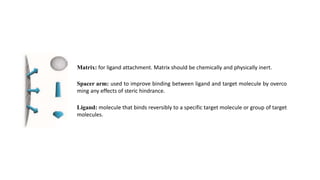
Matrix: for ligand attachment. Matrix should be chemically and physically inert.
Spacer arm: used to improve binding between ligand and target molecule by overco
ming any effects of steric hindrance.
Ligand: molecule that binds reversibly to a specific target molecule or group of target
molecules.
PRINCIPLES
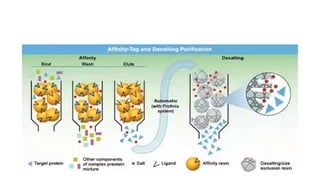
• The purification of protein is based on the reversible interactions
between the protein to be purified and the affinity ligand.
• The protein has inherent recognition site to which the ligand binds to
in a specific and reversible manner.
• To release and elute the bound molecules, a desorption step is usually
performed either specifically using a competitive ligand or
• Nonspecifically by changing the media atmosphere (ionic strength, pH
or polarity). As the elution is performed, the purified protein is
collected in a concentrated form.
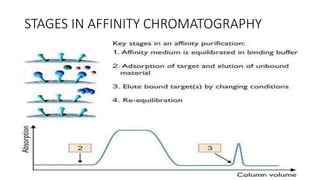
STAGES IN AFFINITY CHROMATOGRAPHY
factors to consider in choosing a support material
• Chemical inertness: - This requires that the support binds only the
molecule of interest.
• Chemical Stability: - The matrix must be resistant to possible
degradation that may be caused by enzymes
• Mechanical Stability: - The material must be able to withstand
pressures without compressing during separations
• Pore Size: - This should be at least five (5) times the diameter of the
molecule to be purified
Applications
• To study drug-protein binding interactions.
• Immunoglobulin purification.
• Recombinant tagged proteins
Advantages
• Affinity chromatography is a fairly achievable technique because of th
e great selectivity of the glucose residues and the target protein, givin
g purified product with a high yield of recovery.
• It can be a one step process in many cases.
• The technique can be used for substances of low concentration.
• Rapid separation is achieved while avoiding contamination.
Disadvantages
• The interaction of proteins of interest and ligand has to be determine
d carefully. This process required expensive materials, time, and small
amount of protein that can be processed at once.

A review on affinity chromatography.ppt shady

  • 1.
    A REVIEW ONAFFINITY CHROMATOGRAPHY • BY • OKOYE, Shedrack Chukwuebuka • 2013/1/46797BH • Supervisor: PROF. H.O. AKANYA
  • 2.
    INTRODUCTION • This isthe process used in separating mixtures by the virtue of differences in its permeability or absorbency. • This is done by passing the mixture with in a solution, suspension or vapor through a medium in which the compounds move at different rates. • These fluids in which it is dissolved is known as the mobile phase. • The separation is as a result of travelling at different speeds on the basis of differential partitioning between the mobile and stationery phase.
  • 3.
    TYPES OF CHROMATOGRAHY •Paper Chromatography • Thin-layer Chromatography • Ion Exchange Chromatography • Liquid Chromatography • Gas Chromatography • Chromatofocusing • Molecular exclusion • Adsorption • Affinity chromatography
  • 4.
    AFFINTY CHROMATOGRAPHY • Ithas been in existence for the past 50 years • Affinity chromatography involves the use traditional purification methods on the basis of pH, Ionic strength and temperature. • Affinity chromatography is based on molecular recognition of a target molecule by another molecule bound to a column.
  • 5.
    Matrix: for ligandattachment. Matrix should be chemically and physically inert. Spacer arm: used to improve binding between ligand and target molecule by overco ming any effects of steric hindrance. Ligand: molecule that binds reversibly to a specific target molecule or group of target molecules.
  • 6.
    PRINCIPLES • The purificationof protein is based on the reversible interactions between the protein to be purified and the affinity ligand. • The protein has inherent recognition site to which the ligand binds to in a specific and reversible manner. • To release and elute the bound molecules, a desorption step is usually performed either specifically using a competitive ligand or • Nonspecifically by changing the media atmosphere (ionic strength, pH or polarity). As the elution is performed, the purified protein is collected in a concentrated form.
  • 8.
    STAGES IN AFFINITYCHROMATOGRAPHY
  • 9.
    factors to considerin choosing a support material • Chemical inertness: - This requires that the support binds only the molecule of interest. • Chemical Stability: - The matrix must be resistant to possible degradation that may be caused by enzymes • Mechanical Stability: - The material must be able to withstand pressures without compressing during separations • Pore Size: - This should be at least five (5) times the diameter of the molecule to be purified
  • 10.
    Applications • To studydrug-protein binding interactions. • Immunoglobulin purification. • Recombinant tagged proteins
  • 11.
    Advantages • Affinity chromatographyis a fairly achievable technique because of th e great selectivity of the glucose residues and the target protein, givin g purified product with a high yield of recovery. • It can be a one step process in many cases. • The technique can be used for substances of low concentration. • Rapid separation is achieved while avoiding contamination.
  • 12.
    Disadvantages • The interactionof proteins of interest and ligand has to be determine d carefully. This process required expensive materials, time, and small amount of protein that can be processed at once.