Chapter 7
Aerosols, Sprays and Inhalations
Section1: Pharmaceutical Aerosols
 PHARMACEUTICAL AEROSOLS are pressurized
dosage forms containing one or more active ingredients
which upon actuation emit a fine dispersion of liquid
and/or solid materials in a gaseous medium.
 They depend upon the function of the container, its
valve assembly, and an added component--the
propellant--for the physical delivery of the medication
in proper form.
Ⅰ Definition
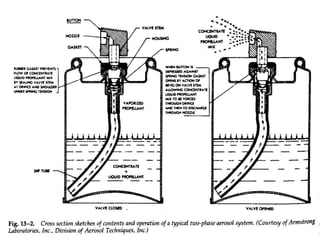
 An equilibrium is quickly established between that
portion of propellant which remains liquefied and that
which vaporizes
 The vapor phase exerts pressure in all directions--
against the walls of the container, the valve assembly,
and the surface of the liquid phase
 It is this pressure that upon actuation of the aerosol
valve forces the liquid phase up the dip tube and out
of the orifice of the valve into the atmosphere.
 As the propellant meets the air, it immediately
evaporates due to the drop in pressure, leaving the
product concentrate as airborne liquid droplets or
dry particles, depending upon the formulation.
 As the liquid phase is removed from the container,
equilibrium between the propellant remaining
liquefied and that in the vapor state is reestablished.
 Thus even during expulsion of the product from the
aerosol package, the pressure within remains virtually
constant, and the product may be continuously released
at an even rate and with the same propulsion.
However, when the liquid reservoir is depleted, the
pressure may not be maintained, and the gas may be
expelled from the container with diminishing pressure
until it is exhausted.
Ⅱ Features of the Aerosol Dosage Form
Some features of pharmaceutical aerosols that may be
considered advantages over other types of dosage
forms are as follows:
1. A portion of medication maybe easily withdrawn
from the package without contamination or
exposure to the remaining material.
2. By virtue of its hermetic character, the aerosol
container protects medicinal agents adversely affected
by atmospheric oxygen and moisture.
 Being opaque, the usual aerosol container also protects
drugs adversely affected by light.
 If the product is packaged under sterile conditions,
sterility may also be maintained during the shelf-life of
the product.
3. Topical medication may be applied in a uniform, thin
layer to the skin, without touching the affected area.
 Reduce the irritation
 The rapid volatilization of the propellant also
provides a cooling, refreshing effect.
4. By proper formulation and valve control, the physical
form and the particle size of the emitted product may
be controlled which may contribute to the efficacy of a
drug.
 Through the use of metered valves, dosage may be
controlled.
5. Aerosol application is a "clean" process, requiring
little or no "wash-up" by the user.
6. Have a immediate effect and can distributing the
medicaments to the certain tissues of the region.
Bigger absorption area; abundant blood circulation;
smaller resistance of penetration.
7. Drug can avoid to be destroyed or inactivated by
the pH or enzymatic activity of the stomach or
intestines, also can avoid the first pass effect.
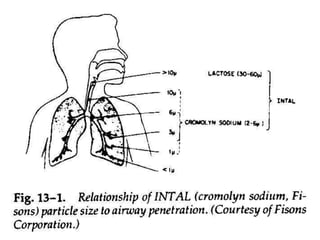
The influencing factors of absorption
The air current of breath: the amount of inspiration
and frequency of breath.
Particle size: most 5μm, must be smaller than 10μm.
The features of drug: solubility; molecular weight,
oil-solubility (Ko/w), moisture absorption.
Disadvantages of the pharmaceutical aerosol:
 High cost.
 Because of the volatility, the propellants has the
refrigeration effect which can irritate the skin.
 To certain individuals, who may be sensitive to the
propellant agent and who utilize an inhalation
aerosol, the fluorinated hydrocarbons may exhibit
cardiotoxic effects following rapid and repeated use
of the aerosol product.
Ⅲ Aerosol Systems
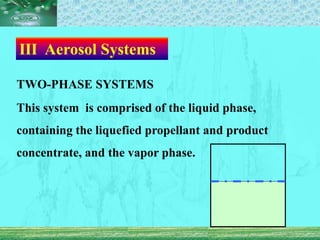
TWO-PHASE SYSTEMS
This system is comprised of the liquid phase,
containing the liquefied propellant and product
concentrate, and the vapor phase.
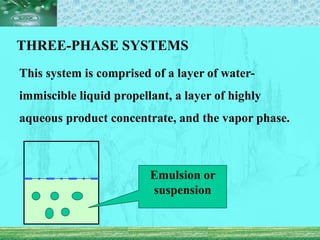
THREE-PHASE SYSTEMS
This system is comprised of a layer of water-
immiscible liquid propellant, a layer of highly
aqueous product concentrate, and the vapor phase.
Emulsion or
suspension
Ⅳ The Aerosol principle
An aerosol formulation consists of two component
parts, the product concentrate and the propellant.
1 The product concentrate is the active ingredient of
the aerosol combined with the required adjuncts,
such as antioxidants, surface-active agents, and
solvents, to prepare a stable and efficacious product.
2 the propellant
 When the propellant is a liquefied gas or a mixture
of liquefied gases, it frequently serves the dual role
of propellant and solvent or vehicle for the product
concentrate.
 In certain aerosol systems, no liquefied compressed
gases, as carbon dioxide, nitrogen, and nitrous
oxide, are employed as the propellant.
Chlorofluorocarbons (CFCs).
 The most used propellant in aerosol products
 However these propellants are being phased out and
will be prohibited due to scientific recognition that
they reduce the amount of ozone in the stratosphere,
which results in an increase in the amount of
ultraviolet radiation reaching the earth, an increase
in the incidence of skin cancer, and other adverse
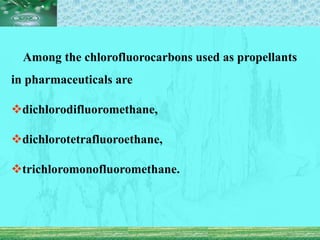
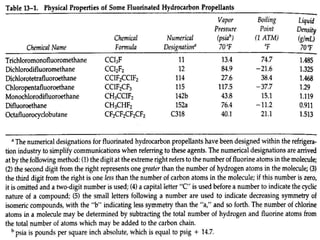
Among the chlorofluorocarbons used as propellants
in pharmaceuticals are
dichlorodifluoromethane,
dichlorotetrafluoroethane,
trichloromonofluoromethane.
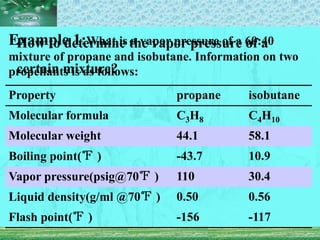
How to determine the vapor pressure of a
certain mixture?
Example 1:What is a vapor pressure of a 60:40
mixture of propane and isobutane. Information on two
propellants is as follows:
Property propane isobutane
Molecular formula C3H8 C4H10
Molecular weight 44.1 58.1
Boiling point(℉ ) -43.7 10.9
Vapor pressure(psig@70℉ ) 110 30.4
Liquid density(g/ml @70℉ ) 0.50 0.56
Flash point(℉ ) -156 -117
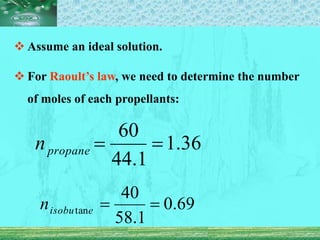
 Assume an ideal solution.
 For Raoult’s law, we need to determine the number
of moles of each propellants:
36
.
1
1
.
44
60


propane
n
69
.
0
1
.
58
40
tan 

e
isobu
n
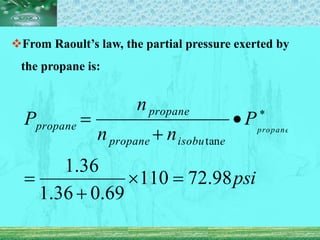
From Raoult’s law, the partial pressure exerted by
the propane is:
psi
P
n
n
n
P propane
e
isobu
propane
propane
propane
98
.
72
110
69
.
0
36
.
1
36
.
1
tan






 
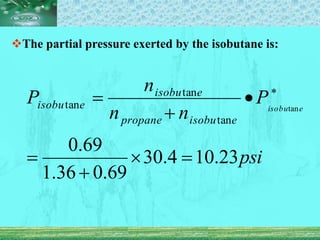
The partial pressure exerted by the isobutane is:
psi
P
n
n
n
P e
isobu
e
isobu
propane
e
isobu
e
isobu
23
.
10
4
.
30
69
.
0
36
.
1
69
.
0
tan
tan
tan
tan






 
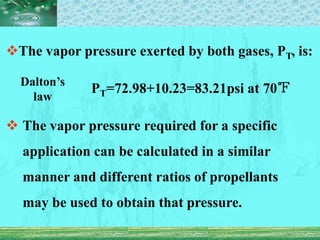
The vapor pressure exerted by both gases, PT, is:
PT=72.98+10.23=83.21psi at 70℉
 The vapor pressure required for a specific
application can be calculated in a similar
manner and different ratios of propellants
may be used to obtain that pressure.
Dalton’s
law
Ⅴ Pressurized containers
 Various materials have been used in the
manufacture of aerosol containers, including
(1)glass, uncoated or plastic coated;
(2)metal, including tin-plated steel, aluminum, and
stainless steel;
(3)plastics
 The selection of the container for an aerosol product is
based on
 its adaptability to production methods
 compatibility with formulation components
 ability to sustain the pressure intended for the product
 the interest in design
 aesthetic appeal on the part of the manufacturer
 cost
Ⅵ Valve assembly
 The function of the valve assembly is to permit the
expulsion of the contents of the can in the desired
form, at the desired rate, and, in the case of metered
valves, in the proper amount or dose.
 Among the materials used in the manufacture of the
various valve parts are plastic, rubber, aluminum,
and stainless steel.
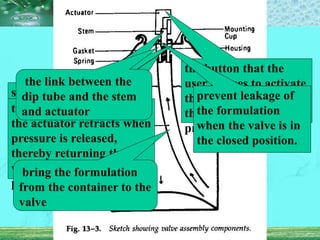
the button that the
user presses to activate
the valve assembly for
the emission of the
product
supports the actuator
and delivers the
formulation in the
proper form to the
chamber of the actuator
prevent leakage of
the formulation
when the valve is in
the closed position.

the mechanism by which
the actuator retracts when
pressure is released,
thereby returning the
valve to the closed
position
hold the valve in place
the link between the
dip tube and the stem
and actuator
bring the formulation
from the container to the
valve
Metered Dose Inhalers (MDIs)
Ⅶ Filling
Operations
COLD FILLING
PRESSURE FILLING
COLD FILLING
 both the product concentrate and the propellant
must be cooled to temperatures of -30℉to -40℉
 the chilled product concentrate is quantitatively
metered into an equally cold aerosol container
 the liquefied gas is added, the heavy vapors of the
cold liquid propellant generally displace the air
present in the container
 When sufficient propellant has been added, the valve
assembly is immediately inserted and crimped into
place
 Notice:
 because of the low temperatures required, aqueous
systems cannot be filled by this process, since the water
turns to ice.
 in the process, some of the propellant vapors are also
lost
PRESSURE FILLING
 the product concentrate is quantitatively placed in
the aerosol container
 the valve assembly is inserted and crimped into
place
 the liquefied gas, under pressure, is metered into
the valve stem from a pressure burette
Pressure filling is used for most pharmaceutical
aerosols.
It has the advantage over the cold filling
method in that there is less danger of moisture
contamination of the product, and also less
propellant is lost in the process.
Ⅷ Testing the Filled
Containers
The aerosol container is tested under various
environmental conditions for leaks or weakness in
the valve assembly or container.
The valve discharge rate is determined by
discharging a portion of the contents of a previously
weighed aerosol during a given period of time, and
calculating.
Aerosols may be tested:
for their spray patterns
for particle size distribution of the spray: most
5μm, must be smaller than 10μm.
for accuracy and reproducibility of dosage when
using metered valves.
Section 2: Sprays
 Sprays may be defined as aqueous or oleaginous
solutions in the form of coarse droplets or as finely
divided solids to be applied topically, most usually to
the nasal-pharyngeal tract or to the skin.
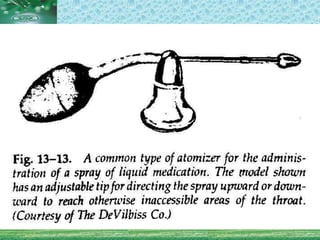
 For example: medicinal atomizers, which are
employed for the issuance of a medicated solution to
the patient in the form of fine droplets
Section 3: Inhalations
Inhalations are drugs or solutions of drugs
administered by the nasal or oral respiratory route.
The drugs may be administered for their local action
on the bronchial tree or for their systemic effects
through absorption from the lungs.
A unique form of powder administration involves the
inhalation of a micronized powder directly into the
lungs using a special breath-activated device
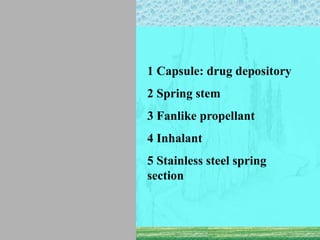
1 Capsule: drug depository
2 Spring stem
3 Fanlike propellant
4 Inhalant
5 Stainless steel spring
section
Glossary
Aerosols; sprays; inhalations;
Pressurized container, valve assembly; propellant;
Two-phase systems; three-phase systems;
Ingredient; solvent or vehicle ;
Chlorofluorocarbons (CFCs);
Metered dose inhalers ;
Cold filling ; pressure filling
Problems:
1 What is aerosols, sprays and inhalations?
2 Please briefly describe the influencing factors of
aerosols absorption.
3 Please briefly describe the advantages and
disadvantages of aerosols.
4 Which are the constituents of aerosols?
5 Please briefly describe the quality request of aerosols.
6 What is the function of propellants?

aerosols.ppt

  • 1.
  • 2.
    Section1: Pharmaceutical Aerosols PHARMACEUTICAL AEROSOLS are pressurized dosage forms containing one or more active ingredients which upon actuation emit a fine dispersion of liquid and/or solid materials in a gaseous medium.  They depend upon the function of the container, its valve assembly, and an added component--the propellant--for the physical delivery of the medication in proper form. Ⅰ Definition
  • 4.
     An equilibriumis quickly established between that portion of propellant which remains liquefied and that which vaporizes  The vapor phase exerts pressure in all directions-- against the walls of the container, the valve assembly, and the surface of the liquid phase  It is this pressure that upon actuation of the aerosol valve forces the liquid phase up the dip tube and out of the orifice of the valve into the atmosphere.
  • 5.
     As thepropellant meets the air, it immediately evaporates due to the drop in pressure, leaving the product concentrate as airborne liquid droplets or dry particles, depending upon the formulation.  As the liquid phase is removed from the container, equilibrium between the propellant remaining liquefied and that in the vapor state is reestablished.
  • 6.
     Thus evenduring expulsion of the product from the aerosol package, the pressure within remains virtually constant, and the product may be continuously released at an even rate and with the same propulsion. However, when the liquid reservoir is depleted, the pressure may not be maintained, and the gas may be expelled from the container with diminishing pressure until it is exhausted.
  • 7.
    Ⅱ Features ofthe Aerosol Dosage Form Some features of pharmaceutical aerosols that may be considered advantages over other types of dosage forms are as follows: 1. A portion of medication maybe easily withdrawn from the package without contamination or exposure to the remaining material.
  • 8.
    2. By virtueof its hermetic character, the aerosol container protects medicinal agents adversely affected by atmospheric oxygen and moisture.  Being opaque, the usual aerosol container also protects drugs adversely affected by light.  If the product is packaged under sterile conditions, sterility may also be maintained during the shelf-life of the product.
  • 9.
    3. Topical medicationmay be applied in a uniform, thin layer to the skin, without touching the affected area.  Reduce the irritation  The rapid volatilization of the propellant also provides a cooling, refreshing effect.
  • 10.
    4. By properformulation and valve control, the physical form and the particle size of the emitted product may be controlled which may contribute to the efficacy of a drug.  Through the use of metered valves, dosage may be controlled. 5. Aerosol application is a "clean" process, requiring little or no "wash-up" by the user.
  • 12.
    6. Have aimmediate effect and can distributing the medicaments to the certain tissues of the region. Bigger absorption area; abundant blood circulation; smaller resistance of penetration. 7. Drug can avoid to be destroyed or inactivated by the pH or enzymatic activity of the stomach or intestines, also can avoid the first pass effect.
  • 13.
    The influencing factorsof absorption The air current of breath: the amount of inspiration and frequency of breath. Particle size: most 5μm, must be smaller than 10μm. The features of drug: solubility; molecular weight, oil-solubility (Ko/w), moisture absorption.
  • 14.
    Disadvantages of thepharmaceutical aerosol:  High cost.  Because of the volatility, the propellants has the refrigeration effect which can irritate the skin.  To certain individuals, who may be sensitive to the propellant agent and who utilize an inhalation aerosol, the fluorinated hydrocarbons may exhibit cardiotoxic effects following rapid and repeated use of the aerosol product.
  • 15.
    Ⅲ Aerosol Systems TWO-PHASESYSTEMS This system is comprised of the liquid phase, containing the liquefied propellant and product concentrate, and the vapor phase.
  • 16.
    THREE-PHASE SYSTEMS This systemis comprised of a layer of water- immiscible liquid propellant, a layer of highly aqueous product concentrate, and the vapor phase. Emulsion or suspension
  • 17.
    Ⅳ The Aerosolprinciple An aerosol formulation consists of two component parts, the product concentrate and the propellant. 1 The product concentrate is the active ingredient of the aerosol combined with the required adjuncts, such as antioxidants, surface-active agents, and solvents, to prepare a stable and efficacious product.
  • 18.
    2 the propellant When the propellant is a liquefied gas or a mixture of liquefied gases, it frequently serves the dual role of propellant and solvent or vehicle for the product concentrate.  In certain aerosol systems, no liquefied compressed gases, as carbon dioxide, nitrogen, and nitrous oxide, are employed as the propellant.
  • 19.
    Chlorofluorocarbons (CFCs).  Themost used propellant in aerosol products  However these propellants are being phased out and will be prohibited due to scientific recognition that they reduce the amount of ozone in the stratosphere, which results in an increase in the amount of ultraviolet radiation reaching the earth, an increase in the incidence of skin cancer, and other adverse
  • 20.
    Among the chlorofluorocarbonsused as propellants in pharmaceuticals are dichlorodifluoromethane, dichlorotetrafluoroethane, trichloromonofluoromethane.
  • 22.
    How to determinethe vapor pressure of a certain mixture? Example 1:What is a vapor pressure of a 60:40 mixture of propane and isobutane. Information on two propellants is as follows: Property propane isobutane Molecular formula C3H8 C4H10 Molecular weight 44.1 58.1 Boiling point(℉ ) -43.7 10.9 Vapor pressure(psig@70℉ ) 110 30.4 Liquid density(g/ml @70℉ ) 0.50 0.56 Flash point(℉ ) -156 -117
  • 23.
     Assume anideal solution.  For Raoult’s law, we need to determine the number of moles of each propellants: 36 . 1 1 . 44 60   propane n 69 . 0 1 . 58 40 tan   e isobu n
  • 24.
    From Raoult’s law,the partial pressure exerted by the propane is: psi P n n n P propane e isobu propane propane propane 98 . 72 110 69 . 0 36 . 1 36 . 1 tan        
  • 25.
    The partial pressureexerted by the isobutane is: psi P n n n P e isobu e isobu propane e isobu e isobu 23 . 10 4 . 30 69 . 0 36 . 1 69 . 0 tan tan tan tan        
  • 26.
    The vapor pressureexerted by both gases, PT, is: PT=72.98+10.23=83.21psi at 70℉  The vapor pressure required for a specific application can be calculated in a similar manner and different ratios of propellants may be used to obtain that pressure. Dalton’s law
  • 27.
    Ⅴ Pressurized containers Various materials have been used in the manufacture of aerosol containers, including (1)glass, uncoated or plastic coated; (2)metal, including tin-plated steel, aluminum, and stainless steel; (3)plastics
  • 28.
     The selectionof the container for an aerosol product is based on  its adaptability to production methods  compatibility with formulation components  ability to sustain the pressure intended for the product  the interest in design  aesthetic appeal on the part of the manufacturer  cost
  • 29.
    Ⅵ Valve assembly The function of the valve assembly is to permit the expulsion of the contents of the can in the desired form, at the desired rate, and, in the case of metered valves, in the proper amount or dose.  Among the materials used in the manufacture of the various valve parts are plastic, rubber, aluminum, and stainless steel.
  • 30.
    the button thatthe user presses to activate the valve assembly for the emission of the product supports the actuator and delivers the formulation in the proper form to the chamber of the actuator prevent leakage of the formulation when the valve is in the closed position. the mechanism by which the actuator retracts when pressure is released, thereby returning the valve to the closed position hold the valve in place the link between the dip tube and the stem and actuator bring the formulation from the container to the valve
  • 31.
  • 32.
  • 33.
    COLD FILLING  boththe product concentrate and the propellant must be cooled to temperatures of -30℉to -40℉  the chilled product concentrate is quantitatively metered into an equally cold aerosol container  the liquefied gas is added, the heavy vapors of the cold liquid propellant generally displace the air present in the container
  • 34.
     When sufficientpropellant has been added, the valve assembly is immediately inserted and crimped into place  Notice:  because of the low temperatures required, aqueous systems cannot be filled by this process, since the water turns to ice.  in the process, some of the propellant vapors are also lost
  • 35.
    PRESSURE FILLING  theproduct concentrate is quantitatively placed in the aerosol container  the valve assembly is inserted and crimped into place  the liquefied gas, under pressure, is metered into the valve stem from a pressure burette
  • 36.
    Pressure filling isused for most pharmaceutical aerosols. It has the advantage over the cold filling method in that there is less danger of moisture contamination of the product, and also less propellant is lost in the process.
  • 38.
    Ⅷ Testing theFilled Containers The aerosol container is tested under various environmental conditions for leaks or weakness in the valve assembly or container. The valve discharge rate is determined by discharging a portion of the contents of a previously weighed aerosol during a given period of time, and calculating.
  • 39.
    Aerosols may betested: for their spray patterns for particle size distribution of the spray: most 5μm, must be smaller than 10μm. for accuracy and reproducibility of dosage when using metered valves.
  • 40.
    Section 2: Sprays Sprays may be defined as aqueous or oleaginous solutions in the form of coarse droplets or as finely divided solids to be applied topically, most usually to the nasal-pharyngeal tract or to the skin.  For example: medicinal atomizers, which are employed for the issuance of a medicated solution to the patient in the form of fine droplets
  • 42.
    Section 3: Inhalations Inhalationsare drugs or solutions of drugs administered by the nasal or oral respiratory route. The drugs may be administered for their local action on the bronchial tree or for their systemic effects through absorption from the lungs. A unique form of powder administration involves the inhalation of a micronized powder directly into the lungs using a special breath-activated device
  • 43.
    1 Capsule: drugdepository 2 Spring stem 3 Fanlike propellant 4 Inhalant 5 Stainless steel spring section
  • 44.
    Glossary Aerosols; sprays; inhalations; Pressurizedcontainer, valve assembly; propellant; Two-phase systems; three-phase systems; Ingredient; solvent or vehicle ; Chlorofluorocarbons (CFCs); Metered dose inhalers ; Cold filling ; pressure filling
  • 45.
    Problems: 1 What isaerosols, sprays and inhalations? 2 Please briefly describe the influencing factors of aerosols absorption. 3 Please briefly describe the advantages and disadvantages of aerosols. 4 Which are the constituents of aerosols? 5 Please briefly describe the quality request of aerosols. 6 What is the function of propellants?