RECTAL DRUG DELIVERY
SYSTEMS
Presented by: Pr.RAGHAVENDRA KUMAR GUNDA M.PHARM
ASSISTANT.PROFESSOR,
DEPARTMENTOF PHARMACEUTICS,
NARASARAOPETA INSTITUTE OF PHARMACEUTICAL SCIENCES
History:
 The history of rectal medication can be
traced back to antiquity. These
medications were being used in ancient
Egypt, India, & Mesopotamia. In the
second half of 19th century a scientific
basis for rectal therapy was established.
2DEPARTMENT OF PHARMACEUTICS, NIPS
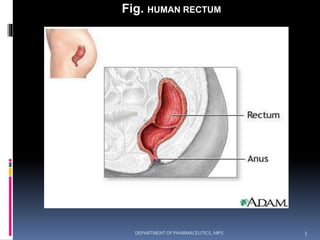
Fig. HUMAN RECTUM
3DEPARTMENT OF PHARMACEUTICS, NIPS
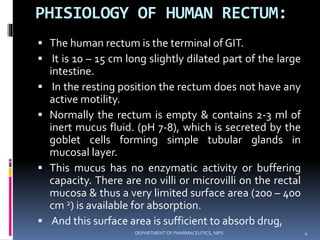
PHISIOLOGY OF HUMAN RECTUM:
 The human rectum is the terminal of GIT.
 It is 10 – 15 cm long slightly dilated part of the large
intestine.
 In the resting position the rectum does not have any
active motility.
 Normally the rectum is empty & contains 2-3 ml of
inert mucus fluid. (pH 7-8), which is secreted by the
goblet cells forming simple tubular glands in
mucosal layer.
 This mucus has no enzymatic activity or buffering
capacity. There are no villi or microvilli on the rectal
mucosa & thus a very limited surface area (200 – 400
cm 2) is available for absorption.
 And this surface area is sufficient to absorb drug,
4DEPARTMENT OF PHARMACEUTICS, NIPS
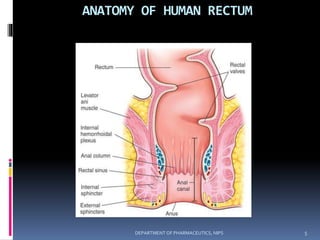
ANATOMY OF HUMAN RECTUM
5DEPARTMENT OF PHARMACEUTICS, NIPS
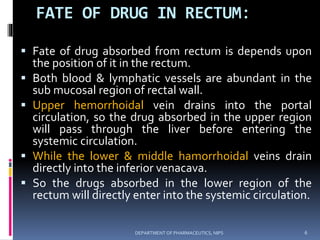
FATE OF DRUG IN RECTUM:
 Fate of drug absorbed from rectum is depends upon
the position of it in the rectum.
 Both blood & lymphatic vessels are abundant in the
sub mucosal region of rectal wall.
 Upper hemorrhoidal vein drains into the portal
circulation, so the drug absorbed in the upper region
will pass through the liver before entering the
systemic circulation.
 While the lower & middle hamorrhoidal veins drain
directly into the inferior venacava.
 So the drugs absorbed in the lower region of the
rectum will directly enter into the systemic circulation.
6DEPARTMENT OF PHARMACEUTICS, NIPS
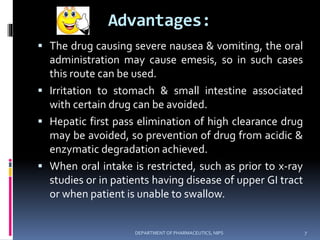
Advantages:
 The drug causing severe nausea & vomiting, the oral
administration may cause emesis, so in such cases
this route can be used.
 Irritation to stomach & small intestine associated
with certain drug can be avoided.
 Hepatic first pass elimination of high clearance drug
may be avoided, so prevention of drug from acidic &
enzymatic degradation achieved.
 When oral intake is restricted, such as prior to x-ray
studies or in patients having disease of upper GI tract
or when patient is unable to swallow.
7DEPARTMENT OF PHARMACEUTICS, NIPS
 Useful in pediatric, geriatric & unconscious patients.
 Drug delivery can be stopped by removal of dosage
form & drug absorption can be easily interrupted in
cases of accidental overdose or suicide attempts.
 Drugs used traditionally are only given parentraly by
making several combinations with absorption
promoting additives.
Disadvantages:
 Inconvenient for patients.
 The absorption of drugs is frequently irregular
& difficult to predict.
8DEPARTMENT OF PHARMACEUTICS, NIPS
Factors affecting the absorption
of drug from rectum:
1) Physiological factors of drug-
 Colonic content- drug will have greater opportunity to
get absorbed when the rectum is empty. For this purpose
enema is given before rectal drug administration.
 Circulation route- if the drug is absorbed from lower
hamorrhoidal veins it will directly take the drug to
inferior venacava, so the absorption will be rapid and
effective.
9DEPARTMENT OF PHARMACEUTICS, NIPS
@
 pH and lack of buffering capacity of rectal fluids- the
rectal fluid have pH7-8, hence no effective buffering
capacity. So ionized or un-ionized form of the drugs will be
having marked influence.
2) Physiochemical factors of drug-
 Lipid-water solubility – a lipophilic drug if given with
fatty bases it will not escape from base easily. So
absorption is altered.
 Particle size – the smaller the particle the greater will
be the solubility.
 Nature of base- if the base interacts with the drug or if
it irritates the mucus membrane it will decrease the
absorption. Mainly in case of suppositories.
10DEPARTMENT OF PHARMACEUTICS, NIPS
Different types of rectal dosage forms:
 In the rectal drug delivery system the
following types of dosage forms are available.
 Rectal semisolids: 1) Creams
2) Gels
3) Ointments
4) Suppositories
 Rectal liquids : 1) Solutions
2) Suspensions
 Rectal aerosols
11DEPARTMENT OF PHARMACEUTICS, NIPS
@
Rectal semisolids:
 Rectal cream, gels and ointments-
 These preparations are used for topical application to the
perianal area for insertion within the anal canal. They largely
are used to treat local conditions of anorectal pruritis,
inflammation and the pain and discomfort associated with
hemorrhoids.
 The drugs includes astringents (eg. Zinc oxide), protectants
and lubricants ( eg. Cocoa butter, lanolin), local anaestheics
(eg. Pramoxine HCL), and antipruritis and anti inflammatory
agents( eg. Hydrocortisone)
12DEPARTMENT OF PHARMACEUTICS, NIPS
@
 The bases used in anorectal creams and ointments includes
combinations of polyethylene glycol 300 & 3350, emulsion
cream bases using cetyl alcohol & cetyl esters wax, and
white petroleum and mineral oil.
 The preservatives like methylparaben, propylparaben,
benzlyacohol and butylated hydrocortisole (BHA) are also
used.
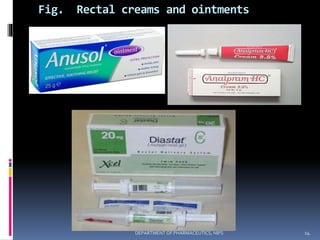
 Several commercial rectal creams and ointments and gels -
 ANUSOL ointment - GLAXOSMITHKLINE ( starch)
 TRONOLANE cream - ROSS ( pramoxine HCL)
 ANALPRAM -HC cream
 DIASTAT Gel - AcuDial ( Diazepam )
13DEPARTMENT OF PHARMACEUTICS, NIPS
Fig. Rectal creams and ointments
14DEPARTMENT OF PHARMACEUTICS, NIPS
@
 APPLICATION - Before applying rectal ointments and
cream the perianal skin and the affected area should be
cleaned and dried.
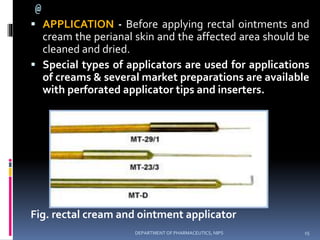
 Special types of applicators are used for applications
of creams & several market preparations are available
with perforated applicator tips and inserters.
Fig. rectal cream and ointment applicator
15DEPARTMENT OF PHARMACEUTICS, NIPS
@
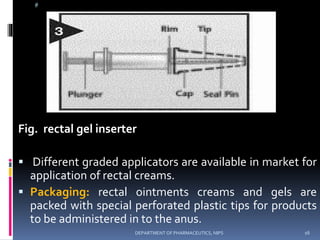
Fig. rectal gel inserter
 Different graded applicators are available in market for
application of rectal creams.
 Packaging: rectal ointments creams and gels are
packed with special perforated plastic tips for products
to be administered in to the anus.
16DEPARTMENT OF PHARMACEUTICS, NIPS
Rectal suppositories:
 Solid suppositories are the most common dosage form used
for rectal drug administration and represent greater than 98%
of all rectal dosage forms.
 Typically, these are torpedo-shaped dosage forms composed
of fatty bases (low-melting) or water-soluble bases
(dissolving) which vary in weight from 1 g (children) to 2.5 g
(adult).
 Lipophilic drugs are usually incorporated into water-soluble
bases while hydrophilic drugs are formulated into the fatty
base suppositories.
17DEPARTMENT OF PHARMACEUTICS, NIPS
@
 For suppositories made from fatty bases,
melting should occur rapidly near body
temperature (37°C).
 Ideally the resultant melt would readily flow to
provide thin, broad coverage of the rectal
tissue, thereby minimizing lag time effects due
to slow release of the drug from the suppository
base.
 Water-soluble suppositories should likewise
readily dissolve at 37°C to facilitate drug release
and subsequent absorption.
18DEPARTMENT OF PHARMACEUTICS, NIPS
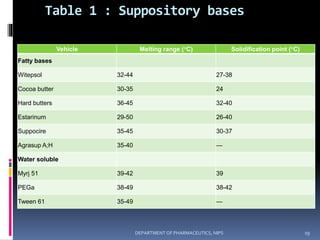
Table 1 : Suppository bases
Vehicle Melting range (°C) Solidification point (°C)
Fatty bases
Witepsol 32-44 27-38
Cocoa butter 30-35 24
Hard butters 36-45 32-40
Estarinum 29-50 26-40
Suppocire 35-45 30-37
Agrasup A;H 35-40 —
Water soluble
Myrj 51 39-42 39
PEGa 38-49 38-42
Tween 61 35-49 —
19DEPARTMENT OF PHARMACEUTICS, NIPS
@
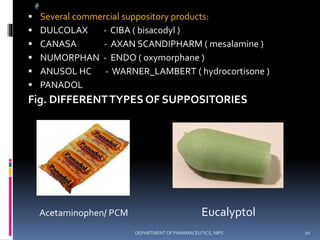
 Several commercial suppository products:
 DULCOLAX - CIBA ( bisacodyl )
 CANASA - AXAN SCANDIPHARM ( mesalamine )
 NUMORPHAN - ENDO ( oxymorphane )
 ANUSOL HC - WARNER_LAMBERT ( hydrocortisone )
 PANADOL
Fig. DIFFERENTTYPES OF SUPPOSITORIES
Acetaminophen/ PCM Eucalyptol
20DEPARTMENT OF PHARMACEUTICS, NIPS
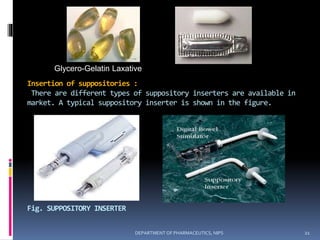
Insertion of suppositories :
There are different types of suppository inserters are available in
market. A typical suppository inserter is shown in the figure.
Fig. SUPPOSITORY INSERTER
Glycero-Gelatin Laxative
21DEPARTMENT OF PHARMACEUTICS, NIPS
@
 PACKAGING: Packaging is done after lubrication with
proper lubricant in aluminum foil or in other suitable
material. And with indication
[ STORE IN A COOL PLACE ]
 The use of gels, foams or ointments for rectal
administration can afford advantages over liquid
formulations because retention of the dosage form in the
rectal cavity reduces patient compliance problems. Drug
release with semisolid dosage forms is usually limited to
local indications such as hemorrhoids and lower bowel
inflammation (proctitis). Drug release and subsequent
pharmacologic action is usually faster with semisolid
formulations than with solid suppositories since a lag
time is not required for melting or dissolution.
22DEPARTMENT OF PHARMACEUTICS, NIPS
@
Rectal liquids:
 Rectal suspensions, emulsions & solutions
 Solutions, suspensions, or retention enemas represent rectal
dosage forms with very limited application, largely due to
inconvenience of use and poor patient compliance.
 In many cases, these formulations are utilized to administer
contrast media and imaging agents for lower GI roentgenography.
 Although drug absorption from solutions has been shown to
exceed that from solid suppositories in some cases so this
particular administration route is only infrequently employed.
 This dosage forms are mainly used as enemas
 Retention enema: For systemic or local effect this is used. The
drugs like hydrocortisone (local effect) or aminophylline (systemic
effect) etc are used in this dosage form.
 Evacuation enema: For cleansing of bowel this enemas are used.
The agents are sodium phosphate and sodium biphosphate,
glycerin and doccusate potassium and light mineral oil.
23DEPARTMENT OF PHARMACEUTICS, NIPS
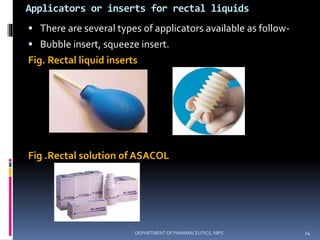
Applicators or inserts for rectal liquids
 There are several types of applicators available as follow-
 Bubble insert, squeeze insert.
Fig. Rectal liquid inserts
Fig .Rectal solution of ASACOL
24DEPARTMENT OF PHARMACEUTICS, NIPS
@
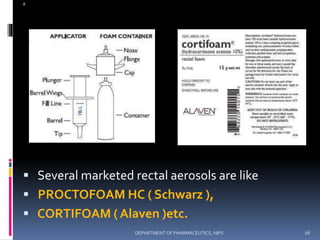
RECTAL AEROSOLS:
 Rectal aerosols or foams-
 Rectal aerosol foam products are also accompanied by
applicators to facilitate administration.
 The applicator is attached to the container and filled with a
measured dose of product.
 Metered dose aerosols are available. The inserter is inserted
in to the anus and the plunger is pushed to deliver the drug
product.
25DEPARTMENT OF PHARMACEUTICS, NIPS
@
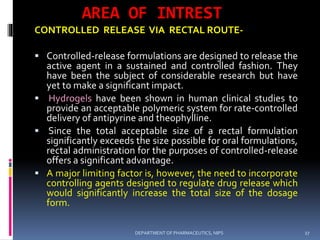
 Several marketed rectal aerosols are like
 PROCTOFOAM HC ( Schwarz ),
 CORTIFOAM ( Alaven )etc.
26DEPARTMENT OF PHARMACEUTICS, NIPS
AREA OF INTREST
CONTROLLED RELEASE VIA RECTAL ROUTE-
 Controlled-release formulations are designed to release the
active agent in a sustained and controlled fashion. They
have been the subject of considerable research but have
yet to make a significant impact.
 Hydrogels have been shown in human clinical studies to
provide an acceptable polymeric system for rate-controlled
delivery of antipyrine and theophylline.
 Since the total acceptable size of a rectal formulation
significantly exceeds the size possible for oral formulations,
rectal administration for the purposes of controlled-release
offers a significant advantage.
 A major limiting factor is, however, the need to incorporate
controlling agents designed to regulate drug release which
would significantly increase the total size of the dosage
form.
27DEPARTMENT OF PHARMACEUTICS, NIPS
@
 Since adult rectal dosage forms are acceptable up
to 2.5 g, the total drug load which can be
formulated in a rectal controlled-release
formulation can be 2-3 times that possible in an
oral formulation. For some therapeutic agents,
this higher drug load can offer an advantage which
is not achievable via the oral route.
 Development and marketing of rectal controlled-
release formulations will, however, still be
disadvantaged because of the perceived
reluctance of patients to employ this route and
problems of poor patient compliance.
 Only a limited number of therapeutic agents are
currently marketed as rectal dosage forms.
@@
28DEPARTMENT OF PHARMACEUTICS, NIPS
REASEARCH ARTICLE:
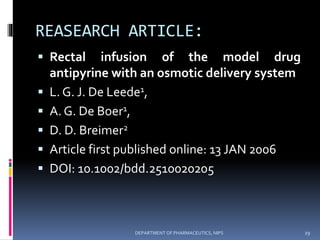
 Rectal infusion of the model drug
antipyrine with an osmotic delivery system
 L. G. J. De Leede1,
 A. G. De Boer1,
 D. D. Breimer2
 Article first published online: 13 JAN 2006
 DOI: 10.1002/bdd.2510020205
29DEPARTMENT OF PHARMACEUTICS, NIPS
REASEARCH ARTICLE (cont.) :osmotically-
powered rectal drug delivery system
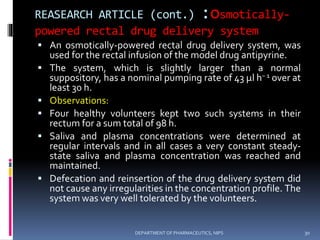
 An osmotically-powered rectal drug delivery system, was
used for the rectal infusion of the model drug antipyrine.
 The system, which is slightly larger than a normal
suppository, has a nominal pumping rate of 43 μl h− 1 over at
least 30 h.
 Observations:
 Four healthy volunteers kept two such systems in their
rectum for a sum total of 98 h.
 Saliva and plasma concentrations were determined at
regular intervals and in all cases a very constant steady-
state saliva and plasma concentration was reached and
maintained.
 Defecation and reinsertion of the drug delivery system did
not cause any irregularities in the concentration profile. The
system was very well tolerated by the volunteers.
30DEPARTMENT OF PHARMACEUTICS, NIPS
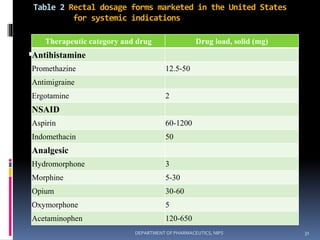
Table 2 Rectal dosage forms marketed in the United States
for systemic indications

Therapeutic category and drug Drug load, solid (mg)
Antihistamine
Promethazine 12.5-50
Antimigraine
Ergotamine 2
NSAID
Aspirin 60-1200
Indomethacin 50
Analgesic
Hydromorphone 3
Morphine 5-30
Opium 30-60
Oxymorphone 5
Acetaminophen 120-650
31DEPARTMENT OF PHARMACEUTICS, NIPS
@
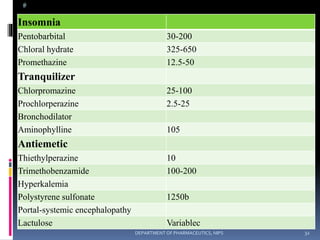
Insomnia
Pentobarbital 30-200
Chloral hydrate 325-650
Promethazine 12.5-50
Tranquilizer
Chlorpromazine 25-100
Prochlorperazine 2.5-25
Bronchodilator
Aminophylline 105
Antiemetic
Thiethylperazine 10
Trimethobenzamide 100-200
Hyperkalemia
Polystyrene sulfonate 1250b
Portal-systemic encephalopathy
Lactulose Variablec
32DEPARTMENT OF PHARMACEUTICS, NIPS
@
 CONCLUSION
 In certain areas of the world, particularly some European
countries and Japan, rectal dosage forms are somewhat
more accepted by the patient population and, hence,
development of rectal dosage forms has surpassed that in
other countries.
 According to a survey in 1970, approximately 7.5% of all
prescriptions in France were formulations intended for
rectal administration.
 Even though a few countries may find rectal dosage forms
more acceptable, these still represent a small area of the
world-wide market share which can be assigned to rectal
drug therapy.
33DEPARTMENT OF PHARMACEUTICS, NIPS
@
REFFRENCE:
 Ansel’s Pharmaceutical Dosage Forms and Drug
Delivery Systems, by Howard c. Ansel , Loyd v.
Allen, Jr. Nicholas G. Popovich. 8th edition
 Rectal drug delivery ,Wikipedia.
 Encyclopedia of pharmaceutical technology ,3rd
edition
 By J. Howard Rytting
 Images from Google images.
34DEPARTMENT OF PHARMACEUTICS, NIPS
@
35DEPARTMENT OF PHARMACEUTICS, NIPS

Rectal dds

  • 1.
    RECTAL DRUG DELIVERY SYSTEMS Presentedby: Pr.RAGHAVENDRA KUMAR GUNDA M.PHARM ASSISTANT.PROFESSOR, DEPARTMENTOF PHARMACEUTICS, NARASARAOPETA INSTITUTE OF PHARMACEUTICAL SCIENCES
  • 2.
    History:  The historyof rectal medication can be traced back to antiquity. These medications were being used in ancient Egypt, India, & Mesopotamia. In the second half of 19th century a scientific basis for rectal therapy was established. 2DEPARTMENT OF PHARMACEUTICS, NIPS
  • 3.
    Fig. HUMAN RECTUM 3DEPARTMENTOF PHARMACEUTICS, NIPS
  • 4.
    PHISIOLOGY OF HUMANRECTUM:  The human rectum is the terminal of GIT.  It is 10 – 15 cm long slightly dilated part of the large intestine.  In the resting position the rectum does not have any active motility.  Normally the rectum is empty & contains 2-3 ml of inert mucus fluid. (pH 7-8), which is secreted by the goblet cells forming simple tubular glands in mucosal layer.  This mucus has no enzymatic activity or buffering capacity. There are no villi or microvilli on the rectal mucosa & thus a very limited surface area (200 – 400 cm 2) is available for absorption.  And this surface area is sufficient to absorb drug, 4DEPARTMENT OF PHARMACEUTICS, NIPS
  • 5.
    ANATOMY OF HUMANRECTUM 5DEPARTMENT OF PHARMACEUTICS, NIPS
  • 6.
    FATE OF DRUGIN RECTUM:  Fate of drug absorbed from rectum is depends upon the position of it in the rectum.  Both blood & lymphatic vessels are abundant in the sub mucosal region of rectal wall.  Upper hemorrhoidal vein drains into the portal circulation, so the drug absorbed in the upper region will pass through the liver before entering the systemic circulation.  While the lower & middle hamorrhoidal veins drain directly into the inferior venacava.  So the drugs absorbed in the lower region of the rectum will directly enter into the systemic circulation. 6DEPARTMENT OF PHARMACEUTICS, NIPS
  • 7.
    Advantages:  The drugcausing severe nausea & vomiting, the oral administration may cause emesis, so in such cases this route can be used.  Irritation to stomach & small intestine associated with certain drug can be avoided.  Hepatic first pass elimination of high clearance drug may be avoided, so prevention of drug from acidic & enzymatic degradation achieved.  When oral intake is restricted, such as prior to x-ray studies or in patients having disease of upper GI tract or when patient is unable to swallow. 7DEPARTMENT OF PHARMACEUTICS, NIPS
  • 8.
     Useful inpediatric, geriatric & unconscious patients.  Drug delivery can be stopped by removal of dosage form & drug absorption can be easily interrupted in cases of accidental overdose or suicide attempts.  Drugs used traditionally are only given parentraly by making several combinations with absorption promoting additives. Disadvantages:  Inconvenient for patients.  The absorption of drugs is frequently irregular & difficult to predict. 8DEPARTMENT OF PHARMACEUTICS, NIPS
  • 9.
    Factors affecting theabsorption of drug from rectum: 1) Physiological factors of drug-  Colonic content- drug will have greater opportunity to get absorbed when the rectum is empty. For this purpose enema is given before rectal drug administration.  Circulation route- if the drug is absorbed from lower hamorrhoidal veins it will directly take the drug to inferior venacava, so the absorption will be rapid and effective. 9DEPARTMENT OF PHARMACEUTICS, NIPS
  • 10.
    @  pH andlack of buffering capacity of rectal fluids- the rectal fluid have pH7-8, hence no effective buffering capacity. So ionized or un-ionized form of the drugs will be having marked influence. 2) Physiochemical factors of drug-  Lipid-water solubility – a lipophilic drug if given with fatty bases it will not escape from base easily. So absorption is altered.  Particle size – the smaller the particle the greater will be the solubility.  Nature of base- if the base interacts with the drug or if it irritates the mucus membrane it will decrease the absorption. Mainly in case of suppositories. 10DEPARTMENT OF PHARMACEUTICS, NIPS
  • 11.
    Different types ofrectal dosage forms:  In the rectal drug delivery system the following types of dosage forms are available.  Rectal semisolids: 1) Creams 2) Gels 3) Ointments 4) Suppositories  Rectal liquids : 1) Solutions 2) Suspensions  Rectal aerosols 11DEPARTMENT OF PHARMACEUTICS, NIPS
  • 12.
    @ Rectal semisolids:  Rectalcream, gels and ointments-  These preparations are used for topical application to the perianal area for insertion within the anal canal. They largely are used to treat local conditions of anorectal pruritis, inflammation and the pain and discomfort associated with hemorrhoids.  The drugs includes astringents (eg. Zinc oxide), protectants and lubricants ( eg. Cocoa butter, lanolin), local anaestheics (eg. Pramoxine HCL), and antipruritis and anti inflammatory agents( eg. Hydrocortisone) 12DEPARTMENT OF PHARMACEUTICS, NIPS
  • 13.
    @  The basesused in anorectal creams and ointments includes combinations of polyethylene glycol 300 & 3350, emulsion cream bases using cetyl alcohol & cetyl esters wax, and white petroleum and mineral oil.  The preservatives like methylparaben, propylparaben, benzlyacohol and butylated hydrocortisole (BHA) are also used.  Several commercial rectal creams and ointments and gels -  ANUSOL ointment - GLAXOSMITHKLINE ( starch)  TRONOLANE cream - ROSS ( pramoxine HCL)  ANALPRAM -HC cream  DIASTAT Gel - AcuDial ( Diazepam ) 13DEPARTMENT OF PHARMACEUTICS, NIPS
  • 14.
    Fig. Rectal creamsand ointments 14DEPARTMENT OF PHARMACEUTICS, NIPS
  • 15.
    @  APPLICATION -Before applying rectal ointments and cream the perianal skin and the affected area should be cleaned and dried.  Special types of applicators are used for applications of creams & several market preparations are available with perforated applicator tips and inserters. Fig. rectal cream and ointment applicator 15DEPARTMENT OF PHARMACEUTICS, NIPS
  • 16.
    @ Fig. rectal gelinserter  Different graded applicators are available in market for application of rectal creams.  Packaging: rectal ointments creams and gels are packed with special perforated plastic tips for products to be administered in to the anus. 16DEPARTMENT OF PHARMACEUTICS, NIPS
  • 17.
    Rectal suppositories:  Solidsuppositories are the most common dosage form used for rectal drug administration and represent greater than 98% of all rectal dosage forms.  Typically, these are torpedo-shaped dosage forms composed of fatty bases (low-melting) or water-soluble bases (dissolving) which vary in weight from 1 g (children) to 2.5 g (adult).  Lipophilic drugs are usually incorporated into water-soluble bases while hydrophilic drugs are formulated into the fatty base suppositories. 17DEPARTMENT OF PHARMACEUTICS, NIPS
  • 18.
    @  For suppositoriesmade from fatty bases, melting should occur rapidly near body temperature (37°C).  Ideally the resultant melt would readily flow to provide thin, broad coverage of the rectal tissue, thereby minimizing lag time effects due to slow release of the drug from the suppository base.  Water-soluble suppositories should likewise readily dissolve at 37°C to facilitate drug release and subsequent absorption. 18DEPARTMENT OF PHARMACEUTICS, NIPS
  • 19.
    Table 1 :Suppository bases Vehicle Melting range (°C) Solidification point (°C) Fatty bases Witepsol 32-44 27-38 Cocoa butter 30-35 24 Hard butters 36-45 32-40 Estarinum 29-50 26-40 Suppocire 35-45 30-37 Agrasup A;H 35-40 — Water soluble Myrj 51 39-42 39 PEGa 38-49 38-42 Tween 61 35-49 — 19DEPARTMENT OF PHARMACEUTICS, NIPS
  • 20.
    @  Several commercialsuppository products:  DULCOLAX - CIBA ( bisacodyl )  CANASA - AXAN SCANDIPHARM ( mesalamine )  NUMORPHAN - ENDO ( oxymorphane )  ANUSOL HC - WARNER_LAMBERT ( hydrocortisone )  PANADOL Fig. DIFFERENTTYPES OF SUPPOSITORIES Acetaminophen/ PCM Eucalyptol 20DEPARTMENT OF PHARMACEUTICS, NIPS
  • 21.
    Insertion of suppositories: There are different types of suppository inserters are available in market. A typical suppository inserter is shown in the figure. Fig. SUPPOSITORY INSERTER Glycero-Gelatin Laxative 21DEPARTMENT OF PHARMACEUTICS, NIPS
  • 22.
    @  PACKAGING: Packagingis done after lubrication with proper lubricant in aluminum foil or in other suitable material. And with indication [ STORE IN A COOL PLACE ]  The use of gels, foams or ointments for rectal administration can afford advantages over liquid formulations because retention of the dosage form in the rectal cavity reduces patient compliance problems. Drug release with semisolid dosage forms is usually limited to local indications such as hemorrhoids and lower bowel inflammation (proctitis). Drug release and subsequent pharmacologic action is usually faster with semisolid formulations than with solid suppositories since a lag time is not required for melting or dissolution. 22DEPARTMENT OF PHARMACEUTICS, NIPS
  • 23.
    @ Rectal liquids:  Rectalsuspensions, emulsions & solutions  Solutions, suspensions, or retention enemas represent rectal dosage forms with very limited application, largely due to inconvenience of use and poor patient compliance.  In many cases, these formulations are utilized to administer contrast media and imaging agents for lower GI roentgenography.  Although drug absorption from solutions has been shown to exceed that from solid suppositories in some cases so this particular administration route is only infrequently employed.  This dosage forms are mainly used as enemas  Retention enema: For systemic or local effect this is used. The drugs like hydrocortisone (local effect) or aminophylline (systemic effect) etc are used in this dosage form.  Evacuation enema: For cleansing of bowel this enemas are used. The agents are sodium phosphate and sodium biphosphate, glycerin and doccusate potassium and light mineral oil. 23DEPARTMENT OF PHARMACEUTICS, NIPS
  • 24.
    Applicators or insertsfor rectal liquids  There are several types of applicators available as follow-  Bubble insert, squeeze insert. Fig. Rectal liquid inserts Fig .Rectal solution of ASACOL 24DEPARTMENT OF PHARMACEUTICS, NIPS
  • 25.
    @ RECTAL AEROSOLS:  Rectalaerosols or foams-  Rectal aerosol foam products are also accompanied by applicators to facilitate administration.  The applicator is attached to the container and filled with a measured dose of product.  Metered dose aerosols are available. The inserter is inserted in to the anus and the plunger is pushed to deliver the drug product. 25DEPARTMENT OF PHARMACEUTICS, NIPS
  • 26.
    @  Several marketedrectal aerosols are like  PROCTOFOAM HC ( Schwarz ),  CORTIFOAM ( Alaven )etc. 26DEPARTMENT OF PHARMACEUTICS, NIPS
  • 27.
    AREA OF INTREST CONTROLLEDRELEASE VIA RECTAL ROUTE-  Controlled-release formulations are designed to release the active agent in a sustained and controlled fashion. They have been the subject of considerable research but have yet to make a significant impact.  Hydrogels have been shown in human clinical studies to provide an acceptable polymeric system for rate-controlled delivery of antipyrine and theophylline.  Since the total acceptable size of a rectal formulation significantly exceeds the size possible for oral formulations, rectal administration for the purposes of controlled-release offers a significant advantage.  A major limiting factor is, however, the need to incorporate controlling agents designed to regulate drug release which would significantly increase the total size of the dosage form. 27DEPARTMENT OF PHARMACEUTICS, NIPS
  • 28.
    @  Since adultrectal dosage forms are acceptable up to 2.5 g, the total drug load which can be formulated in a rectal controlled-release formulation can be 2-3 times that possible in an oral formulation. For some therapeutic agents, this higher drug load can offer an advantage which is not achievable via the oral route.  Development and marketing of rectal controlled- release formulations will, however, still be disadvantaged because of the perceived reluctance of patients to employ this route and problems of poor patient compliance.  Only a limited number of therapeutic agents are currently marketed as rectal dosage forms. @@ 28DEPARTMENT OF PHARMACEUTICS, NIPS
  • 29.
    REASEARCH ARTICLE:  Rectalinfusion of the model drug antipyrine with an osmotic delivery system  L. G. J. De Leede1,  A. G. De Boer1,  D. D. Breimer2  Article first published online: 13 JAN 2006  DOI: 10.1002/bdd.2510020205 29DEPARTMENT OF PHARMACEUTICS, NIPS
  • 30.
    REASEARCH ARTICLE (cont.):osmotically- powered rectal drug delivery system  An osmotically-powered rectal drug delivery system, was used for the rectal infusion of the model drug antipyrine.  The system, which is slightly larger than a normal suppository, has a nominal pumping rate of 43 μl h− 1 over at least 30 h.  Observations:  Four healthy volunteers kept two such systems in their rectum for a sum total of 98 h.  Saliva and plasma concentrations were determined at regular intervals and in all cases a very constant steady- state saliva and plasma concentration was reached and maintained.  Defecation and reinsertion of the drug delivery system did not cause any irregularities in the concentration profile. The system was very well tolerated by the volunteers. 30DEPARTMENT OF PHARMACEUTICS, NIPS
  • 31.
    Table 2 Rectaldosage forms marketed in the United States for systemic indications  Therapeutic category and drug Drug load, solid (mg) Antihistamine Promethazine 12.5-50 Antimigraine Ergotamine 2 NSAID Aspirin 60-1200 Indomethacin 50 Analgesic Hydromorphone 3 Morphine 5-30 Opium 30-60 Oxymorphone 5 Acetaminophen 120-650 31DEPARTMENT OF PHARMACEUTICS, NIPS
  • 32.
    @ Insomnia Pentobarbital 30-200 Chloral hydrate325-650 Promethazine 12.5-50 Tranquilizer Chlorpromazine 25-100 Prochlorperazine 2.5-25 Bronchodilator Aminophylline 105 Antiemetic Thiethylperazine 10 Trimethobenzamide 100-200 Hyperkalemia Polystyrene sulfonate 1250b Portal-systemic encephalopathy Lactulose Variablec 32DEPARTMENT OF PHARMACEUTICS, NIPS
  • 33.
    @  CONCLUSION  Incertain areas of the world, particularly some European countries and Japan, rectal dosage forms are somewhat more accepted by the patient population and, hence, development of rectal dosage forms has surpassed that in other countries.  According to a survey in 1970, approximately 7.5% of all prescriptions in France were formulations intended for rectal administration.  Even though a few countries may find rectal dosage forms more acceptable, these still represent a small area of the world-wide market share which can be assigned to rectal drug therapy. 33DEPARTMENT OF PHARMACEUTICS, NIPS
  • 34.
    @ REFFRENCE:  Ansel’s PharmaceuticalDosage Forms and Drug Delivery Systems, by Howard c. Ansel , Loyd v. Allen, Jr. Nicholas G. Popovich. 8th edition  Rectal drug delivery ,Wikipedia.  Encyclopedia of pharmaceutical technology ,3rd edition  By J. Howard Rytting  Images from Google images. 34DEPARTMENT OF PHARMACEUTICS, NIPS
  • 35.