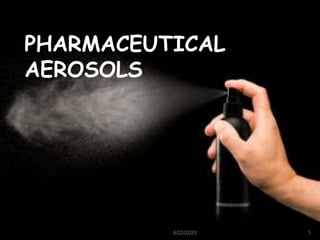
PHARMACEUTICAL
AEROSOLS
PRESENTED BY,
AMRUTHA FELIX
M.PHARM 1ST YEAR
PHARMACEUTICS
PHARMACEUTICAL
AEROSOLS
8/22/2020 1
HISTORY
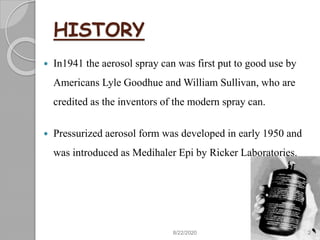
 In1941 the aerosol spray can was first put to good use by
Americans Lyle Goodhue and William Sullivan, who are
credited as the inventors of the modern spray can.
 Pressurized aerosol form was developed in early 1950 and
was introduced as Medihaler Epi by Ricker Laboratories.
8/22/2020 2
DEFINITION
‘A system that depends on the power of a compressed or
liquefied gas to expel the contents from the container.’
‘Pressurized dosage forms containing one or more active
ingredients which upon actuation emit a fine dispersion of
liquid and/or solid materials in a gaseous medium.’
8/22/2020 3
ADVANTAGES
 Removal of dose without contamination.
 Directly delivered to the affected area in a desired form.
 Minimized manual contact with drug.
 Rapid response.
 Convenient, easy.
 Controlled and uniform dosage by metered valves.
 No manual contact with patient.
8/22/2020 4
DISADVANTAGES
 Costly.
 Difficulty in disposal.
 Difficulty in formulation.
 Q.C testing is complicated.
 Cannot be subjected to heat.
8/22/2020 5
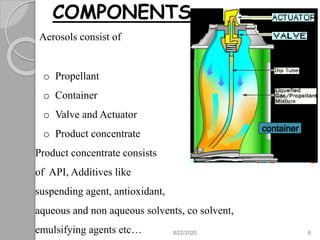
COMPONENTS
Aerosols consist of
o Propellant
o Container
o Valve and Actuator
o Product concentrate
Product concentrate consists
of API, Additives like
suspending agent, antioxidant,
aqueous and non aqueous solvents, co solvent,
emulsifying agents etc…
container
8/22/2020 6
PROPELLANT
 Develops pressure within the container.
 Expels the product, when the valve is opened.
 Aids in foam production.
 Vapor pressure differs.
Mainly three types :
1. Liquefied gas system
2. a) Fluorinated hydrocarbon(FHC)
b) Chlorofluorocarbon (CFC)
c) Hydrocarbons (HC)
3. Compressed gas system
8/22/2020 7
LIQUIFIED GAS SYSTEM
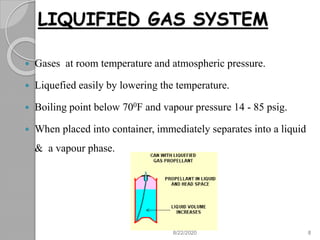
 Gases at room temperature and atmospheric pressure.
 Liquefied easily by lowering the temperature.
 Boiling point below 700F and vapour pressure 14 - 85 psig.
 When placed into container, immediately separates into a liquid
& a vapour phase.
8/22/2020 8
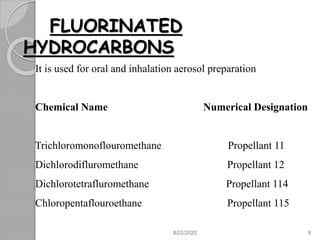
FLUORINATED
HYDROCARBONS
It is used for oral and inhalation aerosol preparation
Chemical Name Numerical Designation
Trichloromonoflouromethane Propellant 11
Dichlorodifluromethane Propellant 12
Dichlorotetrafluromethane Propellant 114
Chloropentaflouroethane Propellant 115
8/22/2020 9
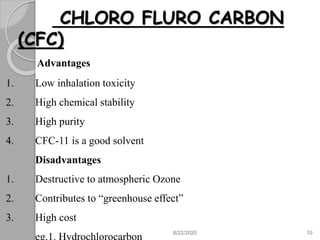
CHLORO FLURO CARBON
(CFC)
Advantages
1. Low inhalation toxicity
2. High chemical stability
3. High purity
4. CFC-11 is a good solvent
Disadvantages
1. Destructive to atmospheric Ozone
2. Contributes to “greenhouse effect”
3. High cost
8/22/2020 10
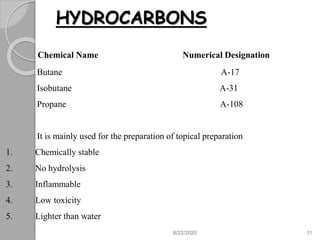
HYDROCARBONS
Chemical Name Numerical Designation
Butane A-17
Isobutane A-31
Propane A-108
It is mainly used for the preparation of topical preparation
1. Chemically stable
2. No hydrolysis
3. Inflammable
4. Low toxicity
5. Lighter than water
8/22/2020 11
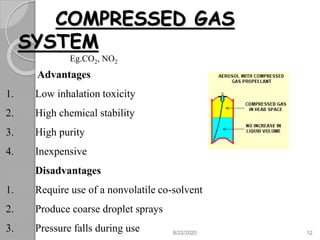
COMPRESSED GAS
SYSTEM
Eg.CO2, NO2
Advantages
1. Low inhalation toxicity
2. High chemical stability
3. High purity
4. Inexpensive
Disadvantages
1. Require use of a nonvolatile co-solvent
2. Produce coarse droplet sprays
3. Pressure falls during use 8/22/2020 12
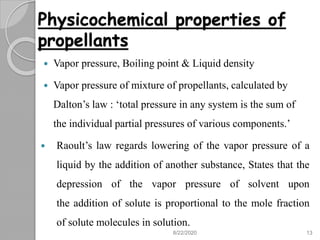
Physicochemical properties of
propellants
 Vapor pressure, Boiling point & Liquid density
 Vapor pressure of mixture of propellants, calculated by
Dalton’s law : ‘total pressure in any system is the sum of
the individual partial pressures of various components.’
 Raoult’s law regards lowering of the vapor pressure of a
liquid by the addition of another substance, States that the
depression of the vapor pressure of solvent upon
the addition of solute is proportional to the mole fraction
of solute molecules in solution.
8/22/2020 13
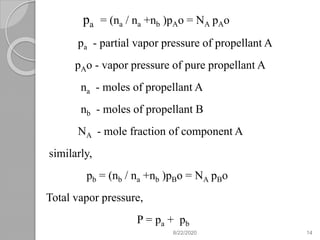
pa = (na / na +nb )pAo = NA pAo
pa - partial vapor pressure of propellant A
pAo - vapor pressure of pure propellant A
na - moles of propellant A
nb - moles of propellant B
NA - mole fraction of component A
similarly,
pb = (nb / na +nb )pBo = NA pBo
Total vapor pressure,
P = pa + pb
8/22/2020 14
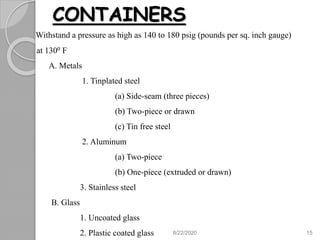
CONTAINERS
Withstand a pressure as high as 140 to 180 psig (pounds per sq. inch gauge)
at 1300 F
A. Metals
1. Tinplated steel
(a) Side-seam (three pieces)
(b) Two-piece or drawn
(c) Tin free steel
2. Aluminum
(a) Two-piece
(b) One-piece (extruded or drawn)
3. Stainless steel
B. Glass
1. Uncoated glass
2. Plastic coated glass 8/22/2020 15
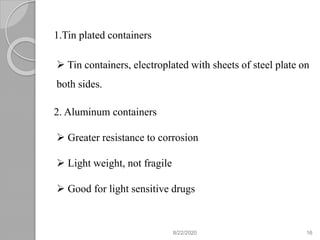
1.Tin plated containers
 Tin containers, electroplated with sheets of steel plate on
both sides.
2. Aluminum containers
 Greater resistance to corrosion
 Light weight, not fragile
 Good for light sensitive drugs
8/22/2020 16
3. Stainless steel container
1. Limited for smaller size
2. Extremely strong and resistant to corrosion
3. Withstand pressure
4. Glass containers
1. Available with plastic or without plastic coating
2. Compatible with many additives
3. No corrosion problems
4. Can have various shape because of molding
5. Fragile
6. Not for light sensitive drugs8/22/2020 17
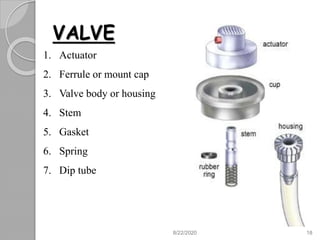
VALVE
1. Actuator
2. Ferrule or mount cap
3. Valve body or housing
4. Stem
5. Gasket
6. Spring
7. Dip tube
8/22/2020 18
TYPES OF ACTUATOR
Actuators:
• Specially designed button placed on the valve system, helps
in easy opening and closing of the valve.
• Directs the spray to the desired area.
-Spray Actuators
-Foam Actuators
-Solid Stream Actuators
-Special Actuators
8/22/2020 19
Ferrule/ mounting cup
• Attach the valve in proper position in container.
• Coated with epoxy resin.
Valve body / housing
• Made of nylon/ delrin
• Connect dip tube, stem & actuator
• Determines rate of delivery
Stem
• It is made of nylon /delrin /s.steel
• One or more orifice (0.013 to 0.030 inch)
8/22/2020 20
Gasket
 It is made of Buna –N, Neoprene rubber
Spring
 Hold the gasket in its place
 Made of stainless steel
Dip tube
 Made of poly propylene material / poly ethylene
 Inner diameter 0.120 –0.125 inch for less viscous
 Viscous product - 0.195 inch.
8/22/2020 21
TYPES OF AEROSOL
SYSTEM
Four types :
1. Solution system / Two phase system
2. Water based system / Three phase system
3. Suspension or Dispersion system
4. Foam system
Aqueous stable foam
Non-Aqueous stable foam
Quick Breaking Foam
Thermal foam
8/22/2020 22
Two phase system
 Contains both vapor & liquid.
 Drug soluble in propellant – no co-solvent.
 Propellant 12 – single or mixture.
 In mixture – propellant with vapor pressure less than
propellant 12 , vapor pressure reduction, bigger sized
aerosol particles.
 E.g. propellant 12/11(30:70), propellant 12/114(45:55).
8/22/2020 23
Three phase system
 Contains water phase, vapor phase and the propellant.
 Water immiscible with propellant – solubility increased by
adding,
- Co – solvent (ethanol)
- Surfactants (0.5% - 2.0%) – non polar ( esters of
oleic acid, palmitic acid, stearic acid)
8/22/2020 24
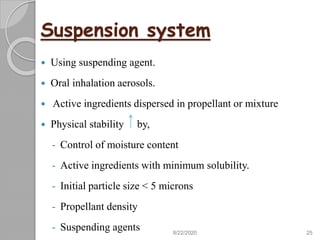
Suspension system
 Using suspending agent.
 Oral inhalation aerosols.
 Active ingredients dispersed in propellant or mixture
 Physical stability by,
- Control of moisture content
- Active ingredients with minimum solubility.
- Initial particle size < 5 microns
- Propellant density
- Suspending agents 8/22/2020 25
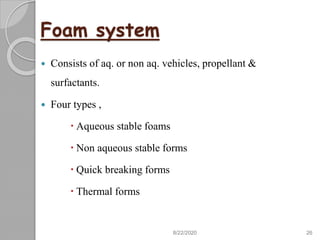
Foam system
 Consists of aq. or non aq. vehicles, propellant &
surfactants.
 Four types ,
 Aqueous stable foams
 Non aqueous stable forms
 Quick breaking forms
 Thermal forms
8/22/2020 26
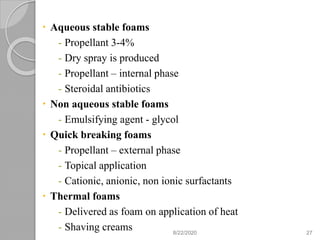
 Aqueous stable foams
- Propellant 3-4%
- Dry spray is produced
- Propellant – internal phase
- Steroidal antibiotics
 Non aqueous stable foams
- Emulsifying agent - glycol
 Quick breaking foams
- Propellant – external phase
- Topical application
- Cationic, anionic, non ionic surfactants
 Thermal foams
- Delivered as foam on application of heat
- Shaving creams 8/22/2020 27
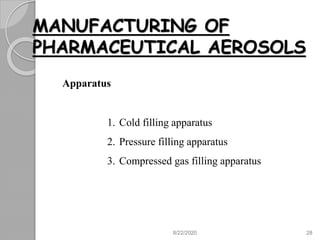
MANUFACTURING OF
PHARMACEUTICAL AEROSOLS
Apparatus
1. Cold filling apparatus
2. Pressure filling apparatus
3. Compressed gas filling apparatus
8/22/2020 28
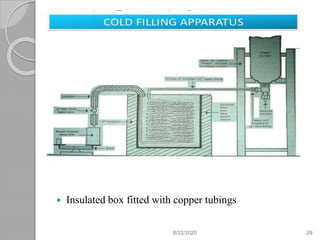
COLD FILLING
APPARATUS
 Insulated box fitted with copper tubings
8/22/2020 29
Methods
Method A
 Product concentrate chilled to -30 to -40o F.
 Chilled product added to chilled container.
 Chilled propellant added through inlet valve.
Method B
 Product concentrate and propellant chilled to -30 to -40o F.
 Mixture added to chilled container.
8/22/2020 30
 The valves are set in place.
 Filled containers passed through water bath (contents
heated to 130o F).
 Containers dried, capped and labeled.
Advantage
 Easy process
Disadvantage
 Aqueous products, emulsions cannot be filled.
 For non aqueous systems, moisture appears in final
product.
8/22/2020 31
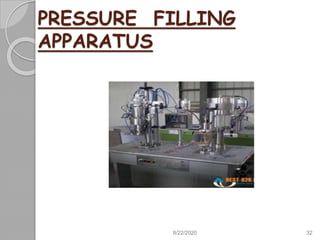
PRESSURE FILLING
APPARATUS
8/22/2020 32
 Consists of metering burette – measures the amount of
propellant to be filled.
Method
 Product concentrate is filled through the burette at room
temperature.
 Propellant is added through the inlet valve.
 Flow of propellant stops when pressure of filling
propellant become equal to the pressure within the
container.
8/22/2020 33
Advantages
 Preferred for solutions, emulsions & suspensions.
 Less contamination.
 Less propellant is lost.
 No refrigeration.
8/22/2020 34
COMPRESSED GAS FILLING
APPARATUS
 Propellant – compressed gas
 Pressure reduced by pressure reducing valve
 Pressure used – 150 psig
METHOD
 Product concentrate placed in container
 Valve crimped in its place
 Air evacuated by vacuum pump
 Filling head inserted into valve opening, valve depressed &
gas allowed to flow into container.
 Container shaken during and after filling by mechanical
shakers
8/22/2020 35
QUALITY CONTROL
TESTS
It Includes the testing of :
» Propellants
» Valves, Actuator, Dip Tubes
» Containers
» Weight Checking
» Leak Testing
» Spray Testing
36
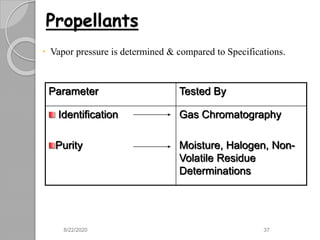
Propellants
 Vapor pressure is determined & compared to Specifications.
Parameter Tested By
Identification
Purity
Gas Chromatography
Moisture, Halogen, Non-
Volatile Residue
Determinations
8/22/2020 37
Valves, Actuators &
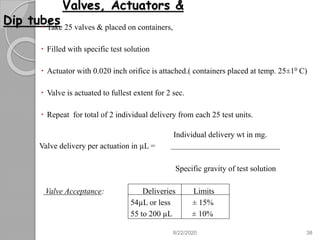
Dip tubes Take 25 valves & placed on containers,
 Filled with specific test solution
 Actuator with 0.020 inch orifice is attached.( containers placed at temp. 25±10 C)
 Valve is actuated to fullest extent for 2 sec.
 Repeat for total of 2 individual delivery from each 25 test units.
Individual delivery wt in mg.
Valve delivery per actuation in µL =
Specific gravity of test solution
Valve Acceptance: Deliveries Limits
54µL or less ± 15%
55 to 200 µL ± 10%
8/22/2020 38
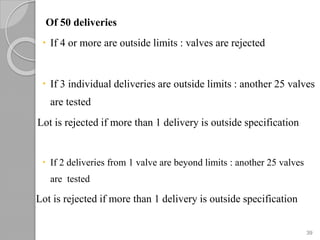
Of 50 deliveries
 If 4 or more are outside limits : valves are rejected
 If 3 individual deliveries are outside limits : another 25 valves
are tested
Lot is rejected if more than 1 delivery is outside specification
 If 2 deliveries from 1 valve are beyond limits : another 25 valves
are tested
Lot is rejected if more than 1 delivery is outside specification
39
Containers
 Containers are examined for defects in lining.
 Q.C aspects includes degree of conductivity of electric current
as measure of exposed metals.
 Glass containers examined for Flaws.
Weight Checking
 Add tared empty aerosol container to filling lines which after
filling with concentrate are removed & weighed.
 Same procedure is used for checking weight of Propellants.
8/22/2020 40
Leak Test
 Done by measuring the Crimp’s dimension & comparing.
 Final testing of valve closure is done by passing filled containers
through water bath.
Spray Testing
 It is done
»To clear dip tube of pure propellant &
concentrate,
»To check for defects in valves & spray
pattern.
8/22/2020 41
Evaluation Tests
A. Flammability & combustibility:
1.Flash point
2.Flame Projection
B. Physicochemical characteristics:
1.Vapour pressure
2.Density
3.Moisture content
4.Identification of Propellants
8/22/2020 42
C. Performance
1. Aerosol valve discharge rate
2. Spray pattern
3. Dosage with metered valves
4. Net contents
5. Foam stability
6. Particle size determination
D. Biological testing
1.Therapeutic activity
2.Toxicity studies
E. Extractable Substances
8/22/2020 43
A. Flammability & combustibility:
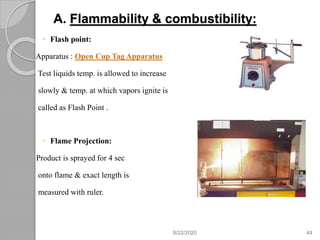
 Flash point:
Apparatus : Open Cup Tag Apparatus
Test liquids temp. is allowed to increase
slowly & temp. at which vapors ignite is
called as Flash Point .
 Flame Projection:
Product is sprayed for 4 sec
onto flame & exact length is
measured with ruler.
8/22/2020 44
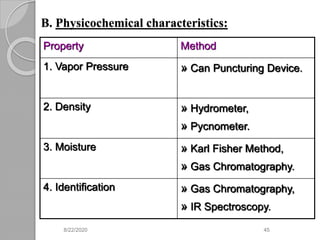
B. Physicochemical characteristics:
Property Method
1. Vapor Pressure » Can Puncturing Device.
2. Density » Hydrometer,
» Pycnometer.
3. Moisture » Karl Fisher Method,
» Gas Chromatography.
4. Identification » Gas Chromatography,
» IR Spectroscopy.
8/22/2020 45
C. Performance:
1. Aerosol valve discharge rate :
 Aerosol product of known weight is discharged for specific time.
 By reweighing the container, the change in the wt. per time dispensed is the discharge rate
(g/sec).
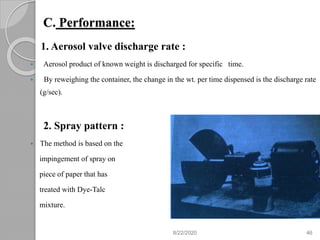
2. Spray pattern :
 The method is based on the
impingement of spray on
piece of paper that has
treated with Dye-Talc
mixture.
8/22/2020 46
3. Dosage with metered valves :
 Reproducibility of dosage determined by:
»Assay
»Accurate weighing of filled container followed by dispensing
several dosage.
 Containers again reweighed & diff. in wt. divided by no. of
dosage dispensed gives average dose.
4. Net Contents :
 Tared cans placed on filling lines are reweighed & then
difference in wt. is equal to net content.
 In Destructive method : opening the container & removing as
much of product possible.
8/22/2020 47
5. Foam stability :
Methods :
» Visual Evaluation
» Time for given mass to penetrate the foam
» Time for given rod to fall which is inserted into the foam
» Rotational Viscometer
6.Partical Size Determination :
Methods : » Cascade Impactor,
» Light Scattering Decay.
8/22/2020 48
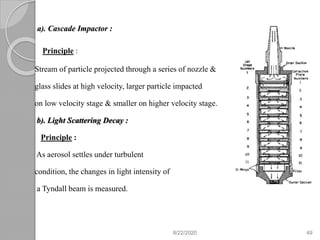
a). Cascade Impactor :
Principle :
Stream of particle projected through a series of nozzle &
glass slides at high velocity, larger particle impacted
on low velocity stage & smaller on higher velocity stage.
b). Light Scattering Decay :
Principle :
As aerosol settles under turbulent
condition, the changes in light intensity of
a Tyndall beam is measured.
8/22/2020 49
D. Biological testing:
1.Therapeutic Activity :
» For Inhalation Aerosols : Depends on the particle size.
» For Topical Aerosols : Is applied to test areas &
absorption of therapeutic ingredient is determined.
2.Toxicity :
» For Inhalation Aerosols : Exposing test animals to vapor
sprayed from aerosol container.
» For Topical Aerosols : Irritation & chilling effects are
determined.
8/22/2020 50
E. Extractable Substances
• Leaching of extractable from plastic components into the formulation is a
potential serious problem.
• Extractable include: antioxidants, plasticizers, monomers, nitrosamine,
vulcanization accelerators, etc., should be identified and minimized.
• The composition and the quality of materials used in the manufacturing
of the valve components must be carefully selected and controlled. Their
compatibility with formulation components should be well established to
minimize change in the medication delivery, leak rate, impurity profile of
the drug product over time.
8/22/2020 51
Labeling
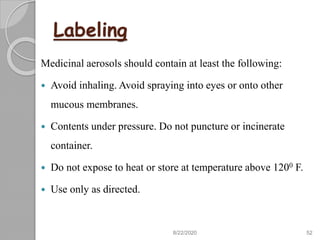
Medicinal aerosols should contain at least the following:
 Avoid inhaling. Avoid spraying into eyes or onto other
mucous membranes.
 Contents under pressure. Do not puncture or incinerate
container.
 Do not expose to heat or store at temperature above 1200 F.
 Use only as directed.
8/22/2020 52
REFERENCES
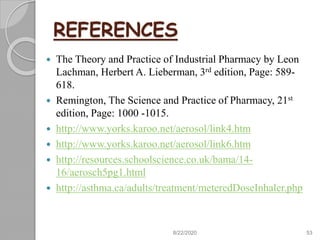
 The Theory and Practice of Industrial Pharmacy by Leon
Lachman, Herbert A. Lieberman, 3rd edition, Page: 589-
618.
 Remington, The Science and Practice of Pharmacy, 21st
edition, Page: 1000 -1015.
 http://www.yorks.karoo.net/aerosol/link4.htm
 http://www.yorks.karoo.net/aerosol/link6.htm
 http://resources.schoolscience.co.uk/bama/14-
16/aerosch5pg1.html
 http://asthma.ca/adults/treatment/meteredDoseInhaler.php
8/22/2020 53
8/22/2020 54

Aerosols

  • 1.
    PHARMACEUTICAL AEROSOLS PRESENTED BY, AMRUTHA FELIX M.PHARM1ST YEAR PHARMACEUTICS PHARMACEUTICAL AEROSOLS 8/22/2020 1
  • 2.
    HISTORY  In1941 theaerosol spray can was first put to good use by Americans Lyle Goodhue and William Sullivan, who are credited as the inventors of the modern spray can.  Pressurized aerosol form was developed in early 1950 and was introduced as Medihaler Epi by Ricker Laboratories. 8/22/2020 2
  • 3.
    DEFINITION ‘A system thatdepends on the power of a compressed or liquefied gas to expel the contents from the container.’ ‘Pressurized dosage forms containing one or more active ingredients which upon actuation emit a fine dispersion of liquid and/or solid materials in a gaseous medium.’ 8/22/2020 3
  • 4.
    ADVANTAGES  Removal ofdose without contamination.  Directly delivered to the affected area in a desired form.  Minimized manual contact with drug.  Rapid response.  Convenient, easy.  Controlled and uniform dosage by metered valves.  No manual contact with patient. 8/22/2020 4
  • 5.
    DISADVANTAGES  Costly.  Difficultyin disposal.  Difficulty in formulation.  Q.C testing is complicated.  Cannot be subjected to heat. 8/22/2020 5
  • 6.
    COMPONENTS Aerosols consist of oPropellant o Container o Valve and Actuator o Product concentrate Product concentrate consists of API, Additives like suspending agent, antioxidant, aqueous and non aqueous solvents, co solvent, emulsifying agents etc… container 8/22/2020 6
  • 7.
    PROPELLANT  Develops pressurewithin the container.  Expels the product, when the valve is opened.  Aids in foam production.  Vapor pressure differs. Mainly three types : 1. Liquefied gas system 2. a) Fluorinated hydrocarbon(FHC) b) Chlorofluorocarbon (CFC) c) Hydrocarbons (HC) 3. Compressed gas system 8/22/2020 7
  • 8.
    LIQUIFIED GAS SYSTEM Gases at room temperature and atmospheric pressure.  Liquefied easily by lowering the temperature.  Boiling point below 700F and vapour pressure 14 - 85 psig.  When placed into container, immediately separates into a liquid & a vapour phase. 8/22/2020 8
  • 9.
    FLUORINATED HYDROCARBONS It is usedfor oral and inhalation aerosol preparation Chemical Name Numerical Designation Trichloromonoflouromethane Propellant 11 Dichlorodifluromethane Propellant 12 Dichlorotetrafluromethane Propellant 114 Chloropentaflouroethane Propellant 115 8/22/2020 9
  • 10.
    CHLORO FLURO CARBON (CFC) Advantages 1.Low inhalation toxicity 2. High chemical stability 3. High purity 4. CFC-11 is a good solvent Disadvantages 1. Destructive to atmospheric Ozone 2. Contributes to “greenhouse effect” 3. High cost 8/22/2020 10
  • 11.
    HYDROCARBONS Chemical Name NumericalDesignation Butane A-17 Isobutane A-31 Propane A-108 It is mainly used for the preparation of topical preparation 1. Chemically stable 2. No hydrolysis 3. Inflammable 4. Low toxicity 5. Lighter than water 8/22/2020 11
  • 12.
    COMPRESSED GAS SYSTEM Eg.CO2, NO2 Advantages 1.Low inhalation toxicity 2. High chemical stability 3. High purity 4. Inexpensive Disadvantages 1. Require use of a nonvolatile co-solvent 2. Produce coarse droplet sprays 3. Pressure falls during use 8/22/2020 12
  • 13.
    Physicochemical properties of propellants Vapor pressure, Boiling point & Liquid density  Vapor pressure of mixture of propellants, calculated by Dalton’s law : ‘total pressure in any system is the sum of the individual partial pressures of various components.’  Raoult’s law regards lowering of the vapor pressure of a liquid by the addition of another substance, States that the depression of the vapor pressure of solvent upon the addition of solute is proportional to the mole fraction of solute molecules in solution. 8/22/2020 13
  • 14.
    pa = (na/ na +nb )pAo = NA pAo pa - partial vapor pressure of propellant A pAo - vapor pressure of pure propellant A na - moles of propellant A nb - moles of propellant B NA - mole fraction of component A similarly, pb = (nb / na +nb )pBo = NA pBo Total vapor pressure, P = pa + pb 8/22/2020 14
  • 15.
    CONTAINERS Withstand a pressureas high as 140 to 180 psig (pounds per sq. inch gauge) at 1300 F A. Metals 1. Tinplated steel (a) Side-seam (three pieces) (b) Two-piece or drawn (c) Tin free steel 2. Aluminum (a) Two-piece (b) One-piece (extruded or drawn) 3. Stainless steel B. Glass 1. Uncoated glass 2. Plastic coated glass 8/22/2020 15
  • 16.
    1.Tin plated containers Tin containers, electroplated with sheets of steel plate on both sides. 2. Aluminum containers  Greater resistance to corrosion  Light weight, not fragile  Good for light sensitive drugs 8/22/2020 16
  • 17.
    3. Stainless steelcontainer 1. Limited for smaller size 2. Extremely strong and resistant to corrosion 3. Withstand pressure 4. Glass containers 1. Available with plastic or without plastic coating 2. Compatible with many additives 3. No corrosion problems 4. Can have various shape because of molding 5. Fragile 6. Not for light sensitive drugs8/22/2020 17
  • 18.
    VALVE 1. Actuator 2. Ferruleor mount cap 3. Valve body or housing 4. Stem 5. Gasket 6. Spring 7. Dip tube 8/22/2020 18
  • 19.
    TYPES OF ACTUATOR Actuators: •Specially designed button placed on the valve system, helps in easy opening and closing of the valve. • Directs the spray to the desired area. -Spray Actuators -Foam Actuators -Solid Stream Actuators -Special Actuators 8/22/2020 19
  • 20.
    Ferrule/ mounting cup •Attach the valve in proper position in container. • Coated with epoxy resin. Valve body / housing • Made of nylon/ delrin • Connect dip tube, stem & actuator • Determines rate of delivery Stem • It is made of nylon /delrin /s.steel • One or more orifice (0.013 to 0.030 inch) 8/22/2020 20
  • 21.
    Gasket  It ismade of Buna –N, Neoprene rubber Spring  Hold the gasket in its place  Made of stainless steel Dip tube  Made of poly propylene material / poly ethylene  Inner diameter 0.120 –0.125 inch for less viscous  Viscous product - 0.195 inch. 8/22/2020 21
  • 22.
    TYPES OF AEROSOL SYSTEM Fourtypes : 1. Solution system / Two phase system 2. Water based system / Three phase system 3. Suspension or Dispersion system 4. Foam system Aqueous stable foam Non-Aqueous stable foam Quick Breaking Foam Thermal foam 8/22/2020 22
  • 23.
    Two phase system Contains both vapor & liquid.  Drug soluble in propellant – no co-solvent.  Propellant 12 – single or mixture.  In mixture – propellant with vapor pressure less than propellant 12 , vapor pressure reduction, bigger sized aerosol particles.  E.g. propellant 12/11(30:70), propellant 12/114(45:55). 8/22/2020 23
  • 24.
    Three phase system Contains water phase, vapor phase and the propellant.  Water immiscible with propellant – solubility increased by adding, - Co – solvent (ethanol) - Surfactants (0.5% - 2.0%) – non polar ( esters of oleic acid, palmitic acid, stearic acid) 8/22/2020 24
  • 25.
    Suspension system  Usingsuspending agent.  Oral inhalation aerosols.  Active ingredients dispersed in propellant or mixture  Physical stability by, - Control of moisture content - Active ingredients with minimum solubility. - Initial particle size < 5 microns - Propellant density - Suspending agents 8/22/2020 25
  • 26.
    Foam system  Consistsof aq. or non aq. vehicles, propellant & surfactants.  Four types ,  Aqueous stable foams  Non aqueous stable forms  Quick breaking forms  Thermal forms 8/22/2020 26
  • 27.
     Aqueous stablefoams - Propellant 3-4% - Dry spray is produced - Propellant – internal phase - Steroidal antibiotics  Non aqueous stable foams - Emulsifying agent - glycol  Quick breaking foams - Propellant – external phase - Topical application - Cationic, anionic, non ionic surfactants  Thermal foams - Delivered as foam on application of heat - Shaving creams 8/22/2020 27
  • 28.
    MANUFACTURING OF PHARMACEUTICAL AEROSOLS Apparatus 1.Cold filling apparatus 2. Pressure filling apparatus 3. Compressed gas filling apparatus 8/22/2020 28
  • 29.
    COLD FILLING APPARATUS  Insulatedbox fitted with copper tubings 8/22/2020 29
  • 30.
    Methods Method A  Productconcentrate chilled to -30 to -40o F.  Chilled product added to chilled container.  Chilled propellant added through inlet valve. Method B  Product concentrate and propellant chilled to -30 to -40o F.  Mixture added to chilled container. 8/22/2020 30
  • 31.
     The valvesare set in place.  Filled containers passed through water bath (contents heated to 130o F).  Containers dried, capped and labeled. Advantage  Easy process Disadvantage  Aqueous products, emulsions cannot be filled.  For non aqueous systems, moisture appears in final product. 8/22/2020 31
  • 32.
  • 33.
     Consists ofmetering burette – measures the amount of propellant to be filled. Method  Product concentrate is filled through the burette at room temperature.  Propellant is added through the inlet valve.  Flow of propellant stops when pressure of filling propellant become equal to the pressure within the container. 8/22/2020 33
  • 34.
    Advantages  Preferred forsolutions, emulsions & suspensions.  Less contamination.  Less propellant is lost.  No refrigeration. 8/22/2020 34
  • 35.
    COMPRESSED GAS FILLING APPARATUS Propellant – compressed gas  Pressure reduced by pressure reducing valve  Pressure used – 150 psig METHOD  Product concentrate placed in container  Valve crimped in its place  Air evacuated by vacuum pump  Filling head inserted into valve opening, valve depressed & gas allowed to flow into container.  Container shaken during and after filling by mechanical shakers 8/22/2020 35
  • 36.
    QUALITY CONTROL TESTS It Includesthe testing of : » Propellants » Valves, Actuator, Dip Tubes » Containers » Weight Checking » Leak Testing » Spray Testing 36
  • 37.
    Propellants  Vapor pressureis determined & compared to Specifications. Parameter Tested By Identification Purity Gas Chromatography Moisture, Halogen, Non- Volatile Residue Determinations 8/22/2020 37
  • 38.
    Valves, Actuators & Diptubes Take 25 valves & placed on containers,  Filled with specific test solution  Actuator with 0.020 inch orifice is attached.( containers placed at temp. 25±10 C)  Valve is actuated to fullest extent for 2 sec.  Repeat for total of 2 individual delivery from each 25 test units. Individual delivery wt in mg. Valve delivery per actuation in µL = Specific gravity of test solution Valve Acceptance: Deliveries Limits 54µL or less ± 15% 55 to 200 µL ± 10% 8/22/2020 38
  • 39.
    Of 50 deliveries If 4 or more are outside limits : valves are rejected  If 3 individual deliveries are outside limits : another 25 valves are tested Lot is rejected if more than 1 delivery is outside specification  If 2 deliveries from 1 valve are beyond limits : another 25 valves are tested Lot is rejected if more than 1 delivery is outside specification 39
  • 40.
    Containers  Containers areexamined for defects in lining.  Q.C aspects includes degree of conductivity of electric current as measure of exposed metals.  Glass containers examined for Flaws. Weight Checking  Add tared empty aerosol container to filling lines which after filling with concentrate are removed & weighed.  Same procedure is used for checking weight of Propellants. 8/22/2020 40
  • 41.
    Leak Test  Doneby measuring the Crimp’s dimension & comparing.  Final testing of valve closure is done by passing filled containers through water bath. Spray Testing  It is done »To clear dip tube of pure propellant & concentrate, »To check for defects in valves & spray pattern. 8/22/2020 41
  • 42.
    Evaluation Tests A. Flammability& combustibility: 1.Flash point 2.Flame Projection B. Physicochemical characteristics: 1.Vapour pressure 2.Density 3.Moisture content 4.Identification of Propellants 8/22/2020 42
  • 43.
    C. Performance 1. Aerosolvalve discharge rate 2. Spray pattern 3. Dosage with metered valves 4. Net contents 5. Foam stability 6. Particle size determination D. Biological testing 1.Therapeutic activity 2.Toxicity studies E. Extractable Substances 8/22/2020 43
  • 44.
    A. Flammability &combustibility:  Flash point: Apparatus : Open Cup Tag Apparatus Test liquids temp. is allowed to increase slowly & temp. at which vapors ignite is called as Flash Point .  Flame Projection: Product is sprayed for 4 sec onto flame & exact length is measured with ruler. 8/22/2020 44
  • 45.
    B. Physicochemical characteristics: PropertyMethod 1. Vapor Pressure » Can Puncturing Device. 2. Density » Hydrometer, » Pycnometer. 3. Moisture » Karl Fisher Method, » Gas Chromatography. 4. Identification » Gas Chromatography, » IR Spectroscopy. 8/22/2020 45
  • 46.
    C. Performance: 1. Aerosolvalve discharge rate :  Aerosol product of known weight is discharged for specific time.  By reweighing the container, the change in the wt. per time dispensed is the discharge rate (g/sec). 2. Spray pattern :  The method is based on the impingement of spray on piece of paper that has treated with Dye-Talc mixture. 8/22/2020 46
  • 47.
    3. Dosage withmetered valves :  Reproducibility of dosage determined by: »Assay »Accurate weighing of filled container followed by dispensing several dosage.  Containers again reweighed & diff. in wt. divided by no. of dosage dispensed gives average dose. 4. Net Contents :  Tared cans placed on filling lines are reweighed & then difference in wt. is equal to net content.  In Destructive method : opening the container & removing as much of product possible. 8/22/2020 47
  • 48.
    5. Foam stability: Methods : » Visual Evaluation » Time for given mass to penetrate the foam » Time for given rod to fall which is inserted into the foam » Rotational Viscometer 6.Partical Size Determination : Methods : » Cascade Impactor, » Light Scattering Decay. 8/22/2020 48
  • 49.
    a). Cascade Impactor: Principle : Stream of particle projected through a series of nozzle & glass slides at high velocity, larger particle impacted on low velocity stage & smaller on higher velocity stage. b). Light Scattering Decay : Principle : As aerosol settles under turbulent condition, the changes in light intensity of a Tyndall beam is measured. 8/22/2020 49
  • 50.
    D. Biological testing: 1.TherapeuticActivity : » For Inhalation Aerosols : Depends on the particle size. » For Topical Aerosols : Is applied to test areas & absorption of therapeutic ingredient is determined. 2.Toxicity : » For Inhalation Aerosols : Exposing test animals to vapor sprayed from aerosol container. » For Topical Aerosols : Irritation & chilling effects are determined. 8/22/2020 50
  • 51.
    E. Extractable Substances •Leaching of extractable from plastic components into the formulation is a potential serious problem. • Extractable include: antioxidants, plasticizers, monomers, nitrosamine, vulcanization accelerators, etc., should be identified and minimized. • The composition and the quality of materials used in the manufacturing of the valve components must be carefully selected and controlled. Their compatibility with formulation components should be well established to minimize change in the medication delivery, leak rate, impurity profile of the drug product over time. 8/22/2020 51
  • 52.
    Labeling Medicinal aerosols shouldcontain at least the following:  Avoid inhaling. Avoid spraying into eyes or onto other mucous membranes.  Contents under pressure. Do not puncture or incinerate container.  Do not expose to heat or store at temperature above 1200 F.  Use only as directed. 8/22/2020 52
  • 53.
    REFERENCES  The Theoryand Practice of Industrial Pharmacy by Leon Lachman, Herbert A. Lieberman, 3rd edition, Page: 589- 618.  Remington, The Science and Practice of Pharmacy, 21st edition, Page: 1000 -1015.  http://www.yorks.karoo.net/aerosol/link4.htm  http://www.yorks.karoo.net/aerosol/link6.htm  http://resources.schoolscience.co.uk/bama/14- 16/aerosch5pg1.html  http://asthma.ca/adults/treatment/meteredDoseInhaler.php 8/22/2020 53
  • 54.