
 Aerated lightweight concrete have many advantages
when compared with conventional concrete such as
advanced strength to weight ratio, lower coefficient
of thermal expansion, and good sound insulation as
a result of air voids within aerated concrete.
 The literature review of aerated lightweight
properties is focuses on the porosity, permeability,
compressive strength and splitting strength.
Abstract

 Aerated concrete is also well-known as a cellular
concrete
 It can be divided into two main types according to
the method of production. They are foamed concrete
(non-autoclaved aerated concrete (NAAC)) i.e. Foam
concrete and autoclaved aerated concrete (AAC).
INTRODUCTION

FOAMED CONCRETE

 The foam agent used to obtain foamed concrete. It is
defined as air entraining agent. The foam agent is the
most essential influence on the foamed concrete. The
foam agents when added into the mix water it will
produce discrete bubbles cavities which become
incorporated in the cement paste.
FOAMED AGENT

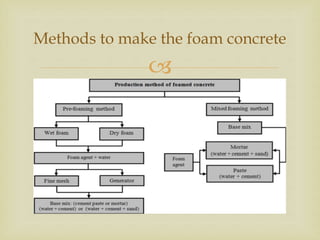
 Foamed concrete is produced either by pre-foaming
method or mixed foaming method. Pre-foaming
method involves the separate production of a base
mix cement slurry (cement paste or mortar) and a
stably preformed aqueous (foam agent with water)
and then the thorough blending of this foam into a
base mix.
FOAMED CONCRETE

Methods to make the foam concrete

 In mixed foaming, the surface active agent is mixed with
the base mixture ingredients and during the process of
mixing, foam is produced resulting in cellular structure in
concrete.
 The preformed foam can be either wet or dry foam. The
wet foam is produced by spraying a solution of foaming
agent over a fine mesh, has 2-5mm bubble size and is
relatively less stable. Dry foam is produced by forcing the
foaming agent solution through a series of high density
restrictions and forcing compressed air simultaneously
into the mixing chamber.

AAC

Reagents used to make the Autoclaved Aerated
Concrete
ALUMINIUM
 Aluminium powder is usually used to obtain
autoclaved aerated concrete by a chemical reaction
generating a gas in fresh mortar, so that when it sets
it contains a large number of gas bubbles.
 Aluminium is used as a foaming agent in AAC
production worldwide and it is widely proven as the
best solution for its purpose.
Autoclaved Aerated Concrete

 Aluminium powder in the AAC industry is often
made from foil scrap and exists of microscopic flake-
shaped aluminium particles.
 The production of AAC requires aluminium
powders that contain fractions finer than 100 or
50μm. This is important in order to obtain required
mechanical properties of the aerated concrete

 Raw materials which are suitable for autoclaved
aerated concrete are fine grading materials. Silica or
quartz sand, lime, cement and aluminium powder
are main raw materials for producing AAC.
Batching process of AAC


 Autoclaved aerated concrete (AAC) is made with
fine aggregates, cement, and an expansion agent that
causes the fresh mixture to rise like bread dough. In
fact, this type of concrete contains 80 percent air.
Autoclaved Aerated Concrete

 Cured blocks or panels of autoclaved aerated
concrete are joined with thin bed mortar.
Components can be used for walls, floors, and roofs.
The lightweight material offers excellent sound and
thermal insulation, and like all cement-based
materials, is strong and fire resistant. In order to be
durable, AAC requires some type of applied finish,
such as a polymer-modified stucco, natural or
manufactured stone, or siding.

 COMPRESSIVE STRENGTH:-
35kg to 40kg per Cm2 / 3.5 to 4.0 N/mm2
conforming to IS 2185/1984.
 FIRE RESISTANCE
1600° Celsius for 6 hours for a block with
200mm thickness.
 DENSITY
600-650 kg/m3 (dry)
Properties of AAC blocks

 THERMAL CONDUCTIVITY
Low / 0.16 kelvin per meter.
 COLOUR
Grey

 ECO - Friendly
 Lightweight
 Precision
 Design Flexibility
 Faster- Construction
 Low Maintenance
 Fire Resistant & Thermally Insulated
 Seismic Resistant
Advantages of AAC blocks

 The light weight means that R-values for AAC are comparable
to conventional frame walls, but they have higher thermal
mass, provide air tightness, and as just noted, are not
combustible. That light weight also gives a high sound
reduction for privacy, both from outside noises and from other
rooms when used as interior partition walls.
 But the material does have some limitations. It is not as widely
available as most concrete products, though it can be shipped
anywhere. If it has to be shipped, its light weight is
advantageous. Because it is lower strength than most concrete
products or systems, in load-bearing applications, it must
typically be reinforced. It also requires a protective finish since
the material is porous and would deteriorate if left exposed.

THANK YOU
By
Gokul.A(114012011826)
Sakthisangar.M(114012011856)

Aerated concrete-Concrete Technology

  • 2.
      Aerated lightweightconcrete have many advantages when compared with conventional concrete such as advanced strength to weight ratio, lower coefficient of thermal expansion, and good sound insulation as a result of air voids within aerated concrete.  The literature review of aerated lightweight properties is focuses on the porosity, permeability, compressive strength and splitting strength. Abstract
  • 3.
      Aerated concreteis also well-known as a cellular concrete  It can be divided into two main types according to the method of production. They are foamed concrete (non-autoclaved aerated concrete (NAAC)) i.e. Foam concrete and autoclaved aerated concrete (AAC). INTRODUCTION
  • 4.
  • 5.
      The foamagent used to obtain foamed concrete. It is defined as air entraining agent. The foam agent is the most essential influence on the foamed concrete. The foam agents when added into the mix water it will produce discrete bubbles cavities which become incorporated in the cement paste. FOAMED AGENT
  • 6.
      Foamed concreteis produced either by pre-foaming method or mixed foaming method. Pre-foaming method involves the separate production of a base mix cement slurry (cement paste or mortar) and a stably preformed aqueous (foam agent with water) and then the thorough blending of this foam into a base mix. FOAMED CONCRETE
  • 7.
     Methods to makethe foam concrete
  • 8.
      In mixedfoaming, the surface active agent is mixed with the base mixture ingredients and during the process of mixing, foam is produced resulting in cellular structure in concrete.  The preformed foam can be either wet or dry foam. The wet foam is produced by spraying a solution of foaming agent over a fine mesh, has 2-5mm bubble size and is relatively less stable. Dry foam is produced by forcing the foaming agent solution through a series of high density restrictions and forcing compressed air simultaneously into the mixing chamber.
  • 10.
  • 11.
     Reagents used tomake the Autoclaved Aerated Concrete ALUMINIUM  Aluminium powder is usually used to obtain autoclaved aerated concrete by a chemical reaction generating a gas in fresh mortar, so that when it sets it contains a large number of gas bubbles.  Aluminium is used as a foaming agent in AAC production worldwide and it is widely proven as the best solution for its purpose. Autoclaved Aerated Concrete
  • 12.
      Aluminium powderin the AAC industry is often made from foil scrap and exists of microscopic flake- shaped aluminium particles.  The production of AAC requires aluminium powders that contain fractions finer than 100 or 50μm. This is important in order to obtain required mechanical properties of the aerated concrete
  • 13.
      Raw materialswhich are suitable for autoclaved aerated concrete are fine grading materials. Silica or quartz sand, lime, cement and aluminium powder are main raw materials for producing AAC. Batching process of AAC
  • 14.
  • 15.
      Autoclaved aeratedconcrete (AAC) is made with fine aggregates, cement, and an expansion agent that causes the fresh mixture to rise like bread dough. In fact, this type of concrete contains 80 percent air. Autoclaved Aerated Concrete
  • 16.
      Cured blocksor panels of autoclaved aerated concrete are joined with thin bed mortar. Components can be used for walls, floors, and roofs. The lightweight material offers excellent sound and thermal insulation, and like all cement-based materials, is strong and fire resistant. In order to be durable, AAC requires some type of applied finish, such as a polymer-modified stucco, natural or manufactured stone, or siding.
  • 17.
      COMPRESSIVE STRENGTH:- 35kgto 40kg per Cm2 / 3.5 to 4.0 N/mm2 conforming to IS 2185/1984.  FIRE RESISTANCE 1600° Celsius for 6 hours for a block with 200mm thickness.  DENSITY 600-650 kg/m3 (dry) Properties of AAC blocks
  • 18.
      THERMAL CONDUCTIVITY Low/ 0.16 kelvin per meter.  COLOUR Grey
  • 19.
      ECO -Friendly  Lightweight  Precision  Design Flexibility  Faster- Construction  Low Maintenance  Fire Resistant & Thermally Insulated  Seismic Resistant Advantages of AAC blocks
  • 20.
      The lightweight means that R-values for AAC are comparable to conventional frame walls, but they have higher thermal mass, provide air tightness, and as just noted, are not combustible. That light weight also gives a high sound reduction for privacy, both from outside noises and from other rooms when used as interior partition walls.  But the material does have some limitations. It is not as widely available as most concrete products, though it can be shipped anywhere. If it has to be shipped, its light weight is advantageous. Because it is lower strength than most concrete products or systems, in load-bearing applications, it must typically be reinforced. It also requires a protective finish since the material is porous and would deteriorate if left exposed.
  • 21.