MY PHILOSOPHY OF
TEACHING STATEMENT
            BY ZOE BROWN
   EL 5006 ADULT LEARNING THEORIES
SECTIONS

• Section 1: Conceptualization of Learning
• Section 2: Conceptualization of Teaching
• Section 3: Goals for Students
• Section 4: Implementation of the philosophy
• Section 5: Professional Growth Plan
SECTION 1
CONCEPTUALIZATION OF LEARNING
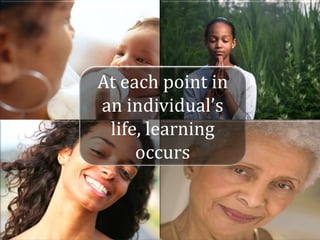
At each point in
an individual’s
 life, learning
     occurs
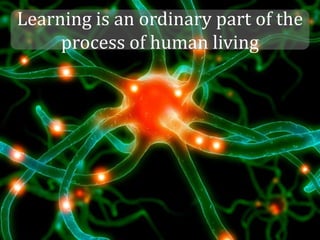
Learning is an ordinary part of the
     process of human living
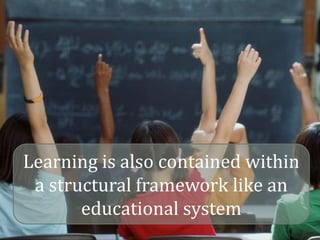
Learning is also contained within
 a structural framework like an
       educational system
With the increased
use of technology,
 learning is more
self-directed, and
 learner centered
SECTION 2
CONCEPTUALIZATION OF TEACHING
LEARNING


           TEACHING
Me


Teaching = Facilitating + Guiding +
     Supporting + Coaching
SECTION 3
GOALS FOR LEARNERS
MEANING
COMPENTENCY
              MAKING
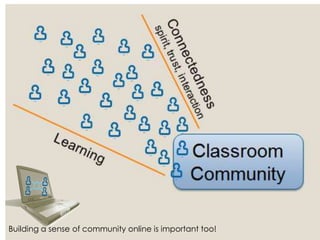
Building a sense of community online is important too!
SECTION 4
IMPLEMENTATION OF THE PHILOSOPHY
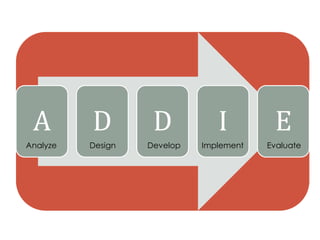
A        D         D           I         E
Analyze   Design   Develop   Implement   Evaluate
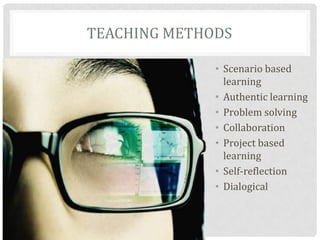
TEACHING METHODS

              • Scenario based
                learning
              • Authentic learning
              • Problem solving
              • Collaboration
              • Project based
                learning
              • Self-reflection
              • Dialogical
SECTION 5
PERSONAL GROWTH PLAN
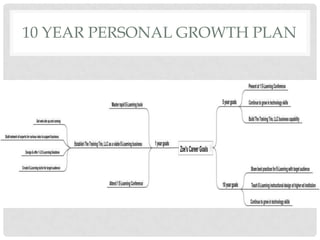
10 YEAR PERSONAL GROWTH PLAN
REFERENCES

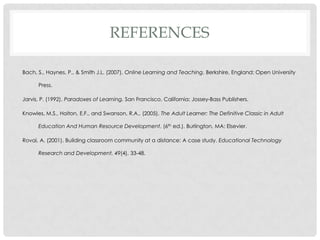
Bach, S., Haynes, P., & Smith J.L. (2007). Online Learning and Teaching. Berkshire, England: Open University

      Press.

Jarvis, P. (1992). Paradoxes of Learning. San Francisco, California: Jossey-Bass Publishers.

Knowles, M.S., Holton, E.F., and Swanson, R.A., (2005). The Adult Learner: The Definitive Classic in Adult

      Education And Human Resource Development. (6th ed.). Burlington, MA: Elsevier.

Rovai, A. (2001). Building classroom community at a distance: A case study. Educational Technology

      Research and Development, 49(4), 33-48.

Philosophy Of Teaching Statement

Editor's Notes

  • #4 Section 1: Conceptualization of Learning
  • #5 All human beings have the innate ability to learn. Throughout the cycle of life, humans are engaged in learning. Learning is the process of acquiring knowledge and skills through experiences, socialization, and formal education. Through this acquisition, human beings are able to adapt and change. Therefore, learning is change. At each point in an individual’s life, they are learning, adapting, and changing.
  • #6 Without the brain, humans would not have the ability to think which is central to the learning process. It is through sensory information that the brain perceives through the five senses (sight, hearing, smell, touch and taste), that a human is able to learn about the world around them. Learning as an innate ability of humans is often “…taken for granted as an ordinary part of the process of human living” (Jarvis, 1992, p. 4)
  • #7 Learning is an innate ability, but it is also a function that occurs within a formal system of education. In this regard, learning is juxtaposed with the term education (Knowles, Holton & Swanson, 2005) and is contained within a structural framework. While learning within this context is critical, especially as it relates to social context, I agree with Jarvis that “learning is wider than education; education is only one social institution in which learning occurs, albeit the only one specifically directed to it”(p. 10).
  • #8 The landscape of learning is shifting because of the increased use of technology and the increase in online learning programs. More than likely our paradigm of learning has been shaped by our experience that may resemble an image of a traditional classroom. The instructor was the expert who imparted his or her knowledge to the learner. Because of technology and online learning, learning has become more self-directed and learner centered. The effect of online learning is multifaceted and as it relates to the learning process itself, online learning may prompt the learner to reconsider her preferred learning style. By developing new styles and approaches to learning, she will become more adaptable in her future learning (Bach, Haynes, Smith, 2007).
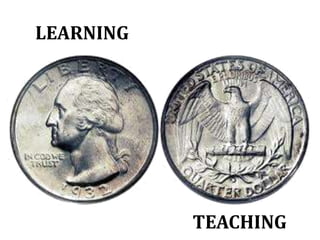
  • #10 A coin metaphor is befitting of the processes of learning and teaching. If learning is the head, then teaching is the tail. Learning and teaching are essentially two sides of the same coin. They are inextricably connected. They go hand in hand with learning being the outcome of the impact of teaching experiences. The responsibility of learning falls both on the learner and teacher. The teacher sets the tone, delivers the instruction, provides the motivation, ensures correction, and creates opportunities for the learner’s success. The learner receives that which the teacher provides to construct knowledge, develop skills, and make meaning.
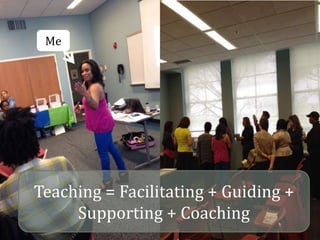
  • #11 As a learning and development professional who has primarily worked with adults, I believe that teaching equals facilitating, guiding, supporting, and coaching. I have to resist the urge to tell adults what they need to do. Most often, they already know what to do; they just might not be motivated or clear on how to do it. My job is to provide prompts that facilitate the construction of knowledge. I also believe that my job is to help widen the frame so that adult learners can see more of a bigger picture. Sometimes seeing a different or bigger perspective is all somebody needs to push forward and learn.
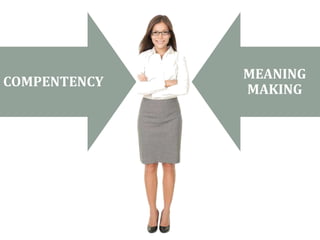
  • #13 I usually have two goals for learners. When I am facilitating a learning experience, I am concerned that learners obtain the skills that will make them competent in their roles. These skills vary depending on the course that I am teaching. It’s important that during the course, the learner gets an opportunity to practice using the skills and receive feedback on their progress. When they return to the workplace, it’s also important to make sure that their learning has transferred from the training setting to the real work setting. In order to do this, learners my receive follow up support from managers, access to job aids, or an opportunity to retake an e-course. Additionally, it is important for learners to make meaning for themselves so that what they have learned is relevant to them.
  • #14 Another goal for learners that I believe is important is establishing a classroom community. Classroom community is a concept defined and measured by Rovai (2001). It is comprised of two main components – learning and connectedness. Learning “…is the feeling that knowledge and meaning are actively constructed within the community, that the community enhances the acquisition of knowledge and understanding, and that the educational needs of its members are being satisfied” (Rovai, 2001, p. 35). Spirit, trust and interaction form the basis for connectedness. Spirit is the feeling of belonging and group identity. Trust is the feeling that the community can be trusted and will provide constructive feedback. Interaction is linked to the completion of assigned tasks and socio emotional relationships. Building classroom community is especially important in an online environment since learners experience feelings of isolation from others.
  • #16 In my opinion, the implementation of the philosophy starts with the instructional design process. This is important because instructional design provides a framework/system to build learning experiences. It’s an intentional effort to create a meaningful, relevant, and effective learning experience. Throughout my career, I have used the ADDIE model as a basis for my instructional design work. While it may not be a perfect model, it has served as a comprehensive model for me to follow. I have found that it is logical and adaptable to different learning situations.
  • #17 My teaching style lends to the constructivist pedagogical model. I have designed and delivered workshops, e-courses, virtual instructor led sessions that contain scenarios, authentic learning experiences, problem solving, collaboration, and self reflection. I also have a tendency to create dialogical experiences to create space for open dialogue.
  • #19 I created this mind map last year and it incorporates the development of my business with my professional development growth. Within the past year, I have accomplished two of my 1 year goals so far, including establish my company as an e-learning business and master rapid e-learning development tools.