





Investors in Values
  LWM Consultants Ltd.

Financial advice, or do it yourself, that is
             the question?
“You may have come across the term
financial planning and wondered what
does it mean, and does it apply to me?”
What is financial planning
• Provides direction and meaning to your financial
  decisions

• Considers the whole picture, so one decision impacts on
  another

• Enables you to consider both short and long-term goals
  as part of your overall life goals

• Enables you to adapt more easily to life changes

• Makes you feel more secure that your goals are on track
Do it yourself – why?
•   You have a need and know what you want, i.e.
    prepared to do your own financial planning and
    know how to deliver your goals

•   You want online access and ability to trade 24
    hours a day

•   You have access to plenty of free “advice”
    through online media, papers, magazines, self help
    books and good investment knowledge

•   You don’t want to pay for “advice”, and are
    happy for the responsibility for decisions to rest with
    you

•   You want to take advantage of “low charges” – no
    advice charges mean charges can be lower
Do it yourself?
                     - the market
•   Dominated by one key player, but others coming on
    board

•   Likely to become more popular as advice focuses on
    higher value investors, market already has a firm foothold
    as alternative option to advice

•   Product focus, i.e. pension, ISA etc

•   Technology driven, online access 24 hours day

•   Price driven, big players can get “rebates” from fund
    managers which they pass back to customers (may
    change in 2013)

•   Marketing / service driven – plenty of free / guided
    “advice” i.e. “popular funds”, portfolios etc

•   Focus on funds, but plenty of trading platforms for those
    wanting to invest in shares etc
DIY – be your own
            financial planner
• Set measurable goals

   o   Rather than saying you want to be comfortable in retirement, quantify what you
       mean and how you will achieve this

• Understand the effect of each financial decision

   o   All financial decisions are interrelated, so a decision around a child’s education may
       effect when and how you meet your retirement goals

• Review your financial situation periodically

   o   Financial planning is a dynamic process

   o   Goals may change over the years due to changes in your lifestyle (i.e. an
       inheritance)

   o   Revisit and review your financial plan as time goes by to reflect these changes so
       you stay on track with your long-term goals
DIY – be your own
             financial planner
• Start planning as soon as you can

   o   Don’t delay your financial planning

   o   Save or invest small amounts of money early, and often

   o   Develop good financial planning habits such as saving, budgeting, investing

   o   Regularly review your finances so you are better prepared to meet life changes and
       handle emergencies

• Be realistic in your expectations

   o   You cannot change your situation overnight, this is a lifelong process

   o   And remember there are events beyond your control such as inflation, stock markets
       and interest rates which will affect your financial planning results
DIY – be your own
           financial planner
• Realise you are in charge

   o Be sure you understand what you are doing

   o Make sure you look at your whole financial situation

   o Ask yourself questions before making any decisions
Financial advice - myths
• Financial advice is not about selling you a
  product

• Financial advice is about working with you
  to develop a long-term financial game
  plan, i.e. financial planning

• Financial advice does not have to be paid
  for in cash

• Financial advice can be paid for out of
  the investments used to deliver your long-
  term financial game plan
Financial advice – why?
• You may need expertise you don’t possess
  in certain areas of your finances. For
  example, an adviser can evaluate the
  level of risk you are comfortable with, and
  adjust your retirement plan to reflect this

• You may feel you don’t have the time to
  spare to do your own financial planning

• You have an immediate need or
  unexpected life event such as a birth,
  inheritance or major illness
Financial advice – why?
• You feel a professional financial adviser could help
  you improve on how you are currently managing
  your finances

• You know that you need to improve your current
  financial situation but don’t know where to start
What to expect from a
        financial adviser
A financial adviser will work with you to develop a
game plan that fits your financial circumstances and
tailors it to accomplish your goals by:

•   Looking at the whole financial picture including
    your goals

•   Understanding your tolerance for risk and what your
    expected returns are

•   Providing an unemotional assessment of what
    needs to be done

•   Delivering a comprehensive annual review

•   Keeping your informed
The process
• Analysing and evaluating your financial goals

   o Understand what your goals are

   o Analyse your information to assess your current situation

   o Determine what you need to do to meet your goals

• Develop and present financial planning
  recommendations and / or alternatives

   o Deliver financial planning recommendations that address your goals

   o Go over the recommendations with you to help you understand so that you
     can make an informed decision

   o Listen to your concerns and revise the recommendations as appropriate
The process
• Implementation of financial planning recommendations

   o Agree how recommendations will be carried out

   o Adviser may carry out the recommendation, or act as a “coach”, co-
     ordinating the whole process with you and using other professionals such as
     stock brokers etc.


• Monitoring your financial plan

   o You and the adviser agree who will monitor your progress towards your goals
     (normally this rests with the adviser)

   o If resting with adviser then they will review your situation and adjust the
     recommendations, if needed, as your life changes
Expectations
• Set measurable goals

   o   Rather than saying you want to be comfortable in retirement, quantify what you
       mean, the adviser can only help if your goals are quantifiable

• Understand the effect of each financial decision

   o   All financial decisions are interrelated, so a decision around a child’s education may
       effect when and how you meet your retirement goals

• Review your financial situation periodically

   o   Financial planning is a dynamic process

   o   Goals may change over the years due to changes in your lifestyle (i.e. an
       inheritance)

   o   Your financial adviser will meet you at least once a year to review your financial
       situation, but you can call them anytime if things change
Expectations
• Be realistic in your expectations

   o An adviser cannot change your situation overnight but they will take control of
     the lifelong process to deliver your goals


• Realise you are in charge

   o You are in charge, make sure you understand what your adviser is doing for
     you and what they are offering

   o Make sure you provide the adviser with all the relevant information on your
     financial situation

   o Ask questions and play an active role in decision making
Do you have to pay?
• YES

• An adviser is a professional like an accountant or
  solicitor and they will charge

• From 2013 charges for advice must be clear and
  transparent (this will apply to platforms who offer a
  “free” service)
Do you have to pay?
• What you pay depends on the structure they have
  but may include:

   o Hourly or fixed fee – you will be charged an hourly rate or fixed fee for any
     work they do for you

   o Retainer fee – some may combine the hourly rate or fixed fee with a
     retainer fee. This could be a fixed amount or a percentage of your
     investments


• This could be as a direct payment, or could be
  made out of your investment
Do you have to pay?
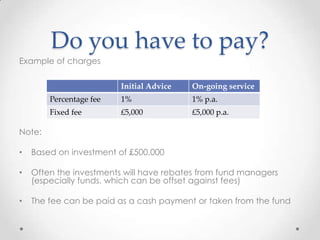
Example of charges

                         Initial Advice   On-going service
        Percentage fee   1%               1% p.a.
        Fixed fee        £5,000           £5,000 p.a.

Note:

•   Based on investment of £500,000

•   Often the investments will have rebates from fund managers
    (especially funds, which can be offset against fees)

•   The fee can be paid as a cash payment or taken from the fund
Choosing an adviser
Remember you are in charge:

• Understand the initial process, and what
  they do for you

• Understand what on-going service you will
  get – for example:

   o   What is the annual review – not only looking at goals and
       aspirations but also your investment performance, review
       of legislative changes, appropriateness of current strategy
       and recommendations for any changes

   o   Regular information – regular market information, alerts on
       regulatory changes and access to information on your
       investments

   o   Telephone contact – being available when you need
       them
Choosing an adviser
Effectively the whole partnership is
service driven, a good service means
you don’t need to worry about
financial planning because they will
do that for you.
What if I only have a
  small amount of money
    and need advice?
This is likely to be mopped up by the banks. The service
is likely to be more product focused and less emphasis
on lifetime financial planning goals.
Choosing an adviser
• You can find financial advisers on-line there are a
  number of websites you can go to like -
  http://www.unbiased.co.uk/

• Alternatively think about what you do for major financial
  decisions like buying a car or house, this is no different:

   o Ask friends, family or work colleagues. Recommendations are worth their
     weight in gold

   o When you find an adviser, do your research, find out what they will do for you,
     look at how they communicate with their clients (look for websites, twitter,
     Facebook and other social media outlets)

   o Talk to them, talk to their team, be active
Financial advice, or do it
   yourself, that is the
       question?
About LWM Consultants
We are financial advisers who developed a company based on
Values. Adding Value is how we judge ourselves.

We aim to:

• Share knowledge; good knowledge is the pathway to
  understanding

• Be thoughtful and challenging of set ideas and practices

• Be supportive and empowering of our employees

• Help those less fortunate than ourselves in the UK and overseas
Twitter: http://twitter.com/#!/LWM_Consultants
Facebook: http://www.facebook.com/InvestorsinValues
Website: http://www.lwmconsultants.com/public/
Shareshare: http://www.slideshare.net/InvestorsinValues


   LWM Consultants Ltd is an appointed representative of Sense Network
    Limited, which is authorised and regulated by the Financial Services
    Authority. Registered in England and Wales under Company Number
07408315. Registered Office: St John’s Court Whiteladies Road Bristol BS8 2QY

Advice

  • 1.
    Investors in Values LWM Consultants Ltd. Financial advice, or do it yourself, that is the question?
  • 2.
    “You may havecome across the term financial planning and wondered what does it mean, and does it apply to me?”
  • 3.
    What is financialplanning • Provides direction and meaning to your financial decisions • Considers the whole picture, so one decision impacts on another • Enables you to consider both short and long-term goals as part of your overall life goals • Enables you to adapt more easily to life changes • Makes you feel more secure that your goals are on track
  • 4.
    Do it yourself– why? • You have a need and know what you want, i.e. prepared to do your own financial planning and know how to deliver your goals • You want online access and ability to trade 24 hours a day • You have access to plenty of free “advice” through online media, papers, magazines, self help books and good investment knowledge • You don’t want to pay for “advice”, and are happy for the responsibility for decisions to rest with you • You want to take advantage of “low charges” – no advice charges mean charges can be lower
  • 5.
    Do it yourself? - the market • Dominated by one key player, but others coming on board • Likely to become more popular as advice focuses on higher value investors, market already has a firm foothold as alternative option to advice • Product focus, i.e. pension, ISA etc • Technology driven, online access 24 hours day • Price driven, big players can get “rebates” from fund managers which they pass back to customers (may change in 2013) • Marketing / service driven – plenty of free / guided “advice” i.e. “popular funds”, portfolios etc • Focus on funds, but plenty of trading platforms for those wanting to invest in shares etc
  • 6.
    DIY – beyour own financial planner • Set measurable goals o Rather than saying you want to be comfortable in retirement, quantify what you mean and how you will achieve this • Understand the effect of each financial decision o All financial decisions are interrelated, so a decision around a child’s education may effect when and how you meet your retirement goals • Review your financial situation periodically o Financial planning is a dynamic process o Goals may change over the years due to changes in your lifestyle (i.e. an inheritance) o Revisit and review your financial plan as time goes by to reflect these changes so you stay on track with your long-term goals
  • 7.
    DIY – beyour own financial planner • Start planning as soon as you can o Don’t delay your financial planning o Save or invest small amounts of money early, and often o Develop good financial planning habits such as saving, budgeting, investing o Regularly review your finances so you are better prepared to meet life changes and handle emergencies • Be realistic in your expectations o You cannot change your situation overnight, this is a lifelong process o And remember there are events beyond your control such as inflation, stock markets and interest rates which will affect your financial planning results
  • 8.
    DIY – beyour own financial planner • Realise you are in charge o Be sure you understand what you are doing o Make sure you look at your whole financial situation o Ask yourself questions before making any decisions
  • 9.
    Financial advice -myths • Financial advice is not about selling you a product • Financial advice is about working with you to develop a long-term financial game plan, i.e. financial planning • Financial advice does not have to be paid for in cash • Financial advice can be paid for out of the investments used to deliver your long- term financial game plan
  • 10.
    Financial advice –why? • You may need expertise you don’t possess in certain areas of your finances. For example, an adviser can evaluate the level of risk you are comfortable with, and adjust your retirement plan to reflect this • You may feel you don’t have the time to spare to do your own financial planning • You have an immediate need or unexpected life event such as a birth, inheritance or major illness
  • 11.
    Financial advice –why? • You feel a professional financial adviser could help you improve on how you are currently managing your finances • You know that you need to improve your current financial situation but don’t know where to start
  • 12.
    What to expectfrom a financial adviser A financial adviser will work with you to develop a game plan that fits your financial circumstances and tailors it to accomplish your goals by: • Looking at the whole financial picture including your goals • Understanding your tolerance for risk and what your expected returns are • Providing an unemotional assessment of what needs to be done • Delivering a comprehensive annual review • Keeping your informed
  • 13.
    The process • Analysingand evaluating your financial goals o Understand what your goals are o Analyse your information to assess your current situation o Determine what you need to do to meet your goals • Develop and present financial planning recommendations and / or alternatives o Deliver financial planning recommendations that address your goals o Go over the recommendations with you to help you understand so that you can make an informed decision o Listen to your concerns and revise the recommendations as appropriate
  • 14.
    The process • Implementationof financial planning recommendations o Agree how recommendations will be carried out o Adviser may carry out the recommendation, or act as a “coach”, co- ordinating the whole process with you and using other professionals such as stock brokers etc. • Monitoring your financial plan o You and the adviser agree who will monitor your progress towards your goals (normally this rests with the adviser) o If resting with adviser then they will review your situation and adjust the recommendations, if needed, as your life changes
  • 15.
    Expectations • Set measurablegoals o Rather than saying you want to be comfortable in retirement, quantify what you mean, the adviser can only help if your goals are quantifiable • Understand the effect of each financial decision o All financial decisions are interrelated, so a decision around a child’s education may effect when and how you meet your retirement goals • Review your financial situation periodically o Financial planning is a dynamic process o Goals may change over the years due to changes in your lifestyle (i.e. an inheritance) o Your financial adviser will meet you at least once a year to review your financial situation, but you can call them anytime if things change
  • 16.
    Expectations • Be realisticin your expectations o An adviser cannot change your situation overnight but they will take control of the lifelong process to deliver your goals • Realise you are in charge o You are in charge, make sure you understand what your adviser is doing for you and what they are offering o Make sure you provide the adviser with all the relevant information on your financial situation o Ask questions and play an active role in decision making
  • 17.
    Do you haveto pay? • YES • An adviser is a professional like an accountant or solicitor and they will charge • From 2013 charges for advice must be clear and transparent (this will apply to platforms who offer a “free” service)
  • 18.
    Do you haveto pay? • What you pay depends on the structure they have but may include: o Hourly or fixed fee – you will be charged an hourly rate or fixed fee for any work they do for you o Retainer fee – some may combine the hourly rate or fixed fee with a retainer fee. This could be a fixed amount or a percentage of your investments • This could be as a direct payment, or could be made out of your investment
  • 19.
    Do you haveto pay? Example of charges Initial Advice On-going service Percentage fee 1% 1% p.a. Fixed fee £5,000 £5,000 p.a. Note: • Based on investment of £500,000 • Often the investments will have rebates from fund managers (especially funds, which can be offset against fees) • The fee can be paid as a cash payment or taken from the fund
  • 20.
    Choosing an adviser Rememberyou are in charge: • Understand the initial process, and what they do for you • Understand what on-going service you will get – for example: o What is the annual review – not only looking at goals and aspirations but also your investment performance, review of legislative changes, appropriateness of current strategy and recommendations for any changes o Regular information – regular market information, alerts on regulatory changes and access to information on your investments o Telephone contact – being available when you need them
  • 21.
    Choosing an adviser Effectivelythe whole partnership is service driven, a good service means you don’t need to worry about financial planning because they will do that for you.
  • 22.
    What if Ionly have a small amount of money and need advice? This is likely to be mopped up by the banks. The service is likely to be more product focused and less emphasis on lifetime financial planning goals.
  • 23.
    Choosing an adviser •You can find financial advisers on-line there are a number of websites you can go to like - http://www.unbiased.co.uk/ • Alternatively think about what you do for major financial decisions like buying a car or house, this is no different: o Ask friends, family or work colleagues. Recommendations are worth their weight in gold o When you find an adviser, do your research, find out what they will do for you, look at how they communicate with their clients (look for websites, twitter, Facebook and other social media outlets) o Talk to them, talk to their team, be active
  • 24.
    Financial advice, ordo it yourself, that is the question?
  • 25.
    About LWM Consultants Weare financial advisers who developed a company based on Values. Adding Value is how we judge ourselves. We aim to: • Share knowledge; good knowledge is the pathway to understanding • Be thoughtful and challenging of set ideas and practices • Be supportive and empowering of our employees • Help those less fortunate than ourselves in the UK and overseas
  • 26.
    Twitter: http://twitter.com/#!/LWM_Consultants Facebook: http://www.facebook.com/InvestorsinValues Website:http://www.lwmconsultants.com/public/ Shareshare: http://www.slideshare.net/InvestorsinValues LWM Consultants Ltd is an appointed representative of Sense Network Limited, which is authorised and regulated by the Financial Services Authority. Registered in England and Wales under Company Number 07408315. Registered Office: St John’s Court Whiteladies Road Bristol BS8 2QY