



Financial Planning
By:- eFinancialManagement.com
Contents
1. Meaning of Financial
Planning
2. Process of financial
Planning
3. Objective of Financial
Planning
4. Conclusion and more…
Meaning of Financial
Planning
 Financial Planning is the process of estimating the capital
required and determining it’s competition. It is the
process of framing financial policies in relation to
procurement, investment and administration of funds of
an enterprise.
 Short term financial planning focuses on ensuring that
the business does not run out of cash. It seeks to ensure
that the firm has enough cash to pay its bills and makes
sensible short term borrowing and lending decisions.
 Long term financial planning calculates how much capital
will be required at what point of time so that the
emergencies can be pre-planned and handled effectively.
Process of Financial
Planning
To be Continue…
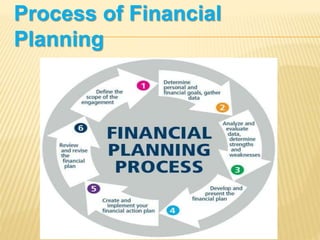
1.This is where the adviser introduces himself or herself and typically
explains the financial planning process to a client or prospective client.
The purpose of establishing the goal or relationship is to form the
foundation or purpose of planning itself-to begin the financial journey
with the clarification of a financial destination.
2.This step is where the information required to make recommendations
for the appropriate strategies and financial products to reach your goals
is gathered. For example, what is your time horizon? Do you want to
accomplish this goal in five years, 10 years, 20 years, or 30 years?
Although you may already know this information, it is wise to have it all
written down so that you can visualize all of the necessary data required
to make investment decisions--to give yourself prudent "advice."
To be Continue…
3. The financial planning professional analyzes the client’s information,
subject to the scope of the engagement, to gain an understanding of the
client’s financial situation. The financial planning professional assesses
the strengths and weaknesses of the client’s current financial situation
and compares them to the client’s objectives, needs and priorities.
4. The financial planning professional considers one or more strategies
relevant to the client’s current situation that could reasonably meet the
client’s objectives, needs and priorities; develops the financial planning
recommendations based on the selected strategies to reasonably meet
the client’s confirmed objectives, needs and priorities; and presents the
financial planning recommendations and the supporting rationale in a
way that allows the client to make an informed decision.
To be Continue…
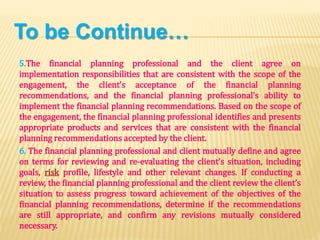
5.The financial planning professional and the client agree on
implementation responsibilities that are consistent with the scope of the
engagement, the client’s acceptance of the financial planning
recommendations, and the financial planning professional’s ability to
implement the financial planning recommendations. Based on the scope of
the engagement, the financial planning professional identifies and presents
appropriate products and services that are consistent with the financial
planning recommendations accepted by the client.
6. The financial planning professional and client mutually define and agree
on terms for reviewing and re-evaluating the client’s situation, including
goals, risk profile, lifestyle and other relevant changes. If conducting a
review, the financial planning professional and the client review the client’s
situation to assess progress toward achievement of the objectives of the
financial planning recommendations, determine if the recommendations
are still appropriate, and confirm any revisions mutually considered
necessary.
Objectives of financial
planning
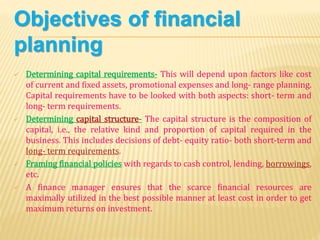
 Determining capital requirements- This will depend upon factors like cost
of current and fixed assets, promotional expenses and long- range planning.
Capital requirements have to be looked with both aspects: short- term and
long- term requirements.
 Determining capital structure- The capital structure is the composition of
capital, i.e., the relative kind and proportion of capital required in the
business. This includes decisions of debt- equity ratio- both short-term and
long- term requirements.
 Framing financial policies with regards to cash control, lending, borrowings,
etc.
 A finance manager ensures that the scarce financial resources are
maximally utilized in the best possible manner at least cost in order to get
maximum returns on investment.
Conclusion
 If you don’t know where to begin from, then take advice from a
reliable source. You can even invest in Mutual Funds to get the benefit
of diversification & professional fund management. Investing in
Mutual Funds is made paperless and hassle-free at Clear Tax.
 To know more about it just one click on the link given below…
https://efinancemanagement.com/financial-
management/financial-planning
Thank You

Financial Planning

  • 1.
  • 2.
    Contents 1. Meaning ofFinancial Planning 2. Process of financial Planning 3. Objective of Financial Planning 4. Conclusion and more…
  • 3.
    Meaning of Financial Planning Financial Planning is the process of estimating the capital required and determining it’s competition. It is the process of framing financial policies in relation to procurement, investment and administration of funds of an enterprise.  Short term financial planning focuses on ensuring that the business does not run out of cash. It seeks to ensure that the firm has enough cash to pay its bills and makes sensible short term borrowing and lending decisions.  Long term financial planning calculates how much capital will be required at what point of time so that the emergencies can be pre-planned and handled effectively.
  • 4.
  • 5.
    To be Continue… 1.Thisis where the adviser introduces himself or herself and typically explains the financial planning process to a client or prospective client. The purpose of establishing the goal or relationship is to form the foundation or purpose of planning itself-to begin the financial journey with the clarification of a financial destination. 2.This step is where the information required to make recommendations for the appropriate strategies and financial products to reach your goals is gathered. For example, what is your time horizon? Do you want to accomplish this goal in five years, 10 years, 20 years, or 30 years? Although you may already know this information, it is wise to have it all written down so that you can visualize all of the necessary data required to make investment decisions--to give yourself prudent "advice."
  • 6.
    To be Continue… 3.The financial planning professional analyzes the client’s information, subject to the scope of the engagement, to gain an understanding of the client’s financial situation. The financial planning professional assesses the strengths and weaknesses of the client’s current financial situation and compares them to the client’s objectives, needs and priorities. 4. The financial planning professional considers one or more strategies relevant to the client’s current situation that could reasonably meet the client’s objectives, needs and priorities; develops the financial planning recommendations based on the selected strategies to reasonably meet the client’s confirmed objectives, needs and priorities; and presents the financial planning recommendations and the supporting rationale in a way that allows the client to make an informed decision.
  • 7.
    To be Continue… 5.Thefinancial planning professional and the client agree on implementation responsibilities that are consistent with the scope of the engagement, the client’s acceptance of the financial planning recommendations, and the financial planning professional’s ability to implement the financial planning recommendations. Based on the scope of the engagement, the financial planning professional identifies and presents appropriate products and services that are consistent with the financial planning recommendations accepted by the client. 6. The financial planning professional and client mutually define and agree on terms for reviewing and re-evaluating the client’s situation, including goals, risk profile, lifestyle and other relevant changes. If conducting a review, the financial planning professional and the client review the client’s situation to assess progress toward achievement of the objectives of the financial planning recommendations, determine if the recommendations are still appropriate, and confirm any revisions mutually considered necessary.
  • 8.
    Objectives of financial planning Determining capital requirements- This will depend upon factors like cost of current and fixed assets, promotional expenses and long- range planning. Capital requirements have to be looked with both aspects: short- term and long- term requirements.  Determining capital structure- The capital structure is the composition of capital, i.e., the relative kind and proportion of capital required in the business. This includes decisions of debt- equity ratio- both short-term and long- term requirements.  Framing financial policies with regards to cash control, lending, borrowings, etc.  A finance manager ensures that the scarce financial resources are maximally utilized in the best possible manner at least cost in order to get maximum returns on investment.
  • 9.
    Conclusion  If youdon’t know where to begin from, then take advice from a reliable source. You can even invest in Mutual Funds to get the benefit of diversification & professional fund management. Investing in Mutual Funds is made paperless and hassle-free at Clear Tax.  To know more about it just one click on the link given below… https://efinancemanagement.com/financial- management/financial-planning
  • 10.