Investors in Values
LWM Consultants Ltd.

Ensuring your wealth is protected….
    making sure you have a will
Intestacy rules
“Without a will, the law decides who gets what –
wishes or promises are worthless and who get‟s what is
determined by intestacy rules….intestacy rules do not
recognise „common law partners‟ and „step-
children‟”
Case study one
Lawful spouse or civil partner (i.e. you are legally
married), plus children

• If your estate is worth less than £250,000 then your
  spouse or civil partner would get everything
Case study one
Lawful spouse or civil partner (i.e. you are legally married),
plus children

• If your estate is worth more than £250,000 then your
  spouse or civil partner would get £250,000 and a life
  interest (i.e. the right to take interest in the remainder,
  but not the capital itself) in half of anything over this sum
• Your children would get the remaining half of the sum
  over £250,000 immediately and be entitled to the other
  half on the death of your spouse
• Should any of your children die before you then their
  children would be entitled to take their parent’s share
Case study two
Lawful spouse or civil partner (i.e. you are legally
married), no children, but
parents/brothers/sisters/grandparents/aunts/uncles

• If your estate is worth less than £450,000 then your
  spouse or civil partner would get everything
Case study two
Lawful spouse or civil partner (i.e. you are legally
married), no children, but
parents/brothers/sisters/grandparents/aunts/uncles

• If your estate is worth more than £450,000 then your
  spouse or civil partner would get £450,000, plus half
  the balance
• Remaining balance goes to other relatives in this
  order of priority – parents; brothers/sisters; half
  brothers/sisters; grandparents; aunts/uncles; spouses
  of aunts/uncles
Case study three
Lawful spouse or civil partner (i.e. you are legally
married) and no other relatives

• If your estate is worth less than £450,000 then your
  spouse or civil partner would get everything
• If your estate is work more than £450,000 and you
  have no other surviving relative (e.g. children,
  grandchildren, parents), then your spouse or civil
  partner would still get everything
Case study four
If you are not lawfully married, but have had children

• Your estate will be shared between the children i.e.
  your common law partner will receive nothing
• Should they die before you then their children
  would take their share
Case study five
If you are not lawfully married, have no children, but
have parents or have had
brothers/sisters/grandparents/aunts/uncles

• Your estate will be shared amongst them i.e. your
  common law partner will receive nothing
• The order of priority will be – parents; brothers/sisters;
  half brothers/sisters; grandparents; aunts/uncles;
  spouses of aunts/uncles
• If any of these have predeceased, but have living
  children then the children will take their parent’s
  share
Case study six
If you are not lawfully married, and have no other
relatives

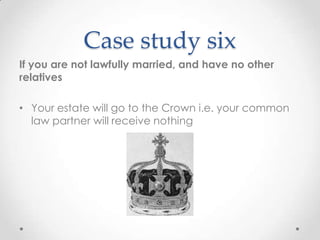
• Your estate will go to the Crown i.e. your common
  law partner will receive nothing
Should you make a will?
• Consider the case studies, if these apply to you then
  the answer is YES

• Other reasons to consider:

   o You choose who receives your money
   o If you have assets over £325,000 , there are simple things that can be
     done during your lifetime and under your will to reduce or negate any
     inheritance tax liability
   o If you have children you can appoint guardians who will be responsible
     for your children’s upbringing, i.e. you can appoint someone you can trust
Common reasons for not
    having a will….
• Too young – if you are are old enough to drink and
  vote, you have money and you want to leave your
  money to someone you love, then you are not too
  young
• It’s too expensive – it doesn’t have to be expensive,
  you can draw up your own will, you can go to a
  solicitor or a professional will writer
• It’s time consuming – it doesn’t have to be,
  particularly with the aid of computers
• It’s too morbid – although depressing, we will die
  eventually and making a will won’t kill you!
Next step….
• During November 2011 visit -
   http://www.willaid.org.uk/ - pay £85 for a simple will
   and this will go to charity
• Alternatively you can purchase a DIY will kit, some
   of these are free (just search on online)
• Visit a family solicitor
• Or, find a professional
will writer – for example
visit http://www.ipw.org.uk/
Any reference to other companies is not a recommendation, and we
 cannot guarantee the service that they offer. The information contained in
  this presentation is based on our understanding of the law. Changes can
occur and therefore we recommend that you check with legal professionals
   if there is anything you are not sure about. LWM are not qualified legal
  professionals, this presentation has been purely developed to highlight a
                                     need.

   LWM Consultants Ltd is an appointed representative of Sense Network
    Limited, which is authorised and regulated by the Financial Services
    Authority. Registered in England and Wales under Company Number
07408315. Registered Office: St John’s Court Whiteladies Road Bristol BS8 2QY

Making a will

  • 1.
    Investors in Values LWMConsultants Ltd. Ensuring your wealth is protected…. making sure you have a will
  • 2.
    Intestacy rules “Without awill, the law decides who gets what – wishes or promises are worthless and who get‟s what is determined by intestacy rules….intestacy rules do not recognise „common law partners‟ and „step- children‟”
  • 3.
    Case study one Lawfulspouse or civil partner (i.e. you are legally married), plus children • If your estate is worth less than £250,000 then your spouse or civil partner would get everything
  • 4.
    Case study one Lawfulspouse or civil partner (i.e. you are legally married), plus children • If your estate is worth more than £250,000 then your spouse or civil partner would get £250,000 and a life interest (i.e. the right to take interest in the remainder, but not the capital itself) in half of anything over this sum • Your children would get the remaining half of the sum over £250,000 immediately and be entitled to the other half on the death of your spouse • Should any of your children die before you then their children would be entitled to take their parent’s share
  • 5.
    Case study two Lawfulspouse or civil partner (i.e. you are legally married), no children, but parents/brothers/sisters/grandparents/aunts/uncles • If your estate is worth less than £450,000 then your spouse or civil partner would get everything
  • 6.
    Case study two Lawfulspouse or civil partner (i.e. you are legally married), no children, but parents/brothers/sisters/grandparents/aunts/uncles • If your estate is worth more than £450,000 then your spouse or civil partner would get £450,000, plus half the balance • Remaining balance goes to other relatives in this order of priority – parents; brothers/sisters; half brothers/sisters; grandparents; aunts/uncles; spouses of aunts/uncles
  • 7.
    Case study three Lawfulspouse or civil partner (i.e. you are legally married) and no other relatives • If your estate is worth less than £450,000 then your spouse or civil partner would get everything • If your estate is work more than £450,000 and you have no other surviving relative (e.g. children, grandchildren, parents), then your spouse or civil partner would still get everything
  • 8.
    Case study four Ifyou are not lawfully married, but have had children • Your estate will be shared between the children i.e. your common law partner will receive nothing • Should they die before you then their children would take their share
  • 9.
    Case study five Ifyou are not lawfully married, have no children, but have parents or have had brothers/sisters/grandparents/aunts/uncles • Your estate will be shared amongst them i.e. your common law partner will receive nothing • The order of priority will be – parents; brothers/sisters; half brothers/sisters; grandparents; aunts/uncles; spouses of aunts/uncles • If any of these have predeceased, but have living children then the children will take their parent’s share
  • 10.
    Case study six Ifyou are not lawfully married, and have no other relatives • Your estate will go to the Crown i.e. your common law partner will receive nothing
  • 11.
    Should you makea will? • Consider the case studies, if these apply to you then the answer is YES • Other reasons to consider: o You choose who receives your money o If you have assets over £325,000 , there are simple things that can be done during your lifetime and under your will to reduce or negate any inheritance tax liability o If you have children you can appoint guardians who will be responsible for your children’s upbringing, i.e. you can appoint someone you can trust
  • 12.
    Common reasons fornot having a will…. • Too young – if you are are old enough to drink and vote, you have money and you want to leave your money to someone you love, then you are not too young • It’s too expensive – it doesn’t have to be expensive, you can draw up your own will, you can go to a solicitor or a professional will writer • It’s time consuming – it doesn’t have to be, particularly with the aid of computers • It’s too morbid – although depressing, we will die eventually and making a will won’t kill you!
  • 13.
    Next step…. • DuringNovember 2011 visit - http://www.willaid.org.uk/ - pay £85 for a simple will and this will go to charity • Alternatively you can purchase a DIY will kit, some of these are free (just search on online) • Visit a family solicitor • Or, find a professional will writer – for example visit http://www.ipw.org.uk/
  • 14.
    Any reference toother companies is not a recommendation, and we cannot guarantee the service that they offer. The information contained in this presentation is based on our understanding of the law. Changes can occur and therefore we recommend that you check with legal professionals if there is anything you are not sure about. LWM are not qualified legal professionals, this presentation has been purely developed to highlight a need. LWM Consultants Ltd is an appointed representative of Sense Network Limited, which is authorised and regulated by the Financial Services Authority. Registered in England and Wales under Company Number 07408315. Registered Office: St John’s Court Whiteladies Road Bristol BS8 2QY