FINANCIAL
PLANNING
FOR
LIFE
LIFE NOW
• EARNING
• AIMLESS SPENDING
• WEEKENDS,Travels etc.
• GET-TOGATHERS,PARTIES etc.
• UNNECESSARY PURCHASES
• AIMLESS INVESTMENTS
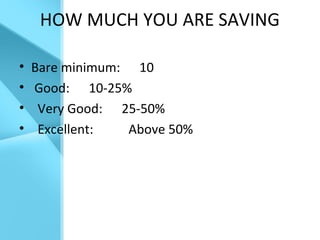
HOW MUCH YOU ARE SAVING
• Bare minimum: 10
• Good: 10-25%
• Very Good: 25-50%
• Excellent: Above 50%
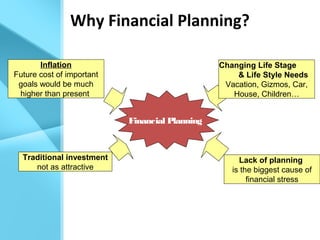
Why Financial Planning?
Financial Planning
Inflation
Future cost of important
goals would be much
higher than present
Lack of planning
is the biggest cause of
financial stress
Traditional investment
not as attractive
Changing Life Stage
& Life Style Needs
Vacation, Gizmos, Car,
House, Children…
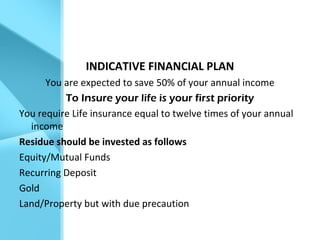
INDICATIVE FINANCIAL PLAN
You are expected to save 50% of your annual income
To Insure your life is your first priority
You require Life insurance equal to twelve times of your annual
income
Residue should be invested as follows
Equity/Mutual Funds
Recurring Deposit
Gold
Land/Property but with due precaution
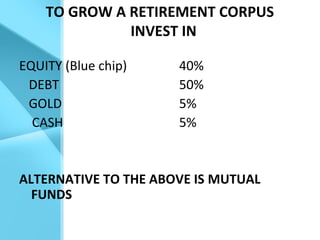
TO GROW A RETIREMENT CORPUS
INVEST IN
EQUITY (Blue chip) 40%
DEBT 50%
GOLD 5%
CASH 5%
ALTERNATIVE TO THE ABOVE IS MUTUAL
FUNDS
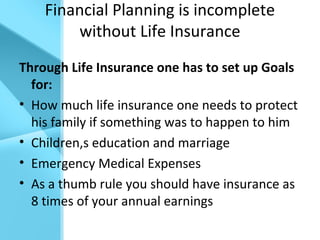
Financial Planning is incomplete
without Life Insurance
Through Life Insurance one has to set up Goals
for:
• How much life insurance one needs to protect
his family if something was to happen to him
• Children,s education and marriage
• Emergency Medical Expenses
• As a thumb rule you should have insurance as
8 times of your annual earnings
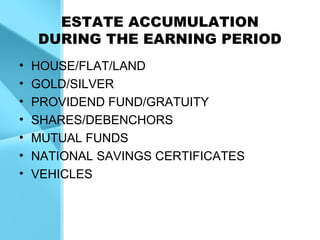
ESTATE ACCUMULATION
DURING THE EARNING PERIOD
• HOUSE/FLAT/LAND
• GOLD/SILVER
• PROVIDEND FUND/GRATUITY
• SHARES/DEBENCHORS
• MUTUAL FUNDS
• NATIONAL SAVINGS CERTIFICATES
• VEHICLES
• Retirement planning means making sure you
will have enough money to live on after
retiring from work.
• Should be the best period of your life, when
you can literally sit back and relax.
• To achieve a hassle-free retired life, you need
to make prudent investment decisions during
your working life
• Planning for retirement is as important as
planning your career and marriage.
• Compulsory savings in provident fund through
both employee and employer.
• It may not be enough to support you
throughout your retirement.
• Life takes its own course and from the poorest
to the wealthiest, no one gets spared.
"Everyone grows older". We get older every
day, without realizing. However, we assume
that old age is never going to touch us.
• The future depends to a great extent on the
choices you make today. Right decisions with
the help of proper planning, taken at the right
time will assure smile and success at the time
of retirement.
• Nuclear families and its attendant insecurity.
• Increasing uncertainties in personal and
professional life.
• The growing trends of seeking early
retirement and rising health risks are among
few important risks.
• Falling interest rates and the sustained
increase in the cost of living.
• If you are young, retirement may be the last
thing on your mind. But if you think you have
a long way to go for to plan for retirement,
think again.
It is never too early to prepare for retirement,
especially if you want to maintain the same
standard of living that you would have got
accustomed to by then.
• Let's assume that you are a 35 year old, earning Rs.3
lakh per annum.
• Your salary grows at 5% per annum and you plan to
retire after 25 years. Under these circumstances,
assuming your post-retirement requirement would
be 60% of your last annual income (Rs.10 lakh
approx).
• You would need about Rs.6 lakh per annum after
retirement. To achieve this, you need a retirement
corpus of Rs.75 lakh assuming you earn a return of
5% per annum over a period of 20 years.
• To meet this goal, you would have to invest more
than Rs.9,000 per month at 7% per annum for the
next 25 years. Inflation and tax implications have not
been considered for simplicity.
• The key to a financially independent future is
"sooner the better".
• Cautious investors not only save, they save
early and regularly. . The catch is to make the
power of compounding work one's benefit.
• Retirement should be kept as a top priority
because;
• if one does not keep it at the top one might
end up depending on one's children, which
probably no one would relish.
• Saving and investing regularly makes a big
difference at the time of retirement. Investing
at regular intervals builds your retirement
fund over time and helps you to minimize risk
and gives a tension free retirement-a time to
pursue your hobbies, fulfill your dreams and
passions.
• Saving and investing regularly makes a big
difference at the time of retirement. Investing
at regular intervals builds your retirement
fund over time and helps you to minimize risk
and gives a tension free retirement-a time to
pursue your hobbies, fulfill your dreams and
passions.
This is the usual picture of a soon to be retired person.
Retired is being twice tired,
I have thought
first tired of working.
then tired of not
Richard Armour
• High percentage of people die during their
first year of retirement .One of the reasons
being psychological trauma. A sense of feeling
that you’re a worn out individual and should
be placed in the corner of the house sitting
idle most of the time.
• Retirement is the point where a person is not
in any kind of employment/ bussiness
/occupation
• This usually happens upon reaching a
determined age ,when physical conditions do
not allow the person to work any more
RETIREMENT IS A PROCESS
• People frequently underestimate of this
transition
• At least 1/3of retirees experience difficulty
making the transition to retirement
• Planning makes a difference
The following changes can be viewed as a
normal part of aging
• Decreased cognitive capacity
• Increased depression
• Increased fears of illness
• Increased agitation
• Decreased performance speed
TWO STAGES OF
RETIREMENT PLANNING
Pre-retirement planning
Post-retirement planning
Need for retirement Planning
• Increased life span
• Unintended contingencies
• Increasing medical cost
• Diminishing trend of joint family
system
LIFE EXPECTENCY
Life expectancy is the measure ruler of
retirement planning.
With the increasing life expectency,high
standards of living and high expectations for
the upcoming future,pressure is building up
for fund allocation,to meet up the needs of
retirement.
Longivity of life expectancy has to be kept in
mind while making out a retirement plan
PREPARE PSYCHOLOGICALLY
WHAT IS YOUR ATTITUDE TOWARDS RETIREMENT
Is it an ending, a beginning or both
FEW WAYS TO STAY ACTIVE
Physical activity
Meet friends
Help grandkids
Go on a Holiday
Social Work
Use Your Skills
Pen them
Join course
Today’s Retirement
• Presents many complex social emotional and
financial issues
• Marriage and other familial and social
relationships
• Care giving responsibilities and living
arrangements
• Role Loss/Gain
• Decreased abilities and loss of independence
• Grief
• Time Management
• Rework
• Fixed/Reduced income
Prepare for family change
• How will you realign your marital relationship?
• How will you renegotiate the division of household
chores?
• What activities will you do jointly and individually?
• How will you set limits and boundaries around your
new found free’time?
• What care giving tasks will you have to assume?
• Are you meeting your own needs as well as those of
others?
Retirement Impacts Marital Life
• Lack of consensus on retirement expectations
will cause problems
• Wives complain of husbands invading their
‘domen’ and requiring attention
PREPARE FOR SOCIAL CHANGES
• With whom you will keep in touch?
• From whom do you receive support?
• To whom do you provide support?
• How do you plan to meet new friends?
• How will you keep in touch with old friends
and former work colleagues?
ESTATE PLANNING WITH RETIREMENT
PLANNING
• ESTATE PLANNING IS THE PROCESS OF
DISPOSING OF AN ESTATE
• VARIOUS TOOLS OF ESTATE PLANNING ARE
USED LIKE WILLS,TRUSTS,GIFTS Etc.
BEFORE THE DAY OF YOUR RETREMENT
• PAY ALL DUES
• PAY ALL OUTSTANDING BILLS
• PAY ALL OUTSTANDING LOANS
ON RETIREMENT WHAT SHALL BE WITH YOU
•FIXED ASSETS
»HOUSE/FLAT/LAND
•LIQUID ASSETS
»PROVIDENT FUND
»GRATUITY
»FIXED DEPOSITS
»LEAVE ENCASHMENT
Which are the investment avenues for your liquid
assets
• MIS
BANK DEPOSITS
• CO-OP. SOCIETIES
• NSC
• SHARES/DEBENCHORES
• MUTUAL FUNDS
• PENSION SCHEMES
DIVIDE LIQUID ASSETS EQUILLY AND NOMINATE
RESPECTIVE HEIRS
DO NOT NOMINATE MINORS
HOW TO DISPOSE OF GOLD/SILVER
• SELL THE ORNAMENTS IN YOUR LIFE
TIME
• ENCASH IT
• DIVIDE IT EQUALLY AMONGST YOUR
HEIRS
HOW TO DISPOSE OF YOUR HOUSE/FLAT/LAND
ETC.
VEHICLES
OTHER HOUSEHOLD ARTICLES
Discuss and achieve common consensus
Amongst
Sons/Daughters
In-laws
IF YOU INTEND TO REWORK
INVESTMENT AGENCIES
TEACHING
GENERAL ADMISTRATION EXECUTIVE
LEGEAL PRACTICE
IF YOU INTEND TO DO SOCIAL WORK
JOIN NGO
MARRIAGE BUREAU
START SOME ACTIVITY IN YOUR LOCALITY
Become a Saver, Wise Spender and better Investor
Financial planning for life

Financial planning for life

  • 1.
  • 2.
    LIFE NOW • EARNING •AIMLESS SPENDING • WEEKENDS,Travels etc. • GET-TOGATHERS,PARTIES etc. • UNNECESSARY PURCHASES • AIMLESS INVESTMENTS
  • 3.
    HOW MUCH YOUARE SAVING • Bare minimum: 10 • Good: 10-25% • Very Good: 25-50% • Excellent: Above 50%
  • 4.
    Why Financial Planning? FinancialPlanning Inflation Future cost of important goals would be much higher than present Lack of planning is the biggest cause of financial stress Traditional investment not as attractive Changing Life Stage & Life Style Needs Vacation, Gizmos, Car, House, Children…
  • 5.
    INDICATIVE FINANCIAL PLAN Youare expected to save 50% of your annual income To Insure your life is your first priority You require Life insurance equal to twelve times of your annual income Residue should be invested as follows Equity/Mutual Funds Recurring Deposit Gold Land/Property but with due precaution
  • 6.
    TO GROW ARETIREMENT CORPUS INVEST IN EQUITY (Blue chip) 40% DEBT 50% GOLD 5% CASH 5% ALTERNATIVE TO THE ABOVE IS MUTUAL FUNDS
  • 7.
    Financial Planning isincomplete without Life Insurance Through Life Insurance one has to set up Goals for: • How much life insurance one needs to protect his family if something was to happen to him • Children,s education and marriage • Emergency Medical Expenses • As a thumb rule you should have insurance as 8 times of your annual earnings
  • 8.
    ESTATE ACCUMULATION DURING THEEARNING PERIOD • HOUSE/FLAT/LAND • GOLD/SILVER • PROVIDEND FUND/GRATUITY • SHARES/DEBENCHORS • MUTUAL FUNDS • NATIONAL SAVINGS CERTIFICATES • VEHICLES
  • 10.
    • Retirement planningmeans making sure you will have enough money to live on after retiring from work. • Should be the best period of your life, when you can literally sit back and relax. • To achieve a hassle-free retired life, you need to make prudent investment decisions during your working life
  • 11.
    • Planning forretirement is as important as planning your career and marriage. • Compulsory savings in provident fund through both employee and employer. • It may not be enough to support you throughout your retirement.
  • 12.
    • Life takesits own course and from the poorest to the wealthiest, no one gets spared. "Everyone grows older". We get older every day, without realizing. However, we assume that old age is never going to touch us. • The future depends to a great extent on the choices you make today. Right decisions with the help of proper planning, taken at the right time will assure smile and success at the time of retirement.
  • 13.
    • Nuclear familiesand its attendant insecurity. • Increasing uncertainties in personal and professional life. • The growing trends of seeking early retirement and rising health risks are among few important risks. • Falling interest rates and the sustained increase in the cost of living.
  • 14.
    • If youare young, retirement may be the last thing on your mind. But if you think you have a long way to go for to plan for retirement, think again. It is never too early to prepare for retirement, especially if you want to maintain the same standard of living that you would have got accustomed to by then.
  • 15.
    • Let's assumethat you are a 35 year old, earning Rs.3 lakh per annum. • Your salary grows at 5% per annum and you plan to retire after 25 years. Under these circumstances, assuming your post-retirement requirement would be 60% of your last annual income (Rs.10 lakh approx). • You would need about Rs.6 lakh per annum after retirement. To achieve this, you need a retirement corpus of Rs.75 lakh assuming you earn a return of 5% per annum over a period of 20 years. • To meet this goal, you would have to invest more than Rs.9,000 per month at 7% per annum for the next 25 years. Inflation and tax implications have not been considered for simplicity.
  • 16.
    • The keyto a financially independent future is "sooner the better". • Cautious investors not only save, they save early and regularly. . The catch is to make the power of compounding work one's benefit.
  • 17.
    • Retirement shouldbe kept as a top priority because; • if one does not keep it at the top one might end up depending on one's children, which probably no one would relish.
  • 18.
    • Saving andinvesting regularly makes a big difference at the time of retirement. Investing at regular intervals builds your retirement fund over time and helps you to minimize risk and gives a tension free retirement-a time to pursue your hobbies, fulfill your dreams and passions.
  • 19.
    • Saving andinvesting regularly makes a big difference at the time of retirement. Investing at regular intervals builds your retirement fund over time and helps you to minimize risk and gives a tension free retirement-a time to pursue your hobbies, fulfill your dreams and passions.
  • 20.
    This is theusual picture of a soon to be retired person.
  • 21.
    Retired is beingtwice tired, I have thought first tired of working. then tired of not Richard Armour
  • 22.
    • High percentageof people die during their first year of retirement .One of the reasons being psychological trauma. A sense of feeling that you’re a worn out individual and should be placed in the corner of the house sitting idle most of the time.
  • 23.
    • Retirement isthe point where a person is not in any kind of employment/ bussiness /occupation • This usually happens upon reaching a determined age ,when physical conditions do not allow the person to work any more
  • 24.
    RETIREMENT IS APROCESS • People frequently underestimate of this transition • At least 1/3of retirees experience difficulty making the transition to retirement • Planning makes a difference
  • 25.
    The following changescan be viewed as a normal part of aging • Decreased cognitive capacity • Increased depression • Increased fears of illness • Increased agitation • Decreased performance speed
  • 26.
    TWO STAGES OF RETIREMENTPLANNING Pre-retirement planning Post-retirement planning
  • 27.
    Need for retirementPlanning • Increased life span • Unintended contingencies • Increasing medical cost • Diminishing trend of joint family system
  • 28.
    LIFE EXPECTENCY Life expectancyis the measure ruler of retirement planning. With the increasing life expectency,high standards of living and high expectations for the upcoming future,pressure is building up for fund allocation,to meet up the needs of retirement. Longivity of life expectancy has to be kept in mind while making out a retirement plan
  • 29.
    PREPARE PSYCHOLOGICALLY WHAT ISYOUR ATTITUDE TOWARDS RETIREMENT Is it an ending, a beginning or both
  • 30.
    FEW WAYS TOSTAY ACTIVE Physical activity Meet friends Help grandkids Go on a Holiday Social Work Use Your Skills Pen them Join course
  • 31.
    Today’s Retirement • Presentsmany complex social emotional and financial issues • Marriage and other familial and social relationships • Care giving responsibilities and living arrangements • Role Loss/Gain • Decreased abilities and loss of independence • Grief • Time Management • Rework • Fixed/Reduced income
  • 32.
    Prepare for familychange • How will you realign your marital relationship? • How will you renegotiate the division of household chores? • What activities will you do jointly and individually? • How will you set limits and boundaries around your new found free’time? • What care giving tasks will you have to assume? • Are you meeting your own needs as well as those of others?
  • 33.
    Retirement Impacts MaritalLife • Lack of consensus on retirement expectations will cause problems • Wives complain of husbands invading their ‘domen’ and requiring attention
  • 34.
    PREPARE FOR SOCIALCHANGES • With whom you will keep in touch? • From whom do you receive support? • To whom do you provide support? • How do you plan to meet new friends? • How will you keep in touch with old friends and former work colleagues?
  • 35.
    ESTATE PLANNING WITHRETIREMENT PLANNING • ESTATE PLANNING IS THE PROCESS OF DISPOSING OF AN ESTATE • VARIOUS TOOLS OF ESTATE PLANNING ARE USED LIKE WILLS,TRUSTS,GIFTS Etc.
  • 36.
    BEFORE THE DAYOF YOUR RETREMENT • PAY ALL DUES • PAY ALL OUTSTANDING BILLS • PAY ALL OUTSTANDING LOANS
  • 37.
    ON RETIREMENT WHATSHALL BE WITH YOU •FIXED ASSETS »HOUSE/FLAT/LAND •LIQUID ASSETS »PROVIDENT FUND »GRATUITY »FIXED DEPOSITS »LEAVE ENCASHMENT
  • 38.
    Which are theinvestment avenues for your liquid assets • MIS BANK DEPOSITS • CO-OP. SOCIETIES • NSC • SHARES/DEBENCHORES • MUTUAL FUNDS • PENSION SCHEMES
  • 39.
    DIVIDE LIQUID ASSETSEQUILLY AND NOMINATE RESPECTIVE HEIRS DO NOT NOMINATE MINORS
  • 40.
    HOW TO DISPOSEOF GOLD/SILVER • SELL THE ORNAMENTS IN YOUR LIFE TIME • ENCASH IT • DIVIDE IT EQUALLY AMONGST YOUR HEIRS
  • 41.
    HOW TO DISPOSEOF YOUR HOUSE/FLAT/LAND ETC. VEHICLES OTHER HOUSEHOLD ARTICLES Discuss and achieve common consensus Amongst Sons/Daughters In-laws
  • 42.
    IF YOU INTENDTO REWORK INVESTMENT AGENCIES TEACHING GENERAL ADMISTRATION EXECUTIVE LEGEAL PRACTICE IF YOU INTEND TO DO SOCIAL WORK JOIN NGO MARRIAGE BUREAU START SOME ACTIVITY IN YOUR LOCALITY
  • 43.
    Become a Saver,Wise Spender and better Investor