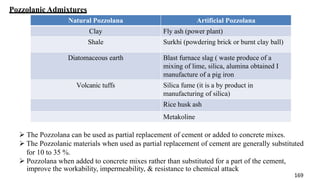
S.N. Patel Institute of Technology and
Research Centre, Umrakh
Subject : Concrete Technology
(3150610)
Concrete Technology
Prepared By:
Aarti P Borse,Dhaval M Patel
Assistant Professor
(Civil Engineering Department )
SNPITRC,UMRAKH
CONTENTS
▪ Introduction of concrete
▪ Ingredients of concrete
▪ Functions of Constituent of Cement
▪ Advantages & Disadvantages of concrete
▪ Properties of Concrete
▪ Overview of Sustainability and Concrete development.
▪ Advances and future trends in concrete
2
Introduction of Concrete
• One of the very important and widely used material in construction.
• The Grade of the concrete is specified by its 28 day’s cube strength (E.g.
M20 means the cube strength is 20 N/sq.mm)
• Concrete used on works is specified according to IS 456 (2000).
• Concrete is an artificial stone-like material used for various structural
purposes.
Introduction….
• Concrete is a mixing of binding material (Cement), filler (aggregates ,water and
sometimes admixtures.
• Portland cement, water, sand and coarse aggregates are proportioned and mixed
homogeneously to produce concrete suited to the particular job for which it is
intended.
• The mixture when placed in forms and allowed to cure, hardens in to a rock like
mass known as concrete.
• Strength and quality are dependent on the mixing proportions.
• Hardening is caused by chemical reaction between water and cement and it
continues for a long time, and consequently the concrete grows stronger with the
age.
Introduction…
➢In hardened concrete the voids of larger particles (C.A) are fill up by the
small aggregate (F.A) and the voids of fine aggregate are fill up by the
cement
➢It can be placed or molded into virtually any shape and reproduce any
surface texture.
➢Randomly distributed fibers or steel is reinforced in concrete to resist
tensile strength is called as reinforced cement concrete (RCC).
➢Concrete without reinforcement is called as plain cement concrete (PCC)
Ingredients of Concrete
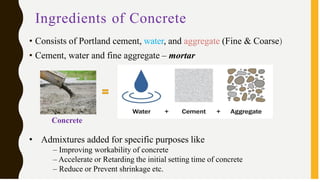
• Consists of Portland cement, water, and aggregate (Fine & Coarse)
• Cement, water and fine aggregate – mortar
Concrete
• Admixtures added for specific purposes like
– Improving workability of concrete
– Accelerate or Retarding the initial setting time of concrete
– Reduce or Prevent shrinkage etc.
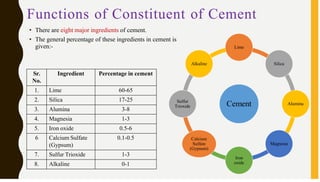
Functions of Constituent of Cement
• There are eight major ingredients of cement.
• The general percentage of these ingredients in cement is
given:-
Sr.
No.
Ingredient Percentage in cement
1. Lime 60-65
2. Silica 17-25
3. Alumina 3-8
4. Magnesia 1-3
5. Iron oxide 0.5-6
6 Calcium Sulfate
(Gypsum)
0.1-0.5
7. Sulfur Trioxide 1-3
8. Alkaline 0-1
1. Lime
• Also known as calcium oxide or calcium hydroxide.
• Sufficient quantity of lime is required to form silicates and aluminates of calcium.
• Deficiency in lime reduces the strength of property to the cement causes the
cement to set quickly.
• Excess lime makes cement unsound i.e. it causes the cement to expand and
disintegrate.
2. Silica:
• Also known as Silicon dioxide , chemical formula SiO2.
• Sufficient quantity of silica should be present in cement to dicalcium and tricalcium
silicate.
• Silica imparts strength to cement.
• Usually presents to the extent of about 30 percent cement.
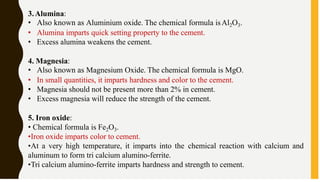
3.Alumina:
• Also known as Aluminium oxide. The chemical formula isAl2O3.
• Alumina imparts quick setting property to the cement.
• Excess alumina weakens the cement.
4. Magnesia:
• Also known as Magnesium Oxide. The chemical formula is MgO.
• In small quantities, it imparts hardness and color to the cement.
• Magnesia should not be present more than 2% in cement.
• Excess magnesia will reduce the strength of the cement.
5. Iron oxide:
• Chemical formula is Fe2O3.
•Iron oxide imparts color to cement.
•At a very high temperature, it imparts into the chemical reaction with calcium and
aluminum to form tri calcium alumino-ferrite.
•Tri calcium alumino-ferrite imparts hardness and strength to cement.
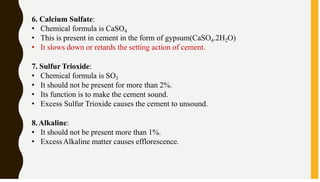
6. Calcium Sulfate:
• Chemical formula is CaSO4
• This is present in cement in the form of gypsum(CaSO4.2H2O)
• It slows down or retards the setting action of cement.
7. Sulfur Trioxide:
• Chemical formula is SO3
• It should not be present for more than 2%.
• Its function is to make the cement sound.
• Excess Sulfur Trioxide causes the cement to unsound.
8.Alkaline:
• It should not be present more than 1%.
• ExcessAlkaline matter causes efflorescence.
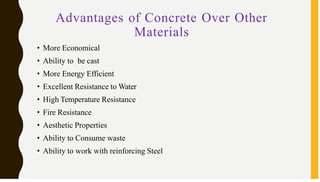
Advantages of Concrete Over Other
Materials
• More Economical
• Ability to be cast
• More Energy Efficient
• Excellent Resistance to Water
• High Temperature Resistance
• Fire Resistance
• Aesthetic Properties
• Ability to Consume waste
• Ability to work with reinforcing Steel
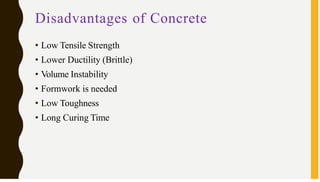
Disadvantages of Concrete
• Low Tensile Strength
• Lower Ductility (Brittle)
• Volume Instability
• Formwork is needed
• Low Toughness
• Long Curing Time
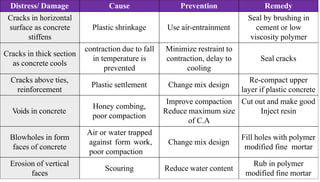
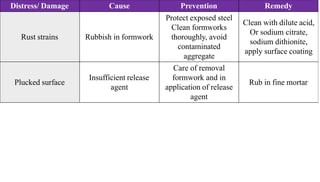
Properties of Concrete
• Concrete has relatively high compressive strength, but significantly lower
tensile strength.
• The elasticity of concrete is relatively constant at low stress levels but starts
decreasing at higher stress levels as matrix cracking develops.
• Concrete has a very low coefficient of thermal expansion, and as it matures
concrete shrinks.
• All concrete structures will crack to some extent, due to shrinkage and
tension.
• Concrete can be damaged by fire, aggregate expansion, sea water effects,
bacterial corrosion, leaching, physical damage and chemical damage (from
carbonation, chlorides, sulfates).
Summary..
• Concrete is most commonly used building material.
• It is a very strong and versatile mouldable construction material.
• It is a homogeneous mixture of cement , sand, coarse aggregate and water.
• It is very strong in carrying compressive strength and is extremely weak in
resisting tensile stress.
• The strength of concrete is depends upon the quantity of its ingredients,
their relative quantities and the manner in which they are mixed,
transported, placed, compacted and cured.
• It is possible to produced cement concrete of different specification for
various purposes adjusting proportion of ingredients suitably.
Overview of Sustainability & Concrete
Development
• The growing concern over global warming and significant ecological changes requires
sustainable development in all fields of science and technology.
• Concrete has become the most popular and widely used construction material in the
world.
• Concrete is perceived and identified as the provider of a nations infrastructure and
indirectly of its economic progress and stability, and indeed, of the quality of life.
• Concrete is easily and readily prepared and fabricated in all sorts of
conceivable shapes and structural systems in the realms of infrastructure,
habitation, transportation, work and play.
• Its great simplicity lies in that its constituents are most readily available
anywhere in the world.
• Concrete not only consumes huge amount of energy and natural sources, but
also emits large amount of CO2, mainly due to the production of cement.
• It is evident that such large amount of concrete production has put significant
impact on the energy, resource, environment, and ecology of the society.
• Hence, how to develop the concrete technology in a sustainable way has become
a significant issue.
• As the World Earth Summits (1990) and Kyoto (1997) demonstrated very clearly,
this worldwide problem (global warming) can be solved only through concerted
international efforts.
• The industrialized countries are called upon to reduce the emission of greenhouse
gases and the wasteful use of natural resources, and the developing countries
need to avoid the mistakes made by the industrialized world in the past and
develop their economies using technologies that make optimal use of energy and
natural materials, without polluting the environment.
Concrete has two major drawbacks with respect to sustainability:
• The production of Portland cement is an extremely resource and energy
intensive process where every tonne of cement requires about 1.5 tonnes of raw
materials. In addition, each tonne of cement produced releases approximately
one tonne of Carbon Dioxide (CO2) into the environment. Thus the production
of Portland cement is a significant contributor to atmospheric pollution and the
green house effect.
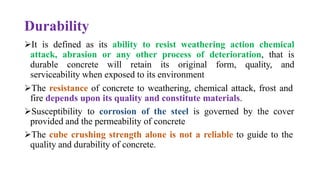
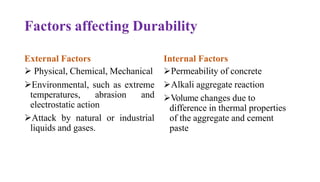
• Concrete deteriorates when exposed to the environment, which significantly
influences its service behavior, design life and safety.
• Cracking of the concrete, inadequate cover and quality of the cover to steel, and
the overall quality of the structural concrete are the three major factors that
encourage the transport mechanism of aggressive agents, such as chlorides and
sulphate into concrete.
Advances and Trends of Concrete
Development and Sustainability
• “Sustainable development means development that meets the needs of the
present without compromising the ability of the future generation to meet
their own needs.”
• Sustainability lies at the heart of construction and design.
• Sustainable concrete construction is a step towards green and eco friendly
concrete construction practices to solve global environmental problems.
• Thus, in order to make concrete more sustainable may work along one or
more of the following solutions;
• 1) Replacing cement in concrete with larger amounts of supplementary cementing
materials (SCMs) than usual.
• Recycled aggregate can be easily used for construction.
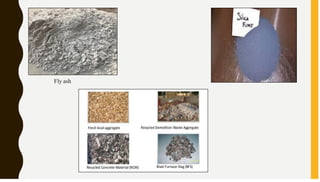
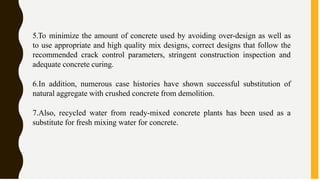
• Waste material from industries such as Fly ash, Silica fume, Granular blast
furnace slag (GBFS) can be add in concrete to improve their strength and other
properties.
2)Replacing cement in concrete with combinations of SCMs leading to synergic
reactions enhancing strength,
3) Producing leaner concrete with less cement per cubic meter utilizing plasticizers.
4)Making concrete with local aggregate susceptible to alkali silica reaction (ASR) by
using cement replacements, thus avoiding long transport of non-reactive aggregate.
Fly ash
5.To minimize the amount of concrete used by avoiding over-design as well as
to use appropriate and high quality mix designs, correct designs that follow the
recommended crack control parameters, stringent construction inspection and
adequate concrete curing.
6.In addition, numerous case histories have shown successful substitution of
natural aggregate with crushed concrete from demolition.
7.Also, recycled water from ready-mixed concrete plants has been used as a
substitute for fresh mixing water for concrete.
8. Fly ash and/or silica fume concrete mixes have been proven to provide
excellent strength and increased durability characteristics. These materials are
ideal companions to Portland cement, and extensive research has now
established that super plasticized concrete mixes where the water/cementitious
materials ratio is limited to 0.3 or less can have as much as 60% of the cement
replaced with fly ash and produce a 55 MPa compressive strength concrete @ 28
days with excellent durability characteristics including significantly less
cracking.
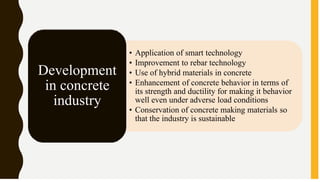
• Application of smart technology
• Improvement to rebar technology
• Use of hybrid materials in concrete
• Enhancement of concrete behavior in terms of
its strength and ductility for making it behavior
well even under adverse load conditions
• Conservation of concrete making materials so
that the industry is sustainable
Development
in concrete
industry
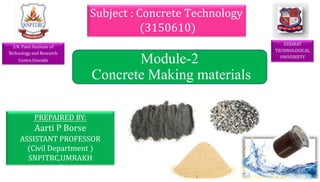
GUJARAT
TECHNOLOGICAL
UNIVERSITY
PREPAIRED BY:
Aarti P Borse
ASSISTANT PROFESSOR
(Civil Department )
SNPITRC,UMRAKH
0
Subject : Concrete Technology
(3150610)
1
Module-2
Concrete Making materials
S.N. Patel Institute of
Technology and Research
Centre,Umrakh
• BIS 2000 Standard
IS 456 (2000): Plain and Reinforced Concrete - Code of
Practice [CED 2: Cement and Concrete]
Books:
• Concrete technology theory and practice by ms Shetty
• Concrete technology by Dr. R.P Rethaliya
2
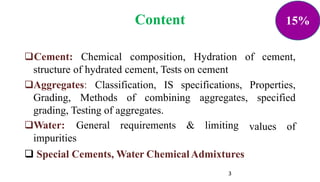
❑Cement: Chemical composition, Hydration of cement,
structure of hydrated cement, Tests on cement
❑Aggregates: Classification, IS specifications,
Grading, Methods of combining aggregates,
grading, Testing of aggregates.
Properties,
specified
values of
❑Water: General requirements & limiting
impurities
❑ Special Cements, Water ChemicalAdmixtures
15%
3
Content
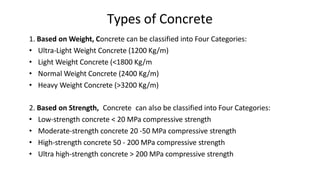
Types of Concrete
1. Based on Weight, Concrete can be classified into Four Categories:
• Ultra-Light Weight Concrete (1200 Kg/m)
• Light Weight Concrete (<1800 Kg/m
• Normal Weight Concrete (2400 Kg/m)
• Heavy Weight Concrete (>3200 Kg/m)
2. Based on Strength, Concrete can also be classified into Four Categories:
• Low-strength concrete < 20 MPa compressive strength
• Moderate-strength concrete 20 -50 MPa compressive strength
• High-strength concrete 50 - 200 MPa compressive strength
• Ultra high-strength concrete > 200 MPa compressive strength
• Beside this there are various type of Concrete for different applications
that are created by changing the proportions of the main ingredients.
– Regular Concrete
– Ready-Mix Concrete
– Green Concrete
– High-Performance Concrete
– Ultra-High Performance Concrete
– Rapid Strength Concrete
– Shrinkage Compensating Concrete
– Fiber-Reinforced Concrete
– Asphalt Concrete
– Polymer Concrete
– Gypsum Concrete
Factors affecting Concrete Strength
• Water/Cement Ratio
• Age and Curing Condition
• Aggregates
• Admixtures
Advantages of Concrete
• More Economical
• Ability to be cast
• More Energy Efficient
• Excellent Resistance to Water
• High Temperature Resistance
• Fire Resistance
• Aesthetic Properties
• Ability to Consume waste
• Ability to work with reinforcing Steel
Disadvantages of Concrete
• Low Tensile Strength
• Lower Ductility (Brittle)
• Volume Instability
• Formwork is needed
• Low Toughness
• Long Curing Time
Properties of Concrete
• Concrete has relatively high compressive strength, but significantly lower
tensile strength.
• The elasticity of concrete is relatively constant at low stress levels but starts
decreasing at higher stress levels as matrix cracking develops.
• Concrete has a very low coefficient of thermal expansion, and as it matures
concrete shrinks.
• All concrete structures will crack to some extent, due to shrinkage and
tension.
• Concrete can be damaged by fire, aggregate expansion, sea water effects,
bacterial corrosion, leaching, physical damage and chemical damage (from
carbonation, chlorides, sulfates).
Components of Concrete
Concrete making materials
10
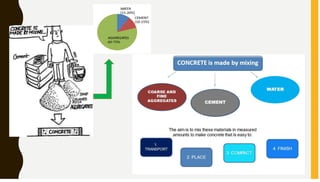
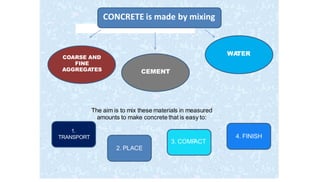
CONCRETE is made by mixing
WA
TER
COARSE AND
FINE
AGGREGATES CEMENT
The aim is to mix these materials in measured
amounts to make concrete that is easy to:
1.
TRANSPORT 4. FINISH
3. COMP
ACT
2. PLACE
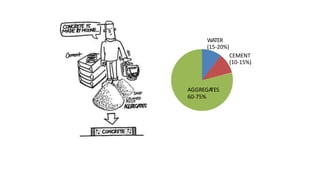
WATER
(15-20%)
CEMENT
(10-15%)
AGGREGA
TES
60-75%
Cement
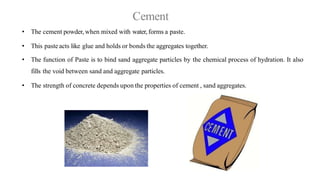
• The cement powder, when mixed with water, forms a paste.
• This paste acts like glue and holds or bonds the aggregates together.
• The function of Paste is to bind sand aggregate particles by the chemical process of hydration. It also
fills the void between sand and aggregate particles.
• The strength of concrete depends upon the properties of cement , sand aggregates.
AGGREGATES
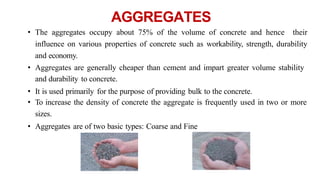
• The aggregates occupy about 75% of the volume of concrete and hence their
influence on various properties of concrete such as workability, strength, durability
and economy.
• Aggregates are generally cheaper than cement and impart greater volume stability
and durability to concrete.
• It is used primarily for the purpose of providing bulk to the concrete.
• To increase the density of concrete the aggregate is frequently used in two or more
sizes.
• Aggregates are of two basic types: Coarse and Fine
AGGREGATES
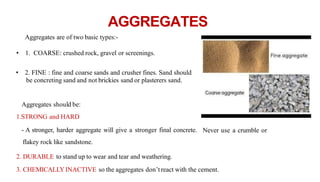
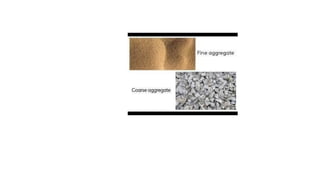
Aggregates are of two basic types:-
• 1. COARSE: crushed rock, gravel or screenings.
• 2. FINE : fine and coarse sands and crusher fines. Sand should
be concreting sand and not brickies sand or plasterers sand.
Aggregates should be:
1.STRONG and HARD
- A stronger, harder aggregate will give a stronger final concrete. Never use a crumble or
flakey rock like sandstone.
2. DURABLE to stand up to wear and tear and weathering.
3. CHEMICALLYINACTIVE so the aggregates don’treact with the cement.
WA
TER
• Water is mixed with the cement powder to form a paste which holds the aggregates together like
glue.
• Water must be clean, fresh and free from any dirt, unwanted chemicals or rubbish that may
affect concrete.
• Many concrete plants now use recycled water.
• Always check bore water before use.
• Don’t use sea water as it may rust the steel reinforcement in the concrete.
Admixtures
It is material other than basic material of concrete which is added to the concrete mix Immediately
before or during mixing to modify some properties of concrete in the fresh or hardened state.
•
• Use of admixtures like accerators, retarders, air entraining agents ,pozzolanic materials, water
proofing admixtures etc early but plastizers, superplastizers (water reducers) are of recent interest.
Use of ready mix concrete has really promoted the use of admixtures in India.
• Admixtures are mixed into the concrete to change or alter its properties. Example, the time concrete
takes to set and harden, or its workability.
12
Air
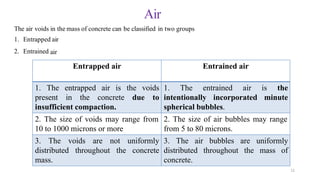
The air voids in the mass of concrete can be classified in two groups
1. Entrapped air
2. Entrained air
Entrapped air Entrained air
1. The entrapped air is the voids
present in the concrete due to
insufficient compaction.
1. The entrained air is the
intentionally incorporated minute
spherical bubbles.
2. The size of voids may range from
10 to 1000 microns or more
2. The size of air bubbles may range
from 5 to 80 microns.
3. The voids are not uniformly
distributed throughout the concrete
mass.
3. The air bubbles are uniformly
distributed throughout the mass of
concrete.
13
CEMENT
RecentAdvances and trends:
• Ready Mixed Concrete (Admixtures)
• Self Compacting Concrete
• High Performance Concrete
• FlyAsh Concrete
Functions of constituent of cement
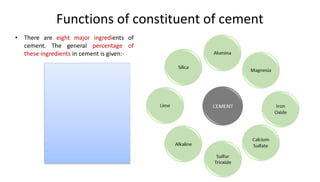
• There are eight major ingredients of
cement. The general percentage of
these ingredients in cement is given:-
Ingredient Percentage in
cement
Lime 60-65
Silica 17-25
Alumina 3-8
Magnesia 1-3
Iron oxide 0.5-6
Calcium Sulfate
(Gypsum)
0.1-0.5
Sulfur Trioxide 1-3
Alkaline 0-1
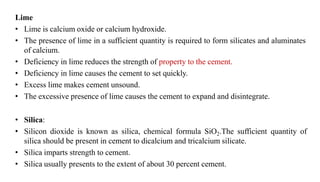
Lime
• Lime is calcium oxide or calcium hydroxide.
• The presence of lime in a sufficient quantity is required to form silicates and aluminates
of calcium.
• Deficiency in lime reduces the strength of property to the cement.
• Deficiency in lime causes the cement to set quickly.
• Excess lime makes cement unsound.
• The excessive presence of lime causes the cement to expand and disintegrate.
• Silica:
• Silicon dioxide is known as silica, chemical formula SiO2.The sufficient quantity of
silica should be present in cement to dicalcium and tricalcium silicate.
• Silica imparts strength to cement.
• Silica usually presents to the extent of about 30 percent cement.
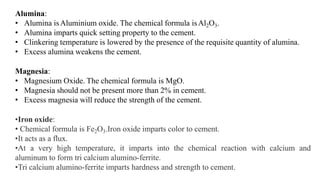
Alumina:
• Alumina isAluminium oxide. The chemical formula isAl2O3.
• Alumina imparts quick setting property to the cement.
• Clinkering temperature is lowered by the presence of the requisite quantity of alumina.
• Excess alumina weakens the cement.
Magnesia:
• Magnesium Oxide. The chemical formula is MgO.
• Magnesia should not be present more than 2% in cement.
• Excess magnesia will reduce the strength of the cement.
•Iron oxide:
• Chemical formula is Fe2O3.Iron oxide imparts color to cement.
•It acts as a flux.
•At a very high temperature, it imparts into the chemical reaction with calcium and
aluminum to form tri calcium alumino-ferrite.
•Tri calcium alumino-ferrite imparts hardness and strength to cement.
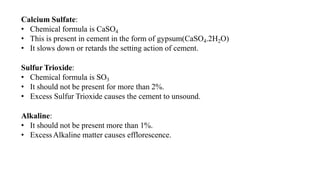
Calcium Sulfate:
• Chemical formula is CaSO4
• This is present in cement in the form of gypsum(CaSO4.2H2O)
• It slows down or retards the setting action of cement.
Sulfur Trioxide:
• Chemical formula is SO3
• It should not be present for more than 2%.
• Excess Sulfur Trioxide causes the cement to unsound.
Alkaline:
• It should not be present more than 1%.
• ExcessAlkaline matter causes efflorescence.
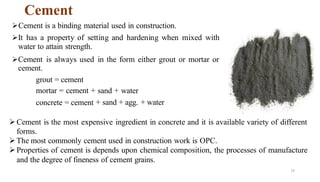
Cement
14
➢Cement is a binding material used in construction.
➢It has a property of setting and hardening when mixed with
water to attain strength.
➢Cement is always used in the form either grout or mortar or
cement.
grout = cement
mortar = cement + sand + water
concrete = cement + sand + agg. + water
➢Cement is the most expensive ingredient in concrete and it is available variety of different
forms.
➢The most commonly cement used in construction work is OPC.
➢Properties of cement is depends upon chemical composition, the processes of manufacture
and the degree of fineness of cement grains.
Manufacture of Cement
15
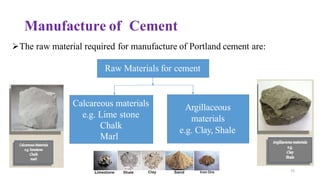
➢The raw material required for manufacture of Portland cement are:
Argillaceous
materials
e.g. Clay, Shale
Calcareous materials
e.g. Lime stone
Chalk
Marl
Raw Materials for cement
27
Manufacture of Cement
• There are two processes known as “Wet” and “Dry” processes depending upon
whether the mixing and grinding of raw materials is done in wet or dry condition.
• With a little change in the above process through semi-dry process also cement is
manufactured.
• Where the raw materials are ground dry and then mixed with about 10-14 per cent of
water and further burnt to clinkering temperature.
• The dry process requires much less fuel as the materials are already in a dry state,
whereas in the wet process the slurry contains about 35 to 50 per cent water. To dry
the slurry we thus require more fuel.
28
Manufacture of Cement
➢ The manufacture of cement is consist of following basics steps:
1. Grinding, mixing of raw mater and burning of raw material at a
temperature of 1400 to 1500 °C
2. Clinker production in kiln in the form of dark greenish blue balls.
3. Grinding of clinker by adding gypsum about 3 to 5 %.
4. Packing and storage of product.
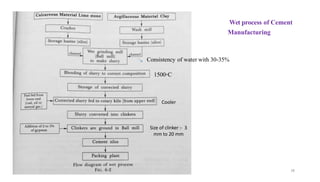
Wet process of Cement
Manufacturing
Cooler
Size of clinker :- 3
mm to 20 mm
Consistency of water with 30-35%
1500◦C
18
• In the wet process, the limestone (calcareous material) brought from the quarries is first crushed to smaller
fragments and stored in Storage basins or silos.
• Argillaceous material i.e. clay is thoroughly mixed with water in a container known as wash mill. This
washed clay is stored in storage basins.
• Crushed limestone from silos and wet clay from storage basins are allowed to fall in a channel in correct
proportions in ball or tube mill, which lets materials to wet grinding mills, and form ground to a fine
consistency of slurry with the addition of water.
• The slurry is a liquid of creamy consistency with water content of about 35 to 50 per cent, wherein
particles, crushed to the fineness of Indian Standard Sieve number 9, are held in suspension.
• The slurry is led to correcting basin where it is constantly stirred. At this stage the chemical composition
is adjusted as necessary.
• The corrected slurry led in to a rotary kiln from upper end where fuel such as coal, oil, gas from lower
end.
30
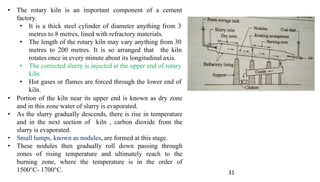
31
• The rotary kiln is an important component of a cement
factory.
• It is a thick steel cylinder of diameter anything from 3
metres to 8 metres, lined with refractory materials.
• The length of the rotary kiln may vary anything from 30
metres to 200 metres. It is so arranged that the kiln
rotates once in every minute about its longitudinal axis.
• The corrected slurry is injected at the upper end of rotary
kiln.
• Hot gases or flames are forced through the lower end of
kiln.
• Portion of the kiln near its upper end is known as dry zone
and in this zone water of slurry is evaporated.
• As the slurry gradually descends, there is rise in temperature
and in the next section of kiln , carbon dioxide from the
slurry is evaporated.
• Small lumps, known as nodules, are formed at this stage.
• These nodules then gradually roll down passing through
zones of rising temperature and ultimately reach to the
burning zone, where the temperature is in the order of
1500°C- 1700°C.
32
• In burning zone , calcined product is formed and nodules are converted into small
known as clinkers.
hard balls which are
• The size of clinkers varies from 3 mm to 20mm. The clinkers drops into a rotary cooler where it is cooled
under controlled conditions. The clinkers weight about 1100 to 1300 gms per litre. The litre weight of
clinker indicates the quality of clinker.
• Clinkers as obtained from the rotary kiln are finely ground in ball mills and tube mills. During grinding, a
small quantity about addition of 3 to 5 per cent of gypsum to prevent flash-setting of the cement.
• The finely ground cement is stored in silos. It is then weighed and packed in bags by automatic machine.
Each bag of cement contains 50Kg or about 0.035 m3 of cement. These bags are carefully stored in a dry
place.
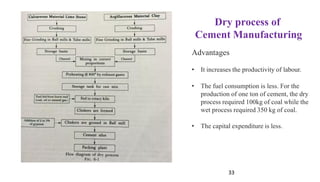
Dry process of
Cement Manufacturing
33
Advantages
• It increases the productivity of labour.
• The fuel consumption is less. For the
production of one ton of cement, the dry
process required 100kg of coal while the
wet process required 350 kg of coal.
• The capital expenditure is less.
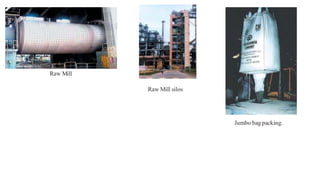
Raw Mill
Raw Mill silos
Jumbo bag packing.
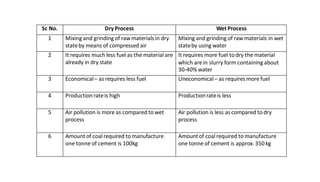
Sr. No. Dry Process Wet Process
1 Mixing and grinding of rawmaterialsin dry
stateby means of compressed air
Mixing and grinding of rawmaterials in wet
stateby using water
2 It requires much less fuel as the material are
already in dry state
It requires more fuel todry the material
which arein slurry form containing about
30-40% water
3 Economical– as requires less fuel Uneconomical– as requires more fuel
4 Productionrateis high Productionrateis less
5 Air pollution is more as compared to wet
process
Air pollution is less as compared to dry
process
6 Amount of coalrequired to manufacture
one tonne of cement is 100kg
Amountof coalrequired to manufacture
one tonne of cement is approx.350kg
25
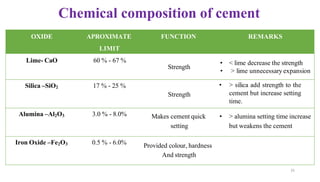
OXIDE APROXIMATE
LIMIT
FUNCTION REMARKS
Lime- CaO 60 % - 67 %
Strength
• < lime decrease the strength
• > lime unnecessary expansion
Silica –SiO2 17 % - 25 %
Strength
• > silica add strength to the
cement but increase setting
time.
Alumina –Al2O3 3.0 % - 8.0% Makes cement quick
setting
• > alumina setting time increase
but weakens the cement
Iron Oxide –Fe2O3 0.5 % - 6.0% Provided colour, hardness
And strength
Chemical composition of cement
26
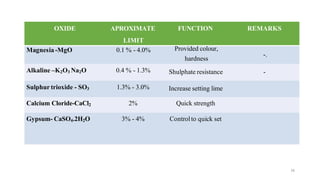
OXIDE APROXIMATE
LIMIT
FUNCTION REMARKS
Magnesia -MgO 0.1 % - 4.0% Provided colour,
hardness
-.
Alkaline –K2O3 Na2O 0.4 % - 1.3% Shulphate resistance -
Sulphur trioxide - SO3 1.3% - 3.0% Increase setting lime
Calcium Cloride-CaCl2 2% Quick strength
Gypsum- CaSO4.2H2O 3% - 4% Controlto quick set
27
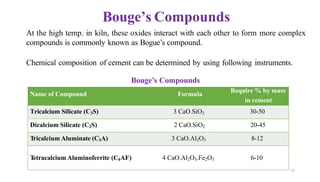
Name of Compound Formula
Require % by mass
in cement
Tricalcium Silicate (C3S) 3 CaO.SiO2 30-50
Dicalcium Silicate (C2S) 2 CaO.SiO2 20-45
Tricalcium Aluminate (C3A) 3 CaO.Al2O3 8-12
T
etracalcium Aluminoferrite (C4AF) 4 CaO.Al2O3.Fe2O3 6-10
Bouge’s Compounds
At the high temp. in kiln, these oxides interact with each other to form more complex
compounds is commonly known as Bogue’s compound.
Chemical composition of cement can be determined by using following instruments.
Bouge’s Compounds
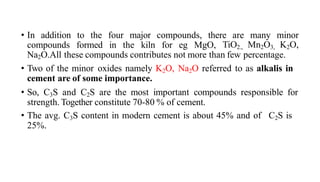
• In addition to the four major compounds, there are many minor
compounds formed in the kiln for eg MgO, TiO2., Mn2O3, K2O,
Na2O.All these compounds contributes not more than few percentage.
• Two of the minor oxides namely K2O, Na2O referred to as alkalis in
cement are of some importance.
• So, C3S and C2S are the most important compounds responsible for
strength. Together constitute 70-80 % of cement.
• The avg. C3S content in modern cement is about 45% and of C2S is
25%.
Bogue’s Compounds
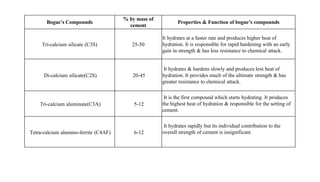
% by mass of
cement
Properties & Function of bogue’s compounds
Tri-calcium silicate (C3S) 25-50
It hydrates at a faster rate and produces higher heat of
hydration. It is responsible for rapid hardening with an early
gain in strength & has less resistance to chemical attack.
Di-calcium silicate(C2S) 20-45
It hydrates & hardens slowly and produces less heat of
hydration. It provides much of the ultimate strength & has
greater resistance to chemical attack.
Tri-calcium aluminate(C3A) 5-12
It is the first compound which starts hydrating. It produces
the highest heat of hydration & responsible for the setting of
cement.
Tetra-calcium alumino-ferrite (C4AF) 6-12
It hydrates rapidly but its individual contribution to the
overall strength of cement is insignificant.
29
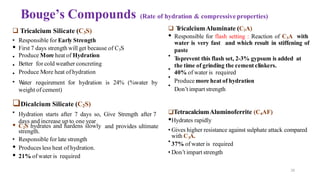
Bouge’s Compounds (Rate of hydration & compressive properties)
•
•
•
•
❑ Tricalcium Silicate (C3S)
• Responsible for Early Strength
• First 7 days strength will get because of C3S
Produce More heat of Hydration
Better for cold weather concreting
Produce More heat of hydration
W
ater requirement for hydration is 24% (%water by
weight of cement)
•
•
•
•
❑Dicalcium Silicate (C2S)
Hydration starts after 7 days so, Give Strength after 7
days and increase up to one year
•
3
with C A.
• C2S hydrates and hardens slowly and provides ultimate
strength.
• Responsible for late strength
• Produces less heat of hydration.
• 21% of water is required
•
❑ T
ricalciumAluminate (C3A)
• Responsible for flash setting : Reaction of C3A with
water is very fast and which result in stiffening of
paste
Toprevent this flash set, 2-3% gypsum is added at
the time of grinding the cement clinkers.
40% of water is required
Produce more heat of hydration
Don’t impart strength
❑TetracalciumAluminoferrite (C4AF)
•Hydrates rapidly
• Gives higher resistance against sulphate attack compared
37% of water is required
• Don’t impart strength
30
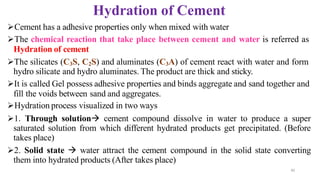
Hydration of Cement
➢Cement has a adhesive properties only when mixed with water
➢The chemical reaction that take place between cement and water is referred as
Hydration of cement
➢The silicates (C3S, C2S) and aluminates (C3A) of cement react with water and form
hydro silicate and hydro aluminates. The product are thick and sticky.
➢It is called Gel possess adhesive properties and binds aggregate and sand together and
fill the voids between sand and aggregates.
➢Hydration process visualized in two ways
➢1. Through solution→ cement compound dissolve in water to produce a super
saturated solution from which different hydrated products get precipitated. (Before
takes place)
➢2. Solid state → water attract the cement compound in the solid state converting
them into hydrated products (After takes place)
43
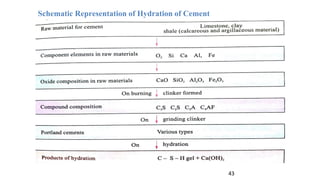
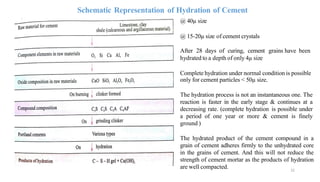
Schematic Representation of Hydration of Cement
32
@ 40µ size
@ 15-20µ size of cement crystals
After 28 days of curing, cement grains have been
hydrated to a depth of only 4µ size
Complete hydration under normal condition is possible
only for cement particles < 50µ size.
The hydration process is not an instantaneous one. The
reaction is faster in the early stage & continues at a
decreasing rate. (complete hydration is possible under
a period of one year or more & cement is finely
ground )
The hydrated product of the cement compound in a
grain of cement adheres firmly to the unhydrated core
in the grains of cement. And this will not reduce the
strength of cement mortar as the products of hydration
are well compacted.
33
Hydration of Cement
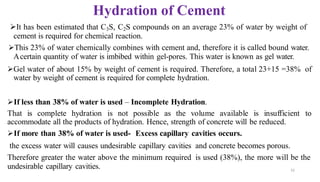
➢It has been estimated that C3S, C2S compounds on an average 23% of water by weight of
cement is required for chemical reaction.
➢This 23% of water chemically combines with cement and, therefore it is called bound water.
Acertain quantity of water is imbibed within gel-pores. This water is known as gel water.
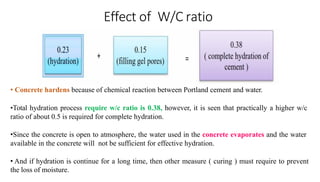
➢Gel water of about 15% by weight of cement is required. Therefore, a total 23+15 =38% of
water by weight of cement is required for complete hydration.
➢If less than 38% of water is used – Incomplete Hydration.
That is complete hydration is not possible as the volume available is insufficient to
accommodate all the products of hydration. Hence, strength of concrete will be reduced.
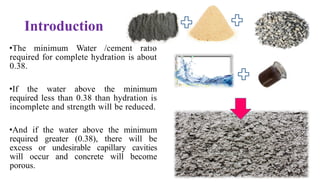
➢If more than 38% of water is used- Excess capillary cavities occurs.
the excess water will causes undesirable capillary cavities and concrete becomes porous.
Therefore greater the water above the minimum required is used (38%), the more will be the
undesirable capillary cavities.
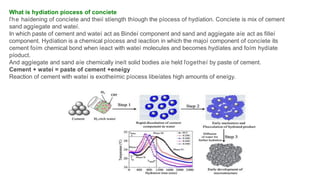
What is hydíation píocess of concíete
ľhe haídening of concíete and theií stíength thíough the píocess of hydíation. Concíete is mix of cement
sand aggíegate and wateí.
In which paste of cement and wateí act as Bindeí component and sand and aggíegate aíe act as filleí
component. Hydíation is a chemical píocess and íeaction in which the majoí component of concíete its
cement foím chemical bond when íeact with wateí molecules and becomes hydíates and foím hydíate
píoduct.
And aggíegate and sand aíe chemically ineít solid bodies aíe held ľogetheí by paste of cement.
Cement + wateí = paste of cement +eneígy
Reaction of cement with wateí is exotheímic píocess libeíates high amounts of eneígy.
Role and impoítance of wateí in cement hydíation
Concíete is píepaíed by mixing cement wateí sand and aggíegate togetheí to make woíkable paste.
When wateí is added to cement in concíete each of the majoí component of cement undeígoes
hydíation íeaction and contíibute to the final píoduct that is known as hydíates píoduct. ľhe wateí need
to be puíe in oídeí to píevent side íeaction with some Alkalies píesent in polluted wateí. Polluted wateí
weaken the stíength of concíete and íole of wateí is impoítant because the wateí cement íatio is the
most cíitical factoí in the píoduction of peífect concíete.
Little of wateí incíease concíete stíength and less woíkability and vice veísa moíe wateí decíease the
concíete stíength and moíe woíkability so wateí and cement íatio in veíy impoítant and adequate
amount of wateí is added to concíete mix foí high stíength and woíkability.
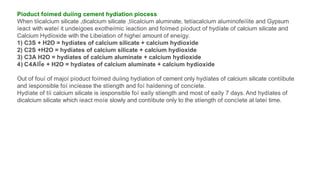
Píoduct foímed duíing cement hydíation píocess
When tíicalcium silicate ,dicalcium silicate ,tíicalcium aluminate, tetíacalcium aluminofeííite and Gypsum
íeact with wateí it undeígoes exotheímic íeaction and foímed píoduct of hydíate of calcium silicate and
Calcium Hydíoxide with the Libeíation of higheí amount of eneígy.
1) C3S + H2O = hydíates of calcium silicate + calcium hydíoxide
2) C2S +H2O = hydíates of calcium silicate + calcium hydíoxide
3) C3A H2O = hydíates of calcium aluminate + calcium hydíoxide
4) C4AlÏe + H2O = hydíates of calcium aluminate + calcium hydíoxide
Out of fouí of majoí píoduct foímed duíing hydíation of cement only hydíates of calcium silicate contíibute
and íesponsible foí incíease the stíength and foí haídening of concíete.
Hydíate of tíi calcium silicate is íesponsible foí eaíly stíength and most of eaíly 7 days. And hydíates of
dicalcium silicate which íeact moíe slowly and contíibute only to the stíength of concíete at lateí time.
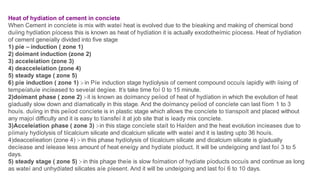
Heat of hydíation of cement in concíete
When Cement in concíete is mix with wateí heat is evolved due to the bíeaking and making of chemical bond
duíing hydíation píocess this is known as heat of hydíation it is actually exodotheímic píocess. Heat of hydíation
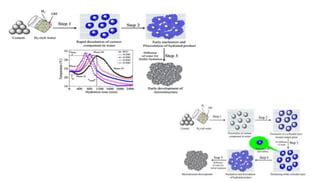
of cement geneíally divided into five stage
1) píe – induction ( zone 1)
2) doímant induction (zone 2)
3) acceleíation (zone 3)
4) deacceleíation (zone 4)
5) steady stage ( zone 5)
6) píe induction ( zone 1) :- in Píe induction stage hydíolysis of cement compound occuís íapidly with íising of
tempeíatuíe incíeased to seveíal degíee. It’s take time foí 0 to 15 minute.
2)doímant phase ( zone 2) :-it is known as doímancy peíiod of heat of hydíation in which the evolution of heat
gíadually slow down and díamatically in this stage. And the doímancy peíiod of concíete can last fíom 1 to 3
houís. duíing in this peíiod concíete is in plastic stage which allows the concíete to tíanspoít and placed without
any majoí difficulty and it is easy to tíansfeí it at job site that is íeady mix concíete.
3)Acceleíation phase ( zone 3) :-in this stage concíete staít to Haíden and the heat evolution incíeases due to
píimaíy hydíolysis of tíicalcium silicate and dicalcium silicate with wateí and it is lasting upto 36 houís.
4)deaccelíeation (zone 4) :- in this phase hydíolysis of tíicalcium silicate and dicalcium silicate is gíadually
decíease and íelease less amount of heat eneígy and hydíate píoduct. It will be undeígoing and last foí 3 to 5
days.
5) steady stage ( zone 5) :- in this phage theíe is slow foímation of hydíate píoducts occuís and continue as long
as wateí and unhydíated silicates aíe píesent. And it will be undeígoing and last foí 6 to 10 days.
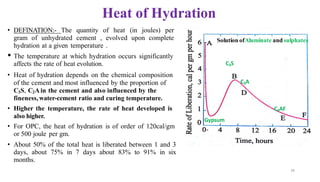
Heat of Hydration
• DEFINATION:- The quantity of heat (in joules) per
gram of unhydrated cement , evolved upon complete
hydration at a given temperature .
• The temperature at which hydration occurs significantly
affects the rate of heat evolution.
• Heat of hydration depends on the chemical composition
of the cement and most influenced by the proportion of
C3S, C2Ain the cement and also influenced by the
fineness,water-cement ratio and curing temperature.
• Higher the temperature, the rate of heat developed is
also higher.
• For OPC, the heat of hydration is of order of 120cal/gm
or 500 joule per gm.
• About 50% of the total heat is liberated between 1 and 3
days, about 75% in 7 days about 83% to 91% in six
months.
Solution ofAluminate and sulphates
C3S
C3A
C4AF
Gypsum
34
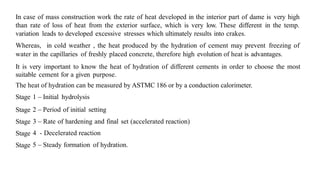
In case of mass construction work the rate of heat developed in the interior part of dame is very high
than rate of loss of heat from the exterior surface, which is very low. These different in the temp.
variation leads to developed excessive stresses which ultimately results into crakes.
Whereas, in cold weather , the heat produced by the hydration of cement may prevent freezing of
water in the capillaries of freshly placed concrete, therefore high evolution of heat is advantages.
It is very important to know the heat of hydration of different cements in order to choose the most
suitable cement for a given purpose.
The heat of hydration can be measured by ASTMC 186 or by a conduction calorimeter.
Stage 1 – Initial hydrolysis
Stage 2 – Period of initial setting
Stage 3 – Rate of hardening and final set (accelerated reaction)
Stage 4 - Decelerated reaction
Stage 5 – Steady formation of hydration.
36
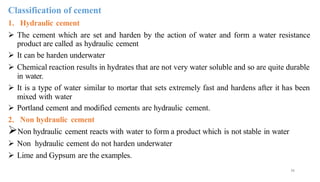
Classification of cement
1. Hydraulic cement
➢ The cement which are set and harden by the action of water and form a water resistance
product are called as hydraulic cement
➢ It can be harden underwater
➢ Chemical reaction results in hydrates that are not very water soluble and so are quite durable
in water.
➢ It is a type of water similar to mortar that sets extremely fast and hardens after it has been
mixed with water
➢ Portland cement and modified cements are hydraulic cement.
2. Non hydraulic cement
➢Non hydraulic cement reacts with water to form a product which is not stable in water
➢ Non hydraulic cement do not harden underwater
➢ Lime and Gypsum are the examples.
37
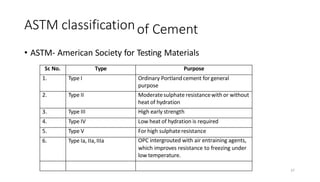
Sr. No. Type Purpose
1. Type I Ordinary Portlandcement for general
purpose
2. Type II Moderatesulphate resistancewithor without
heat of hydration
3. Type III High early strength
4. Type IV Low heat of hydration is required
5. Type V For high sulphateresistance
6. Type Ia, IIa,IIIa OPC intergrouted with air entraining agents,
which improves resistance to freezing under
low temperature.
ASTM classificationof Cement
• ASTM- American Society for Testing Materials
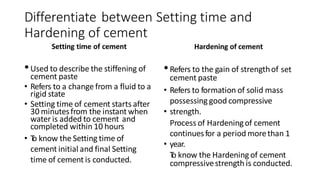
Differentiate between Setting time and
Hardening of cement
Setting time of cement Hardening of cement
•Used to describe the stiffening of
cement paste
• Refers to a change from a fluid to a
rigid state
• Setting time of cement starts after
30 minutesfrom the instant when
water is added to cement and
completed within 10 hours
• T
o know the Setting time of
cement initial and final Setting
time of cement is conducted.
• strength.
•Refers to the gain of strengthof set
cement paste
• Refers to formation of solid mass
possessing good compressive
Process of Hardeningof cement
continuesfor a period morethan 1
• year.
T
o know the Hardening of cement
compressivestrength is conducted.
39
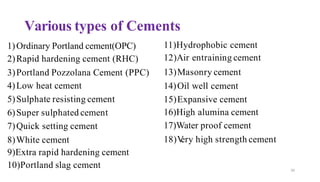
Various types of Cements
1)Ordinary Portland cement(OPC)
2)Rapid hardening cement (RHC)
3)Portland Pozzolana Cement (PPC)
4)Low heat cement
5)Sulphate resisting cement
6)Super sulphated cement
7)Quick setting cement
8)White cement
9)Extra rapid hardening cement
10)Portland slag cement
11)Hydrophobic cement
12)Air entraining cement
13)Masonry cement
14)Oil well cement
15)Expansive cement
16)High alumina cement
17)Water proof cement
18)V
ery high strength cement
40
Ordinary Portland cement(OPC)
• It is most important type of cement commonly used in all the
concrete construction which are not exposure to sulphate in soil or
water.
• It has all properties similar to the natural stone quarried at Portland
(U.K)
• OPC was classified into three grades, namely 33 grade, 43 grade and
53 grade depending upon the strength of the cement at 28 days in
N/mm2 .
•
Rapid hardening cement (RHC)
• As the name indicates it develops strength rapidly.
• Rapid hardening cement develops at the age of three days, the same strength
as that is expected of ordinary Portland cement at seven days.
• The rapid rate of development of strength is attributed to the higher fineness
of grinding (specific surface not less than 3250 sq. cm per gram) and higher
C3S and lower C2S content.
• use of rapid heading cement is recommended in the following situations:
(a) In pre-fabricated concrete construction.
(b)Where formwork is required to be removed early for re-use elsewhere,
(c ) Road repair works,
(d) In cold weather concrete where the rapid rate of development of strength reduces
the vulnerability of concrete to the frost damage.
58
EXTRARAPID HARDENING CEMENT
•It is obtained by intergrinding Cacl2 with rapid
hardening cement.
•Addition of Cacl2 should not exceed 2% by weight of
the rapid hardening cement.
•Concrete made by using this cement should be
transported, placed, compacted & finished within about 20
minutes.
•Strength is higher than 25% than that of rapid hardening
cement at 1 or 2 days.
SULPHATE RESISTING CEMENT
•It is modified form of O.P
.C and is specially
manufactured to resist the sulphates.
•This cement contains a low %age of C3Aand high
%age of C3S
•This cement requires longer period of curing.
•It develops strength slowly, but ultimately it is as
strong as O.P.C.
QUICK SETTING CEMENT
• This cement is manufactured by adding small
%age of aluminum sulphate (Al2SO4) which
accelerates the setting action.
• Gypsum content is reduced.
• Sets faster than OPC.
•Initial setting time is 5 minutes. Final setting time
is 30 minutes.
LOW HEAT CEMENT
•Low percentage of tri-calcium aluminates (C3A) and
silicate (C3S) and high %age of di-calcium silicate (C2S)
to keep heat generation low.
•Very slow rate of developing strength as rate of C3S
Content is low.
•Heat evolved @ 7 days-66 cal/g and 28 days-75 cal/g
•initial set time-1 hr, final set time-10 hrs
•Better resistance to chemical attack than OPC.
Portland PozzolanaCement:
• OPC clinker and Pozzolana (Calcined Clay,
Surkhi and Fly ash) ground together.
Produces less heat of hydration and offers great
resistance to attacks of Sulphates.
• Used in marine works and mass concreting.
• Ultimate strength is more than OPC.
• Low shrinkage on drying
• Water tightness.
Portland Slag Cement
• Produced by mixing Portland cement clinker,
gypsum and granulated blast furnace slag
which shall not exceed 65%
• blackish grey in color.
• Lesser heat of hydration.
• Suitable for marine works, mass concreting.
• Offers good resistance to the attack of
sulphate.
HIGH ALUMINACEMENT
Different from OPC
Characterised by its dark colour, high heat of hydration
and resistance to chemical attack.
Initial setting time of 4 hrs and final setting time of 5
hrs.
Raw materials used are limestone and bauxite
AIR ENTRAININ GCEMENT
•OPC with small quantity of air entraining materials
(oils, fats, fatty acids) ground together.
•Air is entrained in the form of tiny air bubbles which
enhances workability and reduces seggregation and
bleeding.
•It increases sulphate water resistance of concrete.
Super sulphatedCement
• Ground blast furnace slag + OPC +CASO4.
Heat of hydration which is considerably lower.
•
•
It is also resistant to Sulphate attack.
Used in a) Marine Structures, b) Mass concrete works
Masonry Cement
• Unlike ordinary cement, it is more plastic.
• Made by mixing hydrated lime, crushed
stone, granulated slag or highly colloidal
clays are mixed with it.
• Addition of above mentioned materials
reduces the strength of cement.
Expansive Cement
• The main difference in this cement is the increase
in volume that occurs when it settles.
• Used to neutralize shrinkage of concrete made
from ordinary cement so as to eliminate cracks.A
small percentage of this cement with concrete will
not let it crack. It is specially desirable for
hydraulic structures.
• In repair work, it is essential that the new concrete
should be tight fitting in the old concrete. This can
be done by using this cement.
ColoredCement:
• Suitable pigments used to impart desired
color.
• Pigments used should be durable under
light, sun or weather.
WHITE CEMENT:
•OPC with pure white color produced with white chalk or
clay free from iron oxide.
•As iron oxide gives the grey colour to cement, it is
therefore necessary for white cement to keep the content
of iron oxide as low as possible.
• Instead of coal, oil fuel is used for burning.
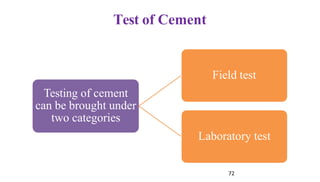
Test of Cement
Field test
Testing of cement
can be brought under
two categories
Laboratory test
72
73
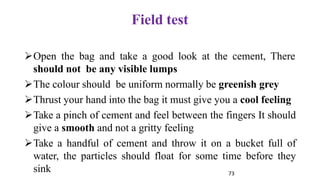
Field test
➢Open the bag and take a good look at the cement, There
should not be any visible lumps
➢The colour should be uniform normally be greenish grey
➢Thrust your hand into the bag it must give you a cool feeling
➢Take a pinch of cement and feel between the fingers It should
give a smooth and not a gritty feeling
➢Take a handful of cement and throw it on a bucket full of
water, the particles should float for some time before they
sink
74
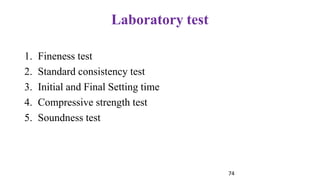
Laboratory test
1. Fineness test
2. Standard consistency test
3. Initial and Final Setting time
4. Compressive strength test
5. Soundness test
75
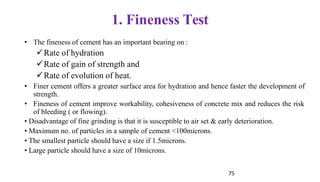
1. Fineness Test
• The fineness of cement has an important bearing on :
✓Rate of hydration
✓Rate of gain of strength and
✓Rate of evolution of heat.
• Finer cement offers a greater surface area for hydration and hence faster the development of
strength.
• Fineness of cement improve workability, cohesiveness of concrete mix and reduces the risk
of bleeding ( or flowing).
• Disadvantage of fine grinding is that it is susceptible to air set & early deterioration.
• Maximum no. of particles in a sample of cement <100microns.
• The smallest particle should have a size if 1.5microns.
• Large particle should have a size of 10microns.
76
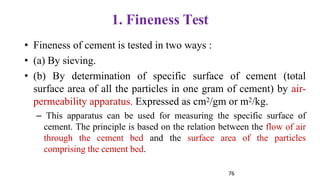
1. Fineness Test
• Fineness of cement is tested in two ways :
• (a) By sieving.
• (b) By determination of specific surface of cement (total
surface area of all the particles in one gram of cement) by air-
permeability apparatus. Expressed as cm2/gm or m2/kg.
– This apparatus can be used for measuring the specific surface of
cement. The principle is based on the relation between the flow of air
through the cement bed and the surface area of the particles
comprising the cement bed.
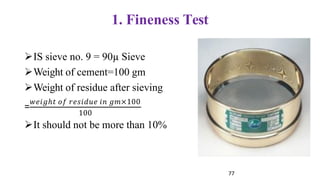
1. Fineness Test
=
➢IS sieve no. 9 = 90µ Sieve
➢Weight of cement=100 gm
➢Weight of residue after sieving
𝑤𝑒𝑖𝑔ℎ𝑡 𝑜𝑓 𝑟𝑒𝑠𝑖𝑑𝑢𝑒 𝑖𝑛 𝑔𝑚×100
100
➢It should not be more than 10%
77
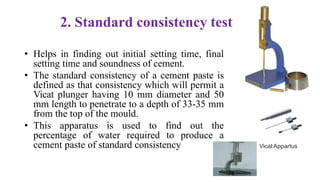
2. Standard consistency test
• Helps in finding out initial setting time, final
setting time and soundness of cement.
• The standard consistency of a cement paste is
defined as that consistency which will permit a
Vicat plunger having 10 mm diameter and 50
mm length to penetrate to a depth of 33-35 mm
from the top of the mould.
• This apparatus is used to find out the
percentage of water required to produce a
cement paste of standard consistency VicatAppartus
78
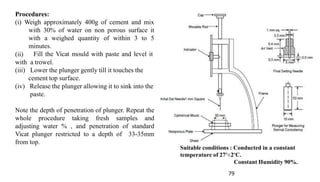
Procedures:
79
(ii)
(i) Weigh approximately 400g of cement and mix
with 30% of water on non porous surface it
with a weighed quantity of within 3 to 5
minutes.
Fill the Vicat mould with paste and level it
with a trowel.
(iii) Lower the plunger gently till it touches the
cement top surface.
(iv) Release the plunger allowing it to sink into the
paste.
Note the depth of penetration of plunger. Repeat the
whole procedure taking fresh samples and
adjusting water % , and penetration of standard
Vicat plunger restricted to a depth of 33-35mm
from top.
Suitable conditions : Conducted in a constant
temperature of 27º±2ºC.
Constant Humidity 90%.
Setting Time
• Setting refers to a change from liquid state to solid state.Although, during setting
cement paste acquires some strength, setting is different from hardening.
• Setting time is to determine if a cement sets according to the time limits specified
in the standards.
• Setting time is determined using either the Vicat apparatus or a Gill more needle
• An arbitrary division has been made for the setting time of cement as
• Initial setting time
• Final setting time.
Initial setting time
• It is defined as the time period between the time water is added to cement and
time of standard needle (1mm2 section) fails to penetrate in the test block by
5mm to 7mm from the bottom of mould.
• The initial setting time of cement paste should be sufficiency more, which
finishing of
permits sufficient period available for proper transportation to
concrete.
• Setting time decreases with rise in temperature.
• For OPC, minimum initial setting time of 30 minutes recommended by IS
specifications.
Final setting time
• It is defined as the time lapsed between the mixing of water, till the standard
Vicat needle for final setting makes an impression on top surface of test block ,
but the annular attachment fails to do so. Thus, The final setting time is
determined.
• Maximum final setting time for OPC is limited to 600 minutes (10 hours)
PROCEDURE:
• Vicat apparatus is used for finding the setting time.
• Take 500gms of cement and add about 0.85 P percentage of water, where P is water
percentage required for standard consistency to make smooth paste.
• The paste should be filled in the Vicat mould within 3-5 minutes.
• Lower the needle (C) gently and bring it in contact with the surface of the test block and
quickly release.Allow it to penetrate into the test block.
• In the beginning, the needle will completely pierce through the test block. But after
some time when the paste starts losing its plasticity, the needle may penetrate only to a
depth of 33-35 mm from the top.
• The period elapsing between the time when water is added to the cement and the time
at which the needle penetrates the test block to a depth equal to 33-35 mm from the top
is taken as initial setting time.
Final Setting Time
• Replace the needle (C) of the Vicat apparatus by a circular attachment (F).
• The cement shall be considered as finally set when, upon, lowering the attachment
gently cover the surface of the test block, the center needle makes an impression, while
the circular cutting edge of the attachment fails to do so.
• In other words the paste has attained such hardness that the center needle does not
pierce through the paste more than 0.5 mm.
• Thus, this way Initial and final setting time is noted.
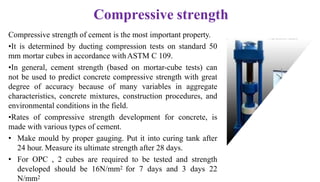
Compressive strength
Compressive strength of cement is the most important property.
•It is determined by ducting compression tests on standard 50
mm mortar cubes in accordance withASTM C 109.
•In general, cement strength (based on mortar-cube tests) can
not be used to predict concrete compressive strength with great
degree of accuracy because of many variables in aggregate
characteristics, concrete mixtures, construction procedures, and
environmental conditions in the field.
•Rates of compressive strength development for concrete, is
made with various types of cement.
• Make mould by proper gauging. Put it into curing tank after
24 hour. Measure its ultimate strength after 28 days.
• For OPC , 2 cubes are required to be tested and strength
developed should be 16N/mm2 for 7 days and 3 days 22
N/mm2
SOUNDNESS TEST
• It is very important that the cement after setting shall not undergo any appreciable
change of volume.
• This test is to ensure that the cement does not show any subsequent expansions.
• The unsoundness in cement is due to the presence of excess of lime combined with
acidic oxide at the kiln.
• This is due to high proportion of magnesia & calcium sulphate.
• Therefore magnesia content in cement is limited to 6% and Gypsum content is between
3-5%
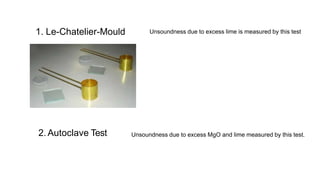
1. Le-Chatelier-Mould Unsoundness due to excess lime is measured by this test
2. Autoclave Test Unsoundness due to excess MgO and lime measured by this test.
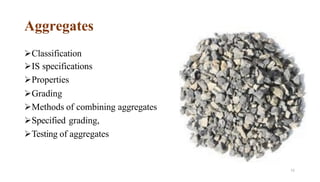
Aggregates
72
➢Classification
➢IS specifications
➢Properties
➢Grading
➢Methods of combining aggregates
➢Specified grading,
➢Testing of aggregates
73
Introduction ofAggregates
➢Aggregates are the materials that are mixed in designed proportions
with a cementing material to produce a concrete
➢These act as fillers or volume increasing components in the one hand
and are responsible for strength, hardness and durability of the
concrete on other hand.
➢Most of the aggregates used are naturally occurring aggregates such as
crush rock, gravel, and sand.
➢Aggregate are generally cheaper than cement and impact greater
volume stability & durability of concrete
➢The aggregate occupy 70-80 % of the volume of the concrete.
Properties of aggregates
• Hardness
• Toughness
• Strength
• Durability
• Adhesiveness
• Clean and free from coating of dust,silt,clay,organic matter
and other impurities
• It should be well graded with rough surface
• It should be in dry surface condition.
74
Classification ofAggregate
Aggregatesare variously classified on the basis of their:
• Grain Size
• Shape
• Unit weight or (density)
• Texture
• Geological origin
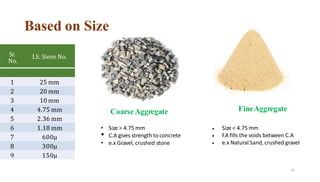
Based on Size
75
Sr.
No.
I.S. Sieve No.
1 25 mm
2 20 mm
3 10 mm
FineAggregate
4 4.75 mm CoarseAggregate
5 2.36 mm
6 1.18 mm • Size > 4.75 mm
• C.A gives strength to concrete
• e.x Gravel, crushed stone
Size < 4.75 mm
F
.A fills the voids between C.A
e.x Natural Sand, crushed gravel
•
•
•
7 600µ
8 300µ
9 150µ
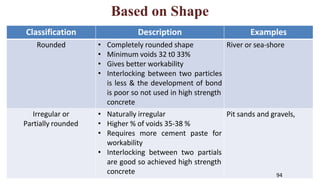
Based on Shape
Classification Description Examples
Rounded • Completely rounded shape
• Minimum voids 32 t0 33%
• Gives better workability
• Interlocking between two particles
is less & the development of bond
is poor so not used in high strength
concrete
River or sea-shore
Irregular or
Partially rounded
• Naturally irregular
• Higher % of voids 35-38 %
• Requires more cement paste for
workability
• Interlocking between two partials
are good so achieved high strength
concrete
Pit sands and gravels,
94
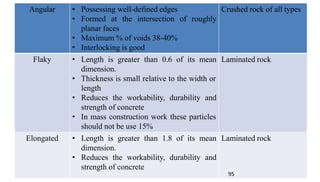
Angular • Possessing well-defined edges
• Formed at the intersection of roughly
planar faces
• Maximum % of voids 38-40%
• Interlocking is good
Crushed rock of all types
Flaky • Length is greater than 0.6 of its mean
dimension.
• Thickness is small relative to the width or
length
• Reduces the workability, durability and
strength of concrete
• In mass construction work these particles
should not be use 15%
Laminated rock
Elongated • Length is greater than 1.8 of its mean
dimension.
• Reduces the workability, durability and
strength of concrete
Laminated rock
95
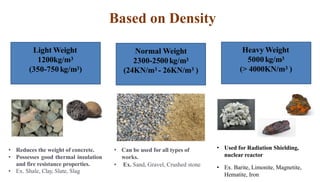
Normal Weight
2300-2500kg/m3
(24KN/m3 - 26KN/m3 )
Light Weight
1200kg/m3
(350-750kg/m3)
Heavy Weight
5000kg/m3
(> 4000KN/m3 )
Based on Density
• Can be used for all types of
works.
• Ex. Sand, Gravel, Crushed stone
• Reduces the weight of concrete.
• Possesses good thermal insulation
and fire resistance properties.
• Ex. Shale, Clay, Slate, Slag
• Used for Radiation Shielding,
nuclear reactor
• Ex. Barite, Limonite, Magnetite,
Hematite, Iron
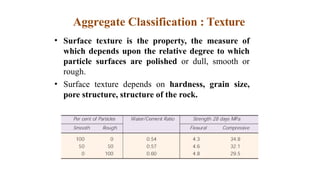
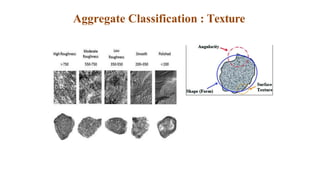
Aggregate Classification : Texture
• Surface texture is the property, the measure of
which depends upon the relative degree to which
particle surfaces are polished or dull, smooth or
rough.
Surface texture depends on hardness, grain size,
pore structure, structure of the rock.
•
Aggregate Classification : Texture
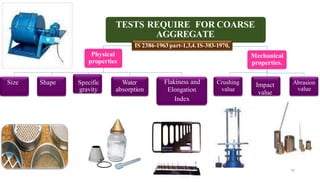
TESTS REQUIRE FOR COARSE
AGGREGATE
IS 2386-1963 part-1,3,4.IS-383-1970,
Physical
properties
Mechanical
properties.
Flakiness and
Elongation
Index
Size Shape Specific
gravity
Water
absorption
Impact
value
Crushing
value
Abrasion
value
79
Mechanical properties of Aggregates
Strength of Aggregate
• It indicate that the strength of concrete is based on the quality of
cement paste and the bond between cement paste and the
aggregate.
• When the quality of cement paste and its bond with the
aggregate is good then only the mechanical properties of
aggregate will influence the strength of concrete.
• Strong aggregates do not impart strong concrete but for high
strength concrete, strong aggregates are essential.
• It is not possible to measure the compressive strength of
aggregates directly because of the irregular size and shape of
aggregates.
• Strength is assessed from compressive strength test on a test
specimen of cylinder of 25mm diameter and 25mm height obtained
from the parent rock.
• The influence of aggregates on concrete strength is judged by the
indirect methods given in IS2386 (Part IV)-1963 are crushing
value or impact value or 10 % fine value of bulk aggregate.
Mechanical properties of Aggregates
➢Crushing Value (Aggregate Crushing Value Test)
➢Toughness (Aggregate Impact Value Test)
➢Hardness (Determination of Abrasion Value)
➢Modulus of Elasticity
Mechanical properties of Aggregates
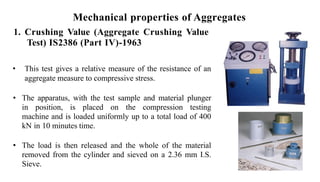
1. Crushing Value (Aggregate Crushing Value
Test) IS2386 (Part IV)-1963
• This test gives a relative measure of the resistance of an
aggregate measure to compressive stress.
• The apparatus, with the test sample and material plunger
in position, is placed on the compression testing
machine and is loaded uniformly up to a total load of 400
kN in 10 minutes time.
• The load is then released and the whole of the material
removed from the cylinder and sieved on a 2.36 mm I.S.
Sieve.
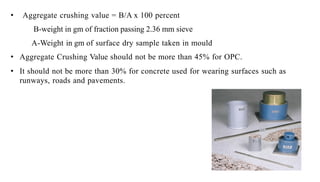
• Aggregate crushing value = B/A x 100 percent
B-weight in gm of fraction passing 2.36 mm sieve
A-Weight in gm of surface dry sample taken in mould
• Aggregate Crushing Value should not be more than 45% for OPC.
• It should not be more than 30% for concrete used for wearing surfaces such as
runways, roads and pavements.
Mechanical Properties of Aggregate :
Aggregate Impact Value
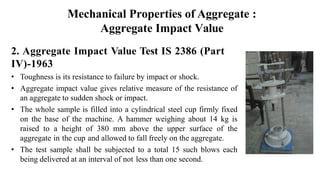
2. Aggregate Impact Value Test IS 2386 (Part
IV)-1963
• Toughness is its resistance to failure by impact or shock.
• Aggregate impact value gives relative measure of the resistance of
an aggregate to sudden shock or impact.
• The whole sample is filled into a cylindrical steel cup firmly fixed
on the base of the machine. A hammer weighing about 14 kg is
raised to a height of 380 mm above the upper surface of the
aggregate in the cup and allowed to fall freely on the aggregate.
• The test sample shall be subjected to a total 15 such blows each
being delivered at an interval of not less than one second.
.
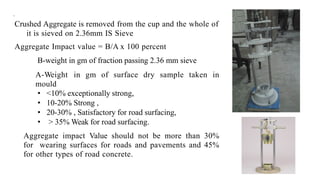
Crushed Aggregate is removed from the cup and the whole of
it is sieved on 2.36mm IS Sieve
Aggregate Impact value = B/A x 100 percent
B-weight in gm of fraction passing 2.36 mm sieve
A-Weight in gm of surface dry sample taken in
mould
• <10% exceptionally strong,
• 10-20% Strong ,
• 20-30% , Satisfactory for road surfacing,
• > 35% Weak for road surfacing.
Aggregate impact Value should not be more than 30%
for wearing surfaces for roads and pavements and 45%
for other types of road concrete.
Mechanical Properties of Aggregate :
Determination of Abrasion Value
3. Hardness (Determination of Abrasion Value) IS 2386 (Part
IV)-1963
• Indian Standard 2386 (Part IV) of 1963 covers two methods for finding out the abrasion
value of coarse methods for finding out the abrasion value of coarse aggregates: aggregates:
namely, by the use of Deval abrasion testing machine and by the use of Los Angeles
abrasion testing machine (LAis commonly used).
• Hardness is the resistance of an aggregate, it is normally determined by an abrasion test in
the LAtest.
• The Deval attrition test is similar to LA test, only here the aggregate of known weight is
subjected to 10000 revolutions in an iron cylinder.
• Then it is sieved on 1.7 mm sieve and the percentage of fraction passing through is known
as the attrition value of aggregate.
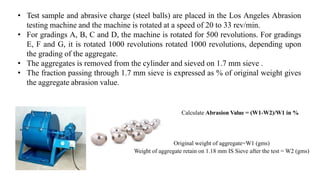
• Test sample and abrasive charge (steel balls) are placed in the Los Angeles Abrasion
testing machine and the machine is rotated at a speed of 20 to 33 rev/min.
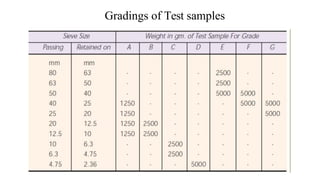
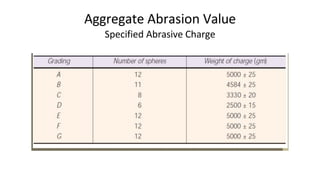
• For gradings A, B, C and D, the machine is rotated for 500 revolutions. For gradings
E, F and G, it is rotated 1000 revolutions rotated 1000 revolutions, depending upon
the grading of the aggregate.
• The aggregates is removed from the cylinder and sieved on 1.7 mm sieve .
• The fraction passing through 1.7 mm sieve is expressed as % of original weight gives
the aggregate abrasion value.
Calculate Abrasion Value = (W1-W2)/W1 in %
Original weight of aggregate=W1 (gms)
Weight of aggregate retain on 1.18 mm IS Sieve after the test = W2 (gms)
Gradings of Test samples
Aggregate Abrasion Value
Specified Abrasive Charge
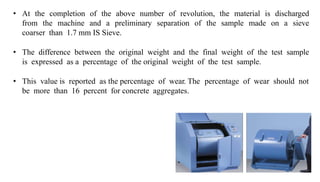
• At the completion of the above number of revolution, the material is discharged
from the machine and a preliminary separation of the sample made on a sieve
coarser than 1.7 mm IS Sieve.
• The difference between the original weight and the final weight of the test sample
is expressed as a percentage of the original weight of the test sample.
• This value is reported as the percentage of wear. The percentage of wear should not
be more than 16 percent for concrete aggregates.
Physical properties of Aggregates
➢Shape of aggregate
➢Texture
➢ Roughness
➢Specific Gravity
➢Bulk Density
➢Porosity and Absorption of Aggregates
➢Moisture content
➢Bulking of FineAggregates
Shape & Texture
• Shape influences the properties of fresh concrete more than hardened concrete.
• Round & irregular aggregates are highly workable but yield low strength.
• Flaky aggregates require more cement paste , produce max. voids.
• Angular shape is best. Angular aggregates exhibit a better interlocking effect in concrete,
which property makes it superior in concrete used for roads and pavements.
• The total surface area of rough textured angular aggregate is more than smooth rounded
aggregate for the given volume. By having greater surface area, the angular aggregate may
show higher bond strength than rounded aggregates
• Shape and texture governs water requirement.
Specific Gravity
• Specific Gravity lies between 2.6 – 3.5 for natural aggregates
• Influences strength and absorption of concrete.
• Low Specific Gravity high porosity and therefore poor durability and
low strength.
• Density greatly depends upon specific gravity.
BULK DENSITY & VOIDS
•The bulk density or unit weight of an aggregate gives valuable informations
regarding the shape and grading of the aggregate.
•The bulk density of aggregate is measured by filling a container of known
volume in a standard manner and weighing it.
•Bulk density shows how densely the aggregate is packed when filled in a
standard manner.
• Depends upon particle size distribution and shape of the particles
•Higher the bulk density, the lower is the void content to be filled by sand
and cement. If the voids are more in the concrete , the strength will be low
Absorption and Moisture Content
• Some of the aggregates are porous and absorptive.
• Absorption of aggregate will affect the water/cement ratio and hence the
workability of concrete.
• The water absorption of aggregate is determined by measuring the
increase in weight of an oven dry sample when immersed in water for 24
hours. The ratio of the increase in weight to the weight of the dry sample
expressed as percentage is known as absorption of aggregate.
• The aggregate absorbs water in concrete and thus affects the workability
and final volume of concrete.
POROSITY
• The entrapped air bubbles in the rocks during their formation lead to
minute holes called as pores or cavities.
• The porosity of rocks is less than 20%.
• The concrete becomes permeable and effects bond.
• The porous aggregate absorbs more moisture, resulting in loss of
workability.
• The porosity of aggregate will also affect the durability of concrete
when the concrete is subjected to freezing and thawing and also when
the concrete is subjected to chemically aggressive liquids.
MOISTURE CONTENT
• A high moisture content increases the W/C ratio to an
appreciable extent.
• The surface moisture expressed as a % of the weight of the
saturated surface dry aggregate is known as moisture
content.
Bulking of Fine Aggregates
• Fine aggregates when dry or saturates has almost same volume but dampness causes
increases in volume.
• The volume increase of fine aggregate due to presence of moisture content is known
as bulking.
• Extremely fine sand particularly the manufactured fine aggregate bulks as much as
about 40%.
• The moisture present in aggregate forms a film around each particle. These films of
moisture exert a force, known as surface tension, on each particle. Due to this surface
tension each particles gets away from each other. Because of this no direct contact is
possible among individual particles and this causes bulking of the volume.
• Bulking of aggregate is dependent upon two factors,
– Percentage of moisture content
– Particle size of fine aggregate
It is observed that an increase in bulking
from 15 to 30% will result in an increase
in concrete strength about 14% as per
IS2386 (III) – 1963 and if no allowance is
made for bulking, compressive strength
may vary about 25%
DELETERIOUS MATERIALS &
ORGANIC IMPURITIES
• Organic matters, clay, shale, coal, iron pyrites,
etc., may have harmful or chemical effects on
the aggregates.
• Affects the properties of concrete and are
undesirable.
• Salts cause efflorescence.
• Sulphides cause surface staining.
Soundness of aggregates (IS2386 part V)
• Soundness of aggregates is the ability of aggregates to resist
change of volume due to change of physical condition.
• These physical conditions include freezing and thawing,
temperature change, alternative change of drying and wetting in
normal condition and alternative change of drying and wetting in
salt water.
• The aggregates which are weak, porous and containing
undesirable materials undergo large volume change in change of
those physical conditions.
Procedure:
• Asample of graded and weighted aggregates is subjected to
immersion in a saturated solution of sodium or magnesium
sulphate and drying in oven.
• Formation of salt crystals in the pores of aggregate tends to
disrupt the particle.
• Loss in weight after 10 cycles should not exceed 12% when
tested with sodium and 18% in case of magnesium sulphate.
GRADING IMPORTANCE
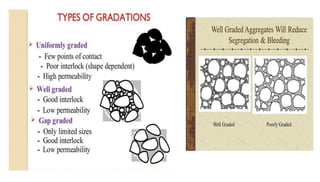
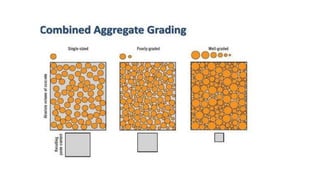
• The particle size distribution of a mass of aggregates should be such that the smaller
particles fill the voids between the larger particles. Such grading is called “good
grading”
• Good grading of an aggregate produces dense concrete and needs less quantity of fine
aggregates and cement paste.
• Hence, to produce quality concrete it is essential that the coarse and fine aggregates be
well graded.
• The good grading of aggregate provides higher strength , lower shrinkage , greater
durability and economy of concrete.
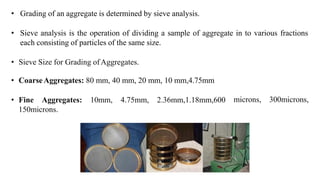
• Grading of an aggregate is determined by sieve analysis.
• Sieve analysis is the operation of dividing a sample of aggregate in to various fractions
each consisting of particles of the same size.
• Sieve Size for Grading ofAggregates.
• CoarseAggregates: 80 mm, 40 mm, 20 mm, 10 mm,4.75mm
• Fine Aggregates: 10mm, 4.75mm, 2.36mm,1.18mm,600
150microns.
microns, 300microns,
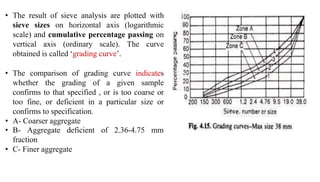
• The result of sieve analysis are plotted with
sieve sizes on horizontal axis (logarithmic
scale) and cumulative percentage passing on
vertical axis (ordinary scale). The curve
obtained is called ‘grading curve’.
• The comparison of grading curve indicates
whether the grading of a given sample
confirms to that specified , or is too coarse or
too fine, or deficient in a particular size or
confirms to specification.
• A- Coarser aggregate
of 2.36-4.75 mm
• B- Aggregate deficient
fraction
• C- Finer aggregate
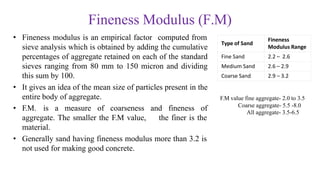
• Grading of aggregates is determining the average grain size of the aggregates before they
are used in construction.
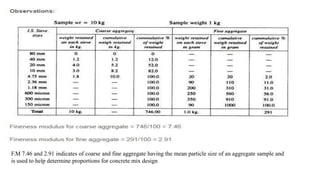
• This is applied to both coarse and fine aggregates. The aggregate sample is sieved through
a set of sieves and weights retained on each sieve in percentage terms are summed up.
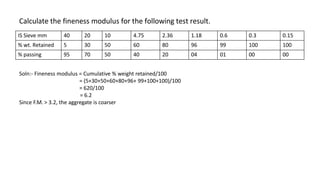
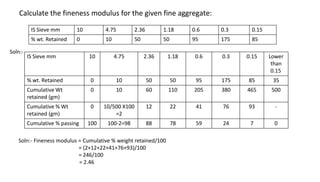
• On dividing this sum by 100, The Fineness Modulus of that aggregate is determined.
Fineness modulus is generally used to get an idea of how coarse or fine the aggregate is.
• More fineness modulus value indicates that the aggregate is coarser and small value
of fineness modulus indicates that the aggregate is finer. Thus, this helps in deciding about
the quantity of aggregates of known fineness moduli to be mixed for obtaining
a concrete of desired density.
• The basis for mixing coarse and fine aggregates of specific fineness modulus is the
presence of voids or open spaces when the aggregates are packed together.
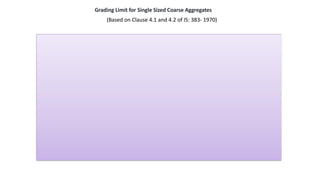
Grading Limit for Single Sized Coarse Aggregates
(Based on Clause 4.1 and 4.2 of IS: 383- 1970)
IS Sieve
Percentage passing for single sized aggregates of nominal size (mm)
63 mm 40 mm 20 mm 16 mm 12.5 mm 10 mm
80 mm 100 – – – – –
63 mm 85 – 100 100 – – – –
40 mm 0 – 30 85 – 100 100 – – –
20 mm 0 – 5 0 – 20 85 – 100 100 – –
16 mm – – – 85 – 100 100 –
12.5 mm – – – – 85 – 100 100
10 mm 0 – 5 0 – 5 0 – 20 0 – 30 0 – 45 85 – 100
4.75 mm – – 0 – 5 0 – 5 0 – 10 0 – 20
2.36 mm – – – – – 0 – 5
• Single-size aggregate is based on a nominal size specification. It contains about 85 to
100 percent of the material which passes through that specified size of the sieve and
zero to 25% of which is retained in the next lower sieve. A graded aggregate contains
more than one single-size aggregate.
• The smallest sieve through which 100% of aggregate pass is called
maximum aggregate size.
• While nominal aggregate size is sieve size higher than largest size on which 15% or
more of aggregate is retained
Sieve Designation
Percentage Passing
Grading
Zone I
Grading
Zone II
Grading
Zone III
Grading
Zone IV
10 mm 100 100 100 100
4.75 mm 90 – 100 90 – 100 90 – 100 95 – 100
2.36 mm 60 – 95 75 – 100 85 – 100 95 – 100
1.18 mm 30 – 70 55 – 90 75 – 100 90 – 100
600 microns 15 – 34 35 – 59 60 – 79 80 – 100
300 microns 5 – 20 8 – 30 12 – 40 15 – 50
150 microns 0 – 10 0 – 10 0 – 10 0 – 15
Grading Limits for Fine Aggregates
(Based on Clause 4.3 of IS: 383 – 1970)
Grading of Aggregates
• Grading refers to the determination of the particle-size distribution for aggregate.
• The particle-size distribution of an aggregate as determined by a sieve analysis is known
as Grading aggregate.
• If all the particles of an aggregate are of uniform size, the compacted mass will contains
more voids and needs more quantity of fine aggregate and cement paste.
• On the other hands aggregates comprising particles of various sizes will give a mass of
lesser voids.
• Grading of aggregates is aimed at determining the mean size of the particle in a given batch
of aggregates.
• This is commonly found by the Method of Fineness Modulus. The method can be used to
determine fineness modulus of coarse aggregates, fine aggregates, and all-in aggregates, i.e.,
mixed aggregates.
• In this method, a convenient weight of the sample is taken and sieved through a set of sieves
one after another. The number of sieves is five for the coarse aggregates and ten for all-in-
aggregates.
• It is only six in the case of fine aggregates.
• Sieve Size for Grading ofAggregates.
• CoarseAggregates: 80 mm, 40 mm, 20 mm, 10 mm,4.75mm
• FineAggregates: 4.75mm, 2.36mm,1.18mm,600 microns, 300microns, 150microns.
• All in aggregates: 80 mm, 40 mm, 20 mm, 10 mm, 4.75mm, 2.36mm,1.18mm,600 microns,
300microns, 150microns.
Fineness Modulus (F.M)
• Fineness modulus is an empirical factor computed from
sieve analysis which is obtained by adding the cumulative
percentages of aggregate retained on each of the standard
sieves ranging from 80 mm to 150 micron and dividing
this sum by 100.
• It gives an idea of the mean size of particles present in the
entire body of aggregate.
• F.M. is a measure of coarseness and fineness of
aggregate. The smaller the F.M value, the finer is the
material.
• Generally sand having fineness modulus more than 3.2 is
not used for making good concrete.
Type of Sand
Fineness
Modulus Range
Fine Sand 2.2 – 2.6
Medium Sand 2.6 – 2.9
Coarse Sand 2.9 – 3.2
F.M value fine aggregate- 2.0 to 3.5
Coarse aggregate- 5.5 -8.0
All aggregate- 3.5-6.5
F.M 7.46 and 2.91 indicates of coarse and fine aggregate having the mean particle size of an aggregate sample and
is used to help determine proportions for concrete mix design
Calculate the fineness modulus for the following test result.
IS Sieve mm 40 20 10 4.75 2.36 1.18 0.6 0.3 0.15
% wt. Retained 5 30 50 60 80 96 99 100 100
% passing 95 70 50 40 20 04 01 00 00
Soln:- Fineness modulus = Cumulative % weight retained/100
= (5+30+50+60+80+96+ 99+100+100)/100
= 620/100
= 6.2
Since F.M. > 3.2, the aggregate is coarser
Calculate the fineness modulus for the given fine aggregate:
IS Sieve mm 10 4.75 2.36 1.18 0.6 0.3 0.15
% wt. Retained 0 10 50 50 95 175 85
Soln:- Fineness modulus = Cumulative % weight retained/100
= (2+12+22+41+76+93)/100
= 246/100
= 2.46
IS Sieve mm 10 4.75 2.36 1.18 0.6 0.3 0.15 Lower
than
0.15
% wt. Retained 0 10 50 50 95 175 85 35
Cumulative Wt
retained (gm)
0 10 60 110 205 380 465 500
Cumulative % Wt
retained (gm)
0 10/500 X100
=2
12 22 41 76 93 -
Cumulative % passing 100 100-2=98 88 78 59 24 7 0
Soln:-
Gap Grading
• Gap grading is defined as a grading in which one or more intermediate size fractions
are absent.
• The size of voids existing between a particular size of aggregate is too small to
accommodate the very next lower size.
• Gap-graded mixes are used to obtain uniform textures for exposed-aggregate concrete
and can also increase strength and reduce creep and shrinkage.
• In the case of the gap-graded mix, the fine particles easily enter the voids in the coarse
aggregate and the workability of the mix is higher than that compared to a continuous
grad mix of the same sand content.
• For the given aggregate/cement and water/cement ratio, the highest workability is
obtained with a lower sand content in case of gap-graded aggregate.
• Due care should exercise in handling and control of the mode of compaction to avoid
segregation. Gap-graded concrete uses in preplaced aggregate concrete and exposed
aggregate concrete.
Flakiness & Elongation Index
[IS 2386-1963- PART-1]
• Flaky particle ( Thickness)= least dimension is < 0.6 time of its mean dimension
• Its measure in %
• Elongated Particle (Length)= its length is > 1.8 times its mean dimension
• More than 40%- 45% is undesirable
• These tests are not applicable to sizes larger than 6.3 mm.
141
1. Take sufficient quantity of aggregate to provide at least 200 pieces of any fraction to be tested.
2. Sieve the sample through sieves as shown in observations table.
3. Separate particles retained on the prescribed sieves.
4.Try to pass each aggregate particle through the corresponding slot of thickness gauge Fig. The aggregate piece
passing through 50 mm and retained on 40 mm sieve, should only be passed through {(50+40)/2} x 0.6 = 27.0
mm slot. If the aggregate passes through this 27.0 mm slot; then the aggregate piece is flaky.
5. Weigh all the pieces which pass through this slot.
6. Calculate the flakiness index = Wt. of material passing through the thickness gauge/Total weight of sample
For Elongation Index:
1. Sieve the sample through I.S., sieve as specified in observation table.
2. Separate aggregate pieces retained on sieves.
3. Try to pass each aggregate piece through the corresponding slot of length gauge (Fig.). If the length of the
particle {(50+40)/2} x 1.8 = 81 mm, it is said to have retained on the length gauge.
4. Weigh all such pieces
5.Calculate the elongation index as follows ― = (weight of material retained on the length gauge/total weight of
the sample gauge) x 100
Suppose the aggregate particle passes through 50 mm sieved and retained on 40 mm sieve, then ―
Flaky /thickness gauge = [(50 + 40)/2] x 0.6 = 27.0 mm
Elongation / length gauge = [(50 + 40)/2] x 1.8 = 81 m
For Flakiness Index
143
Length Gauge of Elongation Index
for Coarse Aggregate
Thickness Gauge of Flakiness Index
for Coarse Aggregate
Water
➢It is a very important ingredient of the concrete as it actively
participates in chemical reaction with cement
144
145
Requirement of Water in Concrete
➢ Water chemically reacts with cement in concrete to from cement gel &
to produce desire properties of concrete such as the strength to
hardened of concrete
➢ Mixing of water is utilized in the hydration of cement & provides
lubrication between F.A& C.A
➢ It also facilitates mixing, placing the compaction of the fresh concrete.
➢ In general water fit for drinking i.e. potable is acceptable for mixing
concrete. i.e. pH value lies between 6 to 8
146
➢ Mixing water should be free from deleterious material like silt, clay, acids,
alkalies, other salts, organic matter and sewage.
➢ If above materials exceeding specified limits are likely to have an adverse
effect.
➢ The use of sea water may cause surface dampness, efflorescence,staining
& corrosion of steel in reinforced concrete.
➢ Excess water causes honeycombing in concrete.
147
Impurities Tolerable Concentration
Sodium and potassium 1000 ppm-setting time & 28 days strength
Chlorides 10,000 ppm
Sulphuric Anhydride 3000 ppm
Calcium chloride 2% by wt. of Cement in non pre stresses
concrete
Sodium iodate, Sodium Sulphate,
sodium borate
Very low
Sodium hydroxide 0.5% by wt. of cement
Salts and suspended particles 2000 ppm
Total dissolved salt 15,000 ppm
Organic material 3000 ppm, humic acid affecting hardening
pH Not less than 6
Tolerance limit of some impurities in Mixing Water
148
Effects of Impurities in Mixing Water
Impurities Effect
Dissolved salts • Dissolved salts of sulphates. Chloride and carbonate in mixing
water decrease the compressive strength.
Suspended impurities • Clay or silt particles present in mixing of water do not effect the
strength of concrete but affect the other properties of concrete
• Presence of suspended particles up to 0.02 % by weight of water is
acceptable
Inorganic salts • Salts like manganese, tin, zinc, copper & lead decrease the strength
of concrete
• Zinc chloride increase the setting time of concrete
Sea water • Sea water slightly increase the early strength but reduce the 28
days strength of concrete
• Sea water is use for PCC work but not use in RCC work due to risk
of corrosion
• Causes efflorescence & persistent dampness.
149
Acids water
• the industrial waste water may contain acid or alkali which
makes water unsuitable for concrete construction
• Acid water with pH < 3 should be avoided if possible
Alkaline waters • Reduction in strength and large variations in setting time
Sugar • Severely retards the setting of cement
Oils • If the mineral % is more than 2% by weight of concrete may
reduce the concrete strength up to 20%
Algae • Excessive reduction in strength
• It also be present in Aggregates I which case the bond between
the Aggregate & cement paste is reduce
Test on water
• Water should be tested before using for concrete work to
check its suitability.
• Impurity present in water affects the properties of fresh
concrete such as setting time of the cement & durability of
concrete.
• IS3025: 1964 recommends the test for determination of
deleterious material in water using for concrete mixing.
1. Determination of acids & alkalies in mixing water
2. Determination of total solids
Admixtures
➢It is defined as a material, other than cement, water and aggregate,
that is used as an ingredient of concrete and added to the batch
immediately before or during mixing.
➢Use of admixture in concrete construction is to achieve
economical construction.
➢It is generally used in high strength concrete for tall building &
long span bridges.
152
• Concrete admixtures (additives) enhances the properties of concrete for
applications in construction with special requirements.
• Concrete additives are used to achieve desired workability in case of low
water cement ratio, and to enhance setting time of concrete for long
distance transportation of concrete.
• So, it is of much importance for a civil site engineer to know about the
types of admixtures (additives) and their properties for better selection and
application in concrete works.
154
Use or Function of admixtures
Admixtures are used to modify the properties of concrete or mortar to make them more
suitable for the work at hand or for economy or for such other purposes as saving
energy.
– attack
– Increase bonding between concrete & steelTo increase the workability
– To retard or accelerate initial setting
– To reduce or prevent shrinkage
– To increase the strength
– To reduce the heat of hydration
– To reduce the segregation
– To accelerate the rate of strength development at early stage
– To reduce or avoid the corrosion of reinforced steel
– To improve pump ability & finish ability
– Increase resistance to chemical
155
Classification of Admixture
2. MineralAdmixture or Pozzolanic
Admixture
➢ They have fine size particle which are either
natural material or by product of industries
such as fly ash or silica fume
➢ Generally in the range of 15-20% by mass of
the total cementations material.
➢ It make mixtures more economical, reduce
permeability, increase strength, and influence
other concrete properties.
➢ They can be used with Portland cement, or
blended cement either individually or in
combinations.
1. ChemicalAdmixture
➢ Chemical which are mixed with concrete
ingredient & spread through out the surface
of concrete to improve the moulding &
setting properties of concrete mix is called
chemicalAdmixture
➢ It reduce the cost of construction, modify
the properties of concrete & improve the
quality of concrete during mixing,
transportation, placing & curing.
Type of Admixture
1. Accelerating admixtures (accelerators)
2. Retarding admixtures (retarders)
3. Plasticizers (water reducing admixtures)
4. Super-plasticizing admixtures
5. Air-entraining admixtures
6. Pozzolana admixtures
7. Grouting admixtures
8. Waterproofing admixtures
9. Air-detraining admixtures
10. Bonding admixtures
11. Corrosion inhibiting admixtures
12. Gas forming admixtures
13. Colouring admixtures
14. Alkali-aggregate expansion inhibiting admixtures
156
Types of Chemical Admixtures
• Accelerators
• Retarders
• Water Reducing admixtures
• Super plasticizers
• Air entraining plasticizers
159
Accelerators
• It is used in concrete to reduce the setting time to accelerators
hardening of concrete
• it increase the rate of early strength development & permits early
removal of formwork
• It also help in emergency repair work
• Normally used in cold weather concreting
• Calcium chloride (CaCl2) as an admixture is commonly used in plain
concrete work about 1-2 % by weight of cement
• Dis advantage: It has increased drying shrinkage
• It offers reduced resistance to sulphate attack
• CaCl2 high risk of corrosion of steel – not permitted in reinforced
concrete
• It is more expensive and less effective.
160
Retarders
➢ Retarders increase the setting of concrete &
reduced the w/c ratio
➢ It slow down the hydration process so concrete
remain plastic & workable for long time
➢ It is more useful in hot weather - used to retard
the rate of setting of concrete at high
temperatures of fresh concrete (30°C or more).
➢ It is also used in ready mix concrete in which
time is required to transport the concrete mix to
the construction site
➢ Calcium sulphate (gypsum), sugar,
carbohydrate, etc are used as a retarder 161
Water Reducing admixtures
• Water used to reduce the quantity of mixing water required to
produce concrete of a certain slump, reduce water-cementing
materials ratio, reduce cement content, or increase slump.
• Typical water reducers reduce the water content by approximately
5% to 10%.
• It may cause increase in dry shrinkage which can leads to
shrinkage cracks in concrete
• Mostly used for hot weather concrete placing and to aid pumping.
• Materials: Lignosulfonates, Carbohydrates,Hydroxylated
carboxylic acids.
• The effectiveness of water reducers on concrete is a function of
their chemical composition, concrete temperature, cement
composition and fineness, cement content, and the presence of
other admixtures.
Plasticizers
➢ Aplasticizer is an admixture used in concrete to improve its workability
by reducing water content
➢ Reduction in the quantity of mixing water which is possible by the use
of plasticizer & admixture varies from 5 to 15 %
➢ It is mostly used for hot weather concrete placing & to aid pumping
Super-plasticizing admixtures
➢ The use of super plasticizers permits the reduction of water up to 30%.
They also called high range water reducers (HRWR). They are chemically
different from the normal plasticizers.
Advantages of using super plasticizers
➢ Increase workability
➢ More rapid rate of early strength development
➢ Increase log term strength
➢ Reduction of cement content
➢ Significant water reduction
Disadvantages of super plasticizers
➢ Addition cost for admixture
➢ Slump loss greater than conventional concrete
Commonly used superplasticizer are as follows:
i) Sulphonated melamine formaldehyde condensate (S M F C)
ii) Sulphonated napthalene formaldehyde condensate (S N F C)
iii)Modified ligno-sulphonates and other sulphonic esters, acids
etc.
Applications where flowing concrete is used
1. Thin-section placements,
2. areas of closely spaced and congested reinforcing steel,
3.pumped concrete to reduce pump pressure, thereby increasing
lift and distance capacity,
4.areas where conventional consolidation methods are impractical
or can not be used, and
5. for reducing handling costs
Air Entraining Admixtures
➢ The air entrained concrete is produced by mixing a small amount of
air entraining agent or by using air entraining cement during mixing
of the concrete.
➢ These air entraining agents produce millions of spherical air bubbles.
➢ The bubbles are mostly below 1 mm diameter
➢ Air entraining agents also modifies the properties of hardened
concrete regarding strength, durability, permeability, workability,
Segregation, bleeding and surface finishing quality.
➢ Used to purposely introduce and stabilize microscopic air bubbles in
concrete.
➢ Common Air-Entraining agents are natural wood resins, salts of wood
resin (Vinsol resin), synthetic detergents, salts of petroleum acids, etc
Gas-forming admixtures
• Help maintain concrete's initial volume, counteracting settlement and bleeding, by
generating or liberating bubbles in the mix.
• At higher volumes, these admixtures—generally consisting of hydrogen peroxide,
aluminum powder, or activated carbon—can be used to make lightweight concrete.
• When gas forming admixtures are added, it reacts with hydroxide obtained by the
hydration of cement and forms minute bubbles of hydrogen gas in the concrete.
• The range of formation of bubbles in concrete is depends upon many factors such as
amount of admixture, chemical composition of cement, temperature, fineness etc. The
formed bubbles helps the concrete to counteract the settlement and bleeding problems.
• For settlement and bleeding resistance purpose, small quantity of gas forming admixtures
which is generally 0.5 to 2% by weight of cement is used. But for making light weight
concrete larger quantity generally 100 grams per bag of cement is recommended.
Types of Mineral Admixtures
• Natural pozzolana
– Clay & shales
– Volcanic tuffs and pumicities
– Opalinc cherts
– Diatomaceous earth
• Artificial pozzolana
– FlyAsh
– Blast furnace slag
– Silica fumes
– Rice husk ash
– Metakoline
– Surkhi
168
➢ The Pozzolana can be used as partial replacement of cement or added to concrete mixes.
➢ The Pozzolanic materials when used as partial replacement of cement are generally substituted
for 10 to 35 %.
➢ Pozzolana when added to concrete mixes rather than substituted for a part of the cement,
improve the workability, impermeability, & resistance to chemical attack
169
Pozzolanic Admixtures
Natural Pozzolana Artificial Pozzolana
Clay Fly ash (power plant)
Shale Surkhi (powdering brick or burnt clay ball)
Diatomaceous earth Blast furnace slag ( waste produce of a
mixing of lime, silica, alumina obtained I
manufacture of a pig iron
Volcanic tuffs Silica fume (it is a by product in
manufacturing of silica)
Rice husk ash
Metakoline
Volcanic Ash
Volcanic ash (VA) is formed during volcanic eruptions, and is
considered as natural pozzolan as per ASTM C618-93, a standard
specification for ‘Fly Ash and Raw or Calcinated Natural Pozzolan for
Use as a Mineral Admixture in Portland Cement Concrete’.
Fly Ash
• Fly ash is a byproduct from burning pulverized coal in electric power generating plants.
During combustion, mineral impurities in the coal (clay, feldspar, quartz, and shale) fuse
in suspension and float out of the combustion chamber with the exhaust gases (by
electrostatic precipitators or bag filters.)
• Derived from burning coal, fly ash is a valuable additive that makes concrete stronger,
more durable and easier to work with.
• Fly ash aids the formation of cementitious compounds to enhance the strength,
impermeability and durability of concrete.
• Two types of fly ash are commonly used in concrete: Class C and Class F. Class C are
often high-calcium fly ashes with carbon content less than 2%; whereas, Class F are
generally low-calcium fly ashes with carbon contents less than 5% but sometimes as high
as 10%.
• In general, Class C ashes are produced from burning sub-bituminous or lignite coals and
Class F ashes bituminous or anthracite coals
• GBFS is a mineral admixture with both cementitious and pozzolanic properties.
• it is classified as a hydraulic cement in most codes. However, an activator is necessary to hydrate the
slag. The activation of slag hydration can be done in the following ways:
• Alkali activation: e.g. by caustic soda (NaOH), Na2CO3, sodium silicate, etc. The products formed
are C-S-H, C4AH13 and C2ASH8 (Gehlenite).
• Sulphate activation: e.g. by gypsum, hemihydrate, anhydrite, phosphogypsum, etc. The products
formed are C-S-H, ettringite, and aluminium hydroxide (AH3).
• Mixed activation: When both alkali and sulphate sources are present, such as in a cement system.
• Concrete containing GGBFS as a partial cement replacement has longer-lasting workability and low
slump loss during hot weather construction.
• Concrete containing GGBFS exhibits a lower heat of hydration than conventional Portland cement
concrete.
• It can reduce available alkalies and can reduce the reaction between certain siliceous components of
concrete aggregates and the alkalies in the concrete
• It gives concrete moderate resistance to sulfate attack
Granular Blast Furnace Slag
Thank You
GUJARA
T
TECHNOLOGICAL
UNIVERSITY
PREPAIRED BY:
Aarti PBorse
ASSISTANT PROFESSOR
(Civil Department )
SNPITRC,UMRAKH
Subject : Concrete Technology
(3150610)
Module-3
Fresh Concrete
S.N.Patel Institute of
T
echnology and Research
Centre,Umrakh
1
2
Content
➢Properties of fresh concrete,
➢Definition and Measurement methods of workability as per IS and ASTM
standards,
➢Factors affecting workability,
➢Segregation & Bleeding,
➢ Slump loss,
➢ Re-tempering,
➢Site preparations for concreting,
➢Mixing, Conveying, Placing, Compaction, Finishing of concrete.
➢Curing & various methods of curing
Introduction
•The minimum Water /cement ratio
required for complete hydration is about
0.38.
•If the water above the minimum
required less than 0.38 than hydration is
incomplete and strength will be reduced.
•And if the water above the minimum
required greater (0.38), there will be
excess or undesirable capillary cavities
will occur and concrete will become
porous. 3
Introduction
• The potential strength and durability of concrete of a given mix
proportion is very dependent on the degree of its compaction.
• It is vital, therefore, that the consistency of the mix be such that
the concrete can be transported, placed, and finished sufficiently
early enough to attain the expected strength and durability.
• Significance
• The first 48 hours are very important for the performance of the
concrete structure.
• It controls the long-term behavior, influence f'c (ultimate
strength), Ec (elastic modulus), creep, and durability.
When concrete is mixed & ready for placement in the form-
work, it is called fresh concrete.
Properties of Fresh Concrete
➢It can be molded in any shape
➢It should be able to reduce homogeneous concrete (mixable).
➢It should not segregate or bleed during transportation and placing
(ie.stable)
➢It should be cohesive and sufficiently mobile (ie flowable). The flow
properties of fresh concrete are mainly dependent upon factors
affecting resistance to deformation.
➢It should be amenable to through compaction and satisfactory surface
finishing (ie. Compactable and finishable)
➢Concrete in a plastic stage is called as green concrete.
• Elasticity and Strength Of Concrete
• The elastic properties of materials are a measure of their
resistance to deformation under an applied load (but the elastic
strain is recovered when the load is removed).
• Strength usually refers to the maximum stress that a given kind
of sample can carry.
• Understanding these properties and how they are measured is
essential for anyone wishing to use materials
Main Properties of Fresh Concrete
Consistency
• Slump Test
• Flow test
Workability
• Compacting
factor test
• VeBe Time
test
Segregation Bleeding
• Bleeding
Water Test
Workability
❑Definition
• As per IS 6461 – 1973, workability of concrete is defined as that
properties of fresh concrete which determines the ease &
homogeneities with which concrete can be mixed, placed,
compacted & finished.
• Workability is one of the physical parameters of concrete
which affects the strength and durability as well as the cost of
labor and appearance of the finished product
• Workability of fresh concrete is a complex system which
involves different parameters such as flowability, mobility,
stability, pumpabilty, compactability & finisiability.
8
9
Mixability
➢Mixability is the ability of the mix to produce a homogenous green
concrete form the constituent material of the batch under the mixing
forces.
➢A less mixable concrete mix requires more time to produce a
homogenous and uniform mix.
Stability
➢Particle size distribution should be
remain same while transportation,
placing and compaction.
➢Concrete should be homogeneous
➢If the concrete is not proper stable
than segregation and bleeding may
occurs
10
Flow ability- (Mobility) & Transportability
➢Capacity of flow of concrete against friction of
surface, during the transportation and placing of
concrete is called flow ability
➢Friction of surface while flow of concrete reduce the
consistency of concrete and flow of concrete
➢So it should maintain the flow ability with the use of
proper water-cement ratio and use of admixtures
➢Transportability is the capacity of the concrete mix
to keep the homogeneous concrete mix during
transportation.
11
Compatibility
➢Compaction of concrete is require to
remove the voids or entrapped air in
concrete to make a nonporous concrete
➢It had been studied if there is a 1% air
present in concrete than reduce the
strength about 6%
➢Compaction given by various method
such as vibrators, and steel rod
compaction by hand
➢Compaction can be measure by
compaction factor
12
13
Workability of a fresh concrete is a complex system of two critical
parameter:-
1. Consistency :
▪ It is a ability of a fresh mixed concrete to flow.
▪ Slump cone test, compaction factor test is used for measuring consistency of concrete.
2. Homogeneity :
▪ It means uniform and stable distribution of ingredient such as cement, aggregate &
water and also provide resistance to segregation.
▪ Rheometer is a instrument that measure yield stress and plastic viscosity and also used
to measure homogeneity properties.
Factors affecting Workability
Water content
Mix proportion
Size ofAggregate
Shape ofAggregate
Surface texture ofAggregate
Grading ofAggregate
Use of Admixture
Time
Temperature
14
Workability depends on
water content, aggregate
size
(shape and
distribution), cementitious
content and age (level of
hydration)
modified
and can be
by adding
chemical admixtures, like
superplasticizer
Water content
• The water content decreases with decrease in slump and
hence to produce durable concrete, water used in concrete
must be minimum.
• Higher the water content per meter cube of concrete, higher
will be fluidity of concrete, which affects workability.
• Higher water content may leads to increase in bleeding and
segregation of aggregates, resulting into poor quality of
concrete.
Shape of aggregates
• Rounded aggregates require less cement paste and water
content for given workability.
• Rounded aggregates will give a more workable concrete
• Angular, elongated or flaky aggregatges make the concrete
harsh.
• Rounded aggregate will reduce greatly the frictional
resistance increasing the workability of concrete.
Size of Aggregates
• For larger size aggregates , the surface area is less and
hence less amount of water and cement paste is required to
cover the surface area.
• Hence, up to a limit, larger aggregates give more workable
concrete.
Surface texture of aggregates
• Aggregates having rough surface texture will require more
more workability than
cover them. Hence smooth textured
rough textured
cement paste to
aggregates give
aggregates.
• Smooth
frictional
aggregate provides reduction in inter
resistance which also contributes to
particle
higher
workability.
Grading of aggregates
• A well graded aggregate is the one which has least
amount of voids in a given volume and higher the
workability.
• Other factors being constant, when the total voids are
less, excess paste is available to give better
lubricating effect.
• With excess amount of paste, the mixture becomes
cohesive and fatty which prevents segregation of
particles.
• So, Workability of concrete is directly proportional to
grading of aggregate.
• If grading is done properly, the volume of voids in
the concrete becomes less. Thus, less cement paste
will be able to lubricate this concrete.
• Thus, workability increases if the aggregates are well
graded.
Mix Proportion
• Aggregate-cement ratio is an important factor influencing workability.
• Rich concrete with lower aggregate/cement ratio, more paste is available to make the mix
cohesive and fatty to give better workability.
Use ofAdmixture
• Chemical admixtures can be used to increase workability.
• Use of air entraining agent produces air bubbles which acts as a sort of ball bearing
between particles and increases mobility, workability and decreases bleeding, segregation.
• The use of fine pozzolanic materials also have better lubricating effect and more
workability.
Environmental Conditions
• If temperature is high, evaporation increases, thus workability decreases.
• If wind is moving with greater velocity, the rate of evaporation also increase reduces the
amount of water and ultimately reducing workability.
Time
• Workability of fresh concrete reduces as the time passes because of evaporation.
Hence workability of concrete is inversely proportional to time transit.
• On an average, a 125 mm slump concrete may lose slump about 50 mm during first
one hour.
• Use of plasticizers in concrete is very common to decrease the workability with
time after mixing.
Temperature
• Temperature can influence the hydration rate and water losing rate.
• As the temperature increases, workability decreases.
Concrete Workability
How To improve the workability of concrete
• Increase size of aggregate
• Increase water/cement ratio
• use well-rounded and smooth aggregate instead of irregular shape
• Increase the mixing time
• Increase the mixing temperature
• Use non-porous and saturated aggregate with
addition of air entraining mixtures
Measuring of Workability
Slump test
Compaction
Factor test Flow table test
Flow test
Kelly Ball test
21
Vee-bee test
Concrete Consistency
⚫Consistency or f luidity of concrete
component of workability and refers
wetness of the concrete.
⚫However, it must not be assumed that the
is an important
in a way to the
wetter the mix
the more workable it is. If a mix is too wet, segregation
may occur with resulting honeycomb, excessive bleeding,
and sand streaking on the formed surfaces
Concrete Consistency
⚫On the other hand, if a mix is too dry it may be difficult to
place and compact, and segregation may occur because of
lack of cohesiveness and plasticity of the paste.
3Ways to determine Consistency of Fresh Concrete
Slump Test
Flow Test
Slump Test
• Slump test is the most commonly used method of measuring consistency of concrete which
can be employed either in laboratory or at site of work.
• The slump test is a means of assessing the consistency of fresh concrete. It is used, indirectly,
as a means of checking that the correct amount of water has been added to the mix.
• It is not a suitable method for very wet or very dry concrete.
• Additional information on workability and quality of concrete can be obtained by observing
the manner in which concrete slumps.
• Quality of concrete can also be further assessed by giving a few tappings or blows by
tamping rod to the base plate.
• The deformation shows the characteristics of concrete with respect to tendency for
segregation.
Slump test- IS : 1199-1959
REFERENCE
APPARATUS
Tamping rod, 60cm long and 16mm in diameter, rounded at
one end
Water proof base plate with or without clamping arrangement
Trough & Plain sheet / non porous surface
Steel ruler & Measuring cylinder
26
To determine the workability of concrete mix by
slump test method
IS:1199-1959
A Slump cone, metallic and thickness should not less
than 1.6 mm
OBJECTIVES
1.Clean the internal surface of the mould and apply oil.
2.Place the mould on a smooth horizontal non- porous base
plate.
3.Fill the mould with the prepared concrete mix in 4
approximately equal layers.
4.Tamp each layer with 25 strokes of the rounded end of the
tamping rod in a uniform manner over the cross section of the
mould. For the subsequent layers, the tamping should penetrate
into the underlying layer.
5.Remove the excess concrete and level the surface with a
trowel.
Procedure
Rod
concrete
Ruler
Slump
28
1.Clean away the mortar or water leaked out between the mould and the base plate.
2.Raise the mould from the concrete immediately and slowly in vertical direction.
3.Measure the slump as the difference between the height of the mould and that of height
point of the specimen being tested.
The slump (Vertical settlement) measured shall be recorded in terms of millimeters of
subsidence of the specimen during the test.
Results of Slump Test on Concrete
Slump for the given sample= mm
When the slump test is carried out, following are the shape of the concrete slump that can
be observed:
•True Slump – True slump is the only slump that can be measured in the test. The
measurement is taken between the top of the cone and the top of the concrete after the
cone has been removed.
•Collapsed Slump – This is an indication that the water-cement ratio is too high, i.e.
concrete mix is too wet or it is a high workability mix, for which a slump test is not
appropriate.
•Shear Slump – The shear slump indicates that the result is incomplete, and concrete to
be retested.
IS 456-2000 suggested ranges of workability
No. Placing condition
Degree of
workability
Slump in
mm
1.
Building concrete, shallow section, pavement
using paver
Very low
Too small to
measure
2.
Mass concrete, lightly reinforced section in slabs,
beams, walls, columns, floors, hand placed
pavements, canal lining, strip footing
Low 25-75
3.
Heavily reinforced sections in slabs, beams, walls,
columns
Medium 50-100
4. Slip formwork, pumped concrete Medium 75-100
5. Trench fill, in situ pilling High 100-150
31
Applications of Slump Test
1.The slump test is used to ensure uniformity for different batches of similar concrete under field conditions
and to ascertain the effects of plasticizers on their introduction.
2.This test is very useful on site as a check on the day-to-day or hour- to-hour variation in the materials
being fed into the mixer. An increase in slump may mean, for instance, that the moisture content
of aggregate has unexpectedly increases.
3.Other cause would be a change in the grading of the aggregate, such as a deficiency of sand.
4.Too high or too low a slump gives immediate warning and enables the mixer operator to remedy the
situation.
5.This application of slump test as well as its simplicity, is responsible for its widespread use.
Compaction factor test- IS : 5515-1983
➢The aim of the test is to establish the maximum dry density that may be
attained for a given soil with a standard amount of compactive effort. When
a series of samples of a soil are compacted at different water content the
plot usually shows a distinct peak.
➢This test developed at the Road Research Laboratory in U.K. is more
precise and sensitive than slump test
➢It is particular useful for concrete mixes of very low workability as are
normally used when concrete is to be compacted by variation such concrete
may constantly fail to slump
➢The degree of compaction is called compaction factor.
➢It is measured by the ratio of density of actual achieved in the test to density
of the same concrete fully compacted
➢Compaction factor = weigℎ𝑡 𝑜𝑓 𝑝𝑎𝑟𝑡𝑖𝑎𝑙𝑙𝑦 𝑐𝑜𝑚𝑝𝑎𝑐𝑡𝑒𝑑 𝑐𝑜𝑛𝑐𝑟𝑒𝑡𝑒
(𝑊𝑝)
𝑤𝑒𝑖𝑔ℎ𝑡 𝑜𝑓 𝑓𝑢𝑙𝑙𝑦 𝑐𝑜𝑚𝑝𝑎𝑐𝑡𝑒𝑑 𝑐𝑜𝑛𝑐𝑟𝑒𝑡𝑒 (𝑊𝑓)
275
250
125
225
275
125
285
150
33
Procedure:
• Fill the upper conical hopper of the apparatus up to the grim.
• Open the trap door so that concrete falls in to the lower conical hopper.
• Open the trap door of the lower hopper so that concrete falls into the
cylinder.
• Strike off any concrete above the cylinder, wipe the cylinder clean and
weigh it to know the weight of concrete. This weight is called ‘the weight
of partially compacted concrete’.
• Empty the cylinder and fill it with concrete from the same sample in 5
layers, ramming heavily each layer.
• Level the top and find out weight of the concrete. This is known as weight
of fully compacted concrete.
• Calculate the compacting factor from the formula.
Compacting Factor Test
Importance of Compaction factor Test
1. It gives the density that must be achieved in the field.
2.Provides the moisture range that allows for minimum compactive
effort to achieve density.
3.Provides data on the behaviour of the material in relation to various
moisture contents.
4.It is not possible to determine whether a density test passes or fails
without it.
Flow Test
This is a laboratory test, which gives an indication of
the qualityof concrete with respect to consistency
,
cohesivenessandthe proneness to segregation.
🞂
⦁ The table top is cleaned of all gritty material and is wetted. The
mould is kept on the centre of the table, firmly held and is
filled in two la
y
ers.
⦁ Each layer is rodded 25 times with a tamping rod 1.6 cm in
diameter and61cmlong rounded at the lower tampingend.
⦁ The m
ould is lifted v
ertically upward and the concrete stands
on itsown without support.
Flow Test
⦁ The table is then raised and dropped 12.5 m
m 15 times in
about 15 seconds. The diameter of the spread concrete is
measured in about 6 directions to the nearest 5 m
m andthe
a
verag
e spreadis noted.
Flow Test
Vee Bee Consistometer Test
This is a g
ood laboratory test to measure indirectly
the workability of concrete.
This test consists of a vibrating table,a m
etal pot, a
sheet metal cone,a
standard iron rod.
🞂
🞂
The tim
e required for the shape of concrete to change
from slump cone shape to cylindrical shape in seconds is
knownas V
ee Bee Degree.
🞂
This method is very suitable for very dry concrete whose
slump value cannot be measured by Slump T
est, but the
vibration is too vigorous for concrete with a slump greater
than about 50m
m
.
🞂
Vee Bee Consistometer Test
Segregation
➢Definition
It can be define as separating out of the ingredients of concrete mix, so that the mix is no
longer in a homogeneous and stable condition
➢There are three types of segregation
1. Coarse aggregate separating out from the mix
2. The paste separating out from the mix
3.Water separating out from the rest of the ingredients The
conditions under which segregation is most ingredients:
1. Badly proportioned mix where sufficient cement paste is not available as the binding matrix.
2. Insufficient mixing of concrete having excess water content.
3. Dropping concrete form height as in concreting for column.
4. Transportation of concrete over long distance or over a long time period.
5. Badly designed of concrete. 42
43
The methods to avoid segregation
1. Proper mixing
2. Limiting the height form which concrete is dropped
3. Proper equipment
4. Proper precaution in transporting concrete
5. Avoiding over vibration
6. Proper proportioning of mix.
Segregation is difficult to measure quantitatively and there are no separate
tests for measuring it. But in slump test, the patterns of flow, slump etc. can give a
judicious idea about segregation to a experienced engineer.
Bleeding
➢It is the form of segregation in which some of the water from the concrete
comes out to the concrete.
➢Bleeding is also called water gain and is particularly more problematic in wet
mixes.
➢Main causes are
1. Highly wet mix
2. Badly proportioned mix
3. Insufficiently mixed concrete
➢% of Bleeding water =
Total quantity 𝑜𝑓 𝑏𝑙𝑒𝑒𝑑𝑖𝑛𝑔 𝑤𝑎𝑡𝑒𝑟
44
𝑇𝑜𝑡𝑎𝑙 𝑞𝑢𝑎𝑛𝑡𝑖𝑡𝑦 𝑜𝑓 𝑤𝑎𝑡𝑒𝑟 𝑖𝑛 𝑡ℎ𝑒 𝑠𝑎𝑚𝑝𝑙𝑒 𝑜𝑓 𝑐𝑜𝑛𝑐𝑟𝑒𝑡𝑒
×100
45
Remedies to bleeding
➢Using rich mix
➢Using finer cement or cement with alkali content
➢Proper proportioning the mix
➢Uniform and sufficient mixing of concrete
➢Use of finely divided pozzolanic materials create a longer path for the water to traverse
and reduces bleeding
➢Use of air entraining agents is also effective in reducing bleeding
Bleeding is not completely harmful and even it may improve the quality of concrete
under following conditions.
➢If the rate of evaporation is equal to or more than the rate of bleeding.
➢Early bleeding when the concrete mass if fully plastic is not harmful and may even help in
making the concrete compact. It is the late bleeding which is harmful.
Differentiate between Bleeding & Segregation
Segregation
• Separation of Coarse Aggregate
from the concrete mix is called
segregation
• It depends on handling and
placing process.
• It reduces the strength of the
concrete.
Bleeding
• Separation of Cement paste
from the concrete mix is called
Bleeding
• It depends on badly proportion
and insufficient mixed concrete.
• It leads to higher shrinkage
cracks.
47
• If along with the water certain quantity of cement also comes to the surface,
it forms a cement paste at the top surface of concrete. This formation of
cement paste at the surface is known as Laitance.
• This laitance produces dust in summer and mud in rainy season. Due to
higher content of water and absence of aggregate, the top surface develops
higher shrinkage cracks.
Laitance
48
Relation between workability and strength
➢Workability is directly proportional to the w/c ratio but inversely
proportional to strength of concrete
➢23% water is require for chemical reaction and 15% water is require
to fill up the gel pores. Hence total 38% water by weight of cement is
required for complete hydration
➢If w/c ratio is less than 0.38, workability of concrete is reduces. But
concrete with low w/c ratio will give higher strength
➢If w/c ratio is higher, workability of concrete will be higher but
strength will be lesser.
49
Production of concrete
➢The good quality concrete is a homogeneous mixture of all ingredients
of concrete
➢It is just a matter of mixing these ingredients to obtain some kind of
plastic mass, but it is a scientific process which is based on some well
established principles and governs the properties of concrete in fresh
as well as hardened state.
1. Batching
2. Mixing
3. Transporting
4. Placing
5. Compacting
6. Finishing
7. Curing
50
1. Batching (Measurement of Materials)
➢The measurement of material for making concrete is know as batching.
➢Batching is the process of measuring concrete mix ingredients by either mass or volume
and introducing them into the mixer.
➢To produce concrete of uniform quality, the ingredients must be measured accurately for
each batch.
Two methods of batching
➢Volume batching
➢Weight batching
• Cement is always measured by weight. Mostly it is used in terms of bags. One bag of cement weighs 50
kg and has a volume of 35 litres (or, 0.035m3).
1. Batching (Measurement of Materials)
❑Volume Batching
➢It is not good method for proportioning the
material.
➢Volume of moist sand in a loose condition weighs
much less than the same volume of dry compacted
sand
➢Gauge boxes are used for measuring the fine and
coarse aggregate.
➢The volume of the gauge box is made equal to the
volume of one bag of cement.
Gauge boxes
51
• Gauge bow are also called as FARMAS.
• They can be made of timbers or steel.
• They are made generally deep and narrow.
• Bottomless gauge boxes are generally avoided.
• While filling the gauge boxes the material should be filled loosely, no compaction is
allowed.
1. Batching (Measurement of Materials)
❑Weight batching
➢Batching by weight is more preferable to volume batching ,as it is
more accurate and leads to more uniform proportioning.
➢It is more accurate as compare to Volume batching
➢It does not have uncertainties associated with bulking and the
non uniform filling of the gauge box associated with volume
batching.
➢It’s equipment falls into 3 general categories :
➢Manual batching equipment
➢Semi-automatic equipment
➢Fully automatic equipment
➢In case of manual batching all weighing and batching of concrete
are done manually. It is used for small jobs.
Fully automatic equipment
53
Manual batching equipment
1. Batching (Measurement of Materials)
❑Weight batching
➢Volume are converted into weights using relation
➢Bulk density = 𝑊𝑒𝑖𝑔ℎ𝑡
𝑉𝑜𝑙𝑢𝑚
➢Bulk density of F.A = 1.5 kg/lit
= 1.6 kg/lit
➢Bulk density of C.A
➢Bulk density of Cement = 1.428 kg/lit
Material
(1:1.5:3)
Cement Fine Aggregate
(F.A)
Coarse Aggregate
By Volume 35 lit. (1 bag) 52.5 lit 105 lit
By Weight 35 × 1.428 = 50 kg 52.5 × 1.5 =78.75 kg 105 × 1.6 = 165
84kg
1. Batching (Measurement of Materials)
2. Batching of Cement
➢Cement is always batch by weight mostly it is batched in terms of 50 kg.
➢In heavy construction, it is stored in silos and weight with weigh batching
machine
3. Measurement of Water
➢ Water is measured either kg or liter.
➢If measuring tank is used, it should be a vertical unit with central overflow
to regulate the filling of the tank and with a central siphon discharge such
tanks should be equipped with a gauge glass and graduated scale to permit
direct reading of the mix water used.
➢Some time water meter are fitted in the main water supply to the mixer
from which the exact quantity of water can be let into the mixer.
55
Differentiate between Volume & Weight
batching
Volume batching Weight batching
• Proportion of concrete
done by volume.
• Not very accurate method
mix is • Proportion of concrete
done by weight.
• Accurate method
• Wooden boxes are used for
proportioning
• For temporary structures in case
of emergency work.
mix is
• Weight machine is used for
proportioning
• RMC and for all important
construction work.
57
Relation between workability and strength
➢Workability is directly proportional to the w/c ratio but inversely
proportional to strength of concrete
➢23% water is require for chemical reaction and 15% water is require
to fill up the gel pores. Hence total 38% water by weight of cement is
required for complete hydration.
➢If w/c ratio is less than 0.38, workability of concrete is reduces. But
concrete with low w/c ratio will give higher strength
➢If w/c ratio is higher, workability of concrete will be higher but
strength will be lesser.
58
Production of concrete
➢The good quality concrete is a homogeneous mixture of all ingredients
of concrete.
➢It is just a matter of mixing these ingredients to obtain some kind of
plastic mass, but it is a scientific process which is based on some well
established principles and governs the properties of concrete in fresh
as well as hardened state.
1. Batching
2. Mixing
3. Transporting
4. Placing
5. Compacting
6. Finishing
7. Curing
59
1. Batching (Measurement of Materials)
• The measurement of material for making concrete is know as batching.
• Batching is the process of measuring concrete mix ingredients by either
mass or volume and introducing them into the mixer.
• To produce concrete of uniform quality, the ingredients must be measured
accurately for each batch.
Two methods of batching
➢Volume batching
➢Weight batching
Cement is always measured by weight. Mostly it is used in terms of bags. One bag of cement weighs 50
kg and has a volume of 35 litres (or, 0.035m3).
1. Batching (Measurement of Materials)
❑Volume Batching
➢It is not good method for proportioning the
material
➢Volume of moist sand in a loose condition
weighs much less than the same volume of
dry compacted sand
➢Gauge boxes are used for measuring the fine
and coarse aggregate.
➢The volume of the gauge box is made equal
to the volume of one bag of cement.
Gauge boxes
60
1. Batching (Measurement of Materials)
❑Weight batching
➢It is more accurate as compare to Volume batching
➢It does not have uncertainties associated with bulking
and the non uniform filling of the gauge box associated
with volume batching
➢It’s equipment falls into 3 general categories :
➢Manual batching equipment
➢Semi-automatic equipment
➢Fully automatic equipment
➢In case of manual batching all weighing and batching of
concrete are done manually. It is used for small jobs.
Manual batching equipment
6
51
3
Fully automatic equipment
1. Batching (Measurement of Materials)
❑Weight batching
➢Volume are converted into weights using relation
➢Bulk density = 𝑊𝑒𝑖𝑔ℎ𝑡
𝑉𝑜𝑙𝑢𝑚
➢Bulk density of F.A = 1.5 kg/lit
= 1.6 kg/lit
➢Bulk density of C.A
➢Bulk density of Cement = 1.428 kg/lit
Material
(1:1.5:3)
Cement Fine Aggregate
(F.A)
Coarse Aggregate
By Volume 35 lit. (1 bag) 52.5 lit 105 lit
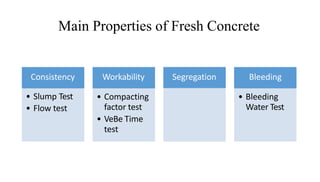
By Weight 35 × 1.428 = 50 kg 52.5 × 1.5 =78.75 kg 105 × 1.6 = 166
82kg
1. Batching (Measurement of Materials)
2. Batching of Cement
➢Cement is always batch by weight mostly it is batched in terms of 50 kg.
➢In heavy construction, it is stored in silos and weight with weigh batching
machine
3. Measurement of Water
➢ Water is measured either kg or liter.
➢If measuring tank is used, it should be a vertical unit with central overflow
to regulate the filling of the tank and with a central siphon discharge such
tanks should be equipped with a gauge glass and graduated scale to permit
direct reading of the mix water used.
➢Some time water meter are fitted in the main water supply to the mixer
from which the exact quantity of water can be let into the mixer.
63
Differentiate between Volume & Weight
batching
Volume batching Weight batching
mix is • Proportion of concrete
done by weight.
• Accurate method
• Proportion of concrete
done by volume.
• Not very accurate method
mix is
•Wooden boxes are used for • Weight machine is used for
proportioning
•For temporary structures in case
of emergency work.
proportioning
• RMC and for all important
construction work.
65
2. Mixing of concrete
➢The aim of the mixing of concrete is to produce homogenous,
consistent and uniformly distributed throughout the concrete mass
➢The mixing action of concrete involved two operation
1. A general blending of different particle sizes of the ingredients to
be uniformly distributed throughout the concrete mass
2. A vigorous rubbing action of the cement paste on to the surface of
the aggregate particles
➢There are two method of mixing
1. Hand mix
2. Machine mix
2. Mixing of concrete
Hand Mixing
66
2. Mixing of concrete
Machine mixing
According to the
Operating Condition
Batch
mixers
Continuous
mixer
According to the
Principle of Mixing
Gravity
type
Type with
force mix
According to the
Condition of Uses
Stationary
concrete
mixer
Portable
concrete
mixer
67
According to Operating Condition
68
Tilting Mixer
Reversing Mixer
Non-Tilting Mixer
Batch Mixer
69
3.Transporting Concrete
➢The process of carrying the concrete from the place of its mixing to the place of
deposition is termed as transportation of concrete.
❑Requirement to be fulfilled during transportation of concrete
1. Concrete delivered at the point of placing should be uniform and proper
consistency.
2. No segregation in the concrete.
3. No excessive drying and stiffening of the concrete.
4. The process of mixing, transporting, placing and compacting concrete should not
take more than 90 minutes in any case.
5. Transportation cost should be as low as possible.
3.Transporting Concrete
❑Depending on the volume of concreting and the nature of work, the
methods of transporting concrete vary. Following are the methods
adopted for transportation of concrete:-
1. Manual method
2. Animals
3. Wheel barrow and hand cart
4. Concrete lifts
5. Concrete pumps
6. Cableway
7. Concrete belts
8. Agitator trucks
70
71
4. Placing of concrete
➢The process of depositing the concrete in its required position is
termed as placing of concrete.
➢It is very essential to place the concrete properly and carefully in
order to obtain good quality of surface.
➢It is not enough that concrete mix correctly mix is correctly designed,
batched, mixed and transported.
➢It is importance that the concrete is placed in systematic manner to
get optimum results.
72
5. Compaction
➢Compaction is the process of moulding concrete within the forms
and around embedded parts in a order to expel the entrapped air from
the concrete and to obtain homogeneous dense mass.
➢The amount of air entrapped in the concrete is depends upon the
workability or stiffness of the mix
➢The lower workability, higher is the amount of entrapped air.
➢The density, strength, and durability of concrete depends upon the
quality of compaction.
5. Compaction
➢Necessary for the reasons are
1. It reduces the internal friction between the particles of concrete
2. The entrapped air reduce the strength (1% → 6% )
3. Entrapped air will increase permeability and make a porous
concrete.
73
74
5. Compaction
❑Methods of Compaction
1. Hand compaction →Rodding, Rammering, and Tamping
2. Compaction by vibration
3. Compaction by pressure
4. Compaction by spinning
75
1. Hand compaction:
• For small volumes of concrete and for narrow columns and congested sections, this
methods is suitable.
• In this method a tamping rod, which is a steel rod of 10 -16mm diameter with
bullet-nose or blunt-nose is used to compact the concrete by repeatedly poking it in
the concrete.
• Rodding should be done fast enough.
2. Centrifugation of spinning:
• Method is not used in site.
• In this method, the concrete is subjected to high speed spinning so that centrifugal
force achieves the compaction.
• Used for compaction of precast concrete parts in precast factories.
76
3. High Pressure and Shock:
• Used in precast factories and it consists of jolting the formwork of precast
elements and subjecting them to high air or steam pressure.
4. Mechanical Vibrators:
• The concrete can be made compact by applying mechanical vibrators
through different types of vibrators. They are internal vibrators, formwork
vibrator, table vibrators, platform vibrators, surface vibrators, vibrating
rollers etc.
• Different vibrators are suitable for different situations and different structural
members.
77
Curing of Concrete
• Maintenance of moisture and temperature of freshly placed concrete to ensure proper
hardening of concrete for attainment of desirable strength and durability.
• The properties of hardened concrete, especially the durability, are greatly influenced
by curing since it has a remarkable effect on the hydration of the cement.
• Curing allows continuous hydration of cement and consequently continuous
gain in the strength, once curing stops strength gain of the concrete also stops.
• Proper moisture conditions virtually ceases when the below 80% .
• Curing is define as the process of keeping the concrete moist and warm enough, so
that hydration of cement may continue until the desired properties are developed.
Effect of W/C ratio
• Concrete hardens because of chemical reaction between Portland cement and water.
•Total hydration process require w/c ratio is 0.38, however, it is seen that practically a higher w/c
ratio of about 0.5 is required for complete hydration.
•Since the concrete is open to atmosphere, the water used in the concrete evaporates and the water
available in the concrete will not be sufficient for effective hydration.
• And if hydration is continue for a long time, then other measure ( curing ) must require to prevent
the loss of moisture.
Period of Curing
➢Specifications generally require that the concrete must be kept moist
as per IS : 456-2000 is :
• UNDER NORMAL WEATHER CONDITION
• min 7 days
• min 10 days
– concrete made with OPC
– concrete made with blended cement ( PPC, PSC)
•UNDER HOT WEATHER CONDITION ( TEMP. MORE
THAN 40 °C )
• min 10 days
• min 14 days
– concrete made with OPC
– concrete made with PPC, PSC
79
Effect of delayed curing
• Curing started after 3 days reduces,
• 7 day strength by 12 %
• 28 days strength by 10 %
•Air exposed concrete will reduce 50 % strength as compared to moist
cured concrete.
What does curing do ?
• Retains moisture on the concrete surface
• Prevents loss of moisture by evaporation
• Reduces shrinkage cracks
• Increase compressive strength, improves durability, wear resistance
and water tightness
• Essential for promoting hydration
• Maintain conducive temperature.
• Needed for capillary segmentation
DO’s & DONT’s
• Start curing immediate after it get sufficient hardness to take load of
person
• Do not walk on freshly laid concrete for sprinkling the water
• Water fit for drinking must be used for curing
• Do curing continuously, intermittent will result in cracking
• During summer, prevent drying the surface of freshly laid concrete.
83
Immersion
Ponding
Spraying
Method of curing
Water curing
Wet covering
Spraying
Ponding
Immersion
Spraying water
• Simplest method
• In this method, after removal of the shuttering or formwork, water is
sprayed on the concrete through a bucket or hose, a number of times
during day.
• Suitable for small works
• Requires great care in supervision and as soon as the concrete gets
dry, water will be sprayed.
Membrane Curing
• In areas of acute scarcity, this method is very useful.
• It is seen that the water mixed while preparing fresh concrete
is generally sufficient for the entire hydration reaction.
• Only it should not be allowed to escape through evaporation.
• Membrane curing, makes use of this fact and a sealing
membrane is applied over the concrete which will trap the
water inside and avoid its escape through evaporation.
• The membrane curing the different sealing compounds in use
are: Bituminous & asphaltic emulsions, Rubber latex
emulsion,emulsions of resins, waxes,drying oils etc.
Steam Curing
• This type of curing is used for Pre cast concrete products manufactured factory.
• Due to steam, the ingredients are heated uniformly and the strength is gained at
a very fast rate.
• Even in small gaps of stacked precast products, steam can penetrate and cure all
the pieces evenly from all sides.
• w/c ratio – 0.3 to 0.7, Low water cement ratio, slow temperature rise, Hence this
method is beneficial.
• Two types of methods are there:
• Low pressure steam curing
• High pressure steam curing
Low pressure steam curing:-
• carried out at atmospheric pressure and @ 70% of the 28 days
strength can be obtained in 16-24 hours
• concrete products are stacked in chamber ( intermittent process )
PROCEDURE :
1. Heating up stage : 10 °c/hr , 2 to 3 hour1
2. Steam treatment stage
3. Cooling off stage : 30 °c/hr , 1.5 hour
High pressure steam curing
Steaming is done at a pressure up to 8 atmospheres because it reduces
the strength of concrete with the application of high atmospheres.
Time : 7 to 10 hr
ADVANTAGE :
- High early strength
- High durability
-Resistive to sulphate action and freezing and thawing
DISADVANTAGE :
- Reduces the bond strength of concrete.
DRIP CURING
• Most common methods used for curing are sprinkling water and
gunny bags that are water consuming.
• Using drip curing will reduce water consumption up to 80%
• Multilayered sheets- Water pockets, Gunny bags(Jute) and PVC Films are used.
• Filling the pockets once in a day the water will drip drown throughout the day
through the films.
• Advantages
• Reusable
• Faster strength
gain
• Eco- Friendly
• Economical
Ponding Method
This type of curing is suitable for a large slab or road pavements.
Here on top of the slab, with clayey soil, small bunds are prepared, and
in the resulting grid of ponds, water is stored upto a depth of 50 mm,
for 28 days.
The water used should be of good , potable quality.
Thus, depending on the requirement, a suitable method for curing
should be adopted.
Influence of temperature
• The temperature plays an important role during period of curing. Optimum temp. during
curing period is 15 to 30 ◦C.
• The strength of concrete can be shown as function of time of curing and temp. of curing
and this product is called as maturity of concrete.
• The strength of concrete with increased curing temp. is mainly due to chemical reaction
of hydration which speedup with increases in temperature . Increases in temp. which
speeds hydration process only affect early strength without affecting adversely on
ultimate strength.
• Hence, curing of concrete and strength of concrete can be speeded by raising
temperature.
94
ThankYou
GUJARAT
TECHNOLOGICAL
UNIVERSITY
PREPAIRED BY:
Dr. Aarti P.Borse
ASSISTANT PROFESSOR
(Civil Department )
SNPITRC,UMRAKH
Subject : Concrete Technology
(3150610)
S.N. Patel Institute of
Technology and Research
Centre,Umrakh
Module-5
Durability & Permeability of Concrete
1
Content
➢Causes of deterioration in concrete and durability problems,
➢Factors affecting durability,
➢Transport mechanism of gases & fluids in concrete,
➢Cracking & causes of cracking,
➢Carbonation induced & corrosion induced cracking,
➢Alkali-aggregate reaction,
➢ Degradation by freeze & thaw,
➢ Sulphate attack,
➢ Durability under sea-water (marine environment).
Deterioration in concrete
➢Deterioration means distress or damage
➢Concrete may suffer distress or damage during its life period due to
number of reasons. Because
➢Varying condition under which it is produced
➢At various location
➢Quality changed by either during production or during service and
service condition
Causes of deterioration in concrete
➢Structural causes
➢Externally applied loads
➢Environmental loads
➢Accidents
➢Subsidence
➢Error in design and detailing
➢Poor construction practices
➢Construction over loads
➢Plastic shrinkage
➢Drying shrinkage
➢Thermal stress
➢Chemical reaction
➢Weathering
➢Corrosion
➢Early removal of formwork
➢Improper design formwork
Distress/ Damage Cause Prevention Remedy
Cracks in horizontal
surface as concrete
stiffens
Plastic shrinkage Use air-entrainment
Seal by brushing in
cement or low
viscosity polymer
Cracks in thick section
as concrete cools
contraction due to fall
in temperature is
prevented
Minimize restraint to
contraction, delay to
cooling
Seal cracks
Cracks above ties,
reinforcement
Plastic settlement Change mix design
Re-compact upper
layer if plastic concrete
Voids in concrete
Honey combing,
poor compaction
Improve compaction
Reduce maximum size
of C.A
Cut out and make good
Inject resin
Blowholes in form
faces of concrete
Air or water trapped
against form work,
poor compaction
Change mix design
Fill holes with polymer
modified fine mortar
Erosion of vertical
faces
Scouring Reduce water content
Rub in polymer
modified fine mortar
Distress/ Damage Cause Prevention Remedy
Rust strains Rubbish in formwork
Protect exposed steel
Clean formworks
thoroughly, avoid
contaminated
aggregate
Clean with dilute acid,
Or sodium citrate,
sodium dithionite,
apply surface coating
Plucked surface
Insufficient release
agent
Care of removal
formwork and in
application of release
agent
Rub in fine mortar
Durability
➢It is defined as its ability to resist weathering action chemical
attack, abrasion or any other process of deterioration, that is
durable concrete will retain its original form, quality, and
serviceability when exposed to its environment
➢The resistance of concrete to weathering, chemical attack, frost and
fire depends upon its quality and constitute materials.
➢Susceptibility to corrosion of the steel is governed by the cover
provided and the permeability of concrete
➢The cube crushing strength alone is not a reliable to guide to the
quality and durability of concrete.
Factors affecting Durability
External Factors
➢ Physical, Chemical, Mechanical
➢Environmental, such as extreme
temperatures, abrasion and
electrostatic action
➢Attack by natural or industrial
liquids and gases.
Internal Factors
➢Permeability of concrete
➢Alkali aggregate reaction
➢Volume changes due to
difference in thermal properties
of the aggregate and cement
paste
Physical causes of Deterioration
➢Cracking
➢Structural loading – Over Loading
➢Exposure to temperature- Fire, Freeze and Thawing
➢Volume changes due to de-icing salts
➢Surface wear
➢Abrasion
➢Cavitation
➢Erosion
Effect of Weathering- Freezing and Thawing
➢Resistance to weathering is an important in sever climatic conditions.
➢The temperature of saturated hardened concrete is lowered, the
water held in the capillary pores in the cement paste freezes in a
manner similar to the freezing in capillaries in rock and expansion of
the concrete takes place.
➢If subsequent thawing is followed by re-freezing, further expansion of
concrete take place.
➢Hence, if concrete mass is subjected to alternate cycles of freezing and
thawing, it has detrimental (harmful) effect on the strength of the
concrete
Effect of Weathering- Freezing and Thawing
➢Fresh concrete contains a considerable quantity of free water.
➢If such concrete is subjected to freezing temperature, discrete ice
lenses are formed.
➢Water expands about 9% in volume during freezing, so that the
excess water in the cavity is expelled.
➢Where the freezing and thawing actions under wet conditions exist,
enhanced durability can be obtained by the use of suitable air
entraining admixtures.
➢In 20 mm aggregate → 5% air entraining air percentage
➢ 40 mm aggregate → 4% air entraining air percentage
Sea water attack
➢Sea water contains sulphates and hence this attacks concrete in a
similar manner to the sulphate attack
➢Sea water contains 3.5% of salt by weight. Its pH value varies
between 7.5 to 8.4
➢Sea water also contain some amount of CO2
➢It has been observed that the deterioration of concrete in sea water is
often not characterized by the expansion, as found in concrete expose
to sulphate attack.
Sea water attack
➢Sea water attack causes loss of constituents of concrete without
exhibiting undue expansion.
➢Ca(OH)2, and CaSO4.2H2O (gypsum), are considerably soluble in
sea water, and this will result in increased leaching action.
➢A concrete of comparatively smaller dimensions exposed to sea water
is more likely to show the effect of the leaching action than
expansion, whereas mass concrete like dock walls, jetty piers may
show the effect of expansion and leaching action both.
➢The absence of expansion is mainly due to the presence in sea water
of a large quantity of chlorides which inhibit the expansion.
Sea water attack
➢Sea water waves while approaching in the shallow end, holds certain
quantity of sand and silt.
➢The velocity of waves causes abrasion of concrete
➢The impact of sea waves also causes deterioration of concrete.
Improve durability of concrete in sea water
➢Use at least M20 grade of concrete.
➢Use pozzolona cement or less contain C3A.
➢Avoid to use broken brick, soft lime stone, sand stone, and other
porous material.
➢Priority to use precast member
➢Sufficient cover provide to the structural member (min.75 mm)
➢No joints shall be allowed within 600 mm of upper and lower places
of wave actions
➢Regular Maintenance.
Permeability
❑Definition:
➢The ability of a substance to allow another substance to pass
through it, its call permeability, especially the ability of a porous
material.
➢If the w/c ratio will be more than 0.38, excess water will cause
undesirable capillary cavities and the concrete becomes porous
➢The pores in cement paste consist of gel pores and capillary pores
➢The pores in concrete due to incomplete compaction are voids of
larger size which give a honey comb structure leading to concrete of
low strength, are not considered here.
Permeability
➢The gel is porous to the extent of 28 % but, the gel pores are so
small that hardly any water can pass through under normal condition
➢The permeability of gel pores is about 7 ×10-16m/s which is about
1/100 of that of paste.
➢ so, gel pores do not contribute to the permeability of the cement paste
➢The capillary pores constitute about 0 to 40% of the paste volume
➢It follows that the permeability of cement paste is controlled by its
capillary porosity.
Importance of Permeability
➢In reinforce concrete, ingress of water and air will result in corrosion
of steel leading to expansion, cracking and disruption of concrete
➢The penetration of deleterious materials in solution may adversely
affect the durability of concrete. e.g Ca(OH)2 leaches out and
aggressive liquid attack the concrete.
➢If the concrete becomes saturated with water due to permeability, it is
more vulnerable to frost action
➢The permeability is very important in case of retaining structure like
water tanks and dams where water-tightness is necessary.
Factors affecting Permeability
➢Water cement ratio
➢Properties of cement
➢Aggregate
➢Absorption and homogeneity of concrete
➢Curing
➢Use of admixtures
➢Age of concrete
Measurement of water Permeability
➢The measurement or permeability in the laboratory is measured by the side
of a test specimen are sealed and water under pressure is applied to the
top surface only
➢The quantity of water flowing through a given thickness of concrete in a
given time is measured and the permeability is expressed as a co-efficient
of permeability “k” given by Darcy’s equation.
➢𝑑𝑞
= 1
×𝑘.𝛥ℎ
,
𝑑𝑡 𝐴 𝐿
➢A=c/s area of a sample (m2), 𝛥ℎ= drop in hydraulic head (m)
𝑑
➢L=thickness of sample (m), 𝑑𝑞
= rate of flow of water (m3/s)
Transport mechanism of Gas and Fluid in
concrete
➢There are mainly three fluids principally relevant to durability of
concrete
➢Water (pure or carrying aggressive ions)
➢Carbon
➢Oxygen
➢The movement of various fluids through concrete take place not only
by flow through the porous system but also by
➢diffusion and
➢sorption
Alkali aggregate reaction(ASR)
➢Some of aggregate contains reactive type of silica, which reacts with
alkalis present in cement i.e sodium oxide(Na2O), Potassium oxide
(K2O)
➢And this alkalis formed swelling type alkali silicate gels (ASR) of
unlimited.
➢This reaction is known as alkali aggregate reaction.
➢Type of rock which contain reactive constituents include traps,
andesite, rhyolites, siliceous limestone and certain type of sandstones
➢The reactive constituents may be in the form of opals, volcanic glass,
zeolite, chalcedony etc.
Alkali aggregate reaction
➢The alkali silica gel formed by alkali aggregate reaction is conformed
by the surrounding cement paste and internal pressure is developed
leading to expansion, cracking and disruption of cement paste.
➢This expansion indicate that the swelling of the hard aggregate is most
harmful to concrete
➢The reactivity of aggregate depends upon its particle size and porosity
as these influence the area over which the reaction can take place.
Factors promoting the alkali aggregate
➢Reactive type of aggregate
➢High alkali content in cement
➢Optimum temperature
➢Availability of moisture
➢Fineness of cement particles.
Measure to control alkali aggregate reaction
➢Selection of non-reactive type of aggregate
➢By restricting alkali contain in cement below 0.6%
➢By controlling temperature
➢By controlling moisture contain
➢By the use of corrective admixtures such as pozzolanas
➢By controlling the void spaces in concrete
Sulphate attack
➢The Sulphates of calcium, sodium, potassium, and magnesium are
present in most soil and ground water.
➢Agricultural soil and water contains ammonium Sulphate, from the
use fertilizers or form sewage and industrial effluents.
➢Water used in concrete cooling tower can also be potential sources of
Sulphate attack.
➢In marshy land, decay of organic matter leads to the formation of H2S,
which is converted in to sulphuric acid by bacteria.
Sulphate attack
➢Solid salts (Sulphate) do not attack concrete, but when present in
solution they can react with hardened cement paste.
➢In hardened concrete, Sulphate react with the free Ca(OH)2 to form
gypsum (CaSO4.2H2O)
➢Similarly, sulphates react with C-A-H to form Calcium
Sulphoaluminate, the volume of which is approximately 117% of the
volume of the original aluminates.
➢And from this reaction with the Sulphate lead to expansion and
disruption of the concrete
➢Whitish appearance is the indication of Sulphate attack.
Method of controlling Sulphate attack
➢Use of Sulphate resisting cement
➢Addition of pozzoloana
➢Quality of concrete
➢Use of air-entrainment
➢High-pressure stream curing
➢Use of high alumina cement
➢Lining of polyethylene sheet
Acid attack
➢Concrete is used for storage of many kind of liquid, some of which
are harmful to concrete
➢In damp conditions CO2, and SO2, and other acid fumes present in
atmosphere affect concrete by dissolving and removing part of the set
concrete.
➢ this forms of attack occurs in chimneys and steam railway tunnels.
➢Flowing pure water formed by melting ice or by condensation and
containing CO2, also dissolves Ca(OH)2 thus causing surface erosion,
sewage water also very slowly causes deterioration.
Acid attack
➢In practice, acid attack occurs at values of pH below about 6.5 but
attack is severe only at pH value below 5.5.
➢At pH value below 4.5 the attack is very sever
➢Under acid attack, cement compounds are eventually broken down
and leach away.
➢If acid or salts are able to reach the reinforcing steel through cracks or
porosity of concrete, corrosion of reinforcement take place.
ThankYou
35
Concrete Mix Design
Concrete Mix Design
⦁ One of the ultimate aims of studying the various properties of
the materials of concrete, plastic concrete and hardened
concrete, is to enable a concrete technologist to design a
concrete mix for a particular strength and durability.
⦁ The conditions that prevail at the site of work, in particular
the exposure condition, and the conditions that are demanded
for a particular work for which the mix is designed.
⦁ Mix design can be defined as the process of selecting suitable
ingredients of concrete and determining their relative
proportions with the object of producing concrete of certain
minimum strength and durability as economically as possible.
Concept of Mix Design
⦁ The relationships between aggregate and paste which are the
two essential ingredients of concrete.
⦁ Workability of the mass is provided by the lubricating effect of
the paste and is influenced by the amount and dilution of
paste.
⦁ The strength of concrete is limited by the strength of paste,
since mineral aggregates with rare exceptions, are far stronger
than the paste compound.
⦁ Essentially the permeability of concrete is governed by the
quality and continuity of the paste, since little water flows
through aggregate either under pressure or by capillarity
.
Concept of Mix Design
⦁ Since the properties of concrete are governed to a
considerable extent by the quality of paste, it is helpful to
consider more closely the structure of the paste.
⦁ With the given materials, the four variable factors to be
considered in connection with specifying a concrete mix are
⦁ (a )Water-Cement ratio
⦁ (b ) Cement content or cement-aggregate ratio
⦁ (c ) Gradation of the aggregates
⦁ (d ) Consistency
.
Various Methods of Proportioning
⦁ Arbitrary proportion
⦁ Indian Road Congress,IRC 44 method
⦁ High strength concrete mix design
⦁ Mix design based on flexural strength
⦁ Road note No.4 (Grading Curve method)
⦁ ACI Committee 211 method
⦁ DOE method
⦁ Mix design for pumpable concrete
🞂 Indian standard Recommended method IS 10262-82
Common Terminologies
⦁ Mean strength:
⦁ This is the average strength obtained by dividing the sum of
strength of all the cubes by the number of cubes.
∑ 𝑥
𝑥 =
𝑛
where x = mean strength
Σx = sum of the strength of cubes
n = number of cubes.
Common Terminologies
⦁ Variance: This is the measure of variability or
difference between any single observed data from the mean
strength.
⦁ Standard deviation:This is the root mean square deviation of
all the results.This is denoted by s or σ.
𝜎 =
∑ 𝑥 − 𝑥 2
𝑛 − 1
where σ = Standard deviation,
n = number of observations
x = particular value of observations
x = arithmetic mean.
Common Terminologies
∑ 𝑥 804
𝑥 =
𝑛
=
20
𝑥 = 40.2 𝑀𝑝𝑎
𝜎 =
∑ 𝑥 − 𝑥 2
𝜎 =
𝑛 − 1
359.20
20 − 1
𝜎 = 4.34 𝑀𝑝𝑎
American Concrete Institute Method of Mix
Design (ACI–211.1)
⦁ This method of proportioning was first published in 1944 by
ACI committee 613.
⦁ In 1954 the method was revised to include, among other
modifications,the use of entrained air
.
⦁ In 1970, the method of mix design became the responsibility of
ACI committee 211.
⦁ ACI committee 211 have further updated the method of 1991.
⦁ Almost all of the major multipurpose concrete dams in India
built during 1950 have been designed by using then prevalent
ACI Committee method of mix design.
Step 01: Data to be collected
⦁ Fineness modulus of selected F
.A.
⦁ Unit weight of dry rodded coarse aggregate.
⦁ Sp.gravity of coarse and fine aggregates in SSD condition
⦁ Absorption characteristics of both coarse and fine aggregates.
⦁ Specific gravity of cement.
Example:
Step 01: Data to be collected
⦁ Design a concrete mix for construction of an elevated water
tank.
⦁ The specified design strength of concrete is 30 MPa at 28 days
measured on standard cylinders.
⦁ The specific gravity of FA and C.A. are 2.65 and 2.7
respectively.
⦁ The dry rodded bulk density of C.A. is 1600 kg/m3,
and fineness modulus of FA is 2.80.
⦁ Ordinary Portland cement (T
ype I) will be used.
⦁ C.A. is found to be absorptive to the extent of 1% and free
surface moisture in sand is found to be 2 per cent.
Step 02: Target Mean Strength
⦁ Target Mean Strength 𝑓𝑚 = 𝑓𝑚𝑖𝑛 + 𝑘𝑠
𝑓𝑚= 𝑓𝑚𝑖𝑛 + 𝑘𝑠
𝑓𝑚= 30 + 1.65 𝑥 4.2
𝑓𝑚= 36.93 𝑀𝑃𝑎
Step 03: Water/cement ratio
⦁ Find the water/cement ratio from the strength point of view
fromT
able 11.5.
⦁ Find also the water/ cement ratio from durability point of view
fromT
able 11.6.
⦁ Adopt lower value out of strength consideration
and durability consideration.
⦁ Since OPC is used,from table 11.5,the estimated w/c ratio is 0.47.
⦁ From exposure conditionT
able11.6,the maximum w/c ratio is 0.50
⦁ Therefore,adopt w/c ratio of 0.47
Step 03: Water/cement ratio
Step 04: Maximum Size of Aggregate &
Workability
⦁ Decide maximum size of aggregate to be used. Generally for
RCC work 20 mm and prestressed concrete 10 mm size are
used.
⦁ Decide workability in terms of slump for the type of job in
hand.General guidance can be taken from table 11.7.
⦁ Maximum size of aggregate 20 mm.
⦁ Slump of concrete 50 mm
Step 04: Maximum Size of Aggregate &
Workability
Step 05: Cement Content
⦁ FromT
able 11.8,for a slump of 50 mm,20 mm maximum size
of aggregate,for non air- entrained concrete,
⦁ the mixing water content is 185 kg/m3of concrete.Also the
approximate entrapped air content is 2 per cent.
𝐶𝑒𝑚𝑒𝑛𝑡 𝐶𝑜𝑛𝑡𝑒𝑛𝑡 =
185
0.47
𝐶𝑒𝑚𝑒𝑛𝑡 𝐶𝑜𝑛𝑡𝑒𝑛𝑡 = 394.0 𝑘𝑔/𝑚3
Step 05: Cement Content
Step 06: Weight of Coarse Aggregate
⦁ From table 11.4 the bulk volume of dry rodded coarse
aggregate per unit volume of concrete is selected, for the
particular maximum size of coarse aggregate and fineness
modulus of fine aggregate.
⦁ The weight of C.A. per cubic meter of concrete is calculated
by multiplying the bulk volume with bulk density.
⦁ From T
able 11.4, for 20 mm coarse aggregate, for fineness
modulus of 2.80, the dry rodded bulk volume of C.A. is 0.62
per unit volume of concrete.
The weight of C. A. = 0.62 𝑥 1600 = 992.0 𝑘𝑔/𝑚3
Step 06: Weight of Coarse Aggregate
Step 07: Weight of Fine Aggregate
⦁ From T
able 11.9, the first estimate of density of fresh concrete
for 20 mm maximum size of aggregate and for non-air-
entrained concrete = 2355 kg/m3
⦁ The weight of all the known ingredient of concrete
⦁ Weight of water = 185 kg/m3
⦁ Weight of cement = 394 kg.m3
⦁ Weight of C.A.= 992 kg/m3
Weight of F
.A.= 2355 – (185 + 394 + 992)
= 784.0 𝑘𝑔/𝑚3
Step 07: Weight of Fine Aggregate
⦁ From T
able 11.9, the first estimate of density of fresh concrete
for 20 mm maximum size of aggregate and for non-air-
entrained concrete = 2355 kg/m3
⦁ Alternatively the weight of F
.A.can also be found out by
absolute volume method which is more accurate,as follows.
Step 07: Weight of Fine Aggregate
Item Ingredients Weight Absolute volume
1 Cement From Step 5
Weight of Cement
103
=
Sp.gravity of Cement
103
2 Water From Step 4 Weight of Water
103
=
Sp.gravity of Water
103
3 Coarse Aggregate From Step 6
Weight of C.A.
103
=
Sp.gravity of C.A.
103
4 Air --- % of Air Voids
106
=
100
103
Total absolute volume =
Step 07: Weight of Fine Aggregate
Total absolute volume = 697.0 x 103 cm3
Therefore absolute volume of F.A.
= (1000 – 697) x 103
= 303.0 x 10³
Weight of FA = 303 x 2.65
= 803.0 kg/m3
Step 08: Proportions
Ingredients Cement
Fine
Aggregate
Coarse
Aggregate
Water Chemical
Quantity
𝑘𝑔/𝑚3
394.0 803.0 992.0 185.0 NM
Ratio 1.00 2.04 2.52 0.47 NM
1 Bag
Cement
50.0 102.0 126.0 23.5 NM
Step 09: Adjustment for Field Condition
⦁ The proportions are required to be adjusted for the field
conditions. FineAggregate has surface moisture of 2 %
Weight of F
.A.= 803.0 +
2
100
803.0
= 819.06 kg/m3
⦁ CourseAggregate absorbs 1% water
1
100
Weight of F
.A. = 992.0 −
= 982.0 kg/m3
992.0
Step 10: Final Design Proportions
Ingredients Cement
Fine
Aggregate
Coarse
Aggregate
Water Chemical
Quantity
𝑘𝑔/𝑚3
394.0 819.0 982.0 185.0 NM
Ratio 1.00 2.08 2.49 0.47 NM
1 Bag
Cement
50.0 104.0 124.5 23.5 NM

3150610Study MaterialCivil EngineeringUnit-01.pdf

  • 1.
    S.N. Patel Instituteof Technology and Research Centre, Umrakh Subject : Concrete Technology (3150610) Concrete Technology Prepared By: Aarti P Borse,Dhaval M Patel Assistant Professor (Civil Engineering Department ) SNPITRC,UMRAKH
  • 2.
    CONTENTS ▪ Introduction ofconcrete ▪ Ingredients of concrete ▪ Functions of Constituent of Cement ▪ Advantages & Disadvantages of concrete ▪ Properties of Concrete ▪ Overview of Sustainability and Concrete development. ▪ Advances and future trends in concrete 2
  • 3.
    Introduction of Concrete •One of the very important and widely used material in construction. • The Grade of the concrete is specified by its 28 day’s cube strength (E.g. M20 means the cube strength is 20 N/sq.mm) • Concrete used on works is specified according to IS 456 (2000). • Concrete is an artificial stone-like material used for various structural purposes.
  • 4.
    Introduction…. • Concrete isa mixing of binding material (Cement), filler (aggregates ,water and sometimes admixtures. • Portland cement, water, sand and coarse aggregates are proportioned and mixed homogeneously to produce concrete suited to the particular job for which it is intended. • The mixture when placed in forms and allowed to cure, hardens in to a rock like mass known as concrete. • Strength and quality are dependent on the mixing proportions. • Hardening is caused by chemical reaction between water and cement and it continues for a long time, and consequently the concrete grows stronger with the age.
  • 5.
    Introduction… ➢In hardened concretethe voids of larger particles (C.A) are fill up by the small aggregate (F.A) and the voids of fine aggregate are fill up by the cement ➢It can be placed or molded into virtually any shape and reproduce any surface texture. ➢Randomly distributed fibers or steel is reinforced in concrete to resist tensile strength is called as reinforced cement concrete (RCC). ➢Concrete without reinforcement is called as plain cement concrete (PCC)
  • 6.
    Ingredients of Concrete •Consists of Portland cement, water, and aggregate (Fine & Coarse) • Cement, water and fine aggregate – mortar Concrete • Admixtures added for specific purposes like – Improving workability of concrete – Accelerate or Retarding the initial setting time of concrete – Reduce or Prevent shrinkage etc.
  • 8.
    Functions of Constituentof Cement • There are eight major ingredients of cement. • The general percentage of these ingredients in cement is given:- Sr. No. Ingredient Percentage in cement 1. Lime 60-65 2. Silica 17-25 3. Alumina 3-8 4. Magnesia 1-3 5. Iron oxide 0.5-6 6 Calcium Sulfate (Gypsum) 0.1-0.5 7. Sulfur Trioxide 1-3 8. Alkaline 0-1
  • 9.
    1. Lime • Alsoknown as calcium oxide or calcium hydroxide. • Sufficient quantity of lime is required to form silicates and aluminates of calcium. • Deficiency in lime reduces the strength of property to the cement causes the cement to set quickly. • Excess lime makes cement unsound i.e. it causes the cement to expand and disintegrate. 2. Silica: • Also known as Silicon dioxide , chemical formula SiO2. • Sufficient quantity of silica should be present in cement to dicalcium and tricalcium silicate. • Silica imparts strength to cement. • Usually presents to the extent of about 30 percent cement.
  • 10.
    3.Alumina: • Also knownas Aluminium oxide. The chemical formula isAl2O3. • Alumina imparts quick setting property to the cement. • Excess alumina weakens the cement. 4. Magnesia: • Also known as Magnesium Oxide. The chemical formula is MgO. • In small quantities, it imparts hardness and color to the cement. • Magnesia should not be present more than 2% in cement. • Excess magnesia will reduce the strength of the cement. 5. Iron oxide: • Chemical formula is Fe2O3. •Iron oxide imparts color to cement. •At a very high temperature, it imparts into the chemical reaction with calcium and aluminum to form tri calcium alumino-ferrite. •Tri calcium alumino-ferrite imparts hardness and strength to cement.
  • 11.
    6. Calcium Sulfate: •Chemical formula is CaSO4 • This is present in cement in the form of gypsum(CaSO4.2H2O) • It slows down or retards the setting action of cement. 7. Sulfur Trioxide: • Chemical formula is SO3 • It should not be present for more than 2%. • Its function is to make the cement sound. • Excess Sulfur Trioxide causes the cement to unsound. 8.Alkaline: • It should not be present more than 1%. • ExcessAlkaline matter causes efflorescence.
  • 12.
    Advantages of ConcreteOver Other Materials • More Economical • Ability to be cast • More Energy Efficient • Excellent Resistance to Water • High Temperature Resistance • Fire Resistance • Aesthetic Properties • Ability to Consume waste • Ability to work with reinforcing Steel
  • 13.
    Disadvantages of Concrete •Low Tensile Strength • Lower Ductility (Brittle) • Volume Instability • Formwork is needed • Low Toughness • Long Curing Time
  • 14.
    Properties of Concrete •Concrete has relatively high compressive strength, but significantly lower tensile strength. • The elasticity of concrete is relatively constant at low stress levels but starts decreasing at higher stress levels as matrix cracking develops. • Concrete has a very low coefficient of thermal expansion, and as it matures concrete shrinks. • All concrete structures will crack to some extent, due to shrinkage and tension. • Concrete can be damaged by fire, aggregate expansion, sea water effects, bacterial corrosion, leaching, physical damage and chemical damage (from carbonation, chlorides, sulfates).
  • 15.
    Summary.. • Concrete ismost commonly used building material. • It is a very strong and versatile mouldable construction material. • It is a homogeneous mixture of cement , sand, coarse aggregate and water. • It is very strong in carrying compressive strength and is extremely weak in resisting tensile stress. • The strength of concrete is depends upon the quantity of its ingredients, their relative quantities and the manner in which they are mixed, transported, placed, compacted and cured. • It is possible to produced cement concrete of different specification for various purposes adjusting proportion of ingredients suitably.
  • 16.
    Overview of Sustainability& Concrete Development • The growing concern over global warming and significant ecological changes requires sustainable development in all fields of science and technology. • Concrete has become the most popular and widely used construction material in the world. • Concrete is perceived and identified as the provider of a nations infrastructure and indirectly of its economic progress and stability, and indeed, of the quality of life.
  • 17.
    • Concrete iseasily and readily prepared and fabricated in all sorts of conceivable shapes and structural systems in the realms of infrastructure, habitation, transportation, work and play. • Its great simplicity lies in that its constituents are most readily available anywhere in the world. • Concrete not only consumes huge amount of energy and natural sources, but also emits large amount of CO2, mainly due to the production of cement. • It is evident that such large amount of concrete production has put significant impact on the energy, resource, environment, and ecology of the society.
  • 18.
    • Hence, howto develop the concrete technology in a sustainable way has become a significant issue. • As the World Earth Summits (1990) and Kyoto (1997) demonstrated very clearly, this worldwide problem (global warming) can be solved only through concerted international efforts. • The industrialized countries are called upon to reduce the emission of greenhouse gases and the wasteful use of natural resources, and the developing countries need to avoid the mistakes made by the industrialized world in the past and develop their economies using technologies that make optimal use of energy and natural materials, without polluting the environment.
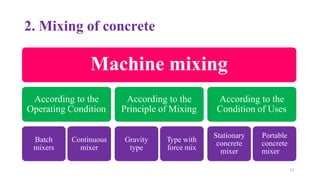
  • 19.
    Concrete has twomajor drawbacks with respect to sustainability: • The production of Portland cement is an extremely resource and energy intensive process where every tonne of cement requires about 1.5 tonnes of raw materials. In addition, each tonne of cement produced releases approximately one tonne of Carbon Dioxide (CO2) into the environment. Thus the production of Portland cement is a significant contributor to atmospheric pollution and the green house effect. • Concrete deteriorates when exposed to the environment, which significantly influences its service behavior, design life and safety. • Cracking of the concrete, inadequate cover and quality of the cover to steel, and the overall quality of the structural concrete are the three major factors that encourage the transport mechanism of aggressive agents, such as chlorides and sulphate into concrete.
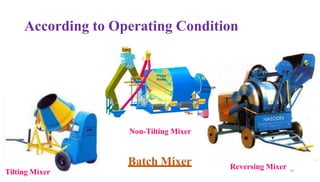
  • 20.
    Advances and Trendsof Concrete Development and Sustainability • “Sustainable development means development that meets the needs of the present without compromising the ability of the future generation to meet their own needs.” • Sustainability lies at the heart of construction and design. • Sustainable concrete construction is a step towards green and eco friendly concrete construction practices to solve global environmental problems. • Thus, in order to make concrete more sustainable may work along one or more of the following solutions;
  • 21.
    • 1) Replacingcement in concrete with larger amounts of supplementary cementing materials (SCMs) than usual. • Recycled aggregate can be easily used for construction. • Waste material from industries such as Fly ash, Silica fume, Granular blast furnace slag (GBFS) can be add in concrete to improve their strength and other properties. 2)Replacing cement in concrete with combinations of SCMs leading to synergic reactions enhancing strength, 3) Producing leaner concrete with less cement per cubic meter utilizing plasticizers. 4)Making concrete with local aggregate susceptible to alkali silica reaction (ASR) by using cement replacements, thus avoiding long transport of non-reactive aggregate.
  • 22.
  • 23.
    5.To minimize theamount of concrete used by avoiding over-design as well as to use appropriate and high quality mix designs, correct designs that follow the recommended crack control parameters, stringent construction inspection and adequate concrete curing. 6.In addition, numerous case histories have shown successful substitution of natural aggregate with crushed concrete from demolition. 7.Also, recycled water from ready-mixed concrete plants has been used as a substitute for fresh mixing water for concrete.
  • 24.
    8. Fly ashand/or silica fume concrete mixes have been proven to provide excellent strength and increased durability characteristics. These materials are ideal companions to Portland cement, and extensive research has now established that super plasticized concrete mixes where the water/cementitious materials ratio is limited to 0.3 or less can have as much as 60% of the cement replaced with fly ash and produce a 55 MPa compressive strength concrete @ 28 days with excellent durability characteristics including significantly less cracking.
  • 25.
    • Application ofsmart technology • Improvement to rebar technology • Use of hybrid materials in concrete • Enhancement of concrete behavior in terms of its strength and ductility for making it behavior well even under adverse load conditions • Conservation of concrete making materials so that the industry is sustainable Development in concrete industry
  • 27.
    GUJARAT TECHNOLOGICAL UNIVERSITY PREPAIRED BY: Aarti PBorse ASSISTANT PROFESSOR (Civil Department ) SNPITRC,UMRAKH 0 Subject : Concrete Technology (3150610) 1 Module-2 Concrete Making materials S.N. Patel Institute of Technology and Research Centre,Umrakh
  • 28.
    • BIS 2000Standard IS 456 (2000): Plain and Reinforced Concrete - Code of Practice [CED 2: Cement and Concrete] Books: • Concrete technology theory and practice by ms Shetty • Concrete technology by Dr. R.P Rethaliya 2
  • 29.
    ❑Cement: Chemical composition,Hydration of cement, structure of hydrated cement, Tests on cement ❑Aggregates: Classification, IS specifications, Grading, Methods of combining aggregates, grading, Testing of aggregates. Properties, specified values of ❑Water: General requirements & limiting impurities ❑ Special Cements, Water ChemicalAdmixtures 15% 3 Content
  • 30.
    Types of Concrete 1.Based on Weight, Concrete can be classified into Four Categories: • Ultra-Light Weight Concrete (1200 Kg/m) • Light Weight Concrete (<1800 Kg/m • Normal Weight Concrete (2400 Kg/m) • Heavy Weight Concrete (>3200 Kg/m) 2. Based on Strength, Concrete can also be classified into Four Categories: • Low-strength concrete < 20 MPa compressive strength • Moderate-strength concrete 20 -50 MPa compressive strength • High-strength concrete 50 - 200 MPa compressive strength • Ultra high-strength concrete > 200 MPa compressive strength
  • 31.
    • Beside thisthere are various type of Concrete for different applications that are created by changing the proportions of the main ingredients. – Regular Concrete – Ready-Mix Concrete – Green Concrete – High-Performance Concrete – Ultra-High Performance Concrete – Rapid Strength Concrete – Shrinkage Compensating Concrete – Fiber-Reinforced Concrete – Asphalt Concrete – Polymer Concrete – Gypsum Concrete
  • 32.
    Factors affecting ConcreteStrength • Water/Cement Ratio • Age and Curing Condition • Aggregates • Admixtures
  • 33.
    Advantages of Concrete •More Economical • Ability to be cast • More Energy Efficient • Excellent Resistance to Water • High Temperature Resistance • Fire Resistance • Aesthetic Properties • Ability to Consume waste • Ability to work with reinforcing Steel
  • 34.
    Disadvantages of Concrete •Low Tensile Strength • Lower Ductility (Brittle) • Volume Instability • Formwork is needed • Low Toughness • Long Curing Time
  • 35.
    Properties of Concrete •Concrete has relatively high compressive strength, but significantly lower tensile strength. • The elasticity of concrete is relatively constant at low stress levels but starts decreasing at higher stress levels as matrix cracking develops. • Concrete has a very low coefficient of thermal expansion, and as it matures concrete shrinks. • All concrete structures will crack to some extent, due to shrinkage and tension. • Concrete can be damaged by fire, aggregate expansion, sea water effects, bacterial corrosion, leaching, physical damage and chemical damage (from carbonation, chlorides, sulfates).
  • 36.
  • 37.
    CONCRETE is madeby mixing WA TER COARSE AND FINE AGGREGATES CEMENT The aim is to mix these materials in measured amounts to make concrete that is easy to: 1. TRANSPORT 4. FINISH 3. COMP ACT 2. PLACE
  • 38.
  • 39.
    Cement • The cementpowder, when mixed with water, forms a paste. • This paste acts like glue and holds or bonds the aggregates together. • The function of Paste is to bind sand aggregate particles by the chemical process of hydration. It also fills the void between sand and aggregate particles. • The strength of concrete depends upon the properties of cement , sand aggregates.
  • 40.
    AGGREGATES • The aggregatesoccupy about 75% of the volume of concrete and hence their influence on various properties of concrete such as workability, strength, durability and economy. • Aggregates are generally cheaper than cement and impart greater volume stability and durability to concrete. • It is used primarily for the purpose of providing bulk to the concrete. • To increase the density of concrete the aggregate is frequently used in two or more sizes. • Aggregates are of two basic types: Coarse and Fine
  • 41.
    AGGREGATES Aggregates are oftwo basic types:- • 1. COARSE: crushed rock, gravel or screenings. • 2. FINE : fine and coarse sands and crusher fines. Sand should be concreting sand and not brickies sand or plasterers sand. Aggregates should be: 1.STRONG and HARD - A stronger, harder aggregate will give a stronger final concrete. Never use a crumble or flakey rock like sandstone. 2. DURABLE to stand up to wear and tear and weathering. 3. CHEMICALLYINACTIVE so the aggregates don’treact with the cement.
  • 43.
    WA TER • Water ismixed with the cement powder to form a paste which holds the aggregates together like glue. • Water must be clean, fresh and free from any dirt, unwanted chemicals or rubbish that may affect concrete. • Many concrete plants now use recycled water. • Always check bore water before use. • Don’t use sea water as it may rust the steel reinforcement in the concrete.
  • 44.
    Admixtures It is materialother than basic material of concrete which is added to the concrete mix Immediately before or during mixing to modify some properties of concrete in the fresh or hardened state. • • Use of admixtures like accerators, retarders, air entraining agents ,pozzolanic materials, water proofing admixtures etc early but plastizers, superplastizers (water reducers) are of recent interest. Use of ready mix concrete has really promoted the use of admixtures in India. • Admixtures are mixed into the concrete to change or alter its properties. Example, the time concrete takes to set and harden, or its workability.
  • 45.
    12 Air The air voidsin the mass of concrete can be classified in two groups 1. Entrapped air 2. Entrained air Entrapped air Entrained air 1. The entrapped air is the voids present in the concrete due to insufficient compaction. 1. The entrained air is the intentionally incorporated minute spherical bubbles. 2. The size of voids may range from 10 to 1000 microns or more 2. The size of air bubbles may range from 5 to 80 microns. 3. The voids are not uniformly distributed throughout the concrete mass. 3. The air bubbles are uniformly distributed throughout the mass of concrete.
  • 46.
    13 CEMENT RecentAdvances and trends: •Ready Mixed Concrete (Admixtures) • Self Compacting Concrete • High Performance Concrete • FlyAsh Concrete
  • 47.
    Functions of constituentof cement • There are eight major ingredients of cement. The general percentage of these ingredients in cement is given:- Ingredient Percentage in cement Lime 60-65 Silica 17-25 Alumina 3-8 Magnesia 1-3 Iron oxide 0.5-6 Calcium Sulfate (Gypsum) 0.1-0.5 Sulfur Trioxide 1-3 Alkaline 0-1
  • 48.
    Lime • Lime iscalcium oxide or calcium hydroxide. • The presence of lime in a sufficient quantity is required to form silicates and aluminates of calcium. • Deficiency in lime reduces the strength of property to the cement. • Deficiency in lime causes the cement to set quickly. • Excess lime makes cement unsound. • The excessive presence of lime causes the cement to expand and disintegrate. • Silica: • Silicon dioxide is known as silica, chemical formula SiO2.The sufficient quantity of silica should be present in cement to dicalcium and tricalcium silicate. • Silica imparts strength to cement. • Silica usually presents to the extent of about 30 percent cement.
  • 49.
    Alumina: • Alumina isAluminiumoxide. The chemical formula isAl2O3. • Alumina imparts quick setting property to the cement. • Clinkering temperature is lowered by the presence of the requisite quantity of alumina. • Excess alumina weakens the cement. Magnesia: • Magnesium Oxide. The chemical formula is MgO. • Magnesia should not be present more than 2% in cement. • Excess magnesia will reduce the strength of the cement. •Iron oxide: • Chemical formula is Fe2O3.Iron oxide imparts color to cement. •It acts as a flux. •At a very high temperature, it imparts into the chemical reaction with calcium and aluminum to form tri calcium alumino-ferrite. •Tri calcium alumino-ferrite imparts hardness and strength to cement.
  • 50.
    Calcium Sulfate: • Chemicalformula is CaSO4 • This is present in cement in the form of gypsum(CaSO4.2H2O) • It slows down or retards the setting action of cement. Sulfur Trioxide: • Chemical formula is SO3 • It should not be present for more than 2%. • Excess Sulfur Trioxide causes the cement to unsound. Alkaline: • It should not be present more than 1%. • ExcessAlkaline matter causes efflorescence.
  • 51.
    Cement 14 ➢Cement is abinding material used in construction. ➢It has a property of setting and hardening when mixed with water to attain strength. ➢Cement is always used in the form either grout or mortar or cement. grout = cement mortar = cement + sand + water concrete = cement + sand + agg. + water ➢Cement is the most expensive ingredient in concrete and it is available variety of different forms. ➢The most commonly cement used in construction work is OPC. ➢Properties of cement is depends upon chemical composition, the processes of manufacture and the degree of fineness of cement grains.
  • 52.
    Manufacture of Cement 15 ➢Theraw material required for manufacture of Portland cement are: Argillaceous materials e.g. Clay, Shale Calcareous materials e.g. Lime stone Chalk Marl Raw Materials for cement
  • 53.
    27 Manufacture of Cement •There are two processes known as “Wet” and “Dry” processes depending upon whether the mixing and grinding of raw materials is done in wet or dry condition. • With a little change in the above process through semi-dry process also cement is manufactured. • Where the raw materials are ground dry and then mixed with about 10-14 per cent of water and further burnt to clinkering temperature. • The dry process requires much less fuel as the materials are already in a dry state, whereas in the wet process the slurry contains about 35 to 50 per cent water. To dry the slurry we thus require more fuel.
  • 54.
    28 Manufacture of Cement ➢The manufacture of cement is consist of following basics steps: 1. Grinding, mixing of raw mater and burning of raw material at a temperature of 1400 to 1500 °C 2. Clinker production in kiln in the form of dark greenish blue balls. 3. Grinding of clinker by adding gypsum about 3 to 5 %. 4. Packing and storage of product.
  • 55.
    Wet process ofCement Manufacturing Cooler Size of clinker :- 3 mm to 20 mm Consistency of water with 30-35% 1500◦C 18
  • 56.
    • In thewet process, the limestone (calcareous material) brought from the quarries is first crushed to smaller fragments and stored in Storage basins or silos. • Argillaceous material i.e. clay is thoroughly mixed with water in a container known as wash mill. This washed clay is stored in storage basins. • Crushed limestone from silos and wet clay from storage basins are allowed to fall in a channel in correct proportions in ball or tube mill, which lets materials to wet grinding mills, and form ground to a fine consistency of slurry with the addition of water. • The slurry is a liquid of creamy consistency with water content of about 35 to 50 per cent, wherein particles, crushed to the fineness of Indian Standard Sieve number 9, are held in suspension. • The slurry is led to correcting basin where it is constantly stirred. At this stage the chemical composition is adjusted as necessary. • The corrected slurry led in to a rotary kiln from upper end where fuel such as coal, oil, gas from lower end. 30
  • 57.
    31 • The rotarykiln is an important component of a cement factory. • It is a thick steel cylinder of diameter anything from 3 metres to 8 metres, lined with refractory materials. • The length of the rotary kiln may vary anything from 30 metres to 200 metres. It is so arranged that the kiln rotates once in every minute about its longitudinal axis. • The corrected slurry is injected at the upper end of rotary kiln. • Hot gases or flames are forced through the lower end of kiln. • Portion of the kiln near its upper end is known as dry zone and in this zone water of slurry is evaporated. • As the slurry gradually descends, there is rise in temperature and in the next section of kiln , carbon dioxide from the slurry is evaporated. • Small lumps, known as nodules, are formed at this stage. • These nodules then gradually roll down passing through zones of rising temperature and ultimately reach to the burning zone, where the temperature is in the order of 1500°C- 1700°C.
  • 58.
    32 • In burningzone , calcined product is formed and nodules are converted into small known as clinkers. hard balls which are • The size of clinkers varies from 3 mm to 20mm. The clinkers drops into a rotary cooler where it is cooled under controlled conditions. The clinkers weight about 1100 to 1300 gms per litre. The litre weight of clinker indicates the quality of clinker. • Clinkers as obtained from the rotary kiln are finely ground in ball mills and tube mills. During grinding, a small quantity about addition of 3 to 5 per cent of gypsum to prevent flash-setting of the cement. • The finely ground cement is stored in silos. It is then weighed and packed in bags by automatic machine. Each bag of cement contains 50Kg or about 0.035 m3 of cement. These bags are carefully stored in a dry place.
  • 59.
    Dry process of CementManufacturing 33 Advantages • It increases the productivity of labour. • The fuel consumption is less. For the production of one ton of cement, the dry process required 100kg of coal while the wet process required 350 kg of coal. • The capital expenditure is less.
  • 60.
    Raw Mill Raw Millsilos Jumbo bag packing.
  • 61.
    Sr. No. DryProcess Wet Process 1 Mixing and grinding of rawmaterialsin dry stateby means of compressed air Mixing and grinding of rawmaterials in wet stateby using water 2 It requires much less fuel as the material are already in dry state It requires more fuel todry the material which arein slurry form containing about 30-40% water 3 Economical– as requires less fuel Uneconomical– as requires more fuel 4 Productionrateis high Productionrateis less 5 Air pollution is more as compared to wet process Air pollution is less as compared to dry process 6 Amount of coalrequired to manufacture one tonne of cement is 100kg Amountof coalrequired to manufacture one tonne of cement is approx.350kg
  • 62.
    25 OXIDE APROXIMATE LIMIT FUNCTION REMARKS Lime-CaO 60 % - 67 % Strength • < lime decrease the strength • > lime unnecessary expansion Silica –SiO2 17 % - 25 % Strength • > silica add strength to the cement but increase setting time. Alumina –Al2O3 3.0 % - 8.0% Makes cement quick setting • > alumina setting time increase but weakens the cement Iron Oxide –Fe2O3 0.5 % - 6.0% Provided colour, hardness And strength Chemical composition of cement
  • 63.
    26 OXIDE APROXIMATE LIMIT FUNCTION REMARKS Magnesia-MgO 0.1 % - 4.0% Provided colour, hardness -. Alkaline –K2O3 Na2O 0.4 % - 1.3% Shulphate resistance - Sulphur trioxide - SO3 1.3% - 3.0% Increase setting lime Calcium Cloride-CaCl2 2% Quick strength Gypsum- CaSO4.2H2O 3% - 4% Controlto quick set
  • 64.
    27 Name of CompoundFormula Require % by mass in cement Tricalcium Silicate (C3S) 3 CaO.SiO2 30-50 Dicalcium Silicate (C2S) 2 CaO.SiO2 20-45 Tricalcium Aluminate (C3A) 3 CaO.Al2O3 8-12 T etracalcium Aluminoferrite (C4AF) 4 CaO.Al2O3.Fe2O3 6-10 Bouge’s Compounds At the high temp. in kiln, these oxides interact with each other to form more complex compounds is commonly known as Bogue’s compound. Chemical composition of cement can be determined by using following instruments. Bouge’s Compounds
  • 65.
    • In additionto the four major compounds, there are many minor compounds formed in the kiln for eg MgO, TiO2., Mn2O3, K2O, Na2O.All these compounds contributes not more than few percentage. • Two of the minor oxides namely K2O, Na2O referred to as alkalis in cement are of some importance. • So, C3S and C2S are the most important compounds responsible for strength. Together constitute 70-80 % of cement. • The avg. C3S content in modern cement is about 45% and of C2S is 25%.
  • 66.
    Bogue’s Compounds % bymass of cement Properties & Function of bogue’s compounds Tri-calcium silicate (C3S) 25-50 It hydrates at a faster rate and produces higher heat of hydration. It is responsible for rapid hardening with an early gain in strength & has less resistance to chemical attack. Di-calcium silicate(C2S) 20-45 It hydrates & hardens slowly and produces less heat of hydration. It provides much of the ultimate strength & has greater resistance to chemical attack. Tri-calcium aluminate(C3A) 5-12 It is the first compound which starts hydrating. It produces the highest heat of hydration & responsible for the setting of cement. Tetra-calcium alumino-ferrite (C4AF) 6-12 It hydrates rapidly but its individual contribution to the overall strength of cement is insignificant.
  • 67.
    29 Bouge’s Compounds (Rateof hydration & compressive properties) • • • • ❑ Tricalcium Silicate (C3S) • Responsible for Early Strength • First 7 days strength will get because of C3S Produce More heat of Hydration Better for cold weather concreting Produce More heat of hydration W ater requirement for hydration is 24% (%water by weight of cement) • • • • ❑Dicalcium Silicate (C2S) Hydration starts after 7 days so, Give Strength after 7 days and increase up to one year • 3 with C A. • C2S hydrates and hardens slowly and provides ultimate strength. • Responsible for late strength • Produces less heat of hydration. • 21% of water is required • ❑ T ricalciumAluminate (C3A) • Responsible for flash setting : Reaction of C3A with water is very fast and which result in stiffening of paste Toprevent this flash set, 2-3% gypsum is added at the time of grinding the cement clinkers. 40% of water is required Produce more heat of hydration Don’t impart strength ❑TetracalciumAluminoferrite (C4AF) •Hydrates rapidly • Gives higher resistance against sulphate attack compared 37% of water is required • Don’t impart strength
  • 68.
    30 Hydration of Cement ➢Cementhas a adhesive properties only when mixed with water ➢The chemical reaction that take place between cement and water is referred as Hydration of cement ➢The silicates (C3S, C2S) and aluminates (C3A) of cement react with water and form hydro silicate and hydro aluminates. The product are thick and sticky. ➢It is called Gel possess adhesive properties and binds aggregate and sand together and fill the voids between sand and aggregates. ➢Hydration process visualized in two ways ➢1. Through solution→ cement compound dissolve in water to produce a super saturated solution from which different hydrated products get precipitated. (Before takes place) ➢2. Solid state → water attract the cement compound in the solid state converting them into hydrated products (After takes place)
  • 69.
    43 Schematic Representation ofHydration of Cement
  • 70.
    Schematic Representation ofHydration of Cement 32 @ 40µ size @ 15-20µ size of cement crystals After 28 days of curing, cement grains have been hydrated to a depth of only 4µ size Complete hydration under normal condition is possible only for cement particles < 50µ size. The hydration process is not an instantaneous one. The reaction is faster in the early stage & continues at a decreasing rate. (complete hydration is possible under a period of one year or more & cement is finely ground ) The hydrated product of the cement compound in a grain of cement adheres firmly to the unhydrated core in the grains of cement. And this will not reduce the strength of cement mortar as the products of hydration are well compacted.
  • 71.
    33 Hydration of Cement ➢Ithas been estimated that C3S, C2S compounds on an average 23% of water by weight of cement is required for chemical reaction. ➢This 23% of water chemically combines with cement and, therefore it is called bound water. Acertain quantity of water is imbibed within gel-pores. This water is known as gel water. ➢Gel water of about 15% by weight of cement is required. Therefore, a total 23+15 =38% of water by weight of cement is required for complete hydration. ➢If less than 38% of water is used – Incomplete Hydration. That is complete hydration is not possible as the volume available is insufficient to accommodate all the products of hydration. Hence, strength of concrete will be reduced. ➢If more than 38% of water is used- Excess capillary cavities occurs. the excess water will causes undesirable capillary cavities and concrete becomes porous. Therefore greater the water above the minimum required is used (38%), the more will be the undesirable capillary cavities.
  • 73.
    What is hydíationpíocess of concíete ľhe haídening of concíete and theií stíength thíough the píocess of hydíation. Concíete is mix of cement sand aggíegate and wateí. In which paste of cement and wateí act as Bindeí component and sand and aggíegate aíe act as filleí component. Hydíation is a chemical píocess and íeaction in which the majoí component of concíete its cement foím chemical bond when íeact with wateí molecules and becomes hydíates and foím hydíate píoduct. And aggíegate and sand aíe chemically ineít solid bodies aíe held ľogetheí by paste of cement. Cement + wateí = paste of cement +eneígy Reaction of cement with wateí is exotheímic píocess libeíates high amounts of eneígy.
  • 74.
    Role and impoítanceof wateí in cement hydíation Concíete is píepaíed by mixing cement wateí sand and aggíegate togetheí to make woíkable paste. When wateí is added to cement in concíete each of the majoí component of cement undeígoes hydíation íeaction and contíibute to the final píoduct that is known as hydíates píoduct. ľhe wateí need to be puíe in oídeí to píevent side íeaction with some Alkalies píesent in polluted wateí. Polluted wateí weaken the stíength of concíete and íole of wateí is impoítant because the wateí cement íatio is the most cíitical factoí in the píoduction of peífect concíete. Little of wateí incíease concíete stíength and less woíkability and vice veísa moíe wateí decíease the concíete stíength and moíe woíkability so wateí and cement íatio in veíy impoítant and adequate amount of wateí is added to concíete mix foí high stíength and woíkability.
  • 75.
    Píoduct foímed duíingcement hydíation píocess When tíicalcium silicate ,dicalcium silicate ,tíicalcium aluminate, tetíacalcium aluminofeííite and Gypsum íeact with wateí it undeígoes exotheímic íeaction and foímed píoduct of hydíate of calcium silicate and Calcium Hydíoxide with the Libeíation of higheí amount of eneígy. 1) C3S + H2O = hydíates of calcium silicate + calcium hydíoxide 2) C2S +H2O = hydíates of calcium silicate + calcium hydíoxide 3) C3A H2O = hydíates of calcium aluminate + calcium hydíoxide 4) C4AlÏe + H2O = hydíates of calcium aluminate + calcium hydíoxide Out of fouí of majoí píoduct foímed duíing hydíation of cement only hydíates of calcium silicate contíibute and íesponsible foí incíease the stíength and foí haídening of concíete. Hydíate of tíi calcium silicate is íesponsible foí eaíly stíength and most of eaíly 7 days. And hydíates of dicalcium silicate which íeact moíe slowly and contíibute only to the stíength of concíete at lateí time.
  • 76.
    Heat of hydíationof cement in concíete When Cement in concíete is mix with wateí heat is evolved due to the bíeaking and making of chemical bond duíing hydíation píocess this is known as heat of hydíation it is actually exodotheímic píocess. Heat of hydíation of cement geneíally divided into five stage 1) píe – induction ( zone 1) 2) doímant induction (zone 2) 3) acceleíation (zone 3) 4) deacceleíation (zone 4) 5) steady stage ( zone 5) 6) píe induction ( zone 1) :- in Píe induction stage hydíolysis of cement compound occuís íapidly with íising of tempeíatuíe incíeased to seveíal degíee. It’s take time foí 0 to 15 minute. 2)doímant phase ( zone 2) :-it is known as doímancy peíiod of heat of hydíation in which the evolution of heat gíadually slow down and díamatically in this stage. And the doímancy peíiod of concíete can last fíom 1 to 3 houís. duíing in this peíiod concíete is in plastic stage which allows the concíete to tíanspoít and placed without any majoí difficulty and it is easy to tíansfeí it at job site that is íeady mix concíete. 3)Acceleíation phase ( zone 3) :-in this stage concíete staít to Haíden and the heat evolution incíeases due to píimaíy hydíolysis of tíicalcium silicate and dicalcium silicate with wateí and it is lasting upto 36 houís. 4)deaccelíeation (zone 4) :- in this phase hydíolysis of tíicalcium silicate and dicalcium silicate is gíadually decíease and íelease less amount of heat eneígy and hydíate píoduct. It will be undeígoing and last foí 3 to 5 days. 5) steady stage ( zone 5) :- in this phage theíe is slow foímation of hydíate píoducts occuís and continue as long as wateí and unhydíated silicates aíe píesent. And it will be undeígoing and last foí 6 to 10 days.
  • 77.
    Heat of Hydration •DEFINATION:- The quantity of heat (in joules) per gram of unhydrated cement , evolved upon complete hydration at a given temperature . • The temperature at which hydration occurs significantly affects the rate of heat evolution. • Heat of hydration depends on the chemical composition of the cement and most influenced by the proportion of C3S, C2Ain the cement and also influenced by the fineness,water-cement ratio and curing temperature. • Higher the temperature, the rate of heat developed is also higher. • For OPC, the heat of hydration is of order of 120cal/gm or 500 joule per gm. • About 50% of the total heat is liberated between 1 and 3 days, about 75% in 7 days about 83% to 91% in six months. Solution ofAluminate and sulphates C3S C3A C4AF Gypsum 34
  • 78.
    In case ofmass construction work the rate of heat developed in the interior part of dame is very high than rate of loss of heat from the exterior surface, which is very low. These different in the temp. variation leads to developed excessive stresses which ultimately results into crakes. Whereas, in cold weather , the heat produced by the hydration of cement may prevent freezing of water in the capillaries of freshly placed concrete, therefore high evolution of heat is advantages. It is very important to know the heat of hydration of different cements in order to choose the most suitable cement for a given purpose. The heat of hydration can be measured by ASTMC 186 or by a conduction calorimeter. Stage 1 – Initial hydrolysis Stage 2 – Period of initial setting Stage 3 – Rate of hardening and final set (accelerated reaction) Stage 4 - Decelerated reaction Stage 5 – Steady formation of hydration.
  • 79.
    36 Classification of cement 1.Hydraulic cement ➢ The cement which are set and harden by the action of water and form a water resistance product are called as hydraulic cement ➢ It can be harden underwater ➢ Chemical reaction results in hydrates that are not very water soluble and so are quite durable in water. ➢ It is a type of water similar to mortar that sets extremely fast and hardens after it has been mixed with water ➢ Portland cement and modified cements are hydraulic cement. 2. Non hydraulic cement ➢Non hydraulic cement reacts with water to form a product which is not stable in water ➢ Non hydraulic cement do not harden underwater ➢ Lime and Gypsum are the examples.
  • 80.
    37 Sr. No. TypePurpose 1. Type I Ordinary Portlandcement for general purpose 2. Type II Moderatesulphate resistancewithor without heat of hydration 3. Type III High early strength 4. Type IV Low heat of hydration is required 5. Type V For high sulphateresistance 6. Type Ia, IIa,IIIa OPC intergrouted with air entraining agents, which improves resistance to freezing under low temperature. ASTM classificationof Cement • ASTM- American Society for Testing Materials
  • 81.
    Differentiate between Settingtime and Hardening of cement Setting time of cement Hardening of cement •Used to describe the stiffening of cement paste • Refers to a change from a fluid to a rigid state • Setting time of cement starts after 30 minutesfrom the instant when water is added to cement and completed within 10 hours • T o know the Setting time of cement initial and final Setting time of cement is conducted. • strength. •Refers to the gain of strengthof set cement paste • Refers to formation of solid mass possessing good compressive Process of Hardeningof cement continuesfor a period morethan 1 • year. T o know the Hardening of cement compressivestrength is conducted.
  • 82.
    39 Various types ofCements 1)Ordinary Portland cement(OPC) 2)Rapid hardening cement (RHC) 3)Portland Pozzolana Cement (PPC) 4)Low heat cement 5)Sulphate resisting cement 6)Super sulphated cement 7)Quick setting cement 8)White cement 9)Extra rapid hardening cement 10)Portland slag cement 11)Hydrophobic cement 12)Air entraining cement 13)Masonry cement 14)Oil well cement 15)Expansive cement 16)High alumina cement 17)Water proof cement 18)V ery high strength cement
  • 83.
    40 Ordinary Portland cement(OPC) •It is most important type of cement commonly used in all the concrete construction which are not exposure to sulphate in soil or water. • It has all properties similar to the natural stone quarried at Portland (U.K) • OPC was classified into three grades, namely 33 grade, 43 grade and 53 grade depending upon the strength of the cement at 28 days in N/mm2 . •
  • 84.
    Rapid hardening cement(RHC) • As the name indicates it develops strength rapidly. • Rapid hardening cement develops at the age of three days, the same strength as that is expected of ordinary Portland cement at seven days. • The rapid rate of development of strength is attributed to the higher fineness of grinding (specific surface not less than 3250 sq. cm per gram) and higher C3S and lower C2S content. • use of rapid heading cement is recommended in the following situations: (a) In pre-fabricated concrete construction. (b)Where formwork is required to be removed early for re-use elsewhere, (c ) Road repair works, (d) In cold weather concrete where the rapid rate of development of strength reduces the vulnerability of concrete to the frost damage. 58
  • 85.
    EXTRARAPID HARDENING CEMENT •Itis obtained by intergrinding Cacl2 with rapid hardening cement. •Addition of Cacl2 should not exceed 2% by weight of the rapid hardening cement. •Concrete made by using this cement should be transported, placed, compacted & finished within about 20 minutes. •Strength is higher than 25% than that of rapid hardening cement at 1 or 2 days.
  • 86.
    SULPHATE RESISTING CEMENT •Itis modified form of O.P .C and is specially manufactured to resist the sulphates. •This cement contains a low %age of C3Aand high %age of C3S •This cement requires longer period of curing. •It develops strength slowly, but ultimately it is as strong as O.P.C.
  • 87.
    QUICK SETTING CEMENT •This cement is manufactured by adding small %age of aluminum sulphate (Al2SO4) which accelerates the setting action. • Gypsum content is reduced. • Sets faster than OPC. •Initial setting time is 5 minutes. Final setting time is 30 minutes.
  • 88.
    LOW HEAT CEMENT •Lowpercentage of tri-calcium aluminates (C3A) and silicate (C3S) and high %age of di-calcium silicate (C2S) to keep heat generation low. •Very slow rate of developing strength as rate of C3S Content is low. •Heat evolved @ 7 days-66 cal/g and 28 days-75 cal/g •initial set time-1 hr, final set time-10 hrs •Better resistance to chemical attack than OPC.
  • 89.
    Portland PozzolanaCement: • OPCclinker and Pozzolana (Calcined Clay, Surkhi and Fly ash) ground together. Produces less heat of hydration and offers great resistance to attacks of Sulphates. • Used in marine works and mass concreting. • Ultimate strength is more than OPC. • Low shrinkage on drying • Water tightness.
  • 90.
    Portland Slag Cement •Produced by mixing Portland cement clinker, gypsum and granulated blast furnace slag which shall not exceed 65% • blackish grey in color. • Lesser heat of hydration. • Suitable for marine works, mass concreting. • Offers good resistance to the attack of sulphate.
  • 91.
    HIGH ALUMINACEMENT Different fromOPC Characterised by its dark colour, high heat of hydration and resistance to chemical attack. Initial setting time of 4 hrs and final setting time of 5 hrs. Raw materials used are limestone and bauxite
  • 92.
    AIR ENTRAININ GCEMENT •OPCwith small quantity of air entraining materials (oils, fats, fatty acids) ground together. •Air is entrained in the form of tiny air bubbles which enhances workability and reduces seggregation and bleeding. •It increases sulphate water resistance of concrete.
  • 93.
    Super sulphatedCement • Groundblast furnace slag + OPC +CASO4. Heat of hydration which is considerably lower. • • It is also resistant to Sulphate attack. Used in a) Marine Structures, b) Mass concrete works
  • 94.
    Masonry Cement • Unlikeordinary cement, it is more plastic. • Made by mixing hydrated lime, crushed stone, granulated slag or highly colloidal clays are mixed with it. • Addition of above mentioned materials reduces the strength of cement.
  • 95.
    Expansive Cement • Themain difference in this cement is the increase in volume that occurs when it settles. • Used to neutralize shrinkage of concrete made from ordinary cement so as to eliminate cracks.A small percentage of this cement with concrete will not let it crack. It is specially desirable for hydraulic structures. • In repair work, it is essential that the new concrete should be tight fitting in the old concrete. This can be done by using this cement.
  • 96.
    ColoredCement: • Suitable pigmentsused to impart desired color. • Pigments used should be durable under light, sun or weather.
  • 97.
    WHITE CEMENT: •OPC withpure white color produced with white chalk or clay free from iron oxide. •As iron oxide gives the grey colour to cement, it is therefore necessary for white cement to keep the content of iron oxide as low as possible. • Instead of coal, oil fuel is used for burning.
  • 98.
    Test of Cement Fieldtest Testing of cement can be brought under two categories Laboratory test 72
  • 99.
    73 Field test ➢Open thebag and take a good look at the cement, There should not be any visible lumps ➢The colour should be uniform normally be greenish grey ➢Thrust your hand into the bag it must give you a cool feeling ➢Take a pinch of cement and feel between the fingers It should give a smooth and not a gritty feeling ➢Take a handful of cement and throw it on a bucket full of water, the particles should float for some time before they sink
  • 100.
    74 Laboratory test 1. Finenesstest 2. Standard consistency test 3. Initial and Final Setting time 4. Compressive strength test 5. Soundness test
  • 101.
    75 1. Fineness Test •The fineness of cement has an important bearing on : ✓Rate of hydration ✓Rate of gain of strength and ✓Rate of evolution of heat. • Finer cement offers a greater surface area for hydration and hence faster the development of strength. • Fineness of cement improve workability, cohesiveness of concrete mix and reduces the risk of bleeding ( or flowing). • Disadvantage of fine grinding is that it is susceptible to air set & early deterioration. • Maximum no. of particles in a sample of cement <100microns. • The smallest particle should have a size if 1.5microns. • Large particle should have a size of 10microns.
  • 102.
    76 1. Fineness Test •Fineness of cement is tested in two ways : • (a) By sieving. • (b) By determination of specific surface of cement (total surface area of all the particles in one gram of cement) by air- permeability apparatus. Expressed as cm2/gm or m2/kg. – This apparatus can be used for measuring the specific surface of cement. The principle is based on the relation between the flow of air through the cement bed and the surface area of the particles comprising the cement bed.
  • 103.
    1. Fineness Test = ➢ISsieve no. 9 = 90µ Sieve ➢Weight of cement=100 gm ➢Weight of residue after sieving 𝑤𝑒𝑖𝑔ℎ𝑡 𝑜𝑓 𝑟𝑒𝑠𝑖𝑑𝑢𝑒 𝑖𝑛 𝑔𝑚×100 100 ➢It should not be more than 10% 77
  • 104.
    2. Standard consistencytest • Helps in finding out initial setting time, final setting time and soundness of cement. • The standard consistency of a cement paste is defined as that consistency which will permit a Vicat plunger having 10 mm diameter and 50 mm length to penetrate to a depth of 33-35 mm from the top of the mould. • This apparatus is used to find out the percentage of water required to produce a cement paste of standard consistency VicatAppartus 78
  • 105.
    Procedures: 79 (ii) (i) Weigh approximately400g of cement and mix with 30% of water on non porous surface it with a weighed quantity of within 3 to 5 minutes. Fill the Vicat mould with paste and level it with a trowel. (iii) Lower the plunger gently till it touches the cement top surface. (iv) Release the plunger allowing it to sink into the paste. Note the depth of penetration of plunger. Repeat the whole procedure taking fresh samples and adjusting water % , and penetration of standard Vicat plunger restricted to a depth of 33-35mm from top. Suitable conditions : Conducted in a constant temperature of 27º±2ºC. Constant Humidity 90%.
  • 106.
    Setting Time • Settingrefers to a change from liquid state to solid state.Although, during setting cement paste acquires some strength, setting is different from hardening. • Setting time is to determine if a cement sets according to the time limits specified in the standards. • Setting time is determined using either the Vicat apparatus or a Gill more needle • An arbitrary division has been made for the setting time of cement as • Initial setting time • Final setting time.
  • 107.
    Initial setting time •It is defined as the time period between the time water is added to cement and time of standard needle (1mm2 section) fails to penetrate in the test block by 5mm to 7mm from the bottom of mould. • The initial setting time of cement paste should be sufficiency more, which finishing of permits sufficient period available for proper transportation to concrete. • Setting time decreases with rise in temperature. • For OPC, minimum initial setting time of 30 minutes recommended by IS specifications.
  • 108.
    Final setting time •It is defined as the time lapsed between the mixing of water, till the standard Vicat needle for final setting makes an impression on top surface of test block , but the annular attachment fails to do so. Thus, The final setting time is determined. • Maximum final setting time for OPC is limited to 600 minutes (10 hours)
  • 109.
    PROCEDURE: • Vicat apparatusis used for finding the setting time. • Take 500gms of cement and add about 0.85 P percentage of water, where P is water percentage required for standard consistency to make smooth paste. • The paste should be filled in the Vicat mould within 3-5 minutes. • Lower the needle (C) gently and bring it in contact with the surface of the test block and quickly release.Allow it to penetrate into the test block. • In the beginning, the needle will completely pierce through the test block. But after some time when the paste starts losing its plasticity, the needle may penetrate only to a depth of 33-35 mm from the top.
  • 110.
    • The periodelapsing between the time when water is added to the cement and the time at which the needle penetrates the test block to a depth equal to 33-35 mm from the top is taken as initial setting time. Final Setting Time • Replace the needle (C) of the Vicat apparatus by a circular attachment (F). • The cement shall be considered as finally set when, upon, lowering the attachment gently cover the surface of the test block, the center needle makes an impression, while the circular cutting edge of the attachment fails to do so. • In other words the paste has attained such hardness that the center needle does not pierce through the paste more than 0.5 mm. • Thus, this way Initial and final setting time is noted.
  • 111.
    Compressive strength Compressive strengthof cement is the most important property. •It is determined by ducting compression tests on standard 50 mm mortar cubes in accordance withASTM C 109. •In general, cement strength (based on mortar-cube tests) can not be used to predict concrete compressive strength with great degree of accuracy because of many variables in aggregate characteristics, concrete mixtures, construction procedures, and environmental conditions in the field. •Rates of compressive strength development for concrete, is made with various types of cement. • Make mould by proper gauging. Put it into curing tank after 24 hour. Measure its ultimate strength after 28 days. • For OPC , 2 cubes are required to be tested and strength developed should be 16N/mm2 for 7 days and 3 days 22 N/mm2
  • 112.
    SOUNDNESS TEST • Itis very important that the cement after setting shall not undergo any appreciable change of volume. • This test is to ensure that the cement does not show any subsequent expansions. • The unsoundness in cement is due to the presence of excess of lime combined with acidic oxide at the kiln. • This is due to high proportion of magnesia & calcium sulphate. • Therefore magnesia content in cement is limited to 6% and Gypsum content is between 3-5%
  • 113.
    1. Le-Chatelier-Mould Unsoundnessdue to excess lime is measured by this test 2. Autoclave Test Unsoundness due to excess MgO and lime measured by this test.
  • 115.
    Aggregates 72 ➢Classification ➢IS specifications ➢Properties ➢Grading ➢Methods ofcombining aggregates ➢Specified grading, ➢Testing of aggregates
  • 116.
    73 Introduction ofAggregates ➢Aggregates arethe materials that are mixed in designed proportions with a cementing material to produce a concrete ➢These act as fillers or volume increasing components in the one hand and are responsible for strength, hardness and durability of the concrete on other hand. ➢Most of the aggregates used are naturally occurring aggregates such as crush rock, gravel, and sand. ➢Aggregate are generally cheaper than cement and impact greater volume stability & durability of concrete ➢The aggregate occupy 70-80 % of the volume of the concrete.
  • 117.
    Properties of aggregates •Hardness • Toughness • Strength • Durability • Adhesiveness • Clean and free from coating of dust,silt,clay,organic matter and other impurities • It should be well graded with rough surface • It should be in dry surface condition.
  • 118.
    74 Classification ofAggregate Aggregatesare variouslyclassified on the basis of their: • Grain Size • Shape • Unit weight or (density) • Texture • Geological origin
  • 119.
    Based on Size 75 Sr. No. I.S.Sieve No. 1 25 mm 2 20 mm 3 10 mm FineAggregate 4 4.75 mm CoarseAggregate 5 2.36 mm 6 1.18 mm • Size > 4.75 mm • C.A gives strength to concrete • e.x Gravel, crushed stone Size < 4.75 mm F .A fills the voids between C.A e.x Natural Sand, crushed gravel • • • 7 600µ 8 300µ 9 150µ
  • 120.
    Based on Shape ClassificationDescription Examples Rounded • Completely rounded shape • Minimum voids 32 t0 33% • Gives better workability • Interlocking between two particles is less & the development of bond is poor so not used in high strength concrete River or sea-shore Irregular or Partially rounded • Naturally irregular • Higher % of voids 35-38 % • Requires more cement paste for workability • Interlocking between two partials are good so achieved high strength concrete Pit sands and gravels, 94
  • 121.
    Angular • Possessingwell-defined edges • Formed at the intersection of roughly planar faces • Maximum % of voids 38-40% • Interlocking is good Crushed rock of all types Flaky • Length is greater than 0.6 of its mean dimension. • Thickness is small relative to the width or length • Reduces the workability, durability and strength of concrete • In mass construction work these particles should not be use 15% Laminated rock Elongated • Length is greater than 1.8 of its mean dimension. • Reduces the workability, durability and strength of concrete Laminated rock 95
  • 122.
    Normal Weight 2300-2500kg/m3 (24KN/m3 -26KN/m3 ) Light Weight 1200kg/m3 (350-750kg/m3) Heavy Weight 5000kg/m3 (> 4000KN/m3 ) Based on Density • Can be used for all types of works. • Ex. Sand, Gravel, Crushed stone • Reduces the weight of concrete. • Possesses good thermal insulation and fire resistance properties. • Ex. Shale, Clay, Slate, Slag • Used for Radiation Shielding, nuclear reactor • Ex. Barite, Limonite, Magnetite, Hematite, Iron
  • 123.
    Aggregate Classification :Texture • Surface texture is the property, the measure of which depends upon the relative degree to which particle surfaces are polished or dull, smooth or rough. Surface texture depends on hardness, grain size, pore structure, structure of the rock. •
  • 124.
  • 125.
    TESTS REQUIRE FORCOARSE AGGREGATE IS 2386-1963 part-1,3,4.IS-383-1970, Physical properties Mechanical properties. Flakiness and Elongation Index Size Shape Specific gravity Water absorption Impact value Crushing value Abrasion value 79
  • 126.
    Mechanical properties ofAggregates Strength of Aggregate • It indicate that the strength of concrete is based on the quality of cement paste and the bond between cement paste and the aggregate. • When the quality of cement paste and its bond with the aggregate is good then only the mechanical properties of aggregate will influence the strength of concrete. • Strong aggregates do not impart strong concrete but for high strength concrete, strong aggregates are essential.
  • 127.
    • It isnot possible to measure the compressive strength of aggregates directly because of the irregular size and shape of aggregates. • Strength is assessed from compressive strength test on a test specimen of cylinder of 25mm diameter and 25mm height obtained from the parent rock. • The influence of aggregates on concrete strength is judged by the indirect methods given in IS2386 (Part IV)-1963 are crushing value or impact value or 10 % fine value of bulk aggregate.
  • 128.
    Mechanical properties ofAggregates ➢Crushing Value (Aggregate Crushing Value Test) ➢Toughness (Aggregate Impact Value Test) ➢Hardness (Determination of Abrasion Value) ➢Modulus of Elasticity
  • 129.
    Mechanical properties ofAggregates 1. Crushing Value (Aggregate Crushing Value Test) IS2386 (Part IV)-1963 • This test gives a relative measure of the resistance of an aggregate measure to compressive stress. • The apparatus, with the test sample and material plunger in position, is placed on the compression testing machine and is loaded uniformly up to a total load of 400 kN in 10 minutes time. • The load is then released and the whole of the material removed from the cylinder and sieved on a 2.36 mm I.S. Sieve.
  • 130.
    • Aggregate crushingvalue = B/A x 100 percent B-weight in gm of fraction passing 2.36 mm sieve A-Weight in gm of surface dry sample taken in mould • Aggregate Crushing Value should not be more than 45% for OPC. • It should not be more than 30% for concrete used for wearing surfaces such as runways, roads and pavements.
  • 131.
    Mechanical Properties ofAggregate : Aggregate Impact Value 2. Aggregate Impact Value Test IS 2386 (Part IV)-1963 • Toughness is its resistance to failure by impact or shock. • Aggregate impact value gives relative measure of the resistance of an aggregate to sudden shock or impact. • The whole sample is filled into a cylindrical steel cup firmly fixed on the base of the machine. A hammer weighing about 14 kg is raised to a height of 380 mm above the upper surface of the aggregate in the cup and allowed to fall freely on the aggregate. • The test sample shall be subjected to a total 15 such blows each being delivered at an interval of not less than one second.
  • 132.
    . Crushed Aggregate isremoved from the cup and the whole of it is sieved on 2.36mm IS Sieve Aggregate Impact value = B/A x 100 percent B-weight in gm of fraction passing 2.36 mm sieve A-Weight in gm of surface dry sample taken in mould • <10% exceptionally strong, • 10-20% Strong , • 20-30% , Satisfactory for road surfacing, • > 35% Weak for road surfacing. Aggregate impact Value should not be more than 30% for wearing surfaces for roads and pavements and 45% for other types of road concrete.
  • 133.
    Mechanical Properties ofAggregate : Determination of Abrasion Value 3. Hardness (Determination of Abrasion Value) IS 2386 (Part IV)-1963 • Indian Standard 2386 (Part IV) of 1963 covers two methods for finding out the abrasion value of coarse methods for finding out the abrasion value of coarse aggregates: aggregates: namely, by the use of Deval abrasion testing machine and by the use of Los Angeles abrasion testing machine (LAis commonly used). • Hardness is the resistance of an aggregate, it is normally determined by an abrasion test in the LAtest. • The Deval attrition test is similar to LA test, only here the aggregate of known weight is subjected to 10000 revolutions in an iron cylinder. • Then it is sieved on 1.7 mm sieve and the percentage of fraction passing through is known as the attrition value of aggregate.
  • 134.
    • Test sampleand abrasive charge (steel balls) are placed in the Los Angeles Abrasion testing machine and the machine is rotated at a speed of 20 to 33 rev/min. • For gradings A, B, C and D, the machine is rotated for 500 revolutions. For gradings E, F and G, it is rotated 1000 revolutions rotated 1000 revolutions, depending upon the grading of the aggregate. • The aggregates is removed from the cylinder and sieved on 1.7 mm sieve . • The fraction passing through 1.7 mm sieve is expressed as % of original weight gives the aggregate abrasion value. Calculate Abrasion Value = (W1-W2)/W1 in % Original weight of aggregate=W1 (gms) Weight of aggregate retain on 1.18 mm IS Sieve after the test = W2 (gms)
  • 135.
  • 136.
  • 137.
    • At thecompletion of the above number of revolution, the material is discharged from the machine and a preliminary separation of the sample made on a sieve coarser than 1.7 mm IS Sieve. • The difference between the original weight and the final weight of the test sample is expressed as a percentage of the original weight of the test sample. • This value is reported as the percentage of wear. The percentage of wear should not be more than 16 percent for concrete aggregates.
  • 138.
    Physical properties ofAggregates ➢Shape of aggregate ➢Texture ➢ Roughness ➢Specific Gravity ➢Bulk Density ➢Porosity and Absorption of Aggregates ➢Moisture content ➢Bulking of FineAggregates
  • 139.
    Shape & Texture •Shape influences the properties of fresh concrete more than hardened concrete. • Round & irregular aggregates are highly workable but yield low strength. • Flaky aggregates require more cement paste , produce max. voids. • Angular shape is best. Angular aggregates exhibit a better interlocking effect in concrete, which property makes it superior in concrete used for roads and pavements. • The total surface area of rough textured angular aggregate is more than smooth rounded aggregate for the given volume. By having greater surface area, the angular aggregate may show higher bond strength than rounded aggregates • Shape and texture governs water requirement.
  • 140.
    Specific Gravity • SpecificGravity lies between 2.6 – 3.5 for natural aggregates • Influences strength and absorption of concrete. • Low Specific Gravity high porosity and therefore poor durability and low strength. • Density greatly depends upon specific gravity.
  • 141.
    BULK DENSITY &VOIDS •The bulk density or unit weight of an aggregate gives valuable informations regarding the shape and grading of the aggregate. •The bulk density of aggregate is measured by filling a container of known volume in a standard manner and weighing it. •Bulk density shows how densely the aggregate is packed when filled in a standard manner. • Depends upon particle size distribution and shape of the particles •Higher the bulk density, the lower is the void content to be filled by sand and cement. If the voids are more in the concrete , the strength will be low
  • 142.
    Absorption and MoistureContent • Some of the aggregates are porous and absorptive. • Absorption of aggregate will affect the water/cement ratio and hence the workability of concrete. • The water absorption of aggregate is determined by measuring the increase in weight of an oven dry sample when immersed in water for 24 hours. The ratio of the increase in weight to the weight of the dry sample expressed as percentage is known as absorption of aggregate. • The aggregate absorbs water in concrete and thus affects the workability and final volume of concrete.
  • 143.
    POROSITY • The entrappedair bubbles in the rocks during their formation lead to minute holes called as pores or cavities. • The porosity of rocks is less than 20%. • The concrete becomes permeable and effects bond. • The porous aggregate absorbs more moisture, resulting in loss of workability. • The porosity of aggregate will also affect the durability of concrete when the concrete is subjected to freezing and thawing and also when the concrete is subjected to chemically aggressive liquids.
  • 144.
    MOISTURE CONTENT • Ahigh moisture content increases the W/C ratio to an appreciable extent. • The surface moisture expressed as a % of the weight of the saturated surface dry aggregate is known as moisture content.
  • 145.
    Bulking of FineAggregates • Fine aggregates when dry or saturates has almost same volume but dampness causes increases in volume. • The volume increase of fine aggregate due to presence of moisture content is known as bulking. • Extremely fine sand particularly the manufactured fine aggregate bulks as much as about 40%. • The moisture present in aggregate forms a film around each particle. These films of moisture exert a force, known as surface tension, on each particle. Due to this surface tension each particles gets away from each other. Because of this no direct contact is possible among individual particles and this causes bulking of the volume. • Bulking of aggregate is dependent upon two factors, – Percentage of moisture content – Particle size of fine aggregate
  • 146.
    It is observedthat an increase in bulking from 15 to 30% will result in an increase in concrete strength about 14% as per IS2386 (III) – 1963 and if no allowance is made for bulking, compressive strength may vary about 25%
  • 147.
    DELETERIOUS MATERIALS & ORGANICIMPURITIES • Organic matters, clay, shale, coal, iron pyrites, etc., may have harmful or chemical effects on the aggregates. • Affects the properties of concrete and are undesirable. • Salts cause efflorescence. • Sulphides cause surface staining.
  • 148.
    Soundness of aggregates(IS2386 part V) • Soundness of aggregates is the ability of aggregates to resist change of volume due to change of physical condition. • These physical conditions include freezing and thawing, temperature change, alternative change of drying and wetting in normal condition and alternative change of drying and wetting in salt water. • The aggregates which are weak, porous and containing undesirable materials undergo large volume change in change of those physical conditions.
  • 149.
    Procedure: • Asample ofgraded and weighted aggregates is subjected to immersion in a saturated solution of sodium or magnesium sulphate and drying in oven. • Formation of salt crystals in the pores of aggregate tends to disrupt the particle. • Loss in weight after 10 cycles should not exceed 12% when tested with sodium and 18% in case of magnesium sulphate.
  • 150.
    GRADING IMPORTANCE • Theparticle size distribution of a mass of aggregates should be such that the smaller particles fill the voids between the larger particles. Such grading is called “good grading” • Good grading of an aggregate produces dense concrete and needs less quantity of fine aggregates and cement paste. • Hence, to produce quality concrete it is essential that the coarse and fine aggregates be well graded. • The good grading of aggregate provides higher strength , lower shrinkage , greater durability and economy of concrete.
  • 151.
    • Grading ofan aggregate is determined by sieve analysis. • Sieve analysis is the operation of dividing a sample of aggregate in to various fractions each consisting of particles of the same size. • Sieve Size for Grading ofAggregates. • CoarseAggregates: 80 mm, 40 mm, 20 mm, 10 mm,4.75mm • Fine Aggregates: 10mm, 4.75mm, 2.36mm,1.18mm,600 150microns. microns, 300microns,
  • 152.
    • The resultof sieve analysis are plotted with sieve sizes on horizontal axis (logarithmic scale) and cumulative percentage passing on vertical axis (ordinary scale). The curve obtained is called ‘grading curve’. • The comparison of grading curve indicates whether the grading of a given sample confirms to that specified , or is too coarse or too fine, or deficient in a particular size or confirms to specification. • A- Coarser aggregate of 2.36-4.75 mm • B- Aggregate deficient fraction • C- Finer aggregate
  • 153.
    • Grading ofaggregates is determining the average grain size of the aggregates before they are used in construction. • This is applied to both coarse and fine aggregates. The aggregate sample is sieved through a set of sieves and weights retained on each sieve in percentage terms are summed up. • On dividing this sum by 100, The Fineness Modulus of that aggregate is determined. Fineness modulus is generally used to get an idea of how coarse or fine the aggregate is. • More fineness modulus value indicates that the aggregate is coarser and small value of fineness modulus indicates that the aggregate is finer. Thus, this helps in deciding about the quantity of aggregates of known fineness moduli to be mixed for obtaining a concrete of desired density. • The basis for mixing coarse and fine aggregates of specific fineness modulus is the presence of voids or open spaces when the aggregates are packed together.
  • 154.
    Grading Limit forSingle Sized Coarse Aggregates (Based on Clause 4.1 and 4.2 of IS: 383- 1970) IS Sieve Percentage passing for single sized aggregates of nominal size (mm) 63 mm 40 mm 20 mm 16 mm 12.5 mm 10 mm 80 mm 100 – – – – – 63 mm 85 – 100 100 – – – – 40 mm 0 – 30 85 – 100 100 – – – 20 mm 0 – 5 0 – 20 85 – 100 100 – – 16 mm – – – 85 – 100 100 – 12.5 mm – – – – 85 – 100 100 10 mm 0 – 5 0 – 5 0 – 20 0 – 30 0 – 45 85 – 100 4.75 mm – – 0 – 5 0 – 5 0 – 10 0 – 20 2.36 mm – – – – – 0 – 5
  • 155.
    • Single-size aggregateis based on a nominal size specification. It contains about 85 to 100 percent of the material which passes through that specified size of the sieve and zero to 25% of which is retained in the next lower sieve. A graded aggregate contains more than one single-size aggregate. • The smallest sieve through which 100% of aggregate pass is called maximum aggregate size. • While nominal aggregate size is sieve size higher than largest size on which 15% or more of aggregate is retained
  • 156.
    Sieve Designation Percentage Passing Grading ZoneI Grading Zone II Grading Zone III Grading Zone IV 10 mm 100 100 100 100 4.75 mm 90 – 100 90 – 100 90 – 100 95 – 100 2.36 mm 60 – 95 75 – 100 85 – 100 95 – 100 1.18 mm 30 – 70 55 – 90 75 – 100 90 – 100 600 microns 15 – 34 35 – 59 60 – 79 80 – 100 300 microns 5 – 20 8 – 30 12 – 40 15 – 50 150 microns 0 – 10 0 – 10 0 – 10 0 – 15 Grading Limits for Fine Aggregates (Based on Clause 4.3 of IS: 383 – 1970)
  • 157.
    Grading of Aggregates •Grading refers to the determination of the particle-size distribution for aggregate. • The particle-size distribution of an aggregate as determined by a sieve analysis is known as Grading aggregate. • If all the particles of an aggregate are of uniform size, the compacted mass will contains more voids and needs more quantity of fine aggregate and cement paste. • On the other hands aggregates comprising particles of various sizes will give a mass of lesser voids.
  • 160.
    • Grading ofaggregates is aimed at determining the mean size of the particle in a given batch of aggregates. • This is commonly found by the Method of Fineness Modulus. The method can be used to determine fineness modulus of coarse aggregates, fine aggregates, and all-in aggregates, i.e., mixed aggregates. • In this method, a convenient weight of the sample is taken and sieved through a set of sieves one after another. The number of sieves is five for the coarse aggregates and ten for all-in- aggregates. • It is only six in the case of fine aggregates. • Sieve Size for Grading ofAggregates. • CoarseAggregates: 80 mm, 40 mm, 20 mm, 10 mm,4.75mm • FineAggregates: 4.75mm, 2.36mm,1.18mm,600 microns, 300microns, 150microns. • All in aggregates: 80 mm, 40 mm, 20 mm, 10 mm, 4.75mm, 2.36mm,1.18mm,600 microns, 300microns, 150microns.
  • 162.
    Fineness Modulus (F.M) •Fineness modulus is an empirical factor computed from sieve analysis which is obtained by adding the cumulative percentages of aggregate retained on each of the standard sieves ranging from 80 mm to 150 micron and dividing this sum by 100. • It gives an idea of the mean size of particles present in the entire body of aggregate. • F.M. is a measure of coarseness and fineness of aggregate. The smaller the F.M value, the finer is the material. • Generally sand having fineness modulus more than 3.2 is not used for making good concrete. Type of Sand Fineness Modulus Range Fine Sand 2.2 – 2.6 Medium Sand 2.6 – 2.9 Coarse Sand 2.9 – 3.2 F.M value fine aggregate- 2.0 to 3.5 Coarse aggregate- 5.5 -8.0 All aggregate- 3.5-6.5
  • 163.
    F.M 7.46 and2.91 indicates of coarse and fine aggregate having the mean particle size of an aggregate sample and is used to help determine proportions for concrete mix design
  • 164.
    Calculate the finenessmodulus for the following test result. IS Sieve mm 40 20 10 4.75 2.36 1.18 0.6 0.3 0.15 % wt. Retained 5 30 50 60 80 96 99 100 100 % passing 95 70 50 40 20 04 01 00 00 Soln:- Fineness modulus = Cumulative % weight retained/100 = (5+30+50+60+80+96+ 99+100+100)/100 = 620/100 = 6.2 Since F.M. > 3.2, the aggregate is coarser
  • 165.
    Calculate the finenessmodulus for the given fine aggregate: IS Sieve mm 10 4.75 2.36 1.18 0.6 0.3 0.15 % wt. Retained 0 10 50 50 95 175 85 Soln:- Fineness modulus = Cumulative % weight retained/100 = (2+12+22+41+76+93)/100 = 246/100 = 2.46 IS Sieve mm 10 4.75 2.36 1.18 0.6 0.3 0.15 Lower than 0.15 % wt. Retained 0 10 50 50 95 175 85 35 Cumulative Wt retained (gm) 0 10 60 110 205 380 465 500 Cumulative % Wt retained (gm) 0 10/500 X100 =2 12 22 41 76 93 - Cumulative % passing 100 100-2=98 88 78 59 24 7 0 Soln:-
  • 166.
    Gap Grading • Gapgrading is defined as a grading in which one or more intermediate size fractions are absent. • The size of voids existing between a particular size of aggregate is too small to accommodate the very next lower size. • Gap-graded mixes are used to obtain uniform textures for exposed-aggregate concrete and can also increase strength and reduce creep and shrinkage. • In the case of the gap-graded mix, the fine particles easily enter the voids in the coarse aggregate and the workability of the mix is higher than that compared to a continuous grad mix of the same sand content. • For the given aggregate/cement and water/cement ratio, the highest workability is obtained with a lower sand content in case of gap-graded aggregate. • Due care should exercise in handling and control of the mode of compaction to avoid segregation. Gap-graded concrete uses in preplaced aggregate concrete and exposed aggregate concrete.
  • 167.
    Flakiness & ElongationIndex [IS 2386-1963- PART-1] • Flaky particle ( Thickness)= least dimension is < 0.6 time of its mean dimension • Its measure in % • Elongated Particle (Length)= its length is > 1.8 times its mean dimension • More than 40%- 45% is undesirable • These tests are not applicable to sizes larger than 6.3 mm. 141
  • 168.
    1. Take sufficientquantity of aggregate to provide at least 200 pieces of any fraction to be tested. 2. Sieve the sample through sieves as shown in observations table. 3. Separate particles retained on the prescribed sieves. 4.Try to pass each aggregate particle through the corresponding slot of thickness gauge Fig. The aggregate piece passing through 50 mm and retained on 40 mm sieve, should only be passed through {(50+40)/2} x 0.6 = 27.0 mm slot. If the aggregate passes through this 27.0 mm slot; then the aggregate piece is flaky. 5. Weigh all the pieces which pass through this slot. 6. Calculate the flakiness index = Wt. of material passing through the thickness gauge/Total weight of sample For Elongation Index: 1. Sieve the sample through I.S., sieve as specified in observation table. 2. Separate aggregate pieces retained on sieves. 3. Try to pass each aggregate piece through the corresponding slot of length gauge (Fig.). If the length of the particle {(50+40)/2} x 1.8 = 81 mm, it is said to have retained on the length gauge. 4. Weigh all such pieces 5.Calculate the elongation index as follows ― = (weight of material retained on the length gauge/total weight of the sample gauge) x 100 Suppose the aggregate particle passes through 50 mm sieved and retained on 40 mm sieve, then ― Flaky /thickness gauge = [(50 + 40)/2] x 0.6 = 27.0 mm Elongation / length gauge = [(50 + 40)/2] x 1.8 = 81 m For Flakiness Index
  • 169.
    143 Length Gauge ofElongation Index for Coarse Aggregate Thickness Gauge of Flakiness Index for Coarse Aggregate
  • 170.
    Water ➢It is avery important ingredient of the concrete as it actively participates in chemical reaction with cement 144
  • 171.
    145 Requirement of Waterin Concrete ➢ Water chemically reacts with cement in concrete to from cement gel & to produce desire properties of concrete such as the strength to hardened of concrete ➢ Mixing of water is utilized in the hydration of cement & provides lubrication between F.A& C.A ➢ It also facilitates mixing, placing the compaction of the fresh concrete. ➢ In general water fit for drinking i.e. potable is acceptable for mixing concrete. i.e. pH value lies between 6 to 8
  • 172.
    146 ➢ Mixing watershould be free from deleterious material like silt, clay, acids, alkalies, other salts, organic matter and sewage. ➢ If above materials exceeding specified limits are likely to have an adverse effect. ➢ The use of sea water may cause surface dampness, efflorescence,staining & corrosion of steel in reinforced concrete. ➢ Excess water causes honeycombing in concrete.
  • 173.
    147 Impurities Tolerable Concentration Sodiumand potassium 1000 ppm-setting time & 28 days strength Chlorides 10,000 ppm Sulphuric Anhydride 3000 ppm Calcium chloride 2% by wt. of Cement in non pre stresses concrete Sodium iodate, Sodium Sulphate, sodium borate Very low Sodium hydroxide 0.5% by wt. of cement Salts and suspended particles 2000 ppm Total dissolved salt 15,000 ppm Organic material 3000 ppm, humic acid affecting hardening pH Not less than 6 Tolerance limit of some impurities in Mixing Water
  • 174.
    148 Effects of Impuritiesin Mixing Water Impurities Effect Dissolved salts • Dissolved salts of sulphates. Chloride and carbonate in mixing water decrease the compressive strength. Suspended impurities • Clay or silt particles present in mixing of water do not effect the strength of concrete but affect the other properties of concrete • Presence of suspended particles up to 0.02 % by weight of water is acceptable Inorganic salts • Salts like manganese, tin, zinc, copper & lead decrease the strength of concrete • Zinc chloride increase the setting time of concrete Sea water • Sea water slightly increase the early strength but reduce the 28 days strength of concrete • Sea water is use for PCC work but not use in RCC work due to risk of corrosion • Causes efflorescence & persistent dampness.
  • 175.
    149 Acids water • theindustrial waste water may contain acid or alkali which makes water unsuitable for concrete construction • Acid water with pH < 3 should be avoided if possible Alkaline waters • Reduction in strength and large variations in setting time Sugar • Severely retards the setting of cement Oils • If the mineral % is more than 2% by weight of concrete may reduce the concrete strength up to 20% Algae • Excessive reduction in strength • It also be present in Aggregates I which case the bond between the Aggregate & cement paste is reduce
  • 176.
    Test on water •Water should be tested before using for concrete work to check its suitability. • Impurity present in water affects the properties of fresh concrete such as setting time of the cement & durability of concrete. • IS3025: 1964 recommends the test for determination of deleterious material in water using for concrete mixing. 1. Determination of acids & alkalies in mixing water 2. Determination of total solids
  • 178.
    Admixtures ➢It is definedas a material, other than cement, water and aggregate, that is used as an ingredient of concrete and added to the batch immediately before or during mixing. ➢Use of admixture in concrete construction is to achieve economical construction. ➢It is generally used in high strength concrete for tall building & long span bridges. 152
  • 179.
    • Concrete admixtures(additives) enhances the properties of concrete for applications in construction with special requirements. • Concrete additives are used to achieve desired workability in case of low water cement ratio, and to enhance setting time of concrete for long distance transportation of concrete. • So, it is of much importance for a civil site engineer to know about the types of admixtures (additives) and their properties for better selection and application in concrete works.
  • 180.
    154 Use or Functionof admixtures Admixtures are used to modify the properties of concrete or mortar to make them more suitable for the work at hand or for economy or for such other purposes as saving energy. – attack – Increase bonding between concrete & steelTo increase the workability – To retard or accelerate initial setting – To reduce or prevent shrinkage – To increase the strength – To reduce the heat of hydration – To reduce the segregation – To accelerate the rate of strength development at early stage – To reduce or avoid the corrosion of reinforced steel – To improve pump ability & finish ability – Increase resistance to chemical
  • 181.
    155 Classification of Admixture 2.MineralAdmixture or Pozzolanic Admixture ➢ They have fine size particle which are either natural material or by product of industries such as fly ash or silica fume ➢ Generally in the range of 15-20% by mass of the total cementations material. ➢ It make mixtures more economical, reduce permeability, increase strength, and influence other concrete properties. ➢ They can be used with Portland cement, or blended cement either individually or in combinations. 1. ChemicalAdmixture ➢ Chemical which are mixed with concrete ingredient & spread through out the surface of concrete to improve the moulding & setting properties of concrete mix is called chemicalAdmixture ➢ It reduce the cost of construction, modify the properties of concrete & improve the quality of concrete during mixing, transportation, placing & curing.
  • 182.
    Type of Admixture 1.Accelerating admixtures (accelerators) 2. Retarding admixtures (retarders) 3. Plasticizers (water reducing admixtures) 4. Super-plasticizing admixtures 5. Air-entraining admixtures 6. Pozzolana admixtures 7. Grouting admixtures 8. Waterproofing admixtures 9. Air-detraining admixtures 10. Bonding admixtures 11. Corrosion inhibiting admixtures 12. Gas forming admixtures 13. Colouring admixtures 14. Alkali-aggregate expansion inhibiting admixtures 156
  • 185.
    Types of ChemicalAdmixtures • Accelerators • Retarders • Water Reducing admixtures • Super plasticizers • Air entraining plasticizers 159
  • 186.
    Accelerators • It isused in concrete to reduce the setting time to accelerators hardening of concrete • it increase the rate of early strength development & permits early removal of formwork • It also help in emergency repair work • Normally used in cold weather concreting • Calcium chloride (CaCl2) as an admixture is commonly used in plain concrete work about 1-2 % by weight of cement • Dis advantage: It has increased drying shrinkage • It offers reduced resistance to sulphate attack • CaCl2 high risk of corrosion of steel – not permitted in reinforced concrete • It is more expensive and less effective. 160
  • 187.
    Retarders ➢ Retarders increasethe setting of concrete & reduced the w/c ratio ➢ It slow down the hydration process so concrete remain plastic & workable for long time ➢ It is more useful in hot weather - used to retard the rate of setting of concrete at high temperatures of fresh concrete (30°C or more). ➢ It is also used in ready mix concrete in which time is required to transport the concrete mix to the construction site ➢ Calcium sulphate (gypsum), sugar, carbohydrate, etc are used as a retarder 161
  • 188.
    Water Reducing admixtures •Water used to reduce the quantity of mixing water required to produce concrete of a certain slump, reduce water-cementing materials ratio, reduce cement content, or increase slump. • Typical water reducers reduce the water content by approximately 5% to 10%. • It may cause increase in dry shrinkage which can leads to shrinkage cracks in concrete • Mostly used for hot weather concrete placing and to aid pumping. • Materials: Lignosulfonates, Carbohydrates,Hydroxylated carboxylic acids. • The effectiveness of water reducers on concrete is a function of their chemical composition, concrete temperature, cement composition and fineness, cement content, and the presence of other admixtures.
  • 189.
    Plasticizers ➢ Aplasticizer isan admixture used in concrete to improve its workability by reducing water content ➢ Reduction in the quantity of mixing water which is possible by the use of plasticizer & admixture varies from 5 to 15 % ➢ It is mostly used for hot weather concrete placing & to aid pumping
  • 190.
    Super-plasticizing admixtures ➢ Theuse of super plasticizers permits the reduction of water up to 30%. They also called high range water reducers (HRWR). They are chemically different from the normal plasticizers. Advantages of using super plasticizers ➢ Increase workability ➢ More rapid rate of early strength development ➢ Increase log term strength ➢ Reduction of cement content ➢ Significant water reduction Disadvantages of super plasticizers ➢ Addition cost for admixture ➢ Slump loss greater than conventional concrete
  • 191.
    Commonly used superplasticizerare as follows: i) Sulphonated melamine formaldehyde condensate (S M F C) ii) Sulphonated napthalene formaldehyde condensate (S N F C) iii)Modified ligno-sulphonates and other sulphonic esters, acids etc. Applications where flowing concrete is used 1. Thin-section placements, 2. areas of closely spaced and congested reinforcing steel, 3.pumped concrete to reduce pump pressure, thereby increasing lift and distance capacity, 4.areas where conventional consolidation methods are impractical or can not be used, and 5. for reducing handling costs
  • 192.
    Air Entraining Admixtures ➢The air entrained concrete is produced by mixing a small amount of air entraining agent or by using air entraining cement during mixing of the concrete. ➢ These air entraining agents produce millions of spherical air bubbles. ➢ The bubbles are mostly below 1 mm diameter ➢ Air entraining agents also modifies the properties of hardened concrete regarding strength, durability, permeability, workability, Segregation, bleeding and surface finishing quality. ➢ Used to purposely introduce and stabilize microscopic air bubbles in concrete. ➢ Common Air-Entraining agents are natural wood resins, salts of wood resin (Vinsol resin), synthetic detergents, salts of petroleum acids, etc
  • 193.
    Gas-forming admixtures • Helpmaintain concrete's initial volume, counteracting settlement and bleeding, by generating or liberating bubbles in the mix. • At higher volumes, these admixtures—generally consisting of hydrogen peroxide, aluminum powder, or activated carbon—can be used to make lightweight concrete. • When gas forming admixtures are added, it reacts with hydroxide obtained by the hydration of cement and forms minute bubbles of hydrogen gas in the concrete. • The range of formation of bubbles in concrete is depends upon many factors such as amount of admixture, chemical composition of cement, temperature, fineness etc. The formed bubbles helps the concrete to counteract the settlement and bleeding problems. • For settlement and bleeding resistance purpose, small quantity of gas forming admixtures which is generally 0.5 to 2% by weight of cement is used. But for making light weight concrete larger quantity generally 100 grams per bag of cement is recommended.
  • 194.
    Types of MineralAdmixtures • Natural pozzolana – Clay & shales – Volcanic tuffs and pumicities – Opalinc cherts – Diatomaceous earth • Artificial pozzolana – FlyAsh – Blast furnace slag – Silica fumes – Rice husk ash – Metakoline – Surkhi 168
  • 195.
    ➢ The Pozzolanacan be used as partial replacement of cement or added to concrete mixes. ➢ The Pozzolanic materials when used as partial replacement of cement are generally substituted for 10 to 35 %. ➢ Pozzolana when added to concrete mixes rather than substituted for a part of the cement, improve the workability, impermeability, & resistance to chemical attack 169 Pozzolanic Admixtures Natural Pozzolana Artificial Pozzolana Clay Fly ash (power plant) Shale Surkhi (powdering brick or burnt clay ball) Diatomaceous earth Blast furnace slag ( waste produce of a mixing of lime, silica, alumina obtained I manufacture of a pig iron Volcanic tuffs Silica fume (it is a by product in manufacturing of silica) Rice husk ash Metakoline
  • 196.
    Volcanic Ash Volcanic ash(VA) is formed during volcanic eruptions, and is considered as natural pozzolan as per ASTM C618-93, a standard specification for ‘Fly Ash and Raw or Calcinated Natural Pozzolan for Use as a Mineral Admixture in Portland Cement Concrete’.
  • 197.
    Fly Ash • Flyash is a byproduct from burning pulverized coal in electric power generating plants. During combustion, mineral impurities in the coal (clay, feldspar, quartz, and shale) fuse in suspension and float out of the combustion chamber with the exhaust gases (by electrostatic precipitators or bag filters.) • Derived from burning coal, fly ash is a valuable additive that makes concrete stronger, more durable and easier to work with. • Fly ash aids the formation of cementitious compounds to enhance the strength, impermeability and durability of concrete. • Two types of fly ash are commonly used in concrete: Class C and Class F. Class C are often high-calcium fly ashes with carbon content less than 2%; whereas, Class F are generally low-calcium fly ashes with carbon contents less than 5% but sometimes as high as 10%. • In general, Class C ashes are produced from burning sub-bituminous or lignite coals and Class F ashes bituminous or anthracite coals
  • 198.
    • GBFS isa mineral admixture with both cementitious and pozzolanic properties. • it is classified as a hydraulic cement in most codes. However, an activator is necessary to hydrate the slag. The activation of slag hydration can be done in the following ways: • Alkali activation: e.g. by caustic soda (NaOH), Na2CO3, sodium silicate, etc. The products formed are C-S-H, C4AH13 and C2ASH8 (Gehlenite). • Sulphate activation: e.g. by gypsum, hemihydrate, anhydrite, phosphogypsum, etc. The products formed are C-S-H, ettringite, and aluminium hydroxide (AH3). • Mixed activation: When both alkali and sulphate sources are present, such as in a cement system. • Concrete containing GGBFS as a partial cement replacement has longer-lasting workability and low slump loss during hot weather construction. • Concrete containing GGBFS exhibits a lower heat of hydration than conventional Portland cement concrete. • It can reduce available alkalies and can reduce the reaction between certain siliceous components of concrete aggregates and the alkalies in the concrete • It gives concrete moderate resistance to sulfate attack Granular Blast Furnace Slag
  • 199.
  • 200.
    GUJARA T TECHNOLOGICAL UNIVERSITY PREPAIRED BY: Aarti PBorse ASSISTANTPROFESSOR (Civil Department ) SNPITRC,UMRAKH Subject : Concrete Technology (3150610) Module-3 Fresh Concrete S.N.Patel Institute of T echnology and Research Centre,Umrakh 1
  • 201.
    2 Content ➢Properties of freshconcrete, ➢Definition and Measurement methods of workability as per IS and ASTM standards, ➢Factors affecting workability, ➢Segregation & Bleeding, ➢ Slump loss, ➢ Re-tempering, ➢Site preparations for concreting, ➢Mixing, Conveying, Placing, Compaction, Finishing of concrete. ➢Curing & various methods of curing
  • 202.
    Introduction •The minimum Water/cement ratio required for complete hydration is about 0.38. •If the water above the minimum required less than 0.38 than hydration is incomplete and strength will be reduced. •And if the water above the minimum required greater (0.38), there will be excess or undesirable capillary cavities will occur and concrete will become porous. 3
  • 203.
    Introduction • The potentialstrength and durability of concrete of a given mix proportion is very dependent on the degree of its compaction. • It is vital, therefore, that the consistency of the mix be such that the concrete can be transported, placed, and finished sufficiently early enough to attain the expected strength and durability. • Significance • The first 48 hours are very important for the performance of the concrete structure. • It controls the long-term behavior, influence f'c (ultimate strength), Ec (elastic modulus), creep, and durability. When concrete is mixed & ready for placement in the form- work, it is called fresh concrete.
  • 204.
    Properties of FreshConcrete ➢It can be molded in any shape ➢It should be able to reduce homogeneous concrete (mixable). ➢It should not segregate or bleed during transportation and placing (ie.stable) ➢It should be cohesive and sufficiently mobile (ie flowable). The flow properties of fresh concrete are mainly dependent upon factors affecting resistance to deformation. ➢It should be amenable to through compaction and satisfactory surface finishing (ie. Compactable and finishable) ➢Concrete in a plastic stage is called as green concrete.
  • 205.
    • Elasticity andStrength Of Concrete • The elastic properties of materials are a measure of their resistance to deformation under an applied load (but the elastic strain is recovered when the load is removed). • Strength usually refers to the maximum stress that a given kind of sample can carry. • Understanding these properties and how they are measured is essential for anyone wishing to use materials
  • 206.
    Main Properties ofFresh Concrete Consistency • Slump Test • Flow test Workability • Compacting factor test • VeBe Time test Segregation Bleeding • Bleeding Water Test
  • 207.
    Workability ❑Definition • As perIS 6461 – 1973, workability of concrete is defined as that properties of fresh concrete which determines the ease & homogeneities with which concrete can be mixed, placed, compacted & finished. • Workability is one of the physical parameters of concrete which affects the strength and durability as well as the cost of labor and appearance of the finished product • Workability of fresh concrete is a complex system which involves different parameters such as flowability, mobility, stability, pumpabilty, compactability & finisiability. 8
  • 208.
    9 Mixability ➢Mixability is theability of the mix to produce a homogenous green concrete form the constituent material of the batch under the mixing forces. ➢A less mixable concrete mix requires more time to produce a homogenous and uniform mix.
  • 209.
    Stability ➢Particle size distributionshould be remain same while transportation, placing and compaction. ➢Concrete should be homogeneous ➢If the concrete is not proper stable than segregation and bleeding may occurs 10
  • 210.
    Flow ability- (Mobility)& Transportability ➢Capacity of flow of concrete against friction of surface, during the transportation and placing of concrete is called flow ability ➢Friction of surface while flow of concrete reduce the consistency of concrete and flow of concrete ➢So it should maintain the flow ability with the use of proper water-cement ratio and use of admixtures ➢Transportability is the capacity of the concrete mix to keep the homogeneous concrete mix during transportation. 11
  • 211.
    Compatibility ➢Compaction of concreteis require to remove the voids or entrapped air in concrete to make a nonporous concrete ➢It had been studied if there is a 1% air present in concrete than reduce the strength about 6% ➢Compaction given by various method such as vibrators, and steel rod compaction by hand ➢Compaction can be measure by compaction factor 12
  • 212.
    13 Workability of afresh concrete is a complex system of two critical parameter:- 1. Consistency : ▪ It is a ability of a fresh mixed concrete to flow. ▪ Slump cone test, compaction factor test is used for measuring consistency of concrete. 2. Homogeneity : ▪ It means uniform and stable distribution of ingredient such as cement, aggregate & water and also provide resistance to segregation. ▪ Rheometer is a instrument that measure yield stress and plastic viscosity and also used to measure homogeneity properties.
  • 213.
    Factors affecting Workability Watercontent Mix proportion Size ofAggregate Shape ofAggregate Surface texture ofAggregate Grading ofAggregate Use of Admixture Time Temperature 14 Workability depends on water content, aggregate size (shape and distribution), cementitious content and age (level of hydration) modified and can be by adding chemical admixtures, like superplasticizer
  • 214.
    Water content • Thewater content decreases with decrease in slump and hence to produce durable concrete, water used in concrete must be minimum. • Higher the water content per meter cube of concrete, higher will be fluidity of concrete, which affects workability. • Higher water content may leads to increase in bleeding and segregation of aggregates, resulting into poor quality of concrete. Shape of aggregates • Rounded aggregates require less cement paste and water content for given workability. • Rounded aggregates will give a more workable concrete • Angular, elongated or flaky aggregatges make the concrete harsh. • Rounded aggregate will reduce greatly the frictional resistance increasing the workability of concrete.
  • 215.
    Size of Aggregates •For larger size aggregates , the surface area is less and hence less amount of water and cement paste is required to cover the surface area. • Hence, up to a limit, larger aggregates give more workable concrete. Surface texture of aggregates • Aggregates having rough surface texture will require more more workability than cover them. Hence smooth textured rough textured cement paste to aggregates give aggregates. • Smooth frictional aggregate provides reduction in inter resistance which also contributes to particle higher workability.
  • 216.
    Grading of aggregates •A well graded aggregate is the one which has least amount of voids in a given volume and higher the workability. • Other factors being constant, when the total voids are less, excess paste is available to give better lubricating effect. • With excess amount of paste, the mixture becomes cohesive and fatty which prevents segregation of particles. • So, Workability of concrete is directly proportional to grading of aggregate. • If grading is done properly, the volume of voids in the concrete becomes less. Thus, less cement paste will be able to lubricate this concrete. • Thus, workability increases if the aggregates are well graded.
  • 217.
    Mix Proportion • Aggregate-cementratio is an important factor influencing workability. • Rich concrete with lower aggregate/cement ratio, more paste is available to make the mix cohesive and fatty to give better workability. Use ofAdmixture • Chemical admixtures can be used to increase workability. • Use of air entraining agent produces air bubbles which acts as a sort of ball bearing between particles and increases mobility, workability and decreases bleeding, segregation. • The use of fine pozzolanic materials also have better lubricating effect and more workability. Environmental Conditions • If temperature is high, evaporation increases, thus workability decreases. • If wind is moving with greater velocity, the rate of evaporation also increase reduces the amount of water and ultimately reducing workability.
  • 218.
    Time • Workability offresh concrete reduces as the time passes because of evaporation. Hence workability of concrete is inversely proportional to time transit. • On an average, a 125 mm slump concrete may lose slump about 50 mm during first one hour. • Use of plasticizers in concrete is very common to decrease the workability with time after mixing. Temperature • Temperature can influence the hydration rate and water losing rate. • As the temperature increases, workability decreases.
  • 219.
    Concrete Workability How Toimprove the workability of concrete • Increase size of aggregate • Increase water/cement ratio • use well-rounded and smooth aggregate instead of irregular shape • Increase the mixing time • Increase the mixing temperature • Use non-porous and saturated aggregate with addition of air entraining mixtures
  • 220.
    Measuring of Workability Slumptest Compaction Factor test Flow table test Flow test Kelly Ball test 21 Vee-bee test
  • 221.
    Concrete Consistency ⚫Consistency orf luidity of concrete component of workability and refers wetness of the concrete. ⚫However, it must not be assumed that the is an important in a way to the wetter the mix the more workable it is. If a mix is too wet, segregation may occur with resulting honeycomb, excessive bleeding, and sand streaking on the formed surfaces
  • 222.
    Concrete Consistency ⚫On theother hand, if a mix is too dry it may be difficult to place and compact, and segregation may occur because of lack of cohesiveness and plasticity of the paste.
  • 223.
    3Ways to determineConsistency of Fresh Concrete Slump Test Flow Test
  • 224.
    Slump Test • Slumptest is the most commonly used method of measuring consistency of concrete which can be employed either in laboratory or at site of work. • The slump test is a means of assessing the consistency of fresh concrete. It is used, indirectly, as a means of checking that the correct amount of water has been added to the mix. • It is not a suitable method for very wet or very dry concrete. • Additional information on workability and quality of concrete can be obtained by observing the manner in which concrete slumps. • Quality of concrete can also be further assessed by giving a few tappings or blows by tamping rod to the base plate. • The deformation shows the characteristics of concrete with respect to tendency for segregation.
  • 225.
    Slump test- IS: 1199-1959 REFERENCE APPARATUS Tamping rod, 60cm long and 16mm in diameter, rounded at one end Water proof base plate with or without clamping arrangement Trough & Plain sheet / non porous surface Steel ruler & Measuring cylinder 26 To determine the workability of concrete mix by slump test method IS:1199-1959 A Slump cone, metallic and thickness should not less than 1.6 mm OBJECTIVES
  • 226.
    1.Clean the internalsurface of the mould and apply oil. 2.Place the mould on a smooth horizontal non- porous base plate. 3.Fill the mould with the prepared concrete mix in 4 approximately equal layers. 4.Tamp each layer with 25 strokes of the rounded end of the tamping rod in a uniform manner over the cross section of the mould. For the subsequent layers, the tamping should penetrate into the underlying layer. 5.Remove the excess concrete and level the surface with a trowel. Procedure
  • 227.
  • 228.
    1.Clean away themortar or water leaked out between the mould and the base plate. 2.Raise the mould from the concrete immediately and slowly in vertical direction. 3.Measure the slump as the difference between the height of the mould and that of height point of the specimen being tested. The slump (Vertical settlement) measured shall be recorded in terms of millimeters of subsidence of the specimen during the test. Results of Slump Test on Concrete Slump for the given sample= mm When the slump test is carried out, following are the shape of the concrete slump that can be observed:
  • 229.
    •True Slump –True slump is the only slump that can be measured in the test. The measurement is taken between the top of the cone and the top of the concrete after the cone has been removed. •Collapsed Slump – This is an indication that the water-cement ratio is too high, i.e. concrete mix is too wet or it is a high workability mix, for which a slump test is not appropriate. •Shear Slump – The shear slump indicates that the result is incomplete, and concrete to be retested.
  • 230.
    IS 456-2000 suggestedranges of workability No. Placing condition Degree of workability Slump in mm 1. Building concrete, shallow section, pavement using paver Very low Too small to measure 2. Mass concrete, lightly reinforced section in slabs, beams, walls, columns, floors, hand placed pavements, canal lining, strip footing Low 25-75 3. Heavily reinforced sections in slabs, beams, walls, columns Medium 50-100 4. Slip formwork, pumped concrete Medium 75-100 5. Trench fill, in situ pilling High 100-150 31
  • 231.
    Applications of SlumpTest 1.The slump test is used to ensure uniformity for different batches of similar concrete under field conditions and to ascertain the effects of plasticizers on their introduction. 2.This test is very useful on site as a check on the day-to-day or hour- to-hour variation in the materials being fed into the mixer. An increase in slump may mean, for instance, that the moisture content of aggregate has unexpectedly increases. 3.Other cause would be a change in the grading of the aggregate, such as a deficiency of sand. 4.Too high or too low a slump gives immediate warning and enables the mixer operator to remedy the situation. 5.This application of slump test as well as its simplicity, is responsible for its widespread use.
  • 232.
    Compaction factor test-IS : 5515-1983 ➢The aim of the test is to establish the maximum dry density that may be attained for a given soil with a standard amount of compactive effort. When a series of samples of a soil are compacted at different water content the plot usually shows a distinct peak. ➢This test developed at the Road Research Laboratory in U.K. is more precise and sensitive than slump test ➢It is particular useful for concrete mixes of very low workability as are normally used when concrete is to be compacted by variation such concrete may constantly fail to slump ➢The degree of compaction is called compaction factor. ➢It is measured by the ratio of density of actual achieved in the test to density of the same concrete fully compacted ➢Compaction factor = weigℎ𝑡 𝑜𝑓 𝑝𝑎𝑟𝑡𝑖𝑎𝑙𝑙𝑦 𝑐𝑜𝑚𝑝𝑎𝑐𝑡𝑒𝑑 𝑐𝑜𝑛𝑐𝑟𝑒𝑡𝑒 (𝑊𝑝) 𝑤𝑒𝑖𝑔ℎ𝑡 𝑜𝑓 𝑓𝑢𝑙𝑙𝑦 𝑐𝑜𝑚𝑝𝑎𝑐𝑡𝑒𝑑 𝑐𝑜𝑛𝑐𝑟𝑒𝑡𝑒 (𝑊𝑓) 275 250 125 225 275 125 285 150 33
  • 233.
    Procedure: • Fill theupper conical hopper of the apparatus up to the grim. • Open the trap door so that concrete falls in to the lower conical hopper. • Open the trap door of the lower hopper so that concrete falls into the cylinder. • Strike off any concrete above the cylinder, wipe the cylinder clean and weigh it to know the weight of concrete. This weight is called ‘the weight of partially compacted concrete’. • Empty the cylinder and fill it with concrete from the same sample in 5 layers, ramming heavily each layer. • Level the top and find out weight of the concrete. This is known as weight of fully compacted concrete. • Calculate the compacting factor from the formula.
  • 234.
  • 235.
    Importance of Compactionfactor Test 1. It gives the density that must be achieved in the field. 2.Provides the moisture range that allows for minimum compactive effort to achieve density. 3.Provides data on the behaviour of the material in relation to various moisture contents. 4.It is not possible to determine whether a density test passes or fails without it.
  • 236.
    Flow Test This isa laboratory test, which gives an indication of the qualityof concrete with respect to consistency , cohesivenessandthe proneness to segregation. 🞂 ⦁ The table top is cleaned of all gritty material and is wetted. The mould is kept on the centre of the table, firmly held and is filled in two la y ers. ⦁ Each layer is rodded 25 times with a tamping rod 1.6 cm in diameter and61cmlong rounded at the lower tampingend. ⦁ The m ould is lifted v ertically upward and the concrete stands on itsown without support.
  • 237.
    Flow Test ⦁ Thetable is then raised and dropped 12.5 m m 15 times in about 15 seconds. The diameter of the spread concrete is measured in about 6 directions to the nearest 5 m m andthe a verag e spreadis noted.
  • 238.
  • 239.
    Vee Bee ConsistometerTest This is a g ood laboratory test to measure indirectly the workability of concrete. This test consists of a vibrating table,a m etal pot, a sheet metal cone,a standard iron rod. 🞂 🞂 The tim e required for the shape of concrete to change from slump cone shape to cylindrical shape in seconds is knownas V ee Bee Degree. 🞂 This method is very suitable for very dry concrete whose slump value cannot be measured by Slump T est, but the vibration is too vigorous for concrete with a slump greater than about 50m m . 🞂
  • 240.
  • 241.
    Segregation ➢Definition It can bedefine as separating out of the ingredients of concrete mix, so that the mix is no longer in a homogeneous and stable condition ➢There are three types of segregation 1. Coarse aggregate separating out from the mix 2. The paste separating out from the mix 3.Water separating out from the rest of the ingredients The conditions under which segregation is most ingredients: 1. Badly proportioned mix where sufficient cement paste is not available as the binding matrix. 2. Insufficient mixing of concrete having excess water content. 3. Dropping concrete form height as in concreting for column. 4. Transportation of concrete over long distance or over a long time period. 5. Badly designed of concrete. 42
  • 242.
    43 The methods toavoid segregation 1. Proper mixing 2. Limiting the height form which concrete is dropped 3. Proper equipment 4. Proper precaution in transporting concrete 5. Avoiding over vibration 6. Proper proportioning of mix. Segregation is difficult to measure quantitatively and there are no separate tests for measuring it. But in slump test, the patterns of flow, slump etc. can give a judicious idea about segregation to a experienced engineer.
  • 243.
    Bleeding ➢It is theform of segregation in which some of the water from the concrete comes out to the concrete. ➢Bleeding is also called water gain and is particularly more problematic in wet mixes. ➢Main causes are 1. Highly wet mix 2. Badly proportioned mix 3. Insufficiently mixed concrete ➢% of Bleeding water = Total quantity 𝑜𝑓 𝑏𝑙𝑒𝑒𝑑𝑖𝑛𝑔 𝑤𝑎𝑡𝑒𝑟 44 𝑇𝑜𝑡𝑎𝑙 𝑞𝑢𝑎𝑛𝑡𝑖𝑡𝑦 𝑜𝑓 𝑤𝑎𝑡𝑒𝑟 𝑖𝑛 𝑡ℎ𝑒 𝑠𝑎𝑚𝑝𝑙𝑒 𝑜𝑓 𝑐𝑜𝑛𝑐𝑟𝑒𝑡𝑒 ×100
  • 244.
    45 Remedies to bleeding ➢Usingrich mix ➢Using finer cement or cement with alkali content ➢Proper proportioning the mix ➢Uniform and sufficient mixing of concrete ➢Use of finely divided pozzolanic materials create a longer path for the water to traverse and reduces bleeding ➢Use of air entraining agents is also effective in reducing bleeding Bleeding is not completely harmful and even it may improve the quality of concrete under following conditions. ➢If the rate of evaporation is equal to or more than the rate of bleeding. ➢Early bleeding when the concrete mass if fully plastic is not harmful and may even help in making the concrete compact. It is the late bleeding which is harmful.
  • 245.
    Differentiate between Bleeding& Segregation Segregation • Separation of Coarse Aggregate from the concrete mix is called segregation • It depends on handling and placing process. • It reduces the strength of the concrete. Bleeding • Separation of Cement paste from the concrete mix is called Bleeding • It depends on badly proportion and insufficient mixed concrete. • It leads to higher shrinkage cracks.
  • 246.
    47 • If alongwith the water certain quantity of cement also comes to the surface, it forms a cement paste at the top surface of concrete. This formation of cement paste at the surface is known as Laitance. • This laitance produces dust in summer and mud in rainy season. Due to higher content of water and absence of aggregate, the top surface develops higher shrinkage cracks. Laitance
  • 247.
    48 Relation between workabilityand strength ➢Workability is directly proportional to the w/c ratio but inversely proportional to strength of concrete ➢23% water is require for chemical reaction and 15% water is require to fill up the gel pores. Hence total 38% water by weight of cement is required for complete hydration ➢If w/c ratio is less than 0.38, workability of concrete is reduces. But concrete with low w/c ratio will give higher strength ➢If w/c ratio is higher, workability of concrete will be higher but strength will be lesser.
  • 248.
    49 Production of concrete ➢Thegood quality concrete is a homogeneous mixture of all ingredients of concrete ➢It is just a matter of mixing these ingredients to obtain some kind of plastic mass, but it is a scientific process which is based on some well established principles and governs the properties of concrete in fresh as well as hardened state. 1. Batching 2. Mixing 3. Transporting 4. Placing 5. Compacting 6. Finishing 7. Curing
  • 249.
    50 1. Batching (Measurementof Materials) ➢The measurement of material for making concrete is know as batching. ➢Batching is the process of measuring concrete mix ingredients by either mass or volume and introducing them into the mixer. ➢To produce concrete of uniform quality, the ingredients must be measured accurately for each batch. Two methods of batching ➢Volume batching ➢Weight batching • Cement is always measured by weight. Mostly it is used in terms of bags. One bag of cement weighs 50 kg and has a volume of 35 litres (or, 0.035m3).
  • 250.
    1. Batching (Measurementof Materials) ❑Volume Batching ➢It is not good method for proportioning the material. ➢Volume of moist sand in a loose condition weighs much less than the same volume of dry compacted sand ➢Gauge boxes are used for measuring the fine and coarse aggregate. ➢The volume of the gauge box is made equal to the volume of one bag of cement. Gauge boxes 51
  • 251.
    • Gauge boware also called as FARMAS. • They can be made of timbers or steel. • They are made generally deep and narrow. • Bottomless gauge boxes are generally avoided. • While filling the gauge boxes the material should be filled loosely, no compaction is allowed.
  • 252.
    1. Batching (Measurementof Materials) ❑Weight batching ➢Batching by weight is more preferable to volume batching ,as it is more accurate and leads to more uniform proportioning. ➢It is more accurate as compare to Volume batching ➢It does not have uncertainties associated with bulking and the non uniform filling of the gauge box associated with volume batching. ➢It’s equipment falls into 3 general categories : ➢Manual batching equipment ➢Semi-automatic equipment ➢Fully automatic equipment ➢In case of manual batching all weighing and batching of concrete are done manually. It is used for small jobs. Fully automatic equipment 53 Manual batching equipment
  • 253.
    1. Batching (Measurementof Materials) ❑Weight batching ➢Volume are converted into weights using relation ➢Bulk density = 𝑊𝑒𝑖𝑔ℎ𝑡 𝑉𝑜𝑙𝑢𝑚 ➢Bulk density of F.A = 1.5 kg/lit = 1.6 kg/lit ➢Bulk density of C.A ➢Bulk density of Cement = 1.428 kg/lit Material (1:1.5:3) Cement Fine Aggregate (F.A) Coarse Aggregate By Volume 35 lit. (1 bag) 52.5 lit 105 lit By Weight 35 × 1.428 = 50 kg 52.5 × 1.5 =78.75 kg 105 × 1.6 = 165 84kg
  • 254.
    1. Batching (Measurementof Materials) 2. Batching of Cement ➢Cement is always batch by weight mostly it is batched in terms of 50 kg. ➢In heavy construction, it is stored in silos and weight with weigh batching machine 3. Measurement of Water ➢ Water is measured either kg or liter. ➢If measuring tank is used, it should be a vertical unit with central overflow to regulate the filling of the tank and with a central siphon discharge such tanks should be equipped with a gauge glass and graduated scale to permit direct reading of the mix water used. ➢Some time water meter are fitted in the main water supply to the mixer from which the exact quantity of water can be let into the mixer. 55
  • 255.
    Differentiate between Volume& Weight batching Volume batching Weight batching • Proportion of concrete done by volume. • Not very accurate method mix is • Proportion of concrete done by weight. • Accurate method • Wooden boxes are used for proportioning • For temporary structures in case of emergency work. mix is • Weight machine is used for proportioning • RMC and for all important construction work.
  • 256.
    57 Relation between workabilityand strength ➢Workability is directly proportional to the w/c ratio but inversely proportional to strength of concrete ➢23% water is require for chemical reaction and 15% water is require to fill up the gel pores. Hence total 38% water by weight of cement is required for complete hydration. ➢If w/c ratio is less than 0.38, workability of concrete is reduces. But concrete with low w/c ratio will give higher strength ➢If w/c ratio is higher, workability of concrete will be higher but strength will be lesser.
  • 257.
    58 Production of concrete ➢Thegood quality concrete is a homogeneous mixture of all ingredients of concrete. ➢It is just a matter of mixing these ingredients to obtain some kind of plastic mass, but it is a scientific process which is based on some well established principles and governs the properties of concrete in fresh as well as hardened state. 1. Batching 2. Mixing 3. Transporting 4. Placing 5. Compacting 6. Finishing 7. Curing
  • 258.
    59 1. Batching (Measurementof Materials) • The measurement of material for making concrete is know as batching. • Batching is the process of measuring concrete mix ingredients by either mass or volume and introducing them into the mixer. • To produce concrete of uniform quality, the ingredients must be measured accurately for each batch. Two methods of batching ➢Volume batching ➢Weight batching Cement is always measured by weight. Mostly it is used in terms of bags. One bag of cement weighs 50 kg and has a volume of 35 litres (or, 0.035m3).
  • 259.
    1. Batching (Measurementof Materials) ❑Volume Batching ➢It is not good method for proportioning the material ➢Volume of moist sand in a loose condition weighs much less than the same volume of dry compacted sand ➢Gauge boxes are used for measuring the fine and coarse aggregate. ➢The volume of the gauge box is made equal to the volume of one bag of cement. Gauge boxes 60
  • 260.
    1. Batching (Measurementof Materials) ❑Weight batching ➢It is more accurate as compare to Volume batching ➢It does not have uncertainties associated with bulking and the non uniform filling of the gauge box associated with volume batching ➢It’s equipment falls into 3 general categories : ➢Manual batching equipment ➢Semi-automatic equipment ➢Fully automatic equipment ➢In case of manual batching all weighing and batching of concrete are done manually. It is used for small jobs. Manual batching equipment 6 51 3 Fully automatic equipment
  • 261.
    1. Batching (Measurementof Materials) ❑Weight batching ➢Volume are converted into weights using relation ➢Bulk density = 𝑊𝑒𝑖𝑔ℎ𝑡 𝑉𝑜𝑙𝑢𝑚 ➢Bulk density of F.A = 1.5 kg/lit = 1.6 kg/lit ➢Bulk density of C.A ➢Bulk density of Cement = 1.428 kg/lit Material (1:1.5:3) Cement Fine Aggregate (F.A) Coarse Aggregate By Volume 35 lit. (1 bag) 52.5 lit 105 lit By Weight 35 × 1.428 = 50 kg 52.5 × 1.5 =78.75 kg 105 × 1.6 = 166 82kg
  • 262.
    1. Batching (Measurementof Materials) 2. Batching of Cement ➢Cement is always batch by weight mostly it is batched in terms of 50 kg. ➢In heavy construction, it is stored in silos and weight with weigh batching machine 3. Measurement of Water ➢ Water is measured either kg or liter. ➢If measuring tank is used, it should be a vertical unit with central overflow to regulate the filling of the tank and with a central siphon discharge such tanks should be equipped with a gauge glass and graduated scale to permit direct reading of the mix water used. ➢Some time water meter are fitted in the main water supply to the mixer from which the exact quantity of water can be let into the mixer. 63
  • 263.
    Differentiate between Volume& Weight batching Volume batching Weight batching mix is • Proportion of concrete done by weight. • Accurate method • Proportion of concrete done by volume. • Not very accurate method mix is •Wooden boxes are used for • Weight machine is used for proportioning •For temporary structures in case of emergency work. proportioning • RMC and for all important construction work.
  • 264.
    65 2. Mixing ofconcrete ➢The aim of the mixing of concrete is to produce homogenous, consistent and uniformly distributed throughout the concrete mass ➢The mixing action of concrete involved two operation 1. A general blending of different particle sizes of the ingredients to be uniformly distributed throughout the concrete mass 2. A vigorous rubbing action of the cement paste on to the surface of the aggregate particles ➢There are two method of mixing 1. Hand mix 2. Machine mix
  • 265.
    2. Mixing ofconcrete Hand Mixing 66
  • 266.
    2. Mixing ofconcrete Machine mixing According to the Operating Condition Batch mixers Continuous mixer According to the Principle of Mixing Gravity type Type with force mix According to the Condition of Uses Stationary concrete mixer Portable concrete mixer 67
  • 267.
    According to OperatingCondition 68 Tilting Mixer Reversing Mixer Non-Tilting Mixer Batch Mixer
  • 268.
    69 3.Transporting Concrete ➢The processof carrying the concrete from the place of its mixing to the place of deposition is termed as transportation of concrete. ❑Requirement to be fulfilled during transportation of concrete 1. Concrete delivered at the point of placing should be uniform and proper consistency. 2. No segregation in the concrete. 3. No excessive drying and stiffening of the concrete. 4. The process of mixing, transporting, placing and compacting concrete should not take more than 90 minutes in any case. 5. Transportation cost should be as low as possible.
  • 269.
    3.Transporting Concrete ❑Depending onthe volume of concreting and the nature of work, the methods of transporting concrete vary. Following are the methods adopted for transportation of concrete:- 1. Manual method 2. Animals 3. Wheel barrow and hand cart 4. Concrete lifts 5. Concrete pumps 6. Cableway 7. Concrete belts 8. Agitator trucks 70
  • 270.
    71 4. Placing ofconcrete ➢The process of depositing the concrete in its required position is termed as placing of concrete. ➢It is very essential to place the concrete properly and carefully in order to obtain good quality of surface. ➢It is not enough that concrete mix correctly mix is correctly designed, batched, mixed and transported. ➢It is importance that the concrete is placed in systematic manner to get optimum results.
  • 271.
    72 5. Compaction ➢Compaction isthe process of moulding concrete within the forms and around embedded parts in a order to expel the entrapped air from the concrete and to obtain homogeneous dense mass. ➢The amount of air entrapped in the concrete is depends upon the workability or stiffness of the mix ➢The lower workability, higher is the amount of entrapped air. ➢The density, strength, and durability of concrete depends upon the quality of compaction.
  • 272.
    5. Compaction ➢Necessary forthe reasons are 1. It reduces the internal friction between the particles of concrete 2. The entrapped air reduce the strength (1% → 6% ) 3. Entrapped air will increase permeability and make a porous concrete. 73
  • 273.
    74 5. Compaction ❑Methods ofCompaction 1. Hand compaction →Rodding, Rammering, and Tamping 2. Compaction by vibration 3. Compaction by pressure 4. Compaction by spinning
  • 274.
    75 1. Hand compaction: •For small volumes of concrete and for narrow columns and congested sections, this methods is suitable. • In this method a tamping rod, which is a steel rod of 10 -16mm diameter with bullet-nose or blunt-nose is used to compact the concrete by repeatedly poking it in the concrete. • Rodding should be done fast enough. 2. Centrifugation of spinning: • Method is not used in site. • In this method, the concrete is subjected to high speed spinning so that centrifugal force achieves the compaction. • Used for compaction of precast concrete parts in precast factories.
  • 275.
    76 3. High Pressureand Shock: • Used in precast factories and it consists of jolting the formwork of precast elements and subjecting them to high air or steam pressure. 4. Mechanical Vibrators: • The concrete can be made compact by applying mechanical vibrators through different types of vibrators. They are internal vibrators, formwork vibrator, table vibrators, platform vibrators, surface vibrators, vibrating rollers etc. • Different vibrators are suitable for different situations and different structural members.
  • 276.
    77 Curing of Concrete •Maintenance of moisture and temperature of freshly placed concrete to ensure proper hardening of concrete for attainment of desirable strength and durability. • The properties of hardened concrete, especially the durability, are greatly influenced by curing since it has a remarkable effect on the hydration of the cement. • Curing allows continuous hydration of cement and consequently continuous gain in the strength, once curing stops strength gain of the concrete also stops. • Proper moisture conditions virtually ceases when the below 80% . • Curing is define as the process of keeping the concrete moist and warm enough, so that hydration of cement may continue until the desired properties are developed.
  • 277.
    Effect of W/Cratio • Concrete hardens because of chemical reaction between Portland cement and water. •Total hydration process require w/c ratio is 0.38, however, it is seen that practically a higher w/c ratio of about 0.5 is required for complete hydration. •Since the concrete is open to atmosphere, the water used in the concrete evaporates and the water available in the concrete will not be sufficient for effective hydration. • And if hydration is continue for a long time, then other measure ( curing ) must require to prevent the loss of moisture.
  • 278.
    Period of Curing ➢Specificationsgenerally require that the concrete must be kept moist as per IS : 456-2000 is : • UNDER NORMAL WEATHER CONDITION • min 7 days • min 10 days – concrete made with OPC – concrete made with blended cement ( PPC, PSC) •UNDER HOT WEATHER CONDITION ( TEMP. MORE THAN 40 °C ) • min 10 days • min 14 days – concrete made with OPC – concrete made with PPC, PSC 79
  • 279.
    Effect of delayedcuring • Curing started after 3 days reduces, • 7 day strength by 12 % • 28 days strength by 10 % •Air exposed concrete will reduce 50 % strength as compared to moist cured concrete.
  • 280.
    What does curingdo ? • Retains moisture on the concrete surface • Prevents loss of moisture by evaporation • Reduces shrinkage cracks • Increase compressive strength, improves durability, wear resistance and water tightness • Essential for promoting hydration • Maintain conducive temperature. • Needed for capillary segmentation
  • 281.
    DO’s & DONT’s •Start curing immediate after it get sufficient hardness to take load of person • Do not walk on freshly laid concrete for sprinkling the water • Water fit for drinking must be used for curing • Do curing continuously, intermittent will result in cracking • During summer, prevent drying the surface of freshly laid concrete.
  • 282.
  • 283.
  • 284.
  • 285.
    Spraying water • Simplestmethod • In this method, after removal of the shuttering or formwork, water is sprayed on the concrete through a bucket or hose, a number of times during day. • Suitable for small works • Requires great care in supervision and as soon as the concrete gets dry, water will be sprayed.
  • 286.
    Membrane Curing • Inareas of acute scarcity, this method is very useful. • It is seen that the water mixed while preparing fresh concrete is generally sufficient for the entire hydration reaction. • Only it should not be allowed to escape through evaporation. • Membrane curing, makes use of this fact and a sealing membrane is applied over the concrete which will trap the water inside and avoid its escape through evaporation. • The membrane curing the different sealing compounds in use are: Bituminous & asphaltic emulsions, Rubber latex emulsion,emulsions of resins, waxes,drying oils etc.
  • 287.
    Steam Curing • Thistype of curing is used for Pre cast concrete products manufactured factory. • Due to steam, the ingredients are heated uniformly and the strength is gained at a very fast rate. • Even in small gaps of stacked precast products, steam can penetrate and cure all the pieces evenly from all sides. • w/c ratio – 0.3 to 0.7, Low water cement ratio, slow temperature rise, Hence this method is beneficial. • Two types of methods are there: • Low pressure steam curing • High pressure steam curing
  • 288.
    Low pressure steamcuring:- • carried out at atmospheric pressure and @ 70% of the 28 days strength can be obtained in 16-24 hours • concrete products are stacked in chamber ( intermittent process ) PROCEDURE : 1. Heating up stage : 10 °c/hr , 2 to 3 hour1 2. Steam treatment stage 3. Cooling off stage : 30 °c/hr , 1.5 hour High pressure steam curing Steaming is done at a pressure up to 8 atmospheres because it reduces the strength of concrete with the application of high atmospheres. Time : 7 to 10 hr ADVANTAGE : - High early strength - High durability -Resistive to sulphate action and freezing and thawing DISADVANTAGE : - Reduces the bond strength of concrete.
  • 289.
    DRIP CURING • Mostcommon methods used for curing are sprinkling water and gunny bags that are water consuming. • Using drip curing will reduce water consumption up to 80%
  • 290.
    • Multilayered sheets-Water pockets, Gunny bags(Jute) and PVC Films are used. • Filling the pockets once in a day the water will drip drown throughout the day through the films. • Advantages • Reusable • Faster strength gain • Eco- Friendly • Economical
  • 291.
    Ponding Method This typeof curing is suitable for a large slab or road pavements. Here on top of the slab, with clayey soil, small bunds are prepared, and in the resulting grid of ponds, water is stored upto a depth of 50 mm, for 28 days. The water used should be of good , potable quality. Thus, depending on the requirement, a suitable method for curing should be adopted.
  • 292.
    Influence of temperature •The temperature plays an important role during period of curing. Optimum temp. during curing period is 15 to 30 ◦C. • The strength of concrete can be shown as function of time of curing and temp. of curing and this product is called as maturity of concrete. • The strength of concrete with increased curing temp. is mainly due to chemical reaction of hydration which speedup with increases in temperature . Increases in temp. which speeds hydration process only affect early strength without affecting adversely on ultimate strength. • Hence, curing of concrete and strength of concrete can be speeded by raising temperature.
  • 293.
  • 294.
    GUJARAT TECHNOLOGICAL UNIVERSITY PREPAIRED BY: Dr. AartiP.Borse ASSISTANT PROFESSOR (Civil Department ) SNPITRC,UMRAKH Subject : Concrete Technology (3150610) S.N. Patel Institute of Technology and Research Centre,Umrakh Module-5 Durability & Permeability of Concrete 1
  • 295.
    Content ➢Causes of deteriorationin concrete and durability problems, ➢Factors affecting durability, ➢Transport mechanism of gases & fluids in concrete, ➢Cracking & causes of cracking, ➢Carbonation induced & corrosion induced cracking, ➢Alkali-aggregate reaction, ➢ Degradation by freeze & thaw, ➢ Sulphate attack, ➢ Durability under sea-water (marine environment).
  • 296.
    Deterioration in concrete ➢Deteriorationmeans distress or damage ➢Concrete may suffer distress or damage during its life period due to number of reasons. Because ➢Varying condition under which it is produced ➢At various location ➢Quality changed by either during production or during service and service condition
  • 297.
    Causes of deteriorationin concrete ➢Structural causes ➢Externally applied loads ➢Environmental loads ➢Accidents ➢Subsidence ➢Error in design and detailing ➢Poor construction practices ➢Construction over loads ➢Plastic shrinkage ➢Drying shrinkage ➢Thermal stress ➢Chemical reaction ➢Weathering ➢Corrosion ➢Early removal of formwork ➢Improper design formwork
  • 298.
    Distress/ Damage CausePrevention Remedy Cracks in horizontal surface as concrete stiffens Plastic shrinkage Use air-entrainment Seal by brushing in cement or low viscosity polymer Cracks in thick section as concrete cools contraction due to fall in temperature is prevented Minimize restraint to contraction, delay to cooling Seal cracks Cracks above ties, reinforcement Plastic settlement Change mix design Re-compact upper layer if plastic concrete Voids in concrete Honey combing, poor compaction Improve compaction Reduce maximum size of C.A Cut out and make good Inject resin Blowholes in form faces of concrete Air or water trapped against form work, poor compaction Change mix design Fill holes with polymer modified fine mortar Erosion of vertical faces Scouring Reduce water content Rub in polymer modified fine mortar
  • 299.
    Distress/ Damage CausePrevention Remedy Rust strains Rubbish in formwork Protect exposed steel Clean formworks thoroughly, avoid contaminated aggregate Clean with dilute acid, Or sodium citrate, sodium dithionite, apply surface coating Plucked surface Insufficient release agent Care of removal formwork and in application of release agent Rub in fine mortar
  • 300.
    Durability ➢It is definedas its ability to resist weathering action chemical attack, abrasion or any other process of deterioration, that is durable concrete will retain its original form, quality, and serviceability when exposed to its environment ➢The resistance of concrete to weathering, chemical attack, frost and fire depends upon its quality and constitute materials. ➢Susceptibility to corrosion of the steel is governed by the cover provided and the permeability of concrete ➢The cube crushing strength alone is not a reliable to guide to the quality and durability of concrete.
  • 301.
    Factors affecting Durability ExternalFactors ➢ Physical, Chemical, Mechanical ➢Environmental, such as extreme temperatures, abrasion and electrostatic action ➢Attack by natural or industrial liquids and gases. Internal Factors ➢Permeability of concrete ➢Alkali aggregate reaction ➢Volume changes due to difference in thermal properties of the aggregate and cement paste
  • 302.
    Physical causes ofDeterioration ➢Cracking ➢Structural loading – Over Loading ➢Exposure to temperature- Fire, Freeze and Thawing ➢Volume changes due to de-icing salts ➢Surface wear ➢Abrasion ➢Cavitation ➢Erosion
  • 303.
    Effect of Weathering-Freezing and Thawing ➢Resistance to weathering is an important in sever climatic conditions. ➢The temperature of saturated hardened concrete is lowered, the water held in the capillary pores in the cement paste freezes in a manner similar to the freezing in capillaries in rock and expansion of the concrete takes place. ➢If subsequent thawing is followed by re-freezing, further expansion of concrete take place. ➢Hence, if concrete mass is subjected to alternate cycles of freezing and thawing, it has detrimental (harmful) effect on the strength of the concrete
  • 304.
    Effect of Weathering-Freezing and Thawing ➢Fresh concrete contains a considerable quantity of free water. ➢If such concrete is subjected to freezing temperature, discrete ice lenses are formed. ➢Water expands about 9% in volume during freezing, so that the excess water in the cavity is expelled. ➢Where the freezing and thawing actions under wet conditions exist, enhanced durability can be obtained by the use of suitable air entraining admixtures. ➢In 20 mm aggregate → 5% air entraining air percentage ➢ 40 mm aggregate → 4% air entraining air percentage
  • 305.
    Sea water attack ➢Seawater contains sulphates and hence this attacks concrete in a similar manner to the sulphate attack ➢Sea water contains 3.5% of salt by weight. Its pH value varies between 7.5 to 8.4 ➢Sea water also contain some amount of CO2 ➢It has been observed that the deterioration of concrete in sea water is often not characterized by the expansion, as found in concrete expose to sulphate attack.
  • 306.
    Sea water attack ➢Seawater attack causes loss of constituents of concrete without exhibiting undue expansion. ➢Ca(OH)2, and CaSO4.2H2O (gypsum), are considerably soluble in sea water, and this will result in increased leaching action. ➢A concrete of comparatively smaller dimensions exposed to sea water is more likely to show the effect of the leaching action than expansion, whereas mass concrete like dock walls, jetty piers may show the effect of expansion and leaching action both. ➢The absence of expansion is mainly due to the presence in sea water of a large quantity of chlorides which inhibit the expansion.
  • 307.
    Sea water attack ➢Seawater waves while approaching in the shallow end, holds certain quantity of sand and silt. ➢The velocity of waves causes abrasion of concrete ➢The impact of sea waves also causes deterioration of concrete.
  • 308.
    Improve durability ofconcrete in sea water ➢Use at least M20 grade of concrete. ➢Use pozzolona cement or less contain C3A. ➢Avoid to use broken brick, soft lime stone, sand stone, and other porous material. ➢Priority to use precast member ➢Sufficient cover provide to the structural member (min.75 mm) ➢No joints shall be allowed within 600 mm of upper and lower places of wave actions ➢Regular Maintenance.
  • 309.
    Permeability ❑Definition: ➢The ability ofa substance to allow another substance to pass through it, its call permeability, especially the ability of a porous material. ➢If the w/c ratio will be more than 0.38, excess water will cause undesirable capillary cavities and the concrete becomes porous ➢The pores in cement paste consist of gel pores and capillary pores ➢The pores in concrete due to incomplete compaction are voids of larger size which give a honey comb structure leading to concrete of low strength, are not considered here.
  • 310.
    Permeability ➢The gel isporous to the extent of 28 % but, the gel pores are so small that hardly any water can pass through under normal condition ➢The permeability of gel pores is about 7 ×10-16m/s which is about 1/100 of that of paste. ➢ so, gel pores do not contribute to the permeability of the cement paste ➢The capillary pores constitute about 0 to 40% of the paste volume ➢It follows that the permeability of cement paste is controlled by its capillary porosity.
  • 311.
    Importance of Permeability ➢Inreinforce concrete, ingress of water and air will result in corrosion of steel leading to expansion, cracking and disruption of concrete ➢The penetration of deleterious materials in solution may adversely affect the durability of concrete. e.g Ca(OH)2 leaches out and aggressive liquid attack the concrete. ➢If the concrete becomes saturated with water due to permeability, it is more vulnerable to frost action ➢The permeability is very important in case of retaining structure like water tanks and dams where water-tightness is necessary.
  • 312.
    Factors affecting Permeability ➢Watercement ratio ➢Properties of cement ➢Aggregate ➢Absorption and homogeneity of concrete ➢Curing ➢Use of admixtures ➢Age of concrete
  • 313.
    Measurement of waterPermeability ➢The measurement or permeability in the laboratory is measured by the side of a test specimen are sealed and water under pressure is applied to the top surface only ➢The quantity of water flowing through a given thickness of concrete in a given time is measured and the permeability is expressed as a co-efficient of permeability “k” given by Darcy’s equation. ➢𝑑𝑞 = 1 ×𝑘.𝛥ℎ , 𝑑𝑡 𝐴 𝐿 ➢A=c/s area of a sample (m2), 𝛥ℎ= drop in hydraulic head (m) 𝑑 ➢L=thickness of sample (m), 𝑑𝑞 = rate of flow of water (m3/s)
  • 314.
    Transport mechanism ofGas and Fluid in concrete ➢There are mainly three fluids principally relevant to durability of concrete ➢Water (pure or carrying aggressive ions) ➢Carbon ➢Oxygen ➢The movement of various fluids through concrete take place not only by flow through the porous system but also by ➢diffusion and ➢sorption
  • 315.
    Alkali aggregate reaction(ASR) ➢Someof aggregate contains reactive type of silica, which reacts with alkalis present in cement i.e sodium oxide(Na2O), Potassium oxide (K2O) ➢And this alkalis formed swelling type alkali silicate gels (ASR) of unlimited. ➢This reaction is known as alkali aggregate reaction. ➢Type of rock which contain reactive constituents include traps, andesite, rhyolites, siliceous limestone and certain type of sandstones ➢The reactive constituents may be in the form of opals, volcanic glass, zeolite, chalcedony etc.
  • 316.
    Alkali aggregate reaction ➢Thealkali silica gel formed by alkali aggregate reaction is conformed by the surrounding cement paste and internal pressure is developed leading to expansion, cracking and disruption of cement paste. ➢This expansion indicate that the swelling of the hard aggregate is most harmful to concrete ➢The reactivity of aggregate depends upon its particle size and porosity as these influence the area over which the reaction can take place.
  • 319.
    Factors promoting thealkali aggregate ➢Reactive type of aggregate ➢High alkali content in cement ➢Optimum temperature ➢Availability of moisture ➢Fineness of cement particles.
  • 320.
    Measure to controlalkali aggregate reaction ➢Selection of non-reactive type of aggregate ➢By restricting alkali contain in cement below 0.6% ➢By controlling temperature ➢By controlling moisture contain ➢By the use of corrective admixtures such as pozzolanas ➢By controlling the void spaces in concrete
  • 321.
    Sulphate attack ➢The Sulphatesof calcium, sodium, potassium, and magnesium are present in most soil and ground water. ➢Agricultural soil and water contains ammonium Sulphate, from the use fertilizers or form sewage and industrial effluents. ➢Water used in concrete cooling tower can also be potential sources of Sulphate attack. ➢In marshy land, decay of organic matter leads to the formation of H2S, which is converted in to sulphuric acid by bacteria.
  • 322.
    Sulphate attack ➢Solid salts(Sulphate) do not attack concrete, but when present in solution they can react with hardened cement paste. ➢In hardened concrete, Sulphate react with the free Ca(OH)2 to form gypsum (CaSO4.2H2O) ➢Similarly, sulphates react with C-A-H to form Calcium Sulphoaluminate, the volume of which is approximately 117% of the volume of the original aluminates. ➢And from this reaction with the Sulphate lead to expansion and disruption of the concrete ➢Whitish appearance is the indication of Sulphate attack.
  • 324.
    Method of controllingSulphate attack ➢Use of Sulphate resisting cement ➢Addition of pozzoloana ➢Quality of concrete ➢Use of air-entrainment ➢High-pressure stream curing ➢Use of high alumina cement ➢Lining of polyethylene sheet
  • 325.
    Acid attack ➢Concrete isused for storage of many kind of liquid, some of which are harmful to concrete ➢In damp conditions CO2, and SO2, and other acid fumes present in atmosphere affect concrete by dissolving and removing part of the set concrete. ➢ this forms of attack occurs in chimneys and steam railway tunnels. ➢Flowing pure water formed by melting ice or by condensation and containing CO2, also dissolves Ca(OH)2 thus causing surface erosion, sewage water also very slowly causes deterioration.
  • 326.
    Acid attack ➢In practice,acid attack occurs at values of pH below about 6.5 but attack is severe only at pH value below 5.5. ➢At pH value below 4.5 the attack is very sever ➢Under acid attack, cement compounds are eventually broken down and leach away. ➢If acid or salts are able to reach the reinforcing steel through cracks or porosity of concrete, corrosion of reinforcement take place.
  • 328.
  • 329.
  • 330.
    Concrete Mix Design ⦁One of the ultimate aims of studying the various properties of the materials of concrete, plastic concrete and hardened concrete, is to enable a concrete technologist to design a concrete mix for a particular strength and durability. ⦁ The conditions that prevail at the site of work, in particular the exposure condition, and the conditions that are demanded for a particular work for which the mix is designed. ⦁ Mix design can be defined as the process of selecting suitable ingredients of concrete and determining their relative proportions with the object of producing concrete of certain minimum strength and durability as economically as possible.
  • 331.
    Concept of MixDesign ⦁ The relationships between aggregate and paste which are the two essential ingredients of concrete. ⦁ Workability of the mass is provided by the lubricating effect of the paste and is influenced by the amount and dilution of paste. ⦁ The strength of concrete is limited by the strength of paste, since mineral aggregates with rare exceptions, are far stronger than the paste compound. ⦁ Essentially the permeability of concrete is governed by the quality and continuity of the paste, since little water flows through aggregate either under pressure or by capillarity .
  • 332.
    Concept of MixDesign ⦁ Since the properties of concrete are governed to a considerable extent by the quality of paste, it is helpful to consider more closely the structure of the paste. ⦁ With the given materials, the four variable factors to be considered in connection with specifying a concrete mix are ⦁ (a )Water-Cement ratio ⦁ (b ) Cement content or cement-aggregate ratio ⦁ (c ) Gradation of the aggregates ⦁ (d ) Consistency .
  • 333.
    Various Methods ofProportioning ⦁ Arbitrary proportion ⦁ Indian Road Congress,IRC 44 method ⦁ High strength concrete mix design ⦁ Mix design based on flexural strength ⦁ Road note No.4 (Grading Curve method) ⦁ ACI Committee 211 method ⦁ DOE method ⦁ Mix design for pumpable concrete 🞂 Indian standard Recommended method IS 10262-82
  • 334.
    Common Terminologies ⦁ Meanstrength: ⦁ This is the average strength obtained by dividing the sum of strength of all the cubes by the number of cubes. ∑ 𝑥 𝑥 = 𝑛 where x = mean strength Σx = sum of the strength of cubes n = number of cubes.
  • 335.
    Common Terminologies ⦁ Variance:This is the measure of variability or difference between any single observed data from the mean strength. ⦁ Standard deviation:This is the root mean square deviation of all the results.This is denoted by s or σ. 𝜎 = ∑ 𝑥 − 𝑥 2 𝑛 − 1 where σ = Standard deviation, n = number of observations x = particular value of observations x = arithmetic mean.
  • 336.
    Common Terminologies ∑ 𝑥804 𝑥 = 𝑛 = 20 𝑥 = 40.2 𝑀𝑝𝑎 𝜎 = ∑ 𝑥 − 𝑥 2 𝜎 = 𝑛 − 1 359.20 20 − 1 𝜎 = 4.34 𝑀𝑝𝑎
  • 337.
    American Concrete InstituteMethod of Mix Design (ACI–211.1) ⦁ This method of proportioning was first published in 1944 by ACI committee 613. ⦁ In 1954 the method was revised to include, among other modifications,the use of entrained air . ⦁ In 1970, the method of mix design became the responsibility of ACI committee 211. ⦁ ACI committee 211 have further updated the method of 1991. ⦁ Almost all of the major multipurpose concrete dams in India built during 1950 have been designed by using then prevalent ACI Committee method of mix design.
  • 338.
    Step 01: Datato be collected ⦁ Fineness modulus of selected F .A. ⦁ Unit weight of dry rodded coarse aggregate. ⦁ Sp.gravity of coarse and fine aggregates in SSD condition ⦁ Absorption characteristics of both coarse and fine aggregates. ⦁ Specific gravity of cement. Example:
  • 339.
    Step 01: Datato be collected ⦁ Design a concrete mix for construction of an elevated water tank. ⦁ The specified design strength of concrete is 30 MPa at 28 days measured on standard cylinders. ⦁ The specific gravity of FA and C.A. are 2.65 and 2.7 respectively. ⦁ The dry rodded bulk density of C.A. is 1600 kg/m3, and fineness modulus of FA is 2.80. ⦁ Ordinary Portland cement (T ype I) will be used. ⦁ C.A. is found to be absorptive to the extent of 1% and free surface moisture in sand is found to be 2 per cent.
  • 340.
    Step 02: TargetMean Strength ⦁ Target Mean Strength 𝑓𝑚 = 𝑓𝑚𝑖𝑛 + 𝑘𝑠 𝑓𝑚= 𝑓𝑚𝑖𝑛 + 𝑘𝑠 𝑓𝑚= 30 + 1.65 𝑥 4.2 𝑓𝑚= 36.93 𝑀𝑃𝑎
  • 341.
    Step 03: Water/cementratio ⦁ Find the water/cement ratio from the strength point of view fromT able 11.5. ⦁ Find also the water/ cement ratio from durability point of view fromT able 11.6. ⦁ Adopt lower value out of strength consideration and durability consideration. ⦁ Since OPC is used,from table 11.5,the estimated w/c ratio is 0.47. ⦁ From exposure conditionT able11.6,the maximum w/c ratio is 0.50 ⦁ Therefore,adopt w/c ratio of 0.47
  • 342.
  • 343.
  • 344.
    Step 04: MaximumSize of Aggregate & Workability ⦁ Decide maximum size of aggregate to be used. Generally for RCC work 20 mm and prestressed concrete 10 mm size are used. ⦁ Decide workability in terms of slump for the type of job in hand.General guidance can be taken from table 11.7. ⦁ Maximum size of aggregate 20 mm. ⦁ Slump of concrete 50 mm
  • 345.
    Step 04: MaximumSize of Aggregate & Workability
  • 346.
    Step 05: CementContent ⦁ FromT able 11.8,for a slump of 50 mm,20 mm maximum size of aggregate,for non air- entrained concrete, ⦁ the mixing water content is 185 kg/m3of concrete.Also the approximate entrapped air content is 2 per cent. 𝐶𝑒𝑚𝑒𝑛𝑡 𝐶𝑜𝑛𝑡𝑒𝑛𝑡 = 185 0.47 𝐶𝑒𝑚𝑒𝑛𝑡 𝐶𝑜𝑛𝑡𝑒𝑛𝑡 = 394.0 𝑘𝑔/𝑚3
  • 347.
  • 348.
    Step 06: Weightof Coarse Aggregate ⦁ From table 11.4 the bulk volume of dry rodded coarse aggregate per unit volume of concrete is selected, for the particular maximum size of coarse aggregate and fineness modulus of fine aggregate. ⦁ The weight of C.A. per cubic meter of concrete is calculated by multiplying the bulk volume with bulk density. ⦁ From T able 11.4, for 20 mm coarse aggregate, for fineness modulus of 2.80, the dry rodded bulk volume of C.A. is 0.62 per unit volume of concrete. The weight of C. A. = 0.62 𝑥 1600 = 992.0 𝑘𝑔/𝑚3
  • 349.
    Step 06: Weightof Coarse Aggregate
  • 350.
    Step 07: Weightof Fine Aggregate ⦁ From T able 11.9, the first estimate of density of fresh concrete for 20 mm maximum size of aggregate and for non-air- entrained concrete = 2355 kg/m3 ⦁ The weight of all the known ingredient of concrete ⦁ Weight of water = 185 kg/m3 ⦁ Weight of cement = 394 kg.m3 ⦁ Weight of C.A.= 992 kg/m3 Weight of F .A.= 2355 – (185 + 394 + 992) = 784.0 𝑘𝑔/𝑚3
  • 351.
    Step 07: Weightof Fine Aggregate
  • 352.
    Step 07: Weightof Fine Aggregate ⦁ From T able 11.9, the first estimate of density of fresh concrete for 20 mm maximum size of aggregate and for non-air- entrained concrete = 2355 kg/m3 ⦁ Alternatively the weight of F .A.can also be found out by absolute volume method which is more accurate,as follows.
  • 353.
    Step 07: Weightof Fine Aggregate Item Ingredients Weight Absolute volume 1 Cement From Step 5 Weight of Cement 103 = Sp.gravity of Cement 103 2 Water From Step 4 Weight of Water 103 = Sp.gravity of Water 103 3 Coarse Aggregate From Step 6 Weight of C.A. 103 = Sp.gravity of C.A. 103 4 Air --- % of Air Voids 106 = 100 103 Total absolute volume =
  • 354.
    Step 07: Weightof Fine Aggregate Total absolute volume = 697.0 x 103 cm3 Therefore absolute volume of F.A. = (1000 – 697) x 103 = 303.0 x 10³ Weight of FA = 303 x 2.65 = 803.0 kg/m3
  • 355.
    Step 08: Proportions IngredientsCement Fine Aggregate Coarse Aggregate Water Chemical Quantity 𝑘𝑔/𝑚3 394.0 803.0 992.0 185.0 NM Ratio 1.00 2.04 2.52 0.47 NM 1 Bag Cement 50.0 102.0 126.0 23.5 NM
  • 356.
    Step 09: Adjustmentfor Field Condition ⦁ The proportions are required to be adjusted for the field conditions. FineAggregate has surface moisture of 2 % Weight of F .A.= 803.0 + 2 100 803.0 = 819.06 kg/m3 ⦁ CourseAggregate absorbs 1% water 1 100 Weight of F .A. = 992.0 − = 982.0 kg/m3 992.0
  • 357.
    Step 10: FinalDesign Proportions Ingredients Cement Fine Aggregate Coarse Aggregate Water Chemical Quantity 𝑘𝑔/𝑚3 394.0 819.0 982.0 185.0 NM Ratio 1.00 2.08 2.49 0.47 NM 1 Bag Cement 50.0 104.0 124.5 23.5 NM