ADVANCED TECHNOLOGY
IN UPPER LIMB REHABILITATION
Mr Vaikunthan Rajaratnam
MBBS(Mal),AM(Mal),FRCS(Ed),FRCS(Glasg),MIDT Dist(OUM),FICS(USA),MBA(USA),
Dip Hand Surgery(Eur),Dip MedEd(Dundee),FHEA(UK),FFST(Ed),FAcadMEd(UK).
Senior Consultant Hand Surgeon
KTPH NHG Healthcare Group, SINGAPORE
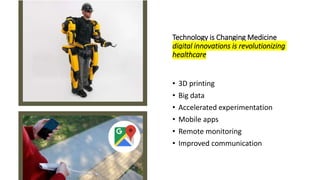
Technology is Changing Medicine
digital innovations is revolutionizing
healthcare
• 3D printing
• Big data
• Accelerated experimentation
• Mobile apps
• Remote monitoring
• Improved communication
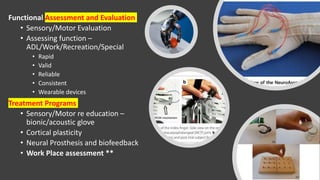
Functional Assessment and Evaluation
• Sensory/Motor Evaluation
• Assessing function –
ADL/Work/Recreation/Special
• Rapid
• Valid
• Reliable
• Consistent
• Wearable devices
Treatment Programs
• Sensory/Motor re education –
bionic/acoustic glove
• Cortical plasticity
• Neural Prosthesis and biofeedback
• Work Place assessment **
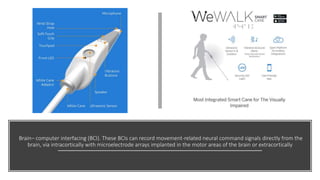
Brain– computer interfacing (BCI). These BCIs can record movement-related neural command signals directly from the
brain, via intracortically with microelectrode arrays implanted in the motor areas of the brain or extracortically
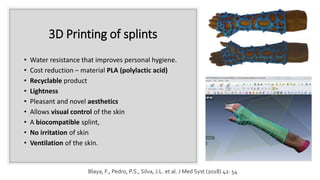
3D Printing of splints
• Water resistance that improves personal hygiene.
• Cost reduction – material PLA (polylactic acid)
• Recyclable product
• Lightness
• Pleasant and novel aesthetics
• Allows visual control of the skin
• A biocompatible splint,
• No irritation of skin
• Ventilation of the skin.
Blaya, F., Pedro, P.S., Silva, J.L. et al. J Med Syst (2018) 42: 54
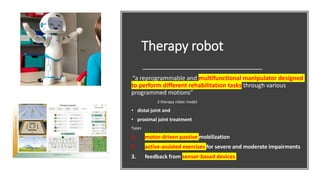
Therapy robot
“a reprogrammable and multifunctional manipulator designed
to perform different rehabilitation tasks through various
programmed motions”
2 therapy robot model
• distal joint and
• proximal joint treatment
Types
1. motor-driven passive mobilization
2. active-assisted exercises for severe and moderate impairments
3. feedback from sensor-based devices
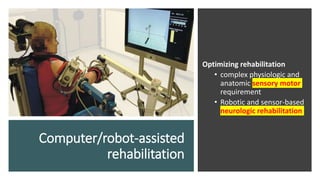
Computer/robot-assisted
rehabilitation
Optimizing rehabilitation
• complex physiologic and
anatomic sensory motor
requirement
• Robotic and sensor-based
neurologic rehabilitation
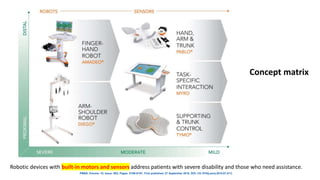
Concept matrix
Robotic devices with built-in motors and sensors address patients with severe disability and those who need assistance.
PM&R, Volume: 10, Issue: 9S2, Pages: S189-S197, First published: 27 September 2018, DOI: (10.1016/j.pmrj.2018.07.011)
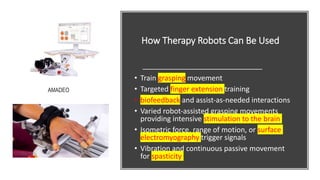
How Therapy Robots Can Be Used
• Train grasping movement
• Targeted finger extension training
• biofeedback and assist‐as‐needed interactions
• Varied robot‐assisted grasping movements
providing intensive stimulation to the brain
• Isometric force, range of motion, or surface
electromyography trigger signals
• Vibration and continuous passive movement
for spasticity
AMADEO
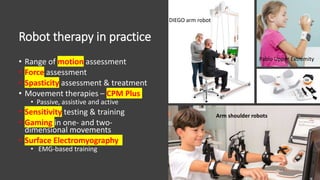
Robot therapy in practice
• Range of motion assessment
• Force assessment
• Spasticity assessment & treatment
• Movement therapies – CPM Plus
• Passive, assistive and active
• Sensitivity testing & training
• Gaming in one- and two-
dimensional movements
• Surface Electromyography
• EMG-based training
Arm shoulder robots
DIEGO arm robot
Pablo Upper Extremity
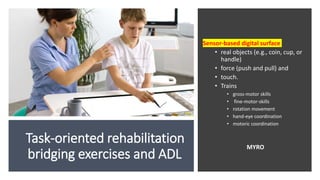
Task-oriented rehabilitation
bridging exercises and ADL
Sensor‐based digital surface
• real objects (e.g., coin, cup, or
handle)
• force (push and pull) and
• touch.
• Trains
• gross-motor skills
• fine-motor-skills
• rotation movement
• hand-eye coordination
• motoric coordination
MYRO
• wearable systems
• monitoring and provision
of feedback
• on posture and upper
extremity movements
• in stroke rehabilitation.
• accelerometers and
inertial measurement
units (IMUs) - most
frequently used sensors,
Journal of NeuroEngineering and Rehabilitation (2017) 14:20
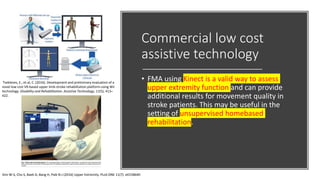
Commercial low cost
assistive technology
• FMA using Kinect is a valid way to assess
upper extremity function and can provide
additional results for movement quality in
stroke patients. This may be useful in the
setting of unsupervised homebased
rehabilitation.
Kim W-S, Cho S, Baek D, Bang H, Paik N-J (2016) Upper Extremity. PLoS ONE 11(7): e0158640
Tsekleves, E., et.al, C. (2016). Development and preliminary evaluation of a
novel low cost VR-based upper limb stroke rehabilitation platform using Wii
technology. Disability and Rehabilitation. Assistive Technology, 11(5), 413–
422.
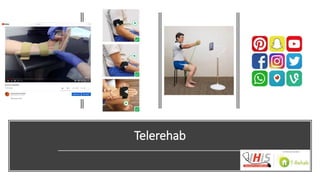
Telerehab
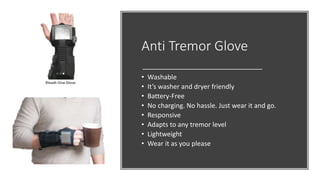
Anti Tremor Glove
• Washable
• It’s washer and dryer friendly
• Battery-Free
• No charging. No hassle. Just wear it and go.
• Responsive
• Adapts to any tremor level
• Lightweight
• Wear it as you please
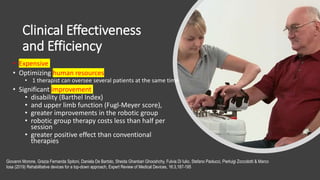
Clinical Effectiveness
and Efficiency
• Expensive
• Optimizing human resources
• 1 therapist can oversee several patients at the same time
• Significant improvement
• disability (Barthel Index)
• and upper limb function (Fugl‐Meyer score),
• greater improvements in the robotic group
• robotic group therapy costs less than half per
session
• greater positive effect than conventional
therapies
Giovanni Morone, Grazia Fernanda Spitoni, Daniela De Bartolo, Sheida Ghanbari Ghooshchy, Fulvia Di Iulio, Stefano Paolucci, Pierluigi Zoccolotti & Marco
Iosa (2019) Rehabilitative devices for a top-down approach, Expert Review of Medical Devices, 16:3,187-195
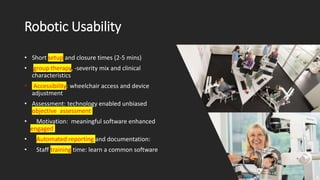
Robotic Usability
• Short setup and closure times (2-5 mins)
• group therapy, -severity mix and clinical
characteristics
• Accessibility: wheelchair access and device
adjustment
• Assessment: technology enabled unbiased
objective assessment
• Motivation: meaningful software enhanced
engaged
• Automated reporting and documentation:
• Staff training time: learn a common software
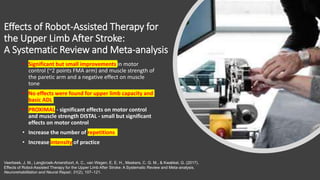
Effects of Robot-Assisted Therapy for
the Upper Limb After Stroke:
A Systematic Review and Meta-analysis
• Significant but small improvements in motor
control (~2 points FMA arm) and muscle strength of
the paretic arm and a negative effect on muscle
tone
• No effects were found for upper limb capacity and
basic ADL
• PROXIMAL - significant effects on motor control
and muscle strength DISTAL - small but significant
effects on motor control
• Increase the number of repetitions
• Increase intensity of practice
Veerbeek, J. M., Langbroek-Amersfoort, A. C., van Wegen, E. E. H., Meskers, C. G. M., & Kwakkel, G. (2017).
Effects of Robot-Assisted Therapy for the Upper Limb After Stroke: A Systematic Review and Meta-analysis.
Neurorehabilitation and Neural Repair, 31(2), 107–121.
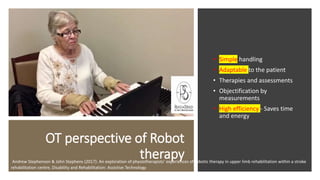
OT perspective of Robot
therapy
• Simple handling
• Adaptable to the patient
• Therapies and assessments
• Objectification by
measurements
• High efficiency - Saves time
and energy
Andrew Stephenson & John Stephens (2017): An exploration of physiotherapists’ experiences of robotic therapy in upper limb rehabilitation within a stroke
rehabilitation centre, Disability and Rehabilitation: Assistive Technology
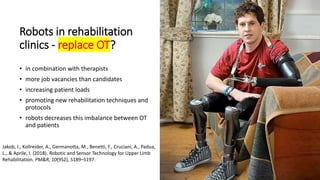
Robots in rehabilitation
clinics - replace OT?
• in combination with therapists
• more job vacancies than candidates
• increasing patient loads
• promoting new rehabilitation techniques and
protocols
• robots decreases this imbalance between OT
and patients
Jakob, I., Kollreider, A., Germanotta, M., Benetti, F., Cruciani, A., Padua,
L., & Aprile, I. (2018). Robotic and Sensor Technology for Upper Limb
Rehabilitation. PM&R, 10(9S2), S189–S197.
• valued the use of RT as an adjunct to
conventional therapy,
• barriers to successful implementation
seemed to dominate the views of some
• Resource management and skill mix
crucial
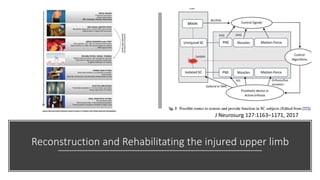
Reconstruction and Rehabilitating the injured upper limb
J Neurosurg 127:1163–1171, 2017
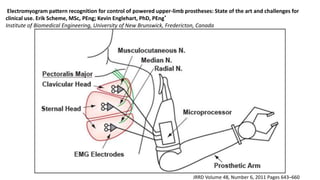
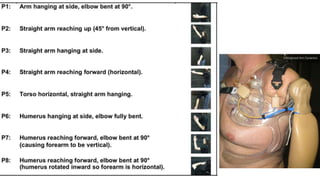
Electromyogram pattern recognition for control of powered upper-limb prostheses: State of the art and challenges for
clinical use. Erik Scheme, MSc, PEng; Kevin Englehart, PhD, PEng*
Institute of Biomedical Engineering, University of New Brunswick, Fredericton, Canada
JRRD Volume 48, Number 6, 2011 Pages 643–660
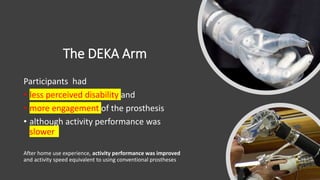
The DEKA Arm
Participants had
• less perceived disability and
• more engagement of the prosthesis
• although activity performance was
slower
After home use experience, activity performance was improved
and activity speed equivalent to using conventional prostheses
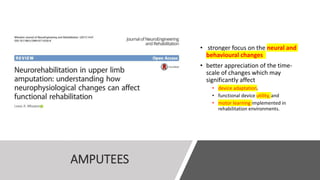
AMPUTEES
• stronger focus on the neural and
behavioural changes
• better appreciation of the time-
scale of changes which may
significantly affect
• device adaptation,
• functional device utility, and
• motor learning implemented in
rehabilitation environments.

Advanced technology in Rehabilitation

  • 1.
    ADVANCED TECHNOLOGY IN UPPERLIMB REHABILITATION Mr Vaikunthan Rajaratnam MBBS(Mal),AM(Mal),FRCS(Ed),FRCS(Glasg),MIDT Dist(OUM),FICS(USA),MBA(USA), Dip Hand Surgery(Eur),Dip MedEd(Dundee),FHEA(UK),FFST(Ed),FAcadMEd(UK). Senior Consultant Hand Surgeon KTPH NHG Healthcare Group, SINGAPORE
  • 2.
    Technology is ChangingMedicine digital innovations is revolutionizing healthcare • 3D printing • Big data • Accelerated experimentation • Mobile apps • Remote monitoring • Improved communication
  • 3.
    Functional Assessment andEvaluation • Sensory/Motor Evaluation • Assessing function – ADL/Work/Recreation/Special • Rapid • Valid • Reliable • Consistent • Wearable devices Treatment Programs • Sensory/Motor re education – bionic/acoustic glove • Cortical plasticity • Neural Prosthesis and biofeedback • Work Place assessment **
  • 4.
    Brain– computer interfacing(BCI). These BCIs can record movement-related neural command signals directly from the brain, via intracortically with microelectrode arrays implanted in the motor areas of the brain or extracortically
  • 5.
    3D Printing ofsplints • Water resistance that improves personal hygiene. • Cost reduction – material PLA (polylactic acid) • Recyclable product • Lightness • Pleasant and novel aesthetics • Allows visual control of the skin • A biocompatible splint, • No irritation of skin • Ventilation of the skin. Blaya, F., Pedro, P.S., Silva, J.L. et al. J Med Syst (2018) 42: 54
  • 7.
    Therapy robot “a reprogrammableand multifunctional manipulator designed to perform different rehabilitation tasks through various programmed motions” 2 therapy robot model • distal joint and • proximal joint treatment Types 1. motor-driven passive mobilization 2. active-assisted exercises for severe and moderate impairments 3. feedback from sensor-based devices
  • 8.
    Computer/robot-assisted rehabilitation Optimizing rehabilitation • complexphysiologic and anatomic sensory motor requirement • Robotic and sensor-based neurologic rehabilitation
  • 9.
    Concept matrix Robotic deviceswith built-in motors and sensors address patients with severe disability and those who need assistance. PM&R, Volume: 10, Issue: 9S2, Pages: S189-S197, First published: 27 September 2018, DOI: (10.1016/j.pmrj.2018.07.011)
  • 10.
    How Therapy RobotsCan Be Used • Train grasping movement • Targeted finger extension training • biofeedback and assist‐as‐needed interactions • Varied robot‐assisted grasping movements providing intensive stimulation to the brain • Isometric force, range of motion, or surface electromyography trigger signals • Vibration and continuous passive movement for spasticity AMADEO
  • 11.
    Robot therapy inpractice • Range of motion assessment • Force assessment • Spasticity assessment & treatment • Movement therapies – CPM Plus • Passive, assistive and active • Sensitivity testing & training • Gaming in one- and two- dimensional movements • Surface Electromyography • EMG-based training Arm shoulder robots DIEGO arm robot Pablo Upper Extremity
  • 14.
    Task-oriented rehabilitation bridging exercisesand ADL Sensor‐based digital surface • real objects (e.g., coin, cup, or handle) • force (push and pull) and • touch. • Trains • gross-motor skills • fine-motor-skills • rotation movement • hand-eye coordination • motoric coordination MYRO
  • 15.
    • wearable systems •monitoring and provision of feedback • on posture and upper extremity movements • in stroke rehabilitation. • accelerometers and inertial measurement units (IMUs) - most frequently used sensors, Journal of NeuroEngineering and Rehabilitation (2017) 14:20
  • 16.
    Commercial low cost assistivetechnology • FMA using Kinect is a valid way to assess upper extremity function and can provide additional results for movement quality in stroke patients. This may be useful in the setting of unsupervised homebased rehabilitation. Kim W-S, Cho S, Baek D, Bang H, Paik N-J (2016) Upper Extremity. PLoS ONE 11(7): e0158640 Tsekleves, E., et.al, C. (2016). Development and preliminary evaluation of a novel low cost VR-based upper limb stroke rehabilitation platform using Wii technology. Disability and Rehabilitation. Assistive Technology, 11(5), 413– 422.
  • 17.
  • 18.
    Anti Tremor Glove •Washable • It’s washer and dryer friendly • Battery-Free • No charging. No hassle. Just wear it and go. • Responsive • Adapts to any tremor level • Lightweight • Wear it as you please
  • 19.
    Clinical Effectiveness and Efficiency •Expensive • Optimizing human resources • 1 therapist can oversee several patients at the same time • Significant improvement • disability (Barthel Index) • and upper limb function (Fugl‐Meyer score), • greater improvements in the robotic group • robotic group therapy costs less than half per session • greater positive effect than conventional therapies Giovanni Morone, Grazia Fernanda Spitoni, Daniela De Bartolo, Sheida Ghanbari Ghooshchy, Fulvia Di Iulio, Stefano Paolucci, Pierluigi Zoccolotti & Marco Iosa (2019) Rehabilitative devices for a top-down approach, Expert Review of Medical Devices, 16:3,187-195
  • 20.
    Robotic Usability • Shortsetup and closure times (2-5 mins) • group therapy, -severity mix and clinical characteristics • Accessibility: wheelchair access and device adjustment • Assessment: technology enabled unbiased objective assessment • Motivation: meaningful software enhanced engaged • Automated reporting and documentation: • Staff training time: learn a common software
  • 21.
    Effects of Robot-AssistedTherapy for the Upper Limb After Stroke: A Systematic Review and Meta-analysis • Significant but small improvements in motor control (~2 points FMA arm) and muscle strength of the paretic arm and a negative effect on muscle tone • No effects were found for upper limb capacity and basic ADL • PROXIMAL - significant effects on motor control and muscle strength DISTAL - small but significant effects on motor control • Increase the number of repetitions • Increase intensity of practice Veerbeek, J. M., Langbroek-Amersfoort, A. C., van Wegen, E. E. H., Meskers, C. G. M., & Kwakkel, G. (2017). Effects of Robot-Assisted Therapy for the Upper Limb After Stroke: A Systematic Review and Meta-analysis. Neurorehabilitation and Neural Repair, 31(2), 107–121.
  • 22.
    OT perspective ofRobot therapy • Simple handling • Adaptable to the patient • Therapies and assessments • Objectification by measurements • High efficiency - Saves time and energy Andrew Stephenson & John Stephens (2017): An exploration of physiotherapists’ experiences of robotic therapy in upper limb rehabilitation within a stroke rehabilitation centre, Disability and Rehabilitation: Assistive Technology
  • 23.
    Robots in rehabilitation clinics- replace OT? • in combination with therapists • more job vacancies than candidates • increasing patient loads • promoting new rehabilitation techniques and protocols • robots decreases this imbalance between OT and patients Jakob, I., Kollreider, A., Germanotta, M., Benetti, F., Cruciani, A., Padua, L., & Aprile, I. (2018). Robotic and Sensor Technology for Upper Limb Rehabilitation. PM&R, 10(9S2), S189–S197.
  • 24.
    • valued theuse of RT as an adjunct to conventional therapy, • barriers to successful implementation seemed to dominate the views of some • Resource management and skill mix crucial
  • 25.
    Reconstruction and Rehabilitatingthe injured upper limb J Neurosurg 127:1163–1171, 2017
  • 26.
    Electromyogram pattern recognitionfor control of powered upper-limb prostheses: State of the art and challenges for clinical use. Erik Scheme, MSc, PEng; Kevin Englehart, PhD, PEng* Institute of Biomedical Engineering, University of New Brunswick, Fredericton, Canada JRRD Volume 48, Number 6, 2011 Pages 643–660
  • 28.
    The DEKA Arm Participantshad • less perceived disability and • more engagement of the prosthesis • although activity performance was slower After home use experience, activity performance was improved and activity speed equivalent to using conventional prostheses
  • 29.
    AMPUTEES • stronger focuson the neural and behavioural changes • better appreciation of the time- scale of changes which may significantly affect • device adaptation, • functional device utility, and • motor learning implemented in rehabilitation environments.