Coastal Erosion
Breakwaters Off shore breakwaters reduce the force of the waves and reduce the amount of costal erosion to the land behind it. They can either be floating or fixed depending the water dept and tides. They are designed  to absorb shock, this either done by simple mass, the waves will just hit it. Or buy a slope which slowly stops the waves using gravity.They are usually used in harbours because of the amount of ships going in and out but can also be used to stop erosion and stop the destruction of a beach.Advantages:They stop wave forcePrevent costal erosion effectivelyProvides a suitable area for a port or harbour.Disadvantages:ExpensiveVisual pollution
GabionsAre metal cages filled with rocks.  They are very versatile. They can be stacked into the required shape, used to filter silt from run-off and used to retain walls, this can also be useful in a coastal erosion situation.Like breakwaters they are a shock absorbers and used to reduce the force of waves.Advantages:Protect areas below cliffs or hill for landslideCheapAn effective erosion stopperDisadvantages:Visual pollutionCan be obstructive on a beach
GroynesGroynes prevent  longshore drift, they do this by stopping the sand that the waves push along the beach in longshore drift. However, people don’t always see eye-to-eye on the subject, they are considerd to be a form of visual pollution but do prevent a beach being taken by longshore drift.Advantages:Effective preventers of long shore driftCheap resources requiredDisadvantages:Lots of maintenance Visual pollution
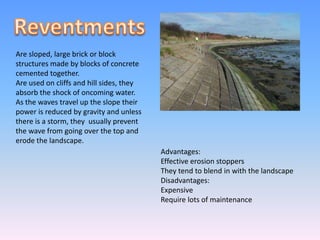
ReventmentsAre sloped, large brick or block structures made by blocks of concrete cemented together.Are used on cliffs and hill sides, they absorb the shock of oncoming water. As the waves travel up the slope their power is reduced by gravity and unless there is a storm, they  usually prevent  the wave from going over the top and erode the landscape.Advantages:Effective erosion stoppersThey tend to blend in with the landscapeDisadvantages:ExpensiveRequire lots of maintenance
Sea WallSea walls are huge concrete structures, usually curved to deflect the wash.If they are flat faced, they just stop the wave in its tracks, a curved one deflect away the swash and it goes back into the sea.Advantages:Very strong and solid, to prevent wave actionDisadvantages:ExpensiveNeeds lots of maintenanceUgly structure.

Costal Protection

  • 1.
  • 2.
    Breakwaters Off shorebreakwaters reduce the force of the waves and reduce the amount of costal erosion to the land behind it. They can either be floating or fixed depending the water dept and tides. They are designed to absorb shock, this either done by simple mass, the waves will just hit it. Or buy a slope which slowly stops the waves using gravity.They are usually used in harbours because of the amount of ships going in and out but can also be used to stop erosion and stop the destruction of a beach.Advantages:They stop wave forcePrevent costal erosion effectivelyProvides a suitable area for a port or harbour.Disadvantages:ExpensiveVisual pollution
  • 3.
    GabionsAre metal cagesfilled with rocks. They are very versatile. They can be stacked into the required shape, used to filter silt from run-off and used to retain walls, this can also be useful in a coastal erosion situation.Like breakwaters they are a shock absorbers and used to reduce the force of waves.Advantages:Protect areas below cliffs or hill for landslideCheapAn effective erosion stopperDisadvantages:Visual pollutionCan be obstructive on a beach
  • 4.
    GroynesGroynes prevent longshore drift, they do this by stopping the sand that the waves push along the beach in longshore drift. However, people don’t always see eye-to-eye on the subject, they are considerd to be a form of visual pollution but do prevent a beach being taken by longshore drift.Advantages:Effective preventers of long shore driftCheap resources requiredDisadvantages:Lots of maintenance Visual pollution
  • 5.
    ReventmentsAre sloped, largebrick or block structures made by blocks of concrete cemented together.Are used on cliffs and hill sides, they absorb the shock of oncoming water. As the waves travel up the slope their power is reduced by gravity and unless there is a storm, they usually prevent the wave from going over the top and erode the landscape.Advantages:Effective erosion stoppersThey tend to blend in with the landscapeDisadvantages:ExpensiveRequire lots of maintenance
  • 6.
    Sea WallSea wallsare huge concrete structures, usually curved to deflect the wash.If they are flat faced, they just stop the wave in its tracks, a curved one deflect away the swash and it goes back into the sea.Advantages:Very strong and solid, to prevent wave actionDisadvantages:ExpensiveNeeds lots of maintenanceUgly structure.