ORAL
PRESENTATION
 Understand different types of presentations
 Able to prepare and research the topic
thoroughly for the presentation.
 Able to deliver presentations effectively
 Wise choices of visual aids for greater impact
 Effective handling of questions
 Organizing materials for captivating
presentation.
 ?????????
 Heights
 Insects and bugs
 Financial problems
 Deep water
 Sickness
 Death
 Flying
 Loneliness
 Dogs
An oral presentation is a one-
t0-group encounter
lectures,seminars,talks,oral
reports).
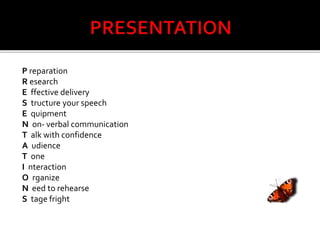
P reparation
R esearch
E ffective delivery
S tructure your speech
E quipment
N on- verbal communication
T alk with confidence
A udience
T one
I nteraction
O rganize
N eed to rehearse
S tage fright
 Helps to increase personal influence and “visibility”
which are important to managerial success.
 Presents an opportunity to demonstrate your
expertise and leadership ability.
 Facilitates better decision making.
Oral
Presentation
Knowing
the
audience
Planning and
preparation
Delivery
Practice
Visual aids
Overcoming
stage fright
 Is it to persuade?
 Is it to inform?
 Is it to recommend?
 Or is it a combination of some or all of these?
Plan
Analyze situation
Gather Information
Select the Right
Medium
Organize the
information
Write
Adapt to your audience
Compose your
presentation
Complete
Revise the message
Master your delivery
Prepare to speak
OvercomeAnxiety
 Define purpose of presentation
 To inform
 To persuade
 Develop profile of your audience
 Size and composition
 Audience reaction
 Audience’s level of understanding
 Scene/Circumstances
 Choose the best medium for delivering your
presentation including handouts and other
supporting materials
 Medium often used
 Overhead transparencies
 Electronic presentation (OHP, slide show)
 Whiteboards
 Handouts
 Flipcharts
ADVANTAGES
 Easy to prepare
 Does not require latest
computer or projection
equipment
 OHP never crash on the
user
DISADVANTAGES
 Limited to display
 Impossible to edit once
printed
ADVANTAGES
 Easy to update and edit
 Sounds, photos, videos and
animation can be added to
get attention
 Can be recorded for self-
running presentation for
websites, etc
 More professional
DISADVANTAGES
 High cost equipment
 Hardware and software fail
to cooperate
 Encourage inexperience
users to create poorly
designed slides
ADVANTAGES
 Effective tool to illustrate
points during small group
discussions
 Flexible and spontaneous
nature of brainstorming
sessions
DISADVANTAGES
 Difficulty in capturing
information written on
them
ADVANTAGES
 Support points made in
presentation
 Offer additional
information
 Enables audience to take
notes
DISADVANTAGES
 Allows audience to read
before listening to you
 Encourage listeners to
backfire you if your subject
is sensitive
ADVANTAGES
 Record ideas generated
during discussion
 Record comments and
discussions during
presentation
 Keep track of all the ideas
generated
 Low cost
DISADVANTAGES
 Low technology
 Define your main idea
 Limit your scope
 Choose your approach
 Direct – for receptive audience
 Indirect – for audience that might resist to your ideas
 Prepare outline of presentation
 State your purpose and main idea
 Organize major points and sub points
 Identify introduction, body and close
 Show your connection
 Show your sources
 Choose a title
Introduction Body Closing
 A good introduction arouses the audience interest in your
topic, establish your credibility and prepares the audience
for what will follow
 Building rapport by getting their attention
 Attention grabber
 Tell a joke
 Tell an anecdote or a story
 Share a personal experience
 Quotation
 Statistics
 Show a movie clip
 State a proverb or saying
 Make a startling statement Recite a poem

 Discussion of your main points
 Ensure
 Organization of your presentation is clear
 Your presentation holds the audience attention
 Relate your subject to your audience needs
 People are interested in things that affect them personally.As much as
possible, present every point in light of your audience’s needs and values
 Anticipate your audience’s questions
 Try to anticipate as many questions as you can and address these
questions in the body of your presentation
 Use clear, vivid language
 Use familiar words, simple, short and less complex
 Explain the relationship between your subject and familiar ideas
 Stick to points that are directly and clearly relevant to your listeners
 Ask for opinions or pause occasionally for
questions or comments
 Audience feedback helps you determine whether your
listeners understand a key point before you launch
into another section
 Feedback also gives your audience members a chance
to switch for a time of listening to a time for
participating
 Illustrate your ideas with visual aid
 Visuals enliven your message, help you connect with
members and help them remember your message
more effectively
 Plan your closing carefully so that your audience leave
with your main ideas fresh in their mind
 Restating your main points
 Describing the next step – what is the next action
 Ending on a strong note – conclude with a quote, a call for
action or an encouraging word
 Delivery is how you present yourself and your
material to the audience
 Most important part of your presentation as
it is the deciding factor in convincing your
audience
 Delivery can be verbal (vocal) and nonverbal
VERBAL
 Be audible
 Be brisk – ongoing pace
 Be enthusiastic
 Be clear
NON-VERBAL
 Be poised
 Be expressive
 Be sincere – keep eye
contact
 Be confident
 Dress smartly
 Use notes discreetly
 Handle visuals confidently
 Memorizing
 Avoid memorizing
 Reading
 If your are delivering a technical or complex presentation,
you may want to read it. Otherwise reading is not
recommended.
 Speaking from Notes
 Making presentations with the help of an outline, note
card or visuals is usually the easiest and most effective
delivery mode
 Impromptu Speaking
 Avoid speaking unprepared unless you are well versed in
the topic
 Be well prepared
 Know your subject well
 Rehearse often
 Release your nervous energy by:
 Take deep relaxing breaths
 Tense and relax your muscle
 Do the best you can
 Don’t aim for perfection
 Hints for handling questions
 Know more about the topic that what you present to
the audience
 Anticipate areas where questions might arise
 Invite them to ask questions
 Listen and understand the questions carefully
 Repeat or rephrase the question for the whole
audience to hear
 Direct long winded members to get to the point
 Avoid letting one member dominate the question
session
 Hints for answering questions
 Think before you answer
 Keep to the objectives of your presentation
 Be honest
 Be brief and to the point
 Use clear and correct language
 Be polite
 Correct any false statement or assumptions before
answering
 Keep to the time allocated for question period
 Why??
 To become familiar with the material and the
organization
 To check timing of delivery
 To improve usage of the visual support
 To improve delivery style
 Rehearse in front of audience
 Rehearse with visuals
 Watch your performance in front of the mirror. If
possible videotape your performance
 Creating effective slides can be challenging
because you want to create presentations that
are attractive without compromising your
message
 Accuracy and simplicity are the keys to
effective visuals
 One of the biggest mistake you can make is to
overload them with information
 Readable – are the font too large? Can they be seen?
 Consistent – are colors and design used consistently?
 Simple – should some information be illustrated by a chart?
 Audience centered – are design elements such as animation and
clip art appropriate for audience?
 Clear – is the main point easy to understand?
 Focused – Does the slide support the key points of your message?
 Fully operational – Does all the animation or special effects work?
 When writing content for text slides:
 Limit each slide to one thought, concept or idea
 Limit the content to about 40 words – no more than six lines
of text
 Write short bulleted phrases
 Make your slide easy to read by using active words
 Include short information titles
What is Supply Chain Management
 Developing long-term partnerships among
channel members working together to create
a distribution system that reduces
inefficiencies, costs, and redundancies while
creating competitive advantage and satisfying
customers
Example of Ineffective Slide
What is Supply Chain Management
 Partnering with channel members
 Reducing channel inefficiencies
 Creating a competitive advantage
 Satisfying customers
Color Best Uses
Blue Background for electronic business presentation (usually dark
blue), safe and conservative
White Font color of choice for most electronic business presentation
with a dark background color
Yellow Text bullets and subheadings with a dark background
Green Highlight and accent color
Red Promote action or stimulate audience, seldom use as a
background
 Use color to stimulate specific emotional responses
 A good background should stay in the
background and not compete with the
foreground
 Cluttered or flashy backgrounds tend to distract
your message
 If your company have a standard design, use
them.
 Artwork is either functional – charts, diagrams or
decorative – simply to enhance look of your
slides
 Use decorative artwork sparingly.
 Use clipart only if it makes your presentation
more effective and compelling
What is Supply Chain
Management
• Partnering with channel members
• Reducing channel inefficiencies
• Creating a competitive advantage
• Satisfying customers
 Select font base on how well it will display
through a projection system
 Avoid script or decorative fonts
 Limit fonts to one or two per slide
 For thinner fonts, use boldface type
 Avoid italicized type
 Avoid all capitalized words and phrases
 Be consistent with fonts, type styles, colors
and sizes
 Arial are better choice for fonts
 Design inconsistencies confuse and annoy
audiences
 Don’t change colors and other design
elements randomly in your presentation
 Functional Animation
 Set of tools for changing and moving things on the
screen
 Use animation to support your message, not simple
for animation sake
 Transitions and Builds
 Transitions control how one slides replaces another
on screen
 Build control the release of text, graphics and other
elements on individual slides
 Use same transitions and build to avoid confusion and
distraction
 Hyperlinks andAction Buttons
 Use to add flexibility to your presentation or share
different kinds of files with the audience
 Hyperlink instructs the computer to jump to
another slide in your presentation
 Multimedia Elements
 For some presentations, audio or video clips are
an effective way to get you message across
 Engage content to your presentation as long as
they are relevant, interesting and brief
 Use handouts materials to support the points
you made in your presentation
 Handouts offer the audience additional
information on your topic
 Handouts include
 Complex charts and diagrams
 Articles and technical papers
 Case Studies
 Websites
 Copies of presentation slides
 Brochures
 Pictures
ORAL PRESENTATION.ppt

ORAL PRESENTATION.ppt

  • 1.
  • 2.
     Understand differenttypes of presentations  Able to prepare and research the topic thoroughly for the presentation.  Able to deliver presentations effectively  Wise choices of visual aids for greater impact  Effective handling of questions  Organizing materials for captivating presentation.
  • 3.
     ?????????  Heights Insects and bugs  Financial problems  Deep water  Sickness  Death  Flying  Loneliness  Dogs
  • 4.
    An oral presentationis a one- t0-group encounter lectures,seminars,talks,oral reports).
  • 5.
    P reparation R esearch Effective delivery S tructure your speech E quipment N on- verbal communication T alk with confidence A udience T one I nteraction O rganize N eed to rehearse S tage fright
  • 6.
     Helps toincrease personal influence and “visibility” which are important to managerial success.  Presents an opportunity to demonstrate your expertise and leadership ability.  Facilitates better decision making.
  • 7.
  • 8.
     Is itto persuade?  Is it to inform?  Is it to recommend?  Or is it a combination of some or all of these?
  • 9.
    Plan Analyze situation Gather Information Selectthe Right Medium Organize the information Write Adapt to your audience Compose your presentation Complete Revise the message Master your delivery Prepare to speak OvercomeAnxiety
  • 10.
     Define purposeof presentation  To inform  To persuade  Develop profile of your audience  Size and composition  Audience reaction  Audience’s level of understanding  Scene/Circumstances
  • 11.
     Choose thebest medium for delivering your presentation including handouts and other supporting materials  Medium often used  Overhead transparencies  Electronic presentation (OHP, slide show)  Whiteboards  Handouts  Flipcharts
  • 12.
    ADVANTAGES  Easy toprepare  Does not require latest computer or projection equipment  OHP never crash on the user DISADVANTAGES  Limited to display  Impossible to edit once printed
  • 13.
    ADVANTAGES  Easy toupdate and edit  Sounds, photos, videos and animation can be added to get attention  Can be recorded for self- running presentation for websites, etc  More professional DISADVANTAGES  High cost equipment  Hardware and software fail to cooperate  Encourage inexperience users to create poorly designed slides
  • 14.
    ADVANTAGES  Effective toolto illustrate points during small group discussions  Flexible and spontaneous nature of brainstorming sessions DISADVANTAGES  Difficulty in capturing information written on them
  • 15.
    ADVANTAGES  Support pointsmade in presentation  Offer additional information  Enables audience to take notes DISADVANTAGES  Allows audience to read before listening to you  Encourage listeners to backfire you if your subject is sensitive
  • 16.
    ADVANTAGES  Record ideasgenerated during discussion  Record comments and discussions during presentation  Keep track of all the ideas generated  Low cost DISADVANTAGES  Low technology
  • 17.
     Define yourmain idea  Limit your scope  Choose your approach  Direct – for receptive audience  Indirect – for audience that might resist to your ideas  Prepare outline of presentation  State your purpose and main idea  Organize major points and sub points  Identify introduction, body and close  Show your connection  Show your sources  Choose a title
  • 18.
  • 19.
     A goodintroduction arouses the audience interest in your topic, establish your credibility and prepares the audience for what will follow  Building rapport by getting their attention  Attention grabber  Tell a joke  Tell an anecdote or a story  Share a personal experience  Quotation  Statistics  Show a movie clip  State a proverb or saying  Make a startling statement Recite a poem 
  • 20.
     Discussion ofyour main points  Ensure  Organization of your presentation is clear  Your presentation holds the audience attention
  • 21.
     Relate yoursubject to your audience needs  People are interested in things that affect them personally.As much as possible, present every point in light of your audience’s needs and values  Anticipate your audience’s questions  Try to anticipate as many questions as you can and address these questions in the body of your presentation  Use clear, vivid language  Use familiar words, simple, short and less complex  Explain the relationship between your subject and familiar ideas  Stick to points that are directly and clearly relevant to your listeners
  • 22.
     Ask foropinions or pause occasionally for questions or comments  Audience feedback helps you determine whether your listeners understand a key point before you launch into another section  Feedback also gives your audience members a chance to switch for a time of listening to a time for participating  Illustrate your ideas with visual aid  Visuals enliven your message, help you connect with members and help them remember your message more effectively
  • 23.
     Plan yourclosing carefully so that your audience leave with your main ideas fresh in their mind  Restating your main points  Describing the next step – what is the next action  Ending on a strong note – conclude with a quote, a call for action or an encouraging word
  • 24.
     Delivery ishow you present yourself and your material to the audience  Most important part of your presentation as it is the deciding factor in convincing your audience  Delivery can be verbal (vocal) and nonverbal
  • 25.
    VERBAL  Be audible Be brisk – ongoing pace  Be enthusiastic  Be clear NON-VERBAL  Be poised  Be expressive  Be sincere – keep eye contact  Be confident  Dress smartly  Use notes discreetly  Handle visuals confidently
  • 26.
     Memorizing  Avoidmemorizing  Reading  If your are delivering a technical or complex presentation, you may want to read it. Otherwise reading is not recommended.  Speaking from Notes  Making presentations with the help of an outline, note card or visuals is usually the easiest and most effective delivery mode  Impromptu Speaking  Avoid speaking unprepared unless you are well versed in the topic
  • 27.
     Be wellprepared  Know your subject well  Rehearse often  Release your nervous energy by:  Take deep relaxing breaths  Tense and relax your muscle  Do the best you can  Don’t aim for perfection
  • 28.
     Hints forhandling questions  Know more about the topic that what you present to the audience  Anticipate areas where questions might arise  Invite them to ask questions  Listen and understand the questions carefully  Repeat or rephrase the question for the whole audience to hear  Direct long winded members to get to the point  Avoid letting one member dominate the question session
  • 29.
     Hints foranswering questions  Think before you answer  Keep to the objectives of your presentation  Be honest  Be brief and to the point  Use clear and correct language  Be polite  Correct any false statement or assumptions before answering  Keep to the time allocated for question period
  • 30.
     Why??  Tobecome familiar with the material and the organization  To check timing of delivery  To improve usage of the visual support  To improve delivery style  Rehearse in front of audience  Rehearse with visuals  Watch your performance in front of the mirror. If possible videotape your performance
  • 31.
     Creating effectiveslides can be challenging because you want to create presentations that are attractive without compromising your message  Accuracy and simplicity are the keys to effective visuals  One of the biggest mistake you can make is to overload them with information
  • 32.
     Readable –are the font too large? Can they be seen?  Consistent – are colors and design used consistently?  Simple – should some information be illustrated by a chart?  Audience centered – are design elements such as animation and clip art appropriate for audience?  Clear – is the main point easy to understand?  Focused – Does the slide support the key points of your message?  Fully operational – Does all the animation or special effects work?
  • 33.
     When writingcontent for text slides:  Limit each slide to one thought, concept or idea  Limit the content to about 40 words – no more than six lines of text  Write short bulleted phrases  Make your slide easy to read by using active words  Include short information titles
  • 34.
    What is SupplyChain Management  Developing long-term partnerships among channel members working together to create a distribution system that reduces inefficiencies, costs, and redundancies while creating competitive advantage and satisfying customers Example of Ineffective Slide
  • 35.
    What is SupplyChain Management  Partnering with channel members  Reducing channel inefficiencies  Creating a competitive advantage  Satisfying customers
  • 36.
    Color Best Uses BlueBackground for electronic business presentation (usually dark blue), safe and conservative White Font color of choice for most electronic business presentation with a dark background color Yellow Text bullets and subheadings with a dark background Green Highlight and accent color Red Promote action or stimulate audience, seldom use as a background  Use color to stimulate specific emotional responses
  • 37.
     A goodbackground should stay in the background and not compete with the foreground  Cluttered or flashy backgrounds tend to distract your message  If your company have a standard design, use them.  Artwork is either functional – charts, diagrams or decorative – simply to enhance look of your slides  Use decorative artwork sparingly.  Use clipart only if it makes your presentation more effective and compelling
  • 38.
    What is SupplyChain Management • Partnering with channel members • Reducing channel inefficiencies • Creating a competitive advantage • Satisfying customers
  • 39.
     Select fontbase on how well it will display through a projection system  Avoid script or decorative fonts  Limit fonts to one or two per slide  For thinner fonts, use boldface type  Avoid italicized type  Avoid all capitalized words and phrases  Be consistent with fonts, type styles, colors and sizes  Arial are better choice for fonts
  • 40.
     Design inconsistenciesconfuse and annoy audiences  Don’t change colors and other design elements randomly in your presentation
  • 41.
     Functional Animation Set of tools for changing and moving things on the screen  Use animation to support your message, not simple for animation sake  Transitions and Builds  Transitions control how one slides replaces another on screen  Build control the release of text, graphics and other elements on individual slides  Use same transitions and build to avoid confusion and distraction
  • 42.
     Hyperlinks andActionButtons  Use to add flexibility to your presentation or share different kinds of files with the audience  Hyperlink instructs the computer to jump to another slide in your presentation  Multimedia Elements  For some presentations, audio or video clips are an effective way to get you message across  Engage content to your presentation as long as they are relevant, interesting and brief
  • 43.
     Use handoutsmaterials to support the points you made in your presentation  Handouts offer the audience additional information on your topic
  • 44.
     Handouts include Complex charts and diagrams  Articles and technical papers  Case Studies  Websites  Copies of presentation slides  Brochures  Pictures