ADVANCED MANUFACTURINGADVANCED MANUFACTURING
PROCESSPROCESS
Mr. KONAL SINGHMr. KONAL SINGH
Director and Founder of
ProBotiZ Group, NagpurProBotiZ Group, Nagpur
1(W) - Probotizgroup.com (M) - 8862098889, 9423632068 (E) - probotizinfo@gmail.com
SYLLABUS
-Need and importance of nontraditional machining processes, its
classifications
-Electrical discharge Machining.
Principle of working, Setup of EDM, Dielectric fluid,
tools(electrodes), Process parameters, Output
characteristics,Applications e.g. micro hole drilling, curve hole
drilling.
-Wire cut EDM - Principle of working, Setup of WEDM,
controlling Parameters, Applications.
-Laser Beam Machining.
Physical principle of Laser, Laser action in ruby rod,
Types of Lasers. Set-up for LBM. Characteristics,
controlling Parameters, Applications, Application Of
Laser Beam for Welding (LBW)
-Other non traditional machines such as ECM, AJM,
USM, LBM, PAM etc. Principle of working, Applications
2
LEARNING OBJECTIVE
-In this chapter we are going to learn different types of
non traditional machining process.
- How traditional and non traditional machines differs.
3
Why Nontraditional Processes?
-New Materials (1940’s)
Stronger
Tougher
Harder
-Applications
Cut tough materials
Finish complex surface geometry
Surface finish requirements
texture, fine, etc.
4
Processes
-Mechanical
-Chemical
-Electrochemical
-Thermoelectric
5
Mechanical
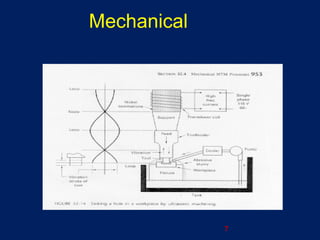
-Ultrasonic Machining - Cutting action is
accomplished with an abrasive slurry which is
driven by a tool vibrating at high frequency. The
tool is the exact shape of the desired shape to be
cut into the work.
-Applications
slots, blind holes, irregular shapes, and
through holes
6
Mechanical
7
Mechanical
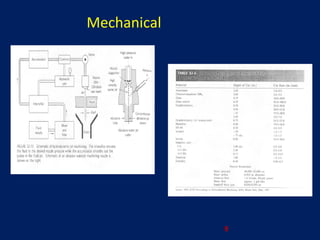
Abrasive Water-Jet Cutting
-Similar to sandblasting
-Process utilizes a high velocity stream of water
mixed with an -abrasive as the cutting tool
-Forces the mixture through a nozzle with a hole
diameter of .0040” - .012”
-System pressures range from 30,000 - 50,000
psi
-Used to cut a variety of materials from wood to
tool steel
-Cutting rate - ¼” Alum. Plate - 150 in/min.
-One disadvantage to note
Tolerances typically (+/- .01”) 8
Mechanical
9
Chemical
Chemical Milling
-Controlled etching process
-MRR about .001” cu/in per min ~ .045”
cu/in hour
-Process
Sample part is tested for erosion rate
Part to be “chem” machined is cleaned
Mask area you do not want to machine
Dip part in chemical solution hot
alkaline
Remove part
Clean part
10
Chemical
11
Electrochemical
-Basically the same
principle as plating
-Differences
Part is the anode (+) and
the tool is the cathode (-)
Metal is “pulled” away
from work
12
Electrochemical
Advantages
-Hard to soft materials made of
conductive material can be
machined
-Cutting tool can be made from soft
material
-Low heat generated during
process
-No cutting forces
-Excellent surface finish
13
Thermoelectric
Electrical Discharge Machining (EDM)
This process is like a mini-thunderstorm.
Flashes of lightning in rapid succession (500 -
5,000 sparks per second) erode material from
the part being machined.
14
EDM
-Machining action forms a gap between the
part and the electrode (tool) which causes a
spark which removes the material
-Electrode is (+) and the part is (-)
-Electrodes can be made from
Brass
Copper
Graphite-
15
EDM
-Cutting action takes place in a dielectric fluid
which helps to contain the spark and flush away
chips
-Metal removal rates (MRR) are low compared to
other process like milling
EDM, MRR= 1 cu/in to 15 cu/in per hr.
16
EDM
17
types of machines
EDM
18
EDM
Applications
-Finish geometry for molds ( die sinking)
Ram
-Punch & dies for blanking, shearing, and
progressive die tooling
Wire
19
SUMMARY
Non Traditional machines more useful for hard materials
and complex shapes can be produced easily.
These machines are more precise.
USM,EDM,WEDM are the examples of non traditional
machines.
20
21
REFERENCE:
ADVANCED MANUFACTURING PROCESS:
MP by S.L Gawale

Advance manufacturing process

  • 1.
    ADVANCED MANUFACTURINGADVANCED MANUFACTURING PROCESSPROCESS Mr.KONAL SINGHMr. KONAL SINGH Director and Founder of ProBotiZ Group, NagpurProBotiZ Group, Nagpur 1(W) - Probotizgroup.com (M) - 8862098889, 9423632068 (E) - probotizinfo@gmail.com
  • 2.
    SYLLABUS -Need and importanceof nontraditional machining processes, its classifications -Electrical discharge Machining. Principle of working, Setup of EDM, Dielectric fluid, tools(electrodes), Process parameters, Output characteristics,Applications e.g. micro hole drilling, curve hole drilling. -Wire cut EDM - Principle of working, Setup of WEDM, controlling Parameters, Applications. -Laser Beam Machining. Physical principle of Laser, Laser action in ruby rod, Types of Lasers. Set-up for LBM. Characteristics, controlling Parameters, Applications, Application Of Laser Beam for Welding (LBW) -Other non traditional machines such as ECM, AJM, USM, LBM, PAM etc. Principle of working, Applications 2
  • 3.
    LEARNING OBJECTIVE -In thischapter we are going to learn different types of non traditional machining process. - How traditional and non traditional machines differs. 3
  • 4.
    Why Nontraditional Processes? -NewMaterials (1940’s) Stronger Tougher Harder -Applications Cut tough materials Finish complex surface geometry Surface finish requirements texture, fine, etc. 4
  • 5.
  • 6.
    Mechanical -Ultrasonic Machining -Cutting action is accomplished with an abrasive slurry which is driven by a tool vibrating at high frequency. The tool is the exact shape of the desired shape to be cut into the work. -Applications slots, blind holes, irregular shapes, and through holes 6
  • 7.
  • 8.
    Mechanical Abrasive Water-Jet Cutting -Similarto sandblasting -Process utilizes a high velocity stream of water mixed with an -abrasive as the cutting tool -Forces the mixture through a nozzle with a hole diameter of .0040” - .012” -System pressures range from 30,000 - 50,000 psi -Used to cut a variety of materials from wood to tool steel -Cutting rate - ¼” Alum. Plate - 150 in/min. -One disadvantage to note Tolerances typically (+/- .01”) 8
  • 9.
  • 10.
    Chemical Chemical Milling -Controlled etchingprocess -MRR about .001” cu/in per min ~ .045” cu/in hour -Process Sample part is tested for erosion rate Part to be “chem” machined is cleaned Mask area you do not want to machine Dip part in chemical solution hot alkaline Remove part Clean part 10
  • 11.
  • 12.
    Electrochemical -Basically the same principleas plating -Differences Part is the anode (+) and the tool is the cathode (-) Metal is “pulled” away from work 12
  • 13.
    Electrochemical Advantages -Hard to softmaterials made of conductive material can be machined -Cutting tool can be made from soft material -Low heat generated during process -No cutting forces -Excellent surface finish 13
  • 14.
    Thermoelectric Electrical Discharge Machining(EDM) This process is like a mini-thunderstorm. Flashes of lightning in rapid succession (500 - 5,000 sparks per second) erode material from the part being machined. 14
  • 15.
    EDM -Machining action formsa gap between the part and the electrode (tool) which causes a spark which removes the material -Electrode is (+) and the part is (-) -Electrodes can be made from Brass Copper Graphite- 15
  • 16.
    EDM -Cutting action takesplace in a dielectric fluid which helps to contain the spark and flush away chips -Metal removal rates (MRR) are low compared to other process like milling EDM, MRR= 1 cu/in to 15 cu/in per hr. 16
  • 17.
  • 18.
  • 19.
    EDM Applications -Finish geometry formolds ( die sinking) Ram -Punch & dies for blanking, shearing, and progressive die tooling Wire 19
  • 20.
    SUMMARY Non Traditional machinesmore useful for hard materials and complex shapes can be produced easily. These machines are more precise. USM,EDM,WEDM are the examples of non traditional machines. 20
  • 21.