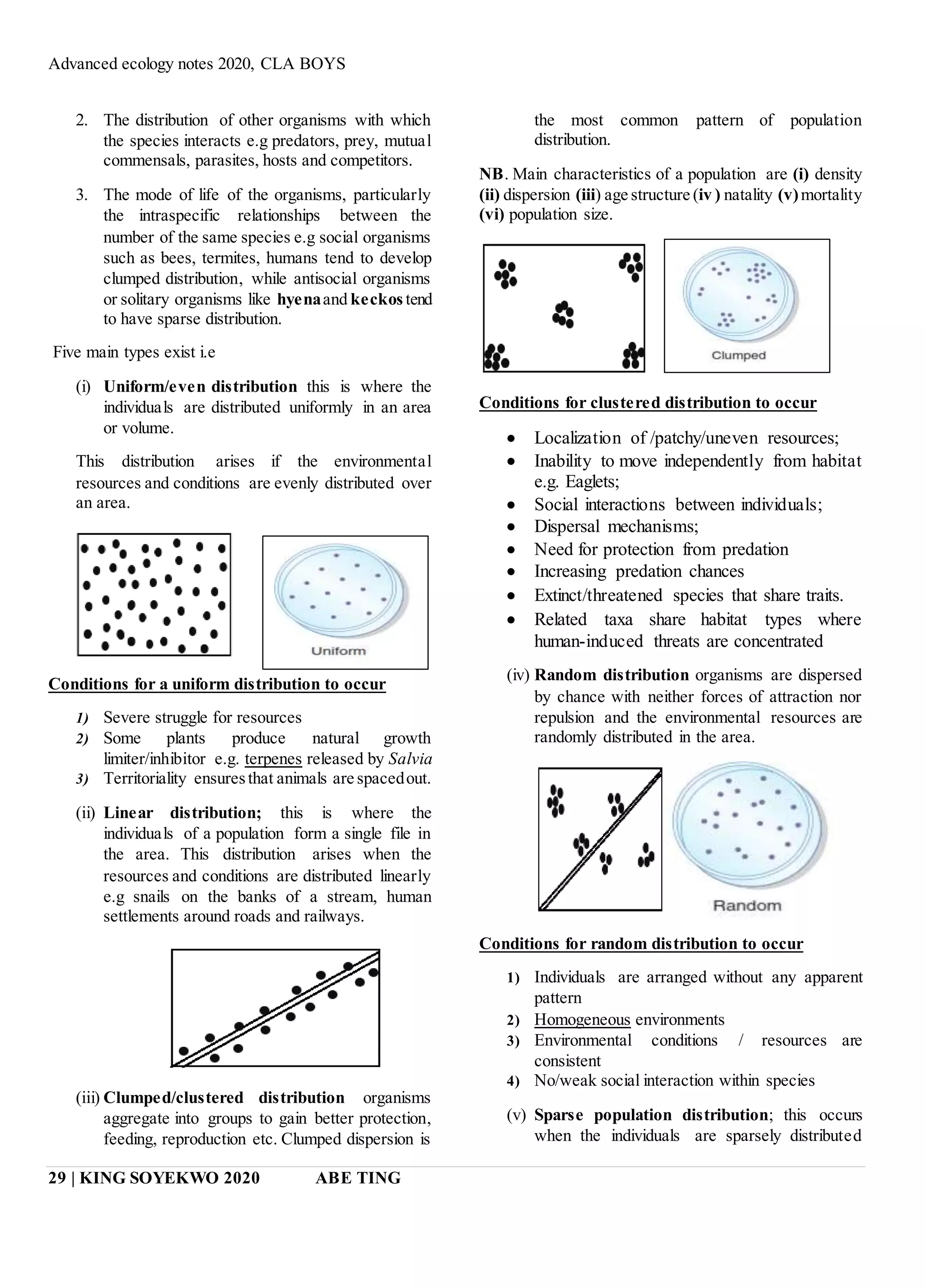
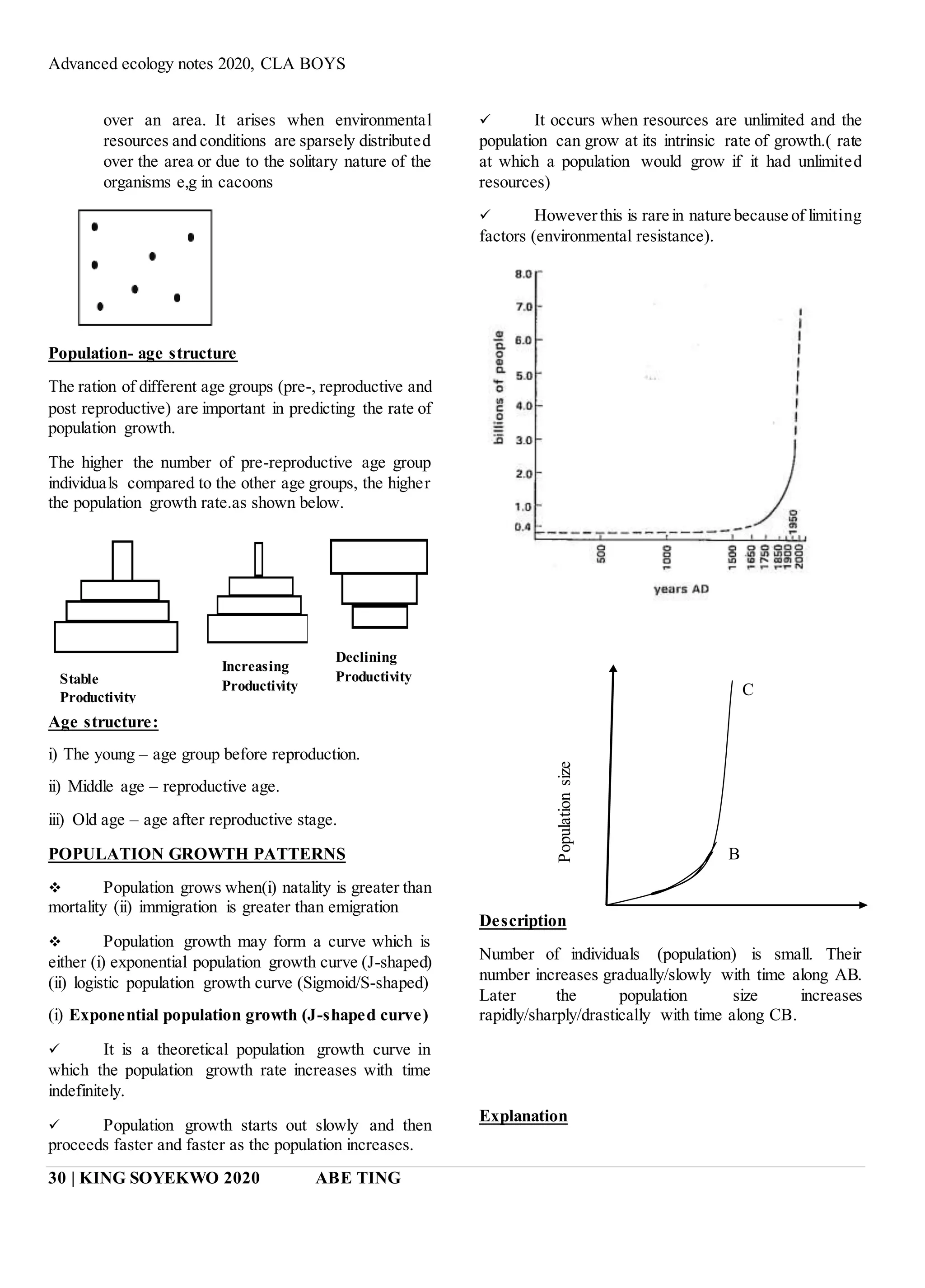
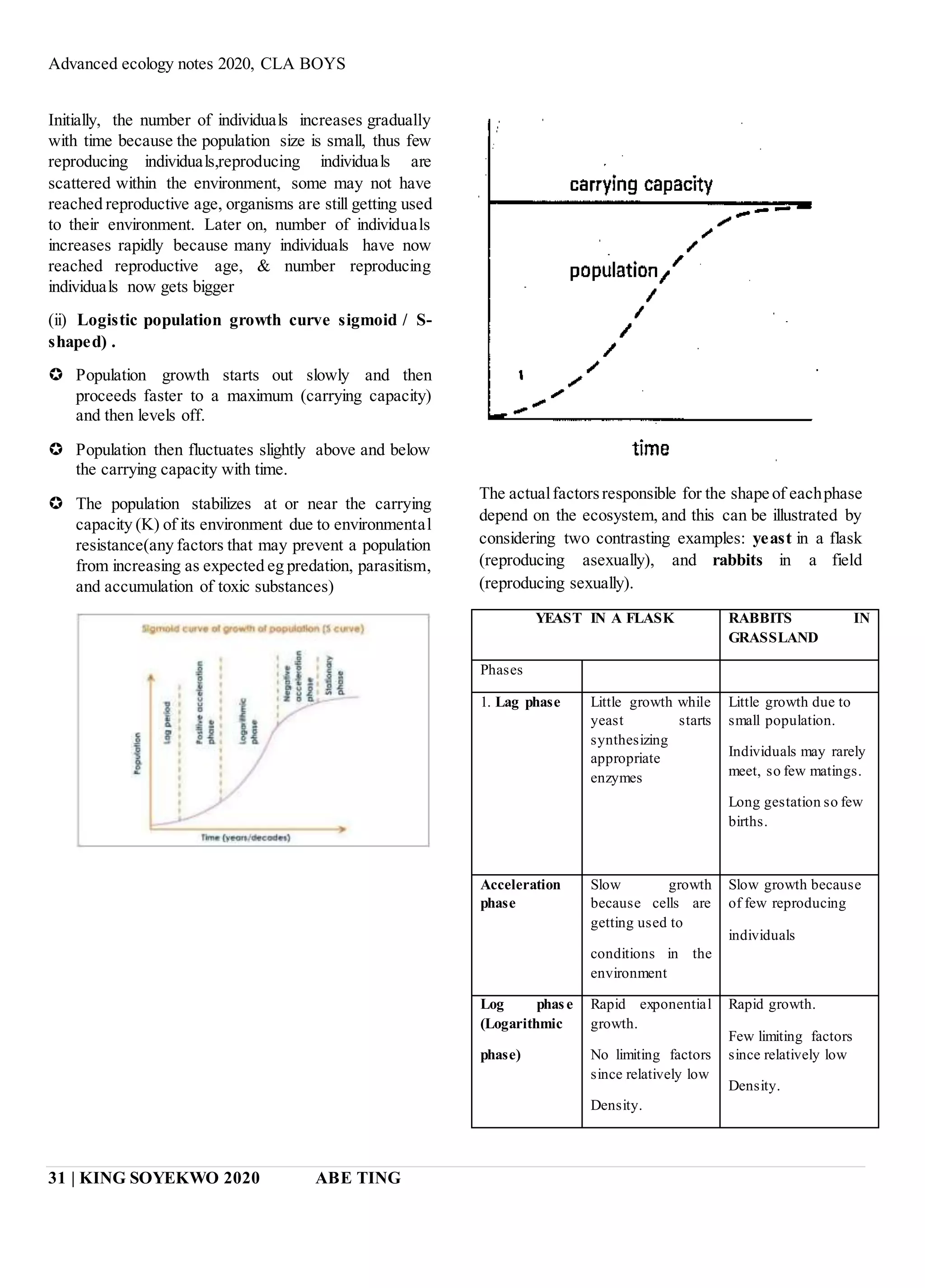
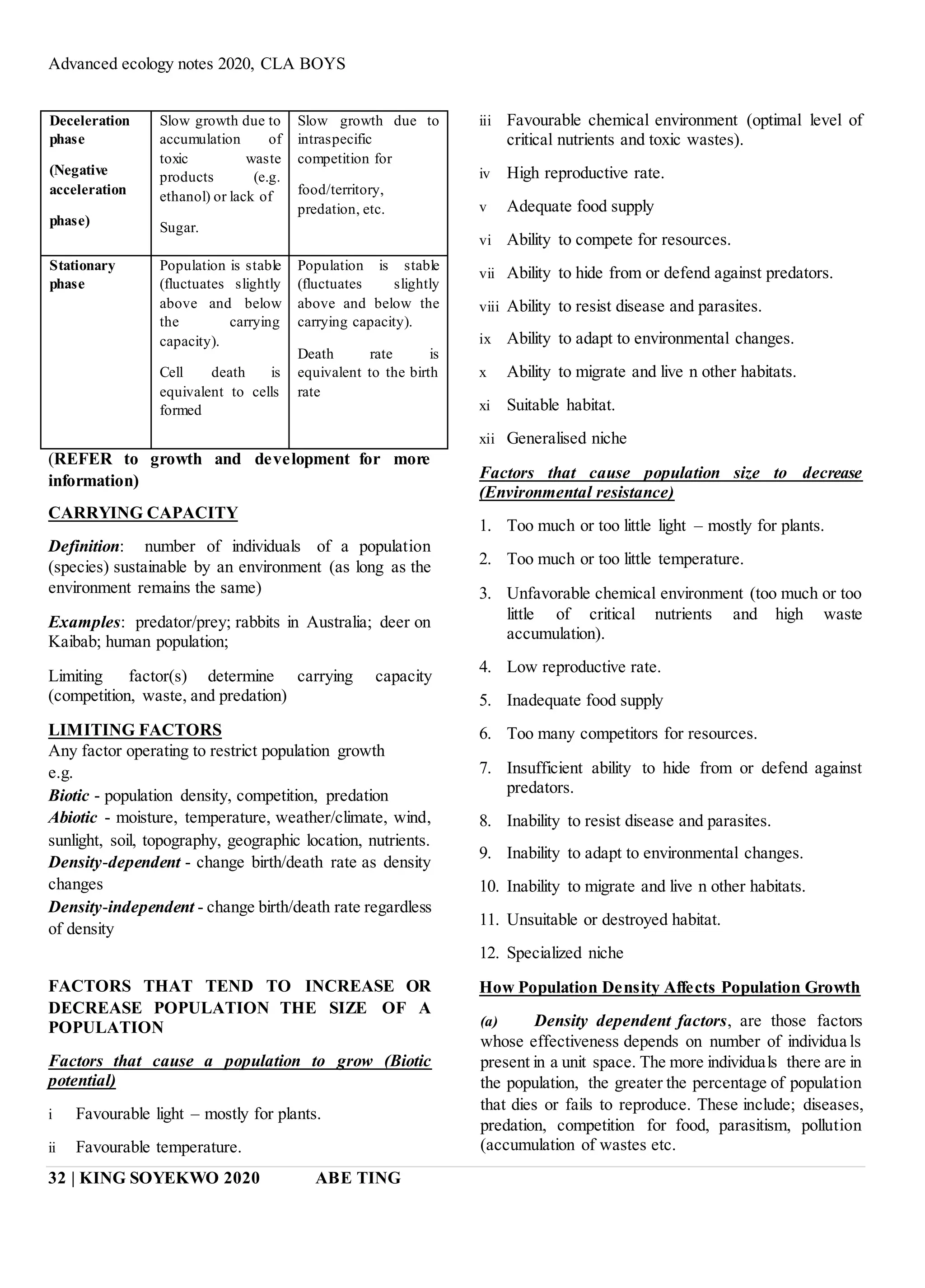
Advanced ecology notes 2020, CLA BOYS
1 | KING SOYEKWO 2020 ABE TING
ECOLOGY
It is the scientific study of the interactions that determine
the distribution and abundance of organisms within a
particular environment.
OR:
 Is the scientific study of the complex relationships
between organisms and their environment.
 These interactions determine the distribution and
abundance of organism within a particular
environment.
OLD DEFINITION OF ECOLOGY
The study of inter-relations betweenliving organisms and
their natural environment.
TERMS USED IN ECOLOGY
1. Ecosystem
A natural unit composed of living (biotic) and non-living
(abiotic) components whose interactions lead to a self-
sustaining systeme.g. ponds, lakes, forest,desert,stream.
2. Species
Group of organisms showing resemblance among
themselves in appearance, behaviour, chemistry and
genetic makeup.
Organisms that reproduce sexually are classified as
members of the same species if, under natural conditions,
they can (i) actually or potentially breed with one another
and (ii) produce fertile offspring.
3. Population
Total number of members of a species occupying a
specific area at the same time. E.g. tilapia fish in a pond,
mahogany trees in a forest, people in a country
4. Community
All the organisms of different species that interact in a
given, well defined area e.g. all organisms within a pond
5. Synecology
Study of many species within an ecosystem
6. Autecology
Study of single organisms or populations of single
species and their relationship to their environment e.g.
considering a lion in the bush, what does it feed on?, how
does it reproduce?,what are its competitors?, what are its
predators?, etc
7. Habitat
Specific locality where anorganism normally lives within
the environment e.g. the underside of a log for
earthworms, intestines of man for tapeworms, ponds for
frogs, kitchen for cockroaches, etc. Habitat is like the
“address” of an organism.
Microhabitat
Small locality within the habitat with particular
conditions (microclimate) that support specific
organisms e.g. mosses can grow at the upper side of a
fallen log, while the underside supports earthworms.
a) Niche /Ecological niche
The role an organism plays in the habitat, and its
interactions with other organisms. i.e. the sum of all
environmental factors that influence the growth, survival
and reproduction of a species. A niche is like the
“profession” of an organism
b) Fundamental niche
The physical conditions under which a speciesmight live,
in the absence of interactions with other species.
c) Realised niche
The role an organism plays in the habitat, and its
interactions with other organisms in the presence of
competition and other constraining factors i.e. is the set
of conditions under which an organism exists in nature.
8. Native species
Species that normally and shrive in a particular
ecosystem
9. Non-native/alien/exotic species
Species that migrate into the ecosystem or are
deliberately or accidentally introduced into an ecosystem
by humans e.g. crops and game species
10. Indicator species
Species that serve as early warnings of damage to a
community or an ecosystem
11. Keystone species
Species that play more important roles than others in
maintaining the structure and function of ecosystems of
which they are a part i.e. it is a dominant species that
dictates community structure by affecting abundances of
other species.
Advanced ecology notes 2020, CLA BOYS
2 | KING SOYEKWO 2020 ABE TING
Examples:
1) Top predator keystone species like lions, crocodiles
and great white sharks exert a stabilizing effect on
their ecosystems by feeding on and helping regulate
the populations of certain species.
2) Bats and birds regenerate deforested areas by
depositing plant seeds in their droppings.
3) Elephants uproot and break trees, creating forest
openings in the savanna grasslands and woodlands,
which promotes growth of grasses for grazers and
also accelerates nutrient recycling.
4) Dung beetles remove,bury and recycle animal wastes
(dung)
Note: all species play some role in their ecosystems and
thus are important, therefore the assertion that some
species are more important than others remains
controversial
THE MAJOR PARTS OF THE EARTH’S LIFE
SUPPORT SYSTEM
a) Atmosphere:
It is a thin envelope or membrane of air around the
planet.
b) Biosphere:
The part of the earth in which living organisms exist
and interact with one another and with their nonliving
environment. It reaches from the deepest ocean floor,
20 kilometers (12 miles) below sea level, to the top
of the highest mountains.
c) Troposphere:
Inner layer of the earthextending about 17 kilometers
(11miles) above sea level, but containing most of the
planet’s air, mostly nitrogen (78%) and oxygen
(21%).
d) Stratosphere:
This is the layer stretching 17 – 48 kilometers (11 –
30 miles) above the earth’s surface. Its lower portion
contains ozone (O3) to filter out most of the sun’s
harmful ultraviolet radiation.
e) Hydrosphere:
It consists of the earth’s (i) liquid water (both surface
and underground), (ii) ice (polar ice, icebergs, and ice
in frozen soil layers) (iii) water vapour in the
atmosphere.
f) Lithosphere:
This is the earth’s crust and upper mantle. The crust
contains nonrenewable fossil fuels and minerals as
well as renewable soil nutrients needed for plant life.
BIOMES
These are large regions of the biosphere characterized by
a distinct climate and specific life-forms (especially
vegetation) adapted to it.
Examples of the major terrestrial biomes of the world:
a) Tropical forests
i) Tropical rainforests: occur at low latitudes where the
rain falls abundantly all year long and temperature is
warm
ii) Tropical seasonal forests: occur where climate is
ratherdrier, and treesmay lose their leaves during the dry
season.
A forest biome is divided into ground zone (consisting
of millipedes & earthworms) and canopy zone/aerial
zone;(consisting of birds & monkeys); with eachof these
zones supporting different animals that are adapted to the
conditions within them.
b) Savannah: warm and dry grasslands with few trees,
typically supporting grazing of animals
c) Deserts: areas of very little rainfall, ranging from
entire barrennessto seasonalrainfall that supports growth
of some vegetation.
Deserts can be: Hot and dry desert regions
(evaporation is high and there is too much heat), cold
deserts (precipitation coming from colder water sources
than rain, such as snow or ice), temperate region (winters
and summers).
d) Chaparral (temperate shrub land): grow where
summers are hot and dry, and the winters are cool and
wet. Vegetation is composed of mainly dense spiny
shrubs with tough evergreen leaves.
e) Temperate grassland: are similar to savannas but
occur in cooler climates e.g. Canadian prairies and
pampas of Argentina.
f) Temperate forests: include deciduous and evergreen
forests but contain far fewer species than a tropical
rainforest.
g) Taiga (coniferous forest/boreal forest): conifer
forests in cold subarctic or subalpine conditions
Advanced ecology notes 2020, CLA BOYS
3 | KING SOYEKWO 2020 ABE TING
h) Tundra: treeless plains in the arctic; cold for most of
the year. It is characterized by grasses, lichens, sedges,
and mosses as the most predominant species.
 Organisms live within a relatively narrow sphere
(land, water and air) and the earth’s surface and this
is known as Biosphere/ecosphere.
 The biosphere is divided into two major regions
namely;
i. Aquatic regions; made up of fresh water (lakes
and ponds, rivers and streams, wetlands), marine water
(oceans), and estuaries.
ii. Terrestrial regions covering a few meters deep
in the soil and a few kilometers into the atmosphere.
 On land, there are several bio-geographical areas,
each with specific conditions that support distinct
species of plants and animals. Such areas include the
present day continents.
ECOSYSTEM
It is natural unit of environment composed of living
(biotic) and non-living (abiotic) components whose
interactions lead to a self-sustaining system.
(i) Water (aquatic) ecosystems may be fresh water
bodies (e.g. lakes, ponds, rivers) or marine water bodies
(e.g. sea, ocean).
Organisms in water may be of large size (nektons) e.g.
fish, whales, turtles or very tiny (planktons) e.g.
phytoplankton and zooplanktons.
(ii) Land (terrestrial) ecosystems include forests,
deserts, savanna, etc
THE MAJOR COMPONENTS OF AN
ECOSYSTEM
a) Abiotic / non-living things: these are physical and
chemical factors that influence living organisms on land
(terrestrial) ecosystems and in water (aquatic).
Examples of abiotic components:
Climatic factors, which include; Temperature, Light,
Wind, Humidity, rainfall etc
i. Soil (edaphic) factors e.g. Soil pH, Soil air,
Inorganic particles, Soil water,Organic matter (dead
organic matter and living organisms), Soil
temperature etc
ii. Topography
iii. Other physical factors e.g fire and wave action etc
Question. How do abiotic factors affect the
distribution and abundance of organisms?
(i) Climatic factors
Temperature
1) Affects physiological processes (respiration,
photosynthesis, and growth etc) in organisms which
in turn influence their distribution.
2) Ultimate heating and cooling of rocks cause air to
break and crack into small pieces and finally form
soil.
3) These changes in turn may result into migration of
organisms e.g birds to avoid over heating or freezing.
4) Low temperatures inactivate enzymes while
excessive temperatures denature enzymes.
5) High temperature increase transpiration and sweating
6) Low temperatures break dormancy of some plants.
7) Temperatures stimulate flowering in some plants e.g
cabbage (vernalisation)
8) Exposure to low temperature (stratification)
stimulate germination in some seeds after imbibition.
9) Organisms have evolved to have structural,
physiological and behavioral adaptations to maintain
their temperature in an optimum range.
Adaptations ofanimals for life in hot and dry deserts.
A. Structural adaptations,
(i) Large body extremities e.g ear lobes; to increase
surface area over which heat is lost.
(ii) Small sized; to increase the surface area to volume
ratio, for heat loss
(iii)Some animals like the camel, have long skinny non
fatty legs to increase heat loss during locomotion
(iv)Little or no fur to reduce on insulation, and increase
amount of heat lost
(v) Thin subcutaneous fatlayer under the skin to increase
heat loss from the body
(vi)Have tissues tolerant to extreme temperature
changes, maintaining the body’s main functions
B. Physiological adaptations
 Enzymes work under a high optimum temperature
range to maintain metabolism during day and night.
Advanced ecology notes 2020, CLA BOYS
4 | KING SOYEKWO 2020 ABE TING
C. Behavioral adaptations
(i) Most are nocturnal, i.e most active at night, when
temperatures are relatively low
(ii) Aestivation (seasonalresponse by animals to drought
or excessive heatduring which they become dormant,
and the metabolic rate followed by body temperature
fall to the minimum required for maintaining the vital
activities of the body) ; allows them to survive
extremes of hot temperatures e E.g. African lungfish
burrows into mud till the dry season ends,
earthworms , garden snails , desert rats, termites also
aestivate
(iii) Movement with some body parts raised to minimize
direct contact with hot grounds e.g desert snakes
(iv) Salivation of the neck and legs; increasing heat loss
by evaporation e.g in tortoise
Adaptations of animals for life in cold environments
Structural adaptations
1) Thick layer of fat under the skin; to increase on
insulation by avoiding heat loss
2) Small body extremities to reduce the surface area
over which heat is lost
3) Large sized; thus small surface area to volume ratio;
reducing amount of heat lost to the surrounding
4) Thick fur; to increase on insulation
5) Tissues tolerant to extreme changes in temperature;
maintaining their normal functions in the body
 Physiological adaptations
 Enzymes work under a high optimum temperature
range to maintain metabolism during day and night
 Behavioral adaptations
 Hibernation (is seasonal response by animals to cold
temperature during which they become dormant,
body temperature and metabolic rate fall to the
minimum required for maintaining the vital activities
of the body) The animals, said to be in ‘deep sleep’
ably reduce energy needs to survive the winter when
food is scarce allowing them survive extreme cold
conditions eg in polar bears.
 Gathering in groups to warm themselves e.gpenguins
Question
How does temperature influence the distribution of
organisms? (10 marks)
Approach
Small temperature range ; because enzymes work within
narrowoptimumtemperaturerange;mostorganismsare
foundwheretemperatureismoderate;like in tropicsand
temperate regions ; high temperatures cause Enzyme
denaturation ; rapid evaporation of water ; dehydration
; low temperature in-activates enzymes ; makescrystals
in cells so, killing them ; therefore very few inhabits
regionswith extreme high/lowtemperature@ 1 mark =
10 marks
Rain fall;
Amount of rainfall in a given area determines the
abundance, distribution and types of plants in the area.
Vegetation cover is influenced by the amount of
precipitation in an area.
Ecological significances of water
1) Habitat for many aquatic organisms e.g frogs,
fish etc
2) Raw material for photosynthesis; main energy
source for body processes of other organisms
3) High thermal capacities; acting as cooling agent
for terrestrial organisms e.g plants during
transpiration, some animals during sweating.
4) Agent for fruit, seed, spore, larva and gamete
dispersal
5) Condition for germination
6) Highly transparent; therefore allowing light to
reach acquatic organisms, for photosynthesis;
and aquatic predators to locate their prey
7) Important factor in decay and decomposition;
therefore,increasesin recycling of nutrients in an
ecosystem.
Humidity;
Amount of water in the atmosphere affects the rate at
which water evaporates from organisms’ i.e Low
humidity results to increasing evaporation while high
humidity causeslow rate of evaporation; through stomata
of leaves in plants.
Accordingly, organisms within areas of low humidity are
adapted to avoid excessive loss of water by;
1) Having reduced number of sweat glands e.g in
kangaroo rat
2) Presence ofleaf spines in cactusplants; to reduce
surface area over which water is lost through
transpiration.
Advanced ecology notes 2020, CLA BOYS
5 | KING SOYEKWO 2020 ABE TING
3) Controls other activities of animals like feeding,
hunting, and movements e.g earth worms
experience a larger ecological niche when the
environment is humid.
4) Controls opening and closure of stomata;
therefore, affecting rate of photosynthesis and
transpiration.
Wind / air currents;
It influences the following,
1) Dispersal or migration of flying mammals, winged
insects; thus reducing the level of competition.
2) Pollination
3) Dispersal of seeds and spores; increasing the spread
of non-motile organisms e.g fungi and some bacteria.
4) Takes part in rain formation
5) Current and wave formation in seasand lakes enables
distribution of mineral salts.
6) Increase transpiration; thus promoting water and
mineral salt uptake from the soil by plant roots
7) Increases evaporation and reduces sweating.
8) Causes physical damage to vegetation and soils e.g
soil erosion.
• Increases dissolution of oxygen in aquatic
bodies; thereby increasing aerobic activities of
organisms.
Light (intensity, quality, and duration)
1) Influences many physiological activities of
organisms ie
2) It is a source of energy for photolysis (breakdown of
water during photosynthesis.).
3) Absence of light causes etiolation (elongation of
shoot inter nodes).
4) Induces flowering in long-day plants e.g. barley, but
inhibits flowering in short day plants.
5) Phototropism, by redistributing auxins on the darker
sides of shoots and roots, with cells on darker side
elongating more than those on illuminated side.
6) Germination; some seeds are positively photoblastic;
germination only in presence of light while other do
not require light to germinate.(are negatively
photoblastic)
7) Stomatal opening and closure; with most plant
species opening their stomata during day (when there
is light) and closing during night (in absence of
light/darkness).
8) Predation; (hunting and killing of prey by predators
require certain levels of illumination and visibility
9) Courtship; with some animals preferring light so as
to carry out courtship while others prefer darkness
10) Light breaks dormancy of seeds.
11) Stimulates synthesis of vitamin D in mammals;
where lipids(sterols) in the dermis are converted to
vitamin D by uv light
12) It enables the mechanisms photoreceptions in eyes
13) Absence of light results in failure of chlorophyll
formation in plants i.e. plant remains yellow, and
leaves fail to expand.
14) Photoperiod affects migratory and reproductive
behaviour in various animals e.g. sunlight polarised
by water acts as a compass for migration of salmon
fish.
15) Necessary for the germination of certain seeds e.g.
lettuce
(ii) Topography.;
1) Refers to the nature of the landscape, which
includes features like mountains, valleys, lakes
etc.
2) High altitude is associatedwith, low atmospheric
pressure; low average temperatures, increased
wind speed; decreased partial pressures of
oxygen, thus few organisms live permanently
here.
3) Slope reduces water logging and there is a lot of
soil erosion preventing proper plant
establishment especially at steep slopes
4) At low altitudes, average temperatures are high,
high atmospheric pressure, partial pressures of
oxygen are high, and in some places there is
water logging.
Assignment. Describe different adaptations of
organisms that live in high altitude.
(iii). Edaphic (soil) factors,
Soil formed by chemical and physical weathering of
rocks, possess both living components(living organisms
like bacteria, fungi, algae and animals like protozoans,
nematodes earthworms, insects, burrowing mammals)
and non living components (particles of different sizes)
o Also present are; mineral salts, water, organic matter,
and grasses.
Advanced ecology notes 2020, CLA BOYS
6 | KING SOYEKWO 2020 ABE TING
Soil pH
1) Influences physical properties of soil and
availability of certain minerals to plants, thus
affecting their distribution in soil; i.e tea and
coffee plants thrive well in acidic soils
2) Affects activity of decomposers e.g in acidic
medium, the rate of decomposition is reduced,
subsequently recycling of matterin an ecosystem
reduced.
Water content;
1) Varies markedly in any well-defined soil,
2) Any finely drained soil holding much water as
possible is said to be at full capacity
3) Addition of more water which cannot be drained
away leads to water logging; and anaerobic
conditions, affectingmineral ion uptake by active
transport, subsequently affecting osmotic uptake
of water, due to decreased osmotic potential
gradient, causing plants to dry out.
4) Plants like rice, marshes, and sedges have
developed air spacesamong root tissues allowing
some diffusion of oxygen from aerial parts to
help supply the roots.
Biotic component;
1) Microorganisms like bacteria and fungi carry out
decomposition of dead organic material, therefore
recycling nutrients back to the soil.
2) Burrowing organisms e..g earthworms improve
drainage and aeration by forming air spaces in the
soil.
3) Earthworms also improve soil fertility by mixing of
soil, asthey bring leached minerals from lower layers
within reach of plant roots.
4) They also improve humus content, by pulling leaves
into their burrows
5) Also press soil through their bodies making its
texture fine.
Air content;
• Spaces between soil particles is filled with air
from which plant roots obtain oxygen by diffusion for
aerobic respiration,
• Also essential for aerobic respiration by
microorganisms in the soil that decompose the humus.
Salinity;
 Is the measure of salt concentration in aquatic bodies
and soil water.
1) Determines the osmotic pressure of water; therefore
the organisms have developed structural, behavioral,
and physiological adaptations to osmo regulate in the
respective salt concentration, (read adaptations of
fresh water fish,marine water fish and migratory fish
to their osmo regulatory problems).
2) Mineral salts in water affect the distribution of plant
species,which in turn affects the animals that depend
on plants for food.
3) Plants growing in soils deficient of certain salts, e.g
insectivorous plants in nitrogen deficient soils, obtain
nitrogen feeding on insects.
4) Significances of mineral salts to plants
5) Mineral salts together with other solutes determine
the osmotic pressure of cells and body fluids
6) Determinants in anion and cation balance in cells, e.g
Na+ and Cl-, involved in transmission of nerve
7) Constituents of certain pigments like haemoglobin,
and chlorophyll containing iron and magnesium
respectively.
8) Metabolic activators; some ions activate enzymes,
e.g chloride ions activate salivary amylase,
magnesium activate enzymes in phosphate
metabolism, and phosphorus as phosphate is required
in activation of sugars during Glycolysis in tissue
respiration.
9) Mineral salts like potassium are involved in
formation of cell membrane and opening of stomata;
10) Development of stem and root e.g. calcium pectate in
formation of plant cell wall. Etc
(v) Fire;
Types of fire
a) Natural fires; are set up by natural causes like
lightening, volcanic eruptions etc
b) Artificial fires; are set up by man either intentionally
or carelessly
c) Wild fires; burn in the direction of wind
Advanced ecology notes 2020, CLA BOYS
7 | KING SOYEKWO 2020 ABE TING
d) Early fires; set up at beginning of dry season
e) Prescribed fires; under ecological management
where prevention measures are taken when stting up
the fire.
Properties of fire
a) Fire intensity;
Is the heat content of the fire,
Depends on environmental factors such as wind,
temperature as wellas the amount and type of vegetation.
b) Fire duration;
Is the time taken by the fire to destroy a given area.
c) Fire severity; is measured in terms of major
vegetation destroyed by the fire.
Ecological effects of fire
Positive effects
1) Removes old leaves and stimulates trees and
grasses to produce new buds.
2) Breaks dormancy (seed dormancy), incase seed
coats are hard and impermeable.
3) Causes release of mineral nutrients in form ash;
on burning organic matter, releasing nitrate and
phosphate compounds into soil, and
subsequently improving on soil fertility.
4) Improves on visibility of organisms such as
predators,prey, mates allowing them easily carry
out their activities.
5) Improves on food productivity in terms of
quality, quantity and productivity, because after
burning new species with high protein content
grows.
6) Destroys pests
7) Controls undesirable plant species and weeds
Negative effects
1) Increase soil erosion; leading soil infertility
2) Kills slow moving animals e.g snails, earthworms
3) Destruction of habitat for most of the animal species
may leading migration or extinction.
4) Increases fire resistant species.
5) Reduction in population density and biodiversity.
6) Destroys food for animals like herbivores which may
lead to starvation and eventually death.
7) Air pollution by products such as carbon monoxide
and carbon dioxide, increasing on global warmimg.
8) It disrupts the hydrological cycle (water cycle),since
it destroys vegetation which would contribute to rain
formation.
9) It also disrupts the nitrogen cycle by killing nitrogen
fixing bacteria.
10) When fire kills decomposers, organic pollutants
accumulate and recycling of matter is hindered.
Adaptations of plants to fire
 Thick succulent shoot system to reduce the effects of
heat.
 Grasses grow in tussocks to protect the young
growing buds.
 Some tree stems are succulent i.e. store water in
parenchyma cells to reduce on the effectsoffire heat.
 Many plants are annuals to avoid fire severity in form
of seeds, which may be underground. Some trees
have heat resistant tissues.
(b). Biotic / living components: these are the plants,
animals and decomposers.
Adaptation of Desert-Dwelling Flora to Challenges in
their Habitat
1. Structural adaptations
2. Possession of extremely deep roots so as to
obtain water from deep down below the water
table e.g. acacia and Oleander.
3. Shallow root system for absorbing moisture even
after slight showering e.g. cactus
4. Possession of fleshy succulent stems and leaves
that store water in large parenchyma cells e.g.
Bryophylum and cactus.
5. Reduction in stomata number to reduce on
transpiration.
6. Possession of stomata sunken with a hairy leaf
surface to trap air and reduce on transpiration.
7. Rolling / curling / folding of leaves to reduce
Transpiration e.g. Marram grass (Ammophila)
Advanced ecology notes 2020, CLA BOYS
8 | KING SOYEKWO 2020 ABE TING
8. Hairy epidermis for reflecting solar radiation and
trapping humid air next to leaf surface andreduce
transpiration.
9. Possession of thick cuticle, which is
impermeable to water e.g. prickly pear
(Opuntia).
10. Reduction of surface area over which
transpiration has to occur by having small leaves.
Physiological adaptations
a) Reversal of the normal stomatal rhythm in some
plants e.g. opening stomata at night and closing
during day time so as to reduce on waterevaporation.
b) Increased levels of abscisic acid, which induces
stomatal closure so as to reduce water loss.
c) Possession of tissues tolerant to desiccation e.g. low
solute potential of cytoplasm and production of
resistant enzymes.
d) Leaf fall in deciduous trees so as to cut down
transpiration
e) Survival of drought as seeds or spores that are highly
dehydrated and protected within a hard coat
THE MAJOR BIOTIC / LIVING COMPONENTS
OF ECOSYSTEMS
1. Producer:
Are autotrophs capable of synthesizing complex organic
food materials from simple inorganic food raw materials
e.g carbon dioxide and water. Examples include; large
greenterrestrialplants e.g trees,shrubs, grass.For aquatic
ecosystem, the producers are microscopic algae, blue
green bacteria.Othersare flagellates like euglena, volvox,
chlamydomonas etc. They are collectively called
Phytoplanktons (microscopic marine producers)
NB; Some producers use chemical energy derived from
breakdown of chemical compounds like sulphur to
convert carbon dioxide and water into high energy
compounds like carbohydrates e.g sulphur bacteria i.e
they are chemosynthetic.
2. Consumer:
Are organisms that get energy and nutrients by feeding
on other organisms or their remains.
Are classified as;
a) Primary consumers (Herbivore):
A consumer that eats plants. E.g. insects, birds, most
mammals (grazers),
In aquatic ecosystem, they include; water fleas, fish,
crabs, mollusks, and protozoans, collectively known as
zooplanktons (microscopic marine consumers).
b) Secondary consumers (Carnivore):
Aconsumer that eatsother animals. E.g. birds of prey like
eagle, kites, kingfishers; and lions, cheetahs, tigers,
hyenas, snakes, big fish
c) Tertiary consumers:
These feed on both primary and secondary consumers
Can be predators that hunt and kill others for food or
scavengers (animals that feed on dead organisms but do
not kill them. E.g. vultures, hyenas, marabou stocks etc
d) Omnivore: A consumer that eats both plants and
animals.e.g. man, pigs, etc
3. Decomposer:
An organism that feeds on dead organic matter.
Classified into;
a. Detrivore/ macro decomposers;
An animal that eats detritus. (dead and waste matter not
eaten by consumers)
E.g earth worms, rag worms, mites, maggots, wood lice,
termites etc.
b. Saprophyte:
A microbe (bacterium or fungus) that lives on detritus.
Importance of decomposition:
(1) It enables dead bodies to be disposed off which,
if left would accumulate everywhere.
(2) Recycles nutrients to be used by other organisms
e.g. Mineral salts are released from dead bodies into soil
for plant growth.
(3) Unlocks trapped energy in the body of dead
organisms.
ENERGY FLOW THROUGH AN ECOSYSTEM
The sun is the primary source of energy in the ecosystem.
Light energy is trapped by photosynthetic organisms
(green plants, algae, and some bacteria); converted
into chemical energy by during photosynthesis.
Advanced ecology notes 2020, CLA BOYS
9 | KING SOYEKWO 2020 ABE TING
It is then transferred from one feeding level to another
through feeding relationships like food chains or food
webs.
Most of the energy from sun getting the earth’s surface is
reflected by vegetation, soil, and water or absorbed and
radiated to atmosphere; leaving only between 5%-10%
for the producers to make use of.
• Along the food chain, only a small proportion of
the available energy is transferred from one feeding level
to another; much energy is lost as heat during sweating
and evaporation, excretion, respiration, egestion, and
some remains locked up in indigestible parts of the plant
like cellulose, or bones, hooves, hair, skin etc of animals.
The number of organisms decrease at each successive
feeding level because of the great energy losses, so the
energy left in organisms is little to support large numbers
of top consumers; limiting the length of food chain ( not
exceeding five trophic levels( feeding level in a food
chain containing given amount of energy).
Energy flow through an ecosystem and the relative
efficiency with which it occurs.
The primary source of energy is the sun, whose energy
(less than 0.1%) is fixed by photosynthetic plants as
chemical energy;
As primary consumers (herbivores) feed on producers,
they obtain about 5 – 10% of the energy (a loss of 90 –
95% occurs) because of egestion, excretion and
indigestibility of materials like lignin, cellulose
As secondary consumers (lower order carnivores) feed
on herbivores, they obtain only about 10-20% of energy
(loss of 80 – 90% occurs) because:
(i) Animal tissues e.g. bones, hooves, hides not readily
digestible
(ii) Feeding is not 100% efficient – much digestible
material e.g. blood and food fragments may be lost to
the environment.
However, energy transfer is more efficient than
producer to herbivore because:
(i) Animal tissue is more digestible than plant tissue
(ii) Animal tissue has a higher energy value
(iii) Carnivores may be extremely specialized for prey
consumption.
Feeding levels are thus limited to 4 or rarely 5 because
of the cumulative energy losses along successive trophic
levels.
TROPHIC EFFICIENCY/ ECOLOGICAL
EFFICIENCY
 Is the percentage of energy at one trophic level that is
converted into organic substances at the next trophic
level.
Productivity in ecosystem
 Is the amount of organic material manufactured by
organisms.
Can be measured using several methods i.e
 Harvest crop
 Through oxygen production of the given area of
the ecosystem.
 Amount of carbon dioxide consumed during
photosynthesis.
 .Rate of consumption or use of raw materials
ENERGY BUDGETS
An energy budget shows the percentage allocation of
energy consumed by an individual organism to the
various processes in the body such as respiration, growth
and reproduction.
TERMSASSOCIATEDWITH ENERGYBUDGETS
a) Gross primary productivity (GPP)
It is the rate at which producers convert solar energy into
chemical energy stored in organic substances.
It is the total amount of energy fixed by producers per
unit area of photosynthetic surface per unit time.
Productivity may be expressed as units of energy (e.g.
kJm-2yr-1 or kCal m-2yr-1), or units of mass (e.g. kg m-
2yr-1)
GPP is greatest:
(i) In shallow waters near continents
(ii) Along coral reefs where abundant light, heat
and nutrients stimulate the growth of algae.
(iii) Where upwelling currents bring nitrogen
and phosphorus from the oceanbottom to the
surface.
Advanced ecology notes 2020, CLA BOYS
10 | KING SOYEKWO 2020 ABE TING
GPP is lowest in:
(i) deserts due to low precipitation and intense
heat
(ii) the open ocean due to lack of nutrients and
sunlight except near the surface.
Gross productivity; is the total amount of energy and
organic matterstored in an organism over a period of time
b) Net primary productivity (NPP)
It is the rate at which energy for use by heterotrophs or
consumers is stored in new organic substances.
NPP is the energy that remains to be used by consumers
after producers have used part of GPP for their own
respiration.
NPP = GPP – (respiration + metabolism)
NPP most productive ecosystems are:
(i) Estuaries
(ii) Swamps and marshes
(iii) Tropical rainforests
NPP least productive ecosystems are:
(i) Open ocean
(ii) Tundra – arctic and alpine grasslands
(iii) Desert.
Despite its low net productivity, the open ocean produces
more of the earth’s NPP per year than any other
ecosystem because of its large size.
Net productivity; is the amount of energy and organic
matter stored in an organism and passed onto the next
trophic level.
c) Primary productivity; Is the amount of energy
and organic material stored in primary producers.
Measured in mass per unit area per unit time
(kilogram per unit area per year, Kg/M /yr.)
d) Secondary productivity; Is the amount of
energy incorporated into the body of consumers.
Also known as Gross secondary productivity.
Net secondary productivity; is the amount of energy
that cansuccessfully be transferredfrom one consumer to
another.
Carnivores have a higher secondary productivity than
herbivores because;
1. Diet of carnivores is rich in proteins; easily
digestible and therefore absorbed efficiently,
allowing little energy to be lost. Herbivores their
diet mainly consists of plant materials which are
not easily digested.
2. Carnivores do not have symbiotic microbes to
consume part of the energy of their diet in their
digestive tracts,
3. Their faeces contain much less undigested
matter.
Netsecondary productivity is higher in exotherms than in
endotherms, because;
 Energy from absorbed food, is usedin replace the
lost heat to their surroundings, in order to
maintain a constant body temperature, unlike
exotherms that depend mostly on behavioral
means to maintain their body temperature.
Biomass
It is the dry weight of all organic matter contained in
organisms per unit area of ground or water
Biomass is expressed as g/m2
Standing biomass (Standing crop biomass)
It is the dry weight of all organic matter contained in
organisms per unit area of ground or water at a given
moment in time
Trophic efficiency (Ecological efficiency)
It is the percentage of energy at one trophic level that
is converted into organic substances at the next
trophic level
Trophic efficiencies range from less than 1% (e.g.
herbivores eating plant material) to over 40% (e.g.
zooplanktons feeding on phytoplanktons).
FOOD CHAIN AND FOOD WEB.
FOOD CHAIN
A linear sequence of energy flow from producers
through a series of organisms in which there is
repeated eating and being eaten.
Advanced ecology notes 2020, CLA BOYS
11 | KING SOYEKWO 2020 ABE TING
Two types exist i.e
(i) Grazing food chain (ii) Detritus food chain
i Grazer food chain,
Starts with autotrophs (producers)/ green plants
which convert carbon dioxide & water into
chemical compounds.
These are grazed upon by herbivores.
Energy is further transferred to carnivores. It can
be in grass land or water body (aquatic). E.g.
Grass millipedes toads snakes hawks
Green algae haplochromics tilapia kingfisher
ii Detritus food chain
 Is the one where the consumers obtain
energy from fragments of dead decaying
organic matter.
 Exists in both aquatic and terrestrial
habiats.
 1st
trophic level is occupied by a
decomposing organic matter
E.g Tree log wood lice - toad python
Dead animal maggot birds python
FOOD WEB
Is a complex nutritional interrelationship that
illustrates alternative food sources and predator
for each organism.
This is a complex nutritional relationship
showing alternative sources of food for each
organism in a food chain i.e. a complex network
of food chains linked to one another.
In a food web, there are several food chains.
Examples of food webs in a grassland
NB. Techniques used in constructing food webs and food
chains
1. Direct observation of organisms as it feeds so as to
establish the organisms prey.
2. Examination of stomach content through dissecting
the animals’ stomach
3. Faecal method; observation of faecal materials
egested by an animal.
4. Use of radioactive tracers to label the environment
from which organisms obtain their food and then
trace them in the organisms gut.
Typical examination question:
The figure below shows energy flow process in a food
chain;
a) Assuming that 10% of the energy received by the
herbivores is lost, calculated the energy retained
by the herbivores
b) Explain why;
i) Energy transfer from herbivores to
carnivores is more efficient than
from producers to herbivores
Advanced ecology notes 2020, CLA BOYS
12 | KING SOYEKWO 2020 ABE TING
ii) The efficiency of energy transfer
from herbivores to carnivores is less
than 100%
c) State the factors which limit the number of
trophic levels in a food chain
Approach
a) Energy received = 800kJ
Energy lost = 10%
=
𝟏𝟎 𝐗 𝟖𝟎𝟎
𝟏𝟎𝟎
= 80 kJ
Energy retained = energy recievd – energy lost
= 800kJ - 80 kJ = 720kJ
b) (i)
 Producers contain a high proportion of cellulose and
sometimes wood which are relatively indigestible
and therefore unavailable as a source of energy for
most herbivores.
 The herbivores transfer animal tissue to the
carnivores, which is digestible and can therefore be
utilized by the carnivores. As a result, a large
proportion of energy is transferredfrom the herbivores
to carnivores than from producers to herbivores.
ii) - Some energy is lost in respiration and cannot be
transferred to other living organisms
Energy is also lost in form of excreta and egesta and is
transferred and is transferred to detritivores and
decomposers and never reaches the carnivores.
c) - Amount of energy received by producers
- Proportion of received energy that is converted
into net primary productivity (NPP)
- Extent of energy loss at each trophic level.
ECOLOGICAL PYRAMIDS
These are histograms that provide information about
trophic levels in ecosystems.
Pyramid of numbers
Pyramid of biomass
Pyramid of energy flow
1. Pyramid of numbers
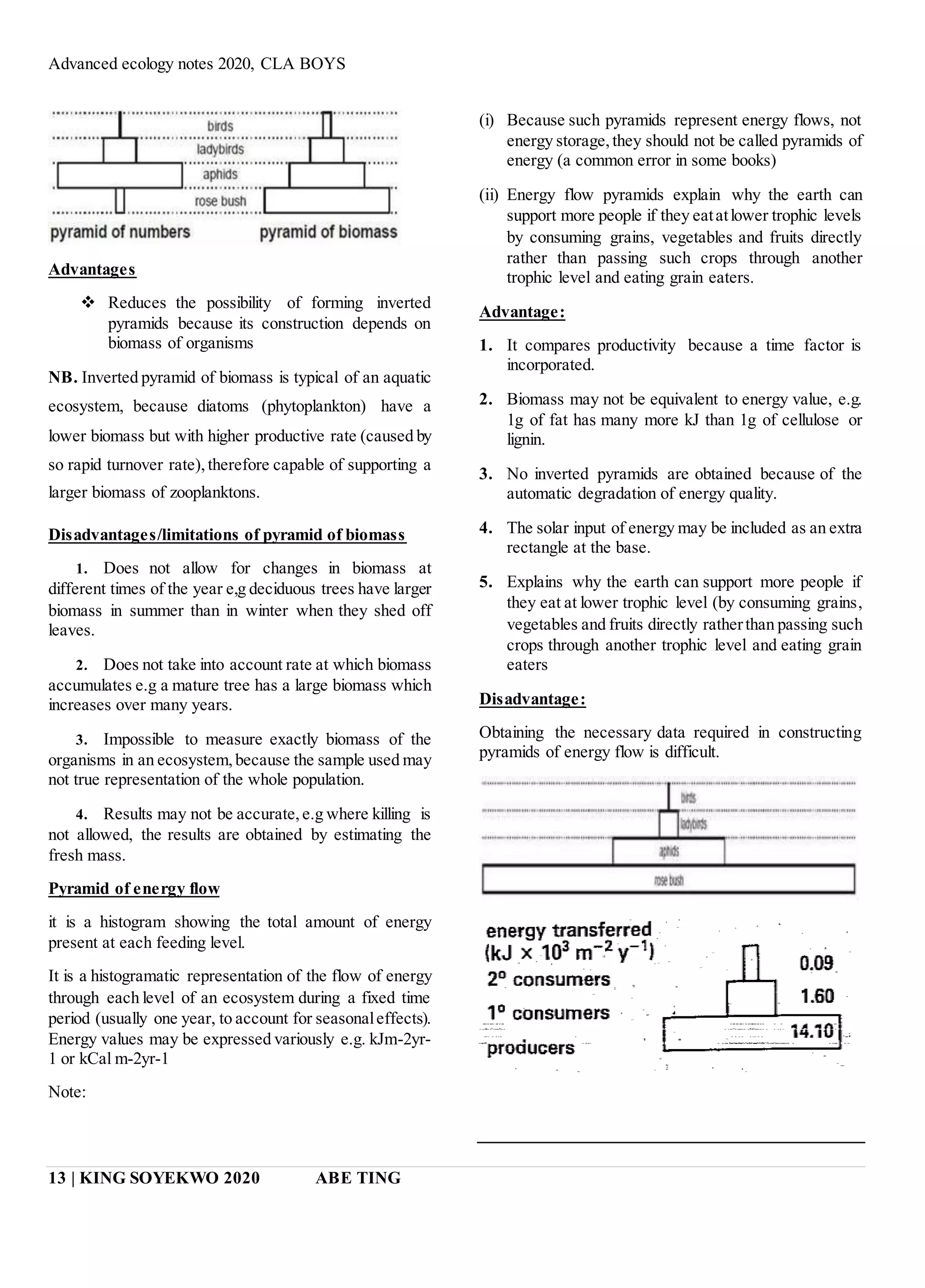
It is a histogramatic representation of the numbers of
different organisms at each trophic level in an ecosystem
at any one time.
The number of organisms at any trophic level is
represented by the length (or area) of a rectangle
NB.
 As a pyramid is ascended, the number of organisms
decreases but the size of each individual increases.
 In some cases,the consumers may be more than the
producers e.g in a parasitic food chain, inverted
pyramids B & C are obtained, because parasites
progressively become smaller and many along a food
chain.
Disadvantages:
1. Drawing the pyramid accurately to scale may be very
difficult where the range of numbers is large e.g. a
million grass plants may only support a single top
carnivore.
2. Pyramids may be inverted; particularly if the
producer is very large e.g. an oak tree or parasites
feed on the consumers e.g. fleas on a dog.
3. The trophic level of an organism may be difficult to
ascertain.
4. The young forms of a species may have a different
diet from adults, yet they are considered together.
Pyramid of biomass
Is a histogram showing the total dry mass of organisms
present at each feeding level.
It is a histogramatic representation of the biomass
(number of individuals x mass of each individual) at each
trophic level in an ecosystem at any one time.
Advanced ecology notes 2020, CLA BOYS
13 | KING SOYEKWO 2020 ABE TING
Advantages
 Reduces the possibility of forming inverted
pyramids because its construction depends on
biomass of organisms
NB. Inverted pyramid of biomass is typical of an aquatic
ecosystem, because diatoms (phytoplankton) have a
lower biomass but with higher productive rate (caused by
so rapid turnover rate),therefore capable of supporting a
larger biomass of zooplanktons.
Disadvantages/limitations of pyramid of biomass
1. Does not allow for changes in biomass at
different times of the year e,g deciduous trees have larger
biomass in summer than in winter when they shed off
leaves.
2. Does not take into account rate at which biomass
accumulates e.g a mature tree has a large biomass which
increases over many years.
3. Impossible to measure exactly biomass of the
organisms in an ecosystem,because the sample used may
not true representation of the whole population.
4. Results may not be accurate, e.g where killing is
not allowed, the results are obtained by estimating the
fresh mass.
Pyramid of energy flow
it is a histogram showing the total amount of energy
present at each feeding level.
It is a histogramatic representation of the flow of energy
through each level of an ecosystem during a fixed time
period (usually one year, to account for seasonaleffects).
Energy values may be expressed variously e.g. kJm-2yr-
1 or kCal m-2yr-1
Note:
(i) Because such pyramids represent energy flows, not
energy storage,they should not be called pyramids of
energy (a common error in some books)
(ii) Energy flow pyramids explain why the earth can
support more people if they eatatlower trophic levels
by consuming grains, vegetables and fruits directly
rather than passing such crops through another
trophic level and eating grain eaters.
Advantage:
1. It compares productivity because a time factor is
incorporated.
2. Biomass may not be equivalent to energy value, e.g.
1g of fat has many more kJ than 1g of cellulose or
lignin.
3. No inverted pyramids are obtained because of the
automatic degradation of energy quality.
4. The solar input of energy may be included as an extra
rectangle at the base.
5. Explains why the earth can support more people if
they eat at lower trophic level (by consuming grains,
vegetables and fruits directly ratherthan passing such
crops through another trophic level and eating grain
eaters
Disadvantage:
Obtaining the necessary data required in constructing
pyramids of energy flow is difficult.
Advanced ecology notes 2020, CLA BOYS
14 | KING SOYEKWO 2020 ABE TING
WHAT IS BIODIVERSITY (BIOLOGICAL
DIVERSITY)?
The different life forms and life-sustaining processes that
can best survive the variety of conditions currently on
earth.
KINDS OF BIODIVERSITY:
Genetic diversity– variety in the genetic make up among
individuals within a species.
Species diversity (species richness) – number of species
present in a habitat.
Ecological diversity – the different biological
communities e.g. forests, deserts, lakes etc.
Functional diversity – biological and chemical
processes or functions such as energy flow and matter
cycling needed for the survival of species and biological
communities.
Distinguish between Species diversity (species richness)
and species abundance.
Species abundance: the number of individuals of each
species
Rare species
Species with small populations either restricted
geographically with localized habitats or with widely
scattered individuals.
Endangered species
Species with low population numbers that are in
considerable danger of becoming extinct.
Extinct species
Species, which cannot be found in areas they previously
inhabited nor in other likely habitats.
FACTORS THAT AFFECT SPECIES DIVERSITY
ON LAND AND IN WATER
1. Latitude (distance from equator) in terrestrial
communities – species diversity decrease steadily
with distance from the equator toward either pole,
resulting in the highest species diversity in tropical
areas e.g. tropical rain forests and lowest in polar
areassuchasarctic tundra. The main effect of latitude
is on temperature, which later affects life.
2. Depth in aquatic systems - in marine communities,
speciesdiversity increasesfrom the surface to a depth
of 2,000 metresand then begins to decline with depth
until the deep-sea bottom is reached, where species
diversity is very high. This change is attributed to
light penetration which affects photosynthesis,
availability of oxygen and availability of dead
organisms at the sea bottom.
3. Pollution in aquatic systems – increased pollution
kills off or impairs the reproductively of various
aquatic species hence reducing species diversity and
abundance.
4. Increased solar radiation increases species diversity
in terrestrial communities.
5. Increased precipitation in terrestrial communities
increases species diversity.
6. Increased elevation decreases species diversity.
7. Pronounced seasonal changes increase species
diversity.
FACTORS THAT AFFECT SPECIES DIVERSITY
IN AN ISLAND ECOSYSTEM
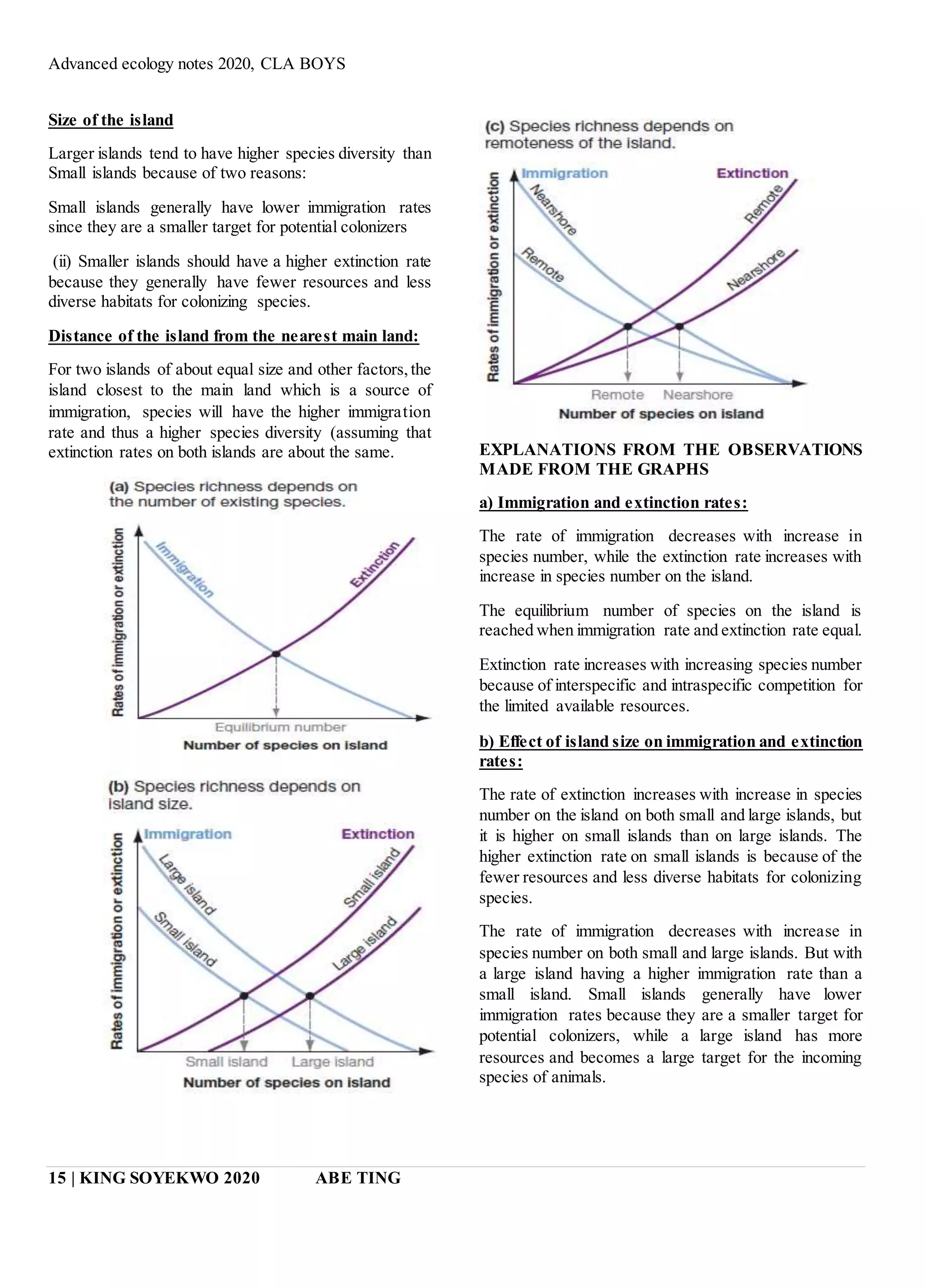
Robert MacArthur and Edward O. Wilson (1960s)
studied communities on islands after which they
proposed the species equilibrium model or the theory of
island biogeography.
According to this model, the number of species found on
an island is determined by a balance betweentwo factors:
(i) The rate atwhich new speciesimmigrate to the island
and
(ii) The rate at which species become extinct on the
island.
The model predicts that at some point the rates of
immigration and extinction will reach an equilibrium
point that determines the island’s average number of
different species (species diversity)
The model also predicts that immigration and extinction
rates (and thus species diversity) are affected by two
important features of the island:
i) Size of the island.
ii) Distance of the island from the nearest main land.
Advanced ecology notes 2020, CLA BOYS
15 | KING SOYEKWO 2020 ABE TING
Size of the island
Larger islands tend to have higher species diversity than
Small islands because of two reasons:
Small islands generally have lower immigration rates
since they are a smaller target for potential colonizers
(ii) Smaller islands should have a higher extinction rate
because they generally have fewer resources and less
diverse habitats for colonizing species.
Distance of the island from the nearest main land:
For two islands of about equal size and other factors,the
island closest to the main land which is a source of
immigration, species will have the higher immigration
rate and thus a higher species diversity (assuming that
extinction rates on both islands are about the same. EXPLANATIONS FROM THE OBSERVATIONS
MADE FROM THE GRAPHS
a) Immigration and extinction rates:
The rate of immigration decreases with increase in
species number, while the extinction rate increases with
increase in species number on the island.
The equilibrium number of species on the island is
reached when immigration rate and extinction rate equal.
Extinction rate increases with increasing species number
because of interspecific and intraspecific competition for
the limited available resources.
b) Effect of island size on immigration and extinction
rates:
The rate of extinction increases with increase in species
number on the island on both small and large islands, but
it is higher on small islands than on large islands. The
higher extinction rate on small islands is because of the
fewer resources and less diverse habitats for colonizing
species.
The rate of immigration decreases with increase in
species number on both small and large islands. But with
a large island having a higher immigration rate than a
small island. Small islands generally have lower
immigration rates because they are a smaller target for
potential colonizers, while a large island has more
resources and becomes a large target for the incoming
species of animals.
Advanced ecology notes 2020, CLA BOYS
16 | KING SOYEKWO 2020 ABE TING
c) Effect of distance from mainland on immigration
and extinction rates:
For both near and far islands, immigration rate decreases
with increase in species number, but immigration rate is
higher on near island than on the distant island. The
higher immigration rate on near island is because of the
easy reach by organisms enabled by its proximity to the
main land.
Since extinction rate increases with increasing species
number that exert interspecific and intraspecific
competition, extinction rate is far higher on small islands
due to the fierce competition caused by the higher
immigration rate because of easy reach by organisms
enabled by its proximity to the main land. (UNEB 2006
P2)
BIOGEOCHEMICAL CYCLING (NUTRIENT
CYCLING)
This the process by which chemical compounds of a
particular element that constitutes living matter are
transferred between living organisms (biotic phase) and
non-living environment (abiotic phase).
These cycles driven directly or indirectly by incoming
solar energy and gravity include the carbon, nitrogen,
phosphorus, oxygen, Sulphur and hydrological (water)
cycles, but a few have been considered below.
The earth’s chemical cycles also connect past, present
and future forms of life. Just imagine:
i) Some of the carbon atoms in your skin may once have
been part of a leaf.
ii) Some of the oxygen molecules you just inhaled may
have been inhaled by a person a billion years ago!
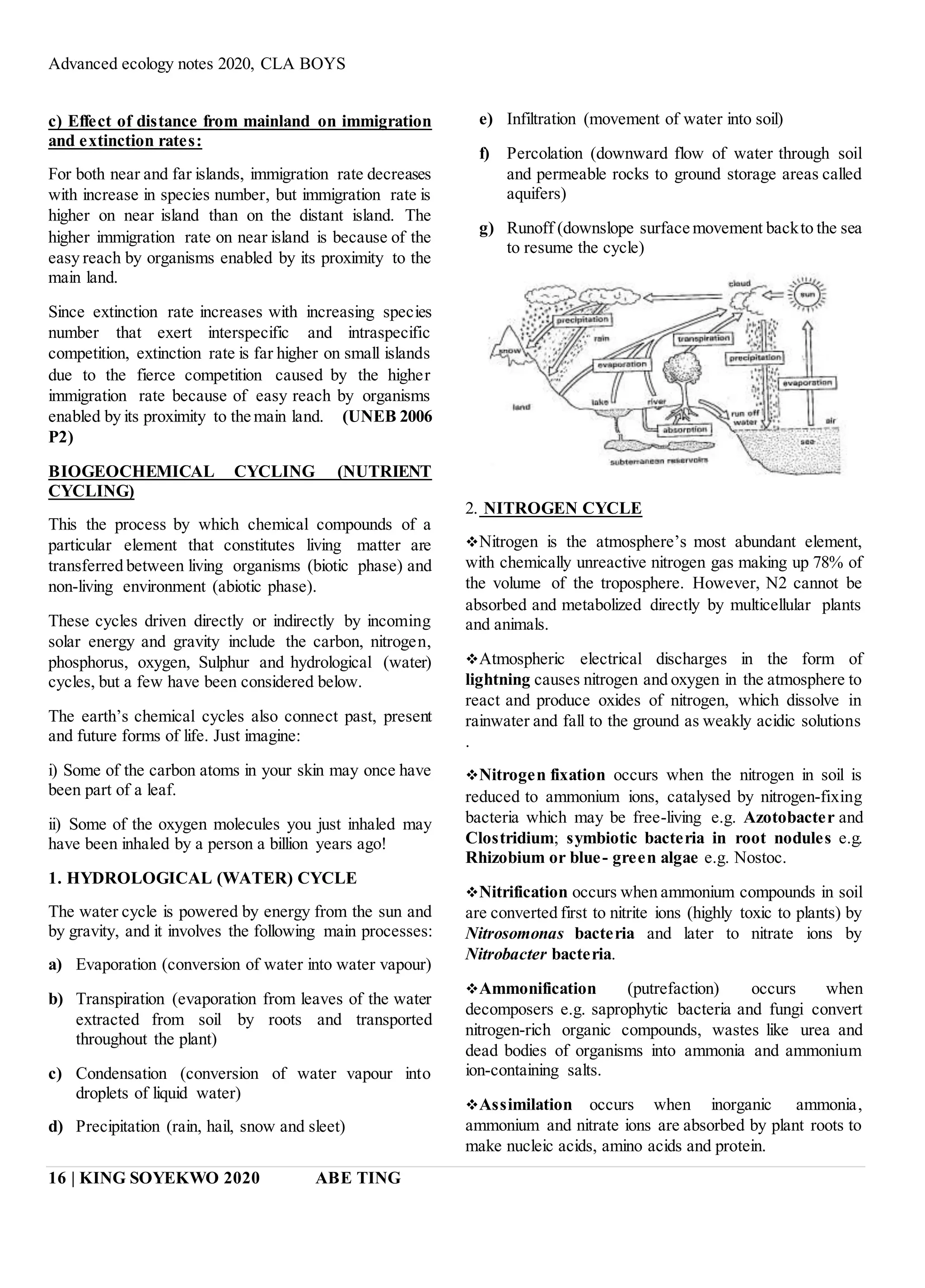
1. HYDROLOGICAL (WATER) CYCLE
The water cycle is powered by energy from the sun and
by gravity, and it involves the following main processes:
a) Evaporation (conversion of water into water vapour)
b) Transpiration (evaporation from leaves of the water
extracted from soil by roots and transported
throughout the plant)
c) Condensation (conversion of water vapour into
droplets of liquid water)
d) Precipitation (rain, hail, snow and sleet)
e) Infiltration (movement of water into soil)
f) Percolation (downward flow of water through soil
and permeable rocks to ground storage areas called
aquifers)
g) Runoff (downslope surface movement backto the sea
to resume the cycle)
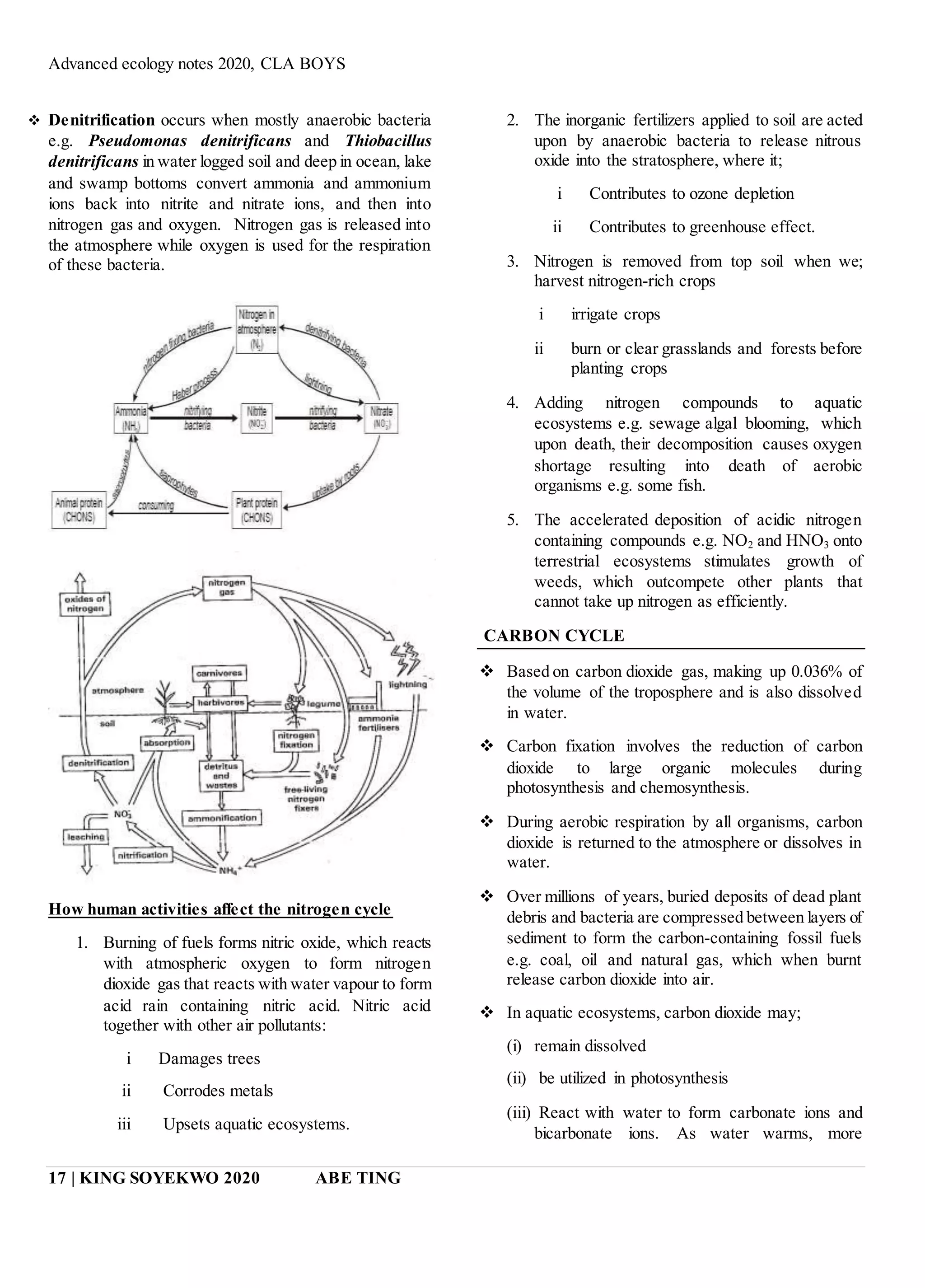
2. NITROGEN CYCLE
Nitrogen is the atmosphere’s most abundant element,
with chemically unreactive nitrogen gas making up 78% of
the volume of the troposphere. However, N2 cannot be
absorbed and metabolized directly by multicellular plants
and animals.
Atmospheric electrical discharges in the form of
lightning causes nitrogen and oxygen in the atmosphere to
react and produce oxides of nitrogen, which dissolve in
rainwater and fall to the ground as weakly acidic solutions
.
Nitrogen fixation occurs when the nitrogen in soil is
reduced to ammonium ions, catalysed by nitrogen-fixing
bacteria which may be free-living e.g. Azotobacter and
Clostridium; symbiotic bacteria in root nodules e.g.
Rhizobium or blue- green algae e.g. Nostoc.
Nitrification occurs when ammonium compounds in soil
are converted first to nitrite ions (highly toxic to plants) by
Nitrosomonas bacteria and later to nitrate ions by
Nitrobacter bacteria.
Ammonification (putrefaction) occurs when
decomposers e.g. saprophytic bacteria and fungi convert
nitrogen-rich organic compounds, wastes like urea and
dead bodies of organisms into ammonia and ammonium
ion-containing salts.
Assimilation occurs when inorganic ammonia,
ammonium and nitrate ions are absorbed by plant roots to
make nucleic acids, amino acids and protein.
Advanced ecology notes 2020, CLA BOYS
17 | KING SOYEKWO 2020 ABE TING
 Denitrification occurs when mostly anaerobic bacteria
e.g. Pseudomonas denitrificans and Thiobacillus
denitrificans in water logged soil and deep in ocean, lake
and swamp bottoms convert ammonia and ammonium
ions back into nitrite and nitrate ions, and then into
nitrogen gas and oxygen. Nitrogen gas is released into
the atmosphere while oxygen is used for the respiration
of these bacteria.
How human activities affect the nitrogen cycle
1. Burning of fuels forms nitric oxide, which reacts
with atmospheric oxygen to form nitrogen
dioxide gas that reacts with water vapour to form
acid rain containing nitric acid. Nitric acid
together with other air pollutants:
i Damages trees
ii Corrodes metals
iii Upsets aquatic ecosystems.
2. The inorganic fertilizers applied to soil are acted
upon by anaerobic bacteria to release nitrous
oxide into the stratosphere, where it;
i Contributes to ozone depletion
ii Contributes to greenhouse effect.
3. Nitrogen is removed from top soil when we;
harvest nitrogen-rich crops
i irrigate crops
ii burn or clear grasslands and forests before
planting crops
4. Adding nitrogen compounds to aquatic
ecosystems e.g. sewage algal blooming, which
upon death, their decomposition causes oxygen
shortage resulting into death of aerobic
organisms e.g. some fish.
5. The accelerated deposition of acidic nitrogen
containing compounds e.g. NO2 and HNO3 onto
terrestrial ecosystems stimulates growth of
weeds, which outcompete other plants that
cannot take up nitrogen as efficiently.
CARBON CYCLE
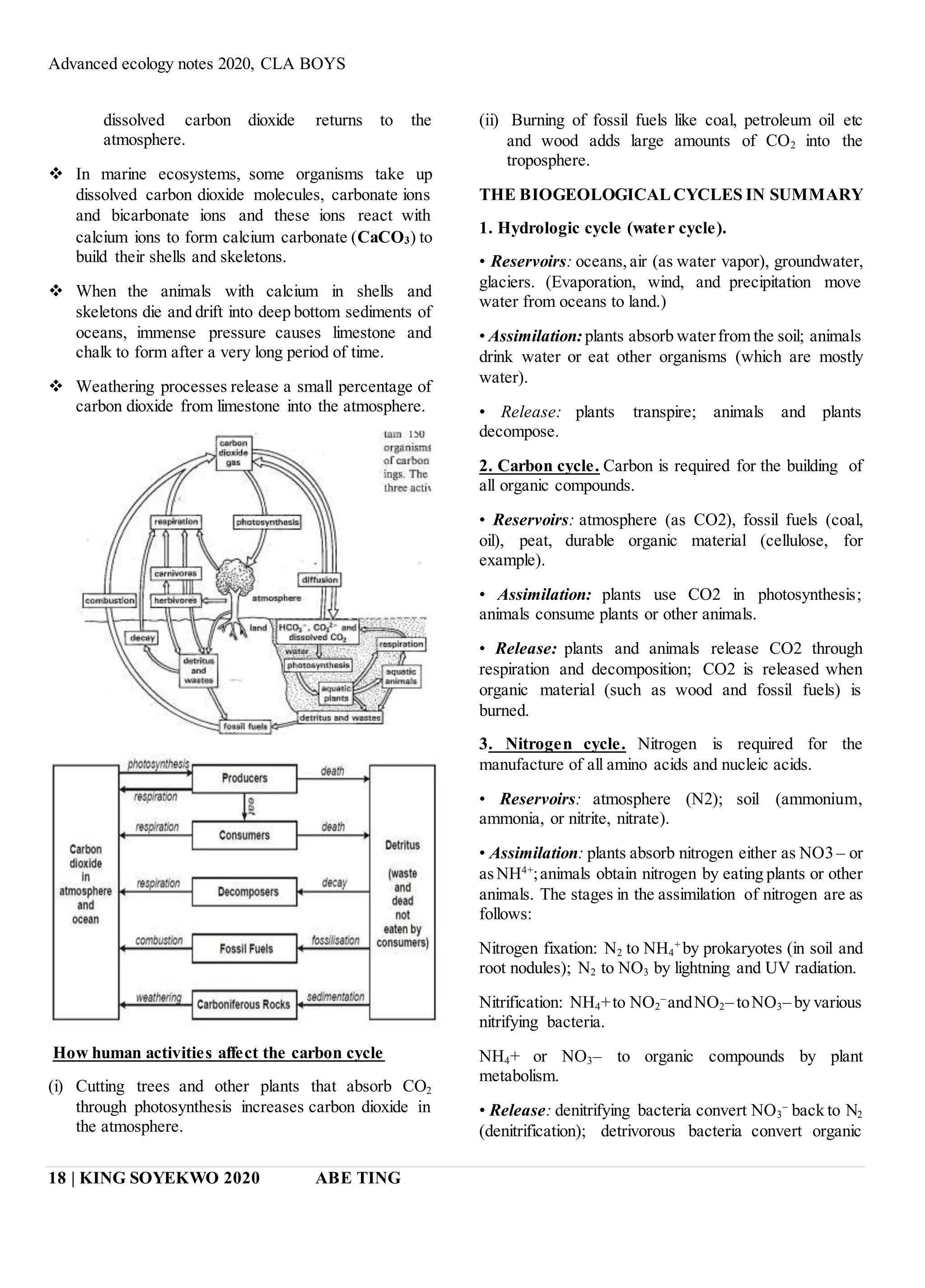
 Based on carbon dioxide gas, making up 0.036% of
the volume of the troposphere and is also dissolved
in water.
 Carbon fixation involves the reduction of carbon
dioxide to large organic molecules during
photosynthesis and chemosynthesis.
 During aerobic respiration by all organisms, carbon
dioxide is returned to the atmosphere or dissolves in
water.
 Over millions of years, buried deposits of dead plant
debris and bacteria are compressed between layers of
sediment to form the carbon-containing fossil fuels
e.g. coal, oil and natural gas, which when burnt
release carbon dioxide into air.
 In aquatic ecosystems, carbon dioxide may;
(i) remain dissolved
(ii) be utilized in photosynthesis
(iii) React with water to form carbonate ions and
bicarbonate ions. As water warms, more
Advanced ecology notes 2020, CLA BOYS
18 | KING SOYEKWO 2020 ABE TING
dissolved carbon dioxide returns to the
atmosphere.
 In marine ecosystems, some organisms take up
dissolved carbon dioxide molecules, carbonate ions
and bicarbonate ions and these ions react with
calcium ions to form calcium carbonate (CaCO3) to
build their shells and skeletons.
 When the animals with calcium in shells and
skeletons die and drift into deep bottom sediments of
oceans, immense pressure causes limestone and
chalk to form after a very long period of time.
 Weathering processes release a small percentage of
carbon dioxide from limestone into the atmosphere.
How human activities affect the carbon cycle
(i) Cutting trees and other plants that absorb CO2
through photosynthesis increases carbon dioxide in
the atmosphere.
(ii) Burning of fossil fuels like coal, petroleum oil etc
and wood adds large amounts of CO2 into the
troposphere.
THE BIOGEOLOGICAL CYCLES IN SUMMARY
1. Hydrologic cycle (water cycle).
• Reservoirs: oceans,air (as water vapor), groundwater,
glaciers. (Evaporation, wind, and precipitation move
water from oceans to land.)
• Assimilation:plants absorb waterfrom the soil; animals
drink water or eat other organisms (which are mostly
water).
• Release: plants transpire; animals and plants
decompose.
2. Carbon cycle. Carbon is required for the building of
all organic compounds.
• Reservoirs: atmosphere (as CO2), fossil fuels (coal,
oil), peat, durable organic material (cellulose, for
example).
• Assimilation: plants use CO2 in photosynthesis;
animals consume plants or other animals.
• Release: plants and animals release CO2 through
respiration and decomposition; CO2 is released when
organic material (such as wood and fossil fuels) is
burned.
3. Nitrogen cycle. Nitrogen is required for the
manufacture of all amino acids and nucleic acids.
• Reservoirs: atmosphere (N2); soil (ammonium,
ammonia, or nitrite, nitrate).
• Assimilation: plants absorb nitrogen either as NO3 – or
asNH4+
;animals obtain nitrogen by eating plants or other
animals. The stages in the assimilation of nitrogen are as
follows:
Nitrogen fixation: N2 to NH4
+
by prokaryotes (in soil and
root nodules); N2 to NO3 by lightning and UV radiation.
Nitrification: NH4+to NO2
–
andNO2– toNO3– by various
nitrifying bacteria.
NH4+ or NO3– to organic compounds by plant
metabolism.
• Release: denitrifying bacteria convert NO3
–
back to N2
(denitrification); detrivorous bacteria convert organic
Advanced ecology notes 2020, CLA BOYS
19 | KING SOYEKWO 2020 ABE TING
compounds back to NH4
+
(ammonification); animals
excrete NH4+ (or NH3), urea, or uric acid.
Qn. (a) Describe the flowofenergy and the cycling of
carbon and nitrogen in any named ecosystem.
(b). Suggest reasons why felling and removal of
forest trees result in changes in the levels ofnutrients
in the soil.
HOW BIOTIC FACTORS AFFECT THE
DISTRIBUTION AND ABUNDANCY OF
ORGANISMS
Biotic factors are those that arise in organisms
interacting with each other. Examples include (i)
diseases (ii) competition, (iii) parasitism, (iv) pollution,
(v) pollination &dispersal,(vi) antibiosis (vii) mimicry.
. (a) Human influence.
 Of all living organisms, humans exert most
influence on the distribution and survival of other species
through a multitude of activities like pollution,
deforestation, farming, construction etc
Man is also a predator hunting down many animals to a
point of extinction.
b) Competition
 This is a relationship whereby two individuals of
the same species or different species struggle to obtain
resources which are in limited supply. E.g plants
competing for light, carbon dioxide, water, minerals,
pollinators, and sites for spores and seeds to germinate
while animals compete for food, mates, breeding sites
and shelter from predators.
(i) Intraspecific competition
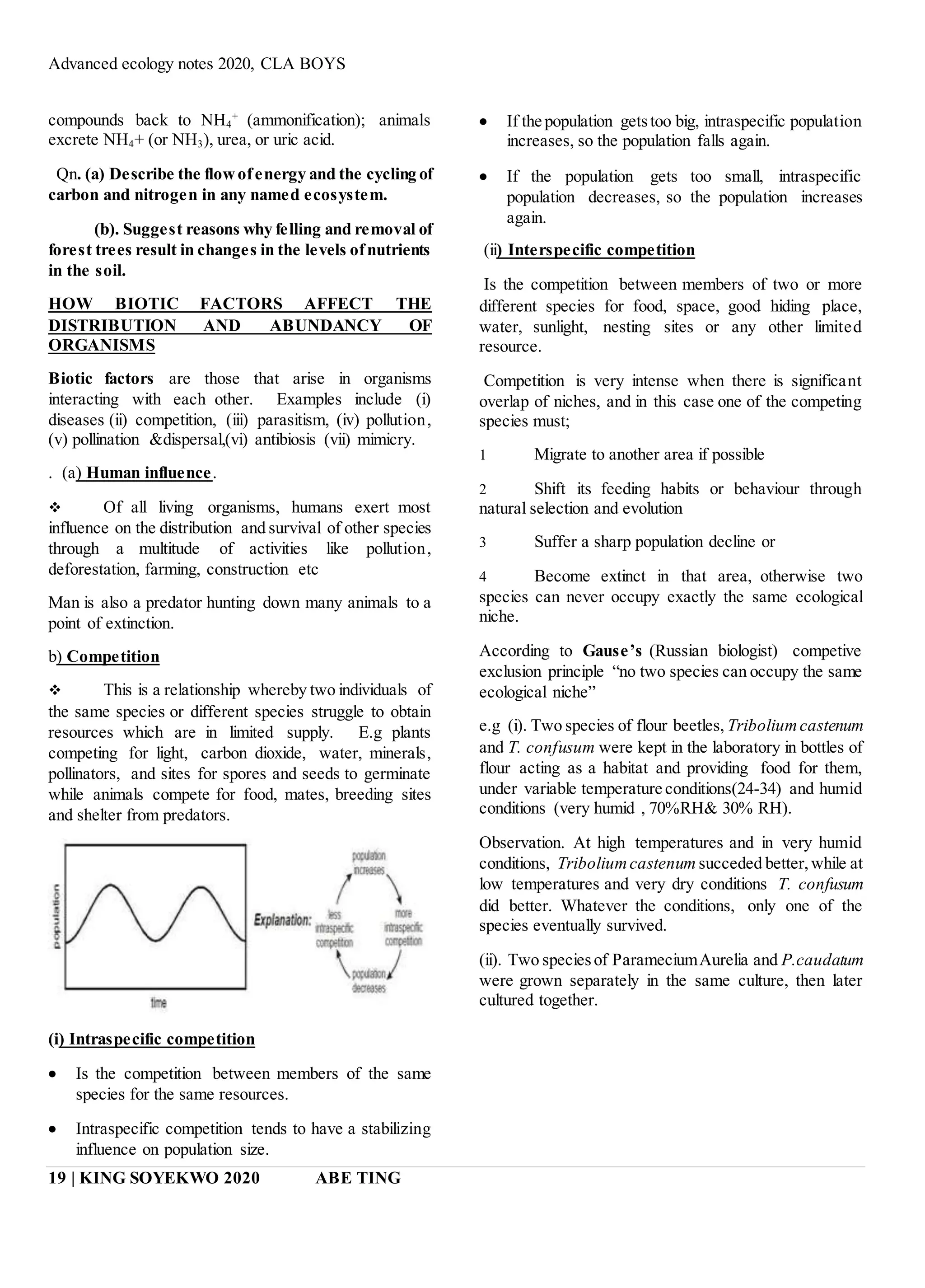
 Is the competition between members of the same
species for the same resources.
 Intraspecific competition tends to have a stabilizing
influence on population size.
 If the population getstoo big, intraspecific population
increases, so the population falls again.
 If the population gets too small, intraspecific
population decreases, so the population increases
again.
(ii) Interspecific competition
Is the competition between members of two or more
different species for food, space, good hiding place,
water, sunlight, nesting sites or any other limited
resource.
Competition is very intense when there is significant
overlap of niches, and in this case one of the competing
species must;
1 Migrate to another area if possible
2 Shift its feeding habits or behaviour through
natural selection and evolution
3 Suffer a sharp population decline or
4 Become extinct in that area, otherwise two
species can never occupy exactly the same ecological
niche.
According to Gause’s (Russian biologist) competive
exclusion principle “no two species can occupy the same
ecological niche”
e.g (i). Two species of flour beetles, Triboliumcastenum
and T. confusum were kept in the laboratory in bottles of
flour acting as a habitat and providing food for them,
under variable temperature conditions(24-34) and humid
conditions (very humid , 70%RH& 30% RH).
Observation. At high temperatures and in very humid
conditions, Triboliumcastenum succeded better,while at
low temperatures and very dry conditions T. confusum
did better. Whatever the conditions, only one of the
species eventually survived.
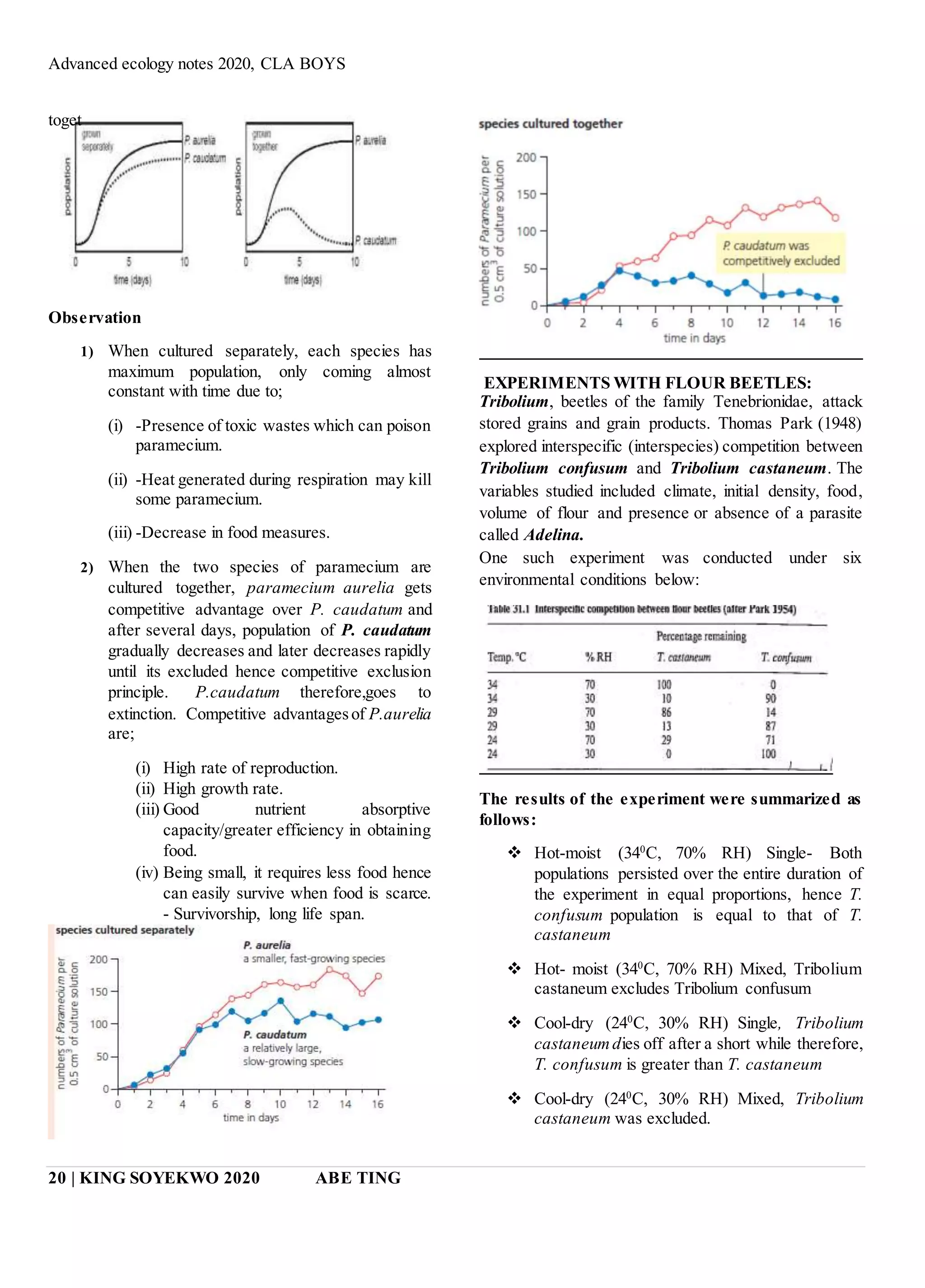
(ii). Two speciesof ParameciumAurelia and P.caudatum
were grown separately in the same culture, then later
cultured together.
Advanced ecology notes 2020, CLA BOYS
20 | KING SOYEKWO 2020 ABE TING
Observation
1) When cultured separately, each species has
maximum population, only coming almost
constant with time due to;
(i) -Presence of toxic wastes which can poison
paramecium.
(ii) -Heat generated during respiration may kill
some paramecium.
(iii) -Decrease in food measures.
2) When the two species of paramecium are
cultured together, paramecium aurelia gets
competitive advantage over P. caudatum and
after several days, population of P. caudatum
gradually decreases and later decreases rapidly
until its excluded hence competitive exclusion
principle. P.caudatum therefore,goes to
extinction. Competitive advantagesof P.aurelia
are;
(i) High rate of reproduction.
(ii) High growth rate.
(iii) Good nutrient absorptive
capacity/greater efficiency in obtaining
food.
(iv) Being small, it requires less food hence
can easily survive when food is scarce.
- Survivorship, long life span.
EXPERIMENTS WITH FLOUR BEETLES:
Tribolium, beetles of the family Tenebrionidae, attack
stored grains and grain products. Thomas Park (1948)
explored interspecific (interspecies) competition between
Tribolium confusum and Tribolium castaneum. The
variables studied included climate, initial density, food,
volume of flour and presence or absence of a parasite
called Adelina.
One such experiment was conducted under six
environmental conditions below:
The results of the experiment were summarized as
follows:
 Hot-moist (340
C, 70% RH) Single- Both
populations persisted over the entire duration of
the experiment in equal proportions, hence T.
confusum population is equal to that of T.
castaneum
 Hot- moist (340
C, 70% RH) Mixed, Tribolium
castaneum excludes Tribolium confusum
 Cool-dry (240
C, 30% RH) Single, Tribolium
castaneumdies off after a short while therefore,
T. confusum is greater than T. castaneum
 Cool-dry (240
C, 30% RH) Mixed, Tribolium
castaneum was excluded.
toget
her
.
Advanced ecology notes 2020, CLA BOYS
21 | KING SOYEKWO 2020 ABE TING
 Temperate- moist (290
C, 70% RH) single, Both
populations persisted, but T. castaneum thrived
better, hence, T. confusum was less than T.
castaneum
 Temperate- moist (290
C, 70% RH) mixed, T.
castaneum excluded T. confusum more times
 Hot-dry (340
C, 30% RH) Single, Both
populations persisted, but T. confusum shrived
better, hence, T. confusum is greater than T.
castaneum
 Hot-dry (340
C, 30% RH) Mixed, Tribolium
confusum excluded Tribolium castaneum more
times
 Temperate-dry (290
C, 30% RH) single, Both
populations persisted, but T. confusum thrived
better, hence, T. confusum is greater than T.
castaneum
 Temperate-dry (290
C, 30% RH) mixed,
Triboliumconfusum won Tribolium castaneum
 Cool- moist (240
C, 70% RH) Single, Both
populations persisted, but T. castaneum thrived
better hence T. confusum is less than T.
castaneum
 Cool- moist (240
C, 70% RH) Mixed, Tribolium
confusum won Tribolium castaneum.
Deductions and interpretations of results:
i) Cool-dry conditions appear to favour Tribolium
confusum
ii) Under a particular set of conditions, either Tribolium
confusum or Tribolium castaneum was usually
favoured, but not always.
iii) Under intermediate environment conditions, each
species did well when grown alone but the outcome
of interspecific competition was not completely
predictable. Sometimes T. confusum won,
sometimes T. castaneum won
iv) Growing the two species separately showed that the
fundamental niche of Tribolium castaneum includes
five of the six environmental conditions in the
experiment, while the fundamental niche of
Tribolium confusum includes all the six
environmental conditions.
v) Growing the two species together suggests that
interspecies competition restricts the realized niches
of both species to fewer environmental conditions.
vi) Interspecific competition restricts the realized niches
of species in nature.
HOW SPECIES REDUCE OR AVOID
COMPETITION THROUGH RESOURCE
PARTITIONING
Resource partitioning is the dividing up of scarce
resources so that species with similar needs use them (i)
at different times (ii) in different ways or (iii) in different
places.
 Some species that are in competition for the same
resources have evolved adaptations that reduce or avoid
competition or an overlap of their fundamental niches.
 Resource partitioning decreases competition
between two species leading to increased niche
specialization
Examples of resource partitioning:
1. When living in the same area, lions prey mostly on
larger animals while leopards on smaller ones.
2. Hawksand owls feedon similar prey,but hawks hunt
during the day and owls hunt at night.
3. Each of the five species of common warblers (insect-
eating birds) minimizes competition with the others
by
(i) Spending at least half its feeding time in a
different part of spruce tree branches e.g. some
hunt at the extreme top, others at the lower
portion, some mid-way etc
(ii) Consuming somewhat different insect species.
4. Different speciesof eagles in a forestfeed at different
times of the day e.g. bald headed eagles are most
active early mornings and evenings while the white-
breasted eagles feed vigorously towards noon.
5. When three species of ground finches of Galapagos
Islands occur on separate islands, their bills tend to
be the same intermediate size, enabling each to feed
on a wider range of seeds, but where they co-occur,
there is divergence in beak size to suit each finch
species to feeding on seeds of either small, medium
or large size, but not all sizes.
Advanced ecology notes 2020, CLA BOYS
22 | KING SOYEKWO 2020 ABE TING
6. In an abandoned field, drought tolerant grasses with
shallow, fibrous root system grow near the soil
surface to absorb moisture; plants with a taproot
system grow in deeper soil while those with a taproot
system that even branches to the topsoil and below
the roots of other species grow where soil is
continuously moist.
NB:
i) The more than two species in the same habitat
differ in their use of resources,the more likely they
can coexist.
ii) Two competing species also may coexist by
sharing the same resource in different ways or at
different times.
iii) The tendency for characteristics to be more
divergent when populations belong to the same
community than when they are isolated is termed
character displacement e.g Galapagos finches.
(c.) Predation.
This is a relationship whereby members of one species
(the predator) feed on all or part of a living organism of
another species (the prey). Therefore, predators are only
found where there is prey e.g.herbivores are found where
there is suitable plant material.
A predator is an animal that feeds on another live
organism.
A prey is the live organism that is fed on by the predator.
PREDATOR-PREY INTERACTIONS IN
ECOSYSTEMS
Description of the changes in population numbers:
Initially, the population of the prey is higher that the
population of the predator.
Within a short time, both populations of prey and
predator increase rapidly.
The population of the prey reachesa maximum earlier the
predator.
As the prey population decreases rapidly, the predator
population continues to increase gradually for a short
than time to a maximum then also decreases rapidly. As
the predator population continues to decrease, the prey
population starts to increase rapidly, followed by a rapid
increase in predator population. The cycle is repeated.
Explanation for the observed changes in populations:
At the beginning, there are more prey than predator to
provide food to the predators.
When the predator population is low, they get enough
food and few preys are eaten so they both increase
rapidly.
The large number of preys provides food to predators, so
they reproduce fast and increase in numbers.
The increased predator population eats many preys and
the prey population crashes.
The decrease in prey numbers causes the predators to
starve and even their reproduction reduces, so the
predator numbers crash. Finally, the very low number of
predators allows the prey population to recover, causing
the cycle to start again.
Evolutionary significance of predator –prey
Predation usually eliminates the unfit (aged, sick, weak).
This gives the remaining prey accesstothe available food
supply and also improves their genetic stock hence,
enhances the chances of reproductive success and
longtime survival, thus pass on their good traits to their
off springs which can improve their evolution.
How are the predator suited for capturing prey?
1. Have keen eyes for locating prey eg wolves, African
lions hunt in groups.
2. Preying mantis, chameleon have cryptic
coloration/camouflage that enable them to walk to
prey unnoticed..
3. Nocturnal predators eg bats have highly developed
sense for detecting sound made by prey.
4. Some snakes which have glands to secrete poison
(venom) which the fangs inject into prey to
immobilize it (prey).
5. Web-spinning spiders use their silky cob webs to
catch small sized ground walking or flying insects.
6. Ant-lions lay traps by making pits in the ground
where preys fall
7. Some have soft pads at the bottom of their feetso that
they are not easily detectedasthey walk towards prey
8. Some have stinging cells which paralyze their prey
e.g sea anemones
Advanced ecology notes 2020, CLA BOYS
23 | KING SOYEKWO 2020 ABE TING
9. Have long and sharp canines which pierce and kill
prey
10. Well-developed limbs which increase the speed of
locomotion to chase and capture prey.
How are prey species suited to avoid predation?
1) Ability to run, swim or fly faster.
2) Possession of highly developed sense of sight or
smell alerting the presence of predators.
3) Possession of protective shells eg in tortoise and
snails for rolling into armour-plated ball
4) Possession of spines to prick the predators.
5) In some lizards, the tail breaks off when attacked
giving the animal (lizard) time to escape.
6) Possession of spines (porcupines) or thorns (cactiand
rose-bushes) for pricking predators.
7) In some lizards tails break off when attacked,giving
the animal enough time to escape.
8) Some prey camouflage by changing colour e.g.
chameleon and cuttlefish, or having deceptive
colours that blend with the background e.g. arctic
hare in its winter fur blends into snow.
9) Some prey species discourage predators with
chemicals that are poisonous (e.g. oleander plants),
irritating (e.g. bombardier beetles), foul smelling
(e.g. stinkbugs and skunk cabbages) or bad tasting
(e.g. monarch butterflies and buttercups)
10) Some prey species have evolved warning coloration
– contrasting pattern of advertising colours that
enable predators to recognize and avoid such prey
e.g. the poisonous frogs, some snakes, monarch
butterflies and some grasshoppers.
11) Some species gain protection to avoid predation by
mimicking (looking and acting like) other species
that are distasteful to the predator e.g. the non-
poisonous viceroy butterfly mimics the poisonous
monarch butterfly.
12) Batesian mimicry occurs when the palatable species
mimics other distasteful species e.g . Viceroy
butterfly mimics the poisonous monarch butterfly,
the harmless hoverfly mimics the painful stinging
wasp while:
13) Mullerianmimicry occurswhen both the mimic and
mimicked are unpalatable and dangerous e.g. the five
spot Burnet and related moths.
14) Other preys gain some protection by living in large
groups e.g. schools of fish, herd of antelope, flocks
of birds.
15) Some prey scare predators by puffing up e.g.
blowfish, or spreading wings e.g. peacock.
16) The flesh of some slow-moving fish is poisonous e.g.
porcupine fish.
17) Some preys secrete poisonous or repellant substances
e.g. scorpions, caterpillars, some grasshoppers, culex
mosquito eggs
18) The electric fish Malapterurus (a cat fish) produces
high voltage discharge of up to 350v that shocks any
predator that makes contact with it.
19) Other preys employ alarm signals and calls e.g. ants,
various fish, small birds and mammals.
20) Group defense, occurring among those that live and
feed in herds.
NB. Camouflage is the use of any combination of
materials, coloration, or illumination for concealment,
either by making animals difficult to see,or by disguising
them as something else.
Exists in various forms;
(i) Warning coloration,conspicuous colouring that
warnsa predator that ananimal is unplalable or poisonous
e.g poisonous frogs, some snakes, monarch butterflies,
and some grasshoppers
(ii) Disruptive colouration/patterning, works by
breaking up the outlines of an animal with a strongly
contrasting pattern, thus decreasing detectability e.g.
group of zebras
(iii) Cryptic colouration allows an organism to
match its background and hence become less vulnerable
to predation e.g chameleon.
NB: Predation
1. -Determines distribution and abundance of the prey
because predators will always be found in places of
their potential prey.
Advanced ecology notes 2020, CLA BOYS
24 | KING SOYEKWO 2020 ABE TING
2. -leads to dispersal of animals which reduces
competition, since it involves movement of animals
from place to place.
3. Is a biological control method.
(d) Pollination and dispersal
1. Pollination is an ecological interaction because plants
and animals interact with each other. Insects transfer
pollen grains from anthers to stigma.
2. Dispersal of seeds and fruits introduces new plants to
new habitats and this minimizes competition among
species.
3. Both interactions between the flowering plants and
animals like insects, birds & bats may be highly
elaborate and species specific.
4. This co- evolution ensures that the distribution of the
plants with their pollinations or agents of dispersal
are related e.g arum lily flowers are pollinated by
dung flies.
NB. Co evolution is a long term evolutionary adjustment
of two or more groups of organisms that facilitate those
organisms living with one another.
Examples include;
(i) Many features of flowering plants have evolved
as a result of dispersal of plant’s gametes by
insects and insects have in turn evolved special
traits for obtaining nectar
(ii) Grasses have evolved the ability to deposit silica
in their leaves and stems to reduce their risks of
being grazed, large herbivores have in turn
evolved complex molars with enamel ridges for
grinding up the plant material.
(e) Antibiosis; is the secretion by organisms chemical
substances into their surrounding that may be repellant to
members of the same species or different species e.g.
penicillium (a fungus) secretes antibiotics that inhibit
bacterial growth, ants release pheromones to warn off
other members of a species in case of danger.
Two types exist i.e
(i) Intraspecific antibiosis secretion by organisms
chemical substances into their surrounding that
may be repellant to members of the same species
e,g male rabbits secrete pheromones from their
submandibular salivary glands that are used to
mark territory as a warning to other bucks that
the territory is occupied
(ii) Interspecific antibiosis secretion by organisms
chemical substances into their surrounding that
may be repellant to members of the different
species e.g penicillium (a fungus) secretes
antibiotics that kill or prevent the bacterial
growth.
(f) Parasitism
An organism called parasite obtains part or all its
nutrients from the body of another organism of different
species called host.
The parasite is usually smaller than its host in size.
Parasites do not usually kill their hosts, but the host
suffers harm.
Many parasites live permanently on (ectoparasites) or in
their hosts (endo parasite) while some visit their hosts
only to feed.
Some parasites are facultative, live on or in the host for
some time e.g.Pythium(a fungus) that causesdamping off
seedlings, on killing the seedlings, lives as a saprophyte
on their dead remains and others are obligate (live on or
in the host for their entire lives.)
(g) Mutualism. Is an interspecific association in which
both organisms benefit.
Examples include
(i) Cellulose digesting bacteria in gut of
ruminants such as goats, cattle& sheep.
Ruminants obtain sugars, amino acids while
bacteria obtains shelter and food.
Advanced ecology notes 2020, CLA BOYS
25 | KING SOYEKWO 2020 ABE TING
(ii) Leguminous plants e.g clover and nitrogen fixing
bacteria (Rhizobium). The plants obtain nitrates
while bacteria obtains shelter, sugars, vitamins.
(iii) Microorganisms and cellulose digestion.
Interspecific mutualism is demonstrated by the
flagellate protozoan, Trichonympha an obligate
anaerobe in the gut of several species of wood
eating termites where it digests cellulose.
Trichonympha also occurs in the alimentary
canal of wood eating roach Cryptocerus. The
termite and roach reduce the wood to small
fragments, passing them through the alimentary
canalto hind gut, where the protozoans digest the
cellulose, changing it into sugar. The host
benefits the protozoa by removing harmful
metabolic waste products and maintaining
anaerobic conditions in the intestine.
(iv) Mycorrhizae (fungus and root of higher plants)
In ectotrophic mycorrhiza, the fungus forms a
sheath covering lateral roots of forest trees such
as oaks, beech, conifers, while depending on
photosynthesis by the tree to provide organic
materials.
Endotrophic mycorrhiza involves most of
fungi inside the root of orchids with the fungi
digesting lignin and cellulose in the soil; and
passing the end products into the roots of plants.
(v) Lichens; algae and fungus. Algae carries out
photosynthesis, providing nutrients to the fungus
while the fungi it is protected by the fungi from
intense sunlight and dessication, minerals
absorbed by the fungus are passed onto it.
(vi) Hermit Crab And Sea Anemones, with the
hermit crab (Eupagurus berhardus) obtaining
defence from the stinging cells of anemones
(Adamsia) & camouflaging from its predators.
Sea anemones feed on food remains of the crab
& obtains free transport from one area to another
NB: Some ecologists place the interaction of sea
anemone and hermit crab under commensalism,
yet some books also describe it as
protocooperation.
(h) Commensalism.Isanassociation between organisms
of different species in which one benefits while the other
neither benefits nor its harmed e.g
(i) Cow and white egrets; egrets are associated with
large herbivores which during grazing, attract
insects which are eaten by the birds.
(ii) Epiphytes and host plant. Many epiphytes
develop a thick network of roots upon which
windblown dust accumulates and provides the
necessary edaphic environment where it obtains
nutrients for growth and development.
(i) Many harmless protozoans occur in the intestinal
tract of mammals, including man. Some
microorganisms such as bacterium Escherchia
coli is found in human colon.
ECOLOGICAL SUCCESSION
 This is a long- term directional change in the
composition of a community from its origin to its climax
through a number of stages brought about by the actions
of the organisms themselves.
 It is a process by which plants and animal
communities in a given area change gradually over time,
becoming replaced by different and usually more
complex communities.
 Pioneers are first sets of organisms to occupy the
area, collectively such organisms constitute the pioneer
community.
 Climax community: the final community at the
end of succession, which a particular environment can
sustain. Climax community is characterisedby (i) diverse
species (ii) complex feeding relationships and (iii)
progressive increases in biomass.
 The process of succession continues through
stages known as seral stages and there are a number of
sere (complete succession) according to the environment
being colonized:
(i) Hydrosere; succession in aquatic environment
(ii) Halosere; succession in salty environment
(iii) Xerosere; succession dry envirionments e.g
deserts
(iii) Lithosere; succession on a rocky surface.
Types of succession
a) Primary succession
b) Secondary succession
Advanced ecology notes 2020, CLA BOYS
26 | KING SOYEKWO 2020 ABE TING
a) Primary succession
This is the gradual change in species composition of an
area that has never had any vegetation growing on it.
It occurson Bare rocks exposed by erosion, newly cooled
lava, newly created shallow ponds, Sand dunes,
Abandoned highway or parking yard.
Description of Primary succession on land
 If a bare rock is left undisturbed for a long period
of time, it creates a favorable environment for the
colonization of the area by primitive plants like the
lichens and mosses.
 Lichens and mosses attach to bare rocks and start
forming soil by trapping wind- blown soil particles,
producing tiny bits of organic matter due to their death
and secreting mild acids that slowly breakdown the rock.
Mosses also survives/withstands desiccation by
absorbing moisture in the air. Alternate heating and
cooling also causes break down of rocks. Mosses and
lichens are therefore the pioneer community in the area.
 As patches of soil build up and spread, it creates
a suitable environment for more other species of plants
and eventually the pioneer species are replaced by the
early successional plants like small grasses and ferns,
whose seeds and spores respectively germinate after
arriving by wind or in droppings of birds.
 Some of their roots penetrate and break rocks
into soil particles, and death and decay of small grasses
and ferns increases nutrients in soil.
 After a long period of time, the soil becomes
deep, moist and fertile enough to support the growth of
mid successional plant species like herbs, large grasses,
low shrubs and small trees that need a lot of sunlight.
 Late successionalplant species (mostly trees that
tolerate shade) later replace the mid successional plant
species.
 Unless natural or human processes disturb the
area, a complex forest community remains
Characteristics of the stages of primary succession;
a) Early succession
 Species grow very close to the ground and have
low biomass.
 Species have short life span.
 Species are simple and small sized.
 Species diversity (number of species present in a
habitat) is very low.
 Community is open ie allows space for other
colonizers.
 Species may show symbiotic relationships to aid
their establishment.
 Species are poor competitors and hence get
replaced by higher, more demanding plants like grasses,
shrubs and trees.
 The community is mostly is mostly composed of
producers and a few decomposers.
 Net productivity is high.
 Feeding relationships are simple, mostly
herbivores feeding on plant with few decomposers.
b) Late succession
 Plants are of large size and complex.
 Species diversity is high
Advanced ecology notes 2020, CLA BOYS
27 | KING SOYEKWO 2020 ABE TING
 Community is a mixture of producers,consumers
and decomposers.
 Biomass is high
 Net productivity is low
 Community takes a longtime to establish.
 Climax community is often determined by one
dominant species.
 There is increased soil depth and nutrients.
 Interspecific competition is very high.
 There is little space for new species
 The climax community is stable and is in
equilibrium with its environment.
 Feeding relationships are complex, dominated
by decomposers.
PRIMARY SUCCESSION IN A WATER BODY
The first community to occupy the lake consists of
pioneer species with r-selected characteristics. These
characteristics include good dispersal ability, rapid
growth, and rapid reproduction of many offspring.
The lake is first populated by algae and protists, then
followed by rotifers, mollusks, insects, and other
arthropods.
Various vegetation, such as grasses, sedges, rushes, and
cattails, grows at the perimeter of the lake. Submerged
vegetation (growing on the lake bottom) is replaced by
vegetation that emerges from the surface, perhaps
covering the surface with leaves.
As the plants and animals die, they add to the organic
matter that fills the lake. In addition, sediment is
deposited by water from streams that enter the lake.
Eventually, the lake becomes marshy as it is overrun by
vegetation.
When, the lake is completely filled, it becomes a
meadow, occupied by plants and animals that are adapted
to a dry, rather than marshy, habitat. Subsequently, the
meadow is invaded by shrubs and trees from the
surrounding area.
In a temperate mountain habitat, the climax community
may be a deciduous forest consisting of oaks or maples.
In colder regions, the climax community is often a
coniferous forest, consisting of pines, firs, and hemlocks.
SECONDARY SUCCESSION.
This is the gradual change in species composition of an
area where the natural community of organisms has been
disturbed, removed or destroyed but some soil or bottom
sediment remains.
It occurs on abandoned farmlands, burnt or cut forests,
heavily polluted streams, flooded land.
Due to some soil or sediment present, vegetation usually
begins to germinate within a few weeks.
Seeds and spores can be present in the soil and can be
carried from nearby plants by wind, birds and insects.
The ground may even contain resistant plants/vegetative
organs of the colonizing plants that survived the changes.
Reasons why invasive species are often successful in
colonizing new habitats.
1. No natural predators, parasites, pathogens;
2. Effective aggressive mechanism of invasive
organism;
3. No limitation on resources.
4. No environmental inhibitors (e.g., pollutants).
5. R-selected species; increased season for
reproduction; large or logarithmic populations.
6. Variation in phenotype of large population.
7. Available niche not occupied by any other species,
hence no successful competitors.
8. Prey lack effective defense mechanism against
introduced species.
9. Appropriate environmental conditions (e.g., rainfall,
temperature).
TYPICAL EXAMINATION QUESTION
Explain the sequence of changes that will occur in a
previously burnt piece of land from its initial stages
until a climax community. (11 marks)
Approach
Its secondary succession ; pioneer organisms are
fast growing annual herb plants ; like Bidens pilosa/
commelina species ; and animals such as
Insects/detritivores(earthworms) ;theseorganismsdie
,decomposeandadd organic matterinto thesoil ; a few
years later, perennial herbs ; such as Lantana camara
Advanced ecology notes 2020, CLA BOYS
28 | KING SOYEKWO 2020 ABE TING
beginstoreplace theannualherbs andestablishthemin
thearea; Manyyearsafter,shrubslikeacacia replace the
perennial herbs ; birds begin to inhabit areas where
acacia is present ; the litter from the falling Leaves
accumulate in the area whose decompositionadd more
organicmatterintothesoil;thicknessofsoilisincreased
;thiscreatesfavourable conditionsforthetreestogrow
and larger animals live in and climax community is
attained ; ;@1/2 mark = total 11 marks
During succession:
1) Each species facilitates the emergence of other
species by modifying the environment, making it
more suitable for new species with different niche
requirements.
2) Early species inhibit / hinder the establishment and
growth of other species by releasing toxic chemicals
that reduce competition from other plants.
3) Late successional plants are largely unaffected by
plants at earlier stages of succession, explaining why
late successional plants can thrive in mature
communities without eliminating some early
successional and midsuccessional plants.
4) Plagioclimax climax community: one that is
gradually established after human interference,and it
appears very different from the original climax. This
is termed deflected succession:
POPULATION DYNAMICS
These are changes in population in response to
environmental stress or environmental conditions.
A population is a group of organisms of the same species
living together in a given place at a particular time.
TERMS USED IN POPULATION STUDIES:
Population size: Number of individuals in a population.
Population density: Total number of organisms of a
species per unit area (land) or per unit volume (water)
Population growth: A change in the number of
individuals (increase-positive or decrease-negative)
Population growth rate; Change in number of individuals
per unit time
Birth rate (natality): Number of new individuals
produced by one organism per unit time (Humans: per
year). Expressed as the number of individuals born in a
given period for every 1000 individuals e.g 36 births per
1000 people per year.
Deathrate (mortality): Number of individuals dying per
unit of time per unit of population (humans: number of
deaths per 1000 per year e.g. 20 deaths per 1000 people
per year)
Environmental resistance: All the environmental
factors acting jointly to limit the growth of a population.
Carrying capacity: Maximum number of individuals of
a given species that can be sustained indefinitely in a
given area of land or volume of water.
Age structure/distribution; is the proportion of
individuals of each age in a population.
The young-age group before reproduction
Middle age- reproductive age
Old age-age after reproductive stage
Biotic potential:Maximum rate at which the members of
a given population can reproduce given unlimited
resources and favourable environmental conditions.
Immigration: Movement of individuals into a population
from neighboring populations.
Emigration: Departure of individuals from a population.
Rare species: Species with small populations either
restricted geographically with localized habitats or with
widely scattered individuals.
Endangered species: Species with low population
numbers that are in considerable danger of becoming
extinct.
Extinct species: Species,which cannot be found in areas
they previously inhabited nor in other likely habitats
Population distribution/dispersion - distribution of
organisms in a habitat.
The nature of distribution of organisms of a given
population in a particular area depends on:
1. The nature of distribution of physical resources
and conditions necessary for the survival of the
organisms e.g snailsin an area with a stream
passing through will have a linear displacement
on the banks of the stream.
Advanced ecology notes 2020, CLA BOYS
29 | KING SOYEKWO 2020 ABE TING
2. The distribution of other organisms with which
the species interacts e.g predators, prey, mutual
commensals, parasites, hosts and competitors.
3. The mode of life of the organisms, particularly
the intraspecific relationships between the
number of the same species e.g social organisms
such as bees, termites, humans tend to develop
clumped distribution, while antisocial organisms
or solitary organisms like hyenaand keckos tend
to have sparse distribution.
Five main types exist i.e
(i) Uniform/even distribution this is where the
individuals are distributed uniformly in an area
or volume.
This distribution arises if the environmental
resources and conditions are evenly distributed over
an area.
Conditions for a uniform distribution to occur
1) Severe struggle for resources
2) Some plants produce natural growth
limiter/inhibitor e.g. terpenes released by Salvia
3) Territoriality ensuresthat animals are spacedout.
(ii) Linear distribution; this is where the
individuals of a population form a single file in
the area. This distribution arises when the
resources and conditions are distributed linearly
e.g snails on the banks of a stream, human
settlements around roads and railways.
(iii) Clumped/clustered distribution organisms
aggregate into groups to gain better protection,
feeding, reproduction etc. Clumped dispersion is
the most common pattern of population
distribution.
NB. Main characteristics of a population are (i) density
(ii) dispersion (iii) age structure (iv ) natality (v)mortality
(vi) population size.
Conditions for clustered distribution to occur
 Localization of /patchy/uneven resources;
 Inability to move independently from habitat
e.g. Eaglets;
 Social interactions between individuals;
 Dispersal mechanisms;
 Need for protection from predation
 Increasing predation chances
 Extinct/threatened species that share traits.
 Related taxa share habitat types where
human-induced threats are concentrated
(iv) Random distribution organisms are dispersed
by chance with neither forces of attraction nor
repulsion and the environmental resources are
randomly distributed in the area.
Conditions for random distribution to occur
1) Individuals are arranged without any apparent
pattern
2) Homogeneous environments
3) Environmental conditions / resources are
consistent
4) No/weak social interaction within species
(v) Sparse population distribution; this occurs
when the individuals are sparsely distributed
Advanced ecology notes 2020, CLA BOYS
30 | KING SOYEKWO 2020 ABE TING
over an area. It arises when environmental
resources and conditions are sparsely distributed
over the area or due to the solitary nature of the
organisms e,g in cacoons
Population- age structure
The ration of different age groups (pre-, reproductive and
post reproductive) are important in predicting the rate of
population growth.
The higher the number of pre-reproductive age group
individuals compared to the other age groups, the higher
the population growth rate.as shown below.
Age structure:
i) The young – age group before reproduction.
ii) Middle age – reproductive age.
iii) Old age – age after reproductive stage.
POPULATION GROWTH PATTERNS
 Population grows when(i) natality is greater than
mortality (ii) immigration is greater than emigration
 Population growth may form a curve which is
either (i) exponential population growth curve (J-shaped)
(ii) logistic population growth curve (Sigmoid/S-shaped)
(i) Exponential population growth (J-shaped curve)
 It is a theoretical population growth curve in
which the population growth rate increases with time
indefinitely.
 Population growth starts out slowly and then
proceeds faster and faster as the population increases.
 It occurs when resources are unlimited and the
population can grow at its intrinsic rate of growth.( rate
at which a population would grow if it had unlimited
resources)
 Howeverthis is rare in nature because of limiting
factors (environmental resistance).
Description
Number of individuals (population) is small. Their
number increases gradually/slowly with time along AB.
Later the population size increases
rapidly/sharply/drastically with time along CB.
Explanation
Stable
Productivity
Increasing
Productivity
Declining
Productivity
C
B
Advanced ecology notes 2020, CLA BOYS
31 | KING SOYEKWO 2020 ABE TING
Initially, the number of individuals increases gradually
with time because the population size is small, thus few
reproducing individuals,reproducing individuals are
scattered within the environment, some may not have
reached reproductive age, organisms are still getting used
to their environment. Later on, number of individuals
increases rapidly because many individuals have now
reached reproductive age, & number reproducing
individuals now gets bigger
(ii) Logistic population growth curve sigmoid / S-
shaped) .
 Population growth starts out slowly and then
proceeds faster to a maximum (carrying capacity)
and then levels off.
 Population then fluctuates slightly above and below
the carrying capacity with time.
 The population stabilizes at or near the carrying
capacity (K) of its environment due to environmental
resistance(any factors that may prevent a population
from increasing as expected eg predation, parasitism,
and accumulation of toxic substances)
The actualfactorsresponsible for the shape of eachphase
depend on the ecosystem, and this can be illustrated by
considering two contrasting examples: yeast in a flask
(reproducing asexually), and rabbits in a field
(reproducing sexually).
YEAST IN A FLASK RABBITS IN
GRASSLAND
Phases
1. Lag phase Little growth while
yeast starts
synthesizing
appropriate
enzymes
Little growth due to
small population.
Individuals may rarely
meet, so few matings.
Long gestation so few
births.
Acceleration
phase
Slow growth
because cells are
getting used to
conditions in the
environment
Slow growth because
of few reproducing
individuals
Log phase
(Logarithmic
phase)
Rapid exponential
growth.
No limiting factors
since relatively low
Density.
Rapid growth.
Few limiting factors
since relatively low
Density.
Advanced ecology notes 2020, CLA BOYS
32 | KING SOYEKWO 2020 ABE TING
Deceleration
phase
(Negative
acceleration
phase)
Slow growth due to
accumulation of
toxic waste
products (e.g.
ethanol) or lack of
Sugar.
Slow growth due to
intraspecific
competition for
food/territory,
predation, etc.
Stationary
phase
Population is stable
(fluctuates slightly
above and below
the carrying
capacity).
Cell death is
equivalent to cells
formed
Population is stable
(fluctuates slightly
above and below the
carrying capacity).
Death rate is
equivalent to the birth
rate
(REFER to growth and development for more
information)
CARRYING CAPACITY
Definition: number of individuals of a population
(species) sustainable by an environment (as long as the
environment remains the same)
Examples: predator/prey; rabbits in Australia; deer on
Kaibab; human population;
Limiting factor(s) determine carrying capacity
(competition, waste, and predation)
LIMITING FACTORS
Any factor operating to restrict population growth
e.g.
Biotic - population density, competition, predation
Abiotic - moisture, temperature, weather/climate, wind,
sunlight, soil, topography, geographic location, nutrients.
Density-dependent - change birth/death rate as density
changes
Density-independent - change birth/death rate regardless
of density
FACTORS THAT TEND TO INCREASE OR
DECREASE POPULATION THE SIZE OF A
POPULATION
Factors that cause a population to grow (Biotic
potential)
i Favourable light – mostly for plants.
ii Favourable temperature.
iii Favourable chemical environment (optimal level of
critical nutrients and toxic wastes).
iv High reproductive rate.
v Adequate food supply
vi Ability to compete for resources.
vii Ability to hide from or defend against predators.
viii Ability to resist disease and parasites.
ix Ability to adapt to environmental changes.
x Ability to migrate and live n other habitats.
xi Suitable habitat.
xii Generalised niche
Factors that cause population size to decrease
(Environmental resistance)
1. Too much or too little light – mostly for plants.
2. Too much or too little temperature.
3. Unfavorable chemical environment (too much or too
little of critical nutrients and high waste
accumulation).
4. Low reproductive rate.
5. Inadequate food supply
6. Too many competitors for resources.
7. Insufficient ability to hide from or defend against
predators.
8. Inability to resist disease and parasites.
9. Inability to adapt to environmental changes.
10. Inability to migrate and live n other habitats.
11. Unsuitable or destroyed habitat.
12. Specialized niche
How Population Density Affects Population Growth
(a) Density dependent factors, are those factors
whose effectiveness depends on number of individua ls
present in a unit space. The more individuals there are in
the population, the greater the percentage of population
that dies or fails to reproduce. These include; diseases,
predation, competition for food, parasitism, pollution
(accumulation of wastes etc.
Advanced ecology notes 2020, CLA BOYS
33 | KING SOYEKWO 2020 ABE TING
(b) Density independent factors, are those whose
effectiveness is not related to the density of the
population. Any change in the factor affects the same
proportion of the population regardless of population
density. They include; temperature,rainfall, light, floods,
soil nutrients, fires, drought, hurricanes and habitat
destruction e.g. clearing a forest or fishing in a wetland,
pesticide spraying. They are mainly abiotic factors.
SURVIVORSHIP
This is the percentage of an original population that
survives to a given age.
Survivorship curve:is a graph which shows the number
(or percentage) of surviving individuals of each age
group of a population for a particular species.
Importance of plotting survivorship curves:
1) Enables determination of mortality rates of
individuals of different ages and hence to determine
at which age they are most vulnerable.
2) Enables identification of factors causing death at
different ages so as to plan regulation of population
size.
1 Late loss curves
Occurs in Humans, elephants, rhinoceroses,
mountain sheep
These are organisms with stable populations close to
carrying capacity of the environment (K).
They produce few young ones which are cared for
until reproductive age, thus reducing juvenile
mortality and therefore enabling high survivorship to
a certain age, then high mortality at later age in life.
2 Early loss curves
Occursin annual plants, most invertebrates and most
bony fish species; with a high intrinsic rate of
increase.
They produce many offspring which are poorly cared
for resulting into high juvenile mortality. There is
high survivorship once the surviving young reach a
certain age and size.
3 Constant loss
Many song birds,lizards, small mammals and hydra
This is characteristic of species with intermediate
reproductive patterns with a fairly constant rate of
mortality in all age classes and thus a steadily
declining survivorship curve.
There is an equal chance of dying at all ages.
These organisms face a fairly constant threat from
starvation, predation and disease throughout their
lives.
Survivorship curves for some countries in the
world compared
QUANTITATIVE ECOLOGY
Methods of collecting organisms
There are various methods used to collect organisms
and these depend on;
1 The size of the organism
2 The nature of the organism
III II
Age in years
Advanced ecology notes 2020, CLA BOYS
34 | KING SOYEKWO 2020 ABE TING
3 The mode of life of the organism
4 The area of land or volume of water or air
under study should be determined.
5 The nature of vegetation cover of the habitat.
6 Facilitation in terms of equipment to be used.
7 Behavior of the organism e.g. their level of
hostility and excitement when disturbed.
8 Topography of the area
9 Type of habitat, terrestrial/aquatic.
10 Risks involved during the exercise.
11 Seasonal changes and its effect on
organisms.
NB: it is highly necessary to take all the
necessary precautions to ensure that the safety of
the people is guaranteed and at the same time,
damage to the organisms being collected should
also be avoided as much as possible. The
ecosystem should also be left intact.
Importance of estimating population size
1) Enables monitoring of population growth
2) Enables determination of habitat
requirements of species.
3) Enables determination of carrying capacity
in the area. i.e determine whether existing
population are likely to be sustainable.
4) Enables determination of age structure, and
sometimes sex ratio of a population.
5) It enables projection of how population size
is likely to change with time for proper
planning eg determining the peak
populations of organisms e.g mosquitoes
enables control measures to be prepared.
Methods of collecting organisms
i) Beating tray; non flying insects, larval stages,
insects.
ii) Kite net; flying insects.
iii) Sweep net; insects and crustaceans
iv) Plankton net; plankton
v) Sticky trap; flying insects
vi) Pitfall trap; walking/crawling insects,
myriapods, spiders, crustaceans
vii) Light trap; night flying insects, caaddies flies
viii) Mammal traps; shrews, moles and mice
ix) Kick sampling; aquatic insects and crustaceans
x) Pooter; aphids, small insects and spiders.
xi) Hand sorting ; mites, worms, larvae, small
insects
xii) Extraction; earthworms
xiii) Floatation; mites, inssects, eggs,cacoon, larval
and pupal stages
xiv) Tullgren; small arthropods e.g millipedes,
centipedes, mites
xv) Baemann funnel; wet extraction(small
arthropods, nematodes)
Methods of sampling an area
A sample of a representative portion of an event such as
a population.
Usually, areas of ecological studies are large and due to
constraints in resources,energyand ability, it is necessary
to handle smaller representative portions of the area
(sample) rather than the whole.
The process of taking representative portions is called
sampling.
Methods of sampling
1. The line transect
The line transect involves a tape or string running along
the ground in a straight line betweentwo poles, indicating
the position of the transect.
Sampling is confined to species actually touching the
line.
The line transect may be used to sample a uniform area
but is particularly useful when there is a transition of
habits and population through an area.
Advanced ecology notes 2020, CLA BOYS
35 | KING SOYEKWO 2020 ABE TING
2. The belt transect
The belt is a strip of chosen width througha habitat, made
by setting up two line transects which are quite apart.
Lines may be 0.5 or 1meter apart and it is between this
than sampling is confined.
3. The profile transect
the profile transect is obtained when height variations are
recorded along a line/belt transect; producing a profile of
the transect which can be used when presenting the data.
4. The quadrat
The quadrat frame is a metal or wooden frame that forms
a square of known area.
The quadrat may be collapsible to facilitate carrying and
the area may be 0.2 M2
or more.
The size of the quadrat used depends on the organism
being studied e.g 0.25m2
flexible quadrat is suitable for a
study of lichens.
5. The pin frame (point quadrat)
 The point quadrat is a frame bearing a
number of holes through which a pin can be
passed. The pin may be a knitting needle.
 The pin frame is particularly useful with
transect studies of organism habitatats where
several plant species may overlap.
 All the species that touch the pin as it
descents to the ground are recorded for each
of the holes.
6. Permanent quadrat or transect
 Used for long term ecological investigations
involving community change or succession
or seasonal community change/ seasonality.
 Involves use of metal pegs and nylon ropes
to mark out an area on the ground.
 Periodic samples of abiotic and biotic data
can then be taken and presented in such a
manner that it shows trends and changes and
possible factors accounting for or associated
with these changes.
METHODS OF DETERMINING POPULATION
SIZE OF ORGANISMS
a) Total count:
This is the physical counting of every individual of a
population in a specified area of ground.
It is effective for large animals living in unconcealed
(exposed) habitats. It includes;
(i) Direct counting method (using a low flying
aircraft)
(ii) Aerial photography
(iii) Drive and count
(iv) Strip census
(v) Removal method
b) Direct counting method using a low flying
aircraft
Used to determine population of large animals.
Advanced ecology notes 2020, CLA BOYS
36 | KING SOYEKWO 2020 ABE TING
Requirements
i) An air craft e.g. a helicopter
ii) Survey map of the area
iii) Stationary
iv) binoculars
Procedure
An air craft is flown at low altitude over the study area a
long several strips of known area
The number of organisms of given species under study is
obtained by direct counting and recorded.
This is repeated several times. The average population
density for all the sample is then calculated.
Advantages
i) It gives a quick estimate of the population size
ii) Other studies on the population such as feeding
habits, reproductive behavior, and predation can be
carried out simultaneously.
iii) It reduces the risk of attacks from aggressive animals
eg lions, buffalos, etc
Disadvantages
1) It is expensive since it requires sophisticated air
craft and skilled man power
2) The sound made by the air craft may scare some
animals which may hide in concealed areas e.g.
under the trees.
3) It’s greatly hampered by some weather
conditions e.g fog, misty or cloudy weather.
4) Can only be used on large animals and those in
open grass lands
5) Not easy in very hilly areas.
6) calculations involved may cause inaccuracy
c) Aerial photography.
Requirements
(i) Low flying air craft
(ii) Good camera
Procedure
 Photographs are taken from a low flying air craftover
the whole study area.
 Photographs are then developed, printed and number
of animals in each photograph counted
 The average number of organisms in the area is then
determined by determining the average number of
organisms per unit area of photographs.
 Population density is then expressed as number per
unit area
 Its used for estimating the population sizes of large
mammals and sea birds which congregate in the open
e.g elephants, antelopes, sea gulls, herrings,
penguins, flamingoes
NB; advantages and disadvantages are as seen above
(direct counting)
d) Drive and count method
Requirements
(i)Man power (ii) Stationary
Procedure
A number of people drive animals into a particular
space/area and count them.
Advantages
i. It is quick and more accurate especially
for slow moving animals and those that live in
herds e.g. antelopes.
ii. There is reduced likelihood of not
counting an animal or counting a given animal
more than once.
Disadvantages
-It cannot be applied to aggressive animals e.g.
lions, tigers, etc
-Limited to slow moving animals
-Restricted to animals moving in herds
e) Stripe census
Requirements
(i) Map of the area
Advanced ecology notes 2020, CLA BOYS
37 | KING SOYEKWO 2020 ABE TING
(ii) Vehicle
Procedure
1) While driving, animals are counted in a given strip
/besides the road.
2) The number of organisms in each strip is
obtained by direct counting and the population
density of the strip is obtained.
3) Such is repeated for several strips and the
average population density for the strips is
calculated.
4) The population of total population of the area
given is calculated as ;
Average population area of each strip x total
area.
Advantages
 It’s quick
 It’s cheap compared to aerial means
Disadvantages
(i) Moving vehicles scare away animals that may run
into hiding
(ii) Some animals avoid roads and paths commonly
used by man in the park.
(iii) There is increased likelihood of counting fast
moving animals more than once.
(iv) Very many counts have to be made so as to
come out with a reliable number.
f) Capture mark Release recapture method
(Lincoln Index).
This method is used on highly mobile animals like fish,
small animals like mammals e.g. rats, birds,
arthropods e.g insects like butterflies, moth, grass
hoppers.
Requirements
(i) Suitable traps
(ii) Suitable tags/label e.g. aluminum discs for
fish, permanent ink for rats/mice
Procedure
 Traps are set up randomly over study area.
 After some time, the traps are observed for
any captures made, a count is made for all animals
captured in this first occasion noted as N1.
 They are all marked using a suitable label or
tag e.g. placing an aluminum disc on the ear of a
mammal (rat).
 These animals are then released back to their
natural environment.
 After allowing sufficient time for the population
to mix thoroughly, the traps are set up again all over
the study area.
 A count is made of all animals captured on
the second catch noted as N2.
 A count is made of how many animals
captured on the second catch have marks /labels; i.e.
those that have been recaptured. Noted as N3.
 The estimated total population(P) of animals
in the area is then estimated using the Lincoln index
as follows;
P =
𝑁1 𝑋 𝑁2
𝑁3
Where P-estimated total population of the area
N1- number of individuals captured on the first occasion.
N2- number of individuals captured on the second catch.
N3- number of individuals recaptured on the second
catch.
Assumptions made when using the capture mark
Release recapture method –
1) That organism’s mix randomly within the
population.
2) That the time allowed for random mixing is
enough.
3) That changes in population size due to
immigration, emigration, death and birth are
negligible.
4) That the movement of organisms is restricted
geographically.
Advanced ecology notes 2020, CLA BOYS
38 | KING SOYEKWO 2020 ABE TING
5) That there is even dispersing of organisms within
the study area.
6) That the mark does not hinder the movement of
organisms or make them conspicuous to
predators.
Disadvantages/limitations
i) It’s only reliable when the organisms’ range of
movement is relatively restricted and defined.
ii) Animals often move in groups whose members
recognize one another and avoid mixing with
those of other groups.
iii) Many animals have particular localities where
they confine, so the marked animals may not
spread widely.
iv) Loss of marked individuals reduces those
recaptured and this causes inaccuracy.
v) The label may psychologically or physically
disturb the organism.
Example
In an attempt to estimate the number of tilapia in a small
lake, 625 tilapia were netted, marked and released. One
weeklater, 873 were netted of which 129 tilapia had been
marked. What is the estimated population size of tilapia?
P =
𝑁1 𝑋 𝑁2
𝑁3
P =
625 𝑋 873
129
P=4230 tilapia
ASSIGNMENT.
In an investigation of a fresh water pond, 35 water bugs
(Notonecta) were caught, marked and released. Three
days later 35 water bugs were caught and 7 were found to
be marked.
(a) What is the approximate size of
population of water bugs in the pond? Show
your working.
(b) Give three reasons why capture-
recapture is unlikely to be an accurate way of
assessing the size of water bugs.
g) Use of quadrat
This is suitable for slow moving animals and grass.
Requirements
(i)Metallic, plastic or wooden frame of a known area e.g.
1m2
(ii) Stationary
Procedure
 The frame is randomly thrown several times in an
area under investigation.
 All individual within a quadratare counted eachtime.
 Population density is expressed as the average figure
per metre squared.
 Total population is got by multiplying the average
with the total area under investigation.
Advantages
(i) It’s accurate
(ii) It enables comparison of different areas
and species.
(iii) It provides an absolute measure of
abundance.
Disadvantages
i) Its time consuming.
ii) It’s not suitable for first moving animals.
iii) It’s not suitable for large sized animals.
iv) Some plants e.g. grass species are
indistinguishable and may disturb.
(iii) Removal method
This is suitable for small organisms like insects and rats
within a known area of grassland or volume of water.
After sweeping with a heavy net, counting and recording
of the animals captured is done without replacement.
The procedure is repeated several times and gradually
decreasing numbers of organisms and cumulative number
of organisms captured is noted.
REGULATION OF POPULATION SIZE
Population size is naturally maintained at their normal
carrying capacity depending on the resources in a given
habitat. These populations are controlled by homeostatic
means depending on the density controlled factors e.g.
food, pests, diseases, predators etc.
The population itself initiates the control measure i.e an
increase in population stimulates environmental
resistance which brings the population back to normal,
and a decrease in population below carrying capacity,
environmental resistance decreases, thus causing an
increase in the number of organisms e.g. predator –prey
relationship.
Advanced ecology notes 2020, CLA BOYS
39 | KING SOYEKWO 2020 ABE TING
Methods of population control
(a) Biological control method
This is the eating or weakening of a pest species or weeds
using other organisms called control agents e.g. natural
predator, parasite or pathogen.E.g.
(i) Using cats to eat rats,
(ii) using beetles to feed on the water
hyacinth on Lake Victoria,
(iii) Placing fish in ponds to eat mosquito
larvae.
Biological control aims at bringing the pest population to
a level where they are economically not harmful.
Biological control method can be used to;
 Control of vector population
 control of parasite
 control of pathogens (bacteria& virus)
 Control of some plants e.g. Weeds
 Control of pests.
Steps involved in biological pest control:
1) Identifying the pest and tracing its origins, i.e. where
it came from.
2) Investigating the original site of the pest and
identifying natural predators, parasites or pathogens
of the pest.
3) Testing the potential control agent under careful
quarantine to ensure its specificity.
4) Mass culturing of the control agent.
5) Development of the most effective distribution /
release method for the control agent.
NB.Biological control of population is very specific; thus
useful organisms are not affected.
Advantages of biological pest control
i) Very low instances of environmental pollution
since it is not toxic.
ii) Very rare instances of pest resistance.
iii) Pest resurgence is not expected except in
situations of the survivor’s breeding.
iv) It is highly specific hence often eliminates or
reduces population of target organisms.
v) There is no biomagnification i.e organo
chemicals do not accumulate in higher trophic
levels of organisms.
vi) No bioaccumulation i.e organochemicals do not
accumulate in the tissues of organisms with time.
(b) Chemical method.
Involves use of chemicals by humans to eradicate
harmful organisms
Are named according to the target organisms e.g.
herbicides kill weeds,insecticides kill insects, fungicides
kill fungi.
Properties of an ideal pesticide:
1) Should be biodegradable / non-persistent so that
toxic products are not left in or on crop plants.
2) Should be specific so that only pest species is
killed.
3) Should not accumulate either in specific parts of
an organism or as it passes along food chains.
4) Should effectively control the pest under field
growing conditions
5) Should be easy to apply at the correct dosage.
Ecological characteristics of pesticides.
1) Toxicity
Toxicity of a pesticide for a given species is defined by
the lethal dose 50 (LD 50).
LD50 is the single dose of the pesticide that can kill half
of the target population in an experimental/laboratory
population. The aim of pesticide is to reduce the pest
levels to levels that they cannot cause harm or cause
minimal injuries.
Advanced ecology notes 2020, CLA BOYS
40 | KING SOYEKWO 2020 ABE TING
Unfortunately, for every pesticide, some individuals of
the pest population survive and their survivors reproduce
and form the basis of resistant next generation of the pest
population.
2) Persistence
This refers to the length of time that a pesticide remains
in the environment including within the organisms
without being broken down e.g DDT a persistant
pesticide which was used in the 1960s.
3) Specificity
The specificity of a pesticide is the range of organisms it
affects. Broad spectrum pesticides affect a wide range of
organisms, while narrow spectrum pesticides only affect
a small range.
 DDT is a good example of a broad spectrum
pesticide. The use of broad spectrum pesticides
worsen the problems of pest resurgence after
application, since they do not only kill the non-
resistant members of the pest population, but also kill
the competitors and predators of the pests.
 Successive application not only allow the evolution
of a resistant pest population, but also reduce the
number of competitors and predators of the pest
population, allowing the carrying capacity of the pest
population to rise.
Case of toxicity of a pesticide
a) The figure below shows the biomass and
amounts of DDT(ppm) at different levels in food
chain in the USA.
DDT in the water surrounding the algae was 0.02 ppm,
what was the final concentration factor for DDT in
passing from water into:
i. Producers
ii. Small fish
iii. Large fish
iv. The top carnivore
b) Explain your observation from (a) above
c) At which trophic level :
(i) Is DDT likely to have the most marked
effect?
(ii) Would DDT be most easily detected
(iii) Are the insect pests of crops which are
typical target of DDT found?
d) Suggests waysin which birds like penguins in the
Antarctica might come to contain DDT
e) A clear lake in California is a large lake used for
recreationalactivities and fishing. Disturbance of
the natural ecosystem by eutrophication led to
increased population of midges (lake flies)
during the 1940s and these were treated by
spraying with DDD, a relative of DDT in the
years 1949, 1954 and 1957.
The first and secondapplication killed about 99%
of the midges, but they recoveredquickly and the
third application had little effect on the midges.
Analysis of small fish from the lake showed
levels of 1-200ppm of DDD in the flesh eaten by
humans and 40-2500ppm in fatty tissues.
A population of 1000 western grebes that bred at
that lake died out and levels of 1600ppm were
found in their fatty tissues.
(i) Suggest reasons why the DDD did not
succeed in eradication of the midges and
why they recoveredso quickly afterthird
application.
(ii) It has been observed that many animals
die from DDT poisoning in times of food
shortage. Suggest from a reason for this
based on the data given so far.
f) In Great Britain, the winters of 1946/7 and
1962/3 were particularly severe. The death tollof
birds was high in both winters but much higher
in 1962/3. Suggest a possible reason for this in
the data given about DDT
Advanced ecology notes 2020, CLA BOYS
41 | KING SOYEKWO 2020 ABE TING
Approach
a)
In producers
𝟎.𝟎𝟒
𝟎.𝟎𝟐
= X2
In small fish;
𝟏𝟎
𝟎.𝟎𝟐
= X 500
In large fish;
𝒄𝒐𝒏𝒄𝒆𝒏𝒕𝒓𝒂𝒕𝒊𝒐𝒏 𝒊𝒏 𝒍𝒂𝒓𝒈𝒆 𝒇𝒊𝒔𝒉
𝒄𝒐𝒏𝒄𝒆𝒏𝒕𝒓𝒂𝒕𝒊𝒐𝒏 𝒊𝒏 𝒘𝒂𝒕𝒆𝒓
=
𝟓𝟎
𝟎.𝟎𝟐
= X 2500
The top carnivore;
𝒄𝒐𝒏𝒄𝒆𝒏𝒕𝒓𝒂𝒕𝒊𝒐𝒏 𝒊𝒏 𝒕𝒐𝒑 𝒄𝒂𝒓𝒏𝒊𝒗𝒐𝒓𝒆
𝒄𝒐𝒏𝒄𝒆𝒏𝒕𝒓𝒂𝒕𝒊𝒐𝒏 𝒊𝒏 𝒘𝒂𝒕𝒆𝒓
=
𝟕𝟓
𝟎.𝟎𝟐
= X 3750
Problems of using insecticides:
1) Accidental misuse of toxic chemicals results in death
of humans and domestic animal.
2) Many are non-specific, killing non-target species,
particularly natural predators of the pest species.
3) Pest resistance occurs i.e. genetic variation enables a
few individuals in the pest population to survive and
may quickly reproduce.
4) There is pest replacement i.e. since most crop are
susceptible to attack by more than one pest species,
and the pesticide may be more deadly to one species
than another, elimination of one species may simply
allow another species to assume major pest
proportions.
5) Pest resurgence may occur i.e. non-specific
pesticides may kill natural predators as well as pests,
and so a small residual pest population may multiply
quickly without being checked.
6) Bioaccumulation (some molecules of the pesticide
may be stored in specific organs or tissues at levels
higher than would be expected) and biological
magnification (the pesticide may get more
concentrated as it passes along the food chains and
webs) may occur. E.g. If
Dichlorodiphenyltrichloroethane, DDT is sprayed
on plants, to kill greenflies, some survive, and absorb
the chemical into their bodies. When eaten by small
birds, DDT accumulates and when birds are eaten by
other predators, e.g birds of prey, the accumulation
of DDT reaches a level which burns up and kills the
final consumer.
AQUATIC ECOSYSTEMS
Limnology is the study of waters contained within
continental boundaries. An aquatic ecosystem is either
fresh water or marine water, where organisms interact
with either biotic or abiotic factors.
Oceanography is the study of open oceans is called.
Limnology covers lakes, rivers, ponds, streams,
wetlands, estuaries, and reservoirs while oceanography
covers the open sea.
Types of aquatic life zones:
a) Marine / saltwater (coastlines, coral reefs, coastal
marshes, mangrove swamps and oceans)
b) Fresh water (lakes, rivers, ponds, streams, and inland
wetlands).
c) Brackish water (estuarine)
The classification gives two distinct fresh water bodies;
either lotic or lentic environment. Lotic environment has
running water e.g streams and rivers; while lentic
environment consists of stationery water e.g in ponds, lakes,
seas and oceans.
The lentic environment may be divided into three sub-
habitats;
a) The limnetic zone
This is the open water zone of effective light penetration. It
is a zone where photosynthesis, hence primary production
takes place.
Advanced ecology notes 2020, CLA BOYS
42 | KING SOYEKWO 2020 ABE TING
b) Littoral zone
This is the zone of shallow water, where light penetration is
optimal and it is typically occupied by rooted plants.
c) Profundal zone
This is bottom and deep area which is beyond the depth of
effective light penetration. Thezone is usually characterized
by absence of light, though it is absent in ponds due to
shallow depth.
An illustration of the different zones in a water body
ORGANISMS IN AQUATIC LIFE ZONES:
Most organisms are classified on the basis of their most
common habitat.
Neustons are those which live at or close to the fresh water
surfaceandinclude duckweeds, bladderworts, pond-skaters,
diving beetles, springtails, water boatmen
Planktons mainly depend on water currents for locomotion
and they include phytoplanktons like the algae and free-
floating microscopic cyanobacteria, Zooplanktons like non-
photosynthetic consumers e.g. single celled protozoa and
jellyfish
Nekton are the strongly swimming consumers e.g. fish,
turtles, whales inhabiting the pelagic zone
Benthos are the bottom dwellers e.g. oysters, barnacles,
crabs lobsters
NB: benthos; are organism living on the bottom of the
water. These organisms are dentrivores, hence are helpfulin
the decomposition of organic matter.
Decomposers, mostly bacteria and fungi, and viruses are
usually associated with suspended particles.
A. FRESH WATER LIFE ZONES
Fresh water is the water with a dissolved salt concentration
of less than 1% by volume.
Fresh water may be lentic (standing) e.g. lakes, ponds,
inland wetlands or lotic (flowing) e.g. rivers and streams
The major ecological and economic roles of fresh water
systems.
Economic roles
 Moderation of climate.
 Taking part in nutrient cycling.
 Dilution of wastes and enabling of waste treatment.
 Are habitats for aquatic and terrestrial species.
 Source of scientific information.
 Provides genetic resources and biodiversity.
 Recharging of ground water.
 Source of food.
 Provision of drinking water.
 Provision of irrigation water.
 Generation of hydroelectric power.
 Provide transportation routes.
 Provision of recreation.
 Source of employment.
THE STRUCTURE OF LAKE ECOSYSTEM
Because ponds are shallow, sunlight often penetrates to the
bottom so ponds usually have one zone. In contrast, lakes
normally consist of four distinct zones that are defined by
their depth and distance from the shore.
a) Littoral zone: is characterized by closeness to the shore,
much illumination, strong wave action, abundant
populations of animals e.g. snails, frogs, turtles and plants,
firm attachment of organisms to rocks or plants, rocky or
mobile sand substrate, shallowness, high rate of
decomposition that releases nutrients into water, much
photosynthesis coupled with oxygen production.
Advanced ecology notes 2020, CLA BOYS
43 | KING SOYEKWO 2020 ABE TING
b) Pelagic (limnetic) zone: is characterised by an absence
of contact with either lake bottom or shore, inhabitants are
good at swimming e.g. fish like perch and pike, and whales
to avoid sinking to the bottom, much illumination, much
photosynthesis from planktons coupled with oxygen
production.
1. Photosynthesis hardly takes place
2. Bottom water
3. Low and fairly stable water
4. Decomposition of organic matter occurs here
5. Low temperature
6. High mineral content due products of
decomposition.
d) Benthic zone: it is at the bottom of the lake inhabited
mostly by organisms like bloodworms, oysters, barnacles,
crabs and lobsters that tolerate cool temperature and low
oxygen levels.
BIOTIC COMPONENT OF AN AQUATIC
ECOSYSTEM
1. Producers
Can be grouped into macrophytes and phytoplanktons
MACROPHYTES,
Are microscopic plants which may be rooted, fixed or free
floating mostly found in the littoral zone. They contribute to
increase in oxygen concentration in the water.
When the population of green algae increase they form a
thick covering on the water surface called algal bloom.
Hydrophytes: Plants that grow in water or in soil covered
with water. They are categorized as:
(1) Submerged – if completely under water e.g. Elodea,
Vallisneria
(2) Floating e.g. Pistia, Lemna, Eichorhnia, Nymphaea
(3) Amphibious - if growing in shallow and muddy waters
e.g. Typha, Alisma.
Adaptations of hydrophytes to aquatic life
They show the following adaptations:
1) Have a large number of stomatal pores especially on the
upper epidermis than the lower epidermis to get rid of
excess water.
2) Large airspaces between the leaves and stems for
buoyancy and storage respiratory gases.
3) The have a thick and impermeable cuticle for regulation
of amount of water
4) Possession of adventitious roots for absorption and
anchorage.
5) Spongy leaves and stems for buoyancy.
6) Poorly developed vascular bundles for limiting the
amount of water being taken to the leaves.
7) Possession of perenating organs e.g tubers, rhizomes
and corms for regeneration.
8) Having a high reproductive rate, short life cycle both
sexually and asexually.
9) Possession of broad leaves which provide a large
surface area for trapping sunlight to increase rate of
water loss by transpiration/evaporation.
10) Dimorphism of leaves i.e. some submerged plants bear
under water leaves that are thin while the leaves above
water are broad for floating.
11) Formation of coiled pedicels and petioles to keep
flowers and leaves above water surface.
12) Development of water proofing waxy cuticle to avoid
decay.
2. CONSUMERS
Consumers are aquatic organisms e.g molluscs, cnidarians
annelids, helminthes/flatworms, protozoans, amphibians,
decomposers like fungi and bacteria, detrivores which feed
on small fragments of organic matter of plants and detritus
and decomposing organic matter.
NB: The major communityof the profundal zone consists of
fungi and bacteria because of accumulation of organic
matter. All animals in this zone are adapted to withstand
Advanced ecology notes 2020, CLA BOYS
44 | KING SOYEKWO 2020 ABE TING
periods of low oxygen concentration and many bacteria can
survive without oxygen (anaerobically).
Abiotic component
The abiotic component includes salinity, turbidity,
temperature, nutrients, oxygen, wind/air movements and pH
of the water.
a) Light
Required by primary producers for photosynthesis.
Significance of light.
 Required for photosynthesis, hence primary production.
 Determines the distribution of organisms (explain
how?)
 Required for some activities such as mating and
migration of organisms.
 Determines the concentration of carbon dioxide and
oxygen in the water body
Factors that affect the amount of light in the water body
 Level of turbidity
 Amount of organic matter suspended
 Depth of the water
A graph showing the variation of light with depth of the
water body
Light intensity
b) Oxygen concentration
Oxygen concentration decreases with increase in depth.
Uses of oxygen
 Required for respiration
 Breakdown of organic matter.
 In chemical weathering of basement rock
 Nitrification
 Determines the distribution pattern of organisms.
The amount of oxygen varies with;
1) The time of the day due to effect of light intensity on
photosynthesis.
2) Water temperature; amount of dissolved oxygen
dicreases with increase in water temperature.
3) Phytoplankton density
4) Salinity of the water. Salty water holds less oxygen than
fresh water due to low solubility in salty water.
5) Degree of turbulence of water. Water currents increases
the dissolution of oxygen in the water body.
6) Amount of organic matter in the water body. The
amount of oxygen dissolved by primary producers in
the water body can be used us a measure of primary
productivity. Primary productivity decrease with
increase in depth of the water body.
TEMPERATURE (THERMAL PROPERTIES OF
LAKES)
Heat transmitted with light in aquatic ecosystems
performs two major functions:
1) Regulation of rates of chemical reactions and
biological processes,
2) Establishment of thermal stratification
The depth at which light intensity is 1% of the
incident light is called euphotic depth
The region above it is called euphotic zone
i.e the upper layer of the water that receives
sufficient light for photosynthesis.
Depth
Advanced ecology notes 2020, CLA BOYS
45 | KING SOYEKWO 2020 ABE TING
Thermal stratification is the formation of different
temperature layers in deep water
HOWTHERMAL STRATIFICATIONOCCURS IN
LAKES
In warm weather the surface of a lake is heated by the
sun. The warmed surface becomes less dense, and so
remains at the surface, floating on the colder water
beneath. The surface continues to gain heat from the sun,
while the bottom water remains cold. If this surface
heating continues for some days, without storm winds to
stir the lake, a marked temperature difference can develop
between the top and bottom water and the following
compartments are recognised:
a) Epilimnion: upper warmer water, usually well
oxygenated.
b) Metalimnion (thermocline): middle portion
between Epilimnion and Hypolimnion where the rate
of temperature change with depth is rapid.
c) Hypolimnion: the deepest portion, with denser and
cooler water,usually with low oxygen concentration.
SEASONAL CHANGES THAT OCCUR IN
TEMPERATE LAKES
Winter
Late spring/early summer
Late summer
Autumn
 During the winter, water is evenly mixed and tends
to have the same temperature and chemical
composition at all depths.
 If the lake freezes, ice of 00C floats over warmer
water of 40C.
 The nutrient and oxygen concentrations of the water
are high, but oxygen can be depleted under ice in
shallow lakes. No overturn of water is experienced
by the lake.
 Sediment at the mud/water interface usually will be
oxidized.
 In the spring, sunshine and warm air temperature
melt the ice cover and bring the upper layers of the
lake to the same temperature as the lower, about 40
C,
enabling strong winds to mix the waters of the lake
completely (spring overturn)
 During summer, sun heatsup the surface ofthe water.
Temperature of the surface water increases and
density reduces, hence the warm surface
water/epilimnion floats on top of the cold and denser
bottom wate/ hypolimnion. The lake stratifies with a
warm Epilimnion floating over a cold Hypolimnion
and a thermocline between. Phytoplankton bloom in
the surface water.
 Nutrient concentrations begin to fall in the
Epilimnion and oxygen concentrations begin to fall
in the Hypolimnion.
 Sediment at the mud/water interface is still oxidised.
 During autumn, the temperature at the epilimnion
falls below that of the hypolimnion. Surface water
becomes denser than bottom water at the
hypolimnion. This causes an overturn. Nutrients will
be circulated at the epilimnion. Productivity of the
water body increases, as oxygen reaches the
hypolimnion and nutrients are increased in the
epilimnion layer.
 In very fertile lakes the hypolimnion may become
anoxic and the sediments of the mud/water interface
may be chemically reduced.
Advanced ecology notes 2020, CLA BOYS
46 | KING SOYEKWO 2020 ABE TING
LIMITING FACTORS IN AQUATIC
ECOSYSTEMS
The important environmental factors determining the
types and numbers of organisms found at different depths
in aquatic life zones include;
a) Temperature; (i) affects distribution of organisms (ii)
affects activities of organisms e.g mating (iii) affects
photosymthesis (enzymes) (iv) affectsthe dissolution
of oxygen in the water body.
b) Access to light for photosynthesis
c) Dissolved oxygen content – the amount of oxygen
gas dissolved in a given volume of water at a
particular temperature and pressure.
d) Availability of nutrients such as carbon (as dissolved
CO2 gas), nitrogen (as NO3-),phosphorus (mostly as
PO4
3
-) for producers
e) Salinity - amounts of various inorganic minerals or
salts dissolved in a given volume of water.
f) Turbidity- amount of dissolved particles in the water
body e.g sediments of soil e.t.c
LIGHT PENETRATION IN A LAKE
Based on light penetration, different zones can be
established within a lake.
Euphotic (photic) zone: this is a sunlit zone extending to
a depth where light dims to about 1% of that at the
surface, characterized by net oxygen production during
day which reducesatnight. All the littoral zone and upper
parts of limnetic zone form the photic zone.
Aphotic: there is low illumination for photosynthesis but
respiration occurs at all depths. The photic zone’s lower
boundary varies daily and seasonally with changing solar
intensity and water transparency, which greatly depends
on algal blooms or suspended sediment.
Sublittoral zone: this is a transition between littoral and
profundal zones, characterised by low illumination of
less than 1% of that at the surface to favour some plant
growth at great depth.
B.O.D* (Biological oxygen demand)
Mass of oxygen consumed by microorganisms in a
sample of water in a given time - usually measured as the
mass (in mg) of oxygen used by 1dm3 of water stored in
darkness at 200
C for 5 days.
B.O.D indicates the oxygen not available to more
advanced organisms. Therefore, a high B.O.D indicates
anaerobic conditions (low oxygen availability).
OXYGEN AND CARBONDIOXIDE
AVAILABILITY IN WATER
Oxygen enters an aquatic system from the atmosphere
and through photosynthesis by aquatic producers, and is
removed by aerobic respiration of plants, animals and
decomposers.
Carbon dioxide enters an aquatic system from the
atmosphere and through aerobic respiration by plants,
animals and decomposers, and is removed by
photosynthesizing plants. Some dissolved CO2 forms
carbonate ions (CO3
2
), which are stored as calcium
carbonate for long periods in sediments, minerals and
shells and skeletons of aquatic animals.
EUTROPHICATION
Is the over enrichment of a water body with nutrients,
resulting into the blooming of aquatic macrophytes in the
water e.g phosphates, nitrates, sewages.
Eutrophication is also defined as the increase in the
nutrient concentration in a water body, resulting in the
blooming of aquatic plants and algae. Naturally over a
long period of time, lake ecosystem show a progression
from oligotrophic (with few nutrients) to eutrophic or
even dystrophic (very rich in nutrients) states. Today,
water bodies have had increased level of nutrients
worldwide, due to human activity.
THE PROCESS OF
EUTROPHICATION/SEQUENCES OF EVENTS
LEADING TO EUTROPHICATION
 Nitrates and phosphates are the major nutrients that
limit primary productivity in aquatic ecosytems.
 The addition of nitrates and phosphates, especially
from fertilizers and non-soapy detergents favors
Advanced ecology notes 2020, CLA BOYS
47 | KING SOYEKWO 2020 ABE TING
growth of competitive phytoplankton species e.g
algae, photosynthetic bacteria and blue-green algae.
 This results in an algal bloom. Since it takes longer
for the consumer organisms like the zooplankton and
aquatic carnivores to increase,the increased primary
producers is not eaten/fed upon by the consumer
organisms.
 The excess primary production which is not eaten is
instead entered into the decomposition pathway.
 The breakdown of organic matter to simple inorganic
nutrients is carried out by microorganisms which
consumer large amounts of oxygen and increase
biochemical oxygen demand (BOD).
 The lowering of the watersurface byalgal bloom and
increased use of oxygen by decomposers, reduce the
level of dissolved oxygen below that necessary for
successful growth and reproduction of other aquatic
species such as fish.
 In extreme cases,the death of fish and other aquatic
species and their subsequent decomposition can
impose further oxygen demand, making the situation
worse.
 Decomposition in such partially anaerobic conditions
is partial, yielding reducing gases such as methane,
hydrogen sulphide and ammonia; these are toxic to
aquatic organisms and have bad odour further
worsening the situation.
A DIAGRAMATIC ILLUSTRATION OF THE
EVENTS LEADING TO EUTROPHICATION
SOURCES OF NUTRIENTS
 Agriculture fertilizers
 Industrial wastes
 Death and decay and decomposition of organic
matter of aquatic plants and animals
 Sewage
 Sedimentation- pouring of sediments which are
biodegradable and non-biodegradable.
NB: BOD is the measure of the rate of oxygen depletion
by organisms. The BOD reflects microorganism’s
activity, thus high BOD is indicative of eutrophication-
related pollution problems in water.
EFFECTS OF EUTROPHICATION
(i) Anoxic conditions may develop
(ii) Decrease species density
(iii) Increased rate of sedimentation in the water body.
(iv) Change in dominant biota of the water body
(v) Population of algae and microphytes grows hence
forming algal bloom
(vi) Turbidity of the water increases
Advanced ecology notes 2020, CLA BOYS
48 | KING SOYEKWO 2020 ABE TING
(vii)Light penetration through water decreases
(viii) Concentration of oxygen decreases hence it
suffers from anoxic conditions leading to death of
some aerobes of insufficient amount of oxygen.
(ix) Increase population of some harmful species e.g
Anaebena in the water
(x) Decrease in species diversity
(xi) Physical and chemical properties of water loss and
change, hence unhealthy for human consumption
(xii)Drowning of terrestrial animals due to confusion of
the waterenvironment with that of land since both are
green
(xiii) Navigation problems
(xiv) Reduced H.E.P production
(xv) Increase in sedimentation of the water body
(xvi) Loss of water by evaporation
HUMAN PROBLEMS ASSOCIATED WITH
EFFECTS OF EUTROPHICATION
 Treatment of water for human consumption is
difficult and expensive due to turbidity, smell and
bad taste
 Water may be hazardous to health
 Increase vegetation in the water hinders water flow
and navigation.
 Commercially important species such as salmonids
and coregonids may disappear
SOLUTION
1. Lake restoration
This is performed on a eutrophied lake to restore its status
through:
1) Oxygen provision; through pumping oxygen to the
bottom of the water body with anoxic conditions.
2) Selective removal of minerals from the water body
using a pump.
3) Precipitation where minerals are precipitated. This is
done by adding certain ions e.g Fe2+,
Fe3+
, Al3+
to
precipitate the nutrients e.h NO3, and phosphates.
These nutrients will settle at the bottom of the water
in precipitate form and are not used for algal growth.
4) Biological control using living organisms that feed
on algae or macrophytes can be introduced to reduce
on the population.
5) Mechanical harvest; removing macrophytes
mechanically.
6) Use of selective harbicides to remove the algae and
macrophytes.
2.Lake sanitation
This involves the prevention of eutrophication by
minimizing nutrients from entering the water body. The
pollution of a water body can be from a point source of
diffused source.
Point source implies that source of pollution is known
e.g an effluent from sewage. This can be reduced by
manipulation of the BOD or nutrient concentration
Diffuse source means that pollution source is not known
or come from different sources. This can be controlled
by;
 Imposition of government laws e.g by
encouraging use of manure rather than synthetic
fertilizers.
 Avoiding chemical control of pest which lead to
eutrophication.
Restoration of the water catchment areas to reduce soil
erosion.
LOTIC HABITATS
These are aquatic ecosystemsconsisting of running water
e.g springs, streams and rivers. Organisms in lotic
habitats show adaptations for maintaining position in
moving water in the following ways:
1. Permanent attachment to firm substrata such as
stones, leaves or logs e.g green algae and
sponges.
2. Hooks and suckers that enable them to grip on
surfaces e.g Simulium larvae has suckers at the
posterior end.
Advanced ecology notes 2020, CLA BOYS
49 | KING SOYEKWO 2020 ABE TING
3. Sticky under surface to adhere to surface e.g
snails and flat worms
4. Streamline bodies which minimize water
resistance
5. Flattened bodies which enable them to hide under
stones and caves or crevices
6. Positive rheostasis. Most organisms orient
themselves upstream and are capable of
swimming continuously against the water
currents.
POLLUTION
Pollution is the natural or artificial addition to an
ecosystem of anything to the extent that it harms the
ecosystem in any way.
A pollutant is a natural or artificial substance that enters
the ecosystem in such quantities that it does harm to it.
Most pollutants are due to human activities like
agriculture, industrialization etc
Major pollutants
 Industrial wastes
 Oil products
 Untreated sewage
 Radioactive substances
 Fertilizers
 Noise
 Heat
 Exhaust fumes
 Smog (smoke and fog)
WATER POLLUTION
Water is said to be polluted if it loses its natural physical
and chemical properties e.g being colorless, odourless,
neutral and this affects the biological components
Main causes
1. Sewage
Human faeces and urine discharged from urban areas
mainly. Sewage contains a lot of nutrients whenuntreated
and cause algal blooms. High organic matter also leads to
high BOD.
2. Industrial wastes
Discharge of untreated wastes from textiles, refineries,
breweries and soap factories. These wastes contain toxic
chemicals like mercury and di-uric hydroxide. Some have
nitrogen and phosphorus which cause algal blooms
3. Dumping of non-biodegradable material
These include jerrycans, tins, old car tyres, polythene
bags, broken glass, plastic materials etc
4. Agricultural wastes
Mainly have fertilizers and pesticides which are washed
into the water bodies by rain from catchment areas.
Fertilizers have phosphates and nitrates which encourage
algal blooms and hence cause oxygen depletion.
Pesticides also have chemicals which poison aquatic
organisms and when incorporated into food chains
undergo biomagnification
5. Sedimentation
Sediments are solid particles that are washed to the water
bodies from catchment areas. They make the water turbid
and interfere with light penetration to the water. This
disrupts growth of photosynthetic organisms
Excess sedimentation also leads to reduction of depth of
the water bodies and results into transformation of the
water body into a swamp.
6. Heat/thermal pollution
Due to use of water from nearby sources to coolmachines
and the hot water is released into water body.
 This kills many species of aquatic organisms
 Reduces species diversity
 Causes ecological imbalance
 Reduces the concentration of oxygen
 Reduces the volume of water
Advanced ecology notes 2020, CLA BOYS
50 | KING SOYEKWO 2020 ABE TING
 Reduces the productivity of the water body
7. Aquatic weeds
Examples are water hyacinth. They have harmful effects
e.g
 Obstruction of light
 Production of toxic substances
 Oxygen depletion due to decomposition upon
death
 Imparting colour and abnoxious smell.
TYPICAL EXAMINATION QUESTION (UNEB
2016 P2)
Qn.1 . The waterhyacinth Echhornia crassipesisa weed
growing on many waters of Uganda. In the biological
control of the weed on Lake Victoria, a fungal pathogen
and weevils are employed. The characteristics of the
fungus and the weevils in relation to their feeding
behavior is shown in Table 1.
The level of destruction of the weed by the fungus and
the weevils under varying water conditions in
temperature, turbidity and speed of water, are shown in
figures 1, 2 and 3. Study the information and answer the
questions that follow.
(a) From figure 1, 2 and 3, describe the
level of destruction of the weed by each of
the organisms under different conditions of
water.
(i) Fungus (04 marks)
 Level of destruction slightly decreases;
with increase in temperature;
 Level of destruction slightly decreases;
with increase in turbidity;
 Level of destruction drops slightly; with
increasing speed of water; @11
/2 = 41
/2mks
(ii) Weevils (06 marks)
 Effect of weevils increases; with
increase in temperature;
 Effect of weevils decreases; with
increasing turbidity;
 Effect of weevils decreases; with
increasing speed of water;
(b) From the information provided,
suggest explanations for the level of
destruction of the weed by each organism
under different conditions of water.
(i) Fungus (05 marks)
• The fungus attacks the green part of the water
hyacinth most of which is outside the water; so is not
affected by varying temperature of the water;
• Turbidity which reflects the quality of water in
terms of dissolved oxygen does not affect the damage
of the fungus because most of it is outside water;
• The speed of water slightly reducesthe effect of
the fungus because moving water may cause
brushing of leaves against each other; thereby
brushing off some amount of fungus from leaves;
(ii) Weevils (06 marks)
• Weevils attack all parts of the water hyacinth
thus warm temperatures increase their metabolic
activity; leading to increased feeding;
Fungus Weevils
Feeds on the water
hyacinth alone
May feed on other plants
other than the water
hyacinth
Attacks only the
green parts of the
plant
Attacksall parts of the plant
Advanced ecology notes 2020, CLA BOYS
51 | KING SOYEKWO 2020 ABE TING
• Turbidity reduces activity of weevils because the
higher the turbidity the less the amount of dissolved
oxygen; which reduces the metabolic activity of
weevils;
Accept; reducing visibility of edible parts of the
plant.
• The faster the speed of the water the less the
effect of weevils; because fast moving water may
dislodge some weevils; attached on/ bond into the
water hyacinth plant together with their leaves;
(c) From the information provided, give
advantages that the;
(i) Fungus has over the weevils in
destroying the weed.
(04 marks)
 Fungus is specific; so destruction of
hyacinth is more intense; while weevils feed
on otherplants;so reducingtheireffecton the
hyacinth;
 Fungusisnotaffected byturbidity,speed
of water and temperature;
(ii) Weevils have over the fungus in
destroying the weed. (04 marks)
 Weevils attack all parts of the water
hyacinth;making destruction of the hyacinth
more complete; while the fungus attacksonly
the green parts; leaving some parts
undamaged;
(d) What are the ecological effects ofthe water
hyacinth on Lake Victoria? (08
marks)
 Water hyacinth grows on surface of
water causing shading; which restricts the
developmentofphotosynthetic algae;whichform
the basis of the aquatic food chain;
Accept primary producers.
• Restricted growth of photosynthetic algae/
submerged aquatic plant deprives the water of
oxygen; resulting into death of fish/ aquatic
organisms;
• Decay of the dead weed uses up oxygen
aggregating its shortage/ increased biochemical
oxygen demand (BOD);
• Shallow water breeding fish compete with water
hyacinth; acc. competition of organisms.
• Water hyacinth maybe habitat for dangerous
species like snakes;
• Water hyacinth are food to aquatic organisms;
(e) What are the advantages of employing
biological control as a means of checking
the populationofthe water hyacinth? (03
marks)
a) Cheap;
b) Haslittle environmentalimpacts/notvery
harmful to the environment/ does not
cause pollution;
c) An effective long term control tool;
2 .a) What are endangered species? (01 mark)
Species whose numbers have been greatly reduced and
are likely to become extinct if the factor causing their
numbers to decline is not removed.
b) Describe how organisms become endangered?
(08 marks)
• Habitat destruction: through
deforestation, bush burning, swamp reclamation
e.g. the Uganda cranes breedsin wetlands,when
such wet lands are destroyed, their existence is
threatened.
• Hunting and collection: elephants are
hunted for their ivory, rhinos for their horns,
python for its skin; threatening their survival.
• Some organismsare massively destroyed
due to their being health hazards to man. E.g.
vectors like mosquitoes and water snails are
killed because they are dangerous to man.
• Competition between exotic and local
breeds. In cattle, exotic breeds are preferred
Advanced ecology notes 2020, CLA BOYS
52 | KING SOYEKWO 2020 ABE TING
because of their high breed vigor reducing the
numberof localbreedsgreatly to nearextinction.
• Processof naturalselectionwhere some
speciesare betteradaptedto the conditionsofthe
environment than others, those less adapted are
likely to reduce in number.
• Stiff predation pressure where the
predatorhas a preferred prey, the preferred prey
will be over consumed leading to its population
to decline.
• Pollution e.g oil spills, excessive use of
fertilizers due to industrialization resulting into
release of dangerous gases.
c) How would you ensure that organisms that are
endangered get conserved? (08 marks)
• Development of national parks and nature
reserves: they may preserve a vulnerable food source to
the animal e.g. bamboo forests are preserved because
they are the sole source of food to the Chinese giant
panda, thick forests which are habitats for gorillas.
• Legal protection: for endangered species by
making it illegal to collect or kill endangered species.
• Commercial farming: the development of farms
which producesoughtoutaftergoodse.g.sheep and deer
farming, may produce enough material (wool) to satisfy
the market and so remove the necessity to kill these
animals in the wild.
• Breeding in zoos and botanical gardens:
endangered species may be bred in the protected
environment and when numbers have been sufficiently
increased they may be reintroduced into the wild.
• Removal of animals from threatened areas:
organisms in habitats threatened by humans or by
natural disasters such as floods, may be removed and
resettled in more secure habitats.
• Control of introduced species: organisms
introduced into a country by humans often require strict
control if they are not to outcompete the indigenous
species.
• Ecological study of threatened habitats: careful
analysis of all natural habitats is essential if they are to
be managed in a way that permits conservation of a
maximum number of species.
• Pollution control; measures to control pollution
such assmoke emissions,oilspills,overuse ofpesticides,
fertilizer run off,all help to prevent habitat and species
destruction.
• Recycling:the more materialthatisrecycled,the
less need there is to obtain raw materials from natural
sources, e.g. through mining. These activities often
destroy sensitive habitats, either directly or indirectly
through dumping of waste which is toxic or the
development of roads to transport such materials.
• Education: it is important to educate the people
in ways of preventing habitat destruction and
encouraging the conservation of organisms.
d) Suggest reasons why large mammals are more prone
to extinction than small mammals. (03 marks)
• Large animals need more food than small ones,
in conditionsof food scarcity they are likely to die which
reduces their numbers up to extinction.
• Problemsin achieving fastenoughlocomotionso
that prey fails to escape frompredators or predators fail
to catch prey and die due to lack of food.
• Food specialization limits range of consumed
food,populationmay be wipedin caseofsudden shortage
of food.
• Large animals are normally at the end of a food
chain so get less energy, accumulate more stable
pesticides e.g. DDT.
NATURAL RESOURCES
 A natural resource is anything not made by man
obtained from the environment to meet human
needs and wants
 While some resources are directly available for use
e.g. solar energy, fresh air, wind, fresh surface
Advanced ecology notes 2020, CLA BOYS
53 | KING SOYEKWO 2020 ABE TING
water,fertile soil, wild edible plants others,become
available after processing has been done e.g.
petroleum, metallic elements like iron, ground
water, and modern crops.
CLASSIFICATION OF NATURAL RESOURCES
(i) Perpetual resources.
Resources that are replaced (renewed) continuously on
human time scale.
Examples are: (i) Solar energy (ii) wind (iii) tides.
(ii) Renewable resources
Resources that are replenished (replaced) fairly rapidly
(hours to decades) through natural processes as long as
the usage is not faster than the replacement.
Examples are:(i) Freshwater(ii) freshair (iii) fertile soil
(iv) animals and plants (Forests, grasslands)
(iii) Nonrenewable resources
Resources that exist in a fixed quantity or stock in the
earth’s crust.
On the shorter human time scale,they are depleted much
faster than they are formed.
Examples are: (i) Fossil fuels (e.g. coal, oil, natural gas)
(ii) metallic minerals (e.g. copper, iron, aluminium) (iii)
non-metallic minerals (e.g. salt, clay, sand, phosphates).
Further terms associated with natural resource.
(i) Sustainable yield
The highest rate at which a renewable resource can be
used indefinitely without reducing its availability supply.
Examples and/or comments
In spite of the renewability, renewable resources can be
depleted or degraded.
(ii) Environmental degradation
The process when the resources natural replacement rate
is exceeded resulting into a decline in its availability.
Examples and/or comments
Urbanization of productive land, excessive soil erosion,
deforestation, ground water depletion, over grazing of
grass lands by livestock, reduction in the earth forms of
wild life by elimination of habitats and species,pollution,
water logging and salt build up in the soil.
(iii)Recycling of resources
This is the reprocessing of a resource into new products.
Examples and/or comments
Old aluminum saucepans and copper items can be
recycled.
(iv)Reusing of resources
Using of resources over and over in the same form.
Examples and/or comments
Glass bottles of alcoholic and soft drinks can be collected
washed and refilled many times.
(v) Wild life
This includes plants and animals that occur in their
natural environment.
Examples and/or comments
Forests and wild animals
Impact of deforestation on ecosystem
Loss of energy
Removal of primary producers
Destruction of habitat, which decreases food supply
Disruption of ecosystem
Natural succession – no change in energy flow
Clear-cutting for agriculture increases primary
productivity
Clear-cutting for development decreases primary
productivity.
POLLUTION
 It is the release of substances or energy into the
external environment in such quantities and for such
duration that may cause harm to living organisms or their
environment.
Advanced ecology notes 2020, CLA BOYS
54 | KING SOYEKWO 2020 ABE TING
 Pollutants include; noise, heat and radiation as
different forms of energy, many chemical compounds
and elements and excretory products.
 The parts of external environment affected
include air, water and land.
Harm cause by pollutants.
 Disruption of life support systems for living
organisms.
 Damage to wild life, human health and property.
 Nuisances such as noise and unpleasant smells,
tastes and sights.
CATEGORISATION OF POLLUTANTS BASING ON
THEIR PERSISTENCE IN THE ENVIRONMENT
(a) Degradable (non-persistent) pollutants: Are the
pollutants that are broken down completely or reduced to
acceptable levels by natural physical, chemical and
biological processes.
Biodegradation: is the breakdown of complex chemical
pollutants into simpler chemicals by living organisms
(usually specialized bacteria) e.g. sewage is a
biodegradable pollutant.
(b) Slowly degradable (persistent pollutants): Are
those that take a longer time to degrade e.g. DDT - an
insecticide, and plastics e.g. plastic bags.
c) Non-degradable pollutants: these cannot be broken
down by natural processes e.g. the toxic elements lead,
mercury, arsenic, selenium
TYPES OF POLLUTION
(a) AIR POLLUTION
Pollutant: 1. Carbon monoxide
Source; (i) Motor vehicle exhausts (ii) Incomplete
combustion of fossil fuels (iii) tobacco smoking
Effects/ consequences
1) Prevents oxygen usage by blood by forming
carboxy-haemoglobin, which may cause death.
2) Small concentrations cause dizziness and
headache
Control measures
(i) Efficient combustion of fuels in industry an homes (ii)
Avoid smoking (iii) Vehicle exhausts gas control e.g. in
USA.
Pollutant: 2. Sulphur dioxide
Source: (i) Combustion of Sulphur containing fuels, oil,
coal gas
Effects/ consequences
(i) Causes lung diseases, irritation of eye surface, and
asthma resulting into death if in high concentrations. (ii)
Forms acid rain which increases soil PH.(iii) Reduces
growth of plants and kills lichens.
NB. Lichens are indicator species for sulphurdioxide
pollution. The presence of many lichen species indicates
low level of sulphurdioxide pollution in that area.
Control measures
(i) Use of Sulphur free fuel e.g. natural gas.
(ii) Installation of Sulphurdioxide extraction units in
industrial fluels and chimneys.
Pollutant 3: OZONE
Sources:
(i) Motor vehicle exhausts
(ii) Combustion of fossil fuels to form nitrogen dioxide
which decomposes to form oxygen atoms that
combine with oxygen molecules to form ozone.
Effects/consequences
Low level (tropospheric) ozone causes:
(i) Internal damage to leaves hence reducing
photosynthesis.
(ii) Eye, throat and lung irritation which may result into
death.
(iii) Internal damage to leaves which severely reduces
photosynthesis.
(iv) Green house effect by absorbing and radiating heat
which raises the temperature at the earth’s surface.
High level (stratospheric) ozone offers protection
against excessive solar heatby absorbing solar ultraviolet
radiation which would reach the earth’s surface.
Advanced ecology notes 2020, CLA BOYS
55 | KING SOYEKWO 2020 ABE TING
a) Causes lung diseases when inhaled
b) Sunlight barrier, hence reducing
photosynthesis
c) Stunted plant growth
Control measures
Vehicle exhausts gas control e.g. in USA
Pollutant 4: SMOKE
Sources
(i) House coal, smoke, soot ii)Motor vehicle exhausts iii)
tobacco smocking iv) Incomplete combustion of refuse in
incinerators and bonfires
Effects/ consequences
(i) Causes lung diseases when inhaled (ii) Sunlight
barrier, hence reducing photosynthesis.(iii)Stunted
growth of plants
(iv) Stomatal blockage hence reducing photosynthesis
Control measures
(i) Usage of smokeless fuels
(ii) Efficient combustion
(iii) No smoking
(iv) Vehicle exhausts gas control
Dust
Sources: (i) Solid fuel ash (ii) soil (iii) quarrying (iv)
mining, etc
Effects/consequences
(i)Lung diseases ( ii) stomatal blockage iii) Stunted
growth of plants.(iv) Smog – forms when temperature
inversion occurs (layer of warm air traps cool air
containing dust and smoke close to the earth’ surface).
Control measures
(i) Installation of dust precipitators in industrial
chimneys.
(ii) Efficient combustion.
(iii) Wearing of face masks by factory workers
Pollutant 5: Carbon dioxide
Sources: (i) Motor vehicle exhausts ii) combustion of
fossil fuels.
Effects/consequences
Increased carbon dioxide causes Greenhouse effect –
warming up of the earth’s atmosphere as a result of the
blanket of carbon dioxide, preventing escape of solar
radiation higher into space.
Control measures
(i)Planting more green plants, (ii) reduction in
combustion of fossil fuels by relying on alternative
sources of energy e.g.g. solar energy.
Nitrogen oxides (nitric oxide
& nitrogen dioxide)
Sources: (i) Car exhaust emissions (ii) industrial fuel
gases
Effects/consequences
(i)Acid rain formation (ii) contribute to greenhouse effect
Control measures
(i) Car exhaust control
Chlorofluoroc arbons CFCs
Sources:(i) Aerosol propellants, (ii) refrigerator (iii) air
conditioner coolants (iv) Expanded plastics. E.g.
bubbles in plastic foam used for insulation and packaging
(polyurethane form)
Effects/consequences
Enters stratosphere, the chlorine reacts with ozone hence
reducing the ozone layer and permitting greater
penetration of UV light to cause global warming.
Control measures
Ban on the use of CFCs
Noise
Sources: (i) Discos (ii) road traffic, (iii0 engines (iv)
machines, (v) aero planes (vi) firearms.
Effects/consequences
(i) Hearing impairment, (ii) total deafness
(iii) Nervous disorders
Advanced ecology notes 2020, CLA BOYS
56 | KING SOYEKWO 2020 ABE TING
Control measures
(i) Effect laws against excessive noise (ii) Put on ear
muffs and plugs while in industry
Radioactive- fallout from explosion
Sources: (i) Nuclear weapons (ii) Nuclear power fuels.
Effects/consequences
Ionizing radiation causes cancer
Control measures
Nuclear power controls
GREENHOUSEEFFECTANDGLOBALWARMING
Greenhouse effect
 This is a description of the condition which
results when greenhouse gases i.e. gases in the
troposphere (atmosphere’s inner most layer extending
about 17km above sea level) like carbon dioxide, water
vapor, methane and nitrous oxide allow mostly visible
light, some infrared radiation and ultraviolent radiation
from the sun to pass through the troposphere to the
earth, which transforms this solar energy to longer-wave
lengths-infrared radiation (heat) which then rises into the
atmosphere.
 Molecules of greenhouse gases absorb and emit
this heat into the troposphere as even longer-wave-length
infrared radiation, which causes a warming effect of the
earth’s surface and air.
The tropospheric gases act like a glass of large green
house surrounding the earth.
 Greenhouse substances include CO2, SO2, CO,
NO, methane and CFCs
An illustration of the greenhouse effect:
GLOBAL WARMING
This is the observed average global temperature rise of
0.8o
C since 1900 as result of the enhanced natural
greenhouse effect.
The origins of greenhouse gases are;
1) Combustion of fossil fuels by motor engines and
industries releases carbon dioxide and methane into
the troposphere.
2) Deforestation and clearing of grasslands reduces the
uptake of carbon dioxide in photosynthesis.
3) Ruminant fermentation produces methane, which is
released into troposphere.
4) Use of aerosol propellants, which contain CFCs that
are 105 times worse than carbon dioxide as
greenhouse gases
5) Cultivation of rice in swampsand paddy fields causes
anaerobic fermentation, which produces methane.
6) Use of inorganic fertilizers cause the release of
nitrous oxide.
EFFECTS OF GLOBAL WARMING.
(i) Rise in sea level due to melting of polar ice and
thermal expansion of seas.
(ii) Altered temperature gradients cause cyclones and
heavy rains as water evaporates quicker.
(iii) Species migration which are likely to cause
pests/diseases to extend their ranges.
(iv) Reduced cropped fields due to drier weather.
(v) Increased crop yields because of more rainfall and
longer growing seasons in some regions.
(vi) Flooding low-lying islands and coastal cities.
(vii) Extinction of some animal and plant species.
(viii) Increased death of human population.
Advanced ecology notes 2020, CLA BOYS
57 | KING SOYEKWO 2020 ABE TING
(ix) Greatly increased wild fires in areas where the
climate becomes drier.
EVIDENCE OF GLOBAL WARMING
1) Polar ice melt
2) Reduction in volume of glazier in glaciated areas
of the world
3) Rising sea levels
4) Changing weather patterns and ocean current
5) Coral bleaching
Question: Explain the relationship between
atmospheric carbon dioxide concentration and climate
change (06 mks)
Approach
Atmospheric CO2 forms about 0.04% by volume of the
atmosphere;
The steady increase in atmospheric carbon dioxide is
due to burning of fossil fuels in motor engines,
deforestation and clearing of grasslands;
Accumulation of carbon dioxide and othergasesforms
a blanket around the earth; which allows the sun’s
radiation to hitthe earth and gettransformedinto longer-
wavelengths (heat); but prevents escape of solar
radiation higher into space; causing global warming
(warming effect of the earth’s surface and air);
ACID RAIN Formation
Combustion of fossil fuels releases sulphur dioxide and
nitrogen oxides into the atmosphere.
Catalyzed by ammonia and unburnt hydrocarbons, these
oxides react with water in the clouds to form solutions of
sulphuric acid and nitric acid, which make up acid rain.
EFFECTS
 Hydrogen ions bound to soil particles are displaced
into runoff water by the SO42-
ions from sulphuric
acid, causing formation of soft exoskeletons, which
results into death of invertebrates.
 Aluminum ions are displaced from soil by SO4 ions
into water where it interferes with gill functioning in
fish causing their death.
 Aluminum ions are displaced from soil by SO42-
ions
into water are toxic when absorbed by plants.
 The leaching action of acid rain removes calcium and
magnesium ions from soil causing poor formation of
middle lamella and chlorophyll in leaves.
 Contributes to humans respiratory diseases such as
bronchitis and asthma.
 Can leach toxic metals such as lead and copper from
water pipes into drinking water.
 Damages statues and buildings.
 Decreasesatmospheric visibility, mostly because of
sulphate particles.
 Promotes the growth of acid-loving mosses that can
kill trees.
 Loss of fish population when the pH lowers below
4.5
Prevention
 Installation of SO2 extraction units (wet scrubbers)
in chimneys of industries.
 Cleaning up of exhaust emissions by encouraging
several pollutants to react with one another to give
less harmful products in catalytic converters.
 Reduce coal use.
 Increase use of renewable resources.
 Tax emissions of sulphur dioxide, “polluter pays
principle” should be adopted everywhere.
Qn. Why high-altitude lakes quickly become acidic
than low- altitude lakes?
Low- altitude lakes are richer than high-altitude lakes in
limestone; which buffers against the effects of acid rain;
and also the surrounding soils to low-altitude lakes are
deeper;
Advanced ecology notes 2020, CLA BOYS
58 | KING SOYEKWO 2020 ABE TING
HOW THE STRATOSPHERE IS DESTROYED
 A stratosphere is the upper layer of the atmosphere,
lying between 15-40km above the earth`s surface
with the ozone layer. The ozone layer is a layer of
triatomic molecules of ozone which absorbs the short
wavelength radiations like ultra-violet rays, x-rays
and gamma rays emitted from the sun and prevent
them from reaching the earth’s surface in large
amounts.
 Ozone is destroyed by fluorine and chlorine radicals
from the breakdown of chlorofluorocarbons (CFC)
using untraviolet radiations from the sun.
 The CFCs are used as aerosol sprays, in solvents and
in coolants such as refrigerators. Chlormethane from
rotting vegetation and bush burning also reacts with
ozone in the ozone layer.
 When the fluorine and chlorine radicals react with
ozone using energy from the ultra-violet radiations of
sunlight, the ozone is broken down into molecular
oxygen at a rate faster than that at which it is
reformed.
 Bromine also gives off free radicals which react and
breakdown ozone. Bromine is mainly obtained from
methyl bromide used in fungicides.
 Nitrogen monoxide from the reaction of dinitrogen
oxide with atomic oxygen using U.V radiations as
source of energy also reacts and destroys the ozone
layer.
 The high flying aircrafts release icy particles in the
stratosphere leading to depletion of ozone layer.
These results in the escape of the short wavelength
radiations from the sun to the earth surface.
 CCl4 Cl0
+ O3 ClO + O2
WATER POLLUTION
MAJOR CATEGORIES OF WATER POLLUTION
A. SEWAGE DISCHARGE INTO RIVERS
Sewage is liquid waste (composedof faeces,urine, water,
detergents and other substances) from industries and/ or
homes carried through pipes called sewers.
Effects of untreated sewage discharge into rivers
Discharge of untreated sewage into a river has an
immediate effect on the aquatic environment, causing
many changes in both the abiotic and biotic components.
Some of these changes are due to specific chemical
pollutants (e.g. heavy metals such as cadmium from
industrial processes,and pesticides from agriculture, with
the effects varying according to the chemicals present in
the discharge.
A graph showing the variation of components in a river
on discharge of untreated sewage
COMPONENTS, VARIATION DOWNSTREAM
AND POSSIBLE EXPLANATION
1. Dissolved oxygen and B.O.D (Biological or
biochemical oxygen demand)
BOD is mass of oxygen consumed by microorganisms in
a sample of water in a given time - usually measured as
UV
Advanced ecology notes 2020, CLA BOYS
59 | KING SOYEKWO 2020 ABE TING
the mass(in mg) of oxygen used by 1dm3
of water stored
in darkness at 20degrees Celsius for 5 days.
B.O.D indicates the oxygen not available to more
advanced organisms. Therefore, a high B.O.D indicates
anaerobic conditions (low oxygen availability).
Variation down stream
Dissolved oxygen level is high in unpolluted water;
decreases rapidly at sewage discharge to the minimum;
and then increases gradually downstream, returning to a
normal level further downstream.
- B.O.Dis very low in unpolluted water,increasesrapidly
at sewage discharge then decreases gradually
downstream.
Explanation
Decomposition of organic components of sewage by
aerobic bacteria coupled with reduced photosynthesis
because of low illumination caused by suspended solids
in sewage rapidly reduce oxygen (cause oxygen sag) and
create a high BOD at outfall.
-The gradual increase of dissolved oxygen downstream is
because of increasedphotosynthesis and dissolution from
atmosphere.
-The death of aerobic bacteria due to reduction in organic
substances decreases BOD downstream.
2. Suspended Solids
Variation down stream
Suspended solids are very few before outfall, increase
rapidly at the sewage discharge but progressively
decrease downstream.
Explanation
Sewage discharge adds decomposable organic matterinto
the water at the point of discharge, the progressive
decrease downstreamis due to bacterial consumption and
dilution by water.
Living organisms e.g Aerobic bacteria, sewage fungus
((filamentous bacteria), algae(cladophora) and higher
plants.
Variation down stream
-Aerobic bacteria are very few before, but very many at
outfall, then their population decreases rapidly
immediately and gradually after out fall downstream.
-Sewage fungus is contained in sewage population;
increases to a maximum immediately after outfall, but
decreases rapidly downstream to very low level. -Algae
and higher plant populations decrease rapidly to a
minimum at outfall but increase rapidly a short distance
downstream and return to normal further downstream.
Explanation
-Sewage contains aerobic bacteria that feed on organic
substances,but population falls as availability of oxygen
and nutrients diminishes.
-Population increases at outfall because the sewage
fungus thrives in anaerobic conditions and is very tolerant
at high ammonia concentrations.
-The rapid decrease in population results from reduced
photosynthesis because of the turbidity caused by
suspended solids, the rapid increase is because of the high
concentrations of nitrate ions and increased illumination
because suspended solids reduce and water becomes
clearer.
3. Ammonium, nitrate and phosphate ions.
Variation down stream
Ammonium, nitrate and phosphate ions concentration is
very low before out fall. -NH4
+
ions increase rapidly at
discharge; more rapidly to a maximum just after outfall;
then decreases first rapidly and later gradually to a very
low level downstream. -NO3
-
ions first decrease
gradually to a minimum concentration after outfall,
gradually increase to a maximum a short distance
downstream, then decreases gradually further
downstream.
-PO4
3-
ion concentration increases (1) rapidly at
discharge, (2) gradually just after outfall to a maximum,
then decreases gradually to a very low level downstream.
Explanation
-Sewage contains NH4
+
ions. Putrefying (ammonifying)
bacteria convert organic nitrogen-containing compounds
in sewage to NH4
+
just after outfall. -Downstream, NH4
+
ions are converted to NO3
-
by nitrifying bacteria and
further downstream there is dilution by water. -NO3
-
ions
first decrease due to consumption by sewage fungus
abundant atoutfall, then gradually increase because NH4
+
ions are converted to NO3
-
by nitrifying bacteria, then
decrease gradually due to consumption by plants and
algae. Sewage contains PO4
3-
ions from;
Advanced ecology notes 2020, CLA BOYS
60 | KING SOYEKWO 2020 ABE TING
(1) Detergents and
(2) Decomposition of organic matter, yet the
consumption by autotrophs is very low at outfall,
accounting for the high PO4
3-
ion concentration.
PO4
3-
ion gradual decline downstream is caused by; (1)
absorption by the progressively increasing populations of
autotrophs; (2) storage in sediments.
4. Cleanwater fauna (e.g.stoneflynymphs, may
fly larvae, Caddis fly larvae) Asellus (fresh
water louse), Chironomus(bloodworm),
Tubifex and rat –tailed maggots(not indicated
on the graph but it can be sketched basing on
tolerance to pollution)
NB-organisms above are indicator speciesof un polluted,
well oxygenated water.
Variation downstream
The populations of clean water fauna are high before
outfall, decrease rapidly to zero
At outfall only appearing and increasing to normal with
distance downstream.
-Asellus population decreases rapidly to zero at outfall,
only appearing and increasing rapidly to a maximum a
short distance downstream after which it decreases
rapidly. -Tubifex population increases rapidly to a
maximum at outfall and then decreases rapidly
downstream.
- Chironomuspopulation increasesrapidly to a maximum
at a slightly longer distance from outfall and then
decreases rapidly downstream.
Explanation
Clean water species cannot tolerate anaerobic conditions
at outfall, populations
Increase downstream because oxygen and food become
available.
-Asellus cannot tolerate anaerobic conditions at outfall
and therefore dies and migrates to the relatively less
polluted water downstream where it shrives.
-The increase in population of Tubifex,and Chironomus
is because they are
(i) Relatively inactive to reduce oxygen demand and
(ii) Have haemoglobin with very high affinity for oxygen
enabling them to be tolerant to anaerobic conditions. The
increase in their population downstream indicates the
level of pollution in the water. Tubifex, is the most
tolerant to anaerobic conditions, followed by rat tailed
maggots and Chironomus. The decrease in population
downstream is partly due to predation.
NB:
a) Flowing rivers naturally undergo self-
purification to recover from pollution through a
combination of dilution and biodegradation, but
the recovery time and distance depend on;
(1) Volume of incoming degradable wastes in
sewage (2)flowrate ofthe river(3)temperature
of the water (4)pHlevelof the water.(5)existing
population of microorganisms.
b) Indicator species are organisms requiring
particular environmental conditions or set of
conditions in order to survive and provide
information about the environment e.g. can be
used in ecological investigations to find out
about both the present and past conditions of
soil and climate.
Question: With suitable examples explain what
is meant by an indicator species (07 marks)
Approach:
This is a species of organisms which are highly
sensitive; to a certain environmental factor;
whereby their presence, absence or relative
numbers reflectsthe level or amount of that factor
in the environment; like the lichens are indicator
species of the concentration of sulphur dioxide in
the atmosphere; because the lichens are highly
poisoned by sulphurdioxide; their high population
in the area reflects low levels or absence of sulphur
dioxide in the atmosphere in the area; and theirlow
population in the areareflectshighlevelsorsulphur
dioxide in the area.Butterflies, frogs and caddisfly
larvae are also indicator species.
B. ADDITIONOFINORGANICCHEMICALS,
PLANT NUTRIENTS AND SEDIMENTS
INTO LAKES.
Pollutant 1: Plant nutrients
Advanced ecology notes 2020, CLA BOYS
61 | KING SOYEKWO 2020 ABE TING
Examples include; (i) (NO3
-
) (ii) phosphate (PO43-) and
(iii) ammonium (NH4
+
) ions.
Main human sources
-Raw sewage discharge, detergents and other chemical
release from industries, leaching of inorganic fertilizers
e.g. NPK from farmland.
Harmful effects
(i) Rapid growth of algae and green protists (algal
blooming/dramatic first growth of algae)
(ii) Reduces light penetration in water leading to
(iii) Death and decay of algae, which depletes water
of dissolved oxygen, killing fish and other
aerobic animals.
(iv) Excessive levels of NO3
-
if drank in water
lowers the oxygen carrying capacity of blood
and kill unborn children and infants (“blue baby
syndrome”).
Pollutant 2: Sediment
Examples are soil and silt
Main sources: land erosion
Harmful effects
Can (i) cause turbidity / cloudiness in water; light
penetration is reduced therefore reduce
photosynthesis, (ii) settle and destroy feeding and
spawning grounds of fish, (iii) clog and fill water
bodies, shortening their lifespan (iv) disrupt aquatic
ecosystems (v) carry pesticides, bacteria and other
harmful substances into water.
Pollutant 3: Inorganic chemicals
Examples
(i) acids, (ii) compounds of toxic metals like lead
(Pb), mercury (Hg), arsenic (As) and selenium (Se)
and (iii) salts e.g. NaCl in ocean water
Main sources
Surface runoff, industrial effluents and household
cleaners
Harmful effects
(i)Drinking water becomes unusable for drinking
and irrigation (ii) Lead and Arsenic damage the
nervous system, liver and kidneys (iii) they harm
fish and other aquatic life (iv) they lower crop yields
(v) they accelerate corrosion of metals exposed to
such water.
C. HEAT (THERMAL) POLLUTION
Main human sources
Use of water as a coolant in industrial processes
e.g. electricity generating plants.
Harmful effects
1) Lowers dissolved oxygen levels since solubility
of most gases reduces with temperature.
2) Make aquatic organisms more vulnerable to
disease, parasites, and toxic chemicals.
3) When a power plant shuts down for repair or
opens, fish and other aquatic organisms
adopted to a particular temperature range can
be killed by the abrupt change in water
temperature.This is known asthermalshock. 4)
Some aquatic animals may migrate to water
with favorable temperature.
Note:
Effects of eutrophication are more severe in water
bodies where thermal pollution occurs because of;
1) Increased decomposition of organic
matter and metabolism, which raise the
demand for oxygen by higher organisms.
2) Reduced dissolved oxygen levels in
water.
Please note that it’s a prototype and is in the process
of being cleaned for future use. Meanwhile, you can
be using it for now till a new version of it is done.
(TO BE CONTINUED, BECAUSE IT ISNT
COMPLETE YET)
Chlorofluoroc arbons CFCs

Advanced ecology notes 2020,

  • 1.
    Advanced ecology notes2020, CLA BOYS 1 | KING SOYEKWO 2020 ABE TING ECOLOGY It is the scientific study of the interactions that determine the distribution and abundance of organisms within a particular environment. OR:  Is the scientific study of the complex relationships between organisms and their environment.  These interactions determine the distribution and abundance of organism within a particular environment. OLD DEFINITION OF ECOLOGY The study of inter-relations betweenliving organisms and their natural environment. TERMS USED IN ECOLOGY 1. Ecosystem A natural unit composed of living (biotic) and non-living (abiotic) components whose interactions lead to a self- sustaining systeme.g. ponds, lakes, forest,desert,stream. 2. Species Group of organisms showing resemblance among themselves in appearance, behaviour, chemistry and genetic makeup. Organisms that reproduce sexually are classified as members of the same species if, under natural conditions, they can (i) actually or potentially breed with one another and (ii) produce fertile offspring. 3. Population Total number of members of a species occupying a specific area at the same time. E.g. tilapia fish in a pond, mahogany trees in a forest, people in a country 4. Community All the organisms of different species that interact in a given, well defined area e.g. all organisms within a pond 5. Synecology Study of many species within an ecosystem 6. Autecology Study of single organisms or populations of single species and their relationship to their environment e.g. considering a lion in the bush, what does it feed on?, how does it reproduce?,what are its competitors?, what are its predators?, etc 7. Habitat Specific locality where anorganism normally lives within the environment e.g. the underside of a log for earthworms, intestines of man for tapeworms, ponds for frogs, kitchen for cockroaches, etc. Habitat is like the “address” of an organism. Microhabitat Small locality within the habitat with particular conditions (microclimate) that support specific organisms e.g. mosses can grow at the upper side of a fallen log, while the underside supports earthworms. a) Niche /Ecological niche The role an organism plays in the habitat, and its interactions with other organisms. i.e. the sum of all environmental factors that influence the growth, survival and reproduction of a species. A niche is like the “profession” of an organism b) Fundamental niche The physical conditions under which a speciesmight live, in the absence of interactions with other species. c) Realised niche The role an organism plays in the habitat, and its interactions with other organisms in the presence of competition and other constraining factors i.e. is the set of conditions under which an organism exists in nature. 8. Native species Species that normally and shrive in a particular ecosystem 9. Non-native/alien/exotic species Species that migrate into the ecosystem or are deliberately or accidentally introduced into an ecosystem by humans e.g. crops and game species 10. Indicator species Species that serve as early warnings of damage to a community or an ecosystem 11. Keystone species Species that play more important roles than others in maintaining the structure and function of ecosystems of which they are a part i.e. it is a dominant species that dictates community structure by affecting abundances of other species.
  • 2.
    Advanced ecology notes2020, CLA BOYS 2 | KING SOYEKWO 2020 ABE TING Examples: 1) Top predator keystone species like lions, crocodiles and great white sharks exert a stabilizing effect on their ecosystems by feeding on and helping regulate the populations of certain species. 2) Bats and birds regenerate deforested areas by depositing plant seeds in their droppings. 3) Elephants uproot and break trees, creating forest openings in the savanna grasslands and woodlands, which promotes growth of grasses for grazers and also accelerates nutrient recycling. 4) Dung beetles remove,bury and recycle animal wastes (dung) Note: all species play some role in their ecosystems and thus are important, therefore the assertion that some species are more important than others remains controversial THE MAJOR PARTS OF THE EARTH’S LIFE SUPPORT SYSTEM a) Atmosphere: It is a thin envelope or membrane of air around the planet. b) Biosphere: The part of the earth in which living organisms exist and interact with one another and with their nonliving environment. It reaches from the deepest ocean floor, 20 kilometers (12 miles) below sea level, to the top of the highest mountains. c) Troposphere: Inner layer of the earthextending about 17 kilometers (11miles) above sea level, but containing most of the planet’s air, mostly nitrogen (78%) and oxygen (21%). d) Stratosphere: This is the layer stretching 17 – 48 kilometers (11 – 30 miles) above the earth’s surface. Its lower portion contains ozone (O3) to filter out most of the sun’s harmful ultraviolet radiation. e) Hydrosphere: It consists of the earth’s (i) liquid water (both surface and underground), (ii) ice (polar ice, icebergs, and ice in frozen soil layers) (iii) water vapour in the atmosphere. f) Lithosphere: This is the earth’s crust and upper mantle. The crust contains nonrenewable fossil fuels and minerals as well as renewable soil nutrients needed for plant life. BIOMES These are large regions of the biosphere characterized by a distinct climate and specific life-forms (especially vegetation) adapted to it. Examples of the major terrestrial biomes of the world: a) Tropical forests i) Tropical rainforests: occur at low latitudes where the rain falls abundantly all year long and temperature is warm ii) Tropical seasonal forests: occur where climate is ratherdrier, and treesmay lose their leaves during the dry season. A forest biome is divided into ground zone (consisting of millipedes & earthworms) and canopy zone/aerial zone;(consisting of birds & monkeys); with eachof these zones supporting different animals that are adapted to the conditions within them. b) Savannah: warm and dry grasslands with few trees, typically supporting grazing of animals c) Deserts: areas of very little rainfall, ranging from entire barrennessto seasonalrainfall that supports growth of some vegetation. Deserts can be: Hot and dry desert regions (evaporation is high and there is too much heat), cold deserts (precipitation coming from colder water sources than rain, such as snow or ice), temperate region (winters and summers). d) Chaparral (temperate shrub land): grow where summers are hot and dry, and the winters are cool and wet. Vegetation is composed of mainly dense spiny shrubs with tough evergreen leaves. e) Temperate grassland: are similar to savannas but occur in cooler climates e.g. Canadian prairies and pampas of Argentina. f) Temperate forests: include deciduous and evergreen forests but contain far fewer species than a tropical rainforest. g) Taiga (coniferous forest/boreal forest): conifer forests in cold subarctic or subalpine conditions
  • 3.
    Advanced ecology notes2020, CLA BOYS 3 | KING SOYEKWO 2020 ABE TING h) Tundra: treeless plains in the arctic; cold for most of the year. It is characterized by grasses, lichens, sedges, and mosses as the most predominant species.  Organisms live within a relatively narrow sphere (land, water and air) and the earth’s surface and this is known as Biosphere/ecosphere.  The biosphere is divided into two major regions namely; i. Aquatic regions; made up of fresh water (lakes and ponds, rivers and streams, wetlands), marine water (oceans), and estuaries. ii. Terrestrial regions covering a few meters deep in the soil and a few kilometers into the atmosphere.  On land, there are several bio-geographical areas, each with specific conditions that support distinct species of plants and animals. Such areas include the present day continents. ECOSYSTEM It is natural unit of environment composed of living (biotic) and non-living (abiotic) components whose interactions lead to a self-sustaining system. (i) Water (aquatic) ecosystems may be fresh water bodies (e.g. lakes, ponds, rivers) or marine water bodies (e.g. sea, ocean). Organisms in water may be of large size (nektons) e.g. fish, whales, turtles or very tiny (planktons) e.g. phytoplankton and zooplanktons. (ii) Land (terrestrial) ecosystems include forests, deserts, savanna, etc THE MAJOR COMPONENTS OF AN ECOSYSTEM a) Abiotic / non-living things: these are physical and chemical factors that influence living organisms on land (terrestrial) ecosystems and in water (aquatic). Examples of abiotic components: Climatic factors, which include; Temperature, Light, Wind, Humidity, rainfall etc i. Soil (edaphic) factors e.g. Soil pH, Soil air, Inorganic particles, Soil water,Organic matter (dead organic matter and living organisms), Soil temperature etc ii. Topography iii. Other physical factors e.g fire and wave action etc Question. How do abiotic factors affect the distribution and abundance of organisms? (i) Climatic factors Temperature 1) Affects physiological processes (respiration, photosynthesis, and growth etc) in organisms which in turn influence their distribution. 2) Ultimate heating and cooling of rocks cause air to break and crack into small pieces and finally form soil. 3) These changes in turn may result into migration of organisms e.g birds to avoid over heating or freezing. 4) Low temperatures inactivate enzymes while excessive temperatures denature enzymes. 5) High temperature increase transpiration and sweating 6) Low temperatures break dormancy of some plants. 7) Temperatures stimulate flowering in some plants e.g cabbage (vernalisation) 8) Exposure to low temperature (stratification) stimulate germination in some seeds after imbibition. 9) Organisms have evolved to have structural, physiological and behavioral adaptations to maintain their temperature in an optimum range. Adaptations ofanimals for life in hot and dry deserts. A. Structural adaptations, (i) Large body extremities e.g ear lobes; to increase surface area over which heat is lost. (ii) Small sized; to increase the surface area to volume ratio, for heat loss (iii)Some animals like the camel, have long skinny non fatty legs to increase heat loss during locomotion (iv)Little or no fur to reduce on insulation, and increase amount of heat lost (v) Thin subcutaneous fatlayer under the skin to increase heat loss from the body (vi)Have tissues tolerant to extreme temperature changes, maintaining the body’s main functions B. Physiological adaptations  Enzymes work under a high optimum temperature range to maintain metabolism during day and night.
  • 4.
    Advanced ecology notes2020, CLA BOYS 4 | KING SOYEKWO 2020 ABE TING C. Behavioral adaptations (i) Most are nocturnal, i.e most active at night, when temperatures are relatively low (ii) Aestivation (seasonalresponse by animals to drought or excessive heatduring which they become dormant, and the metabolic rate followed by body temperature fall to the minimum required for maintaining the vital activities of the body) ; allows them to survive extremes of hot temperatures e E.g. African lungfish burrows into mud till the dry season ends, earthworms , garden snails , desert rats, termites also aestivate (iii) Movement with some body parts raised to minimize direct contact with hot grounds e.g desert snakes (iv) Salivation of the neck and legs; increasing heat loss by evaporation e.g in tortoise Adaptations of animals for life in cold environments Structural adaptations 1) Thick layer of fat under the skin; to increase on insulation by avoiding heat loss 2) Small body extremities to reduce the surface area over which heat is lost 3) Large sized; thus small surface area to volume ratio; reducing amount of heat lost to the surrounding 4) Thick fur; to increase on insulation 5) Tissues tolerant to extreme changes in temperature; maintaining their normal functions in the body  Physiological adaptations  Enzymes work under a high optimum temperature range to maintain metabolism during day and night  Behavioral adaptations  Hibernation (is seasonal response by animals to cold temperature during which they become dormant, body temperature and metabolic rate fall to the minimum required for maintaining the vital activities of the body) The animals, said to be in ‘deep sleep’ ably reduce energy needs to survive the winter when food is scarce allowing them survive extreme cold conditions eg in polar bears.  Gathering in groups to warm themselves e.gpenguins Question How does temperature influence the distribution of organisms? (10 marks) Approach Small temperature range ; because enzymes work within narrowoptimumtemperaturerange;mostorganismsare foundwheretemperatureismoderate;like in tropicsand temperate regions ; high temperatures cause Enzyme denaturation ; rapid evaporation of water ; dehydration ; low temperature in-activates enzymes ; makescrystals in cells so, killing them ; therefore very few inhabits regionswith extreme high/lowtemperature@ 1 mark = 10 marks Rain fall; Amount of rainfall in a given area determines the abundance, distribution and types of plants in the area. Vegetation cover is influenced by the amount of precipitation in an area. Ecological significances of water 1) Habitat for many aquatic organisms e.g frogs, fish etc 2) Raw material for photosynthesis; main energy source for body processes of other organisms 3) High thermal capacities; acting as cooling agent for terrestrial organisms e.g plants during transpiration, some animals during sweating. 4) Agent for fruit, seed, spore, larva and gamete dispersal 5) Condition for germination 6) Highly transparent; therefore allowing light to reach acquatic organisms, for photosynthesis; and aquatic predators to locate their prey 7) Important factor in decay and decomposition; therefore,increasesin recycling of nutrients in an ecosystem. Humidity; Amount of water in the atmosphere affects the rate at which water evaporates from organisms’ i.e Low humidity results to increasing evaporation while high humidity causeslow rate of evaporation; through stomata of leaves in plants. Accordingly, organisms within areas of low humidity are adapted to avoid excessive loss of water by; 1) Having reduced number of sweat glands e.g in kangaroo rat 2) Presence ofleaf spines in cactusplants; to reduce surface area over which water is lost through transpiration.
  • 5.
    Advanced ecology notes2020, CLA BOYS 5 | KING SOYEKWO 2020 ABE TING 3) Controls other activities of animals like feeding, hunting, and movements e.g earth worms experience a larger ecological niche when the environment is humid. 4) Controls opening and closure of stomata; therefore, affecting rate of photosynthesis and transpiration. Wind / air currents; It influences the following, 1) Dispersal or migration of flying mammals, winged insects; thus reducing the level of competition. 2) Pollination 3) Dispersal of seeds and spores; increasing the spread of non-motile organisms e.g fungi and some bacteria. 4) Takes part in rain formation 5) Current and wave formation in seasand lakes enables distribution of mineral salts. 6) Increase transpiration; thus promoting water and mineral salt uptake from the soil by plant roots 7) Increases evaporation and reduces sweating. 8) Causes physical damage to vegetation and soils e.g soil erosion. • Increases dissolution of oxygen in aquatic bodies; thereby increasing aerobic activities of organisms. Light (intensity, quality, and duration) 1) Influences many physiological activities of organisms ie 2) It is a source of energy for photolysis (breakdown of water during photosynthesis.). 3) Absence of light causes etiolation (elongation of shoot inter nodes). 4) Induces flowering in long-day plants e.g. barley, but inhibits flowering in short day plants. 5) Phototropism, by redistributing auxins on the darker sides of shoots and roots, with cells on darker side elongating more than those on illuminated side. 6) Germination; some seeds are positively photoblastic; germination only in presence of light while other do not require light to germinate.(are negatively photoblastic) 7) Stomatal opening and closure; with most plant species opening their stomata during day (when there is light) and closing during night (in absence of light/darkness). 8) Predation; (hunting and killing of prey by predators require certain levels of illumination and visibility 9) Courtship; with some animals preferring light so as to carry out courtship while others prefer darkness 10) Light breaks dormancy of seeds. 11) Stimulates synthesis of vitamin D in mammals; where lipids(sterols) in the dermis are converted to vitamin D by uv light 12) It enables the mechanisms photoreceptions in eyes 13) Absence of light results in failure of chlorophyll formation in plants i.e. plant remains yellow, and leaves fail to expand. 14) Photoperiod affects migratory and reproductive behaviour in various animals e.g. sunlight polarised by water acts as a compass for migration of salmon fish. 15) Necessary for the germination of certain seeds e.g. lettuce (ii) Topography.; 1) Refers to the nature of the landscape, which includes features like mountains, valleys, lakes etc. 2) High altitude is associatedwith, low atmospheric pressure; low average temperatures, increased wind speed; decreased partial pressures of oxygen, thus few organisms live permanently here. 3) Slope reduces water logging and there is a lot of soil erosion preventing proper plant establishment especially at steep slopes 4) At low altitudes, average temperatures are high, high atmospheric pressure, partial pressures of oxygen are high, and in some places there is water logging. Assignment. Describe different adaptations of organisms that live in high altitude. (iii). Edaphic (soil) factors, Soil formed by chemical and physical weathering of rocks, possess both living components(living organisms like bacteria, fungi, algae and animals like protozoans, nematodes earthworms, insects, burrowing mammals) and non living components (particles of different sizes) o Also present are; mineral salts, water, organic matter, and grasses.
  • 6.
    Advanced ecology notes2020, CLA BOYS 6 | KING SOYEKWO 2020 ABE TING Soil pH 1) Influences physical properties of soil and availability of certain minerals to plants, thus affecting their distribution in soil; i.e tea and coffee plants thrive well in acidic soils 2) Affects activity of decomposers e.g in acidic medium, the rate of decomposition is reduced, subsequently recycling of matterin an ecosystem reduced. Water content; 1) Varies markedly in any well-defined soil, 2) Any finely drained soil holding much water as possible is said to be at full capacity 3) Addition of more water which cannot be drained away leads to water logging; and anaerobic conditions, affectingmineral ion uptake by active transport, subsequently affecting osmotic uptake of water, due to decreased osmotic potential gradient, causing plants to dry out. 4) Plants like rice, marshes, and sedges have developed air spacesamong root tissues allowing some diffusion of oxygen from aerial parts to help supply the roots. Biotic component; 1) Microorganisms like bacteria and fungi carry out decomposition of dead organic material, therefore recycling nutrients back to the soil. 2) Burrowing organisms e..g earthworms improve drainage and aeration by forming air spaces in the soil. 3) Earthworms also improve soil fertility by mixing of soil, asthey bring leached minerals from lower layers within reach of plant roots. 4) They also improve humus content, by pulling leaves into their burrows 5) Also press soil through their bodies making its texture fine. Air content; • Spaces between soil particles is filled with air from which plant roots obtain oxygen by diffusion for aerobic respiration, • Also essential for aerobic respiration by microorganisms in the soil that decompose the humus. Salinity;  Is the measure of salt concentration in aquatic bodies and soil water. 1) Determines the osmotic pressure of water; therefore the organisms have developed structural, behavioral, and physiological adaptations to osmo regulate in the respective salt concentration, (read adaptations of fresh water fish,marine water fish and migratory fish to their osmo regulatory problems). 2) Mineral salts in water affect the distribution of plant species,which in turn affects the animals that depend on plants for food. 3) Plants growing in soils deficient of certain salts, e.g insectivorous plants in nitrogen deficient soils, obtain nitrogen feeding on insects. 4) Significances of mineral salts to plants 5) Mineral salts together with other solutes determine the osmotic pressure of cells and body fluids 6) Determinants in anion and cation balance in cells, e.g Na+ and Cl-, involved in transmission of nerve 7) Constituents of certain pigments like haemoglobin, and chlorophyll containing iron and magnesium respectively. 8) Metabolic activators; some ions activate enzymes, e.g chloride ions activate salivary amylase, magnesium activate enzymes in phosphate metabolism, and phosphorus as phosphate is required in activation of sugars during Glycolysis in tissue respiration. 9) Mineral salts like potassium are involved in formation of cell membrane and opening of stomata; 10) Development of stem and root e.g. calcium pectate in formation of plant cell wall. Etc (v) Fire; Types of fire a) Natural fires; are set up by natural causes like lightening, volcanic eruptions etc b) Artificial fires; are set up by man either intentionally or carelessly c) Wild fires; burn in the direction of wind
  • 7.
    Advanced ecology notes2020, CLA BOYS 7 | KING SOYEKWO 2020 ABE TING d) Early fires; set up at beginning of dry season e) Prescribed fires; under ecological management where prevention measures are taken when stting up the fire. Properties of fire a) Fire intensity; Is the heat content of the fire, Depends on environmental factors such as wind, temperature as wellas the amount and type of vegetation. b) Fire duration; Is the time taken by the fire to destroy a given area. c) Fire severity; is measured in terms of major vegetation destroyed by the fire. Ecological effects of fire Positive effects 1) Removes old leaves and stimulates trees and grasses to produce new buds. 2) Breaks dormancy (seed dormancy), incase seed coats are hard and impermeable. 3) Causes release of mineral nutrients in form ash; on burning organic matter, releasing nitrate and phosphate compounds into soil, and subsequently improving on soil fertility. 4) Improves on visibility of organisms such as predators,prey, mates allowing them easily carry out their activities. 5) Improves on food productivity in terms of quality, quantity and productivity, because after burning new species with high protein content grows. 6) Destroys pests 7) Controls undesirable plant species and weeds Negative effects 1) Increase soil erosion; leading soil infertility 2) Kills slow moving animals e.g snails, earthworms 3) Destruction of habitat for most of the animal species may leading migration or extinction. 4) Increases fire resistant species. 5) Reduction in population density and biodiversity. 6) Destroys food for animals like herbivores which may lead to starvation and eventually death. 7) Air pollution by products such as carbon monoxide and carbon dioxide, increasing on global warmimg. 8) It disrupts the hydrological cycle (water cycle),since it destroys vegetation which would contribute to rain formation. 9) It also disrupts the nitrogen cycle by killing nitrogen fixing bacteria. 10) When fire kills decomposers, organic pollutants accumulate and recycling of matter is hindered. Adaptations of plants to fire  Thick succulent shoot system to reduce the effects of heat.  Grasses grow in tussocks to protect the young growing buds.  Some tree stems are succulent i.e. store water in parenchyma cells to reduce on the effectsoffire heat.  Many plants are annuals to avoid fire severity in form of seeds, which may be underground. Some trees have heat resistant tissues. (b). Biotic / living components: these are the plants, animals and decomposers. Adaptation of Desert-Dwelling Flora to Challenges in their Habitat 1. Structural adaptations 2. Possession of extremely deep roots so as to obtain water from deep down below the water table e.g. acacia and Oleander. 3. Shallow root system for absorbing moisture even after slight showering e.g. cactus 4. Possession of fleshy succulent stems and leaves that store water in large parenchyma cells e.g. Bryophylum and cactus. 5. Reduction in stomata number to reduce on transpiration. 6. Possession of stomata sunken with a hairy leaf surface to trap air and reduce on transpiration. 7. Rolling / curling / folding of leaves to reduce Transpiration e.g. Marram grass (Ammophila)
  • 8.
    Advanced ecology notes2020, CLA BOYS 8 | KING SOYEKWO 2020 ABE TING 8. Hairy epidermis for reflecting solar radiation and trapping humid air next to leaf surface andreduce transpiration. 9. Possession of thick cuticle, which is impermeable to water e.g. prickly pear (Opuntia). 10. Reduction of surface area over which transpiration has to occur by having small leaves. Physiological adaptations a) Reversal of the normal stomatal rhythm in some plants e.g. opening stomata at night and closing during day time so as to reduce on waterevaporation. b) Increased levels of abscisic acid, which induces stomatal closure so as to reduce water loss. c) Possession of tissues tolerant to desiccation e.g. low solute potential of cytoplasm and production of resistant enzymes. d) Leaf fall in deciduous trees so as to cut down transpiration e) Survival of drought as seeds or spores that are highly dehydrated and protected within a hard coat THE MAJOR BIOTIC / LIVING COMPONENTS OF ECOSYSTEMS 1. Producer: Are autotrophs capable of synthesizing complex organic food materials from simple inorganic food raw materials e.g carbon dioxide and water. Examples include; large greenterrestrialplants e.g trees,shrubs, grass.For aquatic ecosystem, the producers are microscopic algae, blue green bacteria.Othersare flagellates like euglena, volvox, chlamydomonas etc. They are collectively called Phytoplanktons (microscopic marine producers) NB; Some producers use chemical energy derived from breakdown of chemical compounds like sulphur to convert carbon dioxide and water into high energy compounds like carbohydrates e.g sulphur bacteria i.e they are chemosynthetic. 2. Consumer: Are organisms that get energy and nutrients by feeding on other organisms or their remains. Are classified as; a) Primary consumers (Herbivore): A consumer that eats plants. E.g. insects, birds, most mammals (grazers), In aquatic ecosystem, they include; water fleas, fish, crabs, mollusks, and protozoans, collectively known as zooplanktons (microscopic marine consumers). b) Secondary consumers (Carnivore): Aconsumer that eatsother animals. E.g. birds of prey like eagle, kites, kingfishers; and lions, cheetahs, tigers, hyenas, snakes, big fish c) Tertiary consumers: These feed on both primary and secondary consumers Can be predators that hunt and kill others for food or scavengers (animals that feed on dead organisms but do not kill them. E.g. vultures, hyenas, marabou stocks etc d) Omnivore: A consumer that eats both plants and animals.e.g. man, pigs, etc 3. Decomposer: An organism that feeds on dead organic matter. Classified into; a. Detrivore/ macro decomposers; An animal that eats detritus. (dead and waste matter not eaten by consumers) E.g earth worms, rag worms, mites, maggots, wood lice, termites etc. b. Saprophyte: A microbe (bacterium or fungus) that lives on detritus. Importance of decomposition: (1) It enables dead bodies to be disposed off which, if left would accumulate everywhere. (2) Recycles nutrients to be used by other organisms e.g. Mineral salts are released from dead bodies into soil for plant growth. (3) Unlocks trapped energy in the body of dead organisms. ENERGY FLOW THROUGH AN ECOSYSTEM The sun is the primary source of energy in the ecosystem. Light energy is trapped by photosynthetic organisms (green plants, algae, and some bacteria); converted into chemical energy by during photosynthesis.
  • 9.
    Advanced ecology notes2020, CLA BOYS 9 | KING SOYEKWO 2020 ABE TING It is then transferred from one feeding level to another through feeding relationships like food chains or food webs. Most of the energy from sun getting the earth’s surface is reflected by vegetation, soil, and water or absorbed and radiated to atmosphere; leaving only between 5%-10% for the producers to make use of. • Along the food chain, only a small proportion of the available energy is transferred from one feeding level to another; much energy is lost as heat during sweating and evaporation, excretion, respiration, egestion, and some remains locked up in indigestible parts of the plant like cellulose, or bones, hooves, hair, skin etc of animals. The number of organisms decrease at each successive feeding level because of the great energy losses, so the energy left in organisms is little to support large numbers of top consumers; limiting the length of food chain ( not exceeding five trophic levels( feeding level in a food chain containing given amount of energy). Energy flow through an ecosystem and the relative efficiency with which it occurs. The primary source of energy is the sun, whose energy (less than 0.1%) is fixed by photosynthetic plants as chemical energy; As primary consumers (herbivores) feed on producers, they obtain about 5 – 10% of the energy (a loss of 90 – 95% occurs) because of egestion, excretion and indigestibility of materials like lignin, cellulose As secondary consumers (lower order carnivores) feed on herbivores, they obtain only about 10-20% of energy (loss of 80 – 90% occurs) because: (i) Animal tissues e.g. bones, hooves, hides not readily digestible (ii) Feeding is not 100% efficient – much digestible material e.g. blood and food fragments may be lost to the environment. However, energy transfer is more efficient than producer to herbivore because: (i) Animal tissue is more digestible than plant tissue (ii) Animal tissue has a higher energy value (iii) Carnivores may be extremely specialized for prey consumption. Feeding levels are thus limited to 4 or rarely 5 because of the cumulative energy losses along successive trophic levels. TROPHIC EFFICIENCY/ ECOLOGICAL EFFICIENCY  Is the percentage of energy at one trophic level that is converted into organic substances at the next trophic level. Productivity in ecosystem  Is the amount of organic material manufactured by organisms. Can be measured using several methods i.e  Harvest crop  Through oxygen production of the given area of the ecosystem.  Amount of carbon dioxide consumed during photosynthesis.  .Rate of consumption or use of raw materials ENERGY BUDGETS An energy budget shows the percentage allocation of energy consumed by an individual organism to the various processes in the body such as respiration, growth and reproduction. TERMSASSOCIATEDWITH ENERGYBUDGETS a) Gross primary productivity (GPP) It is the rate at which producers convert solar energy into chemical energy stored in organic substances. It is the total amount of energy fixed by producers per unit area of photosynthetic surface per unit time. Productivity may be expressed as units of energy (e.g. kJm-2yr-1 or kCal m-2yr-1), or units of mass (e.g. kg m- 2yr-1) GPP is greatest: (i) In shallow waters near continents (ii) Along coral reefs where abundant light, heat and nutrients stimulate the growth of algae. (iii) Where upwelling currents bring nitrogen and phosphorus from the oceanbottom to the surface.
  • 10.
    Advanced ecology notes2020, CLA BOYS 10 | KING SOYEKWO 2020 ABE TING GPP is lowest in: (i) deserts due to low precipitation and intense heat (ii) the open ocean due to lack of nutrients and sunlight except near the surface. Gross productivity; is the total amount of energy and organic matterstored in an organism over a period of time b) Net primary productivity (NPP) It is the rate at which energy for use by heterotrophs or consumers is stored in new organic substances. NPP is the energy that remains to be used by consumers after producers have used part of GPP for their own respiration. NPP = GPP – (respiration + metabolism) NPP most productive ecosystems are: (i) Estuaries (ii) Swamps and marshes (iii) Tropical rainforests NPP least productive ecosystems are: (i) Open ocean (ii) Tundra – arctic and alpine grasslands (iii) Desert. Despite its low net productivity, the open ocean produces more of the earth’s NPP per year than any other ecosystem because of its large size. Net productivity; is the amount of energy and organic matter stored in an organism and passed onto the next trophic level. c) Primary productivity; Is the amount of energy and organic material stored in primary producers. Measured in mass per unit area per unit time (kilogram per unit area per year, Kg/M /yr.) d) Secondary productivity; Is the amount of energy incorporated into the body of consumers. Also known as Gross secondary productivity. Net secondary productivity; is the amount of energy that cansuccessfully be transferredfrom one consumer to another. Carnivores have a higher secondary productivity than herbivores because; 1. Diet of carnivores is rich in proteins; easily digestible and therefore absorbed efficiently, allowing little energy to be lost. Herbivores their diet mainly consists of plant materials which are not easily digested. 2. Carnivores do not have symbiotic microbes to consume part of the energy of their diet in their digestive tracts, 3. Their faeces contain much less undigested matter. Netsecondary productivity is higher in exotherms than in endotherms, because;  Energy from absorbed food, is usedin replace the lost heat to their surroundings, in order to maintain a constant body temperature, unlike exotherms that depend mostly on behavioral means to maintain their body temperature. Biomass It is the dry weight of all organic matter contained in organisms per unit area of ground or water Biomass is expressed as g/m2 Standing biomass (Standing crop biomass) It is the dry weight of all organic matter contained in organisms per unit area of ground or water at a given moment in time Trophic efficiency (Ecological efficiency) It is the percentage of energy at one trophic level that is converted into organic substances at the next trophic level Trophic efficiencies range from less than 1% (e.g. herbivores eating plant material) to over 40% (e.g. zooplanktons feeding on phytoplanktons). FOOD CHAIN AND FOOD WEB. FOOD CHAIN A linear sequence of energy flow from producers through a series of organisms in which there is repeated eating and being eaten.
  • 11.
    Advanced ecology notes2020, CLA BOYS 11 | KING SOYEKWO 2020 ABE TING Two types exist i.e (i) Grazing food chain (ii) Detritus food chain i Grazer food chain, Starts with autotrophs (producers)/ green plants which convert carbon dioxide & water into chemical compounds. These are grazed upon by herbivores. Energy is further transferred to carnivores. It can be in grass land or water body (aquatic). E.g. Grass millipedes toads snakes hawks Green algae haplochromics tilapia kingfisher ii Detritus food chain  Is the one where the consumers obtain energy from fragments of dead decaying organic matter.  Exists in both aquatic and terrestrial habiats.  1st trophic level is occupied by a decomposing organic matter E.g Tree log wood lice - toad python Dead animal maggot birds python FOOD WEB Is a complex nutritional interrelationship that illustrates alternative food sources and predator for each organism. This is a complex nutritional relationship showing alternative sources of food for each organism in a food chain i.e. a complex network of food chains linked to one another. In a food web, there are several food chains. Examples of food webs in a grassland NB. Techniques used in constructing food webs and food chains 1. Direct observation of organisms as it feeds so as to establish the organisms prey. 2. Examination of stomach content through dissecting the animals’ stomach 3. Faecal method; observation of faecal materials egested by an animal. 4. Use of radioactive tracers to label the environment from which organisms obtain their food and then trace them in the organisms gut. Typical examination question: The figure below shows energy flow process in a food chain; a) Assuming that 10% of the energy received by the herbivores is lost, calculated the energy retained by the herbivores b) Explain why; i) Energy transfer from herbivores to carnivores is more efficient than from producers to herbivores
  • 12.
    Advanced ecology notes2020, CLA BOYS 12 | KING SOYEKWO 2020 ABE TING ii) The efficiency of energy transfer from herbivores to carnivores is less than 100% c) State the factors which limit the number of trophic levels in a food chain Approach a) Energy received = 800kJ Energy lost = 10% = 𝟏𝟎 𝐗 𝟖𝟎𝟎 𝟏𝟎𝟎 = 80 kJ Energy retained = energy recievd – energy lost = 800kJ - 80 kJ = 720kJ b) (i)  Producers contain a high proportion of cellulose and sometimes wood which are relatively indigestible and therefore unavailable as a source of energy for most herbivores.  The herbivores transfer animal tissue to the carnivores, which is digestible and can therefore be utilized by the carnivores. As a result, a large proportion of energy is transferredfrom the herbivores to carnivores than from producers to herbivores. ii) - Some energy is lost in respiration and cannot be transferred to other living organisms Energy is also lost in form of excreta and egesta and is transferred and is transferred to detritivores and decomposers and never reaches the carnivores. c) - Amount of energy received by producers - Proportion of received energy that is converted into net primary productivity (NPP) - Extent of energy loss at each trophic level. ECOLOGICAL PYRAMIDS These are histograms that provide information about trophic levels in ecosystems. Pyramid of numbers Pyramid of biomass Pyramid of energy flow 1. Pyramid of numbers It is a histogramatic representation of the numbers of different organisms at each trophic level in an ecosystem at any one time. The number of organisms at any trophic level is represented by the length (or area) of a rectangle NB.  As a pyramid is ascended, the number of organisms decreases but the size of each individual increases.  In some cases,the consumers may be more than the producers e.g in a parasitic food chain, inverted pyramids B & C are obtained, because parasites progressively become smaller and many along a food chain. Disadvantages: 1. Drawing the pyramid accurately to scale may be very difficult where the range of numbers is large e.g. a million grass plants may only support a single top carnivore. 2. Pyramids may be inverted; particularly if the producer is very large e.g. an oak tree or parasites feed on the consumers e.g. fleas on a dog. 3. The trophic level of an organism may be difficult to ascertain. 4. The young forms of a species may have a different diet from adults, yet they are considered together. Pyramid of biomass Is a histogram showing the total dry mass of organisms present at each feeding level. It is a histogramatic representation of the biomass (number of individuals x mass of each individual) at each trophic level in an ecosystem at any one time.
  • 13.
    Advanced ecology notes2020, CLA BOYS 13 | KING SOYEKWO 2020 ABE TING Advantages  Reduces the possibility of forming inverted pyramids because its construction depends on biomass of organisms NB. Inverted pyramid of biomass is typical of an aquatic ecosystem, because diatoms (phytoplankton) have a lower biomass but with higher productive rate (caused by so rapid turnover rate),therefore capable of supporting a larger biomass of zooplanktons. Disadvantages/limitations of pyramid of biomass 1. Does not allow for changes in biomass at different times of the year e,g deciduous trees have larger biomass in summer than in winter when they shed off leaves. 2. Does not take into account rate at which biomass accumulates e.g a mature tree has a large biomass which increases over many years. 3. Impossible to measure exactly biomass of the organisms in an ecosystem,because the sample used may not true representation of the whole population. 4. Results may not be accurate, e.g where killing is not allowed, the results are obtained by estimating the fresh mass. Pyramid of energy flow it is a histogram showing the total amount of energy present at each feeding level. It is a histogramatic representation of the flow of energy through each level of an ecosystem during a fixed time period (usually one year, to account for seasonaleffects). Energy values may be expressed variously e.g. kJm-2yr- 1 or kCal m-2yr-1 Note: (i) Because such pyramids represent energy flows, not energy storage,they should not be called pyramids of energy (a common error in some books) (ii) Energy flow pyramids explain why the earth can support more people if they eatatlower trophic levels by consuming grains, vegetables and fruits directly rather than passing such crops through another trophic level and eating grain eaters. Advantage: 1. It compares productivity because a time factor is incorporated. 2. Biomass may not be equivalent to energy value, e.g. 1g of fat has many more kJ than 1g of cellulose or lignin. 3. No inverted pyramids are obtained because of the automatic degradation of energy quality. 4. The solar input of energy may be included as an extra rectangle at the base. 5. Explains why the earth can support more people if they eat at lower trophic level (by consuming grains, vegetables and fruits directly ratherthan passing such crops through another trophic level and eating grain eaters Disadvantage: Obtaining the necessary data required in constructing pyramids of energy flow is difficult.
  • 14.
    Advanced ecology notes2020, CLA BOYS 14 | KING SOYEKWO 2020 ABE TING WHAT IS BIODIVERSITY (BIOLOGICAL DIVERSITY)? The different life forms and life-sustaining processes that can best survive the variety of conditions currently on earth. KINDS OF BIODIVERSITY: Genetic diversity– variety in the genetic make up among individuals within a species. Species diversity (species richness) – number of species present in a habitat. Ecological diversity – the different biological communities e.g. forests, deserts, lakes etc. Functional diversity – biological and chemical processes or functions such as energy flow and matter cycling needed for the survival of species and biological communities. Distinguish between Species diversity (species richness) and species abundance. Species abundance: the number of individuals of each species Rare species Species with small populations either restricted geographically with localized habitats or with widely scattered individuals. Endangered species Species with low population numbers that are in considerable danger of becoming extinct. Extinct species Species, which cannot be found in areas they previously inhabited nor in other likely habitats. FACTORS THAT AFFECT SPECIES DIVERSITY ON LAND AND IN WATER 1. Latitude (distance from equator) in terrestrial communities – species diversity decrease steadily with distance from the equator toward either pole, resulting in the highest species diversity in tropical areas e.g. tropical rain forests and lowest in polar areassuchasarctic tundra. The main effect of latitude is on temperature, which later affects life. 2. Depth in aquatic systems - in marine communities, speciesdiversity increasesfrom the surface to a depth of 2,000 metresand then begins to decline with depth until the deep-sea bottom is reached, where species diversity is very high. This change is attributed to light penetration which affects photosynthesis, availability of oxygen and availability of dead organisms at the sea bottom. 3. Pollution in aquatic systems – increased pollution kills off or impairs the reproductively of various aquatic species hence reducing species diversity and abundance. 4. Increased solar radiation increases species diversity in terrestrial communities. 5. Increased precipitation in terrestrial communities increases species diversity. 6. Increased elevation decreases species diversity. 7. Pronounced seasonal changes increase species diversity. FACTORS THAT AFFECT SPECIES DIVERSITY IN AN ISLAND ECOSYSTEM Robert MacArthur and Edward O. Wilson (1960s) studied communities on islands after which they proposed the species equilibrium model or the theory of island biogeography. According to this model, the number of species found on an island is determined by a balance betweentwo factors: (i) The rate atwhich new speciesimmigrate to the island and (ii) The rate at which species become extinct on the island. The model predicts that at some point the rates of immigration and extinction will reach an equilibrium point that determines the island’s average number of different species (species diversity) The model also predicts that immigration and extinction rates (and thus species diversity) are affected by two important features of the island: i) Size of the island. ii) Distance of the island from the nearest main land.
  • 15.
    Advanced ecology notes2020, CLA BOYS 15 | KING SOYEKWO 2020 ABE TING Size of the island Larger islands tend to have higher species diversity than Small islands because of two reasons: Small islands generally have lower immigration rates since they are a smaller target for potential colonizers (ii) Smaller islands should have a higher extinction rate because they generally have fewer resources and less diverse habitats for colonizing species. Distance of the island from the nearest main land: For two islands of about equal size and other factors,the island closest to the main land which is a source of immigration, species will have the higher immigration rate and thus a higher species diversity (assuming that extinction rates on both islands are about the same. EXPLANATIONS FROM THE OBSERVATIONS MADE FROM THE GRAPHS a) Immigration and extinction rates: The rate of immigration decreases with increase in species number, while the extinction rate increases with increase in species number on the island. The equilibrium number of species on the island is reached when immigration rate and extinction rate equal. Extinction rate increases with increasing species number because of interspecific and intraspecific competition for the limited available resources. b) Effect of island size on immigration and extinction rates: The rate of extinction increases with increase in species number on the island on both small and large islands, but it is higher on small islands than on large islands. The higher extinction rate on small islands is because of the fewer resources and less diverse habitats for colonizing species. The rate of immigration decreases with increase in species number on both small and large islands. But with a large island having a higher immigration rate than a small island. Small islands generally have lower immigration rates because they are a smaller target for potential colonizers, while a large island has more resources and becomes a large target for the incoming species of animals.
  • 16.
    Advanced ecology notes2020, CLA BOYS 16 | KING SOYEKWO 2020 ABE TING c) Effect of distance from mainland on immigration and extinction rates: For both near and far islands, immigration rate decreases with increase in species number, but immigration rate is higher on near island than on the distant island. The higher immigration rate on near island is because of the easy reach by organisms enabled by its proximity to the main land. Since extinction rate increases with increasing species number that exert interspecific and intraspecific competition, extinction rate is far higher on small islands due to the fierce competition caused by the higher immigration rate because of easy reach by organisms enabled by its proximity to the main land. (UNEB 2006 P2) BIOGEOCHEMICAL CYCLING (NUTRIENT CYCLING) This the process by which chemical compounds of a particular element that constitutes living matter are transferred between living organisms (biotic phase) and non-living environment (abiotic phase). These cycles driven directly or indirectly by incoming solar energy and gravity include the carbon, nitrogen, phosphorus, oxygen, Sulphur and hydrological (water) cycles, but a few have been considered below. The earth’s chemical cycles also connect past, present and future forms of life. Just imagine: i) Some of the carbon atoms in your skin may once have been part of a leaf. ii) Some of the oxygen molecules you just inhaled may have been inhaled by a person a billion years ago! 1. HYDROLOGICAL (WATER) CYCLE The water cycle is powered by energy from the sun and by gravity, and it involves the following main processes: a) Evaporation (conversion of water into water vapour) b) Transpiration (evaporation from leaves of the water extracted from soil by roots and transported throughout the plant) c) Condensation (conversion of water vapour into droplets of liquid water) d) Precipitation (rain, hail, snow and sleet) e) Infiltration (movement of water into soil) f) Percolation (downward flow of water through soil and permeable rocks to ground storage areas called aquifers) g) Runoff (downslope surface movement backto the sea to resume the cycle) 2. NITROGEN CYCLE Nitrogen is the atmosphere’s most abundant element, with chemically unreactive nitrogen gas making up 78% of the volume of the troposphere. However, N2 cannot be absorbed and metabolized directly by multicellular plants and animals. Atmospheric electrical discharges in the form of lightning causes nitrogen and oxygen in the atmosphere to react and produce oxides of nitrogen, which dissolve in rainwater and fall to the ground as weakly acidic solutions . Nitrogen fixation occurs when the nitrogen in soil is reduced to ammonium ions, catalysed by nitrogen-fixing bacteria which may be free-living e.g. Azotobacter and Clostridium; symbiotic bacteria in root nodules e.g. Rhizobium or blue- green algae e.g. Nostoc. Nitrification occurs when ammonium compounds in soil are converted first to nitrite ions (highly toxic to plants) by Nitrosomonas bacteria and later to nitrate ions by Nitrobacter bacteria. Ammonification (putrefaction) occurs when decomposers e.g. saprophytic bacteria and fungi convert nitrogen-rich organic compounds, wastes like urea and dead bodies of organisms into ammonia and ammonium ion-containing salts. Assimilation occurs when inorganic ammonia, ammonium and nitrate ions are absorbed by plant roots to make nucleic acids, amino acids and protein.
  • 17.
    Advanced ecology notes2020, CLA BOYS 17 | KING SOYEKWO 2020 ABE TING  Denitrification occurs when mostly anaerobic bacteria e.g. Pseudomonas denitrificans and Thiobacillus denitrificans in water logged soil and deep in ocean, lake and swamp bottoms convert ammonia and ammonium ions back into nitrite and nitrate ions, and then into nitrogen gas and oxygen. Nitrogen gas is released into the atmosphere while oxygen is used for the respiration of these bacteria. How human activities affect the nitrogen cycle 1. Burning of fuels forms nitric oxide, which reacts with atmospheric oxygen to form nitrogen dioxide gas that reacts with water vapour to form acid rain containing nitric acid. Nitric acid together with other air pollutants: i Damages trees ii Corrodes metals iii Upsets aquatic ecosystems. 2. The inorganic fertilizers applied to soil are acted upon by anaerobic bacteria to release nitrous oxide into the stratosphere, where it; i Contributes to ozone depletion ii Contributes to greenhouse effect. 3. Nitrogen is removed from top soil when we; harvest nitrogen-rich crops i irrigate crops ii burn or clear grasslands and forests before planting crops 4. Adding nitrogen compounds to aquatic ecosystems e.g. sewage algal blooming, which upon death, their decomposition causes oxygen shortage resulting into death of aerobic organisms e.g. some fish. 5. The accelerated deposition of acidic nitrogen containing compounds e.g. NO2 and HNO3 onto terrestrial ecosystems stimulates growth of weeds, which outcompete other plants that cannot take up nitrogen as efficiently. CARBON CYCLE  Based on carbon dioxide gas, making up 0.036% of the volume of the troposphere and is also dissolved in water.  Carbon fixation involves the reduction of carbon dioxide to large organic molecules during photosynthesis and chemosynthesis.  During aerobic respiration by all organisms, carbon dioxide is returned to the atmosphere or dissolves in water.  Over millions of years, buried deposits of dead plant debris and bacteria are compressed between layers of sediment to form the carbon-containing fossil fuels e.g. coal, oil and natural gas, which when burnt release carbon dioxide into air.  In aquatic ecosystems, carbon dioxide may; (i) remain dissolved (ii) be utilized in photosynthesis (iii) React with water to form carbonate ions and bicarbonate ions. As water warms, more
  • 18.
    Advanced ecology notes2020, CLA BOYS 18 | KING SOYEKWO 2020 ABE TING dissolved carbon dioxide returns to the atmosphere.  In marine ecosystems, some organisms take up dissolved carbon dioxide molecules, carbonate ions and bicarbonate ions and these ions react with calcium ions to form calcium carbonate (CaCO3) to build their shells and skeletons.  When the animals with calcium in shells and skeletons die and drift into deep bottom sediments of oceans, immense pressure causes limestone and chalk to form after a very long period of time.  Weathering processes release a small percentage of carbon dioxide from limestone into the atmosphere. How human activities affect the carbon cycle (i) Cutting trees and other plants that absorb CO2 through photosynthesis increases carbon dioxide in the atmosphere. (ii) Burning of fossil fuels like coal, petroleum oil etc and wood adds large amounts of CO2 into the troposphere. THE BIOGEOLOGICAL CYCLES IN SUMMARY 1. Hydrologic cycle (water cycle). • Reservoirs: oceans,air (as water vapor), groundwater, glaciers. (Evaporation, wind, and precipitation move water from oceans to land.) • Assimilation:plants absorb waterfrom the soil; animals drink water or eat other organisms (which are mostly water). • Release: plants transpire; animals and plants decompose. 2. Carbon cycle. Carbon is required for the building of all organic compounds. • Reservoirs: atmosphere (as CO2), fossil fuels (coal, oil), peat, durable organic material (cellulose, for example). • Assimilation: plants use CO2 in photosynthesis; animals consume plants or other animals. • Release: plants and animals release CO2 through respiration and decomposition; CO2 is released when organic material (such as wood and fossil fuels) is burned. 3. Nitrogen cycle. Nitrogen is required for the manufacture of all amino acids and nucleic acids. • Reservoirs: atmosphere (N2); soil (ammonium, ammonia, or nitrite, nitrate). • Assimilation: plants absorb nitrogen either as NO3 – or asNH4+ ;animals obtain nitrogen by eating plants or other animals. The stages in the assimilation of nitrogen are as follows: Nitrogen fixation: N2 to NH4 + by prokaryotes (in soil and root nodules); N2 to NO3 by lightning and UV radiation. Nitrification: NH4+to NO2 – andNO2– toNO3– by various nitrifying bacteria. NH4+ or NO3– to organic compounds by plant metabolism. • Release: denitrifying bacteria convert NO3 – back to N2 (denitrification); detrivorous bacteria convert organic
  • 19.
    Advanced ecology notes2020, CLA BOYS 19 | KING SOYEKWO 2020 ABE TING compounds back to NH4 + (ammonification); animals excrete NH4+ (or NH3), urea, or uric acid. Qn. (a) Describe the flowofenergy and the cycling of carbon and nitrogen in any named ecosystem. (b). Suggest reasons why felling and removal of forest trees result in changes in the levels ofnutrients in the soil. HOW BIOTIC FACTORS AFFECT THE DISTRIBUTION AND ABUNDANCY OF ORGANISMS Biotic factors are those that arise in organisms interacting with each other. Examples include (i) diseases (ii) competition, (iii) parasitism, (iv) pollution, (v) pollination &dispersal,(vi) antibiosis (vii) mimicry. . (a) Human influence.  Of all living organisms, humans exert most influence on the distribution and survival of other species through a multitude of activities like pollution, deforestation, farming, construction etc Man is also a predator hunting down many animals to a point of extinction. b) Competition  This is a relationship whereby two individuals of the same species or different species struggle to obtain resources which are in limited supply. E.g plants competing for light, carbon dioxide, water, minerals, pollinators, and sites for spores and seeds to germinate while animals compete for food, mates, breeding sites and shelter from predators. (i) Intraspecific competition  Is the competition between members of the same species for the same resources.  Intraspecific competition tends to have a stabilizing influence on population size.  If the population getstoo big, intraspecific population increases, so the population falls again.  If the population gets too small, intraspecific population decreases, so the population increases again. (ii) Interspecific competition Is the competition between members of two or more different species for food, space, good hiding place, water, sunlight, nesting sites or any other limited resource. Competition is very intense when there is significant overlap of niches, and in this case one of the competing species must; 1 Migrate to another area if possible 2 Shift its feeding habits or behaviour through natural selection and evolution 3 Suffer a sharp population decline or 4 Become extinct in that area, otherwise two species can never occupy exactly the same ecological niche. According to Gause’s (Russian biologist) competive exclusion principle “no two species can occupy the same ecological niche” e.g (i). Two species of flour beetles, Triboliumcastenum and T. confusum were kept in the laboratory in bottles of flour acting as a habitat and providing food for them, under variable temperature conditions(24-34) and humid conditions (very humid , 70%RH& 30% RH). Observation. At high temperatures and in very humid conditions, Triboliumcastenum succeded better,while at low temperatures and very dry conditions T. confusum did better. Whatever the conditions, only one of the species eventually survived. (ii). Two speciesof ParameciumAurelia and P.caudatum were grown separately in the same culture, then later cultured together.
  • 20.
    Advanced ecology notes2020, CLA BOYS 20 | KING SOYEKWO 2020 ABE TING Observation 1) When cultured separately, each species has maximum population, only coming almost constant with time due to; (i) -Presence of toxic wastes which can poison paramecium. (ii) -Heat generated during respiration may kill some paramecium. (iii) -Decrease in food measures. 2) When the two species of paramecium are cultured together, paramecium aurelia gets competitive advantage over P. caudatum and after several days, population of P. caudatum gradually decreases and later decreases rapidly until its excluded hence competitive exclusion principle. P.caudatum therefore,goes to extinction. Competitive advantagesof P.aurelia are; (i) High rate of reproduction. (ii) High growth rate. (iii) Good nutrient absorptive capacity/greater efficiency in obtaining food. (iv) Being small, it requires less food hence can easily survive when food is scarce. - Survivorship, long life span. EXPERIMENTS WITH FLOUR BEETLES: Tribolium, beetles of the family Tenebrionidae, attack stored grains and grain products. Thomas Park (1948) explored interspecific (interspecies) competition between Tribolium confusum and Tribolium castaneum. The variables studied included climate, initial density, food, volume of flour and presence or absence of a parasite called Adelina. One such experiment was conducted under six environmental conditions below: The results of the experiment were summarized as follows:  Hot-moist (340 C, 70% RH) Single- Both populations persisted over the entire duration of the experiment in equal proportions, hence T. confusum population is equal to that of T. castaneum  Hot- moist (340 C, 70% RH) Mixed, Tribolium castaneum excludes Tribolium confusum  Cool-dry (240 C, 30% RH) Single, Tribolium castaneumdies off after a short while therefore, T. confusum is greater than T. castaneum  Cool-dry (240 C, 30% RH) Mixed, Tribolium castaneum was excluded. toget her .
  • 21.
    Advanced ecology notes2020, CLA BOYS 21 | KING SOYEKWO 2020 ABE TING  Temperate- moist (290 C, 70% RH) single, Both populations persisted, but T. castaneum thrived better, hence, T. confusum was less than T. castaneum  Temperate- moist (290 C, 70% RH) mixed, T. castaneum excluded T. confusum more times  Hot-dry (340 C, 30% RH) Single, Both populations persisted, but T. confusum shrived better, hence, T. confusum is greater than T. castaneum  Hot-dry (340 C, 30% RH) Mixed, Tribolium confusum excluded Tribolium castaneum more times  Temperate-dry (290 C, 30% RH) single, Both populations persisted, but T. confusum thrived better, hence, T. confusum is greater than T. castaneum  Temperate-dry (290 C, 30% RH) mixed, Triboliumconfusum won Tribolium castaneum  Cool- moist (240 C, 70% RH) Single, Both populations persisted, but T. castaneum thrived better hence T. confusum is less than T. castaneum  Cool- moist (240 C, 70% RH) Mixed, Tribolium confusum won Tribolium castaneum. Deductions and interpretations of results: i) Cool-dry conditions appear to favour Tribolium confusum ii) Under a particular set of conditions, either Tribolium confusum or Tribolium castaneum was usually favoured, but not always. iii) Under intermediate environment conditions, each species did well when grown alone but the outcome of interspecific competition was not completely predictable. Sometimes T. confusum won, sometimes T. castaneum won iv) Growing the two species separately showed that the fundamental niche of Tribolium castaneum includes five of the six environmental conditions in the experiment, while the fundamental niche of Tribolium confusum includes all the six environmental conditions. v) Growing the two species together suggests that interspecies competition restricts the realized niches of both species to fewer environmental conditions. vi) Interspecific competition restricts the realized niches of species in nature. HOW SPECIES REDUCE OR AVOID COMPETITION THROUGH RESOURCE PARTITIONING Resource partitioning is the dividing up of scarce resources so that species with similar needs use them (i) at different times (ii) in different ways or (iii) in different places.  Some species that are in competition for the same resources have evolved adaptations that reduce or avoid competition or an overlap of their fundamental niches.  Resource partitioning decreases competition between two species leading to increased niche specialization Examples of resource partitioning: 1. When living in the same area, lions prey mostly on larger animals while leopards on smaller ones. 2. Hawksand owls feedon similar prey,but hawks hunt during the day and owls hunt at night. 3. Each of the five species of common warblers (insect- eating birds) minimizes competition with the others by (i) Spending at least half its feeding time in a different part of spruce tree branches e.g. some hunt at the extreme top, others at the lower portion, some mid-way etc (ii) Consuming somewhat different insect species. 4. Different speciesof eagles in a forestfeed at different times of the day e.g. bald headed eagles are most active early mornings and evenings while the white- breasted eagles feed vigorously towards noon. 5. When three species of ground finches of Galapagos Islands occur on separate islands, their bills tend to be the same intermediate size, enabling each to feed on a wider range of seeds, but where they co-occur, there is divergence in beak size to suit each finch species to feeding on seeds of either small, medium or large size, but not all sizes.
  • 22.
    Advanced ecology notes2020, CLA BOYS 22 | KING SOYEKWO 2020 ABE TING 6. In an abandoned field, drought tolerant grasses with shallow, fibrous root system grow near the soil surface to absorb moisture; plants with a taproot system grow in deeper soil while those with a taproot system that even branches to the topsoil and below the roots of other species grow where soil is continuously moist. NB: i) The more than two species in the same habitat differ in their use of resources,the more likely they can coexist. ii) Two competing species also may coexist by sharing the same resource in different ways or at different times. iii) The tendency for characteristics to be more divergent when populations belong to the same community than when they are isolated is termed character displacement e.g Galapagos finches. (c.) Predation. This is a relationship whereby members of one species (the predator) feed on all or part of a living organism of another species (the prey). Therefore, predators are only found where there is prey e.g.herbivores are found where there is suitable plant material. A predator is an animal that feeds on another live organism. A prey is the live organism that is fed on by the predator. PREDATOR-PREY INTERACTIONS IN ECOSYSTEMS Description of the changes in population numbers: Initially, the population of the prey is higher that the population of the predator. Within a short time, both populations of prey and predator increase rapidly. The population of the prey reachesa maximum earlier the predator. As the prey population decreases rapidly, the predator population continues to increase gradually for a short than time to a maximum then also decreases rapidly. As the predator population continues to decrease, the prey population starts to increase rapidly, followed by a rapid increase in predator population. The cycle is repeated. Explanation for the observed changes in populations: At the beginning, there are more prey than predator to provide food to the predators. When the predator population is low, they get enough food and few preys are eaten so they both increase rapidly. The large number of preys provides food to predators, so they reproduce fast and increase in numbers. The increased predator population eats many preys and the prey population crashes. The decrease in prey numbers causes the predators to starve and even their reproduction reduces, so the predator numbers crash. Finally, the very low number of predators allows the prey population to recover, causing the cycle to start again. Evolutionary significance of predator –prey Predation usually eliminates the unfit (aged, sick, weak). This gives the remaining prey accesstothe available food supply and also improves their genetic stock hence, enhances the chances of reproductive success and longtime survival, thus pass on their good traits to their off springs which can improve their evolution. How are the predator suited for capturing prey? 1. Have keen eyes for locating prey eg wolves, African lions hunt in groups. 2. Preying mantis, chameleon have cryptic coloration/camouflage that enable them to walk to prey unnoticed.. 3. Nocturnal predators eg bats have highly developed sense for detecting sound made by prey. 4. Some snakes which have glands to secrete poison (venom) which the fangs inject into prey to immobilize it (prey). 5. Web-spinning spiders use their silky cob webs to catch small sized ground walking or flying insects. 6. Ant-lions lay traps by making pits in the ground where preys fall 7. Some have soft pads at the bottom of their feetso that they are not easily detectedasthey walk towards prey 8. Some have stinging cells which paralyze their prey e.g sea anemones
  • 23.
    Advanced ecology notes2020, CLA BOYS 23 | KING SOYEKWO 2020 ABE TING 9. Have long and sharp canines which pierce and kill prey 10. Well-developed limbs which increase the speed of locomotion to chase and capture prey. How are prey species suited to avoid predation? 1) Ability to run, swim or fly faster. 2) Possession of highly developed sense of sight or smell alerting the presence of predators. 3) Possession of protective shells eg in tortoise and snails for rolling into armour-plated ball 4) Possession of spines to prick the predators. 5) In some lizards, the tail breaks off when attacked giving the animal (lizard) time to escape. 6) Possession of spines (porcupines) or thorns (cactiand rose-bushes) for pricking predators. 7) In some lizards tails break off when attacked,giving the animal enough time to escape. 8) Some prey camouflage by changing colour e.g. chameleon and cuttlefish, or having deceptive colours that blend with the background e.g. arctic hare in its winter fur blends into snow. 9) Some prey species discourage predators with chemicals that are poisonous (e.g. oleander plants), irritating (e.g. bombardier beetles), foul smelling (e.g. stinkbugs and skunk cabbages) or bad tasting (e.g. monarch butterflies and buttercups) 10) Some prey species have evolved warning coloration – contrasting pattern of advertising colours that enable predators to recognize and avoid such prey e.g. the poisonous frogs, some snakes, monarch butterflies and some grasshoppers. 11) Some species gain protection to avoid predation by mimicking (looking and acting like) other species that are distasteful to the predator e.g. the non- poisonous viceroy butterfly mimics the poisonous monarch butterfly. 12) Batesian mimicry occurs when the palatable species mimics other distasteful species e.g . Viceroy butterfly mimics the poisonous monarch butterfly, the harmless hoverfly mimics the painful stinging wasp while: 13) Mullerianmimicry occurswhen both the mimic and mimicked are unpalatable and dangerous e.g. the five spot Burnet and related moths. 14) Other preys gain some protection by living in large groups e.g. schools of fish, herd of antelope, flocks of birds. 15) Some prey scare predators by puffing up e.g. blowfish, or spreading wings e.g. peacock. 16) The flesh of some slow-moving fish is poisonous e.g. porcupine fish. 17) Some preys secrete poisonous or repellant substances e.g. scorpions, caterpillars, some grasshoppers, culex mosquito eggs 18) The electric fish Malapterurus (a cat fish) produces high voltage discharge of up to 350v that shocks any predator that makes contact with it. 19) Other preys employ alarm signals and calls e.g. ants, various fish, small birds and mammals. 20) Group defense, occurring among those that live and feed in herds. NB. Camouflage is the use of any combination of materials, coloration, or illumination for concealment, either by making animals difficult to see,or by disguising them as something else. Exists in various forms; (i) Warning coloration,conspicuous colouring that warnsa predator that ananimal is unplalable or poisonous e.g poisonous frogs, some snakes, monarch butterflies, and some grasshoppers (ii) Disruptive colouration/patterning, works by breaking up the outlines of an animal with a strongly contrasting pattern, thus decreasing detectability e.g. group of zebras (iii) Cryptic colouration allows an organism to match its background and hence become less vulnerable to predation e.g chameleon. NB: Predation 1. -Determines distribution and abundance of the prey because predators will always be found in places of their potential prey.
  • 24.
    Advanced ecology notes2020, CLA BOYS 24 | KING SOYEKWO 2020 ABE TING 2. -leads to dispersal of animals which reduces competition, since it involves movement of animals from place to place. 3. Is a biological control method. (d) Pollination and dispersal 1. Pollination is an ecological interaction because plants and animals interact with each other. Insects transfer pollen grains from anthers to stigma. 2. Dispersal of seeds and fruits introduces new plants to new habitats and this minimizes competition among species. 3. Both interactions between the flowering plants and animals like insects, birds & bats may be highly elaborate and species specific. 4. This co- evolution ensures that the distribution of the plants with their pollinations or agents of dispersal are related e.g arum lily flowers are pollinated by dung flies. NB. Co evolution is a long term evolutionary adjustment of two or more groups of organisms that facilitate those organisms living with one another. Examples include; (i) Many features of flowering plants have evolved as a result of dispersal of plant’s gametes by insects and insects have in turn evolved special traits for obtaining nectar (ii) Grasses have evolved the ability to deposit silica in their leaves and stems to reduce their risks of being grazed, large herbivores have in turn evolved complex molars with enamel ridges for grinding up the plant material. (e) Antibiosis; is the secretion by organisms chemical substances into their surrounding that may be repellant to members of the same species or different species e.g. penicillium (a fungus) secretes antibiotics that inhibit bacterial growth, ants release pheromones to warn off other members of a species in case of danger. Two types exist i.e (i) Intraspecific antibiosis secretion by organisms chemical substances into their surrounding that may be repellant to members of the same species e,g male rabbits secrete pheromones from their submandibular salivary glands that are used to mark territory as a warning to other bucks that the territory is occupied (ii) Interspecific antibiosis secretion by organisms chemical substances into their surrounding that may be repellant to members of the different species e.g penicillium (a fungus) secretes antibiotics that kill or prevent the bacterial growth. (f) Parasitism An organism called parasite obtains part or all its nutrients from the body of another organism of different species called host. The parasite is usually smaller than its host in size. Parasites do not usually kill their hosts, but the host suffers harm. Many parasites live permanently on (ectoparasites) or in their hosts (endo parasite) while some visit their hosts only to feed. Some parasites are facultative, live on or in the host for some time e.g.Pythium(a fungus) that causesdamping off seedlings, on killing the seedlings, lives as a saprophyte on their dead remains and others are obligate (live on or in the host for their entire lives.) (g) Mutualism. Is an interspecific association in which both organisms benefit. Examples include (i) Cellulose digesting bacteria in gut of ruminants such as goats, cattle& sheep. Ruminants obtain sugars, amino acids while bacteria obtains shelter and food.
  • 25.
    Advanced ecology notes2020, CLA BOYS 25 | KING SOYEKWO 2020 ABE TING (ii) Leguminous plants e.g clover and nitrogen fixing bacteria (Rhizobium). The plants obtain nitrates while bacteria obtains shelter, sugars, vitamins. (iii) Microorganisms and cellulose digestion. Interspecific mutualism is demonstrated by the flagellate protozoan, Trichonympha an obligate anaerobe in the gut of several species of wood eating termites where it digests cellulose. Trichonympha also occurs in the alimentary canal of wood eating roach Cryptocerus. The termite and roach reduce the wood to small fragments, passing them through the alimentary canalto hind gut, where the protozoans digest the cellulose, changing it into sugar. The host benefits the protozoa by removing harmful metabolic waste products and maintaining anaerobic conditions in the intestine. (iv) Mycorrhizae (fungus and root of higher plants) In ectotrophic mycorrhiza, the fungus forms a sheath covering lateral roots of forest trees such as oaks, beech, conifers, while depending on photosynthesis by the tree to provide organic materials. Endotrophic mycorrhiza involves most of fungi inside the root of orchids with the fungi digesting lignin and cellulose in the soil; and passing the end products into the roots of plants. (v) Lichens; algae and fungus. Algae carries out photosynthesis, providing nutrients to the fungus while the fungi it is protected by the fungi from intense sunlight and dessication, minerals absorbed by the fungus are passed onto it. (vi) Hermit Crab And Sea Anemones, with the hermit crab (Eupagurus berhardus) obtaining defence from the stinging cells of anemones (Adamsia) & camouflaging from its predators. Sea anemones feed on food remains of the crab & obtains free transport from one area to another NB: Some ecologists place the interaction of sea anemone and hermit crab under commensalism, yet some books also describe it as protocooperation. (h) Commensalism.Isanassociation between organisms of different species in which one benefits while the other neither benefits nor its harmed e.g (i) Cow and white egrets; egrets are associated with large herbivores which during grazing, attract insects which are eaten by the birds. (ii) Epiphytes and host plant. Many epiphytes develop a thick network of roots upon which windblown dust accumulates and provides the necessary edaphic environment where it obtains nutrients for growth and development. (i) Many harmless protozoans occur in the intestinal tract of mammals, including man. Some microorganisms such as bacterium Escherchia coli is found in human colon. ECOLOGICAL SUCCESSION  This is a long- term directional change in the composition of a community from its origin to its climax through a number of stages brought about by the actions of the organisms themselves.  It is a process by which plants and animal communities in a given area change gradually over time, becoming replaced by different and usually more complex communities.  Pioneers are first sets of organisms to occupy the area, collectively such organisms constitute the pioneer community.  Climax community: the final community at the end of succession, which a particular environment can sustain. Climax community is characterisedby (i) diverse species (ii) complex feeding relationships and (iii) progressive increases in biomass.  The process of succession continues through stages known as seral stages and there are a number of sere (complete succession) according to the environment being colonized: (i) Hydrosere; succession in aquatic environment (ii) Halosere; succession in salty environment (iii) Xerosere; succession dry envirionments e.g deserts (iii) Lithosere; succession on a rocky surface. Types of succession a) Primary succession b) Secondary succession
  • 26.
    Advanced ecology notes2020, CLA BOYS 26 | KING SOYEKWO 2020 ABE TING a) Primary succession This is the gradual change in species composition of an area that has never had any vegetation growing on it. It occurson Bare rocks exposed by erosion, newly cooled lava, newly created shallow ponds, Sand dunes, Abandoned highway or parking yard. Description of Primary succession on land  If a bare rock is left undisturbed for a long period of time, it creates a favorable environment for the colonization of the area by primitive plants like the lichens and mosses.  Lichens and mosses attach to bare rocks and start forming soil by trapping wind- blown soil particles, producing tiny bits of organic matter due to their death and secreting mild acids that slowly breakdown the rock. Mosses also survives/withstands desiccation by absorbing moisture in the air. Alternate heating and cooling also causes break down of rocks. Mosses and lichens are therefore the pioneer community in the area.  As patches of soil build up and spread, it creates a suitable environment for more other species of plants and eventually the pioneer species are replaced by the early successional plants like small grasses and ferns, whose seeds and spores respectively germinate after arriving by wind or in droppings of birds.  Some of their roots penetrate and break rocks into soil particles, and death and decay of small grasses and ferns increases nutrients in soil.  After a long period of time, the soil becomes deep, moist and fertile enough to support the growth of mid successional plant species like herbs, large grasses, low shrubs and small trees that need a lot of sunlight.  Late successionalplant species (mostly trees that tolerate shade) later replace the mid successional plant species.  Unless natural or human processes disturb the area, a complex forest community remains Characteristics of the stages of primary succession; a) Early succession  Species grow very close to the ground and have low biomass.  Species have short life span.  Species are simple and small sized.  Species diversity (number of species present in a habitat) is very low.  Community is open ie allows space for other colonizers.  Species may show symbiotic relationships to aid their establishment.  Species are poor competitors and hence get replaced by higher, more demanding plants like grasses, shrubs and trees.  The community is mostly is mostly composed of producers and a few decomposers.  Net productivity is high.  Feeding relationships are simple, mostly herbivores feeding on plant with few decomposers. b) Late succession  Plants are of large size and complex.  Species diversity is high
  • 27.
    Advanced ecology notes2020, CLA BOYS 27 | KING SOYEKWO 2020 ABE TING  Community is a mixture of producers,consumers and decomposers.  Biomass is high  Net productivity is low  Community takes a longtime to establish.  Climax community is often determined by one dominant species.  There is increased soil depth and nutrients.  Interspecific competition is very high.  There is little space for new species  The climax community is stable and is in equilibrium with its environment.  Feeding relationships are complex, dominated by decomposers. PRIMARY SUCCESSION IN A WATER BODY The first community to occupy the lake consists of pioneer species with r-selected characteristics. These characteristics include good dispersal ability, rapid growth, and rapid reproduction of many offspring. The lake is first populated by algae and protists, then followed by rotifers, mollusks, insects, and other arthropods. Various vegetation, such as grasses, sedges, rushes, and cattails, grows at the perimeter of the lake. Submerged vegetation (growing on the lake bottom) is replaced by vegetation that emerges from the surface, perhaps covering the surface with leaves. As the plants and animals die, they add to the organic matter that fills the lake. In addition, sediment is deposited by water from streams that enter the lake. Eventually, the lake becomes marshy as it is overrun by vegetation. When, the lake is completely filled, it becomes a meadow, occupied by plants and animals that are adapted to a dry, rather than marshy, habitat. Subsequently, the meadow is invaded by shrubs and trees from the surrounding area. In a temperate mountain habitat, the climax community may be a deciduous forest consisting of oaks or maples. In colder regions, the climax community is often a coniferous forest, consisting of pines, firs, and hemlocks. SECONDARY SUCCESSION. This is the gradual change in species composition of an area where the natural community of organisms has been disturbed, removed or destroyed but some soil or bottom sediment remains. It occurs on abandoned farmlands, burnt or cut forests, heavily polluted streams, flooded land. Due to some soil or sediment present, vegetation usually begins to germinate within a few weeks. Seeds and spores can be present in the soil and can be carried from nearby plants by wind, birds and insects. The ground may even contain resistant plants/vegetative organs of the colonizing plants that survived the changes. Reasons why invasive species are often successful in colonizing new habitats. 1. No natural predators, parasites, pathogens; 2. Effective aggressive mechanism of invasive organism; 3. No limitation on resources. 4. No environmental inhibitors (e.g., pollutants). 5. R-selected species; increased season for reproduction; large or logarithmic populations. 6. Variation in phenotype of large population. 7. Available niche not occupied by any other species, hence no successful competitors. 8. Prey lack effective defense mechanism against introduced species. 9. Appropriate environmental conditions (e.g., rainfall, temperature). TYPICAL EXAMINATION QUESTION Explain the sequence of changes that will occur in a previously burnt piece of land from its initial stages until a climax community. (11 marks) Approach Its secondary succession ; pioneer organisms are fast growing annual herb plants ; like Bidens pilosa/ commelina species ; and animals such as Insects/detritivores(earthworms) ;theseorganismsdie ,decomposeandadd organic matterinto thesoil ; a few years later, perennial herbs ; such as Lantana camara
  • 28.
    Advanced ecology notes2020, CLA BOYS 28 | KING SOYEKWO 2020 ABE TING beginstoreplace theannualherbs andestablishthemin thearea; Manyyearsafter,shrubslikeacacia replace the perennial herbs ; birds begin to inhabit areas where acacia is present ; the litter from the falling Leaves accumulate in the area whose decompositionadd more organicmatterintothesoil;thicknessofsoilisincreased ;thiscreatesfavourable conditionsforthetreestogrow and larger animals live in and climax community is attained ; ;@1/2 mark = total 11 marks During succession: 1) Each species facilitates the emergence of other species by modifying the environment, making it more suitable for new species with different niche requirements. 2) Early species inhibit / hinder the establishment and growth of other species by releasing toxic chemicals that reduce competition from other plants. 3) Late successional plants are largely unaffected by plants at earlier stages of succession, explaining why late successional plants can thrive in mature communities without eliminating some early successional and midsuccessional plants. 4) Plagioclimax climax community: one that is gradually established after human interference,and it appears very different from the original climax. This is termed deflected succession: POPULATION DYNAMICS These are changes in population in response to environmental stress or environmental conditions. A population is a group of organisms of the same species living together in a given place at a particular time. TERMS USED IN POPULATION STUDIES: Population size: Number of individuals in a population. Population density: Total number of organisms of a species per unit area (land) or per unit volume (water) Population growth: A change in the number of individuals (increase-positive or decrease-negative) Population growth rate; Change in number of individuals per unit time Birth rate (natality): Number of new individuals produced by one organism per unit time (Humans: per year). Expressed as the number of individuals born in a given period for every 1000 individuals e.g 36 births per 1000 people per year. Deathrate (mortality): Number of individuals dying per unit of time per unit of population (humans: number of deaths per 1000 per year e.g. 20 deaths per 1000 people per year) Environmental resistance: All the environmental factors acting jointly to limit the growth of a population. Carrying capacity: Maximum number of individuals of a given species that can be sustained indefinitely in a given area of land or volume of water. Age structure/distribution; is the proportion of individuals of each age in a population. The young-age group before reproduction Middle age- reproductive age Old age-age after reproductive stage Biotic potential:Maximum rate at which the members of a given population can reproduce given unlimited resources and favourable environmental conditions. Immigration: Movement of individuals into a population from neighboring populations. Emigration: Departure of individuals from a population. Rare species: Species with small populations either restricted geographically with localized habitats or with widely scattered individuals. Endangered species: Species with low population numbers that are in considerable danger of becoming extinct. Extinct species: Species,which cannot be found in areas they previously inhabited nor in other likely habitats Population distribution/dispersion - distribution of organisms in a habitat. The nature of distribution of organisms of a given population in a particular area depends on: 1. The nature of distribution of physical resources and conditions necessary for the survival of the organisms e.g snailsin an area with a stream passing through will have a linear displacement on the banks of the stream.
  • 29.
    Advanced ecology notes2020, CLA BOYS 29 | KING SOYEKWO 2020 ABE TING 2. The distribution of other organisms with which the species interacts e.g predators, prey, mutual commensals, parasites, hosts and competitors. 3. The mode of life of the organisms, particularly the intraspecific relationships between the number of the same species e.g social organisms such as bees, termites, humans tend to develop clumped distribution, while antisocial organisms or solitary organisms like hyenaand keckos tend to have sparse distribution. Five main types exist i.e (i) Uniform/even distribution this is where the individuals are distributed uniformly in an area or volume. This distribution arises if the environmental resources and conditions are evenly distributed over an area. Conditions for a uniform distribution to occur 1) Severe struggle for resources 2) Some plants produce natural growth limiter/inhibitor e.g. terpenes released by Salvia 3) Territoriality ensuresthat animals are spacedout. (ii) Linear distribution; this is where the individuals of a population form a single file in the area. This distribution arises when the resources and conditions are distributed linearly e.g snails on the banks of a stream, human settlements around roads and railways. (iii) Clumped/clustered distribution organisms aggregate into groups to gain better protection, feeding, reproduction etc. Clumped dispersion is the most common pattern of population distribution. NB. Main characteristics of a population are (i) density (ii) dispersion (iii) age structure (iv ) natality (v)mortality (vi) population size. Conditions for clustered distribution to occur  Localization of /patchy/uneven resources;  Inability to move independently from habitat e.g. Eaglets;  Social interactions between individuals;  Dispersal mechanisms;  Need for protection from predation  Increasing predation chances  Extinct/threatened species that share traits.  Related taxa share habitat types where human-induced threats are concentrated (iv) Random distribution organisms are dispersed by chance with neither forces of attraction nor repulsion and the environmental resources are randomly distributed in the area. Conditions for random distribution to occur 1) Individuals are arranged without any apparent pattern 2) Homogeneous environments 3) Environmental conditions / resources are consistent 4) No/weak social interaction within species (v) Sparse population distribution; this occurs when the individuals are sparsely distributed
  • 30.
    Advanced ecology notes2020, CLA BOYS 30 | KING SOYEKWO 2020 ABE TING over an area. It arises when environmental resources and conditions are sparsely distributed over the area or due to the solitary nature of the organisms e,g in cacoons Population- age structure The ration of different age groups (pre-, reproductive and post reproductive) are important in predicting the rate of population growth. The higher the number of pre-reproductive age group individuals compared to the other age groups, the higher the population growth rate.as shown below. Age structure: i) The young – age group before reproduction. ii) Middle age – reproductive age. iii) Old age – age after reproductive stage. POPULATION GROWTH PATTERNS  Population grows when(i) natality is greater than mortality (ii) immigration is greater than emigration  Population growth may form a curve which is either (i) exponential population growth curve (J-shaped) (ii) logistic population growth curve (Sigmoid/S-shaped) (i) Exponential population growth (J-shaped curve)  It is a theoretical population growth curve in which the population growth rate increases with time indefinitely.  Population growth starts out slowly and then proceeds faster and faster as the population increases.  It occurs when resources are unlimited and the population can grow at its intrinsic rate of growth.( rate at which a population would grow if it had unlimited resources)  Howeverthis is rare in nature because of limiting factors (environmental resistance). Description Number of individuals (population) is small. Their number increases gradually/slowly with time along AB. Later the population size increases rapidly/sharply/drastically with time along CB. Explanation Stable Productivity Increasing Productivity Declining Productivity C B
  • 31.
    Advanced ecology notes2020, CLA BOYS 31 | KING SOYEKWO 2020 ABE TING Initially, the number of individuals increases gradually with time because the population size is small, thus few reproducing individuals,reproducing individuals are scattered within the environment, some may not have reached reproductive age, organisms are still getting used to their environment. Later on, number of individuals increases rapidly because many individuals have now reached reproductive age, & number reproducing individuals now gets bigger (ii) Logistic population growth curve sigmoid / S- shaped) .  Population growth starts out slowly and then proceeds faster to a maximum (carrying capacity) and then levels off.  Population then fluctuates slightly above and below the carrying capacity with time.  The population stabilizes at or near the carrying capacity (K) of its environment due to environmental resistance(any factors that may prevent a population from increasing as expected eg predation, parasitism, and accumulation of toxic substances) The actualfactorsresponsible for the shape of eachphase depend on the ecosystem, and this can be illustrated by considering two contrasting examples: yeast in a flask (reproducing asexually), and rabbits in a field (reproducing sexually). YEAST IN A FLASK RABBITS IN GRASSLAND Phases 1. Lag phase Little growth while yeast starts synthesizing appropriate enzymes Little growth due to small population. Individuals may rarely meet, so few matings. Long gestation so few births. Acceleration phase Slow growth because cells are getting used to conditions in the environment Slow growth because of few reproducing individuals Log phase (Logarithmic phase) Rapid exponential growth. No limiting factors since relatively low Density. Rapid growth. Few limiting factors since relatively low Density.
  • 32.
    Advanced ecology notes2020, CLA BOYS 32 | KING SOYEKWO 2020 ABE TING Deceleration phase (Negative acceleration phase) Slow growth due to accumulation of toxic waste products (e.g. ethanol) or lack of Sugar. Slow growth due to intraspecific competition for food/territory, predation, etc. Stationary phase Population is stable (fluctuates slightly above and below the carrying capacity). Cell death is equivalent to cells formed Population is stable (fluctuates slightly above and below the carrying capacity). Death rate is equivalent to the birth rate (REFER to growth and development for more information) CARRYING CAPACITY Definition: number of individuals of a population (species) sustainable by an environment (as long as the environment remains the same) Examples: predator/prey; rabbits in Australia; deer on Kaibab; human population; Limiting factor(s) determine carrying capacity (competition, waste, and predation) LIMITING FACTORS Any factor operating to restrict population growth e.g. Biotic - population density, competition, predation Abiotic - moisture, temperature, weather/climate, wind, sunlight, soil, topography, geographic location, nutrients. Density-dependent - change birth/death rate as density changes Density-independent - change birth/death rate regardless of density FACTORS THAT TEND TO INCREASE OR DECREASE POPULATION THE SIZE OF A POPULATION Factors that cause a population to grow (Biotic potential) i Favourable light – mostly for plants. ii Favourable temperature. iii Favourable chemical environment (optimal level of critical nutrients and toxic wastes). iv High reproductive rate. v Adequate food supply vi Ability to compete for resources. vii Ability to hide from or defend against predators. viii Ability to resist disease and parasites. ix Ability to adapt to environmental changes. x Ability to migrate and live n other habitats. xi Suitable habitat. xii Generalised niche Factors that cause population size to decrease (Environmental resistance) 1. Too much or too little light – mostly for plants. 2. Too much or too little temperature. 3. Unfavorable chemical environment (too much or too little of critical nutrients and high waste accumulation). 4. Low reproductive rate. 5. Inadequate food supply 6. Too many competitors for resources. 7. Insufficient ability to hide from or defend against predators. 8. Inability to resist disease and parasites. 9. Inability to adapt to environmental changes. 10. Inability to migrate and live n other habitats. 11. Unsuitable or destroyed habitat. 12. Specialized niche How Population Density Affects Population Growth (a) Density dependent factors, are those factors whose effectiveness depends on number of individua ls present in a unit space. The more individuals there are in the population, the greater the percentage of population that dies or fails to reproduce. These include; diseases, predation, competition for food, parasitism, pollution (accumulation of wastes etc.
  • 33.
    Advanced ecology notes2020, CLA BOYS 33 | KING SOYEKWO 2020 ABE TING (b) Density independent factors, are those whose effectiveness is not related to the density of the population. Any change in the factor affects the same proportion of the population regardless of population density. They include; temperature,rainfall, light, floods, soil nutrients, fires, drought, hurricanes and habitat destruction e.g. clearing a forest or fishing in a wetland, pesticide spraying. They are mainly abiotic factors. SURVIVORSHIP This is the percentage of an original population that survives to a given age. Survivorship curve:is a graph which shows the number (or percentage) of surviving individuals of each age group of a population for a particular species. Importance of plotting survivorship curves: 1) Enables determination of mortality rates of individuals of different ages and hence to determine at which age they are most vulnerable. 2) Enables identification of factors causing death at different ages so as to plan regulation of population size. 1 Late loss curves Occurs in Humans, elephants, rhinoceroses, mountain sheep These are organisms with stable populations close to carrying capacity of the environment (K). They produce few young ones which are cared for until reproductive age, thus reducing juvenile mortality and therefore enabling high survivorship to a certain age, then high mortality at later age in life. 2 Early loss curves Occursin annual plants, most invertebrates and most bony fish species; with a high intrinsic rate of increase. They produce many offspring which are poorly cared for resulting into high juvenile mortality. There is high survivorship once the surviving young reach a certain age and size. 3 Constant loss Many song birds,lizards, small mammals and hydra This is characteristic of species with intermediate reproductive patterns with a fairly constant rate of mortality in all age classes and thus a steadily declining survivorship curve. There is an equal chance of dying at all ages. These organisms face a fairly constant threat from starvation, predation and disease throughout their lives. Survivorship curves for some countries in the world compared QUANTITATIVE ECOLOGY Methods of collecting organisms There are various methods used to collect organisms and these depend on; 1 The size of the organism 2 The nature of the organism III II Age in years
  • 34.
    Advanced ecology notes2020, CLA BOYS 34 | KING SOYEKWO 2020 ABE TING 3 The mode of life of the organism 4 The area of land or volume of water or air under study should be determined. 5 The nature of vegetation cover of the habitat. 6 Facilitation in terms of equipment to be used. 7 Behavior of the organism e.g. their level of hostility and excitement when disturbed. 8 Topography of the area 9 Type of habitat, terrestrial/aquatic. 10 Risks involved during the exercise. 11 Seasonal changes and its effect on organisms. NB: it is highly necessary to take all the necessary precautions to ensure that the safety of the people is guaranteed and at the same time, damage to the organisms being collected should also be avoided as much as possible. The ecosystem should also be left intact. Importance of estimating population size 1) Enables monitoring of population growth 2) Enables determination of habitat requirements of species. 3) Enables determination of carrying capacity in the area. i.e determine whether existing population are likely to be sustainable. 4) Enables determination of age structure, and sometimes sex ratio of a population. 5) It enables projection of how population size is likely to change with time for proper planning eg determining the peak populations of organisms e.g mosquitoes enables control measures to be prepared. Methods of collecting organisms i) Beating tray; non flying insects, larval stages, insects. ii) Kite net; flying insects. iii) Sweep net; insects and crustaceans iv) Plankton net; plankton v) Sticky trap; flying insects vi) Pitfall trap; walking/crawling insects, myriapods, spiders, crustaceans vii) Light trap; night flying insects, caaddies flies viii) Mammal traps; shrews, moles and mice ix) Kick sampling; aquatic insects and crustaceans x) Pooter; aphids, small insects and spiders. xi) Hand sorting ; mites, worms, larvae, small insects xii) Extraction; earthworms xiii) Floatation; mites, inssects, eggs,cacoon, larval and pupal stages xiv) Tullgren; small arthropods e.g millipedes, centipedes, mites xv) Baemann funnel; wet extraction(small arthropods, nematodes) Methods of sampling an area A sample of a representative portion of an event such as a population. Usually, areas of ecological studies are large and due to constraints in resources,energyand ability, it is necessary to handle smaller representative portions of the area (sample) rather than the whole. The process of taking representative portions is called sampling. Methods of sampling 1. The line transect The line transect involves a tape or string running along the ground in a straight line betweentwo poles, indicating the position of the transect. Sampling is confined to species actually touching the line. The line transect may be used to sample a uniform area but is particularly useful when there is a transition of habits and population through an area.
  • 35.
    Advanced ecology notes2020, CLA BOYS 35 | KING SOYEKWO 2020 ABE TING 2. The belt transect The belt is a strip of chosen width througha habitat, made by setting up two line transects which are quite apart. Lines may be 0.5 or 1meter apart and it is between this than sampling is confined. 3. The profile transect the profile transect is obtained when height variations are recorded along a line/belt transect; producing a profile of the transect which can be used when presenting the data. 4. The quadrat The quadrat frame is a metal or wooden frame that forms a square of known area. The quadrat may be collapsible to facilitate carrying and the area may be 0.2 M2 or more. The size of the quadrat used depends on the organism being studied e.g 0.25m2 flexible quadrat is suitable for a study of lichens. 5. The pin frame (point quadrat)  The point quadrat is a frame bearing a number of holes through which a pin can be passed. The pin may be a knitting needle.  The pin frame is particularly useful with transect studies of organism habitatats where several plant species may overlap.  All the species that touch the pin as it descents to the ground are recorded for each of the holes. 6. Permanent quadrat or transect  Used for long term ecological investigations involving community change or succession or seasonal community change/ seasonality.  Involves use of metal pegs and nylon ropes to mark out an area on the ground.  Periodic samples of abiotic and biotic data can then be taken and presented in such a manner that it shows trends and changes and possible factors accounting for or associated with these changes. METHODS OF DETERMINING POPULATION SIZE OF ORGANISMS a) Total count: This is the physical counting of every individual of a population in a specified area of ground. It is effective for large animals living in unconcealed (exposed) habitats. It includes; (i) Direct counting method (using a low flying aircraft) (ii) Aerial photography (iii) Drive and count (iv) Strip census (v) Removal method b) Direct counting method using a low flying aircraft Used to determine population of large animals.
  • 36.
    Advanced ecology notes2020, CLA BOYS 36 | KING SOYEKWO 2020 ABE TING Requirements i) An air craft e.g. a helicopter ii) Survey map of the area iii) Stationary iv) binoculars Procedure An air craft is flown at low altitude over the study area a long several strips of known area The number of organisms of given species under study is obtained by direct counting and recorded. This is repeated several times. The average population density for all the sample is then calculated. Advantages i) It gives a quick estimate of the population size ii) Other studies on the population such as feeding habits, reproductive behavior, and predation can be carried out simultaneously. iii) It reduces the risk of attacks from aggressive animals eg lions, buffalos, etc Disadvantages 1) It is expensive since it requires sophisticated air craft and skilled man power 2) The sound made by the air craft may scare some animals which may hide in concealed areas e.g. under the trees. 3) It’s greatly hampered by some weather conditions e.g fog, misty or cloudy weather. 4) Can only be used on large animals and those in open grass lands 5) Not easy in very hilly areas. 6) calculations involved may cause inaccuracy c) Aerial photography. Requirements (i) Low flying air craft (ii) Good camera Procedure  Photographs are taken from a low flying air craftover the whole study area.  Photographs are then developed, printed and number of animals in each photograph counted  The average number of organisms in the area is then determined by determining the average number of organisms per unit area of photographs.  Population density is then expressed as number per unit area  Its used for estimating the population sizes of large mammals and sea birds which congregate in the open e.g elephants, antelopes, sea gulls, herrings, penguins, flamingoes NB; advantages and disadvantages are as seen above (direct counting) d) Drive and count method Requirements (i)Man power (ii) Stationary Procedure A number of people drive animals into a particular space/area and count them. Advantages i. It is quick and more accurate especially for slow moving animals and those that live in herds e.g. antelopes. ii. There is reduced likelihood of not counting an animal or counting a given animal more than once. Disadvantages -It cannot be applied to aggressive animals e.g. lions, tigers, etc -Limited to slow moving animals -Restricted to animals moving in herds e) Stripe census Requirements (i) Map of the area
  • 37.
    Advanced ecology notes2020, CLA BOYS 37 | KING SOYEKWO 2020 ABE TING (ii) Vehicle Procedure 1) While driving, animals are counted in a given strip /besides the road. 2) The number of organisms in each strip is obtained by direct counting and the population density of the strip is obtained. 3) Such is repeated for several strips and the average population density for the strips is calculated. 4) The population of total population of the area given is calculated as ; Average population area of each strip x total area. Advantages  It’s quick  It’s cheap compared to aerial means Disadvantages (i) Moving vehicles scare away animals that may run into hiding (ii) Some animals avoid roads and paths commonly used by man in the park. (iii) There is increased likelihood of counting fast moving animals more than once. (iv) Very many counts have to be made so as to come out with a reliable number. f) Capture mark Release recapture method (Lincoln Index). This method is used on highly mobile animals like fish, small animals like mammals e.g. rats, birds, arthropods e.g insects like butterflies, moth, grass hoppers. Requirements (i) Suitable traps (ii) Suitable tags/label e.g. aluminum discs for fish, permanent ink for rats/mice Procedure  Traps are set up randomly over study area.  After some time, the traps are observed for any captures made, a count is made for all animals captured in this first occasion noted as N1.  They are all marked using a suitable label or tag e.g. placing an aluminum disc on the ear of a mammal (rat).  These animals are then released back to their natural environment.  After allowing sufficient time for the population to mix thoroughly, the traps are set up again all over the study area.  A count is made of all animals captured on the second catch noted as N2.  A count is made of how many animals captured on the second catch have marks /labels; i.e. those that have been recaptured. Noted as N3.  The estimated total population(P) of animals in the area is then estimated using the Lincoln index as follows; P = 𝑁1 𝑋 𝑁2 𝑁3 Where P-estimated total population of the area N1- number of individuals captured on the first occasion. N2- number of individuals captured on the second catch. N3- number of individuals recaptured on the second catch. Assumptions made when using the capture mark Release recapture method – 1) That organism’s mix randomly within the population. 2) That the time allowed for random mixing is enough. 3) That changes in population size due to immigration, emigration, death and birth are negligible. 4) That the movement of organisms is restricted geographically.
  • 38.
    Advanced ecology notes2020, CLA BOYS 38 | KING SOYEKWO 2020 ABE TING 5) That there is even dispersing of organisms within the study area. 6) That the mark does not hinder the movement of organisms or make them conspicuous to predators. Disadvantages/limitations i) It’s only reliable when the organisms’ range of movement is relatively restricted and defined. ii) Animals often move in groups whose members recognize one another and avoid mixing with those of other groups. iii) Many animals have particular localities where they confine, so the marked animals may not spread widely. iv) Loss of marked individuals reduces those recaptured and this causes inaccuracy. v) The label may psychologically or physically disturb the organism. Example In an attempt to estimate the number of tilapia in a small lake, 625 tilapia were netted, marked and released. One weeklater, 873 were netted of which 129 tilapia had been marked. What is the estimated population size of tilapia? P = 𝑁1 𝑋 𝑁2 𝑁3 P = 625 𝑋 873 129 P=4230 tilapia ASSIGNMENT. In an investigation of a fresh water pond, 35 water bugs (Notonecta) were caught, marked and released. Three days later 35 water bugs were caught and 7 were found to be marked. (a) What is the approximate size of population of water bugs in the pond? Show your working. (b) Give three reasons why capture- recapture is unlikely to be an accurate way of assessing the size of water bugs. g) Use of quadrat This is suitable for slow moving animals and grass. Requirements (i)Metallic, plastic or wooden frame of a known area e.g. 1m2 (ii) Stationary Procedure  The frame is randomly thrown several times in an area under investigation.  All individual within a quadratare counted eachtime.  Population density is expressed as the average figure per metre squared.  Total population is got by multiplying the average with the total area under investigation. Advantages (i) It’s accurate (ii) It enables comparison of different areas and species. (iii) It provides an absolute measure of abundance. Disadvantages i) Its time consuming. ii) It’s not suitable for first moving animals. iii) It’s not suitable for large sized animals. iv) Some plants e.g. grass species are indistinguishable and may disturb. (iii) Removal method This is suitable for small organisms like insects and rats within a known area of grassland or volume of water. After sweeping with a heavy net, counting and recording of the animals captured is done without replacement. The procedure is repeated several times and gradually decreasing numbers of organisms and cumulative number of organisms captured is noted. REGULATION OF POPULATION SIZE Population size is naturally maintained at their normal carrying capacity depending on the resources in a given habitat. These populations are controlled by homeostatic means depending on the density controlled factors e.g. food, pests, diseases, predators etc. The population itself initiates the control measure i.e an increase in population stimulates environmental resistance which brings the population back to normal, and a decrease in population below carrying capacity, environmental resistance decreases, thus causing an increase in the number of organisms e.g. predator –prey relationship.
  • 39.
    Advanced ecology notes2020, CLA BOYS 39 | KING SOYEKWO 2020 ABE TING Methods of population control (a) Biological control method This is the eating or weakening of a pest species or weeds using other organisms called control agents e.g. natural predator, parasite or pathogen.E.g. (i) Using cats to eat rats, (ii) using beetles to feed on the water hyacinth on Lake Victoria, (iii) Placing fish in ponds to eat mosquito larvae. Biological control aims at bringing the pest population to a level where they are economically not harmful. Biological control method can be used to;  Control of vector population  control of parasite  control of pathogens (bacteria& virus)  Control of some plants e.g. Weeds  Control of pests. Steps involved in biological pest control: 1) Identifying the pest and tracing its origins, i.e. where it came from. 2) Investigating the original site of the pest and identifying natural predators, parasites or pathogens of the pest. 3) Testing the potential control agent under careful quarantine to ensure its specificity. 4) Mass culturing of the control agent. 5) Development of the most effective distribution / release method for the control agent. NB.Biological control of population is very specific; thus useful organisms are not affected. Advantages of biological pest control i) Very low instances of environmental pollution since it is not toxic. ii) Very rare instances of pest resistance. iii) Pest resurgence is not expected except in situations of the survivor’s breeding. iv) It is highly specific hence often eliminates or reduces population of target organisms. v) There is no biomagnification i.e organo chemicals do not accumulate in higher trophic levels of organisms. vi) No bioaccumulation i.e organochemicals do not accumulate in the tissues of organisms with time. (b) Chemical method. Involves use of chemicals by humans to eradicate harmful organisms Are named according to the target organisms e.g. herbicides kill weeds,insecticides kill insects, fungicides kill fungi. Properties of an ideal pesticide: 1) Should be biodegradable / non-persistent so that toxic products are not left in or on crop plants. 2) Should be specific so that only pest species is killed. 3) Should not accumulate either in specific parts of an organism or as it passes along food chains. 4) Should effectively control the pest under field growing conditions 5) Should be easy to apply at the correct dosage. Ecological characteristics of pesticides. 1) Toxicity Toxicity of a pesticide for a given species is defined by the lethal dose 50 (LD 50). LD50 is the single dose of the pesticide that can kill half of the target population in an experimental/laboratory population. The aim of pesticide is to reduce the pest levels to levels that they cannot cause harm or cause minimal injuries.
  • 40.
    Advanced ecology notes2020, CLA BOYS 40 | KING SOYEKWO 2020 ABE TING Unfortunately, for every pesticide, some individuals of the pest population survive and their survivors reproduce and form the basis of resistant next generation of the pest population. 2) Persistence This refers to the length of time that a pesticide remains in the environment including within the organisms without being broken down e.g DDT a persistant pesticide which was used in the 1960s. 3) Specificity The specificity of a pesticide is the range of organisms it affects. Broad spectrum pesticides affect a wide range of organisms, while narrow spectrum pesticides only affect a small range.  DDT is a good example of a broad spectrum pesticide. The use of broad spectrum pesticides worsen the problems of pest resurgence after application, since they do not only kill the non- resistant members of the pest population, but also kill the competitors and predators of the pests.  Successive application not only allow the evolution of a resistant pest population, but also reduce the number of competitors and predators of the pest population, allowing the carrying capacity of the pest population to rise. Case of toxicity of a pesticide a) The figure below shows the biomass and amounts of DDT(ppm) at different levels in food chain in the USA. DDT in the water surrounding the algae was 0.02 ppm, what was the final concentration factor for DDT in passing from water into: i. Producers ii. Small fish iii. Large fish iv. The top carnivore b) Explain your observation from (a) above c) At which trophic level : (i) Is DDT likely to have the most marked effect? (ii) Would DDT be most easily detected (iii) Are the insect pests of crops which are typical target of DDT found? d) Suggests waysin which birds like penguins in the Antarctica might come to contain DDT e) A clear lake in California is a large lake used for recreationalactivities and fishing. Disturbance of the natural ecosystem by eutrophication led to increased population of midges (lake flies) during the 1940s and these were treated by spraying with DDD, a relative of DDT in the years 1949, 1954 and 1957. The first and secondapplication killed about 99% of the midges, but they recoveredquickly and the third application had little effect on the midges. Analysis of small fish from the lake showed levels of 1-200ppm of DDD in the flesh eaten by humans and 40-2500ppm in fatty tissues. A population of 1000 western grebes that bred at that lake died out and levels of 1600ppm were found in their fatty tissues. (i) Suggest reasons why the DDD did not succeed in eradication of the midges and why they recoveredso quickly afterthird application. (ii) It has been observed that many animals die from DDT poisoning in times of food shortage. Suggest from a reason for this based on the data given so far. f) In Great Britain, the winters of 1946/7 and 1962/3 were particularly severe. The death tollof birds was high in both winters but much higher in 1962/3. Suggest a possible reason for this in the data given about DDT
  • 41.
    Advanced ecology notes2020, CLA BOYS 41 | KING SOYEKWO 2020 ABE TING Approach a) In producers 𝟎.𝟎𝟒 𝟎.𝟎𝟐 = X2 In small fish; 𝟏𝟎 𝟎.𝟎𝟐 = X 500 In large fish; 𝒄𝒐𝒏𝒄𝒆𝒏𝒕𝒓𝒂𝒕𝒊𝒐𝒏 𝒊𝒏 𝒍𝒂𝒓𝒈𝒆 𝒇𝒊𝒔𝒉 𝒄𝒐𝒏𝒄𝒆𝒏𝒕𝒓𝒂𝒕𝒊𝒐𝒏 𝒊𝒏 𝒘𝒂𝒕𝒆𝒓 = 𝟓𝟎 𝟎.𝟎𝟐 = X 2500 The top carnivore; 𝒄𝒐𝒏𝒄𝒆𝒏𝒕𝒓𝒂𝒕𝒊𝒐𝒏 𝒊𝒏 𝒕𝒐𝒑 𝒄𝒂𝒓𝒏𝒊𝒗𝒐𝒓𝒆 𝒄𝒐𝒏𝒄𝒆𝒏𝒕𝒓𝒂𝒕𝒊𝒐𝒏 𝒊𝒏 𝒘𝒂𝒕𝒆𝒓 = 𝟕𝟓 𝟎.𝟎𝟐 = X 3750 Problems of using insecticides: 1) Accidental misuse of toxic chemicals results in death of humans and domestic animal. 2) Many are non-specific, killing non-target species, particularly natural predators of the pest species. 3) Pest resistance occurs i.e. genetic variation enables a few individuals in the pest population to survive and may quickly reproduce. 4) There is pest replacement i.e. since most crop are susceptible to attack by more than one pest species, and the pesticide may be more deadly to one species than another, elimination of one species may simply allow another species to assume major pest proportions. 5) Pest resurgence may occur i.e. non-specific pesticides may kill natural predators as well as pests, and so a small residual pest population may multiply quickly without being checked. 6) Bioaccumulation (some molecules of the pesticide may be stored in specific organs or tissues at levels higher than would be expected) and biological magnification (the pesticide may get more concentrated as it passes along the food chains and webs) may occur. E.g. If Dichlorodiphenyltrichloroethane, DDT is sprayed on plants, to kill greenflies, some survive, and absorb the chemical into their bodies. When eaten by small birds, DDT accumulates and when birds are eaten by other predators, e.g birds of prey, the accumulation of DDT reaches a level which burns up and kills the final consumer. AQUATIC ECOSYSTEMS Limnology is the study of waters contained within continental boundaries. An aquatic ecosystem is either fresh water or marine water, where organisms interact with either biotic or abiotic factors. Oceanography is the study of open oceans is called. Limnology covers lakes, rivers, ponds, streams, wetlands, estuaries, and reservoirs while oceanography covers the open sea. Types of aquatic life zones: a) Marine / saltwater (coastlines, coral reefs, coastal marshes, mangrove swamps and oceans) b) Fresh water (lakes, rivers, ponds, streams, and inland wetlands). c) Brackish water (estuarine) The classification gives two distinct fresh water bodies; either lotic or lentic environment. Lotic environment has running water e.g streams and rivers; while lentic environment consists of stationery water e.g in ponds, lakes, seas and oceans. The lentic environment may be divided into three sub- habitats; a) The limnetic zone This is the open water zone of effective light penetration. It is a zone where photosynthesis, hence primary production takes place.
  • 42.
    Advanced ecology notes2020, CLA BOYS 42 | KING SOYEKWO 2020 ABE TING b) Littoral zone This is the zone of shallow water, where light penetration is optimal and it is typically occupied by rooted plants. c) Profundal zone This is bottom and deep area which is beyond the depth of effective light penetration. Thezone is usually characterized by absence of light, though it is absent in ponds due to shallow depth. An illustration of the different zones in a water body ORGANISMS IN AQUATIC LIFE ZONES: Most organisms are classified on the basis of their most common habitat. Neustons are those which live at or close to the fresh water surfaceandinclude duckweeds, bladderworts, pond-skaters, diving beetles, springtails, water boatmen Planktons mainly depend on water currents for locomotion and they include phytoplanktons like the algae and free- floating microscopic cyanobacteria, Zooplanktons like non- photosynthetic consumers e.g. single celled protozoa and jellyfish Nekton are the strongly swimming consumers e.g. fish, turtles, whales inhabiting the pelagic zone Benthos are the bottom dwellers e.g. oysters, barnacles, crabs lobsters NB: benthos; are organism living on the bottom of the water. These organisms are dentrivores, hence are helpfulin the decomposition of organic matter. Decomposers, mostly bacteria and fungi, and viruses are usually associated with suspended particles. A. FRESH WATER LIFE ZONES Fresh water is the water with a dissolved salt concentration of less than 1% by volume. Fresh water may be lentic (standing) e.g. lakes, ponds, inland wetlands or lotic (flowing) e.g. rivers and streams The major ecological and economic roles of fresh water systems. Economic roles  Moderation of climate.  Taking part in nutrient cycling.  Dilution of wastes and enabling of waste treatment.  Are habitats for aquatic and terrestrial species.  Source of scientific information.  Provides genetic resources and biodiversity.  Recharging of ground water.  Source of food.  Provision of drinking water.  Provision of irrigation water.  Generation of hydroelectric power.  Provide transportation routes.  Provision of recreation.  Source of employment. THE STRUCTURE OF LAKE ECOSYSTEM Because ponds are shallow, sunlight often penetrates to the bottom so ponds usually have one zone. In contrast, lakes normally consist of four distinct zones that are defined by their depth and distance from the shore. a) Littoral zone: is characterized by closeness to the shore, much illumination, strong wave action, abundant populations of animals e.g. snails, frogs, turtles and plants, firm attachment of organisms to rocks or plants, rocky or mobile sand substrate, shallowness, high rate of decomposition that releases nutrients into water, much photosynthesis coupled with oxygen production.
  • 43.
    Advanced ecology notes2020, CLA BOYS 43 | KING SOYEKWO 2020 ABE TING b) Pelagic (limnetic) zone: is characterised by an absence of contact with either lake bottom or shore, inhabitants are good at swimming e.g. fish like perch and pike, and whales to avoid sinking to the bottom, much illumination, much photosynthesis from planktons coupled with oxygen production. 1. Photosynthesis hardly takes place 2. Bottom water 3. Low and fairly stable water 4. Decomposition of organic matter occurs here 5. Low temperature 6. High mineral content due products of decomposition. d) Benthic zone: it is at the bottom of the lake inhabited mostly by organisms like bloodworms, oysters, barnacles, crabs and lobsters that tolerate cool temperature and low oxygen levels. BIOTIC COMPONENT OF AN AQUATIC ECOSYSTEM 1. Producers Can be grouped into macrophytes and phytoplanktons MACROPHYTES, Are microscopic plants which may be rooted, fixed or free floating mostly found in the littoral zone. They contribute to increase in oxygen concentration in the water. When the population of green algae increase they form a thick covering on the water surface called algal bloom. Hydrophytes: Plants that grow in water or in soil covered with water. They are categorized as: (1) Submerged – if completely under water e.g. Elodea, Vallisneria (2) Floating e.g. Pistia, Lemna, Eichorhnia, Nymphaea (3) Amphibious - if growing in shallow and muddy waters e.g. Typha, Alisma. Adaptations of hydrophytes to aquatic life They show the following adaptations: 1) Have a large number of stomatal pores especially on the upper epidermis than the lower epidermis to get rid of excess water. 2) Large airspaces between the leaves and stems for buoyancy and storage respiratory gases. 3) The have a thick and impermeable cuticle for regulation of amount of water 4) Possession of adventitious roots for absorption and anchorage. 5) Spongy leaves and stems for buoyancy. 6) Poorly developed vascular bundles for limiting the amount of water being taken to the leaves. 7) Possession of perenating organs e.g tubers, rhizomes and corms for regeneration. 8) Having a high reproductive rate, short life cycle both sexually and asexually. 9) Possession of broad leaves which provide a large surface area for trapping sunlight to increase rate of water loss by transpiration/evaporation. 10) Dimorphism of leaves i.e. some submerged plants bear under water leaves that are thin while the leaves above water are broad for floating. 11) Formation of coiled pedicels and petioles to keep flowers and leaves above water surface. 12) Development of water proofing waxy cuticle to avoid decay. 2. CONSUMERS Consumers are aquatic organisms e.g molluscs, cnidarians annelids, helminthes/flatworms, protozoans, amphibians, decomposers like fungi and bacteria, detrivores which feed on small fragments of organic matter of plants and detritus and decomposing organic matter. NB: The major communityof the profundal zone consists of fungi and bacteria because of accumulation of organic matter. All animals in this zone are adapted to withstand
  • 44.
    Advanced ecology notes2020, CLA BOYS 44 | KING SOYEKWO 2020 ABE TING periods of low oxygen concentration and many bacteria can survive without oxygen (anaerobically). Abiotic component The abiotic component includes salinity, turbidity, temperature, nutrients, oxygen, wind/air movements and pH of the water. a) Light Required by primary producers for photosynthesis. Significance of light.  Required for photosynthesis, hence primary production.  Determines the distribution of organisms (explain how?)  Required for some activities such as mating and migration of organisms.  Determines the concentration of carbon dioxide and oxygen in the water body Factors that affect the amount of light in the water body  Level of turbidity  Amount of organic matter suspended  Depth of the water A graph showing the variation of light with depth of the water body Light intensity b) Oxygen concentration Oxygen concentration decreases with increase in depth. Uses of oxygen  Required for respiration  Breakdown of organic matter.  In chemical weathering of basement rock  Nitrification  Determines the distribution pattern of organisms. The amount of oxygen varies with; 1) The time of the day due to effect of light intensity on photosynthesis. 2) Water temperature; amount of dissolved oxygen dicreases with increase in water temperature. 3) Phytoplankton density 4) Salinity of the water. Salty water holds less oxygen than fresh water due to low solubility in salty water. 5) Degree of turbulence of water. Water currents increases the dissolution of oxygen in the water body. 6) Amount of organic matter in the water body. The amount of oxygen dissolved by primary producers in the water body can be used us a measure of primary productivity. Primary productivity decrease with increase in depth of the water body. TEMPERATURE (THERMAL PROPERTIES OF LAKES) Heat transmitted with light in aquatic ecosystems performs two major functions: 1) Regulation of rates of chemical reactions and biological processes, 2) Establishment of thermal stratification The depth at which light intensity is 1% of the incident light is called euphotic depth The region above it is called euphotic zone i.e the upper layer of the water that receives sufficient light for photosynthesis. Depth
  • 45.
    Advanced ecology notes2020, CLA BOYS 45 | KING SOYEKWO 2020 ABE TING Thermal stratification is the formation of different temperature layers in deep water HOWTHERMAL STRATIFICATIONOCCURS IN LAKES In warm weather the surface of a lake is heated by the sun. The warmed surface becomes less dense, and so remains at the surface, floating on the colder water beneath. The surface continues to gain heat from the sun, while the bottom water remains cold. If this surface heating continues for some days, without storm winds to stir the lake, a marked temperature difference can develop between the top and bottom water and the following compartments are recognised: a) Epilimnion: upper warmer water, usually well oxygenated. b) Metalimnion (thermocline): middle portion between Epilimnion and Hypolimnion where the rate of temperature change with depth is rapid. c) Hypolimnion: the deepest portion, with denser and cooler water,usually with low oxygen concentration. SEASONAL CHANGES THAT OCCUR IN TEMPERATE LAKES Winter Late spring/early summer Late summer Autumn  During the winter, water is evenly mixed and tends to have the same temperature and chemical composition at all depths.  If the lake freezes, ice of 00C floats over warmer water of 40C.  The nutrient and oxygen concentrations of the water are high, but oxygen can be depleted under ice in shallow lakes. No overturn of water is experienced by the lake.  Sediment at the mud/water interface usually will be oxidized.  In the spring, sunshine and warm air temperature melt the ice cover and bring the upper layers of the lake to the same temperature as the lower, about 40 C, enabling strong winds to mix the waters of the lake completely (spring overturn)  During summer, sun heatsup the surface ofthe water. Temperature of the surface water increases and density reduces, hence the warm surface water/epilimnion floats on top of the cold and denser bottom wate/ hypolimnion. The lake stratifies with a warm Epilimnion floating over a cold Hypolimnion and a thermocline between. Phytoplankton bloom in the surface water.  Nutrient concentrations begin to fall in the Epilimnion and oxygen concentrations begin to fall in the Hypolimnion.  Sediment at the mud/water interface is still oxidised.  During autumn, the temperature at the epilimnion falls below that of the hypolimnion. Surface water becomes denser than bottom water at the hypolimnion. This causes an overturn. Nutrients will be circulated at the epilimnion. Productivity of the water body increases, as oxygen reaches the hypolimnion and nutrients are increased in the epilimnion layer.  In very fertile lakes the hypolimnion may become anoxic and the sediments of the mud/water interface may be chemically reduced.
  • 46.
    Advanced ecology notes2020, CLA BOYS 46 | KING SOYEKWO 2020 ABE TING LIMITING FACTORS IN AQUATIC ECOSYSTEMS The important environmental factors determining the types and numbers of organisms found at different depths in aquatic life zones include; a) Temperature; (i) affects distribution of organisms (ii) affects activities of organisms e.g mating (iii) affects photosymthesis (enzymes) (iv) affectsthe dissolution of oxygen in the water body. b) Access to light for photosynthesis c) Dissolved oxygen content – the amount of oxygen gas dissolved in a given volume of water at a particular temperature and pressure. d) Availability of nutrients such as carbon (as dissolved CO2 gas), nitrogen (as NO3-),phosphorus (mostly as PO4 3 -) for producers e) Salinity - amounts of various inorganic minerals or salts dissolved in a given volume of water. f) Turbidity- amount of dissolved particles in the water body e.g sediments of soil e.t.c LIGHT PENETRATION IN A LAKE Based on light penetration, different zones can be established within a lake. Euphotic (photic) zone: this is a sunlit zone extending to a depth where light dims to about 1% of that at the surface, characterized by net oxygen production during day which reducesatnight. All the littoral zone and upper parts of limnetic zone form the photic zone. Aphotic: there is low illumination for photosynthesis but respiration occurs at all depths. The photic zone’s lower boundary varies daily and seasonally with changing solar intensity and water transparency, which greatly depends on algal blooms or suspended sediment. Sublittoral zone: this is a transition between littoral and profundal zones, characterised by low illumination of less than 1% of that at the surface to favour some plant growth at great depth. B.O.D* (Biological oxygen demand) Mass of oxygen consumed by microorganisms in a sample of water in a given time - usually measured as the mass (in mg) of oxygen used by 1dm3 of water stored in darkness at 200 C for 5 days. B.O.D indicates the oxygen not available to more advanced organisms. Therefore, a high B.O.D indicates anaerobic conditions (low oxygen availability). OXYGEN AND CARBONDIOXIDE AVAILABILITY IN WATER Oxygen enters an aquatic system from the atmosphere and through photosynthesis by aquatic producers, and is removed by aerobic respiration of plants, animals and decomposers. Carbon dioxide enters an aquatic system from the atmosphere and through aerobic respiration by plants, animals and decomposers, and is removed by photosynthesizing plants. Some dissolved CO2 forms carbonate ions (CO3 2 ), which are stored as calcium carbonate for long periods in sediments, minerals and shells and skeletons of aquatic animals. EUTROPHICATION Is the over enrichment of a water body with nutrients, resulting into the blooming of aquatic macrophytes in the water e.g phosphates, nitrates, sewages. Eutrophication is also defined as the increase in the nutrient concentration in a water body, resulting in the blooming of aquatic plants and algae. Naturally over a long period of time, lake ecosystem show a progression from oligotrophic (with few nutrients) to eutrophic or even dystrophic (very rich in nutrients) states. Today, water bodies have had increased level of nutrients worldwide, due to human activity. THE PROCESS OF EUTROPHICATION/SEQUENCES OF EVENTS LEADING TO EUTROPHICATION  Nitrates and phosphates are the major nutrients that limit primary productivity in aquatic ecosytems.  The addition of nitrates and phosphates, especially from fertilizers and non-soapy detergents favors
  • 47.
    Advanced ecology notes2020, CLA BOYS 47 | KING SOYEKWO 2020 ABE TING growth of competitive phytoplankton species e.g algae, photosynthetic bacteria and blue-green algae.  This results in an algal bloom. Since it takes longer for the consumer organisms like the zooplankton and aquatic carnivores to increase,the increased primary producers is not eaten/fed upon by the consumer organisms.  The excess primary production which is not eaten is instead entered into the decomposition pathway.  The breakdown of organic matter to simple inorganic nutrients is carried out by microorganisms which consumer large amounts of oxygen and increase biochemical oxygen demand (BOD).  The lowering of the watersurface byalgal bloom and increased use of oxygen by decomposers, reduce the level of dissolved oxygen below that necessary for successful growth and reproduction of other aquatic species such as fish.  In extreme cases,the death of fish and other aquatic species and their subsequent decomposition can impose further oxygen demand, making the situation worse.  Decomposition in such partially anaerobic conditions is partial, yielding reducing gases such as methane, hydrogen sulphide and ammonia; these are toxic to aquatic organisms and have bad odour further worsening the situation. A DIAGRAMATIC ILLUSTRATION OF THE EVENTS LEADING TO EUTROPHICATION SOURCES OF NUTRIENTS  Agriculture fertilizers  Industrial wastes  Death and decay and decomposition of organic matter of aquatic plants and animals  Sewage  Sedimentation- pouring of sediments which are biodegradable and non-biodegradable. NB: BOD is the measure of the rate of oxygen depletion by organisms. The BOD reflects microorganism’s activity, thus high BOD is indicative of eutrophication- related pollution problems in water. EFFECTS OF EUTROPHICATION (i) Anoxic conditions may develop (ii) Decrease species density (iii) Increased rate of sedimentation in the water body. (iv) Change in dominant biota of the water body (v) Population of algae and microphytes grows hence forming algal bloom (vi) Turbidity of the water increases
  • 48.
    Advanced ecology notes2020, CLA BOYS 48 | KING SOYEKWO 2020 ABE TING (vii)Light penetration through water decreases (viii) Concentration of oxygen decreases hence it suffers from anoxic conditions leading to death of some aerobes of insufficient amount of oxygen. (ix) Increase population of some harmful species e.g Anaebena in the water (x) Decrease in species diversity (xi) Physical and chemical properties of water loss and change, hence unhealthy for human consumption (xii)Drowning of terrestrial animals due to confusion of the waterenvironment with that of land since both are green (xiii) Navigation problems (xiv) Reduced H.E.P production (xv) Increase in sedimentation of the water body (xvi) Loss of water by evaporation HUMAN PROBLEMS ASSOCIATED WITH EFFECTS OF EUTROPHICATION  Treatment of water for human consumption is difficult and expensive due to turbidity, smell and bad taste  Water may be hazardous to health  Increase vegetation in the water hinders water flow and navigation.  Commercially important species such as salmonids and coregonids may disappear SOLUTION 1. Lake restoration This is performed on a eutrophied lake to restore its status through: 1) Oxygen provision; through pumping oxygen to the bottom of the water body with anoxic conditions. 2) Selective removal of minerals from the water body using a pump. 3) Precipitation where minerals are precipitated. This is done by adding certain ions e.g Fe2+, Fe3+ , Al3+ to precipitate the nutrients e.h NO3, and phosphates. These nutrients will settle at the bottom of the water in precipitate form and are not used for algal growth. 4) Biological control using living organisms that feed on algae or macrophytes can be introduced to reduce on the population. 5) Mechanical harvest; removing macrophytes mechanically. 6) Use of selective harbicides to remove the algae and macrophytes. 2.Lake sanitation This involves the prevention of eutrophication by minimizing nutrients from entering the water body. The pollution of a water body can be from a point source of diffused source. Point source implies that source of pollution is known e.g an effluent from sewage. This can be reduced by manipulation of the BOD or nutrient concentration Diffuse source means that pollution source is not known or come from different sources. This can be controlled by;  Imposition of government laws e.g by encouraging use of manure rather than synthetic fertilizers.  Avoiding chemical control of pest which lead to eutrophication. Restoration of the water catchment areas to reduce soil erosion. LOTIC HABITATS These are aquatic ecosystemsconsisting of running water e.g springs, streams and rivers. Organisms in lotic habitats show adaptations for maintaining position in moving water in the following ways: 1. Permanent attachment to firm substrata such as stones, leaves or logs e.g green algae and sponges. 2. Hooks and suckers that enable them to grip on surfaces e.g Simulium larvae has suckers at the posterior end.
  • 49.
    Advanced ecology notes2020, CLA BOYS 49 | KING SOYEKWO 2020 ABE TING 3. Sticky under surface to adhere to surface e.g snails and flat worms 4. Streamline bodies which minimize water resistance 5. Flattened bodies which enable them to hide under stones and caves or crevices 6. Positive rheostasis. Most organisms orient themselves upstream and are capable of swimming continuously against the water currents. POLLUTION Pollution is the natural or artificial addition to an ecosystem of anything to the extent that it harms the ecosystem in any way. A pollutant is a natural or artificial substance that enters the ecosystem in such quantities that it does harm to it. Most pollutants are due to human activities like agriculture, industrialization etc Major pollutants  Industrial wastes  Oil products  Untreated sewage  Radioactive substances  Fertilizers  Noise  Heat  Exhaust fumes  Smog (smoke and fog) WATER POLLUTION Water is said to be polluted if it loses its natural physical and chemical properties e.g being colorless, odourless, neutral and this affects the biological components Main causes 1. Sewage Human faeces and urine discharged from urban areas mainly. Sewage contains a lot of nutrients whenuntreated and cause algal blooms. High organic matter also leads to high BOD. 2. Industrial wastes Discharge of untreated wastes from textiles, refineries, breweries and soap factories. These wastes contain toxic chemicals like mercury and di-uric hydroxide. Some have nitrogen and phosphorus which cause algal blooms 3. Dumping of non-biodegradable material These include jerrycans, tins, old car tyres, polythene bags, broken glass, plastic materials etc 4. Agricultural wastes Mainly have fertilizers and pesticides which are washed into the water bodies by rain from catchment areas. Fertilizers have phosphates and nitrates which encourage algal blooms and hence cause oxygen depletion. Pesticides also have chemicals which poison aquatic organisms and when incorporated into food chains undergo biomagnification 5. Sedimentation Sediments are solid particles that are washed to the water bodies from catchment areas. They make the water turbid and interfere with light penetration to the water. This disrupts growth of photosynthetic organisms Excess sedimentation also leads to reduction of depth of the water bodies and results into transformation of the water body into a swamp. 6. Heat/thermal pollution Due to use of water from nearby sources to coolmachines and the hot water is released into water body.  This kills many species of aquatic organisms  Reduces species diversity  Causes ecological imbalance  Reduces the concentration of oxygen  Reduces the volume of water
  • 50.
    Advanced ecology notes2020, CLA BOYS 50 | KING SOYEKWO 2020 ABE TING  Reduces the productivity of the water body 7. Aquatic weeds Examples are water hyacinth. They have harmful effects e.g  Obstruction of light  Production of toxic substances  Oxygen depletion due to decomposition upon death  Imparting colour and abnoxious smell. TYPICAL EXAMINATION QUESTION (UNEB 2016 P2) Qn.1 . The waterhyacinth Echhornia crassipesisa weed growing on many waters of Uganda. In the biological control of the weed on Lake Victoria, a fungal pathogen and weevils are employed. The characteristics of the fungus and the weevils in relation to their feeding behavior is shown in Table 1. The level of destruction of the weed by the fungus and the weevils under varying water conditions in temperature, turbidity and speed of water, are shown in figures 1, 2 and 3. Study the information and answer the questions that follow. (a) From figure 1, 2 and 3, describe the level of destruction of the weed by each of the organisms under different conditions of water. (i) Fungus (04 marks)  Level of destruction slightly decreases; with increase in temperature;  Level of destruction slightly decreases; with increase in turbidity;  Level of destruction drops slightly; with increasing speed of water; @11 /2 = 41 /2mks (ii) Weevils (06 marks)  Effect of weevils increases; with increase in temperature;  Effect of weevils decreases; with increasing turbidity;  Effect of weevils decreases; with increasing speed of water; (b) From the information provided, suggest explanations for the level of destruction of the weed by each organism under different conditions of water. (i) Fungus (05 marks) • The fungus attacks the green part of the water hyacinth most of which is outside the water; so is not affected by varying temperature of the water; • Turbidity which reflects the quality of water in terms of dissolved oxygen does not affect the damage of the fungus because most of it is outside water; • The speed of water slightly reducesthe effect of the fungus because moving water may cause brushing of leaves against each other; thereby brushing off some amount of fungus from leaves; (ii) Weevils (06 marks) • Weevils attack all parts of the water hyacinth thus warm temperatures increase their metabolic activity; leading to increased feeding; Fungus Weevils Feeds on the water hyacinth alone May feed on other plants other than the water hyacinth Attacks only the green parts of the plant Attacksall parts of the plant
  • 51.
    Advanced ecology notes2020, CLA BOYS 51 | KING SOYEKWO 2020 ABE TING • Turbidity reduces activity of weevils because the higher the turbidity the less the amount of dissolved oxygen; which reduces the metabolic activity of weevils; Accept; reducing visibility of edible parts of the plant. • The faster the speed of the water the less the effect of weevils; because fast moving water may dislodge some weevils; attached on/ bond into the water hyacinth plant together with their leaves; (c) From the information provided, give advantages that the; (i) Fungus has over the weevils in destroying the weed. (04 marks)  Fungus is specific; so destruction of hyacinth is more intense; while weevils feed on otherplants;so reducingtheireffecton the hyacinth;  Fungusisnotaffected byturbidity,speed of water and temperature; (ii) Weevils have over the fungus in destroying the weed. (04 marks)  Weevils attack all parts of the water hyacinth;making destruction of the hyacinth more complete; while the fungus attacksonly the green parts; leaving some parts undamaged; (d) What are the ecological effects ofthe water hyacinth on Lake Victoria? (08 marks)  Water hyacinth grows on surface of water causing shading; which restricts the developmentofphotosynthetic algae;whichform the basis of the aquatic food chain; Accept primary producers. • Restricted growth of photosynthetic algae/ submerged aquatic plant deprives the water of oxygen; resulting into death of fish/ aquatic organisms; • Decay of the dead weed uses up oxygen aggregating its shortage/ increased biochemical oxygen demand (BOD); • Shallow water breeding fish compete with water hyacinth; acc. competition of organisms. • Water hyacinth maybe habitat for dangerous species like snakes; • Water hyacinth are food to aquatic organisms; (e) What are the advantages of employing biological control as a means of checking the populationofthe water hyacinth? (03 marks) a) Cheap; b) Haslittle environmentalimpacts/notvery harmful to the environment/ does not cause pollution; c) An effective long term control tool; 2 .a) What are endangered species? (01 mark) Species whose numbers have been greatly reduced and are likely to become extinct if the factor causing their numbers to decline is not removed. b) Describe how organisms become endangered? (08 marks) • Habitat destruction: through deforestation, bush burning, swamp reclamation e.g. the Uganda cranes breedsin wetlands,when such wet lands are destroyed, their existence is threatened. • Hunting and collection: elephants are hunted for their ivory, rhinos for their horns, python for its skin; threatening their survival. • Some organismsare massively destroyed due to their being health hazards to man. E.g. vectors like mosquitoes and water snails are killed because they are dangerous to man. • Competition between exotic and local breeds. In cattle, exotic breeds are preferred
  • 52.
    Advanced ecology notes2020, CLA BOYS 52 | KING SOYEKWO 2020 ABE TING because of their high breed vigor reducing the numberof localbreedsgreatly to nearextinction. • Processof naturalselectionwhere some speciesare betteradaptedto the conditionsofthe environment than others, those less adapted are likely to reduce in number. • Stiff predation pressure where the predatorhas a preferred prey, the preferred prey will be over consumed leading to its population to decline. • Pollution e.g oil spills, excessive use of fertilizers due to industrialization resulting into release of dangerous gases. c) How would you ensure that organisms that are endangered get conserved? (08 marks) • Development of national parks and nature reserves: they may preserve a vulnerable food source to the animal e.g. bamboo forests are preserved because they are the sole source of food to the Chinese giant panda, thick forests which are habitats for gorillas. • Legal protection: for endangered species by making it illegal to collect or kill endangered species. • Commercial farming: the development of farms which producesoughtoutaftergoodse.g.sheep and deer farming, may produce enough material (wool) to satisfy the market and so remove the necessity to kill these animals in the wild. • Breeding in zoos and botanical gardens: endangered species may be bred in the protected environment and when numbers have been sufficiently increased they may be reintroduced into the wild. • Removal of animals from threatened areas: organisms in habitats threatened by humans or by natural disasters such as floods, may be removed and resettled in more secure habitats. • Control of introduced species: organisms introduced into a country by humans often require strict control if they are not to outcompete the indigenous species. • Ecological study of threatened habitats: careful analysis of all natural habitats is essential if they are to be managed in a way that permits conservation of a maximum number of species. • Pollution control; measures to control pollution such assmoke emissions,oilspills,overuse ofpesticides, fertilizer run off,all help to prevent habitat and species destruction. • Recycling:the more materialthatisrecycled,the less need there is to obtain raw materials from natural sources, e.g. through mining. These activities often destroy sensitive habitats, either directly or indirectly through dumping of waste which is toxic or the development of roads to transport such materials. • Education: it is important to educate the people in ways of preventing habitat destruction and encouraging the conservation of organisms. d) Suggest reasons why large mammals are more prone to extinction than small mammals. (03 marks) • Large animals need more food than small ones, in conditionsof food scarcity they are likely to die which reduces their numbers up to extinction. • Problemsin achieving fastenoughlocomotionso that prey fails to escape frompredators or predators fail to catch prey and die due to lack of food. • Food specialization limits range of consumed food,populationmay be wipedin caseofsudden shortage of food. • Large animals are normally at the end of a food chain so get less energy, accumulate more stable pesticides e.g. DDT. NATURAL RESOURCES  A natural resource is anything not made by man obtained from the environment to meet human needs and wants  While some resources are directly available for use e.g. solar energy, fresh air, wind, fresh surface
  • 53.
    Advanced ecology notes2020, CLA BOYS 53 | KING SOYEKWO 2020 ABE TING water,fertile soil, wild edible plants others,become available after processing has been done e.g. petroleum, metallic elements like iron, ground water, and modern crops. CLASSIFICATION OF NATURAL RESOURCES (i) Perpetual resources. Resources that are replaced (renewed) continuously on human time scale. Examples are: (i) Solar energy (ii) wind (iii) tides. (ii) Renewable resources Resources that are replenished (replaced) fairly rapidly (hours to decades) through natural processes as long as the usage is not faster than the replacement. Examples are:(i) Freshwater(ii) freshair (iii) fertile soil (iv) animals and plants (Forests, grasslands) (iii) Nonrenewable resources Resources that exist in a fixed quantity or stock in the earth’s crust. On the shorter human time scale,they are depleted much faster than they are formed. Examples are: (i) Fossil fuels (e.g. coal, oil, natural gas) (ii) metallic minerals (e.g. copper, iron, aluminium) (iii) non-metallic minerals (e.g. salt, clay, sand, phosphates). Further terms associated with natural resource. (i) Sustainable yield The highest rate at which a renewable resource can be used indefinitely without reducing its availability supply. Examples and/or comments In spite of the renewability, renewable resources can be depleted or degraded. (ii) Environmental degradation The process when the resources natural replacement rate is exceeded resulting into a decline in its availability. Examples and/or comments Urbanization of productive land, excessive soil erosion, deforestation, ground water depletion, over grazing of grass lands by livestock, reduction in the earth forms of wild life by elimination of habitats and species,pollution, water logging and salt build up in the soil. (iii)Recycling of resources This is the reprocessing of a resource into new products. Examples and/or comments Old aluminum saucepans and copper items can be recycled. (iv)Reusing of resources Using of resources over and over in the same form. Examples and/or comments Glass bottles of alcoholic and soft drinks can be collected washed and refilled many times. (v) Wild life This includes plants and animals that occur in their natural environment. Examples and/or comments Forests and wild animals Impact of deforestation on ecosystem Loss of energy Removal of primary producers Destruction of habitat, which decreases food supply Disruption of ecosystem Natural succession – no change in energy flow Clear-cutting for agriculture increases primary productivity Clear-cutting for development decreases primary productivity. POLLUTION  It is the release of substances or energy into the external environment in such quantities and for such duration that may cause harm to living organisms or their environment.
  • 54.
    Advanced ecology notes2020, CLA BOYS 54 | KING SOYEKWO 2020 ABE TING  Pollutants include; noise, heat and radiation as different forms of energy, many chemical compounds and elements and excretory products.  The parts of external environment affected include air, water and land. Harm cause by pollutants.  Disruption of life support systems for living organisms.  Damage to wild life, human health and property.  Nuisances such as noise and unpleasant smells, tastes and sights. CATEGORISATION OF POLLUTANTS BASING ON THEIR PERSISTENCE IN THE ENVIRONMENT (a) Degradable (non-persistent) pollutants: Are the pollutants that are broken down completely or reduced to acceptable levels by natural physical, chemical and biological processes. Biodegradation: is the breakdown of complex chemical pollutants into simpler chemicals by living organisms (usually specialized bacteria) e.g. sewage is a biodegradable pollutant. (b) Slowly degradable (persistent pollutants): Are those that take a longer time to degrade e.g. DDT - an insecticide, and plastics e.g. plastic bags. c) Non-degradable pollutants: these cannot be broken down by natural processes e.g. the toxic elements lead, mercury, arsenic, selenium TYPES OF POLLUTION (a) AIR POLLUTION Pollutant: 1. Carbon monoxide Source; (i) Motor vehicle exhausts (ii) Incomplete combustion of fossil fuels (iii) tobacco smoking Effects/ consequences 1) Prevents oxygen usage by blood by forming carboxy-haemoglobin, which may cause death. 2) Small concentrations cause dizziness and headache Control measures (i) Efficient combustion of fuels in industry an homes (ii) Avoid smoking (iii) Vehicle exhausts gas control e.g. in USA. Pollutant: 2. Sulphur dioxide Source: (i) Combustion of Sulphur containing fuels, oil, coal gas Effects/ consequences (i) Causes lung diseases, irritation of eye surface, and asthma resulting into death if in high concentrations. (ii) Forms acid rain which increases soil PH.(iii) Reduces growth of plants and kills lichens. NB. Lichens are indicator species for sulphurdioxide pollution. The presence of many lichen species indicates low level of sulphurdioxide pollution in that area. Control measures (i) Use of Sulphur free fuel e.g. natural gas. (ii) Installation of Sulphurdioxide extraction units in industrial fluels and chimneys. Pollutant 3: OZONE Sources: (i) Motor vehicle exhausts (ii) Combustion of fossil fuels to form nitrogen dioxide which decomposes to form oxygen atoms that combine with oxygen molecules to form ozone. Effects/consequences Low level (tropospheric) ozone causes: (i) Internal damage to leaves hence reducing photosynthesis. (ii) Eye, throat and lung irritation which may result into death. (iii) Internal damage to leaves which severely reduces photosynthesis. (iv) Green house effect by absorbing and radiating heat which raises the temperature at the earth’s surface. High level (stratospheric) ozone offers protection against excessive solar heatby absorbing solar ultraviolet radiation which would reach the earth’s surface.
  • 55.
    Advanced ecology notes2020, CLA BOYS 55 | KING SOYEKWO 2020 ABE TING a) Causes lung diseases when inhaled b) Sunlight barrier, hence reducing photosynthesis c) Stunted plant growth Control measures Vehicle exhausts gas control e.g. in USA Pollutant 4: SMOKE Sources (i) House coal, smoke, soot ii)Motor vehicle exhausts iii) tobacco smocking iv) Incomplete combustion of refuse in incinerators and bonfires Effects/ consequences (i) Causes lung diseases when inhaled (ii) Sunlight barrier, hence reducing photosynthesis.(iii)Stunted growth of plants (iv) Stomatal blockage hence reducing photosynthesis Control measures (i) Usage of smokeless fuels (ii) Efficient combustion (iii) No smoking (iv) Vehicle exhausts gas control Dust Sources: (i) Solid fuel ash (ii) soil (iii) quarrying (iv) mining, etc Effects/consequences (i)Lung diseases ( ii) stomatal blockage iii) Stunted growth of plants.(iv) Smog – forms when temperature inversion occurs (layer of warm air traps cool air containing dust and smoke close to the earth’ surface). Control measures (i) Installation of dust precipitators in industrial chimneys. (ii) Efficient combustion. (iii) Wearing of face masks by factory workers Pollutant 5: Carbon dioxide Sources: (i) Motor vehicle exhausts ii) combustion of fossil fuels. Effects/consequences Increased carbon dioxide causes Greenhouse effect – warming up of the earth’s atmosphere as a result of the blanket of carbon dioxide, preventing escape of solar radiation higher into space. Control measures (i)Planting more green plants, (ii) reduction in combustion of fossil fuels by relying on alternative sources of energy e.g.g. solar energy. Nitrogen oxides (nitric oxide & nitrogen dioxide) Sources: (i) Car exhaust emissions (ii) industrial fuel gases Effects/consequences (i)Acid rain formation (ii) contribute to greenhouse effect Control measures (i) Car exhaust control Chlorofluoroc arbons CFCs Sources:(i) Aerosol propellants, (ii) refrigerator (iii) air conditioner coolants (iv) Expanded plastics. E.g. bubbles in plastic foam used for insulation and packaging (polyurethane form) Effects/consequences Enters stratosphere, the chlorine reacts with ozone hence reducing the ozone layer and permitting greater penetration of UV light to cause global warming. Control measures Ban on the use of CFCs Noise Sources: (i) Discos (ii) road traffic, (iii0 engines (iv) machines, (v) aero planes (vi) firearms. Effects/consequences (i) Hearing impairment, (ii) total deafness (iii) Nervous disorders
  • 56.
    Advanced ecology notes2020, CLA BOYS 56 | KING SOYEKWO 2020 ABE TING Control measures (i) Effect laws against excessive noise (ii) Put on ear muffs and plugs while in industry Radioactive- fallout from explosion Sources: (i) Nuclear weapons (ii) Nuclear power fuels. Effects/consequences Ionizing radiation causes cancer Control measures Nuclear power controls GREENHOUSEEFFECTANDGLOBALWARMING Greenhouse effect  This is a description of the condition which results when greenhouse gases i.e. gases in the troposphere (atmosphere’s inner most layer extending about 17km above sea level) like carbon dioxide, water vapor, methane and nitrous oxide allow mostly visible light, some infrared radiation and ultraviolent radiation from the sun to pass through the troposphere to the earth, which transforms this solar energy to longer-wave lengths-infrared radiation (heat) which then rises into the atmosphere.  Molecules of greenhouse gases absorb and emit this heat into the troposphere as even longer-wave-length infrared radiation, which causes a warming effect of the earth’s surface and air. The tropospheric gases act like a glass of large green house surrounding the earth.  Greenhouse substances include CO2, SO2, CO, NO, methane and CFCs An illustration of the greenhouse effect: GLOBAL WARMING This is the observed average global temperature rise of 0.8o C since 1900 as result of the enhanced natural greenhouse effect. The origins of greenhouse gases are; 1) Combustion of fossil fuels by motor engines and industries releases carbon dioxide and methane into the troposphere. 2) Deforestation and clearing of grasslands reduces the uptake of carbon dioxide in photosynthesis. 3) Ruminant fermentation produces methane, which is released into troposphere. 4) Use of aerosol propellants, which contain CFCs that are 105 times worse than carbon dioxide as greenhouse gases 5) Cultivation of rice in swampsand paddy fields causes anaerobic fermentation, which produces methane. 6) Use of inorganic fertilizers cause the release of nitrous oxide. EFFECTS OF GLOBAL WARMING. (i) Rise in sea level due to melting of polar ice and thermal expansion of seas. (ii) Altered temperature gradients cause cyclones and heavy rains as water evaporates quicker. (iii) Species migration which are likely to cause pests/diseases to extend their ranges. (iv) Reduced cropped fields due to drier weather. (v) Increased crop yields because of more rainfall and longer growing seasons in some regions. (vi) Flooding low-lying islands and coastal cities. (vii) Extinction of some animal and plant species. (viii) Increased death of human population.
  • 57.
    Advanced ecology notes2020, CLA BOYS 57 | KING SOYEKWO 2020 ABE TING (ix) Greatly increased wild fires in areas where the climate becomes drier. EVIDENCE OF GLOBAL WARMING 1) Polar ice melt 2) Reduction in volume of glazier in glaciated areas of the world 3) Rising sea levels 4) Changing weather patterns and ocean current 5) Coral bleaching Question: Explain the relationship between atmospheric carbon dioxide concentration and climate change (06 mks) Approach Atmospheric CO2 forms about 0.04% by volume of the atmosphere; The steady increase in atmospheric carbon dioxide is due to burning of fossil fuels in motor engines, deforestation and clearing of grasslands; Accumulation of carbon dioxide and othergasesforms a blanket around the earth; which allows the sun’s radiation to hitthe earth and gettransformedinto longer- wavelengths (heat); but prevents escape of solar radiation higher into space; causing global warming (warming effect of the earth’s surface and air); ACID RAIN Formation Combustion of fossil fuels releases sulphur dioxide and nitrogen oxides into the atmosphere. Catalyzed by ammonia and unburnt hydrocarbons, these oxides react with water in the clouds to form solutions of sulphuric acid and nitric acid, which make up acid rain. EFFECTS  Hydrogen ions bound to soil particles are displaced into runoff water by the SO42- ions from sulphuric acid, causing formation of soft exoskeletons, which results into death of invertebrates.  Aluminum ions are displaced from soil by SO4 ions into water where it interferes with gill functioning in fish causing their death.  Aluminum ions are displaced from soil by SO42- ions into water are toxic when absorbed by plants.  The leaching action of acid rain removes calcium and magnesium ions from soil causing poor formation of middle lamella and chlorophyll in leaves.  Contributes to humans respiratory diseases such as bronchitis and asthma.  Can leach toxic metals such as lead and copper from water pipes into drinking water.  Damages statues and buildings.  Decreasesatmospheric visibility, mostly because of sulphate particles.  Promotes the growth of acid-loving mosses that can kill trees.  Loss of fish population when the pH lowers below 4.5 Prevention  Installation of SO2 extraction units (wet scrubbers) in chimneys of industries.  Cleaning up of exhaust emissions by encouraging several pollutants to react with one another to give less harmful products in catalytic converters.  Reduce coal use.  Increase use of renewable resources.  Tax emissions of sulphur dioxide, “polluter pays principle” should be adopted everywhere. Qn. Why high-altitude lakes quickly become acidic than low- altitude lakes? Low- altitude lakes are richer than high-altitude lakes in limestone; which buffers against the effects of acid rain; and also the surrounding soils to low-altitude lakes are deeper;
  • 58.
    Advanced ecology notes2020, CLA BOYS 58 | KING SOYEKWO 2020 ABE TING HOW THE STRATOSPHERE IS DESTROYED  A stratosphere is the upper layer of the atmosphere, lying between 15-40km above the earth`s surface with the ozone layer. The ozone layer is a layer of triatomic molecules of ozone which absorbs the short wavelength radiations like ultra-violet rays, x-rays and gamma rays emitted from the sun and prevent them from reaching the earth’s surface in large amounts.  Ozone is destroyed by fluorine and chlorine radicals from the breakdown of chlorofluorocarbons (CFC) using untraviolet radiations from the sun.  The CFCs are used as aerosol sprays, in solvents and in coolants such as refrigerators. Chlormethane from rotting vegetation and bush burning also reacts with ozone in the ozone layer.  When the fluorine and chlorine radicals react with ozone using energy from the ultra-violet radiations of sunlight, the ozone is broken down into molecular oxygen at a rate faster than that at which it is reformed.  Bromine also gives off free radicals which react and breakdown ozone. Bromine is mainly obtained from methyl bromide used in fungicides.  Nitrogen monoxide from the reaction of dinitrogen oxide with atomic oxygen using U.V radiations as source of energy also reacts and destroys the ozone layer.  The high flying aircrafts release icy particles in the stratosphere leading to depletion of ozone layer. These results in the escape of the short wavelength radiations from the sun to the earth surface.  CCl4 Cl0 + O3 ClO + O2 WATER POLLUTION MAJOR CATEGORIES OF WATER POLLUTION A. SEWAGE DISCHARGE INTO RIVERS Sewage is liquid waste (composedof faeces,urine, water, detergents and other substances) from industries and/ or homes carried through pipes called sewers. Effects of untreated sewage discharge into rivers Discharge of untreated sewage into a river has an immediate effect on the aquatic environment, causing many changes in both the abiotic and biotic components. Some of these changes are due to specific chemical pollutants (e.g. heavy metals such as cadmium from industrial processes,and pesticides from agriculture, with the effects varying according to the chemicals present in the discharge. A graph showing the variation of components in a river on discharge of untreated sewage COMPONENTS, VARIATION DOWNSTREAM AND POSSIBLE EXPLANATION 1. Dissolved oxygen and B.O.D (Biological or biochemical oxygen demand) BOD is mass of oxygen consumed by microorganisms in a sample of water in a given time - usually measured as UV
  • 59.
    Advanced ecology notes2020, CLA BOYS 59 | KING SOYEKWO 2020 ABE TING the mass(in mg) of oxygen used by 1dm3 of water stored in darkness at 20degrees Celsius for 5 days. B.O.D indicates the oxygen not available to more advanced organisms. Therefore, a high B.O.D indicates anaerobic conditions (low oxygen availability). Variation down stream Dissolved oxygen level is high in unpolluted water; decreases rapidly at sewage discharge to the minimum; and then increases gradually downstream, returning to a normal level further downstream. - B.O.Dis very low in unpolluted water,increasesrapidly at sewage discharge then decreases gradually downstream. Explanation Decomposition of organic components of sewage by aerobic bacteria coupled with reduced photosynthesis because of low illumination caused by suspended solids in sewage rapidly reduce oxygen (cause oxygen sag) and create a high BOD at outfall. -The gradual increase of dissolved oxygen downstream is because of increasedphotosynthesis and dissolution from atmosphere. -The death of aerobic bacteria due to reduction in organic substances decreases BOD downstream. 2. Suspended Solids Variation down stream Suspended solids are very few before outfall, increase rapidly at the sewage discharge but progressively decrease downstream. Explanation Sewage discharge adds decomposable organic matterinto the water at the point of discharge, the progressive decrease downstreamis due to bacterial consumption and dilution by water. Living organisms e.g Aerobic bacteria, sewage fungus ((filamentous bacteria), algae(cladophora) and higher plants. Variation down stream -Aerobic bacteria are very few before, but very many at outfall, then their population decreases rapidly immediately and gradually after out fall downstream. -Sewage fungus is contained in sewage population; increases to a maximum immediately after outfall, but decreases rapidly downstream to very low level. -Algae and higher plant populations decrease rapidly to a minimum at outfall but increase rapidly a short distance downstream and return to normal further downstream. Explanation -Sewage contains aerobic bacteria that feed on organic substances,but population falls as availability of oxygen and nutrients diminishes. -Population increases at outfall because the sewage fungus thrives in anaerobic conditions and is very tolerant at high ammonia concentrations. -The rapid decrease in population results from reduced photosynthesis because of the turbidity caused by suspended solids, the rapid increase is because of the high concentrations of nitrate ions and increased illumination because suspended solids reduce and water becomes clearer. 3. Ammonium, nitrate and phosphate ions. Variation down stream Ammonium, nitrate and phosphate ions concentration is very low before out fall. -NH4 + ions increase rapidly at discharge; more rapidly to a maximum just after outfall; then decreases first rapidly and later gradually to a very low level downstream. -NO3 - ions first decrease gradually to a minimum concentration after outfall, gradually increase to a maximum a short distance downstream, then decreases gradually further downstream. -PO4 3- ion concentration increases (1) rapidly at discharge, (2) gradually just after outfall to a maximum, then decreases gradually to a very low level downstream. Explanation -Sewage contains NH4 + ions. Putrefying (ammonifying) bacteria convert organic nitrogen-containing compounds in sewage to NH4 + just after outfall. -Downstream, NH4 + ions are converted to NO3 - by nitrifying bacteria and further downstream there is dilution by water. -NO3 - ions first decrease due to consumption by sewage fungus abundant atoutfall, then gradually increase because NH4 + ions are converted to NO3 - by nitrifying bacteria, then decrease gradually due to consumption by plants and algae. Sewage contains PO4 3- ions from;
  • 60.
    Advanced ecology notes2020, CLA BOYS 60 | KING SOYEKWO 2020 ABE TING (1) Detergents and (2) Decomposition of organic matter, yet the consumption by autotrophs is very low at outfall, accounting for the high PO4 3- ion concentration. PO4 3- ion gradual decline downstream is caused by; (1) absorption by the progressively increasing populations of autotrophs; (2) storage in sediments. 4. Cleanwater fauna (e.g.stoneflynymphs, may fly larvae, Caddis fly larvae) Asellus (fresh water louse), Chironomus(bloodworm), Tubifex and rat –tailed maggots(not indicated on the graph but it can be sketched basing on tolerance to pollution) NB-organisms above are indicator speciesof un polluted, well oxygenated water. Variation downstream The populations of clean water fauna are high before outfall, decrease rapidly to zero At outfall only appearing and increasing to normal with distance downstream. -Asellus population decreases rapidly to zero at outfall, only appearing and increasing rapidly to a maximum a short distance downstream after which it decreases rapidly. -Tubifex population increases rapidly to a maximum at outfall and then decreases rapidly downstream. - Chironomuspopulation increasesrapidly to a maximum at a slightly longer distance from outfall and then decreases rapidly downstream. Explanation Clean water species cannot tolerate anaerobic conditions at outfall, populations Increase downstream because oxygen and food become available. -Asellus cannot tolerate anaerobic conditions at outfall and therefore dies and migrates to the relatively less polluted water downstream where it shrives. -The increase in population of Tubifex,and Chironomus is because they are (i) Relatively inactive to reduce oxygen demand and (ii) Have haemoglobin with very high affinity for oxygen enabling them to be tolerant to anaerobic conditions. The increase in their population downstream indicates the level of pollution in the water. Tubifex, is the most tolerant to anaerobic conditions, followed by rat tailed maggots and Chironomus. The decrease in population downstream is partly due to predation. NB: a) Flowing rivers naturally undergo self- purification to recover from pollution through a combination of dilution and biodegradation, but the recovery time and distance depend on; (1) Volume of incoming degradable wastes in sewage (2)flowrate ofthe river(3)temperature of the water (4)pHlevelof the water.(5)existing population of microorganisms. b) Indicator species are organisms requiring particular environmental conditions or set of conditions in order to survive and provide information about the environment e.g. can be used in ecological investigations to find out about both the present and past conditions of soil and climate. Question: With suitable examples explain what is meant by an indicator species (07 marks) Approach: This is a species of organisms which are highly sensitive; to a certain environmental factor; whereby their presence, absence or relative numbers reflectsthe level or amount of that factor in the environment; like the lichens are indicator species of the concentration of sulphur dioxide in the atmosphere; because the lichens are highly poisoned by sulphurdioxide; their high population in the area reflects low levels or absence of sulphur dioxide in the atmosphere in the area; and theirlow population in the areareflectshighlevelsorsulphur dioxide in the area.Butterflies, frogs and caddisfly larvae are also indicator species. B. ADDITIONOFINORGANICCHEMICALS, PLANT NUTRIENTS AND SEDIMENTS INTO LAKES. Pollutant 1: Plant nutrients
  • 61.
    Advanced ecology notes2020, CLA BOYS 61 | KING SOYEKWO 2020 ABE TING Examples include; (i) (NO3 - ) (ii) phosphate (PO43-) and (iii) ammonium (NH4 + ) ions. Main human sources -Raw sewage discharge, detergents and other chemical release from industries, leaching of inorganic fertilizers e.g. NPK from farmland. Harmful effects (i) Rapid growth of algae and green protists (algal blooming/dramatic first growth of algae) (ii) Reduces light penetration in water leading to (iii) Death and decay of algae, which depletes water of dissolved oxygen, killing fish and other aerobic animals. (iv) Excessive levels of NO3 - if drank in water lowers the oxygen carrying capacity of blood and kill unborn children and infants (“blue baby syndrome”). Pollutant 2: Sediment Examples are soil and silt Main sources: land erosion Harmful effects Can (i) cause turbidity / cloudiness in water; light penetration is reduced therefore reduce photosynthesis, (ii) settle and destroy feeding and spawning grounds of fish, (iii) clog and fill water bodies, shortening their lifespan (iv) disrupt aquatic ecosystems (v) carry pesticides, bacteria and other harmful substances into water. Pollutant 3: Inorganic chemicals Examples (i) acids, (ii) compounds of toxic metals like lead (Pb), mercury (Hg), arsenic (As) and selenium (Se) and (iii) salts e.g. NaCl in ocean water Main sources Surface runoff, industrial effluents and household cleaners Harmful effects (i)Drinking water becomes unusable for drinking and irrigation (ii) Lead and Arsenic damage the nervous system, liver and kidneys (iii) they harm fish and other aquatic life (iv) they lower crop yields (v) they accelerate corrosion of metals exposed to such water. C. HEAT (THERMAL) POLLUTION Main human sources Use of water as a coolant in industrial processes e.g. electricity generating plants. Harmful effects 1) Lowers dissolved oxygen levels since solubility of most gases reduces with temperature. 2) Make aquatic organisms more vulnerable to disease, parasites, and toxic chemicals. 3) When a power plant shuts down for repair or opens, fish and other aquatic organisms adopted to a particular temperature range can be killed by the abrupt change in water temperature.This is known asthermalshock. 4) Some aquatic animals may migrate to water with favorable temperature. Note: Effects of eutrophication are more severe in water bodies where thermal pollution occurs because of; 1) Increased decomposition of organic matter and metabolism, which raise the demand for oxygen by higher organisms. 2) Reduced dissolved oxygen levels in water. Please note that it’s a prototype and is in the process of being cleaned for future use. Meanwhile, you can be using it for now till a new version of it is done. (TO BE CONTINUED, BECAUSE IT ISNT COMPLETE YET) Chlorofluoroc arbons CFCs