Strategy Formulation
Sub topics
(i) Situational Analysis (SWOT)
(ii) Review of Mission and Objective
(iii) Generating Alternative Strategies using the TOW’s Matrix
(iv) Business Strategies
(v) Impact of the Internet on the Business Strategy
Situational Analysis (SWOT)
A SWOT analysis is a strategic planning method used to evaluate the Strengths, Weaknesses,
Opportunities, and Threats involved in a project or in a business venture.
It is an analytical framework to help summarize in a quick and concise way the risk and
opportunities for any company across the value chain.
The aim of SWOT analysis is to identify the key internal and external factors that are important
to achieving the objective.
A SWOT analysis groups key pieces of information into two main categories:
1. Internal factors
2. External factors
1. Internal factors
Factors pertaining to the internal environment of the company are usually classified as Strengths
(S) or Weaknesses (W)
Strengths are characteristics of the business, or project team that give it an advantage over others
Weaknesses (or Limitations) are characteristics that place the firm at a disadvantage relative to
others
Structure of a SWOT analysis.
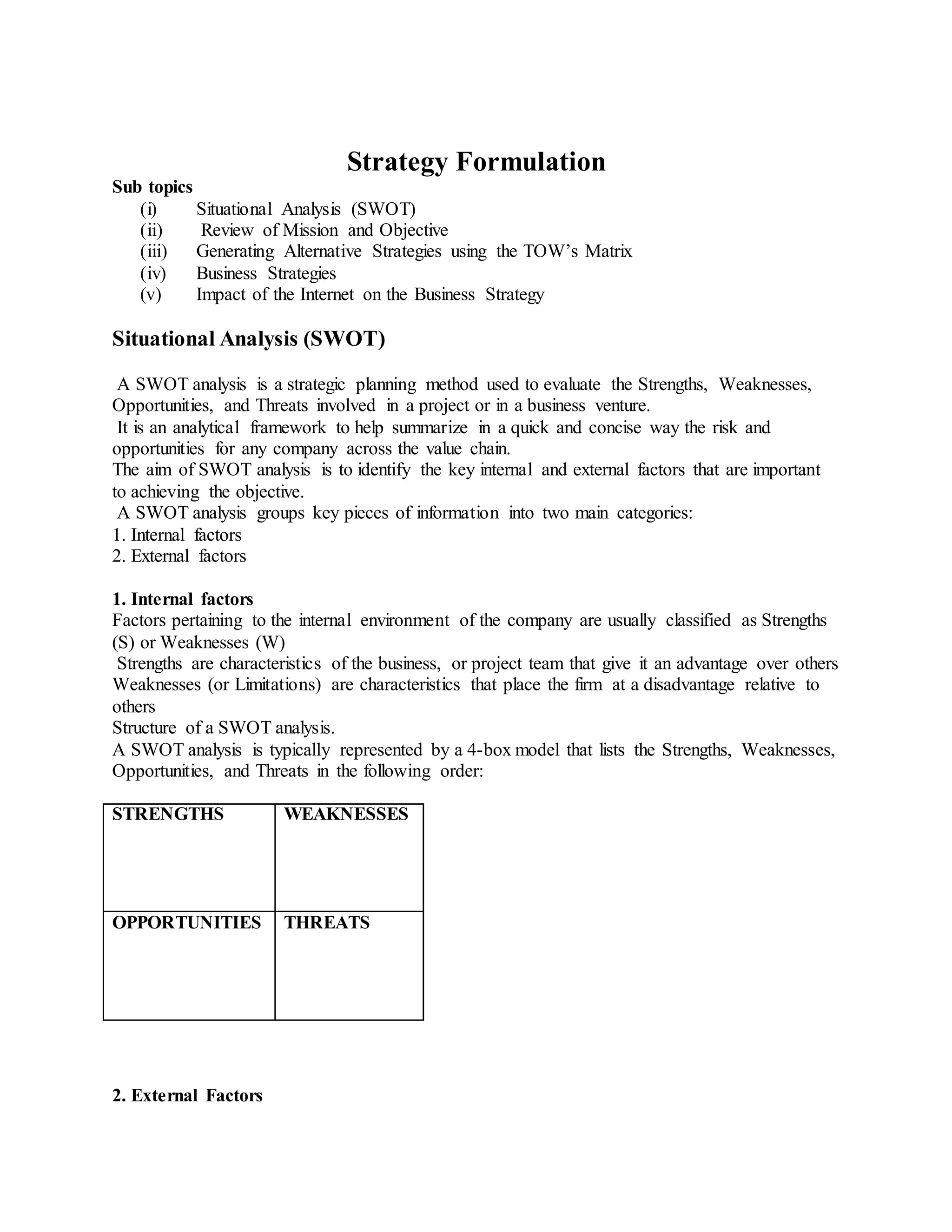
A SWOT analysis is typically represented by a 4-box model that lists the Strengths, Weaknesses,
Opportunities, and Threats in the following order:
STRENGTHS WEAKNESSES
OPPORTUNITIES THREATS
2. External Factors
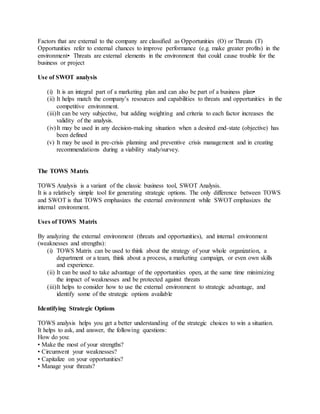
Factors that are external to the company are classified as Opportunities (O) or Threats (T)
Opportunities refer to external chances to improve performance (e.g. make greater profits) in the
environment• Threats are external elements in the environment that could cause trouble for the
business or project
Use of SWOT analysis
(i) It is an integral part of a marketing plan and can also be part of a business plan•
(ii) It helps match the company’s resources and capabilities to threats and opportunities in the
competitive environment.
(iii)It can be very subjective, but adding weighting and criteria to each factor increases the
validity of the analysis.
(iv)It may be used in any decision-making situation when a desired end-state (objective) has
been defined
(v) It may be used in pre-crisis planning and preventive crisis management and in creating
recommendations during a viability study/survey.
The TOWS Matrix
TOWS Analysis is a variant of the classic business tool, SWOT Analysis.
It is a relatively simple tool for generating strategic options. The only difference between TOWS
and SWOT is that TOWS emphasizes the external environment while SWOT emphasizes the
internal environment.
Uses of TOWS Matrix
By analyzing the external environment (threats and opportunities), and internal environment
(weaknesses and strengths):
(i) TOWS Matrix can be used to think about the strategy of your whole organization, a
department or a team, think about a process, a marketing campaign, or even own skills
and experience.
(ii) It can be used to take advantage of the opportunities open, at the same time minimizing
the impact of weaknesses and be protected against threats
(iii)It helps to consider how to use the external environment to strategic advantage, and
identify some of the strategic options available
Identifying Strategic Options
TOWS analysis helps you get a better understanding of the strategic choices to win a situation.
It helps to ask, and answer, the following questions:
How do you:
• Make the most of your strengths?
• Circumvent your weaknesses?
• Capitalize on your opportunities?
• Manage your threats?
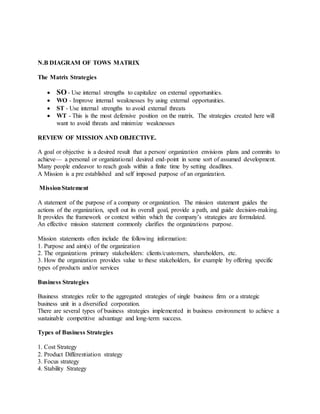
N.B DIAGRAM OF TOWS MATRIX
The Matrix Strategies
 SO - Use internal strengths to capitalize on external opportunities.
 WO - Improve internal weaknesses by using external opportunities.
 ST - Use internal strengths to avoid external threats
 WT - This is the most defensive position on the matrix. The strategies created here will
want to avoid threats and minimize weaknesses
REVIEW OF MISSION AND OBJECTIVE.
A goal or objective is a desired result that a person/ organization envisions plans and commits to
achieve— a personal or organizational desired end-point in some sort of assumed development.
Many people endeavor to reach goals within a finite time by setting deadlines.
A Mission is a pre established and self imposed purpose of an organization.
MissionStatement
A statement of the purpose of a company or organization. The mission statement guides the
actions of the organization, spell out its overall goal, provide a path, and guide decision-making.
It provides the framework or context within which the company’s strategies are formulated.
An effective mission statement commonly clarifies the organizations purpose.
Mission statements often include the following information:
1. Purpose and aim(s) of the organization
2. The organizations primary stakeholders: clients/customers, shareholders, etc.
3. How the organization provides value to these stakeholders, for example by offering specific
types of products and/or services
Business Strategies
Business strategies refer to the aggregated strategies of single business firm or a strategic
business unit in a diversified corporation.
There are several types of business strategies implemented in business environment to achieve a
sustainable competitive advantage and long-term success.
Types of Business Strategies
1. Cost Strategy
2. Product Differentiation strategy
3. Focus strategy
4. Stability Strategy
5. Growth Strategy
6. Vertical Integration Strategy
7. Merger Strategy
8. Price-Skimming Strategy
9. Product Elimination Strategy
10. Acquisition Strategy
Impact of the Internet in Business Strategy.
The Internet and its myriad of applications, tools and technologies have been adopted quickly by
most businesses since the mid- 1990s. The Internet has affected communication paradigms,
advertising methods, information access and dissemination, workforce mobility, business
practices and operational methods of businesses across domains and sectors.
Impact of Internet on Business
• Expanded communication capabilities
• fosters collaboration on projects across boundaries and locations
• facilitated quicker transactions & fostered good e-commerce relations
• Workforce mobility through wireless internet options
• Web-enabled enterprise applications adopted by many businesses
Benefits of Internet in Business
• Lower costs of start up capital and operating expense
• Larger customer market than traditional business
• Accommodates niche businesses
• Customers can shop anytime, anywhere
Negative Impact of Internet in Business
Today, a massive amount of business is done over the Internet. Everything from buying stock to
paying taxes to making household purchases can be done online, often at a substantial savings.
But in certain fields or situations, the Internet is simply bad for business.
1. New Competitors
The Internet brings new competitors to many areas of business who offers products or services
online through any number of selling venues, thus adding literally millions of new merchants to
the global marketplace. For existing businesses, these new online sellers represent a challenge to
retain customers or risk being driven out of business.
2. No Geographical Restrictions
The Internet removes the restrictions of geography. Shopping locally is no longer the only
choice, and goods can be ordered from anywhere. Smaller businesses need only create a website
to expand their customer bases to everyone with Internet access rather than being restricted by a
local or regional market.
3. Obsolescence
Certain products and services are quickly becoming obsolete in the digital age, including stock
brokers, travel agents and even the post office.
They have been largely replaced by stock websites, travel websites and e-mail, respectively.
While some companies have spotted these trends before they occurred and offered online
services to augment their business model, others have been left with a depleted customer base.
4. LesserLabor Force
Automation on the Internet also has eliminated countless jobs. As businesses use the Internet to
simplify and streamline their operations, there is less need for a large labor force. For cases in
which an automated online system can sort data or answer customers’ questions, the human
element is sometimes deemed unnecessary.
5. Security
In online business, confidentiality and security become major concerns. Beyond day-to-day
transactions, major security threats such as hackers, viruses, and e- terrorism means providing
security online is an added expenditure that simply doesn’t exist elsewhere. Breaches of security,
such as the highly publicized theft of credit card data on several occasions, lead customers to
question the safety of doing business online, which can hurt business further by lowering
confidence levels.
6. Lost Productivity
There is reported lost productivity due to employees using the Internet at work spending a
substantial amount of their workday replying to personal e- mail, following live sporting events
and web surfing. Even when employees are not equipped with computers, the availability of
wireless Internet on phones and other mobile devices creates a constant distraction that can cut
into work time. Many employers have taken steps to regulate their employees Internet usage, but
concerns about privacy and legality linger.

Strategy formulation lecture notes

  • 1.
    Strategy Formulation Sub topics (i)Situational Analysis (SWOT) (ii) Review of Mission and Objective (iii) Generating Alternative Strategies using the TOW’s Matrix (iv) Business Strategies (v) Impact of the Internet on the Business Strategy Situational Analysis (SWOT) A SWOT analysis is a strategic planning method used to evaluate the Strengths, Weaknesses, Opportunities, and Threats involved in a project or in a business venture. It is an analytical framework to help summarize in a quick and concise way the risk and opportunities for any company across the value chain. The aim of SWOT analysis is to identify the key internal and external factors that are important to achieving the objective. A SWOT analysis groups key pieces of information into two main categories: 1. Internal factors 2. External factors 1. Internal factors Factors pertaining to the internal environment of the company are usually classified as Strengths (S) or Weaknesses (W) Strengths are characteristics of the business, or project team that give it an advantage over others Weaknesses (or Limitations) are characteristics that place the firm at a disadvantage relative to others Structure of a SWOT analysis. A SWOT analysis is typically represented by a 4-box model that lists the Strengths, Weaknesses, Opportunities, and Threats in the following order: STRENGTHS WEAKNESSES OPPORTUNITIES THREATS 2. External Factors
  • 2.
    Factors that areexternal to the company are classified as Opportunities (O) or Threats (T) Opportunities refer to external chances to improve performance (e.g. make greater profits) in the environment• Threats are external elements in the environment that could cause trouble for the business or project Use of SWOT analysis (i) It is an integral part of a marketing plan and can also be part of a business plan• (ii) It helps match the company’s resources and capabilities to threats and opportunities in the competitive environment. (iii)It can be very subjective, but adding weighting and criteria to each factor increases the validity of the analysis. (iv)It may be used in any decision-making situation when a desired end-state (objective) has been defined (v) It may be used in pre-crisis planning and preventive crisis management and in creating recommendations during a viability study/survey. The TOWS Matrix TOWS Analysis is a variant of the classic business tool, SWOT Analysis. It is a relatively simple tool for generating strategic options. The only difference between TOWS and SWOT is that TOWS emphasizes the external environment while SWOT emphasizes the internal environment. Uses of TOWS Matrix By analyzing the external environment (threats and opportunities), and internal environment (weaknesses and strengths): (i) TOWS Matrix can be used to think about the strategy of your whole organization, a department or a team, think about a process, a marketing campaign, or even own skills and experience. (ii) It can be used to take advantage of the opportunities open, at the same time minimizing the impact of weaknesses and be protected against threats (iii)It helps to consider how to use the external environment to strategic advantage, and identify some of the strategic options available Identifying Strategic Options TOWS analysis helps you get a better understanding of the strategic choices to win a situation. It helps to ask, and answer, the following questions: How do you: • Make the most of your strengths? • Circumvent your weaknesses? • Capitalize on your opportunities? • Manage your threats?
  • 3.
    N.B DIAGRAM OFTOWS MATRIX The Matrix Strategies  SO - Use internal strengths to capitalize on external opportunities.  WO - Improve internal weaknesses by using external opportunities.  ST - Use internal strengths to avoid external threats  WT - This is the most defensive position on the matrix. The strategies created here will want to avoid threats and minimize weaknesses REVIEW OF MISSION AND OBJECTIVE. A goal or objective is a desired result that a person/ organization envisions plans and commits to achieve— a personal or organizational desired end-point in some sort of assumed development. Many people endeavor to reach goals within a finite time by setting deadlines. A Mission is a pre established and self imposed purpose of an organization. MissionStatement A statement of the purpose of a company or organization. The mission statement guides the actions of the organization, spell out its overall goal, provide a path, and guide decision-making. It provides the framework or context within which the company’s strategies are formulated. An effective mission statement commonly clarifies the organizations purpose. Mission statements often include the following information: 1. Purpose and aim(s) of the organization 2. The organizations primary stakeholders: clients/customers, shareholders, etc. 3. How the organization provides value to these stakeholders, for example by offering specific types of products and/or services Business Strategies Business strategies refer to the aggregated strategies of single business firm or a strategic business unit in a diversified corporation. There are several types of business strategies implemented in business environment to achieve a sustainable competitive advantage and long-term success. Types of Business Strategies 1. Cost Strategy 2. Product Differentiation strategy 3. Focus strategy 4. Stability Strategy
  • 4.
    5. Growth Strategy 6.Vertical Integration Strategy 7. Merger Strategy 8. Price-Skimming Strategy 9. Product Elimination Strategy 10. Acquisition Strategy Impact of the Internet in Business Strategy. The Internet and its myriad of applications, tools and technologies have been adopted quickly by most businesses since the mid- 1990s. The Internet has affected communication paradigms, advertising methods, information access and dissemination, workforce mobility, business practices and operational methods of businesses across domains and sectors. Impact of Internet on Business • Expanded communication capabilities • fosters collaboration on projects across boundaries and locations • facilitated quicker transactions & fostered good e-commerce relations • Workforce mobility through wireless internet options • Web-enabled enterprise applications adopted by many businesses Benefits of Internet in Business • Lower costs of start up capital and operating expense • Larger customer market than traditional business • Accommodates niche businesses • Customers can shop anytime, anywhere Negative Impact of Internet in Business Today, a massive amount of business is done over the Internet. Everything from buying stock to paying taxes to making household purchases can be done online, often at a substantial savings. But in certain fields or situations, the Internet is simply bad for business. 1. New Competitors The Internet brings new competitors to many areas of business who offers products or services online through any number of selling venues, thus adding literally millions of new merchants to the global marketplace. For existing businesses, these new online sellers represent a challenge to retain customers or risk being driven out of business. 2. No Geographical Restrictions
  • 5.
    The Internet removesthe restrictions of geography. Shopping locally is no longer the only choice, and goods can be ordered from anywhere. Smaller businesses need only create a website to expand their customer bases to everyone with Internet access rather than being restricted by a local or regional market. 3. Obsolescence Certain products and services are quickly becoming obsolete in the digital age, including stock brokers, travel agents and even the post office. They have been largely replaced by stock websites, travel websites and e-mail, respectively. While some companies have spotted these trends before they occurred and offered online services to augment their business model, others have been left with a depleted customer base. 4. LesserLabor Force Automation on the Internet also has eliminated countless jobs. As businesses use the Internet to simplify and streamline their operations, there is less need for a large labor force. For cases in which an automated online system can sort data or answer customers’ questions, the human element is sometimes deemed unnecessary. 5. Security In online business, confidentiality and security become major concerns. Beyond day-to-day transactions, major security threats such as hackers, viruses, and e- terrorism means providing security online is an added expenditure that simply doesn’t exist elsewhere. Breaches of security, such as the highly publicized theft of credit card data on several occasions, lead customers to question the safety of doing business online, which can hurt business further by lowering confidence levels. 6. Lost Productivity There is reported lost productivity due to employees using the Internet at work spending a substantial amount of their workday replying to personal e- mail, following live sporting events and web surfing. Even when employees are not equipped with computers, the availability of wireless Internet on phones and other mobile devices creates a constant distraction that can cut into work time. Many employers have taken steps to regulate their employees Internet usage, but concerns about privacy and legality linger.