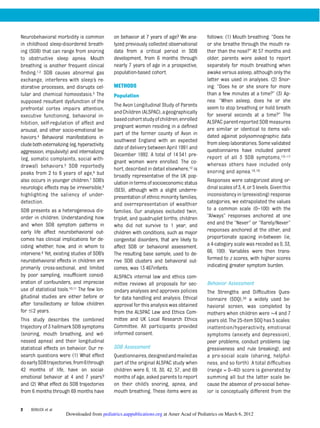
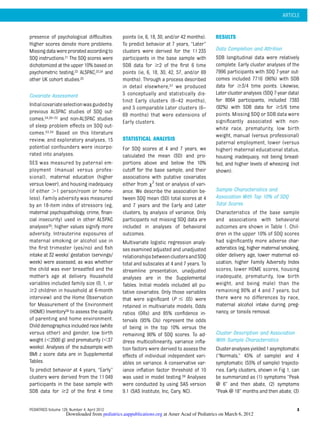
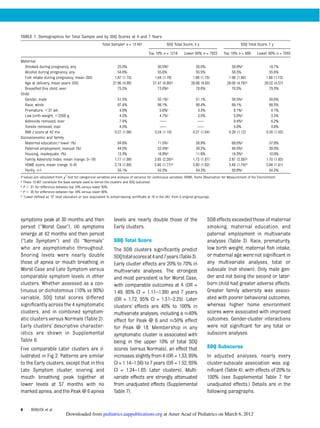
This study examined the relationship between sleep-disordered breathing (SDB) in early childhood and behavioral outcomes later in childhood using data from a large UK cohort study. SDB symptoms were assessed via parent reports at multiple time points between ages 6 months and 7 years. Cluster analysis identified distinct trajectories of SDB symptoms. Higher SDB symptom clusters predicted increased odds of problematic behavior, such as hyperactivity and conduct problems, at ages 4 and 7 years, even after controlling for potential confounding factors. Early SDB symptoms appeared to have long-lasting effects on behavior into middle childhood. The findings suggest that SDB symptoms in infancy and early childhood may warrant clinical attention and intervention.
![Sleep-Disordered Breathing in a Population-Based
Cohort: Behavioral Outcomes at 4 and 7 Years
WHAT’S KNOWN ON THIS SUBJECT: Sleep-disordered breathing is
associated with neurobehavioral morbidity in children. Prior
related research has generally been cross-sectional or short
(ie, 1–2 years) follow-up studies of a single symptom (ie, snoring,
obstructive sleep apnea, mouth breathing), with limited control
for confounders.
WHAT THIS STUDY ADDS: Sleep-disordered breathing was
assessed as a trajectory of combined symptoms from 6 months to
69 months, in more than 11 000 children. Sleep-disordered
breathing was associated with 40% and 60% more behavioral
difficulties at 4 and 7 years, respectively.
abstract
OBJECTIVES: Examine statistical effects of sleep-disordered breathing
(SDB) symptom trajectories from 6 months to 7 years on subsequent
behavior.
METHODS: Parents in the Avon Longitudinal Study of Parents and Chil-
dren reported on children’s snoring, mouth breathing, and witnessed
apnea at $2 surveys at 6, 18, 30, 42, 57, and 69 months, and completed
the Strengths and Difficulties Questionnaire at 4 (n = 9140) and 7 (n =
8098) years. Cluster analysis produced 5 “Early” (6–42 months) and
“Later” (6–69 months) symptom trajectories (“clusters”). Adverse be-
havioral outcomes were defined by top 10th percentiles on Strengths
and Difficulties Questionnaire total and subscales, at 4 and 7 years, in
multivariable logistic regression models.
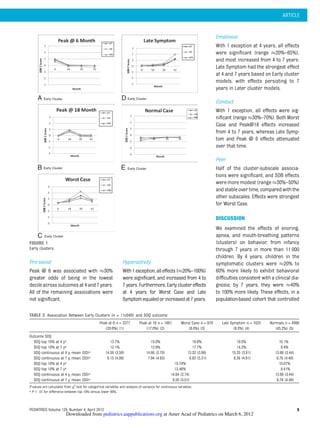
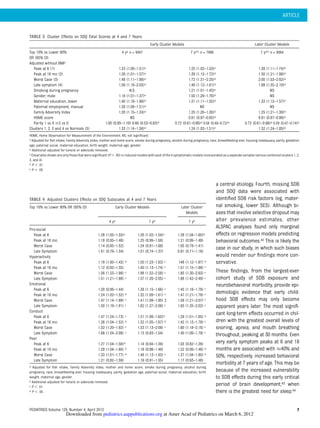
RESULTS: The SDB clusters predicted 20% to 100% increased odds of
problematic behavior, controlling for 15 potential confounders. Early
trajectories predicted problematic behavior at 7 years equally well as
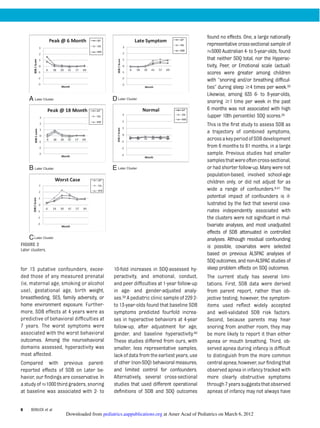
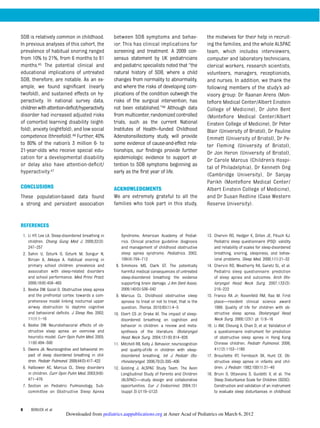
at 4 years. In Later trajectories, the “Worst Case” cluster, with peak
symptoms at 30 months that abated thereafter, nonetheless at 7 years
predicted hyperactivity (1.85 [1.30–2.63]), and conduct (1.60 [1.18–2.16])
and peer difficulties (1.37 [1.04–1.80]), whereas a “Later Symptom”
cluster predicted emotional difficulties (1.65 [1.21–2.07]) and hyperac-
tivity (1.88 [1.42–2.49]) . The 2 clusters with peak symptoms before 18
months that resolve thereafter still predicted 40% to 50% increased
odds of behavior problems at 7 years.
CONCLUSIONS: In this large, population-based, longitudinal study,
early-life SDB symptoms had strong, persistent statistical effects on
subsequent behavior in childhood. Findings suggest that SDB
symptoms may require attention as early as the first year of
life. Pediatrics 2012;129:1–9
AUTHORS: Karen Bonuck, PhD,a
Katherine Freeman, DrPH,b
Ronald D. Chervin, MD, MS,c
and Linzhi Xu, PhDa
Departments of aFamily and Social Medicine, Albert Einstein
College of Medicine, Bronx, New York; bDepartment of
Epidemiology and Population Health, Montefiore Medical Center/
Albert Einstein College of Medicine, Bronx, New York; and c
Department of Neurology and Sleep Disorders Center, University
of Michigan, Ann Arbor, Michigan
KEY WORDS
sleep-disordered breathing, behavior, longitudinal
ABBREVIATIONS
ALSPAC—Avon Longitudinal Study of Parents and Children
CI—confidence interval
HOME—Home Observation for Measurement of the Environment
OR—odds ratio
SDB—sleep-disordered breathing
SDQ—Strengths and Difficulties Questionnaire
SES—socioeconomic status
All authors meet the criteria for authorship; Dr Bonuck
conceptualized and designed the study, drafted the initial
manuscript, reviewed and modified the analyses in
collaboration with Drs Freeman and Xu, and incorporated
coauthor feedback into the final manuscript; Dr Freeman
worked to develop the methods, carried out initial analyses,
supervised final analyses of Dr Xu, and reviewed and revised the
final manuscript; Dr Chervin advised on study design and
analyses, and carefully reviewed and revised multiple versions
of the manuscript; Dr Xu collaborated on statistical design
issues, completed final analyses, and reviewed and revised the
final version of the article.
Dr Xu’s current affiliation is Department of Pediatrics, Baylor
College of Medicine. Dr Freeman is currently semi-retired.
www.pediatrics.org/cgi/doi/10.1542/peds.2011-1402
doi:10.1542/peds.2011-1402
Accepted for publication Nov 22, 2011
Address correspondence to Karen Bonuck, PhD, Department of
Family and Social Medicine, Albert Einstein College of Medicine,
1300 Morris Park Ave, Bronx, NY 10461. E-mail: karen.bonuck@
einstein.yu.edu
PEDIATRICS (ISSN Numbers: Print, 0031-4005; Online, 1098-4275).
Copyright © 2012 by the American Academy of Pediatrics
FINANCIAL DISCLOSURE: The authors have indicated they have
no financial relationships relevant to this article to disclose.
FUNDING: Supported by grants from the National Heart, Lung,
and Blood Institute (R21HL091241 and R21HL091241-01A1).
Funded by the National Institutes of Health (NIH).
PEDIATRICS Volume 129, Number 4, April 2012 1
ARTICLE
at Amer Acad of Pediatrics on March 6, 2012pediatrics.aappublications.orgDownloaded from](https://image.slidesharecdn.com/articles-bonuck-sleepdisorderedbreathing-11-170307003127/85/Articles-bonuck-sleep-disordered-breathing-1-1-2-320.jpg)
![and adolescence. J Sleep Res. 1996;5(4):
251–261
19. Ferreira VR, Carvalho LB, Ruotolo F, de
Morais JF, Prado LB, Prado GF. Sleep dis-
turbance scale for children: translation,
cultural adaptation, and validation. Sleep
Med. 2009;10(4):457–463
20. Goodman R. The strengths and difficulties
questionnaire: a research note. J Child Psy-
chol Psychiatry. 1997;38(5):581–586
21. Scoring the informant-rated strengths and
difficulties questionnaire. Available at: http://
brightfutures.aap.org/pdfs/Other%203/SDQ%
20Scoring%20Instructions%20(Parent,%
20Teacher).pdf. Accessed February 2, 2012
22. Goodman R. Psychometric properties of the
strengths and difficulties questionnaire.
J Am Acad Child Adolesc Psychiatry. 2001;
40(11):1337–1345
23. Ramchandani P, Psychogiou L. Paternal
psychiatric disorders and children’s psy-
chosocial development. Lancet. 2009;374
(9690):646–653
24. Hibbeln JR, Davis JM, Steer C, et al. Ma-
ternal seafood consumption in pregnancy
and neurodevelopmental outcomes in child-
hood (ALSPAC study): an observational
cohort study. Lancet. 2007;369(9561):578–
585
25. Kelly Y, Sacker A, Gray R, Kelly J, Wolke D,
Quigley MA. Light drinking in pregnancy,
a risk for behavioural problems and cog-
nitive deficits at 3 years of age? Int J Epi-
demiol. 2009;38(1):129–140
26. Wiles NJ, Northstone K, Emmett P, Lewis G.
“Junk food” diet and childhood behavioural
problems: results from the ALSPAC cohort.
Eur J Clin Nutr. 2009; Apr 63(4):491–498
27. Brion MJ, Victora C, Matijasevich A, et al.
Maternal smoking and child psychological
problems: disentangling causal and non-
causal effects. Pediatrics. 2010;126(1).
Available at: www.pediatrics.org/cgi/content/
full/126/1/e57
28. Enoch MA, Steer CD, Newman TK, Gibson N,
Goldman D. Early life stress, MAOA, and
gene-environment interactions predict be-
havioral disinhibition in children. Genes
Brain Behav. 2010;9(1):65–74
29. Lawson DW, Mace R. Siblings and childhood
mental health: evidence for a later-born
advantage. Soc Sci Med. 2010;70(12):2061–
2069
30. Huisman M, Araya R, Lawlor DA, Ormel J,
Verhulst FC, Oldehinkel AJ. Cognitive ability,
parental socioeconomic position and in-
ternalising and externalising problems in
adolescence: findings from two European
cohort studies. Eur J Epidemiol. 2010;25(8):
569–580
31. Wiles NJ, Peters TJ, Heron J, Gunnell D,
Emond A, Lewis G. Fetal growth and child-
hood behavioral problems: results from the
ALSPAC cohort. Am J Epidemiol. 2006;163
(9):829–837
32. Brion MJ, Zeegers M, Jaddoe V, et al. In-
trauterine effects of maternal prepreg-
nancy overweight on child cognition and
behavior in 2 cohorts. Pediatrics. 2011;127
(1). Available at: www.pediatrics.org/cgi/
content/full/127/1/e202
33. Hiscock H, Canterford L, Ukoumunne OC,
Wake M. Adverse associations of sleep
problems in Australian preschoolers: na-
tional population study. Pediatrics. 2007;
119(1):86–93
34. Smedje H, Broman JE, Hetta J. Associations
between disturbed sleep and behavioural
difficulties in 635 children aged six to eight
years: a study based on parents’ perceptions.
Eur Child Adolesc Psychiatry. 2001;10(1):1–9
35. Bowen E, Heron J, Waylen A, Wolke D;
ALSPAC Study Team. Domestic violence risk
during and after pregnancy: findings from
a British longitudinal study. BJOG. 2005;112
(8):1083–1089
36. Mundfrom DJ, Bradley RH, Whiteside L. A
factor-analytic study of the infant-toddler
and early-childhood versions of the HOME
inventory. Educ Psychol Meas. 1993;53(2):
479–489
37. Freeman K, Bonuck K. Snoring, mouth-
breathing, and apnea trajectories in a pop-
ulation-based cohort followed from infancy
to 81 months: a cluster analysis. Int J Pediatr
Otorhinolaryngol. 2012;76:122–130
38. O’Brien RM. A caution regarding rules of
thumb for variance inflation factors. Qual
Quant. 2007;41(5):673–690
39. Urschitz MS, Eitner S, Guenther A, et al.
Habitual snoring, intermittent hypoxia, and
impaired behavior in primary school chil-
dren. Pediatrics. 2004;114(4):1041–1048
40. Chervin RD, Ruzicka DL, Archbold KH, Dillon
JE. Snoring predicts hyperactivity four
years later. Sleep. 2005;28(7):885–890
41. Kuehni CE, Strippoli MPF, Chauliac ES, Silverman
M. Snoring in preschool children: preva-
lence, severity and risk factors. Eur Respir
J. 2008;31(2):326–333
42. Wolke D, Waylen A, Samara M, et al. Se-
lective drop-out in longitudinal studies and
non-biased prediction of behaviour dis-
orders. Br J Psychiatry. 2009;195(3):249–
256
43. Jan JE, Reiter RJ, Bax MCO, Ribary U,
Freeman RD, Wasdell MB. Long-term sleep
disturbances in children: a cause of neu-
ronal loss. Eur J Paediatr Neurol. 2010;14
(5):380–390
44. Galland BC, Taylor BJ, Elder DE, Herbison P.
Normal sleep patterns in infants and chil-
dren: a systematic review of observational
studies [published online ahead of print
July 22, 2011]. Sleep Med Rev. 2011
45. Bonuck KA, Chervin RD, Cole TJ, et al.
Prevalence and persistence of sleep dis-
ordered breathing symptoms in young
children: a 6-year population-based cohort
study. Sleep. 2011;34(7):875–884
46. Larson K, Russ SA, Kahn RS, Halfon N. Pat-
terns of comorbidity, functioning, and ser-
vice use for US Children with ADHD, 2007.
Pediatrics. 2011;127(3):462–470
47. Boulet SL, Boyle CA, Schieve LA. Health care
use and health and functional impact of
developmental disabilities among US chil-
dren, 1997-2005. Arch Pediatr Adolesc Med.
2009;163(1):19–26
48. Robb PJ, Bew S, Kubba H, et al. Tonsillec-
tomy and adenoidectomy in children with
sleep related breathing disorders: con-
sensus statement of a UK multidisciplinary
working party. Clin Otolaryngol. 2009;34(1):
61–63
ARTICLE
PEDIATRICS Volume 129, Number 4, April 2012 9
at Amer Acad of Pediatrics on March 6, 2012pediatrics.aappublications.orgDownloaded from](https://image.slidesharecdn.com/articles-bonuck-sleepdisorderedbreathing-11-170307003127/85/Articles-bonuck-sleep-disordered-breathing-1-1-10-320.jpg)


![[창업에듀]32. 전략 안정적 창업을 위한 자본금 증자 방법](https://cdn.slidesharecdn.com/ss_thumbnails/32-170308011520-thumbnail.jpg?width=640&height=640&fit=bounds)


