ADRENAL MASS
DR.SAAD ALYOUSEF
QATAR RED CRESCENT
RADIOLOGIST
Cases
• FILE NO 276309 COMING TO OUR CENTRE
IN ( 5/MARCH/2017)
• FILE NO 21735 COMING IN (27/3/2017)
USG REQUEST
• DIAGNOSIS
WELL DEFINED HYPERECHOIC SUPRA RT
RENAL MASS ABOUT 6,5 X 4,5 CM
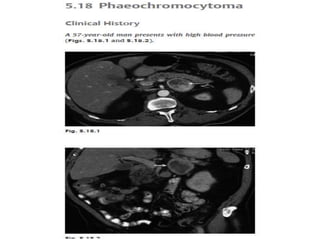
CHALLENGING DIAGNOSIS
●Is it hepatic mass?
● Is it renal/ suprarenal mass?
●Is it malignant?
●Is it functioning?
Adrenal masses
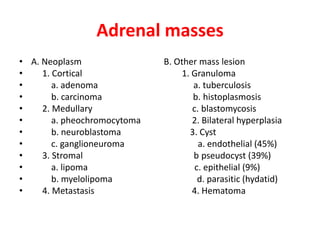
• A. Neoplasm B. Other mass lesion
• 1. Cortical 1. Granuloma
• a. adenoma a. tuberculosis
• b. carcinoma b. histoplasmosis
• 2. Medullary c. blastomycosis
• a. pheochromocytoma 2. Bilateral hyperplasia
• b. neuroblastoma 3. Cyst
• c. ganglioneuroma a. endothelial (45%)
• 3. Stromal b pseudocyst (39%)
• a. lipoma c. epithelial (9%)
• b. myelolipoma d. parasitic (hydatid)
• 4. Metastasis 4. Hematoma
SIZE OF MASS
• Size — The maximum diameter of the adrenal
mass is predictive of malignancy
• Adrenocortical carcinomas were significantly
associated with mass size, with 90 percent
being more than 4 cm in diameter when
discovered.
INDICATORS SUGGESTING POSSIBILITY
OF MALIGNANCY
• Masses > 4cm size tends to be metastasis or
primary adrenocortical carcinoma.
• Irregular shape.
• Heterogenous appearance.
• Growth of adrenal mass over time.
GROUP I : ADRENAL DISEASE WITH
NORMAL FUNCTION
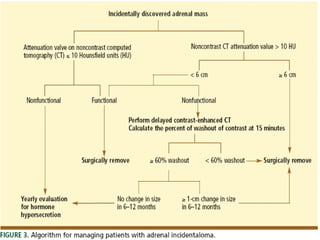
• Adrenal incidentaloma (AI) is a term applied
to an accidentally discovered adrenal mass on
imaging performed for the investigation of an
unrelated complaint. Adrenal incidentalomas
(AIs) are a cluster of different pathologies, the
majority of which are benign and non-
functioning adrenal adenomas. However, mild
hormonal alterations as well as metabolic
abnormalities may be present in patients with
AIs.
Most of these are incidentally detected as adrenal masses.
Include : nonfunctional adrenal adenoma or carcinoma,
metastasis , lymphoma , myelolipoma , adrenal cyst.
Benign non-functioning adenomas
• The vast majority comprise non-functioning, benign
cortical adenomas or hypersecretory tumors (subclinical
Cushing’s syndrome, pheochromocytoma, aldosterone-
secreting adenoma), primary adrenocortical carcinoma,
myelolipomas, cysts and various rare benign tumors.
When they occur bilaterally, the most possible
diagnoses are metastatic disease, congenital adrenal
hyperplasia, bilateral cortical adenomas or infiltrative
disease
• 85 percent of the masses : non fuctioning.
• 9 percent secreted sufficient cortisol to produce subclinical
Cushing's syndrome .
• 4 percent : pheochromocytomas (less than half caused
hypertension) .
• 2 percent : aldosteronomas .
GROUP II : HYPERFUNCTIONING
ADRENAL NEOPLASM
• Adrenal medullary
neoplasm
• Pheochromocytoma
• Adrenal cortical
neoplasm
• Cushing syndrome.
• Hyperaldosteronism or
Conn sydrome.
• Hyperandrogenism .
Cortisol hypersecretory masses
• These lesions are characterized by autonomous
glucocorticoid production without specific signs
and symptoms of Cushing’s syndrome (CS), a
condition termed subclinical hypercortisolism
(SCS)& may be associated with a high prevalence
of arterial hypertension, obesity, impaired
glucose tolerance and dyslipidemia, clinical
features also shared by the metabolic syndrome.
This association is also supported by the fact that
these hormonal and clinical features were
improved in all patients after surgical treatment.
Pheochromocytoma (PHEO)
• PHEOs are rare, catecholamine-producing tumors arising from
the chromafin cells of the adrenal medulla. Their prevalence
in the general population is estimated at about 1 or 2 per
100,000 adults. The vast majority of PHEOs are sporadic
(about 86%), while the remainder (14%) are associated with
familial syndromes, such as neurofibromatosis type 1, von
Hippel-Lindau (VHL) syndrome, multiple endocrine neoplasia
type 1 (MEN1) and 2 (MEN2)
• Neoplasm of adrenal medulla.
• Usually unilateral and benign .
• C/F—paroxysmal headache, palpitation, tachycardia,
perspiration,
• HTN as tumor secretes catecholamines.
• Clinically suspected in younger patient with hypertension.
• Rule of 10 : bilateral in 10%
• malignant in 10%
• extraadrenal in 10%
• multicentric in 10%
• familial in 10%
• The main clinical feature is hypertension, which is
paroxysmal in 48% and persistent in 29%, while 13%
of the patients are normotensive. Besides
hypertension, a common triad of symptoms
comprises attacks of headaches (80%), palpitations
(64%) and diaphoresis. Other manifestations
frequently misdiagnosed are those related to
endocrine gland pathology (CS, hypercalcemia,
diabetes mellitus, thyroid carcinoma) or
cardiovascular episodes (such as shock, myocarditis,
dilated cardiomyopathy, cardiac arrhythmias)
HYPERALDOSTERONISM
• Primary aldosteronism (PA) in its classical form manifests
with high aldosterone (ALD), low plasma renin activity
(PRA) and hypokalemia, although several reports indicate
that normokalemic PA constitutes the most common
presentation of the disease. Hypertension, mild or severe,
is the common finding in these patients and if
hypokalemia is present, nocturia, polyuria, muscle cramps,
palpitations or paralysis may occur.
• Three main etiologies:
1) adrenal adenoma
2) adrenal hyperplasia
3) adrenocortical carcinoma
Adrenal adenomas are usually less than 2cm , solitary and
eccentric within gland.
Adrenal hyperplasia : adrenal glands mildy enlarged and have
irregular surface.
Primary adrenocortical carcinoma
• Primary adrenocortical carcinoma is rare.
can be functional or non-functional. The clinical
manifestation involves symptoms related to adrenal
hypersecretion, such as hypercortisolism (more
common), as well as high sex hormones or ALD
hypersecretion (presented with CS, hirsuitism, acne,
oligo- or amenorrhea, increased libido in the case of
androgens, gynecomastia in the case of estrogens,
hypokalemia-related symptoms, in the case of elevated
aldosterone)
Metastatic cancer
• Metastatic disease to the adrenal glands can
occur in a wide array of malignancies. The most
frequently reported primary cancers that
metastasize to the adrenals are lung (usually the
non-small cell type) and liver (hepatocellular
carcinoma)
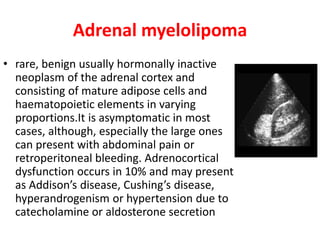
Adrenal myelolipoma
• rare, benign usually hormonally inactive
neoplasm of the adrenal cortex and
consisting of mature adipose cells and
haematopoietic elements in varying
proportions.It is asymptomatic in most
cases, although, especially the large ones
can present with abdominal pain or
retroperitoneal bleeding. Adrenocortical
dysfunction occurs in 10% and may present
as Addison’s disease, Cushing’s disease,
hyperandrogenism or hypertension due to
catecholamine or aldosterone secretion
GROUP III : ADRENAL HYPOFUNCTION
• No specific syndrome has been described.
• May be due to adrenal destruction or inadequate
pituitary stimulation.
• CAUSES : autoimmune disorders
• infections – fungal and TB
• Adrenal hemorrhage
• Sarcoidosis
• Drugs: inhibit cortisol synthesis(
ketoconazole , etomidate) , or increase cortisol
clearane (barbiturates and phenytoin.)
Radiographic features
• Imaging plays a key role in assessing the vast number of incidental adrenal lesions, the
majority of which are adrenal adenomas. Correlation with previous imaging is often useful,
as a lesion which has not changed over some years is unlikely to be malignant.
• General
• They can be divided into those that have typical or atypical appearances.
• Typical adenomas are:
• small: <3 cm
• homogeneous and low density
• Atypical features include:
• haemorrhage
• calcification
• necrosis
• no fat
• large
• if >4 cm: 70% malignant (excluding adrenal myelolipomas which are easily recognised due
to fat, and pheochromocytomas which are usually recognised biochemically)
• if >6 cm: 85% malignant
CT
Routine CT protocol for adrenal
imaging• NCCT abdomen
• CECT abdomen (70 secs delay)
• Delayed scan (after 15 minutes)
• Computed tomography (CT) is the imaging modality of
choice for evaluating adrenal glands morphology and
masses associated with it. High resolution CT of upper
abdomen, using 1-3mm thick slices to reduce the volume
averaging, is most accurate technique for indentifying
adrenal lesions. Contrast-enhanced CT and delayed images
help in further characterization of the lesions. 100-150ml of
contrast is injected at a rate of 3mlper second and images
are aquired at 70sec and 15 min after contrast injection.
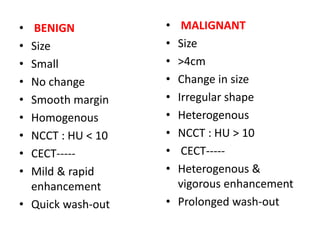
• BENIGN
• Size
• Small
• No change
• Smooth margin
• Homogenous
• NCCT : HU < 10
• CECT-----
• Mild & rapid
enhancement
• Quick wash-out
• MALIGNANT
• Size
• >4cm
• Change in size
• Irregular shape
• Heterogenous
• NCCT : HU > 10
• CECT-----
• Heterogenous &
vigorous enhancement
• Prolonged wash-out
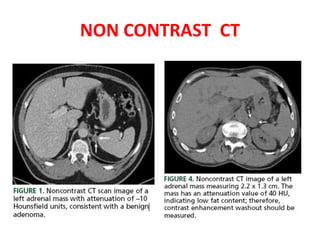
NON CONTRAST CT
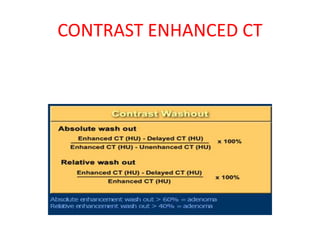
CONTRAST ENHANCED CT
The enhancement washout = (43 - 22)
: (43 - 9) = 62% indicating a fast
washout characteristic of an adenoma.
MRI
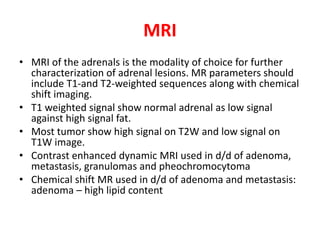
• MRI of the adrenals is the modality of choice for further
characterization of adrenal lesions. MR parameters should
include T1-and T2-weighted sequences along with chemical
shift imaging.
• T1 weighted signal show normal adrenal as low signal
against high signal fat.
• Most tumor show high signal on T2W and low signal on
T1W image.
• Contrast enhanced dynamic MRI used in d/d of adenoma,
metastasis, granulomas and pheochromocytoma
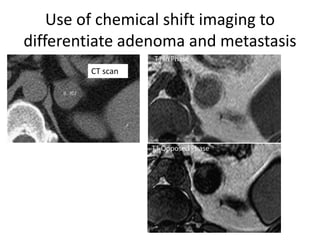
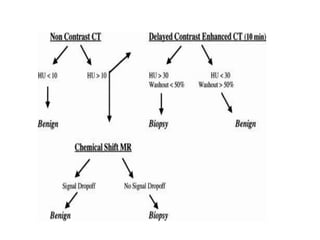
• Chemical shift MR used in d/d of adenoma and metastasis:
adenoma – high lipid content
MRI IN DIFFERENTIATING BENIGN VS
MALIGNANT:
• Various MR parameters used are :
• T1
• T2
• Enhancement pattern.
• Chemical shift characteristics
Use of chemical shift imaging to
differentiate adenoma and metastasis
CT scan
Conclusion
• Most adrenal masses are incidentalomas and
amongst them, adenomas are most common,
which can be functioning or non-functioning.
• Some adrenal masses may have pathognomonic
CT features such as myelolipoma, cysts, lipid-rich
adenomas and malignant masses but most
incidentalomas have nonspecific morphologic
features.
• Most adrenal adenomas are lipid-rich and can be
correctly diagnosed on chemical-shift MR
imaging or unenhanced CT.
• Most lipid-poor adenomas can be accurately
characterized on delayed enhanced CT.
References
• UPTODATE.COM
• RADIOPEDIA.COM
https://radiopaedia.org/articles/adrenal-adenoma
• http://www.hormones.gr/520/article/adrenal-
incidentaloma:-a-diagnostic-
challenge%E2%80%A6.html
• http://www.cancer.net/cancer-types/adrenal-
gland-tumor/diagnosis
THANK YOU

Adrenal mass

  • 1.
    ADRENAL MASS DR.SAAD ALYOUSEF QATARRED CRESCENT RADIOLOGIST
  • 2.
    Cases • FILE NO276309 COMING TO OUR CENTRE IN ( 5/MARCH/2017) • FILE NO 21735 COMING IN (27/3/2017)
  • 3.
    USG REQUEST • DIAGNOSIS WELLDEFINED HYPERECHOIC SUPRA RT RENAL MASS ABOUT 6,5 X 4,5 CM
  • 4.
    CHALLENGING DIAGNOSIS ●Is ithepatic mass? ● Is it renal/ suprarenal mass? ●Is it malignant? ●Is it functioning?
  • 5.
    Adrenal masses • A.Neoplasm B. Other mass lesion • 1. Cortical 1. Granuloma • a. adenoma a. tuberculosis • b. carcinoma b. histoplasmosis • 2. Medullary c. blastomycosis • a. pheochromocytoma 2. Bilateral hyperplasia • b. neuroblastoma 3. Cyst • c. ganglioneuroma a. endothelial (45%) • 3. Stromal b pseudocyst (39%) • a. lipoma c. epithelial (9%) • b. myelolipoma d. parasitic (hydatid) • 4. Metastasis 4. Hematoma
  • 6.
    SIZE OF MASS •Size — The maximum diameter of the adrenal mass is predictive of malignancy • Adrenocortical carcinomas were significantly associated with mass size, with 90 percent being more than 4 cm in diameter when discovered.
  • 7.
    INDICATORS SUGGESTING POSSIBILITY OFMALIGNANCY • Masses > 4cm size tends to be metastasis or primary adrenocortical carcinoma. • Irregular shape. • Heterogenous appearance. • Growth of adrenal mass over time.
  • 8.
    GROUP I :ADRENAL DISEASE WITH NORMAL FUNCTION • Adrenal incidentaloma (AI) is a term applied to an accidentally discovered adrenal mass on imaging performed for the investigation of an unrelated complaint. Adrenal incidentalomas (AIs) are a cluster of different pathologies, the majority of which are benign and non- functioning adrenal adenomas. However, mild hormonal alterations as well as metabolic abnormalities may be present in patients with AIs. Most of these are incidentally detected as adrenal masses. Include : nonfunctional adrenal adenoma or carcinoma, metastasis , lymphoma , myelolipoma , adrenal cyst.
  • 9.
    Benign non-functioning adenomas •The vast majority comprise non-functioning, benign cortical adenomas or hypersecretory tumors (subclinical Cushing’s syndrome, pheochromocytoma, aldosterone- secreting adenoma), primary adrenocortical carcinoma, myelolipomas, cysts and various rare benign tumors. When they occur bilaterally, the most possible diagnoses are metastatic disease, congenital adrenal hyperplasia, bilateral cortical adenomas or infiltrative disease • 85 percent of the masses : non fuctioning. • 9 percent secreted sufficient cortisol to produce subclinical Cushing's syndrome . • 4 percent : pheochromocytomas (less than half caused hypertension) . • 2 percent : aldosteronomas .
  • 10.
    GROUP II :HYPERFUNCTIONING ADRENAL NEOPLASM • Adrenal medullary neoplasm • Pheochromocytoma • Adrenal cortical neoplasm • Cushing syndrome. • Hyperaldosteronism or Conn sydrome. • Hyperandrogenism .
  • 11.
    Cortisol hypersecretory masses •These lesions are characterized by autonomous glucocorticoid production without specific signs and symptoms of Cushing’s syndrome (CS), a condition termed subclinical hypercortisolism (SCS)& may be associated with a high prevalence of arterial hypertension, obesity, impaired glucose tolerance and dyslipidemia, clinical features also shared by the metabolic syndrome. This association is also supported by the fact that these hormonal and clinical features were improved in all patients after surgical treatment.
  • 12.
    Pheochromocytoma (PHEO) • PHEOsare rare, catecholamine-producing tumors arising from the chromafin cells of the adrenal medulla. Their prevalence in the general population is estimated at about 1 or 2 per 100,000 adults. The vast majority of PHEOs are sporadic (about 86%), while the remainder (14%) are associated with familial syndromes, such as neurofibromatosis type 1, von Hippel-Lindau (VHL) syndrome, multiple endocrine neoplasia type 1 (MEN1) and 2 (MEN2) • Neoplasm of adrenal medulla. • Usually unilateral and benign . • C/F—paroxysmal headache, palpitation, tachycardia, perspiration, • HTN as tumor secretes catecholamines. • Clinically suspected in younger patient with hypertension. • Rule of 10 : bilateral in 10% • malignant in 10% • extraadrenal in 10% • multicentric in 10% • familial in 10%
  • 13.
    • The mainclinical feature is hypertension, which is paroxysmal in 48% and persistent in 29%, while 13% of the patients are normotensive. Besides hypertension, a common triad of symptoms comprises attacks of headaches (80%), palpitations (64%) and diaphoresis. Other manifestations frequently misdiagnosed are those related to endocrine gland pathology (CS, hypercalcemia, diabetes mellitus, thyroid carcinoma) or cardiovascular episodes (such as shock, myocarditis, dilated cardiomyopathy, cardiac arrhythmias)
  • 15.
    HYPERALDOSTERONISM • Primary aldosteronism(PA) in its classical form manifests with high aldosterone (ALD), low plasma renin activity (PRA) and hypokalemia, although several reports indicate that normokalemic PA constitutes the most common presentation of the disease. Hypertension, mild or severe, is the common finding in these patients and if hypokalemia is present, nocturia, polyuria, muscle cramps, palpitations or paralysis may occur. • Three main etiologies: 1) adrenal adenoma 2) adrenal hyperplasia 3) adrenocortical carcinoma Adrenal adenomas are usually less than 2cm , solitary and eccentric within gland. Adrenal hyperplasia : adrenal glands mildy enlarged and have irregular surface.
  • 16.
    Primary adrenocortical carcinoma •Primary adrenocortical carcinoma is rare. can be functional or non-functional. The clinical manifestation involves symptoms related to adrenal hypersecretion, such as hypercortisolism (more common), as well as high sex hormones or ALD hypersecretion (presented with CS, hirsuitism, acne, oligo- or amenorrhea, increased libido in the case of androgens, gynecomastia in the case of estrogens, hypokalemia-related symptoms, in the case of elevated aldosterone)
  • 17.
    Metastatic cancer • Metastaticdisease to the adrenal glands can occur in a wide array of malignancies. The most frequently reported primary cancers that metastasize to the adrenals are lung (usually the non-small cell type) and liver (hepatocellular carcinoma)
  • 18.
    Adrenal myelolipoma • rare,benign usually hormonally inactive neoplasm of the adrenal cortex and consisting of mature adipose cells and haematopoietic elements in varying proportions.It is asymptomatic in most cases, although, especially the large ones can present with abdominal pain or retroperitoneal bleeding. Adrenocortical dysfunction occurs in 10% and may present as Addison’s disease, Cushing’s disease, hyperandrogenism or hypertension due to catecholamine or aldosterone secretion
  • 19.
    GROUP III :ADRENAL HYPOFUNCTION • No specific syndrome has been described. • May be due to adrenal destruction or inadequate pituitary stimulation. • CAUSES : autoimmune disorders • infections – fungal and TB • Adrenal hemorrhage • Sarcoidosis • Drugs: inhibit cortisol synthesis( ketoconazole , etomidate) , or increase cortisol clearane (barbiturates and phenytoin.)
  • 20.
    Radiographic features • Imagingplays a key role in assessing the vast number of incidental adrenal lesions, the majority of which are adrenal adenomas. Correlation with previous imaging is often useful, as a lesion which has not changed over some years is unlikely to be malignant. • General • They can be divided into those that have typical or atypical appearances. • Typical adenomas are: • small: <3 cm • homogeneous and low density • Atypical features include: • haemorrhage • calcification • necrosis • no fat • large • if >4 cm: 70% malignant (excluding adrenal myelolipomas which are easily recognised due to fat, and pheochromocytomas which are usually recognised biochemically) • if >6 cm: 85% malignant
  • 21.
    CT Routine CT protocolfor adrenal imaging• NCCT abdomen • CECT abdomen (70 secs delay) • Delayed scan (after 15 minutes) • Computed tomography (CT) is the imaging modality of choice for evaluating adrenal glands morphology and masses associated with it. High resolution CT of upper abdomen, using 1-3mm thick slices to reduce the volume averaging, is most accurate technique for indentifying adrenal lesions. Contrast-enhanced CT and delayed images help in further characterization of the lesions. 100-150ml of contrast is injected at a rate of 3mlper second and images are aquired at 70sec and 15 min after contrast injection.
  • 22.
    • BENIGN • Size •Small • No change • Smooth margin • Homogenous • NCCT : HU < 10 • CECT----- • Mild & rapid enhancement • Quick wash-out • MALIGNANT • Size • >4cm • Change in size • Irregular shape • Heterogenous • NCCT : HU > 10 • CECT----- • Heterogenous & vigorous enhancement • Prolonged wash-out
  • 23.
  • 24.
  • 25.
    The enhancement washout= (43 - 22) : (43 - 9) = 62% indicating a fast washout characteristic of an adenoma.
  • 26.
    MRI • MRI ofthe adrenals is the modality of choice for further characterization of adrenal lesions. MR parameters should include T1-and T2-weighted sequences along with chemical shift imaging. • T1 weighted signal show normal adrenal as low signal against high signal fat. • Most tumor show high signal on T2W and low signal on T1W image. • Contrast enhanced dynamic MRI used in d/d of adenoma, metastasis, granulomas and pheochromocytoma • Chemical shift MR used in d/d of adenoma and metastasis: adenoma – high lipid content
  • 27.
    MRI IN DIFFERENTIATINGBENIGN VS MALIGNANT: • Various MR parameters used are : • T1 • T2 • Enhancement pattern. • Chemical shift characteristics
  • 28.
    Use of chemicalshift imaging to differentiate adenoma and metastasis CT scan
  • 31.
    Conclusion • Most adrenalmasses are incidentalomas and amongst them, adenomas are most common, which can be functioning or non-functioning. • Some adrenal masses may have pathognomonic CT features such as myelolipoma, cysts, lipid-rich adenomas and malignant masses but most incidentalomas have nonspecific morphologic features. • Most adrenal adenomas are lipid-rich and can be correctly diagnosed on chemical-shift MR imaging or unenhanced CT. • Most lipid-poor adenomas can be accurately characterized on delayed enhanced CT.
  • 32.
    References • UPTODATE.COM • RADIOPEDIA.COM https://radiopaedia.org/articles/adrenal-adenoma •http://www.hormones.gr/520/article/adrenal- incidentaloma:-a-diagnostic- challenge%E2%80%A6.html • http://www.cancer.net/cancer-types/adrenal- gland-tumor/diagnosis
  • 33.