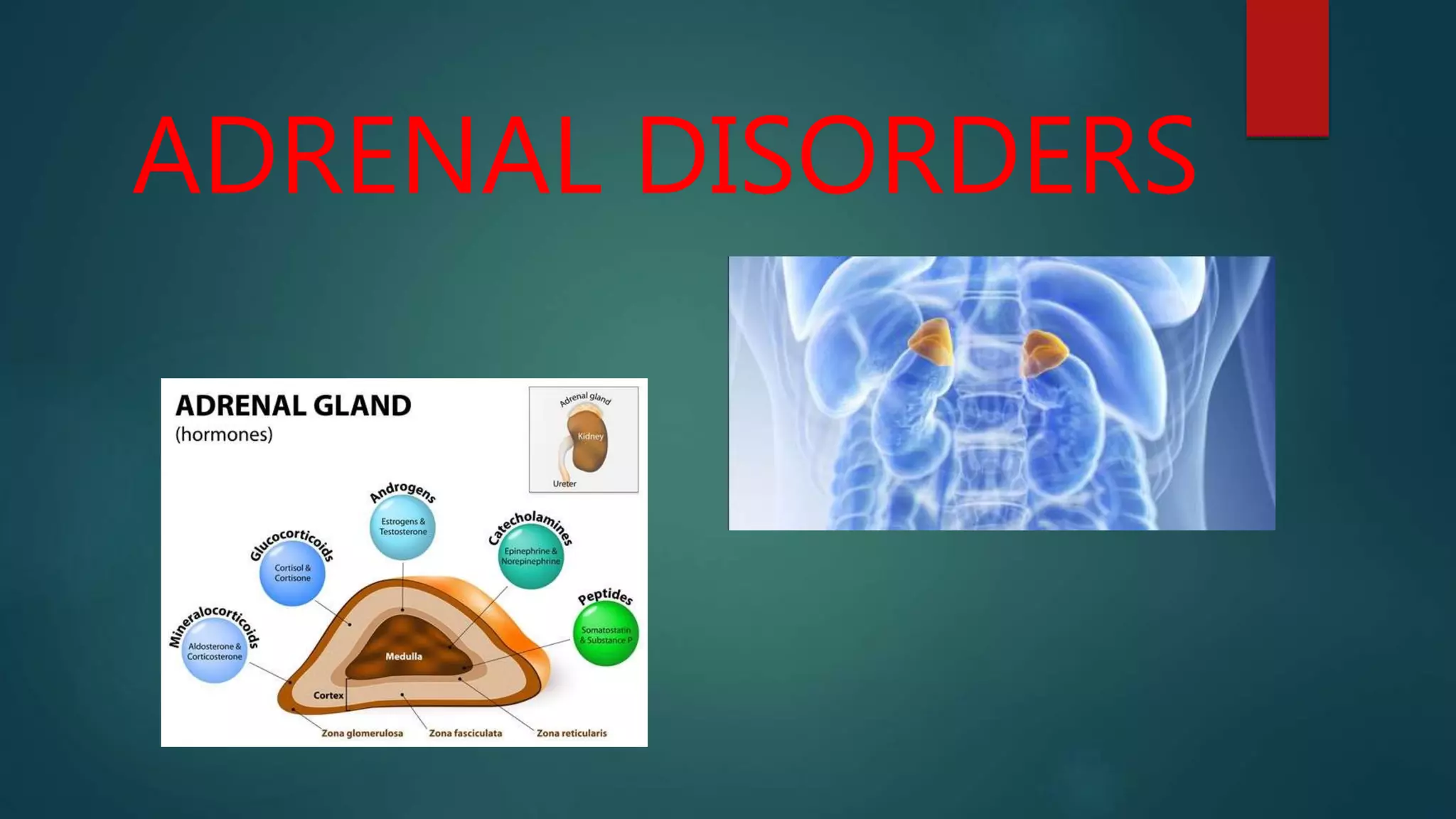
ADRENAL DISORDERS
ADDISON’S DISEASE : Primary
hypoadrenalism
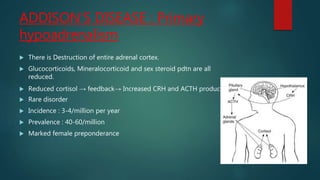
 There is Destruction of entire adrenal cortex.
 Glucocorticoids, Mineralocorticoid and sex steroid pdtn are all
reduced.
 Reduced cortisol → feedback→ Increased CRH and ACTH production.
 Rare disorder
 Incidence : 3-4/million per year
 Prevalence : 40-60/million
 Marked female preponderance
CAUSES
 Autoimmune disease(autoimmune adrenalitis)
 Tuberculosis
 Surgical removal
 Hemorrhage/infarction
 Meningococcal septicaemia
 Venography
 Infiltration
 Malignant destruction
 Amyloid
 Schilders disease(adrenal leukodystrophy)
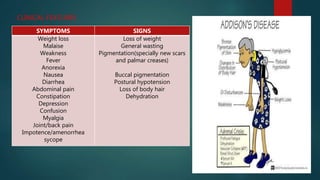
CLINICAL FEATURES
SYMPTOMS SIGNS
Weight loss
Malaise
Weakness
Fever
Anorexia
Nausea
Diarrhea
Abdominal pain
Constipation
Depression
Confusion
Myalgia
Joint/back pain
Impotence/amenorrhea
sycope
Loss of weight
General wasting
Pigmentation(specially new scars
and palmar creases)
Buccal pigmentation
Postural hypotension
Loss of body hair
Dehydration
INVESTIGATIONS
 Single cortisol measurements
random cortisol below 100mmol/L during day-highly suggestive
 Short ACTH Stimulation test
absent or impaired cortisol response confirms the presence of hypoadrenalism.
 9:00 hrs. plasma ACTH level
high level with low or low normal cortisol confirm primary hypoadrenalism
 electrolytes and urea
show hyponatremia, hyperkalemia and high urea.
 Blood glucose – low
 Adrenal antibodies –present
 Chest and abdominal X-rays –show evidence of TB and calcification
 Plasma renin activity – high ←high aldosterone
 hypercalcemia and anaemia
MANAGEMENT
ACUTE CASES LONG TERM
Assuming normal CVS Activity
• 1L of 0.9% saline given over 30-60 min with
100mg of i.v. bolus hydrocortisone.
• Subsq req. of several litres of saline within 24h
+ hydrocortisone 100mg IM 6 hourly , until
until patient is stable
• Oral replacement Medication
hydrocortisone 20mg 8 hourly reducing 20-
30 mg in divided doses over few days .
• long term therapy with replacement
glucocorticoid and mineralocorticoid.
CONGENITAL ADRENAL HYPERPLASIA
 Autosomal recessive deficiency of an enzyme in the cortisol synthetic
pathways.
 Six major types ; most common is 21-hydroxylase deficiency
 1 in 15000 live birth
 Cortisol lvls are reduced → feedback → increased ACTH secretion → adrenal
hyperplasia
 Diversion of steroid precursors into androgenic steroid pathways occurs.
 17-OH progesterone ,androstenedione and testosterone lvs are increased →
virilization.
 Aldosterone synthesis may be impaired → salt wasting .
CLINICAL FEATURES
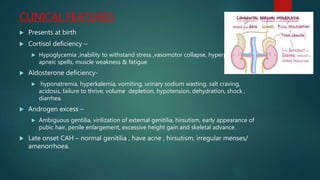
 Presents at birth
 Cortisol deficiency –
 Hypoglycemia ,inability to withstand stress ,vasomotor collapse, hyperpigmentation,
apneic spells, muscle weakness & fatigue
 Aldosterone deficiency-
 hyponatremia, hyperkalemia, vomiting, urinary sodium wasting, salt craving,
acidosis, failure to thrive, volume depletion, hypotension, dehydration, shock ,
diarrhea.
 Androgen excess –
 Ambiguous gentilia, virilization of external genitilia, hirsutism, early appearance of
pubic hair, penile enlargement, excessive height gain and skeletal advance.
 Late onset CAH – normal genitilia , have acne , hirsutism, irregular menses/
amenorrhoea.
INVESTIGATIONS
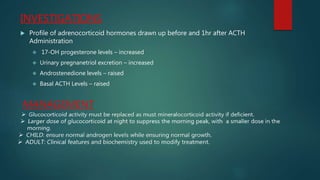
 Profile of adrenocorticoid hormones drawn up before and 1hr after ACTH
Administration
 17-OH progesterone levels – increased
 Urinary pregnanetriol excretion – increased
 Androstenedione levels – raised
 Basal ACTH Levels – raised
PRIMARY HYPERALDOSTERONISM
 Disorder of adrenal cortex
 Increased mineralocorticoid secretion from the adrenal cortex.
 Excess aldosterone production → sodium retention , potassium loss +
combination of hypokalemia and hypertension.
 Account for 5-10% of all hypertension.
 Highest chances of detecting in patients :
 Under 35 yrs. especially without a family history of HTN
 With accelerated HTN
 With hypokalemia before diuretic therapy
 Resistant to conventional antihypertensive therapy
 With unusual symptoms.
ENDOCRINE CASES OF HYPERTENSION
 Excessive renin , and thus angiotensin II pdtn.
 Renal artery stenosis
 Renin secreting tumors
 Excessive production of catecholamines
 pheochromocytoma
 Excessive growth hormone(GH) production
 Acromegaly
 excessive aldosterone production
 Adrenal adenoma (Conn Syndrome)
 Idiopathic adrenal hyperplasia
 Excessive production other mineralocorticoids
 cushing syndrome
 Congenital adrenal hyperplasia
CLINICAL FEATURES
 Hypertension
 Hypokalemia
 Lack of edema
 Metabolic alkalosis
 Mild hypernatremia, hypomagnesmia
 ↑ GFR , polyuria , proteinuria, CRF
 Muscle weakness & Cramps
 LVH, MI, CVA, AF
MANAGEMENT
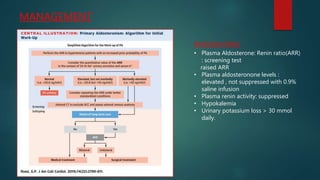
INVESTIGATIONS
• Plasma Aldosterone: Renin ratio(ARR)
: screening test
raised ARR
• Plasma aldosteronone levels :
elevated , not suppressed with 0.9%
saline infusion
• Plasma renin activity: suppressed
• Hypokalemia
• Urinary potassium loss > 30 mmol
daily.
PHAEOCHROMOCYTOMA
 Very rare tumors of sympathetic nervous system.
 Secrete catecholamines, noradrenaline , adrenaline and their
metabolites
 arise in adrenal medulla
 Maye be associated with MEN 2 syndromes and the von Hippel –
Lindau syndrome.
 Oval groups of cells occur in clusters and stain for chromogranin
A.
 25% are multiple and 10% malignant
CLINICAL FEATURES
SYMPTOMS SIGNS
Anxiety/panic attacks
Palpitations
Tremor
Sweating
Headache
Flushing
Nausea and/or Vomitting
Weight loss
Constipation/ constipation
Raynaud’s phenomenon
Chest pain
polyuria
Hypertension
Tachycardia/arrhythmia
Bradycardia
Orthstatic hypotension
Pallor or flushing
Glycosuria
fever
INVESTIGATIONS
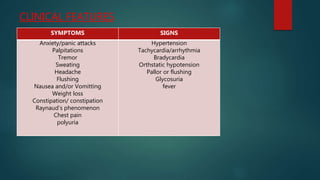
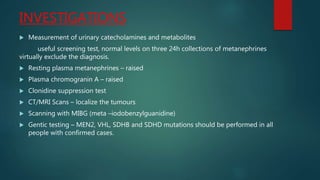
 Measurement of urinary catecholamines and metabolites
useful screening test, normal levels on three 24h collections of metanephrines
virtually exclude the diagnosis.
 Resting plasma metanephrines – raised
 Plasma chromogranin A – raised
 Clonidine suppression test
 CT/MRI Scans – localize the tumours
 Scanning with MIBG (meta –iodobenzylguanidine)
 Gentic testing – MEN2, VHL, SDHB and SDHD mutations should be performed in all
people with confirmed cases.
MANAGEMENT

ADRENAL DISORDER.pptx

  • 1.
  • 2.
    ADDISON’S DISEASE :Primary hypoadrenalism  There is Destruction of entire adrenal cortex.  Glucocorticoids, Mineralocorticoid and sex steroid pdtn are all reduced.  Reduced cortisol → feedback→ Increased CRH and ACTH production.  Rare disorder  Incidence : 3-4/million per year  Prevalence : 40-60/million  Marked female preponderance
  • 3.
    CAUSES  Autoimmune disease(autoimmuneadrenalitis)  Tuberculosis  Surgical removal  Hemorrhage/infarction  Meningococcal septicaemia  Venography  Infiltration  Malignant destruction  Amyloid  Schilders disease(adrenal leukodystrophy)
  • 4.
    CLINICAL FEATURES SYMPTOMS SIGNS Weightloss Malaise Weakness Fever Anorexia Nausea Diarrhea Abdominal pain Constipation Depression Confusion Myalgia Joint/back pain Impotence/amenorrhea sycope Loss of weight General wasting Pigmentation(specially new scars and palmar creases) Buccal pigmentation Postural hypotension Loss of body hair Dehydration
  • 5.
    INVESTIGATIONS  Single cortisolmeasurements random cortisol below 100mmol/L during day-highly suggestive  Short ACTH Stimulation test absent or impaired cortisol response confirms the presence of hypoadrenalism.  9:00 hrs. plasma ACTH level high level with low or low normal cortisol confirm primary hypoadrenalism  electrolytes and urea show hyponatremia, hyperkalemia and high urea.  Blood glucose – low  Adrenal antibodies –present  Chest and abdominal X-rays –show evidence of TB and calcification  Plasma renin activity – high ←high aldosterone  hypercalcemia and anaemia
  • 6.
    MANAGEMENT ACUTE CASES LONGTERM Assuming normal CVS Activity • 1L of 0.9% saline given over 30-60 min with 100mg of i.v. bolus hydrocortisone. • Subsq req. of several litres of saline within 24h + hydrocortisone 100mg IM 6 hourly , until until patient is stable • Oral replacement Medication hydrocortisone 20mg 8 hourly reducing 20- 30 mg in divided doses over few days . • long term therapy with replacement glucocorticoid and mineralocorticoid.
  • 7.
    CONGENITAL ADRENAL HYPERPLASIA Autosomal recessive deficiency of an enzyme in the cortisol synthetic pathways.  Six major types ; most common is 21-hydroxylase deficiency  1 in 15000 live birth  Cortisol lvls are reduced → feedback → increased ACTH secretion → adrenal hyperplasia  Diversion of steroid precursors into androgenic steroid pathways occurs.  17-OH progesterone ,androstenedione and testosterone lvs are increased → virilization.  Aldosterone synthesis may be impaired → salt wasting .
  • 8.
    CLINICAL FEATURES  Presentsat birth  Cortisol deficiency –  Hypoglycemia ,inability to withstand stress ,vasomotor collapse, hyperpigmentation, apneic spells, muscle weakness & fatigue  Aldosterone deficiency-  hyponatremia, hyperkalemia, vomiting, urinary sodium wasting, salt craving, acidosis, failure to thrive, volume depletion, hypotension, dehydration, shock , diarrhea.  Androgen excess –  Ambiguous gentilia, virilization of external genitilia, hirsutism, early appearance of pubic hair, penile enlargement, excessive height gain and skeletal advance.  Late onset CAH – normal genitilia , have acne , hirsutism, irregular menses/ amenorrhoea.
  • 9.
    INVESTIGATIONS  Profile ofadrenocorticoid hormones drawn up before and 1hr after ACTH Administration  17-OH progesterone levels – increased  Urinary pregnanetriol excretion – increased  Androstenedione levels – raised  Basal ACTH Levels – raised
  • 10.
    PRIMARY HYPERALDOSTERONISM  Disorderof adrenal cortex  Increased mineralocorticoid secretion from the adrenal cortex.  Excess aldosterone production → sodium retention , potassium loss + combination of hypokalemia and hypertension.  Account for 5-10% of all hypertension.  Highest chances of detecting in patients :  Under 35 yrs. especially without a family history of HTN  With accelerated HTN  With hypokalemia before diuretic therapy  Resistant to conventional antihypertensive therapy  With unusual symptoms.
  • 11.
    ENDOCRINE CASES OFHYPERTENSION  Excessive renin , and thus angiotensin II pdtn.  Renal artery stenosis  Renin secreting tumors  Excessive production of catecholamines  pheochromocytoma  Excessive growth hormone(GH) production  Acromegaly  excessive aldosterone production  Adrenal adenoma (Conn Syndrome)  Idiopathic adrenal hyperplasia  Excessive production other mineralocorticoids  cushing syndrome  Congenital adrenal hyperplasia
  • 12.
    CLINICAL FEATURES  Hypertension Hypokalemia  Lack of edema  Metabolic alkalosis  Mild hypernatremia, hypomagnesmia  ↑ GFR , polyuria , proteinuria, CRF  Muscle weakness & Cramps  LVH, MI, CVA, AF
  • 13.
    MANAGEMENT INVESTIGATIONS • Plasma Aldosterone:Renin ratio(ARR) : screening test raised ARR • Plasma aldosteronone levels : elevated , not suppressed with 0.9% saline infusion • Plasma renin activity: suppressed • Hypokalemia • Urinary potassium loss > 30 mmol daily.
  • 14.
    PHAEOCHROMOCYTOMA  Very raretumors of sympathetic nervous system.  Secrete catecholamines, noradrenaline , adrenaline and their metabolites  arise in adrenal medulla  Maye be associated with MEN 2 syndromes and the von Hippel – Lindau syndrome.  Oval groups of cells occur in clusters and stain for chromogranin A.  25% are multiple and 10% malignant
  • 15.
    CLINICAL FEATURES SYMPTOMS SIGNS Anxiety/panicattacks Palpitations Tremor Sweating Headache Flushing Nausea and/or Vomitting Weight loss Constipation/ constipation Raynaud’s phenomenon Chest pain polyuria Hypertension Tachycardia/arrhythmia Bradycardia Orthstatic hypotension Pallor or flushing Glycosuria fever
  • 16.
    INVESTIGATIONS  Measurement ofurinary catecholamines and metabolites useful screening test, normal levels on three 24h collections of metanephrines virtually exclude the diagnosis.  Resting plasma metanephrines – raised  Plasma chromogranin A – raised  Clonidine suppression test  CT/MRI Scans – localize the tumours  Scanning with MIBG (meta –iodobenzylguanidine)  Gentic testing – MEN2, VHL, SDHB and SDHD mutations should be performed in all people with confirmed cases.
  • 17.