The Future is Coming! What Does That Mean for Public Libraries? February 27, 2012
Best Practices  1. Send questions or comments to Laura Warren, Libraries Thriving Coordinator- laura.warren@credoreference.com 2. Share comments and questions throughout the session via the chat box.
When the Archives Get Social: The Joe McDonald and Leola Lewis Project March 13 th  at 1:00 PM EST / 10:00 AM PST / 6:00 PM UTC March 15 th  at 3:00 PM EST / 12:00 PM PST / 8:00 PM UTC Information Literacy and E-Resources: Moving Beyond the Chalkboard April 17 th  at 10:00 AM EST / 7:00 AM PST / 3:00 PM UTC April 19 th  at 1:00 PM EST / 10:00 AM PST / 6:00 PM UTC Find, Point, Scan: Using QR Codes in your Library May 14 th  at 10:00 AM EST / 7:00 AM PST / 3:00 PM UTC May 16 th  at 1:00 PM EST / 10:00 AM PST / 6:00 PM UTC Credo Reference Online Seminar Series—Spring 2012
Agenda 1. Public Library Month Recap:  -Laura Warren, Coordinator, Libraries Thriving 2. Featured Speakers on the Future of Public Libraries: -Mary Weiss, Director of Sales—Public and School Libraries,  Credo Reference -Renee DiPilato, Central Library Manager, Alexandria Library, and Lynda Rudd, Technical Services Manager, Alexandria  Library 3. Questions/Comments for Speakers and Discussion:  -What is your vision of the future of public libraries?
The Public Library of Today
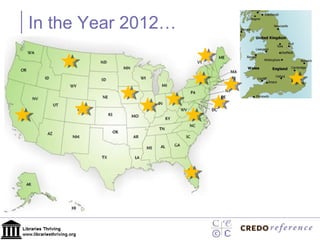
In the Year 2012…    
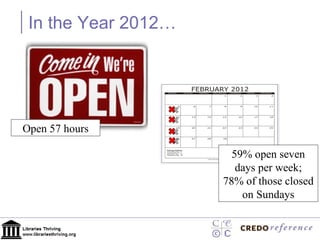
In the Year 2012… Open 57 hours 59% open seven days per week; 78% of those closed on Sundays
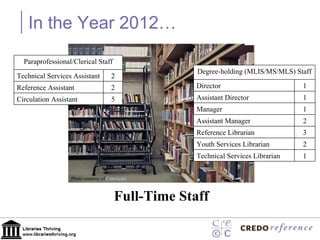
In the Year 2012… Full-Time Staff Photo courtesy of  Cehwiedel Degree-holding (MLIS/MS/MLS) Staff Director 1 Assistant Director 1 Manager 1 Assistant Manager 2 Reference Librarian 3 Youth Services Librarian 2 Technical Services Librarian 1 Paraprofessional/Clerical Staff Technical Services Assistant 2 Reference Assistant 2 Circulation Assistant 5
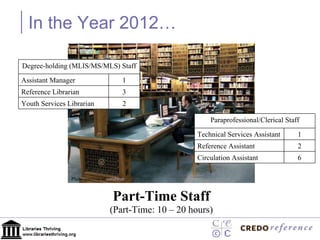
In the Year 2012… Part-Time Staff Photo courtesy of  ceridwen (Part-Time: 10 – 20 hours) Degree-holding (MLIS/MS/MLS) Staff Assistant Manager 1 Reference Librarian 3 Youth Services Librarian 2 Paraprofessional/Clerical Staff Technical Services Assistant 1 Reference Assistant 2 Circulation Assistant 6
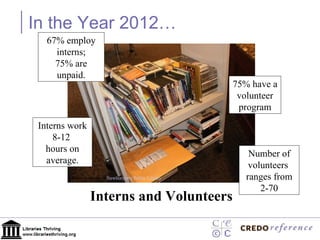
In the Year 2012… 67% employ interns; 75% are unpaid. Interns work 8-12  hours on average. 75% have a  volunteer program Number of volunteers  ranges from 2-70 Interns and Volunteers Photo courtesy of  Newburyport Public Library
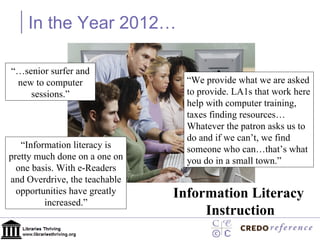
In the Year 2012… Information Literacy  Instruction “ Information literacy is pretty much done on a one on one basis. With e-Readers and Overdrive, the teachable opportunities have greatly increased.” “… senior surfer and new to computer sessions.” “ We provide what we are asked to provide. LA1s that work here help with computer training, taxes finding resources… Whatever the patron asks us to do and if we can’t, we find someone who can…that’s what you do in a small town.”
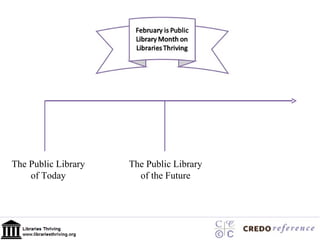
The Public Library of Today The Public Library of the Future
Photo courtesy of Flickr user  Cea It's the year 2022. The public library of today differs from the public library of 2012 in these three ways...
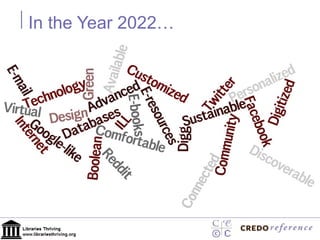
In the Year 2022…
The Future is Coming! What Does That Mean for Public Libraries? Mary Weiss Director Public Libraries [email_address]
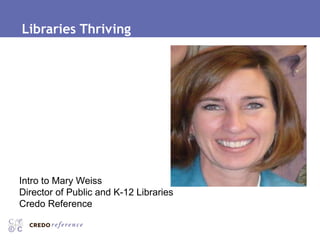
Libraries Thriving Intro to Mary Weiss Director of Public and K-12 Libraries Credo Reference
OCLC 2008 Study “ From Awareness to Funding ; a study in Library Support”
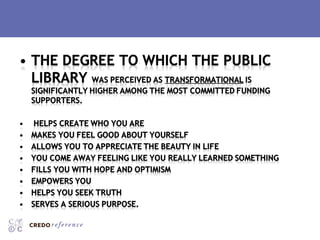
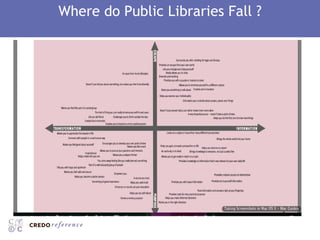
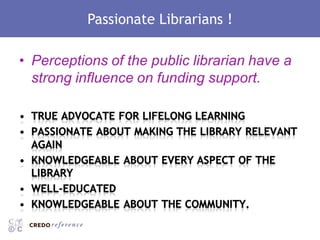
Among the findings from the report: Library funding support is only marginally related to library visitation Perceptions of librarians are an important predictor of library funding support Voters who see the library as a 'transformational' force as opposed to an 'informational' source are more likely to increase taxes in its support The report suggests that targeting marketing messages to the right segments of the voting public is key to driving increased support for U.S. public libraries. OCLC REPORT CONCLUSIONS
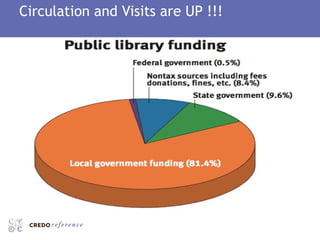
Circulation and Visits are UP !!!
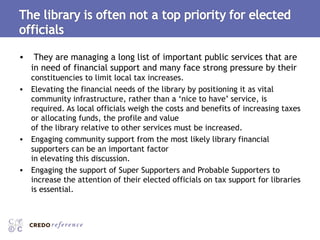
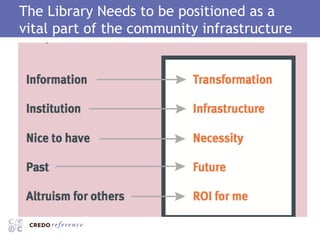
They are managing a long list of important public services that are in need of financial support and many face strong pressure by their  constituencies to limit local tax increases.  Elevating the financial needs of the library by positioning it as vital community infrastructure, rather than a ‘nice to have’ service, is required. As local officials weigh the costs and benefits of increasing taxes or allocating funds, the profile and value of the library relative to other services must be increased.  Engaging community support from the most likely library financial supporters can be an important factor in elevating this discussion.  Engaging the support of Super Supporters and Probable Supporters to increase the attention of their elected officials on tax support for libraries is essential.
TRANSFORMATIONAL The research indicated a need to appeal to both the  heart and mind  of the potential voter, positioning the library as an important part of the community’s  infrastructure  that plays a key role in providing equal access to resources vital for thriving in today’s digital world.
 
Where do Public Libraries Fall ?
Passionate Librarians !
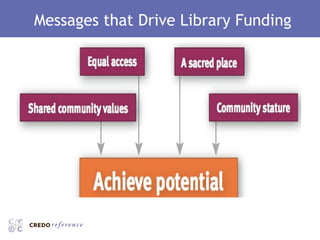
Probable Supporters and Super Supporters felt that support for libraries can be improved by increasing the public’s attention to four essential community benefits that the public library uniquely delivers:  Equal access  Shared community values (or teaches values)  A sacred place  Community stature.
Messages that Drive Library Funding
Brand Communications Objectives Make the library relevant for the 21st century. Instill a sense of urgency by putting the library in the consideration set for local funding with other public services, like police, parks and fire. Activate a conversation about how the library is a vital part of the community’s infrastructure and future.
The Library Needs to be positioned as a vital part of the community infrastructure
Messages that Drive Funding: Access to information was expressed as fundamental to American democracy.  the library plays a unique role in teaching important community values and responsibilities. (sharing community assets, respect for community and self reliance) the library is seen as a ‘sacred place’ that has distinct and unique qualities that make it worthy of increased financial support. Focus group members described the ‘transformational’ qualities  The library is a community symbol of freedom of thought and progress; the library creates status for its community.
Awakening and reinforcing the transformational value of the library is the most important factor in increasing library funding support.
Thank you Mary Weiss [email_address]
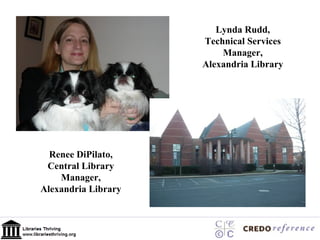
Renee DiPilato, Central Library Manager, Alexandria Library Lynda Rudd, Technical Services Manager, Alexandria Library
RENEE DIPILATO & LYNDA RUDD ALEXANDRIA LIBRARY ALEXANDRIA, VIRGINIA FEBRUARY 27, 2012 The Future is Coming! What does that mean for public libraries?
Introduction Background The Alexandria Library A note of caution
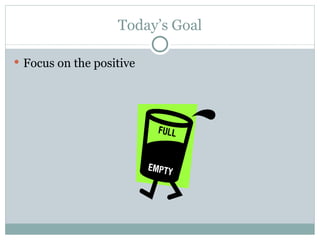
Today’s Goal Focus on the positive
Different Meanings! These are challenging times, but…we can shape our future!
Change is Constant We are in a state of “permanent white water” (Peter Vaill, 1996) Continuous learning is key A new skill set for the profession is imperative
Community Engage your customers Seek out your non-users Leave your facility for a different perspective
Collaboration New opportunities abound Build partnerships that make sense Look for local resources
Communication Spread the word Raise awareness Focus on the positive
Competition E-Books & Technology Google Netflix Amazon How do we compare?  What strengths do libraries have?
Librarians as Connectors “ They are defending library as warehouse as opposed to fighting for the future, which is librarian as producer, concierge, connector, teacher and impresario.”  Seth Godin,  The Future of the Library
Resources Research and Reports ALA, Office for Information Technology Policy—Policy Briefs OCLC—Membership Reports Urban Libraries Council—Research Reports Scenario Planning Scenario Planning for Libraries  edited by Joan Giesecke
Let’s continue the conversation Renee DiPilato [email_address] 703.746.1728
RENEE DIPILATO & LYNDA RUDD ALEXANDRIA LIBRARY ALEXANDRIA, VIRGINIA FEBRUARY 27, 2012 The Future is Coming! What does that mean for procurement in public libraries?
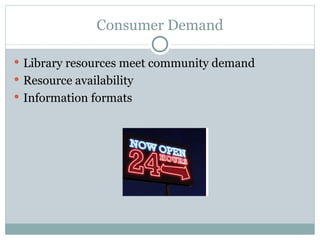
Consumer Demand Library resources meet community demand Resource availability Information formats
Can We Buy That? Library budgets and spending Vendor availability Publisher ownership
Do We Own It? Ownership versus Rental Digital Millennium Copyright Act and the Digital Media Consumer Rights Act (DMCA prohibits bypassing of embedded technology that restricts access or copying of digital media. DMCRA requires copyright protected labeling on material to restore legal usage of digital content made illegal by DMCA.)
Public Libraries and Publishers Intellectual content security Publisher solvency and profitability Where does the public library fit into the picture?
Resources Public Knowledge whitepapers on spectrum reform:  Breaking the Logjam: Creating Sustainable Spectrum Access Through Federal Secondary Markets  and  Breaking the Logjam: Some Modest Proposals for Enhancing Transparency, Efficiency and Innovation in Public Spectrum Management . Bills regarding FCC and Network Neutrality  (Thomas.gov) ALA resolution on publishers and practices that discriminate against library users  (American Libraries, January 31, 2012) “ Ebook Publishers Want Library Borrowing to Be Difficult”  (Jared Newman, PCWorld.com, February 13, 2012) “ Penguin Severs Ties with OverDrive”  (Calvin Reid, Publisher’s Weekly Online, February 9, 2012)
What is your vision of the future of public libraries?

The Future Is Coming! What Does That Mean for Public Libraries?

  • 1.
    The Future isComing! What Does That Mean for Public Libraries? February 27, 2012
  • 2.
    Best Practices 1. Send questions or comments to Laura Warren, Libraries Thriving Coordinator- laura.warren@credoreference.com 2. Share comments and questions throughout the session via the chat box.
  • 3.
    When the ArchivesGet Social: The Joe McDonald and Leola Lewis Project March 13 th at 1:00 PM EST / 10:00 AM PST / 6:00 PM UTC March 15 th at 3:00 PM EST / 12:00 PM PST / 8:00 PM UTC Information Literacy and E-Resources: Moving Beyond the Chalkboard April 17 th at 10:00 AM EST / 7:00 AM PST / 3:00 PM UTC April 19 th at 1:00 PM EST / 10:00 AM PST / 6:00 PM UTC Find, Point, Scan: Using QR Codes in your Library May 14 th at 10:00 AM EST / 7:00 AM PST / 3:00 PM UTC May 16 th at 1:00 PM EST / 10:00 AM PST / 6:00 PM UTC Credo Reference Online Seminar Series—Spring 2012
  • 4.
    Agenda 1. PublicLibrary Month Recap: -Laura Warren, Coordinator, Libraries Thriving 2. Featured Speakers on the Future of Public Libraries: -Mary Weiss, Director of Sales—Public and School Libraries, Credo Reference -Renee DiPilato, Central Library Manager, Alexandria Library, and Lynda Rudd, Technical Services Manager, Alexandria Library 3. Questions/Comments for Speakers and Discussion: -What is your vision of the future of public libraries?
  • 5.
  • 6.
    In the Year2012…    
  • 7.
    In the Year2012… Open 57 hours 59% open seven days per week; 78% of those closed on Sundays
  • 8.
    In the Year2012… Full-Time Staff Photo courtesy of Cehwiedel Degree-holding (MLIS/MS/MLS) Staff Director 1 Assistant Director 1 Manager 1 Assistant Manager 2 Reference Librarian 3 Youth Services Librarian 2 Technical Services Librarian 1 Paraprofessional/Clerical Staff Technical Services Assistant 2 Reference Assistant 2 Circulation Assistant 5
  • 9.
    In the Year2012… Part-Time Staff Photo courtesy of ceridwen (Part-Time: 10 – 20 hours) Degree-holding (MLIS/MS/MLS) Staff Assistant Manager 1 Reference Librarian 3 Youth Services Librarian 2 Paraprofessional/Clerical Staff Technical Services Assistant 1 Reference Assistant 2 Circulation Assistant 6
  • 10.
    In the Year2012… 67% employ interns; 75% are unpaid. Interns work 8-12 hours on average. 75% have a volunteer program Number of volunteers ranges from 2-70 Interns and Volunteers Photo courtesy of Newburyport Public Library
  • 11.
    In the Year2012… Information Literacy Instruction “ Information literacy is pretty much done on a one on one basis. With e-Readers and Overdrive, the teachable opportunities have greatly increased.” “… senior surfer and new to computer sessions.” “ We provide what we are asked to provide. LA1s that work here help with computer training, taxes finding resources… Whatever the patron asks us to do and if we can’t, we find someone who can…that’s what you do in a small town.”
  • 12.
    The Public Libraryof Today The Public Library of the Future
  • 13.
    Photo courtesy ofFlickr user Cea It's the year 2022. The public library of today differs from the public library of 2012 in these three ways...
  • 14.
    In the Year2022…
  • 15.
    The Future isComing! What Does That Mean for Public Libraries? Mary Weiss Director Public Libraries [email_address]
  • 16.
    Libraries Thriving Introto Mary Weiss Director of Public and K-12 Libraries Credo Reference
  • 17.
    OCLC 2008 Study“ From Awareness to Funding ; a study in Library Support”
  • 18.
    Among the findingsfrom the report: Library funding support is only marginally related to library visitation Perceptions of librarians are an important predictor of library funding support Voters who see the library as a 'transformational' force as opposed to an 'informational' source are more likely to increase taxes in its support The report suggests that targeting marketing messages to the right segments of the voting public is key to driving increased support for U.S. public libraries. OCLC REPORT CONCLUSIONS
  • 19.
  • 20.
    They are managinga long list of important public services that are in need of financial support and many face strong pressure by their constituencies to limit local tax increases. Elevating the financial needs of the library by positioning it as vital community infrastructure, rather than a ‘nice to have’ service, is required. As local officials weigh the costs and benefits of increasing taxes or allocating funds, the profile and value of the library relative to other services must be increased. Engaging community support from the most likely library financial supporters can be an important factor in elevating this discussion. Engaging the support of Super Supporters and Probable Supporters to increase the attention of their elected officials on tax support for libraries is essential.
  • 21.
    TRANSFORMATIONAL The researchindicated a need to appeal to both the heart and mind of the potential voter, positioning the library as an important part of the community’s infrastructure that plays a key role in providing equal access to resources vital for thriving in today’s digital world.
  • 22.
  • 23.
    Where do PublicLibraries Fall ?
  • 24.
  • 25.
    Probable Supporters andSuper Supporters felt that support for libraries can be improved by increasing the public’s attention to four essential community benefits that the public library uniquely delivers: Equal access Shared community values (or teaches values) A sacred place Community stature.
  • 26.
    Messages that DriveLibrary Funding
  • 27.
    Brand Communications ObjectivesMake the library relevant for the 21st century. Instill a sense of urgency by putting the library in the consideration set for local funding with other public services, like police, parks and fire. Activate a conversation about how the library is a vital part of the community’s infrastructure and future.
  • 28.
    The Library Needsto be positioned as a vital part of the community infrastructure
  • 29.
    Messages that DriveFunding: Access to information was expressed as fundamental to American democracy. the library plays a unique role in teaching important community values and responsibilities. (sharing community assets, respect for community and self reliance) the library is seen as a ‘sacred place’ that has distinct and unique qualities that make it worthy of increased financial support. Focus group members described the ‘transformational’ qualities The library is a community symbol of freedom of thought and progress; the library creates status for its community.
  • 30.
    Awakening and reinforcingthe transformational value of the library is the most important factor in increasing library funding support.
  • 31.
    Thank you MaryWeiss [email_address]
  • 32.
    Renee DiPilato, CentralLibrary Manager, Alexandria Library Lynda Rudd, Technical Services Manager, Alexandria Library
  • 33.
    RENEE DIPILATO &LYNDA RUDD ALEXANDRIA LIBRARY ALEXANDRIA, VIRGINIA FEBRUARY 27, 2012 The Future is Coming! What does that mean for public libraries?
  • 34.
    Introduction Background TheAlexandria Library A note of caution
  • 35.
    Today’s Goal Focuson the positive
  • 36.
    Different Meanings! Theseare challenging times, but…we can shape our future!
  • 37.
    Change is ConstantWe are in a state of “permanent white water” (Peter Vaill, 1996) Continuous learning is key A new skill set for the profession is imperative
  • 38.
    Community Engage yourcustomers Seek out your non-users Leave your facility for a different perspective
  • 39.
    Collaboration New opportunitiesabound Build partnerships that make sense Look for local resources
  • 40.
    Communication Spread theword Raise awareness Focus on the positive
  • 41.
    Competition E-Books &Technology Google Netflix Amazon How do we compare? What strengths do libraries have?
  • 42.
    Librarians as Connectors“ They are defending library as warehouse as opposed to fighting for the future, which is librarian as producer, concierge, connector, teacher and impresario.” Seth Godin, The Future of the Library
  • 43.
    Resources Research andReports ALA, Office for Information Technology Policy—Policy Briefs OCLC—Membership Reports Urban Libraries Council—Research Reports Scenario Planning Scenario Planning for Libraries edited by Joan Giesecke
  • 44.
    Let’s continue theconversation Renee DiPilato [email_address] 703.746.1728
  • 45.
    RENEE DIPILATO &LYNDA RUDD ALEXANDRIA LIBRARY ALEXANDRIA, VIRGINIA FEBRUARY 27, 2012 The Future is Coming! What does that mean for procurement in public libraries?
  • 46.
    Consumer Demand Libraryresources meet community demand Resource availability Information formats
  • 47.
    Can We BuyThat? Library budgets and spending Vendor availability Publisher ownership
  • 48.
    Do We OwnIt? Ownership versus Rental Digital Millennium Copyright Act and the Digital Media Consumer Rights Act (DMCA prohibits bypassing of embedded technology that restricts access or copying of digital media. DMCRA requires copyright protected labeling on material to restore legal usage of digital content made illegal by DMCA.)
  • 49.
    Public Libraries andPublishers Intellectual content security Publisher solvency and profitability Where does the public library fit into the picture?
  • 50.
    Resources Public Knowledgewhitepapers on spectrum reform:  Breaking the Logjam: Creating Sustainable Spectrum Access Through Federal Secondary Markets  and  Breaking the Logjam: Some Modest Proposals for Enhancing Transparency, Efficiency and Innovation in Public Spectrum Management . Bills regarding FCC and Network Neutrality (Thomas.gov) ALA resolution on publishers and practices that discriminate against library users (American Libraries, January 31, 2012) “ Ebook Publishers Want Library Borrowing to Be Difficult” (Jared Newman, PCWorld.com, February 13, 2012) “ Penguin Severs Ties with OverDrive” (Calvin Reid, Publisher’s Weekly Online, February 9, 2012)
  • 51.
    What is yourvision of the future of public libraries?

Editor's Notes

  • #6 Culminating event. We started the Public Library Month campaign on LT in the beginning of February. Survey of public libraries and a discussion forum post to invite speculation about where public libraries are going to be in 10 years. Let’s start with the survey so that we can establish our picture of the public library of today
  • #7 Informal survey to paint a picture of libraries of today. 23 took the survey. UK, Va, California, Maryland, Florida, among other states.
  • #8 Average amount libraries are open is 57 hours and for most part seven days a week. 78% of those not open 7 days a week were closed on Sunday (some just during certain months, like July and August)
  • #9 Other paraprofessional/clerical staff listed included bookmobile librarians and assistants and youth services assistants
  • #12 Classes and one-to-one instruction were mentioned.
  • #13 Now that we have an idea of what the public library of today looks like, let’s move on to address our creative visions of the public library of the future
  • #14 We started the discussion of the future of public libraries on our Editor Forum. We extended an invitation for public library enthusiasts to respond to the prompt “It’s the year 2022. The public library of today differs from the public library of 2012 in these three ways…”
  • #15 There were common themes in the posts: Emphasis on change in design (reduce energy costs and more environmentally friendly but also more pleasant to be in because of natural light) Save money on energy bills and provide more digital services to community. Enhanced discoverability- “Google-like search experience” but better. One post mentioned a new way of advanced searching where the library system verbally questions patrons to whittle down options for them rather than requiring that patrons narrow by facet themselves. Lots of emphasis on everything being in one place. Whether one giant database or not, being able to access everything in one fell swoop. Personalization and customization as key—already some next-gen catalogs allow tagging, etc. suggestion of books, music and movies based on previous preferences, profiles, etc. One post emphasized that ideally this would be optional and patrons could select a preferred level of connectivity.
  • #16 Credo Reference
  • #17 Credo Reference
  • #19 Credo Reference
  • #24 The research suggests this perception hampers the success of library funding initiatives. The research indicates that transformation, not information, drives financial support. Belief that the library is a transformational force in people’s lives is directly related to their level of funding support. Aggregation of results across all survey respondents indicates that the public library is viewed as a service that provides the emotional and intellectual rewards of ‘purposeful information.’ But a review of results of those voters who said they would definitely vote in favor of a library referendum provides a very important distinction. Credo Reference
  • #28 Based on the research findings, the OCLC and Leo Burnett team developed a library support brand strategy and outlined options for messaging and specific marketing tactics for a library support campaign to move the most likely voters from probable support of library referenda to definite support. Credo Reference
  • #32 Credo Reference
  • #33 Renee DiPilato is the Central Library Manager for the Alexandria Library in Virginia.  She has worked in public libraries for over ten years.  Renee is an active member of the American Library Association and was selected to participate in the Emerging Leaders program in 2008.  She loves spending time with her dogs! Lynda Rudd has a background as a legal researcher and earned her bachelor's degree from Howard University.  Her MLS is from the Catholic University of America.  Lynda has been with the Alexandria Library since 2006