ADJECTIVES
EF Intermediate +
1B
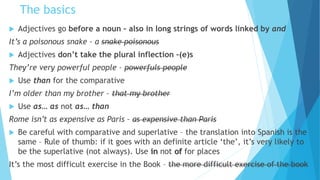
The basics
 Adjectives go before a noun – also in long strings of words linked by and
It’s a poisonous snake – a snake poisonous
 Adjectives don’t take the plural inflection –(e)s
They’re very powerful people – powerfuls people
 Use than for the comparative
I’m older than my brother – that my brother
 Use as… as not as… than
Rome isn’t as expensive as Paris – as expensive than Paris
 Be careful with comparative and superlative – the translation into Spanish is the
same – Rule of thumb: if it goes with an definite article ‘the’, it’s very likely to
be the superlative (not always). Use in not of for places
It’s the most difficult exercise in the Book – the more difficult exercise of the book
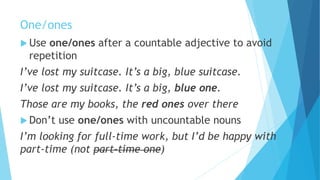
One/ones
 Use one/ones after a countable adjective to avoid
repetition
I’ve lost my suitcase. It’s a big, blue suitcase.
I’ve lost my suitcase. It’s a big, blue one.
Those are my books, the red ones over there
 Don’t use one/ones with uncountable nouns
I’m looking for full-time work, but I’d be happy with
part-time (not part-time one)
More rules for comparatives and superlatives
 One-syllable adjectives ending in –ed always use more and the
most for comparatives and superlatives (bored, pleased, shocked,
stressed, tired …)
I feel more tired today than I did yesterday – not tireder
 Some two syllable adjectives can make comparatives and
superlatives with –er and –est (clever, narrow, polite, quiet,
simple, stupid, handsome….). Use a dictionary when in doubt.
This is the narrowest street in the whole town
A bit and much + comparative adjective
 When the difference is small – a bit/little
It’s a bit cloudier today than yesterday
Sam is a little shorter than Dave
 When the difference is large – much/far
Your job is much more stressful than mine
A Ferrari Testarosa is far more expensive than a Kia Pikanto

Adjectives

  • 1.
  • 2.
    The basics  Adjectivesgo before a noun – also in long strings of words linked by and It’s a poisonous snake – a snake poisonous  Adjectives don’t take the plural inflection –(e)s They’re very powerful people – powerfuls people  Use than for the comparative I’m older than my brother – that my brother  Use as… as not as… than Rome isn’t as expensive as Paris – as expensive than Paris  Be careful with comparative and superlative – the translation into Spanish is the same – Rule of thumb: if it goes with an definite article ‘the’, it’s very likely to be the superlative (not always). Use in not of for places It’s the most difficult exercise in the Book – the more difficult exercise of the book
  • 3.
    One/ones  Use one/onesafter a countable adjective to avoid repetition I’ve lost my suitcase. It’s a big, blue suitcase. I’ve lost my suitcase. It’s a big, blue one. Those are my books, the red ones over there  Don’t use one/ones with uncountable nouns I’m looking for full-time work, but I’d be happy with part-time (not part-time one)
  • 4.
    More rules forcomparatives and superlatives  One-syllable adjectives ending in –ed always use more and the most for comparatives and superlatives (bored, pleased, shocked, stressed, tired …) I feel more tired today than I did yesterday – not tireder  Some two syllable adjectives can make comparatives and superlatives with –er and –est (clever, narrow, polite, quiet, simple, stupid, handsome….). Use a dictionary when in doubt. This is the narrowest street in the whole town
  • 5.
    A bit andmuch + comparative adjective  When the difference is small – a bit/little It’s a bit cloudier today than yesterday Sam is a little shorter than Dave  When the difference is large – much/far Your job is much more stressful than mine A Ferrari Testarosa is far more expensive than a Kia Pikanto