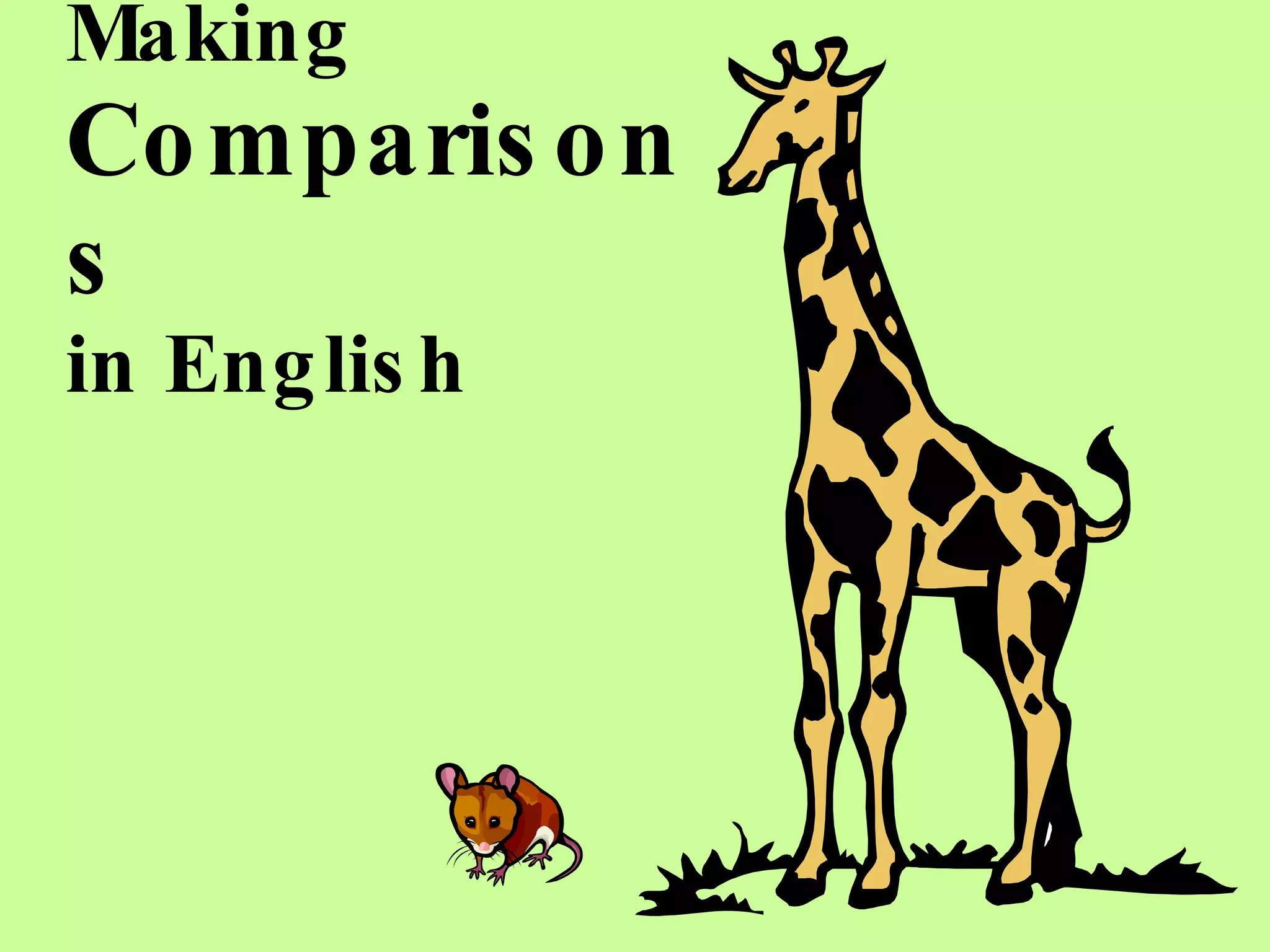
Making  Comparisons in English
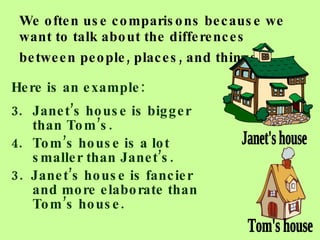
We often use comparisons because we want to talk about the differences between people, places, and things.   Here is an example: Janet’s house is bigger than Tom’s. Tom’s house is a lot smaller than Janet’s. 3.  Janet’s house is fancier and more elaborate than Tom’s house.  Tom's house Janet's house
The comparative forms from the previous example are: - bigg er  than -small er  than -fanc ier  than - more  elaborate than So . . . When do we use “–er” and when do we use “more?” Here are the rules
Rule 1: How many syllables are the words:  “ big”  and “ small ?”   1 For 1-syllable adjectives,  JUST add  “er”  to the end. Example: Tom is  smarter  than Joe. *If the 1-syllable adjective ends with the letter “e,”  JUST add  “r”  to the end.  Examples:   nicer wiser **If the 1-syllable   adjective has a C-V-C pattern,  Double  the consonant and add  “er .”   Examples: San Francisco is wetter than San Diego. San Diego is bigger  than San Francisco.
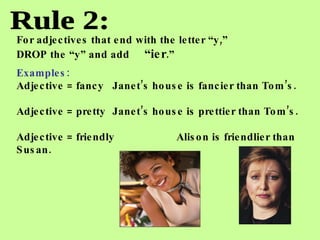
Rule 2: For adjectives that end with the letter “y,”  DROP the “y” and add  “ier .” Examples: Adjective = fancy Janet’s house is fancier than Tom’s. Adjective = pretty Janet’s house is prettier than Tom’s. Adjective = friendly Alison is friendlier than Susan.
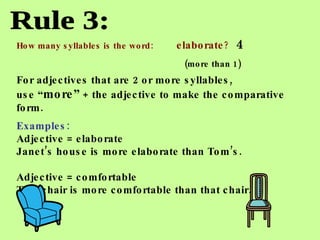
Rule 3: How many syllables is the word:  elaborate ?   4    (more than 1) For adjectives that are 2 or more syllables,  use “ more”  + the adjective to make the comparative form. Examples: Adjective = elaborate  Janet’s house is more elaborate than Tom’s. Adjective = comfortable This chair is more comfortable than that chair.
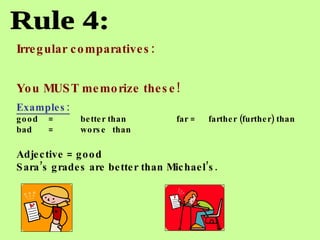
Rule 4: Irregular comparatives: You MUST memorize these! Examples: good  =  better than far =  farther (further) than bad = worse than   Adjective = good  Sara’s grades are better than Michael’s.
Grammar Rule: Never use both MORE and “ER!” Incorrect: Lisa’s job is more better than mine. Correct: Lisa’s job is better than mine.
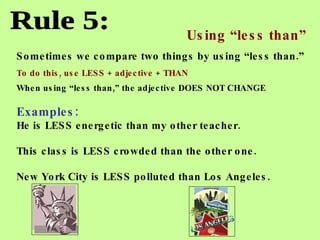
Rule 5: Using “less than” Sometimes we compare two things by using “less than.” To do this, use LESS + adjective + THAN When using “less than,” the adjective DOES NOT CHANGE Examples: He is LESS energetic than my other teacher. This class is LESS crowded than the other one. New York City is LESS polluted than Los Angeles.
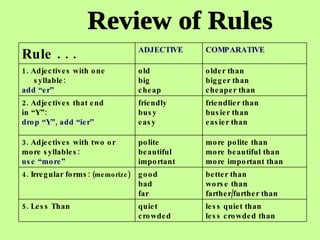
Review of Rules   less quiet than less crowded than quiet crowded 5. Less Than better than worse than farther/further than good bad far 4. Irregular forms:  (memorize) more polite than more beautiful than more important than polite beautiful important 3. Adjectives with two or  more syllables:   use “more”  friendlier than busier than easier than friendly busy  easy 2. Adjectives that end in “Y”:  drop “Y”, add “ier” older than bigger than cheaper than old big  cheap  1. Adjectives with one syllable:  add “er” COMPARATIVE ADJECTIVE Rule . . .
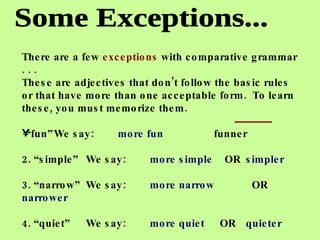
Some Exceptions...   There are a few  exceptions  with comparative grammar . . . These are adjectives that don’t follow the basic rules or that have more than one acceptable form.  To learn these, you must memorize them. “ fun” We say: more fun funner 2. “simple” We say: more simple   OR simpler 3. “narrow” We say: more narrow   OR narrower 4. “quiet” We say: more quiet   OR quieter
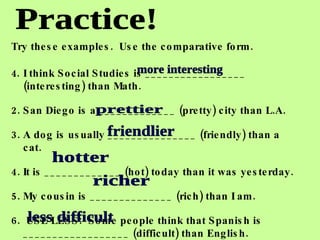
Practice! Try these examples.  Use the comparative form. I think Social Studies is _________________ (interesting) than Math. 2. San Diego is a _____________ (pretty) city than L.A. 3. A dog is usually _______________ (friendly) than a cat. 4. It is _____________ (hot) today than it was yesterday. 5. My cousin is ______________ (rich) than I am. 6.  USE LESS:  Some people think that Spanish is __________________ (difficult) than English.    more interesting prettier friendlier hotter richer less difficult
More Practice Online! For Additional Explanation and Practice, go to these websites: 1.  Comparative / Superlative Explanation and Quizzes: http://web2.uvcs.uvic.ca/elc/studyzone/330/grammar/regcom.htm   2.  Comparatives Challenge Board Game: http://www.quia.com/cb/283937.html If you do these exercises, the grammar will get easier! Javier Burgos E.L.T.

Comparative And Superlatives

  • 1.
  • 2.
    We often usecomparisons because we want to talk about the differences between people, places, and things. Here is an example: Janet’s house is bigger than Tom’s. Tom’s house is a lot smaller than Janet’s. 3. Janet’s house is fancier and more elaborate than Tom’s house. Tom's house Janet's house
  • 3.
    The comparative formsfrom the previous example are: - bigg er than -small er than -fanc ier than - more elaborate than So . . . When do we use “–er” and when do we use “more?” Here are the rules
  • 4.
    Rule 1: Howmany syllables are the words: “ big” and “ small ?” 1 For 1-syllable adjectives, JUST add “er” to the end. Example: Tom is smarter than Joe. *If the 1-syllable adjective ends with the letter “e,” JUST add “r” to the end. Examples: nicer wiser **If the 1-syllable adjective has a C-V-C pattern, Double the consonant and add “er .”  Examples: San Francisco is wetter than San Diego. San Diego is bigger than San Francisco.
  • 5.
    Rule 2: Foradjectives that end with the letter “y,” DROP the “y” and add “ier .” Examples: Adjective = fancy Janet’s house is fancier than Tom’s. Adjective = pretty Janet’s house is prettier than Tom’s. Adjective = friendly Alison is friendlier than Susan.
  • 6.
    Rule 3: Howmany syllables is the word: elaborate ? 4 (more than 1) For adjectives that are 2 or more syllables, use “ more” + the adjective to make the comparative form. Examples: Adjective = elaborate Janet’s house is more elaborate than Tom’s. Adjective = comfortable This chair is more comfortable than that chair.
  • 7.
    Rule 4: Irregularcomparatives: You MUST memorize these! Examples: good = better than far = farther (further) than bad = worse than Adjective = good Sara’s grades are better than Michael’s.
  • 8.
    Grammar Rule: Neveruse both MORE and “ER!” Incorrect: Lisa’s job is more better than mine. Correct: Lisa’s job is better than mine.
  • 9.
    Rule 5: Using“less than” Sometimes we compare two things by using “less than.” To do this, use LESS + adjective + THAN When using “less than,” the adjective DOES NOT CHANGE Examples: He is LESS energetic than my other teacher. This class is LESS crowded than the other one. New York City is LESS polluted than Los Angeles.
  • 10.
    Review of Rules less quiet than less crowded than quiet crowded 5. Less Than better than worse than farther/further than good bad far 4. Irregular forms: (memorize) more polite than more beautiful than more important than polite beautiful important 3. Adjectives with two or more syllables: use “more” friendlier than busier than easier than friendly busy easy 2. Adjectives that end in “Y”: drop “Y”, add “ier” older than bigger than cheaper than old big cheap 1. Adjectives with one syllable: add “er” COMPARATIVE ADJECTIVE Rule . . .
  • 11.
    Some Exceptions... There are a few exceptions with comparative grammar . . . These are adjectives that don’t follow the basic rules or that have more than one acceptable form. To learn these, you must memorize them. “ fun” We say: more fun funner 2. “simple” We say: more simple OR simpler 3. “narrow” We say: more narrow OR narrower 4. “quiet” We say: more quiet OR quieter
  • 12.
    Practice! Try theseexamples. Use the comparative form. I think Social Studies is _________________ (interesting) than Math. 2. San Diego is a _____________ (pretty) city than L.A. 3. A dog is usually _______________ (friendly) than a cat. 4. It is _____________ (hot) today than it was yesterday. 5. My cousin is ______________ (rich) than I am. 6. USE LESS: Some people think that Spanish is __________________ (difficult) than English. more interesting prettier friendlier hotter richer less difficult
  • 13.
    More Practice Online!For Additional Explanation and Practice, go to these websites: 1. Comparative / Superlative Explanation and Quizzes: http://web2.uvcs.uvic.ca/elc/studyzone/330/grammar/regcom.htm 2. Comparatives Challenge Board Game: http://www.quia.com/cb/283937.html If you do these exercises, the grammar will get easier! Javier Burgos E.L.T.