COMPARATIVE ADJECTIVES
Comparative adjectivescompare one person or
thing with another and enable us to say whether
a person or thing has more or less of a
particular quality.
A comparative compares a person or thing with
another person or thing.
3.
EXAMPLES
Josh is tallerthan his sister.
I’m more interested in music than sport.
Big cars that use a lot of petrol are less
popular now than twenty years ago.
4.
SUPERLATIVE ADJECTIVES
Superlative adjectivesdescribe one person or
thing as having more of a quality than all other
people or things in a group.
A superlative compares a person or thing with the
whole group of which that person or thing is a
member.
5.
EXAMPLES
The ‘Silver Arrow’will be the fastest train in the
world when it is built.
The most frightening film I’ve ever seen was
Alfred Hitchcock’s ‘Psycho’.
What is the least expensive way of travelling in
Japan?
6.
COMPARATIVE AND SUPERLATIVEADJECTIVES: FORM
One-syllable adjectives (big, cold, hot, long, nice, old, tall)
To form the comparative, we use the -er suffix
with adjectives of one syllable:
It’s colder today than yesterday.
It was a longer holiday than the one we had last year.
Sasha is older than Mark.
7.
COMPARATIVE AND SUPERLATIVEADJECTIVES:
FORM
To form the superlative, we use the -est suffix with adjectives
of one syllable. We normally use the before a superlative adjective.
• I think that’s the biggest apple I’ve ever seen!
• At one time, the Empire State building in New York was the tallest
building in the world.
• They have three boys. Richard is the oldest and Simon is the youngest.
8.
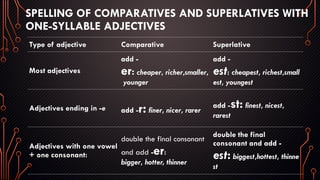
SPELLING OF COMPARATIVESAND SUPERLATIVES WITH
ONE-SYLLABLE ADJECTIVES
Type of adjective Comparative Superlative
Most adjectives
add -
er: cheaper, richer,smaller,
younger
add -
est: cheapest, richest,small
est, youngest
Adjectives ending in -e add -r:finer, nicer, rarer
add -st: finest, nicest,
rarest
Adjectives with one vowel
+ one consonant:
double the final consonant
and add -er:
bigger, hotter, thinner
double the final
consonant and add -
est: biggest,hottest, thinne
st
9.
ONE-SYLLABLE ADJECTIVES WHICHARE IRREGULAR
• Some one-syllable adjectives have irregular comparative
and superlative forms:
1.bad, worse, worst, far, farther/further, farthest/furthest
2.good, better, best, old, older/elder, oldest/eldest
• His elder sister works for the government.
• Olivia is Denise’s best friend.
• I think that was the worst film I’ve ever seen!
• Pluto is the farthest planet from the sun in our solar system.
10.
WARNING:
•We do notuse more or most together with an -er or -
est ending:
•They emigrate because they are looking for a better life.
•Not: … a more better life
•The beach at Miami is one of the biggest in Florida.
•Not: … the most biggest …
11.
TWO-SYLLABLE ADJECTIVES
Two-syllable adjectivesending in -y change y to i and
take the -er and –est endings:
•busy, busier, busiest
•happy, happier, happiest
•easy, easier, easiest
•funny, funnier, funniest
• We were busier last week than this week.
• Are you happier now that you’ve changed your job?
• That was the easiest exam I’ve ever taken.
12.
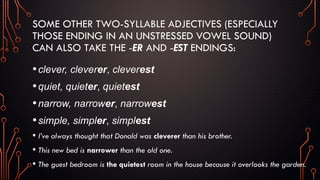
SOME OTHER TWO-SYLLABLEADJECTIVES (ESPECIALLY
THOSE ENDING IN AN UNSTRESSED VOWEL SOUND)
CAN ALSO TAKE THE -ER AND -EST ENDINGS:
•clever, cleverer, cleverest
•quiet, quieter, quietest
•narrow, narrower, narrowest
•simple, simpler, simplest
• I’ve always thought that Donald was cleverer than his brother.
• This new bed is narrower than the old one.
• The guest bedroom is the quietest room in the house because it overlooks the garden.
13.
COMPARATIVE ADJECTIVES:
USING MUCH,A LOT, FAR, ETC.
•We can strengthen or emphasise a comparative adjective
using words such as much, a lot, far, even or rather, or by
using than ever after the adjective:
• This food is much better than the food we had yesterday.
• The town is a lot more crowded these days because of the new shopping centre.
• Alex is far less intelligent than the other kids in the class.
• We’ve been busier than ever at work this last month or so.
• We can soften a comparative adjective using a little or a bit. A bit is less formal:
• She feels a little more confident now that she’s given her first public performance.
• or She feels a bit more confident … (less formal)
14.
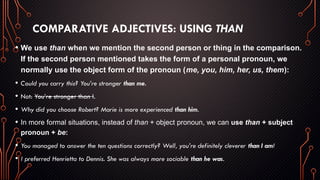
COMPARATIVE ADJECTIVES: USINGTHAN
• We use than when we mention the second person or thing in the comparison.
If the second person mentioned takes the form of a personal pronoun, we
normally use the object form of the pronoun (me, you, him, her, us, them):
• Could you carry this? You’re stronger than me.
• Not: You’re stronger than I.
• Why did you choose Robert? Marie is more experienced than him.
• In more formal situations, instead of than + object pronoun, we can use than + subject
pronoun + be:
• You managed to answer the ten questions correctly? Well, you’re definitely cleverer than I am!
• I preferred Henrietta to Dennis. She was always more sociable than he was.
15.
ANOTHER WARNING
•After asuperlative adjective, we don’t normally
use of before a singular name of a place or group:
•She was the tallest girl in the team.
•Not: She was the tallest girl of the team.
•However, we can use of with a plural word referring to
a group:
•All the sisters are pretty, but Sarah’s the prettiest of them all.
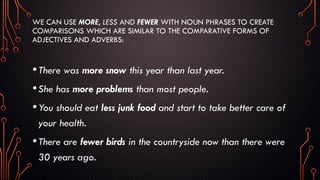
WE CAN USEMORE, LESS AND FEWER WITH NOUN PHRASES TO CREATE
COMPARISONS WHICH ARE SIMILAR TO THE COMPARATIVE FORMS OF
ADJECTIVES AND ADVERBS:
•There was more snow this year than last year.
•She has more problems than most people.
•You should eat less junk food and start to take better care of
your health.
•There are fewer birds in the countryside now than there were
30 years ago.
18.
WE USE LESSWITH UNCOUNTABLE NOUNS AND FEWER WITH
PLURAL COUNTABLE NOUNS.
•I think the room would look better with less furniture. (less + singular
uncountable noun)
•There were fewer cars on the roads twenty years ago. (fewer + plural
countable noun; traditional correct form)
19.
WE USE LEASTWITH SINGULAR
UNCOUNTABLE NOUNS AND FEWEST WITH
PLURAL COUNTABLE NOUNS.
•Which horse eats the least food? That’s the one I’ll
buy! (least + singular uncountable noun)
•Of all the models we tested, the iphone had the fewest
faults. (fewest + plural countable noun; traditional correct
form)











![62344_COMPARATIVE AND SUPERLATIVE ADJECTIVES_amani [Compatibility Mode].pdf](https://cdn.slidesharecdn.com/ss_thumbnails/62344comparativeandsuperlativeadjectivesamanicompatibilitymode-250404225620-a4787298-thumbnail.jpg?width=640&height=640&fit=bounds)


