
ADJECTIVES AS NOUNS
NATIONALITIES
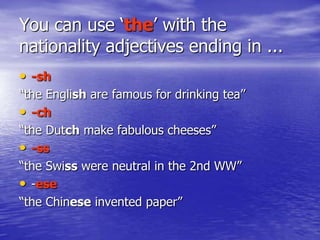
You can use „the‟ with the
nationality adjectives ending in ...
• -sh
“the English are famous for drinking tea”
• -ch
“the Dutch make fabulous cheeses”
• -ss
“the Swiss were neutral in the 2nd WW”
• -ese
“the Chinese invented paper”
DON’T ADD PLURAL ‘S’ TO THESE
WORDS
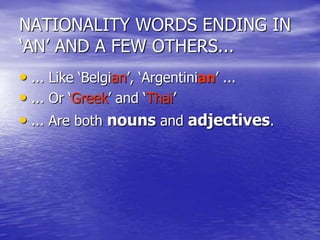
NATIONALITY WORDS ENDING IN
„AN‟ AND A FEW OTHERS...
• ... Like „Belgian‟, „Argentinian‟ ...
• ... Or „Greek‟ and „Thai‟
• ... Are both nouns and adjectives.
USE PLURAL ‘S’ TO TALK ABOUT
THE PEOPLE FROM THOSE
COUNTRIES
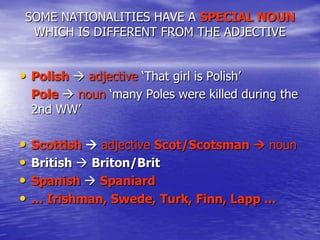
SOME NATIONALITIES HAVE A SPECIAL NOUN
WHICH IS DIFFERENT FROM THE ADJECTIVE

• Polish  adjective „That girl is Polish‟
Pole  noun „many Poles were killed during the
2nd WW‟

•
•
•
•

Scottish  adjective Scot/Scotsman  noun
British  Briton/Brit
Spanish  Spaniard
... Irishman, Swede, Turk, Finn, Lapp ...
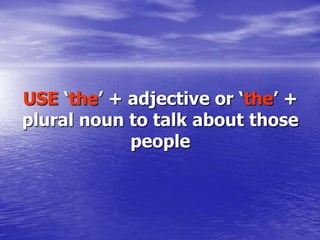
USE ‘the’ + adjective or ‘the’ +
plural noun to talk about those
people
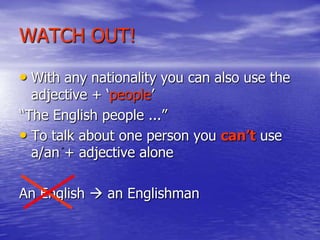
WATCH OUT!
• With any nationality you can also use the
adjective + „people‟
“The English people ...”
• To talk about one person you can’t use
a/an + adjective alone

An English  an Englishman
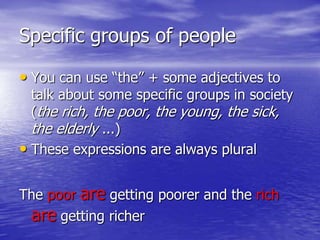
Specific groups of people
• You can use “the” + some adjectives to

talk about some specific groups in society
(the rich, the poor, the young, the sick,
the elderly ...)
• These expressions are always plural

The poor are getting poorer and the rich
are getting richer
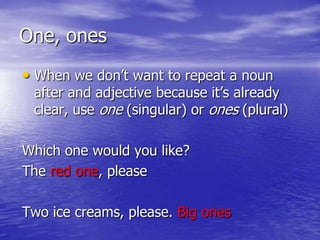
One, ones
• When we don‟t want to repeat a noun

after and adjective because it‟s already
clear, use one (singular) or ones (plural)

Which one would you like?
The red one, please

Two ice creams, please. Big ones

Adjectives as nouns

  • 1.
  • 2.
    You can use„the‟ with the nationality adjectives ending in ... • -sh “the English are famous for drinking tea” • -ch “the Dutch make fabulous cheeses” • -ss “the Swiss were neutral in the 2nd WW” • -ese “the Chinese invented paper”
  • 3.
    DON’T ADD PLURAL‘S’ TO THESE WORDS
  • 4.
    NATIONALITY WORDS ENDINGIN „AN‟ AND A FEW OTHERS... • ... Like „Belgian‟, „Argentinian‟ ... • ... Or „Greek‟ and „Thai‟ • ... Are both nouns and adjectives.
  • 5.
    USE PLURAL ‘S’TO TALK ABOUT THE PEOPLE FROM THOSE COUNTRIES
  • 6.
    SOME NATIONALITIES HAVEA SPECIAL NOUN WHICH IS DIFFERENT FROM THE ADJECTIVE • Polish  adjective „That girl is Polish‟ Pole  noun „many Poles were killed during the 2nd WW‟ • • • • Scottish  adjective Scot/Scotsman  noun British  Briton/Brit Spanish  Spaniard ... Irishman, Swede, Turk, Finn, Lapp ...
  • 7.
    USE ‘the’ +adjective or ‘the’ + plural noun to talk about those people
  • 8.
    WATCH OUT! • Withany nationality you can also use the adjective + „people‟ “The English people ...” • To talk about one person you can’t use a/an + adjective alone An English  an Englishman
  • 9.
    Specific groups ofpeople • You can use “the” + some adjectives to talk about some specific groups in society (the rich, the poor, the young, the sick, the elderly ...) • These expressions are always plural The poor are getting poorer and the rich are getting richer
  • 10.
    One, ones • Whenwe don‟t want to repeat a noun after and adjective because it‟s already clear, use one (singular) or ones (plural) Which one would you like? The red one, please Two ice creams, please. Big ones