Hyphenated
Non-Hyphenated
Of Hyphen Use
In English
Hyphens
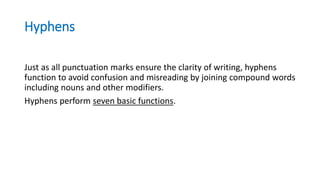
Just as all punctuation marks ensure the clarity of writing, hyphens
function to avoid confusion and misreading by joining compound words
including nouns and other modifiers.
Hyphens perform seven basic functions.
Terminolgy
• Compound Noun = a noun made from two or more nouns
• Coequal Noun = two nouns of equal importance and rank
• Prefix / suffix = sets of letters that are added to the beginning or end
of another word. They are not words in their own right and cannot
stand on their own in a sentence.
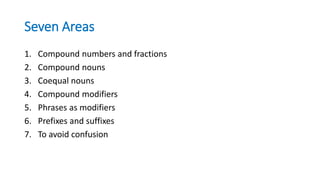
Seven Areas
1. Compound numbers and fractions
2. Compound nouns
3. Coequal nouns
4. Compound modifiers
5. Phrases as modifiers
6. Prefixes and suffixes
7. To avoid confusion
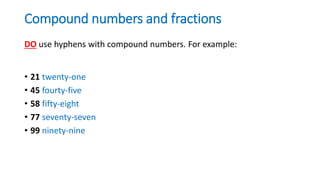
Compound numbers and fractions
• 21 twenty-one
• 45 fourty-five
• 58 fifty-eight
• 77 seventy-seven
• 99 ninety-nine
DO use hyphens with compound numbers. For example:
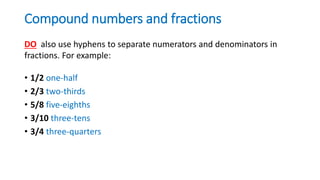
Compound numbers and fractions
• 1/2 one-half
• 2/3 two-thirds
• 5/8 five-eighths
• 3/10 three-tens
• 3/4 three-quarters
DO also use hyphens to separate numerators and denominators in
fractions. For example:
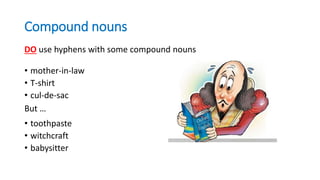
Compound nouns
DO use hyphens with some compound nouns
• mother-in-law
• T-shirt
• cul-de-sac
But …
• toothpaste
• witchcraft
• babysitter
Coequal nouns
DO use hyphens to join coequal nouns. For example:
• writer-illustrator
• director-actor
• librarian-professor
Coequal nouns
DO NOT use hyphens between nouns in which the first noun modifies
or describes the second noun. For example:
• child actor
• football player
• chocolate cake
Compound modifiers
DO use hyphens to join compound modifiers that precede nouns.
• middle-class family
• self-fulfilling prophecy
• soft-hearted neighbor
Compound modifiers
DO use hyphens to join adjectives with adverbs such as better, best, ill,
lower, little, and well. For example:
• well-known novelist
• better-prepared student
• ill-mannered child
Compound modifiers
DO use hyphens to join compound modifiers in which the second word
is the present or past participle of a verb. For example:
• sports-loving uncle
• fear-inspired devotion
• hate-filled rhetoric
Compound modifiers
DO use hyphens to join compound modifiers that contain numbers. For
example:
• sixth-floor stacks
• second-semester freshmen
• twentieth-century literature
Compound modifiers
DO NOT use hyphens to join compound modifiers that follow state-of-
being verbs and that directly modify the subject of the sentence. For
example:
• The author is well known.
• Those peanuts are chocolate covered.
• This child is ill mannered.
• My students were better prepared.
Compound modifiers
DO NOT use hyphens to join adjectives with adverbs ending in -ly or
the adverbs too, very, or much. For example:
• very hungry caterpillar
• too ripe tomatoes
• much loved grandmother
• extremely terrible day
Phrases as modifiers
DO use hyphens to separate words in phrases functioning as modifiers
that precede nouns. For example:
• all-you-can-eat buffet
• out-of-this-world experience
• over-the-counter medication
Prefixes and suffixes
DO use hyphens with certain prefixes and suffixes such as all-, anti-, -
elect, ex-, mid-, neo-, post-, pre-, pro-, and self-. For example:
• all-purpose
• mid-century
• self-employed
• president-elect
Prefixes and suffixes
DO use hyphens with the prefixes anti-, mid-, neo-, post-, pre-, and pro-
that precede proper nouns and numbers. For example:
• anti-American
• mid-1980s
• post-Vietnam War
• pro-American
Prefixes and suffixes
DO NOT use hyphens with most other prefixes. For example:
• antiwar
• coworker
• unhappy
• disinterested
To avoid confusion
DO use hyphens to avoid confusion and misreading. Use hyphens to
avoid awkward letter combinations. For example:
• re-sign (as in to sign again, not resign or quit)
• English-language student (a student studying English, not an English
speaking student studying language)
• semi-independent (not semiindependent)
Source:
http://www.brighthubeducation.com/english-homework-help/26834-
the-use-of-hyphens-in-english/
written by: Heather Marie Kosur • edited by: Rebecca Scudder

Hyphens

  • 1.
  • 2.
    Hyphens Just as allpunctuation marks ensure the clarity of writing, hyphens function to avoid confusion and misreading by joining compound words including nouns and other modifiers. Hyphens perform seven basic functions.
  • 3.
    Terminolgy • Compound Noun= a noun made from two or more nouns • Coequal Noun = two nouns of equal importance and rank • Prefix / suffix = sets of letters that are added to the beginning or end of another word. They are not words in their own right and cannot stand on their own in a sentence.
  • 4.
    Seven Areas 1. Compoundnumbers and fractions 2. Compound nouns 3. Coequal nouns 4. Compound modifiers 5. Phrases as modifiers 6. Prefixes and suffixes 7. To avoid confusion
  • 5.
    Compound numbers andfractions • 21 twenty-one • 45 fourty-five • 58 fifty-eight • 77 seventy-seven • 99 ninety-nine DO use hyphens with compound numbers. For example:
  • 6.
    Compound numbers andfractions • 1/2 one-half • 2/3 two-thirds • 5/8 five-eighths • 3/10 three-tens • 3/4 three-quarters DO also use hyphens to separate numerators and denominators in fractions. For example:
  • 7.
    Compound nouns DO usehyphens with some compound nouns • mother-in-law • T-shirt • cul-de-sac But … • toothpaste • witchcraft • babysitter
  • 8.
    Coequal nouns DO usehyphens to join coequal nouns. For example: • writer-illustrator • director-actor • librarian-professor
  • 9.
    Coequal nouns DO NOTuse hyphens between nouns in which the first noun modifies or describes the second noun. For example: • child actor • football player • chocolate cake
  • 10.
    Compound modifiers DO usehyphens to join compound modifiers that precede nouns. • middle-class family • self-fulfilling prophecy • soft-hearted neighbor
  • 11.
    Compound modifiers DO usehyphens to join adjectives with adverbs such as better, best, ill, lower, little, and well. For example: • well-known novelist • better-prepared student • ill-mannered child
  • 12.
    Compound modifiers DO usehyphens to join compound modifiers in which the second word is the present or past participle of a verb. For example: • sports-loving uncle • fear-inspired devotion • hate-filled rhetoric
  • 13.
    Compound modifiers DO usehyphens to join compound modifiers that contain numbers. For example: • sixth-floor stacks • second-semester freshmen • twentieth-century literature
  • 14.
    Compound modifiers DO NOTuse hyphens to join compound modifiers that follow state-of- being verbs and that directly modify the subject of the sentence. For example: • The author is well known. • Those peanuts are chocolate covered. • This child is ill mannered. • My students were better prepared.
  • 15.
    Compound modifiers DO NOTuse hyphens to join adjectives with adverbs ending in -ly or the adverbs too, very, or much. For example: • very hungry caterpillar • too ripe tomatoes • much loved grandmother • extremely terrible day
  • 16.
    Phrases as modifiers DOuse hyphens to separate words in phrases functioning as modifiers that precede nouns. For example: • all-you-can-eat buffet • out-of-this-world experience • over-the-counter medication
  • 17.
    Prefixes and suffixes DOuse hyphens with certain prefixes and suffixes such as all-, anti-, - elect, ex-, mid-, neo-, post-, pre-, pro-, and self-. For example: • all-purpose • mid-century • self-employed • president-elect
  • 18.
    Prefixes and suffixes DOuse hyphens with the prefixes anti-, mid-, neo-, post-, pre-, and pro- that precede proper nouns and numbers. For example: • anti-American • mid-1980s • post-Vietnam War • pro-American
  • 19.
    Prefixes and suffixes DONOT use hyphens with most other prefixes. For example: • antiwar • coworker • unhappy • disinterested
  • 20.
    To avoid confusion DOuse hyphens to avoid confusion and misreading. Use hyphens to avoid awkward letter combinations. For example: • re-sign (as in to sign again, not resign or quit) • English-language student (a student studying English, not an English speaking student studying language) • semi-independent (not semiindependent)
  • 21.